
The Cartier Movement Matching Principle: Design Dictates Everything
Choosing a movement for a Cartier replica isn’t about finding the “best” one. It’s an engineering puzzle. The most common mistake buyers make is prioritizing a movement—like insisting on a clone of a specific Rolex or Omega calibre—before they’ve even settled on a model, which is why a thorough automatic Cartier replica movement analysis is essential. With Cartier, that approach is a fast track to a watch that feels fundamentally wrong on the wrist.
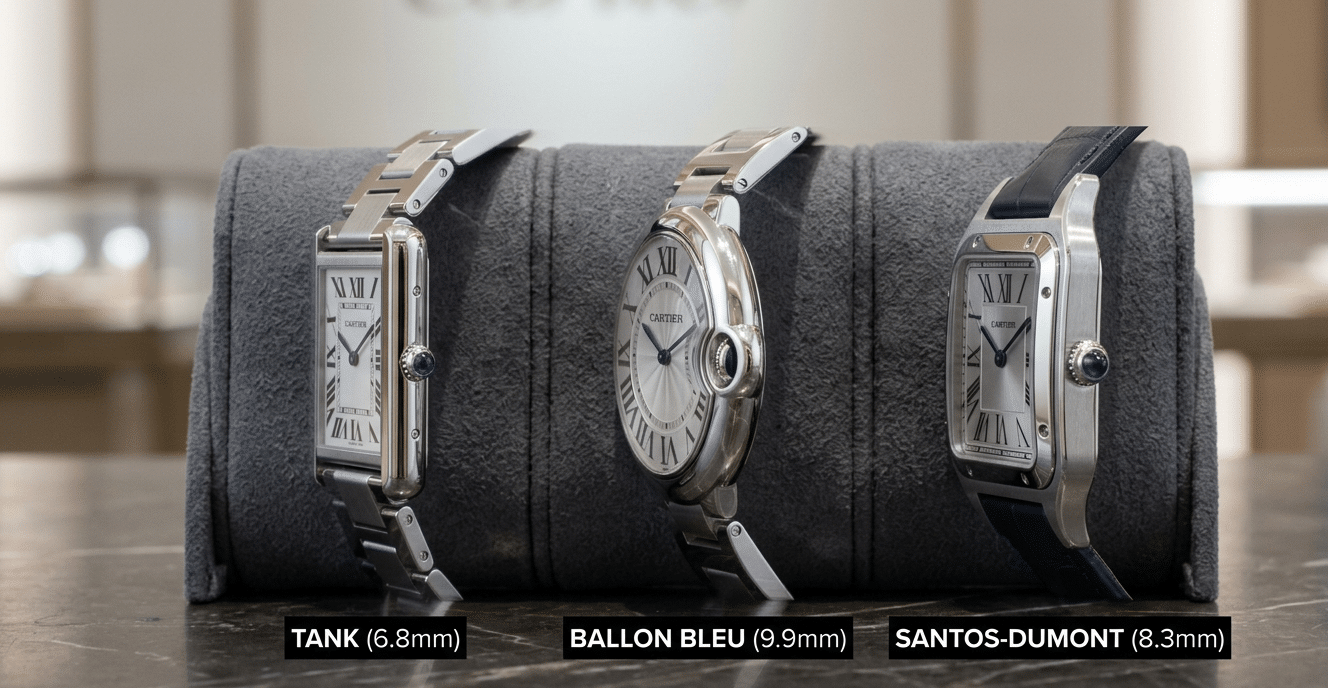
Cartier’s designs are architectural. The Tank is a flat rectangle. The Ballon Bleu is a dome suspended within a bezel. The Santos is a squared-off module with an integrated bracelet. These aren’t generic round cases you can stuff any movement into. The movement is a component that must conform to a pre-defined space and a specific visual expectation. Selecting the wrong one doesn’t just mean a technical mismatch; it means breaking the watch’s essential character.
The goal here isn’t to hunt for prestige under the case back. It’s to solve for the watch’s design integrity. You are not buying a movement; you are buying a Cartier. The movement’s only job is to disappear and let the design work.
Why “Best Movement” is the Wrong Question for Cartier
Asking for the “best movement” is like asking for the best engine without knowing if it’s for a sports car, a sedan, or a vintage roadster. For a Cartier replica, the “best” movement is the one that causes the fewest compromises to the watch’s intended form and function. A technically superior movement that forces the case to be 2mm thicker than the genuine article is a catastrophic failure. That thickness imbalance is a visual and tactile tell that even a novice can spot from across a room, while a slightly off-color rotor engraving is invisible on a closed case back.
This guide is for the buyer who understands that a replica’s success is measured on the wrist, not in a macro-lens photograph. It’s about matching the engine to the chassis.
The Three Constraints: Thickness, Alignment, Expectation
Every Cartier collection filters movement options through three non-negotiable filters:
- Case Thickness & Profile Tolerance: How much internal volume does the design allow? A Tank Must demands near-absolute thinness. A Santos can accommodate more bulk. Exceed the tolerance, and the watch loses its elegance or wears clumsily.
- Crown & Date Window Alignment: The movement’s stem height dictates where the crown sits in relation to the case. A misaligned crown on a Ballon Bleu, breaking the flow of the crown guard, is a dead giveaway. Similarly, the date window’s position on the dial is fixed; the movement’s date disc must align perfectly underneath it.
- The “Wearing Expectation”: Is this a dress watch worn once a week (Tank), a daily-wear piece of jewelry (Ballon Bleu), or a sport-luxury daily driver (Santos)? This dictates priorities: absolute thinness, set-and-forget reliability, or robust timekeeping.
Ignore these constraints, and you end up with a watch that has the right logo but the wrong soul.
Expert Authentication Insight
A professional authenticator’s first check is never the movement. It’s the silhouette. They’ll hold the watch in profile, assessing its thickness against known genuine dimensions. They’ll look at the crown’s integration with the case. They’ll feel the watch’s weight and balance on the wrist. A movement flaw might require opening the case to discover, but a profile that’s off by even a single millimeter is an instant, visual fail. The movement enables the design; it cannot redeem a poorly proportioned case.
Cartier Tank: The Thinness Imperative and Quartz Reality
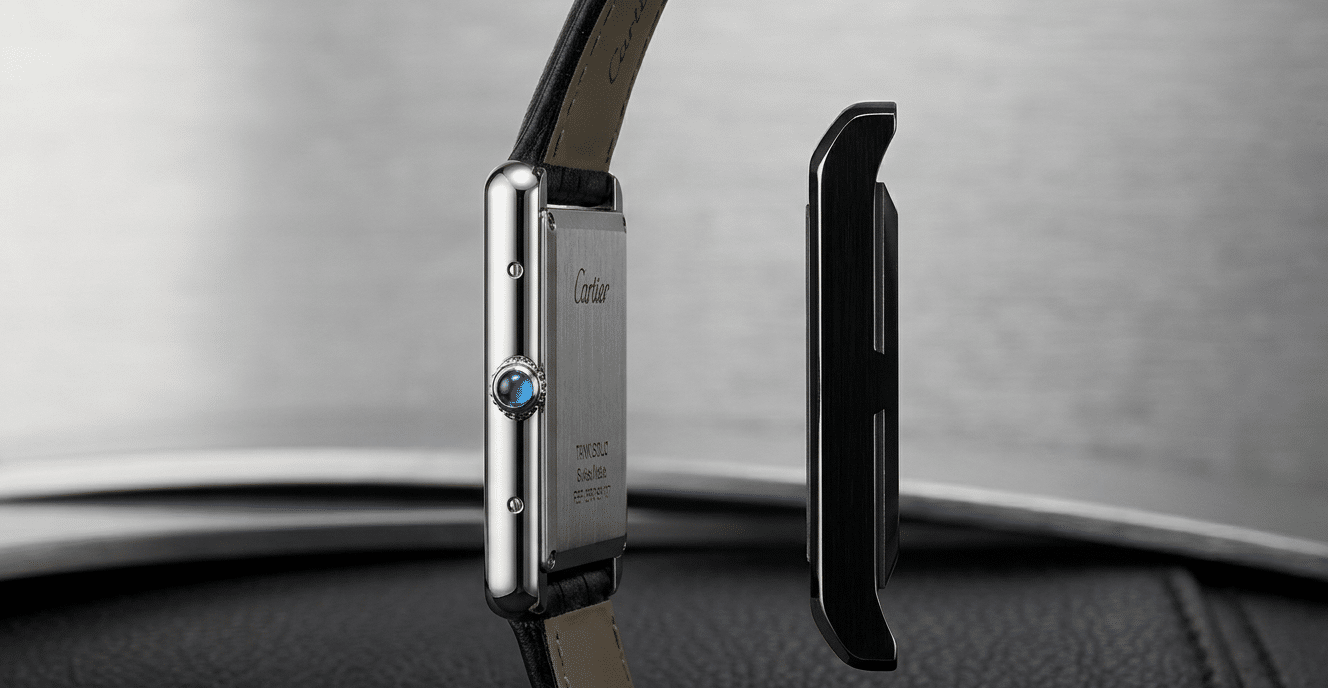
The Cartier Tank is not just a watch; it’s a silhouette. Its identity is tied to an elegant, almost two-dimensional profile that slips effortlessly under a cuff. This creates the single most strict movement constraint in the Cartier catalog: the imperative of thinness. The rectangular case offers minimal internal volume, and the small, cabochon-topped crown demands a correspondingly slim movement construction.
The core challenge for any Tank replica is fitting a movement into this space without inflating the case. The genuine Tank Solo, for example, can be as thin as 5.5mm for quartz models. Most automatic movements, even slim ones, start at around 4-5mm thick by themselves, before you add the case, crystal, and case back. This math forces a brutal choice: sacrifice the Tank’s essential thinness for the romance of mechanical movement, or prioritize the design’s integrity.
The Case for Quartz: Why It’s Often the Right Answer
For the majority of Tank replicas, especially the classic Tank Louis or Tank Solo sizes, a high-quality quartz movement is not a compromise—it’s the most correct choice. A Swiss Ronda or Japanese Miyota quartz calibre is incredibly thin, supremely accurate, and requires zero maintenance beyond a battery change every few years.
We must address the “quartz shame” head-on. In the context of a dress watch like the Tank, which is often worn intermittently, the functional benefits of quartz are overwhelming. It will be ready to go, telling perfect time, whenever you pick it up. Most importantly, it allows the replica to achieve the genuine article’s svelte profile. Choosing a quartz movement for a Tank isn’t settling; it’s choosing fidelity to the design over mechanical dogma. For a watch where elegance is the entire point, this is the intelligent, design-literate decision.
Manual-Wind Mechanics: The Purist’s Compromise
For the mechanical enthusiast who can’t abide a battery, a manual-wind movement like a clone of the Seagull ST17 presents a viable, if compromised, path. These movements can be slightly thinner than their automatic counterparts. The trade-off is twofold. First, you still risk a case that is thicker than the genuine quartz version. Second, you inherit the daily ritual of winding. For a daily-wear watch, this can be a charming interaction. For a dress watch you wear once a week, it becomes a friction point—you’ll likely need to set the time every time you wear it.
It’s the purist’s choice, valuing tactile connection over ultimate convenience and perfect proportion. It’s a valid path, but one that accepts a pragmatic trade-off for mechanical romance.
When an Automatic Might Work: The Large-Format Tank Exception
The rule bends for the larger Tank formats, like the Tank Américaine or the Tank Française in larger sizes. These models have more generous case dimensions that can accommodate a slim automatic movement like a Miyota 9015 or a thin ETA 2892 clone without completely destroying the aesthetic. However, even here, caution is required. In models like the Tank LC or smaller Solo variants, an automatic movement will almost certainly result in a case that feels top-heavy and clunky, betraying the Tank’s delicate wrist presence.
Expert Authentication Insight
For a Tank, an authenticator’s most immediate test is tactile and visual. They will place the watch on its side on a flat surface. A genuine Tank sits nearly flush. A replica with an ill-chosen automatic movement will have a visibly taller profile. Next, they’ll feel the watch on the wrist. The Tank should feel like a second skin, an elegant sliver of metal. Any noticeable thickness or weight is an immediate red flag. The movement inside is almost irrelevant if the case has already failed this primary test of design.
Cartier Ballon Bleu: The Domed Crystal Challenge and Daily-Wear Balance
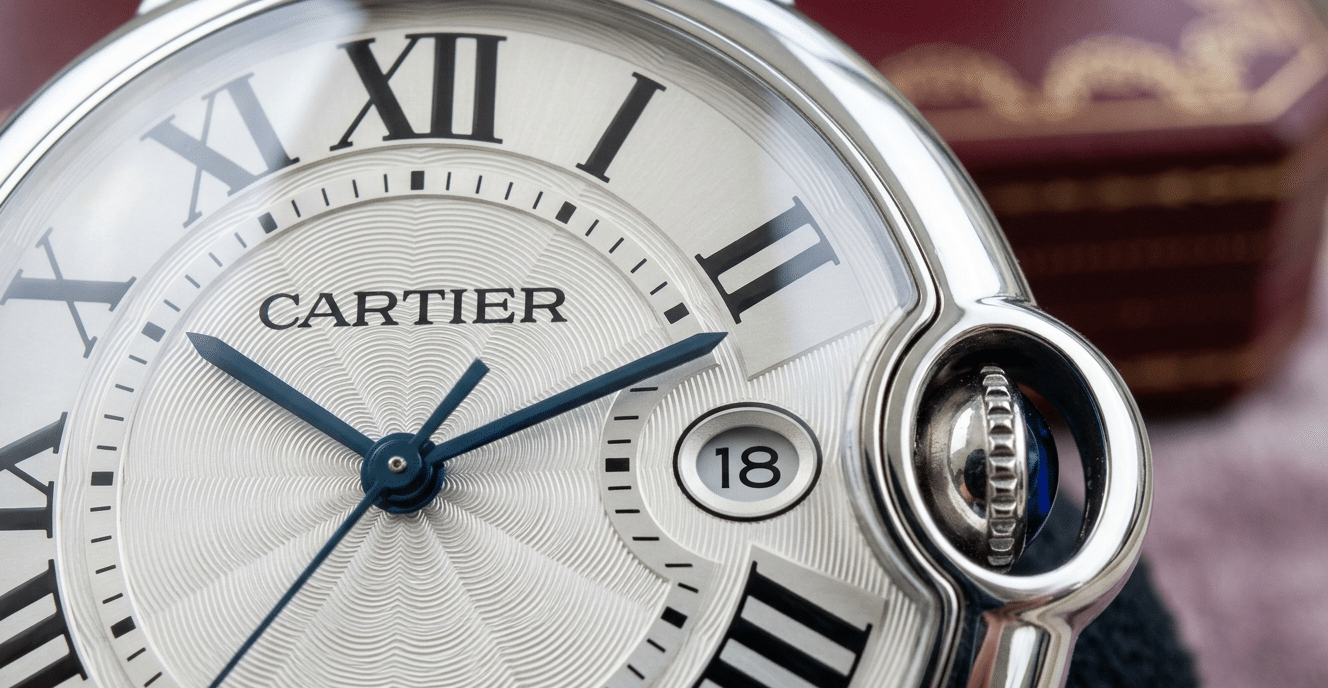
The Ballon Bleu presents a different kind of puzzle. Its defining feature—the dramatic, convex sapphire crystal that melts into a curved bezel—creates an optical and mechanical challenge. The priority here shifts from pure thinness to dial depth perception and overall balance. The movement must sit at precisely the right height so the dial appears correctly positioned under this magnifying dome, not sunken into a deep well. Furthermore, the integrated crown guard dictates a specific crown stem height.
This is a watch designed for daily “elegant wear.” The movement needs to be reliable, relatively slim, and capable of cleanly driving a date complication (on models that have one) without misalignment. It’s about finding the engine that best supports the watch’s role as a polished, go-anywhere companion.
Dial Depth & Date Alignment: The Crystal’s Effect
That soaring dome isn’t just for looks; it acts as a magnifying lens. This exaggerates the perceived distance between the dial and the crystal. If the movement positions the dial too low within the case, the watch loses legibility and the dial can appear small and distant, a flaw instantly noticeable in person. Conversely, if the movement is too tall, the dial can feel cramped against the crystal. The date window at 3 o’clock adds another layer of complexity, a critical consideration when evaluating Cartier replica movement quality. The movement’s date disc must align perfectly with the window aperture. A date that sits too high, too low, or is misaligned laterally is a glaring, everyday tell under the crystal’s distortion.
The Miyota 9015: The Default for a Reason
In the replica Ballon Bleu world, the Japanese Miyota 9015 automatic movement is the ubiquitous workhorse for a simple set of virtues: it’s readily available, relatively thin (3.9mm), reliable, and easy to service. Its 28,800 vph beat rate gives the seconds hand a smooth sweep. For the 42mm and 36mm Ballon Bleu models, its dimensions generally allow for correct dial positioning.
It’s not without trade-offs. The rotor can be audible, a faint whirring sound in a quiet room. Its finish is industrial, not decorative. But for a closed-case-back Ballon Bleu, these are irrelevant. It gets the core job done—providing reliable timekeeping within the correct spatial constraints—at a reasonable cost point, making it the default and often correct choice for most buyers.
ETA/SW Clones: When the Premium Makes Sense for the Bleu
A step up brings you to clones of the Swiss ETA 2824-2 or Sellita SW200. These movements offer a perceived upgrade in refinement: a slightly smoother rotor wind, a reputation for robustness, and a finishing level that, while not genuine Cartier, can feel more substantial. In the context of a Ballon Bleu, is the premium (often adding $100-$150 to the build) justified?
The argument hinges on your priorities. If you value the theoretical long-term serviceability and the marginally smoother operation, and you’re buying a higher-tier replica from a factory like AF or V6 that pairs this movement with superior case construction, it can be a coherent upgrade. However, if the choice is between a mid-tier replica with an SW200 clone and a top-tier replica with a Miyota 9015, the superior case finishing and dial detail of the top-tier model will always be the more impactful upgrade. The movement should complement the build, not lead it.
Expert Authentication Insight
For the Ballon Bleu, an authenticator’s eye is drawn to the crystal and the dial relationship. They will run a finger around the edge of the dome, feeling for the quality of the polish and the bezel transition. More importantly, they will look at the dial from an angle. Does the date sit perfectly centered in its window? Does the dial appear correctly floated beneath the crystal, or does it look recessed? Does the crown integrate seamlessly with its protective arches? These holistic visual checks, dictated by the movement’s placement, happen long before any consideration of what’s inside the case.
Cartier Santos: The Sporty Integrated Bracelet Demands a Robust Heart
The Santos de Cartier is the workhorse of the lineup. It’s designed to be a daily companion, a watch that transitions from the office to a weekend outing without a second thought. This “daily driver” identity fundamentally changes the movement calculus. We’re no longer chasing extreme thinness, as with the Tank, or navigating the optical illusions of a domed crystal, as with the Ballon Bleu. Here, the priority is robustness, reliability, and a movement that matches the watch’s utilitarian, integrated-bracelet spirit. The Santos’s squared-off case provides more internal volume, giving you more breathing room, but it also demands an engine that feels as dependable as the watch looks.
Case Volume Advantage: Why the Santos Can Handle More
The Santos’s case architecture is its greatest asset in the movement-matching game. Unlike the wafer-thin Tank or the domed Ballon Bleu, the Santos’s case—particularly the medium Santos de Cartier and the larger 100—has a more generous height and a squared-off profile. This isn’t just about style; it creates physical space. This volume allows factories to use slightly thicker, more proven automatic movements without forcing a case that feels bloated or visually imbalanced. The movement is no longer the limiting design factor; it becomes a component you can choose based on performance and reliability, not just its ability to fit. This opens the door to the workhorse calibers that thrive under daily wear.
Miyota 9015 vs. ETA 2892 Clones: The Daily Wear Showdown
This is the core decision for most Santos buyers. The Miyota 9015 is the default for a reason. It’s thin (at 3.9mm), reliable, widely available, and every watchmaker on the planet can service it. Its 28,800 vph beat rate gives the seconds hand a smooth, confident sweep that suits the Santos’s sporty character. The trade-off is its rotor noise—a faint, high-pitched whirring that’s often audible in a quiet room. However, on the wrist with the Santos’s integrated bracelet, this noise is usually dampened and becomes a non-issue for most. For the medium Santos de Cartier, it’s a nearly perfect, cost-effective match.
The clone ETA 2892 (or its Sellita SW300 equivalent) represents a step up. It’s even thinner (around 3.6mm) and often perceived as more refined, with a quieter rotor. The question is whether the Santos’s design justifies the premium—often an extra $100-$150. For the Santos-Dumont, a sleeker, dressier interpretation, the 2892’s thinness and slightly smoother operation can enhance the elegant feel. For the standard Santos de Cartier, the Miyota 9015’s robustness and lower cost usually make more practical sense. You’re paying for marginal gains in refinement, not a fundamental upgrade in daily utility.
The 1847 MC Clone: Pursuing Ultimate (Hidden) Authenticity
Some high-end factories, like 3KF, have attempted to clone Cartier’s in-house Caliber 1847 MC for Santos models. This is the most ambitious and philosophically interesting play. On paper, it’s the ultimate in authenticity, replicating the genuine movement’s architecture. In practice, it’s a complex puzzle. The Santos typically has a solid case back. Therefore, this engineering marvel is completely hidden from view. You’re paying a significant premium—often pushing the total cost toward $800 or more—for authenticity you can’t see and a novel movement with a less-proven long-term service record than the Miyota or ETA clones. This choice isn’t about logic; it’s for the collector whose satisfaction comes from knowing what’s inside, even if no one else ever will. For pure daily-wear reliability, it’s a hard sell.
Expert Authentication Insight
For the Santos, an authenticator’s first checks are rarely the movement. The immediate tells are in the execution of the high-end features: the action of the “QuickSwitch” bracelet release system (it should be firm, precise, and flush) and the depth, crispness, and alignment of the case back engraving. A poorly finished, shallow engraving is an instant red flag. The movement is often a secondary verification. On a closed case back, they’d need to open it. On the rare display-back Santos, a clone 1847 MC might look convincing at a glance, but the finishing on the bridges and the rotor engraving will lack the laser-sharp precision of the genuine article. The movement choice matters less than the quality of the case and bracelet it’s housed in.
Cartier Pasha: The Unusual Crown Cap and Its Mechanical Implications
The Pasha is the outlier. A bold, round, sporty design centered around its most iconic feature: a screw-down crown cap secured by a tiny chain. This isn’t just a design quirk; it’s an engineering constraint that dictates everything about the movement choice. Here, you’re not choosing a movement for its prestige or thinness. You’re choosing one that can reliably interface with a unique and finicky crown system. The Pasha’s movement needs to be a team player, focused on seamless function over flash.
The Crown & Chain System: A Movement Compatibility Filter
The Pasha’s defining feature is also its most demanding. The screw-down cap threads onto a small, underlying crown. This means the crown stem—the tiny shaft connecting the movement to the crown—must be perfectly aligned, of exact length, and robust enough to handle the torque of repeatedly screwing and unscrewing the cap. The gaskets for the underlying crown must also be precisely sized to maintain a seal. An overly thick movement can push the dial and hands too far forward, altering the stem geometry. A movement with a weak or poorly machined stem is a point of failure. This unique architecture immediately filters out overly complex or poorly fitting calibers, pushing the decision toward simple, proven workhorses with reliable parts compatibility.
Prioritizing Proven Workhorses: Why 2824 Clones Dominate Here
Given the crown system’s demands, the movement landscape for the Pasha narrows dramatically. The ETA 2824 or Sellita SW200 clone becomes the logical, front-running choice. Not because it’s the thinnest or most elegant, but because it’s the most proven. Its crown stem and keyless works (the mechanism for setting time and date) are industry standards. Every watchmaker has parts and knows how to service it. This widespread compatibility is crucial for a watch with a specialized crown, as future repairs or adjustments are almost inevitable. The Asian 2824 clone (like the Hangzhou 6460) is a cost-effective alternative, but the caveat is critical: you must verify with the seller that the crown stem threading and tube sealing are correctly executed for the Pasha’s specific build. A standard stem won’t work.
Water Resistance Fiction vs. Reality in Replicas
The Pasha, with its screw-down crown, inherently suggests water resistance. This is where you must be brutally pragmatic. While a genuine Pasha might be rated for 100 meters, a replica’s water resistance is a fantasy. The seals, gaskets, and case tolerances are never to genuine specification. The complex crown-and-cap system is a particular vulnerability. You should never submerge a replica Pasha, regardless of the movement inside or the seller’s claims. The movement choice here is about dry-land reliability and serviceability, not enabling aquatic adventures. Choosing a “better” movement does not buy you real water resistance.
Expert Authentication Insight
When examining a Pasha, an expert’s eye goes straight to the crown. They will assess the finish of the crown cap’s grooves, the fluidity and security of the small chain, and—critically—the alignment and smoothness of the screw-down threads. A cap that grinds, cross-threads, or sits crooked is a dead giveaway. The polish on the cap’s blue cabochon will also be scrutinized. The movement is almost an afterthought; a flaw in the crown execution is a faster, more obvious tell than anything happening inside the case. The movement’s job is to not cause problems for this delicate external system.
The Verdict Matrix: Matching Your Priority to Your Collection
Forget finding a single “best” movement. The right choice is the one that best serves your primary goal for a specific watch. Use this filter to cut through the noise. First, decide on your Cartier model. Then, identify your non-negotiable priority. The path will become clear.
If Your Top Priority Is… Here’s Your Filter
Wrist-Feel & Elegance (The Silhouette Purist):
You value how the watch disappears on the wrist, becoming a pure extension of its design.
• For a Tank: High-quality quartz is not a compromise—it’s the correct answer. It guarantees the essential thinness, a principle also detailed in the comprehensive Cartier super clone movement guide which explains various caliber specifications.
• For a Ballon Bleu or Santos: Seek out the thinnest reliable automatic (like a clone ETA 2892) that won’t distort the case profile. For the Santos-Dumont, this is critical.
• For a Pasha: A standard 2824 clone is fine; the case is bold enough to absorb the thickness. Prioritize a well-finished crown system over movement thinness.
Set-and-Forget Daily Wear (The Reliable Workhorse):
You want a watch you can grab, wear, and not baby. Reliability and low maintenance are key.
• For a Santos: The Miyota 9015 is your champion. Robust, easily serviced, and perfectly suited to the watch’s character.
• For a Ballon Bleu: The Miyota 9015 is again a top contender, or a proven Asian 2824 clone. Avoid untested, novel clone movements.
• For a Pasha: A reliable 2824 clone (Asian or SW200) is the pragmatic choice for long-term serviceability.
• For a Tank: If you must have mechanical, a manual-wind like the Seagull ST17 is simple and robust. But for true “set-and-forget,” quartz reigns supreme.
Budget-Conscious Value (The Strategic Saver):
You want the maximum aesthetic impact and functional reliability for the lowest sensible investment.
• For a Tank: A high-quality quartz movement from a top factory (like AF or K11) is the peak of value—perfect aesthetics at a lower cost.
• For a Santos: An Asian 2824 clone in a well-made case from a factory like GF offers tremendous value and proven performance.
• For a Ballon Bleu: Stick with the Miyota 9015 base model from a major factory. Avoid upcharges for “Swiss” or exotic clones.
• For a Pasha: Given its niche status, a solid Asian 2824 clone build is the value sweet spot. Don’t overpay for movement upgrades here.
Inside-Out Authenticity (The Detail Obsessive):
Your satisfaction comes from knowing every detail, visible or not, is as close to genuine as possible.
• For any model with a display case back: This is the only scenario where investing in a high-end clone movement (like a cloned 1847 MC) has a tangible, visual payoff.
• For models with solid case backs (99% of replicas): Redirect your budget and obsession. Pour every dollar into the quality of the case finishing, dial printing, hand setting, and crystal. A perfect exterior with a standard Miyota inside is infinitely more “authentic” on the wrist than a flawed case with a perfect clone movement hidden inside.
Expert Authentication Insight
The final, unifying principle from the authenticator’s bench: they judge the complete package. A perfectly chosen, high-end movement installed in a case with poor proportions, sloppy engraving, or misaligned bezel is still a failed replica. The movement is a component that enables the design’s success; it cannot redeem fundamental flaws in execution. Your goal should be a harmonious whole where the movement choice supports—never compromises—the watch’s intended character and physical form.
Ending Direction: You are not buying a movement; you are buying a Cartier. The movement is the heart, but the design is the soul. Choose the engine that allows the Tank to be elegantly thin, the Ballon Bleu to sit balanced under its dome, the Santos to be a dependable daily companion, and the Pasha to operate its unique crown with reliable simplicity. Let the design dictate the mechanics. The most common and costly mistake is forcing a “prestige” movement into a watch where it creates a compromise—thickness, noise, imbalance. Finalize your collection choice first. Then, and only then, apply the movement logic from this guide. The result won’t be the watch with the “best” movement, but the Cartier replica that feels most authentically, satisfyingly right on your wrist.