
The Daily Wear Reality Check: What “Holding Up” Really Means
When you’re shopping for an automatic Cartier replica, you’ll see a lot of terms. “Super clone.” “1:1 movement.” “Swiss grade.” It’s easy to get lost in a fog of impressive-sounding specs that promise perfection. But here’s the truth: for daily wear, none of that matters if the watch on your wrist is a fragile, noisy, or temperamental piece of machinery. The real test isn’t what the movement looks like in a macro shot or what its static timegrapher numbers are. Decoding these claims requires a super clone buyer’s filter for movement claims, as the real test is how it behaves when it becomes a part of your life—bumping against a laptop, winding from your daily commute, and running quietly on your nightstand.
This article isn’t about achieving theoretical perfection. It’s about finding practical, daily-driver reliability. To cut through the marketing, we need to define what “holding up” actually means in the real world. Forget decoration and theoretical power reserve. For daily wear, judge a movement by these five pillars.
Beyond the Spec Sheet: The Five Pillars of Daily Reliability
1. Winding Efficiency & Behavior: Does the watch reliably power itself from normal wrist motion, or does it require nightly hand-winding rituals? More importantly, is the rotor smooth and quiet, or does it sound like a rattling marble in a tin can during quiet moments?
2. Timekeeping Stability: It’s not about achieving +/- 2 seconds per day in a perfect, stationary position. It’s about consistency. Does it run +10 seconds one day and -20 the next? A stable, predictable error of 10-15 seconds a day is far more livable than a theoretically “better” but erratic movement.
3. Shock & Grime Resistance: Daily life involves minor impacts—desk diving, door frames, gym bags. The movement needs to handle these without the balance staff snapping or the gears jamming. Sealing against everyday dust and moisture is also part of this.
4. Service Interval Reality: All mechanical movements need service. The question is: when, at what cost, and by whom? A movement that needs a $150 service every two years on a $400 watch is a bad financial proposition. Availability of spare parts is critical here.
5. Case Coherence (The Thickness Imperative): The movement dictates the watch’s profile. A bulky movement inside a dress watch like a Tank or Ballon Bleu destroys its elegance and comfort. The right movement allows the case to maintain a gen-like, wearable thickness.
A movement that fails any one of these pillars is a poor choice for a daily watch, regardless of how “perfect” it looks under a loupe.
Why “Decoration” and “Holding Power Reserve” Are Secondary (For You)
Let’s be blunt: a beautifully decorated rotor plate that adds 1.2mm to the case thickness is your enemy if you want to wear the watch under a shirt cuff. A 70-hour power reserve is meaningless if the movement is so poorly lubricated it stops after 30 hours of actual wear. These are “bragging rights” specs that sellers love to highlight because they sound impressive. For daily wear, they are often liabilities, not assets. Your priority is a movement that disappears into the background of your life—reliable, quiet, and appropriately sized.
Expert Authentication Insight
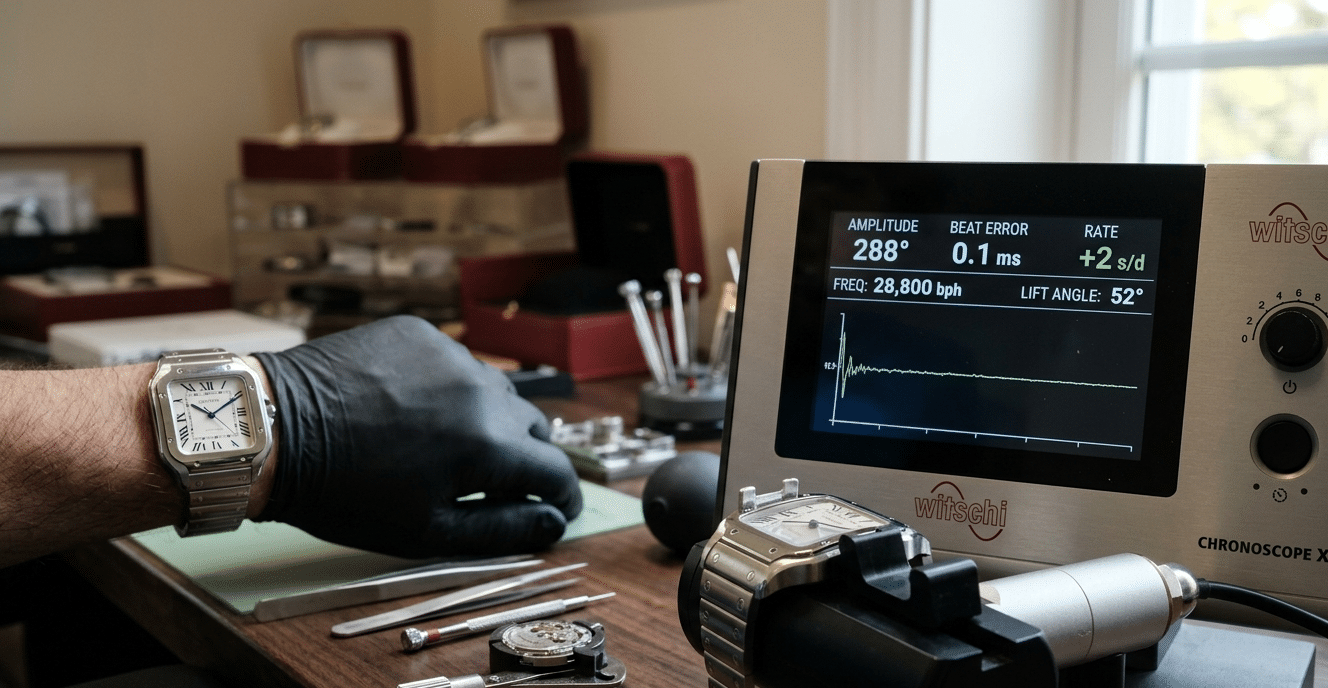
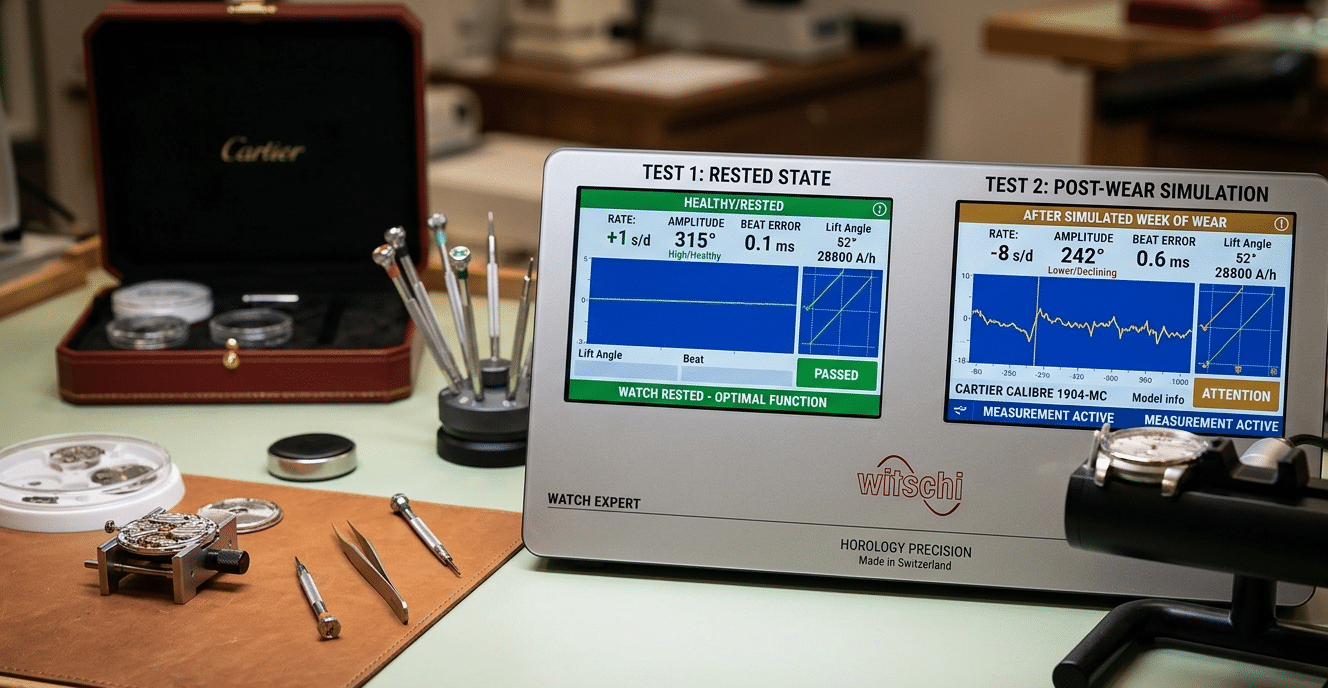
Physical diagnostic: The true test of daily wear isn’t a timegrapher reading in a sterile environment. It’s observing the movement’s health after simulated real-world use. A watchmaker can simulate a week of varied activity (gentle office wear, typing, driving) on a timing machine. A movement that drops below 250° amplitude or shows wildly erratic beat error after this test has poor real-world winding efficiency and stability, regardless of its pristine static spec. This is the first check for any movement claiming to be a “daily driver.”
The Daily Wear Reality Check: What “Holding Up” Really Means
When you’re researching automatic Cartier replicas, the conversation almost always starts and ends with two things: how close it looks to the genuine article, and the technical specs of the movement inside. You’ll see endless debates about “super clone” decorations, 28,800 vph beat rates, and power reserve numbers. It’s all compelling in theory, but it’s a conversation that happens in a vacuum. It ignores the single most important question for someone who actually wants to wear the watch: What happens when you strap it on and live your life?
For daily wear, a movement isn’t a trophy to be admired under a loupe. It’s a component that needs to perform invisibly and reliably. Its job is to keep decent time, survive minor impacts, wind from the motion of your wrist, and not demand constant attention or expensive, unexpected maintenance. The “best” movement for daily wear isn’t the one with the fanciest engravings; it’s the one you forget is even there.
To cut through the spec-sheet noise, you need to evaluate every movement through a practical, ownership-focused lens. We call these the Five Pillars of Daily Reliability. Fail any one, and the watch becomes a source of frustration, not enjoyment.
Beyond the Spec Sheet: The Five Pillars of Daily Reliability
Think of a daily-wear movement like a car engine for your commute. You don’t need a race-tuned V10; you need a dependable inline-four that starts every morning, gets good mileage, and doesn’t require a specialist mechanic for an oil change.
1. Winding Efficiency: Does the rotor actually charge the mainspring from normal activity? This is the most common failure point. A watch that stops every night unless you manually wind it is useless for daily wear. It’s not about the advertised power reserve; it’s about how efficiently it gets there from office work, typing, and driving.
2. Timekeeping Stability: Not “±5 seconds a day in one position on a timegrapher.” We’re talking about real-world consistency over weeks. Does it run fast on the wrist and slow on the nightstand? Does the rate change dramatically as the power reserve depletes? A stable, predictable inaccuracy of 10-15 seconds a day is far more livable than a movement that swings from +5 to -20.
3. Shock & Grime Resistance: Daily wear means bumps, vibrations, and exposure to dust and moisture. A movement needs basic shock protection (like Incabloc or similar) and reasonable sealing. Desk-diving scratches are cosmetic; a rotor axle that shears from a light knock is a functional failure.
4. Service Interval Reality: All mechanical movements need service. The question is when, how much, and how big a hassle it will be. A $150 service on a $300 watch changes its entire value proposition. Is the movement common enough that any watchmaker can work on it? Are parts available, or is it a proprietary black box?
5. Case Coherence: Does the movement force the watch to be thicker, heavier, or more awkwardly proportioned than it should be? A beautiful, accurate clone movement is a poor choice if it turns a dress watch into a wrist-hugging slab. The movement must serve the design, not compromise it.
Why “Decoration” and “Holding Power Reserve” Are Secondary (For You)
Let’s be blunt: for a daily-wear replica, a decorated rotor or bridges are a bonus, not a necessity. They add complexity, potential points of failure, and often thickness. They matter only if the watch has an exhibition caseback—and most Cartier replicas worth wearing daily do not. The Ballon Bleu, Santos, and Tank are predominantly solid casebacks. No one will ever see the “beautiful” clone finishing. Paying a premium for unseen art is a collector’s game, not a daily wearer’s strategy.
Similarly, a 40-hour vs. a 42-hour power reserve is a meaningless distinction if the movement doesn’t wind efficiently. A watch that only achieves 30% of its theoretical reserve from daily motion is the one that will be dead on your wrist every other morning. The winding system’s quality is infinitely more important than the reserve number on paper.
Expert Authentication Insight
Physical diagnostic: The true test of daily wear isn’t a timegrapher reading in a sterile environment. It’s observing the movement’s health after a week of simulated, varied activity. A watchmaker will look at the amplitude (the swing of the balance wheel) and beat error after this period. A movement that drops below 250° amplitude or shows erratic beat error after normal wear has poor real-world winding efficiency and lubrication, regardless of its perfect static spec. This is the first sign it will be a needy, unreliable companion.
The Workhorse: Dissecting the Miyota 9015 & Its True Clones
If there’s a default engine in the replica Cartier world, it’s the Miyota 9015 and its various clones. You’ll find it in countless Santos and Ballon Bleu models from factories like GF. It’s ubiquitous for a reason: it’s thin, relatively reliable, and cheap to source. But “ubiquitous” doesn’t mean “uniform.” Your daily experience hinges entirely on which version you get and what case it’s in.
Evaluated against our five pillars, here’s the reality:
Winding Efficiency: Generally good. The unidirectional rotor is efficient, and it typically powers up well from routine motion. You shouldn’t need to baby it.
Timekeeping Stability: Acceptable, not exceptional. A genuine Miyota 9015 can often hold within +/- 15 seconds per day out of the box. Clones (like the Seagull ST16/ST18 series) can be less consistent, sometimes gaining more.
Shock & Grime Resistance: Robust. This is one of its strengths. The design is simple and proven, making it fairly tolerant of the minor shocks of daily life.
Service Interval Reality: Excellent. This is the 9015’s killer feature for daily wear. It’s a known quantity. Any competent watchmaker can service it, parts are plentiful and cheap, and a full service typically costs between $80-$120. This makes long-term ownership predictable and affordable.
Case Coherence: Very good. At 3.9mm thick, it allows factories to build watches that respect the original’s proportions. A GF Santos with a 9015, for example, hits the genuine thickness of ~9mm.
The Noise Factor: Which Cartier Cases Hide the Rotor Whir?
Here is the non-negotiable, daily-wear trade-off: the Miyota 9015 has a noisy rotor. It’s a distinct, high-pitched whirring or grinding sound when the rotor spins freely. In a quiet room, you will hear it with certain wrist motions.
This is where case design is everything. A solid, well-sealed case like the Santos de Cartier acts as a sound chamber, muffling the noise significantly, a point that is often detailed in a best Cartier replica movement guide when evaluating rotor acoustics. You might hear it if you shake your wrist next to your ear, but it’s often drowned out in daily life. However, in a case with a different acoustic profile or less damping, the noise can be intrusive.
The verdict is simple: If you are sensitive to noise and plan to wear your watch in quiet environments (meetings, libraries, at home in the evening), the 9015 may annoy you. It is the single biggest reason people reject this movement for daily wear. For others, the reliability and serviceability outweigh the auditory quirk.
Genuine vs. Clone: Why the Movement Origin Matters for Longevity
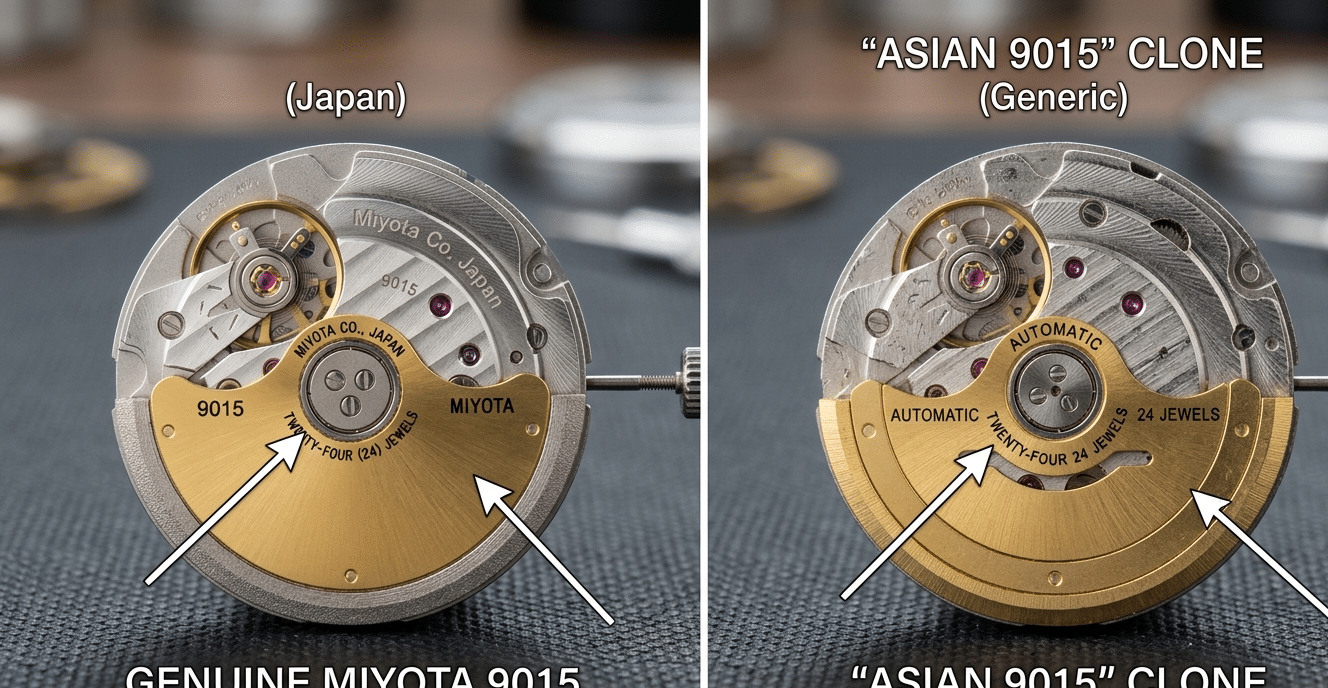
Not all “9015s” are created equal. Factories use three main types:
- Genuine Miyota 9015: Made by Citizen in Japan. The gold standard for consistency and longevity.
- Seagull ST16/ST18 Series: Chinese clones of the 9015. Generally decent, but with more variance in quality control. The ST18 is the closer, thinner clone.
- “Asian 9015” or Mystery Clone: A generic, lower-cost copy. Higher risk of poor lubrication, gritty rotor action, and early failure.
The price difference between a watch with a genuine Miyota and one with a generic clone might be $50-$100. For daily wear, that’s an insurance premium worth paying. The genuine movement will almost always be smoother, quieter (relatively), and last longer with proper care.
Expert Authentication Insight
Physical diagnostic: The tell is in the rotor’s feel and sound. Gently rotate the watch to spin the rotor. A genuine Miyota 9015 has a distinct, smooth, and somewhat noisy but consistent free-spin. A cheap clone often has a grittier, raspier, less fluid sound and tactile feedback through the case. For a daily watch you plan to keep for years, the genuine movement’s proven durability is the clear choice.
The Thickness Trade-Off: A Consistent, Manageable Profile
The 9015’s slim profile is its silent victory. It enables replicas like the 40mm Santos to achieve a near-perfect 9.08mm thickness, which is critical for the watch’s elegant, integrated look on the wrist. It slips effortlessly under a shirt cuff. When choosing a movement for daily wear, this is a tangible benefit that impacts comfort and style every single day. A thicker, more decorated movement might win on paper, but it loses where it matters most—on your wrist.
The “Super Clone” Ambition: A2824, A2892, and Their High-Grade Variants
Step up from the workhorse Miyota, and you enter the realm of the “super clone” movements—the A2824 and A2892 families. These are clones of classic Swiss ETA designs, and they are marketed as premium upgrades. The promise is greater refinement, smoother sweeping seconds hands, and a feel closer to genuine. The reality for daily wear is a nuanced landscape of trade-offs, where not all upgrades are created equal.
It’s crucial to not view these as a monolith. A standard A2824 from a mid-tier factory is a different beast from a high-beat “A2824” from a top-tier maker, and both are distinct from the slim A2892. Your choice here directly dictates your ownership experience.
The Robust Choice: A2824 for Santos and Larger Cases
The standard A2824 clone (often based on the Seagull ST2130) is the tank of the replica movement world. It’s thick, simple, and famously robust. In the context of daily wear:
Pillar Performance: Its winding is efficient, its timekeeping can be very stable (especially after regulation), and its shock resistance is excellent due to its classic, sturdy architecture. Serviceability is top-tier; every watchmaker on earth knows this design, and parts are everywhere.
The Catch: Thickness. At ~4.6mm tall, it forces a thicker case. In a larger watch like a 40mm Santos, this can be absorbed. In a dressier model aiming for slimness, it’s a deal-breaker. The other catch is feel: out of the box, these can sometimes feel a bit gritty when winding or setting the time. This doesn’t usually affect performance, but it cheapens the experience.
Daily Wear Verdict: For a sports watch like the Santos that you plan to wear hard, a well-serviced standard A2824 is arguably the most reliable and worry-free choice you can make. The service (costing ~$100) cleans out factory debris, re-lubricates, and regulates it, transforming it into a rock-solid daily engine.
The Slim Profile Compromise: A2892 in Tank and Ballon Bleu
The A2892 (and its Seagull ST18 clone) is the go-to for slimmer models like the Tank Must or certain Ballon Bleu iterations. At ~3.6mm thick, it’s the key to achieving a dress-watch-appropriate profile.
Pillar Performance: Its slimness is its primary virtue for case coherence. However, this comes with compromises. The A2892 design is more complex and can be less tolerant of shock than the burly A2824. Its winding efficiency can also be slightly less robust. It’s not fragile, but it’s more of a precision instrument than a brute-force tool.
Daily Wear Verdict: This is the movement you choose when wearing the watch under a fitted shirt cuff is a non-negotiable part of “daily wear.” You trade a small degree of potential ruggedness for a significant gain in elegance and comfort. For an office-based daily wearer, this is often the correct trade.
High-Beat vs. Low-Beat: Is the Smooth Sweep Worth the Fragility?
This is a critical sub-division. The standard A2824 clones often beat at 21,600 vibrations per hour (vph), resulting in a seconds hand that ticks 6 times per second. High-beat variants (28,800 vph) tick 8 times per second, creating a noticeably smoother sweep—a hallmark of more expensive genuine watches.
High-beat movements are more demanding. The faster oscillation puts more wear on parts, requires better lubrication, and is less forgiving of imperfections. In the replica world, a high-beat “A2824” from a top factory like V6F or 3KF is a more refined, but potentially more delicate, piece of engineering.
For daily wear, here is the hard truth: A properly serviced standard-beat (21,600 vph) A2824 will likely be more resilient over five years of knocks and bumps than an unserviced high-beat clone. The smoother sweep is aesthetically pleasing, but it is a cosmetic improvement that introduces a mechanical vulnerability. Choose the high-beat only if you are committed to an immediate, high-quality service and accept it as a more delicate mechanism.
Expert Authentication Insight
Physical diagnostic: A quick, non-invasive check for overall movement quality in these clones is the keyless works. Gently pull the crown out to the time-setting position. Feel the action. A smooth, positive, single-click engagement with no grinding, grit, or vagueness is a strong indicator of better internal finishing and careful assembly. A sloppy, grindy, or mushy crown action often correlates with poorer overall quality control inside—a red flag for long-term daily durability.
The True High-End: Clone 1847 MC & 1904-PS MC Movements (e.g., from BVF/GF)
In the hierarchy of replica Cartier movements, the decorated clones of the genuine Cartier 1847 MC and 1904-PS MC calibers sit at the apex. Found in top-tier offerings from factories like BVF (for Santos 100) or certain GF iterations, these are the movements that look breathtaking in macro shots, with custom rotors, engraved bridges, and blued screws that scream “super clone.” But for daily wear, this visual perfection presents a fundamental question: is this a robust engine, or a fragile showpiece?
The answer, unfortunately for the daily wearer, leans heavily toward the latter. These movements are almost never ground-up recreations. They are typically a Japanese Miyota 9015 or a Chinese Seagull ST16/ST18 base movement, upon which a complex, factory-specific decorative plate is mounted. This plate is the source of both their allure and their Achilles’ heel.
Beauty vs. Beast: The Decoration Plate as a Liability
That beautiful, gen-like plate is a liability in three concrete ways. First, it adds thickness—often 1.0mm to 1.5mm—directly impacting the case profile. Second, it creates a perfect trap for dust, lint, and moisture between the plate and the base movement, which can accelerate wear. Third, and most critically, it adds points of failure. These plates are often fixed with adhesive or tiny screws that can come loose with shock and vibration. A loose screw or flake of glue floating inside a movement is a recipe for a sudden, catastrophic stop.
For daily wear, which involves bumps, knocks, and temperature changes, this added complexity is pure risk. The movement underneath might be a robust Miyota, but it’s now buried under a potential problem.
Serviceability: The Potential Cost of “Perfection”
When a standard Miyota 9015 needs service, any competent watchmaker can source a $15 replacement rotor or a $30 mainspring. When a decorated clone 1847 MC movement fails, you face a servicing nightmare.
Most local watchmakers will refuse to touch it. The decorative parts are proprietary; you can’t order a replacement “BVF clone rotor” from Cousins UK. A specialist replica watchsmith is required, and their labor rates are higher due to the complexity and risk. A basic service starts around $200, and if a custom-decorated part is damaged, you might be looking at sourcing an entire new movement for $150-$300—if you can even find one. This turns a $50-$100 routine service into a potentially watch-killing expense.
Expert Authentication Insight
Physical diagnostic: The giveaway for a decorated movement is the rotor weight and sound. These clone rotors are often made of a tungsten alloy to mimic the genuine weight and winding feel. While this feels premium on the wrist, it also increases rotational inertia. Listen for a very deep, slow, and heavy “whirr-thunk” spin—distinct from the lighter, faster, higher-pitched buzz of a standard Miyota or the smooth whir of an A2824. It’s a tell of hidden complexity.
Which Models Actually Need This Level of Clone Accuracy?
Almost none, for daily wear. This level of visual clone accuracy is only a practical necessity in open caseback models. Since no mainstream daily-wear Cartier replica (Ballon Bleu, Santos de Cartier, Tank) has a display caseback, this entire exercise is solving a problem that doesn’t exist for the wearer.
Choosing a watch with a decorated clone movement for daily use is a conscious trade: you are accepting higher potential fragility, significantly higher servicing costs and complexity, and often a thicker case, all for a visual benefit that no one but a watchmaker will ever see. This is a choice for the collector who values the idea of internal perfection above all else, not for the person who needs a reliable daily companion.
The Thickness Imperative: How the Movement Dictates the Wearing Experience
You can’t see a movement’s decoration on your wrist, but you feel its thickness every second. The choice of caliber doesn’t just affect timekeeping; it fundamentally dictates the watch’s silhouette, comfort, and how it interacts with your world. For daily wear, this is often the most important spec of all.
A movement that’s 0.5mm thicker can force a case that’s 1.0mm thicker overall, crossing the critical line from “sleek” to “chunky.” This isn’t about a number on a spec sheet; it’s about whether the watch slides under a shirt cuff or catches on it, whether it sits balanced on the wrist or feels top-heavy, whether it looks elegant or clumsy.
Case Study: Santos 40mm – Miyota vs. Clone A2824
The Santos de Cartier large model is a perfect example. A genuine Santos has a refined, integrated profile. A replica using a Miyota 9015 can achieve a case thickness close to 9.5mm, which is excellent. However, some factories use a clone A2824, which is a thicker movement. This can push the case to 10.5mm or more. That 1mm difference changes the entire wearing experience. The watch loses its sleekness, sits higher on the wrist, and is far more likely to bang into door frames and catch on sleeves. For a daily watch, the Miyota-based version wins on pure wearability, even if the A2824 is a theoretically “higher-grade” clone.
Case Study: Ballon Bleu 42mm – The Struggle for a Slim Profile
The Ballon Bleu’s “flying saucer” case is meant to be curvaceous and wearable. The genuine watch, with its thin Cartier 1847 MC movement, achieves this. Many replicas use the Miyota 9015, which is reasonably thin, resulting in a case around 12.0-12.5mm. However, versions that use a decorated “clone” movement—which layers a plate on top of a base like the 9015—can balloon to 13.5mm or more, a detailed comparison found in this Cartier super clone movement analysis. This transforms the watch from a curved dome into a tall, slab-sided puck. The visual proportions are thrown off, and it wears like a much larger, less refined object.
Expert Authentication Insight
Physical diagnostic: The best test for daily-wear comfort is the “shirt cuff test.” A watch intended for daily wear, especially with business or smart-casual attire, must slide easily under a fitted dress shirt cuff without catching or requiring force. If the movement creates a case thicker than approximately 11mm for a dress style (like a Tank) or 13mm for a sports model (like a Santos or Ballon Bleu), it will consistently fail this fundamental, real-world usability check.
When “Gen-Like” Thickness Becomes a Disadvantage
Paradoxically, the pursuit of “gen-like” thickness can backfire. Some factories, in an effort to match the genuine watch’s slim measurement, will use a thinner but more fragile movement (like certain A2892 clones) or will shave down movement components to dangerous tolerances. The result is a case that measures correctly on calipers but houses an engine that is less resilient to the shocks of daily life. In the quest for a perfect number, they sacrifice the very reliability that makes a watch suitable for daily wear. Sometimes, a slightly thicker case with a proven, robust movement is the far smarter choice for long-term ownership.
The Maintenance Timeline: Realistic Costs and Expectations for Each Movement Type
Buying the watch is just the first financial decision. Owning it—truly wearing it daily—is a long-term commitment with a price tag attached. Ignoring the maintenance reality of replica movements is the fastest way to turn a “bargain” into a money pit. Let’s translate movement choice into a clear schedule of cost and hassle.
The “Service-On-Arrival” Recommendation for Clone Movements
This is the single most important piece of advice for anyone buying a replica with an Asian clone movement (A2824, A2892, etc.) for daily wear: budget for an immediate service. These movements are assembled quickly with little to no lubrication and can be contaminated with microscopic debris from the factory. A $100-$150 service from a specialist upon arrival will clean, properly lubricate, and regulate the movement. This upfront cost often doubles the watch’s lifespan, dramatically improves timekeeping stability, and prevents premature wear. Consider it non-negotiable insurance. For a Miyota 9015, while still beneficial, it’s less critical; you can often wear it for years before a service is needed.
Long-Term Parts Availability: A Hidden Deciding Factor
Five years from now, when a component breaks, can you fix it? This is where movement choice dictates long-term viability.
- Miyota 9015 (Genuine): Excellent. Parts are ubiquitous and cheap from numerous suppliers. Any watchmaker can work on it.
- Seagull ST2130 (ETA 2824 Clone): Very Good. As the most common Chinese clone, generic parts are widely available.
- Standard Asian 2824/2892: Good. Parts are generally interchangeable with Swiss ETA specs, making sourcing feasible.
- Decorated Clone (1847 MC, etc.): Poor to Terrible. Proprietary decorated parts are unavailable. A broken custom rotor or decorated bridge often means replacing the entire movement, if you can find the exact same factory version.
For a daily watch you plan to keep, parts availability is a form of future-proofing.
Total Cost of Ownership: Initial Price + Likely Service
This is the equation that changes everything. Don’t look at the sticker price; look at the total cost of making the watch reliable for daily duty.
- Watch A: $400 replica with a clone A2824. + $150 immediate service. = $550 total.
- Watch B: $600 replica with a genuine Miyota 9015. + $0 service (for 3-5 years). = $600 total.
Suddenly, the “more expensive” watch is nearly the same price and comes with years of worry-free operation. The “cheaper” watch requires immediate additional investment and faith in an unserviced clone movement.
Expert Authentication Insight
Physical diagnostic: Before committing to a movement for daily wear, perform this simple test: call a local watchmaker or a trusted replica watchsmith and ask, “Do you service [X movement]?” Their answer is a powerful diagnostic. Hesitation, an audible sigh, or a quote over $200 signals a movement known for non-standard parts, glued-on decoration, or other headaches. This due diligence is as critical as inspecting the watch itself.
The financial logic is clear: the most cost-effective daily wearer is often the one with the simplest, most serviceable movement, even if its initial price is slightly higher. You’re not just buying a watch; you’re buying into an ecosystem of future support.
Scenario-Based Recommendations: Matching Your Daily Life to the Right Movement
All the technical analysis is useless if it doesn’t translate to a clear choice for your wrist. The “best” movement doesn’t exist in a vacuum; it’s the one that fits your life. Forget abstract rankings. Here, we match real-world wear patterns to the movement that will cause the fewest headaches and deliver the most satisfaction.
For the Desk Jockey: Prioritizing Silence and Slimness
Your day is meetings, typing, and driving. The watch lives under a dress shirt cuff. Your primary enemies are rotor noise and bulk.
The Ideal Choice: A Serviced A2892 Clone (or ST18 base). This is your champion. Its thin architecture allows for the slimmest possible case build, crucial for sliding under a cuff without catching. A freshly serviced example will have its rotor bearings cleaned and lubricated, minimizing any potential noise. The winding is efficient enough for sedentary activity.
The Practical Alternative: A Well-Implemented, Serviced Miyota 9015. This is a conditional recommendation. In a well-insulated case like a solid-backed Santos 40mm, the rotor noise is often muffled to an acceptable hum. The benefit is superior shock resistance and easier, cheaper long-term servicing. The trade-off is a guaranteed, slightly thicker case profile (often adding 0.5-1mm). If you find a model known for good acoustic damping, this becomes a robust, “set-and-forget” option.
What to Avoid: Any unserviced clone movement with a known gritty rotor (common in cheap A2824s) or the thick, decorated high-end clones that will make your Tank or Ballon Bleu feel like a hockey puck.
For the Hands-On Lifestyle: Prioritizing Ruggedness
Your watch faces bumps, vibrations, and the occasional knock. You need a movement that treats shocks as a minor inconvenience, not a terminal event. Reliability under duress is non-negotiable.
The Ideal Choice: A Genuine Miyota 9015. This is the undisputed workhorse. Its design is simple, robust, and proven to handle daily abuse. The rotor noise is irrelevant here; its shock resistance is the key feature. It’s the movement equivalent of a reliable pickup truck—not glamorous, but it always starts.
The Strong Contender: A Serviced, Standard-Beat A2824 Clone. When properly serviced (a must), the standard 21,600 vph A2824 clones are remarkably tough. They lack some of the finesse but make up for it in resilience. This is an excellent choice for a daily-wear Santos or larger case where the Miyota’s noise might be a factor, but you still need durability.
What to Avoid: High-beat (28,800 vph) A2824 variants and the delicate, decorated high-end clones. The thinner, faster-moving components in high-beat movements are more susceptible to damage from sharp impacts. The complex plates of decorated clones can come loose or trap debris from active environments.
For the “Set It and Forget It” Wearer: Prioritizing Low Maintenance
You want to put the watch on and not think about it. The idea of an immediate service or a finicky winding ritual is a deal-breaker. Your priority is maximum uptime with minimum intervention.
The Ideal Choice: A Genuine Miyota 9015 (from a reputable source). Again, the Miyota wins on sheer pragmatism. Out of the box, it’s the most likely to run reliably for years without attention. When it finally does need service, every watchmaker can work on it, and parts are cheap and plentiful. It is the definition of low-maintenance ownership.
The Acceptable Compromise: A High-Grade, Factory-Fresh A2824 Clone from a Top Tier Maker. Factories like V6F or 3KF sometimes apply better lubrication and regulation from the start. While a service is still recommended, you have a higher chance of getting a movement that runs well for 1-2 years without immediate work. This is a gamble, but one with better odds.
What to Avoid: Any unknown, low-grade clone movement and all high-end decorated clones. The former are ticking time bombs; the latter are complex and will be expensive to fix when they inevitably need care.
For the Detail-Obsessed Enthusiast: The Visual-Perfection Premium
You are buying the replica for the closest possible visual and tactile experience to the genuine article. You accept that this pursuit comes with higher costs, fragility, and complexity.
The Only Choice: A High-End Decorated Clone (e.g., BVF/GF’s 1847 MC clone), with an Immediate Service Budget. This is a conscious trade. You are paying for the visual perfection of a decorated rotor and bridges that look correct through a display case back (if applicable) and for the correct, heavy rotor spin feel. You must factor in an immediate $150-$300 service to have a specialist clean, lubricate, and secure the often poorly assembled decorative plates. Even then, it will never be as robust as a simple workhorse movement.
The Reality: This is not a “daily beater” movement in the traditional sense. It’s for the wearer who values authenticity of appearance over absolute robustness and is willing to baby the watch and pay for its upkeep. It’s a showpiece that can be worn daily, not a tool.
Expert Authentication Insight
The final, holistic test isn’t done on a timegrapher in a single moment. It’s a month-long audit of behavior. A true daily-wear movement will maintain consistent performance (within a 15-20 second/day window) and a healthy power reserve from normal, varied activity. It won’t require nightly winding rituals or show wild amplitude swings from one day to the next. This extended “living test”—observing how it performs through your actual routine—is the ultimate verdict on whether a movement is truly suited to your life. A watch that needs constant management has failed the daily wear test, regardless of its specs.
The Final Triage: Your Daily-Wear Movement Matrix
Forget the marketing. This matrix scores the common automatic movements in Cartier replicas against the five pillars of daily wearability. Use it to cut through the noise and make a decision.
| Movement Type | Winding Efficiency | Timekeeping Stability | Shock & Grime Resistance | Service Ease/Cost | Case Thinness | Daily Wear Verdict |
|---|---|---|---|---|---|---|
| Genuine Miyota 9015 | Excellent | Good | Excellent | Excellent ($) | Fair | The Robust Workhorse |
| Clone A2824 (Std Beat) | Good | Fair/Good | Good | Good ($$) | Good | The Reliable Compromise |
| High-Grade A2824 | Good | Good | Fair | Fair ($$) | Good | The Smooth Performer |
| A2892 / ST18 Clone | Fair/Good | Good | Fair | Fair ($$) | Excellent | The Slim Specialist |
| Decorated High-End Clone | Fair | Fair | Poor | Poor ($$$) | Poor | The Visual Premium |
Assumes post-purchase service for optimal performance.
The conclusion is blunt. For the vast majority of people seeking a Cartier replica for actual, no-nonsense daily wear, the proven, serviceable, and consistent choice is the Genuine Miyota 9015. It trades a bit of rotor noise and case thickness for unmatched resilience and low ownership cost. Only deviate to the slimmer A2892 if you must have that dress-watch profile and are willing to accept slightly less robustness, or to a serviced standard A2824 if you find a model where it’s perfectly implemented. Choose the decorated clone only if visual fidelity is your absolute top priority and you have the budget and patience for its fragility. Everything else is a compromise you shouldn’t make for a watch you plan to live with every day.