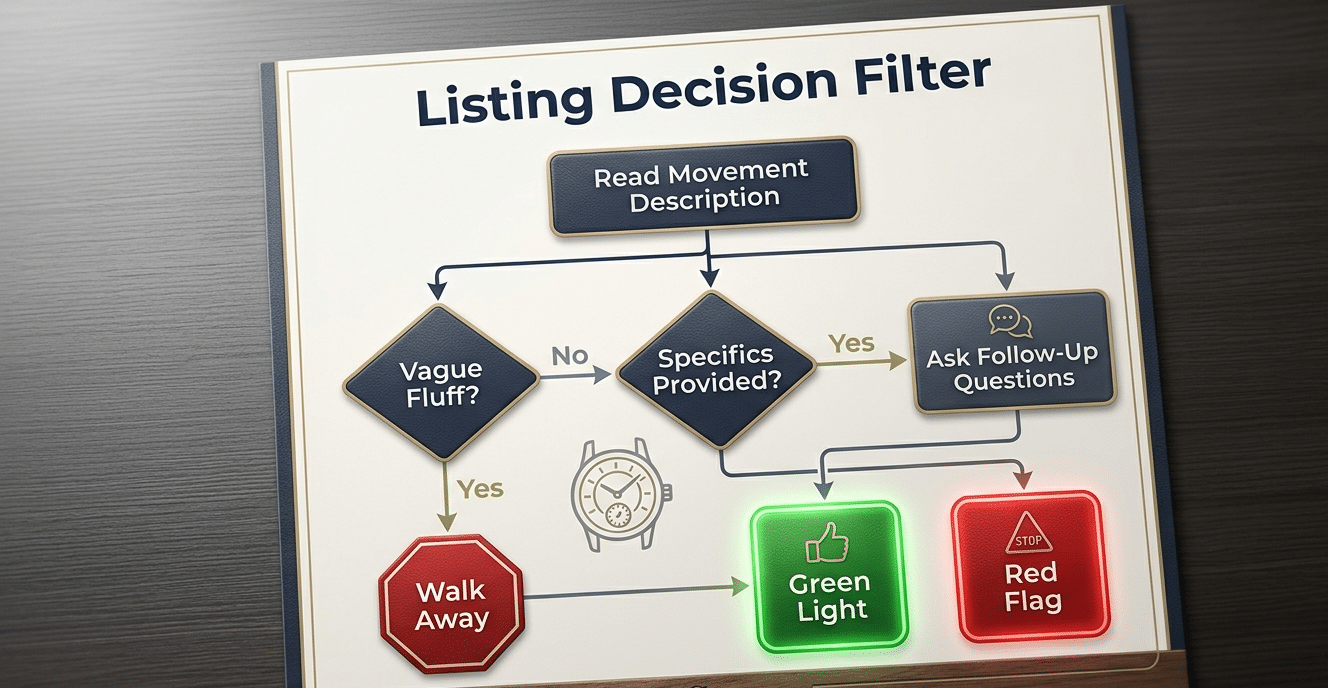
The Anatomy of a Movement Claim: Breaking Down the Seller’s Pitch
You find a watch you like. The photos look sharp. Then you scroll down to the movement description, and you’re hit with a wall of text that reads like a techno-babble poem designed to impress, not inform, which is precisely why a clear Cartier replica movement guide is essential to cut through the jargon and focus on what actually matters for quality and reliability.
“Featuring a high-grade Japanese Miyota 9015 super clone movement, meticulously modified to genuine Cartier Calibre 1847 MC specifications, with a custom engraved rotor and perlage-finished plates for a 1:1 appearance and superior timekeeping.”
It sounds convincing. It’s meant to. But what does any of it actually mean for your decision? Before you get lost in the jargon, you need a filter. The first step is to stop reading for meaning and start reading for structure. Every movement claim, no matter how verbose, is built from just four types of information. Your job is to identify which is which.
The Four Pillars of Any Movement Claim
Think of a seller’s description as a sandwich. The bread might be fancy, but you need to identify the actual ingredients. Every claim fits into one of these four categories:
- Base Architecture: The actual, physical engine inside the watch. This is the non-negotiable starting point. Is it a Miyota 9015? A Seagull ST1812? A generic “Asian 2824”? This tells you about inherent thickness, potential noise, serviceability, and raw reliability.
- Stated Target: What genuine movement the replica is allegedly trying to copy. This is usually a name like “Calibre 1847 MC” or “076.” This matters only if the base architecture has been significantly altered to physically and functionally mimic that target. Often, it’s just an aspirational label.
- Modification Scope: What was physically done to the base movement. This ranges from cosmetic (a new rotor) to necessary (adding a spacer ring) to revolutionary (re-engineering the stem height). This is the most abused and critical category to decode.
- Finish/Decoration: How the movement looks. Perlage, Geneva stripes, blue screws, engraved rotors. This is purely aesthetic. It makes for great macro photos but has zero impact on function, accuracy, or longevity.
A skilled listing will mix all four to create an aura of technical prowess. Your first task is to mentally sort each phrase into its correct pillar. The “super clone” label might be decoration. The “Miyota 9015” is architecture. “Modified to gen spec” could be anything.
Deconstructing a Real Listing Example
Let’s apply the filter to our example phrase:
- “High-grade Japanese Miyota 9015” → Base Architecture. This is specific and meaningful. It tells you the core engine is a known, reliable workhorse about 3.9mm thick.
- “super clone movement” → Vague Marketing. This straddles Stated Target and Modification Scope but is utterly meaningless without context. Is it a “super clone” of the Miyota 9015? Of the Cartier 1847 MC? This phrase demands immediate clarification.
- “meticulously modified to genuine Cartier Calibre 1847 MC specifications” → Stated Target & Modification Scope. The target is named (1847 MC). The claim is modification. But to what degree? Cosmetic finishing? Or actual architectural changes? This is the minefield.
- “with a custom engraved rotor and perlage-finished plates” → Finish/Decoration. Pure aesthetics. This adds to the visual appeal in photos but tells you nothing about performance or functional accuracy.
- “for a 1:1 appearance and superior timekeeping.” → Vague Marketing. Subjective fluff. “1:1” is an overused sales term. “Superior timekeeping” is unquantified and meaningless.
Suddenly, the impressive paragraph collapses into a simple checklist: You have a Miyota 9015 base. Someone has decorated it. They claim it’s modeled after a Cartier calibre. The real question—what, if anything, was functionally changed—remains completely unanswered. That’s the point. The listing is designed to sound comprehensive while hiding the lack of substantive information.
Expert Authentication Insight
Physical diagnostic: The first and most critical test is case thickness. If a listing boasts a “thin, gen-spec movement” but the watch measures 2mm thicker than the genuine article, the entire movement claim is suspect. Thickness is a physical, measurable consequence of the base architecture and any modifications. A genuine Cartier Ballon Bleu 42mm is about 13mm thick. If the replica clocks in at 15mm, no amount of “super clone” or “modified to gen spec” language changes the fact that the movement inside is too thick. Digital calipers don’t lie; marketing copy does.

Base Movement Archaeology: What “Miyota,” “Seagull,” and “Asian 2824” Really Mean
Once you’ve isolated the “Base Architecture” pillar, you need to know what you’re actually getting. These aren’t just brand names; they are blueprints with real-world consequences for thickness, noise, serviceability, and how the watch feels on your wrist. This is where flowery language meets mechanical reality.
The Workhorses: Miyota 9015 vs. Seagull ST16/ST18
For thinner Cartier models like the Tank or the base of many “clone” movements, two families dominate. The choice between them is a fundamental trade-off.
The Miyota 9015 is the industry’s go-to for thin, reliable automatics. At about 3.9mm thick, it allows for slimmer case profiles. Its reliability is proven across millions of watches. The trade-off is its rotor: it’s often described as noisy—a distinct, grinding “zzzzzt” that can be heard during arm movement. In a quiet dress watch, this can be a deal-breaker. For a Santos, where case presence is part of the charm, it might be tolerable.
The Seagull ST16/ST18 series (and its derivatives like the ST1812) is the common Chinese alternative. It’s often a fraction thicker than the Miyota but typically runs quieter. The trade-off here is consistency. While many are robust, Seagull movements can have greater variance in long-term reliability and timekeeping out of the box. They are the backbone of many mid-tier replicas and are perfectly serviceable, but they lack the decades of track record the Miyota boasts.
The Buyer’s Takeaway: If a listing just says “Japanese automatic movement,” it’s almost certainly a Miyota 9015. If it says “high-quality Asian automatic,” it’s likely a Seagull. For a Tank, where thinness is sacred, the Miyota’s profile is a key advantage, noise notwithstanding. For a watch where silence is golden, the Seagull might be the better play, assuming you trust the factory’s quality control.
The “Swiss” and “Asian 2824” Conundrum
This is where the water gets muddy and red flags should start waving.
“Swiss Sellita SW200” or “Genuine ETA 2824-2”: Be deeply skeptical. A genuine Swiss Sellita or ETA movement costs hundreds of dollars on its own. A replica watch claiming to house one, yet priced at $800, is almost certainly lying. At best, it’s a used, refurbished movement of unknown origin. At worst, it’s a complete fabrication. This claim requires extraordinary proof—think of a video of the movement being removed from a sealed Sellita pouch, which you will never get.
“Asian 2824”: This is a category, not a specific movement. It’s a catch-all for clones of the Swiss ETA 2824 design. The quality spectrum is vast:
- High-End (PT5000): Considered one of the best ETA 2824 clones, with good reliability and finishing.
- Mid-Range (Hangzhou 6460): A serviceable, common clone used by many factories.
- Low-End (Generic): No-name clones with poorer materials and erratic performance.
A listing that just says “Asian 2824” is telling you almost nothing. Your immediate follow-up question must be: “Which specific factory or caliber?” If the seller can’t or won’t answer, assume you’re getting the lowest common denominator.
Expert Authentication Insight
Physical diagnostic: Listen to the rotor. This is a simple, post-purchase truth test. Pick up the watch, give your wrist a gentle shake, and listen. A pronounced, grinding “zzzzzt” is the signature of a standard, unmodified Miyota 9015. A much quieter, almost silent sweep points toward a Seagull base or a well-lubricated 2824-clone. If a listing claimed a “quiet, refined Miyota” and you hear the classic grind, you’ve just identified marketing fluff. The sound doesn’t lie about the base architecture.
The “Modified To Gen Spec” Minefield: From Rotor Swaps to True Re-engineering
This is the phrase that separates the overpaying novices from the informed buyers. “Modified to gen spec” can mean a $20 cosmetic upgrade or a $200 engineering feat. For a practical assessment of long-term durability, informed buyers often consult a detailed comparison of automatic Cartier super clone movements. Understanding the hierarchy of modification is critical to assessing value and truth.
Level 1: The Decoration Game (Rotors and Bridges)
This is the most common and least meaningful type of “modification.” It involves adding genuine-looking engravings to the rotor (“Cartier Calibre 1847 MC”), applying perlage (circular graining) or Geneva stripes to the base plate, and maybe bluing some screws. It’s done to make the movement look more authentic in macro photos or if you open the case back.
The Reality: This is purely aesthetic. It has no impact on the movement’s timekeeping, power reserve, reliability, or functionality. A decorated Seagull is still a Seagull. A watch with a “gen-spec decorated rotor” that costs $100 more than an undecorated version is charging you for a photograph, not performance.
Level 2: The Adapter Ring (The Hidden Necessity)
This is where the term “modified” starts to have a technical, but mundane, meaning. Most standard movements (like the 25.6mm diameter ETA 2824) don’t perfectly fit the specific case dimensions of a replica watch. The solution is a movement holder or spacer ring—a plastic or metal ring that fits around the movement to center it and secure it within the case.
The Reality: This is a standard practice in watchmaking, both genuine and replica. It is a necessary adaptation for fit, but it does not make the movement itself any more “genuine” or “clone-like.” It’s a solution to a packaging problem, not an enhancement of the engine. A listing that trumpets “modified to fit case” is often just describing this basic step.
Level 3: True Architectural Changes (The Rare Unicorn)
This is the holy grail and the only modification that fundamentally changes the game. It involves physically altering the movement’s architecture to solve a compatibility issue that decoration or a spacer ring cannot fix. The classic example for Cartier is the Ballon Bleu.
The genuine Ballon Bleu has its crown nestled inside a curved guard. This requires the movement’s stem (the part the crown attaches to) to exit at a very specific height. A standard Miyota 9015’s stem is in the wrong position. A true “super clone” for the Ballon Bleu, like those from top factories, either uses a custom movement base plate or adds a module to re-route the gearing and change the stem height. This is complex, expensive, and what justifies a significant price premium (often pushing the watch toward the $800 mark).
The Reality: This level of modification is rare. It’s a major factory undertaking, not a aftermarket tweak. It’s what truly allows a replica to achieve correct case proportions and functionality. When you see this claimed, the listing should be from a known top-tier factory (like BVF or 3KF for Santos) and the price will reflect it.
Expert Authentication Insight
Physical diagnostic: Open the case back. The evidence is visible. For Level 1 (Decoration), you’ll see nice finishing but a standard movement layout. For Level 2 (Adapter Ring), you’ll see a distinct, often plastic, ring surrounding the movement’s edge, separating it from the case. For Level 3 (Architectural Change), you’ll see obvious, non-standard machining on the movement’s main plate—additional gears, shifted bridges, or a completely custom plate design. The absence of a simple spacer ring and the presence of atypical machinery is the hallmark of a true, functionally modified movement.
Vague Padding vs. Actionable Intel: A Phrase-by-Phrase Glossary
This is your translator. In the world of Cartier replica listings, language is a weapon of both information and obfuscation. The goal here is to strip away the marketing veneer and give you a blunt, practical decoder for the most common phrases you’ll encounter. Consider this your cheat sheet for separating signal from noise.
Meaningless Fluff Phrases
These are the empty calories of listing copy. They sound good but convey zero technical information. They are filler designed to create an impression of quality without making a single falsifiable claim.
“High-Quality Movement”
- Seller Says: A blanket term of approval.
- Buyer Hears: Nothing. Every seller says this. It has no definition. Ignore it completely. The only thing that matters is what specific movement it is.
“Smooth Sweep”
- Seller Says: The seconds hand moves fluidly.
- Buyer Hears: It’s a standard mechanical movement with a balance wheel oscillating at 28,800 vph (8 beats per second). This is true for 99% of the movements used. It’s like advertising a car has “round wheels.” It’s a basic feature, not a premium one.
“Reliable” or “Stable”
- Seller Says: It won’t break immediately.
- Buyer Hears: An expectation, not a guarantee. A Seagull ST2130 is generally reliable. A no-name “Asian 2824” from a ghost factory might not be. The word itself tells you nothing about the movement’s origin or proven track record.
“Best Edition,” “Latest Version,” “1:1”
- Seller Says: This is the top version available.
- Buyer Hears: Marketing superlatives. Without naming the factory (e.g., AF, BVF, GF) or detailing the specific upgrades from a previous version, these terms are meaningless. Every seller claims to have the “best.”
Phrases That Require Immediate Follow-Up
These terms could indicate something important, or they could be cleverly deployed vagaries. Your job is to drill down immediately.
“Clone Movement”
- Seller Says: The movement is made to look like a genuine Cartier calibre.
- Buyer Hears/Should Ask: “What kind of clone? Is it a decorated clone (a standard Miyota 9015 with custom rotor and plates) or a true super clone (an architectural copy like the 1847 MC clone in a Santos)?” This distinction is the difference between a cosmetic trick and a genuine engineering effort.
“Super Clone”
- Seller Says: The highest grade of replication.
- Buyer Hears/Should Ask: “Super clone of what? Which genuine movement is it cloning? And which factory produces it?” For a Santos, a “super clone” should refer to a factory like BVF or 3KF’s clone of the Cartier 1847 MC. For a Tank, it’s often a marketing term for a thin Seagull movement. Context is everything.
“Custom Movement” or “Modified Movement”
- Seller Says: The movement has been altered for this watch.
- Buyer Hears/Should Ask: “Modified how? Is it a cosmetic change (custom rotor), a simple adaptation (spacer ring), or a true architectural change (repositioned stem height for a Ballon Bleu)?” As outlined earlier, the level of modification dictates the price and value.
“Upgraded Movement”
- Seller Says: Better than the standard movement.
- Buyer Hears/Should Ask: “Upgraded from what? And upgraded with what?” Upgraded could mean a better base (Seagull to Miyota), better regulation, or extra decoration. You need the specifics to judge if the upgrade is worth a premium.
“Quiet Rotor”
- Seller Says: The automatic winding mechanism is silent.
- Buyer Hears/Should Ask: This is primarily relevant for watches using the Miyota 9015, which is notoriously audible. Ask: “Has the rotor been lubricated, fitted with new bearings, or otherwise modified to reduce noise?” If the seller cannot detail the modification, assume it’s a stock 9015 and will have its characteristic rotor whir.
Phrases That Actually Convey Information
These are the gold nuggets. When you see these, the seller is providing concrete, researchable data. These phrases should form the foundation of your evaluation.
Specific Base Movement Calibers: “Miyota 9015,” “Seagull ST2130,” “Seagull ST1812,” “NH05A”
- What it means: This names the actual engine. You can now research its thickness, reliability, noise profile, and serviceability. This is the single most important piece of information in any listing.
Factory Names: “AF Factory,” “BVF,” “GF,” “3KF”
- What it means: For models like the Santos where the factory defines the movement approach, this is critical. A “BVF Santos” implies their specific clone of the 1847 MC movement. The factory name often carries more weight than vague “super clone” claims.
Specific Modification Goals: “Modified for correct crown position,” “Thinned to 9.5mm,” “Fitted with movement spacer for case”
- What it means: These are actionable technical claims. They address a known replica challenge (Ballon Bleu crown, Tank thickness, case compatibility). They give you a direct point of verification in photos or QC.
Quantified Performance: “Regulated to +/- 5s per day,” “Timegrapher results provided”
- What it means: This moves from subjective “high precision” to an objective, measurable claim. It invites proof (a timegrapher screenshot) and sets a performance expectation.
Expert Authentication Insight
Physical diagnostic: The litmus test for any performance claim is a timegrapher. Phrases like “high precision” or “excellent accuracy” are just hot air without data. A trustworthy seller should be able and willing to provide a timegrapher screenshot for the exact watch you are buying, showing its rate (e.g., +2 s/d), amplitude (270-310 is healthy), and beat error (<0.5 ms is good). This simple request separates serious sellers from those trading in vague promises.

The Cartier Model Matrix: Which Movement Claims Matter for Your Watch
Not all movement claims are created equal. Their importance is entirely dictated by the specific Cartier model you’re buying. A critical claim for a Ballon Bleu is irrelevant for a Santos. Here’s where to focus your analytical energy for each major series.
Tank & Dress Models: The War on Thickness
For the Cartier Tank Solo, Louis, or Must, the paramount movement consideration is one thing: profile. The genuine article is famously slender, and a deeper understanding of Cartier super clone movements explained is essential for evaluating replica specifications. A replica that gets the dial right but is 2mm thicker fails fundamentally. Therefore, your filter for any Tank listing is brutally simple.
Primary Scrutiny: Case thickness specification. The listing must state a measurement in millimeters (e.g., “6.5mm thick” for a Tank Solo). Any claim of “ultra-thin movement” is meaningless without this number. The base movement is almost always a thin Seagull (like an ST1812) or a heavily modified other caliber. Rotor noise is a secondary concern for a dress watch that may see less wrist motion.
Actionable Filter: Ignore all decorative language. Your first and only question should be about the measured case thickness. Compare it to genuine specs. Everything else is a distant second.
Ballon Bleu: The Crown Position Imperative
The Ballon Bleu presents a unique and non-negotiable engineering challenge: integrating the crown within its signature convex guard. A standard movement places the stem too low, resulting in a “sunken” crown that sits awkwardly deep within the guard, a dead giveaway.
Primary Scrutiny: Any claim related to crown stem height or movement modification. The listing must explicitly address this. Phrases like “modified for correct crown position,” “corrected stem height,” or “gen-spec crown placement” are what you’re hunting for. This is a Level 3 architectural modification.
Actionable Filter: This is a binary switch. If a Ballon Bleu listing does not explicitly mention a modification for crown position, you can assume it uses an unmodified movement and the crown will be sunken. Walk away. This is the single most important movement claim for this model.
Santos, Pasha, and Sports Models: The Factory & Movement Clone Hierarchy
For the Santos de Cartier (and to a lesser extent, the Pasha), the movement claim is intrinsically tied to the factory claim. The best replicas of these watches use purpose-built clone movements that mimic the genuine Cartier calibre (e.g., 1847 MC, 3285). The factory that produces the watch is also producing—or sourcing—that specific movement.
Primary Scrutiny: Factory identification and specific clone movement naming. Listings should mention factories like BVF, 3KF, or GF for Santos. The claim should be something like “BVF factory with clone 1847 MC movement.” Here, “super clone” is a meaningful term if it refers to these factories’ in-house developments.
Actionable Filter: Prioritize listings that name the factory. “Santos super clone” is vague. “BVF Santos 1847 MC clone” is specific and researchable. The factory name is your shorthand for the movement solution and overall build quality. For these models, the movement is the centerpiece of the replica’s claim to fame.
Expert Authentication Insight
Physical diagnostic: For the Ballon Bleu, the proof is in the profile shot. Before buying, compare the seller’s side-view photo to a genuine reference image. Does the crown protrude to the edge of the blue sapphire cabochon, sitting flush with the guard? If it’s recessed, the movement modification claim is false. For the Santos, examine the date window alignment and the cyclops magnification. Misaligned dates or a cyclops that doesn’t properly magnify are common tells of a lower-tier, non-clone movement hiding inside a “super clone” case.
The Pre-Purchase Interrogation: Essential Questions for Your Seller
Now you move from analysis to action. Reading a listing critically is step one. Step two is engaging the seller with targeted questions that cut through the remaining fog. Frame these not as accusations, but as the reasonable due diligence of a knowledgeable buyer. A transparent seller will have answers. An evasive one will reveal themselves.
Questions to Verify Base Architecture
- “Can you confirm the exact base movement caliber? For example, is this a Miyota 9015, a Seagull ST2130, or a clone of the Cartier 1847 MC?”
Why it works: Forces specificity. It separates “clone” from “decorated base movement.”
- “Which factory produced this watch? Is this from AF, BVF, GF, etc.?”
Why it works: For factory-centric models (Santos), this is the most important question. For others, it establishes provenance.
Questions to Verify Performance Claims
- “Do you have a timegrapher screenshot for this specific watch? Can you share the rate, amplitude, and beat error?”
Why it works: The only objective proof for “high precision” or “accurate movement” claims. A good seller will provide this routinely.
- “Has the movement been regulated before shipping?”
Why it works: Shows you expect care. A “yes” is standard for better dealers. A “no” or “it’s already accurate” is a weak response.
Questions to Verify Physical Specifications
- “What is the exact case thickness of this watch in millimeters?”
Why it works: Critical for Tanks and any slim model. A seller who doesn’t know or gives a vague answer hasn’t measured it.
- “For this Ballon Bleu, can you confirm the movement has been modified for the correct crown position? Can you provide a clear side-profile photo showing the crown’s placement?”
Why it works: Directly addresses the model’s key flaw. A legitimate seller will have the photo and be proud to show the modification.
- “Can you provide a clear video of the movement functioning? I’d like to see the winding, time-setting, and date change (if applicable) in action.”
Why it works: Tests basic functionality and the seller’s transparency. Blurry photos or a refusal are major red flags.
Expert Authentication Insight
Physical diagnostic: The seller’s response to a request for a detailed movement video is a powerful transparency proxy. A clear, close-up video showing smooth winding, crisp date change at midnight, and steady running is worth a thousand marketing adjectives. Sellers who only provide still photos of a static movement, or who use blurry, recycled footage, are often hiding poor finishing, incorrect function, or a completely different movement than advertised. Willingness to provide this simple evidence often separates reputable sources from the rest.
Red Flags & Green Lights: Translating Listings into Go/No-Go Decisions
All the analysis in the world is useless if you can’t translate it into a clear, immediate action. This section is your final filter. It converts the complex language of listings into simple, binary signals: proceed with interest, or walk away immediately. Your goal isn’t to find the perfect listing—it’s to efficiently eliminate the bad ones and identify the few that are worth your time and money.
Instant Dismissal Signals (Red Flags)
These are the deal-breakers. When you see any of these, close the tab. The risk of disappointment or outright deception is too high.
- Exclusively Vague Language: The entire movement description is a cloud of meaningless adjectives: “high-quality,” “super reliable,” “best edition,” “smooth sweep.” If there are no specific movement names (Miyota 9015), factory codes (BVF, AF), or model numbers (ST1812), the seller is selling smoke.
- The “Swiss ETA” Mirage at Standard Prices: A listing for a $700-800 USD replica claiming a “Swiss ETA 2824” is almost certainly lying. Genuine, new Swiss ETA/Sellita movements cost nearly that much alone. At this price point, you’re being offered a refurbished old movement of unknown origin or, more likely, a straight-up Asian clone falsely labeled.
- The Ballon Bleu Crown Omission: For a Cartier Ballon Bleu, if the listing does not explicitly mention crown position modification or a movement built for the correct 4 o’clock stem height, it is selling a watch with a visibly sunken crown. This is a fundamental design flaw. Walk away.
- Seller Obfuscation on Basic Facts: You ask for the case thickness or a timegrapher screenshot, and you get evasion: “It’s standard,” “Trust me, it’s good,” or “I don’t have that info.” A transparent seller has these details on hand. Refusal is a major red flag.
- Stock Photos Only, No Actual Watch: If every image is a generic, watermarked factory photo with no shots of the actual watch’s serial number, case back, or movement (if visible), you cannot verify what you’re getting. This is a hallmark of drop-shippers or sellers with inconsistent inventory.
Signs of a Knowledgeable or Transparent Seller (Green Lights)
These signals indicate a listing—and more importantly, a seller—that understands the product and respects an informed buyer. These are worth your further investigation.
- Specificity in Movement Nomenclature: The listing names the base movement by its actual factory and caliber: “Seagull ST1812,” “Miyota 9015,” “PT5000.” It may even state the target: “Clone of Cal. 1847 MC.” This shows a baseline of technical knowledge.
- Factory Acknowledgement for Key Models: For Santos or high-end Ballon Bleu clones, the listing names the factory: “BVF Factory,” “3K Version.” This correlates directly with a known quality standard and specific movement solution.
- Honesty About Modifications: Phrases like “fitted with movement spacer for correct case size” or “uses a custom movement holder” are truthful admissions of standard practice, not attempts to pass it off as advanced engineering. This is a sign of credibility.
- Provision of Concrete Evidence: The listing includes, or the seller promptly provides, a timegrapher screenshot with amplitude, beat error, and rate (+/- sec/day) readings. They offer a macro photo of the movement’s engravings or a video showing the watch functions. This is transparency in action.
- Clear, Unedited Photos of the Actual Piece: Multiple high-resolution images show the exact watch for sale, including case back engravings, clasp code, and serial number. This allows for cross-referencing and shows the seller has physical inventory.
The Amber Zone: Claims That Require Heavy Diligence
These are not immediate red or green lights. They are yellow—proceed, but only with extreme caution and specific verification.
- “Super Clone Movement”: This term has been diluted. It can mean a true architectural clone (like the 324SC for Santos). It can also mean a nicely decorated standard movement. Your immediate follow-up question must be: “What is the base movement, and what specifically has been cloned or modified?” Demand specifics.
- “Quiet Rotor” on a Miyota-based watch: The standard Miyota 9015 rotor is notoriously audible. A claim of “specially lubricated for quiet operation” is plausible but must be verified. Ask if this is a standard feature of this factory’s version or a post-purchase modification. Assume it’s not quiet until proven otherwise.
- Any claim of “Upgraded” or “Latest Version”: This is often just marketing for a new batch. Ask: “What was upgraded from the previous version?” Legitimate upgrades (e.g., a corrected date wheel font, improved lume) are specific. Vague answers indicate no real change.
- Listings at the Extreme High End ($1000+ USD): At this price, expectations are sky-high. The listing must be flawless in its documentation: movement macro videos, proof of any claimed Swiss parts, and crystal-clear communication. The margin for error here is zero.
Expert Authentication Insight
The Final Pre-Purchase Verification: Before sending payment, request a clear, close-up photo of the movement’s bridge, focusing on any serial numbers or factory-specific engravings. Reputable factories like VSF, Clean, or BVF have consistent, clean laser engravings. A movement with blurry, shallow, or completely absent markings is a strong indicator of a lower-tier, generic movement—confirming the suspicions raised by an ambiguous listing. This one image can bridge the gap between a seller’s claims and the watch’s reality.