
The Tape Measure Lie: Why Wrist Circumference is a Flawed Metric
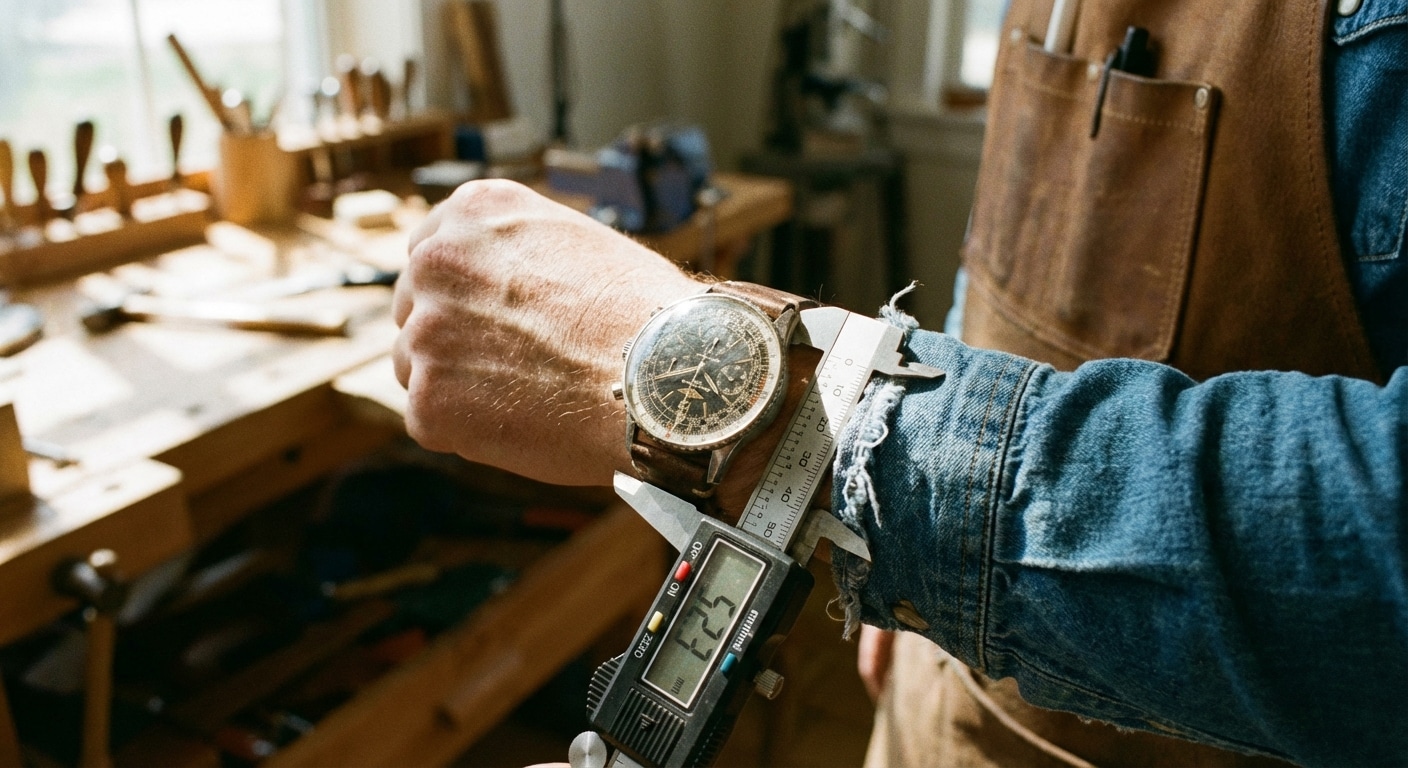
For decades, the watch industry has relied on a single, fundamentally deceptive measurement to dictate wearability: wrist circumference. Wrapping a flexible tape measure around your arm tells you nothing about how a rigid steel instrument will actually sit against your skeleton. When evaluating a piece of heavy aviation hardware like the Breitling Navitimer, or assessing Breitling replicas for small wrists, circumference is a vanity metric. The true determinants of proportional balance are wrist span, bone structure, and the resulting lug-to-lug clearance.
The Cylinder vs. Flat Oval Dilemma
A 17cm wrist shaped like a perfect cylinder cannot support the same case dimensions as a 17cm wrist shaped like a flat oval. The Navitimer features long, relatively straight lugs that demand a broad, flat surface area to anchor properly. When a wearer with a highly cylindrical wrist attempts to strap on the 46mm case, the lugs instantly protrude past the flesh. This creates a visual “dinner plate” effect, where the watch head appears to float above the arm. More importantly, the lack of foundational support causes severe lateral case wobble during daily wear, turning a luxury instrument into a constant ergonomic annoyance.
Mapping the Ulna Bone Position
The position of your ulnar styloid process—the prominent wrist bone on the outer edge of your arm—dictates exactly where the watch must sit. Modern remote-work ergonomics mean watches are frequently pushed further up the arm to avoid constant friction against laptop palm rests. If your ulna bone is highly pronounced and sits close to the hand, a massive 46mm case will constantly grind against it. The sheer diameter of the larger Navitimer ensures that the case edge will overlap this bone on most wrists, making long-term wear physically unbearable compared to the more compact 43mm variant.
Expert Authentication Insight
To determine your actual capacity for a larger case, abandon the tape measure and utilize digital calipers to measure the flat top span of your wrist just above the bone. If your flat wrist span measures less than 53mm, a watch with a 52mm lug-to-lug distance like the 46mm Navitimer will structurally fail to fit. This is a hard geometric boundary that no amount of total wrist circumference can override.
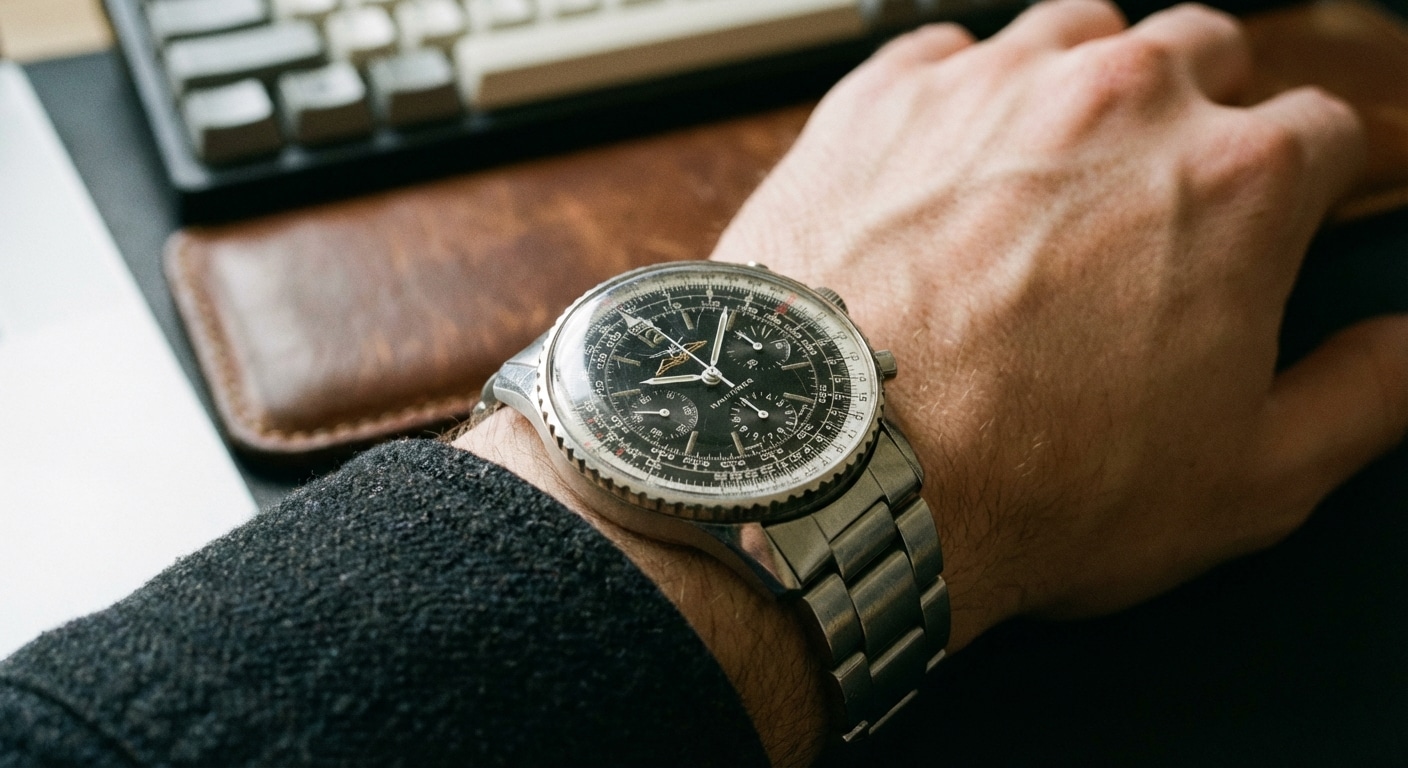
To understand why the 43mm Navitimer is often the superior choice, you must look past the stated diameter and examine its true physical footprint. Breitling cases are heavily engineered, but their on-wrist presence is often manipulated by dial architecture. The optical presence of this watch differs wildly from its raw specifications, leading many buyers to fundamentally misunderstand how it will scale to their body.
Visual Compression of the Slide Rule Bezel
The Navitimer is notorious for wearing significantly smaller than its dimensional width implies. The complex, highly detailed internal slide rule bezel creates a dense perimeter that visually compresses the dial. Because the eye is drawn inward toward the busy chronograph registers, a 43mm Navitimer actually projects the dial presence of a typical 41mm dive watch. This visual compression tricks many buyers into assuming the watch is too small for them, prompting a disastrous sizing up to the 46mm model before factoring in the actual lug span.
The 49mm Lug-to-Lug Reality
The most critical metric of the 43mm Navitimer is not its diameter, but its approximate 49mm lug-to-lug distance. This dimension comfortably anchors to wrists down to 16cm provided the wrist possesses a flat topology. Furthermore, the downward curvature of the lugs on modern 43mm iterations actively mitigates the gap between the case back and the skin. By wrapping downward, the lugs stabilize the watch’s center of gravity, pulling the mass closer to the arm and reducing wear fatigue over a twelve-hour day.
Expert Authentication Insight
When testing the 43mm case, verify the end-link articulation angle. On a properly fitting Navitimer, the first link of the bracelet or the leather strap should drop away from the case at an angle between 45 and 80 degrees, a dynamic profile often scrutinized in a Breitling wrist roll gallery. If the strap drops straight down at a harsh 90-degree angle, the watch is sitting at the absolute maximum limit of your flat wrist span, and any larger size will result in severe lug overhang.
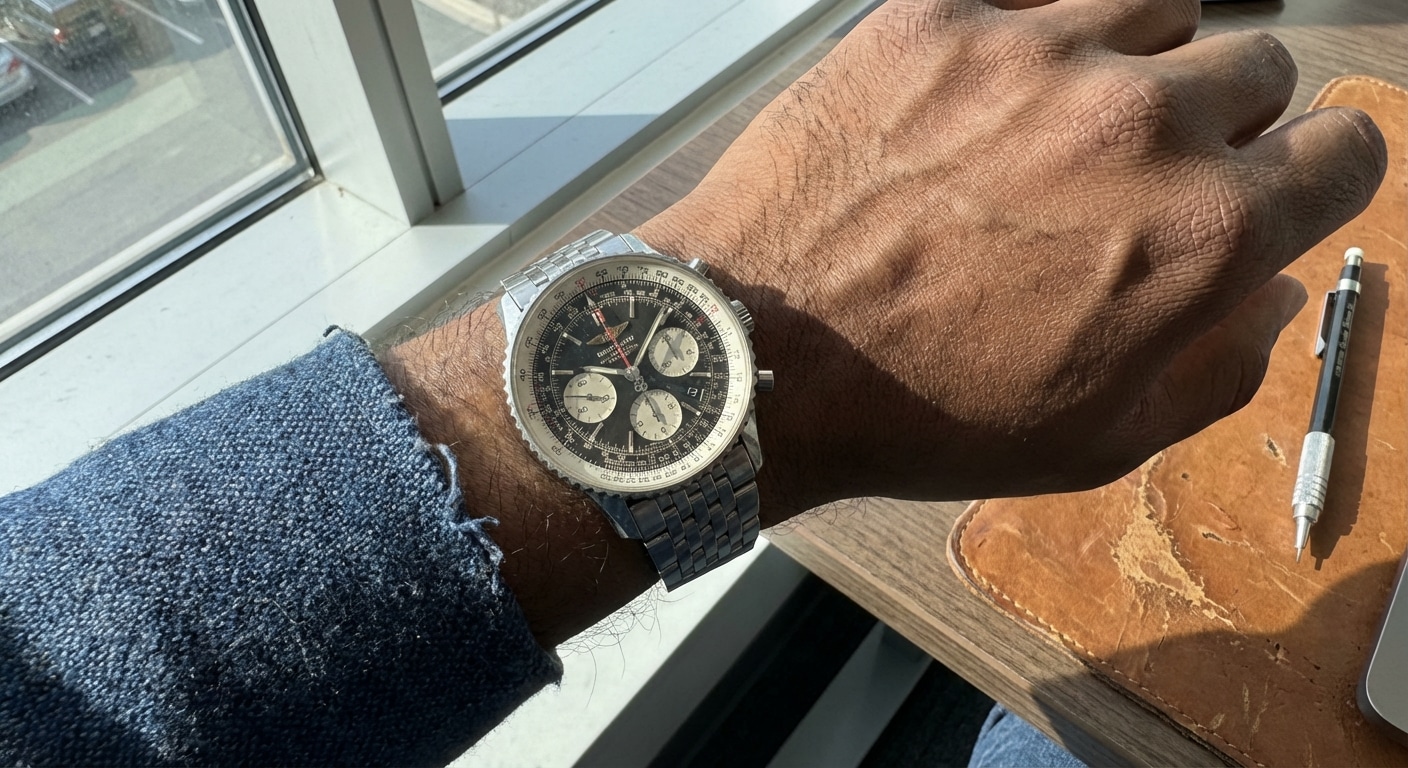
The watch industry thrives on the platitude that you should “wear what you want,” but physical geometry does not care about your enthusiasm. The 46mm Navitimer is a massive, uncompromising piece of steel. Attempting to force this watch onto an incompatible wrist results in a total breakdown of the proportional balance intended by its original mid-century aviation design.
The Illusion of “Pulling It Off”
Let’s establish a hard rule for modern watch fitting: If your wrist circumference is under 17cm, the 46mm Navitimer is an ergonomic failure. You are not “pulling it off.” When the lugs extend beyond the physical bounds of your wrist, it creates a rigid gap where the strap pulls sharply inward toward the buckle rather than wrapping naturally around the arm. This teardrop-shaped negative space is the ultimate indicator of an oversized watch, ruining the silhouette and exposing the wearer’s misunderstanding of case proportions.
Weight Distribution and Rotational Fatigue
A 46mm steel chronograph carries significant top-heavy mass. On a wrist smaller than 17cm, the lack of adequate flat surface area means the watch cannot anchor itself against gravity. This inevitability leads to rotational fatigue. The watch will constantly slip toward the outside of the wrist, pulling the skin and requiring the wearer to physically shake their arm or adjust the strap dozens of times a day just to read the time. Over-tightening the strap to prevent this slippage only leads to restricted blood flow and clasp pressure points.
Expert Authentication Insight
To definitively prove a sizing mismatch, perform the Lug Overhang Shadow Test. View the worn watch from directly above under harsh overhead lighting. If you can see a shadow cast directly beneath the tips of the lugs onto the floor or table—meaning there is absolutely no wrist flesh directly beneath the lug tips to support them—the watch is objectively too large for your skeletal frame.
The 2026 Physical Mockup Protocol
Because trying on watches in brightly lit boutiques is increasingly being replaced by online purchasing, relying on a retailer’s mirror to judge proportion is a luxury of the past. To combat the optical illusions of macro photography and manufacturer spec sheets, utilizing a 1:1 printable paper mockup is now a mandatory step. You cannot judge flat-span coverage by wrapping a flexible tape measure around your arm; you need a rigid, two-dimensional representation of the exact dial, bezel, and lug-to-lug distance.
Deploying the 1:1 Printable Template
The methodology is brutally simple but highly effective. By printing the exact dimensional footprint of both the 43mm and 46mm cases, cutting them out, and taping them directly to your wrist, you instantly visualize the true coverage. This bypasses the subjective “looks good to me” bias. When you look straight down at your arm, the paper template will either sit cleanly within the boundaries of your wrist span, or the paper lugs will protrude past your skin, immediately indicating a structural failure in proportional balance.
Simulating Case Thickness and Cuff Friction
Paper templates have one glaring flaw: they lack Z-axis volume. A flat piece of paper cannot simulate the 14.2mm case thickness of a modern Navitimer B01. To accurately recreate the physical mass, stack three standard quarters beneath the paper template before taping it down. This physically demonstrates how the 46mm case proportions analyzed in a Breitling replica size guide will interact with a tailored shirt cuff or a modern fitted jacket. More often than not, this simulation reveals that the larger diameter combined with the vertical height causes the cuff to catch aggressively on the 3 o’clock crown, making daily office wear an exercise in constant sleeve-pulling.
Expert Authentication Insight
To perform a Template Curvature Validation, tape the 1:1 mockup to your wrist and press down firmly on the center of the paper dial. If the paper lugs lift off your skin by more than 2mm on either side, stop right there. This lift indicates that the rigid steel case of the actual watch will create a massive, uncomfortable air gap, completely ruining the wrist bone clearance and stability of the timepiece.
Bracelet vs. Strap: The Final Fit Variable
The dimensions of the watch head only tell half the story. How that mass is tethered to your arm fundamentally alters the wearing experience. The choice between Breitling’s signature metal bracelet and a traditional leather strap will drastically shift the wear fatigue and perceived scale of both the 43mm and 46mm cases.
The Seven-Link Bracelet Drape Factor
Breitling’s iconic seven-link Navitimer bracelet is a masterpiece of articulation, but it adds significant visual bulk and physical weight to the equation. On the 43mm case, this heavy steel bracelet provides an excellent counterbalance, anchoring the watch securely and preventing it from feeling top-heavy. However, on the 46mm case, it effectively turns the watch into a massive, unyielding steel cuff. Furthermore, the solid end-links of the bracelet flare out slightly wider than a standard strap, effectively adding 1mm to 2mm to the perceived lug-to-lug distance. If your wrist is borderline, the bracelet will push it over the edge into oversized territory.
Calfskin Break-in and Case Stabilization
Conversely, a fresh Breitling calfskin or alligator strap comes with high articulation resistance. Out of the box, the leather is rigid and will initially force the watch to sit high off the wrist, creating an awkward gap. For wrists hovering around the 17cm mark attempting to support the 46mm case, this initial rigidity makes the watch functionally unwearable. The leather must be aggressively massaged and broken in to allow the strap to drop straight down from the lugs at a steep angle, minimizing the lateral footprint and stabilizing the center of gravity.
Expert Authentication Insight
Conduct a clasp pressure point mapping test. After six hours of continuous wear, remove the watch and examine the underside of your wrist. If you see a deep, red indentation from the deployant clasp mechanism, the watch head is inherently too heavy and wide for your wrist span. This mark proves you are subconsciously over-tightening the strap to prevent the severe rotational wobble caused by an oversized case.
Do not let a commissioned salesperson or a forum echo chamber convince you that a watch fits just because you can physically fasten the buckle. The physics of wrist span and lug-to-lug distance do not care about your brand enthusiasm or how much you love the dial color. Before you spend thousands of dollars on a Navitimer, take digital calipers to your wrist, download the 1:1 paper template, and accept the hard mathematical truth of human ergonomics. If your wrist is under 17cm, the 43mm is your absolute ceiling. Force the 46mm onto a smaller arm, and you will be left with a top-heavy, ergonomically flawed mistake that spends far more time sitting in your watch box than it ever will on your wrist.