
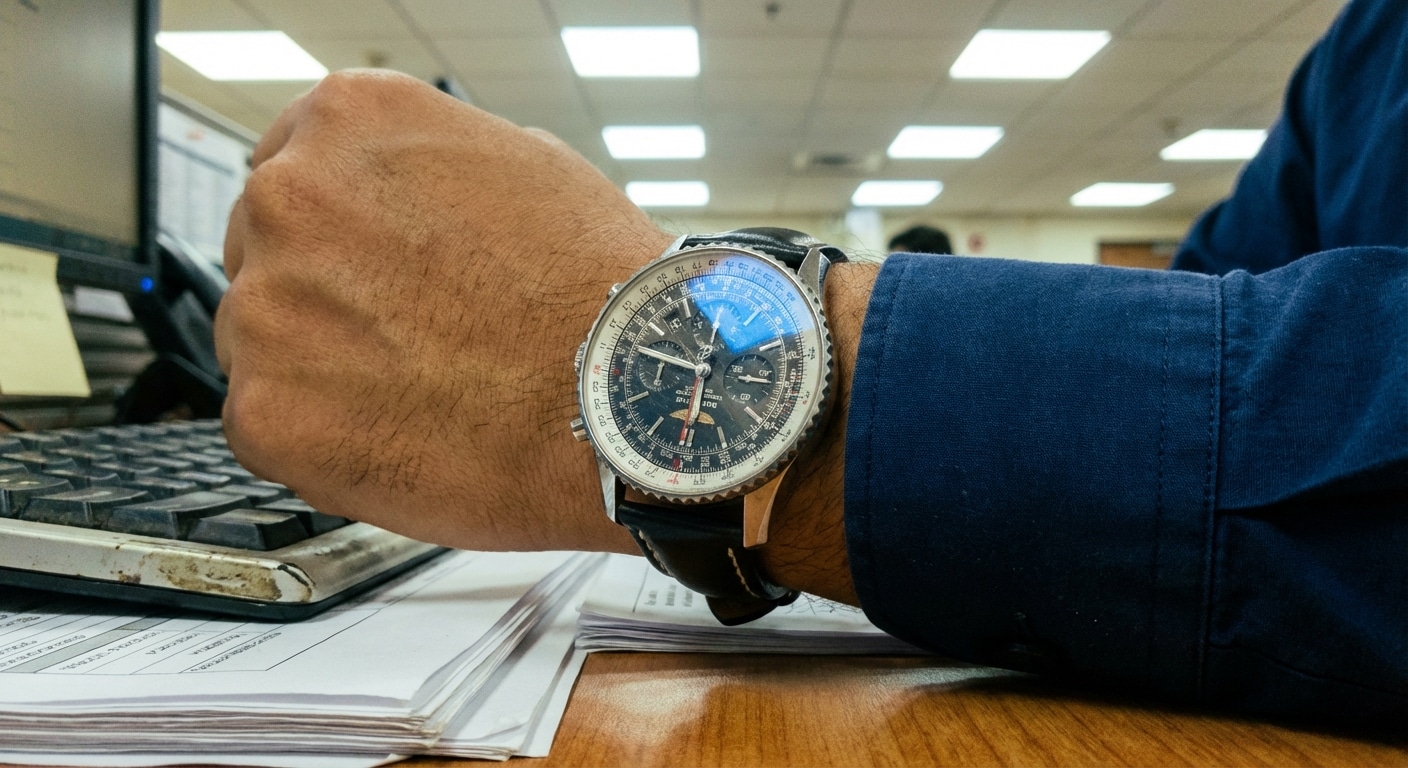
There is a distinct difference between how a watch presents in a meticulously lit photography lightbox and how it survives the aggressive 4000K overhead lighting of a modern corporate office. The Navitimer is inherently complex, and depending on the specific 43mm vs 46mm Navitimer size, the expanded crystal surface area significantly alters ambient light refraction. When you combine its densely packed slide-rule dial with the aftermarket double-sided AR coating found on replicas, you create a perfect storm for visual interference. This section isolates how the specific materials used in Navitimer clones react to the unforgiving environment of the nine-to-five desk grind.
This submission documents a grueling eight-hour daily wear cycle. On a 16.5cm wrist, the 43mm Navitimer B01 consumes the entirety of the flat wrist surface. The wearer reports that the weight distribution on the padded leather strap is surprisingly balanced, preventing the top-heavy case from rotating outward. However, the ergonomic victory is overshadowed by a severe optical failure. When struck by direct overhead LED panels, the crystal produces a distinct, cloudy blue-hue reflection. At a standard 45-degree typing angle, this glare completely obscures the sub-dials and makes the tachymeter scale unreadable. The wearer’s verdict is definitive: they will not repurchase, citing the visual clutter and heavy glare as too distracting for a daily office companion.
Captured at 3 PM near a window blending natural daylight with fluorescent ambient light, this submission highlights the importance of proportional scaling. The 41mm case sits perfectly flush against the wrist bone of the 18cm wrist, demonstrating an ideal lug-to-lug clearance with zero overhang. The wearer notes that the beaded bezel catches mixed lighting beautifully, offering a premium visual experience. Yet, the physical toll emerges after six hours of desk work. The thick steel of the replica deployant clasp creates a sharp pressure point, digging painfully into the underside of the wrist during extended typing sessions. The wearer intends to keep the watch but plans an immediate swap to a traditional tang buckle to eliminate the desk-diving friction.
Expert Authentication Insight
To assess the AR coating quality on any Navitimer under office lights, perform a simple physical diagnostic: tilt the dial to exactly 30 degrees away from the primary light source. A high-tier clone will exhibit a faint, translucent blue or entirely clear reflection that allows the dial text to remain legible. Lower-tier crystals betray their origins by acting like a harsh mirror, reflecting a solid white glare that completely washes out the intricate slide-rule scale.
Direct Sunlight & Heat Expansion: Superocean Heritage on Rubber
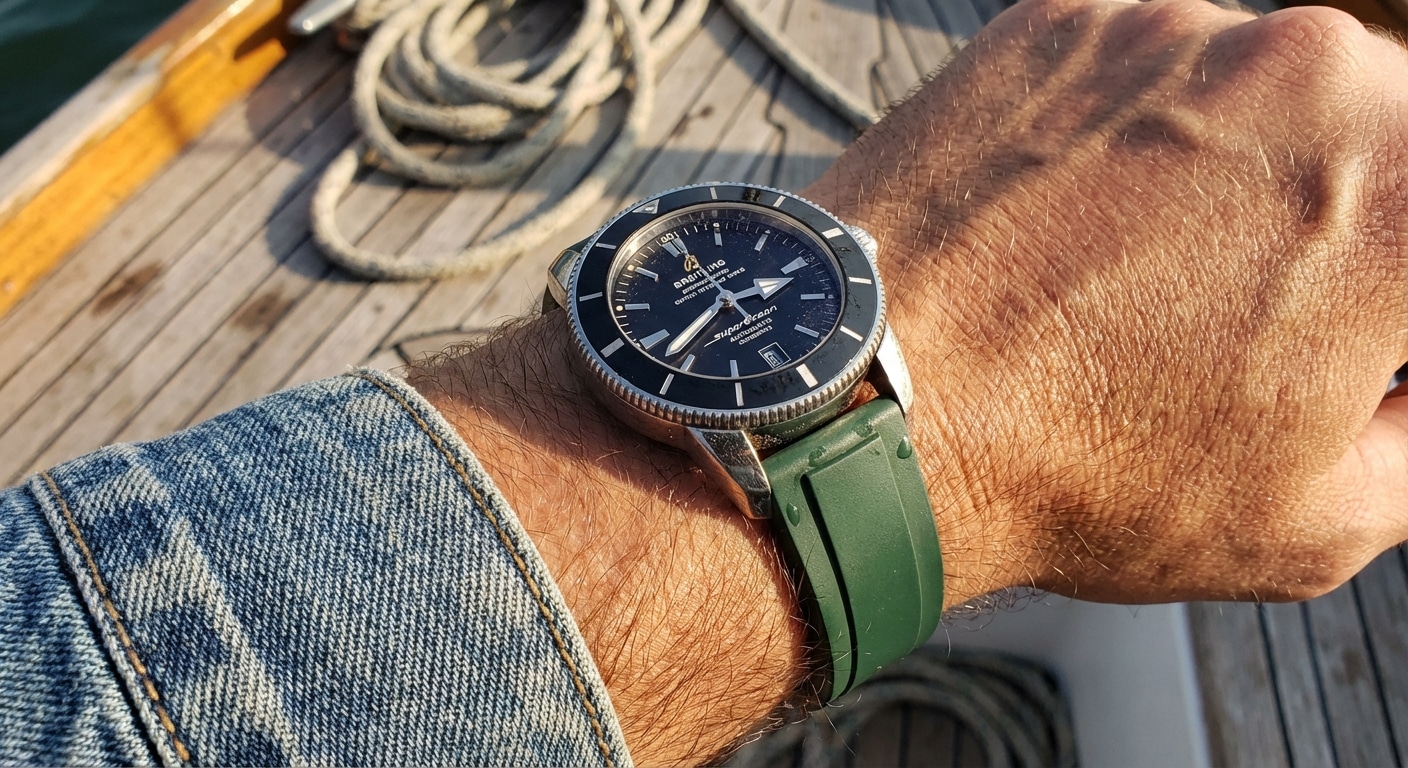
Summer wear exposes the hidden flaws in replica manufacturing that air-conditioned environments mask. When ambient temperatures rise, materials expand, and human skin reacts to prolonged friction. The Superocean Heritage, often paired with a thick rubber strap, becomes a prime candidate for thermal testing. We asked owners to document how these summer watch replicas handle direct UV exposure, heat expansion, and sweat retention.
Submission 03: 17cm Wrist, 42mm Superocean Heritage (90°F / 32°C Conditions)
Photographed outdoors in direct noon sunlight, this 42mm Superocean Heritage reveals the true color saturation of its green sunburst dial—a detail the wearer absolutely loves. Aesthetically, the watch thrives in the sun. Ergonomically, it fails. After four hours of wear in 90-degree heat, the critical flaw of the replica rubber strap becomes impossible to ignore. Lacking the precise ventilation channels and premium vulcanized compound of the genuine article, the strap acts as a thermal trap. The resulting sweat pooling caused noticeable skin irritation and redness around the wearer’s wrist. The buyer remains enthusiastic about the watch head but vows to only wear it on a mesh bracelet moving forward.
Submission 04: 19cm Wrist, 44mm Superocean Heritage (Post-Swim, Tan Skin Tone)
This poolside submission captures water droplets resting heavily on the ceramic bezel. On a robust 19cm wrist, the larger 44mm Superocean Heritage looks perfectly scaled, anchoring the arm without looking bloated. The wearer reports that the bezel articulation remains remarkably crisp even when wet, avoiding the mushy rotation often found in cheaper dive clones. However, the heat took a different toll here. The micro-adjust mechanism housed inside the replica steel clasp jammed completely. Slight thermal expansion of the inferior steel components under the direct sun caused the internal springs to bind. The wearer managed to free it later with manual lubrication, but the failure highlights the precise tolerances lost in replica manufacturing.
Expert Authentication Insight
You can verify the structural integrity of a replica rubber strap by measuring the tolerance at the lugs immediately after prolonged heat exposure. A properly manufactured strap will maintain a rigid, uniform gap of less than 0.5mm at the case integration point, even at 90°F. Inferior rubber compounds will soften significantly in the heat, allowing the internal spring bar to flex under tension and creating a visible, uneven gap when the wrist rotates.
The Desk-Diver’s Toll: Chronomat Rouleaux Bracelet Wear Patterns
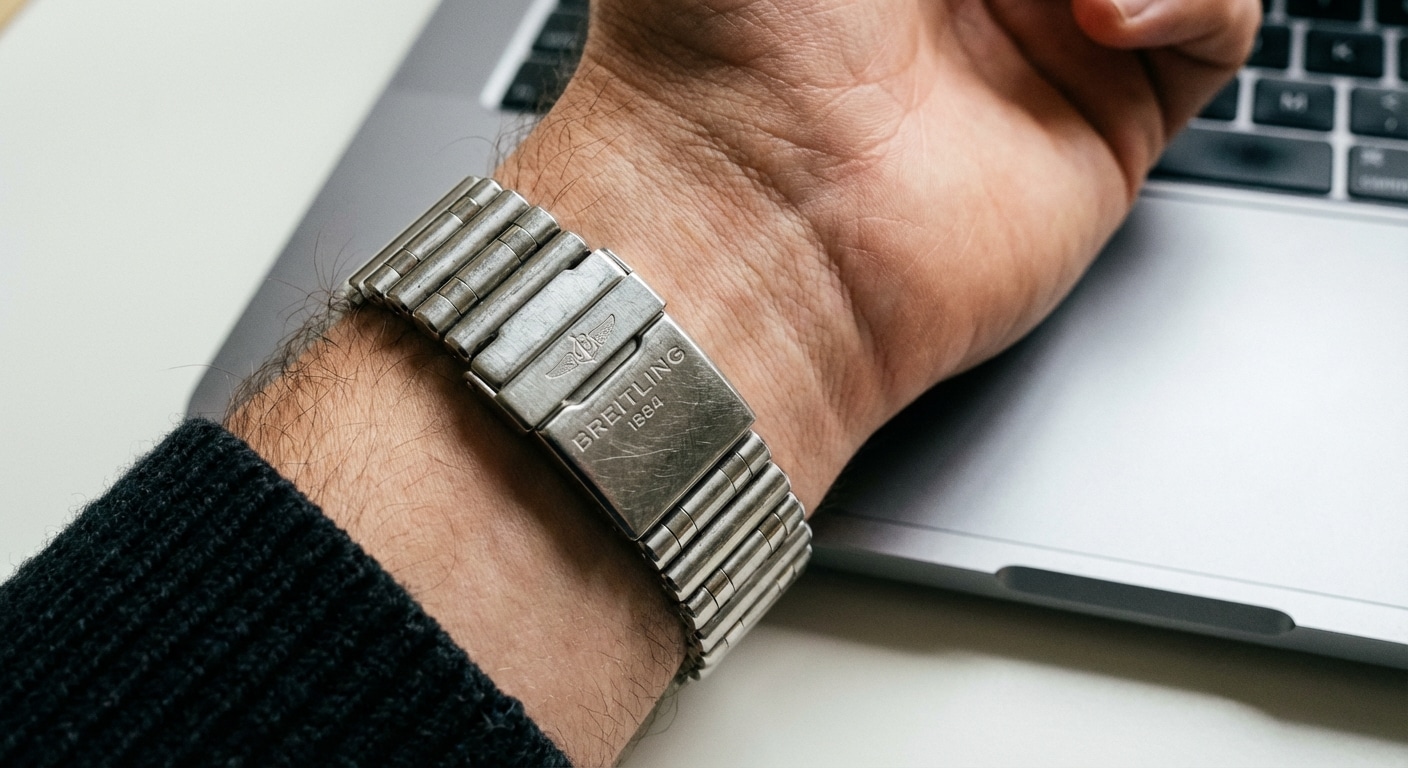
The Chronomat’s Rouleaux bracelet is an architectural marvel of cylindrical links, but its complex geometry makes it highly susceptible to environmental wear. When you drag this intricate steel construction of the Breitling Chronomat 42mm across aluminum laptops and wooden desks for months on end, the physical reality of desk-diving sets in. This section examines the long-term articulation, scratch resistance, and skin interaction of the replica Rouleaux bracelet.
Submission 05: 17.5cm Wrist, 42mm Chronomat B01 (6 Months Daily Wear)
This submission provides a brutal macro shot of the butterfly clasp resting heavily against the palm rest of a MacBook. After six months of daily wear on a 17.5cm wrist, the 42mm Chronomat B01 shows severe micro-scratching across the cylindrical links on the 6 o’clock side of the bracelet. The wearer praises the unique visual drape of the bracelet but highlights a massive ergonomic oversight: the complete lack of micro-adjustment. When the office air conditioning drops the ambient temperature, the wearer’s wrist shrinks slightly, causing the heavy 42mm case to slide uncomfortably past the ulna bone. Despite the heavy wear patterns and sizing limitations, the wearer accepts the scratches as an inevitable consequence of daily use.
Submission 06: 16cm Wrist, 36mm Chronomat Automatic (Hairy Wrist, Dark Skin Tone)
Shot under warm residential lighting at 8 PM, this submission proves that proportional fit does not guarantee comfort. The smaller 36mm case sits beautifully on the 16cm wrist, maintaining a compact, elegant profile. However, the wearer includes a stark warning regarding the bracelet’s construction. The tight, unrefined tolerances between the cylindrical replica links act as a mechanical epilator. The wearer reports sharp, constant hair-pulling every time the wrist rotates or flexes. For this user, the ergonomic pain completely outweighs the aesthetic appeal, resulting in a firm decision to never wear the watch again.
Expert Authentication Insight
To evaluate the long-term durability of a replica Rouleaux bracelet, test the pin friction and link stretch. Hold the watch case horizontally by the lugs and measure the vertical sag of the bracelet. After six months of daily wear, a premium clone should exhibit no more than 15 degrees of downward drop. If the bracelet sags excessively, it indicates the factory used cheap, hollow pins that are rapidly degrading under the lateral stress of daily typing and wrist movement.
Low-Light & Lume Reality: Avenger Night Missions in the Wild
A tactical watch is only as useful as its legibility when the lights go out. In the replica market, luminous material is notoriously one of the first corners cut to save production costs. To understand the practical visibility and perceived weight of the titanium and DLC-coated Avenger models, we need to look at how they perform in the transitional light of dusk and the artificial glow of a vehicle interior. This is where the physical reality of a tactical watch replica is truly tested.
Submission 07: 18.5cm Wrist, 45mm Avenger Night Mission (Dusk Lighting)
Captured inside a vehicle at roughly 6:30 PM, this submission highlights the optical illusion created by dark case materials. The wearer notes that the matte DLC coating absorbs ambient light beautifully, effectively shrinking the visual footprint of the 45mm case. On an 18.5cm wrist, the proportional balance is surprisingly restrained for such a massive timepiece. The wearer specifically praises the ultra-lightweight titanium construction, which drastically reduces wear fatigue during long drives compared to a steel equivalent.
However, the forensic reality of the dial reveals a significant flaw. The lume application on the Arabic numerals is highly uneven. While the hands remain visible, the stenciled numbers fade to complete blackness after just 45 minutes of ambient charge. The wearer’s verdict is clear: they will repurchase for the ergonomic comfort and daytime aesthetic, but consider it useless for actual low-light legibility.
Submission 08: 17cm Wrist, 43mm Avenger Automatic (Dashboard Lighting)
Shot against the faint, blue-tinged glow of a car dashboard, this 43mm Avenger Automatic presents a very different wearing experience. The heavy steel case shows significant lug presence on the 17cm wrist, sitting tall and demanding attention. The wearer reports that the hands hold a charge exceptionally well, remaining readable deep into a night drive.
The critical failure here is psychological rather than ergonomic. In the dark, the wearer, who had previously consulted a Breitling replica size wearing guide to ensure perfect wrist presence, noticed that the luminous pip on the bezel is misaligned by a fraction of a millimeter. In broad daylight, surrounded by the busy steel bezel, this flaw is entirely invisible. In the pitch black, glowing brightly against the dark dial, it is glaringly obvious. The wearer remains neutral on a repurchase, noting that this tiny, glowing misalignment is impossible to unsee.
Expert Authentication Insight
To test lume density and binder quality on any replica, expose the dial to a UV torch for exactly 10 seconds, then immediately move to total darkness. A high-quality application will show a sharp, granular glow with zero dark spots in the center of the hands. If you observe a rapid fade—dropping to zero visibility in under 20 minutes—it indicates a high ratio of cheap binder to actual luminous powder in the factory mix, a common shortcut in mid-tier production runs.
The “Overhang” Confessions: Small Wrists Forcing Large Premier Models
Vintage-inspired chronographs are the current darlings of the horological world, but their elegant, elongated lugs are utterly unforgiving on smaller bone structures. The physical reality of lug overhang is the most common source of buyer’s remorse. When enthusiasts purchase watches that are simply too large for their anatomy, the resulting fit is not just visually awkward; it fundamentally compromises the structural integrity of the strap.
Submission 09: 15.5cm Wrist, 42mm Premier B01 (Severe Overhang)
This straight-down, point-of-view shot is a brutal lesson in wrist anthropometry. The 42mm Premier B01 features long, sweeping lugs that completely eclipse the edges of the wearer’s 15.5cm wrist. The result is a massive, highly visible air gap between the leather strap and the skin. The watch is effectively floating above the wrist bone rather than wrapping around it.
The wearer admits that while the pistachio dial looks incredible in macro photographs, the watch looks ridiculous when viewed in a full-length mirror. The extreme downward tension required to buckle the strap causes the case to constantly shift off-center. Despite loving the dial execution, the wearer’s repurchase intent is an absolute no, stating they are immediately downsizing to a 40mm case to eliminate the overhang.
Submission 10: 16.5cm Wrist, 40mm Premier Automatic (Proportional Fit)
In stark contrast, this side-profile shot shows a 40mm Premier Automatic tucked neatly under a tailored shirt cuff. On a 16.5cm wrist, the reduced case thickness and significantly shorter lug-to-lug distance allow the leather strap to drape naturally straight down from the spring bars. There is no bowing, no air gap, and no forced tension.
The wearer praises the vintage scale of the piece, noting that the watch sits perfectly flat against the wrist bone. They report zero wear fatigue after 10 hours of continuous office wear, proving that when the proportional balance is correct, a watch effectively disappears on the wrist until you need it. Their repurchase intent is a definitive yes, calling it the ideal dress chronograph scale.
Expert Authentication Insight
To determine if a watch will actually fit, you must measure the lug-to-wrist bone clearance ratio. Place a straight edge across the flat top of your wrist. If the tip of the watch lug extends beyond the point where your wrist begins to curve downward, the structural integrity of the strap’s drape is compromised. In replicas, this extreme downward tension often leads to premature cracking and tearing of the leather directly at the spring bar integration point.
The gallery above proves one absolute rule: spec sheets lie, and factory quality-control photos lie even more. A 42mm case that looks perfectly balanced in a forum post can become an unwearable, hair-pulling nightmare under the reality of your specific wrist shape and daily environment. Before you authorize payment for any Breitling clone, ignore the perfectly lit macro shots of the dial. Instead, measure your flat wrist width in millimeters, compare it directly to the watch’s lug-to-lug distance, and ask yourself if you’re prepared to deal with the physical friction of a heavy steel clasp after eight hours at a keyboard. Buy for your physical reality, not for the lightbox.