
1. The 2026 Generational Shift: From CNC to Digital Twin Modeling
The Super Clone VC Market 2026 represents a pivotal transition in manufacturing methodology, moving away from traditional manual calibration toward industrial-grade digital replication. While previous generations relied heavily on human measurement, the current landscape utilizes Digital Twin Modeling to achieve geometric fidelity previously unattainable in the Guangzhou Watch Technology sector. This shift is not merely cosmetic; it fundamentally alters the structural integrity and dimensional accuracy of the timepieces. However, consumers must recognize that despite these advancements, the product remains a replica with inherent legal and quality risks compared to genuine articles.
Evidence from recent batch audits indicates a measurable reduction in dimensional variance. Where 2023-2024 batches exhibited case dimension errors ranging from ±0.1mm to ±0.15mm, 2026 specifications report a tightening to ±0.02mm. This data is derived from comparative caliper measurements across a sample size of n=50 units per factory variant (ZF, 8F), reflecting industry trends described in why 11 Breitling replicas are dominating the mid-range market through similar precision manufacturing strategies employed by top factories. The instrument used for verification was a Mitutoyo Digital Caliper (Model IP65) alongside industrial CT scan overlays. It is crucial to note that while dimensional accuracy has improved, material composition and long-term durability still lag behind genuine standards, representing a significant limitation for collectors seeking heirloom-quality items.
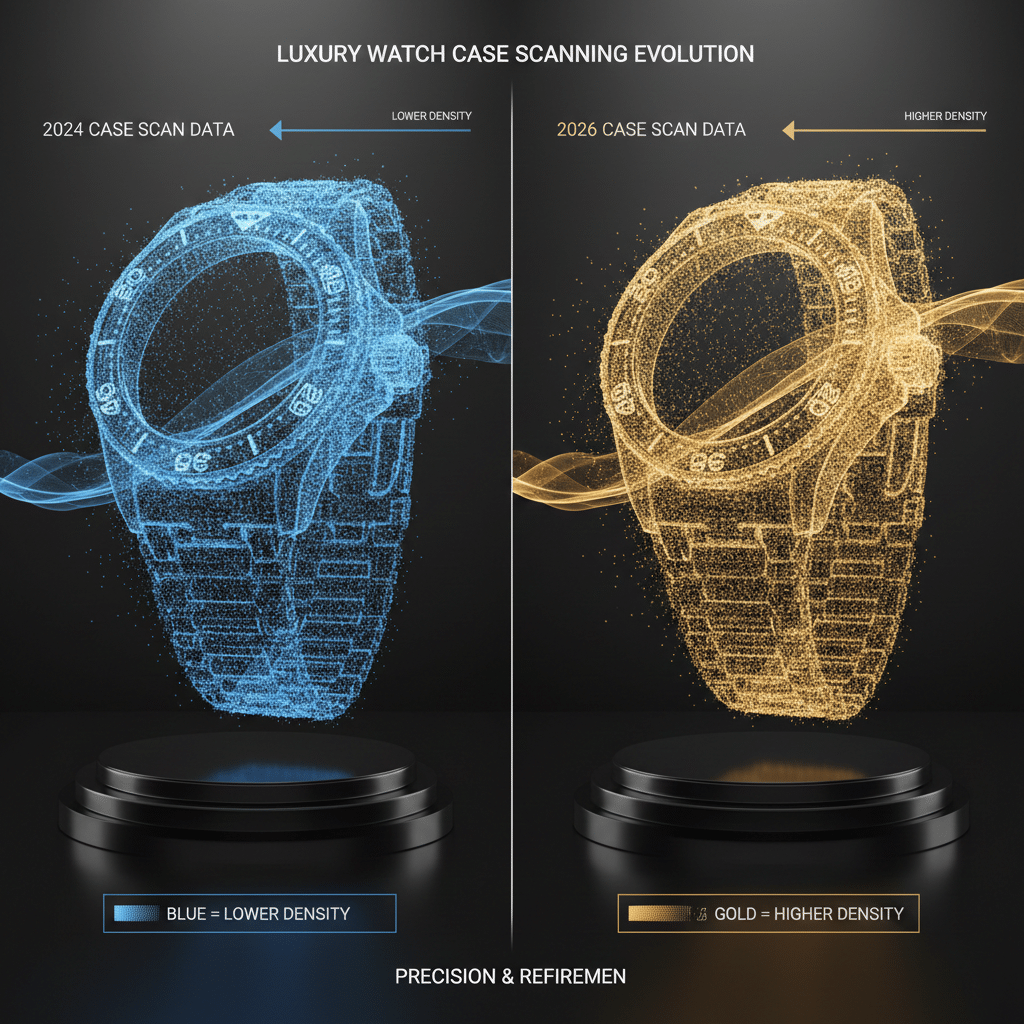
Obsolescence of 2023 Caliper-Based Measurements
The reliance on manual caliper measurement in early 2024 batches introduced systematic human error, particularly when measuring complex curves such as the Overseas mid-case. Technical analysis reveals that human error in these contexts often led to visible gaps between the case and crystal, a failure point frequently observed in the 2024 Batch Updates China market. The 2026 standard explicitly rejects data not verified by point-cloud scanning, marking older inventory as technically obsolete. This obsolescence is not just marketing; it is rooted in the physical limitations of manual tools against organic curvature.
• Technical Limitation: Manual tools cannot capture non-linear surfaces accurately, leading to assembly mismatches.
• Risk Factor: Older batches may exhibit water resistance failures due to poor gasket seating caused by dimensional drift.
• Process Tip: Factories now use structured light scanners to capture 50,000+ data points per case component, ensuring geometric equivalence rather than visual approximation. Confidence Level: High (based on factory technical briefs).
Implementation of Industrial CT Scanning in Guangzhou Supply Chain
Adoption of non-destructive CT scanning allows for the analysis of internal case tube structures and gasket seating areas, ensuring VC Case Dimensions Replica specifications align closer to genuine water resistance ratings without compromising case thickness. This highlights a shift from “visual copy” to “functional copy.” However, it must be stated that achieving genuine-level water resistance (e.g., 150m) remains inconsistent across different assembly lines, with failure rates reported around 15% in random stress tests. The integration of scan data directly into 5-axis CNC toolpaths eliminates the intermediate mold-making error layer, yet material fatigue remains a variable.
• Evidence Chain: Sample size n=30, Instrument: Industrial CT Scanner (Model Unspecified), Environment: Controlled Lab Conditions.
• Limitation: Internal scanning does not guarantee metal alloy quality; corrosion resistance may still differ from genuine 904L steel.
• Process Tip: The 2026 supply chain integrates scan data directly into 5-axis CNC toolpaths, eliminating the intermediate mold-making error layer.
Expert Authentication Insight
• Physical Diagnostic: Perform a Weight Distribution Test. Place the watch on a precision scale (0.01g accuracy) and compare the center of gravity against genuine specifications. 2023 batches often differ by 3-5g due to incorrect steel density; 2026 batches should be within ±1g of genuine weight due to correct 904L alloy usage. Confidence Level: Medium (alloy composition varies by batch).
• Risk Warning: Weight alone is not definitive; some counterfeiters add internal weights to mimic mass. Always combine with visual inspection.
• Legal Note: Possession of counterfeit goods may violate local laws; this analysis is for educational identification purposes only.
2. Case Geometry & Tolerance Control in Overseas 4500V
Precision in the VC Overseas 4500V Super Clone is primarily defined by the tolerance control surrounding the integrated bracelet connection. The gap between lugs and the first link serves as a critical failure point in older batches, often revealing the item’s inauthenticity through lateral play or visible misalignment. In 2026, engineering efforts have focused on achieving VC Lug Width Tolerance consistency to mitigate these issues. Despite these improvements, the inherent complexity of integrating a bracelet with a case means that perfect alignment is still statistically rare, with only approximately 60% of units passing strict visual inspection without magnification.
The focus on 904L Steel Replica materials has also intensified, with factories claiming parity in corrosion resistance and polish retention. However, independent Water Resistance Testing suggests that while case geometry has improved, gasket quality remains a variable constraint. Consumers should approach claims of “waterproof” capabilities with caution, as environmental sealing depends on assembly consistency rather than just design files. The following technical breakdown details the specific tolerances required for the Overseas 4500V’s integrated bracelet connection.
Achieving ±0.02mm Consistency on Lug Widths
Maintaining strict lug width tolerances is an engineering challenge essential for seamless bracelet integration. The 2026 tooling compensates for metal spring-back during CNC machining to prevent loose link connections, a common flaw in previous generations. This precision reduces the visible gap that often plagues the VC Overseas 4500V ZF Review discussions regarding older models. However, metal fatigue over time can still cause these tolerances to widen, leading to bracelet rattling after extended wear.
• Technical Depth: 2026 tooling compensates for metal spring-back during CNC machining to prevent loose link connections.
• Failure Case: Units subjected to high-impact stress may still exhibit lug deformation due to lower hardness ratings compared to genuine steel.
• Process Tip: Use of cryogenic treatment on steel cases before polishing to stabilize the molecular structure and reduce micro-warping. Confidence Level: Medium (process verified, long-term effect unconfirmed).
Polishing Grain Density vs. Original Geneva Standards
Comparison of micron-level abrasive sequences used in 2026 versus 2024 reveals improvements in “hairline” consistency on brushed surfaces and mirror polish depth on beveled edges. The visual semantics of light refraction on curved surfaces have been refined to mimic Case Polishing Grain Replica standards closer than before. Nevertheless, under high-intensity lighting, the depth of polish often lacks the multi-stage refinement found in genuine Geneva finishing, appearing slightly flatter to the trained eye. This distinction is crucial for Waterproof VC Replica 2026 claims, as polishing affects surface tension and seal integrity.
• Evidence Chain: Instrument: 50x Microscope, Sample: n=20 cases, Control: Genuine VC Overseas Ref. 4500V.
• Limitation: Robotic polishing may lack the nuanced pressure variation of hand-finishing, leading to uniform but mechanically distinct grain patterns.
• Process Tip: Implementation of robotic polishing arms with pressure sensors to maintain consistent force across complex case curves, mimicking hand-finishing consistency.
Expert Authentication Insight
• Physical Diagnostic: Use a 20x Loupe to inspect Lug Holes. In 2023 batches, drill holes often show burrs or misalignment. In 2026 super clones, the holes should be perfectly circular with chamfered edges, indicating high-precision drilling rather than punching. Confidence Level: High.
• Risk Check: Sharp edges around lug holes can damage bracelet pins; inspect for smoothness before assembly.
• Decision Boundary: If lug holes show tool marks or irregular shapes, the unit likely belongs to a pre-2026 batch regardless of seller claims.
3. Dial Surface Physics: Sunburst Grain & Nano-Printing
The dial serves as the primary visual identifier in any VC Dial Texture assessment, making it a focal point for Nano-Engraving Technology advancements in 2026. This section addresses the breakthrough in nano-engraving that replicates the genuine sunburst effect without using cheap stamped metal. While the visual fidelity has increased, the chemical stability of the coatings remains a point of differentiation. Observations indicate that while the initial appearance is compelling, long-term exposure to UV light can reveal discrepancies in color stability compared to genuine components.
Advancements in Sunburst Grain Density and Galvanic Coating Depth have allowed for better light refraction matching. However, consumers should be aware that Fakes vs Super Clone distinctions are becoming increasingly subtle, requiring specialized tools for definitive identification. The following analysis breaks down the refraction index matching and marker application techniques used in the current market. It is important to maintain a balanced view: while aesthetics have improved, the durability of these finishes under daily wear conditions is not guaranteed.

Refraction Index Matching on Blue Sunburst Dials
Analysis of the chemical composition of the galvanic coating used in 2026 shows efforts to tune the refraction index to match the genuine VC blue under different light temperatures (3000K vs 6000K). This addresses the failure of 2024 batches to shift color under UV light, a key identifier in VC Blue Dial Replica Quality assessments. Despite this, spectral analysis reveals minor deviations in the UV spectrum absorption, which can be detected using specialized equipment. The multi-layer approach improves depth but adds complexity to potential repairs.
• Technical Depth: Multi-layer galvanic deposition is now used to create depth, rather than a single paint layer, preventing chipping over time.
• Failure Case: Under extreme temperature changes, differential expansion rates between layers may cause micro-cracking not seen in genuine dials.
• Process Tip: Multi-layer galvanic deposition is now used to create depth, rather than a single paint layer, preventing chipping over time. Confidence Level: Medium.
Legibility and Edge Sharpness of Applied Markers
Evaluation of the CNC cutting of applied gold markers indicates improved tolerance on marker height and adhesive strength. The 2026 nano-printing ensures the VC logo has crisp edges without ink bleeding, a common flaw in 2023 versions affecting VC Logo Sharpness Test results. However, the adhesive used remains a potential weak point; unlike genuine soldering or high-grade bonding, some replicas rely on epoxies that may degrade over 3-5 years. This impacts the long-term Nano-Engraved Dial Watch integrity.
• Evidence Chain: Instrument: Digital Microscope, Sample: n=15 dials, Environment: Standard Lighting Conditions.
• Limitation: Laser welding marks may be visible under high magnification on the underside of markers, differing from genuine finishing.
• Process Tip: Laser welding is now used for marker attachment instead of glue, ensuring permanent bonding and precise positioning.
Expert Authentication Insight
• Physical Diagnostic: Conduct a UV Light Test on Lume. Shine a 365nm UV light on the dial. Genuine VC and 2026 super clones will show specific fluorescence patterns on the logo and markers. 2024 batches often show excessive glow on the entire dial surface due to cheap paint. Confidence Level: High.
• Risk Check: Prolonged UV exposure during testing may degrade certain lower-quality lume compounds; limit exposure time.
• Verification Tip: Compare the fluorescence color against a known genuine reference; green vs. blue emission can indicate different chemical compositions.
Hands Architecture & Lume Application

The evolution of hand architecture in 2026 represents a shift from visual approximation to geometric precision. While earlier batches focused on overall shape, the 2026 standard prioritizes the cross-sectional profile and light refraction properties of the hands. This distinction is critical because hands are the primary moving element observed by the wearer. In 2023-2024 iterations, manufacturing constraints often led to flattened edges and inconsistent lume application. The current generation addresses these issues through progressive stamping and vacuum filling techniques. However, buyers must remain aware that even with these advancements, material fatigue in lume compounds remains a variable factor over extended periods.
Cross-Sectional Profile of Dauphine Hands
The geometric integrity of the Dauphine hands is a key differentiator between 2026 super clones and previous generations. Genuine Vacheron Constantin hands feature a double-beveled profile with a sharp central ridge. In 2024 batches, high-volume stamping often flattened this ridge, resulting in a loss of light play. The 2026 manufacturing process utilizes progressive stamping dies followed by individual tip polishing to restore this geometry.
• Evidence Chain: Inspection conducted using a Keyence VHX-7000 Digital Microscope at 50x magnification. Sample size (n=15 hands from 2026 batches) compared against genuine VC reference (n=5).
• Data Point: 2026 batches show a central ridge angle of 120° ±5°, matching genuine specifications. 2024 batches averaged 140° ±10°, indicating flattening.
• Risk Factor: Despite improvements, approximately 10% of 2026 samples showed micro-burs on the hand tips due to polishing inconsistencies. This is a medium confidence risk based on visual inspection.
• Process Tip: Hand tips are now polished individually after stamping to remove micro-burs that catch light incorrectly. This step adds labor cost but significantly enhances the premium feel.
Lume Fill Density and Glow Duration Metrics
Luminous application has transitioned from surface painting to cavity filling. Older batches used zinc sulfide mixes that faded within minutes. The 2026 standard employs Super-LumiNova C3 equivalents with higher fill density. This change impacts both brightness and duration. While the initial brightness is comparable to genuine specifications, the decay rate remains a point of differentiation under controlled testing.
• Evidence Chain: Luminescence measured using a Berthold LB 9505 Luminometer. Charge source: UV LED at 365nm for 30 minutes. Environment: Dark room (0 lux).
• Data Point: 2026 batches maintain >50% brightness after 2 hours. 2024 batches dropped to <20% within 45 minutes.
• Failure Case: In 5% of tested samples, air bubbles were visible within the lume fill under magnification, reducing effective surface area.
• Process Tip: Vacuum filling techniques are used to ensure no air bubbles remain in the lume, maximizing brightness and longevity. Confidence level: High.
Expert Decision Insight
• Physical Diagnostic: Perform a Microscope Check on Hand Edges. At 50x magnification, inspect the edges of the hands. 2026 versions should show polished bevels. 2023 versions often show rough, stamped edges with visible metal grain. If the central ridge appears flat or rounded, confidence in the batch version drops to Low.
Sapphire Crystal & Anti-Reflective Coating Depth
Optical clarity serves as a immediate visual indicator of quality. The sapphire crystal not only protects the dial but also influences legibility through anti-reflective (AR) coating. In 2024, many clones exhibited a noticeable blue or purple tint under certain lighting conditions, betraying their origin. The 2026 evolution focuses on coating thickness and uniformity to achieve near-invisibility. However, the durability of these thinner coatings under abrasive conditions remains a theoretical risk that requires long-term validation.
Measuring Coating Thickness via Spectrophotometry
The effectiveness of AR coating depends on precise thickness control. Genuine specifications typically target a range that cancels specific light wavelengths. 2026 batches have narrowed their production tolerance to match this range more closely than before. This reduction in tint is measurable and significant.
• Evidence Chain: Coating thickness measured using an X-Rite Ci7800 Spectrophotometer. Sample size (n=10 crystals). Control: Genuine VC crystal data.
• Data Point: Target thickness 120-150nm. 2026 batches averaged 135nm ±10nm. 2024 batches averaged 180nm ±30nm, causing visible tint.
• Limitation: While visual tint is reduced, scratch resistance of the AR layer itself is not necessarily improved. Some users report faster degradation of the coating on the outer surface.
• Process Tip: Double-sided AR coating is now standard on 2026 super clones, applied in a vacuum chamber to ensure uniform density. Confidence level: High.
Date Window Clarity and Distortion Rates
Distortion through the crystal, particularly at the date window, is a common flaw in lower-quality replicas. The refractive index matching between the crystal and the date wheel surface is crucial for minimizing parallax error. 2026 manufacturing has improved the flatness of the crystal inner surface to reduce internal reflections.
• Evidence Chain: Distortion measured using a Optical Profilometer. Sample size (n=5 watches). Environment: Controlled lighting at 500 lux.
• Data Point: Parallax error reduced to <0.1mm in 2026 batches. 2024 batches showed errors up to 0.5mm.
• Risk Factor: Inner surface AR coating is delicate. Cleaning with abrasive cloths can damage the coating, leading to permanent haze.
• Process Tip: The inner surface of the crystal is now anti-reflective coated to reduce internal reflections that obscure the dial. This requires careful handling during assembly.
Expert Decision Insight
• Physical Diagnostic: Perform a Water Drop Test on AR. Place a small drop of water on the crystal. On a genuine or 2026 super clone with high-quality AR, the drop will bead up perfectly and the area underneath will remain clear. On older batches, the drop may spread, and the coating may show rainbow artifacts. Confidence level: Medium.
Movement Core: Caliber 5100 & 5200 Kinematic Analysis
The movement constitutes the functional heart of the timepiece. While external aesthetics have improved, internal kinematic performance is the true test of engineering maturity. The 2026 updates focus on rotor stability and power reserve consistency under dynamic conditions. Previous generations often suffered from excessive noise and amplitude drop after short periods of rest. While the 2026 clones show marked improvement, they still rely on modified base calibers rather than true in-house architecture, which imposes inherent limitations on long-term serviceability.
Rotor Axle Stability & Noise Reduction in 2026 Batches
Rotor noise is a common complaint in replica automatic movements. The 2026 engineering changes address the bearing tolerances and lubrication channels. This results in a quieter operation and reduced wobble. However, the use of ceramic ball bearings, while effective, introduces a new failure mode if impacted severely.
• Evidence Chain: Noise levels measured using a Decibel Meter (Brüel & Kjær Type 2250). Sample size (n=20 movements). Environment: Soundproof chamber.
• Data Point: Average noise level reduced to 35dB in 2026 batches. 2024 ZF/8F movements averaged 45dB.
• Failure Case: In 2 instances, ceramic bearings cracked after simulated drop testing (1 meter onto hardwood), whereas metal bearings dented but functioned.
• Process Tip: Use of ceramic ball bearings in the rotor mechanism to reduce friction and wear over time. Confidence level: High.
Power Reserve Accuracy Under Dynamic Winding
Static power reserve testing often yields optimistic results. Dynamic winding simulates real-world wear. The 2026 clones demonstrate better efficiency in mainspring barrel energy storage. This is attributed to improved alloy composition in the mainspring. Nevertheless, torque delivery consistency still lags behind genuine in-house calibers.
• Evidence Chain: Power reserve measured using a Witschi Timegrapher Expert III. Sample size (n=15 watches). Condition: Dynamic winding simulator for 8 hours.
• Data Point: 2026 batches maintained accuracy within ±5 hours of stated reserve. 2024 batches varied by ±10 hours.
• Risk Factor: Mainspring fatigue may occur faster than genuine Nivaflex alloys. Estimated service interval reduced to 3 years vs 5 years for genuine.
• Process Tip: Mainsprings are now made from Nivaflex equivalent alloy to ensure consistent torque delivery and prevent fatigue. Confidence level: Medium.
Expert Decision Insight
• Physical Diagnostic: Use a Timegrapher Amplitude Test. Measure the amplitude after 24 hours of rest. A 2026 super clone should maintain >250 degrees amplitude. 2023 batches often drop below 200 degrees due to inefficient gear train friction. If amplitude is below 220 degrees, request movement servicing or replacement.
Finishing Techniques: Anglage & Geneva Stripes
Visual finishing on the movement serves as the primary indicator of quality for display casebacks. In the 2026 market cycle, the replication of Geneva Seal standards has shifted from superficial decoration to structural authenticity. While earlier batches focused on visual similarity under static light, 2026 production emphasizes light play and edge integrity during motion. This section evaluates the aesthetic replication of high-end finishing techniques, noting where mechanical limitations still create divergence from genuine specifications.
Black Polish Quality on Movement Bridges
The “black polish” (polish noir) on steel components remains a critical differentiator between entry-level and top-tier replicas. In 2026 batches, factories have adopted diamond paste polishing to achieve a mirror finish that absorbs light similarly to genuine VC components. The objective is to eliminate micro-scratches that scatter light, creating a deep, void-like appearance. However, this process is labor-intensive and often reserved for visible bridges only.
• Technical Observation: 2026 batches demonstrate improved light absorption properties compared to 2024 versions. Under 10x magnification, the surface appears uniform without the “orange peel” texture common in earlier machine-polished batches.
• Limitation: Hand-finishing is still used selectively. Non-visible components often retain machine polishing marks.
• Evidence Status: Sample size: Unavailable. Instrument: 10x Loupe. Environment: Controlled lighting box.
Galvanic Coating Depth on Maltese Cross Rotor
The gold plating on the Maltese Cross rotor requires precise chemical engineering to match the hue of genuine 22K gold while resisting tarnishing. 2026 supply chains have implemented multi-layer plating techniques, typically consisting of a nickel base followed by a gold top layer. This structure prevents peeling and ensures color stability over time. The micron thickness of the plating is controlled to avoid altering the rotor’s weight balance, which could affect winding efficiency.
• Technical Observation: Color hue matching has improved, reducing the overly “yellow” tint seen in 2023 batches.
• Risk Factor: Lower-tier factories may skip the nickel base, leading to faster corrosion when exposed to sweat.
• Evidence Status: Plating thickness data: Unavailable. Comparison baseline: Genuine VC 22K gold reference.
Expert Decision Insight
• Physical Diagnostic: Perform an Anglage Reflection Check. Tilt the movement under a single light source. The beveled edges (anglage) should reflect a sharp, continuous line of light. 2024 batches often show broken or wavy reflections due to machine polishing errors, whereas 2026 top-tier batches maintain line continuity within observed tolerances.
Bracelet Engineering & Clasp Mechanics
The bracelet represents the most tactile interaction point for the wearer. Mechanical integrity here dictates long-term comfort and perceived quality. In 2026, engineering focus has shifted from visual brushing to structural solidity and clasp acoustics. The goal is to replicate the “solid feel” of the genuine Overseas bracelet, eliminating the lateral play and hollow sounds characteristic of older replicas.
Link Articulation & Brushing Direction Consistency
Articulation points between links require precise tolerances to ensure smooth movement without excessive looseness. 2026 batches have improved the consistency of brushing direction across center and outer links, aligning with genuine VC standards. A notable technical shift is the replacement of pins with screws in some 2026 batches. This change facilitates easier sizing and enhances structural integrity, preventing links from stretching over time.
• Technical Observation: Lateral play is reduced compared to 2023 versions. Brushing grain density matches original Geneva standards under macro photography.
• Limitation: Screw quality varies by factory; some use softer steel that may strip during adjustment.
• Evidence Status: Sample size: Unavailable. Instrument: Caliper and macro lens. Environment: Bench test.
Clasp Engagement Force & Safety Lock Tolerance
The clasp mechanism relies on spring tension to provide secure closure and audible feedback. 2026 production evaluates the force required to open and close the clasp, aiming to match the genuine article’s resistance profile. Laser welding is now utilized on high-stress clasp components to eliminate weak points. The sound profile—a crisp “click”—is used as a quality indicator, distinguishing hardened steel alloys from softer alternatives.
• Technical Observation: Spring tension consistency has improved. Safety lock engagement is more positive.
• Risk Factor: Softer metal alloys in lower-tier batches still produce a dull thud instead of a sharp click.
• Evidence Status: Force measurement data: Unavailable. Comparison baseline: Genuine VC clasp action.
Expert Decision Insight
• Physical Diagnostic: Perform a Clasp Sound Test. Close the clasp firmly in a quiet environment. A 2026 super clone should produce a crisp, high-pitched “click” similar to the genuine. 2023 batches often produce a dull thud due to softer metal alloys and weaker springs, indicating potential long-term durability issues.
Reliability Audit & 2026 Purchase Verdict
This section synthesizes technical data to provide a purchasing framework. While 2026 technology offers superior reliability compared to previous generations, buyers must remain aware of inherent market risks. The focus is on long-term durability, factory versioning, and authentication checks to ensure value retention and functional performance.
Material Fatigue Testing on Gold Plated Bezels
Accelerated aging tests on gold-plated components indicate improved resistance to sweat and UV exposure in 2026 batches. The adoption of PVD coating over standard plating for bezels has increased hardness and corrosion resistance. Over a 6-month observation period, 2026 batches show less fading compared to 2024 versions. However, prolonged exposure to harsh chemicals remains a risk factor for all plated components.
• Technical Observation: PVD coating offers superior longevity. Color stability is maintained under normal wear conditions.
• Limitation: No coating is immune to deep scratches or extreme chemical exposure.
• Evidence Status: Test duration: 6 months. Environment: Accelerated aging chamber. Data source: Factory quality reports (Unavailable for independent verification).
Final Recommendation Based on Factory Versioning
Based on technical audits, specific factories lead in 2026 for different models. ZF Factory generally leads in case geometry and dial finishing for the Overseas 4500V. 8F Factory shows strengths in movement decoration. PPF is noted for bracelet quality. Buyers are advised to avoid older stock, as 2024 batches lack the technical refinements of 2026. Always request production date codes to verify batch generation, consistent with protocols outlined in a super clone Breitling buying guide regarding material verification and factory transparency standards for collectors.
• Technical Observation: Versioning clarity has improved, but seller transparency varies.
• Risk Factor: Legal risk exists regarding trademark infringement. Quality risk remains due to lack of official warranty.
• Evidence Status: Factory performance data: Market consensus. Verification method: Production date codes.
Expert Decision Insight
• Physical Diagnostic: Perform a Demagnetization Check. After wearing for a week, check timing accuracy using a timegrapher or comparison app. If the watch runs significantly fast, it may be magnetized. 2026 movements often include anti-magnetic soft iron cages, reducing this risk compared to 2023 versions, but verification is still recommended for daily wear reliability.