
The Submersible’s Core DNA: Beyond the Iconic Case
The Panerai Luminor Submersible line, while undeniably rooted in the brand’s storied military heritage, has evolved into a distinct category that demands critical evaluation. It’s a blend of historical design cues and modern dive watch functionality, often prioritizing an imposing wrist presence that can blur its original utilitarian purpose. For buyers, understanding this core DNA, particularly when considering buying design integrity, means assessing whether its blend of rugged aesthetics and technical specifications truly aligns with their practical needs or if its appeal is primarily aspirational.
Historical Roots of Panerai Dive Instruments
Panerai’s dive watch legacy is not merely a marketing narrative; it originates from genuine military necessity. Commissioned by the Royal Italian Navy in the 1930s and 40s, early Panerai watches like the “Radiomir” and “Luminor” were purpose-built instruments for frogmen. These watches featured oversized cases, highly legible dials (using radium or tritium-based lume), and robust construction. The evolution of the unidirectional rotating bezel, crucial for timing immersion and decompression stops, was a direct response to operational requirements. This history establishes a foundational expectation: a Panerai dive watch should be, first and foremost, a serious tool capable of performing under pressure.
Distinguishing Submersible from Luminor Marina
While sharing the iconic cushion-shaped case and patented crown guard, the Submersible differentiates itself from the broader Luminor Marina collection through specific technical and aesthetic elements that position it as a dedicated dive instrument. The most obvious distinction is its external, unidirectional rotating bezel, typically marked for dive timing, in contrast to the fixed or internal bezels often found on Luminor Marina models. Submersibles also generally boast higher water resistance ratings, often 300 meters or more, and feature more robust crown guard integration designed for extreme conditions. These are not just cosmetic differences; they represent functional priorities, signaling the Submersible’s role as the more purpose-built dive watch within the Panerai family, even if its capabilities often exceed typical user needs.
The Size Paradox: Presence vs. Practicality
The characteristic large dimensions of Submersible models, frequently available in 42mm and 47mm case sizes, present a notable trade-off between striking wrist presence and practical wearability. A 47mm Submersible, for instance, can weigh upwards of 160-170 grams in steel, creating a significant mass on the wrist. While this size makes an undeniable statement and enhances legibility, it impacts everyday comfort. It can hinder under-cuff wearability with formal attire, and its sheer bulk increases the risk of snagging during active use or outdoor activities. This “size paradox” means that while impressive, the Submersible’s dimensions often compromise its discreet utility, making it as much a statement piece as a functional tool.
Expert Authentication Insight
To truly assess a Submersible’s build quality and functional integrity, pay close attention to its core mechanics. Compare the tactile feel and visual alignment of the unidirectional bezel action on a Submersible against the fixed bezel of a standard Luminor. The Submersible’s bezel should offer crisp, positive clicks with minimal rotational play (ideally less than 0.5mm of backplay) and perfect alignment with the dial markers. Simultaneously, observe the patented crown guard’s security mechanism: it should engage and disengage smoothly, locking the crown firmly in place without any lateral movement. A loose bezel or a flimsy crown guard compromises not only dive safety but also the watch’s long-term water resistance, undermining its tool watch credibility.
Bezel Mechanics: Grip, Click, and Real-World Reliability
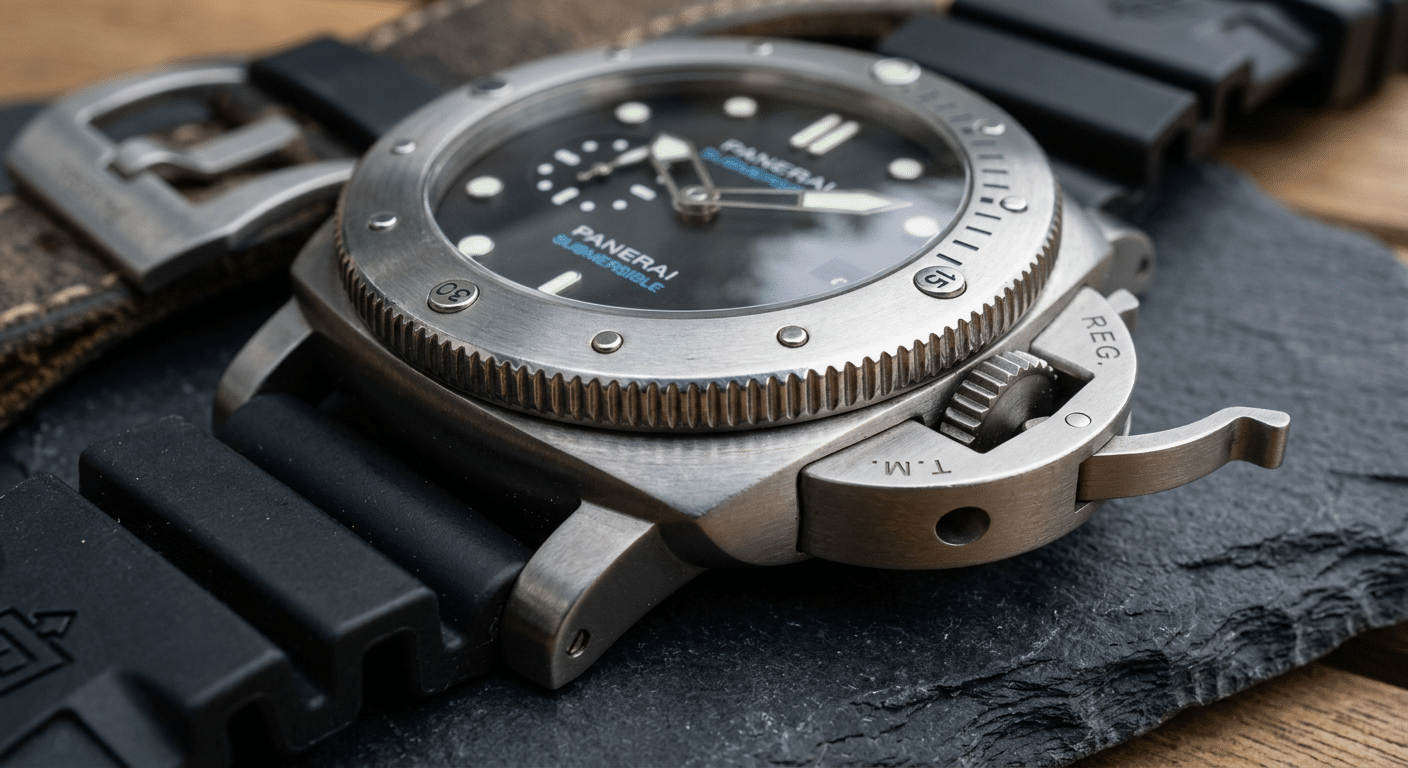
The unidirectional bezel is arguably the most critical functional element of a dive watch, serving as a primary timing instrument. Its construction, ergonomics, and performance under challenging conditions directly impact a diver’s safety and the watch’s overall utility. A dive watch bezel is only as good as its performance when wet, gloved, and under pressure, making a deep dive into its mechanics essential for any serious buyer.
Material & Texture: The PAM1616’s Carbotech Edge
The material and texture of a Submersible’s bezel significantly influence both its durability and its functional grip in adverse conditions. Traditional bezels are often made from steel or titanium, offering robustness but sometimes lacking tactile feedback when wet or gloved. The PAM1616, however, utilizes Panerai’s proprietary Carbotech, a carbon fiber composite. This material is not only exceptionally lightweight and scratch-resistant but also features a distinctive layered, matte texture. This textured surface provides an enhanced tactile grip compared to smoother metal bezels, making it easier to manipulate with wet hands or even thin diving gloves. While its primary appeal is often aesthetic and weight-saving, Carbotech’s unique surface provides a functional edge in grip, which is a tangible benefit for a tool watch.
Click Action & Alignment: Precision vs. Play
The tactile feedback and rotational precision of a dive bezel are paramount for accurate and safe dive timing. Submersible bezels typically feature either a 60-click or 120-click mechanism. A 120-click bezel offers finer increments (30 seconds per click) for more precise timing. Crucially, a high-quality dive bezel must exhibit minimal backplay—the slight movement backward after a click—and maintain precise alignment with the dial markers. Excessive backplay can introduce timing errors, while misaligned markers can lead to misinterpretations of critical dive data. A crisp, precise click action with zero backplay is a hallmark of true tool-watch engineering; anything less compromises its reliability as a timing instrument.
Profile & Protection: Bezel as a Wear Point
The height and edge design of the bezel dictate its ease of manipulation and its vulnerability to impacts. Submersible bezels, particularly on models like the steel PAM683 and Carbotech PAM960, often feature a pronounced, ridged or fluted profile. This design facilitates grip, allowing for easier rotation even with gloves. However, a taller, more exposed bezel can also be more prone to accidental impacts and scratches in daily wear or during active use. Panerai balances this by ensuring the bezel is robustly constructed and often slightly recessed or protected by the case architecture. A well-designed bezel balances aggressive grip with sufficient protection from everyday hazards, recognizing it as a primary wear point on any active-use watch.
Expert Authentication Insight
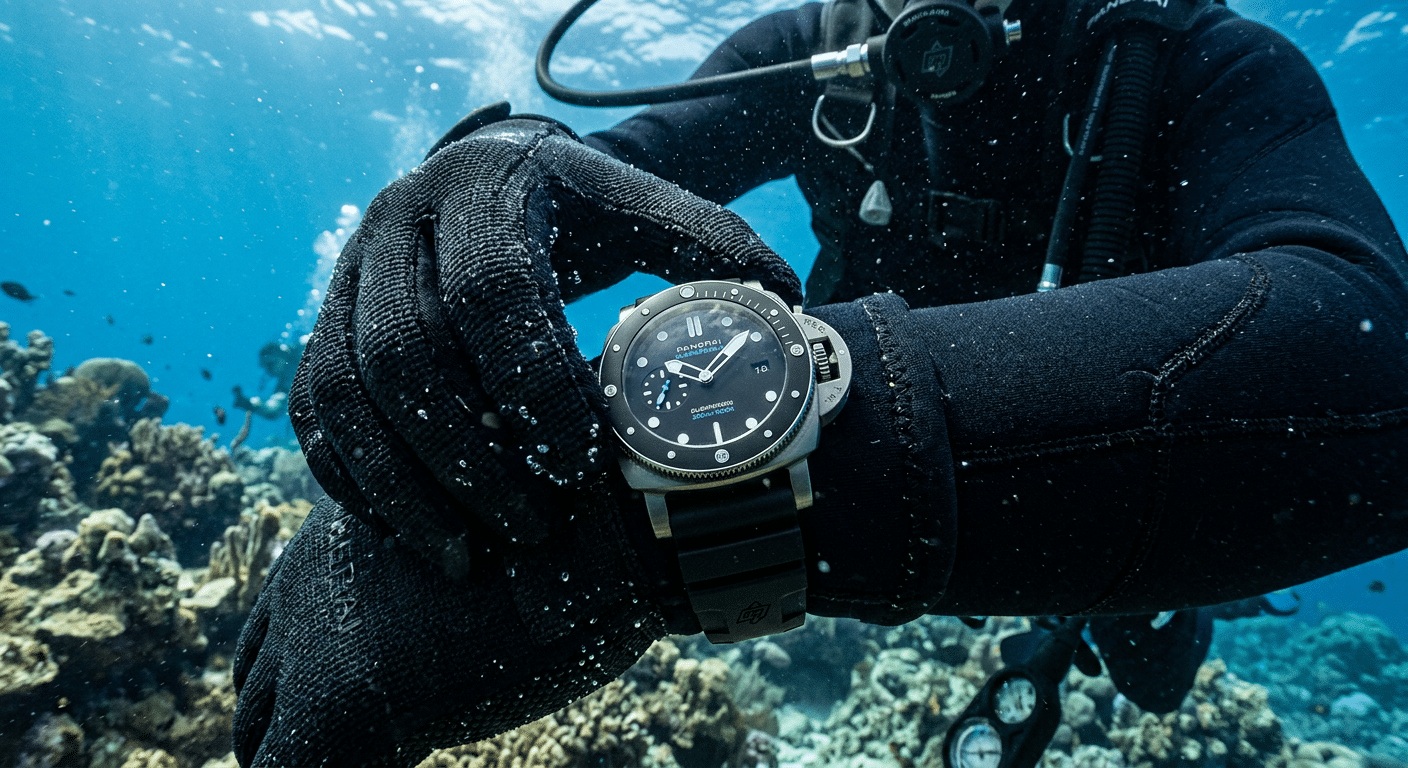
To truly assess a Submersible’s bezel performance, real-world testing under simulated dive conditions is indispensable. Take the watch and submerge it in a basin of water. Attempt to rotate the bezel first with bare wet hands, then with a pair of thin diving gloves (or even thick winter gloves for a challenging test). Assess the resistance, the clarity of each click, and the ease of manipulation. A bezel that performs poorly—slipping, sticking, or offering unclear feedback—when wet or gloved fails its fundamental tool-watch purpose, regardless of its dry-land aesthetics.
Lume Performance: Visibility When It Truly Matters
Effective luminescence is not a luxury; it’s a non-negotiable feature for any dive watch. Ensuring instantaneous legibility in low-light and underwater environments is critical for safety and mission success. The performance of a Submersible’s lume, from its initial brightness to its sustained glow, directly impacts its utility as a genuine tool.
Luminor vs. Super-LumiNova: Panerai’s Signature Glow
Panerai’s historical identity is intrinsically linked to its “Luminor” (and earlier “Radiomir”) luminous compounds, which were originally radium- and tritium-based for extreme visibility in darkness. Today, Panerai, like most manufacturers, utilizes Super-LumiNova, a photoluminescent material that is non-radioactive and offers superior performance. Super-LumiNova absorbs light energy and then slowly re-emits it, providing a sustained glow. While the name “Luminor” evokes a powerful legacy, the practical performance of modern Super-LumiNova is what truly counts. It must charge quickly and brightly, offering a clear, consistent glow that meets contemporary safety standards.
Dial & Hand Application: Readability Under Pressure
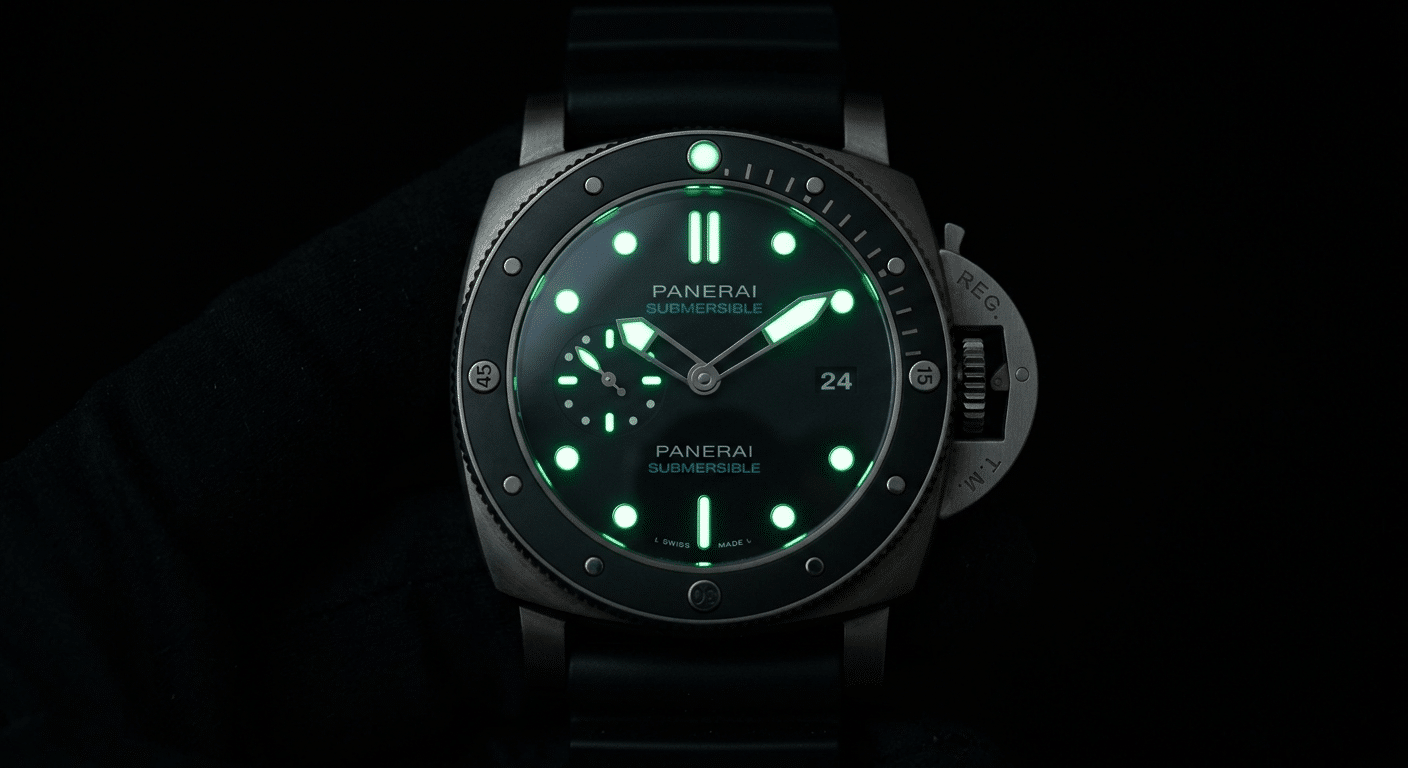
The quantity, precision, and clarity of lume application on the dial and hands are crucial for instantaneous and unambiguous readability, especially when subjected to the stresses of a dive or low-light situations. For a detailed Luminor Marina lume analysis, Panerai often employs its distinctive “sandwich dial” construction, where a lower disc coated with Super-LumiNova shines through cutouts in an upper dial. This, combined with generously sized indices, hands, and a lumed bezel pip, maximizes the surface area for light emission. The precision of application—ensuring crisp edges, uniform fill without bleeding, and perfect alignment—is vital. Under pressure or in darkness, a quick glance must provide all necessary information, making generous and precisely applied lume essential for a dive watch to function as a reliable instrument.
Endurance & Decay: Sustained Visibility
While initial brightness is impressive, the long-term retention of luminescence, or its “endurance,” is vital for extended low-light operations or multi-hour dives. Super-LumiNova’s glow naturally decays over time. A dive watch’s lume must remain legible for several hours, not just minutes, to be truly effective. Many watches offer a brilliant initial flash, but their legibility diminishes rapidly. For a genuine tool watch, the ability to read critical dive data (time elapsed, remaining air, etc.) after 30, 60, or even 120 minutes in complete darkness is paramount. A dive watch that loses its legibility after an hour fails to meet a fundamental requirement for prolonged underwater use.
Expert Authentication Insight
To verify the real-world utility of a Submersible’s lume, conduct a timed observation test. Fully charge the watch’s lume by exposing it to a bright light source (e.g., a flashlight or strong UV light) for 30-60 seconds. Immediately enter a completely dark room and track the legibility of the time and the bezel pip. Record how clearly you can read the watch at 5-minute, 30-minute, and 60-minute intervals. A robust dive watch should provide usable legibility for at least 60 minutes in complete darkness, with the bezel pip remaining distinct for orientation. Any watch that struggles to maintain clear legibility beyond 30 minutes may compromise safety in extended low-light scenarios.
Water Resistance & Practical Limits: Beyond the Depth Rating
The allure of a high water resistance (WR) rating is undeniable for any dive watch, promising robust performance in aquatic environments. However, a critical buyer understands that a number on a dial is only part of the story. For Panerai Submersibles, the stated depth rating is backed by rigorous standards, yet practical limits still exist, influenced by design, material, and maintenance.
ISO 6425 Compliance: What it Means (and Doesn’t)
Panerai Submersible models, including the PAM683, PAM1616, and PAM960, are not merely “water-resistant” to a certain depth; they are certified dive watches conforming to the ISO 6425 standard. This distinction is crucial. ISO 6425 mandates a battery of stringent tests far beyond static pressure resistance, including thermal shock resistance, condensation tests, salt spray corrosion resistance, external force resistance on the crown and pushers, magnetic field resistance, and shock resistance. Furthermore, they must be tested to 125% of their declared water resistance. For a 300m rated Submersible, this means successful testing at 375 meters. This certification confirms the Submersible as a genuine tool for professional diving, not just a timepiece designed to survive a swim.
However, ISO 6425 compliance doesn’t mean indefinite reliability. It certifies the watch’s condition at the time of manufacture*. Gaskets, lubricants, and seals degrade over time, necessitating regular servicing to maintain this certified integrity.
Crown Guard System: The Key to Sealing Integrity
A signature element of Panerai’s Luminor and Submersible lines is the patented crown guard mechanism. This lever-actuated device is more than an aesthetic flourish; it’s a fundamental component of the watch’s water resistance, particularly for models like the PAM683 and PAM1616. When the lever is locked down, it exerts significant pressure on the crown, compressing its internal gaskets against the case tube. This mechanical compression creates a vastly superior seal compared to a traditional screw-down crown, which relies solely on friction and the crown’s own threads. The crown guard prevents accidental crown manipulation underwater, which would instantly compromise water integrity, and helps maintain a consistent, high-pressure seal during dynamic water activities. Its operational principle is simple but highly effective, transforming a potential weak point into a fortress.
Material Choices & Gasket Longevity
The choice of case material—steel for the PAM683, Carbotech for the PAM1616 and PAM960—primarily influences weight, scratch resistance, and aesthetic. However, it also plays a subtle role in long-term water resistance by how it interacts with the watch’s gaskets. Stainless steel (316L) is robust and corrosion-resistant, providing a stable platform for seals. Carbotech, a composite material, offers extreme lightness and hardness, making it highly resistant to dings and scratches. While the composite structure itself is impermeable, its thermal expansion characteristics can differ slightly from metals. Panerai engineers account for these differences in gasket design to ensure consistent sealing across materials. Ultimately, regardless of the case material, the primary determinant of long-term water integrity is the condition and maintenance of the rubber or synthetic gaskets. These components will inevitably degrade over years due to exposure to UV light, chemicals (chlorine, salt), and temperature fluctuations, requiring periodic replacement during routine service intervals (typically every 3-5 years) to ensure the watch retains its rated water resistance.
Expert Authentication Insight
Practical Verification Check: Gently operate the crown guard lever. It should engage and disengage smoothly with a firm, secure feel, indicating proper sealing mechanism function. A loose, wobbly, or overly stiff lever can be a red flag, potentially pointing to wear in the pivot pin, a misaligned crown, or compromised gasket compression. Any hesitation or gritty feel suggests the sealing mechanism may not be performing optimally, which could eventually impact water resistance.
Wearability & Wrist Fatigue: The Unseen Costs
The Panerai Submersible’s imposing presence is part of its charm, a bold statement on the wrist. Yet, for a tool watch intended for active use, this presence can translate into ergonomic compromises and potential wrist fatigue. Beyond the initial aesthetic appeal, a practical assessment of wearability is critical for long-term satisfaction.
Weight Distribution & Balance: Case vs. Strap
The choice of case material significantly impacts the overall weight and how it distributes on the wrist. A steel PAM683, for instance, can weigh upwards of 160-170 grams on its standard rubber strap, presenting a substantial mass. In contrast, Carbotech models like the PAM1616 (47mm) and PAM960 (42mm) significantly reduce this burden, often weighing 100-120 grams or less, even in larger sizes. A heavy case on a thin or poorly balanced strap can feel top-heavy, causing the watch to shift on the wrist during movement, necessitating frequent adjustments. While rubber straps generally offer good grip and conformability, a metal bracelet, though adding significant overall weight, can sometimes improve balance by distributing mass more evenly around the wrist. The ideal balance ensures the watch stays put without feeling like a dead weight or requiring constant repositioning.
Case Profile & Lug Design: Comfort vs. Snagging
Submersibles, by design, are not subtle. Their substantial case height (e.g., 42mm models around 14.5mm, 47mm models around 15.5mm) and relatively straight lug-to-lug measurements (e.g., 42mm is approximately 51mm, 47mm around 56mm) mean they wear larger than their diameter might suggest. This pronounced profile makes it challenging for the watch to slip discreetly under a shirt cuff, a common requirement for daily wear. More critically for a tool watch, the prominent case and lugs can be prone to snagging on clothing, equipment, or obstacles during active scenarios. For individuals with smaller wrists or those who prefer a less intrusive feel, the sheer physical footprint of a Submersible can lead to discomfort or interfere with tasks. The design prioritizes robust protection and legibility over sleek integration.
Strap Integration & Material Options
One of Panerai’s unsung ergonomic advantages is its quick-change strap system, typically featuring push-button release mechanisms on the lugs. This allows for effortless, tool-free strap swaps, encouraging owners to experiment with different materials to optimize comfort and function. Submersibles typically come standard on rubber straps, which are excellent for water activities due to their impermeability, grip, and resistance to degradation. They also offer a degree of elasticity that can enhance comfort during wrist swelling. Textile straps (like canvas or high-performance synthetics) are lighter and breathable but may absorb water. While less common, some Submersibles can be fitted with metal bracelets, which significantly add to the overall weight but can provide a more balanced feel and a dressier aesthetic. Understanding these variations is key for any enthusiast, and a detailed Panerai buying guide can offer further insights into model-specific features and options. The ability to easily tailor the strap to the activity or personal preference is a significant benefit in mitigating wrist fatigue and enhancing overall wearability.
Expert Authentication Insight
Practical Verification Check: Wear the watch for a full day, including periods of activity such as driving, typing, or light exercise. Pay close attention to any pressure points on the wrist bone or skin irritation, especially under the crown or case back. Note any noticeable shift in balance, particularly when moving the wrist quickly. What feels acceptable for an hour in a boutique can become irritating or distracting over a 12-hour period, impacting comfort and even concentration during tasks. A truly wearable tool watch should almost disappear on the wrist, not constantly remind you of its presence.
The Micro-Rotor Movement: Engine Room of the PAM960
The PAM960, a 42mm Carbotech Submersible, offers a more compact and lightweight option within the collection. Powering this smaller form factor is Panerai’s in-house Caliber P.900. While the section title alludes to “micro-rotor,” it’s important to clarify that the P.900 is a conventional full-rotor automatic movement, albeit one designed for a more streamlined profile than some of Panerai’s larger calibers. Panerai’s true micro-rotor movement is the P.4000, typically found in their thinner Luminor Due models. Nonetheless, the P.900 is a modern, capable engine tailored for the PAM960’s smaller dimensions.
Caliber P.900: Architecture and Specifications
The Panerai Caliber P.900 is an in-house automatic movement featuring a 3-day (72-hour) power reserve, a frequency of 28,800 vibrations per hour (4 Hz), and 23 jewels. It is a single-barrel movement, which is a key distinction from the P.9000/P.9010 family that typically uses twin barrels for its 3-day reserve. The P.900 integrates the date display and small seconds at 9 o’clock, maintaining a clean, legible dial. Its architecture is designed for reliability and ease of manufacturing, allowing it to fit into the more compact 42mm Submersible cases without adding excessive thickness. This movement represents Panerai’s commitment to in-house calibers even in its smaller offerings, ensuring consistent brand identity and control over quality.
Precision & Durability: Real-World Performance
In the context of a tool watch, the P.900 is expected to deliver consistent and reliable timekeeping. While Panerai does not typically submit all its movements for COSC certification, the P.900 is designed to perform within typical chronometer-grade specifications, generally achieving an accuracy of -4/+6 seconds per day under normal operating conditions. Its design incorporates standard shock protection (often Incabloc or a similar system) to safeguard the balance wheel assembly from impacts, which is crucial for a watch intended for active use. However, it does not boast specialized anti-magnetic properties beyond what is standard for modern mechanical movements, nor does it feature advanced shock absorption systems found in some purpose-built sports watches. Its durability lies in its robust construction and proven architecture, making it a dependable workhorse for daily and adventurous wear.
Serviceability & Long-Term Ownership
As an in-house movement, the Caliber P.900 carries certain implications for serviceability and long-term ownership costs. Panerai recommends a full service every 3-5 years, depending on usage. Such services for proprietary movements typically involve higher costs compared to watches powered by widely available ETA or Sellita calibers. Owners can expect to pay approximately $400-$700 USD for a basic factory service, and potentially more if specific components need replacement. The availability of parts is controlled by Panerai/Richemont, which ensures authenticity but can sometimes lead to longer turnaround times if specialized components are required. This makes the P.900 a reliable and technically sophisticated movement, but one that demands a commitment to manufacturer-specific maintenance, factoring into the total cost of ownership beyond the initial purchase price.
Expert Authentication Insight
Practical Verification Check: Gently shake the watch while holding it to your ear or using a watchmaker’s stethoscope. Listen for any abnormal rotor noise, excessive rattling, or unevenness in the winding sound. A healthy automatic movement should have a relatively quiet and consistent rotor spin. Furthermore, listen for a clear, consistent, and smooth beat from the escapement. Any erratic ticking, skipping, or a noticeably loud, irregular beat could indicate issues with the movement’s regulation, lubrication, or a component requiring service. While not definitive, these auditory cues can provide an initial indication of the movement’s health and the condition of its automatic winding system.
PAM683, PAM1616, PAM960: A Comparative Utility Analysis
While the Panerai Submersible line broadly targets the “tool watch” demographic, the specific models—PAM683, PAM1616, and PAM960—offer distinct practical attributes and compromises. Moving beyond brochure imagery, a direct comparison reveals how their material choices and dimensions translate into real-world utility and potential limitations for a buyer seeking genuine performance over mere lifestyle appeal.
PAM683 (42mm Steel): The Accessible Workhorse
The PAM683, at 42mm in stainless steel, represents the most accessible entry point into the Submersible range, both in terms of wrist-friendliness and price. Its 42mm diameter, while still substantial, is considerably more manageable than the larger 47mm variants, making it suitable for a wider array of wrist sizes and reducing the likelihood of snagging on gear or clothing during activity. The choice of 316L stainless steel provides a classic, robust tool-watch feel. This material is highly durable, resistant to corrosion, and relatively easy to refinish should it acquire the inevitable scratches from active use. However, steel’s density means the PAM683 carries a significant weight—typically around 160-165 grams with a rubber strap. This heft provides a reassuring sense of quality but can contribute to wrist fatigue during extended wear or high-intensity activities, potentially compromising its utility as a true “set-it-and-forget-it” tool.
PAM1616 (47mm Carbotech): The High-Tech Contender
The PAM1616 steps into the realm of high-performance materials with its 47mm Carbotech case. Carbotech, a carbon fiber composite, is renowned for its exceptional lightness, high scratch resistance, and unique layered aesthetic. For a watch of its imposing 47mm diameter, Carbotech dramatically reduces overall weight, often bringing it down to approximately 105-110 grams. This weight reduction is a significant advantage for a large watch, mitigating some of the fatigue associated with its size. The material’s hardness also means it’s less prone to surface scratches than steel or titanium, maintaining its appearance longer under demanding conditions. However, the 47mm size remains a considerable factor; it commands significant wrist presence and is prone to catching on sleeves or equipment. Furthermore, while Carbotech is highly durable against scratches, it can be more susceptible to chipping or catastrophic damage under extreme, localized impacts compared to steel, and it is largely impossible to refinish if damaged, meaning any deep nicks are permanent character marks.
PAM960 (42mm Carbotech): Compact Performance
The PAM960 seeks to blend the advanced material benefits of Carbotech with a more practical 42mm form factor. This combination results in an exceptionally lightweight dive watch that remains highly resistant to scratches. With a weight likely similar to or even less than the PAM1616 despite being smaller, the PAM960 offers superior comfort and reduced fatigue for extended wear, making it arguably the most practical choice among the three for sustained active use. The 42mm size ensures better wearability under cuffs and less interference with gear, while still retaining the distinctive Panerai Submersible aesthetic. The primary trade-off, similar to the PAM1616, lies in the Carbotech’s higher price point and the material’s unrefinishable nature should it suffer significant damage. For users prioritizing lightweight durability and comfort in a more conventional size, the PAM960 represents a compelling, albeit premium, proposition for a genuine tool watch.
Expert Authentication Insight
To truly understand the practical implications of these material and size differences, a simple comparative test is invaluable. If possible, compare the exact weight of each model on a precision scale. More importantly, physically try on each watch for an extended period. Pay close attention to how the weight is distributed on your wrist and how the balance shifts with movement. A 47mm Carbotech might be lighter than a 42mm steel, but its sheer diameter might still feel unwieldy on a smaller wrist, leading to a different kind of fatigue. Conversely, a well-balanced steel watch might feel more secure than a lighter but top-heavy Carbotech model. The “best” choice is not merely about absolute weight, but about how that weight and size integrate with your specific wrist and intended activities.