
Radiomir Classics: The Design Purity Guide for Discerning Collectors
When the name Panerai comes up in conversation, the mind often conjures images of the robust Luminor – its imposing crown guard, its undeniable presence, and its reputation as a tool watch built for the battlefield. Yet, exploring the slim Panerai concept reveals a different design philosophy. But to fixate solely on the Luminor is to miss Panerai’s most uncompromised design statement. The true connoisseur understands that the Radiomir family, with its elegant simplicity and unwavering historical fidelity, represents the purest distillation of Panerai’s aesthetic philosophy. It is a watch that demands appreciation for its inherent design integrity, not its perceived utility in extreme conditions. For the discerning collector, the Radiomir isn’t just a watch; it’s a wearable testament to design purity, a choice that prioritizes aesthetic lineage over modern trends or tactical hype. This article will guide you through the non-negotiable elements of Radiomir design, helping you confidently identify and acquire a model that resonates with a collecting philosophy centered on authentic historical expression.
The Genesis of Radiomir: A Design Brief, Not a Watch
The Radiomir wasn’t conceived as a fashion accessory; it was born from a stringent military brief. Its foundational design principles were dictated by the extreme demands of underwater warfare, shaping every aesthetic element into a functional necessity.
Military Origins and Functional Aesthetics
The Italian Royal Navy’s requirement for highly legible and robust dive instruments for its frogmen in the late 1930s was the crucible for the Radiomir. This critical demand led directly to its most defining characteristics: oversized cases, often 47mm in diameter, to maximize dial space and legibility, and the pioneering use of radium-based luminous material (Panerai’s patented “Radiomir” compound) to ensure visibility in the darkest underwater conditions. The watch was, in essence, a specialized instrument, where every design choice served an explicit operational purpose. This focus on functional aesthetics meant that superfluous details were eliminated, resulting in a stark, minimalist beauty that remains central to the Radiomir’s appeal.
The Distinctive Case and Wire Lugs
The Radiomir’s unique silhouette, a cushion-shaped case with slender wire lugs, was not an arbitrary design choice but an adaptation of existing technology. Early Radiomir watches were built around pocket watch movements, which necessitated a robust, spacious case. The cushion shape, with its soft, rounded edges, provided this while offering a surprisingly ergonomic fit for its size. The characteristic wire lugs, often soldered directly to the case, further distinguished it. These lugs, initially designed for ease of replacement and to minimize bulk, prioritized minimalism over the conventional, integrated lug structures seen on most watches. This design choice created a watch head that appeared to “float” on the wrist, contributing significantly to its unique wearer experience and visual lightness.
Dial Purity: Legibility as the Ultimate Design Goal
From its inception, the Radiomir dial was engineered for ultimate legibility. Early versions featured simple painted radium numerals, but the pursuit of maximum clarity in extreme low-light conditions led to the innovative “sandwich” construction. This groundbreaking technique involved two superimposed plates: a lower disc fully coated with luminous material, and an upper disc with cut-out hour markers and numerals. This design allowed the luminous compound to glow through the apertures, creating an intense, deeply recessed illumination that was unparalleled. The minimalist layout, typically featuring only the 3, 6, 9, and 12 o’clock numerals along with baton markers, further underscored legibility as the paramount design feature, stripping away any element that might distract from immediate time-telling.
Expert Authentication Insight
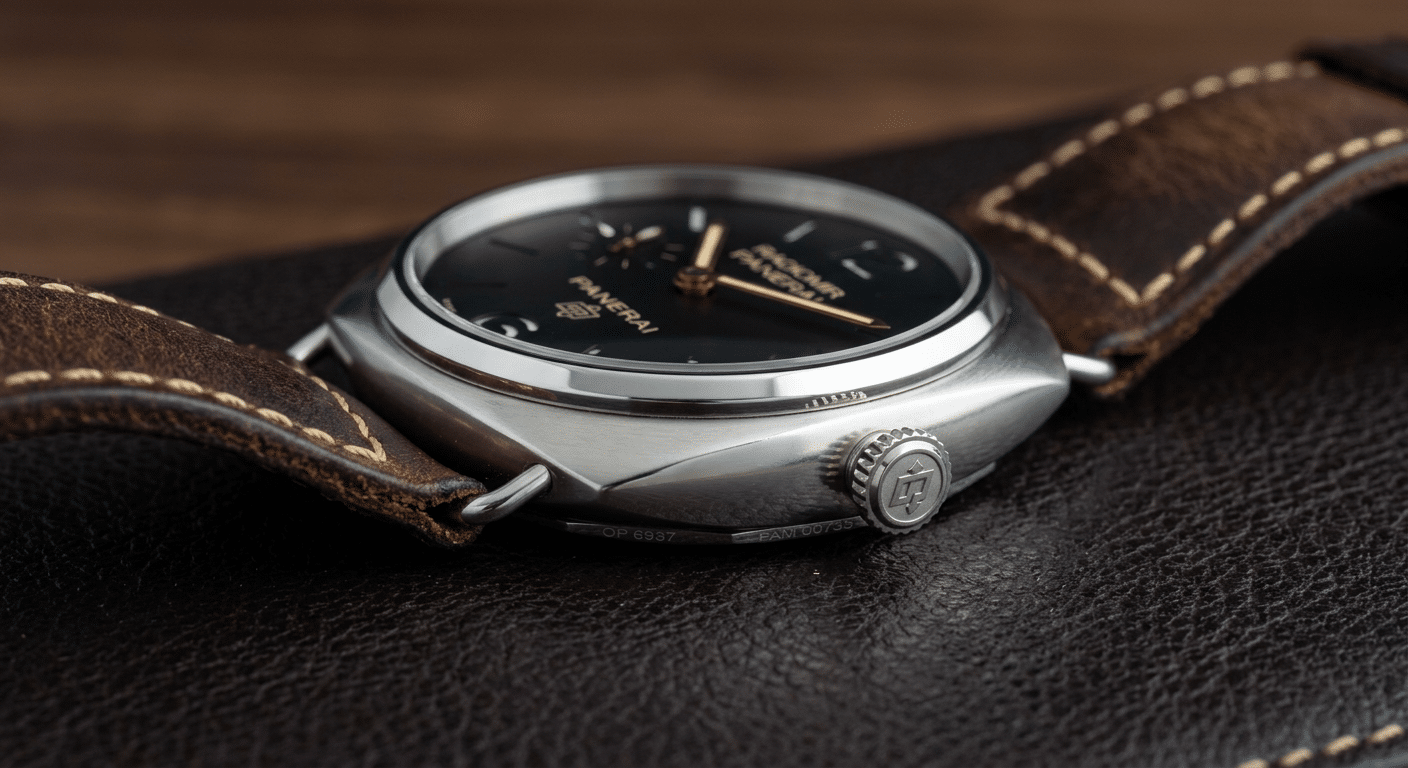
When evaluating a Radiomir for design integrity, pay close attention to the case curvature and dimensions. Using high-resolution archival images of historical models like the 3646 or 6152 as reference, carefully compare the radius of the cushion case, the seamless transition from the mid-case to the bezel, and the proportional integration of the wire lugs. Any significant deviation, such as a flatter case profile, sharper angles, or disproportionately thick lugs, could indicate a departure from the original design language that defines the Radiomir’s aesthetic purity. True Radiomir cases should exhibit a distinct “pillow” effect, where the case subtly curves to hug the wrist, rather than sitting as a flat disc.
Decoding the Modern Classics: PAM210, PAM292, PAM753
Panerai has released numerous Radiomir iterations over the decades, but a few modern references stand out for their adherence to—or thoughtful reinterpretation of—the original design ethos. Examining the PAM210, PAM292, and PAM753 reveals how contemporary manufacturing can either preserve or subtly evolve the Radiomir’s core identity.
PAM210: The Epitome of Radiomir Simplicity
The PAM210, produced from 2005 to 2009, is widely considered a modern Radiomir grail for its nearly perfect embodiment of the early 3646 spirit. Its 45mm polished steel case, with its classic cushion shape and discrete wire lugs, immediately evokes vintage Panerai. Inside, it houses the hand-wound OP X movement, which is based on the robust Unitas 6497 caliber. This choice of a simple, reliable movement allows for a two-hand dial layout, eschewing a running seconds hand for ultimate minimalism and an uncluttered aesthetic. This design decision directly mirrors the earliest Radiomir models, emphasizing time-telling purity and an uninterrupted view of the iconic luminous markers. The PAM210 is a judgment on what truly matters in a Radiomir: historical fidelity and unadulterated design.
PAM292: Ceramic Innovation Meets Vintage Charm
Introduced in 2008, the PAM292 presented a bold step for the Radiomir line by introducing a ceramic case while meticulously preserving its iconic shape. Crafted from zirconium oxide, the case offers superior scratch resistance and a unique matte black finish that provides a striking contrast to the traditional polished steel. Despite this material innovation, the PAM292 maintains the cushion shape and wire lugs with precision, ensuring its Radiomir identity remains intact. Many iterations of the PAM292 also feature a subtle “pig” logo (a reference to the Italian Navy’s “Maiale” human torpedoes) on the dial, a nod to Panerai’s military heritage that adds a layer of vintage charm. This model successfully demonstrates that material advancement can coexist with design purity when executed thoughtfully.
PAM753: The Entry Point to Radiomir Purity
The PAM753, a more recent introduction, aims to offer an accessible entry point to the Radiomir family without compromising its core design cues. Retaining the classic 45mm steel case and wire lugs, it features Panerai’s in-house P.6000 manual-wind movement, which offers a reliable 3-day power reserve. This movement, while more contemporary than the OP X, allows for the essential two-hand layout and minimalist dial that define the Radiomir aesthetic. The PAM753 is positioned as a contemporary reinterpretation that distills the essence of the Radiomir for a broader audience. While it may lack some of the historical nuances of the PAM210, it successfully delivers the fundamental visual and tactile experience of a Radiomir, making it a strong contender for those seeking purity at a more approachable price point.
Expert Authentication Insight
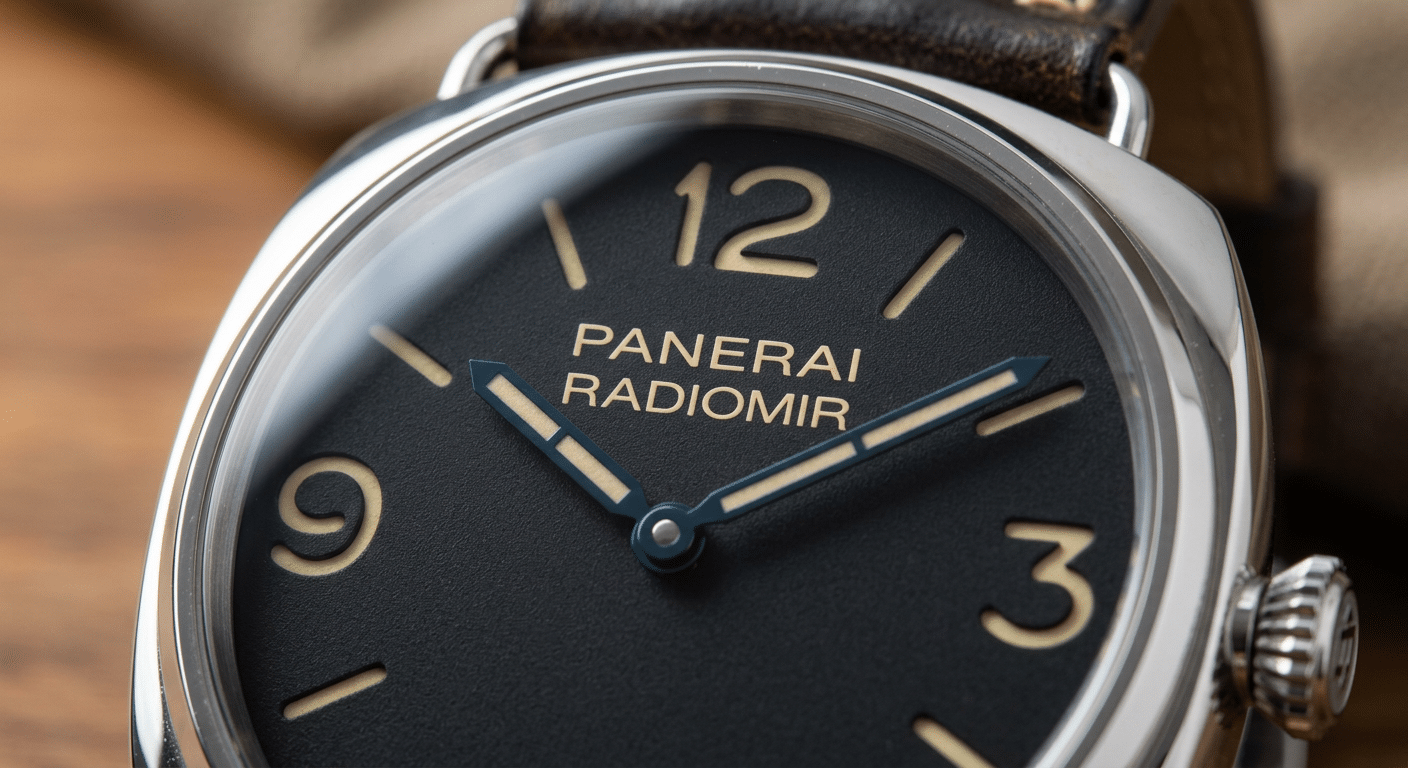
A critical diagnostic for assessing the authenticity and integrity of a Radiomir’s design lies in scrutinizing the dial’s typography. Using a loupe, meticulously examine the font style, size, and spacing of numerals and any text (e.g., “PANERAI,” “RADIOMIR”) across the PAM210, PAM292, and PAM753. Each reference has specific production specifications for these details. For instance, the PAM210’s numerals should exhibit a particular vintage-inspired serif, while the PAM292 might feature a slightly different weight for its text. Subtle discrepancies—such as misaligned “A”s or “R”s, incorrect kerning, or variations in numeral thickness—can be tell-tale signs of aftermarket dials or even a non-factory watch. Official Panerai dials maintain extremely tight tolerances in their printing, and any deviation suggests a compromise in originality.
The Wire Lugs Conundrum: Design Purity vs. Practicality
The wire lug is perhaps the most polarising, yet defining, characteristic of the Radiomir. Far from a mere aesthetic choice, these slender attachments represent a direct lineage to Panerai’s earliest military instruments, a concept central to any tool watch buyers guide, where functionality often dictated form in uncompromising ways. Understanding their implications is crucial for any collector considering a Radiomir.
Aesthetic Dominance: The Visual Lightness
The primary visual effect of Radiomir’s wire lugs is an unparalleled sense of lightness and elegance. Unlike the robust, integrated lugs common on most modern watches, the Radiomir’s slender wires appear almost detached from the main case body. This design choice minimizes visual bulk, allowing the cushion-shaped case to appear as if it floats on the wrist. This visual minimalism is a deliberate nod to historical pocket watches, where wire lugs were a common solution for adapting movements into wrist-worn cases. The result is a stark contrast to conventional solid lugs, which often add visual weight and integrate the strap more heavily into the overall watch profile. This aesthetic decision prioritizes an unencumbered view of the iconic case, making it a statement of pure, unadulterated form.
Structural Considerations: Durability and Strap Changes
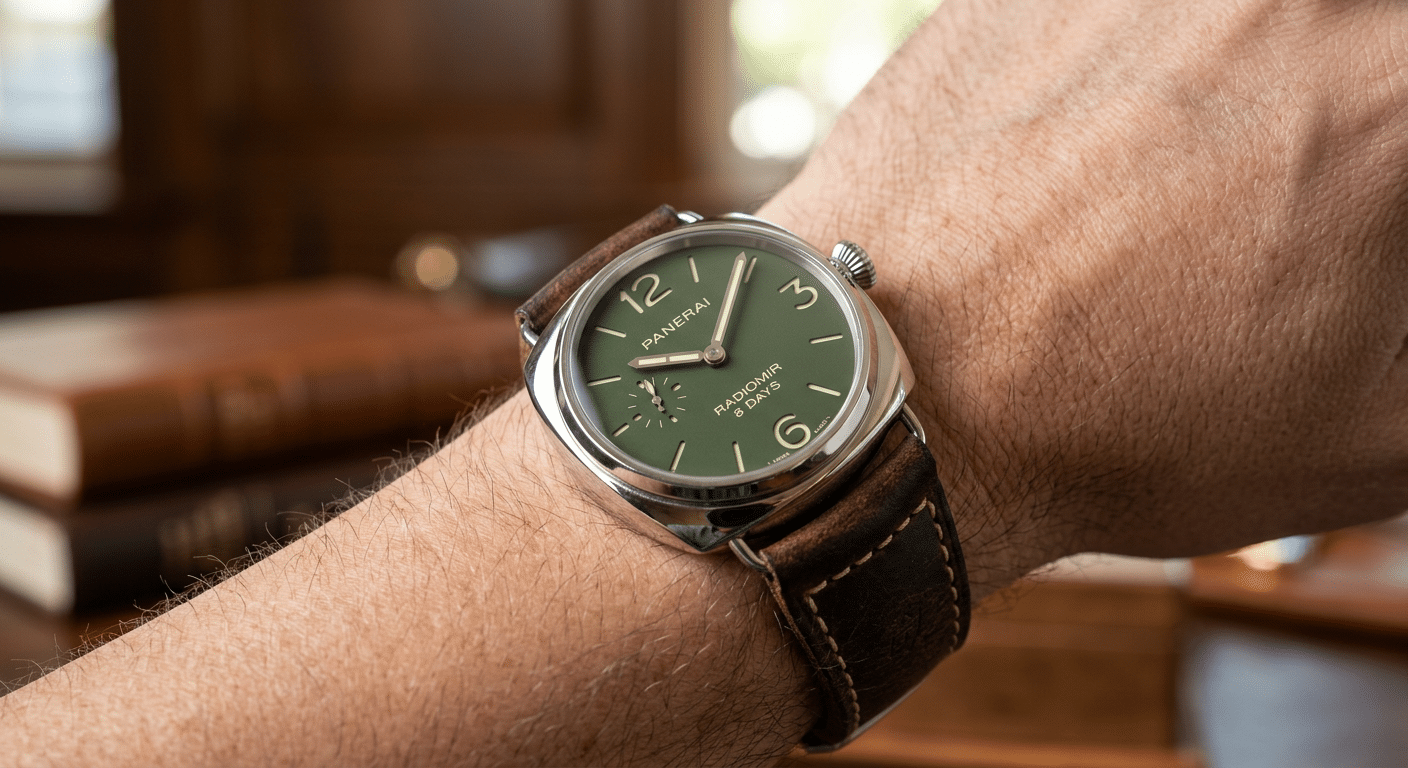
The structural integrity and practicality of wire lugs vary significantly based on their attachment method. Early Radiomir models, and some modern reinterpretations, feature fixed or soldered wire lugs. This construction offers superior strength and resilience, as the lugs are an integral, immovable part of the case. However, this fixed design severely complicates strap changes, often requiring specialized tools or even professional assistance. In contrast, many contemporary Radiomir models, such as the PAM210, employ removable wire lugs secured by small screws or an inner bar. While this system greatly enhances the ease of strap changes, it introduces potential points of failure. The small screws can be prone to stripping if over-tightened or mishandled, and the lugs themselves, being thinner, can be more susceptible to bending or damage if subjected to significant impact. This trade-off between convenience and absolute robustness is a key consideration for owners, impacting the perceived durability for daily wear versus the flexibility of customization.
Strap Compatibility and Wearer Experience
The unique geometry of Radiomir’s wire lugs fundamentally dictates strap compatibility. Standard straight-end watch straps are generally incompatible, as they lack the necessary cutouts or attachment mechanisms. This necessitates either custom-made straps with specific notched ends, specialized spring bars designed to fit the wire lug system, or straps that loop directly around the wire itself. While this can initially seem like a limitation, it also transforms the Radiomir into an exceptional canvas for bespoke strap customization. Enthusiasts often commission unique leather or exotic skin straps that are meticulously crafted to fit the wire lugs, enhancing the watch’s individuality. However, this commitment to specialized straps can significantly increase accessory costs and reduce the spontaneity of strap changes. The wearer experience is thus shaped by a conscious investment in customization, where the watch’s distinct aesthetic extends to its meticulously chosen accessories, rather than a reliance on readily available options.
Expert Authentication Insight
When evaluating a Radiomir with removable wire lugs, a critical inspection of the attachment points is paramount. Carefully examine the screw heads for any signs of stripping, burring, or deformation, which often indicate improper tool use or excessive force during strap changes. The screws should sit flush and securely, with no visible gaps or unevenness. For models utilizing an inner bar system, verify the precise fit of the spring bars within the lug holes; any excessive play, audible creaking, or lateral movement suggests a compromised connection or incorrect component. Experienced watchmakers, such as those specializing in vintage Panerai, often report that minor damage to lug screws or attachment points is a common consequence of amateur strap swaps. Such imperfections, while not always indicative of non-original parts, can signal a history of rough handling and may affect the long-term structural integrity or water resistance of the case.
The Curvature and Comfort: An Ergonomic Masterclass
Despite their often-imposing diameters, Radiomir watches are frequently praised for their surprising comfort on the wrist. This counterintuitive wearability is not accidental but a testament to a thoughtful ergonomic design rooted in Panerai’s heritage, where form was meticulously shaped by function.
The “Pillow” Effect: Cushion Case Ergonomics
The Radiomir’s renowned comfort, particularly for models often exceeding 45mm, stems directly from its distinctive “pillow” or cushion-shaped case. This is achieved through a specific geometric transition and convex shaping from the case back to the case sides. Instead of a flat back that creates pressure points, the Radiomir’s case back is subtly curved, allowing the large diameter to conform remarkably well to the natural contour of the wrist. This design distributes the watch’s weight more evenly across a broader surface area, preventing the feeling of a rigid, oversized disc digging into the wrist. The smoothly integrated sides further enhance this effect, creating a seamless flow from case to strap. This ergonomic masterclass ensures that even a 47mm Radiomir can wear with a surprising degree of comfort, making it accessible to a wider range of wrist sizes than its dimensions might suggest.
Profile and Wrist Presence: Subtlety in Size
Beyond the cushion case, the Radiomir’s overall profile significantly contributes to its less imposing wrist presence compared to its Luminor siblings. Radiomir models often feature a relatively thinner case profile (e.g., the PAM753 at approximately 11.5mm thick, versus many Luminor models exceeding 14mm). Crucially, the intentional absence of the prominent crown guard, a hallmark of the Luminor, further reduces the watch’s visual and physical bulk. This design choice results in a watch that, despite its large diameter, can slide more easily under a shirt cuff and presents a more elegant, understated profile. This subtlety in size, combined with the vintage-correct aesthetic of a clean case flank, appeals to collectors who appreciate generous dimensions but desire a watch that maintains a degree of refinement and historical fidelity, rather than overt tool-watch robustness.
Weight Distribution and Balance
The choice of case material and the specific movement dimensions play a vital role in the Radiomir’s overall balance and perceived weight, directly influencing long-term comfort. Steel Radiomir models offer a reassuring heft, anchoring the watch to the wrist, while ceramic versions (such as the PAM292) provide a significantly lighter experience, which some wearers find more comfortable for extended periods. Furthermore, the selection of a manual-wind movement, such as the P.6000 in the PAM753 or the Unitas-based OP X in the PAM210, often allows for a thinner case construction. This not only contributes to the watch’s sleek profile but also results in a lower center of gravity, improving the watch’s balance and preventing it from feeling top-heavy. Panerai’s careful consideration of these factors ensures that the Radiomir, regardless of its size, maintains a balanced and comfortable presence on wrists both large and small, a critical aspect for a watch designed for prolonged wear.
Expert Authentication Insight
To accurately assess the ergonomic integrity of a Radiomir, precise physical measurements are essential. Using digital calipers, measure the case thickness (excluding the domed sapphire crystal, which can add several millimeters) and the lug-to-lug distance. Compare these measurements against official factory specifications for the specific model. For instance, a PAM753 should exhibit a case thickness around 11.5-12mm and a lug-to-lug of approximately 48-49mm. Any significant deviation (e.g., more than 0.5mm) could indicate an incorrect case back, a case that has been improperly polished to the point of altering its profile, or even non-original components. As noted by a veteran Panerai service technician, “Over-polishing on the case back or mid-case can subtly flatten the ‘pillow’ effect, making a previously comfortable watch feel less conforming.” Such alterations directly impact the intended ergonomic design and can compromise the watch’s on-wrist feel.
Dial Openness and Vintage Tone: The Aesthetic Core
The Radiomir dial is a masterclass in minimalist design, a direct descendant of its military origins where legibility was paramount. Every element, or deliberate lack thereof, contributes to an aesthetic core defined by clarity, historical reverence, and an uncluttered visual experience.
The Uncluttered Canvas: Minimalist Dial Layouts
The Radiomir’s dial philosophy is characterized by an unwavering commitment to minimalism. This intentional design choice manifests in the deliberate omission of date windows, superfluous text, or complex complications that often populate modern watch dials. Models like the PAM210 exemplify this purity with a simple two-hand layout, featuring only the essential hour and minute markers. This uncluttered canvas, a hallmark across many replica Panerai models, allows the core elements—the large, luminous numerals and hands—to dominate, maximizing clarity and aesthetic purity. The absence of distractions ensures instant readability, a critical requirement for its original military purpose. For collectors, this minimalist approach offers a refreshing counterpoint to the often busy and complex dials prevalent in contemporary watchmaking, reinforcing the Radiomir’s identity as a straightforward, purpose-built instrument of time.
Sandwich vs. Painted Dials: Depth and Lume Performance
The Radiomir line showcases two primary dial constructions, each with distinct aesthetic and functional implications: the iconic “sandwich” dial and the simpler painted dial. The sandwich dial, seen in models like the PAM210, is a multi-layered construction where a luminous disc sits beneath a top plate with cutouts for the hour markers. This design creates a striking three-dimensional effect, giving the numerals a perceived depth and allowing for a generous application of luminous material, resulting in superior low-light performance. In contrast, painted dials, such as those found on the PAM753, feature luminous material directly applied to the surface. While offering a flatter, more direct vintage appearance, they generally exhibit less perceived depth and potentially slightly less intense luminosity compared to their sandwich counterparts. Both constructions are historically authentic to Panerai, but the sandwich dial is often celebrated for its technical ingenuity and unique visual character.
Luminous Materials and Patina Emulation
Modern Radiomir dials skillfully employ luminous materials to evoke the coveted vintage aesthetic without the hazards of historical radium or tritium. The specific use of “faux patina” Super-LumiNova colors, often in ecru, beige, or a warm off-white, is a testament to this approach. These specially formulated pigments are designed to mimic the aged, creamy appearance of discolored vintage lume, delivering the visual charm of an antique watch. This emulation is not merely cosmetic; it is a critical component of the Radiomir’s overall vintage tone and collector appeal. By using these warm-toned luminous materials, Panerai successfully bridges the gap between historical accuracy and contemporary safety standards, ensuring that modern Radiomir watches carry the spirit and visual warmth of their predecessors while offering reliable, long-lasting luminescence.
Expert Authentication Insight
To verify the originality and integrity of a Radiomir dial, particularly concerning its luminous elements, a thorough inspection under a UV light source is indispensable. Observe the luminescence of both the dial markers and the hands. The glow should be uniform across all elements, matching the expected hue for the model (e.g., green-blue for modern Super-LumiNova, or a specific “aged” tone if designed with faux patina). Any signs of uneven application, patchy luminescence, or distinct color variations between markers or between hands and markers can indicate re-luming, touch-ups, or the presence of non-factory components. For sandwich dials, specifically confirm that the luminous material is perfectly contained within the cutouts, with no bleeding or smudging onto the top plate. A professional watch authenticator often notes, “Subtle inconsistencies in lume application or color are one of the most common tells for aftermarket dial work, even on otherwise high-quality examples.”
Is a Radiomir for You? The Design Purist’s Checklist
The decision to acquire a Radiomir is less about ticking off technical specifications and more about aligning with a specific philosophy of watch design. Unlike its more overtly robust siblings in the Panerai lineup, the Radiomir appeals to a discerning collector who values historical fidelity and aesthetic purity above all else. This section critically assesses who the Radiomir is truly for, and perhaps more importantly, who it isn’t.
The “Design First” Collector: Embracing the Intent
For a collector whose primary motivation is the integrity of design and a direct connection to horological history, the Radiomir stands as Panerai’s most uncompromised offering. This buyer prioritizes the watch as a piece of industrial art, appreciating its form and narrative over its contemporary utility. The Radiomir’s appeal to this segment stems from its unwavering adherence to the original military specifications that dictated its form, presenting a watch that is, in essence, a time capsule on the wrist.
- Historical Fidelity: The Radiomir’s oversized cushion case, wire lugs, and clean, legible dial directly echo the prototypes supplied to the Italian Navy frogmen in the late 1930s. Owning one is to possess a direct lineage to a foundational design moment.
- Uncluttered Aesthetics: The deliberate absence of a crown guard, date window, or excessive dial text creates an uncluttered canvas. This minimalist approach elevates legibility and visual balance, focusing solely on the core function of time-telling. For these collectors, the “less is more” ethos is a feature, not a limitation.
- Unique Wrist Presence: Despite its often substantial diameter (e.g., 45mm), the Radiomir’s slender profile and the visual lightness of its wire lugs allow it to sit on the wrist with an unexpected elegance. It commands attention through proportion and purity, rather than overt bulk.
Judgment: For the collector who seeks a watch as a statement of design appreciation and historical reverence, one that sacrifices modern conveniences for aesthetic and narrative purity, the Radiomir is an unparalleled choice that delivers a profoundly sophisticated ownership experience.
The “Utility First” Buyer: Why Radiomir Might Disappoint
Conversely, the Radiomir might prove a frustrating acquisition for the “utility first” buyer. This collector typically seeks a watch as a robust tool, prioritizing features like extreme water resistance, shock protection, and practical complications for an active lifestyle. The very design elements that define the Radiomir’s charm can become its perceived drawbacks for this audience.
- Water Resistance Limitations: While perfectly adequate for daily wear and swimming, many Radiomir models offer a water resistance of 100 meters, which, while substantial, falls short of the 300 meters or more commonly found in Luminor or Submersible models. For serious diving or extreme water sports, this can be a genuine concern.
- Exposed Crown: The absence of the iconic crown guard, a hallmark of the Luminor, leaves the Radiomir’s crown exposed. While aesthetically pure, this design choice means the crown is more vulnerable to accidental knocks or impacts, which can be a point of anxiety for those who subject their watches to rough use.
- Perceived Fragility of Wire Lugs: Although historically accurate and structurally sound for their intended purpose, the slender wire lugs can be perceived as less robust than the integrated, solid lugs of other Panerai models. While authentic Radiomirs are built to endure, the visual impression can lead to a sense of unease for a buyer prioritizing sheer durability.
Judgment: If your primary criteria for a watch revolve around ruggedness, high-impact activities, or advanced diving capabilities, the Radiomir’s inherent design constraints, born from a different era’s demands, are likely to lead to disappointment. Other Panerai lines or brands are better suited for a pure tool-watch role.
The Straps Enthusiast: A Canvas for Customization
Despite, or perhaps because of, its unique lug design, the Radiomir is an exceptional platform for strap enthusiasts. The clean, almost architectural presence of the cushion case, unencumbered by a crown guard or complex dial elements, allows the strap to become a prominent part of the watch’s overall aesthetic. This makes the Radiomir a favorite for those who enjoy customizing their timepiece’s appearance.
- Aesthetic Dominance: The simple elegance of the Radiomir case ensures that any strap choice takes center stage. Whether a vintage-inspired leather, a rugged canvas, or an exotic hide, the strap’s texture, color, and stitching are highlighted, becoming an integral design element.
- Unique Compatibility Requirements: The wire lugs, whether fixed or removable, necessitate specific strap designs. Many off-the-shelf straps may not fit, driving enthusiasts towards bespoke options. This “limitation” paradoxically fosters creativity, as custom strap makers specialize in Radiomir-specific designs, offering a vast array of unique choices.
- Transformative Power: A change of strap can dramatically alter the Radiomir’s character, transforming it from a vintage military tool to a sophisticated dress watch, or a casual weekend companion. This versatility, driven by the strap, is a significant draw for collectors who enjoy frequent aesthetic changes.
Judgment: For the collector who views a watch as a canvas for personal expression through straps, the Radiomir’s distinctive design, particularly its wire lugs and minimalist case, offers unparalleled opportunities for customization and aesthetic transformation. The initial challenge of finding compatible straps quickly becomes a rewarding journey into the world of bespoke accessories.
Expert Authentication Insight
When evaluating a Radiomir, particularly those with removable wire lugs, conduct a gentle “wiggle test” on the lugs and their attachment points. Hold the case firmly and attempt to gently move each lug. While some minimal flex might be an inherent characteristic of certain designs or the nature of a removable system, any excessive movement, creaking sounds, or noticeable looseness could indicate a structural compromise. This might point to stripped screw threads, a poorly executed repair, or even a non-factory component. For models with soldered lugs, any signs of separation or repair at the lug-case junction should raise immediate concerns about the watch’s integrity and originality. A solid, secure attachment, free from play, is a critical indicator of a well-maintained and authentic Radiomir case structure.