
The Illusion of “Swiss ETA”: Scarcity and Misrepresentation in Panerai Replicas
Walk into almost any replica watch forum, and you’ll inevitably encounter claims of “Swiss ETA” movements powering Panerai replicas. The promise is tempting: Swiss precision and reliability at a fraction of the cost. However, the reality is far more complex, and often, deliberately misleading. The true availability of genuine ETA movements in the replica market is virtually non-existent, leading to a pervasive cycle of mislabeling and outright deception regarding Panerai replica movements. This isn’t just about semantics; it’s about paying a premium for a ghost, and the consequences for your wallet and wrist can be significant.
Genuine ETA Movements: Supply Chain Realities and Panerai’s Original Use
Before Panerai developed its now-famous in-house calibers like the P.9000, many of its watches, particularly during the pre-2010 era, relied on robust, modified ETA movements. Calibers like the ETA 6497 (Unitas) or the 7750 chronograph were workhorses, known for their reliability and serviceability. However, the landscape for acquiring these movements dramatically shifted with the “Swatch Group effect.” ETA SA, a subsidiary of the Swatch Group, began progressively restricting its supply of ébauches (unfinished movements) and fully assembled movements to third-party brands starting in the mid-2000s, largely ceasing external sales by 2020. This strategic move aimed to bolster Swatch Group brands and encourage other manufacturers to develop their own calibers.
The legitimate channels for acquiring genuine, new ETA 2824, 2836, or 7750 movements today are limited to established watch brands with existing supply agreements, or authorized service centers for repairs. Replica factories, by their very nature operating outside legal frameworks, simply do not have access to these official supply chains. The idea that a replica factory can source genuine ETA movements in bulk, let alone at a price point compatible with replica manufacturing, is a fantasy. Any dealer claiming a “new, genuine Swiss ETA” in a replica Panerai is either misinformed or, more likely, intentionally deceptive.
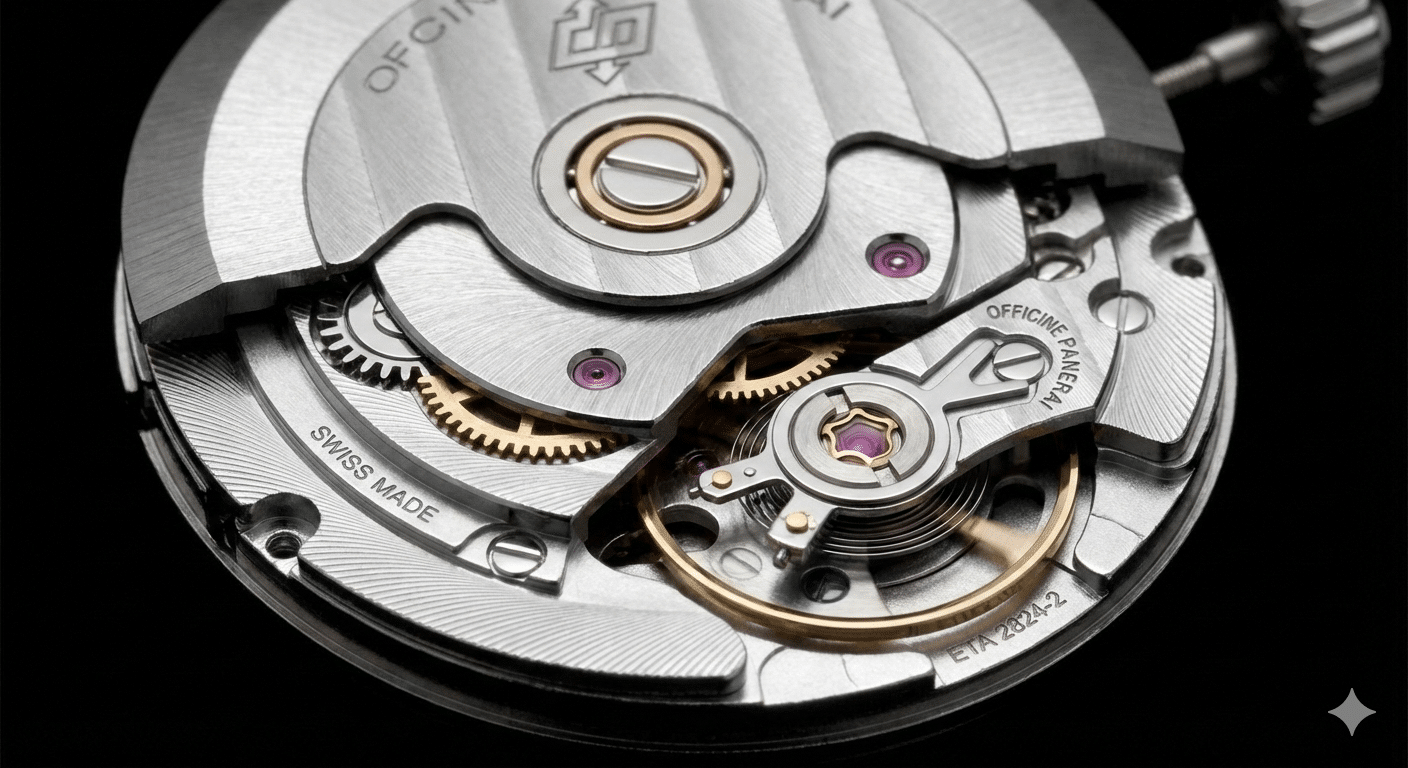
The “Swiss Made” Paradox: What the Label Truly Means (and Doesn’t)
The term “Swiss Made” carries significant weight in the watch industry, implying a certain standard of quality and origin. Legally, for a movement to be considered “Swiss Made,” at least 60% of its manufacturing cost must be generated in Switzerland, and it must be assembled and inspected in Switzerland. For a complete watch, the movement must be Swiss, it must be cased in Switzerland, and the final inspection must take place in Switzerland.
Replica manufacturers frequently exploit consumer misunderstanding of this stringent definition. They might use terms like “Swiss parts movement” or “assembled with Swiss components.” This is often a smokescreen. While a tiny percentage of components (say, a balance wheel or a spring) might originate from Switzerland, the overwhelming majority of the movement’s value and assembly occurs in China. The intent is to leverage the prestige of “Swiss Made” without meeting any of its legal or quality requirements. It’s a linguistic trick designed to inflate perceived value and justify higher prices for what is, fundamentally, a Chinese-made product.
Spotting the Imposter: Common Deceptive Practices for “ETA” Labeling
The replica market’s ingenuity in deception is unfortunately well-honed when it comes to “ETA” branding. Low-grade Chinese movements, often costing less than $50, are routinely rebranded as “ETA” or “Swiss ETA” through a variety of superficial methods. This can include laser-etching “ETA” or “Swiss Made” onto a rotor, applying generic “Swiss” stickers to the movement bridge, or simply relying on misleading product descriptions from unscrupulous dealers. These movements often bear little to no resemblance to genuine ETAs in terms of finishing, component quality, or architecture.
Another common tactic is to use a clone movement (like a Sea-Gull ST2130) and then engrave “ETA” on the rotor, or even “2824-2” on the mainplate. While the base movement might be a functional clone, the “ETA” branding is entirely fraudulent. It preys on the buyer’s lack of expertise and the difficulty of inspecting a movement without opening the watch.
Expert Authentication Insight
When examining a movement claimed to be “Swiss ETA,” pay close attention to the balance wheel and its shock protection system. Genuine ETA movements (2824, 2836, 2892) typically use Incabloc or Etachoc shock protection. Incabloc is identifiable by its distinctive lyre-shaped spring, while Etachoc uses a trident-shaped spring. Counterfeit or low-grade Chinese movements, on the other hand, frequently employ simpler Novodiac or Kif-style shock absorbers, which have different spring geometries. Sometimes, they might attempt a poor copy of Incabloc, but the finish and precision will be visibly inferior. Use a 10x loupe to scrutinize the jewel settings and the spring itself for precise, clean geometric execution. A genuine ETA will exhibit crisp, uniform edges and a consistent metallic sheen, while a fake will often show burrs, uneven polishing, or a duller finish. The jewels themselves in genuine ETAs are typically vibrant, uniformly colored synthetic rubies, whereas fakes might have duller, less consistent colors or even plastic “jewels.”
Sellita SW-Series: The Legitimate Swiss Alternative and Its Replica Market Presence
With ETA’s supply restrictions, Sellita Watch Co. SA stepped into the void, becoming a major independent supplier of Swiss mechanical movements. Sellita’s movements are not just “clones” in the replica sense; they are legitimate, high-quality Swiss alternatives, often built to almost identical specifications as their ETA counterparts. This makes Sellita a crucial player in the broader watch industry, and by extension, in the replica market’s narrative.
Sellita’s Manufacturing Standards: A True Swiss Competitor
Sellita operates a sophisticated manufacturing facility in Switzerland, producing a wide range of calibers that are technically analogous to popular ETA movements. Their SW200-1, for instance, is a direct competitor and near-identical twin to the ETA 2824, sharing its 28,800 vph beat rate, dimensions, and hand-stack. Similarly, the SW300-1 corresponds to the ETA 2892, and other calibers mimic ETA’s chronograph or GMT offerings. Sellita movements adhere to strict Swiss manufacturing standards, including quality control, finishing, and component sourcing. They are widely used by numerous legitimate watch brands that do not have in-house movement capabilities.
From a technical standpoint, a well-regulated Sellita movement can offer performance virtually indistinguishable from an equivalent ETA in everyday use. This makes them an attractive, legitimate option for brands and, deceptively, a convenient name to drop in the replica market.
Sellita in Replicas: Genuine Integration vs. Misleading Claims
The presence of Sellita movements in the replica market is a nuanced issue. It’s highly improbable that replica factories are sourcing new, genuine Sellita movements in bulk for the same reasons they can’t source ETA. However, there are two scenarios where Sellita might genuinely appear:
- Salvaged Movements: Occasionally, a high-tier “franken-watch” (a replica assembled with genuine parts) might incorporate a salvaged genuine Sellita movement. This is rare, expensive, and not a factory-scale operation.
- Deceptive Marketing: More commonly, dealers will claim “Sellita” when they are, in fact, using a high-quality Chinese clone of an ETA movement (like a Sea-Gull ST2130), hoping to leverage the Swiss association. The visual similarity between an SW200-1 and an ST2130 (both ETA 2824 clones) allows for easy misrepresentation to an untrained eye.
The critical takeaway is that if a replica factory were* to genuinely use a new Sellita movement, it would likely be a significant cost driver, pushing the watch well beyond typical replica pricing. Most claims of “Sellita inside” should be met with extreme skepticism, as they rarely translate to actual Swiss movements.
Modifications for Panerai Aesthetics: The SW-Series Transformation
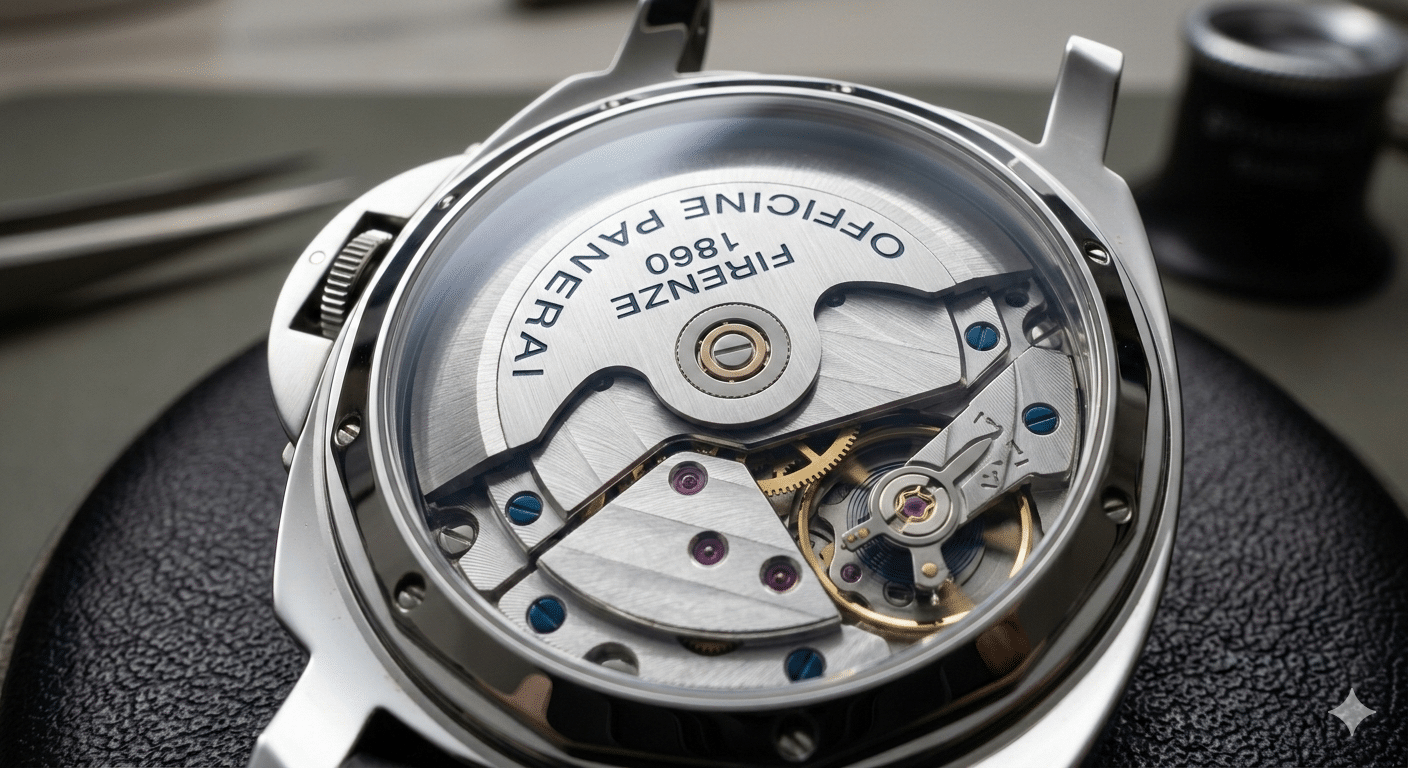
Whether a genuine Sellita (unlikely) or a Chinese clone advertised as such, movements destined for Panerai replicas often undergo cosmetic modifications to better mimic Panerai’s in-house calibers. This is particularly true for models with display casebacks. Common modifications include:
- Custom Rotors: The standard Sellita rotor is often replaced with one engraved with “Panerai,” “Officine Panerai,” or a replica of Panerai’s specific rotor design.
- Bridge Engravings: While difficult to replicate the full architecture, some replica makers will engrave bridges with patterns or text (e.g., “P.9000”) to visually approximate Panerai’s in-house look.
- Plate Additions: In more elaborate clones, additional plates might be added to obscure the original movement’s layout and create the impression of a different caliber, especially to simulate the P.9000’s bridge structure.
These modifications are purely aesthetic and do not change the underlying movement’s mechanical properties. They are designed to fool the eye, not to improve performance.
Expert Authentication Insight
Authenticating a claimed Sellita movement requires meticulous inspection. Genuine Sellita movements often have very faint, laser-etched markings like “SW200-1” or the “Sellita” name, typically located under the balance wheel or on the mainplate. These markings can be incredibly subtle and are often obscured by replica modifications. Use a 15x magnification loupe and a strong light source to search for these. Beyond markings, compare the overall finishing quality: genuine Sellita movements will have consistent perlage or Geneva stripes, precise chamfering on bridges, and uniformly colored synthetic ruby jewels. The screws will be cleanly finished, often heat-blued (a vibrant, iridescent blue) or polished. Many Chinese clones, even good ones, will show less refined finishing, less consistent patterns, and sometimes a slightly different hue to the rhodium plating or jewel color compared to a known genuine Sellita example.
The Rise of the East: Sea-Gull and Hangzhou Clones in Panerai Replicas
While “Swiss ETA” and “Sellita” claims persist, the undeniable truth is that the vast majority of Panerai replicas, from mid-tier to “super clone,” are powered by high-quality Chinese clone movements. Tianjin Sea-Gull Watch Group and Hangzhou Watch Company are the two titans of this industry, producing reliable and increasingly sophisticated mechanical calibers that form the backbone of the replica ecosystem. These movements are not merely cheap imitations; they are well-engineered, mass-produced workhorses that deliver surprisingly good performance for their price point.
Sea-Gull ST2130 (ETA 2824 Clone): The Workhorse of Mid-Tier Replicas
The Sea-Gull ST2130 is arguably the most prevalent automatic movement in mid-tier Panerai replicas that don’t feature in-house clone calibers. For a comprehensive look at chinese panerai movement alternatives, the ST2130 is a direct, well-executed clone of the ETA 2824, sharing its key specifications: a 28,800 vibrations per hour (vph) beat rate, 25 jewels, and a similar hand-stack (hour, minute, central seconds, date). Its reliability is generally considered good, with many owners reporting stable timekeeping within acceptable parameters (+/- 10-20 seconds per day) out of the box. The ST2130 is relatively easy to service by independent watchmakers, as its architecture is so close to the ubiquitous ETA 2824 that parts are often interchangeable.
Typical modifications for Panerai replicas include replacing the standard rotor with a custom-engraved one, and sometimes basic perlage or Geneva stripes on the bridges to enhance visual appeal through a display caseback. Its power reserve typically ranges from 38 to 42 hours, which is standard for this type of movement but falls short of Panerai’s in-house 72-hour calibers.
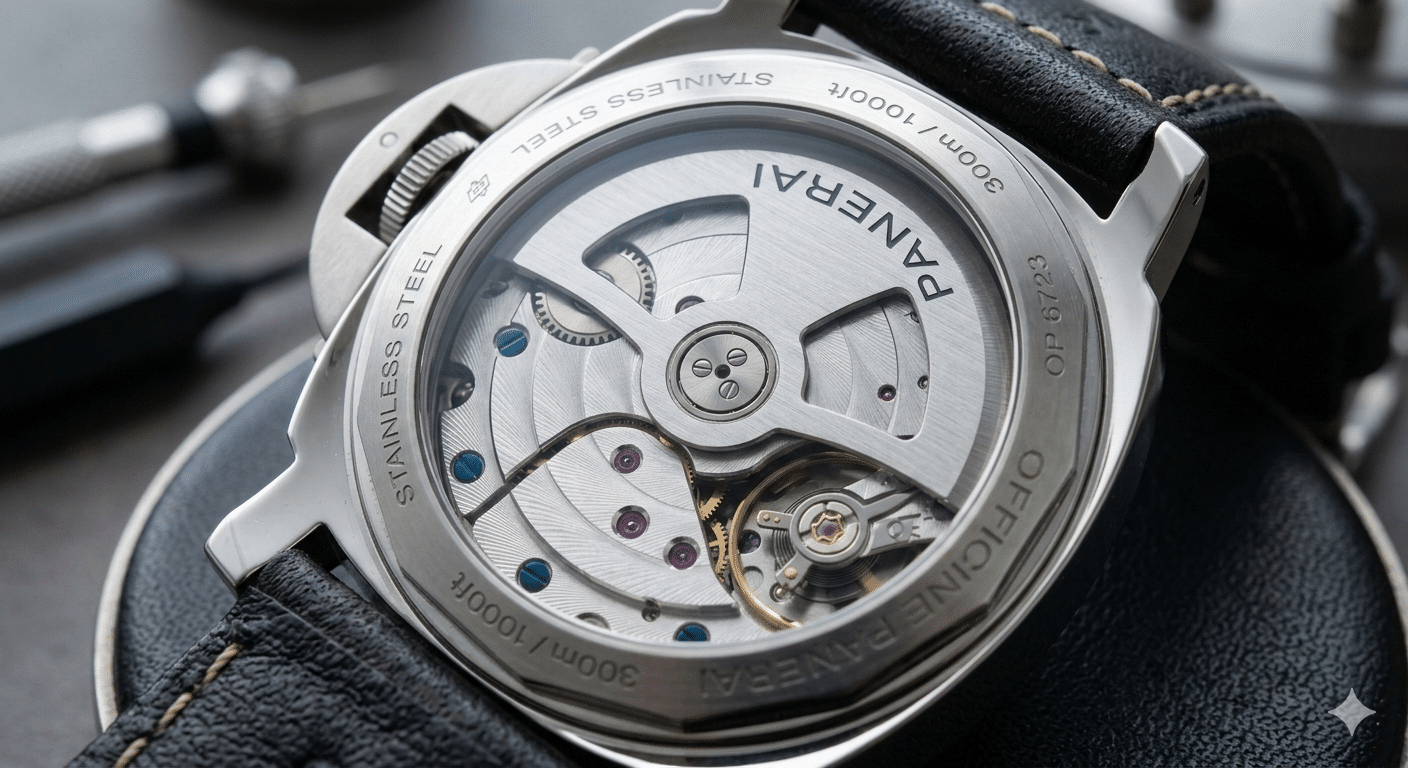
Hangzhou 6460 (ETA 2836 Clone): Date and GMT Functionality
The Hangzhou 6460 is another prominent Chinese clone movement, closely replicating the ETA 2836. The primary distinction from the 2824/ST2130 is its day/date complication and its ability to support GMT functionality with an independent 24-hour hand. This makes the Hangzhou 6460 a common choice for Panerai replicas requiring these complications, such as models with a second time zone or a day-date display.
Like the ST2130, the Hangzhou 6460 operates at 28,800 vph and offers a similar power reserve. Quality variations can exist between batches and specific factories, with some exhibiting better regulation and finishing than others. When used for GMT functions in replicas, the GMT module can sometimes be a point of weakness, leading to functionality issues or fragility if not well-executed. Buyers should exercise caution with complex complications using these base movements, as reliability can vary significantly.
Panerai-Specific “Clone” Movements: The VS P.9000 and Similar Efforts
The true revolution in Panerai replica movements came with the development of factory-specific “super clone” movements, most notably the VS P.9000 (and its derivatives like the P.9010 and P.4000). These are not merely decorated Sea-Gull or Hangzhou movements; they are ground-up reverse-engineered calibers designed to visually and functionally mimic Panerai’s in-house movements. The VS P.9000, for instance, was a breakthrough because it addressed critical “tells” of previous replicas:
- Correct Power Reserve: It achieved a genuine 70-72 hour power reserve, matching the authentic P.9000.
- Correct Balance Wheel Position: The balance wheel is located at 7 o’clock, mirroring the genuine P.9000, unlike generic movements where it’s typically at 6 o’clock.
- Quick-Set Hour Hand (True GMT): For P.9010 clones, it features an independently adjustable jumping hour hand, a crucial “traveler GMT” function that was previously impossible or fragile in replicas.
- Reduced Case Thickness: By accurately replicating the movement’s dimensions, these clones allow for case thicknesses much closer to genuine Panerai watches (e.g., 14.5mm vs. 16mm+ for ETA-based alternatives), solving a long-standing aesthetic issue.
- Visual Fidelity: The bridges, plates, and rotor are designed to replicate the specific layout and finishing of Panerai’s in-house calibers, often with impressive perlage, Geneva stripes, and replica engravings. The VS P.9000, in particular, boasts approximately 85% parts compatibility with the genuine movement, making it a remarkably sophisticated replica.
These movements, while Chinese-made, represent the pinnacle of replica engineering. They are often based on custom-designed Chinese ébauches rather than off-the-shelf Sea-Gull or Hangzhou movements, though those companies’ expertise undoubtedly informs their development. Factories like VS Factory invest heavily in these dedicated clone movements to achieve “super clone” status.
Expert Authentication Insight
When assessing Chinese clone movements, especially the highly decorated ones, observe the balance wheel’s oscillation and the quality of any perlage or Geneva stripes. While top-tier Chinese clones like the VS P.9000 are visually impressive, they often exhibit slightly less refined finishing than genuine Swiss movements. The edges of the bridges, the consistency of the perlage patterns, and the hue of the rhodium plating might show subtle differences under high magnification (e.g., 15x). The perlage might be less uniform in depth or size, and the chamfering on bridge edges less sharp. A timegrapher is an invaluable tool here: while a well-regulated Sea-Gull or Hangzhou clone can show stable readings, their amplitude (the degree of balance wheel swing) and beat error (the asymmetry of the balance wheel’s swing) might be consistently lower than a genuine Swiss movement. For example, a new Swiss ETA might show an amplitude of 280-310 degrees, whereas a Chinese clone, even a good one, might sit in the 250-280 range. Consistent, stable readings are a sign of a good clone, but absolute values can still hint at origin.
The Deceptive World of “Fake ETA” Movements: Low-Grade Clones and Franken-Movements
While some replica manufacturers strive for high-fidelity clones, a significant portion of the market deals in outright counterfeit movements designed to intentionally deceive. These aren’t merely less refined versions; they are often low-grade mechanisms with poor quality and unreliable performance, marketed with misleading “ETA” branding.
Generic Chinese Movements Rebranded as “ETA”
At the bottom tier of the replica movement hierarchy are very low-cost, mass-produced Chinese movements that are superficially altered to resemble their Swiss counterparts. Movements from manufacturers like the DG series (e.g., DG2813) or Nanning are common culprits. These calibers, originally designed for inexpensive watches, are often engraved with fake “ETA” logos or “Swiss Made” text on their rotors or bridges. Sometimes, a generic base movement might even have a decorative plate screwed on top to give the illusion of a more complex or “Swiss” architecture. They are chosen for their extreme low cost, not their precision or durability. While they might tick, their accuracy, power reserve, and longevity are significantly inferior to even a basic genuine ETA movement, let alone a well-made Chinese clone from Sea-Gull or Hangzhou. Buyers often pay a premium for these, mistakenly believing they are acquiring a genuine or high-quality replica of a Swiss movement.
“Franken-Movements”: Assembled from Disparate Parts
The term “Franken-movement” describes a mechanism pieced together from a mix of genuine, counterfeit, and low-quality parts. This practice is particularly insidious because it can be difficult to detect without a full teardown. A “Franken-movement” might, for instance, feature a genuine ETA mainplate, but with low-grade Chinese gears, balance wheel, or shock protection. Conversely, it could be a cheap Chinese movement with a genuine ETA rotor screwed on. The goal is to create a movement that looks convincing enough on a quick inspection but lacks the integrity and reliability of a cohesive, well-engineered caliber. The primary issue with these movements, beyond their inherent unreliability, is their near-impossibility to service. A watchmaker attempting repairs will face a nightmare of incompatible parts, non-standard tolerances, and a lack of readily available replacements, often making the watch unserviceable and a complete write-off.
Common Visual Cues of Deceptive “Fake ETA”
Identifying a deceptive “fake ETA” movement often comes down to scrutinizing specific visual cues, even if you’re not a watchmaker. One of the most immediate red flags is an incorrect jewel count; many low-grade movements will feature fewer jewels than a genuine ETA, or some “jewels” might simply be decorative, non-functional plastic inserts. Another dead giveaway is the use of a plastic movement holder, which is almost never found in genuine Swiss movements. Examine the finishing: genuine ETA movements, even basic ones, have a certain level of precision in their perlage, Geneva stripes, or rhodium plating. Fake ETAs will often display rough, inconsistent finishing on plates and bridges, visible burrs, or poorly applied decoration. Incorrect screw types or finishes (e.g., shiny silver screws where blued steel is expected, or poorly cut screw slots) are also tell-tale signs. Finally, be wary of non-functional decorations, like painted “gears” or “screws” that serve no mechanical purpose, designed purely to mimic a more complex movement.
Expert Authentication Insight
To truly unmask a deceptive “fake ETA” movement, removing the rotor is often necessary. Once exposed, meticulously examine the mainplate and bridge edges for any signs of burrs, uneven polishing, or inconsistent chamfers. Genuine ETA movements exhibit a high degree of precision in these areas, even on their entry-level calibers. The color and consistency of the jewels are also critical. Genuine ETA movements utilize precisely cut and uniformly colored synthetic ruby jewels, which have a distinct, vibrant red or purple hue and are firmly seated. Many low-grade fake ETAs, however, use plastic jewels, poorly formed synthetics, or even just painted dots. A gentle prod with a wooden toothpick can sometimes reveal loose or plastic jewels that are not properly set or are merely decorative. If the jewels appear dull, inconsistent in color, or feel soft, you’re likely looking at a fake.
Dealer Sourcing Patterns: How Replica Movements Reach the Market
The journey of a replica movement from its manufacturing origin to the end-buyer’s wrist is often a convoluted and opaque one. Understanding these sourcing patterns is crucial for any buyer looking to navigate the complex replica market, as they directly impact the quality, authenticity, and pricing of the watches sold.
Direct from Factory vs. Middlemen: The Supply Chain Layers
The replica watch supply chain operates with varying degrees of transparency. At one end are the “Trusted Dealers” (TDs) who claim to source directly from the major replica factories like VS Factory, ZF, or Clean Factory. This direct relationship theoretically allows for better quality control, access to the latest models, and potentially more accurate information about the movement’s origin. These dealers often have established relationships and can provide more reliable guarantees. At the other end, and far more common, are dealers who acquire their stock through multiple layers of middlemen. These intermediaries can obscure the true origin of the watch and its movement, making it difficult to verify claims. Each layer of middleman adds cost, reduces transparency, and increases the risk of receiving a misrepresented or lower-quality product. A dealer operating through several intermediaries might genuinely believe a movement is a “VS P.9000” because that’s what they were told, even if it’s a cheaper substitute.
The “Grade” System: A Marketing Ploy for Movements
Within the replica community, terms like “N-factory,” “VSF-grade,” or “super clone” are frequently thrown around, often creating confusion. While these terms can sometimes refer to a specific factory’s output for the entire watch* (case, dial, overall finish), they are frequently misused when applied to movements. A “super clone” movement, for example, primarily denotes a high-fidelity *visual* clone of a genuine in-house caliber, not necessarily a genuine Swiss movement. It means the replica factory has invested in reverse-engineering the aesthetics and, to some extent, the functionality of the original movement, often using a Chinese base. It’s a marketing term indicating a factory’s commitment to visual accuracy and sometimes functional parity (like the VS P.9000’s 72-hour power reserve). It does not imply a universal quality standard or that the movement is of Swiss origin. Buyers should approach these “grades” with skepticism, understanding they are often factory-specific marketing rather than objective quality benchmarks.
The Language of Deception: Marketing Panerai Replica Movements
Dealers often employ specific euphemisms and misleading phrases to describe their movements, walking a fine line between marketing and outright false advertising. Phrases like “Asian ETA,” “Swiss parts movement,” or “custom decorated clone” are designed to evoke a sense of quality and Swiss heritage without making explicitly false claims. “Asian ETA,” for instance, almost universally refers to a Chinese clone of an ETA movement, such as a Sea-Gull ST2130 or Hangzhou 6460. While these can be good quality movements, they are not Swiss. “Swiss parts movement” can be particularly deceptive, implying Swiss quality when it might only mean one minor component (like a single screw or jewel) is Swiss, while the rest is Chinese. “Custom decorated clone” is more honest, indicating a Chinese base movement that has been visually modified to resemble a genuine caliber. Savvy buyers must learn to decode this language, recognizing that these terms are often used to manage expectations and avoid direct falsehoods, while still implying a higher quality than what might actually be present.
Expert Authentication Insight
When dealing with replica movements, transparency is paramount. Always request clear, high-resolution photographs or videos of the actual* movement being sold, not generic stock photos. These images should be sharp enough to zoom in and examine minute details. Compare specific attributes like bridge shape, the exact placement of screws, the font and depth of any engravings (e.g., “Panerai,” “Officine,” or movement caliber numbers), and the design of the rotor against known examples of genuine movements and high-quality replica clones. Pay particular attention to the movement holder; genuine Swiss movements, when cased in a watch, are secured by a metal or high-quality plastic ring, not a generic, flimsy plastic holder that often indicates a low-grade Chinese movement forced into a case designed for a different caliber.
Decoding Panerai’s In-House Calibers in Replicas: The Art of Replication
Panerai’s move towards distinctive in-house movements like the P.9000, P.3000, and P.5000 presented a fresh challenge for replica factories. Unlike standard ETA clones, the intricacies of replica Panerai clone movements required extensive visual and sometimes functional replication, transforming standard base movements into something that visually mimics Panerai’s unique engine architecture.
The P.9000/P.9010 Clone: Architecture and Functionality Challenges
The genuine Panerai P.9000 and P.9010 (with GMT functionality) are automatic movements known for their 72-hour power reserve and specific bridge layout. To replicate this, manufacturers typically start with a robust Chinese automatic base movement, often a modified Sea-Gull ST2555 or a custom Chinese ebauche. The most critical modifications involve altering the bridge layout and balance wheel position to visually match the genuine P.9000. This includes creating decorative plates that cover parts of the base movement and feature faux bridge structures. For the P.9010 clone, the challenge extends to functionality: achieving a true quick-set hour hand (a “traveler GMT” function) where the hour hand can be adjusted independently without stopping the movement, as found in the genuine. The VS Factory’s P.9000 clone was a breakthrough, achieving a genuine 70-72 hour power reserve and a true jumping hour hand on its P.9010 variants, making it remarkably close to the original in both form and function.
The Manual-Wind P.3000/P.5000 Clones: Simplicity and Visual Fidelity
Panerai’s manual-wind in-house calibers, like the P.3000 (3-day power reserve) and P.5000 (8-day power reserve), are characterized by their large, simple bridges and robust appearance. Replicating these often begins with a large manual-wind Chinese base, such as the Sea-Gull ST3620 (a Unitas 6497 clone), or bespoke designs. The emphasis here is heavily on visual fidelity. Replica factories create custom bridges and plates that mimic the distinctive shape, thickness, and layout of the genuine P.3000 or P.5000. The goal is to replicate the “wall-to-wall” bridge design, the balance wheel’s position, and the overall industrial aesthetic. While achieving the full 8-day power reserve of the P.5000 is still a significant challenge for clones, factories like XF have managed to create P.3000 clones with respectable power reserves of 65-68 hours, alongside accurate visual representation of the plates and bridges, giving the illusion of the original’s robust simplicity.
Movement Decoration and Finishing: The “Super Clone” Aesthetic
For top-tier “super clone” Panerai replicas, significant effort goes into replicating the aesthetic finishing of the genuine movements. This includes applying perlage (circular graining), Geneva stripes (Côtes de Genève), and heat-blued screws. Engraved text, such as “OFFICINE PANERAI” or the caliber number, is meticulously reproduced on the replica bridges. While these decorations can be visually impressive, it’s crucial to understand their limitations. Replica finishing is typically machine-applied and lacks the depth, precision, and hand-finished quality found on genuine Panerai movements. For example, the beveling on replica bridges might be less sharp or consistent, the perlage patterns might be shallower, and the “blued” screws might be chemically treated rather than heat-blued, resulting in a less vibrant or durable blue. These details often require magnification to discern, but they represent a key differentiator between a “super clone” and the genuine article.
Expert Authentication Insight
When examining a replica Panerai with a cloned in-house movement, focus intensely on the balance wheel position and the overall plate architecture. Genuine Panerai in-house movements have very specific, often asymmetrical, bridge layouts and balance wheel placements that are fundamental to their design. Replica clones, even highly decorated ones, frequently betray their underlying base movement through subtle differences. Look for discrepancies in gear train visibility (where gears are exposed or hidden), the exact placement and type of screws, or the curvature and thickness of the bridges. These small details can reveal that the movement is a decorated standard Chinese base rather than a true ground-up clone. Additionally, use a precision caliper to measure the overall movement diameter and thickness. Compare these measurements directly to the published specifications of the genuine Panerai caliber. Significant deviations can indicate a poorly executed clone or a different base movement entirely.
The Buyer’s Roadmap: Making Informed Decisions on Replica Movements
Navigating the complex landscape of Panerai replica movements requires a clear head and a healthy dose of skepticism. The market is rife with misleading claims and opaque sourcing, making it challenging for buyers to discern true value and reliability. This section provides a practical framework to help you make informed decisions, balancing cost, performance, and the often-elusive promise of authenticity.
Prioritizing Reliability: When a “Clone” Outperforms a “Fake ETA”
When evaluating replica movements, it’s crucial to understand that not all non-genuine movements are created equal. A well-executed Chinese clone movement, such as the Sea-Gull ST2130 (an ETA 2824 replica) or the Hangzhou 6460 (an ETA 2836 replica), often represents a far more reliable and serviceable choice than a generic “fake ETA.”
These reputable Chinese clones are manufactured with a degree of consistency and quality control. While they may not match Swiss precision, they are designed to be functional, offer acceptable timekeeping, and critically, can often be serviced by watchmakers familiar with their ETA counterparts due to parts interchangeability. For instance, the Sea-Gull ST2130 is widely praised in the replica community for its robust performance, often running within acceptable daily deviation limits for years without immediate servicing. Many users report that these movements can hold up for 18 months or more before needing attention, making them a workhorse in mid-tier replicas. In contrast, “fake ETA” movements are typically low-cost, mass-produced generics (e.g., DG series or Nanning movements) that are superficially engraved or decorated to resemble an ETA. These movements are notorious for poor precision, short lifespans, and a lack of readily available replacement parts, making them a nightmare for servicing. Paying a premium for a watch containing one of these is a mistake, as you’re likely to encounter significant reliability issues and potential refusal from watchmakers to even attempt a repair.
The Servicing Dilemma: Repairing Modified and Clone Movements
One of the most overlooked aspects of purchasing a replica watch is the long-term servicing prospect. Unlike genuine watches, which have standardized parts and official service centers, replica movements present a significant challenge for watchmakers. Panerai replica movements, especially the highly modified “super clones” like the VS P.9000, are often bespoke creations that blend elements of existing Chinese ebauches with custom plates, bridges, and rotors to mimic Panerai’s in-house calibers.
This customization, while visually impressive, can complicate future repairs. A watchmaker accustomed to genuine ETA movements might find it difficult to source specific replacement parts for a clone movement, particularly if it’s been heavily modified. While some common parts (like balance staffs or mainsprings) might be interchangeable with their ETA or Chinese clone equivalents, proprietary components unique to the replica’s aesthetic modifications are often unobtainable. This can lead to watchmakers charging higher fees due to the increased complexity and time required, or even outright refusing service. Based on community reports and watchmaker conversations, servicing a VS P.9000 clone can range from $150–$250, while a basic Asian 2824 modification might cost $80–$150. This is still considerably less than genuine Panerai service fees ($400–$700), but it’s a cost to factor in, especially if specialized parts are needed.
Price vs. Perceived Value: Setting Realistic Expectations
The replica market often leverages ambiguity to inflate prices. One of the most common deceptions is charging “Swiss ETA” prices for movements that are anything but Swiss. It’s crucial to understand that true, genuine Swiss ETA movements are exceedingly rare in the replica market, especially in bulk. If a dealer advertises a “Swiss ETA” Panerai replica for $500 or more, alarm bells should ring. You are almost certainly paying for a Chinese clone or a modified movement that is being misrepresented.
Instead, focus on the actual movement type and the reputation of the factory producing it. For Panerai replicas, the pricing tiers generally correspond to the movement quality and the overall fidelity of the watch:
- Super Clone ($380–$650): These typically feature highly decorated Chinese clone movements (like the VS P.9000 or XF P.3000), 316L steel, and accurate aesthetic details. The premium here is for the external finishing and the visual accuracy of the clone movement, not its Swiss origin.
- Mid-Tier ($220–$380): Often use standard Chinese clone ETA movements (e.g., Sea-Gull ST2130) with some Panerai-style rotor decoration. These offer good value for money if you prioritize reliable timekeeping over perfect visual authenticity of the movement.
- Budget ($120–$220): These will typically house generic Chinese automatics (like the DG2813) or low-grade clone ETAs. Expect compromises in material quality, finishing, and movement reliability.
Do not conflate “super clone” with “Swiss movement.” A “super clone” refers to the watch’s overall external accuracy (case, dial, hands) and the visual fidelity of the movement’s decoration to the genuine article, not its manufacturing origin or the authenticity of its components. Setting realistic expectations about what your money is actually buying is key to avoiding disappointment.
Expert Authentication Insight
Physical Diagnostic: Perform a Power Reserve Test
A simple yet effective diagnostic tool for assessing movement quality, regardless of its declared origin, is a power reserve test. This test can reveal significant discrepancies between advertised performance and actual reliability. Fully wind the watch (for automatics, this means hand-winding until you feel resistance or for at least 40-50 full crown turns; for manuals, wind until fully tight). Record the start time and let the watch run undisturbed until it stops. Note the total time it ran.
Compare this actual power reserve against the advertised specification:
- A standard automatic (like an ETA 2824 or its clones) should offer 38-42 hours.
- A P.9000 clone should aim for 70-72 hours (though 60-65 hours is common for good replicas).
- A P.5000 clone (manual wind) should target 8 days (192 hours), though replica versions might achieve 60-72 hours.
If your watch, advertised with a 40-hour power reserve, stops after only 20-25 hours, it’s a strong indicator of a low-quality, poorly regulated, or worn-out movement, irrespective of its visual appearance or the dealer’s claims. This discrepancy matters because it directly impacts daily usability and signals underlying mechanical issues.
For Panerai replicas, the focus should less be on ambiguous “Swiss ETA” claims and more on the reputation of the replica factory for producing high-quality, stable Chinese clone movements. Factories like VS Factory have earned their reputation by consistently delivering robust and visually accurate P.9000 clones. Prioritize transparency from dealers: always demand actual, high-resolution photos or videos of the specific movement inside the watch you intend to purchase, not generic stock images. Understand that true “Swiss ETA” is a rarity reserved for genuine watches, not replicas. Before making a purchase, use this checklist:
- Ask for Movement Photos: Insist on clear photos of the actual movement, preferably with the rotor removed if possible.
- Verify Factory Claims: Research the specific factory (e.g., VS, XF) and their known movement types for that model.
- Check Balance Wheel: Look for consistent oscillation and any obvious wobbles.
- Examine Finishing: Even on clones, look for clean, consistent finishing, not rough edges or plastic components.
- Inquire About Servicing: Ask your local watchmaker if they’d service such a movement, and what parts availability might look like.
- Power Reserve Test: If possible, perform or request a power reserve test.
By scrutinizing these details, you can cut through the marketing noise and invest in a Panerai replica that offers both aesthetic appeal and mechanical integrity, rather than a costly disappointment.