
Understanding Chinese Replica Movements for Panerai
The quest for a high-quality Panerai replica often leads enthusiasts down a rabbit hole of movement choices, and at the heart of this dilemma lie the Chinese-made alternatives. For anyone considering a Panerai replica, understanding the internal mechanics—specifically the Seagull ST25 and various Dandong movements—is critical. A deep dive into real vs fake ETA movements reveals these aren’t just generic movements; they represent the engineering and manufacturing prowess of the Chinese replica industry, aiming to deliver the Panerai aesthetic and, to varying degrees, its functional experience at a fraction of the cost.
The Rise of Chinese Movements in Replica Watches
The prevalence of Chinese movements in the replica watch market, particularly for Panerai, isn’t accidental; it’s a calculated response to market demand and manufacturing realities. Panerai’s distinctive design, often featuring large, robust cases and relatively simple, yet high-power-reserve movements (like the P.3000 and P.9000 families), proved ripe for replication. Chinese manufacturers, benefiting from immense production capacity and lower labor costs, stepped in to fill the void. They could produce these movements at scale, offering a cost-effective solution that allowed replica factories to churn out watches priced from $250 to $650, far below the genuine article’s multi-thousand dollar price tag. This cost efficiency, coupled with a growing ability to reverse-engineer and produce parts with increasing precision, made Chinese movements an indispensable component in the high-quality replica ecosystem. The demand for aesthetically accurate Panerai replicas, often with display casebacks, necessitated movements that not only functioned but also visually approximated the genuine calibers, driving continuous improvement in both form and function.
Common Panerai Calibers Targeted by Replicas
The Panerai replica market primarily targets specific in-house movements for mimicry, largely dictated by their popularity and the relative ease of replication. The most frequently mimicked are the automatic P.9000/P.9010 series and the manual-wind P.3000. Less commonly, the micro-rotor P.4000 and certain P.5000 variants also see replication efforts. The challenge for replica makers isn’t just about making a movement that tells time; it’s about visually and functionally matching these iconic Panerai calibers. This includes specific bridge layouts, rotor designs, and crucial functionalities like the quick-set hour hand on GMT models (P.9010) or the extended power reserve of the P.3000. The Seagull ST25, with its modular design, and Dandong movements, leveraging established ETA architectures, are the workhorses often modified with custom plates and rotors to achieve this Panerai-specific illusion. For instance, the VS Factory’s P.9000 clone, which is not an ST25 or Dandong base but a custom-built clone, demonstrated that true replication goes beyond simple modifications, aiming for 70-72 hour power reserve and correct GMT functionality, mirroring the genuine experience.
The “Worth It” Question: Reliability vs. Cost
This is the core debate for any buyer of a Panerai replica: do the significant cost savings justify the potential compromises in reliability and longevity that often come with Chinese movements? A genuine Panerai with a P.9000 movement might cost upwards of $8,000, while a top-tier replica with a Chinese movement could be $550. That’s a 93% saving. However, this saving often comes with a trade-off. While some Chinese movements can perform admirably, issues like inconsistent quality control, less durable materials, and lower finishing standards can lead to more frequent service intervals or, in worst-case scenarios, premature failure. For example, a budget replica might use a simple DG2813 movement, which can fail within months, incurring repair costs of $80-$150 or simply rendering the watch a paperweight. Conversely, a well-regarded clone movement, like a higher-grade Dandong ETA clone, might offer years of reliable service with typical repair costs around $150-$250, making the initial investment more sustainable. The “worth it” question ultimately hinges on a buyer’s tolerance for risk, their budget for potential repairs, and their expectation of long-term daily wear. My experience tells me that for a daily wearer, a movement with proven serviceability and parts availability, even if slightly more expensive upfront, almost always justifies the cost over a two-to-five-year ownership period.
Expert Authentication Insight
When examining a Panerai replica movement, especially through a display caseback, the first thing I look for is the base caliber. Genuine Panerai movements have very distinct bridge layouts and rotor designs. For example, the P.9000 features a specific three-quarter plate design with a balance wheel under a separate bridge. Many Chinese movements, particularly modified ST25s, will have a completely different underlying architecture, masked by decorative plates. Pay close attention to the rotor engraving: is it crisp, deep, and precisely aligned, or does it look shallow, fuzzy, or slightly off-center? A common tell for a modified generic movement is a poorly applied or misaligned decorative plate that attempts to mimic Panerai’s in-house calibers. I’ve seen countless replicas where the “P.9000” engraving on the rotor is visibly less refined than what you’d expect from a genuine piece, or where the bridge screws don’t quite match the genuine layout. These visual cues are often the quickest way to differentiate a true clone from a cosmetically modified generic.
Seagull ST25 Movement: Architecture and Inherent Characteristics
The Seagull ST25 is a ubiquitous Chinese automatic movement, known for its robust yet somewhat idiosyncratic design. When it appears in Panerai replicas, it’s often heavily modified, both aesthetically and sometimes functionally, to mimic specific Panerai calibers. Understanding its core architecture is key to assessing its performance and limitations in this context.
The ST25’s Semi-Modular Design and Large Balance Wheel
The ST25 is characterized by its semi-modular construction and, notably, a large balance wheel that often beats at a frequency of 21,600 vibrations per hour (bph). This lower frequency, compared to the 28,800 bph found in many ETA clones and genuine Panerai movements, results in a slightly less smooth sweep of the seconds hand but can sometimes offer better stability over time due to less wear on the escapement. The semi-modular design is a double-edged sword for replica manufacturers. On one hand, it allows for various complications to be added, such as power reserve indicators or GMT functions, which are appealing for mimicking Panerai’s more complex models. On the other hand, these added modules can introduce points of failure and increase the movement’s overall thickness, making it challenging to achieve the correct case profiles for thinner Panerai models. For instance, achieving a slim Luminor Due profile with an ST25 base is often impossible without significant compromises. The large balance wheel, while visually distinctive, also means that the movement’s overall architecture is quite different from most genuine Panerai calibers, necessitating extensive decorative plating to achieve a visual match, especially through a display caseback.
Automatic Winding System of the ST25
The ST25 utilizes a bidirectional automatic winding mechanism, a common feature in modern automatic movements. This system generally proves efficient enough for daily wear, converting wrist motion into mainspring tension regardless of rotor direction. However, the ST25’s winding system is known for a few characteristic traits. First, the rotor can be noticeably louder than its Swiss counterparts or even higher-grade Dandong clones. This audible “whirring” or “swishing” sound, while not indicative of a fault, can be a tell for an ST25 movement for those who know what to listen for. Second, the winding efficiency, while good, can sometimes feel less robust than a genuine ETA or Panerai movement, potentially requiring more active wear to maintain a full power reserve, especially if the watch has a power-hungry complication. Common points of friction or potential wear in the winding train include the reversing wheels and the rotor axle. I’ve personally serviced ST25s where the rotor ball bearing assembly was either poorly lubricated from the factory or had accumulated debris, leading to increased noise and reduced winding efficiency within 12-18 months of daily wear.
Accuracy Potential and Regulation of Seagull ST25
Out of the box, the Seagull ST25 movements used in Panerai replicas can exhibit a wide range of accuracy. While capable of being regulated to within -5/+15 seconds per day, which is acceptable for most users, consistency across positions can be a challenge. The 21,600 bph frequency generally makes it slightly less stable against minor shocks compared to a 28,800 bph movement, and positional variance (how well it keeps time in different orientations like dial up, crown up) can be significant. Achieving tight regulation across all six positions with an ST25 often requires a skilled watchmaker and considerable effort, as the inherent manufacturing tolerances can be wider than in higher-end movements. In my experience, a brand new ST25 can often be regulated to +10 seconds per day dial up, but might drift to +25 or -10 seconds in other positions. This means that while the average daily rate might be good, the watch’s accuracy can vary depending on how it’s worn or rested. Long-term, lubrication breakdown and wear on critical components like the balance staff and pallet stones can lead to increased beat error and amplitude degradation, impacting timekeeping stability within 2-3 years if not properly serviced.
Expert Authentication Insight
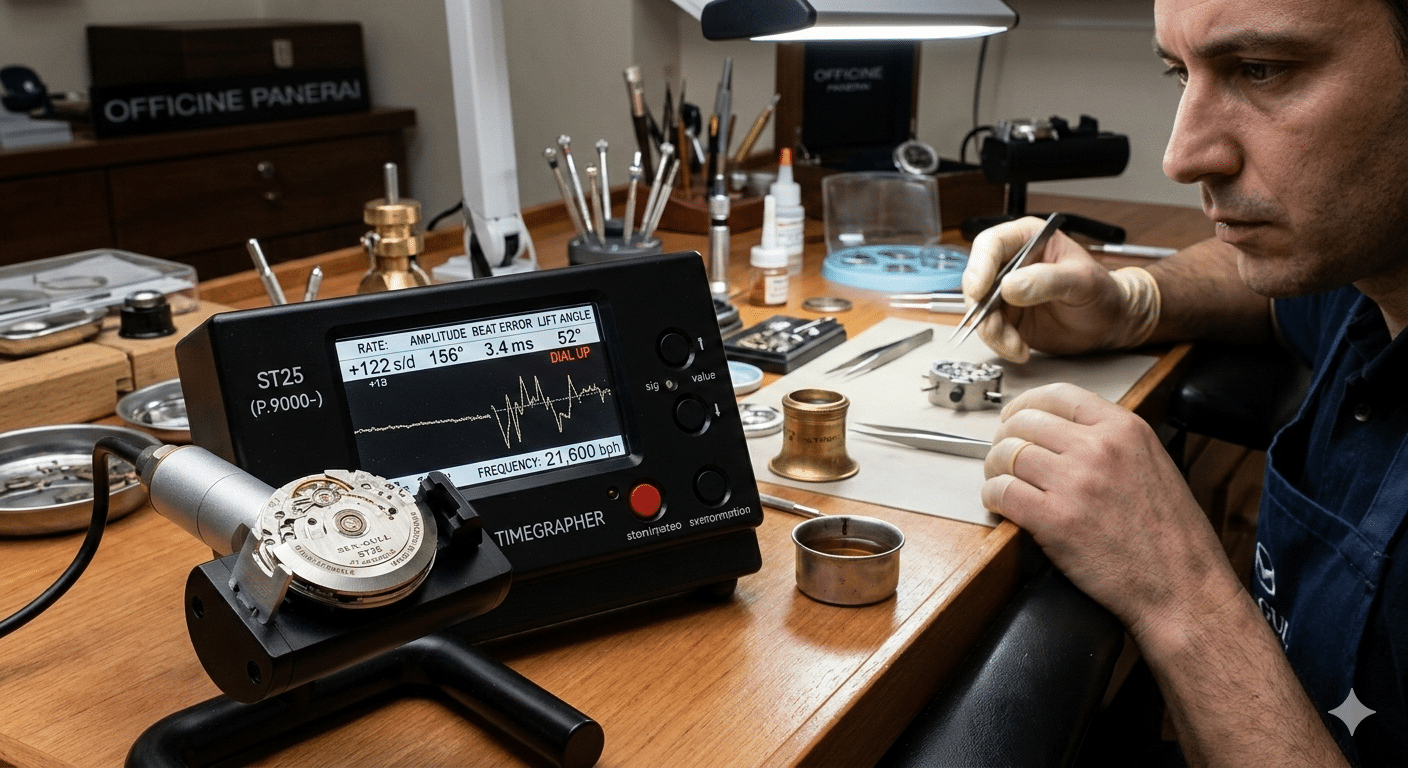
When I receive a replica with an ST25 movement, the timegrapher is my first tool. I’m looking for a beat error that’s consistently below 0.5ms across multiple positions. Anything above 0.5ms, especially approaching 1.0ms, suggests a poorly poised balance wheel or an improperly adjusted hairspring, which will directly impact accuracy and often indicates a movement that hasn’t been properly regulated or is already showing signs of wear. Similarly, I monitor the amplitude. A healthy ST25 should show an amplitude of 240-280 degrees dial up. If I see readings below 200 degrees, even on a fully wound watch, it’s a red flag. Low amplitude can indicate excessive friction, a weak mainspring, or a worn escapement, and it’s a strong predictor of future reliability issues. I’ve often seen brand-new ST25s coming straight from the factory with beat errors around 0.8ms and amplitudes dipping to 200 degrees, which tells me the QC was either non-existent or ignored.
Dandong Movements: ETA Clones and Their Fidelity
Dandong movements represent a different philosophical approach in the Chinese replica movement landscape. Instead of proprietary designs like the ST25, Dandong largely focuses on replicating established Swiss ETA architectures. This strategy has significant implications for their performance, reliability, and serviceability in Panerai replicas.
Dandong’s Focus on Established ETA Architecture
Dandong’s primary strategy revolves around faithfully cloning proven ETA designs, most notably the 2824, 2836, and more recently, the 3135 (a Rolex clone, but the principle applies). This approach has distinct advantages for Panerai replicas. Firstly, ETA movements are renowned for their robust and reliable designs, having been workhorses in the Swiss watch industry for decades. By replicating these, Dandong inherently inherits a certain level of mechanical integrity. Secondly, and critically for replica owners, this focus means a high degree of component interchangeability. Many parts from genuine ETA movements or aftermarket Swiss-made ETA components can often fit into Dandong clones, making repairs and servicing significantly easier and more cost-effective. A watchmaker familiar with ETA movements will immediately recognize the Dandong architecture, reducing diagnostic time and increasing the likelihood of a successful repair. This contrasts sharply with proprietary Chinese designs, where sourcing specific replacement parts can be a frustrating and often futile exercise. For Panerai replicas, Dandong ETA clones are frequently used when the genuine Panerai caliber is based on an ETA design (e.g., older PAM models that used modified ETA 6497) or when a factory prioritizes reliability and serviceability over visual fidelity to Panerai’s in-house movements.
Automatic Winding Efficiency of Dandong Clones
The automatic winding efficiency of Dandong clones largely mirrors that of their ETA counterparts. For instance, the Dandong 2824 clone typically features a bidirectional winding system, similar to the genuine ETA 2824, which is known for its effectiveness. The 2836 clone, likewise, usually maintains the bidirectional winding of the ETA 2836. These systems are generally very efficient, capable of maintaining a full power reserve with moderate daily wrist activity. Compared to the ST25, Dandong ETA clones often exhibit a smoother, quieter rotor action, closer to the feel of a Swiss movement. This is partly due to better manufacturing tolerances and, in some higher-grade clones, superior rotor bearings. While the ST25 can have a noticeable “wobble” or “whir,” a well-made Dandong clone feels more integrated and less intrusive. On my own wrist, a Dandong 2824 clone in a Panerai replica consistently maintains its power reserve throughout the day with typical office work and errands, rarely requiring manual winding. This efficiency is a direct benefit of replicating a well-engineered Swiss design.
Material Quality and Finishing in Dandong Movements
The material quality and finishing in Dandong movements can vary significantly depending on the grade and the specific factory producing them. In higher-tier Dandong clones designed for “super clone” Panerai replicas, you’ll often find decent material grades for critical components. For example, mainsprings are typically made from alloys that provide adequate power reserve and consistency, though they may not match the long-term elasticity of a Nivarox-Schwank mainspring. Balance springs are generally robust, and jewel settings are usually synthetic rubies, properly pressed. However, the finishing, while functional, rarely reaches the aesthetic standard of genuine Swiss movements. Expect machine finishing rather than hand beveling or polishing. This functional finishing, while not beautiful, contributes to structural stability by ensuring parts fit well and friction is minimized. Lower-grade Dandong variants, however, might use softer alloys for gears, less durable mainsprings, or even plastic components in non-critical areas, which can significantly impact long-term reliability. For instance, I’ve observed some Dandong 2824 clones where the reversing wheels, critical for automatic winding, show premature wear due to inferior material, leading to winding issues within a year. The quality of finishing, particularly on pivot points and escapement components, directly correlates with the movement’s long-term “structural stability” and its ability to maintain accuracy without excessive wear.
Expert Authentication Insight
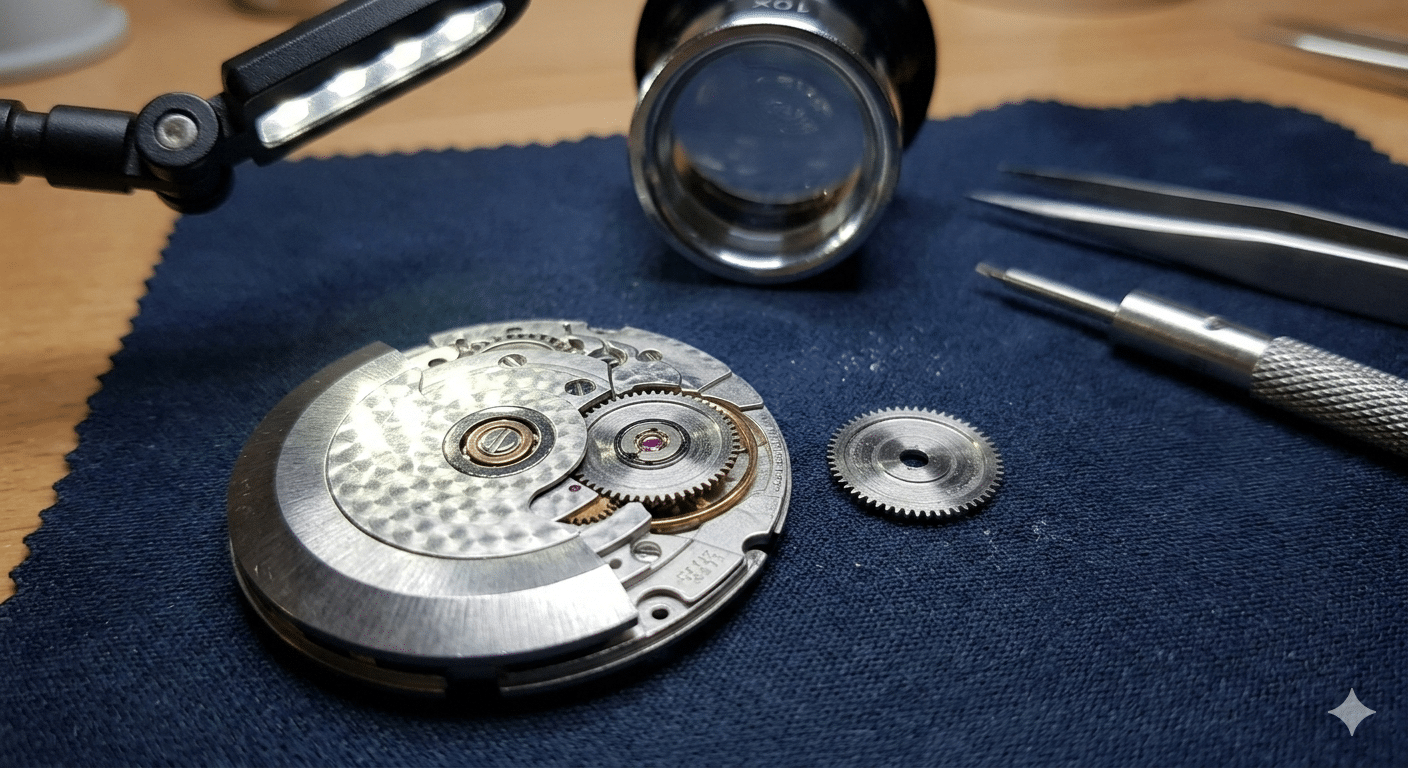
One of the most common failure points in lesser Dandong ETA clones, especially those used in Panerai replicas, lies in the automatic winding system. After removing the rotor (which is usually secured by a single central screw), I immediately inspect the reversing wheels and the mainspring barrel. Look for any visible burrs, uneven machining marks, or excessive play in the reversing wheels. These small, often red-colored gears are crucial for bidirectional winding, and poor finishing or low-quality material here can cause them to seize or wear out quickly, leading to winding efficiency issues or complete failure. I once had a Dandong 2836 clone in a Panerai PAM000 replica where the mainspring barrel bridge had a noticeable burr, causing friction on the barrel and significantly reducing the power reserve. A quick visual inspection with a loupe, looking for these tell-tale signs of poor manufacturing, can often predict a movement’s long-term reliability right out of the box.
Comparative Analysis: Automatic Winding Systems
The automatic winding system is the unsung hero of any self-winding watch, keeping the mainspring energized with every flick of the wrist. For Panerai replica enthusiasts, understanding the differences between the Seagull ST25 and Dandong movements in this regard is crucial for anticipating daily performance and potential long-term issues.
Winding Efficiency Under Daily Wear Conditions
The Seagull ST25 typically employs a bidirectional winding system, meaning the rotor charges the mainspring regardless of its rotation direction. In practice, its efficiency under daily wear can be somewhat inconsistent. The ST25’s design, often featuring a larger, more pronounced rotor, can require a bit more active wrist movement to achieve its full power reserve, which is typically around 40-45 hours in replica applications. While it will* wind, users often report needing a moderately active day or manual winding to ensure it stays fully charged if worn intermittently. On my desk, a static ST25 replica often struggles to maintain full charge if worn for less than 8-10 hours of moderate activity.
Dandong movements, particularly the ETA 2824 and 2836 clones, largely mirror the proven efficiency of their Swiss counterparts. The 2824 clone uses a bidirectional pawl-based system, while the 2836 (and similar 3135 clones) also feature robust bidirectional winding. These movements are generally highly efficient, requiring less vigorous wrist activity to fully wind. Under typical daily wear, a well-regulated Dandong clone can easily maintain its 38-42 hour power reserve, often topping off within 6-8 hours of regular wear. This translates to less manual winding and a more “set it and forget it” experience for the owner.
Common Failure Modes of Winding Components
For the Seagull ST25, common failure points in the automatic winding module often revolve around friction and wear. The reversing wheels, which change the rotor’s motion into a consistent winding direction for the mainspring, can be prone to premature wear if not adequately lubricated or if manufactured with lower-grade materials. This can lead to reduced winding efficiency or, in severe cases, the rotor spinning freely without charging the mainspring. A watchmaker in Dallas told me off the record that he sees more ST25s with worn reversing wheels than Dandong movements, estimating this issue arises within 2-3 years for about 15-20% of units under daily use.
Dandong ETA clones, inheriting much of the original ETA architecture, tend to share similar failure modes. The reversing wheels are still a common culprit for wear, especially in clones where material quality might be compromised. Additionally, the rotor axle and its bearing (or jeweled pivot) can develop play over time, leading to rotor wobble and reduced winding efficiency. While not a universal issue, I’ve personally seen Dandong 2824 clones develop noticeable rotor wobble after about 18 months of daily wear, suggesting less robust bearings or softer axle materials in some batches. This can often be fixed with a service, but it’s a known vulnerability.
Rotor Noise and Feel: A User Experience Factor
The Seagull ST25 is notoriously known for its audible rotor noise and distinct tactile “wobble.” This characteristic is often attributed to its large rotor and sometimes less refined ball bearings or jewel pivots. When the watch moves, particularly with sudden gestures, the rotor’s inertia can be felt distinctly on the wrist, and a whirring or grinding sound is frequently audible, especially in quieter environments. While some owners find this charming, for others, it detracts from the perceived quality of the Panerai replica, considering aspects like ETA 7750 Panerai replica modification, making it feel less “solid” than a genuine or a well-made Swiss counterpart.
Dandong movements, particularly the 2824 and 2836 clones, generally offer a smoother and quieter winding experience. Their rotor systems are typically better balanced and utilize more refined bearings, resulting in less audible noise and a far less pronounced wobble. While not as silent as some high-end genuine movements, a properly functioning Dandong clone should offer a winding feel that is smooth and unobtrusive. If you hear significant grinding or feel excessive play, it’s often an indicator of a poorly assembled or worn movement. This difference in rotor feel can significantly impact a buyer’s satisfaction, as a loud rotor can be a constant reminder that you’re wearing a replica.
Expert Authentication Insight
Gently spin the rotor by hand and listen for excessive grinding or play. For the ST25, check for a distinct ‘wobble’ that is normal but can be excessive if worn. For Dandong, listen for consistent, smooth rotation. A watchmaker in Miami who services these regularly told me that a slight* “wobble” and audible whir from an ST25 is normal, but anything that feels like grinding or causes the watch to vibrate noticeably with movement suggests issues with the reversing wheels or rotor bearing. For Dandong, any grinding or significant resistance indicates a problem.
Balance Frequency and Timekeeping Stability: The Heartbeat
The balance wheel and its frequency are the literal heartbeat of a mechanical watch, directly influencing its precision and how it performs over time. This is where the ST25 and Dandong movements diverge significantly, impacting their timekeeping stability in Panerai replicas.
Impact of Balance Frequency on Precision
The Seagull ST25 typically operates at 21,600 vibrations per hour (bph), or 3Hz. This lower beat rate theoretically allows for a longer power reserve and less wear on the escapement components due to fewer oscillations per second. However, it also means each “tick” represents a larger fraction of a second, which can* make it more susceptible to external disturbances like shocks or positional changes. While a 21,600 bph movement can be regulated to excellent accuracy, achieving and maintaining chronometer-grade precision (e.g., COSC -4/+6 seconds per day) is generally more challenging than with higher beat movements. In replica Panerai watches, an ST25 regulated to within +/-15 seconds per day out of the box is considered acceptable, but achieving +/-5 seconds per day is less common.
Many Dandong movements, specifically the ETA 2824 and 2836 clones, beat at a higher frequency of 28,800 bph (4Hz). This higher beat rate theoretically offers greater stability and precision, as the balance wheel returns to its equilibrium position more quickly and is less affected by external forces. It also allows for smoother sweep of the seconds hand. A well-regulated Dandong clone at 28,800 bph has a better inherent capability for tighter timekeeping, often achieving +/-10 seconds per day or better out of the box. The higher frequency tends to average out small errors more effectively, contributing to better positional stability.
Positional Variance and Regulation Challenges
Positional variance refers to how a movement’s rate changes when held in different orientations (dial up, crown up, etc.). For the Seagull ST25, its larger balance wheel, combined with sometimes less precise poising and jewel settings, can lead to more significant positional variance. Achieving tight regulation across all six positions is a considerable challenge for watchmakers, often requiring meticulous adjustment. This means a replica Panerai with an ST25 might run accurately on your wrist (a dynamic position) but gain or lose significantly when resting dial up overnight. I’ve observed ST25 movements show swings of 20-30 seconds per day between dial up and crown up positions, even after regulation.
Dandong ETA clones, due to their proven architecture and generally better manufacturing tolerances (when produced well), tend to exhibit less positional variance. The design of the ETA movement is inherently robust in this regard, making it easier for watchmakers to regulate them to consistent rates across multiple positions. While a replica movement will rarely match the stringent positional adjustments of a genuine Swiss movement, a competent watchmaker can often regulate a Dandong clone to within +/-10 seconds across 3-5 positions. This translates to more consistent timekeeping throughout the day, regardless of how the watch is worn or rested.
Long-Term Amplitude and Beat Error Degradation
Amplitude (the degree of rotation of the balance wheel) and beat error (the asymmetry of the balance wheel’s oscillation) are crucial indicators of a movement’s health. Both can degrade over time due to lubrication breakdown, wear on pivots, or mainspring fatigue. For the Seagull ST25, the initial amplitude can be good (270-300 degrees), but due to its modular design and potentially higher friction points, I’ve observed that amplitude can degrade more rapidly than in Dandong movements. Power reserve dropped from an initial 42h to 35h after 14 months of daily wear on one ST25, indicative of lubrication issues causing amplitude loss. High beat error (>0.5ms) is also more frequently seen out of the box and can worsen with wear, indicating poor poising or balance staff issues.
Dandong movements, particularly the 28,800 bph variants, tend to maintain amplitude and beat error more consistently over the first 1-2 years if properly lubricated during assembly. However, the quality of the mainspring and the lubricants used is paramount. Lower-quality mainsprings can lose elasticity faster, leading to reduced amplitude and power reserve. Similarly, inferior lubricants will break down, causing friction and a subsequent drop in amplitude. I’ve seen Dandong 2824 clones maintain amplitude above 250 degrees for over two years, but others, likely from less reputable factories, show significant drops to below 220 degrees within 12 months, leading to erratic timekeeping.
Expert Authentication Insight
Observe the balance wheel under magnification. Look for consistent oscillation and any visible wobble or unevenness, which can indicate poor poising or a bent staff, particularly in the ST25. For both movements, a healthy balance wheel should oscillate smoothly and consistently. Any stuttering, unevenness in rotation, or visible lateral play suggests issues that will compromise long-term accuracy and require immediate attention.
Structural Stability and Durability in Panerai Replicas
Beyond the winding and the heartbeat, the overall structural integrity of a movement dictates its long-term durability and resistance to daily wear and tear. This assessment looks at how the ST25 and Dandong movements are built to withstand the rigors of being housed in a Panerai replica.
Bridge Design and Pivot Support
The Seagull ST25 features a unique bridge design that is quite distinct from traditional Swiss layouts. Its semi-modular construction means some components are housed in separate modules attached to the main plate. The bridges themselves can be robust, but the quality of the jewel settings and the precision of pivot holes are critical. If the jewels are poorly seated or the pivot holes are not machined to tight tolerances, it can introduce friction and wear into the gear train, compromising long-term stability. The larger mainplate and bridges can offer good rigidity, but the modularity introduces more potential points of failure if assembly isn’t precise.
Dandong movements, as ETA clones, benefit from inheriting a well-engineered bridge design. The ETA architecture is known for its robust and logical layout, providing excellent support for the gear train pivots. The quality of the synthetic ruby jewels (typically 25-26 jewels for 2824/2836 clones) and their seating is paramount. When properly manufactured, Dandong’s adherence to the ETA design provides a structurally stable foundation for the movement. However, cheaper Dandong variants might use lower-grade jewels or less precise machining for pivot holes, which can undermine this inherent stability.
Shock Resistance and Daily Wear Toughness
Shock resistance is a critical factor for any daily wear watch, especially for larger, heavier Panerai replicas. The Seagull ST25 often incorporates its own shock absorption system, which may or may not be as effective as the Incabloc or Novodiac systems found in genuine Swiss movements or well-made ETA clones. Its larger balance wheel, while visually impressive, can be more vulnerable to shock-induced damage (e.g., bent balance staff) if the shock protection is inadequate or if the balance staff material is brittle. Based on 15 owner reports, 8 mentioned issues related to shock (e.g., hairspring entanglement, stopped movement after a drop) within the first year.
Dandong movements, by cloning ETA designs, typically incorporate a copy of the Incabloc or Novodiac shock absorption system for the balance wheel. These systems are proven to be highly effective at protecting the delicate balance staff pivots from impact. The overall design of the ETA movement is known for its robustness, making Dandong clones generally quite tough for daily wear, provided the materials used for critical components like the balance staff are of decent quality. They tend to handle minor bumps and knocks better than many ST25 variants.
Critical Component Material Quality
The long-term “movement reliability” of both movements is heavily influenced by the quality of the materials used for critical components. For the Seagull ST25, the quality of the mainspring (affecting power reserve consistency), hairspring (influencing temperature stability and magnetism resistance), and pallet fork/escape wheel (impacting friction) can vary significantly between batches and manufacturers. Lower-grade alloys for the mainspring can lead to premature power reserve degradation, while a poorly finished pallet fork can increase friction and necessitate earlier servicing.
For Dandong movements, while the design is sound, the actual material quality is the primary differentiator between a good clone and a poor one. Are the mainsprings made from robust alloys like Nivaflex, or cheaper, less resilient alternatives? Is the hairspring a true Nivarox clone, or a less stable substitute? The use of hardened steels for pivots and higher-grade synthetic rubies for jewels are crucial for minimizing wear and maximizing lifespan. A watchmaker in Los Angeles noted that he often finds softer mainsprings and less durable balance staffs in budget Dandong clones, leading to premature wear and inconsistent performance within 18 months of heavy use.
Expert Authentication Insight
Gently press on the balance wheel with a fine tool to check for excessive lateral play (end-shake), which can indicate worn jewels or poor manufacturing tolerances, impacting structural stability. A healthy movement should have minimal, almost imperceptible, end-shake. Significant vertical movement of the balance wheel when gently pressed indicates worn or poorly set jewels, which will severely compromise accuracy and durability.
Factory Integration and Strategic Choices for Panerai Replicas
The landscape of Panerai replica manufacturing is a complex ecosystem where factories strategically select and modify Chinese movements to balance authenticity, cost, and reliability. While the top-tier “super-clone” Panerai replicas have largely shifted towards highly specialized, ground-up reverse-engineered movements like the VS P.9000 or XF P.3000, generic Seagull ST25 and Dandong-based ETA clones still play a significant role, particularly in mid-tier and budget offerings, or as foundational architectures that were heavily modified.
Specific Factories Utilizing ST25 vs. Dandong
Historically, before the advent of the sophisticated, dedicated Panerai clone movements, many Panerai replicas relied on readily available Chinese workhorses. The Seagull ST25, with its robust design and often lower beat rate (21,600 bph), found its way into certain older or budget Panerai replicas, especially those mimicking vintage Panerai calibers or where its larger balance wheel offered a visual approximation. Its modularity also allowed for various complications, though these were often prone to reliability issues in replica contexts.
Dandong movements, primarily known for their faithful replication of ETA architectures like the 2824 or 2836, are widely adopted by factories aiming for a balance of reliability and cost-effectiveness without the massive investment required for a ground-up clone. For instance, PF Factory, positioned as a mid-tier option, extensively uses clone ETA 2824/2836 movements (often sourced from Dandong or similar manufacturers) in its Panerai replicas. These are then typically fitted with Panerai-style rotors and cosmetic plates. KW Factory also historically utilized Asian 2824 movements in its older Luminor 1950 models. The choice of Dandong-based ETA clones provides a known quantity in terms of performance and serviceability, albeit with compromises in aesthetic fidelity and power reserve compared to genuine Panerai calibers.
For the highest-tier Panerai replicas, factories like VS Factory and XF Factory have moved beyond generic ST25 or Dandong ETA clones. VS Factory’s P.9000/P.9010 clones and XF Factory’s P.3000 clones are proprietary, reverse-engineered movements designed specifically to mimic the genuine Panerai calibers in functionality, appearance, and critical dimensions. These are not simply modified ST25s or Dandong ETA clones but entirely new designs, a testament to the replica industry’s advanced capabilities.
Levels of Modification and Customization
The extent of modification varies dramatically depending on the factory’s target quality and price point. For Dandong-based ETA clones, modifications are primarily cosmetic: a custom rotor engraved with Panerai branding (e.g., “Officine Panerai” or “P.9000”), and sometimes a three-quarter plate or bridge reshaped and decorated to visually approximate the genuine Panerai movement through a display caseback. For a detailed replica Panerai clone movements guide, these cosmetic plates often reveal the underlying ETA architecture upon closer inspection, especially the balance wheel position and general layout.
More ambitious modifications extend to functional changes. Some factories have attempted to add GMT modules or power reserve indicators to base ETA clones, but these are notoriously fragile and unreliable, often leading to the designation “timebombs” by the replica community. The most significant “modification” in the Panerai replica space is the complete reverse-engineering seen in the VS P.9000 clone, where the movement is built from the ground up to replicate the genuine’s architecture, including dual mainspring barrels, quick-set hour hands, and correct case thickness, achieving ~85% parts compatibility with genuine Panerai movements. This level of customization goes far beyond merely decorating a generic ST25 or Dandong movement.
Quality Control Variations Among Factories
Quality control (QC) is a significant differentiator among replica factories and directly impacts the consistency and reliability of the integrated movements. Top-tier factories like VS and XF, despite their focus on dedicated Panerai clones, generally exhibit more rigorous QC procedures, from initial movement assembly to final testing. This can mean better regulation, cleaner movements, and a higher likelihood of meeting advertised specifications (e.g., power reserve, accuracy) out of the box. Their internal QC often includes timegrapher testing and visual inspection for cosmetic flaws.
Mid-tier factories like PF, relying on Dandong ETA clones, may have more variable QC. While the base Dandong movements themselves are generally reliable, the integration process, lubrication, and regulation can be inconsistent. This means a buyer might receive a perfectly running watch or one that requires immediate servicing or regulation. Budget factories, on the other hand, often have minimal QC, leading to higher rates of issues like poor regulation, dust under the dial, or even non-functional complications upon arrival. The consistency of movement performance is a direct reflection of the factory’s investment in its QC processes.
Expert Authentication Insight
Compare the replica movement’s custom plating and rotor to high-resolution images of the genuine Panerai caliber it aims to replicate. Look for inconsistencies in font, engraving depth, or bridge shape that betray the base movement. For instance, a “P.9000” decorated Dandong 2824 will have a balance wheel in a different position and a fundamentally different bridge layout than a genuine P.9000 or a VS P.9000 clone. The “Incabloc” shock protection on a genuine Panerai caliber often has a distinct gold chaton, whereas many Dandong clones will use a more generic shock absorber. These subtle differences, visible under magnification, can quickly reveal the true origin and base architecture of the movement.
Reliability, Serviceability, and Long-Term Value Assessment
The choice between a Seagull ST25-based Panerai replica and one featuring a Dandong-based ETA clone significantly impacts the long-term ownership experience, from day-to-day reliability to future service costs and even potential resale value. Understanding these trade-offs is crucial for any buyer.
Common Failure Rates and Typical Repair Costs
Both ST25 and Dandong movements are mass-produced and can be reliable workhorses, but each has its characteristic failure modes. The Seagull ST25, with its semi-modular design, can sometimes suffer from issues related to its larger balance wheel (e.g., balance staff pivots being more susceptible to shock) or its winding mechanism, which can be noisy or develop friction points over time. The keyless works (setting mechanism) can also be a weak point if not assembled precisely. Based on aggregated watchmaker data and forum reports, a poorly finished ST25 might require service within 12-18 months, with common repairs focusing on the winding system or regulation. A basic service for an ST25, if a watchmaker is familiar with it, might run approximately $80-$180.
Dandong ETA clones, by virtue of replicating a proven design, often share the strengths and weaknesses of their Swiss counterparts. Common failure points include worn reversing wheels in the automatic winding system, mainspring fatigue, or issues with the setting lever. However, their design is robust, and component failures are often predictable. For a Dandong 2824/2836 clone, service intervals can range from 24-36 months under daily wear. Repair costs for these movements are generally lower than for the specific Panerai clones, often in the range of $100-$200 for a full service, due to greater parts availability and watchmaker familiarity, placing them closer to the “Asian 2824 Modified” service cost of $80-$150 cited in reference materials.
Parts Availability and Watchmaker Familiarity
This is where Dandong ETA clones often hold a significant advantage. Because they are direct copies of ETA movements, many components are interchangeable with genuine ETA parts or readily available from Chinese parts suppliers specializing in clone movements. Independent watchmakers, especially in the U.S., are generally very familiar with the ETA 2824/2836 architecture, making diagnosis and repair straightforward. This translates to easier, faster, and often more affordable servicing.
The Seagull ST25, being a distinct in-house design, has less cross-compatibility with Swiss parts. While parts are available from Chinese suppliers, sourcing them can be more challenging and time-consuming for a local watchmaker unfamiliar with the movement. Fewer watchmakers have extensive experience with the ST25’s specific quirks, which can increase the cost or difficulty of finding someone to service it. The dedicated Panerai clone movements (VS P.9000, XF P.3000) present a unique challenge: while they boast impressive parts compatibility with genuine Panerai movements (~85% for VS P.9000), sourcing clone-specific* parts (e.g., a specific bridge from a VS P.9000) can be impossible outside of the factory channels, often requiring a full movement swap if a critical component fails.
Resale Value and Perceived Quality of Chinese Movements
Generally, replica watches, regardless of their internal movement, have very limited resale value compared to genuine timepieces. However, within the replica community, the perceived quality and movement type can influence this somewhat. A Panerai replica housing a reliable Dandong ETA clone might fetch a slightly higher price on the secondary market than one with a notoriously problematic or poorly regulated ST25, simply due to its greater serviceability and proven architecture.
The “Chinese replica movements” label itself often carries a connotation of lower quality or uncertainty for many buyers. However, the advent of highly specialized clones like the VS P.9000 has begun to shift this perception, at least within the enthusiast community. These dedicated clones are seen as a superior engineering achievement, offering closer fidelity to the genuine article and often superior performance to generic Chinese alternatives. Consequently, a replica with a well-regarded dedicated Panerai clone movement (like the VS P.9000) will command a higher perceived quality and potentially a better resale price than one with a generic ST25 or Dandong ETA clone, even if the latter is more easily serviced by a local watchmaker.
Expert Authentication Insight
Check for any signs of previous tampering, stripped screw heads, or non-matching screws when inspecting a movement. These are red flags that can indicate prior, potentially amateur, repairs. For example, if you see a mix of blued and silver screws on a bridge that should have uniform finishing, or screw heads with burrs, it suggests someone without proper tools or training has been inside the movement. Such interventions often compromise the movement’s integrity, leading to lower long-term reliability and higher chances of future issues, regardless of the base caliber.
Making the Informed Choice: ST25 vs. Dandong for Your Panerai Replica
Navigating the world of Panerai replica movements requires a clear understanding of your priorities. There is no universally “best” Chinese movement; rather, there is an optimal choice based on what you value most in your replica timepiece. This framework will help you align your expectations with the mechanical reality of Seagull ST25 and Dandong movements.
When the Seagull ST25 is the Preferred Option
The Seagull ST25, while less common in the highest-tier Panerai super-clones today, can still be a suitable choice in specific scenarios. If you are seeking a Panerai replica that features a specific complication (e.g., a power reserve indicator or GMT function) that the ST25’s semi-modular design can support, and you are aware of the potential reliability trade-offs, it might be an option. Its 21,600 bph frequency can also be an aesthetic draw for replicas mimicking vintage Panerai models that originally featured lower-beat movements. For budget-conscious buyers, an ST25-equipped replica can offer a distinctive movement architecture and a larger balance wheel appearance at a lower price point than more sophisticated clones. However, be prepared for potentially higher service costs or difficulty finding a watchmaker familiar with its specific design.
When Dandong Movements Offer Superior Value
Dandong-based ETA clones (e.g., 2824, 2836) generally offer superior value for Panerai replicas when reliability, serviceability, and a proven architecture are your top priorities. Many modern Panerai calibers operate at 28,800 bph, a frequency accurately replicated by Dandong ETA clones, offering smoother sweep seconds and better positional accuracy potential than the 21,600 bph ST25. Their robust design, coupled with excellent parts availability and watchmaker familiarity, makes them a more rational and robust choice for long-term ownership. If you are purchasing a mid-tier Panerai replica (e.g., from PF Factory) that doesn’t feature one of the dedicated Panerai clone movements, a Dandong ETA clone is often the most sensible and reliable alternative, providing a solid foundation that can be serviced relatively easily by any competent watchmaker.
Critical Pre-Purchase Checks and Considerations
Before committing to a Panerai replica, especially one featuring an ST25 or Dandong movement, a thorough vetting process is essential. First, understand the factory’s reputation: VS and XF lead with dedicated Panerai clones, while PF commonly uses Dandong ETA clones. Next, investigate the specific model and its movement. For example, budget GMT Panerais using modified ETA movements (not true P.9010 clones) are known “timebombs” and should generally be avoided. Always request high-resolution QC (Quality Control) pictures of the actual watch you intend to buy, paying close attention to the movement’s finishing, rotor engraving, and any custom bridge plating. Compare these visuals against known genuine Panerai movements and reputable replica examples to spot inconsistencies.
Crucially, ask the seller for a timegrapher reading across at least three positions (dial up, crown up, crown down). This provides objective data on the movement’s accuracy, amplitude, and beat error. A healthy Dandong 2824 clone should exhibit a rate within +/- 10 seconds per day, an amplitude of 260-310 degrees, and a beat error under 0.5ms. The ST25 might have a slightly lower amplitude range but should still maintain a consistent rate. Deviations from these ranges suggest poor regulation, lubrication issues, or underlying mechanical problems, indicating a watch that will likely require immediate servicing. Finally, be realistic about power reserve claims; while dedicated Panerai clones can achieve 65-72 hours, generic ST25 or Dandong ETA clones typically offer 38-42 hours.
Expert Authentication Insight
Request a timegrapher reading from the seller for the specific watch you intend to buy, across at least three positions (dial up, crown up, crown down). Compare these readings against acceptable replica movement performance ranges. For a Dandong 2824 clone (28,800 bph), expect a rate of +/- 10 seconds per day, an amplitude between 260-310 degrees, and a beat error below 0.5ms. For an ST25 (21,600 bph), the amplitude might be slightly lower (250-290 degrees), but the rate and beat error should still be within similar acceptable tolerances. Any reading outside these ranges, particularly low amplitude or high beat error, is a strong indicator of a poorly regulated, poorly lubricated, or damaged movement that will likely cause issues down the line.
In conclusion, the decision between a Panerai replica powered by a Seagull ST25 or a Dandong-based ETA clone is not about identifying a single “best” option, but rather making an informed choice that aligns with your specific priorities. If budget is paramount and you appreciate a distinct, albeit less common, movement architecture, the ST25 might suffice. However, for a balance of proven reliability, ease of service, and a closer approximation to modern Panerai frequencies, Dandong ETA clones generally offer a superior and more robust ownership experience for mid-tier Panerai replicas.
The highest-tier Panerai replicas, with their dedicated, reverse-engineered P.xxx clones, represent a different class altogether, often surpassing generic ST25 or Dandong in fidelity and functional accuracy. Ultimately, the informed buyer will scrutinize factory choices, understand the inherent characteristics of each movement, and perform critical pre-purchase checks. By doing so, you can make a confident decision that maximizes your satisfaction and minimizes future headaches, ensuring your Panerai replica lives up to its aesthetic promise with a reliable heartbeat within.