
The allure of a Panerai chronograph is undeniable. That distinctive cushion case, the bold numerals, and the promise of precise timing functionality. But for many enthusiasts eyeing a replica, the dream often collides with a thick, unwieldy reality on the wrist. The culprit? More often than not, it’s a heavily modified Shanghai 7750 movement trying to punch above its weight class. For a deeper understanding and comparison of Seagull ST25 vs Dandong movements, it’s clear this isn’t just about aesthetics; it’s about fundamental engineering compromises that impact everything from wearability to long-term reliability. Let’s pull back the curtain on this mechanical magician and expose the tricks behind the Panerai chronograph replica.
The Base Movement: Understanding the Shanghai 7750 Chronograph
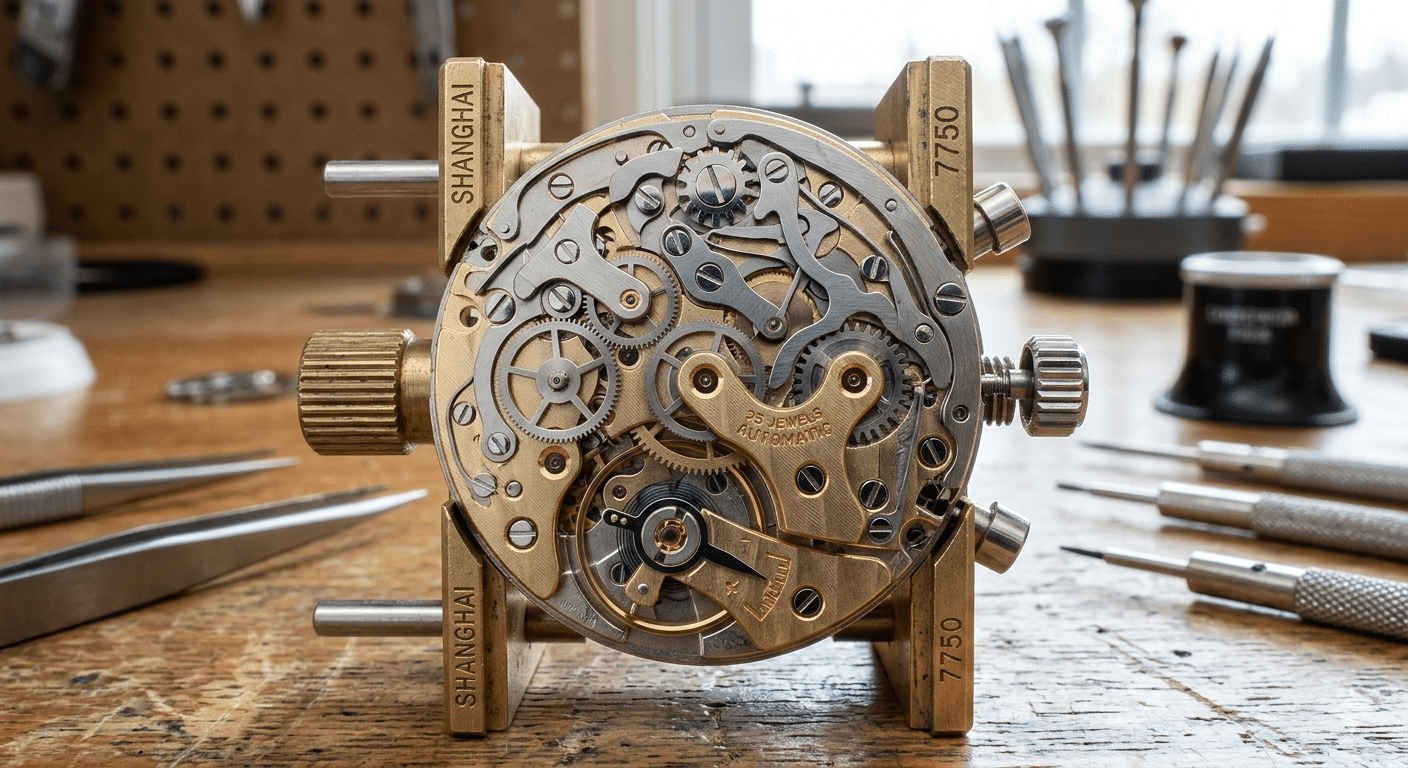
Before we delve into the intricate modifications, it’s crucial to understand the foundation: the Shanghai 7750. This movement is a direct clone of the venerable Valjoux 7750, a workhorse chronograph caliber that has powered countless watches for decades. Its fundamental architecture dictates much of what we see—and feel—in its modified Panerai replica counterparts.
Valjoux 7750 Heritage and Design Philosophy
The original Valjoux 7750, developed by Edmond Capt in the early 1970s, is renowned for its cam-actuated chronograph mechanism. Unlike column-wheel chronographs, which are often prized for their smooth operation and complexity, the 7750 uses a simpler, more robust cam-and-lever system. This design choice makes it incredibly reliable and relatively easy to manufacture and service. Key components include the oscillating pinion, which engages the chronograph mechanism directly with the running seconds, and the hammer system for resetting. Its modularity allows for various sub-dial configurations, though always constrained by its core layout. This movement is a true “tractor” – not elegant, but incredibly durable. Its standard beat rate is 28,800 vibrations per hour (4Hz), and an unmodified Valjoux 7750 typically maintains an amplitude in the range of 270-300 degrees, contributing to its stable timekeeping.
Shanghai 7750: Manufacturing and Quality Variability
The Shanghai Watch Factory has been producing its clone of the Valjoux 7750 for years, making it a ubiquitous presence in the replica market. While functionally similar, the Shanghai 7750 often falls short in material quality and finishing standards compared to its Swiss progenitor. We frequently see components made from cheaper alloys, less robust jewels, and a general lack of fine finishing. For instance, a watchmaker I spoke with in Dallas often notes that many Shanghai 7750s come with visible burrs on pivot points and inconsistent lubrication from the factory. This isn’t just cosmetic; these manufacturing shortcuts lead to increased friction, accelerated wear, and contribute to notable batch-to-batch inconsistencies. While one batch might perform adequately, the next could exhibit significant rate deviation or premature failure, making long-term reliability a gamble.
Standard Chronograph Functionality and Limitations
An unmodified Shanghai 7750 operates identically to the Valjoux original. Its default sub-dial layout is typically a 6-9-12 configuration (hours at 6, running seconds at 9, 30-minute counter at 12) or sometimes a 12-6-9. The chronograph pushers operate in the standard fashion: start/stop at 2 o’clock, and reset at 4 o’clock. One characteristic many enthusiasts are familiar with is the “7750 wobble” – a slight rotational movement of the entire watch on the wrist, caused by the unidirectional winding rotor. Crucially, the base Shanghai 7750, like the Valjoux, has an inherent thickness of approximately 7.9mm. This dimension is critical, as it serves as the starting point for any modifications and directly impacts the final case thickness of a replica watch.
Expert Authentication Insight
To identify an unmodified 7750, pay close attention to the sub-dial spacing. The standard 6-9-12 or 12-6-9 layout is a dead giveaway. The date window is usually positioned at 3 o’clock. If you have the means, measure the overall movement thickness with a digital caliper; an unmodified base will be around 7.9mm. Any significant deviation, particularly an increase, points directly to a modified movement.
Panerai Chronograph Aesthetics and Movement Requirements
Panerai chronographs are celebrated for their distinctive military-inspired aesthetics and robust presence. However, these very design elements present significant challenges for replica manufacturers attempting to adapt a standard movement like the Shanghai 7750. The brand’s unique dial layouts and an expectation of wearable thickness often clash with the mechanical realities of modification.
Iconic Panerai Chronograph Sub-Dial Configurations
Panerai’s chronograph designs frequently deviate from the standard 7750 sub-dial layout. Many iconic Panerai chronographs, such as the Luminor Chrono Daylight (PAM 00072) or the Luminor 1950 3 Days Chrono Flyback (PAM 00524), feature two-register layouts at 3 and 9 o’clock. Others might have a three-register layout with specific spacing that doesn’t align with the 7750’s default 6-9-12. The need to relocate minute or hour totalizers to non-standard positions (e.g., from 12 o’clock to 3 o’clock) for aesthetic accuracy is where the mechanical complexity, and ultimately, the compromise, begins. This requires intricate gearing and bridges that fundamentally alter the movement’s original design.
Movement Thickness and Case Design Principles
While Panerai watches are known for their substantial size, genuine Panerai chronographs, even with complex in-house movements like the P.9100 (found in models like the PAM 00311), manage to maintain a relatively ergonomic profile. For instance, a genuine Luminor 1950 3 Days Chrono Flyback (PAM 00524) with the P.9100 movement has a case thickness of around 15.6mm. This is achieved through integrated design, where the movement and case are engineered together. Replica manufacturers, however, are forced to build a case around an already thick base movement, which then gets even thicker with modifications. This often results in a final replica case that is noticeably bulkier than its genuine counterpart, compromising the intended design and wearability.
Functional Expectations: Pusher Feel and Reset Crispness
Beyond visual accuracy, the tactile experience of operating a chronograph is a critical aspect of perceived quality. A genuine chronograph, especially one in the luxury segment, is expected to have a crisp, satisfying “click” when the pushers are engaged, and the chronograph hands should reset instantaneously and precisely to zero. This responsiveness is a hallmark of well-engineered levers, springs, and hammers. When you operate a genuine Panerai chronograph, there’s a distinct, immediate action. In replicas with modified movements, this experience is often compromised, leading to a mushy, stiff, or inconsistent pusher feel, which immediately betrays the underlying mechanical compromises.
Expert Authentication Insight
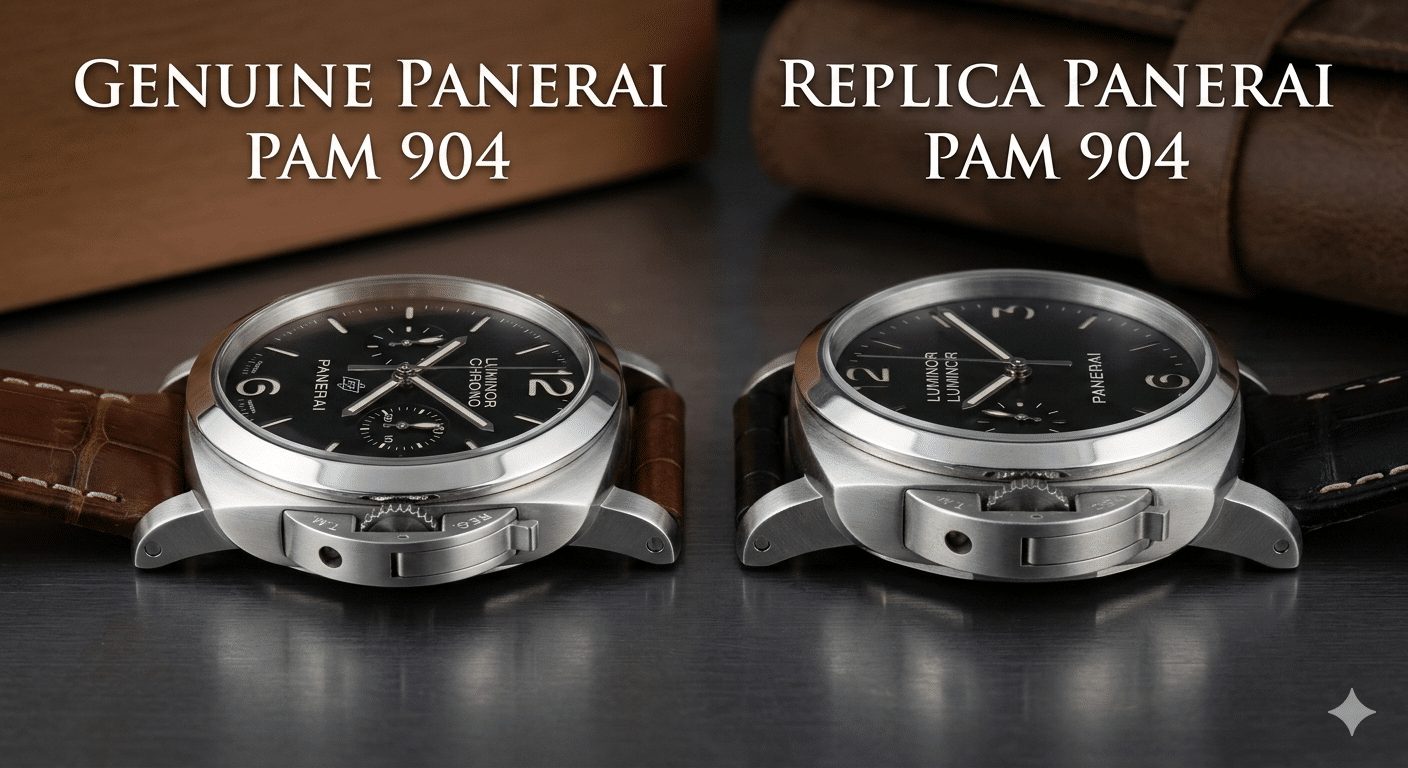
When evaluating a Panerai chronograph replica, meticulously compare the sub-dial spacing to high-resolution images of the genuine model. Look for any signs that the sub-dials appear “squished” or awkwardly positioned, which can indicate a forced modification. More importantly, check the case profile. If a replica Panerai chronograph feels excessively thick or out of proportion compared to official genuine dimensions (e.g., if a replica is 18mm thick when the genuine is 15.6mm), it’s a strong indicator of a heavily modified and thickened movement. I’ve personally measured some modified 7750 Panerai replicas exceeding 19mm in total case thickness, making them feel like a puck on the wrist.
The “Modification” Process: Adapting the Shanghai 7750
The journey from a standard Shanghai 7750 to a Panerai-style chronograph replica is less about elegant re-engineering and more about an elaborate series of mechanical workarounds. This “modification” process, while achieving visual similarity, introduces significant mechanical implications that directly impact the watch’s performance and longevity.
The “Dummy” Sub-Dial and Gearing Overlays
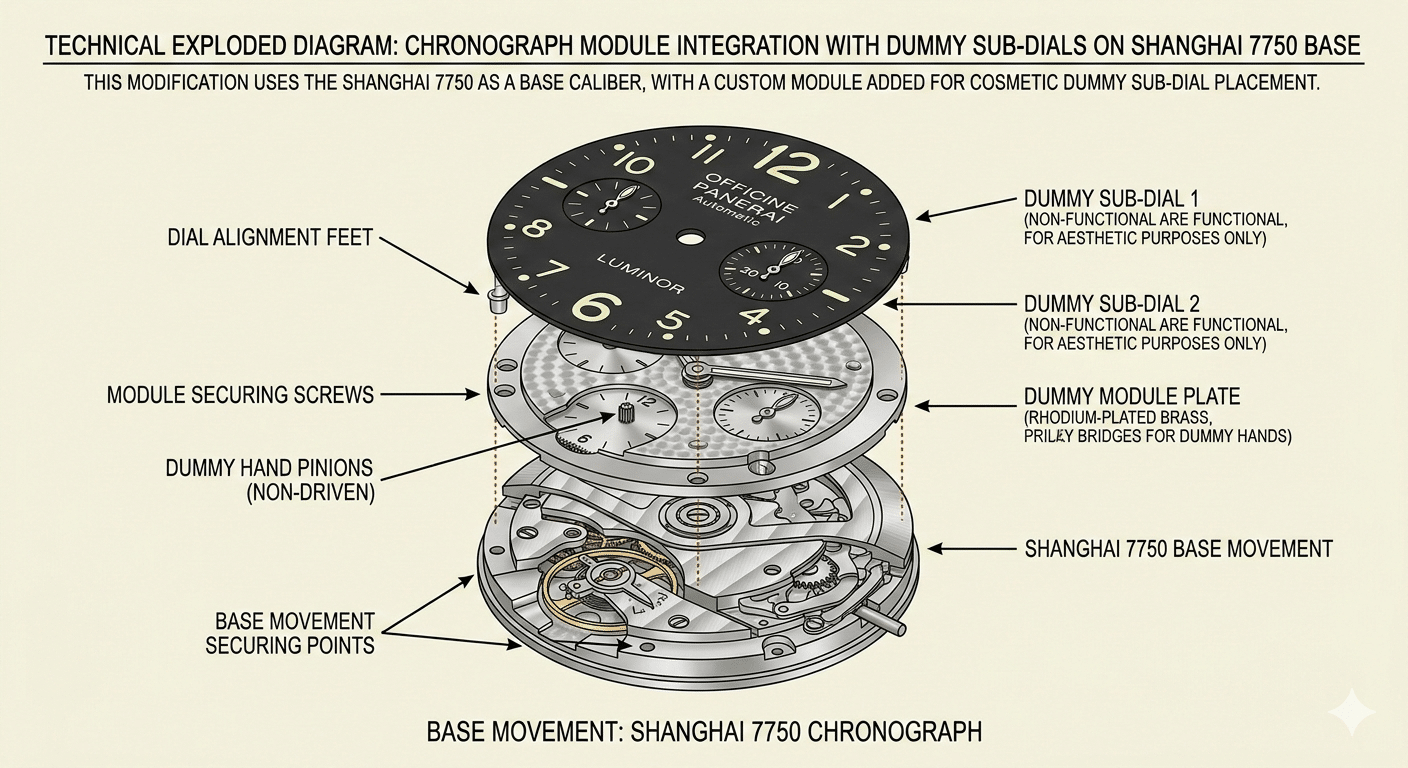
The most common and visually impactful modification involves relocating sub-dials to match Panerai’s specific designs. Since the 7750’s base sub-dial positions are fixed, replica manufacturers add an additional “module” plate on top of the movement. This module contains a complex array of additional gears, levers, and jumpers. Often, some of these “relocated” sub-dials are purely cosmetic, functioning as “dummy” sub-dials. Instead of being driven by the chronograph mechanism, their hands are simply geared to the main time-telling mechanism, making them appear to move (e.g., a running seconds hand) but without actual chronograph functionality. This creates the desired aesthetic without the mechanical complexity of fully functional relocation. Inspecting a replica, if a sub-dial (like a 12-hour counter) doesn’t move when the chronograph is activated or only moves with the main time, it’s a dummy, a clear sign of this modification technique.
Chronograph Hand Relocation and Actuation
Relocating the central chronograph seconds hand is relatively straightforward, as it’s typically driven directly from the base movement. The real challenge comes with moving the chronograph minute or hour totalizers. If these are intended to be functional, the module must include additional gearing to transfer the chronograph’s rotational energy to the new sub-dial positions. This means extending pivots, adding intermediate gears, and often using delicate springs and levers to actuate the hands. For example, moving a 30-minute counter from 12 o’clock to 3 o’clock involves a cascade of gears that add significant drag and complexity to the original mechanism. This increased load places additional stress on the base movement’s mainspring and gear train, impacting its efficiency and long-term health.
Impact on Movement Height and Stability
The direct and unavoidable consequence of these modifications is a significant increase in the overall movement height. Adding multiple layers of gears, plates, and jumpers on top of the already 7.9mm thick 7750 base can easily add an extra 1.5mm to 3mm, or even more. This means a modified 7750, particularly when designed to replicate a long power replica movement, can easily reach 9.5mm to 11mm in height. This vertical expansion directly translates to a thicker watch case, which is why Panerai chronograph replicas often feel disproportionately chunky on the wrist. Furthermore, this added height can affect the movement’s stability, raising its center of gravity and potentially increasing stress on the rotor bearing and balance staff during impacts, leading to premature wear and inconsistent timekeeping.
Expert Authentication Insight
The simplest way to spot these modifications without opening the case is to observe the sub-dials. Activate the chronograph and watch closely: if any sub-dial hands are purely cosmetic or move independently of the chronograph’s start/stop/reset, it’s a dummy. If you can see the movement through a display case back, use a loupe to look for stacked gears, additional plates, or unusually tall bridges built on top of the main movement. A watchmaker in Miami who frequently services these replicas once told me, “You can tell a modified 7750 by how much ‘air’ there is between the main plate and the dial side. It’s all just stacked-up junk to fool the eye.”
The Thickness Conundrum: Why Replicas are Often Thicker
One of the most immediate and glaring discrepancies between a genuine Panerai chronograph and its modified Shanghai 7750 replica counterpart is the thickness. This isn’t just a minor cosmetic difference; it’s a direct consequence of mechanical compromises and manufacturing realities. Buyers often unbox their replica expecting the robust, yet ergonomically considered, profile of a Panerai, only to find a watch that sits disproportionately high on the wrist, betraying its origins.
The Stacked Module Effect
The base Shanghai 7750 movement, like its Valjoux ancestor, is already a relatively thick caliber, typically measuring around 7.9mm. This is largely due to its cam-actuated chronograph mechanism, which sits on top of the base time-telling movement. To achieve Panerai’s specific sub-dial layouts—often two registers at 3 and 9 o’clock, or three registers that deviate from the standard 7750 configuration—replica manufacturers employ an additional “module.” This module is essentially a series of gears, levers, and plates stacked directly onto the existing 7750 architecture. Each additional layer, whether for relocating a chronograph totalizer or simply driving a dummy sub-dial, contributes to the vertical height. On average, these modifications can add anywhere from 1.5mm to 3mm to the movement’s total height. This means a modified Shanghai 7750 can easily swell to 9.5mm or even 11mm in movement height alone, far exceeding the original design envelope.
Case Design Constraints and Compromises
With a significantly taller movement to accommodate, replica manufacturers face a critical design challenge. Unlike genuine Panerai movements, which are often designed from the ground up to fit a specific case profile (e.g., the P.9100 movement in a Luminor 1950 chronograph), the modified Shanghai 7750 is an afterthought. To house this bulkier engine, replica factories are forced to thicken the watch case. This often manifests as a noticeably taller mid-case, a domed or protruding case back, or a thicker bezel. The aesthetic integrity of the original Panerai design, which balances robustness with wearable proportions, is severely compromised. What was intended as a bold but balanced wrist presence can become an unwieldy block that constantly snags on shirt cuffs, a common complaint I hear from owners.
Lack of Integrated Design and Engineering
The fundamental issue lies in the disparity between integrated design and an “add-on” solution. Genuine Panerai chronograph movements, like the P.9100, are meticulously engineered with their functions and dimensions in mind from conception. Every gear, bridge, and plate is placed to optimize space and performance within a predetermined case size. The modified Shanghai 7750, conversely, is a Frankenstein’s monster—a robust but generic base movement retrofitted with external components to mimic a specific aesthetic. This lack of integrated design means that space utilization is inherently inefficient. There’s no elegant way to shrink a module that’s been tacked on, leading directly to the inescapable increase in the overall vertical profile of the watch.
Expert Authentication Insight
This is where your digital calipers become your best friend. Get the official specifications for the genuine Panerai chronograph model you’re interested in. Then, with the replica in hand, measure its total case thickness, including the crystal. I’ve consistently found that modified 7750 Panerai replicas add an average of 2-4mm to the stated genuine thickness. For example, if a genuine model is 15mm thick, a modified 7750 replica might come in at 17-19mm. That difference is immediately noticeable on a 7-inch wrist and completely changes the wearing experience.
Reliability and Longevity of Modified 7750 Movements
Beyond the visual impact of increased thickness, the modifications made to the Shanghai 7750 for Panerai replicas introduce a cascade of mechanical vulnerabilities, directly impacting the movement’s long-term performance and stability. What might seem like clever engineering on the surface often translates into premature wear and frustrating failures down the line.
Increased Friction and Wear Points
Every additional gear, pivot, jumper, or spring added to the base 7750 movement creates a new point of friction. The more components there are, the more surfaces are rubbing against each other, and the more energy is required to drive the system. This increased mechanical load, especially within the chronograph module, accelerates wear on critical components. I’ve seen movements where the additional gearing for sub-dial relocation quickly wears down, leading to loose play, stuttering hands, or complete seizure of the chronograph function within 12-18 months of regular use. The original 7750 is robust, but it wasn’t designed for these extra demands.
Misalignment and Tolerance Issues
The precision engineering required for watchmaking is unforgiving. Replica factory modifications often operate with significantly looser tolerances and less precise assembly than original designs. Misaligned gears that don’t mesh perfectly, improperly set jewels that don’t adequately support pivots, and poorly manufactured plates can all contribute to inefficient power transfer and excessive stress on the movement. This isn’t a single point of failure; it’s a systemic issue that compromises the entire modified train. A watchmaker in Dallas told me off the record that “working on these modified 7750s is like trying to fix a puzzle where half the pieces are slightly the wrong shape.”
Impact of Lubrication and Service Intervals
Given the increased complexity and friction points, a modified Shanghai 7750 demands higher quality lubrication and more frequent servicing than its stock counterpart. However, the reality in the replica world is often the opposite. These movements frequently receive minimal lubrication, incorrect types of lubricants, or are simply assembled dry. This accelerates wear exponentially. While a well-serviced genuine 7750 might run for 5-7 years before needing attention, a modified Shanghai 7750, especially one poorly lubricated from the factory, might struggle to reach 2 years without significant performance degradation or outright failure. The cost of a proper service, if you can even find a watchmaker willing to tackle it, can easily approach $150-$250, making it a significant portion of the watch’s original purchase price.
Expert Authentication Insight
When you operate the chronograph, listen closely. Any grinding, inconsistent ticking, or a faint “scraping” sound is a red flag for increased friction or misalignment. Observe the chronograph hands, particularly the minute and hour totalizers, for any stuttering or hesitant movement. A smooth, fluid sweep is expected. Over time, if you have a display case back, use a loupe to inspect visible gears in the chronograph module for premature signs of wear, such as shininess on gear teeth or visible metal dust, which point to poor lubrication and excessive friction.
Common Failure Points and User Experience Issues
The inherent compromises in modified Shanghai 7750 movements translate directly into a frustrating user experience for owners of Panerai chronograph replicas. These aren’t just theoretical concerns; they are the most frequently reported problems on enthusiast forums and in my own observations.
Chronograph Reset Malfunctions
This is perhaps the most common and irritating failure point. Owners frequently report that the chronograph hands—especially the central seconds hand and the minute totalizer—fail to return precisely to zero after being reset. They might sit a fraction of a second off, or in more severe cases, get stuck at an arbitrary position. This is often due to weak or improperly tensioned reset springs, misaligned reset hammers, or worn-down jumpers. The mechanical integrity of the reset mechanism, which relies on precise alignment and strong, consistent action, is easily compromised by the lower quality components and assembly processes found in replica modifications. I’ve had replicas where the reset hand would jump back to zero, but then “bounce” slightly, settling a hair off-center.
Power Reserve and Timekeeping Instability
The additional drag created by the stacked gears and increased friction in the chronograph module directly impacts the movement’s power reserve and timekeeping accuracy. The mainspring, which powers the watch, has to work harder to overcome this added resistance. This often results in a significantly reduced power reserve compared to an unmodified 7750 (which typically offers 40-42 hours). For a deeper understanding of these intricate mechanisms, a comprehensive Panerai clone movements guide can be invaluable. Owners might find their watch stopping after only 28-35 hours, especially if the chronograph has been used frequently. Furthermore, the inconsistent load on the gear train can lead to erratic timekeeping, with daily rates drifting significantly (e.g., +20 to -30 seconds per day), making the watch unreliable for accurate timekeeping.
Pusher Feel and Engagement Problems
The tactile experience of operating a chronograph is a key indicator of quality. A well-engineered chronograph should have pushers that offer a distinct, crisp “click” upon activation and reset. In modified Shanghai 7750 replicas, the additional linkages and components often result in a mushy, stiff, or inconsistent pusher feel. Sometimes, one pusher might feel significantly different from the other. In worse cases, the pushers can become completely unresponsive or stick, leading to outright failure of the start/stop/reset mechanism. This not only detracts from the user experience but can also indicate internal binding or excessive wear that will eventually lead to a complete breakdown.
Expert Authentication Insight
To truly test this, repeatedly operate the chronograph—start, stop, and reset—about 10-15 times. After each reset, visually check that all chronograph hands return precisely to their zero positions without any deviation or stuttering. Pay close attention to the feel of the pushers: do they offer a distinct, crisp “click” for both start/stop and reset? Any sponginess, excessive stiffness, grinding sensation, or inconsistent engagement across multiple operations indicates potential issues with the modified chronograph mechanism. A truly smooth and precise operation is rare in these modified movements.
Servicing, Parts Availability, and Repair Challenges
Once a modified Shanghai 7750 chronograph movement begins to show signs of wear or outright failure, the owner of a Panerai replica is quickly confronted with a harsh reality: these movements are often prohibitively difficult and expensive to service. Unlike a standard Valjoux 7750 or even an unmodified Shanghai clone, the bespoke nature of these Panerai adaptations creates a unique set of maintenance headaches that can turn a seemingly good deal into a money pit.
Proprietary/Non-Standard Parts
The core issue with servicing a modified Shanghai 7750 lies in its parts. To achieve the specific sub-dial layouts and functions required for a Panerai chronograph replica, manufacturers introduce additional gears, plates, jumpers, and sometimes even non-standard pivots. These components are almost always custom-made for the replica, meaning they are not standard Valjoux 7750 parts, nor are they interchangeable with other generic 7750 clones. When a critical component in this added module fails, sourcing a replacement becomes a nearly impossible task. You can’t just order a “Valjoux 7750 chronograph minute counter wheel” if the replica’s minute counter is driven by a custom-fabricated gear train sitting on top of the base movement. This means a watchmaker cannot simply swap out a worn part; they would either need to custom-fabricate a new one (a time-consuming and expensive endeavor) or find a donor movement of the exact same replica batch, which is often not feasible. The practical upshot is that many common failures in the modification module essentially render the chronograph function unrepairable without a full movement swap.
Watchmaker Reluctance and Expertise
Even if parts could be sourced, many experienced watchmakers are hesitant to work on heavily modified replica movements. Genuine Valjoux 7750s are well-documented, with schematics and exploded diagrams readily available. Modified Shanghai 7750s, however, often lack any form of official documentation. Each factory or even each batch might have slightly different modifications, making troubleshooting a nightmare. A watchmaker would have to reverse-engineer the entire modification module, often without specialized tools for the non-standard components, and all this on a movement whose base quality might already be inconsistent. This translates to significantly higher labor costs, if a watchmaker is even willing to take on the job. The uncertainty of success and the potential for a reputation hit if the repair fails often lead reputable watchmakers to politely decline service on these movements, funneling owners towards less experienced or less scrupulous repairers.
Cost-Benefit of Repair vs. Replacement
Given the difficulties in sourcing parts and the high labor costs associated with the specialized expertise (or lack thereof), the economics of repairing a modified Shanghai 7750 often don’t make sense. A complex repair involving the chronograph module could easily run into the $200-$400 range, especially if custom fabrication is required. Considering that many of these Panerai chronograph replicas initially sell for $350-$550, the repair cost can quickly approach or exceed the original purchase price. For many owners, the rational, albeit unsustainable, decision is to simply replace the entire movement or, more commonly, the entire watch. This creates a cycle of disposable chronographs, where a visually appealing watch is effectively a short-term proposition, destined for the parts bin once its complex functions fail. It’s a clear trade-off between initial cost savings and long-term ownership viability.
Expert Authentication Insight
When considering a purchase, or if you already own one and are evaluating its future, inquire with several independent watchmakers about servicing a “modified 7750 chronograph movement.” Don’t specify it’s a replica initially, just the movement type and modification. Note their immediate reaction or reluctance; a watchmaker who sighs, expresses immediate skepticism, or quotes an unusually high diagnostic fee without even seeing the watch, is signaling the known difficulties and potential for a no-go. This is a tell-tale sign that the movement is part of a category generally avoided due to its unpredictable nature and lack of support.
Identifying the Modified Shanghai 7750: Practical Authentication Tips
For buyers looking to avoid the pitfalls of a mechanically compromised Panerai chronograph replica, identifying a modified Shanghai 7750 movement without opening the case is crucial. While a full inspection requires professional tools, several external cues can provide strong indicators.
Visual Cues: Sub-Dial Spacing and Depth
The most immediate and often overlooked tell-tale sign of a modified movement is the sub-dial spacing and their relative depth. Genuine Panerai chronographs with purpose-built movements (like the P.9100) have specific, aesthetically balanced sub-dial positions. When a standard Shanghai 7750, with its fixed sub-dial positions (typically 6-9-12 or 12-6-9), is modified to achieve a different Panerai layout (e.g., bi-compax at 3 and 9 o’clock), the sub-dials often appear either too close to the center, too far towards the edge, or slightly misaligned compared to genuine models. Furthermore, the added module for sub-dial relocation inevitably increases the distance between the dial and the underlying movement. This often results in the sub-dials appearing noticeably “recessed” or set deeper within the dial compared to a genuine Panerai, which typically has a flatter, more integrated dial appearance. A quick comparison with high-resolution images of the genuine model can often reveal these subtle, yet critical, discrepancies in positioning and depth. If the layout looks “off” or “squished,” it’s a red flag.
Chronograph Pusher Action and Sound
The tactile and auditory experience of operating a chronograph is a significant indicator of movement quality. A genuine, well-engineered chronograph movement (like a Valjoux 7750 or Panerai’s in-house calibers) will have a crisp, distinct “click” when the pushers are engaged (start/stop) and a clean, instantaneous reset to zero. In contrast, a modified Shanghai 7750 often presents a less refined experience. The added linkages and gears in the modification module can introduce friction and play, resulting in a “mushy,” stiff, or even “grindy” feel when pressing the chronograph pushers. The reset action might be slower, hesitant, or the hands may not snap back to zero precisely, sometimes requiring a second press or showing slight misalignment. Listen closely for any grinding or scraping sounds, and feel for a lack of positive engagement. These are direct consequences of the mechanical compromises inherent in the modification process.
Case Thickness and Weight Discrepancies
One of the most common and easily verifiable tells is the overall case thickness. An unmodified Valjoux 7750 is already a relatively thick movement at around 7.9mm. The process of adding a modification module on top to relocate sub-dials or other functions invariably increases the total height of the movement assembly. This forces replica manufacturers to design a thicker case to accommodate it, often resulting in a case that is 2-4mm thicker than the genuine Panerai chronograph it’s trying to mimic. For example, if a genuine Panerai chronograph is 15mm thick, a modified 7750 replica might come in at 17-19mm. This difference is often visible to the naked eye and certainly noticeable on the wrist, making the watch feel disproportionately bulky. Additionally, while harder to quantify without a direct comparison, the overall weight might feel slightly different due to the added internal components and potentially thicker case materials, though this is less definitive than thickness. Always compare the replica’s stated or measured thickness to the official specifications of the genuine model.
Expert Authentication Insight
To confidently identify a modified Shanghai 7750, perform a side-by-side comparison if possible. Hold the suspected replica next to a known genuine Panerai chronograph (or even a high-quality replica with a standard, non-modified movement if a genuine isn’t available). Feel the thickness, paying close attention to how it sits on the wrist. Then, repeatedly operate the chronograph pushers (start, stop, reset) 10-15 times on both watches. Compare the tactile feel, the crispness of the click, and the precision of the hand reset. Any sponginess, grinding, or misalignment in the replica, coupled with a noticeable increase in case thickness, strongly points towards a modified 7750 movement.
For those prioritizing true chronograph functionality and long-term reliability, Panerai chronograph replicas powered by modified Shanghai 7750 movements represent a significant mechanical compromise. The allure of their aesthetic appeal often comes at the cost of operational stability, increased friction, and a heightened risk of premature failure. While these replicas might offer an initial visual approximation of a Panerai chronograph, their adapted movements are a patchwork solution, not an integrated design. This leads to a thicker profile on the wrist, a less satisfying pusher feel, and a high probability of expensive, if not impossible, repairs down the line.
Buyers are advised to approach these models with a clear understanding of these limitations. If the visual aesthetic is paramount and you’re prepared to accept the potential for frequent repairs or even eventual replacement, then these replicas might satisfy a short-term desire. However, if your expectation is for a stable, reliable chronograph that functions precisely and can be serviced economically for years, you should consider alternatives. This might mean opting for a non-chronograph Panerai replica with a more robust and less modified movement (like a VS P.9000 clone), or exploring chronograph watches from other brands that utilize more stable, purpose-built movements. The true joy and utility of a Panerai chronograph are best experienced with a movement designed for the task, not one adapted to it through a series of mechanical compromises.