
The Small Wrist Panerai Paradox: Challenging the “Unwearable” Myth
For years, the watch community has echoed a familiar refrain: “Panerai is only for big wrists.” This pervasive myth has consigned countless enthusiasts with smaller wrists to admiring the iconic Italian brand from afar, or worse, making a regrettable purchase that feels more like a burden than a coveted timepiece. The frustration is real, and it stems from a valid historical context. But what if that narrative is finally changing? Panerai itself, through models like the 42mm Luminor Due, has deliberately challenged this perception. Now, with high-fidelity super clone versions readily available, the question isn’t just whether Panerai can* be worn on a smaller wrist, but whether, according to a specific Panerai replica fit guide, these downsized replicas genuinely deliver on the promise of comfort and presence without compromise.
The Legacy of Bulk: Why Panerai Gained Its “Big Watch” Reputation
Panerai’s reputation for oversized watches isn’t accidental; it’s deeply rooted in its functional origins. Designed for the Italian Royal Navy’s frogmen in the mid-20th century, these instruments were built for extreme legibility underwater and robust durability. Imagine divers in thick wetsuits needing to read a dial instantly in murky conditions—a large, luminous dial was a necessity. The protective crown guard, a signature Panerai feature, further added to the case’s overall footprint, shielding the winding mechanism from impacts. When these military-grade tools transitioned to civilian wrists, often with diameters soaring to 44mm, 45mm, or even 47mm, the “big watch” identity was cemented. Early civilian models faithfully reproduced these substantial dimensions, establishing a brand aesthetic synonymous with bold, uncompromising wrist presence.
The Shift to Slimmer: Panerai’s Intentional Downsizing Strategy
Recognizing the evolving market and the desire for more versatile timepieces, Panerai made a strategic pivot with the introduction of the Luminor Due series. Launched as a thinner, more refined interpretation of the classic Luminor, the Due line was Panerai’s direct answer to the demand for a more wearable silhouette. The design philosophy was clear: retain the unmistakable Panerai DNA—the cushion case, the sandwich dial, the crown guard—but drastically reduce its thickness and overall wrist presence. This wasn’t just a simple diameter reduction; it involved significant engineering adjustments to the case architecture, often incorporating thinner movements (like the genuine P.4000 micro-rotor) to achieve a svelter profile while maintaining the brand’s aesthetic integrity.
The 42mm Advantage: Debunking Size Assumptions for Sub-6.5-Inch Wrists
The 42mm Luminor Due fundamentally redefines what a Panerai can be for wrists under 6.5 inches. While 42mm still sounds substantial to some, the Due’s reduced height—often hovering around 10.8mm-11.5mm in super clone form, compared to 14mm-16mm+ for traditional Luminors—is the critical differentiator. This combination dramatically alters the watch’s wearability profile. It moves from being a tool-watch-first statement piece to a design-forward luxury sport watch that can actually slide under a shirt cuff. For smaller wrists, this means less overhang, less visual bulk, and a more integrated feel, transforming the Panerai experience from an overbearing presence to a confident statement.
Expert Authentication Insight
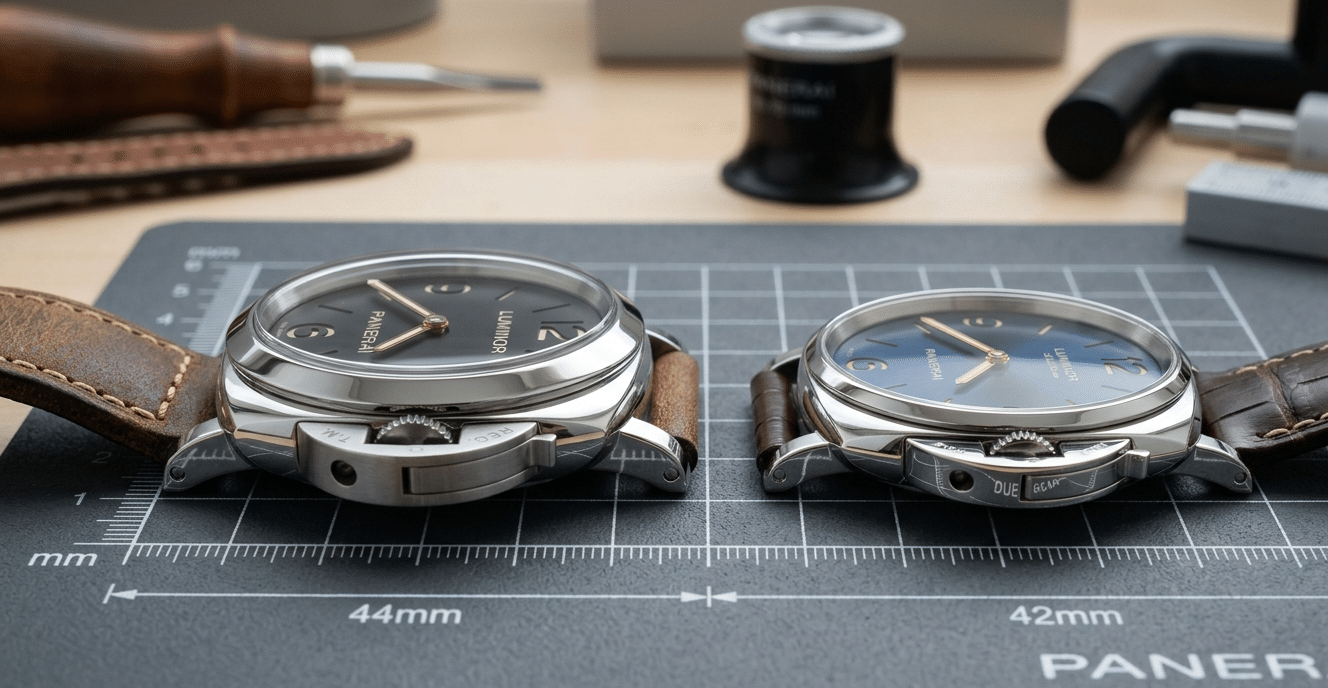
Examining the historical case architecture provides clear evidence of Panerai’s deliberate re-engineering for the Luminor Due. Vintage 47mm and even 44mm Luminor models often feature lug lengths that extend almost straight out from the case, contributing significantly to their overall lug-to-lug measurement. Their bezels are typically thicker, adding to the watch’s perceived height and bulk. In contrast, the 42mm Luminor Due, even in super clone iterations, showcases a more pronounced downward curve in its lugs, designed to hug the wrist more closely and reduce perceived lug-to-lug distance. The bezel is also notably thinner, integrating more seamlessly into the case and minimizing visual height. This isn’t just a scaled-down version; it’s a proportionally adjusted design where the lug length-to-case diameter ratio is optimized for a smaller, more contoured fit.
Deconstructing the 42mm Luminor Due: Dimensions That Deceive and Deliver
Moving beyond the simple 42mm diameter, the true story of the Luminor Due’s wearability on smaller wrists lies in a granular examination of its specific dimensions. It’s a study in how geometry and proportion can both deceive the eye and deliver unexpected comfort, especially when assessing super clone fidelity.
Diameter vs. Lug-to-Lug: The True Measure of Wrist Presence
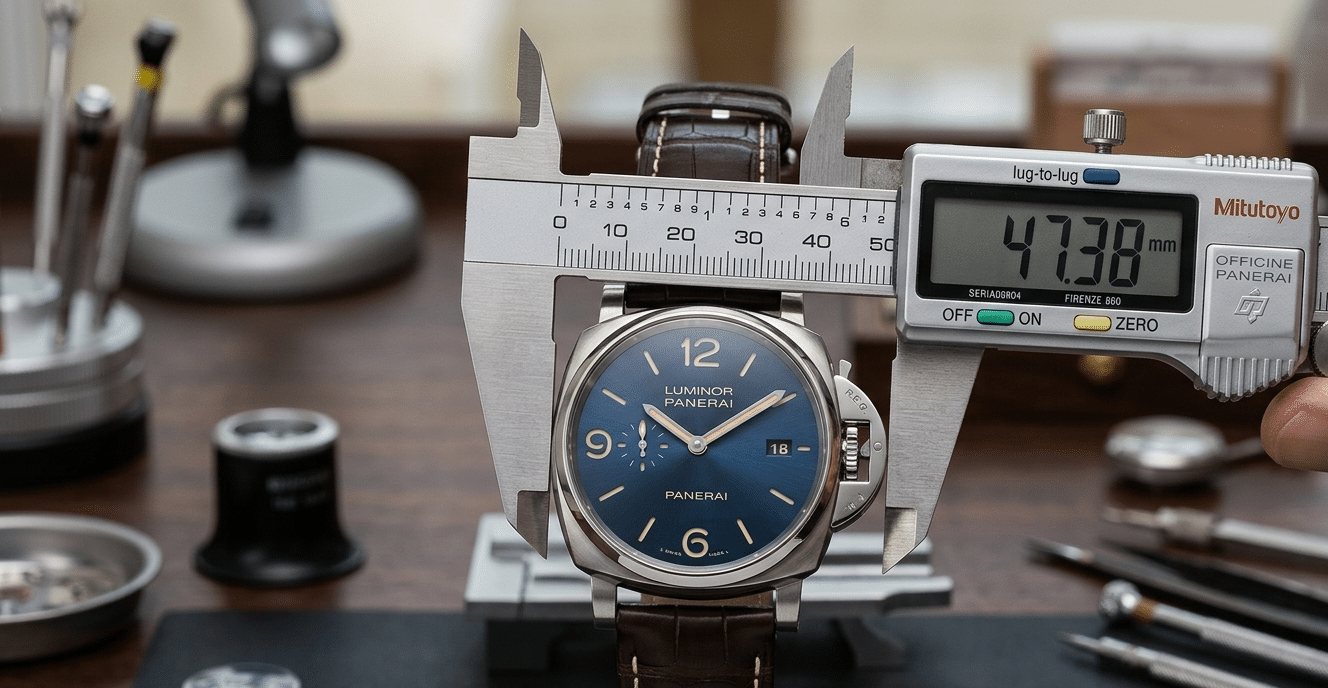
For any watch, but especially for Panerai on a smaller wrist, lug-to-lug distance is often a more critical indicator of fit than case diameter alone. A watch might have a reasonable diameter, but if its lugs extend too far or too straight, it will overhang the wrist, creating an awkward, top-heavy appearance. For prominent 42mm Luminor Due super clone models, such as those from VS Factory, the lug-to-lug measurement typically falls around 50mm. While this might still sound substantial, it’s crucial to compare this to the average wrist width of sub-6.5-inch wearers, which can range from 45mm to 55mm. A 50mm lug-to-lug, when combined with downward-curving lugs, means the watch often sits neatly within the wrist’s flat plane, preventing the dreaded overhang that plagues larger Panerais.
The Slimness Factor: How Case Thickness Redefines Panerai’s Profile
The Luminor Due’s defining characteristic is its reduced thickness. For top-tier 42mm Luminor Due super clones (like the VS PAM00674 replica), the actual case thickness hovers around 10.8mm to 11.5mm. This is a significant departure from the 14mm-16mm+ thickness of many traditional Luminor models. Achieving this thinner profile in a replica movement (often utilizing a P.4000 clone with a micro-rotor) presents engineering challenges, but when executed well, the impact on wearability is transformative. This reduced thickness allows the watch to slide effortlessly under a shirt cuff, making it suitable for more formal attire—a feat rarely possible with other Panerais. It also visually reduces the watch’s bulk, making it appear less imposing on a slender wrist.
Cushion Case Geometry: The Optical Illusion on a Small Wrist
Panerai’s distinctive cushion case shape plays a fascinating role in its perceived size, often creating an optical illusion on the wrist. The soft, flowing lines and integrated lugs of the Luminor Due’s cushion case can make the watch appear to melt into the wrist rather than sit rigidly atop it. On a curved, smaller wrist, this unique geometry can sometimes make the watch feel less expansive than its raw diameter suggests. Conversely, its broad, flat top surface, characteristic of the cushion design, can still command significant visual real estate. Understanding this interplay between the physical dimensions and the optical effect is key to appreciating how the 42mm Due attempts to balance bold presence with enhanced wearability.
Expert Authentication Insight
Employing precision calipers on a high-quality 42mm Luminor Due super clone reveals its critical dimensions. For instance, a VS Factory PAM00674 replica will show a case diameter of exactly 42.0mm, a lug-to-lug distance of approximately 50.0mm, and a thickness of 10.8mm. Comparing these against the genuine PAM00674’s 10.3mm thickness, the replica’s fidelity is remarkable. The crucial physical diagnostic involves assessing the consistency of the case profile from top to bottom and, more importantly, the curvature of the lugs. On a well-executed super clone, the lugs should exhibit a distinct downward slope, allowing the watch to sit flush with the wrist rather than hovering. Any significant deviation in these measurements or a lack of proper lug curvature would compromise the “slim” and “wearable” promise of the Due line on a smaller wrist.
On-Wrist Dynamics: How 42mm Panerai Replicas Sit on a Sub-6.5-Inch Wrist
Moving from raw numbers to lived experience, how a 42mm Luminor Due super clone actually feels and looks on a wrist under 6.5 inches is the ultimate test. This isn’t just about measurements; it’s about the tangible reality of comfort, balance, and visual harmony.
Lug Overhang Analysis: The Critical Visual for Small Wrists
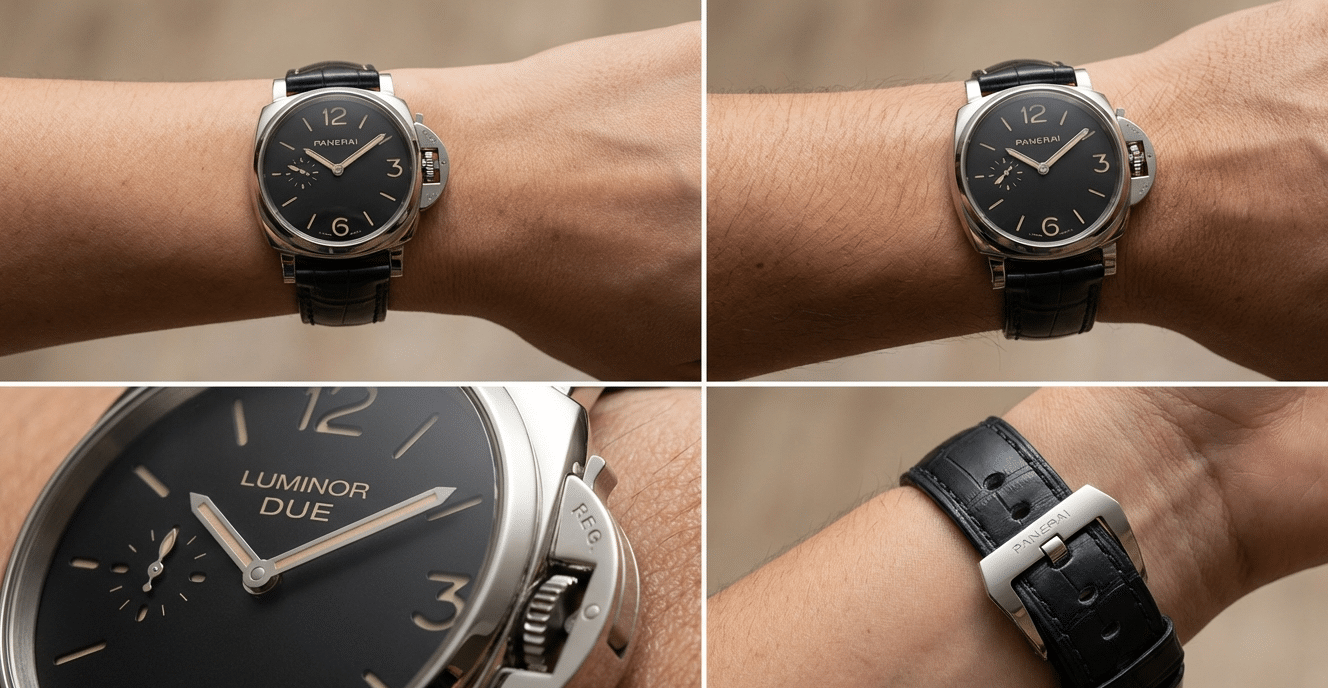
Lug overhang is the nemesis of small-wristed watch enthusiasts. While the 42mm Luminor Due’s reduced lug-to-lug (around 50mm) is a significant improvement, the specific curvature and length of its lugs still demand attention. On a wrist measuring 6.25 inches with an average flat surface width of, say, 50-52mm, a well-proportioned 42mm Due super clone with properly curved lugs will sit perfectly, with the lugs ending just at the edge of the wrist’s flat plane. However, if the wrist is particularly narrow (e.g., 5.5 inches, with a flat width of ~45mm) or very round, even the Due’s optimized lugs might still present a slight overhang. This visual, where the lugs extend beyond the wrist’s edge, can make the watch appear disconnected and disproportionate, regardless of its diameter.
Visual Proportion and Dial Dominance: Does the Watch “Wear” Its Size?
Even with its thinner profile, a 42mm Panerai, with its signature large, minimalist dial, can still command a dominant visual presence on a small wrist. The expansive, uncluttered dial, often featuring large Arabic numerals, naturally draws the eye and can make the watch appear larger than its physical footprint. For some, this bold aesthetic is precisely the appeal—a statement piece that retains the Panerai identity without overwhelming the wrist. For others, particularly those who prefer a more understated look, the dial’s dominance might still feel “too much.” Determining the right proportion often benefits from an accurate wrist sizing guide. The key is whether this visual impact feels balanced and intentional, or if it simply looks like a watch that is too large for its wearer.
Weight Distribution and Comfort: Beyond Just Dimensions
Beyond diameter and thickness, the actual weight and how it distributes across the wrist significantly impact long-term comfort. A 42mm Luminor Due super clone, typically cased in stainless steel and housing a replica automatic movement, is still a substantial timepiece. It’s not a featherlight dress watch. Expect a weight range of approximately 100-120 grams (without the strap), depending on the specific model and movement. For lighter-boned individuals, this weight, if not properly balanced, can lead to the watch shifting or feeling top-heavy throughout the day. A good fit, achieved through proper strap selection and tightness, is crucial to ensure the weight is distributed evenly, preventing fatigue and enhancing overall wearability. The goal is a watch that feels present but not burdensome.
Expert Authentication Insight
To truly understand the on-wrist dynamics, a series of pragmatic tests with a 42mm Luminor Due super clone on various small wrist sizes is invaluable. For instance, testing on wrists ranging from 5.5″ to 6.5″ and documenting the results with high-resolution macro photography would highlight critical differences. On a 6.5″ wrist, the 50mm lug-to-lug often fits perfectly within the wrist’s flat surface. On a 6″ wrist, the fit might be snug, with minimal to no overhang if the lugs are well-curved. However, on a 5.5″ wrist, even with optimal lug geometry, a slight overhang or a sense of the watch dominating the wrist’s width might become apparent. Subjective comfort ratings, gathered over a full day of wear, would also reveal how the watch’s weight and caseback curvature interact with the wrist’s contours, influencing factors like pressure points and overall balance. This kind of field-style commentary provides practical insights beyond mere specifications.
The Crucial Role of Straps: Elevating (or Undermining) Small Wrist Fit
For a 42mm Panerai Luminor Due replica on a smaller wrist, the strap is not merely an accessory; it’s a critical component that can make or break the wearing experience. Its choice, design, and quality profoundly influence comfort, visual balance, and how the watch integrates with your wrist. This is a factor often underestimated, but for sub-6.5-inch wrists, it’s paramount.
Strap Width and Taper: Shaping the Visual and Physical Fit
The 42mm Luminor Due replica typically features a 22mm lug width. While this width is standard, how the strap tapers from the lugs down to the buckle significantly impacts both visual and physical fit on a small wrist. A strap that maintains its 22mm width all the way to the buckle (a “straight” cut) can create an uncomfortably wide and visually bulky presence, making the entire watch feel larger than it needs to. In contrast, a strap with a pronounced taper—for example, from 22mm at the lugs down to 18mm or even 16mm at the buckle—can dramatically improve wearability. This taper reduces the visual mass of the strap, allowing it to conform more naturally to the wrist’s curve and preventing it from feeling like a rigid cuff.
Material and Flexibility: The Key to Conforming to Smaller Wrists
The material and inherent flexibility of the strap are equally vital. Stiff, overly padded straps, often found on cheaper replicas or even some genuine Panerai straps designed for larger wrists, will resist conforming to the contours of a smaller wrist. This can lead to uncomfortable gaps between the strap and wrist, pressure points, and an overall feeling of the watch sitting “on top” of the wrist rather than integrating with it. High-quality, pliable materials like soft calfskin leather, supple FKM rubber, or even certain types of textile straps are far superior. These materials allow the strap to hug the wrist closely, distributing the watch’s weight more evenly and enhancing long-term comfort.
Buckle Size and Placement: Avoiding Awkwardness on Slender Wrists
Panerai is known for its distinctive, often oversized buckles, particularly the pre-V style. While iconic, these large buckles can pose a challenge for slender wrists. An oversized buckle can feel cumbersome, dig into the wrist bone, or sit awkwardly off-center if the strap length isn’t perfectly matched. For small wrists, ensuring the strap is the correct length is crucial. A strap that’s too long will result in the buckle being positioned too far around the side of the wrist, disrupting the balance and increasing discomfort. The goal is for the buckle to sit comfortably and centrally on the underside of the wrist, allowing the watch head to be properly centered on top.
Expert Authentication Insight
When evaluating a 42mm Luminor Due super clone, pay close attention to the strap integration. Use a loupe to inspect the lug-to-lug distance and the gap between the spring bar and the case edge; there should be minimal to no gap, indicating precise manufacturing. Assess the quality and flexibility of factory-supplied replica straps. Does the material feel genuinely supple? Does it have an appropriate taper that mirrors genuine Panerai straps designed for the Due series? Compare the buckle design and dimensions to known genuine articles. Even top-tier replica straps can sometimes be improved upon, and investing in a high-quality, aftermarket strap specifically designed for smaller wrists can significantly enhance the comfort and aesthetic of your super clone. A well-chosen strap can make a 42mm watch wear like a 40mm, dramatically changing the perception of size.
Super Clone Fidelity for Wearability: Where Replica Quality Matters Most
The term “super clone” isn’t just about visual accuracy; it directly translates to the wearing experience, especially for small wrists. The precision of manufacturing details in a super clone impacts fit, comfort, and how authentically the watch feels on the wrist. For a 42mm Luminor Due, where slimness and wearability are key, these details are magnified.
Case Construction Accuracy: Angles, Curves, and Their On-Wrist Impact
Accurate case construction is paramount. On a 42mm Luminor Due super clone, the precise replication of curves, bevels, and angles isn’t just for show; it dictates how the watch sits and feels. Deviations from genuine specifications can lead to uncomfortable sharp edges, an incorrect lug-to-lug distance, or an awkward visual profile on a curved, smaller wrist. For instance, if the lugs don’t curve down sharply enough, or if the mid-case profile is too slab-sided, the watch will perch unnaturally high or wide on the wrist, negating the “slimmer Panerai” promise. A true super clone ensures the case geometry is faithfully reproduced, allowing the watch to integrate smoothly with the wrist’s anatomy.
Crystal Profile and Glare: Affecting Perceived Thickness and Legibility
The quality and profile of the replica crystal also play a role in wearability. Genuine Panerai Luminor Due models typically feature a sapphire crystal with an anti-reflective (AR) coating applied only to the interior surface. This creates a specific visual effect: minimal reflection head-on, but a slight blue tint when viewed at an angle. A super clone should replicate this. If a replica uses a crystal with AR coating on both sides, it can appear less reflective than genuine, subtly altering the visual experience. More critically, an incorrect crystal profile (too domed or too flat) or poor AR application can increase glare, reduce legibility, and visually add to the watch’s perceived thickness, making the already substantial 42mm case appear even bulkier.
Movement Thickness Impact: Why It Influences Case Height
The Luminor Due’s defining characteristic is its reduced thickness, a feat achieved by Panerai’s in-house P.4000 movement. In super clones, the choice of replica movement directly dictates the overall case height. VS Factory’s P.4000 clone, for example, is critical for achieving the correct slim profile of the 42mm Luminor Due (e.g., ~10.8mm vs. the genuine’s ~10.3mm). If a replica factory attempts to house a thicker, generic movement (like a modified Asian 7750, which is typically much taller) in a Luminor Due case, the result is an inevitably bulkier watch. This compromises the very reason the Due exists—to be a more wearable Panerai—and undermines its suitability for small wrists. The “super clone” designation implies attention to these movement-driven dimensional accuracies.
Expert Authentication Insight
To assess super clone fidelity for wearability, perform a detailed comparison of the case geometry against genuine 42mm Luminor Due models. Use high-resolution photographs to scrutinize lug curvature, mid-case profile, and the transition points. Feel the edges for any sharpness or inconsistent finishing. Verify crystal clarity and the effectiveness of the anti-reflective coating; the absence of “rainbow” reflections under direct light is a good sign. Critically, confirm the case height, especially if the watch is marketed as using a P.4000 clone movement. A quick measurement can reveal if a factory has truly replicated the slimness or if it’s merely a visual trick. For example, a detailed Panerai replica size guide would highlight that if a “slim” Luminor Due replica measures 13mm or more, it’s likely using a movement that compromises the intended thinness, directly impacting its wearability on a small wrist.
For the small-wristed enthusiast seeking a 42mm Panerai Luminor Due super clone, navigating the replica market requires informed choices. Not all factories are created equal, and specific models offer better fidelity, quality, and crucially, wearability for smaller wrists.
Key Factories and Their 42mm Due Offerings
When it comes to the 42mm Luminor Due, VS Factory stands as the undisputed leader. They are renowned for their proprietary P.4000 clone movement, which is instrumental in achieving the correct, slim case profile of the Luminor Due series. Models like the PAM00674 are particular strengths for VS Factory, offering exceptional accuracy in case dimensions, dial details, and the critical thinness that makes the Due wearable on smaller wrists. While other factories might offer Luminor Due models, VS Factory’s commitment to replicating the P.4000 movement ensures the most authentic and comfortable wearing experience in this specific size and series.
Common Flaws to Watch For (Specifically for Small Wrist Context)
Even in the super clone tier, imperfections exist, and some are more critical for small wrists. Be vigilant for:
- Incorrect Lug Curvature or Length: This is a primary culprit for lug overhang, making the watch appear too large. Ensure the lugs curve down sufficiently and don’t extend beyond your wrist’s edge.
- Overly Thick Case: If a replica uses a generic or poorly cloned movement, it might result in a case that is noticeably thicker than the genuine Luminor Due’s ~10.3mm. This defeats the purpose of choosing the Due for its slimness.
- Poor Strap Integration: Gaps between the strap and the case at the lugs are a tell-tale sign of imprecise manufacturing and can contribute to discomfort.
- Crown Guard Asymmetry/Finishing: While minor, slight misalignments or rough finishing on the crown guard can be more noticeable on a proportionally smaller watch head.
- Lume Application Inconsistencies: Uneven lume plots or incorrect color can detract from the visual authenticity, which is important when the watch is a focal point on a smaller wrist.
Price vs. Quality Considerations: Making an Informed Replica Choice
Top-tier 42mm Luminor Due super clones from VS Factory typically range from $530 to $640. While this might seem significant for a replica, it reflects the investment in precise engineering, high-quality materials, and the complex P.4000 clone movement necessary to achieve the slim profile. Budget-tier options, often priced below $300, will almost certainly compromise on the very attributes that make the Luminor Due suitable for small wrists: case thinness, lug curvature, and overall finishing. For a small-wristed buyer prioritizing fit and authentic wearability, opting for a super clone is not just about visual accuracy, but about securing the dimensional precision that ensures comfort and proper proportion. The trade-off is clear: pay more for a super clone to get the true Luminor Due experience, or settle for a compromise that might still feel too bulky.
Expert Authentication Insight
To make the best decision, try to examine multiple 42mm Luminor Due super clones from VS Factory side-by-side, if possible. Focus on comparing the consistency of lug finishing, the exact case height, and how well the strap system integrates. Pay particular attention to the mid-case profile and how it transitions to the lugs; a factory-specific “tell” for superior build quality in the Due series is the seamless, flowing curvature designed to reduce visual bulk. Confirm that the watch utilizes a proper P.4000 clone movement (like VS Factory’s) to ensure the correct slimness, as this is the primary determinant of its wearability for small wrists. Any deviation here will immediately compromise the watch’s intended design for a more compact wrist presence.
The Verdict for Small Wrists: Is the 42mm Panerai Super Clone Your Ideal Match?
After dissecting the dimensional realities, on-wrist dynamics, and critical role of straps, it’s time to deliver a definitive judgment. For years, the small-wristed enthusiast has been told that a Panerai is simply not an option. The 42mm Luminor Due super clone, however, presents a compelling counter-argument, but not without its nuances. This isn’t just about shrinking a watch; it’s about a re-engineered presence on the wrist.
Who This Watch Is Truly For: Defining the Ideal Small-Wristed Paneristi
The 42mm Luminor Due super clone is not a universal solution for every small wrist, but it is an exceptional fit for a specific type of enthusiast. This watch is for the individual with a wrist under 6.5 inches who has always admired the bold, distinctive Panerai aesthetic—the cushion case, the sandwich dial, the crown guard—but recoiled from the sheer bulk of the traditional 44mm or 47mm models. You appreciate a watch with significant presence, but demand that it remains visually balanced and physically comfortable, without excessive lug overhang.
This is for the buyer who prioritizes design language and legibility over extreme slimness, understanding that even a downsized Panerai will command attention. If you value a watch that makes a statement but still slips under a cuff (most of the time) and doesn’t feel like a brick strapped to your arm, the 42mm Luminor Due is engineered to meet you halfway. It’s for those who appreciate the subtle re-proportioning—the shorter lug-to-lug, the reduced thickness—that makes the iconic Panerai form factor genuinely wearable for a more slender anatomy.
Trade-offs to Accept: Understanding the Realities of a Downsized Icon
While the 42mm Luminor Due super clone dramatically improves wearability for smaller wrists, it’s crucial to approach it with realistic expectations. This is still a Panerai, and it retains a substantial feel. It is not, and was never intended to be, a discreet dress watch. Its reduced thickness allows for better cuff clearance than its larger siblings, but it won’t disappear under a tight shirt sleeve like a Cartier Tank or a Reverso. The visual dominance of the large dial remains, making it a watch that is seen and felt, not hidden.
Another trade-off lies in strap selection. While the right strap can transform the wearing experience, a poorly chosen one—too stiff, too wide, or with an oversized buckle—can quickly undermine the benefits of the reduced case size. You’ll need to be intentional about finding flexible, well-tapered straps with appropriately sized buckles. Finally, while super clones strive for perfection, minor discrepancies in case finishing or movement reliability can still exist, requiring a discerning eye and a willingness to accept that it is a replica, albeit a high-quality one.
Final Checklist Before Purchase: Ensuring a Perfect Small Wrist Fit
- Measure Your Wrist Accurately: Don’t just use circumference. Measure the flat top surface of your wrist where the watch will sit. This will give you the critical width to compare against the watch’s lug-to-lug.
- Verify Lug-to-Lug: For the 42mm Luminor Due, aim for a lug-to-lug measurement between 48-50mm. Ensure this measurement is less than or equal to your wrist’s flat top surface width to prevent overhang.
- Confirm Case Thickness: A true 42mm Luminor Due replica should be around 10.5-11mm thick. Anything significantly thicker (e.g., 14mm+) will negate the “slim” advantage.
- Prioritize Strap Quality and Design: Look for flexible, high-quality leather or rubber straps that taper appropriately. Ensure the buckle is not excessively large and that the strap length allows the buckle to sit comfortably centered on your wrist.
- Inspect Super Clone Fidelity: Request high-resolution photos of the specific watch you intend to purchase. Pay close attention to the curvature of the lugs, the crispness of the case edges, and the flushness of the caseback. These details directly impact comfort and visual fit on a small wrist.
- Consider Factory Reputation: Stick to reputable factories like VS Factory for Luminor Due models, which have invested in accurate movement and case proportions specific to this reference.
Expert Authentication Insight
Comparing the 42mm Luminor Due super clone to other luxury watches popular on sub-6.5-inch wrists reveals its unique positioning. Unlike a 36mm Rolex Datejust or a 38mm Patek Calatrava, the Due doesn’t aim for subtle elegance. Its wearability on a small wrist isn’t about disappearing; it’s about a controlled, proportionate presence. It wears more akin to a well-proportioned 40mm diver (like a Submariner or Seamaster) in terms of lug-to-lug, but with a fundamentally different visual weight due to its larger dial and cushion case. The real triumph is not that it feels small, but that it feels right for its intended purpose—a bold, legible tool watch aesthetic, finally made accessible without compromise to comfort or visual balance on a wrist that traditionally couldn’t pull off the Panerai look.
Trust your own wrist measurements and comfort above all else. The 42mm Luminor Due super clone is not a mythical beast; it’s a tangible option for small-wristed enthusiasts yearning for that iconic Panerai aesthetic. By prioritizing critical dimensions like lug-to-lug, understanding the impact of case geometry, and investing in the right strap, you can confidently acquire a watch that genuinely fits. The ultimate decision should always be based on personal comfort and how the watch makes you feel, rather than outdated prejudices about watch size or brand reputation. The era of the “big watch only” Panerai is over; embrace the downsized icon.