
The Immediate Impression: Overall Proportions and Wrist Presence
Most Cartier replicas fail their first test before any loupe comes out: the overall impression. A genuine Cartier watch, whether a Tank, Santos, or Ballon Bleu, possesses a distinct visual harmony and tactile quality that is difficult to replicate. This section investigates how a replica’s fundamental dimensions, visual balance, and general “feel” betray its true nature, even at a glance, under typical lighting and viewing distances, without requiring close inspection. Such factors are critical for a thorough replica use case analysis to determine suitability for dress or daily wear.
Case Profile and Curvature Discrepancies
Manufacturing detail: Cartier’s iconic case designs are defined by their complex curves, precise radii, and elegant slimness. Replicas frequently struggle with these intricate geometries. The mid-case might be noticeably too thick, disrupting the watch’s intended silhouette. Lug curvature, particularly on models like the Tank or Santos, can be incorrect, leading to an awkward fit on the wrist or an imbalanced appearance. Overall, a bad replica’s case often looks too flat, bulky, or distorted, lacking the refined and elegant form that defines an authentic Cartier.
Perceived Weight and Material Feel
Manufacturing detail: The tactile experience of handling a watch is an immediate giveaway. Genuine Cartier watches, even in stainless steel, possess a dense, substantial, and refined feel in the hand. Replicas, especially lower-quality ones, often use incorrect alloys or cheap plated brass in place of solid steel or precious metals. This results in watches that are either noticeably too light, feeling flimsy and insubstantial, or conversely, surprisingly heavy in a way that doesn’t convey quality. The overall material feel simply lacks the luxurious and robust impression characteristic of authentic Cartier timepieces.
Reflection and Light Play Dynamics
Manufacturing detail: A hallmark of genuine Cartier watchmaking is the way light interacts with its precisely engineered case geometry and multi-stage polishing. Authentic pieces exhibit specific, nuanced reflections that highlight curves and angles, creating a dynamic interplay of light and shadow. Replicas, by contrast, frequently feature duller, inconsistent, or overly uniform polishing. This can lead to a flat, lifeless appearance or, in some cases, an unnatural, almost garish light catching that lacks the sophisticated and dynamic visual interest seen on authentic pieces.
Expert Authentication Insight
Physical diagnostic: To assess the immediate impression, hold the watch at arm’s length (about 60-70 cm) under natural daylight or standard office lighting. Slowly rotate it, observing how light interacts with the case and crystal. A genuine Cartier will display a dynamic play of light and shadow, highlighting its curves and angles with a rich, deep luster. A bad replica, however, will often appear flat, overly shiny in some areas with a superficial gloss, or have an overall “dead” or static visual presence. Pay close attention to its perceived thickness and general silhouette, comparing it instinctively to known genuine dimensions you might have seen in person or in high-quality images.
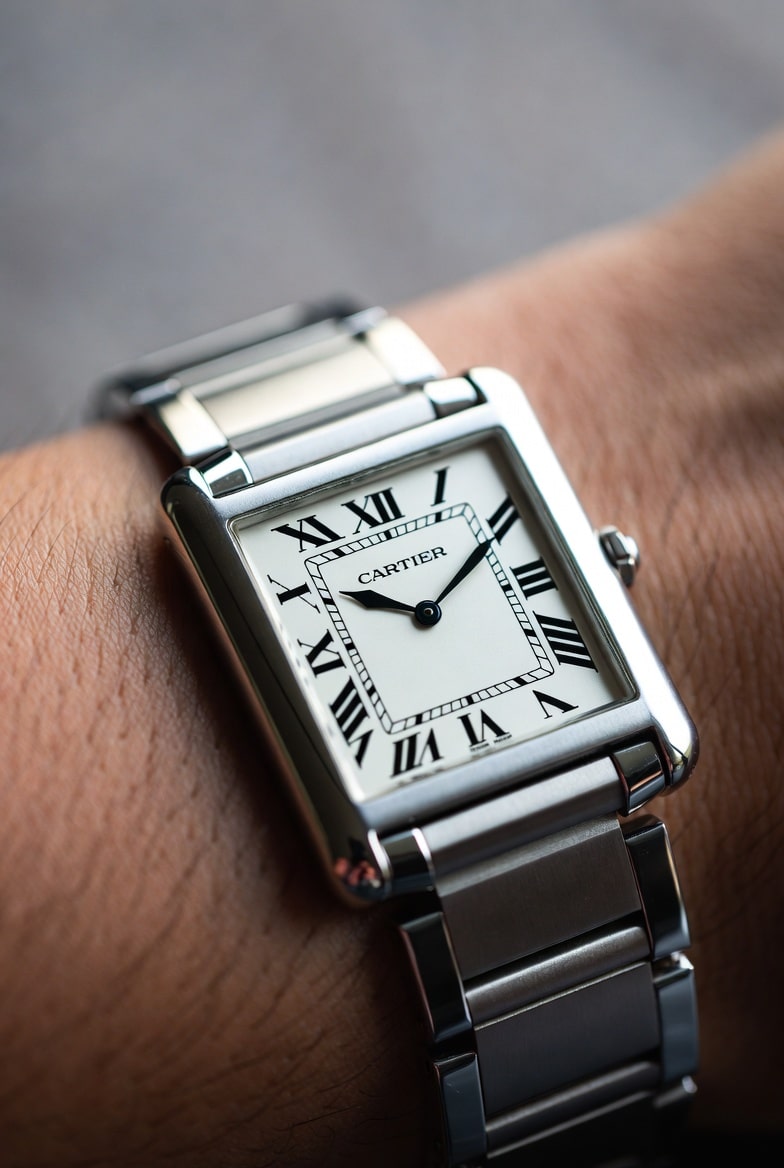
Dial Execution: Printing, Markers, and Textures Under Ambient Light
The dial is the face of the watch, and its execution is paramount to a Cartier’s identity. Even at conversational distance and under normal ambient light, critical quality issues in a replica’s dial printing, markers, and textures often become glaringly obvious. This section focuses on these fine details, which are frequently compromised in poor replicas.
Roman Numeral and Index Printing Quality
Manufacturing detail: Genuine Cartier dials are renowned for their exceptionally crisp, clean, and often slightly raised or perfectly defined printing for Roman numerals and indices. The edges are sharp, and the ink application is uniform. Replicas, due to inferior pad printing techniques or inadequate stamping processes, frequently display blurry, inconsistent, or excessively thick/thin numerals. This is particularly noticeable at the edges, where the ink might bleed, smudge, or appear pixelated, immediately betraying a lack of precision.
Dial Texture and Surface Finish Accuracy
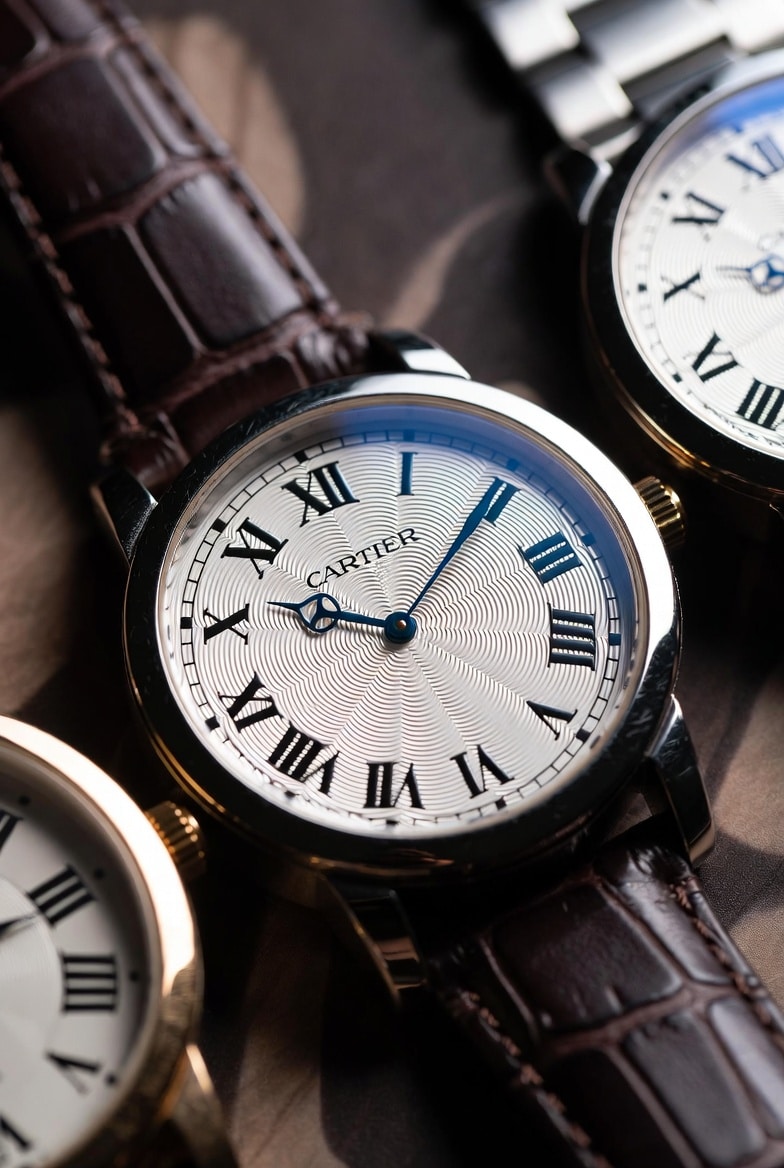
Manufacturing detail: Many Cartier dials incorporate specific, refined textures such as delicate guilloché patterns, subtle sunburst finishes, or precise matte surfaces. These textures add depth and character. Replicas often utilize simpler, less refined stamping or painting methods to simulate these textures. The result is frequently a flat, plasticky, or incorrect texture that lacks the genuine article’s depth, precision, and fine detail. What should be a subtle play of light and shadow becomes a uniform, uninspired surface.
“Secret Signature” Legibility and Placement
Manufacturing detail: A clever and often overlooked hallmark of many genuine Cartier dials is the tiny “Cartier” signature hidden within one of the Roman numerals, typically at the VII or X o’clock position. This micro-printing requires extreme precision. Bad replicas often omit this “secret signature” entirely, or if present, render it illegibly, with blurred or distorted letters. Incorrect placement or an obviously machine-printed appearance also indicates a significant lack of precision in their printing masks and overall quality control, making it a clear tell.
Expert Authentication Insight
Physical diagnostic: Observe the dial under diffuse natural light from a distance of 30-45 cm. Look for uniformity in print thickness across all Roman numerals and markers. Pay close attention to the sharpness of their edges; they should be clean and crisp, not fuzzy or bleeding. Assess the consistency of any textured finish across the dial, ensuring it appears refined and not flat. For the “secret signature,” use a smartphone camera with its zoom function (without a macro lens) to check for legibility and correct placement within the numeral. A bad replica will reveal immediate pixelation, blur, or noticeable unevenness in these fine details, even without a jeweler’s loupe.
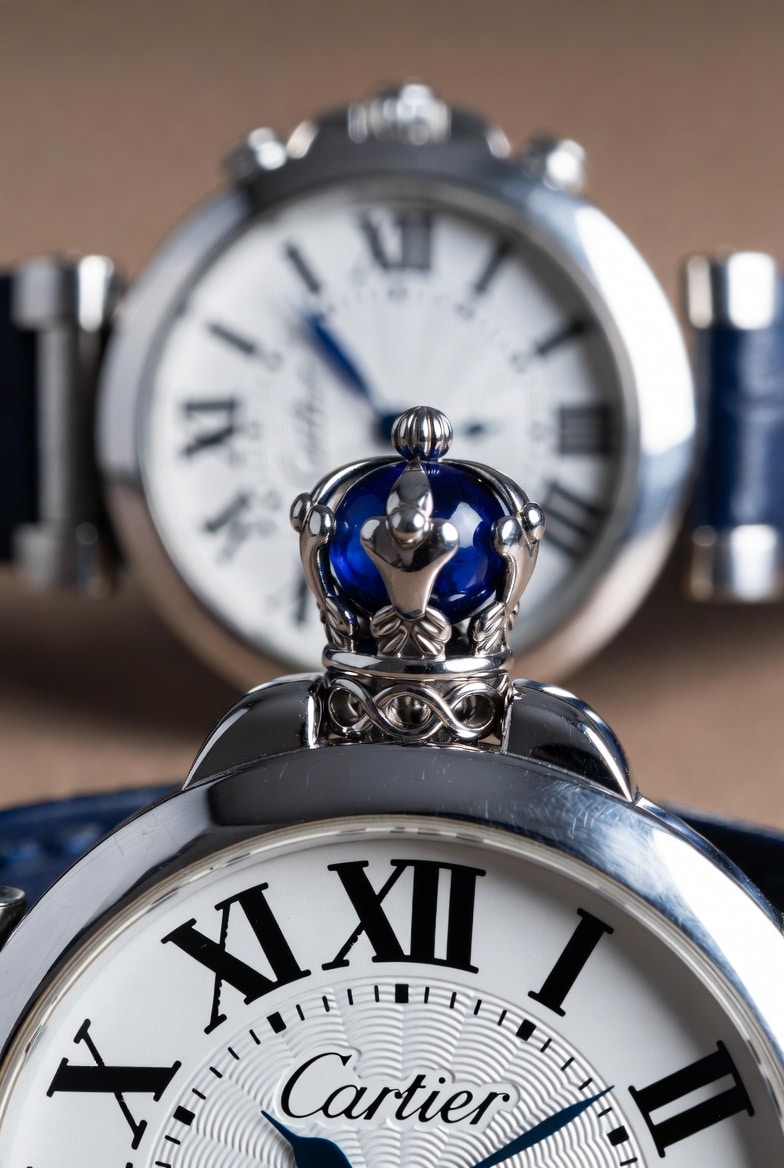
The Cabochon: Color, Clarity, and Integration Flaws
The cabochon, typically a blue synthetic spinel or sapphire set into the crown, is one of Cartier’s most recognizable and elegant design signatures. Paradoxically, this small, prominent detail is a major and immediate giveaway for poor replicas due to fundamental issues with its material, cut, color, and how it is seated within the crown.
Cabochon Material, Color, and Translucency
Manufacturing detail: Genuine Cartier cabochons are crafted from high-quality synthetic sapphire or spinel, offering specific translucency, a deep, rich blue color, and internal brilliance that catches the light beautifully. Replicas, in an effort to cut costs, frequently use colored glass, plastic, or lower-grade synthetic stones. This results in a cabochon that often appears dull, opaque, or has an incorrectly tinted color—it might be too light, too dark, or simply the wrong hue of blue—lacking the vibrant depth and clarity of the authentic material. The color often looks “flat” rather than luminous.
Cut Quality and Surface Symmetry
Manufacturing detail: An authentic Cartier cabochon, whether faceted or domed, features a precise, smooth, and perfectly symmetrical cut. Its surfaces are flawlessly polished. Replicas frequently exhibit rough, uneven, or asymmetrical cuts. These imperfections are visible as irregular reflections, flat spots, or a generally unrefined and crude appearance that immediately betrays its lower quality. The lack of precise cutting skill makes the stone look cheap and poorly executed.
Seating and Alignment within the Crown
Manufacturing detail: On a genuine Cartier, the cabochon is perfectly seated, flush, and seamlessly integrated within its crown or pusher. The fit is tight and precise, with no visible gaps. Replicas, however, often suffer from poor machining tolerances or careless assembly. This leads to visible gaps between the cabochon and the metal crown, misalignment where the stone sits crookedly, or an improperly recessed/protruding stone. Any of these issues create an obvious visual flaw that stands out immediately upon inspection.
Expert Authentication Insight
Physical diagnostic: Hold the watch under both direct and ambient light, observing the cabochon from multiple angles. Check for consistent color saturation and even light reflection across its entire surface; there should be no dull spots or areas where the color looks patchy. Crucially, examine the fit: the cabochon should be seamlessly and precisely integrated into the crown. Gently run a fingernail around the base of the cabochon to detect any unevenness, protruding edges, or visible gaps. Understanding Cartier clone risk ranking reveals that a bad replica will often have immediate color inconsistencies, a dull appearance, or a clearly noticeable gap or ridge where the stone meets the metal, even without magnification.
Case Geometry: Edge Definition, Curves, and Finish Quality
Cartier’s distinctive luxury aesthetic is not just about the dial or movement; it’s profoundly rooted in the precise finishing and complex geometry of its cases. These seemingly subtle elements are critical to the brand’s identity, and they are where poor replicas frequently, and visibly, fail even under normal viewing conditions. The way light plays across a case, the sharpness of its lines, and the accuracy of its curves are immediate indicators of quality.
Edge Definition and Transition Sharpness
Genuine Cartier cases boast impeccably defined edges where polished and brushed surfaces meet. These transitions are crisp, creating distinct lines and strong contrasts that contribute to the watch’s sophisticated appeal. This precision is a hallmark of high-quality machining and meticulous hand-finishing. In contrast, replicas often struggle to replicate this exactitude. Due to inferior CNC machining, excessive or inconsistent polishing, or simply imprecise finishing, their cases frequently exhibit soft, rounded, or inconsistent edges. This lack of definition can make the watch appear less refined, almost “blobby” or melted, losing the architectural integrity that defines a real Cartier.
Curved Surface Thickness and Contour Accuracy
Many iconic Cartier designs, such as the flowing “pebble” case of the Ballon Bleu or the elegantly elongated Tank Cintree, rely on complex, precisely milled curves and specific thicknesses. Achieving these contours requires extremely high manufacturing tolerances. Replicas, however, often fall short. They might present incorrect case thickness, noticeable flat spots where curves should be continuous, or uneven curvature that distorts the watch’s intended form. This can make a replica appear clunky, disproportionate, or simply “off” when compared to the graceful lines of an authentic piece. The subtle interplay of light on these perfectly sculpted surfaces is difficult to reproduce without genuine expertise.
Polishing Uniformity and Luster Depth
The polishing on a genuine Cartier watch is deep, uniform, and consistent across all surfaces, creating a rich, luxurious luster that truly catches the eye. This isn’t just a surface-level shine; it’s a finish that speaks to the quality of the material and the skill of the artisan. Poor replicas, on the other hand, often display tell-tale signs of rushed or inadequate finishing. You might observe swirl marks, an uneven shine, or a superficial, almost “chrome-like” gloss that lacks the true depth and richness of genuine steel or precious metal finishing. This shallow luster often appears cheap and can quickly dull or scratch, further betraying its inauthentic nature.
Expert Authentication Insight
To assess case geometry, hold the watch under ambient light—like natural daylight or standard office lighting. Focus on the case edges, particularly where the lugs meet the bezel, or where different finishes (brushed vs. polished) converge. Look for a clean, sharp, almost knife-edge transition, not a soft or blurry line. Slowly rotate the watch and observe reflections on curved surfaces. On a genuine piece, these reflections will be smooth and undistorted, highlighting the precise contours. A bad replica will often show wavy, uneven reflections or flat spots. The overall polish should appear rich and consistent, not overly reflective like a cheap mirror, nor dull and lifeless. A quick tactile test can also be revealing: gently run a finger along the edges. Genuine edges will feel distinct and crisp, while replica edges might feel unexpectedly soft or even rough.
Bracelet and Clasp: Articulation, Weight, and Finish Discrepancies
For watches fitted with a metal bracelet, this component is often a primary tactile and visual indicator of a replica’s authenticity. The bracelet and clasp are in constant motion and contact with the wearer, making their quality (or lack thereof) immediately apparent. Flaws in construction, material, and overall assembly are easily revealed under normal wear, often signaling a poor replica before any other detail.
Bracelet Link Articulation and Excessive Looseness
Genuine Cartier bracelets are engineered with exacting tolerances. This results in smooth, fluid articulation of the links and minimal side-to-side play. The bracelet drapes elegantly around the wrist, feeling substantial yet flexible. Replicas frequently fail here due to inferior pins, looser manufacturing processes, or incorrect link designs. The result is often an excessive “rattle” as the links knock against each other, a flimsy feel on the wrist, and visible, unsightly gaps between the links. This lack of precision not only feels cheap but also looks visibly sloppy, especially as the watch moves with the wearer.
Clasp Mechanism Functionality and Engravings
The clasp on a genuine Cartier watch operates with a precise, satisfying click, engaging securely and confidently. It’s a small but crucial detail that speaks to overall quality. Furthermore, genuine clasps feature sharp, deeply cut, and correctly fonted engravings, whether it’s the brand name, logo, or other hallmarks. Replicas, by contrast, frequently have stiff, loose, or clunky clasps that lack that reassuring snap. They might be difficult to open or close, or feel insecure. Their engravings are often a major giveaway: shallow, poorly defined, incorrectly spaced, or using an entirely wrong font. These details are readily observable without magnification and instantly compromise the luxury feel.
Bracelet Material Finish and Consistency
The finish—whether brushed or polished—on a genuine Cartier bracelet is uniform, consistent, and meticulously matched to the case. The quality of the steel (typically 316L for Cartier, which replicas often also use) is evident in its luster and texture. Replicas often betray themselves with inconsistent brushing patterns, mismatched polishing that doesn’t flow seamlessly from link to link, or even a slightly different hue of steel or plated metal that doesn’t quite match the case. This lack of harmony in finishing creates a disjointed appearance that is easily spotted, especially in varied lighting conditions.
Expert Authentication Insight
To evaluate the bracelet, hold the watch by its case, allowing the bracelet to hang freely. A genuine bracelet will drape smoothly and fluidly, with minimal lateral play between links. A bad replica bracelet will often sag unnaturally, feel rigid, or exhibit excessive side-to-side movement, often producing a “jangly” sound. Next, operate the clasp multiple times. Feel for a crisp, secure engagement and release; avoid anything that feels stiff, mushy, or insecure. Finally, examine the clasp’s exterior and interior engravings with the naked eye. Look for sharpness, depth, and correct font. Shallow, blurry, or incorrectly proportioned text is a strong indicator of a replica.
Crystal and AR Coating: Clarity, Glare, and Distortion
The watch crystal, the transparent barrier protecting the dial, is the primary interface through which you view the time. As such, it’s a common and often obvious failure point for replicas. Issues can arise from the material quality, clarity, the application of anti-reflective (AR) treatment, and how it is seated within the case, all of which are easily noticeable in normal light.
Crystal Material Quality and Transparency
Genuine Cartier watches exclusively use high-quality sapphire crystal. This material is renowned for its superior transparency, allowing an unobstructed view of the dial, and its exceptional scratch resistance (Mohs hardness of 9). Replicas, aiming to cut costs, may use cheaper mineral glass or lower-grade sapphire. This often results in poorer transparency, giving the crystal a slightly milky, hazy, or less vibrant appearance that subtly obscures the dial. Such crystals are also more prone to scratching, quickly accumulating micro-abrasions that further diminish clarity and betray the watch’s origin.
Anti-Reflective (AR) Coating Application and Color
Many genuine Cartier watches feature a subtle, yet highly effective, anti-reflective coating. This coating minimizes glare, ensuring the dial remains legible even in bright conditions, and often appears almost invisible. Replicas frequently cut corners on AR coating. They might omit it entirely, leading to excessive glare that makes the dial difficult to read. Alternatively, they might use a cheap, highly reflective coating that produces an unnatural, strong blue or purple tint when light hits the crystal. This colored reflection is a dead giveaway, as it’s rarely seen on genuine high-end watches, or is applied inconsistently, creating obvious visual defects.
Crystal Seating and Gasket Integration
On a genuine Cartier, the crystal is perfectly seated, flush with the bezel, and sealed with a high-quality gasket, ensuring both aesthetic integrity and water resistance. This creates a seamless transition between the crystal and the case. Replicas, due to less precise manufacturing or assembly, often exhibit uneven crystal seating, a common indicator examined in a super clone Cartier guide. You might see visible gaps between the crystal and the bezel, or a poorly integrated/protruding gasket that is clearly visible. These flaws not only compromise the watch’s aesthetics but also its water resistance, making it vulnerable to moisture ingress.
Expert Authentication Insight
To examine the crystal, view the dial through it under various light sources, including overhead and angled light. Look for excessive reflections that obscure the dial; a genuine AR coating should make the crystal almost disappear. Be particularly wary of a strong, unnatural blue or purple hue on the crystal’s surface, as this is a common indicator of a cheap or incorrectly applied AR coating on replicas. Tilt the watch from side to side; the dial should remain clearly visible without significant distortion or a “wavy” effect. Finally, run a finger over the crystal’s edge. You should feel a smooth, flush transition with the bezel. Any unevenness, a noticeable step, or a protruding gasket is a clear red flag.
Hand Set and Pinion: Form, Finish, and Alignment
The hands of a watch, though seemingly small, are critical aesthetic components that frequently reveal poor manufacturing due to their delicate forms, precise finishing requirements, and exact alignment. These are not details that require a loupe to spot; their imperfections often become glaringly obvious under normal lighting and at a casual glance.
Hand Shape, Proportions, and Length Accuracy
Genuine Cartier watches utilize hands with very specific, refined shapes—be it the iconic blued steel sword hands, elegant Breguet hands, or simple stick hands. Each type has precise proportions and lengths designed to perfectly align with the dial markers, ensuring legibility and aesthetic balance. Replicas frequently fail here, often presenting hands that are noticeably too thick, too thin, incorrectly shaped, or of the wrong length relative to the minute track or indices. This disruption in proportion immediately compromises the dial’s intended harmony and can make time-telling feel imprecise, betraying the watch’s ersatz nature.
Hand Finishing and Bluing Quality
The finishing of Cartier hands is a hallmark of quality. Genuine blued steel hands achieve their distinctive, vibrant blue through a thermal bluing process. This method creates a deep, consistent hue that dynamically shifts from brilliant blue to almost black depending on the angle of light. Replicas, conversely, often resort to simple painting, resulting in a dull, flat, or inconsistent blue that lacks depth and the captivating light play of the authentic article. For polished hands, genuine models exhibit a flawlessly smooth, mirror-like finish, while replicas frequently show imperfections, brush marks, or an uneven luster that lacks the genuine article’s refined gleam.
Pinion and Cannon Pinion Aesthetics
The central pinion and cannon pinion—the small components at the heart of the hands—are also telling details. On genuine Cartier watches, these elements are neatly finished, often domed or capped, presenting a clean, integrated aesthetic. Replicas, however, commonly feature unfinished, rough, or incorrectly shaped pinions. Visible mounting posts, excessive play, or an unpolished, raw appearance around the central axis are common giveaways, indicating a lack of attention to detail and precision in manufacturing.
Expert Authentication Insight
Observe the hands under both direct and ambient light. Blued hands on a genuine Cartier will exhibit a dynamic shift from deep blue to almost black depending on the angle; painted hands on a bad replica will remain uniformly colored and flat. Check the tips of the hands for crispness—they should be precisely cut, not rounded or blunt. Pay close attention to the central pinion for a clean, finished appearance without burrs, visible screws, or excessive gaps around the hand stack. Any visible roughness, unevenness, or incorrect hand length relative to the minute track or hour markers are clear red flags that can be spotted without magnification, even at a conversational distance.
Crown Functionality and Winding Feel: Tactile Giveaways
The tactile experience of operating the crown, often overlooked by replica manufacturers, provides crucial and immediate clues about the internal quality and finishing of a movement and its interaction with the case. This isn’t just about how it looks; it’s about how it feels in your hand, a direct indicator of underlying craftsmanship.
Winding Resistance and Smoothness
Genuine Cartier movements, whether mechanical or high-quality quartz, offer a consistent, smooth, and refined winding resistance. The action should feel precise and deliberate, a testament to well-machined gears and proper lubrication. Replicas, by contrast, frequently suffer from gritty, uneven, or excessively loose/tight winding. This unpleasant sensation stems from poorly finished gears, inferior lubricants, or misaligned components within the movement, instantly communicating a lack of precision and quality control.
Crown Engagement and Lateral Play (Wobble)
A genuine Cartier crown pulls out to its setting positions with a distinct, firm click, and exhibits minimal lateral play or “wobble.” Each position should feel securely engaged, providing confident control. Replicas frequently feel flimsy, displaying excessive side-to-side wobble that makes the crown feel detached or unstable. Indistinct setting positions, where the crown doesn’t quite “click” into place, are also common, making the watch feel cheap and imprecise during adjustment.
Date Quickset and Time Setting Precision
The mechanisms for date quickset and time setting on a genuine Cartier should operate smoothly and with precise engagement. Date changes should be clean and immediate. Replicas commonly feature stiff, jumpy, or imprecise date changes, often requiring extra force or exhibiting a delayed response. When setting the time, a replica might have a “spongy” feel, excessive backlash (where the hands move back slightly after adjustment), or hands that jump rather than sweep smoothly, all indicating poor gear meshing or inferior internal components.
Expert Authentication Insight
Gently pull the crown out to its various positions, feeling for distinct clicks and minimal lateral play. A genuine watch will feel solid and responsive, while a bad replica will often feel flimsy or wobbly. If it’s a mechanical watch, wind it, paying close attention to any grittiness, stiffness, or inconsistent resistance in the winding action. When setting the time, ensure the hands move smoothly without excessive backlash or jumping. For models with a date complication, test the quickset function: a clean, immediate change without resistance or hesitation is expected from a genuine piece. Any of these tactile imperfections are immediate red flags, perceptible to anyone handling the watch, regardless of their expertise.
The Verdict: What a Bad Cartier Replica Can’t Hide in Real Life
The obsession with microscopic flaws in replica watches often misses the point. In the real world, under normal light and at conversational distances, a truly bad Cartier replica reveals itself not through a loupe, but through a series of significant, visible, and tactile compromises. These aren’t subtle imperfections; they are fundamental failures in manufacturing and design execution that directly impact the watch’s aesthetic integrity and perceived quality.
A “bad replica” will fail the normal light test by showcasing glaring discrepancies in:
- Overall Proportions and Wrist Presence: The case might be too thick, the curves off, or the weight simply feels wrong, giving it a clunky or unsubstantial feel.
- Dial Execution: Roman numerals and indices may appear blurry, uneven, or incorrectly textured. The “secret signature” might be illegible or absent.
- Cabochon Quality: The iconic blue stone is often dull, the wrong color, poorly cut, or visibly misaligned within the crown.
- Case Geometry and Finish: Edges are soft, curves are inaccurate, and polishing is inconsistent, lacking the crisp definition and luxurious luster of a genuine Cartier.
- Bracelet and Clasp: Links might rattle excessively, the clasp feels flimsy or operates poorly, and the finish often doesn’t match the case.
- Crystal and AR Coating: Excessive glare, an unnatural blue tint, or a hazy appearance betrays a cheap or poorly applied anti-reflective treatment.
- Hand Set and Pinion: Hands are incorrectly shaped, poorly finished (especially bluing), or the central pinion looks rough and unfinished.
- Crown Functionality: The winding mechanism feels gritty, the crown wobbles excessively, or the date/time setting is imprecise and spongy.
The takeaway is clear: if a replica exhibits more than one or two of these easily observable flaws—flaws you can see across a table, feel in your hand, or spot in a mirror—it is unequivocally a “bad replica.” It will fail to convince in everyday wear, betraying its nature to anyone with a discerning eye, and is likely not worth the purchase, regardless of its price. While a truly convincing “super clone” strives to minimize these real-world giveaways, a bad one cannot hide them. Your best defense is a sharp eye for these practical, normal-light indicators, not an unrealistic pursuit of microscopic perfection.