
The Illusion of Perfection: Understanding Cartier Super Clone Risk
Cartier’s iconic designs hold an undeniable allure, captivating enthusiasts with their blend of elegance, history, and distinctive style. For many, the promise of a “super clone” offers a tantalizing path to owning these coveted pieces without the prohibitive cost of genuine articles. The term itself suggests a near-flawless replication, a watch so accurate it defies casual detection. However, a deeper understanding of super clone flaws reveals this perception of universal perfection is a myth that often leads to disappointment for the uninitiated buyer.
The reality is that replicating a Cartier watch isn’t a single, uniform challenge. Instead, it’s a spectrum of manufacturing hurdles, with each collection and even individual model presenting its own unique set of difficulties. Just as a master sculptor finds different challenges in reproducing a smooth, simple form versus an intricate, multi-faceted one, replica factories face varying degrees of complexity depending on the watch’s design. This article moves beyond generic marketing claims to provide a practical, risk-based assessment of Cartier’s most popular collections, evaluating them through the lens of specific, observable manufacturing challenges.
The “Super Clone” Myth: Not All Designs Are Created Equal
The phrase “super clone accuracy” might imply a blanket standard of excellence, but it fails to account for the inherent design complexity of different Cartier watches. A super clone, at its best, is a testament to sophisticated manufacturing processes. Yet, even the most advanced replica factories operate within certain limitations, and these limitations are exposed most readily when attempting to reproduce highly intricate or delicate design elements. Some Cartier designs, by their very nature, are far more forgiving of slight imperfections, while others are brutally revealing. Understanding this distinction is key to making an informed purchase and avoiding buyer’s remorse.
Five Critical Risk Factors for Replica Cartier Quality
To provide a clear framework for evaluating Cartier super clones, we’ll focus on five critical risk factors. These are the areas where replica factories most commonly struggle, and where flaws become most apparent in real-world wear:
- Case Geometry: The shape, angles, and transitions of the watch case.
- Dial Printing & Detailing: The precision of text, markers, and decorative patterns on the dial.
- Bracelet & Clasp Execution: The quality, articulation, and finish of the bracelet and its clasp.
- Thickness Sensitivity: How closely the replica’s profile matches the genuine article’s slender dimensions.
- Flaw Visibility: How easily manufacturing imperfections are noticed during normal wear, rather than under a loupe.
Expert Authentication Insight
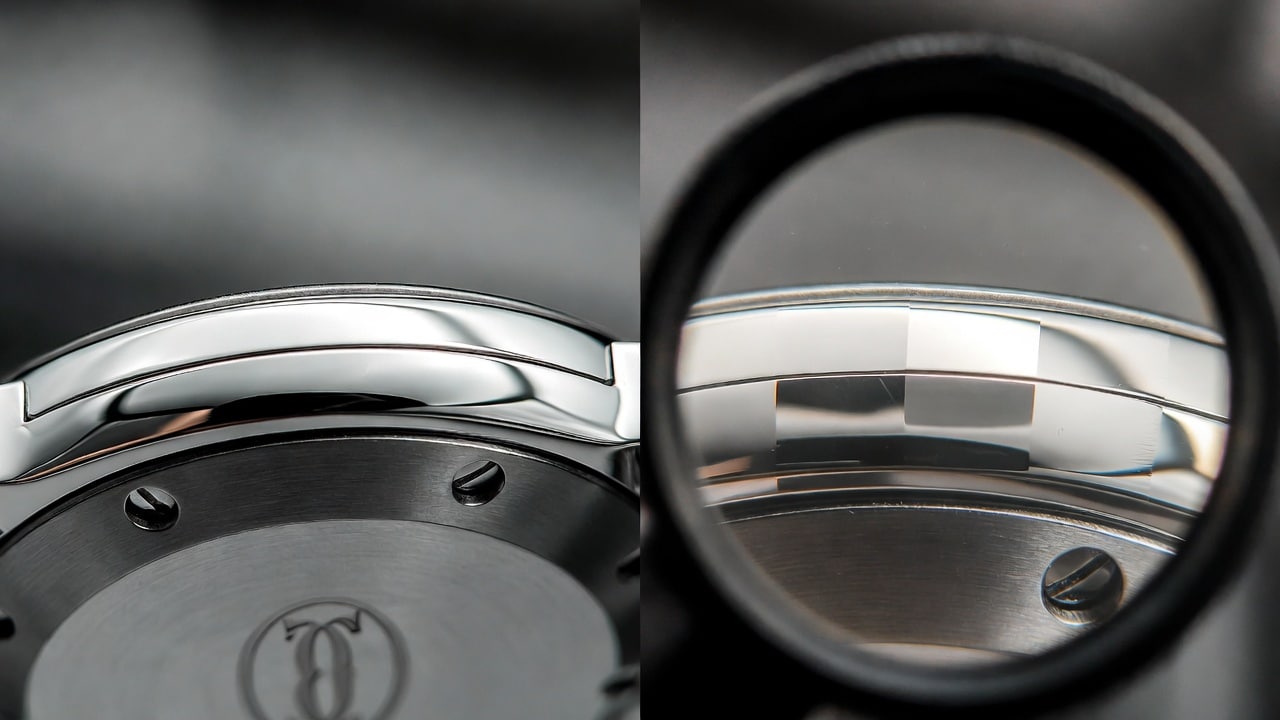
The Risk Framework: How We Evaluate Cartier Super Clone Quality
To truly understand which Cartier super clone collections represent a safer bet and which are fraught with potential pitfalls, it’s essential to dissect the manufacturing challenges that underpin replica quality. This framework provides the lens through which we’ll analyze each collection, offering a granular view of what makes a replica “good” or “bad” beyond a superficial glance.
Case Geometry: The Foundation of Form and Fit
The case is the watch’s foundational structure, and its geometry dictates much of the watch’s character and wearing experience. For replica factories, accurately reproducing complex case shapes is a significant hurdle. Genuine Cartier cases often feature intricate curves, sharp internal angles, and precise transitions between polished and brushed surfaces. Replicas frequently struggle with “soft edges” where angles should be crisp, or uneven polishing that reveals the underlying machining marks. This isn’t just an aesthetic flaw; it impacts how the watch catches the light and feels on the wrist. A poorly executed case geometry can make an otherwise decent replica look and feel cheap, immediately betraying its origins. The challenge lies in the complex multi-axis CNC machining required to achieve these precise forms and the subsequent manual polishing that must perfectly follow those contours.
Dial Printing & Detailing: The Face of Authenticity
The dial is the most visible part of a watch, and its details are often the first point of scrutiny. Cartier dials are known for their exquisite Roman numerals, precise minute tracks, and subtle guilloché patterns. Replica factories often falter here, producing blurry text, inconsistent font thickness, or misaligned markers. The delicate “Cartier” hidden signature at the seven o’clock position on many models is a notorious tell, frequently appearing too thick, too thin, or simply absent. These issues stem from the difficulty of fine pad printing on a curved or textured surface and the incredibly small tolerances involved. A flawed dial is a critical visual tell, as it’s constantly on display and directly impacts the watch’s perceived authenticity.
Bracelet & Clasp Execution: Tactile Tells and Wearability
While often overlooked in photos, the bracelet and clasp are crucial to the overall wearing experience and are common points of failure for replicas. Cartier bracelets are renowned for their fluid articulation, comfortable fit, and seamless integration with the case. Replicas frequently suffer from stiff, rattling links, poor screw quality, sharp edges, or clasps that feel flimsy or don’t close securely. The polishing on individual links and the transitions between them are also difficult to get right, often appearing inconsistent or rough. These flaws are not just visual; they are tactile. A bracelet that feels cheap or uncomfortable immediately diminishes the enjoyment of the watch, and a rattling sound is an instant giveaway. Precise link articulation and consistent finishing across dozens of tiny components are extremely challenging to achieve at scale for replica manufacturers.
Thickness Sensitivity: The Hidden Dimension of Authenticity
Many Cartier designs, particularly the Tank and Panthère, derive much of their elegance from their slender profiles. Replicating this thinness is a significant challenge, primarily because replica movements are often thicker than their genuine counterparts. Consequently, many super clones end up noticeably bulkier than the originals. This isn’t just about a few millimeters; a watch that’s too thick can alter its proportions, make it sit awkwardly on the wrist, and destroy the delicate balance of the original design. While not always immediately obvious from a front-on photo, a bulky profile is a critical flaw that changes the entire wearing experience and visual coherence of the watch when viewed from the side or in motion. It’s a fundamental aspect of the watch’s form that, when compromised, fundamentally changes its character.
Flaw Visibility: What Truly Matters in Daily Wear
Ultimately, the impact of any manufacturing flaw is determined by how visible it is during normal, day-to-day wear. Some imperfections might only be detectable under a jeweler’s loupe, while others jump out immediately. This factor considers the overall design’s ability to “hide” or “reveal” flaws. A watch with a busy dial or a highly reflective surface might obscure minor printing errors, while a clean, minimalist design will highlight every misstep. Similarly, a rounded case might soften the appearance of uneven polishing, whereas a sharply angled case will expose every imperfection. This is where the rubber meets the road: a flaw that’s only visible under extreme scrutiny might be acceptable, but one that’s obvious from an arm’s length away will continuously undermine the replica’s perceived quality.
Expert Authentication Insight
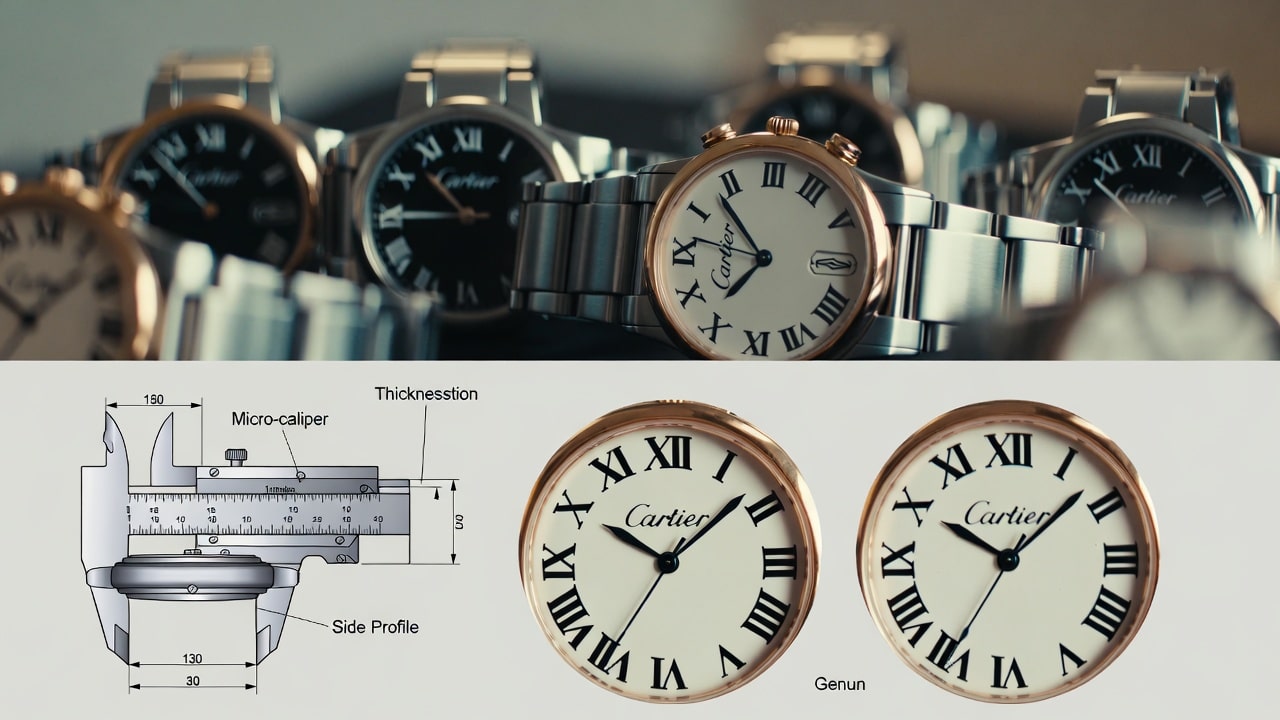
The Safest Bet: Ballon Bleu – Forgiving Curves and Manageable Challenges
If you’re navigating the complex world of Cartier super clones and your primary goal is to minimize visible flaws and maximize your satisfaction, the Cartier Ballon Bleu stands out as the relatively lowest-risk purchase. Its distinctive design attributes inherently make it more forgiving for replica factories, offering a more consistent and convincing replication experience compared to other, more geometrically demanding Cartier collections.
The Ballon Bleu’s signature round, pebble-like case, its deeply domed sapphire crystal, and its generally robust profile are its greatest assets in the replica market. These features, while central to its unique aesthetic, paradoxically make it easier for factories to achieve a high level of accuracy. Minor imperfections in polishing or case finishing are often softened and distorted by the curved surfaces and domed crystal, making them far less noticeable than on watches with sharper angles or flatter surfaces. While no replica is truly perfect, the Ballon Bleu’s design mitigates some of the most glaring issues commonly found elsewhere.
The Advantage of Curvature: Hiding Imperfections
The Ballon Bleu’s flowing, curvilinear design is a boon for replica quality. The soft, rounded edges of the case and the distinctive “bubble” effect of its domed crystal naturally play tricks with light, subtly distorting reflections and softening contours. This optical effect works to the replica factory’s advantage, as it tends to obscure minor inconsistencies in polishing or subtle deviations in case shaping that would be glaringly obvious on a watch with a flat, angular design. Think of it as built-in camouflage; the design itself helps to hide the subtle manufacturing imperfections that are almost inevitable in mass-produced replicas. This means that even if a replica Ballon Bleu isn’t absolutely perfect under a loupe, it often presents a remarkably convincing appearance on the wrist in everyday conditions.
Acceptable Thickness: Less Scrutiny on Profile
Unlike the ultra-thin elegance of the Tank or Panthère, the Ballon Bleu’s design embraces a more substantial, albeit still refined, profile. This inherent thickness makes it less sensitive to the common replica problem of oversized movements leading to overly thick cases. While a super clone Ballon Bleu might still be a fraction of a millimeter thicker than its genuine counterpart, this difference is far less impactful on its overall aesthetic and wearing comfort than it would be on a model whose identity is intrinsically linked to its slenderness. The design allows for more internal space, reducing the pressure on replica factories to achieve an impossibly slim movement or case, thus minimizing a major potential tell.
Common Ballon Bleu Tells: What to Still Look For
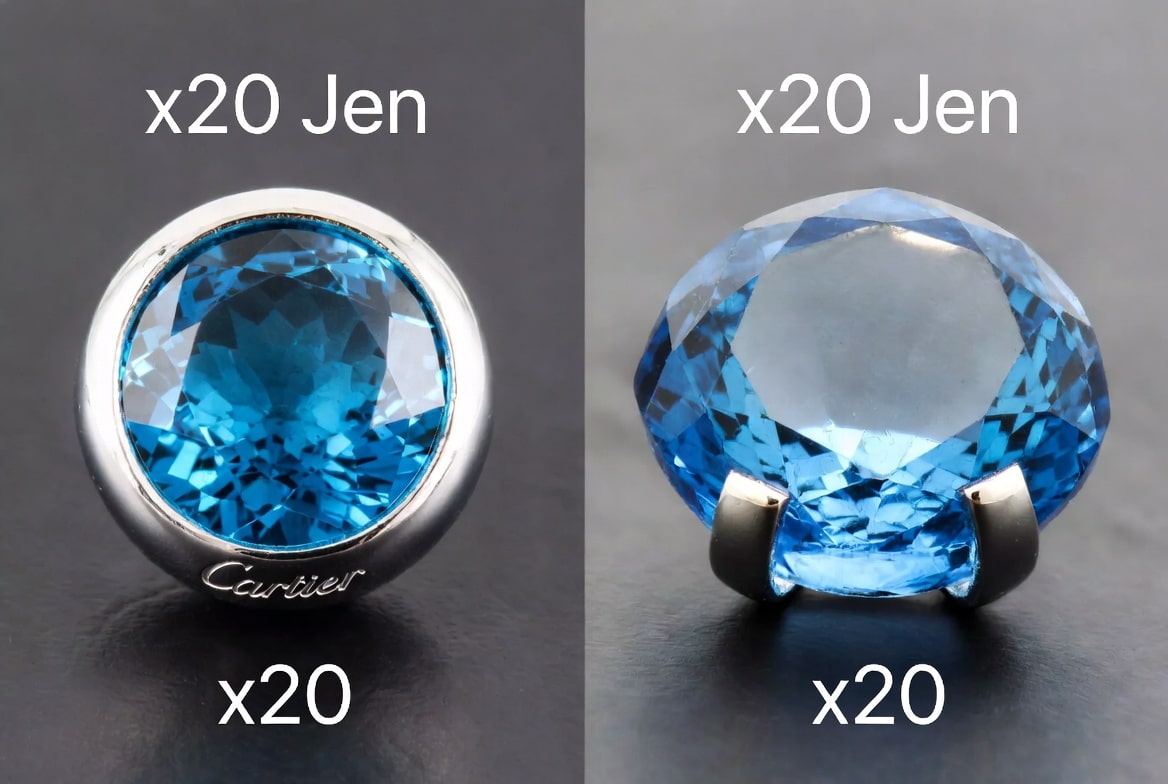
While the Ballon Bleu is a safer bet, it’s crucial to understand that “safer” does not mean “flawless.” Even in the best super clones, certain areas still warrant scrutiny. The most common tells often revolve around the crown cabochon, the dial guilloché, and the precision of the Roman numerals. The crown’s blue synthetic spinel cabochon can sometimes lack the correct clarity, cut, or vibrant color of the genuine article, appearing dull or poorly set. The delicate guilloché pattern on the dial, which creates a subtle sunburst effect, might be less defined or even absent in lower-quality replicas. Additionally, the Roman numerals, particularly the “VII” with its hidden “Cartier” signature, can show signs of imprecise printing or incorrect font thickness. However, these flaws are generally less egregious and often require closer inspection compared to the more fundamental geometric or tactile issues found in higher-risk collections.
Expert Authentication Insight
Medium Risk: Pasha de Cartier – The Crown Guard Challenge
The Cartier Pasha de Cartier stands out with its bold, circular case framed by a distinctive square minute track, but its most iconic and challenging feature for replica manufacturers is undeniably the screw-down crown guard attached by a small chain. This unique aesthetic, while instantly recognizable, elevates the Pasha to a medium-risk purchase in the super clone market. The mechanical complexity and intricate finishing required for this crown guard system present a significant hurdle, often becoming the primary point of failure for even otherwise well-made replicas.
The Articulation Gamble: Pasha’s Crown Guard Mechanism
The defining characteristic of the Pasha is its articulated crown guard, a mechanism that protects the crown and is secured by a delicate chain. This isn’t merely a decorative element; it’s a functional component designed for smooth operation. For replica factories, replicating this system accurately is a miniature engineering challenge. The mechanism must move fluidly, without binding or excessive play, and the chain itself needs to be finely crafted and properly integrated. Common flaws in super clone Pasha models include crown guards that feel gritty or stiff when operated, chains that are poorly constructed or easily detach, or an overall lack of the precise, tactile feedback found in the genuine article. The sound and feel of operating this guard are as crucial as its visual accuracy, often revealing a replica’s shortcomings more immediately than static inspection.
Cabochon Quality and Chain Detail: Subtle But Significant Tells
Beyond the mechanism, the quality of the cabochon stone set within the crown and the chain’s individual links are critical details. A genuine Pasha cabochon will possess a deep, consistent hue and excellent clarity, often a sapphire or spinel. Replica cabochons frequently fall short, appearing cloudy, off-color, or poorly cut. Similarly, the chain links on an authentic Pasha are precisely formed and finished, allowing for fluid movement and a refined appearance. Replicas often feature chains with less defined links, rougher finishing, or an incorrect drape. These seemingly minor details, when viewed together, can quickly betray a replica’s true origin.
Dial and Case: More Manageable, But Not Flawless
While the crown guard is the primary risk factor, the Pasha’s dial and case still present their own set of challenges, though generally less severe than the crown guard. The case, being round, is less prone to the geometric distortions seen in angular designs. However, the polishing and brushing transitions on the case can still be inconsistent in replicas. Dial printing, particularly the unique Cartier numerals and the inner square track, requires precision that some factories struggle to achieve, leading to slightly blurry or misaligned elements. Despite these potential issues, they are often less noticeable in daily wear than a poorly executed crown guard. Buyers considering a Pasha super clone should prioritize close-up videos and images specifically demonstrating the crown guard’s operation and detailing to understand Cartier replica wearing differences. A smooth, well-finished crown guard is a strong indicator of a higher-quality replica.
Medium-High Risk: Tank Collection – The Thinness Trap and Bracelet Woes
The Cartier Tank collection, a century-old icon of rectangular elegance, presents a medium-high risk in the super clone market. Its inherent design, particularly the quest for slenderness in models like the Tank Louis Cartier and Tank Must, and the intricate bracelet of the Tank Française, creates distinct manufacturing challenges that replicas often struggle to overcome. The elegance of a Tank watch is inextricably linked to its svelte profile and precise proportions, making any deviation immediately apparent and detracting from its authentic feel.
Tank Louis & Must: The Unforgiving Quest for Thinness
The Tank Louis Cartier and Tank Must models are defined by their incredibly thin profiles. This slenderness is not just a dimension; it’s a fundamental aspect of their design philosophy and wearing comfort. Replicating this delicate thinness accurately is a monumental task for super clone factories. The internal mechanics of a standard replica movement are typically thicker than the specialized, often quartz or ultra-thin manual-wind movements found in genuine Tank models. This necessitates compromises in replica construction, often resulting in cases that are noticeably thicker than their authentic counterparts. A few extra millimeters in thickness might seem negligible on paper, but on the wrist, it can transform the watch from a refined, elegant piece into a bulkier, less authentic-feeling accessory. The lug curvature and overall case profile are also sensitive to thickness, and any increase can disrupt the harmonious lines of the original design.
Tank Française: The Intricacy of the Curved Bracelet
For the Tank Française, the primary point of failure in replicas shifts from case thinness to its integrated, multi-link bracelet. The Française bracelet is a masterpiece of fluid articulation, designed to drape elegantly around the wrist. It’s composed of numerous small, curved links that must be perfectly polished, precisely assembled, and allow for seamless movement. Replica factories frequently fall short on this intricate design. Common issues include bracelets that feel stiff, exhibit excessive play between links, or produce an audible rattle during wear. The polishing transitions between the varied surfaces of the links are also challenging, often appearing less refined or consistent than on a genuine piece. A poorly articulating bracelet compromises both the visual flow and the tactile experience, immediately signaling a replica.
Dial Printing and Case Finishing: Consistent Challenges Across Tank Models
Beyond the collection-specific challenges, all Tank models share common replica pitfalls in dial printing and case finishing. The crispness of the Roman numerals, the precision of the minute track, and the “secret signature” at 7 o’clock or 10 o’clock are areas where even good replicas can falter, showing slight blurriness or inconsistencies under magnification. Case finishing, especially the sharp, defined edges and consistent brushing/polishing throughout the angular case, is another area of frequent compromise. While these issues are not unique to the Tank, they contribute to the overall medium-high risk profile, as the elegant simplicity of the Tank design leaves little room for error. Achieving true thinness in a mechanical replica often requires a specialized and expensive movement, which is rarely incorporated into standard super clones, making this a persistent “tell.”
High Risk: Santos de Cartier – The Bezel Screw and Bracelet Conundrum
The Santos de Cartier, with its distinctive square case, exposed bezel screws, and integrated bracelet, is a modern icon of industrial-chic design. However, these very defining features make it one of the highest-risk Cartier collections to purchase as a super clone. The high visibility and complexity of its bezel screws, coupled with an intricate bracelet construction and sophisticated quick-release system, provide numerous opportunities for replica factories to fall short, often resulting in easily identifiable flaws.
Bezel Screws: The Most Obvious Tell
The exposed bezel screws are arguably the single most critical visual element of the Santos. Their precise alignment, uniform depth, crisp slot definition, and flawless polishing are hallmarks of the genuine article. For replica manufacturers, achieving this level of perfection is incredibly difficult. Common flaws in super clone Santos models include screws that are misaligned (not all pointing the same direction or angled inconsistently), have incorrect slot depths (too shallow or too deep), exhibit rough or inconsistent finishing (poor chamfering, uneven polishing), or are made from a slightly different material or alloy that doesn’t match the case. Because these screws are so prominent on the watch’s face, any imperfection immediately draws the eye and flags the watch as a replica. They are the first and most obvious “tell” for most Santos super clones.
Santos Bracelet: Quick-Release, Polishing, and Screw Quality
The integrated bracelet of the Santos is another significant area of challenge. Modern Santos models feature Cartier’s innovative QuickSwitch (for strap changes) and SmartLink (for bracelet sizing) systems, which allow for tool-free adjustment. Replicating these systems with the same level of precision, reliability, and tactile satisfaction is extremely difficult. Replica bracelets often suffer from poor articulation, feeling stiff or exhibiting excessive lateral play. The quality of the screws used in the bracelet links, their finish, and their alignment are also frequent points of failure, mirroring the issues seen with the bezel screws. Furthermore, the polishing transitions between the brushed and polished surfaces of the bracelet links are often less refined and consistent on replicas, lacking the seamless flow of the genuine.
Santos Dumont: The Added Challenge of Ultra-Thinness
While the standard Santos models grapple with bezel screws and bracelet complexity, the Santos Dumont introduces an additional layer of risk: ultra-thinness. The Dumont is designed to be exceptionally slender, a characteristic that, much like the Tank Louis, is incredibly difficult for replica factories to achieve due to movement constraints. Super clone Dumonts often present with noticeable thickness discrepancies compared to the genuine, undermining the delicate and refined aesthetic that defines the model. This combination of highly visible, complex external features with the demand for a super-slim profile makes the Santos collection, and particularly the Dumont, a high-stakes purchase in the super clone market. Buyers are strongly advised to scrutinize high-resolution photos and videos specifically focusing on the bezel screws, bracelet articulation, and quick-release functionality before considering a purchase.
Highest Risk: Panthère de Cartier – The Bracelet is the Watch
The Panthère de Cartier collection stands as arguably the most challenging Cartier super clone to get right, a pinnacle of manufacturing complexity that often exposes the limitations of even the most skilled replica factories. Its very identity is inextricably linked to its iconic five-link “brick” bracelet, a signature element that requires an astonishing degree of precision in manufacturing, polishing, and assembly to achieve the fluid, luxurious feel of the genuine article.
This is not merely a matter of visual accuracy; it’s about the tactile experience, the way the bracelet drapes and moves on the wrist. Replicas frequently fall short here, resulting in bracelets that feel stiff, exhibit an audible rattle, or show inconsistent finishing between links. Combine this with the Panthère’s inherently delicate and thin case profile, and you have a double-whammy of replica risk where both key design elements are exceptionally difficult to master.
The Panthère Bracelet: A Manufacturing Nightmare
The Panthère’s bracelet is a triumph of micro-engineering. Each individual link is small, requiring precise machining and polishing on all six sides. Then, these hundreds of tiny, highly finished components must be assembled with absolute minimal tolerance to allow for the bracelet’s famously supple articulation. For replica factories, this presents a manufacturing nightmare with multiple points of failure:
- Link Precision: Minor variations in link size or shape lead to inconsistent gaps or binding.
- Polishing Consistency: Achieving a uniform, mirror-like polish across every surface of every small link, especially in the internal curves and edges, is incredibly labor-intensive and often compromised.
- Articulation: The pins connecting the links must be perfectly sized and installed to ensure smooth, fluid movement without stiffness or excessive play.
When these elements are not executed flawlessly, the bracelet loses its signature “liquid” feel, becoming rigid, prone to catching, or simply feeling cheap on the wrist. This tactile discrepancy is often more telling than any visual flaw under casual inspection.
The Intimate Connection: Bracelet Feel and Visual Flow
For the Panthère, the bracelet isn’t just an accessory; it’s an integral part of the watch’s aesthetic and wearing experience. A genuine Panthère bracelet flows like silk, conforming effortlessly to the wrist. This fluid movement contributes significantly to the watch’s luxurious appeal and delicate visual flow. In replicas, a stiff or poorly articulated bracelet immediately breaks this illusion. The visual gaps between links might be uneven, the bracelet might not drape naturally when laid flat, and the overall impression is one of disjointedness rather than seamless elegance.
Buyers are advised to scrutinize high-resolution videos that show the bracelet being handled, allowing for an assessment of its flexibility and drape. A bracelet that feels cheap or rigid is a dead giveaway, regardless of how well the case or dial might be replicated.
Panthère Thinness: Compounding the Challenge
Adding to the bracelet’s complexity is the Panthère’s inherently thin case. Cartier designed the Panthère to be an elegant, jewel-like timepiece, and its slim profile is critical to this aesthetic. Replicating this thinness accurately presents its own set of challenges, particularly when integrating standard replica movements. While the Panthère often uses quartz movements (especially in smaller sizes), which can be thin, achieving the exact case dimensions and lug curvature of the genuine article still demands extremely precise machining.
If the case is even slightly thicker, or the curvature is off, the watch loses its delicate proportions and sits less elegantly on the wrist. This combination of an intricate, demanding bracelet and a slender, unforgiving case profile makes the Panthère a formidable undertaking for any replica factory, pushing it firmly into the highest-risk category for super clone buyers.
Expert Authentication Insight
A critical diagnostic for the Panthère bracelet involves observing its fluidity. A genuine Panthère bracelet, when held at one end, will drape downwards in a smooth, continuous curve, almost like a chain of liquid metal. In contrast, a replica bracelet often exhibits stiffness, showing noticeable angles or gaps between links as it struggles to conform, indicating poor articulation and less precise manufacturing tolerances.
Cross-Collection Pitfalls: The Universal Cartier Super Clone Challenges
While specific collections present their own unique manufacturing hurdles, certain common pitfalls plague Cartier super clones across the board. These universal challenges, though not unique to a single model, can significantly impact the perceived authenticity and overall quality of any replica, regardless of how well its primary design elements are executed. Understanding these cross-collection flaws is crucial for a holistic evaluation.
Crystal Clarity and Anti-Reflective Coating: The Window to the Watch
The sapphire crystal is the watch’s window to the dial, and its quality profoundly affects how the watch looks in various lighting conditions. Genuine Cartier crystals boast exceptional clarity and often feature subtle, yet effective, anti-reflective (AR) coatings. In super clones, issues frequently arise; a thorough super clone buying guide often details how these problems manifest in inferior clarity and poor AR application.
- Clarity: Replica crystals can sometimes have a slight milky haze or internal imperfections visible under certain angles.
- AR Coating: A common tell is a poorly applied or absent AR coating, which leads to excessive glare, reflections, and sometimes a distinct blue or purple tint when viewed at an angle. This tint is a dead giveaway that the crystal is not up to genuine standards.
- Distortion: Particularly on domed crystals (like the Ballon Bleu), some replicas can exhibit optical distortion, making the dial appear warped or magnifying imperfections.
A crystal that fails in clarity or AR performance fundamentally degrades the visual experience, making even a well-made dial appear less refined.
Crown Cabochon Quality: The Jewel in the Crown
The synthetic spinel or sapphire cabochon set into the crown is a signature Cartier detail, a small but potent symbol of luxury. Its quality is often overlooked by buyers but is a frequent point of failure in replicas.
- Material Quality: Genuine cabochons have a deep, vibrant color and a consistent translucence. Replicas often use cheaper, less refined materials that can appear cloudy, dull, or even too dark, lacking the lively sparkle of the real thing.
- Cut and Polish: The cabochon’s cut should be precise and symmetrical, with smooth, highly polished facets. Replica cabochons can have imprecise cuts, rough edges, or an uneven polish, diminishing their jewel-like quality.
- Setting: How the cabochon is set into the crown is also critical. Genuine pieces feature a seamless, secure setting. Replicas might show gaps, uneven bezels, or appear loosely fitted.
This small detail, being a point of color and light on the watch, draws the eye and can quickly betray a replica if poorly executed.
Movement Decoration (When Visible): An Often-Overlooked Detail
For Cartier models with display case backs, the movement’s decoration becomes a significant authenticity factor. While many Cartier super clones use closed case backs (which conveniently hide the movement), those with exhibition case backs often reveal a stark contrast between genuine and replica.
- Finishing: Genuine Cartier movements (like the 1847 MC or 1904-PS MC) feature exquisite finishing, including Geneva stripes, perlage, blued screws, and finely engraved rotors. Replica movements, even “clone” versions, rarely achieve this level of detail or precision.
- Engravings: The engravings on the rotor and bridges of replica movements are often shallow, poorly defined, or use incorrect fonts compared to the crisp, deep engravings of a genuine movement.
Unless the watch has a closed case back, a visible movement with substandard finishing can immediately expose a super clone, making open-back models inherently riskier to replicate convincingly.
General Polishing and Finishing Inconsistencies
Achieving a consistent, high-quality polish across all surfaces of a watch case and bracelet is a hallmark of luxury watchmaking. Replica factories often struggle with this, leading to:
- Uneven Polishing: Transitions between brushed and polished surfaces can be soft, blurry, or have uneven lines. Flat polished surfaces may show subtle waves or imperfections.
- Sharp Edges: Genuine Cartier watches feature carefully chamfered and smoothed edges that are pleasant to the touch. Replicas can sometimes have overly sharp or unfinished edges, particularly on lugs or case sides.
- Internal Angles: Achieving sharp, clean internal angles (e.g., where a lug meets the case band) is extremely difficult, requiring multi-axis CNC machining and meticulous hand-finishing. Replicas often show rounded or soft internal angles.
These inconsistencies, while sometimes subtle, cumulatively affect the watch’s overall feel and visual refinement, signaling a lack of genuine craftsmanship.
Expert Authentication Insight
A quick test for crystal quality involves observing reflections. A genuine Cartier crystal with proper anti-reflective coating will show minimal glare and allow the dial to be seen clearly, even at an angle. Conversely, a super clone crystal with poor or absent AR coating will exhibit strong, often colorful (blue/purple) reflections, obscuring the dial and betraying its lower quality.
Making Your Decision: Matching Risk Tolerance to Cartier Collection
Navigating the world of Cartier super clones requires more than just knowing which models are popular; it demands a clear understanding of manufacturing risks and an honest assessment of your own tolerance for imperfection. This guide has dissected the inherent challenges each iconic Cartier collection presents to replica factories, moving beyond marketing hype to provide a pragmatic decision-making framework. The best super clone for you isn’t necessarily the “best” in an absolute sense, but the one whose flaws you understand and can comfortably live with.
The Low-Risk Path: Ballon Bleu for Peace of Mind
If your priority is minimizing visible flaws and achieving a high degree of authenticity without deep scrutiny, the Ballon Bleu is your safest bet. Its rounded, pebble-like case, domed crystal, and relatively robust profile are forgiving to replica manufacturing tolerances. Minor imperfections tend to be softened by the design’s curvature and light distortion. While you should still pay attention to the crown cabochon and dial guilloché, these are typically less egregious or noticeable than the flaws found in other collections. This makes the Ballon Bleu an excellent choice for a first-time super clone buyer or anyone prioritizing a worry-free ownership experience.
Mid-Tier Choices: Pasha and Tank for the Discerning Buyer
For those willing to accept a manageable level of risk in exchange for a distinctive design, the Pasha and Tank collections offer compelling options. The Pasha’s primary challenge lies in its unique crown guard mechanism. If you can verify the smooth, tactile operation and aesthetic finish of this feature, the rest of the watch is generally well-replicated. It suits a buyer who appreciates mechanical intricacy and is prepared to specifically vet this critical component.
The Tank collection, particularly the Louis and Must models, requires a keen eye for proportion and thinness. Its elegance is intrinsically linked to its slim profile, and even slight thickness discrepancies can be noticeable. The Tank Française, with its intricate bracelet, demands scrutiny of articulation and finishing. These collections are for the discerning buyer who values specific design aesthetics and is prepared to accept that achieving absolute thinness or bracelet fluidity might be the compromise.
High-Risk, High-Reward: Santos and Panthère for the Enthusiast
Entering the high-risk territory means embracing the inherent manufacturing challenges that define these iconic designs. The Santos, with its exposed bezel screws and complex bracelet, presents highly visible points of failure. Buyers of a Santos super clone must accept that perfect screw alignment, depth, and finish are rare, and the SmartLink/QuickSwitch bracelet system is exceedingly difficult to replicate flawlessly. This is a choice for the enthusiast who prioritizes the Santos’s unique industrial-chic aesthetic and is willing to overlook or tolerate these known compromises.
The Panthère stands as the highest-risk proposition, almost entirely defined by its multi-link “brick” bracelet. Its fluid drape and luxurious feel are exceptionally difficult to replicate. A Panthère super clone will almost inevitably have a bracelet that feels stiffer, is less fluid, or shows more visible imperfections than the genuine article. This collection is for the buyer who is deeply committed to the Panthère’s visual design, understands its manufacturing limitations, and is prepared for the tactile experience of the bracelet to be a clear tell.
Beyond the Collection: Mitigating Risk with Factory Choice and QC
Your journey doesn’t end with choosing a collection. Mitigating risk further involves strategic factory selection and diligent Quality Control (QC). Factories like AF, V6F, GF, and 3KF often specialize, excelling in certain models more than others. Research which factories are currently producing the best versions of your chosen collection.
Once you’ve selected a factory, meticulous QC is paramount. Request high-resolution photos and videos specifically focusing on the known weak points of your chosen model. For a Santos, demand macro shots of the bezel screws and a video demonstrating bracelet articulation. For a Pasha, ask for a video of the crown guard’s operation. For a Panthère, insist on a slow-motion video of the bracelet’s drape. Do not hesitate to ask for multiple angles and close-ups, and compare them rigorously against genuine examples.
Expert Authentication Insight
Before finalizing any super clone purchase, a targeted QC checklist is invaluable. For a Santos, verify: (1) Bezel screw alignment and finish, (2) Smoothness and absence of gaps in the bracelet articulation, (3) Functionality of the QuickSwitch system. For a Ballon Bleu, check: (1) Crown cabochon clarity and setting, (2) Dial printing precision, especially on Roman numerals and minute track. For a Panthère, focus heavily on: (1) Bracelet fluidity and drape, (2) Consistency of polishing across all links, (3) Overall case thinness and profile.
Choose your Cartier super clone not by hype or popularity, but by an honest assessment of its manufacturing challenges and your own tolerance for imperfection. The best super clone is the one whose flaws you understand and can live with, allowing you to enjoy the iconic design without constant disappointment.