
The Unforgiving Aesthetic: Understanding why Super Clone Cartier Wears Differently Than Rolex involves a deep dive into manufacturing precision and material science. These differences are critical for collectors evaluating authenticity and long-term value. For those navigating the complex market of replica watches, especially when considering a Cartier collection buying guide, a thorough assessment of each model’s inherent risks is paramount. This analysis extends beyond superficial resemblances to encompass durability, movement fidelity, and case finishing standards.
The Core Illusion: Why “Super Clone” Means Different Things for Rolex and Cartier
The allure of the “super clone” label is powerful for any watch enthusiast seeking high-fidelity replicas. For both Rolex and Cartier, this term promises an experience that closely mirrors the genuine article, often at a fraction of the cost. However, this seemingly universal standard of quality can be profoundly misleading when comparing a super clone Cartier vs Rolex replica. The practical meaning of “super clone” shifts dramatically between these two titans of horology, leading to a significant disparity in actual replica quality and overall wearer satisfaction.
Buyers often approach both brands with the same set of buyer expectations, viewing watch buying guides through a singular lens. This is where the core illusion lies. The degree of difficulty in replicating the defining characteristics of a Rolex versus a Cartier is vastly different, resulting in disparate outcomes even when replica factories apply similar effort and technology. Many buyers apply a “Rolex lens” to Cartier, expecting the same kind of robust, immediately recognizable clone accuracy and wrist presence, which frequently leads to disappointment.
The “Super Clone” Promise: A Universal Standard?
The term “super clone” suggests a near-perfect replication, an almost indistinguishable copy. For many, this implies a universal benchmark of excellence, regardless of the original watch’s design. Yet, this promise is inherently conditional. The aesthetic principles and engineering priorities of a Rolex are fundamentally different from those of a Cartier, making the journey to “super clone” status a divergent path for each.
Initial Buyer Expectations vs. Replica Reality
When considering a replica perception, buyers often focus on general attributes like material quality, movement type, and overall finish. While these are important, they don’t capture the nuanced challenges specific to each brand. The reality is that what constitutes an acceptable flaw for one brand might be a glaring deal-breaker for another.
The Unspoken Design Languages: Robustness vs. Refinement
Think of it this way: successfully replicating a rugged, utilitarian pickup truck is a different endeavor than perfectly copying a delicate, intricately sculpted porcelain figurine. Both can be “good copies” in their respective categories, but the standards for “good” are entirely distinct. Rolex’s design language leans towards robustness, functionality, and sporty presence, while Cartier’s speaks of refinement, delicate lines, and aesthetic harmony. This fundamental difference means Cartier’s designs are inherently less forgiving of replication errors, as even minor deviations can compromise their intended elegance.
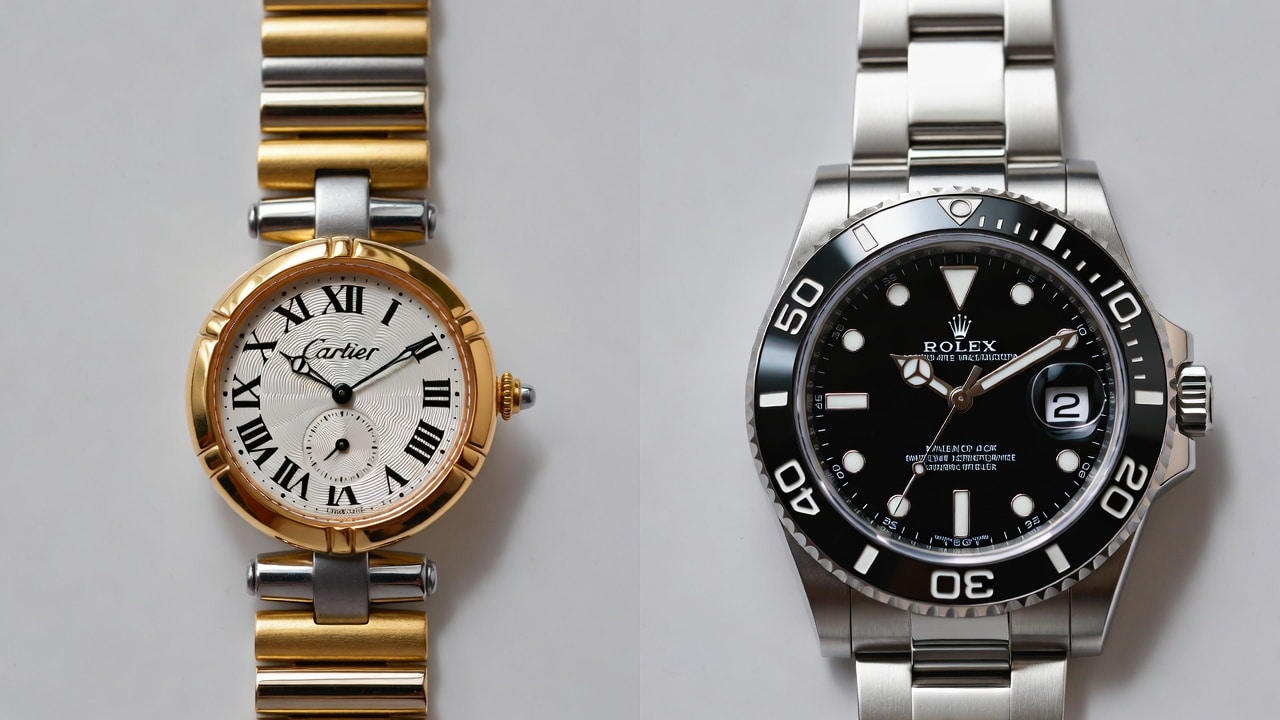
Rolex Replica Logic: The Appeal of Mass, Tool Watch Presence, and Familiarity
For many enthusiasts, the appeal of a Rolex replica quality lies in its tangible sense of solidity and its unmistakable Rolex super clone presence on the wrist. Rolex’s design language is characterized by robust cases, substantial bracelets, and a functional, tool watch aesthetic. These attributes are generally more straightforward for replica factories to achieve, contributing to a higher perceived “super cloneness” among buyers.
The Rolex “Feel”: Weight, Solidity, and Wrist Presence
An authentic Rolex, whether it’s a Submariner, a Daytona, or a GMT-Master II, conveys an immediate sense of quality through its weight and the way it sits on the wrist. This reassuring heft, combined with its strong visual identity, creates a distinct sporty presence replica Rolex that many buyers seek. The good news for replica enthusiasts is that capturing this “mass” and robust wrist feel is often well within the capabilities of top-tier replica manufacturers.
Bracelet Construction and End Link Integration
A critical component of the Rolex wearing experience is its bracelet. The replica bracelet solidity, particularly the integration of solid end links with the case robustness, is paramount. Factories that can precisely machine these components to minimize gaps and ensure a seamless flow from case to bracelet contribute significantly to the “super clone” feeling. A flimsy bracelet or ill-fitting end links can immediately betray a replica, regardless of how well the case is made.
Bezel Action and Insert Clarity: Functional Aesthetics
For models with rotating bezels, like the Submariner or GMT-Master II, the crispness of the bezel action and the clarity of the insert markings are vital. While not purely aesthetic, these functional elements contribute heavily to the overall impression of quality and authenticity. A precise click and a clear, well-aligned bezel insert enhance the tool watch appeal and satisfy the buyer’s expectation of a high-quality replica.
The Forgiving Nature of a Tool Watch Design
Rolex’s design philosophy, with its bolder lines and emphasis on durability, tends to be more forgiving of minor imperfections. A slightly thicker case on a replica Submariner, for instance, might still feel robust and authentic. The overall “mass” and functional aesthetic can often overshadow small visual discrepancies. While movement expectations are often high for Rolex replicas, minor visual flaws are frequently overlooked if the watch otherwise delivers on its promise of solidity and a strong wrist presence.
Cartier Replica Challenge: The Unforgiving Art of Proportion and Visual Refinement
This is where the rubber meets the road for Cartier replica flaws. Unlike Rolex’s robust designs, Cartier’s aesthetic is built upon an intricate web of delicate lines, precise proportions, and subtle visual cues. This reliance on visual refinement replica makes it incredibly difficult to replicate without glaring errors, explaining why Cartier super clone issues are often more pronounced than those of its Rolex counterparts.
The Delicate Dance of Cartier Proportions: Case Curves and Thickness
Cartier watches, from the iconic Tank to the flowing Ballon Bleu and the architectural Santos, are masterpieces of Cartier design proportions. The curvature of a Tank’s case, the gentle bulge of a Ballon Bleu, or the precise angles of a Santos are not arbitrary. Even a millimeter too thick in the case thickness, or a slightly off dial spacing, can completely destroy the intended visual harmony. Where a slightly thicker Submariner might still feel robust, a slightly thicker Tank feels clunky and fundamentally wrong, betraying its elegant origin.
Cabochon Placement and Sapphire Quality: The Devil in the Details
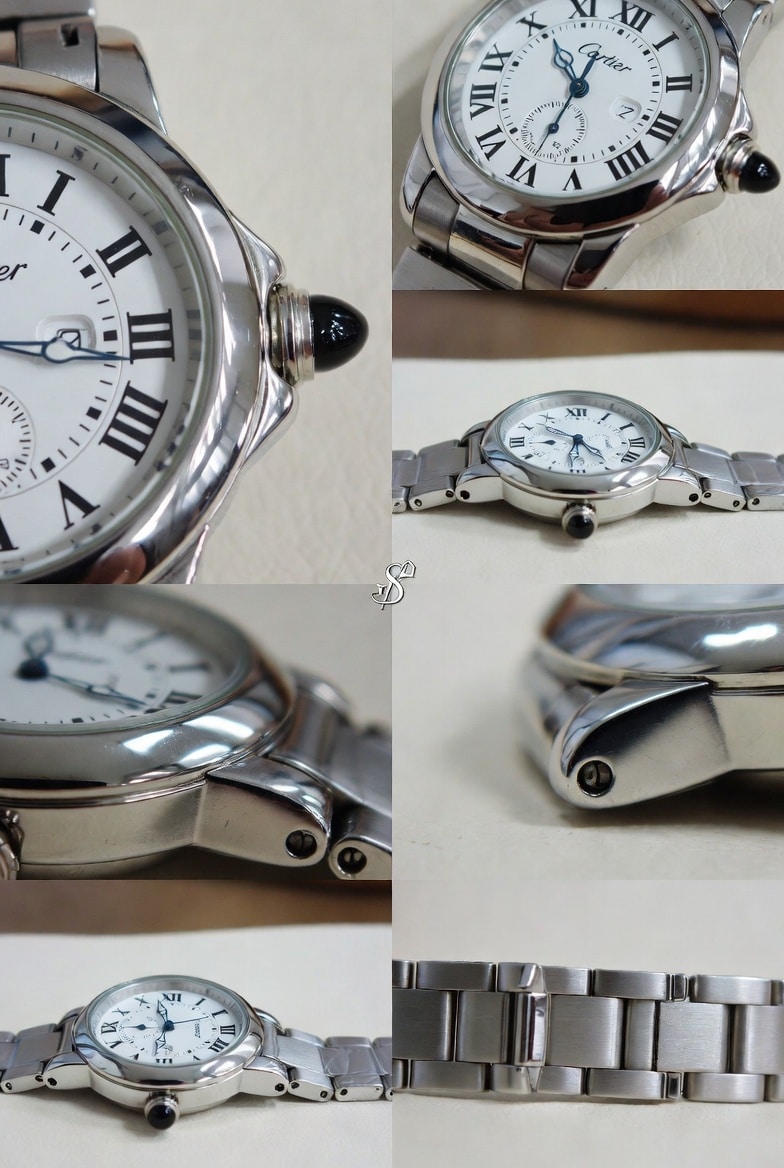
The iconic blue cabochon on a Cartier crown is a signature element. Its size, color, cut, and setting must be perfect. A cabochon flaws, such as one that is too large, too opaque, or poorly seated, immediately cheapens the entire watch. This underscores the need for a thorough Cartier factory version comparison when evaluating quality. The quality of the synthetic sapphire used, its clarity, and its precise hue are critical. This kind of aesthetic precision is non-negotiable for Cartier.
Dial Printing and Blued Hands: Precision Over Power
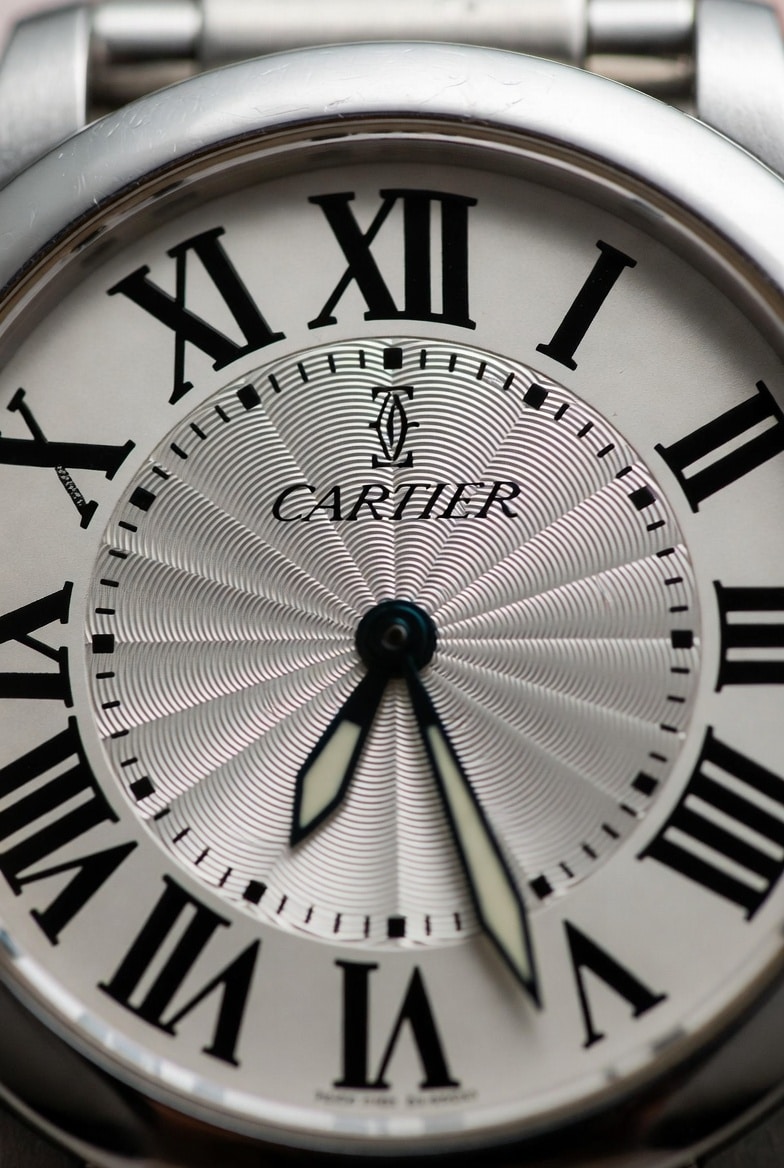
Cartier’s dials are another area where delicate lines and precision are paramount. The Roman numerals, often a signature of the brand, must be crisp, perfectly spaced, and free from smudges or inconsistencies. The blued hands, often heat-treated to achieve a specific, vibrant blue, need to have the correct hue and finish. Any deviation in replica dial printing or hand finishing is instantly noticeable and detracts from the watch’s elegance.
The “Visual Weight” of Cartier: Thinness and Elegance
Many Cartier designs, particularly dress watches like the Tank, are celebrated for their thinness and the way they disappear elegantly on the wrist. Replicating this “visual weight” is a monumental task. If a replica is even slightly thicker or has less refined finishing, it loses that crucial sense of lightness and elegance. This is why a millimeter matters so much; it’s not just a measurement, but a fundamental aspect of the watch’s identity and how it feels to wear.
Why a Millimeter Matters: The Unforgiving Nature of Classic Design
Cartier’s classic designs are so meticulously balanced that they leave virtually no room for error. Every curve, every line, every proportion is intentional. This makes them incredibly unforgiving replica targets. Unlike the more robust, utilitarian designs of Rolex that can absorb minor inconsistencies, even a slight misstep in a Cartier replica can fundamentally distort its identity and ruin its intended aesthetic. This isn’t just about minor imperfections; it’s about the fundamental integrity of the design.
Beyond the Movement: Why Visuals Trump Mechanics in Cartier Replica Decisions
For many replica buyers, the movement inside the watch is often a primary concern. This focus is particularly strong for Rolex replicas, where the robust and reliable movement aligns with the brand’s overall character. However, when it comes to Cartier, prioritizing the Cartier replica movement above all else can be a misplaced priority, often leading to buyer dissatisfaction. For Cartier, visual fidelity and aesthetic accuracy are far more critical to the “super clone” experience than the mechanical prowess under the hood.
The Movement Obsession: A Misplaced Priority for Cartier?
While a stable and accurate movement is always desirable, Cartier watches, especially the dressier models, are primarily about aesthetic pleasure and elegance. Their design is meant to be admired on the wrist, a statement of refined taste. If the visual cues are off, if the proportions are wrong, or if the finishing is subpar, the watch fails its primary purpose, regardless of how perfectly the seconds hand sweeps or how precise the timekeeping is. An obsession with a specific movement type (e.g., a “super clone” ETA) won’t salvage a visually flawed Cartier.
Visual Integrity: The True Heart of a Cartier Replica
The true heart of a Cartier replica lies in its replica visual quality. This encompasses everything from the crispness of the dial printing and the vibrant hue of the blued hands to the flawless case finishing and the precise setting of the cabochon. These elements combine to create the overall wearing experience. For Cartier, if it doesn’t look right, it doesn’t wear right, no matter the movement. A watch designed for elegance that looks clumsy is a fundamental failure.
When a “Good Enough” Movement is Actually Better
Consider this scenario: a replica Cartier with a visually perfect exterior, nailing every curve, proportion, and finishing detail, but housing a reliable Miyota or Seagull movement. Compare this to a visually flawed Cartier with a “super clone” ETA movement, where the case is too thick, the cabochon is cloudy, and the dial printing is sloppy. The former, despite its “lesser” movement, will provide a far more authentic Cartier super clone authenticity and a more satisfying wearing experience. The visual integrity for Cartier is paramount; a good movement cannot fix bad aesthetics.
The Silent Killer: Aesthetic Flaws That Movements Can’t Fix
Many buyers have experienced the frustration of receiving a Cartier replica with a supposedly high-quality movement, only to be disappointed because the watch “just doesn’t look right” on the wrist. The visual flaws, though sometimes subtle, constantly nag at the wearer, diminishing the perceived value and authenticity. This underscores that for Cartier, the “wrist behavior” and overall satisfaction are primarily driven by visual perception and design integrity, not by the mechanics ticking away out of sight.
Key Flaw Exposure: Where Cartier Replicas Often Fail Visibly on the Wrist
Understanding the specific vulnerabilities of Cartier’s design is crucial for anyone considering a replica. Unlike Rolex, where minor flaws might be absorbed by the overall robust aesthetic, Cartier’s elegance is easily shattered by imperfections. Here’s a concrete checklist of Cartier replica common flaws that buyers should scrutinize, as these are the points where Cartier super clone issues become glaringly visible on the wrist, impacting its wrist presence Cartier replica.
The Case: Proportions, Thickness, and Lug Integration
- Incorrect Case Curvature/Thickness: This is a primary betrayer. For models like the Tank or Ballon Bleu, the subtle curves and precise replica case curvature are vital. A replica that’s even slightly too thick (e.g., a Tank that’s 1mm thicker than gen) will feel clunky and lose the elegant profile.
- Lug Integration: The way the lugs flow from the case and integrate with the strap or bracelet is critical. Sloppy finishing or incorrect angles here disrupt the seamless design.
The Crown’s Jewel: Cabochon Shape, Color, and Setting
- Poorly Executed Cabochons: The iconic blue cabochon (often synthetic spinel) on the crown is a common failure point. Cabochon flaws include incorrect size, an opaque or dull color (should be a vibrant, translucent blue), or a loose/uneven setting. An opaque cabochon, for instance, immediately screams “replica.”
- Crown Guard Integration: For models like the Ballon Bleu, the crown guard’s smooth integration with the case is essential. Any rough edges or misalignments are highly visible.
Dial Details: Roman Numerals, Printing Sharpness, and Hand Finish
- Misaligned or Incorrect Roman Numerals: Cartier’s Roman numerals are distinct. Replicas often suffer from numerals that are too thick, too thin, poorly spaced, or not perfectly aligned. The “secret signature” at 7 o’clock (often “Cartier” or “Swiss”) is frequently incorrect or poorly printed.
- Sloppy Dial Printing: Beyond numerals, the overall replica dial printing (minute track, brand name) can be fuzzy, inconsistent, or have paint bleed.
- Incorrect Blued Hand Color or Finish: The blued steel hands should have a specific, often vibrant, heat-treated blue. Replicas often use painted hands that are too dark, too light, or lack the correct metallic sheen. The sword shape and length must also be precise.
Crystal Clarity and Distortion: The Unsung Hero of Curved Cases
- Inaccurate Crystal Distortion: For watches like the Ballon Bleu, the domed crystal creates a unique “fish-eye” distortion effect at the edges of the dial. Replicas often fail to capture this subtle, yet crucial, visual element, resulting in a flat or incorrect appearance.
- Clarity and Anti-Reflective Coating: A cloudy or overly reflective crystal diminishes the dial’s visibility and overall luxury feel.
Bracelet/Strap Integration: The Seamless Flow of Design
- Bracelet Gaps and Finish: Similar to Rolex, but with a different aesthetic goal, Cartier bracelets need to integrate seamlessly. Gaps between links or a mismatched finish can be very noticeable.
- Strap Quality and End Piece Fit: For leather strap models, the quality of the leather and how perfectly the strap fits into the lugs (with no gaps) is vital.
These visual flaws have a profound aesthetic impact. They immediately compromise the authenticity and perceived quality of the watch, making them highly noticeable even to a casual observer. When evaluating a Cartier replica, these specific details are far more revealing than general impressions.
The “Wrist Feel” Disparity: Why Cartier’s Delicacy is Hard to Clone (and Rolex’s Robustness is Easier)
The subjective Cartier replica wrist feel and Rolex replica wrist feel represent a fundamental wearing disparity. This difference stems from the inherent replica delicacy vs robustness challenge in aesthetic cloning. It’s easier for replica factories to achieve the reassuring solidity of a Rolex than the ethereal elegance of a Cartier.
The Authentic Cartier Experience: Lightness and Seamlessness
An authentic Cartier, particularly models like the Tank or Ballon Bleu, often feels light, elegant, and almost disappears on the wrist in a refined way. It’s designed to be an extension of the wearer, a piece of jewelry that tells time, characterized by seamless curves, delicate proportions, and a subtle presence. This authentic feel is about understated luxury and a graceful flow.
The Authentic Rolex Experience: Weight and Reassuring Presence
In stark contrast, an authentic Rolex conveys a sense of substantiality, solidity, and a reassuring presence. It’s a tool watch, designed to be robust and functional. The weight of the steel, the solidity of the bracelet, and the confident stance on the wrist contribute to a feeling of unyielding quality. This authentic feel is about strength and durability.
Why “Clunky” Kills Cartier, But “Solid” Saves Rolex
Replica manufacturers can often achieve the “substantial” feel of a Rolex relatively well. By using appropriate metals and general proportions, they can create a watch that feels weighty and robust. This means that even with minor imperfections, a Rolex replica can still deliver a satisfying luxury watch replica experience, where “solid” is a positive attribute. However, with Cartier, flaws in thickness, case curves, and finishing make a replica feel clunky or cheap. This “clunkiness” immediately destroys the intended delicacy and refinement, leading to a significant drop in quality perception and buyer disappointment. A comprehensive super clone Cartier guide emphasizes that Cartier’s design challenge is that “clunky” fundamentally kills its aesthetic.
The Unclonable Intangibles: Finish, Polish, and Visual Flow
Beyond measurable dimensions, Cartier’s true artistry lies in its intangibles: the way light plays across its polished and brushed surfaces, the subtle gradients of its curves, and the overall visual flow. These are incredibly difficult to replicate perfectly. While a replica Rolex can often achieve a convincing finish that contributes to its robust character, the minute imperfections in a Cartier replica’s finish, polish, or visual flow become glaring errors that undermine its entire aesthetic. Cartier’s designs leave no room for error, whereas Rolex’s, to a certain extent, can absorb minor imperfections without losing their core character.
A Divergent Path: Tailoring Your Buying Strategy for Cartier vs. Rolex Replicas
The insights into Cartier’s aesthetic vulnerability and Rolex’s robust design demand a completely different approach to buying their respective replicas. What works for one will almost certainly lead to disappointment with the other. This section provides actionable advice, outlining distinct strategies for approaching your next Cartier replica buying guide or Rolex replica buying decision.
Rolex Replica Buying: Prioritizing Mass, Bracelet, and Movement
For a super clone Rolex, your focus should be on attributes that contribute to its inherent solidity and tool-watch character. Prioritize:
- Factory Reputation: Look for factories known for excellent replica factory selection that consistently deliver robust cases, precise bezel action, and high-quality bracelets.
- Bracelet Quality: Solid end links, smooth articulation, and a reassuring weight are crucial.
- Case Finishing: While not as delicate as Cartier, crisp edges and consistent brushing/polishing are important.
- Movement Stability: For Rolex, a reliable and accurate movement (like a good Seagull 2824 or a Miyota 9015) is often a strong indicator of overall quality, aligning with the watch’s functional ethos.
Cartier Replica Buying: The Obsessive Search for Visual Perfection
For Cartier, the strategy must shift dramatically. Here, best Cartier factory means one that excels in aesthetic precision, even if it means compromising slightly on movement. Your strategy should involve an obsessive focus on visual details:
- High-Resolution QC Photos: Demand and scrutinize every angle. This is your primary tool for replica quality control.
- Case Profiles: Pay microscopic attention to curves, thickness, and how the lugs integrate. Even a fraction of a millimeter off can ruin the look.
- Dial Details: Examine Roman numerals for crispness, spacing, and alignment. Check the “secret signature” at 7 o’clock. Verify the color and finish of blued hands.
- Cabochon Scrutiny: Ensure the cabochon is the correct size, shape, color, and is perfectly set without opacity.
- Overall Thinness: For dressier models, confirm the watch’s slim profile is maintained.
QC Photo Scrutiny: What to Look For (and Where)
When reviewing QC photos, zoom in aggressively on:
- The crown and cabochon.
- The edges of the case and lugs from multiple angles (side profile is crucial for Cartier).
- The dial printing under magnification.
- The hands, especially their color and finish.
- The bracelet/strap integration points.
Factory Selection: Matching Strengths to Brand Needs
Understand that different factories have different strengths. A factory renowned for its Rolex Submariner might not be the best choice for a Cartier Tank. For Cartier, the “best” factory is the one that demonstrates an exceptional ability to capture the delicate visual inspection nuances and proportions, even if its movements are not always top-tier clones.
The “Acceptable Flaw” Threshold: Different for Each Brand
Your flaw tolerance must be adjusted. A slightly misaligned rehaut on a Rolex might be acceptable to some buyers, but a slightly thick case or a cloudy cabochon on a Cartier is a fundamental aesthetic failure. Be more patient and demanding when ordering a Cartier replica; a slightly lower-tier Rolex replica can still be satisfying, but a slightly lower-tier Cartier replica often is not.
The Price vs. Perception Gap: Why a “Super Clone” Cartier Might Feel Less “Super”
It’s a common and often frustrating experience: investing a significant amount in a “super clone” Cartier replica, only to find that the Cartier replica value doesn’t quite match the perceived quality on the wrist. Even at a high super clone price point (often around $800 USD for top-tier versions), the inherent difficulty in replicating Cartier’s subtle aesthetic means the replica might never achieve the same level of “super cloneness” perception as a Rolex of similar cost.
The Cost of Aesthetic Precision: Is It Achievable?
Achieving true replica aesthetic accuracy for Cartier is an exponentially harder task than for Rolex. Every curve, every line, every millimeter of thickness must be perfect. This level of precision demands more advanced manufacturing techniques, stricter quality control, and often, more expensive materials (like perfectly clear, faceted cabochons). While replica factories do* put immense effort into Cartier, the target is simply more elusive. This means that a high price for a Cartier replica reflects the difficulty of the endeavor, not necessarily a guarantee of perfection.
Buyer Disappointment: When Price Doesn’t Equal Perceived Quality
The disconnect often arises because buyers expect a direct correlation between price and flawlessness. For Rolex, a high-priced replica often delivers on its promise of robustness and general accuracy. For Cartier, however, even a high-end replica might exhibit subtle proportional flaws or minor finishing issues that, while perhaps not “bad” in absolute terms, are enough to disrupt the delicate aesthetic. This leads to buyer remorse, as the watch, despite its cost, “just doesn’t feel right.”
The Psychological Impact of a “Wrong” Proportionality
Cartier watches are designed to evoke a feeling of grace and elegance. When a replica’s proportions are even slightly off, or a detail like the cabochon is imperfect, it creates a constant, nagging sense of “wrongness” for the wearer. This psychological impact is significant. A watch meant to be a symbol of refined taste instead becomes a constant reminder of its imperfections, diminishing the overall luxury replica satisfaction.
Redefining “Value” in the Context of Cartier Replicas
To avoid disappointment, buyers need to set realistic expectations and redefine “value” for Cartier replicas. A “good” Cartier replica is often one that minimizes the most egregious aesthetic errors and achieves a high degree of design integrity in its most critical visual aspects, rather than achieving absolute perfection. The challenge is inherent to the original design’s delicate nature, not necessarily a failing of the replica industry. Understanding this gap is crucial for a more satisfying purchase.
Buying a “super clone” Cartier requires a fundamentally different mindset and evaluation criteria than purchasing a Rolex replica. For Rolex, the key is often to ask: does it feel solid and look generally correct? Does it convey the robust, tool-watch presence that defines the brand? For Cartier, the question must be far more granular and aesthetically driven: does it feel delicate, and does it look perfectly* proportional? Is every curve, every line, and every detail precisely rendered to maintain the watch’s inherent elegance?
The core takeaway is this: adjust your expectations and refine your eye. For Cartier, prioritize visual fidelity over mechanical prowess. Be obsessively critical of high-resolution images, scrutinizing the case profile, dial details, and the iconic cabochon. A high-quality Cartier replica is not merely a good copy; it is a testament to meticulous aesthetic judgment, minimizing flaws where they would most betray the watch’s delicate identity. Approach Cartier replicas with this heightened sense of critical aesthetic judgment, and you’ll be far more likely to find a truly satisfying piece.