
The Confusing World of Cartier Replicas: Why Labels Lie (and Sometimes Tell the Truth)
You’ve scrolled through countless listings, each promising the “best” or “most accurate” Cartier replica. Terms like “1:1,” “factory version,” and “super clone” are plastered everywhere, often accompanied by dazzling photos. You’re trying to make an informed decision, but instead, you’re left with more questions than answers. For a comprehensive super clone buying guide, does “1:1” truly mean identical? Is a “factory version” always superior? And what exactly elevates a replica to “super clone” status?
This confusion isn’t accidental; it’s a deliberate part of the replica market’s sales strategy. For a brand as iconic and detail-oriented as Cartier, these vague labels are particularly problematic. Cartier’s elegance lies in its subtle curves, precise dial printing, and signature cabochon crowns—details that are incredibly difficult to replicate perfectly. A generic claim of “1:1” for a Tank or a Ballon Bleu often crumbles under scrutiny, leaving buyers with misaligned expectations and buyer’s remorse.
This article isn’t here to simply define those terms. It’s here to equip you with a critical lens, helping you cut through the marketing noise. We’ll deconstruct each common label, exposing its true meaning (or lack thereof) in the context of Cartier replicas. By the end, you’ll understand what actually matters when evaluating a Cartier replica’s quality, allowing you to focus on tangible details and make decisions based on insight, not empty promises.

Deconstructing “1:1”: The Most Misused Term in Cartier Replica Sales
The term “1:1 replica Cartier” is arguably the most seductive and misleading phrase in the entire replica watch market. In theory, “1:1” implies a perfect, indistinguishable copy—a replica that is dimensionally, aesthetically, and functionally identical to the genuine article. For many buyers, it conjures an image of a watch that even an expert couldn’t tell apart from the original. The reality, especially for Cartier, is far more nuanced and often disappointing.
The Myth of Perfect Replication for Cartier
True 1:1 replication is a myth, particularly when it comes to mass-produced Cartier replicas. While some high-end replicas can achieve impressive levels of accuracy, claiming absolute identity is a sales tactic, not a technical standard. Cartier’s designs, with their delicate Roman numerals, distinct case curvatures (like the “flying saucer” profile of the Ballon Bleu or the integrated lugs of the Tank Française), and signature blue cabochons, present unique manufacturing challenges. Achieving absolute perfection requires original tooling, proprietary materials, and a level of craftsmanship that simply doesn’t exist at replica price points.
Dimensional Accuracy vs. Perceptual Similarity
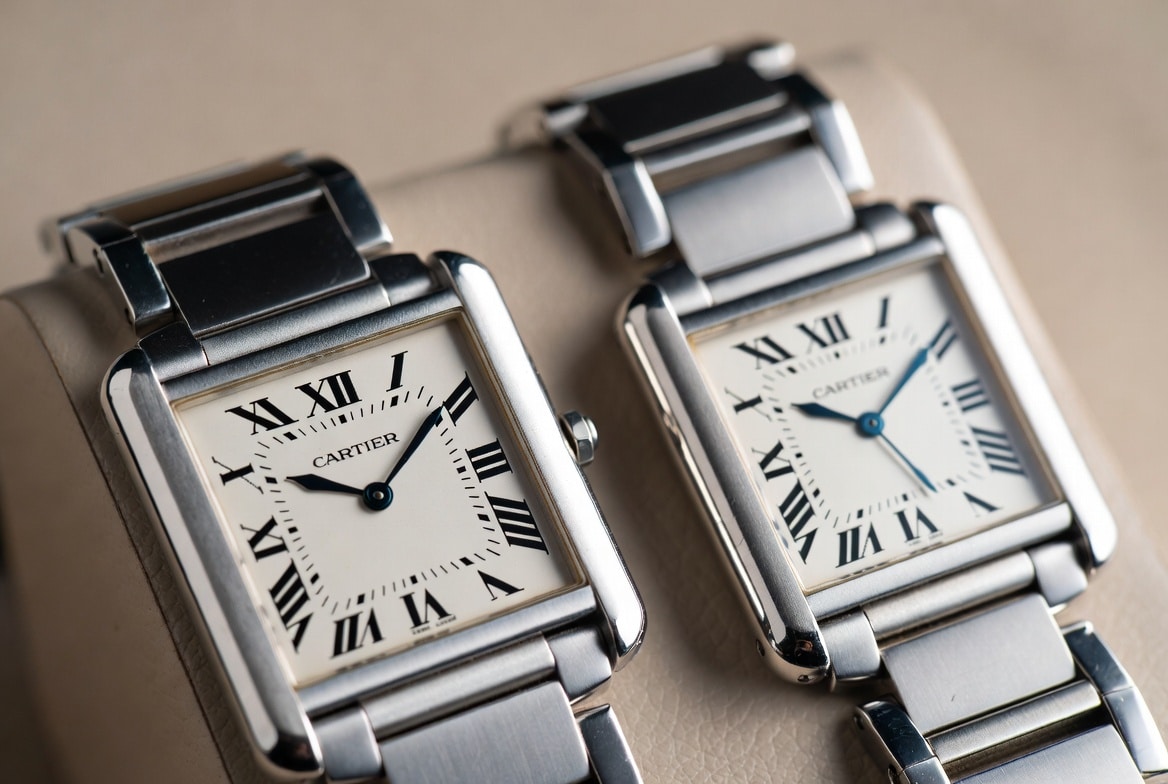
What sellers often mean by “1:1” is “perceptually similar at a glance.” A well-made Cartier replica might look very close to the genuine article from a foot away, but under magnification or direct comparison, the differences become apparent. For instance, the exact curve of a Cartier Tank case, the precise depth and crispness of the Roman numeral printing, or the specific shade and translucency of the blue spinel in the crown are details that are incredibly difficult to match exactly. Even a fraction of a millimeter difference in case thickness or lug-to-lug distance can alter the watch’s presence on the wrist, making it feel “off” compared to the genuine.
Why “1:1” Fails on Cartier’s Finer Details
Consider specific Cartier examples where “1:1” claims frequently fall short. On a Cartier Santos, the alignment and finishing of the bezel screws are often a dead giveaway; genuine screws are flush and perfectly uniform, while replicas might show slight inconsistencies or imperfect finishing. For the Ballon Bleu, the unique distortion created by its domed crystal, known as the “fish-eye” effect, is rarely perfectly replicated, or the crown guard’s integration with the case might lack the seamless flow of the original. Even the subtle “Cartier” hidden signature at the 7 o’clock mark on many dials, while often present on good replicas, might lack the precise engraving or perfect alignment of the authentic piece. These seemingly minor details accumulate, revealing that “1:1” is almost always an exaggeration designed to close a sale, not a guarantee of identical quality or execution.
“Factory Version” Explained: What It Means for Cartier’s Consistency and Build
When you see “factory version Cartier” in a listing, it generally signifies a product from a larger, more established replica manufacturer rather than a small, independent workshop or a cobbled-together piece. In the complex replica ecosystem, these “factories” (like AF, GF, V6, BV, and others known within the community) operate at a scale that allows for more consistent production, better quality control, and access to more sophisticated manufacturing processes and materials. This is a significant step up from the “garage builds” or low-tier replicas that flood the market.
The Hierarchy of Replica Manufacturers for Cartier
The term “factory version” implies that the watch originates from a recognized source within the replica world. These are not official Cartier factories, of course, but rather dedicated replica producers who invest in tooling and attempt to mass-produce models with a degree of consistency. For Cartier, specific factories have gained reputations for excelling in certain models. For example, AF Factory and V6 Factory are often cited for their Ballon Bleu models, while GF Factory is highly regarded for its Santos de Cartier replicas. This specialization means that a “factory version” from the right* factory for a *specific* Cartier model often represents a higher baseline quality.
Consistency and Quality Control: What a “Factory” Delivers
The primary advantage of a “factory version” is consistency. These larger operations typically have more standardized production lines, allowing them to maintain a more uniform level of quality across batches. This translates to more reliable case finishing, more accurate dial printing, and better-regulated movements compared to generic replicas. For Cartier, this means a higher likelihood of finding a replica with a well-polished case, correctly applied Roman numerals, and a functional, if not genuine, movement. While not perfect, a good “factory version” often minimizes glaring flaws that would be immediately obvious on lower-tier replicas. They also tend to offer better post-sale support, which is rare in this market.
Identifying Reputable Cartier Replica Factories (and Their Specialties)
Navigating the “factory version” landscape requires some research. Reputable factories often specialize. For instance, AF Factory is known for its Ballon Bleu and Tank models, with particular attention to dial details and case finishing. GF Factory has made a name for its Santos replicas, often praised for its QuickSwitch strap system and overall build quality. K3 Factory has even invested in specific clone movements for its 33mm Ballon Bleu models to achieve more accurate date-setting functionality. However, it’s crucial to be wary of generic “factory direct” claims that don’t name a specific, recognized factory. Without a known factory name, “factory version” can simply be a marketing ploy. Always cross-reference seller claims with community knowledge to identify which factories genuinely deliver on their promise for your desired Cartier model.
“Super Clone” Cartier: The Pinnacle or Just Premium Marketing?
The term “super clone Cartier” often conjures images of perfection, a replica so flawless it defies detection. In the ideal scenario, a “super clone” aims for near-perfect external and internal accuracy, including a movement that closely mimics the genuine article. This implies not just a passing resemblance, but an obsessive attention to detail that extends to every curve, finish, and functional aspect. For a brand like Cartier, with its distinct design language and intricate aesthetics, this ideal is particularly ambitious.
Defining “Super Clone” for Cartier: Beyond External Aesthetics
A true “super clone” Cartier would need to excel in areas that often trip up lesser replicas. This includes the intricate case finishing, where Cartier’s signature polished and brushed surfaces meet with exacting precision. Dial textures, such as the subtle guilloche patterns on a Ballon Bleu or the crisp Roman numerals of a Tank, must be reproduced with absolute fidelity, free from blurring or inconsistencies. The precise shape and finish of the hands, especially Cartier’s iconic blued steel sword hands, are critical. Even the blue sapphire cabochon on the crown, a Cartier hallmark, must possess the correct color, clarity, and luminosity, often appearing dark brown or black in indirect light and vibrant blue when illuminated. These are the details that elevate a “super clone” beyond a mere copy. The price point for such a replica typically ranges from $400 to $800 USD, reflecting the advanced manufacturing and material costs.
The Movement as the Heart of a Cartier Super Clone
While external perfection is paramount, the “super clone” designation also implies internal realism. For Cartier, this means a convincing movement. For those navigating the complexities of choosing a high-quality replica, a comprehensive super clone Cartier decision map can be invaluable. If the genuine model features an exhibition caseback, a “super clone” must house a movement that not only functions reliably but also visually replicates Cartier’s in-house calibers like the 1847 MC or 1904-PS MC. This usually involves a highly decorated clone movement, featuring correct bridges, rotors, and engravings to match the genuine’s appearance. For models with solid casebacks, like many Ballon Bleu or Santos references, the visual accuracy of the movement becomes less critical, but its functional fidelity – smooth sweep, correct date change, and reliable power reserve – remains a hallmark of “super clone” quality.
Common Flaws Even in “Super Clone” Cartier Watches
Despite the “super clone” label, buyers should maintain realistic expectations. Even the highest-tier Cartier replicas often have subtle tells. For example, perfectly replicating the subtle curve and proportions of a Cartier Tank or the complex interplay of polished and brushed surfaces on a Santos can be incredibly challenging. The blue sapphire cabochon, while often very good, might still lack the exact depth and play of light found in a genuine stone. Movement-wise, while a clone might look similar under a solid caseback, it will rarely match the precision engineering, long-term reliability, or serviceability of a genuine Cartier manufacture caliber. Minor discrepancies in dial printing, such as the exact font of the “Swiss Made” text or the hidden “Cartier” signature at 7 o’clock, can also be present upon microscopic inspection. These compromises are inherent to the replication process, and understanding them is key to evaluating whether a “super clone” justifies its premium price over a “factory version.”
Beyond the Labels: What Actually* Determines Cartier Replica Quality
In the confusing landscape of Cartier replicas, where terms like “1:1” and “super clone” are thrown around with abandon, the discerning buyer must learn to look past the marketing jargon. Labels are secondary to direct, observable quality indicators. Understanding what constitutes a well-made replica, component by component, is the only reliable way to assess its true value and authenticity. This section provides a practical framework for evaluating a Cartier replica based on concrete features, empowering you to become your own expert.
Case Finishing: Polishing, Brushing, and Cartier’s Unique Curves
The case is often the first impression of a Cartier watch, and its finishing is a critical differentiator. Cartier is renowned for its impeccable blend of polished and brushed surfaces, often with intricate curves and transitions. A high-quality replica will feature a case crafted from 316L stainless steel (matching genuine Cartier models), with sharply defined edges between polished and brushed areas, and a mirror-like polish on curved surfaces. Look for:
- Smooth Transitions: On models like the Ballon Bleu, the “pebble” shape demands seamless, flowing curves without any flat spots or unevenness.
- Crisp Edges: For the Santos, the bezel’s sharp, defined edges and perfectly aligned screws are crucial. Poor replicas will show soft edges or misaligned screws.
- Absence of Tool Marks: Even under magnification, there should be no visible machining marks or scratches on polished surfaces, especially in recessed areas like the crown guard.
Dial Execution: Roman Numerals, Text, and Sunburst Precision
Cartier dials are a masterclass in elegance and precision, making them particularly challenging to replicate.
- Roman Numerals: Examine the Roman numerals closely. They should be crisp, evenly applied, and have precise edges. On genuine Cartier dials, the 11 and 19-minute markers (the lines that interrupt the Roman numerals) are subtly shorter than the others; many replicas fail to capture this detail, making them uniform in length.
- “Cartier” Signature: The “Cartier” text on the dial should be sharp and correctly spaced. On many models, a hidden “Cartier” signature is subtly integrated into the 7 o’clock Roman numeral (VII); its execution is a strong indicator of replica quality.
- Guilloche/Sunburst: If present, the guilloche pattern or sunburst finish should be subtle, uniform, and catch the light beautifully, not appear flat or poorly stamped.
Crystal Clarity and Anti-Reflective Coating (AR)
All modern Cartier watches use sapphire crystal, known for its scratch resistance. A good replica will also use sapphire. Crucially, pay attention to:
- Clarity: The crystal should be perfectly clear and free from distortions, especially on models like the Ballon Bleu with its domed “bubble” crystal, which should create a pleasing “fish-eye” effect when viewed from an angle without distorting the dial too much.
- Anti-Reflective Coating: While not always present on genuine Cartier crystals, if a replica claims AR coating, it should minimize glare effectively, making the dial highly legible. Poor AR coating can appear purplish or have a blue hue, which is incorrect.
Hands and Crown: Shape, Finish, and Cabochon Authenticity
These small details often betray a replica’s true quality.
- Hands: Cartier’s blued steel sword-shaped hands are iconic. They should be perfectly formed, with sharp tips and a vibrant, consistent blue color that changes with the light. The central pinion (the small cap in the center of the hands) should be flat, silver-white, and have a clean chamfered edge; many replicas have a blue or black pinion or one that is not perfectly round.
- Crown Cabochon: The blue sapphire cabochon on the crown is a signature Cartier element. It should be clear, well-faceted, and have a deep, consistent blue color. As noted before, it should appear dark in indirect light and bright blue when light hits it directly. A cloudy, dull, or incorrectly colored cabochon is a common flaw in lower-tier replicas.
Bracelet/Strap Quality and Clasp Fidelity
The quality of the bracelet or strap significantly impacts the overall feel and wearing experience.
- Bracelet Construction: For metal bracelets, examine the fit and finish of the links. They should move smoothly without excessive play or sharp edges. The screws (on models like the Santos) should be perfectly flush and evenly spaced.
- Strap Material: If it’s a leather strap, assess the quality of the leather, stitching, and lining. A good replica will use decent quality leather with clean, even stitching.
- Clasp: The folding clasp should operate smoothly, close securely, and have correct, crisp engravings. Many Cartier models feature quick-release systems for straps; a high-quality replica will often mimic this functionality accurately.
Cartier’s Unique Replication Challenges: Why Elegance is Hard to Copy
While all luxury watches present replication challenges, Cartier’s distinctive design philosophy and commitment to intricate details create a particularly high hurdle for replica manufacturers. It’s not merely about copying a shape; it’s about capturing a certain elegance and precision that permeates every aspect of the watch. Understanding why* Cartier is so difficult to replicate perfectly provides crucial context for evaluating “1:1” and “super clone” claims.
The Challenge of Cartier Case Shapes and Proportions
Cartier’s cases are anything but generic. From the “pebble” roundness of the Ballon Bleu to the architectural lines of the Tank and the integrated design of the Santos, each case is a sculptural work.
- Ballon Bleu: The subtle convex and concave curves, the way the crystal distorts the dial at certain angles, and the unique crown guard integration are incredibly difficult to machine and polish consistently. Even slight deviations in curvature can make the watch look “off.”
- Tank: The iconic rectangular shape requires extremely precise angles, flat surfaces, and perfectly executed caseband transitions. The Tank Française, with its integrated bracelet, demands seamless flow between case and links.
- Santos: The square bezel with its eight perfectly aligned screws, the precise chamfers, and the integrated bracelet system (especially the QuickSwitch mechanism) require specialized tooling and meticulous finishing that few replica factories can truly master.
Dial Artistry: Roman Numerals, Track, and Signature Text
Cartier’s dials are instantly recognizable, but their apparent simplicity belies extreme complexity in execution.
- Roman Numerals: The unique elongated and stylized Roman numerals, often in a railway track minute scale, demand extremely fine printing. Achieving the correct thickness, crispness, and slight three-dimensionality is a significant challenge. The subtle distinction of the 11 and 19-minute markers, shorter than the others, is a detail often missed by even advanced replicas.
- Guilloche Patterns: Many Cartier dials feature delicate guilloche patterns (like the sunburst on the Ballon Bleu). Replicating these with the correct depth, uniformity, and light-catching effect requires high-precision stamping or machining that is often absent in replicas, leading to flat or coarse patterns.
- Blued Steel Hands: The signature blued steel hands are not simply painted. They are thermally blued, a process that creates a specific, iridescent blue hue that changes with the light. Replicas often use painted hands, which can look flat or unnaturally bright.
The Elusive Blue Cabochon and Crown Design
The blue sapphire cabochon on the crown is perhaps the most iconic Cartier design element, and also one of the hardest to replicate convincingly.
- Gemstone Quality: Genuine Cartier cabochons are high-quality synthetic sapphires, cut and polished to perfection. Replicas often use inferior synthetic spinels or even tinted glass, which lack the correct clarity, color depth, and light refraction. A truly good replica cabochon will appear almost black in indirect light and a vibrant, deep blue when light hits it directly.
- Crown Integration: The way the cabochon is set into the crown, and how the crown integrates with the case (especially the unique crown guard of the Ballon Bleu), requires precise machining and assembly. Small misalignments or poor finishing here are easily noticeable.
Bracelet Integration and Clasp Engineering for Cartier
Cartier places a strong emphasis on the ergonomics and aesthetic integration of its bracelets and straps.
- Seamless Flow: Bracelets, particularly on models like the Tank Française and Santos, are designed to flow seamlessly from the case. Replicating this integrated design requires extremely tight tolerances and consistent finishing across all components.
- QuickSwitch System: The modern Santos features the “QuickSwitch” system, allowing for easy interchangeability of straps and bracelets. Replicating this ingenious mechanism with the same precision and secure feel as the genuine article is a complex engineering feat for replica factories.
- Clasp Quality: Cartier clasps are often elegantly designed and operate with a satisfying click. Replicas frequently fall short here, with clasps that feel flimsy, don’t close securely, or have rough finishing and incorrect engravings.
The Movement Question: Miyota, ETA Clone, or True Super Clone for Cartier?
Beneath the beautifully finished case and dial, the movement is the beating heart of any watch. For Cartier replicas, understanding the type of movement inside is crucial, not just for functionality but also for evaluating the authenticity claims, a key aspect detailed in any comprehensive super clone Cartier guide, especially when sellers tout “super clone” status. While many buyers focus on external aesthetics, the movement impacts reliability, accuracy, and, in some cases, visual realism through an exhibition caseback.
Entry-Level: Miyota and Generic Asian Movements in Cartier Replicas
At the more accessible end of the Cartier replica spectrum, you’ll frequently encounter movements from Japanese manufacturers like Miyota (Citizen’s movement division) and Seiko, or other generic Asian mechanical movements. These are often chosen for their affordability and respectable reliability for the price point. For example, the Miyota 9015 is a common choice, known for its slim profile, or the Seiko NH05A in smaller women’s models. While generally robust, these movements typically operate at a lower beat rate (e.g., 21,600 vibrations per hour or vph), which translates to a slightly less smooth sweep of the second hand compared to genuine Cartier calibers. Crucially, they are not visually accurate to Cartier’s in-house movements, making them unsuitable for models with transparent casebacks. You might also encounter an issue where a no-date replica watch using a movement designed for a date complication will have a “ghost date position” when pulling out the crown, which is an immediate tell.
Mid-Tier: ETA Clones and Their Role in Cartier
Stepping up, the market for Cartier replicas heavily relies on “ETA clones.” These are movements manufactured in Asia, primarily China (like the Seagull ST2130, which is a clone of the ETA 2824), designed to mimic the dimensions, functionality, and often the 28,800 vph beat rate of popular Swiss ETA movements (such as the 2824, 2836, or 2892). For many Cartier models, particularly the 42mm Ballon Bleu or Santos, which feature solid casebacks, these movements are a pragmatic and effective choice. They offer a smoother second hand sweep and generally good accuracy and power reserve, making them reliable workhorses for daily wear. However, it’s vital to differentiate between these clones and genuine Swiss ETA movements. Due to Swatch Group’s restrictions, new, genuine Swiss ETA movements are virtually unavailable for replica manufacturers. Any claim of a “Swiss ETA” in a replica is almost certainly false, or refers to a refurbished, potentially unreliable used movement. The quality of these clones can also vary, with some being excellent and others prone to issues like rotor noise or premature wear.
The “Super Clone” Movement: Mimicking Cartier’s In-House Calibers
The term “super clone” when applied to movements for Cartier implies an ambitious attempt to replicate the specific aesthetics and, sometimes, the unique functionality of Cartier’s proprietary in-house calibers, such as the 1847 MC or 1904-PS MC. This is particularly relevant for Cartier models that feature an exhibition caseback, where the movement’s visual appearance is critical to authenticity. A true “super clone” movement would aim to match the genuine caliber’s bridge layout, rotor design, engraving, and even jewel placement. While some factories make impressive strides in decorating generic movements to look* like Cartier calibers, achieving a truly identical replica in terms of both aesthetics and mechanical precision is exceedingly difficult. For Cartier, where many popular models like the Ballon Bleu 42mm and Santos have solid casebacks, the visual aspect of the movement is less critical. Here, a “super clone” movement might focus more on matching the crown’s winding action or providing specific functional accuracy, such as the K3 factory’s Cal.076 clone for the 33mm Ballon Bleu, which offers the correct single-position crown adjustment for time setting, unlike modified Miyota movements that often retain a “ghost date” position.
Reliability vs. Authenticity: Choosing Your Cartier Replica Movement
When selecting a Cartier replica, the choice of movement often comes down to a trade-off between absolute visual authenticity and practical reliability. For the vast majority of Cartier replicas with solid casebacks, the movement’s visual accuracy is irrelevant. In these cases, prioritizing a stable, well-regulated ETA clone (like a good Seagull ST2130) or a proven Miyota 9015 makes more sense. These movements offer a good balance of performance and durability for the price. If you are specifically looking at a Cartier model with an exhibition caseback, then a “super clone” movement that attempts to replicate the visual details of the genuine caliber becomes a higher priority. However, even then, be realistic: these movements are still replicas, and their long-term reliability may not match that of a robust, mass-produced workhorse movement. Always inquire about the specific movement, its beat rate, and any known issues. Don’t be swayed by vague “Swiss movement” claims; instead, focus on the verifiable track record of the specific movement type and the factory that builds the watch around it.
Making Your Decision: A Framework for Discerning Cartier Replica Buyers
Navigating the Cartier replica market can feel like deciphering a cryptic language. Terms like “1:1,” “factory version,” and “super clone” are thrown around with abandon, often obscuring rather than clarifying. To make an informed purchase, you must move beyond these labels and adopt a critical framework that prioritizes tangible quality indicators. This guide empowers you to be your own expert, focusing on what truly matters in a Cartier replica.
Start with the Model: Not All Cartier Replicas Are Equal
Your journey should begin with a clear understanding of the specific Cartier model you desire. Not all Cartier watches are replicated with the same level of success. Some models, due to their design complexity or market demand, receive more attention and investment from replica factories, resulting in significantly higher quality versions. For instance, the Cartier Ballon Bleu 42mm (steel, closed caseback) and the Santos de Cartier (large, steel, closed caseback) are widely considered to have the most accurate and well-produced replicas. Conversely, models with intricate complications, elaborate gem settings, or transparent casebacks revealing complex movements are inherently more challenging to replicate perfectly. Research which factories specialize in your chosen model and what the community consensus is on its replication quality.
Researching Factories and Their Cartier Specialties
The term “factory version” holds weight only when it refers to a product from a known* and reputable replica factory. For Cartier, names like AF (Cartier Ballon Bleu, Tank Française), GF (Santos), V6 (Ballon Bleu, Santos), and K3 (Ballon Bleu 33mm with specific movement) are often cited for their superior craftsmanship in specific lines. These factories invest in better tooling, materials, and quality control, leading to more consistent and accurate replicas. Each factory often develops a reputation for excelling in particular models or design elements. For example, AF is lauded for its Ballon Bleu dials and case finishing, while GF is recognized for its Santos models, particularly the QuickSwitch bracelet system. Don’t just accept a generic “factory direct” claim; ask for the specific factory name and cross-reference it with community discussions and reviews to ensure its reputation for your desired model.
Your Personal Priorities: What’s Most Important for Your Replica?
Before diving into listings, define what constitutes “quality” for you*. Are you seeking near-perfect visual accuracy, even under magnification? Or is robust daily wear reliability your primary concern? Perhaps a specific feature, like the blue cabochon on the crown or the precise curve of a Tank case, is paramount.
- Visual Accuracy: If you prioritize how close it looks to the genuine article, focus on dial printing crispness, hand alignment, case finishing, and the color/transparency of the cabochon.
- Movement Realism: For solid caseback models, reliability and proper function (e.g., date change, power reserve) are more important than visual authenticity. For exhibition casebacks, the movement’s decoration becomes critical.
- Reliability & Durability: If the watch is for daily wear, a proven workhorse movement and solid construction are key.
- Price: Establish a realistic budget. Top-tier Cartier replicas typically range from $400 to $800, with some exceptional models or those with unique movements pushing higher.
Understanding your priorities will help you filter out irrelevant claims and focus on the details that truly matter to your ownership experience.
The Power of QC Photos: What to Scrutinize
This is arguably the most critical step in buying a Cartier replica: demanding and meticulously scrutinizing detailed Quality Control (QC) photos and, ideally, videos before* the watch is shipped. Do not rely solely on stock photos. High-resolution, well-lit images from various angles will reveal the true quality.
- Dial: Check for crispness of Roman numerals and text, correct “Cartier” hidden signature at 7 o’clock, evenness of sunburst or guilloche patterns, and proper alignment of hands.
- Case & Bezel: Examine the polishing and brushing transitions, sharp edges, and the precise alignment of screws (e.g., on a Santos bezel). Look for any imperfections or inconsistencies.
- Crystal: Assess clarity, any anti-reflective (AR) coating, and the specific “fish-eye” or doming effect characteristic of certain Ballon Bleu models.
- Crown: Verify the shape and finish of the crown, and the color and clarity of the blue cabochon.
- Bracelet/Strap: Inspect the quality of the steel links or leather, the finishing of the clasp, and the functionality of quick-release systems like Cartier’s QuickSwitch.
Compare these QC photos directly against high-resolution images of the genuine Cartier model. This side-by-side analysis is your best defense against exaggerated claims and allows you to identify any “tells” before committing to the purchase.
The Price vs. Quality Equation in Cartier Replicas
While the replica market offers significant savings over genuine Cartier watches, it’s essential to understand the pricing tiers. A “super clone” or “factory version” Cartier replica that genuinely meets high standards will not be cheap. Expect to pay between $400 and $800 for a top-tier steel model, with prices potentially higher for more complex designs or specialized movements. Be highly skeptical of listings claiming “super clone” quality for prices under $300-$400 USD; these are almost certainly mislabeled, lower-tier replicas. The price difference reflects the investment in superior materials (e.g., 316L stainless steel, sapphire crystal), better movements, more precise manufacturing processes (like CNC machining), and stricter quality control. The goal is to find the best value for your money, which means balancing the replica’s quality with its cost, rather than simply chasing the lowest price or the most impressive-sounding label.
In the complex landscape of Cartier replicas, “super clone” and “1:1” are not guarantees, but rather aspirational terms that demand critical evaluation. The truly discerning buyer knows that market labels are secondary to tangible quality indicators. By focusing on the specific Cartier model, researching reputable factories, prioritizing your personal criteria, meticulously scrutinizing QC photos, and understanding the price-quality relationship, you empower yourself to cut through the marketing noise. The best Cartier replica is not the one with the most impressive label, but the one that, upon close inspection, aligns most closely with your expectations for finish, movement, and overall fidelity to the genuine article, within the realistic bounds of a replica. Approach every claim with skepticism, every photo with scrutiny, and every purchase with an informed perspective, and you will navigate the Cartier replica market with confidence.