
The Santos Daily-Wear Reality Check: Why Coherence Matters More Than Specs
The dream of a Cartier Santos replica is often one of silent, effortless luxury—a perfect, sliver of steel that disappears into your daily life as a polished extension of your wrist. The reality, for most buyers who actually wear the thing, is something else entirely. It’s a watch that gets knocked against a laptop, spun idly during a meeting, and expected to keep ticking through a forgotten weekend on the dresser. The mismatch isn’t about failing to look like a Santos; the best replicas from factories like GF and BVF have that covered, though navigating the claims of super clone sellers requires careful scrutiny. The mismatch is between the fantasy of a flawless object and the needs of a daily companion. This is where spec-sheet perfection fails and functional coherence begins. And at the heart of that coherence for the modern Santos replica isn’t a fancy clone or a decorated showpiece, but a pragmatic, unglamorous workhorse: the Miyota 9015.
The Santos as a Daily Companion, Not a Safe Queen
Think about how a Santos is worn. Its flat, broad case and integrated bracelet are design icons, but they create a specific mechanical reality. The movement sits in a wide, relatively shallow cavity. Every impact from “desk diving” transmits directly through the case. The integrated bracelet, with its minimal end-link articulation, means the watch head doesn’t pivot freely, placing more stress on the movement’s mounting and rotor bearings during arm movement. This isn’t an environment for a delicate, untested “super clone” movement assembled in a hurry. It’s an environment that demands a proven, robust engine that can handle the vibrations and minor shocks of real life. A replica destined for the safe is a failed purchase; a replica built for the wrist needs a movement built for the long haul.
The Coherence Equation: Function, Form, and Reliability
In the context of a high-end replica, “coherence” is the seamless, sustainable interaction between three things: the movement’s performance, the case’s intended dimensions, and the user’s actual wearing habits. It’s the opposite of buying a watch based on a list of disconnected, impressive-sounding features. A movement with beautiful Geneva stripes that’s too thick ruins the case profile. A movement that’s perfectly thin but fails after six months destroys the ownership experience. The Miyota 9015 achieves coherence not by being the best at any one theoretical metric, but by being good enough at all the metrics that matter for daily wear. It hits the critical thresholds for thickness, reliability, and serviceability that allow the rest of the replica—the case, dial, and bracelet you actually see and feel—to shine without compromise.
Expert Authentication Insight
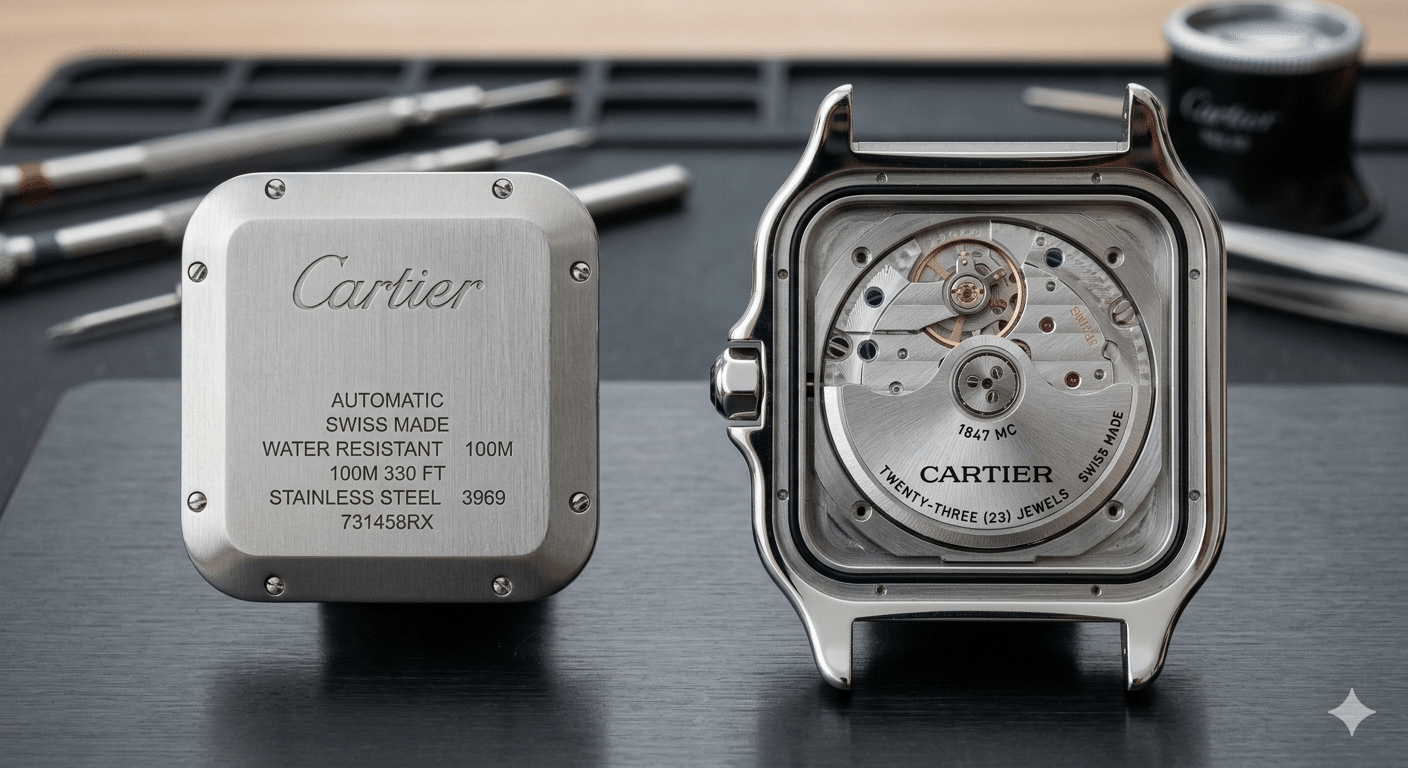
Physical diagnostic: Listen for the rotor sound. A genuine Santos automatic (Calibre 1847 MC) has a very low, almost silent rotor whirl. In a well-made replica with a properly installed Miyota 9015, you will hear a distinct, moderately audible rotor—a specific, slightly metallic whirring sound as it spins. This is normal. Crucially, the absence of this sound in an automatic Santos replica is often a bad sign. It can indicate a non-functional decorative plate glued over a cheaper, noisier movement (like a DG2813) to mute it, or a poorly lubricated rotor that may seize. The 9015’s honest, recognizable whirl is a sign of mechanical integrity, not a flaw.
The Thickness Imperative: How the 9015 Fits the Santos Profile
You can forgive a minor flaw in dial printing if you have to look for it. You cannot forgive a watch that feels like a hockey puck on your wrist. The Santos’s identity is tied to its sleek, integrated profile. The Miyota 9015 is the key that unlocks this, and its primary superpower is a single number: 3.9mm.
Caseback-to-Crystal: The Non-Negotiable Dimension
Take the Santos de Cartier Large, reference WSSA0030. Its genuine thickness is approximately 8.83mm. To achieve this, the total height of the movement, plus the caseback and crystal, must fit within a brutally tight envelope. The movement itself, once nestled into its plastic movement ring and fitted under the caseback, cannot be taller than roughly 4.0mm without forcing a redesign. The 9015, at 3.9mm, slips in with essential breathing room. This allows the replica factory to construct a case that mirrors the genuine article’s slenderness, preserving the all-important on-wrist feel. Any movement taller than this threshold forces a compromise: either a bulging, protruding caseback that ruins the silhouette, or a thicker mid-case that makes the entire watch look and feel clunky.
The Failure of Thicker Alternatives (A2824, A2892)
This is why other common workhorse movements fail for the Santos. The popular Seiko NH35 is a non-starter at 5.32mm tall. Even the decorated Swiss ETA 2824-2 or its clone, the Seagull ST2130, comes in around 4.6mm. To fit one of these into a Santos case, a factory would have to make the caseback noticeably convex or increase the overall case thickness by over half a millimeter—a visually and tactilely obvious deviation. Factories like GF and BVF didn’t choose the 9015 because it was the cheapest option (it often isn’t). They chose it because it was the only viable option that allowed them to correctly replicate the Santos’s most critical physical attribute. Choosing a replica with a thicker movement is choosing a fundamentally misshapen watch.
Expert Authentication Insight
Physical diagnostic: Use a set of digital calipers. Measure the total case thickness from the crystal top to the caseback. For a Santos Large replica claiming to be a top-tier version (modeled after the ~8.83mm gen), anything measuring 9.5mm or more is an immediate red flag. This indicates one of two failures: the factory used an incorrectly thick movement, or they attempted to disguise a thick movement by creating a clumsily enlarged, out-of-spec case. Either way, the coherence of the design is broken.
Stability as a Feature: The 9015’s Unsexy Superpower
In the replica world, where mystery “clone” movements promise the moon, stability is an undervalued currency. The Miyota 9015 trades the fantasy of perfect genetic replication for the concrete benefit of predictable, long-term operation. For a daily-wear watch, this isn’t a compromise—it’s the entire point.
Decade of Proven Track Record in Replicas
The 9015 isn’t a newcomer. It has been the default, go-to automatic movement for mid-to-high-end replicas and homages for over a decade. From Rolex Oyster Perpetual homages to Patek Philippe Nautilus clones, it has been tested in millions of cases by millions of wearers. Its failure modes are well-known and documented: rotor bearings can wear and become noisier over years, and it can be sensitive to magnetization. More importantly, the solutions are equally well-known. Any competent watchmaker, anywhere in the world, has seen a 9015 and can service it. This vast, collective experience is a form of insurance. You are not beta-testing an unknown movement; you are using a known quantity with a known lifespan and known repair pathways.
Power Reserve and Winding Efficiency for Real Life
The 9015’s specifications read like a checklist for a practical watch: a 42-hour power reserve and an efficient bidirectional rotor. Translated from spec-sheet to reality, this means your Santos can be taken off on a Friday evening and will still be running when you pick it up on Sunday afternoon. The rotor effectively winds the mainspring during normal daily motion, so you don’t need to constantly manually wind it to keep it alive. This boring, reliable functionality is the bedrock of the “grab-and-go” daily wear experience. A watch that is constantly dead when you reach for it is a failed tool, no matter how beautiful its decorated rotor might be.
Expert Authentication Insight
Physical diagnostic: Perform a simple power reserve test. Fully wind the watch (about 30-40 crown turns), set it down, and note the time. Let it run until it stops. A healthy, properly lubricated Miyota 9015 should run for between 40 and 44 hours, a critical metric in the broader GF vs BV Cartier Santos super clone factory comparison. If it stops in less than 35 hours, it indicates one of two common issues in replicas: old or dried-out lubrication from long storage, or a worn mainspring from a used or lower-grade movement. This test cuts through marketing claims and tells you the actual mechanical health of your watch’s core engine.
The Maintenance Reality: Why Serviceability Trumps Novelty
When you buy a replica watch, you’re not just buying a static object. You’re entering a long-term relationship with a complex mechanical device. The true cost of ownership isn’t just the initial $800; it’s what happens when it inevitably needs a service, a regulation, or a repair. This is where the pragmatic choice of the Miyota 9015 reveals its genius, and where chasing “clone calibers” or ornate decoration becomes a financial liability.
Unlike a genuine Cartier, your replica has no manufacturer warranty, no authorized service center, and no guarantee of parts availability. Its long-term viability is entirely dependent on the movement inside being a known, serviceable quantity. The 9015 isn’t just a reliable runner; it’s your insurance policy.
The Global Parts Ecosystem
Think of the Miyota 9015 as the Toyota Corolla of watch movements. It’s not glamorous, but every single part—from the mainspring and balance wheel to the tiniest click spring—is a commodity. A broken pallet fork? That’s a $3 part, available from dozens of suppliers globally, shipped in days. A worn winding stem? Another few dollars. The entire movement can be rebuilt from a catalog of off-the-shelf components.
Now, contrast this with a hypothetical “super clone” of the Cartier 1847 MC. It may look closer in photos. But when a proprietary part fails—a gear shaped slightly differently, a bridge with unique screw placements—you are stuck. No supplier stocks these parts. Your only option becomes sourcing an entire new “clone” movement, which can cost $150-$250 and requires a full movement swap. A simple, affordable repair morphs into a major, expensive surgery. The 9015 turns a potential crisis into a routine, low-cost fix.
Any Watchmaker Can Fix It
This ubiquity translates directly to accessibility. Walk into almost any independent watch repair shop in the world, from New York to Bangkok, and there’s a very high chance the watchmaker has worked on a 9015. They know its quirks, its common failure points, and have the tools and lubricants for it. A standard service—cleaning, oiling, regulating—typically costs between $80 and $150. It’s a predictable, manageable expense.
A replica housing a heavily decorated, obscured, or “custom” movement presents a different story. Many reputable watchmakers will refuse to work on it outright, citing the unknown origin, lack of parts, and risk. Others will charge a premium for the diagnostic headache. Worst case, a minor issue renders the watch a permanent paperweight. The 9015 guarantees your watch remains a functional, repairable tool, not a fragile ornament destined for the junk drawer.
Expert Authentication Insight
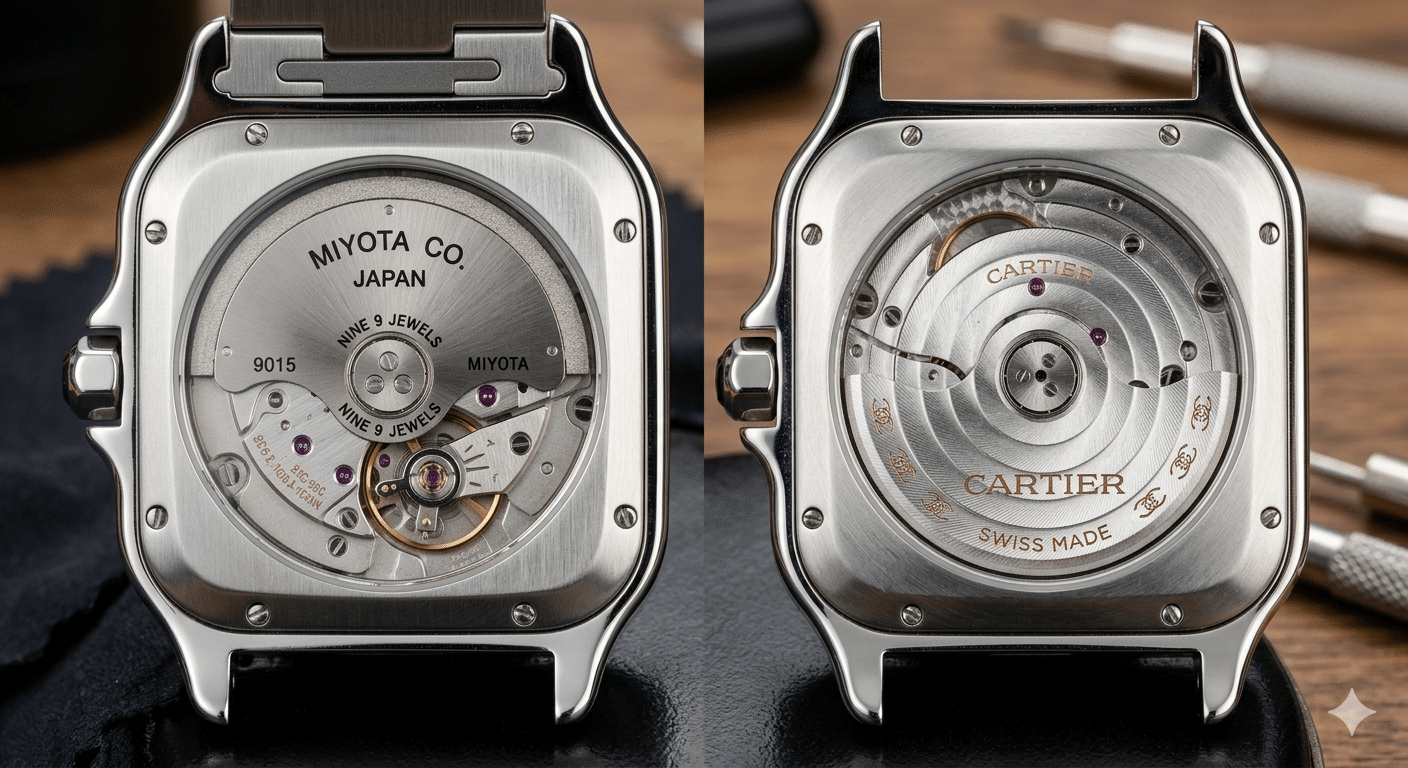
Physical diagnostic: The most telling maintenance check is also the simplest. Open the caseback. A genuine, unmodified Miyota 9015 will have the Miyota logo and “9015” cleanly laser-engraved on both the rotor and the main plate. This is your guarantee of parts compatibility and serviceability. Be deeply skeptical of any movement where this branding has been polished off, obscured by a generic “Cartier” engraving, or covered by a decorative plate. This is a classic tactic used to disguise a lower-grade movement (like a Miyota 8215, which beats slower) or a no-name Chinese clone. You are not buying a more authentic movement; you are buying a movement that is harder to identify, source parts for, and repair.
The Supply Chain Maturity: How Availability Drives Quality
The dominance of the 9015 in the Santos replica isn’t an accident of cost; it’s a strategic enabler of quality. Top-tier factories like GF and BVF aren’t movement manufacturers. They are case, dial, and bracelet specialists. By adopting a universally available, industrially perfected movement, they free their entire operational and financial bandwidth to excel at what actually determines 95% of the wearing experience: the visible craftsmanship.
Consistent Quality from Established Pipelines
Citizen’s Miyota factory produces the 9015 to precise, repeatable industrial tolerances. When a replica factory orders a batch of 5,000 movements, they know exactly what they’re getting: a movement of a consistent 3.9mm height, with predictable torque, power reserve, and beat error. This consistency is a manufacturing superpower. It allows the factory to design and machine the Santos case to a precise, repeatable internal dimension. It streamlines quality control—if the watch isn’t running within spec, the problem is almost certainly in assembly, not a wild variance in the movement itself. This reliability at scale is what allows a “factory” to build a reputation. They can guarantee a baseline of functional performance because the engine is a known, stable quantity.
Freeing Factory R&D for What Actually Matters
Because the movement is a solved problem, the factory’s development budget and engineering skill can be poured into the details you see and feel. The $800 price tag of a top-tier Santos replica isn’t paying for the $60 Miyota movement. It’s paying for the R&D that went into perfectly replicating the Santos’s signature galbée (curved) case profile. It’s paying for the tooling to create the bracelet links that articulate with the correct heft and fluidity. It’s paying for the process to get the sunburst dial texture and printed Roman numerals razor-sharp. It’s paying for the sourcing of a synthetic blue spinel cabochon that captures the right depth of color. The 9015’s role is to be an invisible, dependable foundation that allows all the visible, tactile, and emotional qualities of the watch to be perfected.
Expert Authentication Insight
Physical diagnostic: Verify the heartbeat. Use a timegrapher app on your smartphone or ask a watchmaker to put it on a machine. A genuine Miyota 9015 beats at 28,800 vibrations per hour (vph), or 8 ticks per second. This is a fast, smooth sweep of the seconds hand, a key benchmark detailed in a comprehensive Cartier Santos super clone guide. If you detect a slower, more pronounced tick—7 ticks or, more commonly, 6 ticks per second (21,600 vph)—it is not a 9015. You likely have a cheaper Miyota 8215 or a similar low-beat movement inside. This is a major functional downgrade in precision and smoothness, often hidden behind a decorated rotor. The beat rate doesn’t lie.
The “High-End Decoration” Trap: Why Fancy Finishing is Often a Distraction
In the replica market, “upgrades” are a powerful marketing tool. Nothing sells the dream of authenticity like photos of a movement adorned with Geneva stripes, perlage, and blued screws. But for the Santos—a watch with a solid steel caseback—this is perhaps the most cynical and functionally detrimental upsell. It preys on a buyer’s desire for perceived internal “quality” while often degrading the actual, tangible quality of the watch.
Decoration vs. Function: The Added Thickness Penalty
This is the critical, often hidden, engineering trade-off. That beautiful, rose-gold-plated rotor with the Cartier “C” logo? It’s not part of the base 9015. It’s an added module. Those decorative plates with stamped Geneva waves? More added layers. Each of these cosmetic additions adds height—typically 0.3mm to 0.5mm. Remember, the entire genius of the 9015 in the Santos is its 3.9mm profile, which allows for a case that perfectly mimics the genuine article’s ~8.8mm thickness. Add 0.4mm of decorative fluff, and you’re at 4.3mm. The factory now has two bad choices: bulge the caseback out, ruining the sleek silhouette and on-wrist feel, or thicken the entire mid-case, throwing off the watch’s elegant proportions. You are literally paying extra to make the watch worse in its most critical dimension.
The Illusion of Value: Perceived Upgrades That Matter Only in Photos
Let’s be blunt: you will never see it. Once the solid caseback is screwed on, that $100-$150 premium you paid for “high-beat decorated movement” vanishes into a black hole. It provides zero functional benefit, zero aesthetic pleasure during ownership, and as discussed, often creates a functional drawback. That same $100 could have been allocated to a genuine Swiss-made AR-coated sapphire crystal for better clarity, a higher-grade leather strap, or simply kept in your pocket. The decoration is a party that happens once—when you take the promotional photos—and then is forever locked away. It’s a feature designed for the sales listing, not for the wearer.
Expert Authentication Insight
Physical diagnostic: If you do encounter a decorated movement, inspect it under strong light and magnification. On a genuine high-end movement, Geneva stripes (Côtes de Genève) are applied by a rotating abrasive wheel, creating deep, sharp, parallel lines with a distinct three-dimensional texture and sheen. On 99% of replica decorations, these “stripes” are shallow, laser-etched lines with no depth. Similarly, genuine perlage (circular graining) is a overlapping pattern of small, polished circles. On replicas, it is often a uniform, stamped pattern that looks flat and artificial. This inspection reveals the truth: the budget was spent on superficial cosmetic etching applied by a machine in seconds, not on genuine horological finishing or, more importantly, on the external craftsmanship of the watch itself.
The Verdict: The 9015 as the Invisible Enabler
The Miyota 9015 in a Cartier Santos replica isn’t a story about compromise. It’s a story about strategic focus. In the pursuit of a believable daily object—a watch you can forget you’re wearing until you glance at it—the movement is not the star. It’s the stagehand. Its job isn’t to be seen or admired; its job is to enable everything else to shine, reliably and consistently, for years. The 9015 is that perfect, invisible enabler. It solves the fundamental physics problem of the Santos case, provides a decade-proven reliability backbone, and offers a clear path for maintenance, all while staying out of the way of the factory’s real mission: perfecting the visible design. Choosing a Santos with a 9015 isn’t settling. It’s understanding that in the replica world, coherence is the highest form of luxury.
The Ideal Santos Replica Specification
Forget the marketing fluff. The target specification for a near-perfect Santos replica is brutally simple and ruthlessly pragmatic. You want a watch from a top-tier factory known for its execution—primarily BVF or GF. And inside that watch, you want a standard, unadorned Miyota 9015 movement.
This combination isn’t an accident; it’s an engineered solution. The factory’s expertise is poured into the case geometry, the sharpness of the bezel screws, the sunburst finish of the dial, and the fluid articulation of the bracelet links. The 9015, in its stock form, guarantees that this exterior craftsmanship isn’t sabotaged by a bulging caseback or compromised by a fragile, unserviceable “clone” heart. It ensures the watch’s total thickness stays within the 8.8mm to 9.2mm window that defines the Santos’s sleek, integrated silhouette. By not wasting resources on decorative plates and fake Geneva stripes that add cost and thickness, the factory can allocate maximum budget and precision to the parts you actually see and feel every day. The ideal spec isn’t about having the fanciest internals; it’s about having the most correct and reliable internals that allow the exterior to be as perfect as possible.
What to Prioritize in Your Purchase Decision
When evaluating a Santos replica, your decision hierarchy must be crystal clear. Sentiment and spec-sheet fantasies lead to bad purchases. A practical, wearer-focused hierarchy looks like this:
- Case, Bracelet, and Dial Fidelity from a Proven Factory (BVF/GF): This is non-negotiable. The visual and tactile experience is 90% of the watch. The case must have the correct proportions and finishing. The bracelet must have the signature “SmartLink” adjustment and feel solid. The dial printing and guilloche must be sharp. This is where your money should primarily go.
- Confirmation of a Standard, Unmodified Miyota 9015: This is your insurance policy. Before purchasing, you or your trusted dealer must verify—through video, timegrapher readings, or explicit factory specification—that the movement inside is a genuine 9015, not a decorated cheaper alternative like a Miyota 8215. The presence of this specific movement is your guarantee of correct thickness and long-term serviceability.
- Everything Else: Only after points 1 and 2 are satisfied should you consider other factors. Strap options, packaging, and minor cosmetic details are secondary. Crucially, you should be skeptical of any listing that heavily promotes “upgraded decorated rotors,” “clone 1847 MC calibers,” or “Geneva stripes” as primary selling points. This is often a distraction technique, redirecting your attention (and budget) from potential compromises in the foundational areas of case quality and movement integrity.
Expert Authentication Insight
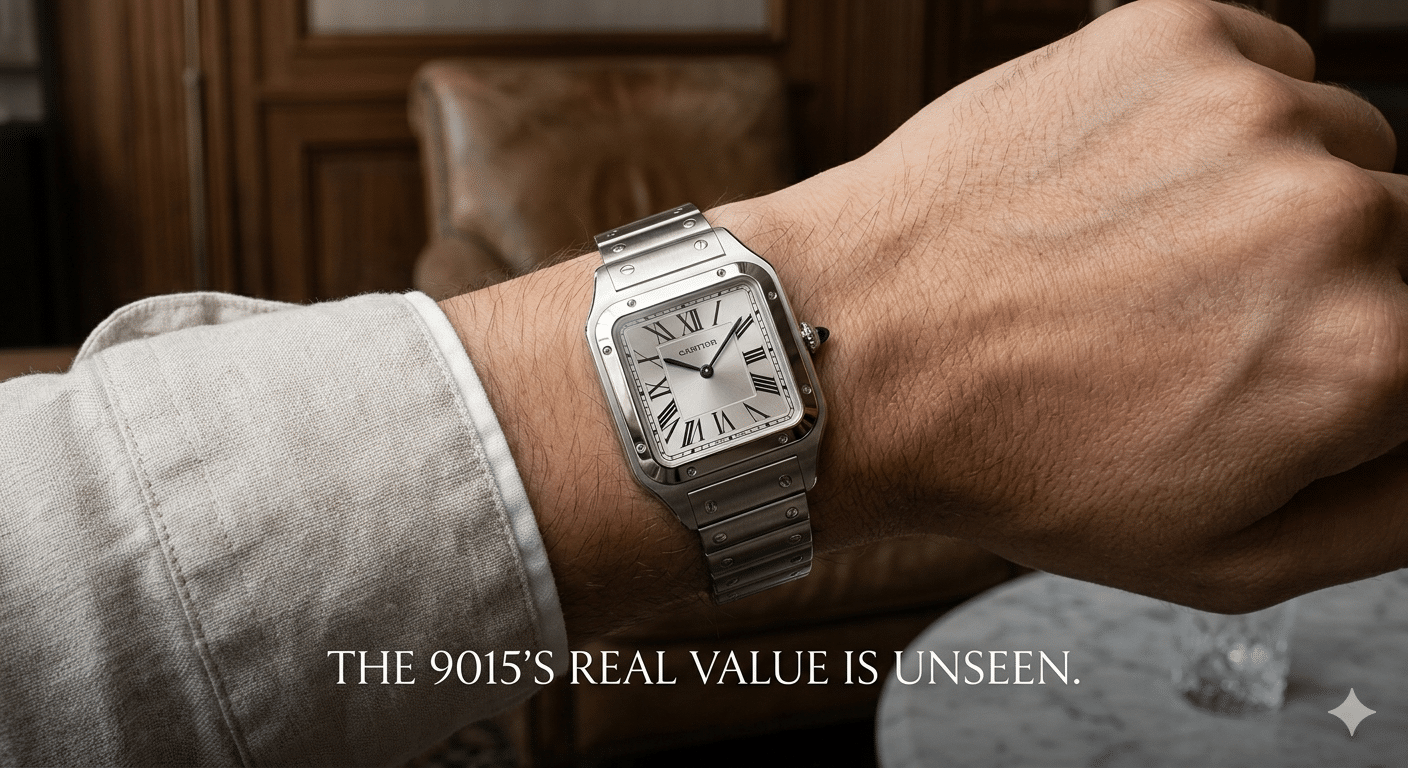
The final test is holistic and happens on the wrist. A Santos replica enabled by a proper 9015 doesn’t just look right in photos; it performs right in reality. Put it on. It should feel slim and solid, with no awkward protrusion from the caseback. Listen: the rotor should have a consistent, moderate, metallic whir—a sign of a healthy, unencumbered automatic winding system. Over a few days, check its timekeeping: it should run within a +/- 15 seconds per day window, demonstrating stable regulation. Finally, run your finger around the caseback edge. It should sit perfectly flush with the case middle. This suite of sensations—slimness, a specific sound, reliable time, and a seamless profile—is the coherent performance package the 9015 delivers. It’s the difference between a watch that is a convincing object and one that is merely a convincing photograph.
The Buyer’s Filter: Your Actionable Checklist
Cut through the noise. Use this filter to make your decision:
- Your Goal: A Santos for daily, worry-free wear.
- Your First Question: “Is this from BVF or GF?” (If not, proceed with extreme caution).
- Your Second Question: “Can you confirm it uses a standard Miyota 9015?” (Request a timegrapher video showing 28,800 vph).
- Your Red Flag: If the dealer’s description leads with “beautifully decorated movement,” “clone caliber,” or “upgraded rotor,” but is vague on factory origin or case thickness specifics—redirect your search.
- Your Priority Budget Allocation: Ensure the ~$800 price point is going toward the case, dial, crystal, and bracelet quality. The movement’s cost is already baked in; it shouldn’t be a premium feature.
- The Final Verdict: The Miyota 9015 is the silent, strategic partner that makes the entire Santos replica project work. Choosing it is not accepting less. It is intelligently prioritizing the elements that create a functionally coherent, durable, and authentically wearable watch. In the economy of a replica, the 9015 is the ultimate value engine: it does everything that matters, and nothing that doesn’t.