
Introduction: The Allure of the Official Code
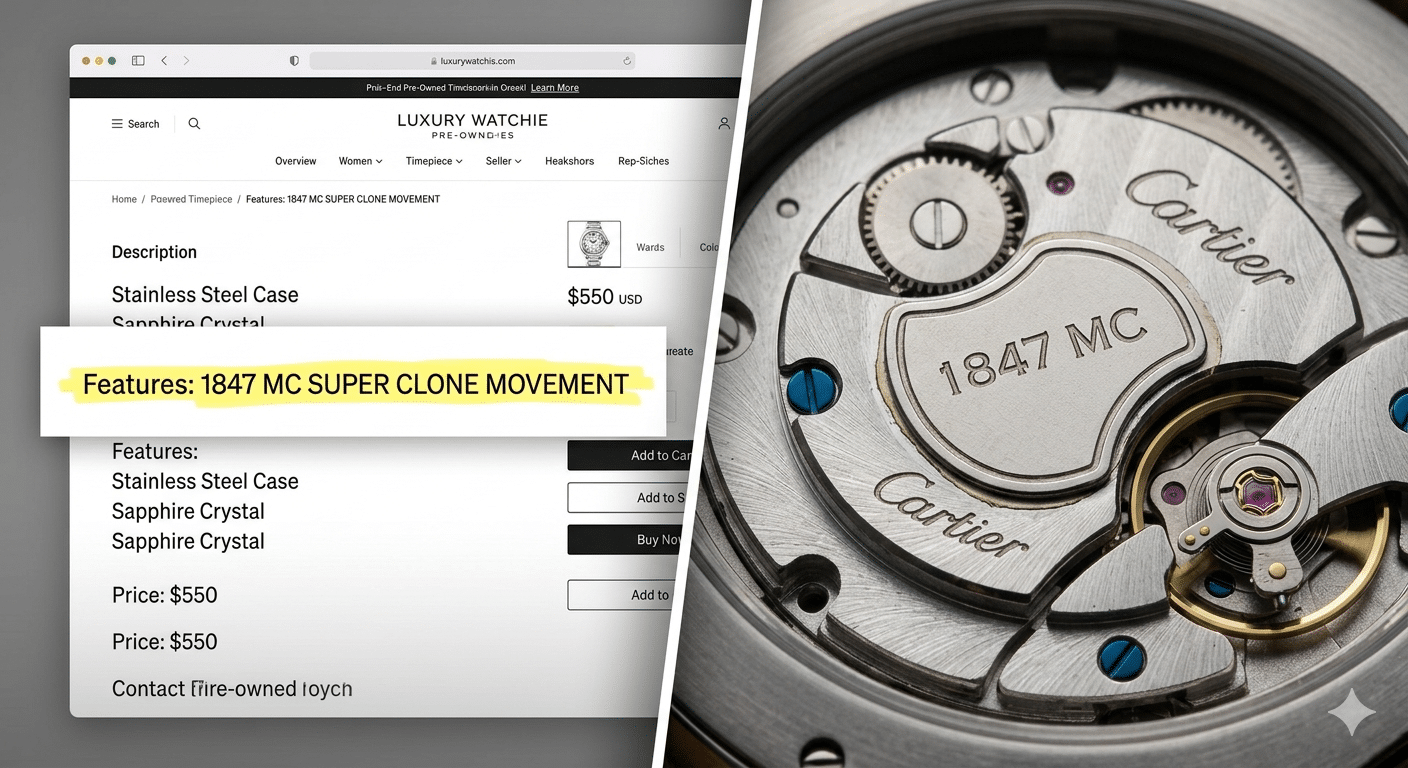
You know the feeling. You’re scrolling through listings for a replica Cartier Santos, and there it is, bolded in the description: “Super Clone with 1847 MC Movement.” It sounds precise, technical, and reassuringly specific. It’s a phrase that separates the $800 replicas from the $300 ones, promising a level of authenticity that borders on the mechanical, yet understanding the actual functionality of features like the QuickSwitch and SmartLink systems requires a detailed Cartier Santos replica guide. Your hesitation is not naive; it’s a rational response to a perfectly crafted piece of psychological marketing.
The genuine Calibre 1847 MC is Cartier’s modern workhorse. Introduced in 2015, it’s their in-house, robust automatic movement found in entry-level models like the Santos. It has a reputation for reliability. So when a replica seller slaps that code onto a listing, they’re not just listing a spec—they’re borrowing the entire trust and authority of the Cartier brand. The implicit promise is staggering: “This imitation is so advanced, we didn’t just copy the watch; we cloned the very heart that Cartier designed.”
It’s a powerful hook because it preys on a specific fear: the fear of buying an “obvious” fake. The “1847 MC” label acts as a talisman against that fear. It suggests that the one area where replicas traditionally fail—the hidden, ticking mechanics—has been conquered.
But here’s the stark reality you need to internalize right now: In the replica world, “1847 MC” is almost never a technical description. It is a psychological anchor, a keyword, a tier signal. It’s the horological equivalent of a used car listing boasting “Equipped with a V8 engine”—it tells you nothing about whether it’s a finely-tuned Ferrari unit or a clapped-out truck engine from the ‘80s. Your job as an informed buyer isn’t to verify the “1847 MC” claim; it’s to see straight through it and understand what it’s actually disguising.
This article exists to perform that translation. We’re going to dissect why this phrase is used, what it physically represents in 99% of cases, and, most importantly, redirect your focus to the movement characteristics that actually determine whether your watch will be a satisfying daily wear or an expensive paperweight.
Why This Phrase Works: Borrowed Authority
The effectiveness is in its specificity. “Automatic movement” is generic. “Japanese Miyota movement” is honest but uninspiring. “1847 MC” is the exact, official factory code. It speaks directly to the buyer who has done their homework, who knows that a genuine Santos has this specific calibre. By using the correct terminology, the listing instantly communicates legitimacy and technical knowledge, creating a shortcut to trust. It makes the subsequent $700-$800 price tag feel justified, even sophisticated.
What You’re Really Worried About (And What You Should Be)
Your underlying anxiety is about quality and longevity. You see “1847 MC” and hope it means robustness, accuracy, and a movement worthy of the watch’s exterior. That’s what you want it to mean. What you should be worried about is far more mundane: Is the rotor obnoxiously loud? Will it keep time within a reasonable margin? If it breaks in a year, can any watchmaker fix it, or will it become a decorative bracelet? The “1847 MC” label cleverly distracts you from these practical concerns by offering a fantasy of mechanical parity. Our mission is to bring you back to reality.
The Seller’s Motive: Why “1847 MC” is the Go-To Buzzword
Let’s remove any notion of malice or deception for a moment. From a seller’s perspective, using “1847 MC” is simply the smartest, most efficient marketing play available. It’s not necessarily a lie; it’s a brilliantly optimized piece of commercial language designed to solve several problems at once.
SEO & Search Visibility: Catching the Informed Buyer
Think about the search journey. A buyer moving beyond basic “fake Cartier Santos” queries will graduate to more specific terms. They’ll search for “Cartier Santos 1847 MC replica,” “Santos super clone movement,” or “best Santos factory movement.” By front-loading the product title and description with the official calibre name, the seller ensures their listing appears for these higher-intent, presumably more knowledgeable (and higher-budget) searches. It’s a direct hook for the buyer who is trying to find the “best” version.
Tier Signaling: “1847 MC” as Code for “Not the Cheapest Option”
In the replica ecosystem, language is currency. “Quartz” denotes the bottom tier. “Asian Automatic” is the vague mid-field. “Clone Movement” suggests better quality. But “1847 MC Clone” or “Super Clone” is the premium label. It’s a shorthand that immediately tells the buyer, “This is not the $250 shitter.” It justifies a price point in the $600-$800 range. Crucially, it’s used as a blanket term across different factories (BVF, GF, KF) that use entirely different base movements. This is the key insight: The phrase functions primarily as a tier indicator, not a technical specification.
The Comfort of Familiar Terminology
For the buyer, there’s a comfort in seeing the familiar. It reduces cognitive dissonance. You’re buying a replica of a watch that should have an 1847 MC; seeing those numbers and letters creates a sense of correctness, of things being “as they should be.” It alleviates the awkwardness of the purchase. The seller leverages this comfort to build a smoother path to the “Add to Cart” button.
Expert Authentication Insight
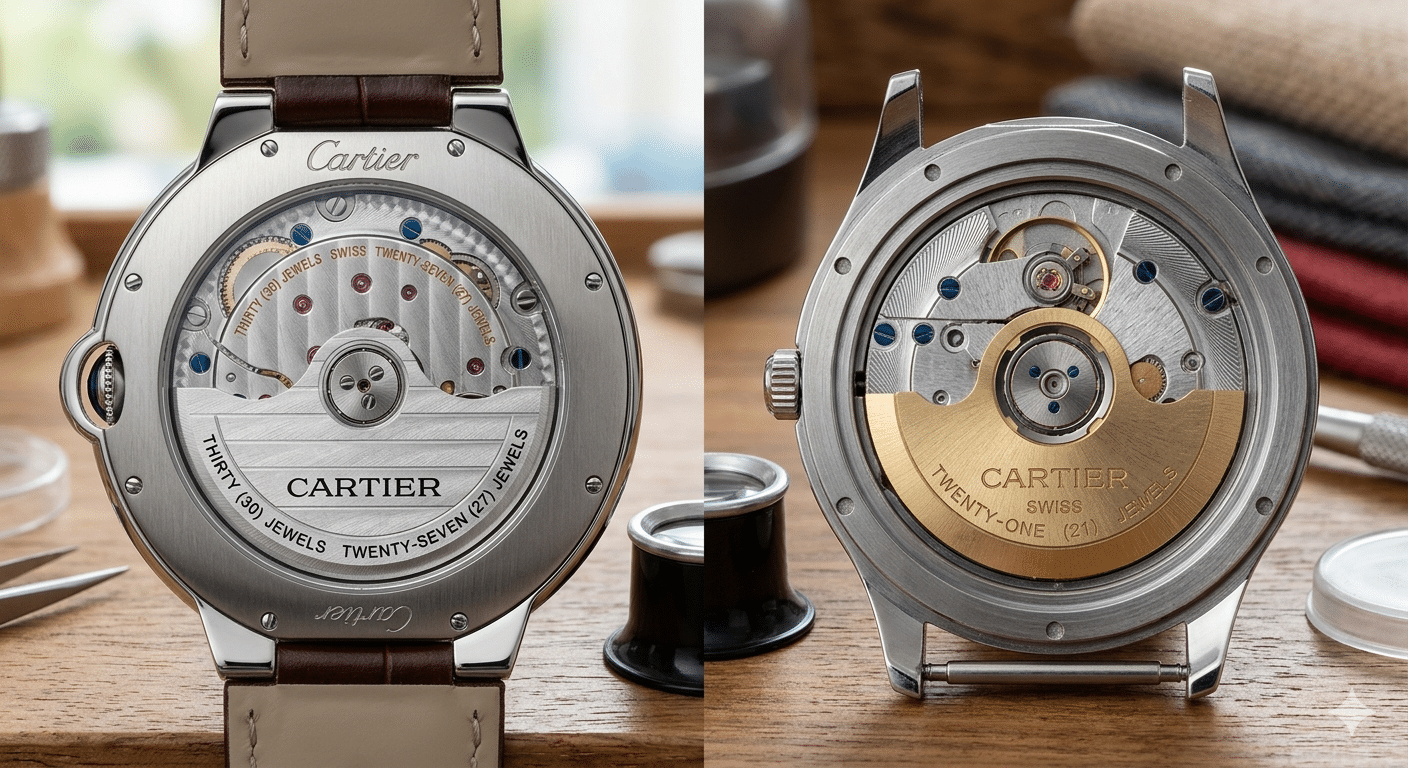
Physical diagnostic: The disconnect between claim and reality is instantly visible upon opening the caseback. A genuine 1847 MC features meticulously applied perlage (circular graining) across the base plate and bridges, with a distinct, solid rotor engraved with deep, crisp “CARTIER” branding. In 99% of replicas using this claim, you’ll find a standard Miyota 9015 or Hangzhou 5000 architecture. The finishing is generic and coarse—if it exists at all. The rotor often has a laser-etched “Cartier” logo that looks shallow and burnt, lacking the refinement of genuine engraving. The immediate tell is the utter absence of the specific, fine finishing and the generic, off-the-shelf movement construction.
Deconstructing the Claim: The Three Realities Behind the Label
When a seller says “1847 MC,” they are almost certainly referring to one of three physical realities, ranked here from most common to pure fantasy. Understanding this spectrum is the core of demystifying the purchase.
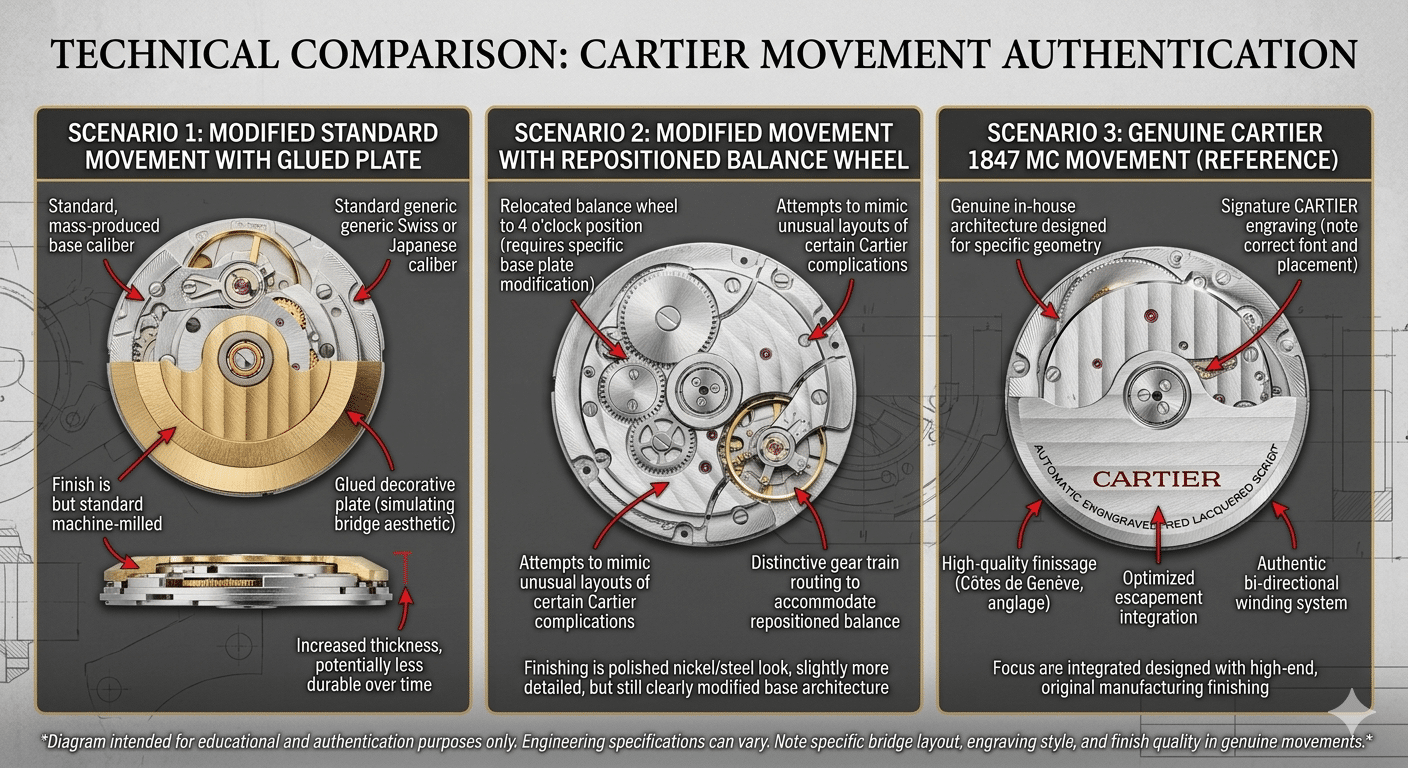
Scenario 1: The Decorative Plate (Illusion Over Engineering)
This is the most common reality, representing the vast majority of “1847 MC” claims, especially from factories like the older KF/GF Santos models. Here, the watch uses a completely standard, reliable workhorse movement—usually a Miyota 9015 or a Seagull/Shanghai automatic. On top of this movement, a thin, stamped metal plate is glued or screwed on. This plate is decorated with patterns and engravings meant to vaguely resemble the bridges and rotor of a genuine 1847 MC when viewed through a display caseback. The text “1847 MC” might be printed on this plate.
Judgment: This is pure theater. It adds zero functional benefit to timekeeping, accuracy, power reserve, or durability. Its sole purpose is to make a quick photo of the caseback look more convincing. Critically, it introduces a potential point of failure: those glued plates can and do come loose, rattling around inside the case. You are paying a premium for a costume, not an engineering upgrade.
Scenario 2: The Re-Positioned Balance (Visual Mimicry)
This is a less common, more meaningful attempt at replication, typically seen in modern BVF factory Santos models. In this case, the watch uses a Chinese Hangzhou 5000-series movement as a base. However, the factory has gone a step further: they have modified the movement to relocate the balance wheel from its standard position (often 6 o’clock) to the 4 o’clock position, matching the layout of the genuine 1847 MC. This modification demonstrates an advanced understanding of replica movement modification techniques, a topic thoroughly explored in the context of the Miyota 9015’s rise as an industry workhorse, and requires significant technical expertise to execute correctly.
Judgment: This is a more structurally honest approach. It’s not about sticking a decorative hat on; it’s about modifying the movement’s architecture to achieve a key visual correctness for display-back models. It shows a higher level of effort. However, the crucial distinction remains: this is a modified Hangzhou movement, not a cloned 1847 MC. The engineering, finishing, and component-level design are entirely different. You are paying for visual accuracy, not mechanical replication.
Scenario 3: The Mythical True Clone
This is the claim of a “true clone” or “1:1 clone 1847 MC”—a movement reverse-engineered and built part-for-part like the genuine article.
Judgment: For the Cartier Santos at its typical replica price point ($600-$800), this does not exist. The R&D and manufacturing cost to produce a functional clone of an in-house movement like the 1847 MC would be astronomical and utterly uneconomical for this market segment. Any listing claiming this is either profoundly misinformed or deliberately deceptive. Treat this specific claim as a major red flag regarding the seller’s credibility.
Expert Authentication Insight
Physical diagnostic: Spotting a decorative plate (Scenario 1) requires a keen eye. Look for a visible seam or a clear “step” between the edge of the rotor and the main movement plate beneath it. The screws holding the “bridges” will often appear to fasten only a thin, top-most layer. For the modified Hangzhou (Scenario 2), the giveaway is the balance wheel location—at the 4 o’clock position when viewed from the caseback, unlike a Miyota’s 6 o’clock position. Remember, a genuine 1847 MC uses a free-sprung balance with micrometric screws for regulation; if you see a standard, etched regulator lever (a small arm near the balance wheel), you are looking at a standard movement, not a clone.
What Actually Matters: Movement Priorities for a Santos Replica
Forget the label. The phrase “1847 MC” in a listing is a siren song, designed to lure you toward a mirage of horological legitimacy. Your real job as a buyer isn’t to decode marketing; it’s to evaluate the physical, ticking heart inside the watch based on what will actually affect your ownership. This is your pivot from chasing a fantasy to securing a functional timepiece. The priorities below are your new checklist, ranked by their impact on your wrist and your wallet.
The Serviceability Test: Can It Be Fixed?
This is priority number one. A watch is a mechanical object, and all mechanical objects can fail. The single most important question about any replica movement is: Can a competent watchmaker service it without a PhD in obscure Chinese calibers? This is where provenance matters.
A Miyota 9015 or a standard Seagull/Hangzhou 5000-series movement is a known quantity. Parts are widely available, and any independent watchmaker has seen hundreds of them. They are workhorses. When a seller’s “1847 MC” claim is just a decorative plate over a Miyota 9015, you’re buying a reliable, serviceable engine in a costume. This is a good thing.
The nightmare scenario is a heavily decorated movement with custom plates and glued-on components. If that rotor decoration comes loose or a custom bridge fails, finding a replacement is nearly impossible. You’re left with a paperweight. A broken watch with perfect cosmetic cloning is still a broken watch. Serviceability isn’t a spec; it’s an insurance policy.
Expert Authentication Insight
Physical diagnostic: The single most important real-world test is the rotor noise. In a quiet room, gently shake the watch next to your ear. A loud, gritty, whirring sound indicates a Miyota 9015 (or a very poorly lubricated movement). A smoother, quieter spin suggests a better-finished or different caliber. For serviceability, a watchmaker can identify a Miyota 9015 or standard Hangzhou architecture in seconds, whereas a heavily decorated movement with glued plates complicates simple servicing.
The Wrist Test: Silencing the Buzz
This is the most tangible daily experience. The Miyota 9015, for all its reliability, is infamous for its rotor noise—a distinct, whirring buzz that’s audible in quiet settings. For some, it’s a deal-breaker; it constantly reminds you you’re wearing a replica. Other movements, like certain Hangzhou calibers, tend to be significantly quieter.
This is a direct quality-of-life metric that no “1847 MC” sticker can fix. When considering a factory, rotor noise is a key differentiator. If a quiet watch is important to you, the movement’s acoustic signature matters far more than the name engraved on its rotor.
The Specs That Count: Power and Precision
Now, the measurable performance. Ignore the poetic names and focus on hard numbers.
- Power Reserve: Aim for a claimed 40+ hours. This is a practical benchmark for a modern automatic movement. A watch that dies over a weekend off your wrist is an annoyance.
- Accuracy Tolerance: Sellers often advertise +/- 10-15 seconds per day. A realistic expectation for a good-quality replica movement is +/- 20-30 seconds per day. Consistency is more important than perfection; a watch that runs a steady +25 seconds per day is easily regulated by a watchmaker.
Finally, there’s Visual Layout. This only matters if your Santos has a display caseback. Do you care if the balance wheel is at the 6 o’clock position (Miyota) instead of 4 o’clock (genuine 1847 MC)? This is a pure aesthetics question with zero functional impact. For a solid caseback model, it is completely irrelevant.
The takeaway is liberating: your decision matrix is now concrete. Serviceability. Noise. Power. Accuracy. In that order.
Factory Decoder: How “1847 MC” Translates Across Major Makers
Armed with your real priorities, you can now cut through the factory marketing. The term “1847 MC” isn’t used consistently; it’s a chameleon that changes meaning depending on who’s selling. Here’s what it actually signifies from the major players.
BVF: The Visual Argument
BVF (sometimes labeled BV) has positioned itself as the visual purist’s choice for the Santos. They typically use a modified Hangzhou 5000-series movement where the balance wheel has been repositioned to the 4 o’clock location, mimicking the genuine 1847 MC layout, a key detail often highlighted in a comprehensive Cartier Santos super clone guide focusing on factory comparisons and movement analysis.
Judgment: This is the most technically honest application of the “1847 MC clone” claim. When BVF uses the term, they are primarily selling the visual correctness of the movement through an exhibition caseback. The base movement is still a Chinese automatic, but the effort to replicate the architecture is real. You’re paying a premium for that visual fidelity.
KF & GF: The Proven Workhorse (With a Costume)
Factories like KF and the older GF iterations have traditionally relied on the Miyota 9015 as their engine. Their “1847 MC” claim is almost always fulfilled by a decorative metal plate fixed to the rotor and sometimes the bridges.
Judgment: Here, “1847 MC” is pure cosmetic marketing. You are buying exceptional case and dial finishing from a proven factory, powered by the reliable, if noisy, Miyota 9015. The movement label is fluff. Your decision is between superb external finishing (KF/GF) and visual movement layout (BVF).
Expert Authentication Insight
Physical diagnostic: To distinguish a BVF (Hangzhou-based) from a KF (Miyota-based) without opening the caseback, use the seconds hand motion. A Miyota 9015 has a lower beat rate (28,800 bph) resulting in a slightly less smooth sweep (6-7 ticks per second). The modified Hangzhou in BVF watches often maintains a higher beat rate (28,800 or 21,600) but the sweep can appear similar; the definitive test remains the rotor noise and, ultimately, viewing the balance wheel position through the display back.
Red Flag Factories: The Keyword Stuffers
Then there are the unnamed, generic “Super Clone” factories. For them, “1847 MC” is a keyword to be stuffed into every listing, often attached to the cheapest available movements like the DG2813 or low-grade Miyota clones.
Judgment: This is a major red flag. The phrase is used here as a blanket to cover low-tier construction. If you see “1847 MC” from an unknown or non-reputable seller, assume it’s a marketing fairy tale wrapped around a bottom-tier movement. The price might be tempting, but the movement inside will reflect it.
The factory, therefore, becomes your shorthand. Choose BVF if the display caseback layout matters most to you. Choose KF if you prioritize proven case construction and accept the Miyota’s rotor noise. The label itself is just the entry ticket.
The Smart Buyer’s Checklist: Evaluating the Movement Claim
This is your action plan. Translate the theory into direct questions and concrete steps. Your goal is not to catch a seller in a lie, but to force the conversation from vague marketing into specific, verifiable reality.
Questions to Ask Your TD (Before Paying)
- Ignore the Label. Start by mentally translating. When you read “Super Clone 1847 MC,” read it as “better-tier automatic movement.” This disarms the marketing.
- Ask Directly. “What is the base movement inside? Is it a Miyota 9015, a Hangzhou 5000, or something else?” A trustworthy dealer will give you a straight answer.
- Ask About Noise. “Is the rotor noise on this model particularly noticeable?” This sets a realistic expectation and signals you know what to listen for.
- Prioritize Factory. Simply ask, “Which factory is this from? BVF or KF?” The factory name tells you more than any movement label.
Photos to Demand (And Red Flags in Them)
- Demand Actual Movement Photos. If the watch has a display back, insist on a clear, close-up photo of the actual watch’s movement, not a stock image of a genuine 1847 MC. Look for the balance wheel position (4 o’clock vs. 6 o’clock).
- Focus on Serviceability. Frame a final, pragmatic question: “If this movement needed a service in a few years, could a standard watchmaker easily work on it?” The answer should be yes.
This checklist shifts your power from passive consumer to informed investigator. You’re no longer buying a story; you’re verifying a specification.
Expert Authentication Insight
Physical diagnostic: When you receive QC photos, magnify the movement shot. Look for the regulator lever. A genuine 1847 MC has a free-sprung balance with micrometric screws; you will not see a standard regulator lever. Its presence immediately confirms a standard, non-Clone movement. Also, examine the engraving depth and font of any “Cartier” or “1847 MC” text on the rotor; genuine engraving is deep and crisp, replica etching is often shallow and laser-burnt.
Conclusion: Moving Beyond the Hype
The journey through the world of “1847 MC” claims isn’t about uncovering a grand conspiracy. It’s about translating a language designed to sell into a language you can use to buy wisely. We started with a phrase that sounds like a technical guarantee—a specific, branded movement from Cartier. We end by understanding it for what it truly is in the replica market: a sophisticated marketing placeholder, a trust signal borrowed to imply quality, and a convenient shorthand for “not the bottom tier.”
The anxiety you felt when first seeing that term—the paralysis of not knowing what it hid or how much weight to give it—was the entire point. That confusion is the seller’s leverage. By demystifying it, you’ve taken that leverage back.
You now know that behind the label lies one of three realities: a decorative costume on a reliable workhorse, a visually modified movement for display-caseback correctness, or, in the worst cases, a complete fiction. The smart move isn’t to hunt for the non-existent “perfect 1847 MC clone,” but to decisively redirect your attention. Your new checklist is practical, not promotional: factory reputation over keyword promises, proven serviceability over cosmetic plates, and the tangible reality of rotor noise over engraved branding.
The real victory is a shift in focus. You’re no longer decoding a seller’s jargon; you’re evaluating a product’s tangible quality. When you see “Super Clone 1847 MC” now, it shouldn’t trigger confusion, but a clear sequence of questions: Which factory? What’s the base movement? How’s the rotor noise? The phrase becomes a starting point for your investigation, not the conclusion of theirs.
So, let the final mindset reset be this: Your energy and scrutiny are finite resources. Invest them where they yield real returns. Your time is unequivocally better spent scrutinizing the sharpness of the dial printing, the finish of the bracelet screws, and the alignment of the crystal than worrying about a movement name it was never going to have. Pursue the best possible version of the watch that actually exists, not the fantasy one in the listing.