
Cartier Santos Replica Bracelet Systems: The Daily Reality Check
When you buy a replica Cartier Santos, you’re not just buying a watch. You’re buying a promise. The promise is embedded in those two words: QuickSwitch and SmartLink. They’re not just features; they’re the entire modern Santos ownership proposition, a key consideration in the Cartier Santos bracelet vs leather strap replica comparison. The genuine systems are marvels of thoughtful engineering—tool-free strap changes and on-the-fly micro-adjustments that turn a static object into an interactive, personal tool.
The replica version of this promise, however, exists in a gray zone between clever mimicry and functional fraud. This isn’t about whether the watch looks like a Santos. At the $700-$800 price point for top-tier examples, the visual fidelity is often stunning. This is about whether the watch works like a Santos where it matters most: in your hands, on your wrist, over months of ownership. Does that satisfying click of the QuickSwitch button lead to seamless changes, or to a frustrating struggle? Does the SmartLink lever offer precise fit, or does it become a gateway to stripped threads and lost parts?
This is a daily reality check. We’re moving past the unboxing glamour shot and into the gritty, practical evaluation of whether these systems are usable tools or merely convincing aesthetic props. The answer determines not just your satisfaction, but the long-term viability of the watch as a wearable object.
The Promise vs. The Purchase: What You’re Actually Buying
The fundamental split in the replica market isn’t just about price; it’s about philosophy. For the bracelet systems, factories fall into two distinct camps.
The first camp, led by factories like BVF and 3K, treats the QuickSwitch and SmartLink as integrated mechanical systems. This is the more expensive and complex path. It means engineering the case lugs with precise channels for the QuickSwitch spring bars from the ground up. It means milling the bracelet links with bores sized for the specific pin-and-collar assembly of the SmartLink. The goal is functional replication, where the systems are designed to work, however imperfectly, as part of a cohesive whole. You’re paying for an attempt at mechanical integrity.
The second camp, encompassing most mid-tier and all budget factories, treats these systems as separate, attached components. Here, the watch case has faux QuickSwitch buttons that are often just aesthetic caps glued over a standard spring bar. The “SmartLink” is a simple pin pushed through a link, sometimes with a fake lever that does nothing. You’re buying theater. The initial look might pass a glance, but the moment you interact with it, the illusion shatters. This distinction is the single most important factor in your buying decision—it’s the difference between a watch you can interact with and a static sculpture.
Initial Impressions Lie: The “New Stiffness” Trap
Here’s a common and costly mistake: judging a replica Santos bracelet by how it feels out of the box. Factories are masters of the “new stiffness” illusion. A bracelet fresh from the workshop often feels solid, tight, and surprisingly premium. This is frequently achieved through a combination of excess assembly lubricant and deliberately overtightened tolerances.
The grease masks the gritty friction between poorly finished link surfaces, creating a smooth, dampened glide. The tight pins and collars eliminate any initial play, making everything feel secure. This initial feel is a trap. It’s designed to impress during the first inspection, to feel “better than expected.” However, as that thin layer of lubricant wears away or migrates after a few days of wear, the underlying reality emerges: rough machining on contact points, misaligned pin holes, and metal-on-metal friction that was temporarily silenced.
The stiffness then reveals itself not as quality, but as a precursor to wear. That tight pin isn’t precision; it’s force-fit into a misaligned hole, and every flex of the bracelet is scoring the soft metal, leading to premature loosening or, worse, a seized pin that can’t be removed without damage.
Expert Authentication Insight
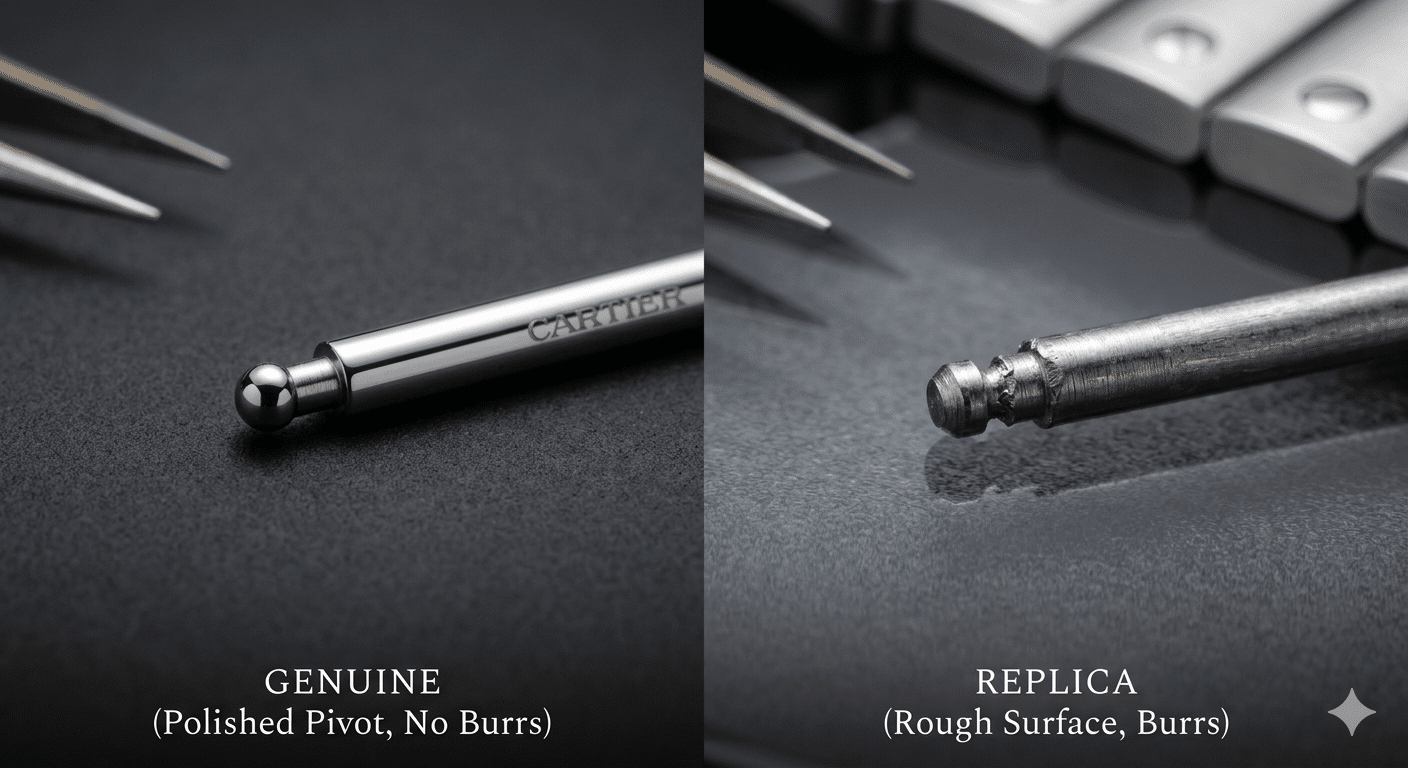
Don’t trust your fingers alone. The true forecast of a bracelet system’s longevity is written in microscopic detail. Grab a 10x loupe and inspect two critical areas. First, examine the pivot points on the ends of the QuickSwitch spring bars. On a genuine system, these are polished hemispheres. On replicas, you’ll often find visible machining marks, burrs, or uneven surfaces. These imperfections act like sandpaper, accelerating wear inside the lug channel every time the bar compresses.
Second, look inside the spring bar channels in the lugs themselves. Are the walls smooth, or can you see rough tooling paths? Any roughness here increases friction exponentially, meaning the spring bar has to fight against resistance every time you press the button, leading to metal fatigue and eventual failure of the spring or, catastrophically, the bar snapping. What feels like a stiff, quality button on day one is often just friction masking poor finishing.
QuickSwitch System Deep Dive: From Tool-Free to Trouble-Free?
The QuickSwitch system is the Santos’s party trick. In genuine form, it’s sublime—a firm press on the discreet button on the caseback, a crisp snick*, and the bracelet or strap releases cleanly. It enables a personality change for your watch in under ten seconds. In the replica realm, this elegant solution often becomes the primary point of failure. The engineering tolerances required for a reliable, tool-free, repeat-release mechanism are extraordinarily high, and this is where replica manufacturing frequently stumbles.
Spring Bar Tension: The Goldilocks Zone
The heart of QuickSwitch is a specialized spring bar with a central plunger. The spring tension inside this bar is everything. It must exist in a perfect “Goldilocks Zone.”
Too weak, and the bar doesn’t maintain enough outward pressure to seat securely in the lug holes. The result is a strap or bracelet that feels loose, can develop audible rattles, or in a worst-case scenario, detaches unexpectedly from the watch. This is a critical failure that turns a watch into a hazard.
Too strong, and the button on the caseback cannot be depressed by human thumb pressure alone. You’ll find yourself pressing with all your might, bruising your thumb, and ultimately reaching for a spring bar tool to lever it out—completely defeating the purpose of a “tool-free” system. This is a functional failure of the core promise.
Factory approaches vary. BVF often errs on the side of stronger tension, prioritizing security over ease of use. Their buttons can be notoriously stiff. GF (a common source for Santos models), conversely, sometimes leans toward lighter tension for a easier button press, but this can introduce that worrying lateral play in the strap. Neither consistently hits the genuine Cartier balance of secure yet effortless.
Button Action and Tactile Feedback
Press the QuickSwitch button on a genuine Santos. The travel is short, deliberate, and ends with a distinct, dampened metallic click*. You feel it through your thumb and hear it. The button then resets positively and completely. This feedback loop—press, click, reset—is confirmation. It tells your brain the action is complete and successful.
Replica mechanisms rarely achieve this. The feedback is often vague, mushy, or inconsistent. You press, and the button travels with a spongy resistance, sometimes bottoming out softly without a clear click. Other times, you might get a faint, high-pitched ping* instead of a solid *click*, indicating thinner or different grade metals. The reset can be sluggish, with the button slowly rising back instead of snapping home. This lack of definitive feedback creates uncertainty. Did it release? Is it still locked? You end up wiggling the strap to check, which is the exact opposite of the confident, seamless experience you’re paying for.
Long-Term Wear: Loosening, Play, and Failure Modes
This is where the theoretical meets the practical. A QuickSwitch system might work perfectly for the first five, ten, or even twenty changes. The real test is cycle 30, 40, and beyond. Replica springs are not made from the same high-grade piano wire as genuine ones. They fatigue faster. Each compression and release work-hardens the metal slightly, gradually reducing the spring’s restoring force.
The result is a system that slowly degrades. First, you might notice increased lateral play—the strap can be wiggled slightly side-to-side even when “locked” in. Then, an audible rattle develops as the bar sits loosely in its channel. Finally, the spring loses so much tension that the bar can no longer snap fully into the lug holes, or the button mechanism itself fails to retract the bar ends completely. At this point, the QuickSwitch is dead. The watch is now permanently attached to one strap, or you must use a standard spring bar tool to remove it, often damaging the faux-button caps in the process.
Expert Authentication Insight
Perform the “Wiggle Test.” With the strap or bracelet securely installed, grasp it firmly near the lugs and try to gently wobble it laterally (not pulling it away from the case, but rocking it side-to-side). On a genuine or high-quality replica system, there should be zero movement—it’s a solid, unitary feel. On most replicas, you will feel a slight but perceptible “click” or movement. This indicates one of two things: the lug channels are machined too wide, or the ends of the QuickSwitch spring bar are already worn and no longer making a tight fit. This play is the first symptom of eventual failure and is a clear sign of compromised machining tolerances.
SmartLink Micro-Adjustment: Precision or Pretension?
If QuickSwitch is about convenience, SmartLink is about comfort. The genuine system is a work of miniature engineering: a tiny lever on the bracelet underside releases a dual-spring collar, allowing a pin to slide out just enough to move the link, before locking back in place with a secure click. It’s meant for fine-tuning your fit throughout the day or across seasons, a crucial point for understanding fake Cartier Santos clone claims. In replicas, this delicate ballet often turns into a clumsy, destructive struggle.
The Pin and Collar Mechanism: A Replica Achilles’ Heel
The precision required here is brutal. The pin must be perfectly cylindrical and hardened. The twin springs in the collar must be identical in tension. The bore holes in the link must be perfectly aligned and smooth. Replica manufacturing struggles with this trifecta.
Common failures are systemic: Pins are too soft, deforming when pressed with a tool. Collars are malformed, causing the springs to bind or not engage the pin grooves correctly. Bores are misaligned by fractions of a millimeter, forcing the pin to bend as it’s inserted. The results are predictable: pins that seize inside the link, never to come out; tiny collars that ping across the room, lost forever; or threaded sections that strip immediately, rendering the link permanently stuck in one position. What’s marketed as a micro-adjustment feature often becomes a single-use, set-and-forget—or worse, a break-and-regret—component.
Tool Compatibility and the “Almost Fits” Problem
Even if you proceed with caution, you face the “almost fits” dilemma. Genuine Santos tools are specific. Replica factories often size their SmartLink pinholes incorrectly. The standard 1.2mm spring bar tool you might own will either be slightly too large, risking damage to the hole, or slightly too small, slipping and scratching the surrounding metal.
The instinct is to apply more force. This is a catastrophic error. The replica steel is softer. Forcing a near-fit tool spreads the metal, deforming the delicate hole and making it impossible for the collar to lock securely ever again. You’ve permanently ruined the link’s functionality for the sake of a half-millimeter adjustment. Many owners discover this only after the damage is done, finding their “micro-adjustable” bracelet now has a permanently loose or stuck link.
Practical Adjustability: How Many Reliable Cycles?
This is the most sobering metric. While a genuine SmartLink is designed for dozens, if not hundreds, of adjustment cycles over a watch’s lifetime, a replica system has a severely limited lifespan. Based on watchmaker and enthusiast community reports, the average high-tier replica SmartLink can withstand 2-5 full adjustment cycles before showing signs of failure (loosening, stiffness, collar failure).
Mid-tier versions often fail on the first or second attempt. This turns the feature from a practical comfort tool into a “configure once at purchase” ritual. It is not designed for the genuine use case of seasonal adjustment—loosening in summer heat, tightening in winter cold. Planning to use it that way is planning for its breakdown.
Expert Authentication Insight
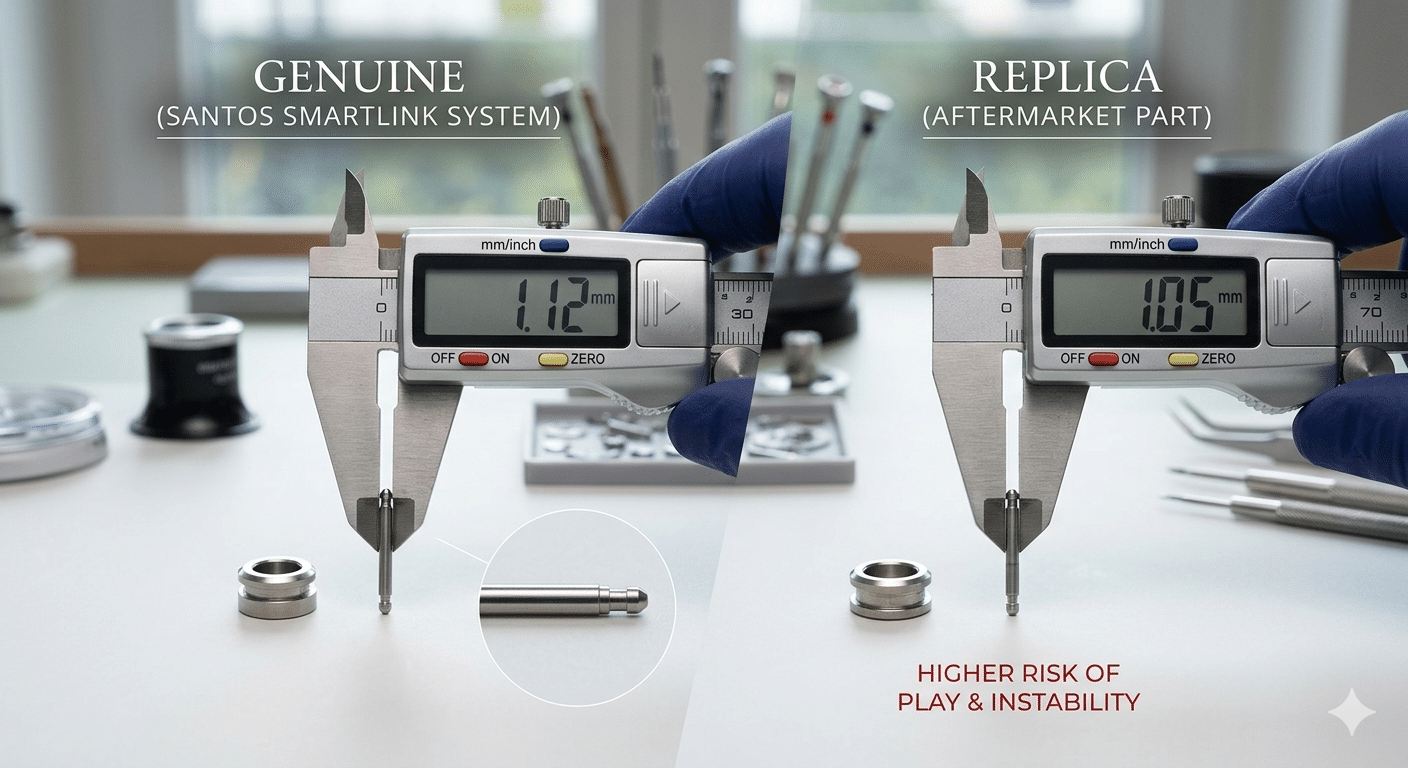
The tolerance stack-up is everything. To assess the risk level of a replica SmartLink system before you even attempt an adjustment, use a digital caliper. Measure the diameter of the pin. Then, if possible, measure the internal diameter of the link’s bore (this requires disassembly, so it’s often a post-purchase check). In a genuine system, the fit is precise with minimal clearance. In replicas, variance is common. A pin that is more than 0.05mm undersized relative to the bore will lead to play and rattling. A pin that is too large, or a bore that is too small, creates an interference fit that will seize. This measurement is a direct predictor of functionality versus failure.
Factory Showdown: BVF, 3K, and the “Others”
When the rubber meets the road—or rather, when the steel meets your wrist—the factory behind your Santos replica isn’t just about dial color or case shape. It’s the single most critical factor determining whether the QuickSwitch and SmartLink systems are functional engineering or fragile theater. Forget vague promises of “high quality.” Here’s a direct, judgment-based breakdown of how the top contenders actually perform, separating marketing claims from daily reality.
BVF: The Integrated Approach Champion
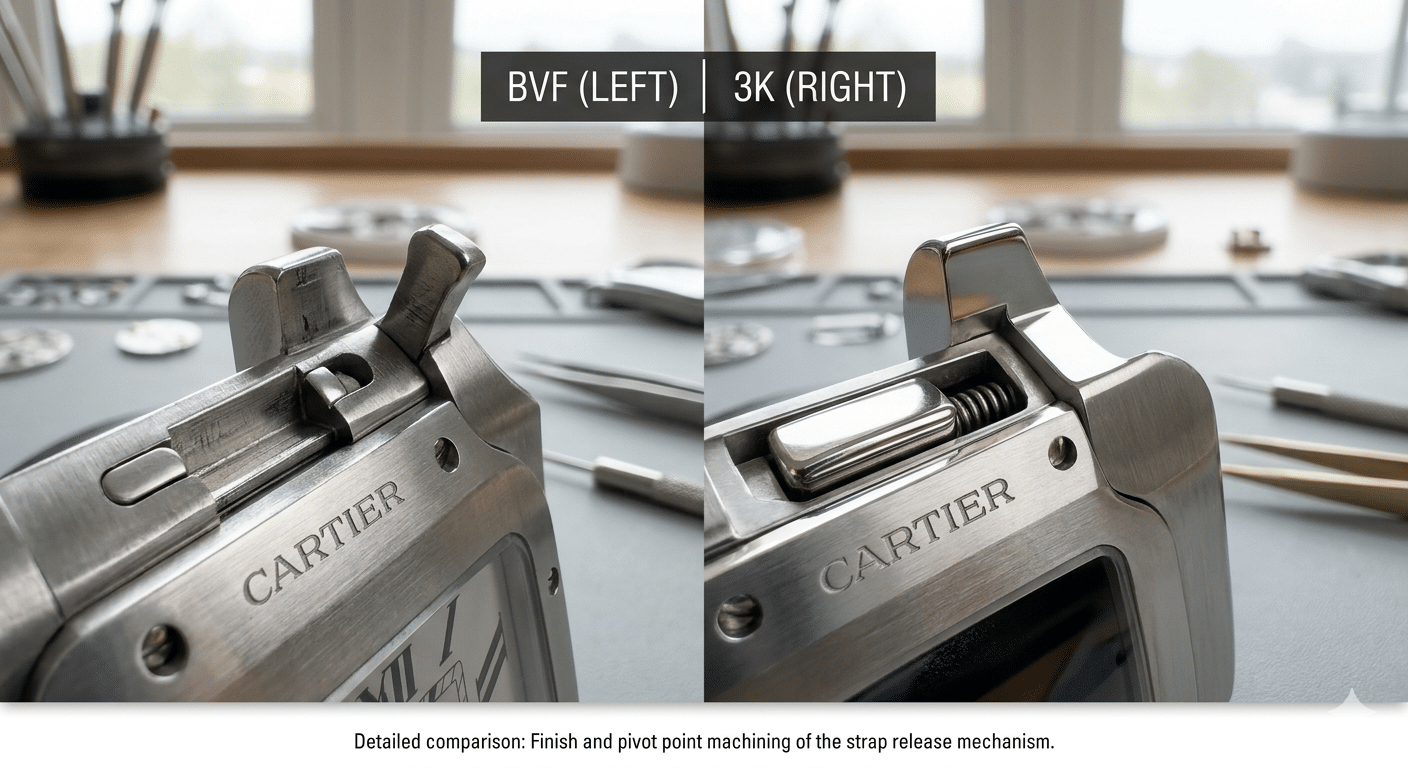
BVF’s strategy is architectural. They don’t treat the QuickSwitch and SmartLink as add-ons; they attempt to build them as core, integrated components of the case and bracelet. This philosophy yields the most coherent initial experience. The QuickSwitch buttons are typically well-aligned with the case, with minimal side-to-side play. The initial press feels deliberate, with a defined, albeit slightly gritty, travel. The SmartLink pins and collars are often better matched than in other factories, meaning the dreaded scenario of a seized pin is less common on arrival.
Strengths: The best out-of-the-box integration. For a buyer who wants the systems to look and initially feel correct, BVF is the benchmark. Their approach minimizes the immediate “this is fake” tactile feedback.
Weaknesses: The Achilles’ heel is longevity, particularly in the QuickSwitch springs. The metal used for the internal spring bars appears to be of lower fatigue resistance. After 20-30 actuations, the crispness degrades. The button action can become mushy, and the spring tension weakens, increasing the risk of accidental strap detachment. It’s a system engineered for a convincing first impression, not for a decade of daily tool-free changes.
3K (K11F): The Detail-Obsessed Contender
If BVF is the architect, 3K is the jeweler. Their focus is laser-targeted on the visual and tactile minutiae. Under a loupe, the finishing on the SmartLink pins and collars often surpasses BVF, with cleaner machining and fewer visible burrs. The surfaces of the QuickSwitch buttons are polished to a sharper, more gen-like gleam. Their goal is to win the macro-shot comparison.
Strengths: Unmatched surface finish and detail replication on the components themselves. For the collector who examines every millimeter, 3K’s parts look more authentic. The tactile “click” of the SmartLink collar seating can feel more precise.
Weaknesses: This obsession with detail can lead to over-engineering and over-tightening. The systems are often too stiff from the factory. The QuickSwitch button may require concerning force to depress, and the SmartLink pins can be installed with such tension that adjustment feels like you’re risking permanent damage. It’s a system that prioritizes static perfection over fluid usability, sometimes to its own detriment.
The Budget Tier: A Warning Label
This category isn’t about brands; it’s about a price point—typically anything significantly below the $700-$800 USD mark for a Santos. Here, the interactive systems are pure illusion, designed only to pass a photograph. The QuickSwitch “buttons” are often non-functional dummies glued in place, with the strap actually attached via a standard, non-removable spring bar hidden behind. The “SmartLink” is frequently just a series of screwed links (with the screws often glued) or, worse, a solid bracelet with fake, non-functional articulation points.
The Reality: Purchasing from this tier for the bracelet functionality is a complete waste of money. You are buying a static prop. Any attempt to force these “features” to work will result in breakage. The metals are softer, the tolerances are non-existent, and the design is a facade. For the Santos, where the bracelet system is half the identity, buying budget is the fastest way to own a watch that feels nothing like a Santos.
Expert Authentication Insight
The sound test is a dead giveaway. In a quiet room, operate the mechanisms. A genuine Santos QuickSwitch produces a distinct, damped metallic snick—a clean, solid, contained sound. The SmartLink pin release has a soft, precise click. Replicas betray themselves acoustically. BVF and 3K might produce a higher-pitched, slightly tinny ping or a faint grind. Budget tiers are often silent (dummy buttons) or produce a hollow, scratchy sound. The audio signature is a direct report on material density, spring quality, and machining precision.
The Daily Grind: Long-Term Wear and Tear Scenarios
The unboxing and the first week are a honeymoon period. The true test of a replica’s interactive systems is the slow, grinding reality of daily life. Here’s what happens after the novelty wears off and ordinary wear takes over.
Desk Diving and Lateral Impact
This is the silent killer for replica QuickSwitch systems. A genuine Santos is designed to handle the occasional knock against a doorframe or desk. The replica is not. The primary risk isn’t a scratched bezel; it’s a lateral shock to the case that transmits directly into the QuickSwitch spring bars. These bars are the weakest structural link. In replicas, the steel of the lugs is often softer, and the spring bar channels can be minutely misaligned. A sharp lateral impact can momentarily compress one side of the spring, allowing it to slip out of its seat or, more commonly, permanently deform the lug channel. The result is a persistent, slight rattle or a button that no longer travels smoothly. It’s a failure of tolerance under stress.
Temperature Cycles and Material Expansion
Metal expands when warm and contracts when cold. On your wrist, this cycle happens daily. Genuine watchmaking accounts for this with precise tolerances and material science. Replica manufacturing, operating at the edge of precision, often does not. On a hot day, a replica QuickSwitch button that was perfectly fine in the morning can become stubborn and sticky as components expand within their already-tight housings. Conversely, on a cold winter day, you might feel a new, slight wobble or play in the system as things contract. This isn’t a catastrophic failure, but it’s a constant reminder of the engineering gap. The systems feel least reliable at the temperature extremes of real life.
The Strap Change Reality: From 30 Seconds to 30 Minutes
The genuine Santos promise is a 30-second, tool-free strap change. The replica reality is a gamble that often ends with you searching for tools. When the QuickSwitch button fails—due to weak spring tension, misalignment, or debris—you are forced to revert to traditional methods, a process detailed in a comprehensive Cartier Santos super clone guide. This means using a thin jeweler’s screwdriver to manually depress the spring bar ends through the small access holes, a frustratingly fiddly process that risks scratching the inside of the lugs. In worst-case scenarios, the spring bar becomes so lodged that gentle persuasion with a rubber mallet and a pin punch is needed. What was marketed as elegant convenience becomes a stressful, time-consuming operation that highlights the fragility of the entire setup.
Expert Authentication Insight
Conduct a stress test after a week of normal wear. Remove a bracelet link using the SmartLink system. Once the pin and collar are out, inspect them under strong light or a loupe. Look for scoring (parallel scratches along the pin), galling (metal transfer and tearing where the pin and collar seized), or deformation (a pin that is no longer perfectly cylindrical). Any of these marks are direct evidence of poor metal hardness, inadequate lubrication, or misaligned bores. On a genuine system, the pin and collar should emerge looking nearly pristine, even after multiple cycles. On a replica, this single use often tells the entire story of its long-term viability.
The Buyer’s Decision Matrix: Utility vs. Illusion
Technical analysis is useless without a clear path to a decision. Your priority as a buyer dictates which factory, and which set of compromises, makes sense. Here is the actionable framework.
For the “One Strap, Forever” Wearer
If you buy the Santos on the bracelet and never intend to change the strap or adjust the fit after the initial setup, your goal is simple: maximize static, visual integration. You want the systems to look flawless and feel solid, but their mechanical longevity is irrelevant. In this case, 3K (K11F) might be your best bet. Their superior surface finish means the watch will look more authentic in close inspection. The initial stiffness of the systems is a non-issue if you never plan to use them. Your priority is the seamless look of the bracelet integration, and 3K often excels here.
For the Practical Adjuster (Seasonal/Sizing)
You need the SmartLink to work reliably for initial sizing and maybe one or two seasonal adjustments. You might use QuickSwitch once to try a leather strap. For you, functionality matters, but it’s a delicate, occasional operation. Here, BVF is the more pragmatic choice. Their more integrated approach typically yields a SmartLink system that is more user-friendly out of the box. The pins and collars are less prone to immediate seizing. You must, however, treat the process with extreme care: use the correct 1.2mm tool, apply minimal force, and consider a drop of lubricant on the threads. View it as a precise, fragile operation, not a casual adjustment.
For the Strap Enthusiast
If the joy of the Santos for you is the QuickSwitch system—swapping between bracelet, leather, and rubber regularly—you must enter this with managed expectations. No replica system is built for this long-term. Your strategy should be: 1) Buy from a Trusted Dealer (TD) who will, upon request, send a video proving the QuickSwitch mechanism works smoothly before shipping. 2) Stick with BVF for its better initial functionality. 3) Budget mentally and financially for the system to degrade or fail. Have a traditional spring bar tool on hand. Consider the QuickSwitch a bonus feature with a limited lifespan, not a permanent pillar of ownership.
Expert Authentication Insight
The only way to de-risk your purchase is with pre-shipment verification. Before paying the balance, request a custom video from your TD. The video should clearly show: the salesperson pressing the QuickSwitch button to release the bracelet, completely detaching it, then re-attaching it and pressing it until an audible, firm click confirms it’s locked. This simple, 30-second video filters out the units where the mechanisms are dysfunctional from day one. It doesn’t guarantee longevity, but it proves basic operational viability, which is the absolute baseline.
Maintenance and Damage Control
Owning a Santos replica with functional QuickSwitch and SmartLink systems is an exercise in delicate stewardship. These are not the robust, over-engineered mechanisms of the genuine article. They are precision-compromised facsimiles, and treating them as such is the key to longevity. The goal isn’t to make them indestructible—that’s impossible—but to maximize their limited operational lifespan through preventative care and realistic repair strategies.
Preventative Lubrication: What to Use and Where
The single most effective thing you can do to extend the life of these systems is apply the right lubricant, in the right amount, to the right places. Friction is the enemy of the replica’s softer metals and looser tolerances.
The gold standard is a high-quality synthetic watch grease like Moebius 9415. Its viscosity is ideal for slow-moving, high-pressure points. You’ll need a set of precision oilers or even a sharpened toothpick. The targets are microscopic: a minuscule dab on the pivot points of the QuickSwitch spring bar where it rotates inside the lug, and an even smaller amount on the threads of the SmartLink adjustment pin before insertion. The goal is to create a protective film, not a reservoir. Over-lubrication attracts dust and grime, creating a abrasive paste that accelerates wear. Think of it as applying a dewdrop, not a droplet.
A critical warning: Never, ever use WD-40, household oil, or silicone spray. These can degrade seals, attract debris, and will not provide the necessary long-term, high-pressure lubrication. They often do more harm than good.
When It Breaks: Sourcing Replacement Parts
This is the cold reality of replica ownership: when a QuickSwitch bar loses its spring tension or a SmartLink collar strips, you cannot simply order a new one. Replica factories do not sell individual micro-components. They sell complete watches or, on rare occasion, complete bracelet assemblies for $150-$250.
Your options are bleakly pragmatic. The most common path is to source a “donor” watch—a broken replica of the same factory origin—and cannibalize its bracelet. This requires luck in finding a matching model and factory. The second option is to go back to your trusted dealer (TD) and plead for a spare bracelet, knowing it will cost a significant portion of the watch’s original price. The third, and often most frustrating, is attempting a repair with non-spec parts, which usually leads to further damage. The takeaway is clear: these systems are not user-serviceable in the traditional sense. A broken mechanism often means a permanently compromised watch.
The Professional Modder Option
For those unwilling to accept a static bracelet or a dead QuickSwitch system, there exists a niche, expensive solution: the professional replica modder. These specialists operate in the gray market, offering services like retrofitting genuine-spec, higher-quality spring bars into the replica lugs or re-tapping stripped SmartLink threads.
The process is delicate and not guaranteed. It involves machining, part adaptation, and a deep understanding of both replica and genuine construction. The cost for such a repair can range from $100 to $300, effectively adding 25-50% to the cost of a $800 replica. This math only makes sense if the watch’s dial, case, and crystal are otherwise flawless. For most, it’s a sobering illustration that the cost of fixing the replica’s weakest link can approach the value of the watch itself.
Expert Authentication Insight
Physical diagnostic: If a QuickSwitch button becomes stuck, your first instinct must be restraint. Do not force it. The internal pins in these replicas are often made of soft steel or even brass. Applying lateral pressure will shear them instantly. Instead, use a hand-held air blower (like those for cleaning camera sensors) to vigorously dislodge any pocket lint or debris that may be jamming the mechanism. If that fails, the repair is likely beyond casual intervention. Forcing it turns a minor cleaning job into a permanent mechanical failure.
The Final Verdict: A Tool or a Theater?
After dissecting the springs, pins, tolerances, and failure modes, we arrive at the fundamental question: What are you actually buying with a replica Santos’ interactive bracelet? The answer requires a clear-eyed separation of marketing fantasy from mechanical reality.
The Core Conclusion: Managed Expectations
Replica QuickSwitch and SmartLink systems are, at their best, convincing demonstrations of a clever idea. They are not durable, daily-driver tools. They are approximations engineered to a price point, where cost-cutting happens in the metallurgy, spring quality, and machining precision you can’t see in a sales photo. They are designed to work convincingly once—for the unboxing video or the initial try-on. Their utility over 30, 50, or 100 cycles is an afterthought. Understanding them as “demonstration capable” rather than “functionally equivalent” is the single most important mindset shift for an owner.
The Priority Inversion for Replica Buyers
This leads to a critical inversion of priorities. When evaluating a Santos replica for daily wear, the hierarchy of importance should be:
- Case Shape & Proportions: This defines the silhouette on your wrist. A poorly shaped case can’t be fixed.
- Dial Finish & Printing: This is what you stare at all day. A flat dial or fuzzy printing is a constant eyesore.
- Crystal Clarity & AR Coating: This affects legibility and the perceived quality of the dial beneath it.
- Bracelet Systems (QuickSwitch/SmartLink): Their flawless operation is a luxury, not a given. They are the highest-risk, lowest-reliability components.
Invest your budget and scrutiny in the first three items. Consider the functionality of the fourth a bonus if it works, not a requirement for satisfaction.
Final Recommendation Filter
Your buying decision should flow from a simple self-assessment:
- For the Interaction Enthusiast: You must have the play factor. Buy from BVF—their integrated approach offers the best chance at reliable, short-term function. Handle every operation with ritualistic care, lubricate proactively, and expect eventual degradation. Budget ~$800.
- For the Durability-First Wearer: You want a watch that looks the part and survives daily life. Buy the replica with the best dial, case, and crystal (often from BVF or a top-tier 3K). Once sized, consider the SmartLink and QuickSwitch systems “sealed.” Do not fiddle with them. You are buying a static, beautiful object, not an interactive toy.
- For the Value-Conscious: Avoid any factory outside the established top tier that claims these features. Budget factories use fake buttons, glued links, and solid end-links. You are paying for a visual lie that offers zero function and often worse overall construction.
Expert Authentication Insight
Physical diagnostic: The most telling real-world test requires a month of patience. After receiving your watch, perform exactly one full cycle: use the QuickSwitch to change from bracelet to strap and back, and use the SmartLink to remove one link and then reinstall it. If you can complete both operations without resorting to external tools, excessive force, or causing visible damage, you have a specimen in the top 5% of replica functional execution. Cherish it, maintain it, and understand that this is the peak of what the replica market can currently deliver. For everyone else, the reality is a beautiful watch with a brilliant, fragile illusion attached.