
The APS Factory RM Reality: A Specialist, Not a Generalist
When you decide you want a Richard Mille replica, the easiest, most common next thought is: “I’ll get the APS version.” It’s a logical assumption. In the forums and dealer listings, APS Factory has become synonymous with top-tier Richard Mille quality. But this is where the smart buyer diverges from the crowd. A thorough ZF Factory RM super clone guide often reveals that starting with the factory name, instead of the watch model, is a fundamental mistake that can lead you to spend a premium on a watch that doesn’t truly play to that factory’s strengths.
Let’s reframe this. APS isn’t the best RM replica factory; it’s the best factory *for specific RM models*. Their reputation isn’t built on universal excellence across the entire RM catalog. It’s built on dominating a very specific niche. They are a replica specialist, not a generalist. The “APS Premium” you pay is only justified when you’re buying a model that aligns perfectly with their particular set of engineering and aesthetic competencies. For everything else, that premium is wasted, or worse, buys you a compromised version of a watch another factory might do better.
The “APS Premium” Myth and Where It Comes From
The myth of the universal APS Premium stems from their early and well-publicized successes with models like the RM055. When a factory absolutely nails a popular model, that halo effect glows over their entire operation. Dealers and forums amplify this, simplifying the narrative to “APS = best.” This is marketing efficiency, not buyer intelligence. The premium exists because their tooling, finishing, and movement decoration on their *flagship models* are indeed superior to the competition. But apply that same factory to a model with a radically different design language—say, a chronograph with layered subdials—and you’re not buying a superior product. You’re buying a factory working outside its comfort zone, and the cracks will show.
Defining the Niche: The Structural Sweet Spot APS Targets
APS excels with RM models that share a core set of characteristics. Think of it as their design sweet spot:
- Clean Case Geometry: Models with less aggressive, more flowing tonneau curves that are easier to machine accurately and consistently.
- Architectural Clarity: Skeleton dials that are essentially a single, main bridge over the movement, not a complex sandwich of multiple overlapping plates.
- Functional Simplicity: Time-only or time-and-date functions. This allows them to use and decorate a simple base movement without having to engineer complex, failure-prone modules.
- Forgiving Proportions: Cases that can accommodate the inherent thickness of a decorated Japanese or Chinese base movement without looking obviously bloated.
When a model fits this brief, APS can focus its budget and effort on perfecting finishes, weight, and silhouette. When a model deviates—with sharp angles, multi-level dials, or ultra-thin profiles—APS’s approach starts to fray at the edges.
Expert Authentication Insight
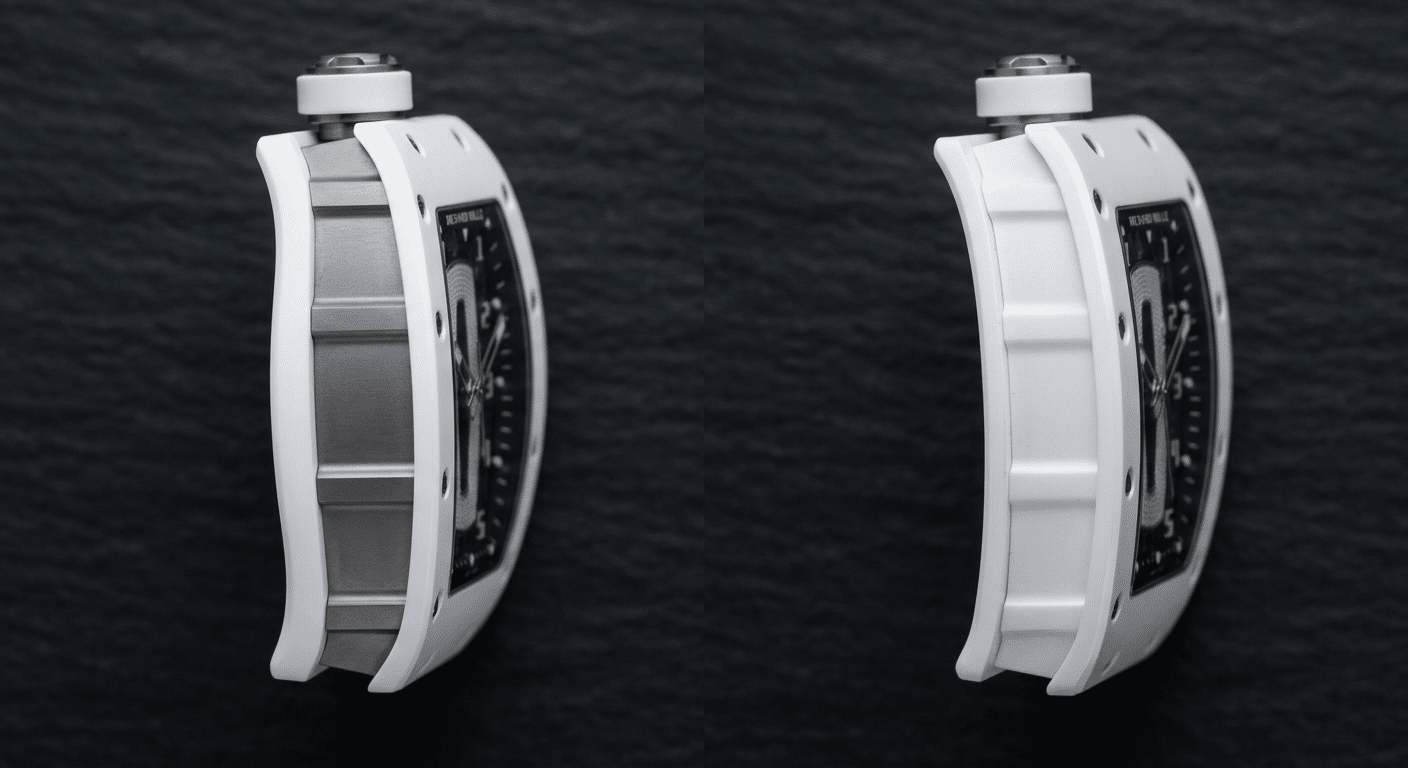
The first tell isn’t the finish—it’s the silhouette. Use a digital caliper on the case profile, particularly the curvature of the caseband where it meets the bezel and caseback. Genuine RM cases have a very specific, often compound, curve that is expensive to machine. Many replicas, even good ones, simplify this curve. APS models in their sweet spot (like the RM055) come closer, while their attempts outside it show flattening or awkward transitions.
Case Study 1: The RM055 – Why APS Owns This Model
If you need one watch to understand the APS phenomenon, it’s the APS RM055. This isn’t just a good replica; it’s a case study in how a factory’s strengths can perfectly intersect with a watch’s design to create a super clone that feels coherent and convincing on the wrist.
Geometry Simplicity: The Tonneau Case That Replica CNC Can Handle
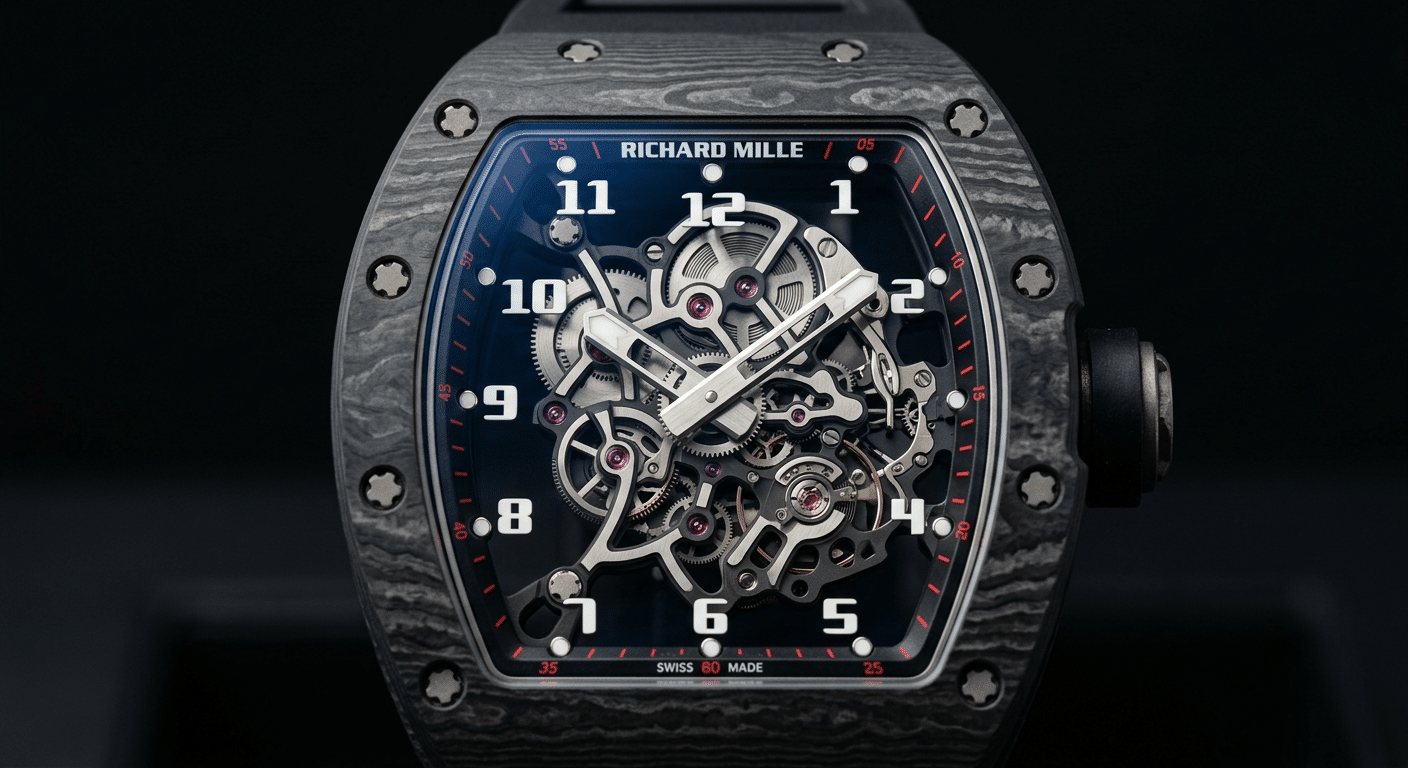
Compared to the more angular RM011 or the sculpted RM027, the RM055’s tonneau case is relatively serene. Its curves are broad and gradual. This plays directly into the capabilities of high-end replica CNC machining. APS can replicate this profile with remarkable accuracy, ensuring the watch hugs the wrist with the same distinctive RM feel. The choice of NTPT-style carbon for the case is also key—the organic, swirling pattern is visually forgiving and helps mask any infinitesimal imperfection in the case form that a solid ceramic or metal case would expose.
Skeleton Layout Clarity: One Bridge, One Challenge
Look at the dial. It’s essentially one large, skeletonized titanium bridge that covers the movement. For APS, this is a single, focused challenge: machine this one bridge cleanly, finish its edges sharply, and plate or finish it to mimic the genuine titanium look. There are no separate sub-dial rings, no overlapping chronograph registers to align. This singular focus allows for exceptional execution. The visual result is depth and sophistication without chaos.
The Thickness Win: How the Base Movement Fits the RM055 Profile
This is the mechanical masterstroke. The genuine RM055 uses the thin RMUL2 caliber. APS uses a heavily decorated Seiko NH05 (or similar) base. By sheer luck of design, the plated and skeletonized decoration of this workhorse movement fits within the RM055’s case profile without creating a thickness penalty. The watch remains close to gen-spec in height, which is half the battle in replica design. The decorated “RMUL2” you see through the caseback has the correct visual layout—the twin barrels, the gear train positioning—creating a convincing illusion at a glance.
Expert Authentication Insight
Focus on the sharpness and finish of the skeletonized titanium bridge. Under a 10x loupe, compare the inner angles of the cutouts. Genuine bridges have razor-sharp, perfectly clean interior corners. APS’s best work here will show very slight rounding or minute machining marks in the corners—a sign of CNC tool wear or a less aggressive finishing process, a subtle clue that becomes more apparent when studying factory switching in Richard Mille super clone watches. Lower-tier replicas will have obvious burrs or uneven surfaces.
Case Study 2: The RM35-01/02 – A Strong Contender in the Sports Line
The APS RM35 represents the outer boundary of their core competency. It’s a more complex watch than the 055, testing their ability to manage additional elements like a functioning rotor and a more detailed dial structure. For the most part, APS passes this test, but here is where you must pay for your watch with clear-eyed scrutiny, not blind faith.
Bezel and Case Integrity: Translating Bulk into Presence
Where APS continues to shine is in the foundational elements. The RM35’s case, with its robust bezel and integrated strap design, is executed with solidity and precision. The NTPT carbon or forged carbon texture is well-realized, and the case has the commanding, tool-like presence of the genuine article. This is APS working from a position of strength: machining a complex but structurally sound sports case.
The Rotor Compromise: Function vs. Authentic Mass
This is the most tangible compromise. The genuine RM35-02 features a platinum rotor that is incredibly dense. The APS replica uses a much lighter alloy. In practice, this means the winding rotor on the APS feels and sounds different. It spins faster and with a lighter, less substantial whirr compared to the slow, damped spin of the gen. It functions perfectly well, but it lacks the haptic, high-inertia quality that is a signature of Richard Mille’s engineering. This is a classic super clone limitation: the function is replicated, but the underlying material physics are not.
Dial Depth: When Layering Tests the Limits
The RM35’s dial is more layered than the 055’s, with its minute track and indices sitting on a separate ring inside the bezel. APS executes this cleanly, but under extreme scrutiny, the sense of three-dimensional depth can appear slightly compressed compared to the genuine article. The engraving on the dial ring might not be as deeply or crisply etched. It’s a minor point from a foot away, but it illustrates how added complexity slightly dilutes APS’s typically laser-focused execution.
Expert Authentication Insight
Listen and feel the rotor. Wind the watch and gently rotate it. The genuine RM35 rotor is heavy and spins with a dense, smooth, almost damped inertia. The APS rotor, while functional, will be noticeably lighter and spin with a faster, less substantial feel. This is a haptic and auditory tell before you even look inside.
The Boundary Lines: RM Models Where APS Stumbles or Avoids
Understanding APS Factory’s limitations is just as critical as knowing their strengths. Their expertise is not universal across the Richard Mille catalog. Recognizing where they stumble—or wisely avoid—protects you from an expensive mismatch and reinforces their identity as a strategic specialist, not a miracle worker.
The RM011 Problem: Complexity That Breaks the Coherence
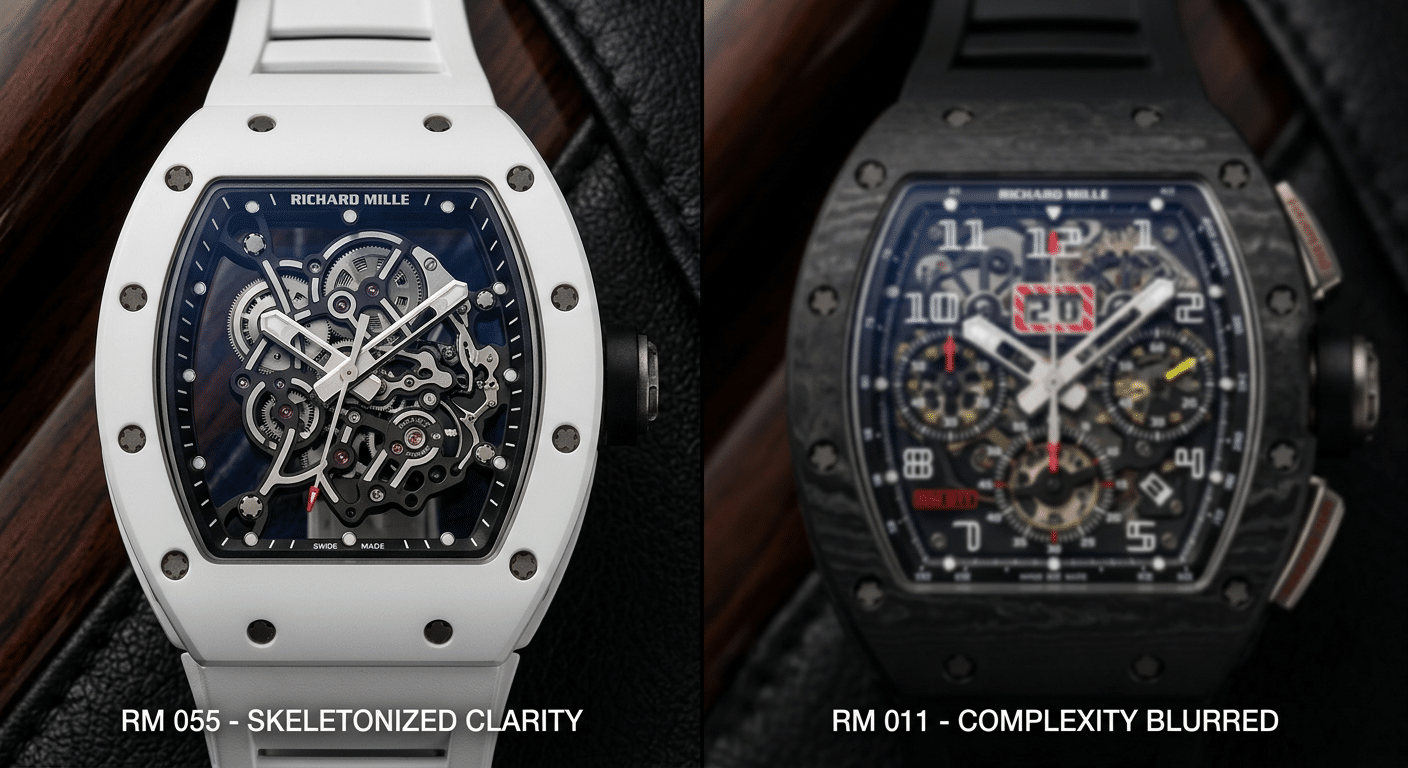
The RM011 Felipe Massa chronograph is the prime example of a model that falls outside APS’s proven skill set. While other factories like KV/KU attempt it, APS has largely steered clear, and for good reason. The RM011’s design presents a perfect storm of challenges: a multi-level dial with chronograph subdials, a date window, and a more aggressive, angular case shape. APS’s approach of using a heavily decorated base movement hits a wall here. To accommodate a chronograph function, factories must use a bulkier movement (like a Shanghai 7750), which instantly destroys the case thickness profile—a fatal flaw for a watch meant to be worn. Furthermore, the visual clutter of the dial exposes the limitations of applied decoration versus true, layered architecture. The result, when attempted by others, is a watch that feels optically “noisy” and physically chunky, losing the integrated coherence APS achieves in simpler models.
Ultra-Thin Pursuits: Why APS Doesn’t Touch the RMUP-01
If the RM011 is a stumble, the realm of ultra-thin Richard Milles like the RMUP-01 or the RM 67-02 is a boundary APS doesn’t even attempt to cross. This is a telling limitation. Achieving genuine thinness requires a complete re-engineering of the movement architecture, not just decoration. While a specialist like AVS Factory has made strides with the RM 67-02 by using custom ultra-thin movements, APS’s entire production is built on adapting existing, workhorse base calibers. These movements have a fixed, minimum thickness. To pursue ultra-thin models would require APS to abandon its core, cost-effective methodology and enter an entirely different and far more expensive engineering arena—something clearly outside their business model and current capabilities.
The “Fantasy” or Rushed Model: A Red Flag
Occasionally, you might see a dealer list an “APS” version of a brand-new or highly complex RM (like an RM 52 tourbillon or a sapphire-cased model). Treat this with extreme skepticism. APS has built its reputation on deliberate, iterative improvements to a select few models. A sudden foray into a fantastically complicated or newly released piece is almost always a red flag. It could be a different, lower-quality factory’s product being mislabeled, or a rushed, compromised job that hasn’t undergone APS’s usual development cycle. In the replica ecosystem, a factory’s discipline in what it chooses not to make is often a greater sign of quality than a long, scattered catalog.
Expert Authentication Insight
For complex models like a hypothetical APS RM011, the failure point is often dial depth and print clarity. Use macro photography to examine the edges of the sub-dial rings and the printing of the minute track. On a genuine RM011, these elements are crisply defined and exist on distinct planes. On a replica struggling with complexity, the printing may be slightly fuzzy, and the layers will appear compressed, losing the genuine’s sense of expansive depth.
The Movement Truth: Decoration vs. Architecture in APS RMs
Every judgment about APS’s strengths and weaknesses ultimately traces back to one irreducible fact: no APS Richard Mille contains a true, cloned RM movement. For a detailed breakdown of how different factories approach this critical aspect, the comprehensive Richard Mille replica factory guide provides essential context. They all use expertly decorated Japanese or Chinese base calibers. This isn’t a critique—it’s the fundamental constraint that defines the entire super clone market and explains why APS excels only where clever decoration can convincingly mimic true architecture.
The Base Caliber Reality: Seiko NH05 and Its Siblings
At the heart of most APS RM 055 and RM 35 models beats a variant of the Seiko NH05 (or a similar Chinese clone), a robust, manual-wind workhorse movement. APS’s skill lies in machining a new set of skeletonized bridges that bolt onto this base movement, transforming its appearance. The Dandong-sourced RMUL2 clones used in their best pieces are more integrated but follow the same principle: they are custom-built replicas of the appearance of an RM movement, not mechanical duplicates of Richard Mille’s in-house architecture. The base going rate, accuracy, and power reserve are those of the underlying caliber, not of a genuine RMUL2.
When Decoration Works: Skeleton Bridges and Fake Geneva Stripes
This approach succeeds brilliantly in models like the RM055. Why? Because the genuine RM055’s RMUL2 movement presents a relatively simple, open bridgework design. APS can machine a convincing replica of that single, top bridge, and the visible gear train beneath aligns plausibly with the NH05’s layout. The decoration fits the visible architecture. From the front, through the sapphire crystal, the illusion is coherent. The “Geneva stripes” are stamped, not hand-finished, but at a glance, they complete the picture.
When Decoration Fails: Chronograph Pushers and Phantom Functions
The illusion breaks down when the genuine watch’s functions exceed the base movement’s capabilities. This is the core of the RM011 problem. A genuine RM011 has a flyback chronograph and an annual calendar. No base movement in the APS price range can replicate that. Therefore, any “APS” RM011 would have to feature non-functional pushers or a completely different, thicker chronograph movement, creating immediate tells in both function and form. The decoration becomes a mask that doesn’t fit, revealing the disconnect between what you see and what the mechanics can actually do.
Expert Authentication Insight
Remove the caseback. Ignore the decoration. Look at the movement’s fundamental layout and the regulator mechanism. A genuine RM caliber is a unique, architectural beast. The APS movement will always reveal itself as a decorated base caliber by the position of the balance wheel, the shape of the mainplate, and the type of regulator (Etachron on a Seiko vs. a free-sprung balance on a gen). This is the inarguable tell.
The Buyer’s Decision Matrix: How to Use This Information
This analysis is useless if it doesn’t lead to a better decision. Let’s convert everything into a practical, three-step filter you can use right now.
Step 1: Lock the Model, Not the Factory
Reverse the common mistake. Don’t start by saying “I want an APS.” Start by asking: “Which Richard Mille design do I actually want to wear?” Is it the clean skeleton of the Bubba Watson RM055? The rugged sports appeal of the Nadal RM35? Or the complex look of an RM011? Your desired model dictates everything that follows.
Step 2: Apply the “Complexity Filter”
Now, run your chosen model through this filter:
- Clean Skeleton (e.g., RM055, RM 61-01): This is APS’s core competency. Their version should be your first and primary stop.
- Sports Automatic (e.g., RM35-02): APS is a top contender here. Proceed, but be mindful of the rotor weight and dial depth caveats. Compare with ZF’s latest offering.
- Complex Chronograph (e.g., RM011) or Ultra-Thin (e.g., RM67-02): APS is not the recommended path. Immediately look to other specialists (e.g., KV for the RM011, AVS for the RM67-02) or seriously temper your expectations regarding thickness and function.
- Tourbillon or High Complication (e.g., RM052, RM027): APS is not a major player. Focus on dedicated tourbillon factories like EUR or JB.
Step 3: QC Photo Priorities for Your APS Candidate
If your model passes the filter and you’re looking at an APS, your QC photos must check these specific points:
- Case Profile: Request a dead-on side shot. Does the caseband curvature look smooth and natural, or flattened and awkward?
- Dial Depth & Print: Zoom in on the edges of skeletonized bridges and any printed text. Is it sharp, or slightly fuzzy? Does the dial have visual depth?
- Rotor Action (for automatics): Ask for a video of the rotor spinning. Does it look and sound too light and fast?
- Bezel Alignment: Check that the screw slots are evenly aligned and the bezel sits flush with the caseband.
Expert Authentication Insight
In QC photos, request a specific shot: a dead-on, perpendicular photo of the side of the case (the caseband). This profile view is critical for assessing the case geometry and curvature discussed throughout this guide. Any distortion or poor angle hides the very flaws APS minimizes in its best models and exacerbates in its weaker ones.
Think of APS Factory not as the ‘RM experts,’ but as the ‘RM055 and RM35 specialists.’ If your heart is set on one of those models, their version deserves to be at the top of your list. For almost anything else in the RM catalog, their name alone is not a sufficient reason to buy. Start with the design you want to wear, then find the factory that has proven it can solve that specific watch’s puzzle.
Remember, you are buying the best approximation within industrial constraints, not a perfect duplicate. APS, at its best, shows where those constraints are best managed.