
The Illusion of Consistency: Why “Same Model” Means Nothing in RM Replicas
Searching for an “RM055 replica” suggests you’re looking for a specific, definable object. You assume that this search will lead you to a product with predictable dimensions, weight, and feel—a consistent interpretation of the original design. This is the first, and most critical, assumption you must abandon. In the super clone market, the model name is a marketing label, not a manufacturing specification. It’s a flag planted on a vast, shifting landscape of components and workshops. The real product isn’t defined by the design that was copied, but by the hidden chain of decisions made after the copying was done, a process best understood through a dedicated APS factory Richard Mille super clone guide that analyzes which replica models specific factories execute best.
From Blueprint to Reality: The Fragmented Production Chain
Forget the image of a single, sprawling factory humming with dedicated assembly lines for each watch model. The production of a high-end Richard Mille replica is a distributed, almost freelance operation. One specialized workshop, perhaps with exceptional five-axis CNC machines, mills the tonneau-shaped case to a certain tolerance. Another, with connections to composite material suppliers, sources and cuts the carbon fiber plates. A third entity, often in a different city like Dandong, focuses on movement assembly, creating “clone” calibers from a mix of generic Chinese base plates, custom-fabricated bridges, and occasionally, genuine Swiss spare parts. A fourth might handle the final “frankening”—swapping in an aftermarket crystal or a better mainspring.
The “factory” name you see on a dealer’s list—ZF, APS, BBR—rarely denotes the origin of all components. More often, it identifies the final assembler, the quality controller, or simply the sales agent who branded and distributed that particular batch. They are curators of a supply chain, not monolithic manufacturers. This fragmentation is the root cause of inconsistency; changing one link in this chain, even for the same “model,” results in a fundamentally different product.
The Case of the RM055: A Single Name, Multiple Personalities
Consider the ubiquitous RM055. A “Version 1” from several years ago likely featured a case that was noticeably thicker, a carbon fiber texture that was softer and less defined, and was powered by a simple, off-the-shelf Seagull movement with a decorative plate glued on top. It was an RM055 in silhouette only.
Contrast this with a “2023 ZF version.” Here, the pursuit of thinness became a priority. The case profile is more aggressive, with sharper, more precisely machined edges. The movement is a decorated clone of the RMUL2, with more attention paid to the visual layout of the gears, even if their function isn’t fully replicated. Then there’s the “custom frankened build.” This watch might combine a case from one specialist, a movement with a genuine Swiss mainspring for better torque, and an aftermarket sapphire crystal with superior anti-reflective coating. All three are sold as “RM055 NTPT.” Yet, if you tried to swap the case from one onto the movement of another, you’d likely find nothing fits. They share a name and a general aesthetic, but almost no interchangeable parts.
Expert Authentication Insight
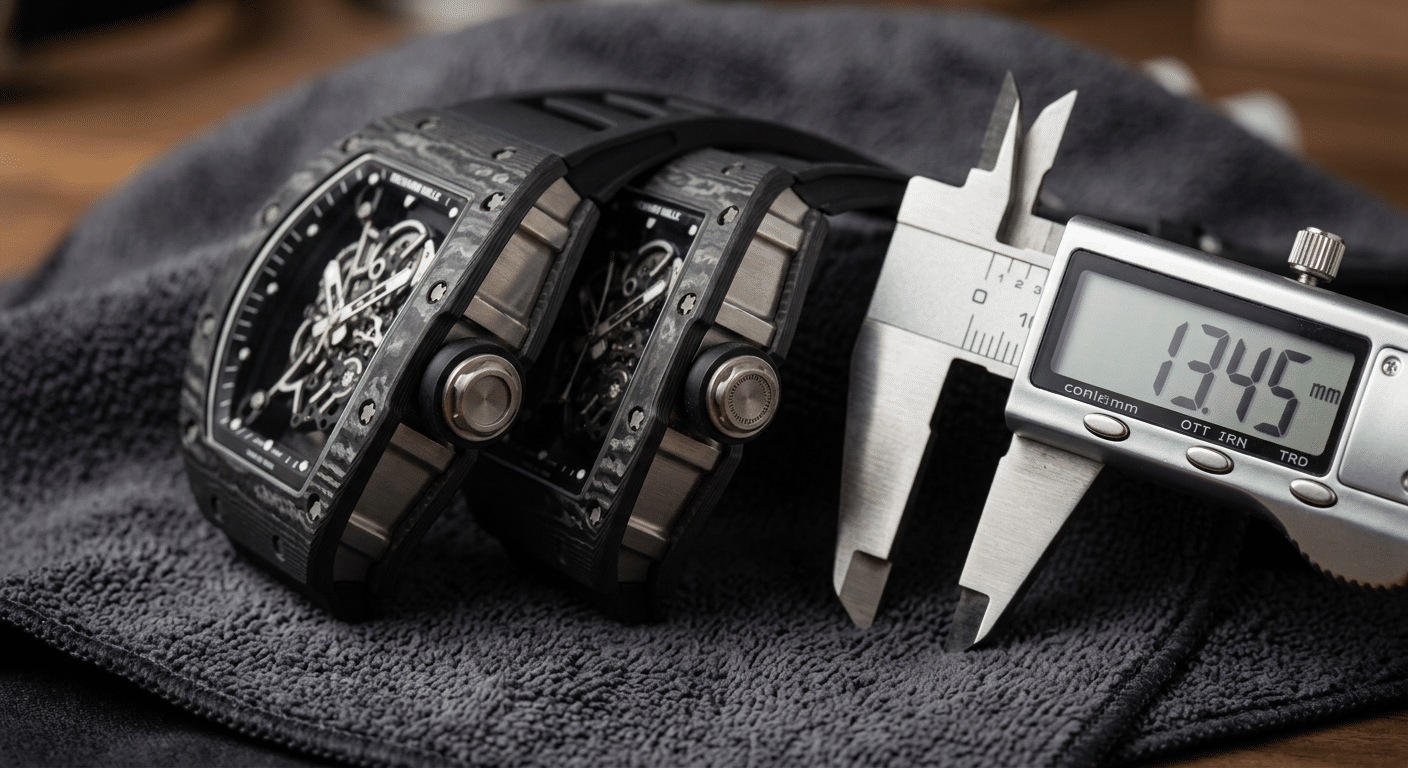
The most immediate and reliable test to cut through the “same model” illusion is a side-by-side case profile comparison. Do not rely on specs alone. Use digital calipers to measure the case thickness at its center and the lug-to-lug height. In the world of Richard Mille, where thinness and specific proportions are engineering hallmarks, variations of even 0.3mm radically alter the silhouette and wrist presence. A genuine RM has a precise, engineered thinness; replicas almost always add bulk somewhere—often in the mid-case or case back—to accommodate thicker, non-native movements. This dimensional difference is the silent giveaway.
Anatomy of a Switch: The Four Pillars of Divergence
When the production source shifts, the changes aren’t subtle or cosmetic. They manifest in four core, tangible pillars that define the entire ownership experience. Understanding these pillars moves you from an abstract awareness of inconsistency to knowing exactly what to scrutinize.
Pillar 1: The Case & Skeleton Architecture
This is the watch’s foundation. Factory A might chase the visual appeal of thinness by using a shallower case back, a decision that immediately compromises any semblance of water resistance. Factory B might prioritize structural rigidity with a thicker mid-case, which changes the weight distribution, making the watch feel more slab-like on the wrist. Look beyond overall dimensions. Examine the skeletonized bridges visible through the dial: are their edges rounded over for safety, or are they razor-sharp, mimicking genuine CNC precision? The angle of these bridges and the depth of their milling are direct results of specific CNC programming choices that vary wildly between workshops.
Pillar 2: The Movement Route: Decoration vs. Architecture
This is the heart of the divergence, and it dictates nearly everything else. The spectrum is wide. At one end is a base Miyota 8215 with a lightweight, glued-on “RM style” rotor—it’s reliable but visually and audibly wrong, with a high-pitched rotor buzz. A step up is a heavily modified Seagull ST2541, which might accept some genuine functional parts, offering better winding torque but often a louder, grating rotor sound. At the top is the true clone attempt of the RMUL2, a complex and fragile ecosystem that aims for visual fidelity but introduces its own reliability concerns and significant cost.
Your choice here dictates the watch’s destiny: its case thickness (the Miyota is thin, the true clone can be bulky), its power reserve (anywhere from 40 to 55 hours), the tactile feel of winding (smooth or gritty), and the sound it makes in a quiet room. The movement isn’t just the engine; it’s the blueprint for the case and the source of the watch’s personality.
Pillar 3: Material Sourcing & Finishing Touch
This pillar governs the sensory experience—what you see and feel up close. The “carbon fiber NTPT” can range from a matte, dry-looking composite with a subdued weave to a glossy, almost plastic-looking sheet with overly dramatic patterning. The titanium used for screws and case components isn’t a standard color; it can lean towards a cool grey, a warm grey, or even have a faint purple hue depending on the alloy and finishing process. Perhaps most underrated is the quality of the rubber used in gaskets and case seals. A denser, higher-quality compound gives the watch a more solid, precise “thunk” when the case back is screwed down, contributing to the overall impression of quality.
Pillar 4: The Forgotten Factor: Strap, Clasp, and Final Assembly
This is where the illusion often crumbles on first contact. The strap is your watch’s interface with your body. Does it have the correct curvature to hug the wrist, or does it sit flat, creating gaps? Is the rubber soft and pliable or stiff and unyielding? The clasp mechanism—whether a push-button or fold-over design—and the quality of its finish (sharp edges vs. polished contours) are frequent afterthoughts. Finally, the final assembly tolerances: how tightly and evenly the bezel sits against the case, the smoothness of the crown screw-down action. These minute details are where the feeling of “cheap” or “premium” is cemented, and they are notoriously inconsistent.
Expert Authentication Insight
Conduct a “wrist roll” weight and balance test. A genuine Richard Mille is defined by its surprising lightness and neutral balance—it disappears on the wrist. Pick up a replica and slowly rotate your wrist. Does it feel head-heavy, with the thick case front wanting to flip downward? Does it feel oddly “dead” and inert, suggesting poor internal weight distribution? A well-executed replica will mirror that genuine, almost weightless, balanced feel. A poor one will immediately telegraph its heft and imbalance. This test is qualitative but unmistakable.
Photo vs. Reality: How Marketing Obscures the Wrist Experience
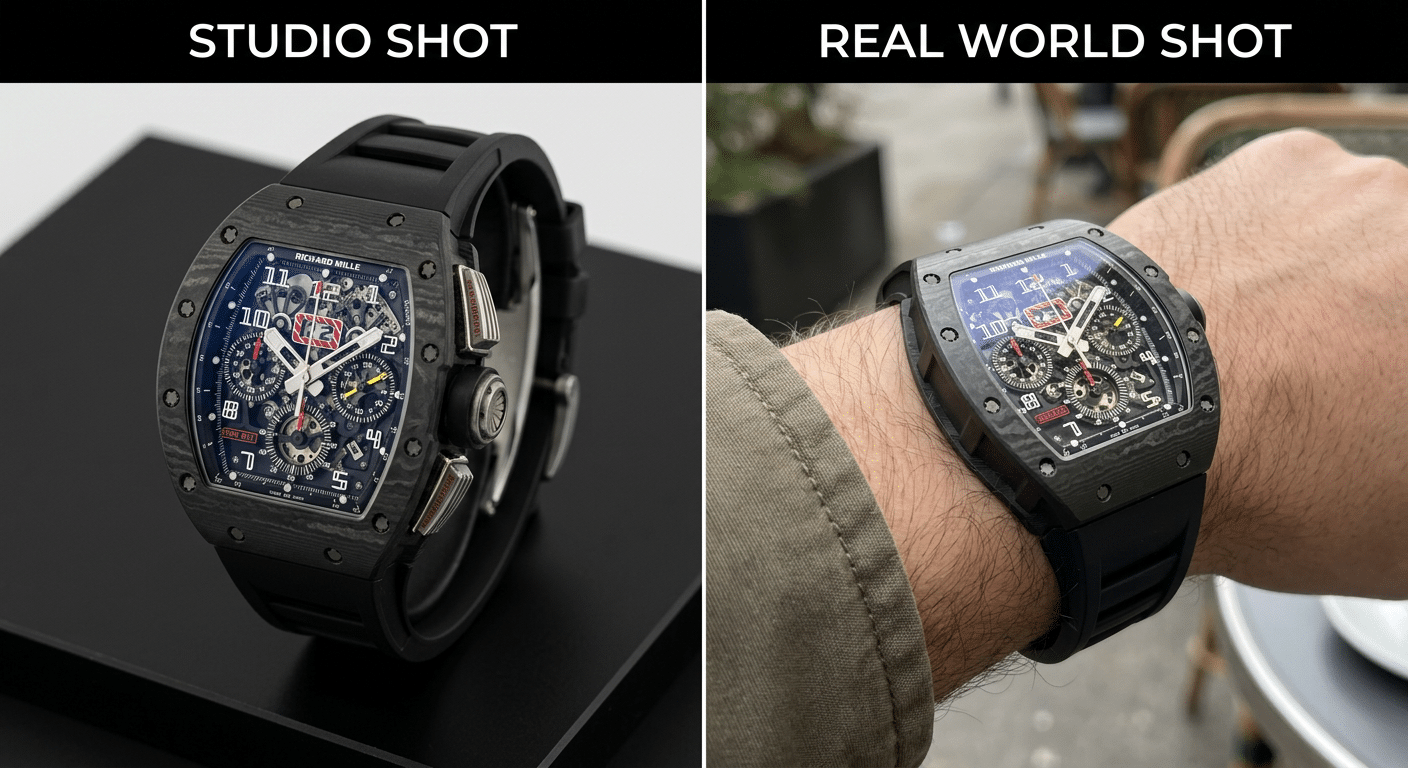
Dealer photos and videos are a seductive trap. They create a dangerous disconnect, selling an aesthetic ideal that has little to do with the ergonomic and qualitative reality of wearing the watch. The similarity you see on screen is a carefully crafted illusion, not a promise of comparable experience.
The Dealer Lens: Flattering Angles and Controlled Lighting
Promotional photography is an exercise in minimization. Macro lenses flatten perspective, making a 14mm-thick case look deceptively slender. Perfect, diffused studio lighting erases texture flaws and makes all carbon fiber—from the best forged composite to a mediocre sheet—look similarly deep and luxurious. Videos show the watch spinning gracefully on a turntable, a disembodied object of desire. What they never show is how it interacts with a human body: how it slides under a shirt cuff, how the strap bends, how light catches the case sides in motion. These images are designed to hide the very flaws you need to see.
The Wrist Reality: Proportion, Height, and Daily Interaction
The reality is in the millimeters and the moments. That 1mm of extra case height you couldn’t see in the photo is now constantly catching on your shirt cuff. The stiff rubber strap that looked sleek in the image doesn’t conform to your wrist bone, creating pressure points and gaps. The rotor that was silent in the studio video now emits a persistent, tinny whirr in your quiet office. The crown action that seemed fine in a close-up shot feels gritty and imprecise when you actually try to wind it. These are the tangible, daily interactions that define ownership, and they are systematically edited out of the marketing material.
Expert Authentication Insight
To bridge this gap, you must change the nature of your QC request. Do not settle for static photos on a pillow. Insist on a video of the watch being worn and moved naturally. Ask the dealer to simulate putting it on and taking it off. Have them tilt the watch to show the case side profile against a plain, neutral background. Ask them to gently flex the strap. This type of video reveals the true proportions, the strap’s behavior, and the overall wearability that glamour shots are designed to conceal.
Decoding the Market: From “Factory Names” to Production Signatures
In the world of genuine watches, a factory name like Patek Philippe or Audemars Piguet signifies a century of institutional standards. In the replica world, it’s a marketing flag planted in shifting sand. Your job is to stop listening to the label and start reading the watch itself. The factory name is a starting point for investigation, not a guarantee of what you’ll receive. The real identity of your RM replica is etched, milled, and assembled into its components—you just need to know where to look.
VF, ZF, BBR, “Custom”: What These Labels Actually Signal
Treat these names not as brands, but as shorthand for a known set of compromises and priorities, much like the factory version numbers and movement upgrades that have emerged through market Darwinism.
“VF” (often linked to VSF’s operations in other segments) has become associated with a specific engineering philosophy: chasing thinness. A VF-labeled RM 055, for instance, might use a shallower case back or a specially modified movement plate to shave off crucial tenths of a millimeter. The trade-off is often found in water resistance or the fragility of the ultra-thin movement architecture.
“ZF” signals an emphasis on surface-level prestige. This factory invests heavily in the visual theater of the movement. Expect sharper, more deeply engraved bridges, better-applied perlage or Geneva stripes on the plates, and a rotor that has more visual mass and finishing. The case finishing also tends to be crisper. However, this “decoration over architecture” approach can sometimes mean the underlying movement is a well-dressed, standard Shanghai or Dandong base.
“BBR” became famous for its movement innovation (the first rotating gear train clone) and for sourcing distinctive carbon fiber. A BBR case often has a more matte, textured carbon finish with a less glossy resin topcoat. The pattern might appear more “organic” or chaotic compared to others. With BBR’s reported decline, watches bearing this label now may be old stock or assembled from remaining component inventories.
“Custom” is the most honest and most dangerous label. It explicitly tells you the watch is a unique assembly. It promises a “best of” build but admits there is no standard. Consistency is zero. One “custom” RM055 might be sublime; the next, from the same assembler in a different month, might have fitment issues because the case supplier changed their milling tolerances.
The Batch Variation Trap: Even Within the “Same” Factory
This is the silent killer of buyer expectations. You do your research, decide ZF V7 is the one for you, and find a trusted dealer. You receive QC photos that match the forum reviews. You think you’ve beaten the system. What you may not know is that “ZF V7” is not a static product.
A factory is not a monolithic entity with locked-down specs. It’s a network of suppliers. Between Batch 1 and Batch 3 of the “same” model, several invisible shifts can occur: The CNC workshop might have worn down a cutting tool, resulting in slightly softer bevel edges. The supplier of the titanium screws might have switched alloys, changing the hue from grey to a faint purple. Most critically, the movement assembler might have changed the source of the mainspring or the shock absorbers within the same Dandong base caliber.
The result is that your watch and the one in the review you studied might feel like cousins, not twins. The dial printing could be a micron thicker. The lume might be a shade greener. The rotor might spin with a different sound. These are not flaws in the traditional sense; they are the inherent characteristics of a decentralized, agile, and opaque production chain.
Expert Authentication Insight
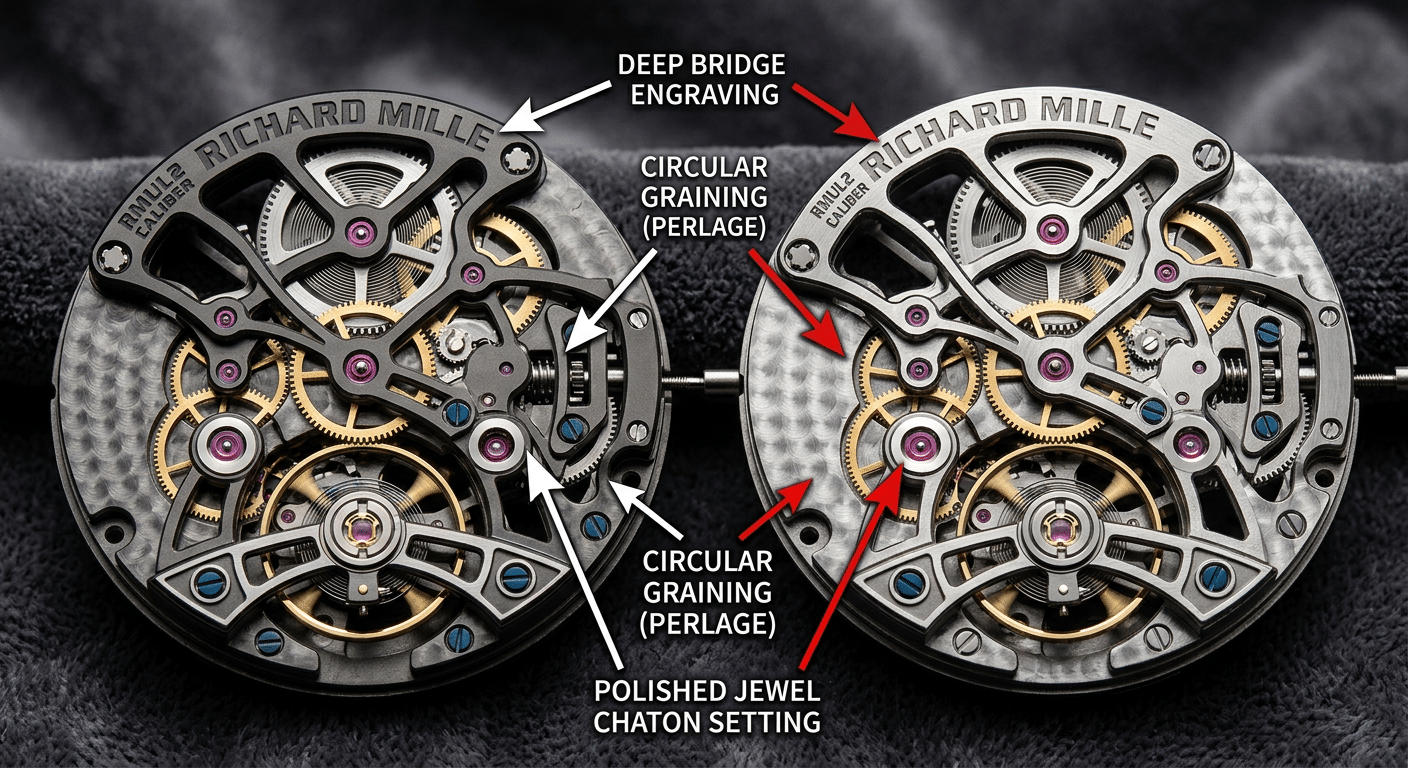
Become an expert in movement decoration tell-tales. This is where factories leave their fingerprints. Under a 10x loupe, ignore the broad strokes and focus on the minutiae:
- Bridge Finishing: Is the perlage (circular graining) uniform and fine, or coarse and uneven? Are the Geneva stripes machined or stamped? ZF often has deeper, more defined stripes.
- Engraving Depth and Font: Compare the “RM” logos and caliber markings. Are the letters crisp with sharp interior corners, or slightly soft? Each factory’s CNC program has a signature depth and tool path.
- Jewel Settings: Examine the chatons (the metal settings for the synthetic rubies). Are they perfectly polished and flush, or do they have a rough, cast appearance? The color of the jewel itself can also vary from a deep, transparent red to a more opaque burgundy.
These details are harder to change batch-to-batch than something like a case. They point directly to the movement decoration workshop’s specific tools and techniques, giving you the true “production signature.”
So you understand the chaos. Now what? The frustration of buying a replica Richard Mille is the absence of a clear “best” choice. You’re not comparing a Rolex Submariner from Clean Factory versus VSF, where the differences are well-documented and ranked. You’re navigating a spectrum where every option is a compromise in three key dimensions. The first step is to stop looking for the perfect watch and start deciding which imperfections you can live with.
Identifying Your Priority: Fidelity, Wearability, or Reliability?
You must choose one primary driver. These three pillars are often mutually exclusive.
Maximum Visual Fidelity: You want the watch that will pass the “Instagram test” and the glance across a room. This prioritizes case shape, dial details, and finishing. You’ll chase the factory with the sharpest bezel edges, the most accurate carbon pattern, and the best movement decoration. Be prepared to accept a thicker case (if the movement demands it) and potential reliability quirks from a highly modified, visually focused movement.
Ultimate Wearability and Comfort: You plan to actually wear this watch daily. Your priority is thinness, weight, and strap ergonomics. You’ll seek out the specific factory or batch known for the slimmest profile, even if it means the movement inside is a simpler, less accurate-looking caliber. The watch should disappear on your wrist, not catch on cuffs. This path often leads to newer factories like AVS for the RM 67-02, where thinness is the core goal.
Worry-Free Reliability: You want a watch that runs for years with minimal fuss. This prioritizes a robust, serviceable movement. You might deliberately choose a replica with a well-known base like a Seagull ST2541, even if it has a standard regulator arm instead of a free-sprung balance. It’s thicker and less gen-like, but every watchmaker in the world can fix it. This is the “tortoise” approach in a market of hares.
Pick one. If you try to optimize for all three, you’ll either end up with a “custom” build at five times the price, or you’ll be perpetually disappointed.
The Question You Must Ask (That Most Dealers Hate)
Dealers thrive on ambiguity. Your weapon is specificity. Shift the conversation from “Is this a good RM055?” to “What are the exact specifications of *this specific watch* you are offering me?” Here is your script:
- “Please measure and provide the exact case thickness in millimeters at the center of the case, not just the listed spec.”
- “Can you confirm the base movement caliber (e.g., Dandong 925, Shanghai 2551)? What specific modifications were made to it?”
- “I need a video of the watch on a wrist, tilted to show the side profile. A static turntable video is not sufficient.”
- “Describe the carbon fiber finish. Is it matte or glossy? Can you send a macro shot in natural light?”
- “What is the lume color? Is it blue or green? Send a photo after charging it with a light.”
This line of questioning does two things: it forces the dealer to engage with the physical object, and it immediately separates sellers who have the watch in hand from drop-shippers who are just forwarding factory photos.
Expert Authentication Insight
If possible, before purchasing, source and compare high-resolution photos of the specific movement. This is your single most powerful tool. Go to forum threads for the factory/model you’re considering, consulting a detailed Richard Mille replica factory guide to better understand movement variations and finishing standards. Find clear, high-resolution images of the movement from confirmed owners. Then, demand equally clear photos from your dealer.
Compare: the shape of the bridges, the type and finish of the screws (flathead vs. hex, blued or not), the pattern on the mainspring barrel, and the style of engraving on the rotor. The movement is the heart of the watch and the component least likely to be swapped out casually. Matching these details to a known, reviewed example is the closest you can get to knowing what you’re buying before it arrives.
The “Frankening” Pathway: Controlled Inconsistency by Design
For a subset of buyers, the entire factory game is a distraction. Their goal isn’t to find the best batch from a mass producer; it’s to build a singular artifact that gets as close to the genuine article as physically and financially possible. This is the world of “frankening”—intentionally creating a watch from disparate, often superior components. Here, factory switching isn’t a problem; it’s the entire methodology.
Building a “Best Bits” Watch: Sourcing the Ideal Components
A frankened RM build is a watchmaking curation project. The builder acts as an editor, selecting each component from the supplier that does it best:
- The Case: Sourced from Factory A, renowned for its perfect bezel curvature and 1:1 profile when measured against gen blueprints.
- The Movement Plate & Bridges: Taken from a high-decorated ZF movement for their excellent engraving, but then stripped and refined by hand.
- The Balance Assembly: A genuine Swiss Incabloc shock system or a custom-fabricated free-sprung balance wheel might be installed.
- The Crystal: A genuine Richard Mille sapphire crystal with flawless double-sided anti-reflective coating.
- The Strap & Clasp: An aftermarket strap from a specialist like Horatech or a modified genuine strap for correct curvature and feel.
The assembler, not a factory, becomes the quality control. Consistency is personal and varies wildly with the builder’s skill, patience, and access to parts. You are not buying a product; you are commissioning a project.
The Cost vs. Control Equation
The financial leap is staggering. A standard super clone RM055 might cost $800. A fully frankened version with a genuine crystal, heavily modified movement, and aftermarket parts can easily reach $2,500 to $4,000. You are paying for:
- Component Cost: Genuine and high-end aftermarket parts are exponentially more expensive.
- Labor: Dozens of hours of skilled assembly, modification, and regulation.
- Scarcity & Access: The builder’s network and ability to source rare parts.
This path solves the inconsistency problem by taking total control, but it introduces new risks: part compatibility issues, the builder’s potential lack of formal watchmaking training, and the absolute lack of recourse if something goes wrong. There is no “factory warranty,” only the builder’s reputation.
Expert Authentication Insight
For a frankened build, your due diligence shifts from inspecting the watch to vetting the process. Insist on documented proof of component origin. A reputable builder will provide:
- Clear, dated photographs of all major components (case, movement, genuine parts) before assembly begins.
- For genuine components, photos that show any serial numbers or distinctive markings.
- A detailed breakdown of the source for each part (e.g., “case from ZF Batch X, movement base from APS, genuine crystal sourced from [Supplier], strap from Horatech”).
- Regular progress updates with photos during assembly.
This paper trail is your only guarantee. It transforms the build from a black-box mystery into an auditable project. If a builder hesitates to provide this transparency, walk away. The risk is not just financial—it’s the risk of receiving a box of expensive, incompatible parts masquerading as a watch.
Conclusion: Embracing the Hunt, Not the Hype
After navigating the fragmented reality of factory switching, a single, liberating truth emerges: there is no finish line. The search for a Richard Mille replica isn’t a quest to locate “the” definitive version, because it doesn’t exist. It’s an ongoing process of matching your personal calculus of priorities—thinness, movement aesthetics, material feel, reliability—against the ever-shifting menu of compromises offered by a decentralized, non-standardized production ecosystem.
Success in this market isn’t measured by how close you get to a mythical 1:1 perfect copy. It’s measured by how well you understand and control the trade-offs you’re making. The factory name on a dealer’s list is not a guarantee; it’s a starting point for an investigation. The model name is not a specification; it’s a loosely defined aesthetic theme around which dozens of different watches are built. Accepting this fluidity is the first step toward genuine satisfaction.
Abandon the Search for Perfection
Every single Richard Mille replica, from the $400 clearance special to the $2,400 custom franken, is a collection of engineered compromises. The factory that nails the case profile might use a noisy, decorated Seagull movement. The workshop that sources the best carbon fiber plate might pair it with a subpar rubber strap. The assembler who builds a stunningly accurate-looking RMUL2 clone might do so in a case that’s half a millimeter too thick.
The pursuit, therefore, shifts from an impossible chase for perfection to an intelligent management of concessions. You must decide: Am I willing to accept a louder rotor for a more visually faithful movement decoration? Can I live with a slightly stiffer strap if it means the case is within 0.2mm of gen thickness? Does a true, functional tourbillon matter more to me than overall case finishing? There is no version that escapes these questions. Your goal is to find the build where the compromises align with what you value most, and where the sacrifices fall in areas you care about least.
Your New Buying Philosophy
Forget everything you thought you knew about buying a watch. Your new methodology is forensic, not aspirational.
Step 1: Define Your Non-Negotiable. Before you even look at a photo, decide on the one thing you cannot compromise on. Is it wrist presence (prioritize case thinness and profile)? Is it mechanical credibility (prioritize movement architecture and decoration)? Is it daily wearability (prioritize strap comfort and rotor silence)? This single priority becomes your north star.
Step 2: Map Priority to Production Path. Your non-negotiable points you toward specific factories or builder types. If thinness is king, you’re immediately looking at APSF for the RM055 or AVS for the RM67-02, and asking every dealer for caliper-measured thickness. If movement look is everything, you’re diving into forums to compare the bridge shapes and engraving of Dandong V2 versus UMI free-sprung clones, and you’re budgeting for a potential service.
Step 3: Scrutinize the Specific, Not the General. You are no longer buying “an APSF RM055.” You are evaluating a specific watch from a specific batch. Your conversation with the dealer changes from “Is this the best?” to a precise interrogation: “Can you provide a video showing the side profile on a wrist?” “What is the exact thickness measurement at the case center?” “Can I see a macro shot of the balance wheel and the engraving on the main bridge?” You demand evidence of the claims.
In essence, you are no longer a consumer purchasing a finished product from a brand. You are a commissioner, sourcing a complex artifact from a opaque and distributed supply chain. The dealer is your agent, not your manufacturer. Your satisfaction depends entirely on your willingness to understand that chain’s workings—the case source, the movement origin, the assembly point—and to specify exactly what you want from it.
The label on the box is meaningless. The understanding in your head is everything. Embrace the hunt for what it truly is: not about acquiring hype, but about acquiring knowledge and applying it with precision to get a watch that fits you, flaws and all.