
The Version Number Illusion: Why “New” Doesn’t Always Mean “Better”
When you see a dealer touting a “V7” or “latest batch upgrade,” it’s natural to assume a linear, meaningful progression. In the world of software or cars, a higher version number signifies a better, more refined product. In the replica Richard Mille market, that assumption is your first mistake. The reality is a chaotic ecosystem where version numbers are more often marketing tools, batch identifiers, or reactions to supply chain hiccups than genuine engineering milestones, a phenomenon thoroughly examined in our detailed analysis of factory switching in Richard Mille super clone watches. This unpredictability makes understanding batch evolution and case finishing standards more critical than ever for accurate assessment.
Chasing the highest number is a fool’s errand. Your real goal should be identifying the best-executed specimen of a specific model, which may be labeled V3, V5, or something else entirely. Understanding why a “new version” appears is the first step toward cutting through the hype.
The Four Real Reasons a “New Version” Appears
Not all factory upgrades are created equal. Typically, a new version number is slapped on for one of four reasons:
- A Genuine Fix to a Major Flaw: This is the holy grail—a factory retools to correct a critical error in case thickness, dial skeletonization, or movement function. This is rare and significant.
- A Change in Material Supplier: The carbon composite batch runs out, the ceramic source changes, or a new strap vendor is found. The watch might look or feel slightly different, but it’s not necessarily “better.”
- A Cosmetic Tweak: This encompasses 90% of announced batch updates. Think: a darker tint on the sapphire crystal, brighter lume, deeper caseback engraving, or a new screw color. It’s visual minutiae that does nothing for core accuracy.
- Pure Marketing Refresh: Sales are slow. The factory has a warehouse of the same watches. Slapping a “VX” on the listing creates a sense of novelty and justifies clearing old inventory at the same price.
Case Study: When V2 Was a Step Back (The RM055 “NTPT Shift”)
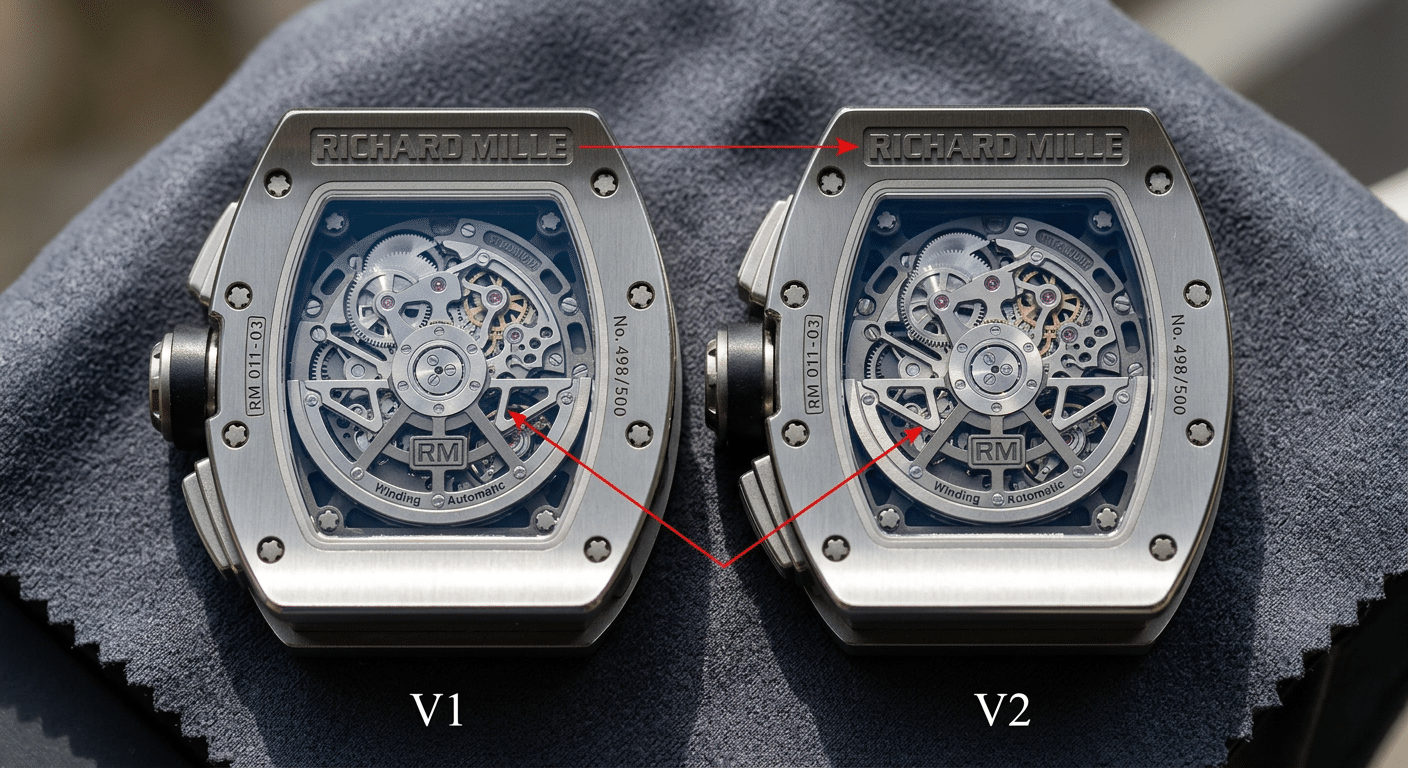
A notorious example involves early RM055 replicas. The V1 from a major factory used a carbon composite with a decent, random pattern. The V2, marketed as an upgrade with “improved carbon,” switched to a supplier whose material had a more pronounced, repetitive wood-grain pattern. To a trained eye, the V2 was actually less accurate to the genuine NTPT’s subtle, non-repeating layers. Buyers paying a premium for the “upgraded” V2 received a watch that was arguably worse. This highlights the danger of assuming linear progress.
Expert Authentication Insight
Authentication Focus: Assessing if a “version change” aligns with genuine model evolution or reveals replica-specific tooling quirks.
Genuine Richard Mille evolution is driven by material science (new composites, alloys) or movement architecture (new calibers). Replica “upgrades” typically focus on fixing their own persistent flaws: case thickness, wrong balance wheel types, or poor carbon patterning. When evaluating a version claim, ask: Does this change mirror a genuine innovation, or is it correcting a mistake the factory itself made two versions ago? The latter is far more common and reveals the iterative, self-referential nature of the replica improvement cycle.
Decoding the Big Three: Case, Dial, and Strap “Upgrades”
Once you move past the version number, you need a forensic toolkit. Most claimed improvements fall into three zones: the case, the dial, and the strap. Knowing what to look for—and what to ignore—is how you separate meaningful progress from marketing noise.
Case Geometry: The Most Meaningful (and Rare) Upgrade
The complex, multi-part tonneau case is a Richard Mille signature and the hardest thing to replicate accurately. A meaningful upgrade in case accuracy is the most valuable but least common. Focus on:
- Thickness: The single most telling metric. A 0.5mm reduction toward the genuine specification is a major engineering achievement. A claim of “thinner case” without a measurement is meaningless.
- Contour and Shape Fidelity: Do the lugs curve correctly? Does the caseband profile match the gentle, organic swell of the genuine? This requires retooling and is a sign of serious investment.
- Material Texture: For carbon models, does the new “carbon fiber pattern” look more random and less “printed” than the last batch? This is often a supplier change, not a retooling, but can improve visual credibility.
Dial Details: Where “V7” Often Just Means Brighter Lume
Dial upgrades are the most frequent and most overhyped. Factories love to tout “updated dial” because it’s cheap to execute. Be skeptical of:
- “Improved Lume”: This almost always means a different shade of green or blue luminous paint. It has zero impact on accuracy to the genuine watch’s appearance in daylight.
- “Sharper Printing”: Minor improvements in the tiny text on the flange or dial edges. Worthwhile only if the previous printing was catastrophically bad.
- Skeletonization Accuracy: A genuine upgrade would involve reshaping the decorative bridges to match the genuine geometry. What you usually get is a cleaner bevel on the existing, slightly wrong shape.
The Strap & Buckle: The Unsexy Upgrade That Matters Daily
You interact with the strap and buckle every time you wear the watch. An upgrade here, while unglamorous, directly impacts comfort and perception of quality.
- Buckle Quality: Does the new version have a buckle that closes with a more secure, refined click? Is the finishing less sharp? This is a tangible improvement.
- Strap Material and Finishing: A shift from a stiff, generic rubber to a softer, more pliable fluoroelastomer is a major win. Cleaner, molded edges on the strap also signal better production.
- Rotor Decoration: If an automatic model claims “upgraded rotor,” see if it’s just more glittery perlage or an actual change in the rotor’s shape and skeletonization to match the genuine piece.
Expert Authentication Insight
Authentication Focus: Using calipers and macro photography to measure case thickness and profile against genuine specifications, and analyzing carbon weave pattern repetition versus genuine randomness.
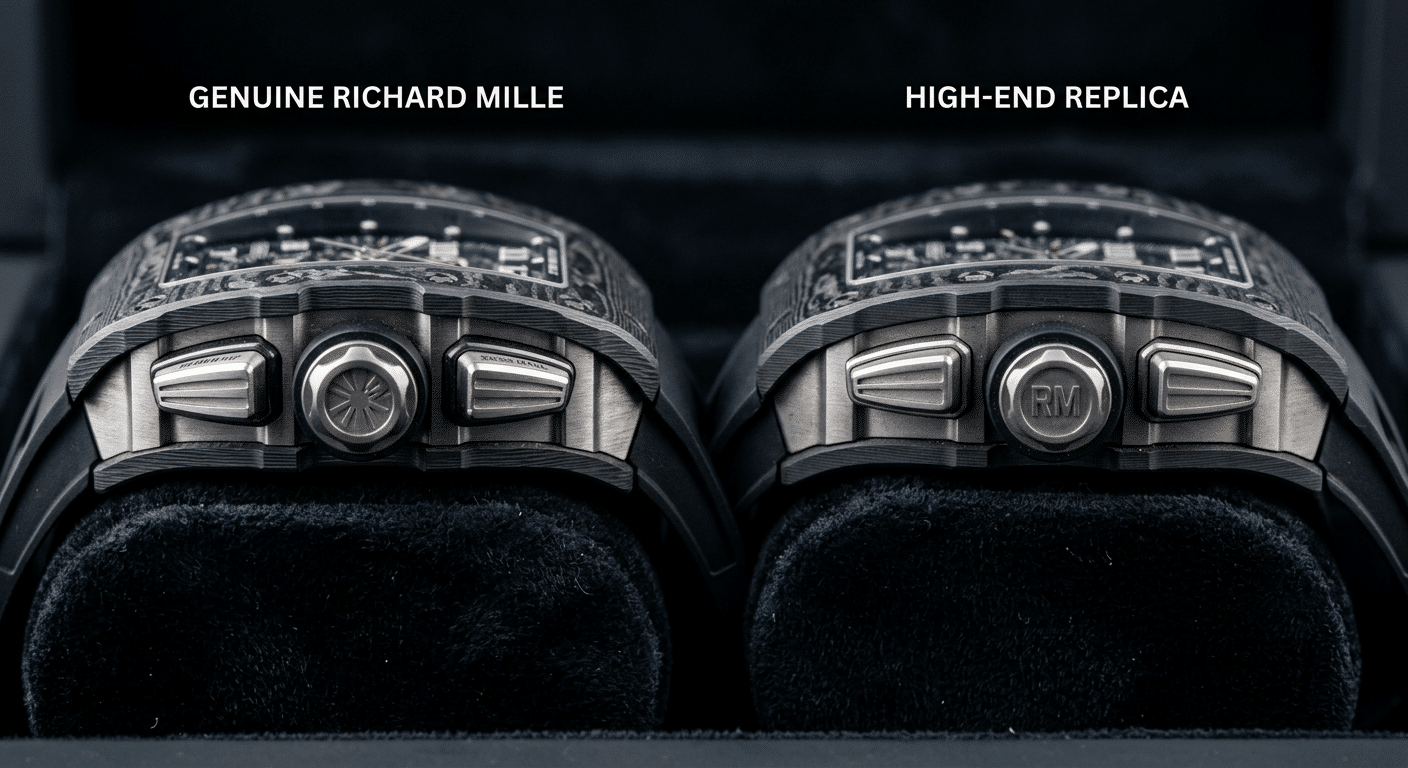
The genuine article is the only reliable ruler. For the RM055, the case is 8.7mm thick. A replica measuring 9.5mm has a fundamental flaw no “version” can fix without a complete redesign, a key point highlighted in the best Richard Mille clone factory comparison. Similarly, genuine NTPT carbon has a non-repeating, wave-like pattern. If you can spot a repeating sequence in the replica’s carbon every few centimeters, that’s a material limitation, not a version-specific detail. True upgrades work to minimize these gaps; cosmetic ones just distract from them.
Movement Upgrades: The Deepest Minefield (Sellita, Miyota, and “Clone” Claims)
This is where the most significant functional upgrades—and the most elaborate deceptions—occur. A change in the RM replica movement can transform the watch’s performance or introduce new headaches. Navigating this requires understanding the hierarchy of what’s inside.
From Miyota to Sellita: The One Worth-Paying-For Upgrade
This is the clearest, most justifiable upgrade path. Early or budget replicas often use a decorated Miyota 9015 replica base (21,600 vph). A genuine upgrade occurs when a factory switches to a decorated Sellita SW200 replica base (28,800 vph).
Why it matters: The Sellita not only matches the genuine RM’s higher beat rate for a smoother seconds sweep, but it’s generally a more robust, reliable, and serviceable movement. If a version change specifies “upgraded to Swiss Sellita movement,” and you can verify it, this is a premium worth paying for long-term ownership satisfaction.
“Clone” Movements: Aesthetic Leap vs. Reliability Gamble
The term “clone movement” is often misused. It rarely means a true 1:1 mechanical clone of an RM calibre. Usually, it refers to a custom-made base plate (often housing a Seagull or Hangzhou movement) with decorative plates skeletonized to *look* like the genuine RMUL2 or RMUL3 movement.
The Trade-off: The aesthetic improvement can be dramatic, bringing the watch much closer to visual parity. However, you’re venturing into unknown territory regarding long-term reliability and repairability. These are low-volume, complex assemblies. When they fail, finding parts or a watchmaker willing to work on them is challenging.
Rotor Noise and Power Reserve: The Practical Benchmarks
Forget marketing poetry; judge a movement upgrade by two tangible metrics:
- Rotor Noise: A loud, grinding rotor is the hallmark of a cheaply decorated movement. A meaningful upgrade should result in a quieter, more refined winding sound.
- Power Reserve: Does the watch actually run for the claimed 40+ hours? An upgrade that moves from a 30-hour reserve to a consistent 45-hour reserve is a concrete functional benefit.
Expert Authentication Insight
Authentication Focus: Identifying base movements under the decoration through balance wheel beat rate (28,800 vph vs 21,600 vph) and rotor bearing architecture, and assessing the quality of decorative Geneva stripes and perlage.
Listen and look. A 28,800 vph movement ticks 8 times per second; a 21,600 vph ticks 6 times. This is a quick auditory tell. Visually, examine the balance wheel: a standard regulator arm (a tiny lever with +/- markings) is a dead giveaway it’s not a genuine RM free-sprung balance. Also, look at the movement decoration. Machine-applied Geneva stripes that are too perfect, shallow, or uniform in spacing are signs of decorative plates, not finished bridges. Real upgrades improve these details; fake ones just add more glitter.
The Model-Specific Version Histories: RM055, RM011, RM035
The abstract principles of versioning become concrete when applied to real models. The replica journey of the RM055, RM011, and RM035 demonstrates how each watch presents a unique set of challenges, and how factories have (or haven’t) addressed them over time. Looking at these histories isn’t about memorizing a timeline; it’s about learning which flaws were critical enough to fix, and which “upgrades” were merely cosmetic noise.
RM055: The Battle for Correct Thickness and Carbon
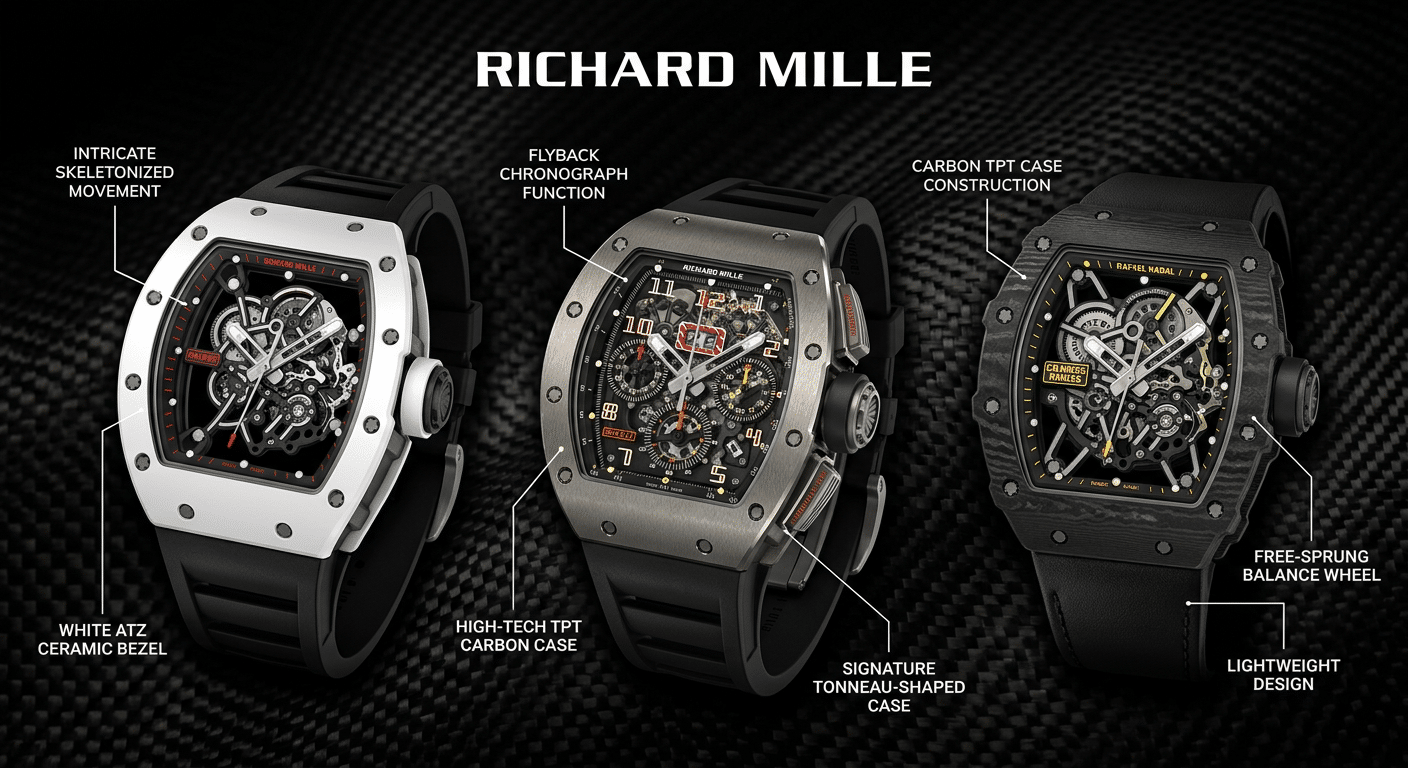
The replica RM055 story is a two-front war: case dimensions and material authenticity. Early versions from factories like KV were fundamentally flawed—too thick, with a crude, printed-looking carbon pattern. The first meaningful upgrade came when factories like BBR and later ZF began using actual forged carbon composites, moving away from painted patterns. This was a visual leap, but the case remained a chunky homage.
The next significant milestone was the correction of case thickness and profile. The genuine RM055 is an exercise in slim, ergonomic engineering. Replicas that shaved off a full millimeter, achieving a profile closer to 13.5mm, represented a major effective upgrade in wearability and silhouette, a key topic often detailed in a comprehensive Richard Mille replica factory guide. Concurrently, leaders like APSF focused on refining the carbon weave pattern to appear more random and less “striped,” closer to the genuine NTPT’s layered effect. Crucially, the movement evolution—from decorated Miyotas to integrated clone calibers like the Dandong RMUL2—was a separate but parallel track. The “best” RM055 replica version isn’t the highest number; it’s the first iteration from your chosen factory that combined the thinner case, better carbon, and a reliable clone movement.
RM011: Chronograph Sub-Dial and Date Font Evolution
The RM011 replica faces a fundamental mechanical constraint: the genuine watch uses a sophisticated flyback chronograph module. Replicas predominantly rely on the thicker Shanghai 7750 movement. This means the battle for accuracy is often a losing one on thickness, so upgrades focus on visual details. The chronology of the RM011 replica best version is less about structural overhauls and more about refining these details.
Key upgrade milestones have included the sunburst finishing on the chronograph sub-dials. Early versions had flat, lifeless sub-dials, while later batches introduced a finer, more authentic radial brush. The date wheel and its font have been another focal point—aligning the date perfectly in the window and matching the distinctive, modern font of the genuine. Caseback engraving depth and clarity have also seen iterative improvements. However, it’s vital to acknowledge that the primary producer, KVF (now KU), operates in a different tier than the super-clone factories. Their “upgrades” are often within this budget framework. For the RM011, a meaningful upgrade is less about a version number and more about selecting a specimen with the best-executed dial details, as the core thickness flaw remains largely unaddressed.
Expert Authentication Insight
For the RM035 Rafael Nadal replica, the most telling flaw is often the dial gradient. The genuine features a subtle, sophisticated color transition. Many replicas exhibit a flat, monochromatic tone or an overly harsh gradient line. For the RM055, examine the font weight on the flange (the inner rehaut ring); replica fonts are often too bold or too thin. For the RM011, the curvature of the caseback is a giveaway—genuine cases have a specific, complex curvature that replicas struggle to replicate perfectly, often resulting in a flatter or differently angled profile.
The Buyer’s Decision Framework: How to Judge an “Upgrade” Claim
Armed with an understanding of market mechanics and model histories, you now need a filter. When a dealer advertises a “New V7” or “Updated Movement,” your job is to dissect the claim with surgical precision. This framework turns you from a passive consumer of marketing into an active analyst.
The Five Questions to Ask Before Paying a “New Version” Premium
1. Ask “Where?” Demand immediate specificity. Is the claimed upgrade to the case, dial, movement, or strap? Vague claims are red flags.
2. Ask “How Much?” Quantify the change. Is it a 0.2mm reduction in thickness or just a new batch of straps? Is it a swap from a Miyota 8215 to a Sellita SW200 (significant) or just “brighter lume” (insignificant)?
3. Ask “Prove It.” Require evidence. Side-by-side comparison photos with the old version are the only credible proof. Promotional beauty shots prove nothing. Search forum reviews for that exact claimed change.
4. Prioritize the Hierarchy. Not all upgrades are created equal. A movement upgrade to a higher-beat, more reliable caliber or a fundamental correction to case geometry is worth a premium. A change in screw color, caseback engraving depth, or strap supplier is not.
5. Ignore the Number, Focus on the Specimen. The version tag is a label, not a guarantee. Your goal is to secure a watch with the best execution of case shape, dial details, and movement for your budget. This ideal combination might be sold as a V3 from one TD and a V5 from another.
Hierarchy of Upgrades: What’s Worth Your Money
To spend wisely, you must rank potential improvements by their impact on authenticity and experience:
- Tier 1 (Worth a Premium): Movement replacement (e.g., Miyota to decorated Sellita SW200), major case geometry correction (reprofiled lugs, corrected thickness >0.5mm), material change (painted to real carbon composite).
- Tier 2 (Nice-to-Have): Improved dial detail finishing (better sunburst, aligned dates), upgraded strap quality (softer rubber, better buckle), minor case finish tweaks.
- Tier 3 (Ignore): “Updated” lume color, different screw colors, new packaging, vague “better engraving” claims, any change described only as “the latest batch.”
This hierarchy is your financial logic. Investing in Tier 1 upgrades gets you meaningfully closer to the genuine article. Paying extra for Tier 3 is paying for marketing.
Expert Authentication Insight
The final step in evolving from a version chaser to a discerning buyer is building a personalized QC checklist. This moves you beyond “is this a V6?” to “does this specific watch meet the critical benchmarks?” For any model, your checklist should start with the genuine watch’s definitive specs: exact thickness, lug-to-lug, and key visual landmarks (e.g., the shape of a skeletonized bridge, the color of a tinted crystal). Your replica buying guide is not a forum thread listing versions; it is this checklist, derived from studying the genuine reference. You’re now buying a physical object, not a story about its version number.
The Realist’s Verdict
Chasing the highest version number is a fool’s errand, a game designed to keep you perpetually buying the “next” thing. Your goal is not to find the latest version; it is to identify the iteration of your desired model that first solved its core, fundamental flaws—typically case thickness/shape and movement choice. For most popular RM models, that “sweet spot” version was reached several numbers ago. Every version claim beyond that point is likely marketing minutiae, a cosmetic tweak masquerading as progress.
Therefore, shift your energy. Stop decoding VX and start scrutinizing QC photos. Spend your time comparing case profiles, examining movement decorations, and verifying dimensions. The version is a label. The watch in the photos is the product. Buy the specimen, not the story.