
The ZF Paradox: A Factory Out of Time in the Richard Mille Replica Market
In the high-stakes, technically obsessive world of Richard Mille replicas, the conversation today is dominated by two names: APS and JB. They represent the cutting edge, the new paradigm. ZF, once the undisputed king, is rarely mentioned in the same breath as the current champions. This is not an article to revive a fallen king or argue for its forgotten supremacy. It is a map of a specific, shrinking territory. Understanding ZF’s residual utility, especially when navigating transitional super clone versions and their real value, is a lesson in pragmatic watch buying—it’s about recognizing when “good enough,” with all its known compromises, is a smarter strategic choice than chasing the bleeding edge. The goal is to reset expectations away from nostalgia and toward a clear-eyed, model-by-model evaluation of what this factory still offers, and more importantly, to whom.
From Benchmark to Benchmark: ZF’s Historical Context
To understand ZF’s current position, you must first understand its foundational role. Around 2020, ZF didn’t just enter the RM replica market; it defined what a “super clone” could be for the brand. When factories like KV offered passable homages, ZF introduced the RM 055 Bubba Watson and early RM 035 models with a level of case finishing, dial detail, and movement decoration that felt like a generational leap. They established the baseline expectation: a replica should not just look like an RM from across a room, but should withstand a closer, more critical inspection. This early work created immense market familiarity. For years, “ZF” was synonymous with the best you could get. They became a known quantity—predictable in their quality and, crucially, in their flaws. This historical context isn’t praise; it’s the reason ZF still has a seat at the table, even if it’s no longer at the head.
The Modern Contenders: Why APS and JB Redefined the Game
The paradigm shift wasn’t incremental; it was architectural. Factories like APS and JB didn’t just make a better version of what ZF did; they changed what was possible. The battle moved from surface-level decoration to fundamental construction.
Where ZF often uses a heavily decorated base movement (like a Seagull or Miyota) with add-on plates to mimic the RM skeleton, APS and JB develop integrated clone movements. These are built from the ground up to replicate the genuine architecture, bridge shapes, and gear train layout. The difference is not just visual; it often enables a thinner case. For example, achieving a case profile within fractions of a millimeter of the genuine RM 035 or RM 055 is now the standard, a feat ZF’s older movement solutions struggle to match.
Furthermore, the material execution, especially for NTPT carbon fiber cases, has evolved. The latest factories use more advanced carbon composites and finishing techniques that better capture the deep, multi-layered, and random weave pattern of genuine Richard Mille cases. ZF’s carbon, while groundbreaking in its day, now often appears flatter and more uniform by comparison. The game is no longer about being “very good.” It’s about technical accuracy at a molecular and mechanical level, and that is where ZF has been outpaced.
Expert Authentication Insight
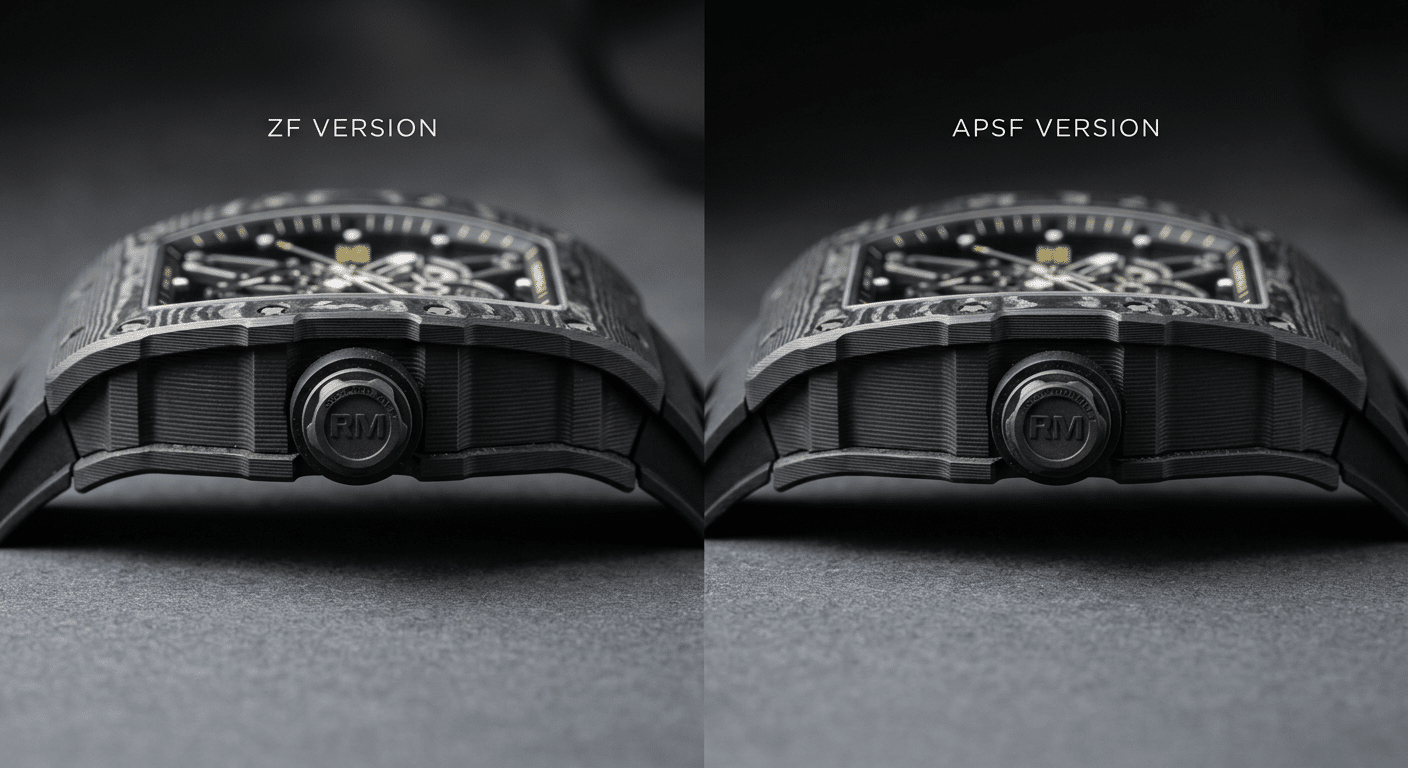
The most telling physical test is case thickness. For models like the RM 035, a digital caliper measurement will immediately separate a ZF (thicker) from an APS/JB (thinner to gen-spec). The bezel screw finish and the depth/color of the barrel cover engraving are secondary visual giveaways.
The Case for Controlled Expectations: When “Good Enough” is a Strategic Choice
Chasing the latest and greatest is not always the wisest path in replica watches. Sometimes, the strategic advantage lies in predictability and risk mitigation. This is the niche where ZF’s legacy models retain a surprising relevance. For a certain type of buyer, the value proposition shifts from “absolute technical fidelity” to “reliable performance with known parameters.” It’s the difference between buying a cutting-edge prototype and a well-understood production model.
The Known Quantity Advantage: Familiar Flaws and Predictable Performance
With ZF, you are buying a fully mapped territory. The community has lived with these watches for years. Their flaws are not secrets; they are documented characteristics. You know about the specific, slightly tinny rotor noise signature common to their decorated movements. You know the power reserve might be a solid 40 hours, not 55. You know the dial printing on the RM 055 might be a fraction bolder than gen. For a risk-averse buyer, this is a feature, not a bug. A known, minor flaw is a calculable compromise. It is vastly preferable to an unknown, major flaw that might emerge in the first batch of a factory’s newest, hyper-complex movement. With ZF, you are not a beta tester.
Secondary Market Viability and Repair Accessibility
This is the ecosystem argument that newer factories cannot match. ZF’s movements are often based on robust, decades-old Seagull or Miyota calibers that have been dressed up. Any competent watchmaker can service them. Parts are cheap and available. If something goes wrong, repair is straightforward and inexpensive.
Contrast this with the latest integrated clone from APS or JB. While more accurate, it is a proprietary unit. A breakdown might require sourcing a whole new movement from China, a costly and time-consuming process. For a comprehensive evaluation of specific models and their movement accuracy, the APS Factory Richard Mille replica guide provides critical technical insights. Furthermore, the secondary market for used ZF watches is established. There’s a known audience and a predictable resale value. Buying a ZF is a less “stranded” asset. If you decide to move on, you can, without taking a catastrophic loss. This financial and practical safety net is a tangible form of value.
Expert Authentication Insight
Open the case back. The movement architecture is the definitive identifier. ZF typically uses a heavily decorated base movement (e.g., a Seagull ST2555) with added plates and faux bridges. The finishing will be good from a distance but lack the genuine integrated architecture and specific bridge shapes of an APS or JB clone movement.
Model-Specific Analysis: Where ZF Holds, Folds, and Fades
Generalizations are useless here. The only way to evaluate ZF is on a model-by-model basis. Its relevance is not universal; it is specific, conditional, and fading in most areas. This breakdown is designed to give you direct, actionable verdicts.
Strong Hold: The RM 055 “Bubba Watson” and RM 035 Legacy
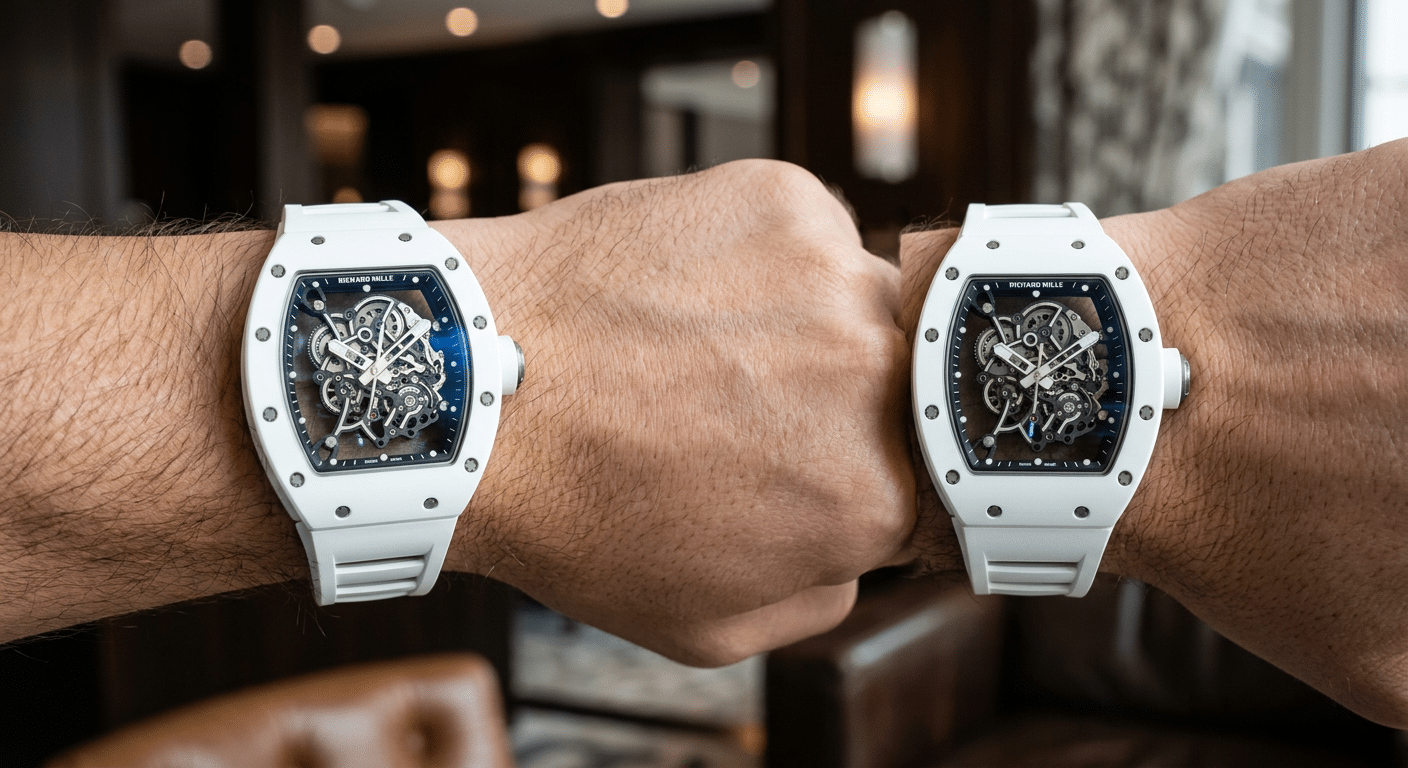
For these specific, foundational models, ZF’s offering remains a coherent and valid package. This is ZF’s home turf. They iterated on the RM 055 and the early RM 035 for years, refining the case shape, the feel of the rubber strap, and the dial layout. While an APSF version of the RM 055 might be technically superior in thinness and movement finish, the ZF version gets 95% of the way there visually, from the wrist. For a buyer who wants the iconic Bubba Watson look, values proven reliability, and isn’t conducting caliper measurements at dinner parties, the ZF represents a stable, lower-risk choice. It’s a known entity that delivers the aesthetic experience at a typically lower price point.
The Fold: Models Where ZF is Outclassed (RM 011, RM 027)
Here, the advice must be blunt: Look elsewhere. For complex models, ZF is generations behind and not competitive. Take the RM 011 chronograph. ZF’s version, like most older reps, uses a modified Shanghai 7750 movement. This results in a case that is far too thick—often by 2-3mm—completely destroying the genuine watch’s profile. The subdial spacing is also often incorrect. Similarly, for ultra-light marvels like the RM 027 series, ZF’s construction and movement choices cannot approach the weight or thinness of the genuine article or the latest specialized replicas from factories like BBR (historically) or AVS. For these references, choosing ZF means accepting a fundamentally inaccurate silhouette and wearing a watch that is immediately identifiable as a replica to anyone familiar with the gen.
The Fade: The NTPT Carbon Dilemma
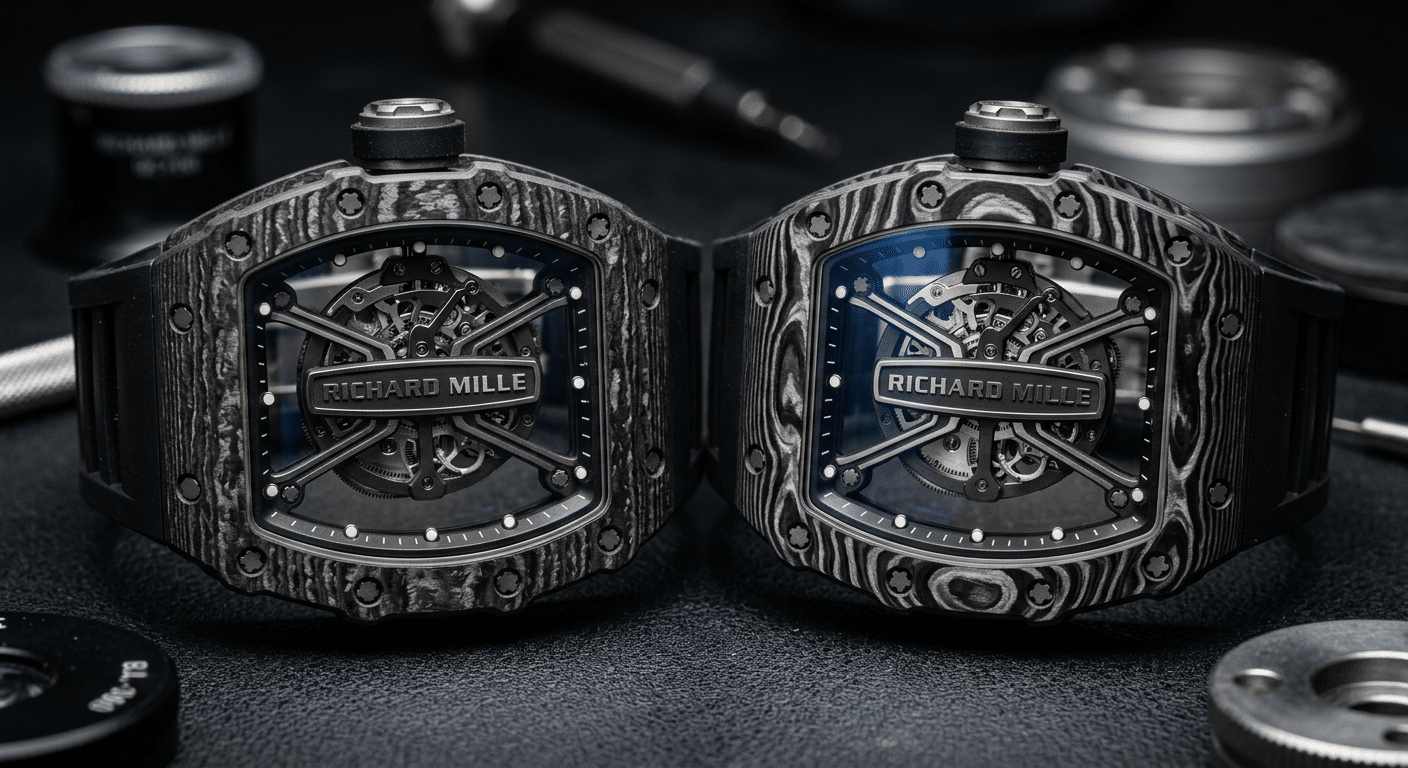
This is perhaps the most critical and visible differentiator. For any model where the carbon case is the star—the RM 035-02, RM 055 in NTPT, etc.—ZF’s execution is a significant limiting factor. Their carbon fiber patterning, while a great achievement half a decade ago, now lacks the depth, texture, and organic randomness of the latest composites from APS or the genuine NTPT material. ZF’s carbon can often appear flatter, with a more uniform, almost “printed” pattern. Under sharp light, it doesn’t have the same three-dimensional, layered quality. If the visceral look and feel of the carbon case material is a top priority for you, ZF’s offering will likely disappoint in direct comparison.
Expert Authentication Insight
For carbon models, use a high-magnification loupe under angled light. Examine the weave pattern. ZF’s carbon often has a more uniform, “printed” look with less of the layered, three-dimensional depth and random fiber termination seen in gen or top-tier replica NTPT.
The Buyer Filter: Who Should Still Consider ZF in 2024/2025?
After dissecting where ZF stands and falls in the modern market, the final question is personal: does this apply to you? ZF isn’t for everyone; it’s a tool for a specific job. If you recognize yourself in one of the following profiles, then ZF moves from being a historical footnote to a viable, pragmatic option.
Profile 1: The Value-Seeking Pragmatist
This buyer’s calculus is about total cost of ownership, not just the sticker price. They prioritize a lower entry point, but more importantly, they value proven reliability and straightforward serviceability. The thought of a cutting-edge, hyper-complex clone movement from APS or JB breaking down—and the costly, specialized repair that would follow—is a genuine concern. For them, ZF’s older, decorated base movements (often based on a Seagull or Miyota caliber) are a feature, not a bug. They’re widely understood by watchmakers, parts are available, and fixes are relatively inexpensive. This buyer wants the iconic RM aesthetic and a watch that works reliably day in, day out, without the anxiety that can accompany the latest, greatest, and sometimes fragile, super clone. They accept the extra millimeter of thickness as the price of peace of mind.
Profile 2: The Specific Model Hunter
This buyer isn’t shopping for “a Richard Mille replica.” They are hunting for one specific reference: the RM 055 “Bubba Watson” or the early, non-“Nadal” RM 035. They’ve done the deep-dive research, pored over forum threads comparing ZF, BBR, and APS versions, and have mapped the flaw-set of each. Their conclusion isn’t that ZF is perfect, but that for this specific model, its total package presents the most coherent balance, a decision informed by the comprehensive Richard Mille replica factory guide. The case shape, dial layout, and rubber strap composition were refined over multiple iterations. While an APS might be technically superior in thinness, the visual accuracy of the ZF from the wrist is extremely high, and its track record is long and documented. For this hunter, ZF represents the most stable, available, and cost-effective way to capture the specific watch they desire.
Profile 3: The Risk-Averse First-Timer
Entering the world of high-end replica Richard Milles can be intimidating. The prices are significant, the technology is complex, and forum horror stories about new movement teething problems are real. For a first-time buyer paralyzed by choice and fear of the unknown, a ZF offers a gentler on-ramp. Its behaviors—the specific rotor noise, the power reserve, the common flaws—are exhaustively documented across years of community discussion. There are no surprises. Choosing a ZF is like choosing a well-mapped hiking trail instead of bushwhacking through new territory. The shortcomings are predictable, which reduces the anxiety of a major purchase. It’s a way to learn the ropes, understand what wearing an RM feels like, and make a more informed decision about chasing the cutting edge later, all with a lower risk of a catastrophic, unfamiliar failure.
Expert Authentication Insight
The most revealing test isn’t performed on the watch, but on yourself. Write down your top three priorities. If your list reads something like “1) Easy to service, 2) Proven reliability, 3) Lower cost,” then ZF warrants a serious look. If your list starts with “1) Closest to gen thickness, 2) Best carbon weave, 3) Most accurate movement architecture,” then you have your answer: ZF is immediately and categorically disqualified. The choice is fundamentally about what you value most.
The Verdict: ZF as a Deliberate Anachronism
The analysis leads to a clear, unambiguous position. ZF should not be viewed as a fallen king, but as a deliberate anachronism—a purposeful choice from a previous era that retains utility in specific, narrow circumstances.
A Niche, Not a Recommendation
Let’s be unequivocal: ZF is not the general recommendation for a Richard Mille super clone in 2024/2025. For the vast majority of buyers, the default starting point for research should be the latest offerings from APS or JB for the desired model. These factories represent the current state of the art in replication. ZF exists in a defined niche, serving a specific cross-section of buyers whose priorities are misaligned with the market’ relentless drive toward millimeter-perfect, technically dazzling clones.
The Final Decision Matrix
Cut through the noise with this simple filter. Only proceed with considering a ZF Richard Mille if you can answer “yes” to all three of the following conditions:
- Your target model is specifically an RM 055 or an early RM 035. This is the non-negotiable foundation.
- You prioritize serviceability and a known, stable flaw-set over absolute dimensional precision and material perfection. You value predictability over potential.
- The financial equation makes sense. This often means the price delta between a used ZF and a new APS/JB is significant to you, reinforcing the value proposition.
If any of these conditions are not met, your path is clear: look to the newer factories. This matrix isn’t about making ZF look good; it’s about providing a ruthless, efficient tool for elimination.
Expert Authentication Insight
Think of it in terms of product lifecycle. A ZF watch is a finalized product from a past generation of technology. What you see is what you get; it will not improve. A watch from APS or JB, however, is a product of ongoing research and development, representing the evolving—and sometimes unstable—cutting edge. Your choice is fundamentally between a settled known and a progressing unknown. One offers the comfort of a completed map, the other the excitement and risk of a frontier.
The conclusion is binary by design. If your pursuit is the most technically advanced replica, where budget is a secondary concern, your research begins and ends with the latest from APS or JB. However, if you are a pragmatic buyer, focused on a specific legacy model, who values mechanical stability and is comfortable with a well-understood set of compromises, then—and only then—does ZF deserve a careful, clear-eyed place on your shortlist. This isn’t about reviving a legacy; it’s about calibrating your position in a complex market.