
Introducing KV Factory: The Historical Anchor of Richard Mille Replicas
If you’ve spent any time researching Richard Mille replicas, you’ve seen the name: KV Factory. It carries a certain weight, a whisper of legacy in forum archives and dealer listings. But here’s the critical frame you need from the start: KV Factory is not a current recommendation. It is a historical benchmark. Understanding KV isn’t about finding a watch to buy today; it’s about understanding where the pursuit of the “super clone” RM began, and how far the market has evolved since, a progression best understood through a modern replica factory tier list ranking super clone factories by structural capability not hype.
In the late 2010s, the replica landscape for Richard Mille’s audacious, skeletonized tonneau watches was a desert of poor options. What existed were either obvious fashion fobs with quartz movements or crude automatics that bore only a passing resemblance to the genuine article. Then, KV emerged. For models like the RM 035, RM 011, and RM 055, KV Factory presented the first coherent answer. They weren’t just making a “fake Richard Mille”; they were attempting to solve the specific engineering and aesthetic puzzles that made these watches so distinctive and difficult to copy.
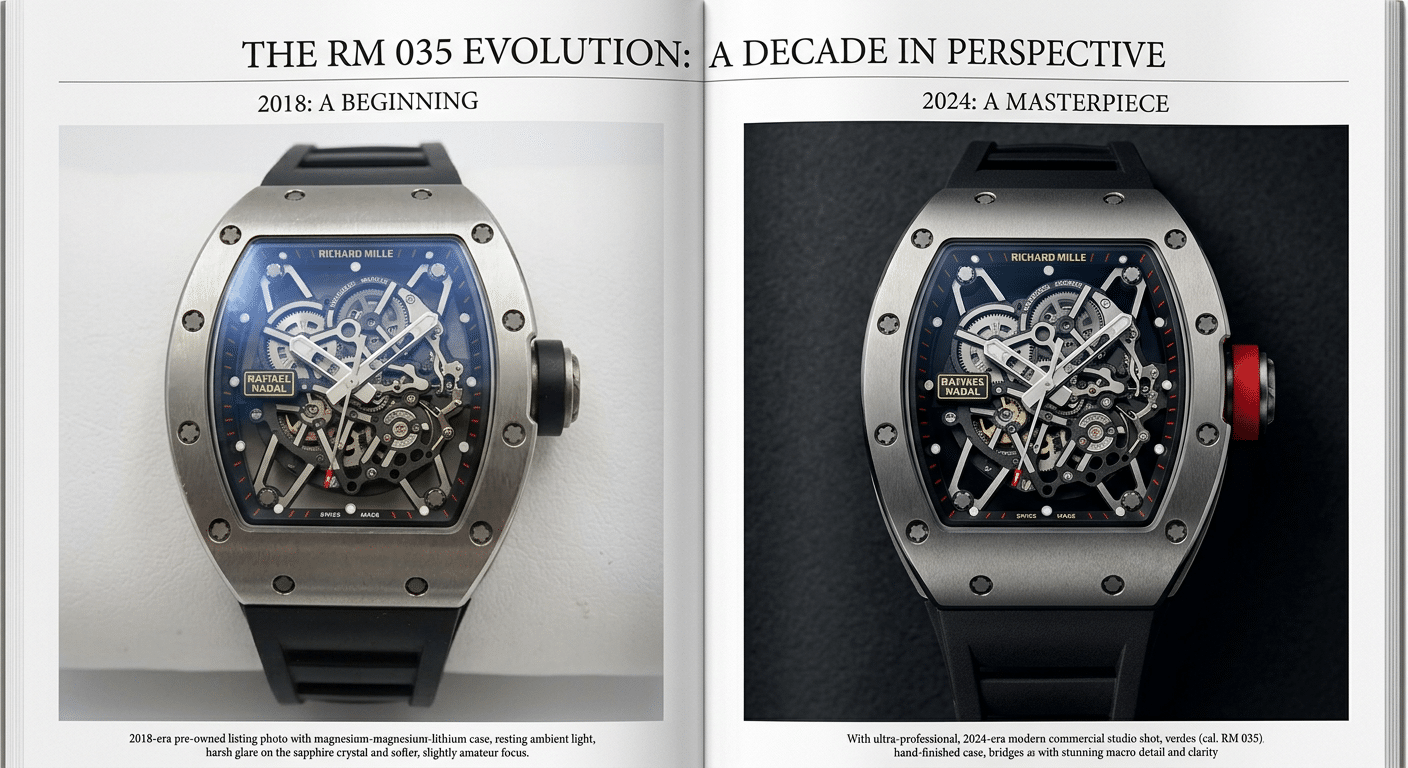
The Era of First Solutions: What KV Factory Represented
KV’s rise coincided with a shift in buyer expectations. The community was moving beyond mere lookalikes and beginning to demand what was then termed a “super clone.” In that era, this label had a different meaning than it does today. It wasn’t about a perfect, integrated movement clone. For KV, it meant a focus on two fronts: achieving a recognizable case shape and thickness that wasn’t comically off, and installing a functional, decorated base movement—like a modified Seagull chronograph caliber—to replace sterile quartz. They were solving the problems of their immediate predecessors. Where others failed to even approximate the complex geometry of an RM case, KV offered a shape you could identify across a room. This was their foundational achievement: they made the first replicas that serious enthusiasts could discuss with a straight face.
Signature Models: The RM 035, RM 011, and Defining the Early “Grail” List
KV’s legacy is built on specific models that defined the early “grail” list for RM replica collectors. The RM 035 “Rafa” was their flagship, offering a working chronograph with a decorated movement in a carbon-patterned case. The RM 011 Felipe Massa flyback chronograph was another milestone, bringing a complex, functional complication to the replica market at a time when it seemed nearly impossible. The RM 055 presented the challenge of the sleek, non-chronograph silhouette. For each, KV provided the first viable, high-tier solution. They established the template of which models were worth replicating at a serious level, a list that factories still follow today.
Expert Authentication Insight
Physical diagnostic: Use high-magnification macro photography (10x+) to examine the brushed finishing on case middle sections and caseback engravings. KV-era finishing often exhibits slightly softer, less defined grain and marginally deeper, less crisp engraving compared to current top-tier factories (like ZF or APSF), which use more advanced CNC tooling.
Deconstructing the KV Legacy Build: Strengths That Defined an Era
To understand why the KV name still resonates, you have to look at what they got right according to the standards of their time. Judged against the crude replicas that came before them, KV’s builds were revolutionary. Their strengths weren’t about absolute perfection, but about meaningful progress in key areas that buyers in the 2018-2020 period actually cared about.
Case Shape Breakthrough: From Toy-like to Recognizable
The single most important victory for KV was in case proportions. Before KV, many so-called RM replicas had cases that were either too flat, too bulbous, or simply the wrong shape entirely—they felt like toys. KV’s engineering, particularly for the RM 035 and RM 055, produced a tonneau case that finally captured the distinctive, muscular curvature and overall silhouette of the genuine watch. The thickness, while not perfect, was dramatically closer. For the first time, you had a replica that didn’t look laughable on the wrist from a few feet away. This was the bedrock of their reputation.
The Movement Strategy: Modified Chronographs as “Realism”
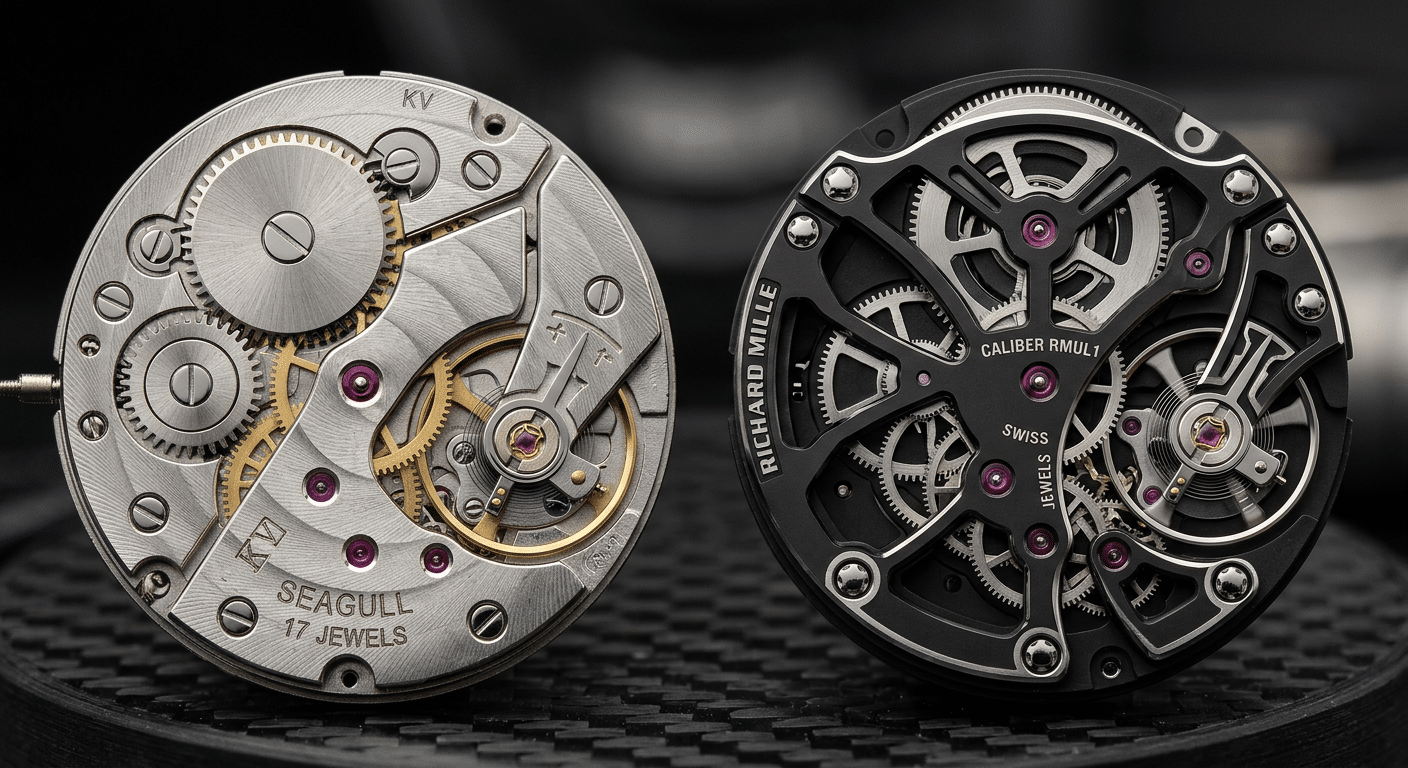
KV’s movement approach was pragmatic and clever for its time. For chronograph models like the RM 035 and RM 011, they utilized modified Seagull ST19 movements. This was a huge step up from the decorated quartz or non-functional subdials common in lower-tier reps. It gave buyers a working chronograph with a closer visual layout to the genuine RM calibers. The bridges were skeletonized and decorated to approximate the look. In an era where “having a mechanical movement that functions like the gen” was a primary benchmark, KV delivered. It felt more substantial and engaging than anything previously available.
Expert Authentication Insight
Physical diagnostic: Measure case thickness with digital calipers. A KV RM 035 will typically measure 0.3-0.5mm thicker than a genuine model (e.g., 15.8mm vs. 15.3mm), a discrepancy that was acceptable in its era but is a clear tell against current “1:1” claims.
Furthermore, KV was among the first to seriously attempt NTPT carbon fiber and ceramic composites in their cases. While the patterns and finishing weren’t gen-spec—the carbon often had a less layered, more uniform look—it was a world away from the painted plastic patterns on cheaper fakes. They introduced the idea that a replica RM should at least *try* to use the correct advanced materials, setting a new expectation for the high-tier market.
The Modern Reality Check: Where KV Builds Show Their Age
Respect for history is one thing; making a purchase decision in today’s market is another. This is where a clear-eyed assessment is crucial. When you hold a legacy KV build against the current output of factories like ZF, APSF, or BBR, the gaps are not just noticeable—they are fundamental. The entire definition of a “super clone” has evolved, leaving KV’s solutions looking like early prototypes.
The Movement Gap: From “Working” to “Believable”
This is the most significant divide. KV’s use of a modified Seagull movement, once a selling point, is now its biggest anachronism. The movement is bulkier, forcing case thickness compromises. More importantly, its architecture is completely different from the genuine Richard Mille RMUL calibers. Today’s leading factories use integrated clone movements (like the Dandong RMUL2) that replicate the genuine movement’s layout, bridge shapes, and even the gear train visibility. The difference is between a watch with “a mechanical chronograph” and a watch with “the mechanical chronograph.” The KV movement works, but it doesn’t *believe*.
Material Science: The Evolution of Carbon and Ceramic Replication
The materials race has left KV far behind. Where KV’s carbon fiber introduced a plausible pattern, modern factories use forged carbon composites with deeper, more organic, and more varied layering that much more closely mimics genuine NTPT. The difference in sheen, depth, and texture under light is apparent, a key point of analysis in a detailed vs factory replica guide. Similarly, ceramic colors and finishes are now more accurate. The “cheese white” of a modern BBR RM 055 ceramic is a specific shade KV never achieved. What was once a pioneering effort now looks flat and simplistic by comparison.
The Details That Date It: Screws, Gaskets, and Finishing Touches
The devil is in the details, and this is where the years of manufacturing refinement become obvious. Modern top-tier reps have near-perfect, sharply machined case screws with clean, centered slots. The finishing on case edges is crisper, with defined angles instead of soft rounds. Gasket tolerances are tighter (though water resistance is still a universal caution). Buckle engravings are cleaner and more precise. A KV build, when inspected closely, shows the softer edges, minor tooling marks, and overall less-refined finish characteristic of an earlier generation of CNC technology and quality control.
Expert Authentication Insight
Physical diagnostic: Examine the caseback screw heads under a loupe. KV screws often have slightly off-center slots, softer edges, and may show minor tooling marks. Current top-tier factories exhibit near-perfect, sharp, and clean screw machining, a clear differentiator in hand.
In essence, the market didn’t just improve—it redefined the goalposts. KV was solving for “recognizable and functional.” Today’s leaders are solving for “visually coherent and mechanically plausible at close inspection.” The gap between those two objectives is the story of the last five years in RM replication.
Market Confusion: Why “KV” Still Appears in Listings Today
If you’re actively shopping for a Richard Mille replica, you’ve likely seen the term “KV” or “KV version” pop up in dealer catalogs and forum sales threads. This creates a practical puzzle: if KV is a legacy factory, why is its name still in circulation? The answer lies in understanding how the replica marketplace repurposes historical reputations, often to the buyer’s disadvantage. Navigating this requires decoding a few key marketplace behaviors.
Old Stock vs. New Claims: Reading Between the Lines
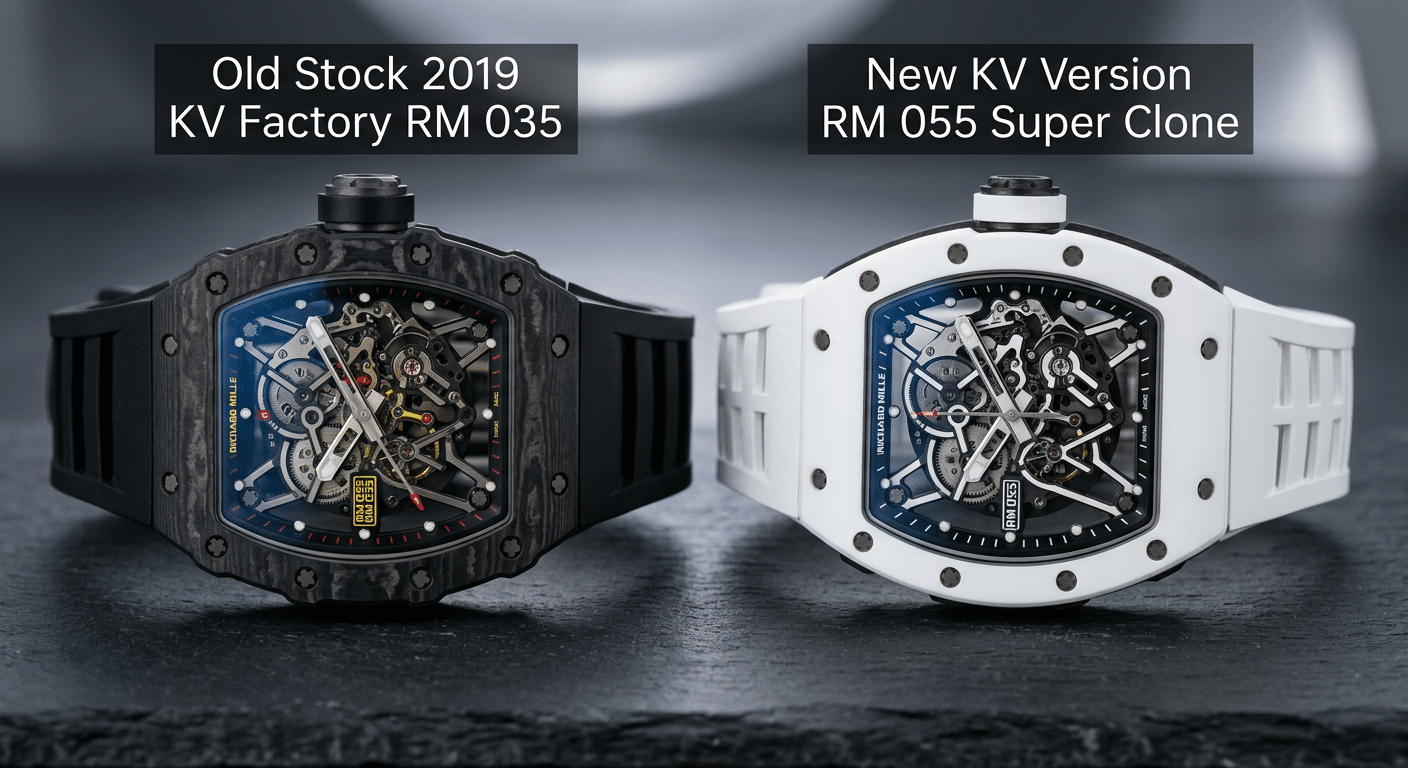
The most straightforward reason is simple inventory liquidation. There are still physical watches from KV’s 2018-2020 production run sitting in warehouses or with dealers who never sold them. These are genuinely old KV builds being cleared out, often at a discount. The risk here isn’t deception about origin, but about condition. A watch that has sat in a box for five-plus years may have dried lubricants, degraded gaskets, or a weakened mainspring. You’re buying a new old stock relic, not a current product.
When “KV Version” Doesn’t Mean KV Factory
More commonly, the term is used as misleading terminology. Sellers, especially on non-trusted dealer platforms, use “KV version” as a generic label for an “older but not the cheapest” build. This watch might be from an unknown, lower-tier workshop that simply mimics the general approach of the original KV—using a decorated Seagull movement in a carbon case. It trades on the historical cachet of the KV name to justify a higher price than a true budget-tier replica, without delivering the actual, period-correct quality that made KV notable for its time. It’s a marketing ghost, not a genuine legacy product.
Other times, it’s pure nostalgia and reputation leverage. Attaching “KV” to a listing adds a layer of perceived heritage and quality, aiming to confuse newer buyers who have seen the name mentioned respectfully in historical context but don’t understand the chronological gap. Finally, there is a small, honest niche: some sellers explicitly market old KV watches as a “budget legacy” option. They are upfront about the age, the specs, and the significant generational gaps, offering them at a low price point for the very specific buyer who understands exactly what they’re getting into.
Expert Authentication Insight
Physical diagnostic: To cut through the fog, you need to verify. If a seller claims a watch is a true KV factory product, ask for a clear photo of the caseback serial number engraving. Then, search known replica forums (like RWI) for “KV” threads from 2018-2020. Compare the font style, depth, and placement. Inconsistent engraving is a strong indicator of a later, unrelated build merely trading on the name. For true old stock, also demand a current movement photo to confirm it’s the correct modified Seagull and to check for any visible corrosion or dust.
The key takeaway is to treat any “KV” listing with immediate skepticism. Your first question should always be: “Is this original KV factory old stock, or are you using ‘KV’ to describe the style?” The answer will immediately separate the honest liquidation from the marketing spin.
The Buyer’s Framework: When Does a KV Replica Make Sense in 2025?
Given everything we’ve covered, the logical question is: should anyone actually buy a KV replica today? The answer is a conditional “maybe,” but only under a very strict set of circumstances. For the overwhelming majority of buyers seeking a convincing, wearable Richard Mille replica, the KV chapter is closed. However, a clear decision filter reveals three narrow scenarios where it might hold rational appeal.
Scenario 1: The Absolute Budget-Conscious Entry Point
This is for the buyer who must have the Richard Mille tonneau shape and skeletonized look but whose budget is firmly in the $250-$400 range. Here, old KV stock (not a “KV version”) represents a known quantity. You are accepting that you will get a watch that feels a generation old: thicker, heavier, with a visibly dated movement and softer finishing. You are buying the aesthetic at its absolute lowest cost of entry for a once-high-tier build, with full awareness that it will not withstand scrutiny. This is not about quality; it’s about price-driven compromise.
Scenario 2: The Modder’s Test Bed
For the hobbyist watch modder, an old KV watch can be a perfect, low-risk platform. Want to practice refinishing carbon composite cases, re-luming skeletonized dials, or modifying a Seagull chronograph movement? Sacrificing a $800+ ZF or APSF watch for practice is painful. A $300 KV donor watch makes sense. You are explicitly buying a project, not a timepiece. It’s a canvas for skill development, with the understanding that the starting point is fundamentally flawed.
Expert Authentication Insight
Physical diagnostic: If you’re buying a KV for modding, a critical pre-purchase check is water resistance. Use a basic dry pressure tester to check if the case and crystal seals hold any pressure. Many older KV builds have degraded or poorly fitted gaskets. This isn’t about making it waterproof, but about knowing if the case is even structurally sealed enough to keep dust out during your work, a principle well-explained in the Richard Mille replica factory guide, and to confirm you’re not starting with a warped or compromised case.
Scenario 3: The Hobby Historian
This is the most niche scenario: the replica enthusiast or collector interested in the history of the craft. For this person, a KV factory watch is a “museum piece”—a tangible artifact of the late 2010s replica evolution. Owning it is about completing a collection that tells the story, having the reference point to physically compare against modern super clones. The value is pedagogical, not horological.
For every other buyer—especially anyone whose primary goal is to acquire a convincing, high-quality replica they can wear with confidence—the framework is clear. The investment should go toward a modern factory. The KV is a lesson in history, not a recommendation for the present.
What Replaced KV: The Modern Factories Redefining RM Replicas
Understanding KV’s legacy is ultimately most useful because it sharpens your appreciation for what followed. The factories that now dominate the high-end Richard Mille replica landscape are the direct spiritual and technical successors to what KV attempted. They didn’t just improve on the formula; they redefined the goals. Here’s a clear map of what replaced KV’s pioneering effort.
For Integrated Movement Realism: The ZF/APS Standard
For the core models like the RM 035-02 and RM 055, the mantle has been seized by ZF and APS Factory (APSF). These factories addressed KV’s fundamental movement gap by sourcing and refining integrated clone movements from Dandong. Instead of a decorated Seagull chronograph, they use purpose-built clone RMUL calibers that replicate the gear train layout, bridge shape, and functionality of the genuine movement. The case proportions have been laser-scanned for accuracy, and their use of forged carbon and ceramic has achieved a new level of material fidelity. APSF, in particular, has pushed the envelope with versions featuring free-sprung balances, directly attacking the most telltale movement flaw. When you see the visual cohesion and thinness of a modern ZF or APS RM, you’re seeing the evolution of the “integrated super clone” concept that KV could only approximate.
For Complex Chronographs: BBR’s Evolution
While the RM 011 chronograph was a KV staple, its modern successor is BBR Factory. BBR took on the immense challenge of replicating the RMAC chronograph movement, creating custom modules where gears actually turn in sync during winding—a detail far beyond KV’s modified Shanghai 7750. Although BBR’s future has been uncertain, its development work represented the next logical step for complex Richard Mille models, focusing on functional realism over simple decoration. For tourbillon models, factories like EUR have specialized in actual working tourbillons, a realm KV never credibly entered.
Expert Authentication Insight
Physical diagnostic: The most immediate test to distinguish a modern successor from a legacy build like KV is the rotor. Modern top-tier factories use a tungsten alloy rotor designed to match the weight, engraved pattern, and slow, silent spin of the genuine Richard Mille rotor. Pick up a modern APS or ZF watch, and the rotor has an inert, heavy quality. In a KV build, the rotor is lighter (often brass-based), spins faster and more freely, and frequently has an audible, tinny whirl. This one physical sensation encapsulates the generational leap.
In essence, the market fragmented and specialized. KV was a generalist pioneer trying to tackle multiple RM models with one basic approach. Today, specific factories are recognized leaders for specific model types, each having solved the problems that defined KV’s era with more advanced technology and resources. Knowing this landscape is the ultimate payoff for understanding KV’s history—it empowers you to make an informed, contemporary choice.
Conclusion: KV as a Chapter, Not a Benchmark
Understanding KV Factory’s place in the replica market evolution is not about finding a hidden gem. It’s about calibrating your expectations and sharpening your eye. KV was the necessary pioneer, the factory that proved a complex Richard Mille could be approximated in China. It solved the problems of its era—making a tonneau case that looked right, stuffing a working chronograph inside, introducing carbon fiber that didn’t look like plastic. For that, it earned its status as a historical benchmark.
But a benchmark is for measuring against, not for buying. The journey from KV to today’s leaders like APSF and ZF is a story of relentless iteration—of movements shrinking from bulky decorated calibers to integrated clones, of carbon patterns gaining depth, and of tolerances tightening to fractions of a millimeter. This progression renders KV’s best work, by the standards of 2025, a period piece.
Expert Authentication Insight
Physical diagnostic: The ultimate lesson from studying legacy builds like KV is pattern recognition. Develop an eye for generational tells: movement decoration style, caseback font trends, and material texture. This skill, honed by comparing eras, is more valuable than memorizing any single factory’s specs, as it allows you to critically assess any future “breakthrough” claim.
Therefore, the final verdict is clear: for any buyer whose primary goal is to own a convincing, high-quality, and wearable Richard Mille replica, the KV chapter is definitively closed. Pursuing a “KV version” today, outside of the three narrow scenarios of extreme budget, modding, or historical collection, is a misallocation of funds and expectations. It is choosing a museum exhibit over a timepiece.
The true value of studying this Richard Mille replica legacy is not in what to buy, but in how to see. By understanding what constituted a “super clone” then versus now, you build an internal framework to evaluate the claims of today and tomorrow. You learn to question marketing, to spot the tells of a previous generation masquerading as the current one, and to appreciate the genuine engineering leaps when they occur. In a market fueled by hype and obscured by nostalgia, that critical perspective is the most valuable tool you can own. Let KV be the chapter that taught you how to read the whole book.