
Why the Standard RM Factory Tier List Is Broken (And What to Replace It With)
Ask any dealer or browse any forum, and you’ll hear the same names: “ZF is the best for the RM 035,” “APSF has the best movement.” This conversation is a popularity contest, an echo chamber of what’s currently selling. But popularity is a lagging indicator—it tells you who spent the most on marketing last season, not who engineered the best watch. For a more objective evaluation based on specific models like the RM055, RM35, and RM011, a detailed comparison of the best Richard Mille super clone factories is essential. The standard tier list is broken because it ranks factories based on hype, not on what actually determines whether a Richard Mille replica feels credible on your wrist for more than a week.
The problem is that we’re judging a three-dimensional, mechanical, architectural object by its two-dimensional, highly curated online photos. A factory can produce a dial with flawless printing and a crystal with perfect clarity—features that look incredible in macro shots—while completely failing at the fundamentals of case construction. You might get a watch that looks perfect on Instagram but creaks when you twist it, has a crown that grinds, or a caseback seam you could catch a fingernail on. The hype cycle celebrates the photogenic; the wear test reveals the truth.
The Hype Cycle vs. The Wear Test
Marketing and social media create a false hierarchy. They prioritize immediate, visual “tells” that are easy to photograph and compare: the color of a rubber strap, the sharpness of a date window, the shine of an anti-reflective coating. These are surface-level details. What they ignore are the structural elements that define the wearing experience and long-term integrity. A factory might be hailed as “top tier” because its latest version has a brighter lume, all while its case geometry is 0.5mm off, throwing off the entire ergonomic profile of the tonneau shape. The disconnect is simple: you buy a watch based on photos, but you own and experience it as a physical object. The former is driven by hype; the latter is dictated by structural capability.
Defining “Structural Capability” for RM Replicas
To move beyond hype, we need a new framework built on engineering and integration. This is “structural capability.” It evaluates a replica factory not by its marketing, but by its ability to execute the watch as a coherent, worn object. We judge it across four critical pillars:
- Integrated Movement Credibility: Does the movement look and function as a core architectural element of the watch? Is it finished and positioned to credibly fill the skeletonized case, or is it a generic slab hidden behind a decorative plate?
- Case Material & Geometry Execution: Does the case have the precise, sharp lines and complex curves of a genuine RM? Is the material (NTPT, ceramic, titanium) not just superficially similar but executed with correct weight, texture, and structural properties?
- Overall Wearing Coherence: When assembled, does the watch feel like one solid piece or a collection of parts? Is there flex, creak, or misalignment? Does it sit on the wrist with the balanced, lightweight solidity of the genuine article?
- Functional Component Integrity: Do the crown, pushers, and buckle operate with precision and smoothness, or do they feel gritty, wobbly, or like an afterthought?
This framework shifts the question from “Which factory is most popular?” to “Which factory can actually build this incredibly complex watch properly?”
Expert Authentication Insight
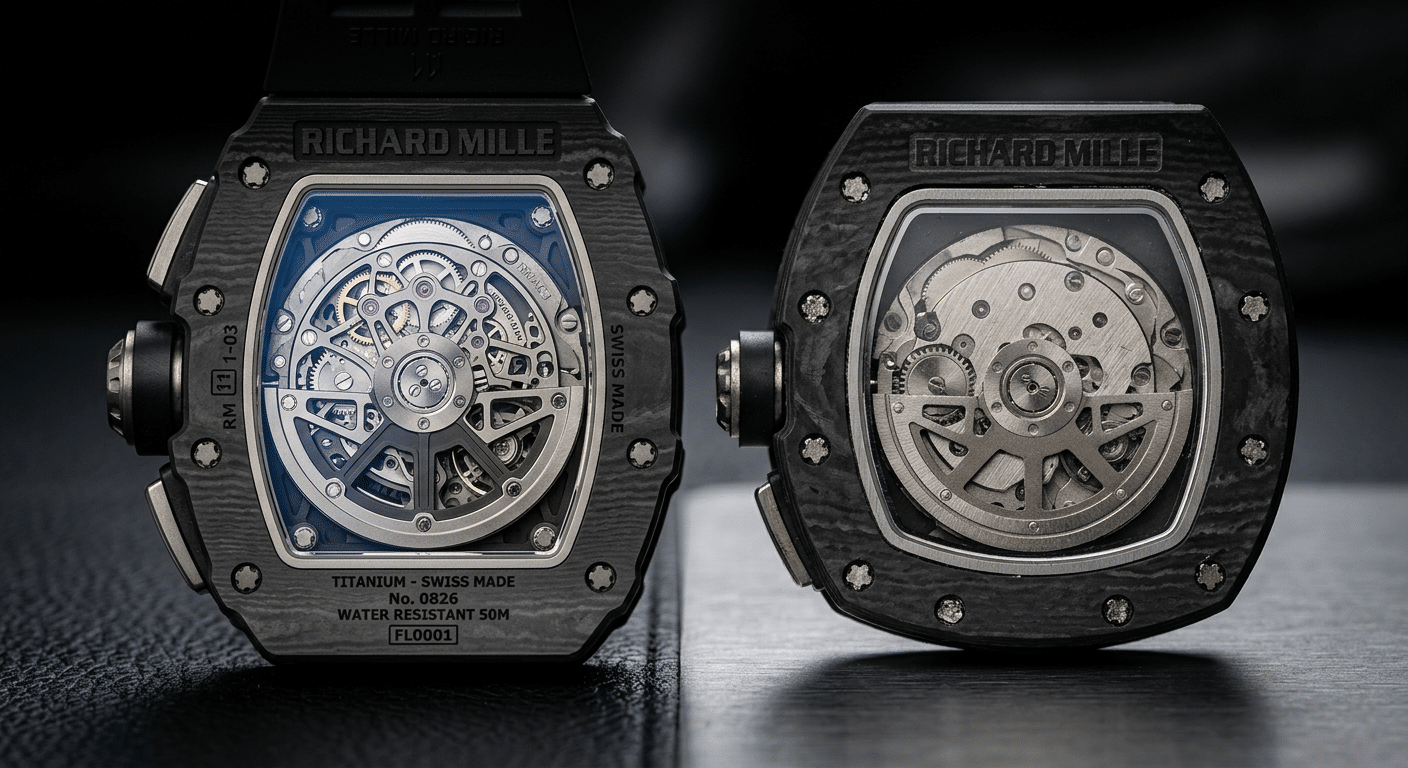
Physical diagnostic: The most revealing test requires no disassembly. Conduct the *caseback-to-case side seam inspection*. Under a 10x loupe with angled light, examine where the sapphire caseback meets the case middle. A watch built with high structural capability will show a perfectly even, hairline seam—virtually invisible. This indicates precise CNC milling and perfect alignment of multiple case components. In a lower-tier build, you’ll often see light gaps, a stepped misalignment, or even filler material. This single seam betrays the entire factory’s approach to geometry and tolerances.
Tier 1: The Structural Integrity Specialists
This tier is not about being “#1” in sales or forum buzz. It’s a rare class defined by a holistic approach to engineering. The watches from these factories feel less like assembled replicas and more like singular, credible objects. The hallmarks are coherence and intentionality—every part feels purposefully integrated, from the movement to the final case polish. These are the projects where the factory treated the RM not as a collection of specs to check off, but as an architectural challenge to solve.
You won’t find many names here, often just one or two at any given time. They may not be the most advertised, because their cost and complexity limit volume. But when you handle a Tier 1 build, the difference is immediately tangible. It has a balanced, solid feel with no hollow spots or unsettling flex. It’s the difference between a well-built machine and a detailed model.
The Movement-as-Architecture Mandate
For Tier 1 factories, the movement is the starting point, not an afterthought. They understand that in a skeletonized Richard Mille, the movement is the dial and a core structural element. This goes far beyond slapping a custom rotor on a stock Seagull caliber. It involves re-configuring or heavily modifying a base movement (like the Dandong RMUL2) so its bridges are positioned correctly, its plates have a plausible color and finish (aiming for that dark, grayish hue of genuine titanium), and it interacts authentically with the case architecture. On models like the RM 011 or 035, this means ensuring the movement is visible through the case-side windows with the correct depth and alignment, not obscured by poorly machined inner walls.
Case Geometry: Where Most Factories Fail, These Succeed
Milling a Richard Mille case is a nightmare of compound angles, steep bevels, and seamless transitions between materials. Most factories get close, but “close” results in a silhouette that’s subtly off—a bezel curve that’s too flat, a caseback that doesn’t flow perfectly into the lugs. Tier 1 factories succeed here through superior CNC programming, better tooling, and stricter quality control. They achieve the precise, consistent thickness, the sharp, unbroken bevel lines, and the perfect alignment of the bezel, caseband, and caseback. When you look at the watch from the side, the silhouette is seamless and unmistakably correct. This geometric precision is what makes the watch visually credible from every angle, not just head-on.
Material Execution Beyond the Surface
Anyone can make a black, swirly material and call it “carbon.” Tier 1 factories aim for the specific visual and physical language of Richard Mille’s materials. For NTPT-style carbon, this means sourcing composite with a fine, multi-directional fiber pattern that has depth, not a flat, printed look. They then machine it cleanly, preserving sharp edges without fraying or chipping the fibers. For colored quartz TPT, it’s about achieving clarity and saturation in the resin, not a painted-on color. The finishing—whether brushed, polished, or sandblasted—is applied with consistency, avoiding the visual muddiness or soft edges that plague lower-tier attempts. The material looks and feels substantial, not just decorative.
Expert Authentication Insight
Physical diagnostic: To separate the best from the rest, perform the *lateral transparency and edge definition test* on a skeleton model like the RM 035. Look directly through the openings in the case side. In a Tier 1 build, you’ll have a clear, unobstructed view of the movement components inside. The edges of the case cutouts will be razor-sharp and cleanly machined. In a lower-tier attempt, the view will often be partially blurred or blocked by misaligned inner case walls or thick, poorly finished edges. This flaw completely destroys the “floating skeleton” architecture that defines the genuine watch.

Tier 2: The Visual Virtuosos with Structural Compromises
This is where the majority of the “high-end” replica market lives, and there’s absolutely nothing wrong with that—if you know what you’re buying. Tier 2 factories are masters of first impressions. They produce watches that are visually stunning, photograph exceptionally well, and offer tremendous value for the price. Their strength is in optimizing the features you see and touch immediately: dial details, crystal clarity, strap texture, and vibrant colors. For many buyers, this is the perfect sweet spot.
However, the “structural compromise” in their title is crucial. These factories achieve their visual brilliance and attractive price points by making calculated trade-offs in areas that aren’t immediately obvious. They prioritize the photographable over the foundational. For a detailed analysis of these trade-offs within the context of kv factory Richard Mille replica legacy and super clone versions, the result is a watch that can look every bit as good as a Tier 1 in pictures or from across a room, but upon closer, physical inspection—or after months of wear—the shortcuts reveal themselves.
The Photogenic Deception: Dial and Crystal vs. The Unseen
Tier 2 factories are brilliant marketers by necessity. They know a buyer’s first (and often only) point of judgment is the QC photo. Therefore, they allocate their budget and effort to ace that test. You’ll find exceptional dial printing with perfect alignment, strong lume with even application, and sapphire crystals with excellent anti-reflective coating that makes the dial pop. These are tangible, high-value features. However, this focus can divert resources from the unseen structure. The stunning dial might be housed in a case with slightly imperfect seam alignment. The brilliant crystal might sit atop a movement that’s fundamentally the wrong shape. The watch is engineered to win the photo review, not the long-term wear test.
Common Compromise #1: The “Dressed-Up” Generic Movement
This is the most frequent structural compromise. Instead of investing in an integrated, RM-specific clone movement, a Tier 2 factory will take a reliable, off-the-shelf workhorse like a Miyota 9015 or a Seagull automatic. They’ll then add a custom-decorated rotor and perhaps some additional bridge plates to mimic the look of a genuine RM calibre. From directly above, through the caseback, it can look convincing. The problem is integration. This generic movement is a round peg in a tonneau-shaped hole. From side angles, the proportions look off—there’s either too much empty space or the wrong parts are visible through the case windows. The finishing (often bright rhodium or rose gold plating) rarely matches the more technical, matte finish of the case materials. It’s a costume, not architecture.
Common Compromise #2: Case Construction Shortcuts
To manage cost and complexity, Tier 2 factories often employ clever shortcuts in case construction. A complex one-piece case might be approximated by joining two or more sections, leading to faint but detectable seams. Case thickness might be within 0.3mm of genuine—good enough for most—but the curvature of the lugs or the angle of the bezel might be subtly simplified. Their carbon fiber, while often real forged carbon, may have a more random, “blotchy” pattern compared to the distinct, layered appearance of higher-end composites. These shortcuts don’t make the watch “bad.” They make it 90% perfect for 60% of the price. But that missing 10% is the difference between a visually accurate replica and a structurally coherent one.
Expert Authentication Insight
Physical diagnostic: A quick way to identify a Tier 2 build is the *crown and pusher action stress test*. Gently operate the crown to set the time. Now, apply very slight lateral pressure (pushing the crown side-to-side) as you turn it. Do the same with any chronograph pushers—press them at a slight angle. In a Tier 2 watch, you may feel a hint of grating, sponginess, or see a slight wobble in the crown stem. This indicates that the tolerances in the keyless works (the gears connecting the crown to the movement) or the case tube threading are not engineered to the highest standard. It’s a sign that the factory prioritized the external look over the precision of these high-stress functional interfaces.
Tier 3: Low-Fidelity Imitation & The Parts-Bin Approach
Let’s be clear: the watches in this tier are not “budget super clones.” They are not part of the same conversation as APSF or ZF. These are visual imitations, assembled from generic, off-the-shelf parts with the sole aim of achieving a distant, low-resolution resemblance to a Richard Mille. Their purpose is to fill a price point, not solve an engineering challenge. Understanding this tier is not about finding a hidden gem; it’s about developing an immune system against obvious mistakes. The goal here is to give you the tools to spot these from a single product photo, saving you time, money, and disappointment.
The Shape is All Wrong: Fundamental Geometry Failures
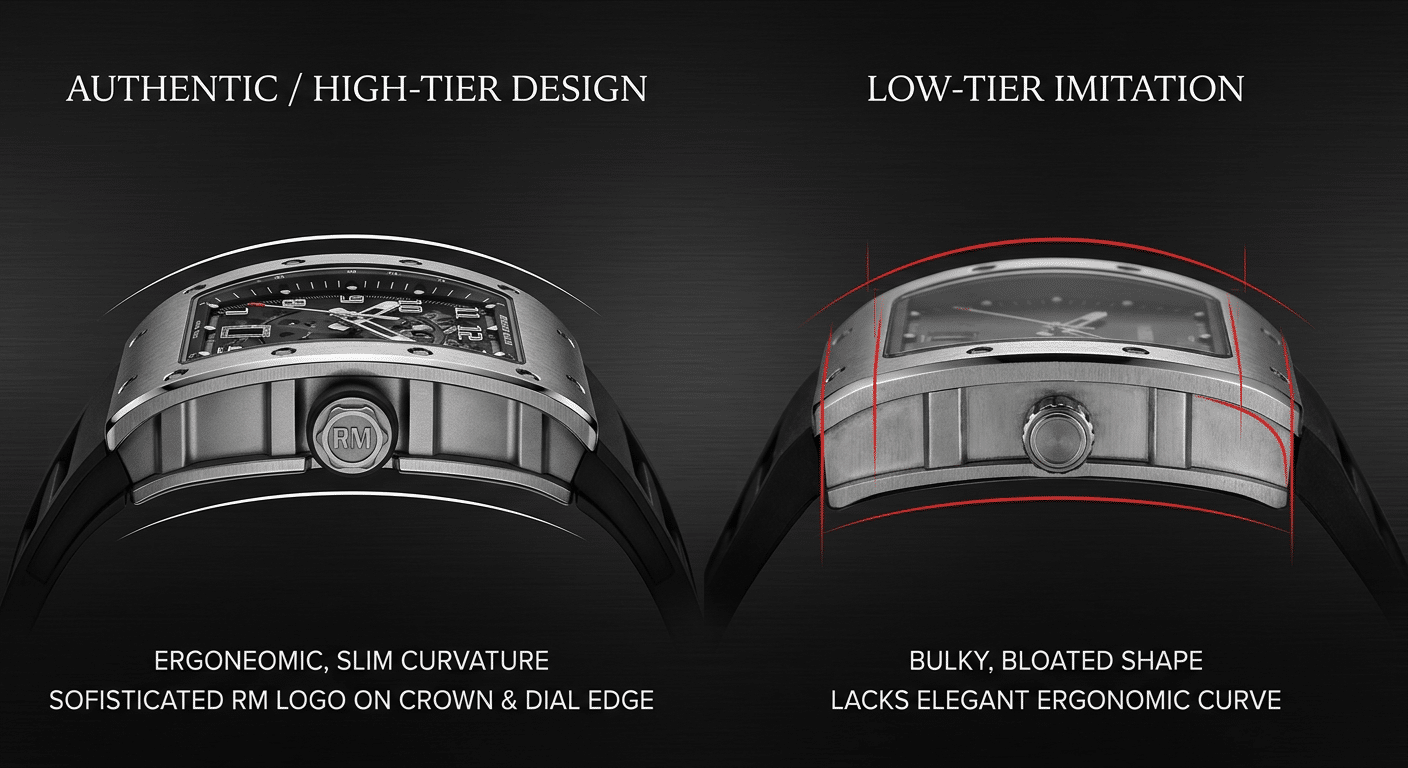
Before you even consider materials or movement, the silhouette betrays a Tier 3 replica. The iconic tonneau case is a complex, three-dimensional sculpture. Tier 3 factories approximate it with basic milling, resulting in fundamental shape errors. The case might be overly bulbous, losing the sharp, architectural shoulders. It could be too flat, looking like a squashed oval. The lugs are often stubby and incorrectly angled, ensuring the strap will never sit correctly on the wrist. Most egregiously, case thickness is frequently off by 2-3mm or more. An RM 011 that should be 16mm thick might be a hulking 19mm. This isn’t a minor compromise; it’s a failure to grasp the basic proportions of the object they’re trying to copy. If the watch looks “chunky” or “off” in the seller’s own promotional images, it’s Tier 3.
The Materials Pantomime: Painted Metals and Plastic
Here, the imitation becomes a costume. What is advertised as a “carbon fiber” case is almost always a steel or aluminum case with a printed carbon fiber pattern under a layer of clear coat. Up close, it has zero depth—it’s a sticker. “Ceramic” models are painted metal. Bezel inserts are plastic. The crystal is mineral glass, not sapphire, and will scratch almost immediately. The strap is a stiff, generic rubber that smells strongly of chemicals. Every material choice is a cost-cutting measure that completely severs any connection to the genuine article’s technological narrative. The watch feels either suspiciously heavy (solid cheap metal) or hollow and tinny.
The Movement Tell: A Dead Giveaway
This is the most unambiguous filter. Look at the caseback. For a skeleton model like the RM 035 or 055, a Tier 3 piece will often show one of three things: 1) A standard quartz movement, 2) A generic Chinese automatic (like a Miyota 8215) with zero attempt at skeletonization or decoration, or 3) A completely solid caseback, blocking the view entirely. For a chronograph like the RM 011, it will be a thick, off-the-shelf chronograph movement that makes the case impractically tall. These movements are not attempts at replication; they are placeholders. They tell you the factory invested nothing in the core mechanical heart of the watch.
Expert Authentication Insight
Physical diagnostic: The weight and acoustic test. Pick up the watch. A genuine RM or high-tier replica has a specific, substantial-yet-light feel from advanced composites and titanium. A Tier 3 replica feels wrong. It’s either oddly heavy (dense, cheap metal) or disconcertingly light and hollow (thin metal and plastic). Now, gently tap the case with your fingernail. A true ceramic or high-density carbon case emits a dense, high-pitched “ting.” A painted metal case gives a dull, low-pitched “clunk.” This simple, immediate test bypasses all visual deception and reveals the fundamental material truth.
Applying the Framework: Case Studies of Popular RM Models
Theory is useful, but application is power. Let’s apply our structural capability framework to specific models. This is where you learn to use the lens, not just look at it. We’ll analyze which factories attempt which models and, more importantly, why they land in their respective tiers based on the execution of case, movement, and integration.
Case Study 1: The RM 035 – A Test of Skeleton Architecture
The RM 035 is a perfect litmus test. Its entire identity is about revealing the skeletonized movement through the dial and case side. A Tier 1 attempt here, like from APSF, must solve two structural puzzles: creating a credible, decorated skeleton movement that fills the space correctly, and machining the case side windows with razor-sharp precision so the movement is cleanly visible. APSF’s version uses a modified Dandong movement with satin-finished bridges and proper geometric cutouts, and the case side windows are milled to allow an unobstructed view. It’s coherent.
A Tier 2 version, such as some earlier BBR or ZF iterations, might nail the dial color and front-facing aesthetics but compromise on the side view. The movement might be more generic, or the edges of the case windows might be poorly finished, blurring the view. The watch looks great head-on but loses its architectural magic at an angle.
A Tier 3 imitation of the RM 035 is simple to spot: it will either have a solid, non-skeleton case side, or a caseback revealing a basic quartz movement. It fails the fundamental premise of the model.
Case Study 2: The RM 011 – Chronograph Complexity and Case Integration
The RM 011 introduces the complexity of a flyback chronograph module. The structural challenge is threefold: integrate a chronograph movement without exploding the case thickness, align the pushers perfectly with the case geometry, and ensure the sub-dials are positioned correctly within the skeleton dial. For a comprehensive Richard Mille replica factory guide, examining these movement integration techniques is essential. The best attempts here, often from factories like ZF in their niche models, focus on integrating a modified chronograph movement to keep thickness in check—though it’s still a struggle.
Most RM 011 replicas, however, like those from KU (formerly KV) Factory, fall into Tier 2. They use a reliable but thick Shanghai 7750 chronograph movement. The compromise is immediate: the case becomes nearly 3mm thicker than genuine. The chronograph works, and from the front, it can look convincing. But the silhouette is off, and the pusher action often feels generic and poorly integrated with the case’s sculpted guards.
A Tier 3 RM 011 would likely feature a non-functional chronograph (fixed sub-dials) or such gross case shape inaccuracies that it’s not worth further examination.
Expert Authentication Insight
Physical diagnostic: For chronograph models like the RM 011, conduct the pusher alignment and actuation symmetry test. Don’t just press the pushers; observe them. In a high-tier build, the pushers will depress smoothly along the exact axis perpendicular to the case, with a crisp, consistent click. They will be perfectly centered within their rubber guards. In Tier 2 and below, you’ll often find slight misalignment—a pusher might sit crooked. The action may feel gritty, uneven, or wobbly. This subtle feedback is the direct result of imprecise machining of the case tube holes and a lack of seamless module integration, revealing the structural compromise beneath the surface.
How to Use This List: A Buyer’s Decision Map
Now that you have the framework and the case studies, it’s time to build your decision map. This isn’t about finding the “best” watch; it’s about finding the right watch for your specific priorities, with your eyes wide open to the trade-offs. Follow this logic.
Priority Filter #1: The “Worn Credibility” vs. “Photographed Impact” Divide
This is your first and most critical choice. Ask yourself: Is my primary goal a watch that feels architecturally solid and credible on the wrist, even under casual inspection? If yes, your path leads to Tier 1 (APSF, high-end ZF). You are investing in structural coherence, material integrity, and long-term satisfaction. You are buying a mechanical object first, a status symbol second.
If your answer is, “I want the dramatic RM look for social media, events, or photos, and I’m comfortable with some compromises if they’re not obvious in a picture,” then Tier 2 is your realm. Here, you allocate budget towards dial brilliance, color accuracy, and crystal clarity. You consciously accept the thicker case, the less-refined movement view, or the generic pusher feel in exchange for significant cost savings and great visual pop.
Priority Filter #2: Budget Allocation and Compromise Awareness
Let’s attach numbers to the philosophy. A Tier 1 RM 035 will command $800-$1,000+. You are paying for R&D, better materials, and finer finishing. A visually striking Tier 2 version of the same model may be $500-$700. The $300+ difference is the structural integrity. For Tier 2, your compromise awareness is key: that extra money you’re saving is directly linked to the movement being generic, the case being thicker, or the carbon pattern being less nuanced. This isn’t bad—it’s a valid choice if you understand the transaction.
If your budget is under $300 and you simply want the RM silhouette on your wrist with zero expectations of authenticity, then Tier 3 exists. The warning is absolute: understand you are buying a fashion accessory, not a horological replica. It will tell time and get attention from a distance, and that’s all.
Armed with this framework, you change the conversation. Instead of asking a dealer the vague, hype-susceptible question, “Who makes the best RM 011?”, you ask the specific, structural question: “For the RM 011, which factory has done the best job minimizing the case thickness from the 7750 movement, and how is the alignment of the chronograph pushers?” This immediately signals you understand the real challenges and shifts the discussion from marketing to mechanics.
Expert Authentication Insight
Physical diagnostic: The pre-purchase QC photo focus list. When your dealer sends QC photos, go beyond checking for dust on the dial. Request specific shots that probe structural weak points:
- 1) The Seam Shot: A macro, angled photo of where the sapphire caseback meets the case middle. Look for even, hairline gaps.
- 2) The Window Shot: For skeleton models, a clear side-view photo looking through the case openings to assess movement visibility and edge finishing.
- 3) The Action Video: A short video of the crown being wound and the time set, and any pushers being depressed. Listen for smoothness, watch for stem wobble.
This shifts your QC from passive approval to active structural verification.
Ending Direction: The New Verdict
The market’s noise is a ranking based on hype, momentum, and what sells easily. Our framework reveals a different, quieter hierarchy based on capability. It shows a landscape where one or two factories operate at the level of true engineering specialists, a handful more function as competent visual artists, and a vast sea produces distant imitations.
The final takeaway is empowerment. You are no longer a passive consumer buffeted by dealer claims and forum hype. You possess a filter. You can look at any RM replica project and ask the decisive questions: How is the movement integrated? How precise is the case geometry? Does the construction support the illusion? With this lens, you’re not just buying a watch that looks like a Richard Mille; you’re evaluating whether it’s built like one. And that changes everything.