
The bold, technical look of Richard Mille watches often comes from their NTPT carbon cases, featuring a distinctive flowing wood-grain pattern created by layering hundreds of ultra-thin carbon sheets under pressure. This material gives the tonneau shape its signature depth and visual complexity through CNC machining curvature, which is why shape controls the whole watch.
In the replica watch market, claims of “NTPT carbon” in China-made super clone Richard Mille watches, however, often involve different levels of execution—from attempts at laminated composites to purely cosmetic treatments that prioritize top-down appearance. This article breaks down the common carbon routes factories use and how buyers can evaluate them through QC photos. It focuses on what actually shows in three dimensions, how the material handles on the wrist, and which details matter more for occasional versus daily wear.
| Inspection Point | Authentic NTPT Carbon | Common Replica Approach |
|---|---|---|
| Case Curves & Contours | Continuous flowing layers following 3D shape | Pattern appears flat or breaks on curves |
| Machined Edges | Visible thin ply stacking like cut wood grain | Uniform black surface without depth |
| Chamfers & Bevels | Fiber direction changes with visible layering | Painted or single-plane texture |
| Screw Holes | Concentric layers visible inside | Solid fill or shallow surface pattern |
| Daily Wear Performance | Consistent appearance and better durability | May wear to reveal cosmetic treatment |
Quick Questions Before You Read
Q: Is NTPT carbon in super clone Richard Mille watches the same as authentic versions?
No replica matches the exact NTPT process and thin-ply specifications used in genuine watches. Many use cosmetic textures or prints rather than true multi-layered material.
Q: What should I look for in photos to verify carbon quality?
Focus on side views, edges, chamfers, and screw holes for evidence of continuous layering and depth rather than top-down weave alone.
Q: Does the difference matter for occasional wear?
For light or occasional use, cosmetic versions may meet expectations in photos and casual glances. For daily wear or closer handling, layered execution reduces visible shortcuts and improves consistency.
Q: Can replicas fully replicate authentic NTPT carbon?
Current replica approaches involve tradeoffs in 3D continuity, edge detail, feel, and long-term surface behavior. No version achieves the original material properties.
Why NTPT Carbon Is Central to Richard Mille’s Distinctive Look
When scrolling through super clone Richard Mille watch listings, the carbon cases hit you first. That intricate, flowing carbon pattern across the tonneau shape creates an immediate visual punch that few other watches can match.
NTPT carbon drives this recognition. The material’s layered construction produces a distinctive wood-grain-like flow that follows every curve of the case, making the watch instantly identifiable even at a distance. It isn’t just a material choice—it’s what gives RM watches their technical, aggressive character and turns the case into the main design statement.
Buyers evaluating replicas quickly notice “NTPT carbon” in nearly every description. Someone scrolling listings might see the bold top-down pattern and assume the claim delivers that same premium, eye-catching realism that defines the genuine watch. The material is central to why these watches command attention and why the description appears so often.
Yet the strong impression from those front-face photos often meets a different reality once the watch is examined in three dimensions. The complex tonneau shape exposes more surfaces and transitions than simpler case designs, which makes carbon execution particularly revealing in replicas.
Real NTPT Carbon vs. Common Imitation Methods in Replicas
Authentic NTPT carbon relies on thin ply technology. Hundreds of ultra-thin carbon fiber layers, each rotated 45 degrees from the one below it, are laminated under heat and pressure into solid blocks, as detailed in the Guangzhou Richard Mille replica factory system. In cross-section view, you see consistent, repeating layers that continue through the entire thickness of the material. This creates both the visual undulation and structural integrity when the case is machined.
In super clone Richard Mille watches from the replica market, four main approaches appear when sellers describe “NTPT carbon.”
The first is an attempt at laminated carbon fiber composite. This uses multi-layer carbon composite material that tries to replicate the ply structure, though it falls short of genuine NTPT specifications and thin-ply precision.
The second is decorative carbon patterns. These apply a printed or molded surface design that mimics the weave from certain angles but lacks any actual layered depth.
The third involves surface texture treatments. The base material receives an applied or etched texture designed to suggest carbon without using composite layers at all.
The fourth is sprayed carbon texture. A paint or coating creates the visual effect of carbon fiber, offering appearance-only results with no material structure underneath.
Factory descriptions in the replica watch market use “NTPT carbon” as a common buyer-facing reference for different levels of carbon-like finishing. The actual outcome depends on the specific execution for that model and version rather than the label itself.
In replica watches, material claims should be evaluated through visible execution details such as texture continuity, edge behavior, and chamfer depth in the specific version offered rather than accepted based on description alone.
Front-Face Success vs. Side and Edge Failures in Carbon Cases
Many RM super clones perform well from the primary viewing angle. The front-face carbon pattern often captures the distinctive weave convincingly enough to satisfy listing photos and initial impressions. The repeating undulations and light play can look impressive when shot straight on.
Turn the same watch to its side profile, however, and the limitations of cosmetic routes become visible. The tonneau case’s complex curvature and flowing contours expose where the texture stops at the surface rather than continuing naturally through the material.
Carbon edge continuity suffers in particular. Where genuine layered construction would show depth and variation along the machined edges, many replicas present flatter, more uniform appearance that breaks the visual flow.
One common buyer experience illustrates the disconnect. A collector orders based on strong top-down photos that showcase the carbon weave in ideal lighting. Upon receiving the watch and examining it in hand, the side views reveal the shortcuts—the pattern that looked deep and organic from above appears painted-on or inconsistent where the case bends and tapers.
This front-versus-3D contrast is especially noticeable on Richard Mille’s tonneau shapes because the design deliberately exposes multiple planes and transitions. What works in controlled photography does not always hold up under normal handling and different wrist angles. For buyers who mainly photograph the watch, top-down success may be enough. For those who wear it daily, the side and edge behavior often becomes the more practical concern.
Critical Inspection Areas: Texture Continuity, Cut Edges, and Layering
When the tonneau case is machined from a carbon block, the material’s true structure becomes visible wherever the surface is cut or angled. Genuine layered carbon maintains ply integrity through these areas; most replica versions, as detailed in Richard Mille China Super Clone, do not. The four diagnostic zones—texture continuity, chamfers, edges, and screw holes—expose whether the carbon is built from rotated thin plies or applied as a cosmetic layer.
Texture Continuity
Layered carbon keeps its undulating pattern flowing naturally across the curved surfaces of the case. The 45-degree ply rotations create a consistent visual rhythm that follows the contours without abrupt breaks or repeating blocks. In practice, replicas often show strong weave on the flat top but lose that flow where the caseband curves, turning into a static or overly uniform texture. One buyer who handled a watch fresh from the box noticed the pattern simply stopped following the shape, revealing the shortcut immediately on the wrist.
Chamfer Carbon Continuity
Chamfers—the beveled transitions between surfaces—cut through the material at an angle and should reveal the layered plies intersecting the edge. Genuine construction shows subtle fiber direction changes and visible layering depth along the bevel. Replica chamfers typically appear painted or molded in a single solid tone, with the decorative texture ending abruptly at the bevel instead of continuing through it. The result is a clean but artificial line that lacks the organic cross-section true layered carbon would display.
Case and Bracelet Edge Checks
Natural layer visibility on cut surfaces is the most reliable tell. When carbon is machined, the edge should display distinct thin plies stacked and rotated, with visible fiber ends and direction shifts exactly like wood grain on end. Most replicas show uniform color or painted edges instead. The material is either a molded composite with random short fibers or a base coated with surface texture, so the edge looks flat black or artificially finished with no layering at all. A collector examining the bracelet-to-case junction on one example saw perfectly smooth, solid-colored sides that contradicted the top-down weave and confirmed the cosmetic route.
Screw Hole Carbon Layers
Every screw hole drilled through the case acts as a window into the material depth. Layered carbon reveals concentric ply rings or visible fiber ends around the hole walls, with the texture remaining consistent from surface to interior. Replica screw holes usually expose a uniform material or a thin decorative skin over a different core, lacking any real layering in the hole itself. The case side profile reveal makes this even clearer: genuine layering follows the full contour, while shortcuts flatten out or disappear once the view shifts off the front face.
Evaluating NTPT Carbon Claims Through QC Photos
QC photos let you test carbon credibility before purchase if you request the right angles and know what they can—and cannot—prove. No single photo set confirms the material construction, but certain views quickly expose common cosmetic shortcuts versus more convincing execution.
- Side angle QC shot: Request a 45-degree side view of the caseband. Look for whether the weave pattern continues smoothly around the curve or breaks into blocks or uniform patches. Strong continuity here supports better material effort; sudden stops or flat texture signal surface treatment.
- Edge cut photo: Ask for a close, well-lit shot directly along the case edge or bracelet link edge. Natural layering shows visible ply shifts and fiber ends; uniform black or painted appearance indicates the shortcut route.
- Chamfer close-up: A macro-style photo of any beveled edge should reveal subtle layering depth and fiber direction change along the bevel. If the chamfer looks solid-colored or the texture ends at the bevel, the carbon is likely decorative only.
- Screw hole interior view: If the seller provides any angle showing inside a screw hole, check for concentric layer rings or fiber texture on the walls. Smooth, single-tone walls are the classic giveaway of non-layered construction.
- Overall continuity QC under angled light: One photo with light raking across the entire case can highlight whether the weave flows consistently or appears printed-on. Shadows and highlights expose breaks that top-down listing shots hide.
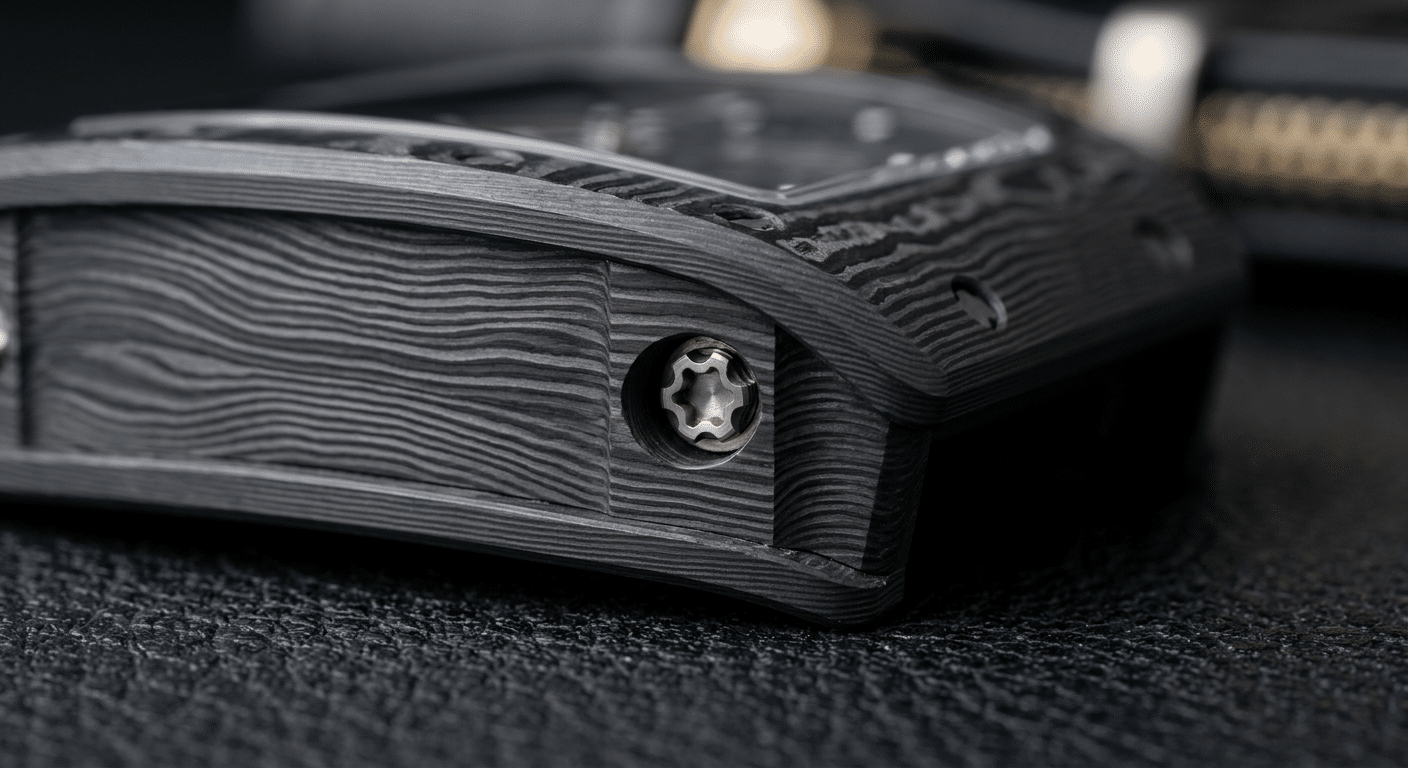
Buyers should review real QC photos from multiple angles where available. These help assess texture continuity, edge behavior, and other finishing details, though they have practical limits in fully confirming material construction.
Material Tradeoffs: Appearance, Feel, and Ownership Reality
The route a factory takes with carbon directly shapes how the watch sits on the wrist and how satisfying it feels over time. Cosmetic treatments can deliver strong front-face impact for occasional wear, but they often create small daily reminders that the material is only skin deep. More convincing executions reduce those reminders and better match the lightweight, structural feel buyers expect from Richard Mille’s design language.
Buyers who value occasional “wow” moments and accept that close inspection will show limits often find cosmetic routes sufficient for their use. Those who handle the watch daily or want fewer visible compromises in normal lighting and movement tend to notice the difference in surface durability and case weight distribution right away. One buyer compared two otherwise similar tonneau models side-by-side: the first had the impressive top-down weave that photographed beautifully but felt heavier and showed flat edges under normal handling; the second carried a noticeably more integrated texture that maintained presence from every angle during a weekend of regular wear. The second watch simply felt closer to the original intent in daily use, even though neither was perfect.
At the end of the day, the real question is whether the carbon route aligns with how you actually plan to wear the watch. Marketing claims focus on the front-face photo; ownership reality lives in the three-dimensional feel and how the material holds up to normal handling. That distinction is what separates a watch that looks impressive on arrival from one that continues to satisfy after the novelty fades.
Buyer Decision Framework for NTPT Carbon Richard Mille Replicas
Evaluating NTPT carbon claims ultimately comes down to separating seller wording from actual material honesty in the finished tonneau case. A straightforward three-step process helps turn the earlier material and visual insights into a repeatable buying decision.
- Inspect photos critically across angles. Move past the strong front-face carbon patterns that most listings emphasize and examine any available side, edge, and angled views that show how the texture holds up on the complex case contours.
- Prioritize 3D tells in your assessment. Pay close attention to texture continuity on machined edges, chamfers, and cut surfaces rather than top-down weave alone. These areas most clearly reveal whether the carbon is layered material or a decorative treatment.
- Match the carbon execution to your own expectations and daily use. Consider whether a primarily cosmetic route will satisfy your needs or if you want a more structurally convincing option that maintains realism from multiple viewing angles on the wrist.
Take the case of a buyer considering an RM 055 NTPT version. Drawn by compelling marketing images, they applied this framework and specifically requested edge and side QC photos. The uniform appearance on the chamfers signaled a surface treatment rather than genuine layering, leading them to select a better-executed alternative and avoid post-purchase disappointment with how the case read in normal wear.
No replica carbon route achieves true NTPT Carbon TPT properties, and every option involves tradeoffs between appearance, feel, and realism. Understanding where those compromises sit allows you to choose a version that fits your priorities rather than relying on marketing descriptions alone. CleanVSFactory treats this kind of evaluation as a model-specific question rather than a simple factory ranking—the tonneau shape and intended wear frequency often matter more than the “NTPT carbon” label itself.
Disclosure: This article is for general educational and comparison purposes only. Replica watches are not genuine products from the original luxury brands, and brand names are used only to identify reference designs or comparison topics. Factory names, movement descriptions, prices, availability, QC details, seller policies, and version information can change, so readers should verify important details with the seller before making a purchase decision. Replica watches should not be represented, resold, or used as genuine watches.