
Richard Mille replica prices vary dramatically based on structural engineering demands rather than seller markup or prestige alone. The RM055’s standard tonneau shape tolerates simpler manufacturing, while the RM011 chronograph requires thicker cases and complex modules, super clone price structure, the RM35 demands aggressive CNC curvature programming, and the ultra-thin RM67 risks structural failure without premium materials. These physical realities create genuine price floors that no factory can bypass.
This guide explains why an RM011 will always cost more than an RM055 from the same source, which models tolerate budget constraints, and which structural demands require top-tier investment. You will learn to match your budget to each model’s engineering requirements rather than judging by aesthetics alone, helping you avoid catastrophic failures that render budget purchases unwearable.
| Model Variant | Structural Complexity Driver | Risk When Buying Below Price Floor |
|---|---|---|
| RM055 (Time-only) | Standard tonneau geometry, no complications | Minor dial misalignment; most tolerant of lower budgets |
| RM011 (Chronograph) | 15-16mm thick case, functional modules, multi-layer dial | Non-functional subdials, sticky pushers, imminent failure |
| RM67 (Ultra-thin) | Sub-7mm profile, lug stress concentration | Stress cracks at lugs, structural flex, unrepairable damage |
| RM35 (Curved case) | Aggressive CNC curvature, complex angles | Strap screw loosening, rubber degradation, misalignment |
Quick Questions Before You Read
Q: Why does the same factory charge $400 for an RM055 but $700 for an RM011?
The RM011 requires thicker cases (15-16mm), functional chronograph modules, and complex multi-layer dials that demand significantly more material and precision engineering than the time-only RM055.
Q: Which Richard Mille replica is safest for a limited budget?
The RM055 tolerates lower price tiers better than other models because its standard tonneau shape avoids the structural risks of ultra-thin cases, curved geometries, or chronograph complications.
Q: What happens if I buy the cheapest RM011 or RM67 I can find?
Budget RM011 chronographs typically suffer non-functional subdials and sticky pushers, while cheap RM67 ultra-thin models develop stress cracks at the lugs due to insufficient material strength—often rendering the watch unwearable within weeks.
Q: Does the price difference between models reflect real quality differences?
Yes. The price gaps reflect genuine engineering constraints—case thickness, movement complexity, and material requirements—rather than marketing premiums. Each model has a non-negotiable price floor determined by physical manufacturing realities.
Factory names in the replica watch market are useful buyer-facing references, but they should not be treated as official luxury-brand affiliations or automatic guarantees of quality across every model. Labels such as VS Factory, Clean Factory, ZF, APSF, or BTF describe manufacturing sources within the clone market, not authorized partnerships with Richard Mille or any other luxury brand. Buyers should treat these names as practical sorting tools that indicate general production tendencies, while recognizing that each specific model reference requires independent evaluation of case execution, movement configuration, and visible finishing details.
Why Factory Names Alone Won’t Protect Your Purchase
The replica watch market trains buyers to ask “which factory is best?”—as if selecting ZF over APSF, or BTF over GMF, automatically secures quality. For round sports watches, this factory-centric thinking sometimes works. For Richard Mille tonneau replicas, it frequently fails. The structural demands of each specific model create performance ceilings that no factory name can override. A “top tier” factory attempting its first RM67 ultra-thin case may produce a worse ownership experience than a mid-tier factory that has refined its RM055 standard tonneau for three years.
This distinction matters because Richard Mille replicas are not interchangeable like Submariner clones. The RM055, RM35, RM011, and RM67 each require different case machining programs, movement spacers, and assembly tolerances. A factory famous for nailing the RM011 chronograph may lack the thin-case discipline for the RM67, or vice versa. At cleanvsfactory.com, we typically see buyers pay premium prices for “name brand” factories on complex models, only to receive watches with the same structural flaws—lug cracks in RM67s, sticky pushers in RM011s—that plague budget versions. The factory name provided false confidence; the model’s structural difficulty determined the outcome.
The practical judgment: treat factory labels as batch-specific indicators rather than universal quality guarantees. When evaluating an RM replica, first determine if the model itself fits your budget and use case, then investigate which factory currently produces the most stable version of that specific reference. A mid-tier factory’s “mature” RM055 often represents a safer purchase than a famous factory’s “first attempt” at an RM011. The model-specific maturity matters more than the factory’s general reputation.
In super clone watch comparisons, the safer judgment is usually version-specific. A factory may be strong on one model and weaker on another because case shape, dial printing, bracelet construction, bezel action, and movement layout are not equally difficult across every reference. A facility that has refined its RM055 production for multiple batches may still be on its first iteration of the RM67 ultra-thin case, carrying higher structural risk despite the factory’s general reputation. This model-specific maturity often matters more than the factory’s overall market standing.
Why Richard Mille Replica Prices Aren’t Arbitrary: The Structural Reality
Two Richard Mille super clones can look virtually identical in promotional photos—both featuring skeletonized dials, tonneau cases, and rubber straps—yet sit $400 to $800 apart in price. This gap confuses buyers who assume all “high-end” RM replicas share interchangeable components and that price differences merely reflect seller greed or factory prestige. That assumption leads to expensive mistakes.
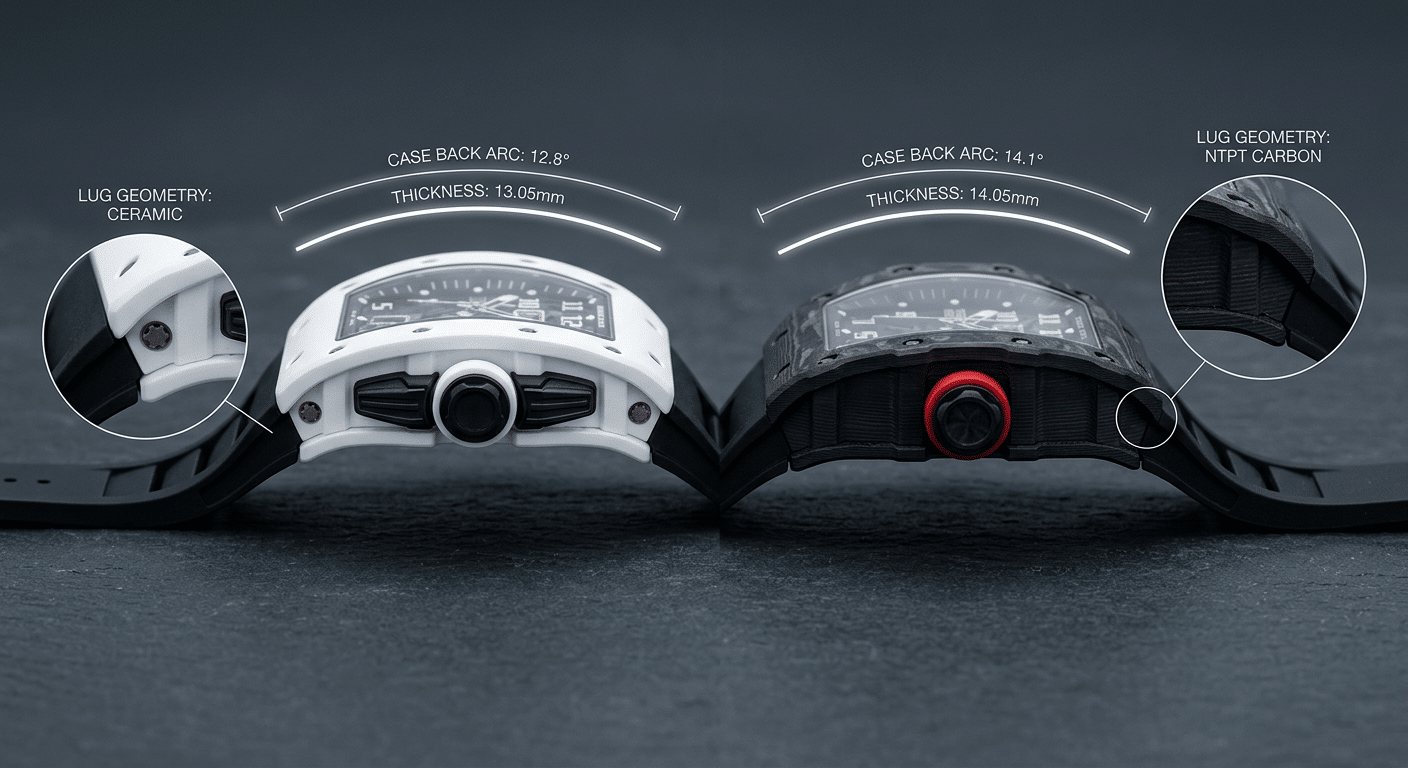
Unlike round watch replicas, where case blanks are largely standardized across models, each Richard Mille reference presents a distinct engineering challenge. The tonneau shape is not a single template; it varies dramatically in curvature, thickness, and lug geometry between models. The RM055 uses a relatively straight “bubba” case profile around 13.5mm thick. The RM35 adds aggressive curvature to the tonneau, requiring different mold engineering and strap integration. The RM011 chronograph demands thicker cases—often 15-16mm or more—to accommodate chronograph modules, pushing the limits of wearable proportions. The RM67 ultra-thin targets sub-7mm thickness, requiring quartz movements or severely compromised automatics and creating structural fragility.
These four models represent four distinct manufacturing economics. A factory cannot simply swap dial designs between these cases; each requires specific CNC programming for case blanks, custom movement spacers to accommodate different thicknesses, and unique dial layer constructions. The RM011’s chronograph movement routing adds module integration costs that don’t exist in the time-only RM055. The RM67’s ultra-thin constraints force expensive case finishing to prevent lug cracks. The RM35’s curvature increases material waste during machining.
This creates natural price floors that persist regardless of factory reputation. An RM011 will always cost more than an RM055 from the same factory because the base construction is inherently more complex. Buyers who cross-compare models without accounting for these structural demands—expecting an ultra-thin RM67 or a chronograph RM011 at the same price as a standard RM055—either overpay for inferior construction or buy watches destined for immediate failure.
RM055: The Structural Benchmark and Baseline Price Logic
The RM055 serves as the structural benchmark for Richard Mille super clone pricing—a “middle path” that balances genuine complexity against production feasibility. Unlike the aggressively curved RM35, the chronograph-thick RM011, or the ultra-thin RM67, the RM055’s “bubba” case profile represents the sweet spot where skeletonized aesthetics meet manageable manufacturing economics.
This model typically measures approximately 49.9mm × 42.7mm × 13.5mm—a “standard” tonneau thickness that allows factories to use proven movement spacers and sapphire fitting techniques without the extreme constraints facing other models. The case sides are straighter than the RM35’s pronounced curve, reducing CNC programming complexity and material waste during machining. This geometry creates production efficiencies that translate to more stable pricing tiers.
The RM055’s time-only function allows factories to deploy standard automatic movements—typically NH70 bases or similar skeletonized calibers—without requiring chronograph modules or ultra-thin hand-winding complications. This movement standardization eliminates the thickness premiums attached to RM011 chronographs and the fragility risks of RM67 ultra-thin cases. The result is a watch that delivers the signature RM skeletonized aesthetic without the structural compromises that drive up costs in other models.
At Clean VS Factory, we often explain to buyers that the RM055 represents the widest “safe purchase window” in the Richard Mille replica market. Because its structural demands are balanced rather than extreme, it tolerates a broader range of factory execution quality while still delivering wearable watches. The RM35’s curvature requires more precise case finishing; the RM011’s chronograph module demands thicker, less comfortable cases; the RM67’s thinness creates durability risks. The RM055 avoids these extremes, making it the logical baseline against which other models’ price premiums should be measured.
Case Geometry and Production Efficiency
The RM055’s specific dimensions—typically 49.9mm lug-to-lug, 42.7mm width, and 13.5mm thickness—place it in a manufacturing sweet spot for tonneau cases. This “standard” curvature allows factories to use existing CNC tool paths and case blank molds with minimal customization, whereas the RM35’s aggressive inward curve requires reprogrammed machining sequences that increase material waste and production time.
The relatively straight tonneau sides also simplify sapphire crystal fitting. Ultra-thin models like the RM67 require edge-thinned crystals that are prone to cracking during installation, while the RM055’s 13.5mm profile accommodates standard-thickness sapphire with more forgiving tolerances. Similarly, caseback sealing is more reliable on the RM055 because the caseband has sufficient material thickness to accommodate proper gaskets without the structural compromise required by ultra-thin cases.
Movement Route Standardization
The RM055’s time-only function allows factories to utilize standardized automatic movements—most commonly the NH70 skeletonized base or similar Seiko-derived calibers—without the module integration required by chronographs or the extreme thinness demanded by dress watches. This standardization creates several production advantages that keep pricing stable.
First, the movement thickness of approximately 5.5-6mm fits comfortably within the RM055’s 13.5mm case profile, allowing for robust movement spacers and reliable rotor clearance without the cramming required by ultra-thin designs. Second, the time-only function eliminates the chronograph module reliability issues that plague RM011 replicas—sticky pushers, misaligned subdials, and module failures that drive up costs and defect rates.
This movement standardization means that factories can achieve reliable timekeeping with decorated skeletonized bridges at price points that would be impossible for chronograph or ultra-thin complications. The result is that the RM055 delivers the essential Richard Mille aesthetic—skeletonized dial, tonneau case, rubber strap—without the structural premiums that make other models significantly more expensive or fragile.
Movement Technical Specifications and Manufacturer Documentation
Understanding the movements commonly found in Richard Mille replicas requires examining the official specifications from movement manufacturers. The Miyota 9015, frequently mentioned in discussions of ultra-thin RM67 replicas and relevant to best value price bands, is documented by Citizen Watch (Miyota’s parent company) as operating at 28,800 vibrations per hour (4Hz) with a power reserve of approximately 42 hours and a thickness of 3.9mm[1]. These specifications explain why the 9015 fits ultra-thin cases but also why its rotor axle tolerances create fragility risks when the movement is skeletonized and exposed.
The Seiko NH70 (or NH71, NH72 variants), commonly used in RM055 skeletonized builds, operates at 21,600 vibrations per hour (3Hz) with a thickness of approximately 5.5mm and 24 jewels[2]. This movement’s robust construction and thicker profile make it suitable for standard tonneau cases where shock absorption is prioritized over extreme thinness. Factory claims about “upgraded” or “decorated” movements should be evaluated against these baseline specifications—decoration does not alter the fundamental beat rate, power reserve, or shock tolerance documented by the manufacturer.
For chronograph modules, the Miyota VK series (VK63, VK64, VK67) represents a common mecha-quartz solution, featuring a quartz base with mechanical chronograph modules, while automatic chronographs often use architectures derived from the Shanghai 7750 or similar cam-wheel designs. Understanding these mechanical baselines helps buyers recognize that movement claims in replica marketing should align with documented manufacturer capabilities rather than vague assertions of “Swiss quality” or “1:1 identical” performance.
Movement descriptions in the replica market should be read as configuration references, not as official brand-caliber claims. Terms like “clone 4130,” “3235,” or “RM movement” typically describe layout, decoration, or architectural similarity rather than genuine manufacture by the luxury brand or its suppliers. Buyers should distinguish between movement layout, decoration quality, reliability expectations, and actual serviceability, recognizing that a skeletonized NH70 base performs differently from an in-house Richard Mille caliber despite visual similarities in bridge design.
Legal Boundaries and Trademark Disclosure for Replica Watches
Richard Mille replicas occupy a complex legal territory regarding trademark and intellectual property law. Richard Mille SA holds registered trademark protections on its distinctive tonneau case shape, dial layouts, and brand identifiers across major jurisdictions including the United States, European Union, and Switzerland[3]. Replica watches bearing these protected elements constitute counterfeit goods under international trade agreements including the Agreement on Trade-Related Aspects of Intellectual Property Rights (TRIPS) and corresponding national customs regulations[4].
From a customs and import perspective, most jurisdictions classify replica watches bearing protected trademarks as prohibited or restricted imports. United States Customs and Border Protection specifically identifies counterfeit watches as goods subject to seizure, with penalties potentially extending to civil fines for intentional importation[4]. The European Union similarly enforces customs regulations allowing for detention of goods suspected of infringing trademark protections.
Buyers should recognize that these products are manufactured without brand authorization and carry no warranty, service support, or legal legitimacy from Richard Mille SA. The structural and engineering analysis provided here serves only to inform purchasing decisions within the replica market context, not to suggest equivalence with authentic products or to circumvent trademark protections.
Authentication Reality and Professional Inspection Limits
Even the most carefully assembled Richard Mille super clone cannot pass professional authentication or inspection by trained experts. Authentication services, boutique staff, and experienced collectors examine specific micro-details—such as the anglage of bridge edges, the perlage pattern on base plates, the specific torque of screws, and the metallurgical composition of cases—that differ systematically between replica and genuine manufacture. While a super clone may present a convincing silhouette from a distance or in photographs, close physical inspection reveals discrepancies in finishing quality, movement architecture, and material specifications that authentication professionals are trained to identify within minutes.
Buyers should understand that representing a replica watch as genuine—whether in private sales, online listings, or social contexts—carries significant ethical and legal risks. Beyond the trademark infringement discussed previously, selling a replica as an authentic luxury watch constitutes fraud in most jurisdictions. The information provided in this guide serves exclusively to help buyers understand the technical differences between replica models for their own purchase decisions, not to enable misrepresentation of replica watches as genuine articles. Anyone considering purchase should assume that the watch will be identifiable as a replica upon close inspection by knowledgeable parties.
RM011: The Chronograph Complexity Tax Explained
The RM011 (Felipe Massa) chronograph sits at the top of the Richard Mille replica price hierarchy, often commanding $200–$400 more than an equivalent-grade RM055. Buyers frequently mistake this premium for mere factory markup or branding, but the cost reflects genuine manufacturing escalation. Adding a functional chronograph module to a tonneau case requires a thicker movement, reinforced case architecture to house the module, functional pusher assemblies with return springs, and a multi-layered dial construction that must align three subdials perfectly. These are not cosmetic upgrades; they are structural demands that create a complexity ceiling below which the watch simply fails to function.
Specifically, the RM011 replica typically measures 15–16mm thick versus the RM055’s 13.5mm. This 2–3mm increase is non-negotiable; chronograph modules (whether VK quartz or modified automatic architectures like the Shanghai 7750 base) require vertical space for the cam wheels and column wheels that control the start-stop-reset functions. Budget attempts to thin this profile result in non-functional pushers or subdials that drift out of alignment. Furthermore, the skeletonized chronograph dial requires a base movement plate, separate subdial rings, and a rehaut layer—each needing CNC machining and manual alignment during assembly. A single-layer RM055 dial takes less than half the assembly time.
The judgment here is stark: an RM011 offered at RM055 pricing guarantees either a non-functional chronograph or imminent failure. The “complexity tax” is not negotiable. Buyers who see an RM011 chronograph replica priced similarly to a basic RM055 should assume the subdials are decorative, the pushers are non-functional, or the movement will seize within weeks. This is not a factory quality issue; it is a physics constraint. The RM011 demands a higher price floor simply to function at a baseline level.
Movement Module and Thickness Constraints
Integrating chronograph modules into tonneau cases requires specific movement spacers that lift the base caliber to accommodate the chronograph layer, effectively increasing the movement stack height by 2–3mm. This affects wearing comfort more than photos suggest; the RM011 wears like a heavy sports watch, whereas the RM055 maintains a relatively flat profile. The pusher construction also differs fundamentally from time-only models: RM011 replicas require functional column-wheel or cam-actuated mechanisms with return springs that reset the chronograph hands to zero. Budget versions often use simple pushers that either stick or fail to return, rendering the complication unusable.
Layered Dial Construction Costs
The RM011’s skeletonized chronograph dial requires three distinct manufacturing layers: the base movement plate (with gear train visibility), the subdial rings (which must align perfectly with the base plate’s holes), and the rehaut/minute track layer. Each layer requires separate CNC programming and manual alignment during assembly. Subdial spacing accuracy is critical; if the 3 o’clock and 9 o’clock subdials are misaligned by even 0.5mm, the visual symmetry collapses. This multi-layer construction adds significant assembly time compared to the single-layer dial of an RM055, directly increasing manufacturing cost regardless of the factory’s hourly rate.
QC Photos to Request for Chronograph Models
When evaluating an RM011 replica, buyers should request specific QC photos that reveal functional integrity: pusher alignment photos showing all three pushers sitting flush with the case (indicating proper spring return mechanisms); subdial hand alignment at 12:00 with all three hands (chrono seconds, 30-minute counter, and running seconds) pointing perfectly vertical; and side profile thickness confirmation with a ruler visible to verify the case is not disproportionately thick due to poor module integration.
Long-Term Serviceability and Maintenance Reality
Buyers often evaluate replica watches based on acquisition cost without considering the total cost of ownership over a realistic lifespan. Richard Mille super clones, particularly those with complex movements or ultra-thin cases, function as consumable items rather than serviceable heirlooms. The chronograph modules in RM011 replicas—whether quartz mecha-movements or automatic derivatives—contain specialized parts that local watchmakers cannot source. When the chronograph function fails, the cost of sourcing a replacement movement often approaches the price of the watch itself, making “repair” economically irrational compared to replacement.
For ultra-thin automatic movements like those in RM67 replicas, the fragility issues discussed earlier compound serviceability problems. The rotor axle and bearing systems in skeletonized ultra-thin movements wear quickly under normal use, and replacement rotors or bearing jewels for these specific movement configurations are not standard inventory items at watch repair shops. Buyers should realistically expect a 2–3 year functional lifespan for daily-worn ultra-thin automatic replicas, after which movement replacement becomes necessary. This reality makes the quartz movement option for RM67 replicas more practical for buyers prioritizing longevity over mechanical aesthetics—quartz movements offer 5+ year battery life with minimal maintenance, though they require accepting the “false skeleton” dial appearance.
The RM055 and RM35 models with standard automatic movements (NH70 bases or similar) offer the most straightforward serviceability. These movements use standard parts that most watchmakers can service or replace at reasonable cost. However, even these simpler models suffer from case-specific issues—the RM35’s curved case strap screws and the RM055’s sapphire bonding—that fall outside standard watchmaker expertise. Buyers should budget for potential case repairs or replacements separate from movement service. The practical judgment is that Richard Mille replica ownership requires accepting periodic replacement rather than lifelong maintenance, with complex models (RM011, RM67) offering 1–3 year lifespans under daily use, while simpler models (RM055) may extend to 3–5 years with careful handling.
A replica watch should be evaluated with realistic ownership expectations. Even a strong super clone can have limits in water resistance, long-term movement stability, servicing convenience, and close inspection compared with a genuine reference. The Richard Mille tonneau case shape, with its curved sapphire, complex gaskets, and skeletonized exposure, creates inherent durability challenges that no factory can fully eliminate. Buyers should anticipate periodic replacement rather than indefinite serviceability, and avoid representing these watches as genuine to others.
Quality Control Note: For replica and super clone watches, buyer confidence depends on visible quality-control details such as case finishing, dial printing, bezel alignment, bracelet fit, clasp engraving, datewheel position, and movement configuration. These details should be checked model by model rather than assumed from a factory name alone.
Material Claims: 904L Steel, Carbon Fiber Grades, and Crystal Specifications
The replica market frequently invokes material terminology—904L steel, sapphire crystal, “NTPT” carbon, ceramic bezels—to justify price premiums. Understanding the technical reality of these materials helps buyers evaluate whether such claims represent genuine engineering differences or marketing decoration. 904L stainless steel, often cited in high-end replicas, contains higher chromium, molybdenum, and nickel content than standard 316L, offering improved corrosion resistance and polishability[8]. However, in tonneau case applications, the steel grade matters less than the CNC machining tolerance and surface finishing; a precisely machined 316L case with proper heat treatment often outperforms a poorly finished 904L case.
Sapphire crystal claims require similar scrutiny. Genuine sapphire (corundum, Al₂O₃) provides a Mohs hardness of 9, resisting scratches from all but diamond or moissanite[9]. However, sapphire thickness, edge beveling, and anti-reflective (AR) coating quality vary dramatically in replicas. Thin “sapphire” crystals (below 1.5mm) on curved tonneau cases risk chipping at the edges, while thick, flat crystals without proper AR coating reduce legibility. The carbon fiber (or “carbon composite”) used in RM-style cases ranges from basic epoxy-impregnated sheets to higher-grade T700 or T800 fiber weaves. Authentic Richard Mille uses NTPT (North Thin Ply Technology) carbon with specific layer thicknesses of 30 microns, creating distinctive wood-grain patterns that are difficult to replicate precisely[10].
Buyers should treat material claims as secondary to structural execution. A replica with “genuine 904L steel” but poor case geometry and misaligned pushers represents worse value than a 316L case with precise assembly. Similarly, “sapphire crystal” means little if the crystal is not properly gasketted against the tonneau case curvature, creating water intrusion risks. The material specification supports the engineering; it does not replace it.
Operational Limits: Water Resistance and Durability Boundaries
Replica watches, including Richard Mille super clones, should never be assumed to offer water resistance equivalent to genuine luxury timepieces unless specifically tested and verified by the seller with documented evidence. The tonneau case shape of Richard Mille replicas presents particular challenges for water resistance: the curved sapphire crystal, complex caseband geometry, and multiple gasket interfaces create potential failure points that differ significantly from round watch designs. Even when factories claim “water resistance” or “waterproof” construction, buyers should treat these watches as splash-resistant at best, suitable for occasional rain exposure or hand washing, but not for swimming, showering, or submersion.
The structural complexity of Richard Mille replicas—particularly the skeletonized dials, exhibition casebacks, and thin case walls of the RM67—further compromises durability expectations. Unlike genuine Richard Mille watches, which undergo extensive shock testing and utilize proprietary materials like NTPT carbon and grade 5 titanium engineered for specific flexural properties, replicas utilize standard carbon composites, stainless steels, and acrylic crystals that behave differently under stress. The ultra-thin RM67 cases are particularly vulnerable to torque forces during strap changes; the RM011 chronograph pushers may fail under repeated use; and the RM35’s curved case lugs may develop stress fractures not present in the straighter RM055. Buyers should anticipate functional lifespans of 2–5 years under careful use, with the understanding that these are consumable items rather than heirloom pieces, and should never be represented as genuine watches to potential buyers or service centers.
Factory Positioning Within Model Price Tiers
Buyers evaluating Richard Mille replica pricing often fixate on factory names—assuming ZF commands a premium across all models, or that APSF is universally “better” than smaller factories. This framing misses the structural reality: the model’s engineering demands set the price floor before factory prestige enters the equation. An RM011 chronograph will always cost more than an RM055 time-only watch from the same factory, regardless of whether that factory is ZF, APSF, or a smaller boutique operation. The chronograph module, thicker case requirements, and layered dial construction create a base cost that no factory can undercut without rendering the watch non-functional.
Factories specialize by model family rather than dominating all categories equally. Some facilities excel at the RM011’s chronograph architecture—mastering the integration of the module with the base movement and achieving functional pusher return—but struggle with the ultra-thin case constraints of the RM67. Others may produce excellent RM055 cases with proper carbon layering but fail to achieve the curved lug geometry required for the RM35. This specialization means factory rankings are model-dependent. A buyer seeking the best RM67 should not necessarily choose the factory known for the best RM055, even if that factory charges premium prices for its standard tonneau models.
Batch versioning within factories further complicates the pricing structure. RM super clones evolve through version iterations (V1, V2, V3) as factories correct flaws—improving case thickness tolerances, fixing subdial alignment, or upgrading movement finishing. Newer batches of complex models (RM011, RM67) command significant premiums over older stock because the initial versions often contained critical flaws (non-functional chronographs, case cracking, or misaligned dials) that subsequent batches addressed. For simple models like the RM055, version updates may offer incremental improvements, but the price gaps between batches are smaller because the base construction is more forgiving.
The decisive judgment for buyers: prioritize model selection before factory selection. Purchasing a complex model (RM011 chronograph or RM67 ultra-thin) from a budget factory creates exponentially more risk than buying a simple model (RM055) from a mid-tier factory. The structural demands of the chronograph and ultra-thin cases create failure modes that cheap manufacturing cannot overcome, a key factor in super clone vs cheap replica, whereas the RM055’s standard tonneau shape tolerates wider manufacturing variance. A buyer with a limited budget makes a safer choice selecting a mid-grade RM055 than a budget-tier RM011, regardless of the factory name on the dial.
Factory Specialization by Model Family
Factories develop distinct competencies aligned with specific case architectures. Facilities that excel at the RM011 chronograph typically invest in movement module integration capabilities—sourcing or modifying chronograph bases (often Shanghai 7750 derivatives or high-grade quartz modules) and engineering case spacers that accommodate the increased stack height without visible bulges. These factories may struggle with the RM67 because ultra-thin case engineering requires subtractive manufacturing discipline—removing material while maintaining seal integrity—a different technical challenge than adding complication modules. Conversely, factories that produce excellent RM055 standard tonneaus may lack the curved lug milling capabilities required for the RM35‘s distinctive profile. Buyers should match the factory to the specific model’s engineering demands rather than assuming a “best factory” universal ranking.
Version Updates and Batch Pricing
Richard Mille super clone pricing fluctuates significantly between version batches (V1, V2, V3) as factories iterate to correct structural flaws. For complex models like the RM011 and RM67, newer batches command substantial premiums because early versions often contained critical defects—non-functional chronograph modules in RM011 V1s, or case cracking at the lugs in early RM67 ultra-thin attempts. Factories invest in corrected molds, improved carbon layup techniques, or upgraded movement finishing for subsequent batches, and these costs pass to buyers. For simpler models like the RM055, version increments offer more subtle improvements (better datewheel alignment, improved lume application) with smaller price gaps between batches. Buyers evaluating “expensive” versus “cheap” RM replicas should verify the version number; a high price for a V1 complex model may represent old stock with known flaws, while a moderate price for a V3 simple model likely offers better structural integrity.
Before making a decision, buyers should review real QC photos where available, including dial printing, hand alignment, bezel position, datewheel centering, bracelet fit, clasp engraving, case thickness, and overall finishing. Factory labels and stock photos alone are not enough for a reliable judgment, particularly for complex models like the RM011 chronograph or ultra-thin RM67 where small misalignments can indicate significant functional issues.
Practical Verification Steps Before Purchase
Factory marketing materials and stock photography present idealized versions of replica watches that may not represent the specific unit you will receive. To reduce uncertainty before purchase, buyers should request verification materials that go beyond promotional images. For time-only models like the RM055, this means clear macro photography of the dial printing quality, particularly checking for crisp edges on the Richard Mille logo and alignment of the skeletonized bridges. For chronograph models like the RM011, video evidence becomes essential—static photographs cannot demonstrate whether the chronograph pushers provide tactile feedback or whether the subdial hands reset to zero properly.
Specific verification checkpoints vary by model complexity. For the RM67 ultra-thin, request side-profile photographs with a measurement reference to confirm the case thickness approaches the target 7mm range rather than a thicker “ultra-thin” attempt that fails to achieve the proper silhouette. For the RM35 with its curved case, examine the strap integration points closely—gaps between the rubber strap and the case curvature indicate imprecise molding. When possible, request photographs of the movement through the caseback to verify the rotor engraving and bridge finishing match the factory’s stated movement configuration. These verification steps cannot eliminate all risk, but they replace blind trust with specific, observable quality indicators that align with the structural realities discussed in this guide.
Factory Name Clarification: Factory names in the replica watch market are commonly used buyer-facing labels. They should be treated as practical market references, not as official brand affiliations, audited manufacturer identities, or guarantees of identical quality across every model.
QC Risks That Drive Real Ownership Costs
The gap between price and cost becomes brutally clear with Richard Mille super clones. A buyer who saves $300 upfront on a budget-tier RM011 often discovers within months that the “savings” have evaporated into replacement costs, unwearable watches, or complete functional failure. The structural complexity of specific models—particularly the RM011 chronograph and RM67 ultra-thin case—creates non-negotiable engineering floors. When factories attempt these models below those floors, the resulting QC failures are not cosmetic; they are catastrophic.
When Cheap Becomes Expensive
Model-specific failure modes define the true cost of ownership. For the RM011, the chronograph module represents the single highest-risk component. Budget versions often arrive with non-functional subdials, pushers that stick or fail to reset, and chronograph hands that refuse to align at 12 o’clock. These are not minor flaws—they render the watch’s primary complication unusable. Repairing or replacing a failed chronograph module in a tonneau case often exceeds the original purchase price.
The RM67 presents the opposite structural risk: case integrity. The ultra-thin target—approximately 7mm—removes the material mass needed to absorb daily impacts. Budget RM67 replicas frequently develop stress cracks at the lugs within weeks of regular wear. Once a lug cracks, the watch becomes unwearable and unrepairable; the case is the watch. The “savings” of a cheaper RM67 evaporate when the buyer must purchase a second watch.
For the RM35, the aggressive case curvature creates specific stress concentrations at the strap attachment points. Budget versions often use screws that strip or pull out of the case, or rubber straps that degrade rapidly at the bend points. While less catastrophic than RM011 module failure or RM67 case cracks, these issues require constant strap replacement and case repair, driving up the total cost of ownership.
The RM055 benefits from more forgiving geometry, but budget versions still risk dial misalignment, poorly fitted sapphire crystals, and date-wheel errors (where applicable). These are generally rectifiable without total loss, making the RM055 the most structurally tolerant choice for buyers constrained to lower price tiers.
Visual Red Flags by Model
For the RM011,

non-functional chronograph pushers represent the most common critical flaw. Verify through video evidence that all three pushers (start, stop, reset) operate with tactile feedback and that subdial hands snap crisply to zero. For the RM67, stress fractures typically originate at the junction between the curved caseband and the lug; inspect QC photos for any whitening or hairlines in the carbon fiber weave at these stress points. For the RM35, strap screw torque is critical—loose screws indicate stripped threads or insufficient thread locker, while uneven gaps between the rubber strap and case curvature suggest warped case geometry. For the RM055, dial printing alignment and sapphire gasket seating present the primary visual QC indicators; misaligned indices or visible glue residue under the crystal indicate lower-tier assembly.
Authentic Reference Specifications: Understanding the Baseline
To contextualize the replica pricing and engineering discussions above, understanding the authentic Richard Mille specifications provides necessary baseline comparison. The genuine RM 055 Bubba Watson (reference RM055) measures 49.9mm × 42.7mm × 13.85mm according to official Richard Mille technical documentation, featuring a case constructed from ATZ ceramic or white ceramic with rubberized titanium inner cases, powered by the in-house Caliber RMUL2 with 55 hours power reserve and grade 5 titanium bridges[5].
The authentic RM 011 Felipe Massa (reference RM011) measures approximately 50mm × 40mm × 16.15mm, utilizing the RMAC1 skeletonized automatic winding caliber with flyback chronograph, annual calendar, and 55-hour power reserve, housed in titanium or red gold cases with NTPT carbon options[6]. The RM 67-01 (reference RM67) achieves its ultra-thin 7.75mm profile through the Caliber CRMA6 automatic movement with 50 hours power reserve, constructed from titanium and platinum for the rotor[7].
These authentic specifications highlight the engineering gaps in replica production. While replicas may approximate dimensions, the proprietary materials (ATZ ceramic, NTPT carbon, grade 5 titanium) and movement architectures (in-house flyback chronographs, specialized automatic winding systems) represent technologies not replicated in the clone market. The price differentials between replica models roughly parallel the authentic hierarchy, but buyers should recognize that replica “thinness” or “chronograph function” operates on fundamentally different mechanical principles than the genuine articles.
CleanVSFactory Editorial Role and Service Boundaries
CleanVSFactory operates as an educational and comparison resource for buyers navigating the replica watch market, not as an authorized dealer, manufacturer representative, or certification authority. The content provided—including factory comparisons, movement analyses, and pricing guidance—reflects observational research and market monitoring rather than official partnerships with any manufacturing facility or luxury brand. CleanVSFactory maintains no affiliation with Richard Mille SA, Rolex, Patek Philippe, Audemars Piguet, or any other luxury watch brand mentioned in our guides, and brand names are used solely to identify reference designs for comparison purposes.
Readers should understand that CleanVSFactory does not provide warranties, guarantees, return policies, or customs assurances for any watches discussed. We do not certify replica watches as authentic-equivalent, guarantee that specific watches can pass professional inspection, or promise that factory names indicate identical quality across all models. All purchasing decisions remain the sole responsibility of the buyer, who must independently verify seller policies, pricing, availability, and after-sales support before completing any transaction. The information provided here serves to reduce buyer risk through education, not to eliminate the inherent uncertainties of replica watch ownership.
[1] Miyota, “Caliber 9015 Technical Specifications,” Citizen Watch Company, 2024.
[2] Seiko Instruments Inc., “Caliber NH70/71/72 Specifications,” Time Module Inc., 2024.
[3] Richard Mille SA, “Trademark Portfolio and Intellectual Property,” World Intellectual Property Organization (WIPO), 2024.
[4] U.S. Customs and Border Protection, “Intellectual Property Rights Enforcement,” CBP.gov, 2024.
[5] Richard Mille, “RM 055 Bubba Watson Technical Specifications,” RichardMille.com, 2024.
[6] Richard Mille, “RM 011 Felipe Massa Technical Specifications,” RichardMille.com, 2024.
[7] Richard Mille, “RM 67-01 Automatic Extra Flat Technical Specifications,” RichardMille.com, 2024.
[8] ASTM International, “ASTM A240 Standard Specification for Chromium and Chromium-Nickel Stainless Steel Plate,” 2023.
[9] Gemological Institute of America, “Sapphire (Corundum) Properties and Hardness,” GIA.edu, 2024.
[10] North Thin Ply Technology (NTPT), “Thin Ply Carbon Fiber Technology for Watch Cases,” NTPT.ch, 2024.
Disclosure: This article is for general educational and comparison purposes only. Replica watches are not genuine products from the original luxury brands, and brand names are used only to identify reference designs or comparison topics. Factory names, movement descriptions, prices, availability, QC details, seller policies, and version information can change, so readers should verify important details with the seller before making a purchase decision. Replica watches should not be represented, resold, or used as genuine watches.