
Doubling your budget from $1,000 to $2,000 when buying a Richard Mille replica does not automatically guarantee better quality. Many buyers discover that the extra money merely polishes surface details while fundamental flaws—resin cases that chip at the edges, noisy generic movements due to movement complexity, and straps that separate from the lugs—remain unchanged. The real question is whether your specific model and wearing habits justify the higher tier.
This article examines the structural differences between entry-level replicas and $2,000 super clones, focusing on carbon fiber construction versus wrapped resin, anatomically molded strap integration, and skeletonized movement architecture. You will learn which Richard Mille models demand the higher investment for daily wear reliability, when the $1,000 tier suffices, and how to verify construction quality beyond inflated version numbers.
| Wearing Scenario / Model Type | Recommended Tier | Critical Quality Verification |
|---|---|---|
| Complex skeletonized (RM 35-02, RM 055) / Daily wear | $2,000 Super Clone | Carbon fiber pattern continuity at machined edges; anatomical strap-lug solidity |
| Simple tonneau or quartz models / Occasional use | $1,000 Entry Tier | Resin wrapping integrity; basic strap curvature alignment |
| Active daily use requiring reliability | $2,000 with RMUL2 simulation | Rotor noise levels; bridge jewel positioning accuracy |
| Budget upgrade from $1,000 tier | Avoid $1,500–$1,800 range | Documented structural changes (V2/V3) vs. marketing labels without material upgrades |
| Visual accuracy priority | Tier varies by model generation | Skeletonization depth (physical layers vs. surface etching); screw head seating depth |
Quick Questions Before You Read
Q: Does paying $2,000 guarantee better construction than a $1,000 replica?
Not automatically. The extra cost only delivers value when it purchases carbon fiber case construction, proper strap lug integration, and layered skeletonization rather than surface polishing. Always verify edge machining and movement architecture rather than trusting version numbers.
Q: Which Richard Mille models actually require the $2,000 super clone tier?
Complex skeletonized references like the RM 35-02 and RM 055 demand the higher investment for structural strap retention and case integrity during daily wear. Simple tonneau cases or quartz models offer minimal advantage at $2,000, making the $1,000 tier sufficient for occasional use.
Q: Why should I avoid watches priced between $1,500 and $1,800?
This middle range typically represents dealer markup with inflated “V2” or “V3” labels that lack documented structural improvements. Without verified changes to case materials, strap molding, or movement architecture, these watches deliver the same quality as $1,000 tiers while costing significantly more.
Q: How can I verify that a “super clone” actually has the upgrades it claims?
Inspect carbon fiber patterns continuing through machined edges rather than stopping at surfaces, check for anatomical strap curvature matching the case lugs, and confirm skeletonization has physical depth with properly positioned bridges and jewels. These structural details reveal genuine tier differences that marketing labels cannot fake.
Claims such as “perfect,” “same as genuine,” or “guaranteed to pass inspection” should be treated with caution. A more reliable comparison looks at the actual model version, movement configuration, finishing details, and available QC evidence.
Editorial Perspective: This article approaches Richard Mille replica pricing from the perspective of wearing reality rather than specification lists. In the RM replica market, factory names and version numbers often obscure more than they reveal. The critical judgment is not which factory has better marketing, but whether the specific model you want can survive the tonneau case’s structural demands at the price point you are considering. At cleanvsfactory.com, we have observed that RM replicas generate disproportionate buyer disappointment because the skeletonized architecture exposes every mechanical shortcut, and the integrated strap system creates failure modes that do not exist in round-case watches. This guide prioritizes structural integrity over visual polish, because a $2,000 RM replica with perfect carbon weave but failing strap screws is ultimately a $2,000 paperweight.
The Marginal Gain Question: What $2,000 Actually Buys in RM Replicas
Doubling your budget from $1,000 to $2,000 in the Richard Mille replica market does not guarantee a doubling of quality. Unlike the predictable increments seen in Rolex super clones, the RM price tier often obscures a chaotic reality: some $2,000 watches solve fundamental structural failures present at $1,000, while others merely repackage the same core flaws with cleaner screws and a smoother carbon weave. The critical distinction lies in whether the extra $1,000 purchases architectural integrity or only surface polish.
Richard Mille replicas present a unique evaluation challenge because the tonneau case shape, integrated rubber strap system, and deeply skeletonized dials create failure modes that do not exist in round-case watches. A $1,000 Submariner replica might survive with minor finishing flaws; a $1,000 RM replica often fails structurally at the strap lugs, leaks through the tonneau case joints, or exposes its budget movement through skeleton windows that should hide nothing. This reality forces a stricter analytical framework when evaluating the $1,000 price jump in RM replicas specifically.
Why Richard Mille Replicas Face Unique Price-Quality Pressure Points
The tonneau shape fundamentally alters how a watch wears and fails. Unlike round cases where pressure distributes evenly across a circular seal, the tonneau’s elongated curves and sharp transitions concentrate mechanical stress at the strap attachment points and caseback junctions. At $1,000, RM replicas often use generic rubber straps with poor compound flexibility and screws that do not seat flush, creating visible gaps where the strap meets the case. Under daily wear, these gaps widen, the screws loosen, and the watch develops a perceptible wobble on the wrist. The $2,000 tier typically addresses this through better rubber compound matching and improved screw torque retention, solving a structural security issue rather than merely improving appearance.
The skeletonized dial architecture presents a second unique pressure point. Richard Mille watches expose the movement through multi-layered skeleton windows, meaning the movement itself becomes part of the visual design. A $1,000 replica often uses a standard automatic movement with plates removed or superficially skeletonized, revealing obvious auto-modules and bridge shapes that bear no resemblance to genuine RM architecture. The $2,000 tier attempts to simulate specific RM base calibers with corrected bridge shapes and jewel positioning, addressing an architectural accuracy problem that is invisible in non-skeletonized watches but glaringly obvious in RM replicas.
The Evaluation Framework: Structural vs. Cosmetic Improvements
To navigate the $1,000 price increment effectively, buyers must categorize every claimed upgrade, as outlined in entry level RM super clone, into one of two categories: structural improvements that affect ownership experience and longevity, versus cosmetic refinements that affect only visual inspection. Structural improvements include case integrity (layered carbon fiber simulation versus surface-wrapped resin), movement stability (simulated RM architecture versus decorated standard autos), and strap security (integrated curved straps with proper screw torque versus generic rubber with visible gaps). These changes determine whether the watch survives daily wear or fails at the lugs within months.
Cosmetic refinements include better carbon weave patterns, sharper printing on the dial, cleaner screw heads, and improved AR coating on the crystal. While these details enhance visual authority under close inspection, they do not solve the fundamental wearing problems that plague $1,000 RM replicas. The critical judgment buyers must make is whether the specific $2,000 watch they are considering delivers structural improvements appropriate to the RM model they want, or merely cosmetic upgrades that cannot compensate for underlying architectural flaws. This framework determines whether the extra $1,000 represents genuine value or simply a more expensive way to own the same problems.
The Factory Name Fallacy: Why Reputation Does Not Transfer Across RM Models
Buyers frequently import factory loyalty from the Rolex replica market, assuming that a factory producing excellent Submariners will deliver equivalent quality in Richard Mille models. This assumption rarely holds because RM replication demands entirely different competencies: carbon case simulation, anatomical strap molding, and skeletonized movement architecture. A factory may excel at stainless steel case finishing and ceramic bezel insertion—skills relevant to Rolex—yet lack the rubber compound expertise or carbon layering capability that RM models require.
Furthermore, factory output varies significantly by model complexity within the same brand. One factory might produce a structurally sound RM 11-03 chronograph because the case architecture is relatively forgiving and the dial partially conceals the movement, but fail at the RM 35-02 because the deep skeletonization exposes movement flaws that the chronograph’s dial hides. Conversely, a factory with mediocre round-case skills might deliver superior RM replicas because they invested specifically in tonneau case machining and rubber strap integration. The buyer should evaluate the specific model and production batch rather than relying on factory reputation carried over from unrelated watch categories. For complex RM skeletons, the factory name is a starting point for research, not a guarantee of structural competence.
Factory Name Clarification: Factory names in the replica watch market are commonly used buyer-facing labels. They should be treated as practical market references, not as official brand affiliations, audited manufacturer identities, or guarantees of identical quality across every model.
Factory names in the replica watch market are useful buyer-facing references, but they should not be treated as official luxury-brand affiliations or automatic guarantees of quality across every model.
Evidence Standards: Verifying Technical Claims Without Factory Confirmation
In the absence of verified factory documentation or authenticated supply chain records, buyers must rely on physical inspection points and cross-referencing against general horological standards. When a seller claims a replica contains a specific movement base, the buyer should verify that the visible components roughly correspond to that caliber’s documented architecture, while understanding that replica movements often deviate in materials and finishing. For example, standard automatic movements typically display specific jewel counts, bridge shapes, and gear train arrangements that correspond to their claimed base caliber. If the movement in QC photos shows architectural elements inconsistent with the claimed base—such as incorrect jewel positioning or bridge layouts that do not match the caliber family—the claim requires scrutiny regardless of seller assurances.
Similarly, claims regarding case materials require careful evaluation against known physical properties. Terms like “904L steel,” “sapphire crystal,” and “carbon fiber” describe specific material categories with measurable characteristics, but replica watches may use grades or constructions that differ from genuine specifications. Visual inspection under magnification—checking for through-material pattern continuity in carbon cases, surface hardness in crystals (synthetic sapphire should resist scratching by steel), and specific gravity—provides more reliable evidence than seller labels. Without laboratory testing, steel grade claims should be treated as marketing terminology rather than verified metallurgical fact. This evidence-based approach extends to water resistance claims; without pressure test certificates from the specific unit, water resistance should be considered unverified, and the watch should not be exposed to moisture regardless of printed ratings. This specification literacy prevents buyers from paying premiums for “upgraded” movements that are merely decorated standard calibers with unchanged underlying performance.
Case Architecture: From Resin Filler to Layered Carbon and Sapphire
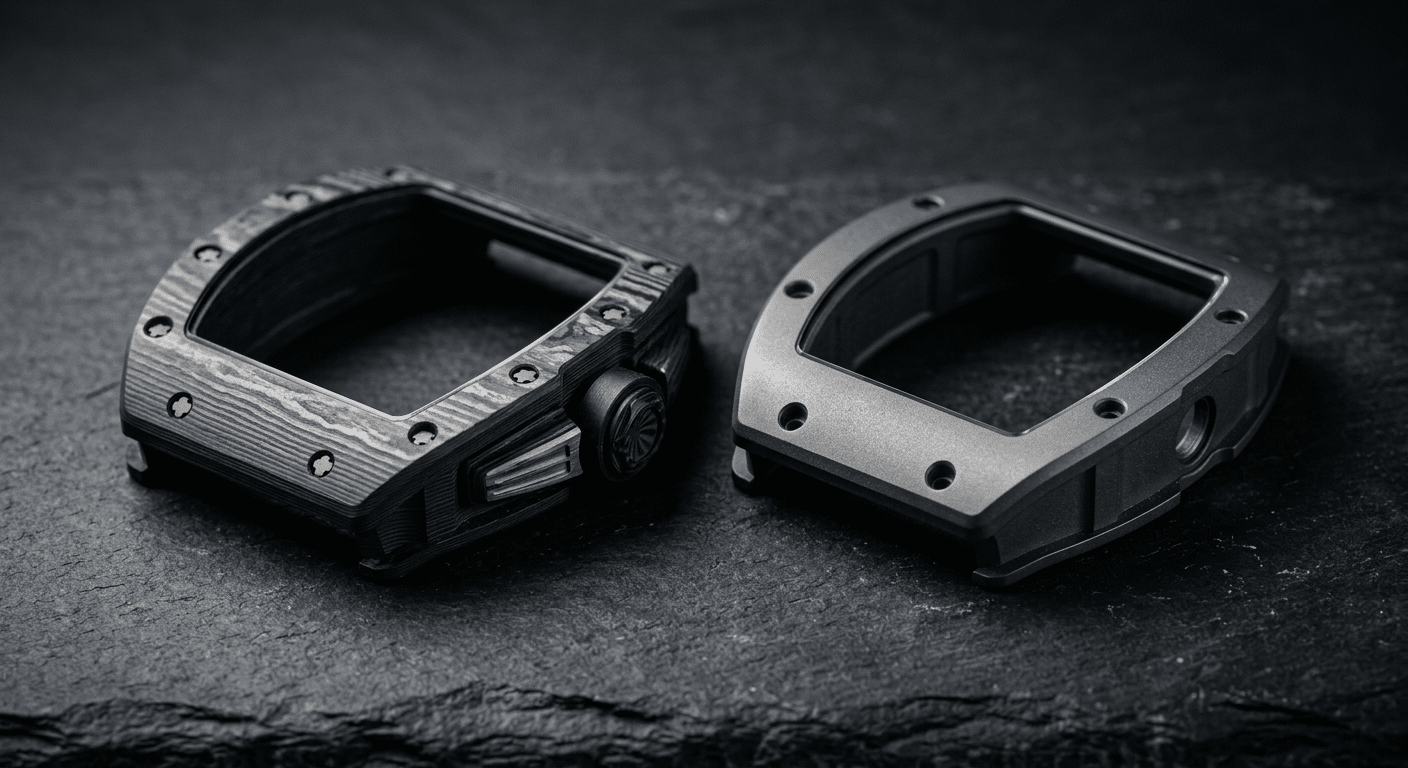
At $1,000, Richard Mille replica cases typically rely on solid molded resin or fiberglass cores wrapped in surface-applied carbon fiber film or gel-coat. This construction method produces a visible carbon pattern but creates critical weaknesses at the edges and screw holes, where the thin surface layer chips away to reveal the dull substrate beneath. The cases feel uniformly dense and slightly dead in the hand, lacking the nuanced texture variation of genuine layered composites. More critically, the molded construction often results in generic, rounded lug profiles that do not match the precise curvature of specific RM references, creating visible gaps where the strap meets the case and compromising the integrated wearing experience.
The $2,000 tier attempts a fundamentally different approach: layered carbon fiber simulation or, in some models, sapphire crystal construction. Rather than molding a solid core and wrapping the surface, these cases use multiple layers of carbon fiber sheet pressed and cured to simulate the NTPT (North Thin Ply Technology) construction used in genuine Richard Mille watches. While replicas cannot access genuine NTPT material due to exclusivity agreements, the layered approach creates a through-and-through carbon structure that maintains its pattern even at machined edges and screw holes, eliminating the chipping problem seen in $1,000 surface-wrapped cases. The material also allows for more precise CNC machining of the complex tonneau curves and lug profiles, resulting in better strap integration and a more convincing wrist presence.
Carbon Fiber Simulation: Surface Wrap vs. Layered Construction
The $1,000 tier’s surface-applied carbon fiber typically involves printing or laminating a carbon weave pattern onto a fiberglass or resin substrate, then coating it with clear gel-coat to simulate depth. Under direct light, these surfaces often appear flat or slightly plasticky, with a uniform gloss that does not shift with viewing angle the way genuine layered carbon does. The most telling weakness appears at the edges: when the surface film meets a machined edge or screw hole, the pattern simply stops, revealing the plain substrate beneath. This creates visible white lines or chips around screws that immediately signal the case’s construction method.
The $2,000 tier’s layered composite simulation attempts to replicate the genuine NTPT process by stacking alternating layers of carbon fiber prepreg at 45-degree angles, then curing them under pressure. While replicas cannot match genuine NTPT’s 30-micron layer precision or the proprietary resin formulation, the layered approach creates a three-dimensional structure where the carbon pattern continues through the material. At machined edges, screws, and caseback openings, the pattern remains visible within the material itself rather than simply printed on the surface. This eliminates the chipping problem and creates the subtle light interaction—where the pattern seems to shift and undulate with viewing angle—that characterizes genuine high-end carbon cases. The $2,000 tier does not achieve genuine NTPT quality, but it crosses the threshold from “carbon-look” to “carbon-like” in a way that significantly improves both durability and visual authority.
Sapphire Case Construction: Transparency and Structural Limits
At the $2,000 tier, some RM replicas attempt sapphire crystal case construction—an ambitious feature rarely seen at $1,000 due to material costs and machining complexity. These cases use synthetic sapphire crystal blocks milled into the tonneau shape, creating a transparent or tinted shell that mimics genuine RM sapphire editions. The visual impact is dramatic: the exposed movement appears to float within the crystal case, creating the depth and transparency that defines genuine high-end sapphire RM watches.
However, the $2,000 tier’s sapphire construction faces specific limitations that distinguish it from genuine sapphire cases. Clarity often suffers from slight color tinting—bluish or greenish hues in the crystal that genuine sapphire cases avoid through higher-grade material selection and AR coating. The machining process at this price point also struggles with the complex tonneau curves, sometimes resulting in optical distortion at the case edges or stress points where the crystal meets the caseback or bezel. Most critically, sapphire’s brittleness combined with the tonneau shape’s stress concentrations creates durability concerns: while a round sapphire case might survive minor impacts, the tonneau’s elongated curves concentrate stress at specific points, making the $2,000 tier’s sapphire RM replicas potentially fragile for daily wear despite their visual impressiveness.
Case and Bracelet Checks
When evaluating case construction at either price tier, specific QC points reveal the construction method and quality level. First, examine screw torque consistency: screws should sit flush with the case surface without protruding or sinking in, and the slots should align uniformly. At $1,000, screws often show uneven seating with visible gaps or misaligned slots; at $2,000, screw alignment and torque should appear uniform across all positions.
Second, check caseback gap uniformity. The caseback should mate flush with the case band without visible gaps or misalignment. Run a fingernail along the seam: at $1,000, you may feel steps or gaps; at $2,000, the transition should feel smooth and continuous. Third, inspect lug-to-case transition smoothness. The tonneau curve should flow continuously from lug to case band without visible flat spots or sharp angles. Finally, examine carbon layer edges under magnification if possible: at $1,000, edges will show the substrate beneath the carbon film; at $2,000, the carbon pattern should continue through the edge with visible layered structure.
Movement Architecture: When the Extra $1,000 Buys Mechanical Reliability
In Richard Mille replicas, the movement is not hidden behind a solid caseback—it is displayed through deeply skeletonized dials, making mechanical architecture a primary aesthetic element. At the $1,000 price tier, the cheap replica RM movements, as documented in super clone versus cheap replica studies, typically employ standard automatic movements (often Miyota 9015 or similar bases) with superficial skeletonization created by removing plates or adding decorative windows. These movements reveal obvious tells: incorrect bridge shapes, visible auto-modules that look nothing like genuine RM winding systems, and brass or steel finishes where genuine RM movements use grade 5 titanium. The result is a movement that functions but visibly broadcasts its budget origins through every skeleton window.
The $2,000 tier attempts to simulate specific RM base calibers—most commonly the RMUL2 or RMUL3 architectures—using the Dandong Peacock Watch Industry clones or similar integrated movements. These attempts focus on bridge shape accuracy, jewel positioning, and skeletonization patterns that mimic genuine RM layouts. While these movements still use brass or steel rather than genuine grade 5 titanium, the bridge shapes, screw positioning, and overall architectural layout attempt to replicate the visual logic of genuine RM movements. This architectural simulation represents the primary mechanical difference between the tiers: the $2,000 tier attempts to make the movement look like it belongs in an RM case, while the $1,000 tier simply exposes whatever standard auto movement was cheapest to skeletonize.
Movement descriptions in the replica market should be read as configuration references, not as official brand-caliber claims unless there is clear, verifiable evidence. Buyers should distinguish between movement layout, decoration, reliability, and actual serviceability.
Base Caliber Architecture: From Decorated Auto to Simulated RM Layout
The $1,000 tier’s approach to movement architecture typically involves taking a standard automatic caliber—commonly the Miyota 9015 or a Chinese equivalent—and applying superficial skeletonization by removing the dial-side plates and adding decorative cutouts. This method exposes the underlying mechanics but reveals standard auto-module components that look nothing like genuine RM architecture. The bridges remain generic, the jewel counts and positioning follow standard layouts rather than RM-specific patterns, and the finishing remains basic. The movement functions adequately for timekeeping but fails visually through every skeleton window, immediately signaling its budget origins to anyone familiar with genuine RM calibers.
The $2,000 tier attempts a fundamentally different approach using the Dandong RMUL2 clone or similar integrated movements designed to simulate specific RM base architectures. These movements attempt to replicate the bridge shapes, screw positioning, and jewel layouts of genuine RM calibers like the RMUL2 or RMUL3. The skeletonization follows the specific window patterns of genuine movements, attempting to expose the correct components while hiding others. While these movements cannot replicate the grade 5 titanium construction or free-sprung balances of genuine RM calibers, the architectural simulation creates a visual logic that holds up under casual inspection. The $2,000 tier’s movement represents an attempt to build something that looks like it belongs in the case, rather than simply modifying whatever standard movement was available.
Rotor Behavior and Winding Efficiency
Rotor behavior represents one of the most immediately noticeable differences between the $1,000 and $2,000 tiers, particularly in skeletonized RM replicas where the rotor remains constantly visible through the dial. At $1,000, movements typically use standard unidirectional or bidirectional winding rotors with basic finishes. These rotors often exhibit excessive noise—a audible rattling or grinding during wrist movement—due to loose tolerances in the auto-module and inadequate lubrication. The rotor mass distribution may feel uneven, creating a perceptible wobble on the wrist that becomes distracting during daily wear. Winding efficiency remains marginal; these movements often require frequent manual winding to maintain power reserve, undermining the convenience of an automatic watch.
The $2,000 tier typically employs refined rotor designs—often simulating the variable-geometry rotor systems found in genuine RM calibers or at minimum using better-balanced unidirectional winding systems. These rotors demonstrate significantly reduced noise levels, with smoother, quieter operation during wrist movement. The mass distribution feels more balanced, eliminating the perceptible wobble that plagues $1,000 movements. Winding efficiency improves markedly; the better bi-directional winding systems capture energy more effectively from normal wrist motion, reducing the need for manual intervention. For a skeletonized watch where the rotor is always on display, these improvements dramatically affect the ownership experience—transforming the watch from a noisy, wobbly distraction into a smooth, quiet companion.
Movement Route to Verify
When evaluating movements at either price tier, specific verification points reveal the depth of architectural simulation and mechanical quality. First, examine bridge shape accuracy: genuine RM calibers use distinctive bridge shapes with specific curves and cutouts. At $1,000, bridges typically follow generic layouts; at $2,000, look for bridges that attempt to mimic the specific shapes of RMUL2 or RMUL3 calibers.
Second, verify jewel count and placement. Genuine RM movements use specific jewel configurations (typically 24-25 jewels for RMUL2-based calibers). Count the visible jewels through the skeleton windows; incorrect counts or obviously misplaced jewels indicate standard movements with superficial decoration rather than architecturally simulated calibers.
Third, assess auto-module visibility. In genuine RM automatic movements, the auto-module integrates cleanly with the bridge architecture. At $1,000, you will typically see a standard auto-module sitting obviously on top of the movement; at $2,000, look for attempts to camouflage or architecturally integrate the winding mechanism so it does not dominate the skeleton view.
Fourth, inspect rotor finishing. The rotor should show clean edges, balanced mass distribution, and appropriate finishing (simulating titanium or tungsten heavy metal depending on the caliber reference). Rough edges, visible imbalance, or poor surface finishing indicate budget auto-modules.
Finally, verify beat rate consistency expectations. Genuine RM calibers beat at 28,800 vph (4 Hz). Both $1,000 and $2,000 tiers typically achieve this rate, but stability differs: $1,000 movements often show rate variations of ±20-40 seconds/day with poor positional variance, while $2,000 tiers typically achieve ±15-30 seconds/day with more stable amplitude across positions. This reliability improvement, rather than raw accuracy, often justifies the price difference for daily wear.
Visual Accuracy vs. Daily Reliability: The Skeletonization Tradeoff
Richard Mille replicas present a unique ownership calculus because the skeletonized dial makes the movement a permanent visual feature, not a hidden functional component. At $1,000, factories prioritize visual impact over mechanical refinement—movements may look architecturally interesting in static photos but exhibit rotor noise, poor amplitude stability, or rapid wear under daily use. At $2,000, the movement attempts both visual simulation and mechanical refinement, but buyers must decide which priority matters more for their specific use case.
A buyer seeking the watch for occasional wear at social events may prioritize visual architecture—correct bridge shapes, convincing screw positioning, and proper skeleton depth—over rotor silence or long-term rate stability. The watch needs to look correct for three hours at a dinner, not maintain chronometer standards for years. Conversely, a daily wearer should prioritize rotor bearing quality, bridge screw torque retention, and gear train stability over perfect visual fidelity, because a noisy or unreliable movement becomes a daily annoyance visible through the dial. The $2,000 tier attempts to satisfy both requirements, but if budget forces a choice, match your priority to your wearing pattern: visual-first for occasional use, mechanical-first for daily wear. This distinction explains why some experienced buyers prefer a $2,000 tier with slightly less perfect bridge finishing but a quieter, more stable movement over a flashier $1,500 option with a noisy rotor.
Movement Specification Literacy: Evaluating Claims Against Documented Standards
Understanding standard movement specifications helps buyers evaluate whether a replica’s visible architecture plausibly matches its claimed base caliber, even when factory confirmation is unavailable. Standard automatic movements used in the watch industry—whether Japanese, Chinese, or Swiss—follow documented architectural patterns regarding jewel counts, beat rates, and dimensions. When a seller claims a specific movement base, the buyer should verify that the visible components roughly correspond to that caliber’s known layout, while understanding that replica movements often use standard architectures decorated to resemble specific calibers.
For example, if a replica claims to use a “clone” of a specific high-grade caliber with a free-sprung balance and extended power reserve, the buyer should verify that the visible balance assembly shows the appropriate architecture (free-sprung vs. regulated) and that the watch actually runs for the claimed duration between windings. Similarly, claims of specific water resistance ratings should be treated cautiously; genuine watches undergo standardized pressure testing protocols, but replica watches rarely undergo individual certification. Without pressure test certificates from the specific unit, water resistance should be considered unverified, and the watch should not be exposed to moisture regardless of printed ratings. This specification literacy prevents buyers from paying premiums for “upgraded” movements that are merely decorated standard calibers with unchanged underlying performance.