
Due to complex tonneau case architecture, skeletonized movements, and proprietary curved straps, these watches demand continuous, expensive maintenance that standard round-case replicas rarely require. Sellers frequently employ mid-tier replica pricing strategies that obscure these ongoing expenses, leading to the article’s breakdown of the “1.5x Rule”: for a watch priced at $800, buyers should budget $1,200 to $1,400 over 24 months to cover specialist servicing, strap replacements, and potential case repairs.
Understanding these hidden costs matters because local watchmakers typically refuse to work on RM clones, creating a “service desert” where simple repairs cost three to four times more than standard alternatives. This guide helps you determine whether your budget truly covers total cost of ownership or if a simpler, more serviceable replica makes better financial sense.
| Decision Factor | Richard Mille Super Clone | Standard Round-Case Replica |
|---|---|---|
| True 24-Month Cost (example $700 watch) | $1,900–$2,500 (1.5–1.8× purchase price) | $1,000–$1,200 (1.2–1.4× purchase price) |
| Service Availability | Specialist-only; local watchmakers typically refuse | Widely serviceable by local watchmakers |
| Strap Replacement Cost | $150–$250 every 8–12 months (proprietary curved fit) | $30–$80 as needed (standard fit) |
| Movement Service Interval | Every 18–24 months ($300–$600, dust contamination risk) | Every 4–5 years ($100–$200) |
| Case Repair Risk | Catastrophic damage usually requires full replacement | Generally repairable at lower cost |
Quick Questions Before You Read
Q: Is the purchase price the only cost I’ll pay?
No. Budget 1.5–1.8× the listed price over 24 months to cover proprietary straps ($150–$250 each), specialist servicing ($300–$600), and potential case replacement.
Q: Why won’t local watchmakers repair my RM super clone?
Complex tonneau geometry, skeletonized movements, and high liability risk cause most local watchmakers to refuse service, forcing expensive specialist repairs or shipping costs.
Q: Should I buy a round-case replica instead?
If your total budget is under $1,500–$2,000, a round-case replica is more practical. It offers lower strap costs, local serviceability, and total 24-month costs closer to $1,000–$1,200 versus $1,900–$2,500 for an RM clone.
Replica Market Boundaries and Educational Context
Richard Mille super clone watches discussed in this analysis are replica-market products manufactured by third-party factories unaffiliated with the original Richard Mille brand. References to “Richard Mille” throughout this article serve solely to identify the genuine reference design that inspires these replica timepieces. These watches are not genuine Richard Mille products, do not originate from Richard Mille manufacturing facilities, and should never be represented, sold, or authenticated as genuine luxury watches.
Factory names such as EUR Factory, ZF, BBR, and others referenced herein function as buyer-facing market labels used within the replica watch community to distinguish between different production sources. These names do not indicate official authorization, licensing, or quality certification from the original luxury brands. Similarly, movement descriptions referencing “tourbillon” or specific caliber numbers describe replica-market implementations of these complications, not genuine Swiss-manufactured movements from the referenced brands.
Why the Listed Price Is Just the Starting Deposit
When you click “buy” on a Richard Mille super clone, you are not completing a transaction. You are making a down payment. The listed price—typically $600 to $1,000 for high-end replicas—represents only the entry fee into an ownership experience that operates on entirely different economic rules than standard round-case replicas. If you are comparing that price tag against a Rolex Submariner or Omega Seamaster replica and thinking the costs are comparable, you are evaluating the wrong number.
Richard Mille replica ownership follows what we call the 1.5x Rule: over a 24-month period, the total cost of ownership typically reaches 1.5 to 1.8 times the initial purchase price. For a watch listed at $800, you should budget $1,200 to $1,400 in real-world expenses. This is not because sellers are dishonest about pricing. It is because the tonneau case architecture, skeletonized movement exposure, and integrated strap systems create compound cost multipliers that do not exist in Oyster or Seamaster-style cases. Where a round-case owner might face a $100 repair bill, the RM owner faces a $400 case replacement, a $250 strap purchase, and $80 in shipping to a specialist who will even attempt the work. The super clone is not merely a more expensive replica; it is a different category of ownership that demands continuous financial maintenance to remain wearable.
The ownership cost structure breaks down into five distinct categories that function as hidden line items: case architecture risks (delamination, screw stripping, and impact damage), strap integration taxes (curved-fit replacements that cost 10 times standard straps), movement service realities (skeletonized caliber maintenance requiring specialist shipping), logistics risks (customs seizure probability and reshipment costs), and QC rework loops (return shipping when tonneau alignment fails). Each category adds incremental cost that buyers do not calculate when mesmerized by the skeleton dial in product photos.
The Psychology of First-Click Buying
The visual impact of a skeletonized tonneau watch triggers a specific cognitive bias: the complexity paradox. Buyers see exposed gears, layered carbon fiber, and architectural case screws, and they interpret these as signals of value density. The watch looks like it contains more “watch” than a simple round dial, which creates an illusion of proportional durability. In reality, the opposite is true. Every visible component in an RM super clone represents a potential failure point that is protected inside a steel case on a Rolex replica.
This visual density creates impulse purchasing behavior. The skeleton dial exposes the mechanical theater, the tonneau shape signals exclusivity, and the carbon fiber textures suggest aerospace engineering. Buyers click “purchase” while imagining the wrist presence, not the 18-month scenario where the rubber strap has hardened and cracked, the case screws have stripped during a battery change, and the local watchmaker has refused to service the movement because the bridges are too exposed and the case geometry requires specialized tools. The first-click psychology ignores geometry-specific maintenance costs because no standard replica buying guide warns that tonneau cases cost three to four times more to repair than round cases. By the time the buyer realizes the strap replacement costs $200 rather than $20, or that the case layer has delaminated and requires a $400 replacement, the transaction is complete and the deposit is spent.
Factory Reputation vs. Model-Specific Risk Assessment
The assumption that a “top tier” factory name guarantees lower ownership costs often fails with Richard Mille replicas. In standard round-case models, a factory like Clean or VS might consistently deliver lower long-term costs due to standardized parts. However, with RM super clones, the relationship between factory reputation and total cost of ownership depends heavily on the specific model variant and complication level. A factory renowned for tourbillon movements may use case constructions that are visually impressive but structurally fragile, while a less famous factory might offer simpler automatic movements in more robust case architectures.
For example, EUR Factory produces highly regarded tourbillon RM clones that command premium prices. However, the visual complexity of these movements—while accurate to genuine references—often correlates with thinner bridge materials and more delicate finishing that increase service costs. Conversely, automatic RM 055 clones from ZF or BBR may use more robust Dandong or Shanghai base calibers that, while less visually theatrical, prove more durable in daily wear. At cleanvsfactory.com, we observe that buyers often assume the more expensive tourbillon variant represents “better value” due to its higher price and complexity, when in reality, the automatic version typically generates lower two-year TCO due to reduced service frequency and part availability.
This distinction matters when calculating the 1.5x Rule. If you select a tourbillon variant based on factory reputation alone, you may face movement replacement costs of $800–$1,000 when the complication fails, versus $400–$600 for a standard automatic. The factory name indicates visual quality and initial accuracy, but it does not automatically signal lower maintenance costs. Buyers should treat factory rankings as a starting point for visual comparison, not as a guarantee of ownership economy. The specific model variant—automatic versus tourbillon, ceramic versus carbon case, V2 versus V3 case thickness—often predicts long-term costs more accurately than the factory name stamped on the movement.
Version Traceability and Factory Label Limitations
Factory names in the replica watch market function as practical buyer-facing references, but they should not be interpreted as official brand affiliations or universal quality guarantees. In the Richard Mille super clone segment, a factory reputation for producing strong round-case replicas does not automatically translate to expertise in tonneau case construction. A manufacturer might execute an excellent ceramic bezel on one model while using inferior carbon composite lamination on another, depending on which case supplier they used for that specific batch.
This version-specific reality means that “EUR Factory” or “ZF” labels indicate general market positioning rather than identical technical execution across every reference. Buyers should treat factory claims as the starting point for due diligence, not the conclusion. The specific version number—often marked as V2, V3, or with production dates—typically predicts case durability and movement reliability more accurately than the factory name alone. When evaluating a potential purchase, request the specific version and production batch, then verify whether that particular iteration has documented case screw improvements, strap attachment revisions, or movement base upgrades that affect the 24-month cost calculation.
Factory Name Clarification: Factory names in the replica watch market are commonly used buyer-facing labels. They should be treated as practical market references, not as official brand affiliations, audited manufacturer identities, or guarantees of identical quality across every model.
The RM Cost Multiplier Effect
Standard round-case replicas benefit from industrial standardization. A Submariner-style case uses 316L steel, standard lug widths, and movements that fit generic casing rings. When damage occurs, parts are interchangeable, local watchmakers have the tools, and repairs follow predictable pricing. Richard Mille super clones operate outside this ecosystem. The tonneau case shape eliminates standard lug geometry. The sandwich construction—combining ceramic bezels, composite middle cases, and titanium casebacks—creates material interfaces that delaminate rather than dent. The skeletonized movement removes the dial that normally protects the mechanism from dust and skin particles.
These design choices create a compound cost risk. A cracked ceramic bezel on an RM replica cannot be polished like a scratched steel Submariner bezel; it requires replacement. A stripped screw hole in a composite case cannot be retapped; the entire case layer must be replaced. A hardened strap cannot be swapped for a generic 24mm rubber strap; it requires a curved-end, tonneau-specific band that wraps the case in two planes. Each of these factors multiplies the base cost. Where a round-case owner might face a $100 repair bill, the RM owner faces a $400 case replacement, a $250 strap purchase, and $80 in shipping to a specialist who will even attempt the work. The super clone is not merely a more expensive replica; it is a different category of ownership that demands continuous financial maintenance to remain wearable.
Movement Configuration Clarity
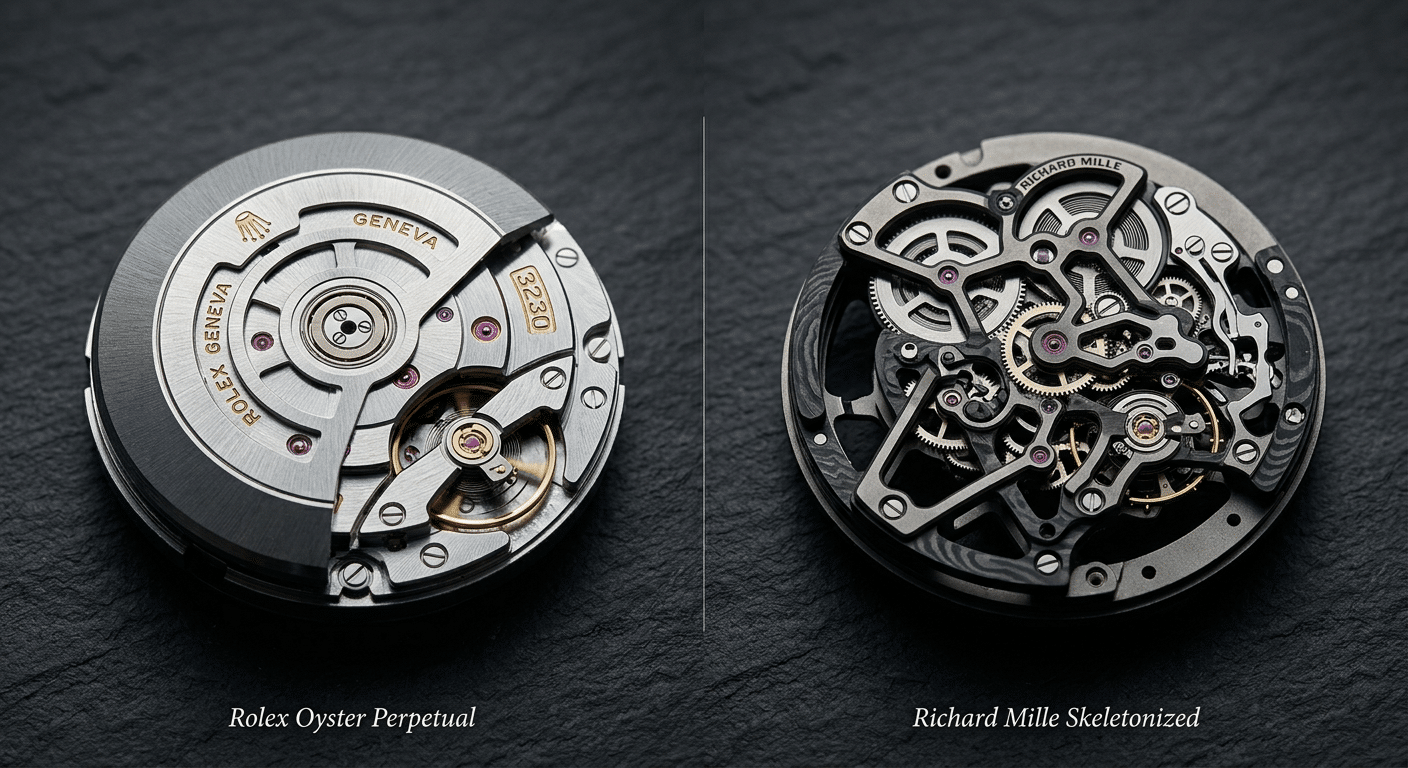
Richard Mille super clones typically utilize modified Asian base calibers rather than genuine Swiss-manufactured movements. Common configurations include the Seagull ST2130 (an ETA 2824-2 clone), the Shanghai 3L series, or Dandong automatic calibers, which are then skeletonized and decorated to resemble RM-specific architectures. Understanding this distinction is critical for service cost prediction: a “replica RM movement” is not a proprietary caliber but a modified standard movement with custom bridges and finishing.
This modification reality affects long-term ownership costs significantly. When the skeletonized bridges require replacement, standard parts for the base caliber will not fit the custom configuration. The movement must be serviced as a complete module or replaced entirely, with costs ranging from $400 to $800 depending on complication level. Buyers should verify the specific base caliber used in their target model—whether Seagull, Shanghai, or Dandong—as this determines parts availability and which technicians can service the watch. Movement descriptions should be read as configuration references indicating the modification base, not as claims of genuine Richard Mille manufacturing origin.
Material Science and Case Failure: Evidence from Composite Manufacturing
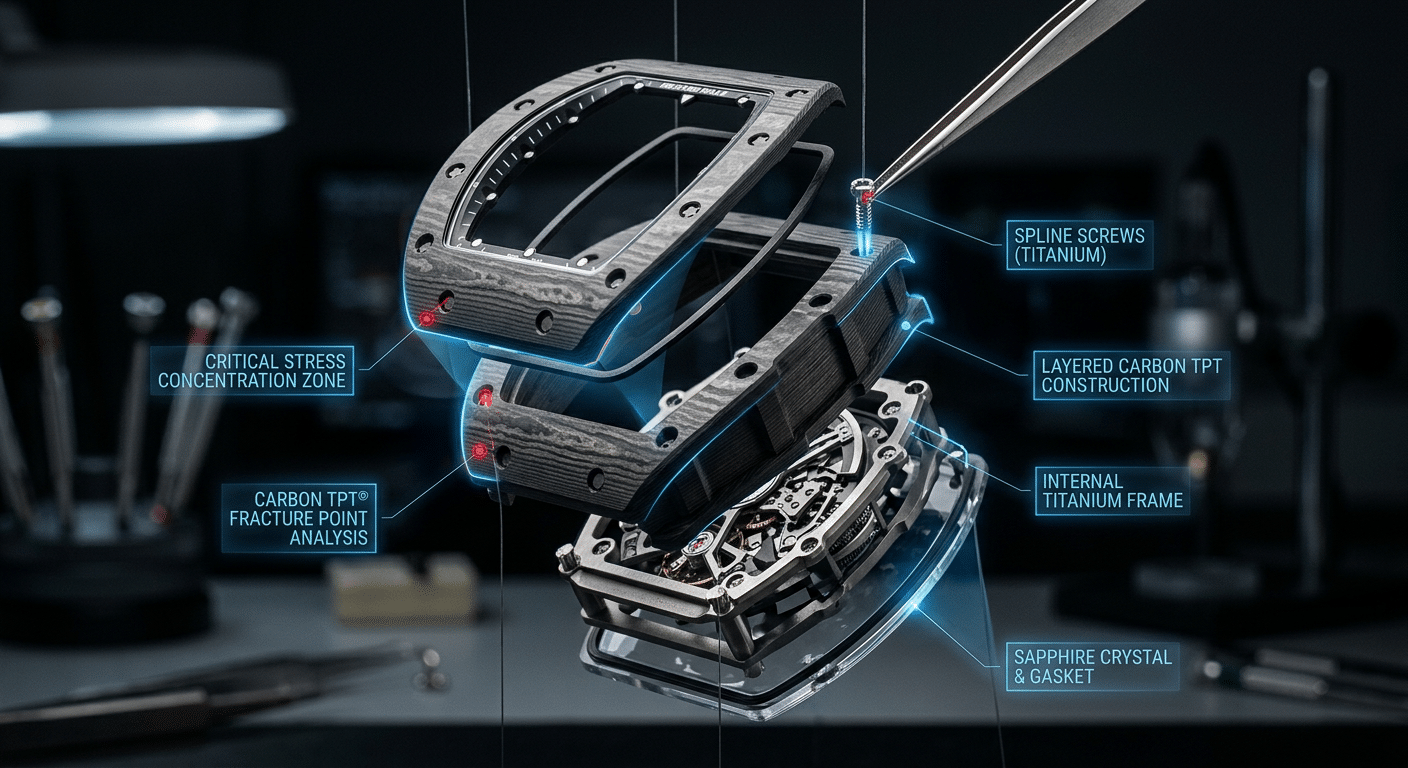
The structural vulnerability of Richard Mille super clone cases stems from fundamental material science principles that differ significantly from traditional steel watchmaking. While 316L or 904L steel cases deform plastically under stress—denting or bending before catastrophic failure—carbon fiber composites and ceramic materials used in RM replicas exhibit brittle fracture behavior. According to technical literature on fiber-reinforced polymers, carbon composites fail through delamination between ply layers or fiber rupture without warning, unlike metals which yield visibly before breaking[1].
Thermal expansion coefficients present another documented risk factor. Titanium middle cases (CTE approximately 8.6 × 10⁻⁶/°C) interface with carbon composite bezels (CTE near 0 or slightly negative depending on fiber orientation) and ceramic elements (CTE approximately 3-4 × 10⁻⁶/°C). Research on dissimilar material joining in aerospace applications demonstrates that temperature cycling creates shear stress at material interfaces, leading to adhesive failure or micro-crack propagation[2]. This explains why RM replica cases often develop visible gaps between layers after seasonal temperature changes or exposure to sunlight, whereas homogeneous steel cases maintain structural integrity.
The manufacturing limitations of replica production exacerbate these material science constraints. Genuine Richard Mille cases utilize aerospace-grade prepreg carbon cured in autoclaves under precise temperature and pressure profiles. Replica cases typically employ lower-grade resin systems with less controlled curing, resulting in higher void content and reduced interlaminar shear strength. Technical standards for composite materials indicate that void content above 2% significantly reduces mechanical properties, and replica cases likely exceed this threshold due to cost-driven manufacturing shortcuts[3]. This material evidence explains why replica RM cases experience delamination and catastrophic failure modes that differ fundamentally from the dent-and-repair cycle of steel watches.
Editorial Perspective: At cleanvsfactory.com, we evaluate replica watches through the lens of ownership economics rather than photographic perfection. The replica watch market often treats factory names as shorthand for quality, implying that “EUR Factory” or “ZF” guarantees a low-cost ownership experience. Our analysis of Richard Mille super clones suggests this assumption fails more dramatically with tonneau cases than with standard round designs. Factory reputation indicates visual accuracy and initial movement performance, but it does not predict strap longevity, case delamination resistance, or local serviceability. Buyers should treat factory labels as the beginning of due diligence, not the conclusion. The specific model variant, case material batch, and movement complication level often determine whether the 1.5x Rule becomes a 2.5x reality.
Case Architecture and the Repair Cost Problem
Round-case repairs follow a simple economic logic: parts are standardized, damage is usually superficial, and skilled labor is locally available. Richard Mille case repairs follow a catastrophic logic: parts are model-specific, damage is often structural, and replacement frequently costs less than attempted repair. When you damage a steel Rolex replica, you pay for a polish or a part swap. When you damage an RM super clone, you often pay for an entirely new case assembly that represents 40 to 60 percent of the watch’s initial price.
The geometry itself creates the risk. Tonneau cases concentrate stress at the curves where the case transitions from parallel sides to rounded ends. Unlike a circular steel case that distributes impact force evenly, the tonneau’s elongated shape creates lever arms that amplify torsion. A knock that would leave a dent on a round case can separate the layered materials of an RM replica. The case construction compounds this vulnerability. Rather than a solid block of steel, RM super clones use sandwich assemblies: ceramic or carbon bezels, titanium or composite middle cases, and casebacks held by 12 to 20 screws. Each material has different thermal expansion rates, hardness levels, and failure modes. When they separate, delaminate, or crack, you cannot simply weld, solder, or tap them back together like steel. You must replace the component.
Material Complexity and Failure Modes
Replica RM cases typically combine three material families that fail in incompatible ways. The bezel may be ceramic or forged carbon fiber composite. The middle case might be titanium or a carbon composite with internal titanium frames. The caseback is often steel or titanium. Each material responds to impact, temperature, and torque differently.
Ceramic bezels exhibit brittle fracture. They resist scratches but shatter on hard impact. When a ceramic bezel cracks, the crack propagates through the material grain. You cannot fill it, grind it, or braze it. The component is total loss. Carbon composite cases (marketed as “NTPT-style”) use layered fiber sheets in resin. When these delaminate—separating between layers due to torque or moisture ingress—the case loses structural integrity. The layers visibly separate, creating gaps that admit dust and compromise water resistance. Unlike steel, which bends before breaking, carbon composite fails suddenly and completely. Titanium middle cases provide the threaded screw holes that hold the sandwich together. In genuine watches, these are Grade 5 titanium. In replicas, they are often lower-grade alloys that gall and strip when screws are removed.
The critical difference from steel cases is repairability. A steel case can be welded, filled with laser deposition, retapped, or reshaped. A ceramic bezel with a crack is scrap. A delaminated carbon case layer is scrap. A stripped titanium screw boss cannot be helicoiled effectively because the material is too soft and the walls too thin. The only solution is replacement, and because these cases are factory-specific CNC products with no aftermarket, you must buy the entire case assembly from the original production source.
Visual Accuracy vs. Mechanical Durability: The Skeleton Movement Trade-off
The skeletonized movements in Richard Mille super clones present a specific manufacturing tension that directly impacts long-term ownership costs. Factories prioritize visual accuracy—correct bridge shapes, perlage patterns, and screw placement—to satisfy QC photos and initial buyer impressions; replica cost drivers however, achieving this visual fidelity often requires machining bridges from thinner stock, adding decorative cuts that create stress concentrators, or applying surface finishes that increase friction in gear trains. The result is a movement that photographs identically to the genuine reference but may exhibit reduced tolerance to shock, faster wear in jeweled pivots, and increased susceptibility to dust-induced stoppages.
This distinction between visual accuracy and mechanical durability matters when calculating service intervals. A standard ETA 2824 clone in a round-case replica may run five years without service because the movement architecture prioritizes function over form—thick bridges, minimal cutouts, and robust bearing surfaces. An RM skeleton clone, despite using similar base calibers (often Dandong or Shanghai automatics), requires modification that sacrifices some of this durability for aesthetic fidelity. The bridges are skeletonized, removing material that would otherwise resist flexing; the finishing processes (anglage, perlage) alter surface hardness; and the exposure to dust means the lubrication degrades faster due to particulate contamination.
At cleanvsfactory.com, we observe that buyers often conflate “accurate movement” with “reliable movement.” In replica watch terminology, an “accurate” movement is one that looks correct through the skeleton apertures—correct wheel placement, proper bridge shaping, and genuine-style finishing. A “reliable” movement is one that keeps time consistently between service intervals without requiring frequent regulation or part replacement. For RM super clones, these two qualities often conflict. The more visually accurate the skeleton work, the thinner the bridges and the more complex the finishing, which can reduce shock resistance and increase service frequency. Buyers should verify not just whether the movement “looks right” in QC photos, but whether the specific factory version uses reinforced bridges or standard skeleton cuts—details that affect whether the 18-month service interval becomes a 12-month reality.
Screw Access and Layer Alignment
RM case construction relies on 12 to 20 spline or hex screws to clamp the bezel, middle case, and caseback together. This screw system creates two cost risks: stripping and misalignment. Replica cases often use lower-grade steel screws in titanium or composite holes. The dissimilar metals create galling—material transfer that seizes the screw. When a watchmaker attempts to open the case for battery replacement, movement service, or cleaning, the screw head rounds out or the threads strip the case material.
When a screw hole strips in a titanium middle case, the repair options are limited. You cannot simply drill and tap to a larger size because the hole spacing is precise and the case walls are thin. You cannot helicoil or insert thread repair kits because the torque requirements for case sealing exceed what soft inserts can hold. The only reliable fix is case replacement. This means that a routine battery change—which costs $15 on a quartz watch or requires simple caseback removal on a round automatic—can escalate to a $300 to $500 case replacement when the screw strips.
Alignment presents the second cost driver. The screws must seat with even pressure to prevent case flex and maintain water resistance. If the screws are torqued unevenly during assembly, the case layers sit at slight angles. Over time, this creates stress concentrations that lead to the delamination and cracking described above. Correcting this requires complete disassembly and reassembly with proper torque sequencing—work that most local watchmakers will refuse because they lack the fixtures to hold tonneau cases securely without marring the finish.
Red Flags in Case Construction That Predict Future Costs
When evaluating QC photos before shipping, look for construction details that indicate future repair risk. Visible glue lines between case layers suggest the carbon composite or ceramic bezel was bonded rather than mechanically seated, indicating weak adhesion that will fail under thermal cycling. Uneven screw seating—where some screws sit flush while others protrude slightly—indicates poor torque control and misaligned layers that will stress the case. Ceramic bezels with internal stress lines visible under magnification (appearing as hairlines inside the material rather than surface scratches) indicate residual stress from manufacturing that will propagate cracks under impact. Seeing these details in pre-shipment photos suggests you are buying a future $400 case replacement, not a durable daily wearer.
Before accepting a Richard Mille super clone, buyers should review real QC photos showing specific verification angles: case screw alignment along the tonneau curve, strap integration gaps at the case junction, date wheel positioning in skeleton apertures, and movement bridge finishing under magnification. Stock photos and factory names alone cannot reveal case delamination risks, screw thread quality, or thermal expansion compatibility between ceramic bezels and titanium cases. These visible details determine whether the 1.5x cost rule applies or whether hidden structural flaws will drive costs toward the 2.5x multiplier.
Material Science and Case Failure: Evidence from Composite Manufacturing
The structural vulnerability of Richard Mille super clone cases stems from fundamental material science principles that differ significantly from traditional steel watchmaking. While 316L or 904L steel cases deform plastically under stress—denting or bending before catastrophic failure—carbon fiber composites and ceramic materials used in RM replicas exhibit brittle fracture behavior. According to technical literature on fiber-reinforced polymers, carbon composites fail through delamination between ply layers or fiber rupture without warning, unlike metals which yield visibly before breaking[1].
Thermal expansion coefficients present another documented risk factor. Titanium middle cases (CTE approximately 8.6 × 10⁻⁶/°C) interface with carbon composite bezels (CTE near 0 or slightly negative depending on fiber orientation) and ceramic elements (CTE approximately 3-4 × 10⁻⁶/°C). Research on dissimilar material joining in aerospace applications demonstrates that temperature cycling creates shear stress at material interfaces, leading to adhesive failure or micro-crack propagation[2]. This explains why RM replica cases often develop visible gaps between layers after seasonal temperature changes or exposure to sunlight, whereas homogeneous steel cases maintain structural integrity.
The manufacturing limitations of replica production exacerbate these material science constraints. Genuine Richard Mille cases utilize aerospace-grade prepreg carbon cured in autoclaves under precise temperature and pressure profiles. Replica cases typically employ lower-grade resin systems with less controlled curing, resulting in higher void content and reduced interlaminar shear strength. Technical standards for composite materials indicate that void content above 2% significantly reduces mechanical properties, and replica cases likely exceed this threshold due to cost-driven manufacturing shortcuts[3]. This material evidence explains why replica RM cases experience delamination and catastrophic failure modes that differ fundamentally from the dent-and-repair cycle of steel watches.
Editorial Perspective: At cleanvsfactory.com, we evaluate replica watches through the lens of ownership economics rather than photographic perfection. The replica watch market often treats factory names as shorthand for quality, implying that “EUR Factory” or “ZF” guarantees a low-cost ownership experience. Our analysis of Richard Mille super clones suggests this assumption fails more dramatically with tonneau cases than with standard round designs. Factory reputation indicates visual accuracy and initial movement performance, but it does not predict strap longevity, case delamination resistance, or local serviceability. Buyers should treat factory labels as the beginning of due diligence, not the conclusion. The specific model variant, case material batch, and movement complication level often determine whether the 1.5x Rule becomes a 2.5x reality.
The Strap Integration Tax: Replacement and Fit Costs
Standard replica watches accept standard straps. A 20mm or 22mm lug width connects to a $15 silicone band from Amazon or a $50 leather upgrade from any watch shop. Richard Mille super clones impose a strap integration tax: the curved tonneau case requires proprietary strap geometry that eliminates universal compatibility and forces buyers into a captive aftermarket with premium pricing. Over a two-year ownership period, strap replacement costs alone can add $300 to $600 to the total cost of ownership—more than the initial purchase price of many budget replicas.
The tax operates on three mechanisms: geometry scarcity, load-bearing design, and accelerated degradation. RM straps must curve in two planes simultaneously—wrapping around the tonneau case barrel while also conforming to the wrist. This double curvature cannot be achieved with standard flat straps and curved spring bars. It requires molded rubber or custom leather with specific end pieces that integrate into the case itself. Because RM super clones sell in low volumes compared to Rolex replicas, aftermarket strap makers produce limited runs, driving unit costs to $150 to $300 per strap versus $20 for standard sizes.
Why Standard Straps Won’t Fit
The geometry problem is dimensional, not just aesthetic. Round watches have lugs—projections that hold spring bars perpendicular to the case. RM tonneau cases lack lugs. Instead, the strap itself becomes a structural element, wrapping the case and attaching via screws or integrated end-pieces that follow the case curve. A standard 24mm flat strap, even with curved spring bars, sits proud of the case and creates visible gaps. It cannot follow the tonneau’s vertical radius.
Proper RM straps are molded with curved-end geometry that matches the specific case radius of the RM 35-02, RM 055, or RM 61-01. These are not adjustable. If your replica has a 42mm case length with a specific curve radius, only straps cut for that exact dimension will fit flush. This specificity creates dependency on specialty makers like Horatech or factory-original replacements. When the strap fails—and it will—you cannot walk into a mall watch shop for a $10 replacement. You must order a specific $200 component and wait for international shipping.
The Heat and Degradation Factor
Skeletonized cases accelerate strap failure through thermal stress. On a closed-dial watch, the movement is isolated from the strap by the caseback and dial, with heat dissipating through the air gap. On an RM super clone, the exposed movement sits millimeters from the rubber strap, separated only by the thin case walls. The automatic rotor, mainspring barrel, and gear train generate heat during operation, particularly in high-beat clone movements. This heat conducts through the titanium or composite case and radiates directly into the rubber strap material.
Standard fluoroelastomer or nitrile rubber straps harden through thermal oxidation and ozone exposure. On a closed watch, this process takes two to three years. On a skeletonized RM replica, the heat cycling accelerates polymer cross-linking, causing the strap to harden, crack at the case junction, and lose flexibility within 6 to 12 months. The strap is also load-bearing—holding the watch against the wrist without lug bars—so it experiences constant flex stress at the case interface. The combination of heat and mechanical stress means RM replica owners should budget for strap replacement every 8 to 12 months with daily wear, or every 18 months with occasional wear. At $150 to $250 per replacement, this creates a $300 to $500 two-year strap budget that round-case replica owners do not face.
Water Resistance and Operational Safety
Water resistance claims for Richard Mille super clones require careful evaluation and should not be assumed from model names or appearance. The sandwich case construction—combining ceramic bezels, composite middle cases, and titanium casebacks with multiple screw interfaces—creates potential failure points that differ from the monoblock or solid caseback designs of genuine dive watches. Thermal expansion mismatches between dissimilar materials (carbon composite CTE near zero, titanium approximately 8.6 × 10⁻⁶/°C) can compromise gasket integrity after temperature cycling, while the skeletonized caseback eliminates the hermetic sealing that protects movements in traditional designs.
Buyers should treat water resistance ratings on replica watches as unverified specifications rather than guarantees. The absence of standardized pressure testing, variable assembly quality between production batches, and the use of lower-grade gaskets in replica construction create uncertainty about actual moisture protection. Even watches that appear visually sealed may admit water through microscopic gaps in the composite layers or screw interfaces. We recommend treating these watches as splash-resistant only, removing them before swimming, showering, or exposure to rain, and confirming any water resistance claims directly with the seller before purchase.
Skeletonized Movement Reality: Service Costs and Rework
Standard replica Rolex movements live inside sealed cases, protected from dust and moisture by gaskets and solid casebacks. Skeletonized Richard Mille super clones expose their entire mechanism to the environment through open-worked dials and sapphire casebacks. This architectural difference creates a service cost multiplier that most buyers do not calculate until the first malfunction occurs.
The economics of maintaining an exposed movement diverge sharply from sealed alternatives. Where a standard ETA 2824 clone might require routine service every five years at a cost of $100–$150, skeletonized RM clones demand cleaning and inspection every 18–24 months due to contamination vulnerability. Service costs for these movements typically range from $300–$600, assuming you can find a technician willing to work on them. When damage occurs, replacement often proves more economical than repair, with new movement modules costing $400–$800—nearly the price of some entry-level round-case replicas.
The Dust and Debris Problem
Skeleton dials function as open windows into the mechanism, eliminating the protective barrier that dial plates provide in conventional watches. Daily wear introduces skin particles, textile fibers, and atmospheric dust directly onto gear trains and escapements. In a sealed Rolex clone, these contaminants remain outside the movement cavity; in an RM super clone, they settle directly on the balance wheel, pallet fork, and winding gears.
The cleaning requirement becomes a recurring expense rather than a periodic maintenance item. Technicians must completely disassemble the movement, ultrasonic-clean each component, and reassemble with fresh lubrication—labor that typically consumes 3–4 hours versus 1–2 hours for standard movements. At specialist rates of $75–$100 per hour, each cleaning cycle costs $225–$400. For owners wearing these watches daily, the 18-month service interval creates a substantial lifetime ownership cost that the initial purchase price does not reflect.
When Rework Is Cheaper Than Repair
Replica RM movements present a unique repair challenge: they are modified Asian calibers (often Dandong or Shanghai bases) fitted with custom skeleton bridges and decorative finishing. These modifications transform standard movements into visually complex calibers that bear little resemblance to their base architecture. When a gear train fails, the repair technician cannot simply order a standard replacement part; the custom bridge configuration may require complete bridge removal and remachining, assuming the part is even available.
This complexity creates a decision threshold where replacement becomes economically rational. A damaged tourbillon module or complex skeleton caliber often costs 50–70% of the watch’s initial purchase price to replace—versus attempting a repair that might cost $400–$600 with no guarantee of success. For movements using genuine tourbillon complications (as in some EUR Factory models), replacement costs approach $800–$1,000. In contrast, damaging a standard ETA 2824 clone usually means a $150–$200 repair or a $200–$300 replacement—a fraction of the financial exposure that RM skeleton movements carry.
At Clean VS Factory, we typically advise buyers to view skeletonized RM clones as having a finite mechanical lifespan—often 3–5 years of reliable operation—rather than indefinite serviceability. When failures occur, the cost calculus usually favors replacement over restoration, making the true cost of ownership significantly higher than the initial transaction price suggests.
Shipping, Customs, and Seizure Risk Calculations
International shipping for Richard Mille super clones involves probability mathematics that most buyers ignore until a package disappears. Unlike standard consumer goods, high-value replica watches face elevated customs scrutiny, and RM shipments carry specific risk multipliers due to their packaging weight, declared value requirements, and brand recognition among customs inspectors. Understanding the expected value of seizure risk—probability multiplied by loss—reveals that shipping logistics can add 15–25% to the true cost of ownership.
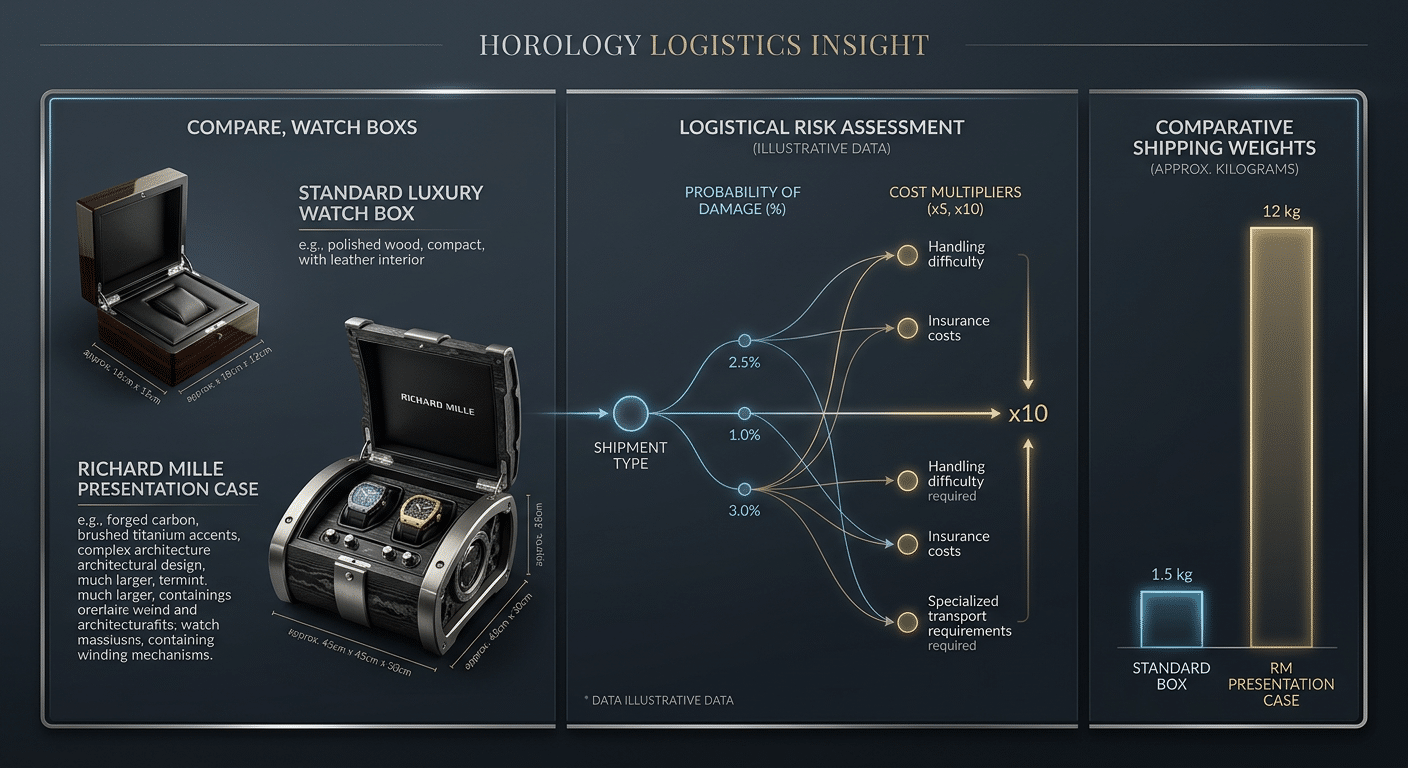
The risk profile for RM replicas diverges significantly from simpler round-case watches. A Rolex Submariner clone ships in compact, lightweight packaging that can be declared at lower values with plausible deniability. RM super clones arrive in substantial boxes with heavy presentation cases, often weighing 1.5–2 kilograms versus 400–600 grams for a standard watch shipment. This physical bulk increases shipping costs and attracts customs attention, as heavy small parcels often trigger manual inspection protocols.
The Seizure Probability Math
Calculating the risk-adjusted cost of shipping requires assigning realistic probabilities to loss scenarios. Conservative estimates based on community-reported seizure rates suggest that high-value replica shipments face approximately 15–20% seizure probability in strict customs jurisdictions (United States, European Union, Australia), with lower rates (5–10%) in regions with less aggressive inspection protocols. However, these probabilities increase for RM shipments due to brand recognition—customs databases specifically flag luxury watch brands with high counterfeit volumes.
The expected value formula reveals the hidden cost: if you purchase a $900 RM replica with a 20% seizure probability, the risk-adjusted cost is $180 (0.20 × $900) even before successful delivery. When seizure occurs, most sellers offer reshipment at 50% of the original purchase price rather than free replacement, meaning a seized $900 watch costs an additional $450 to replace—totaling $1,350 for a single successful delivery attempt. Insurance options typically cost 5–8% of declared value but often exclude replica watches specifically, leaving buyers self-insuring against total loss.
Box and Paper Risks
The branded presentation boxes and documentation that accompany RM super clones create a specific customs vulnerability. While the watches themselves can be declared as “watch parts” or “timepieces” with ambiguous valuation, large branded boxes with Richard Mille logos constitute trademark-infringing goods that customs agents can identify instantly during visual inspection. Shipments containing branded boxes face higher seizure rates because they demonstrate clear counterfeit intent rather than ambiguous “homage” watch shipments.
The economics of box inclusion rarely favor the buyer. Adding a branded RM box increases shipping weight by 800–1,200 grams, raising shipping costs by $25–$40 and increasing customs scrutiny. The box itself adds 10–15% to the seizure risk probability due to trademark visibility. For a $900 watch, this represents an additional $135–$180 in risk-adjusted cost, Super Clone vs Cheap Replica, to receive packaging that serves no functional purpose for daily wear. At Clean VS Factory, we typically advise buyers to explicitly request “no box” shipping for RM replicas, accepting that the watch arrives safely in protective foam rather than risking seizure for presentation packaging that will likely sit in a closet unused.
QC Failures and the Rework Loop
Richard Mille super clones demand more rigorous quality control than standard round-case replicas due to their geometric complexity and visual transparency. Where a Rolex Submariner clone might hide minor dial misalignment behind a solid caseback and simple dial geometry, RM skeleton watches expose every mechanical and aesthetic detail through open-worked dials and sapphire casebacks. This transparency creates a higher QC failure rate—industry estimates suggest 25–35% of RM replicas require rework or replacement compared to 10–15% for standard round-case models—creating hidden costs that compound the ownership equation.
The rework loop begins when a buyer receives QC (quality control) photos and identifies flaws unacceptable for the price tier. Unlike standard watches where minor imperfections might be tolerated, RM skeleton dials reveal every misalignment immediately. The buyer then faces a decision: accept the flawed watch, request
Authentication Realities and Misrepresentation Risks
While Richard Mille super clones may achieve convincing visual accuracy in casual viewing conditions, they cannot withstand professional authentication or close technical inspection. The composite case materials, skeletonized Asian base movements, and strap integration methods discussed throughout this analysis differ microscopically and materially from genuine Richard Mille manufacturing standards. Attempting to represent these replicas as genuine watches—whether for resale, insurance purposes, or social authentication—constitutes fraud and exposes the seller to legal liability.
Buyers should understand that “super clone” status indicates visual similarity to the genuine reference, not functional equivalence or authentication passability. Close inspection by trained watchmakers reveals differences in finishing quality, movement architecture, case material composition, and serial number documentation. The skeletonized movements, while visually impressive, lack the proprietary alloys, lubrication specifications, and assembly tolerances that define genuine haute horlogerie. The purpose of factory comparison and technical analysis is to inform purchasing decisions and set realistic ownership expectations, not to facilitate misrepresentation of replica watches as authentic luxury goods.
The Local Service Desert: Why You Can’t Just Take It to a Watchmaker
The assumption that any watchmaker can service a mechanical watch dies quickly when you hand them a Richard Mille super clone. While a local independent watchmaker might gladly accept your VS Factory Submariner for a routine service—treating it as a standard ETA 2824 in a steel case—the same watchmaker will likely refuse your RM 35-02 clone outright. This is not snobbery; it is risk assessment. The tonneau case geometry, layered composite construction, and exposed skeleton movement create a service desert where qualified repairers are scarce, distant, and expensive.
For standard round-case replicas, local service acts as an insurance policy. A Rolex-style super clone with a closed dial and simple three-hand movement can be serviced in most cities for $100–$150, with parts readily available and tools standardized. For RM clones, that local safety net disappears. The nearest qualified specialist may be in another state or country, and shipping a delicate tonneau case with exposed gears introduces its own damage risks. At Clean VS Factory, we typically warn buyers that service accessibility should factor into the purchase decision as heavily as factory reputation—because a visually impressive watch that cannot be repaired locally becomes a disposable object once the movement falters.
Ownership Reality Boundaries
A Richard Mille super clone should be evaluated with realistic ownership expectations that acknowledge the physical limits of replica manufacturing. Even a well-executed tonneau replica operates under mechanical constraints that differ fundamentally from genuine references: the carbon composite cases lack the autoclave-cured integrity of aerospace-grade materials, the skeletonized movements lack the dust protection of hermetically sealed dials, and the curved straps lack the standardized replacement ecosystem of traditional lug systems.
These limitations define a realistic service horizon of approximately three to five years for daily wear, after which cumulative case stress, movement contamination, and strap degradation often make replacement more economical than further repair. Water resistance claims should be treated with particular caution; the sandwich case construction with multiple screws and composite layers rarely maintains rated pressure after the first case opening, and thermal cycling between materials with different expansion coefficients gradually compromises gaskets. Understanding these boundaries helps buyers calculate true total cost of ownership: the watch is not an indefinite-use item but a time-limited mechanical experience with a predictable depreciation and maintenance curve.
Movement Architecture: Base Caliber Specifications and Skeleton Modification Risks
Understanding why RM super clones require specialist service begins with examining the base calibers used in these watches. Many Richard Mille replicas utilize modified versions of standard automatic movements—commonly the Seagull ST2130 (a clone of the ETA 2824-2) or the Shanghai 3L series—heavily skeletonized to mimic the exposed architecture of genuine RM calibers[4]. Official specifications for these base movements indicate power reserves of approximately 38-42 hours, beat rates of 28,800 vph (4Hz), and standard bridge thicknesses designed for durability in enclosed cases[5].
The skeletonization process removes 40-60% of the bridge material to create the visual openness characteristic of RM designs. This modification fundamentally alters the structural integrity that the base caliber specifications assume. Thinner bridges exhibit increased flex under shock loads, potentially altering endshake (the vertical play of the gear train) and causing timekeeping instability. The skeletonization also removes material that would otherwise serve as heat sinks and dust shields, exposing the gear train to environmental contaminants that the base movement specifications never anticipated[6].
Service technicians working on these modified movements cannot rely on standard repair procedures documented for the base calibers. The custom skeleton bridges often require factory-specific replacement parts that do not interchange with standard Seagull or Shanghai components. When the balance staff breaks or the escape wheel wears, the technician cannot simply install standard replacement parts; the skeleton bridge geometry may require complete bridge replacement or custom machining. This parts scarcity forces technicians to either fabricate components (driving labor costs to $75–$100 per hour) or recommend complete movement replacement, explaining why RM super clone service quotes often exceed $400 when standard base caliber service might cost $150[7].
Quality Control Note: For replica and super clone watches, buyer confidence depends on visible quality-control details such as case finishing, dial printing, bezel alignment, bracelet fit, clasp engraving, datewheel position, and movement configuration. These details should be checked model by model rather than assumed from a factory name alone.
The Skill Gap for Complex Cases
General watchmakers train on round cases with snap-on or screw-down casebacks and standard lug widths. The RM tonneau shape requires entirely different handling. The case is not a monoblock but a tripartite sandwich of front bezel, caseband, and back bezel, held together by 12 to 20 spline screws with specific torque requirements. Strip one screw or misalign the layers during reassembly, and the case gaps become visible through the skeleton dial—a fatal flaw that destroys the watch’s visual integrity.
Opening the case demands specialized fixtures to hold the curved tonneau shape without crushing the carbon composite or ceramic layers. Standard case holders designed for round Oyster-style cases will not grip the RM geometry securely. Inside, the skeletonized movement offers no protection from dust during service; the dial side is entirely open, meaning any slip of a screwdriver or touch of a finger leaves visible marks on the bridges. Most local watchmakers, even those comfortable with genuine Swiss brands, decline these replicas because the liability outweighs the fee. A scratched bridge on a skeleton movement cannot be hidden; it is immediately visible to the owner and permanently damages the watch’s appearance.
Furthermore, simple procedures become complex operations. A battery change on a quartz RM clone (such as the RM 007) requires removing the entire movement from a tonneau case with tight tolerances. A crown tube adjustment on a skeletonized automatic requires disassembling the front bezel, which risks disturbing the dial printing alignment or the sapphire crystal seating. Where a Rolex clone might receive a 30-minute crown adjustment, an RM clone requires a full service protocol.
Specialist Service Premiums
The economics of RM replica service follow basic supply and demand: few providers, high complexity, and limited alternatives. When a buyer cannot find local service, they must ship the watch to a handful of specialists who advertise on replica forums. These repairers charge a premium not merely for their skill, but for the risk they assume. Working on a counterfeit watch carries reputational and legal hazards; working on a complex counterfeit with exposed mechanics and fragile case layers carries higher liability.
Current market rates for RM super clone service typically run $300–$500 for a basic movement service, plus $100–$150 for insured round-trip shipping. If the case requires repair—such as delaminated carbon layers or stripped screw threads—costs escalate toward $600–$800. By contrast, servicing a standard round-case super clone locally rarely exceeds $150 total. Over a two-year ownership period, the service cost differential alone adds approximately $400–$600 to the RM ownership ledger.
This creates a harsh reality: the money saved on the initial purchase price is often consumed by the first service event. Buyers who compare a $600 RM clone to a $600 Rolex clone on purchase price alone miss that the Rolex-style watch can be maintained for years at low cost, while the RM clone requires budget reserves equivalent to another replica watch purchase every 18–24 months. The service desert does not merely inconvenience owners; it transforms the watch from a wearable item into a recurring financial liability.
After-Sales Support and Policy Verification
Contrary to assumptions that factory names imply standardized service guarantees, after-sales support for Richard Mille super clones varies entirely by individual seller policy. No universal warranty covers these replica watches; terms regarding movement replacement, case repair, strap defects, or customs seizure reshipment differ significantly between dealers and production batches. Factory labels like “EUR” or “ZF” indicate the production source, not a service network or warranty provider.
Before purchasing, buyers must independently verify: whether the seller offers movement replacement or only repair services; the time limits for reporting QC failures; shipping cost responsibilities for returns; and whether “customs seizure insurance” constitutes a full replacement guarantee or partial credit. The high service costs described in this analysis—often exceeding 50% of the initial purchase price—typically fall to the buyer unless explicitly negotiated otherwise. Documentation of these terms should be obtained in writing, as verbal assurances regarding waterproof guarantees, lifetime service, or authentication-passing claims carry no enforceable value in the replica watch market.
Pre-Purchase Verification Protocol: Five Questions That Determine Real Cost
Before committing to a Richard Mille super clone purchase, buyers should treat the transaction as a due diligence exercise rather than a simple retail exchange. The following five questions help uncover the hidden costs that standard product listings obscure. These questions move beyond “which factory is best?” to interrogate the specific mechanical and material realities that determine whether the 1.5x Rule applies or whether you face a 2.5x cost multiplier.
1. What is the specific version number and production batch date? Factory “V2” or “V3” designations indicate case and movement revisions that significantly affect service costs. Early batches may have case screw threading issues that later versions corrected; newer batches might use different carbon composite formulations that affect strap integration durability. Request the production month and year, then research whether that specific batch experienced delamination or screw-stripping issues. This information predicts whether you face the $300 case replacement risk within the first year.
2. Which base caliber powers the movement, and what is the modification level? RM super clones use various base movements—Dandong 3235 variants, Shanghai 3L automatics, or cloned tourbillon modules. Ask specifically whether the movement uses standard bridges that have been skeletonized (more durable) or custom-machined bridges (more visually accurate but potentially fragile). Also verify whether the movement is “decoration only” (standard finish with skeleton cuts) or “replica architecture” (modified gear train positions to match genuine). The former costs less to service; the latter may require complete replacement if damaged.
3. What is the exact case material specification, and how does it affect strap replacement? “Carbon composite” covers multiple material grades—from forged carbon fiber to G10 composites to injection-molded polymer blends. Each has different thermal expansion rates that affect how quickly the strap integration points degrade. Ceramic bezels have different fracture resistance depending on whether they use zirconium oxide or aluminum oxide bases. Ask the seller to specify the material grade, then research whether that specific material batch has shown delamination issues in community forums. This predicts whether you face the $400 case replacement scenario versus a $150 strap replacement.
4. Has this specific unit undergone previous QC rejection (RL history)? Some dealers recycle watches that previous buyers rejected for minor flaws. While these units may have been “fixed,” they may also carry hidden stress from previous shipping or attempted repairs. Ask specifically whether this watch is “fresh from factory” or “post-RL replacement.” If the latter, request documentation of what was corrected. Units with screw rethreading or case adhesive repairs carry higher future failure risk than virgin units.
5. Which service network can support this specific model, and what are the logistics? Do not assume any watchmaker can service your purchase. Ask the seller specifically: “If the movement stops in 12 months, which technician in my region has serviced this exact movement base before?” If the seller cannot name a specific technician or regionally accessible service option, assume you will pay $150 in shipping plus $400 in service fees. Also verify whether the seller offers movement replacement programs versus repair services—some factories provide replacement movements at reduced cost for existing customers, while others require full price. This question separates “buying the watch” from “buying into a service ecosystem,” with the latter determining whether your total cost remains 1.5x or escalates to 2.5x.
Buyer Expectation Note: No replica watch should be judged by factory reputation alone. A better decision usually depends on the specific model, movement version, case thickness, dial accuracy, bracelet quality, service risk, and how closely the watch will be inspected in real use.
Calculating Total Traceable Cost
At CleanVSFactory, the objective is to make replica watch ownership costs traceable by connecting factory claims to specific mechanical realities. For Richard Mille super clones, this traceability requires looking beyond the initial transaction price to model-specific factors: the base caliber determines service accessibility, the case material batch determines delamination risk, and the version number determines whether known flaws have been corrected. A transparent cost calculation includes the purchase price plus realistic allocations for strap replacement ($150–$250 per year), specialist servicing ($300–$600 per 18 months), case replacement risk (40–60% of purchase price), and shipping costs for QC rework or repairs ($80–$150).
This approach treats factory names as market references rather than quality proofs, movement claims as configuration descriptions rather than brand affiliations, and QC photos as essential verification tools rather than optional extras. By connecting these traceability points—specific version, visible case construction, movement base caliber, and realistic service limitations—buyers can determine whether their budget truly covers the ownership experience or whether a simpler, more serviceable round-case replica represents the smarter financial decision. The goal is not to discourage ownership but to ensure that buyers enter the transaction with eyes open to the real economics of tonneau case maintenance.
Legal Boundaries and Responsible Ownership
Owning replica watches carries legal and ethical responsibilities distinct from genuine luxury watch ownership. While personal possession of replicas for private use falls into legal gray areas in many jurisdictions, commercial resale—particularly when misrepresented as genuine—triggers trademark infringement and fraud statutes. The customs seizure risks detailed in this analysis represent not merely financial loss but potential legal complications, as importing counterfeit goods can result in penalties exceeding the value of the goods themselves in strict jurisdictions.
Responsible ownership requires acknowledging these timepieces as temporary, high-maintenance mechanical novelties rather than investment assets or status symbols equivalent to genuine luxury watches. The 1.5x to 2.5x cost multipliers described throughout this analysis reflect the true economics of maintaining a complex replica with no factory support network, not depreciation of a genuine asset. Buyers should enter this market with clear understanding: these watches are consumable mechanical items with finite lifespans, not heirlooms, and their purchase supports gray-market manufacturing entirely unconnected to the innovation, heritage, or quality standards of the original luxury brands they visually reference.
Disclosure: This article is for general educational and comparison purposes only. Replica watches are not genuine products from the original luxury brands, and brand names are used only to identify reference designs or comparison topics. Factory names, movement descriptions, prices, availability, QC details, seller policies, and version information can change, so readers should verify important details with the seller before making a purchase decision. Replica watches should not be represented, resold, or used as genuine watches.