
AP-style super clones are harder to judge than many other replica watches because the Royal Oak design leaves very little room to hide mistakes. The flat case planes, octagonal bezel, exposed screws, tapisserie dial, and integrated bracelet all work together visually, so a practical set of super clone ordering questions can help frame the QC review before a small proportion issue makes the whole watch look awkward on the wrist. Factory name, version label, and polished seller photos are useful only as starting points; the actual QC photos matter more.
This checklist focuses on how to approve or reject a specific watch before buying. It explains which flaws are tolerable, which ones affect daily wear or credibility, and why side-profile, bracelet, clasp, caseback, and movement photos should carry as much weight as the front dial shot. The practical goal is not to chase an unrealistic flawless piece, but to choose the example with balanced proportions, clean alignment, believable movement execution, and fewer visible compromises.
Replica watches should be clearly understood as replica-market products, not genuine watches from the original luxury brands. Brand names are used here to identify the genuine reference design being discussed and to make visual comparison easier; they do not imply authorization, endorsement, or affiliation with Audemars Piguet or any other luxury watch brand.
| Inspection Area | What to Verify in QC | When to Be Cautious |
|---|---|---|
| Case and bezel profile | Side thickness, bezel stack, angular case shape | Bulky case, distorted bezel, hidden side views |
| Dial execution | Straight markers, even tapisserie, centered date, logo placement | Crooked indexes, uneven dial texture, off-center date |
| Integrated bracelet | End-link fit, natural link flow, clasp alignment, smooth articulation | Large gaps, stiff links, raised screws, rough edges |
| Movement plausibility | Case thickness, date position, rotor behavior, caseback match | Vague movement claims or decoration that does not match the build |
| Photo consistency | Front, side, clasp, bracelet, caseback, and hand-setting photos | Only beauty shots or missing angles that hide proportion issues |
| Final buying judgment | Overall silhouette, comfort, alignment, and visible coherence | Multiple small flaws forming a pattern across the watch |
Quick Questions Before You Read
Q: Should I choose an AP super clone mainly by factory name?
No. Factory reputation helps narrow the search, but the actual QC photos should decide approval.
Q: What is the first AP detail to check?
Start with the side profile and bracelet integration, because front-facing photos can hide bulk and poor fit.
Q: Are small finishing differences always a reason to reject?
Not always. Minor brushing softness or small caseback decoration differences may be acceptable if the proportions and alignment are strong.
Q: Which flaws are serious enough to avoid?
Reject obvious case bulk, crooked dial parts, uneven bezel screws, poor bracelet flow, clasp problems, or unclear movement claims.
Editorial Perspective: This guide treats an AP super clone as a model-specific buying decision, not a simple factory ranking. A known factory name, a higher price, or a strong seller description can help narrow the shortlist, but none of them proves that the actual watch is worth approving. For an AP-style piece, the more useful judgment is whether the movement route, case thickness, bracelet flow, dial alignment, and QC photo evidence fit the buyer’s intended use. A watch that looks impressive in one front photo may still be a poor daily-wear choice if it sits too thick, has a stiff integrated bracelet, or relies on vague movement claims.
Evidence Boundaries Before Using This Checklist
This article discusses imitation AP-style watches and practical pre-purchase inspection. It does not claim that any replica watch is authorized by Audemars Piguet, equivalent to an authentic watch, or identical to a genuine reference. Official brand specifications can help buyers understand the design language of the original model family, but they should not be treated as proof that a replica has the same materials, dimensions, finishing, water resistance, movement construction, warranty, or service support.
Factory names, version labels, and movement nicknames should also be handled cautiously. In the replica market, terms such as APS, ZF, APF, “clone movement,” “latest version,” or “upgraded case” are usually seller-facing descriptions rather than independently verified manufacturing documentation. They can be useful for organizing options, but the buyer should still ask what the actual QC photos show. If a claim cannot be checked through the visible watch, movement photo, or a clear seller explanation, treat it as a possibility rather than a fact.
A factory-market name is best understood as a comparison label, not as official brand affiliation or automatic proof of quality. The same factory may perform well on one Royal Oak reference and less convincingly on another because case thickness, bracelet architecture, tapisserie dial execution, date placement, and movement route are not equally difficult across every AP-style model.
Water resistance, durability, and long-term reliability should not be assumed from the model being copied. A replica Royal Oak-style watch may visually resemble a luxury sports watch, but that does not prove gasket quality, case sealing, crown construction, pressure-test performance, shock resistance, or future serviceability. Buyers who care about water exposure should treat resistance as unverified unless the individual watch has been pressure-tested after purchase by a competent watch technician.
Brand, Factory, and Movement Claims Need Separate Treatment
It is useful to separate three different kinds of evidence before reviewing an AP-style super clone: the genuine reference design, the replica-market factory label, and the movement description. The genuine reference can help explain what the case shape, bracelet profile, dial layout, and display-back design are trying to imitate. The factory label can help compare replica-market versions. The movement description can help estimate thickness, function layout, and serviceability risk. None of these three points, by itself, proves that the specific watch is authentic, officially approved, or mechanically equivalent to an Audemars Piguet-manufactured watch.
Movement descriptions in the replica market should be checked carefully because they may refer to layout, decoration, clone architecture, or seller terminology rather than an official brand-manufactured caliber. A decorated rotor or bridge can make a display back look more convincing, but it does not confirm original-brand origin, full parts compatibility, official service compatibility, or guaranteed long-term reliability. The safest use of movement information is to understand tradeoffs before purchase, not to suggest that the watch can be represented as genuine.
Why AP Super Clones Need a Stricter Checklist Than Many Replica Watches
An AP super clone should be judged through five areas before approval: case shape, dial texture, bracelet integration, movement credibility, and QC photo consistency. This is not because Audemars Piguet has a more mystical reputation than other brands. It is because the Royal Oak design leaves very little space for manufacturing shortcuts to hide.
A round sports watch can sometimes absorb small errors. A slightly soft lug, a minor bracelet gap, or a tiny dial printing difference may not dominate the watch on the wrist. A Royal Oak replica is different. The octagonal bezel, exposed screw layout, flat case planes, tapisserie dial, and integrated bracelet all create hard visual reference lines. If one line is off, the eye catches it quickly.
That is why an AP super clone checklist is more useful than a simple “best factory” answer. APS Factory, ZF, APF, and other market-known names may all have stronger and weaker examples depending on model, version, movement route, and batch. The individual watch still has to pass inspection before accepting QC photos. A good factory label narrows the search, but it does not approve the watch for you.
The most common buyer mistake is treating an Audemars Piguet replica buying checklist like a normal luxury sports-watch checklist. AP-style watches punish imbalance. A dial that looks attractive in isolation can be let down by a thick case. A good case can be weakened by a bracelet that drops awkwardly from the first link. A decorated movement can look impressive through the caseback while doing nothing to fix date placement, case height, or daily-wear feel.
The Five Areas That Decide Most AP Clone Purchases
The five inspection zones do not carry equal weight, but each affects confidence in a different way. Case shape decides whether the watch has the correct stance. Dial execution decides whether the front view looks organized and believable. Bracelet integration decides whether the watch feels like a Royal Oak rather than a case with a bracelet attached. Movement route affects thickness, date behavior, and caseback credibility. QC photos decide whether the actual unit supports the seller’s claims.
For most buyers, the case and bracelet should be treated as higher priority than tiny caseback decoration differences. This is where AP differs from many replica watch categories. The Royal Oak is not only a dial design; it is a case-and-bracelet object. If the integrated bracelet does not flow correctly from the case, the watch loses much of its character even if the dial looks strong in a close-up photo.
At CleanVSFactory, we usually encourage buyers to separate “looks good in one photo” from “holds together as a complete watch.” AP replicas are a good example of why that distinction matters. A single impressive macro shot is not enough if the side profile, bezel geometry, and bracelet transition have not been checked.
Match the Checklist to Your Wearing Goal
Before reviewing QC, decide whether the watch is mainly for occasional photos, frequent daily wear, or a first AP-style purchase. These are different buying standards. A photo-focused buyer may tolerate a slightly less comfortable bracelet if the front dial, bezel screws, and tapisserie texture look clean. A daily-wear buyer should be stricter about case thickness, bracelet articulation, clasp feel, rotor noise, and movement stability because those issues become noticeable every time the watch is worn.
First-time buyers should usually be cautious with complicated AP-style replicas, especially chronographs, skeleton models, and very thin references that require a more demanding movement and case architecture. A simpler time-and-date Royal Oak can still be difficult to execute, but it has fewer functional and serviceability risks than a complicated model with extra pushers, subdials, openworked bridges, or ambitious movement claims. The most practical choice is not automatically the cheapest or the most famous factory version; it is the model whose visible compromises are easiest for the buyer to accept in real use.
Why Seller Photos Can Make AP Replicas Look Better Than They Wear
Seller photos often favor the AP replica because the Royal Oak photographs well from the front. The octagonal bezel, textured dial, and polished bevels create strong visual drama under controlled lighting. The problem is that many of the real weaknesses appear outside the hero angle.
A straight-on photo can hide case thickness. A cropped dial shot can hide how the bracelet leaves the case. Bright lighting can make brushing look cleaner than it is. A slightly angled image can disguise whether the bezel screws are seated evenly. Even a beautiful dial close-up tells you very little about whether the watch will sit flat and balanced on the wrist.
This is why the inspection process should start before emotional approval. If the first reaction is “the dial looks great,” pause and ask what has not been shown. Has the side profile been shown clearly? Is the bezel stack visible? Can you see the first bracelet links? Does the caseback match the claimed movement route? Are the photos consistent with one another, or does each angle seem chosen to hide something?
The practical goal is not to prove perfection. No replica AP should be treated as identical to a genuine Audemars Piguet watch under close inspection. The goal is risk reduction: approve only the example where the visible compromises are controlled, consistent, and unlikely to bother you during normal wear.
Case Shape, Thickness, and Bezel Geometry Checks
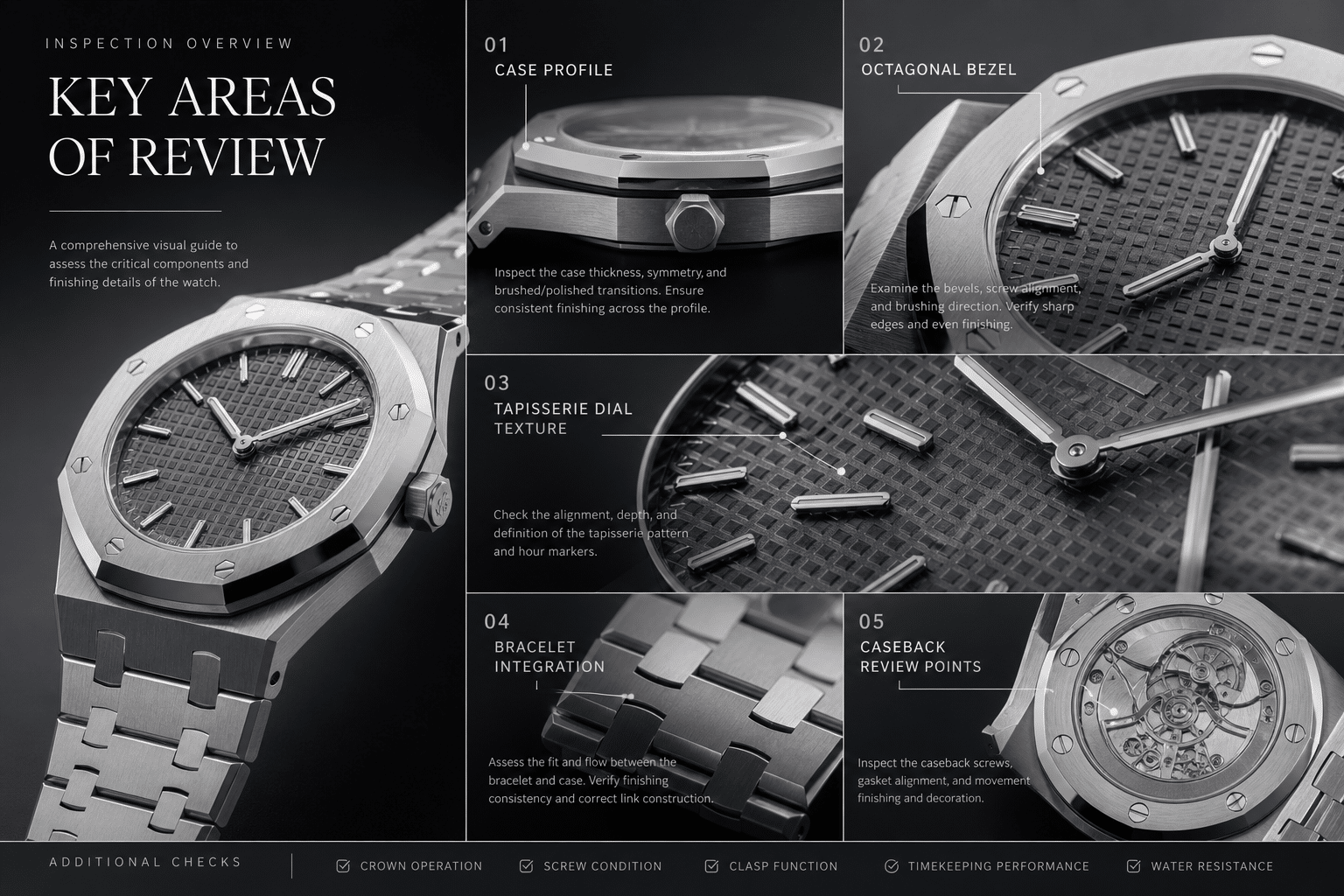
AP case inspection should begin from the side profile, not the front dial view. The front view tells you whether the watch is attractive. The side view tells you whether the AP replica case shape is believable. On a Royal Oak-style watch, thickness, bezel height, mid-case profile, and the way the case transitions into the bracelet determine whether the watch has the correct visual stance.
This matters because the Royal Oak was designed around flat planes and sharp transitions. The case is not supposed to look rounded, swollen, or overly tall. A weak Submariner-style replica may still look acceptable at a glance because the design is more forgiving. A Royal Oak replica with a bulky mid-case or muddy bevels usually looks wrong before the buyer can explain why.
Do not judge Royal Oak replica case thickness from one straight-on image. A front photo compresses depth. It can make a thick case look slim because the bezel outline dominates the image. The side-profile QC photo is where you see whether the bezel, crystal, mid-case, and caseback stack cleanly or whether the watch has been made thicker to accommodate a less suitable movement route.
Side Profile First: The Fastest Way to Spot a Poor AP Clone
The fastest warning sign is a case that looks tall in relation to the bezel and bracelet. The Royal Oak should have a controlled horizontal presence, not the vertical bulk of a generic sports watch. If the mid-case looks slabby, the bezel appears perched on top of the case, or the caseback adds obvious height, the watch may look acceptable in photos but feel wrong on the wrist.
Pay attention to how the case sits relative to the bracelet. The case should not look like a thick block with links dropping sharply downward. Even before evaluating bracelet quality in detail, the side profile should suggest a continuous design. If the first link appears to start too low, too steeply, or too far away from the case, the whole watch can lose the Royal Oak’s flat, integrated character.
Case height is also one of the few flaws that buyers tend to notice repeatedly after purchase. A small printing softness may fade from attention during daily wear. A case that always feels too thick or sits too high does not. For AP super clones, thickness is not just a specification; it changes the entire wrist presence.
Octagonal Bezel Shape and Screw Seating
The octagonal bezel should look symmetrical and controlled. Each flat edge should feel intentional, not wavy, rounded, or uneven. The brushed top surface and polished bevels need clean separation because this contrast is central to the AP look. If the finishing looks cloudy or the bevels blur into the brushed surface, the watch loses the crisp architectural quality that makes the design convincing.
Bezel screws deserve close attention, but buyers should be realistic about what they are checking. On replica AP watches, screw size, seating, and position are common weak points. The practical question is whether the screws look clean and evenly seated in normal QC photos, not whether they survive microscopic comparison. Screws that appear slightly imperfect in extreme close-up may be tolerable. Screws that look crooked, raised, irregular, or visually distracting from a normal front view are more serious.
The bezel should also sit evenly around the crystal. If one side appears compressed, if the octagon looks distorted, or if the crystal-to-bezel spacing appears inconsistent, ask for another angle before approving. Camera distortion can create false alarms, but repeated asymmetry across multiple photos is an AP case red flag.
Acceptable Compromise vs Warning Sign
An acceptable compromise is usually small and non-dominant: slight softness on a polished bevel, minor brushing inconsistency under harsh lighting, or a side-profile photo that looks slightly distorted because of camera angle. These are not ideal, but they may not affect the watch strongly in daily wear if the overall case stance is correct.
A warning sign is different. Obvious case bulk, uneven bezel edges, visibly crooked or protruding screws, distorted octagonal shape, or a case that looks disconnected from the bracelet should make the buyer cautious. These flaws are not hidden details. They affect the Royal Oak’s main design language.
The judgment rule is simple: if the flaw changes the silhouette, it matters more than a tiny finishing imperfection. AP-style watches are shape-driven. A slightly imperfect brushed surface may be acceptable; a case that looks too thick or a bezel that looks geometrically wrong is much harder to live with.
Case Photos to Check Before Approval
- Straight front view: useful for judging bezel symmetry, screw seating, and the overall octagonal outline.
- True side profile: essential for checking Royal Oak replica case thickness, bezel stack, mid-case height, and caseback bulk.
- Angled case shots: helpful for seeing how brushed surfaces and polished bevels transition under light.
- Bezel close-up: useful for checking screw seating, edge definition, and whether the finishing looks muddy.
- Wrist-style perspective, if available: not a perfect measurement tool, but useful for judging whether the case wears flat or looks top-heavy.
Dial Printing, Tapisserie Texture, and Marker Alignment
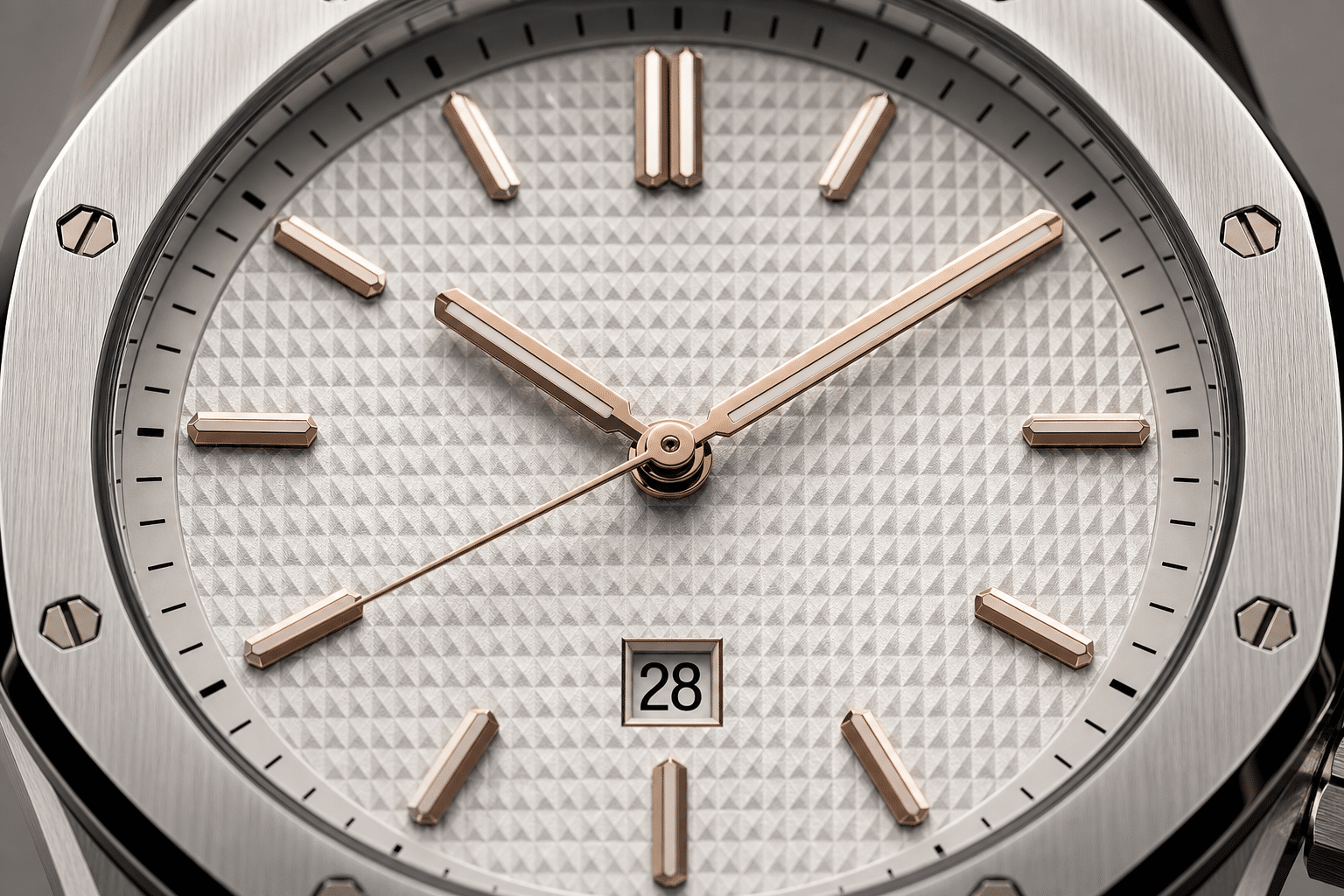
The AP replica dial is difficult because it gives the eye too many reference points. On a Royal Oak replica QC checklist, the tapisserie grid, applied markers, hands, logo, printed text, and date window all have to sit in visual order. A small flaw that might disappear on a plain dial can become obvious when surrounded by a geometric pattern.
This is why dial inspection should not stop at “the color looks good.” Blue, grey, black, and silver dials can all look appealing in seller photos, but the real question is whether the dial structure looks controlled. The tapisserie pattern should support the layout. It should not fight the markers, make the logo look misplaced, or expose a date window that sits awkwardly.
One clear front-facing photo is helpful, but it is not enough to verify every AP dial printing check. Camera angle can make markers look tilted and can make the date window appear off center. The better approach is to compare several clear images and look for repeated evidence. If the same marker looks crooked in every photo, it is probably not just distortion.
Tapisserie Texture: Depth, Spacing, and Finish
The tapisserie dial should look even, dimensional, and controlled. It should not appear like a flat printed grid, a randomly stamped texture, or an overly glossy surface with no depth. On stronger AP super clone dials, the pattern gives the dial a structured, layered look. On weaker examples, the squares can appear blurred, too shallow, too sharp, or visually noisy.
Buyers often overfocus on whether the tapisserie is “perfect.” That is the wrong standard. Genuine AP tapisserie has a level of guilloché depth and light behavior that replicas do not fully reproduce under close inspection. The more useful question is whether the replica dial looks convincing at normal viewing distance and whether the pattern is consistent across the dial.
Uneven texture is more concerning than slightly imperfect texture. If one section looks soft while another looks harsh, or if the pattern appears misaligned around the logo or date area, the dial can feel unbalanced. Consistency matters because the Royal Oak dial is a grid. The grid makes inconsistency visible.
Logo, Text, Markers, and Hands
The logo should sit naturally within the dial layout, not too high, too low, or visually crowded by the tapisserie blocks. Printed text should be clean enough that it does not look heavy or fuzzy in normal QC photos. Some softness under macro inspection is common, but thick, uneven, or poorly spaced printing can make the dial look cheaper than the case deserves.
Applied markers are one of the most important dial checks. They should align cleanly with the tapisserie pattern and chapter layout. A marker that leans noticeably or sits at a strange distance from the edge will draw attention because the surrounding grid makes the tilt easier to see. Hand length should also look appropriate for the reference style; hands that appear too short or awkwardly proportioned disturb the dial balance even if the printing is acceptable.
Lume fill, where relevant, should look clean and reasonably even. Replica lume performance is usually not the strongest part of an AP-style watch, so the inspection priority is not expecting genuine-level brightness. The practical concern is whether the lume application looks messy, mismatched, or visibly uneven in daylight photos.
Date Window and Dial Balance
The date window is a small detail with large visual consequences. It should look centered, level, and naturally placed within the dial architecture. If the date sits too high, too low, or too far to one side inside the window, the eye catches it quickly because the tapisserie grid creates a built-in alignment guide.
Check both the window position and the date font. A slightly imperfect font may be tolerable if it is clean and centered. A badly centered date is more distracting because it appears every time you look at the watch. If the QC set shows only one date number, remember that another number may sit differently, so avoid treating one photo as a full guarantee.
The date should not look like an afterthought cut into the dial. On many AP replicas, the dial can be attractive until the buyer notices the date window does not sit naturally within the pattern. That is the type of flaw that becomes more annoying after purchase, not less.
Acceptable Compromise vs Warning Sign
Acceptable dial compromises include mild font softness, small lighting glare on applied markers, slight color shift caused by camera exposure, or tapisserie that, despite AP super clone marketing claims, is not genuine-level under close inspection but still appears even and dimensional. These are common limitations in replica AP dials and may not affect daily enjoyment if the dial remains balanced.
Warning signs include visibly crooked markers, a logo that looks misplaced, badly centered date numerals, uneven tapisserie texture, heavy or blurry dial printing, or hands that appear incorrectly proportioned. These are not obscure macro flaws. They change the front view, and the front view is what the wearer sees most often.
A strong AP replica dial is not simply the one that looks most dramatic under seller lighting. It is the one that stays organized when you remove the lighting tricks: even texture, clean marker alignment, natural logo placement, and a date window that does not interrupt the dial’s geometry.
Bracelet Integration, End-Link Flow, and Screw Quality
The AP replica bracelet is not a secondary detail. On a Royal Oak-style watch, the bracelet is part of the case architecture, and a weak bracelet can make an otherwise convincing dial feel disappointing the moment the watch is worn. This is where many buyers misjudge AP super clones: they study the tapisserie dial in macro photos but ignore the first links, screw seating, clasp behavior, and how the bracelet drops from the case.
For Royal Oak bracelet QC, the question is not simply whether the bracelet looks shiny or well brushed. The better question is whether the AP replica bracelet behaves like an integrated design. It should continue the case lines, articulate without looking floppy, avoid obvious bracelet gap issues, and preserve the sharp brushed-and-polished visual rhythm that defines the Royal Oak. Photos can show alignment and finishing; they cannot fully prove comfort, so buyers should treat visible bracelet problems as more serious than small cosmetic variance.
Case-to-Bracelet Transition
The first bracelet links should look like they grow out of the case, not like an aftermarket bracelet attached to a watch head. On a good AP super clone, the end-link fit is controlled: the first links sit evenly, the side alignment does not look stepped, and the bracelet begins its downward curve naturally from the case. A small shadow line is normal in photos, especially under hard lighting, but a large open gap or uneven left-right fit is a warning sign.
The most common visual problem is an awkward drop-off at the first link. If the bracelet falls too sharply, the watch can look bulky and sit less naturally on the wrist. If the first links are too stiff, the watch may wear larger than the case diameter suggests. This matters especially on 41mm Royal Oak-style models, where the integrated bracelet already increases wrist presence. A strong dial does not save an uncomfortable Royal Oak replica if the bracelet refuses to wrap the wrist properly.
When reviewing QC photos, compare both sides of the case. One side should not show a tighter transition while the other shows a visible bracelet gap or tilted first link. Slight angle distortion can make a link look uneven, but repeated unevenness across multiple photos usually points to a real fit issue.
Link Screws, Brushing, and Bevel Consistency
AP bracelet finishing is difficult because the links are not simple flat metal blocks. The visual effect depends on straight brushing across the main surfaces, controlled polished bevels along the edges, and clean transitions between the two. On weaker replicas, the bracelet may look acceptable from a distance but become soft and muddy up close. The brushed surfaces lose direction, the bevels become rounded, and the link edges look more mass-produced than sharply machined.
The link screws deserve a separate screw quality check. They should sit flush and appear consistent from link to link. A screw that looks chewed, raised, off-center, or different in tone from the surrounding links suggests poor finishing or careless assembly. This is not only cosmetic. Poorly seated screws can make resizing more annoying and may hint at rougher bracelet construction.
Brushing direction is another area buyers often overlook. The Royal Oak bracelet relies on a strong vertical or lengthwise brushed pattern, depending on the surface, interrupted by polished bevels that catch light cleanly. If the brushing looks wavy, cloudy, or inconsistent across neighboring links, the bracelet will appear less crisp in daily wear. Minor brushing variance is common, but random finishing direction across multiple links is not something to dismiss.
Clasp Fit and Daily-Wear Comfort
The clasp is where visual quality and ownership comfort meet. A good AP replica bracelet should close securely, sit centered enough on the wrist, and avoid a loose or tinny feeling. QC photos can show clasp engraving, clasp alignment, and whether the folding components appear properly finished, but they cannot fully reveal clasp snap, tension, or long-term comfort. This is why buyers should not approve a watch with obvious clasp problems just because the front photo looks strong.
Bracelet articulation matters more on AP than on many round-case sports watches. The integrated bracelet has to drape. If it is too stiff, the watch can sit like a metal cuff and leave gaps at the sides of the wrist. If it is too loose or rattly, the watch loses the solid, architectural feel that buyers expect from a Royal Oak-style design. Some tightness in a new bracelet is normal, but a visibly kinked or uneven bracelet in QC photos should be treated cautiously.
Comfort also depends on link sizing. AP-style bracelets do not always offer the same forgiving adjustment range as simpler oyster-style bracelets. If the bracelet has rough edges, uneven screw heads, or stiff articulation, small sizing issues become more noticeable. For daily wear, bracelet comfort is not a luxury detail; it decides whether the watch actually stays in rotation.
Acceptable Compromise vs Warning Sign
Acceptable compromises include slight brushing variation, minor photo glare on polished bevels, small differences in screw reflection, or a bracelet that looks a little stiff in one still image. These issues are common in replica watch QC and do not automatically make the watch a bad choice if the case transition, link alignment, and clasp all look coherent.
Warning signs are more structural. Large end-link gaps, uneven first-link alignment, visibly raised or damaged screws, rough bracelet edges, a clasp that appears misaligned, or a bracelet that looks kinked instead of articulated should make the buyer pause. These flaws are harder to ignore than small dial-print softness because the bracelet is constantly felt, not just seen.
The practical judgment is simple: for an AP super clone, a weak bracelet lowers the whole watch. If the bracelet does not flow from the case, the Royal Oak identity breaks. Buyers should be more forgiving of tiny finishing softness than of poor end-link fit or uncomfortable articulation, because the latter will affect every day of ownership.
Movement Type, Thickness Impact, and Caseback Credibility
An AP replica movement should be judged by what it does to the whole watch, not only by how impressive the caseback looks. The right movement route can support believable case thickness, date placement, rotor position, power reserve expectations, and winding feel. The wrong movement route can create a watch that looks attractive from the front but feels compromised in profile, sounds noisy on the wrist, or shows a caseback layout that does not match the model being copied.
This is especially important with AP super clone movement claims because sales descriptions often focus on decoration. A gold-toned rotor, engraved bridge, or AP-style plate can make the movement look more convincing in photos, but decoration alone does not prove reliability or correct architecture. At CleanVSFactory, we usually treat movement choice as part of the ownership decision, not just a specification line. If the movement forces the case too thick or shifts the date into an awkward position, the decoration is not solving the real problem.
How to Treat Movement Names and Specifications
Movement names in replica listings should be read carefully. A seller may use a phrase such as “clone movement,” “custom movement,” “decorated movement,” or “same-style movement,” but those phrases do not automatically confirm exact architecture, parts compatibility, accuracy, power reserve, or service options. Unless the seller provides clear movement photos and a credible explanation of the route used in that specific watch, the safer assumption is that the name describes a market category rather than a verified technical specification.
This distinction matters because a movement can be visually decorated to resemble a higher-end layout while still behaving differently in winding feel, date change, rotor noise, hand setting, thickness, and long-term serviceability. A buyer does not need to become a watchmaker, but the buyer should avoid treating decoration as mechanical proof. If the claimed movement is a major reason for the price, ask for a caseback image and check whether the date position, case thickness, and visible layout are consistent with the claim.
Movement trust in the replica market depends on understanding what the movement claim actually describes: architecture, decoration, layout, reliability expectation, or simply a market name used by sellers. A decorated bridge or rotor may support the visual theme of the watch, but it should not be confused with an official Audemars Piguet-manufactured caliber or with guaranteed long-term service compatibility.
Why Movement Route Affects More Than the Caseback
Movement thickness directly affects case thickness. This is one of the biggest reasons AP replicas improved as integrated clone-style movement routes became more common on certain Royal Oak references. Older or lower-tier movement solutions may use a reliable base movement with decorative plates, but those plates and layout compromises can add height or place visible movement components in the wrong position through the caseback.
Date position is another practical clue. If the movement architecture does not suit the dial layout, the date window can sit too far inward, too close to the edge, or visually disconnected from the dial grid. On a Royal Oak, the dial is highly structured, so date placement errors are easier to notice than on many less geometric watches. A buyer does not need to identify every gear train detail to see when the date looks unnatural.
Power reserve, winding feel, and rotor behavior also matter for daily use. Some AP replica movement routes may advertise long reserve figures, but real-world performance can vary by unit, service condition, and assembly quality. Rotor noise is another ownership issue, especially with movement bases known for freer rotor spin. A slightly audible rotor is not unusual in the replica market, but loud grinding, scraping, or inconsistent winding feel should not be ignored.
Decorated Casebacks: Useful Signal or Sales Distraction?
A decorated caseback can be useful when it matches the model and supports the rest of the watch. On AP-style replicas with display backs, the rotor shape, bridge layout, engraving style, jewel placement, and general finishing all contribute to the impression. If the movement view is obviously mismatched to the reference, it weakens the watch even if the dial looks strong.
The mistake is treating caseback decoration as proof of a better watch. Many buyers are drawn to engraved bridges and rotor decoration because they look technical and expensive in seller photos. But a decorated movement that creates a thicker case, vague date behavior, or uncertain serviceability may be less practical than a plainer but stable route on a model where the caseback is not the main visual priority.
For daily wear, the front, side profile, bracelet, and movement route should agree with each other. If the caseback looks impressive but the watch sits too tall or the date alignment looks wrong, the movement claim is not adding credibility. It is distracting from the compromise.
Serviceability and Ownership Risk
Movement choice also affects what happens after the first few weeks of ownership. A movement that is visually closer to the reference may be more appealing in photos, but it may also be less familiar to local watchmakers, harder to source parts for, or more sensitive to poor assembly. A more common base movement can sometimes be easier to regulate or service, even if it is less visually impressive through a display back. This is one reason movement decisions should not be judged only by decoration.
For buyers who plan to wear the watch often, stable timekeeping, clean date change, acceptable winding feel, and realistic service options may matter more than an elaborate rotor engraving. For buyers who only want an occasional display piece, caseback appearance may carry more weight. Neither priority is wrong, but the buyer should understand which compromise they are choosing before approving QC.
Acceptable Compromise vs Warning Sign
Acceptable compromises include modest differences in bridge finishing, slightly less refined engraving, a rotor that does not look as finely finished as the genuine reference, or a power reserve that is realistic rather than marketing-perfect. These are normal limits in many AP replica movement options and may be reasonable if the case thickness, dial layout, and daily function are strong.
Warning signs include an unclear movement route, a seller who cannot explain whether the watch uses an integrated clone-style movement or a decorated base movement, a caseback view that obviously does not match the claimed model, a date window that looks misplaced, or a movement claim that sounds more ambitious than the watch can support. Suspiciously vague phrases such as “best movement,” “same as original,” or “latest upgraded machine” without visible evidence should be treated as weak information.
A practical AP super clone movement choice is not always the most decorated one. It is the route that supports correct-looking proportions, credible dial layout, acceptable winding behavior, and realistic service expectations. If the movement makes the watch thicker, noisier, or harder to trust, the caseback decoration is not enough compensation.
Movement Transparency Note: Movement references in this checklist describe replica-market movement routes, decoration styles, or practical configurations, not an official Audemars Piguet caliber unless independently verifiable evidence is provided. Buyers should judge the movement by visible caseback details, case thickness, date position, hand-setting behavior, rotor noise, and realistic service expectations rather than by a sales nickname alone.
Movement Route to Verify
- Confirm the stated movement type, not just the decoration name or sales nickname.
- Check whether the movement route is appropriate for the specific AP model, especially for thin Royal Oak, Offshore chronograph, or skeleton-style designs.
- Review the caseback style against the claimed reference, including rotor shape, bridge layout, and engraving placement.
- Ask how the date behaves where relevant, including whether the date changes cleanly and sits centered in the window.
- Consider movement thickness as part of the case inspection, because a visually attractive movement can still force an incorrect wrist profile.
- Treat power reserve claims as expectations, not guarantees, unless the watch has been tested after assembly or servicing.
QC Photo Review: The Minimum Image Set Before Approval
AP replica QC photos should prove consistency, not just attractiveness. One clean front photo can make a Royal Oak replica look excellent while hiding case height, bracelet drop, clasp looseness, screw seating, and caseback mismatch. A useful Royal Oak replica QC checklist needs multiple angles because the design is three-dimensional: bezel, case, bracelet, dial, and movement all expose different flaws.
The buyer’s goal is not to demand impossible inspection data or guaranteed water resistance. The goal is to collect enough visual evidence before accepting QC so obvious problems are not discovered only after delivery. Lighting and camera angle can exaggerate minor flaws, but they can also hide major ones. Compare the same area across several photos before deciding whether to approve or question the watch.
QC photos reduce uncertainty, but they do not remove every risk. Buyers should review real photos of the specific watch where available, including dial printing, hand alignment, bezel screw seating, datewheel centering, side thickness, bracelet fit, clasp engraving, caseback finishing, and movement view. Factory labels and stock photos alone are not enough for a reliable AP super clone judgment.
Straight-On Dial and Bezel Photos
A straight-on dial photo is the anchor image. It lets the buyer check marker alignment, hand placement, date centering, logo position, bezel symmetry, and screw placement without as much angle distortion. For AP replica QC photos, this image should be clear enough to see the relationship between the tapisserie grid, applied markers, bezel screws, and date window.
The most useful straight photo is not the most dramatic one. Heavy reflections, tilted framing, or extreme close-ups can make the dial look better while hiding alignment problems. If the bezel appears slightly distorted in one image, compare it with another straight or lightly angled shot before assuming the bezel is actually wrong. But if the same screw looks crooked, raised, or uneven in several images, that is more likely a real QC concern.
Side Profile and Bracelet-Angle Photos
Side profile photos are essential because AP-style watches can look much better from the front than they wear from the side. A side shot helps reveal case thickness, bezel stack, mid-case slope, crystal height, and how the bracelet drops from the case. If the side profile is missing, the QC set is incomplete for a Royal Oak-style super clone.
Bracelet-angle photos show the first links, end-link fit, and whether the bracelet flows naturally or falls awkwardly. This matters because the integrated bracelet controls wrist presence. A watch with a strong dial but a stiff, gapped, or uneven bracelet can feel less convincing in daily use. Photos cannot fully prove comfort, but they can reveal obvious bracelet fit problems before approval.
Clasp, Caseback, and Movement View
Clasp photos help confirm clasp finish, engraving quality, closure alignment, and whether the folding components look cleanly assembled. They also reveal rough finishing that may not show in front-facing images. A clasp does not need to look genuine-level under macro inspection, but it should not look crude, misaligned, or loosely fitted.
Caseback and movement photos support the movement-route claim. They should show whether the caseback style matches the model, whether the rotor and bridge decoration are at least visually coherent, and whether the movement presentation fits the sales description. This is not about using the watch for authentication or resale deception; it is about making sure the watch being offered matches the version the buyer believes they are approving.
Movement photos can also expose sloppy assembly details, such as visible debris, poor rotor finishing, or obvious mismatch between claimed movement and visible layout. Not every buyer can judge movement architecture from a photo, but unclear or missing caseback images should make buyers more cautious when the movement is a major selling point.
Policy and Condition Questions to Confirm Before Approval
QC approval should not be limited to photographs. Before ordering, buyers should confirm practical terms directly with the seller, including what happens if the delivered watch differs from the approved QC set, whether the watch has been tested for basic operation, whether any water-resistance testing has actually been performed, and what repair or support options exist if an issue appears after delivery. These questions should be answered as seller-specific terms, not assumed from a factory name, model name, or sales description.
Prices can change by factory label, version, movement, seller channel, and availability, so exact comparisons should be verified at the time of purchase. A higher price should have a visible or practical explanation, such as a more suitable movement route, cleaner case profile, better bracelet construction, or stronger QC evidence. If the price difference is supported only by broad phrases such as “latest,” “top,” or “factory direct,” treat the claim as incomplete until the seller explains what is actually different in the watch being supplied.
Water resistance should not be assumed unless the specific watch has been tested and the seller’s policy is clearly confirmed. Even if a seller mentions testing, buyers should understand what kind of test was performed, whether it applies to the individual unit, and whether the result changes how cautiously the watch should be used around water. Replica watches should generally be treated more conservatively around moisture than genuine watches maintained through official service channels.
Minimum QC Photo Set
- Straight-on dial photo for marker alignment, hands, logo, date position, bezel symmetry, and screw placement.
- Close dial or date photo where the date window, printed text, and tapisserie texture are easy to review.
- Side profile photo to judge case thickness, bezel height, crystal position, and overall wrist stance.
- Angled case photo to cross-check bezel geometry, brushing, polished bevels, and case-to-bracelet transition.
- Bracelet integration photo showing the first links and end-link fit on both sides of the case.
- Bracelet and screw photo showing link screws, brushing direction, bevel consistency, and visible gaps.
- Clasp photo showing closure alignment, clasp finishing, and engraving quality.
- Caseback and movement photo to confirm caseback style, rotor appearance, and whether the movement route matches the claimed model.
- Time-setting or hand-position variation photo if needed to reveal date centering, hand alignment, or dial obstruction issues.
The practical rule is that a buyer should not approve an AP super clone from beauty shots alone. If the QC set cannot show the front, side, bracelet transition, clasp, and caseback clearly, it is not giving enough evidence for a confident decision. Missing photos are not always proof of a bad watch, but they do increase the risk of approving the wrong one.
Verification Note: When possible, buyers should review real QC photos of the specific watch rather than relying only on stock images, factory labels, or edited promotional angles. Dial alignment, bezel screw seating, case thickness, bracelet flow, clasp finishing, caseback structure, and movement information should be checked together because one strong photo does not prove the whole watch is consistent.
Acceptable Flaws vs Warning Signs Across the Five-Point Checklist
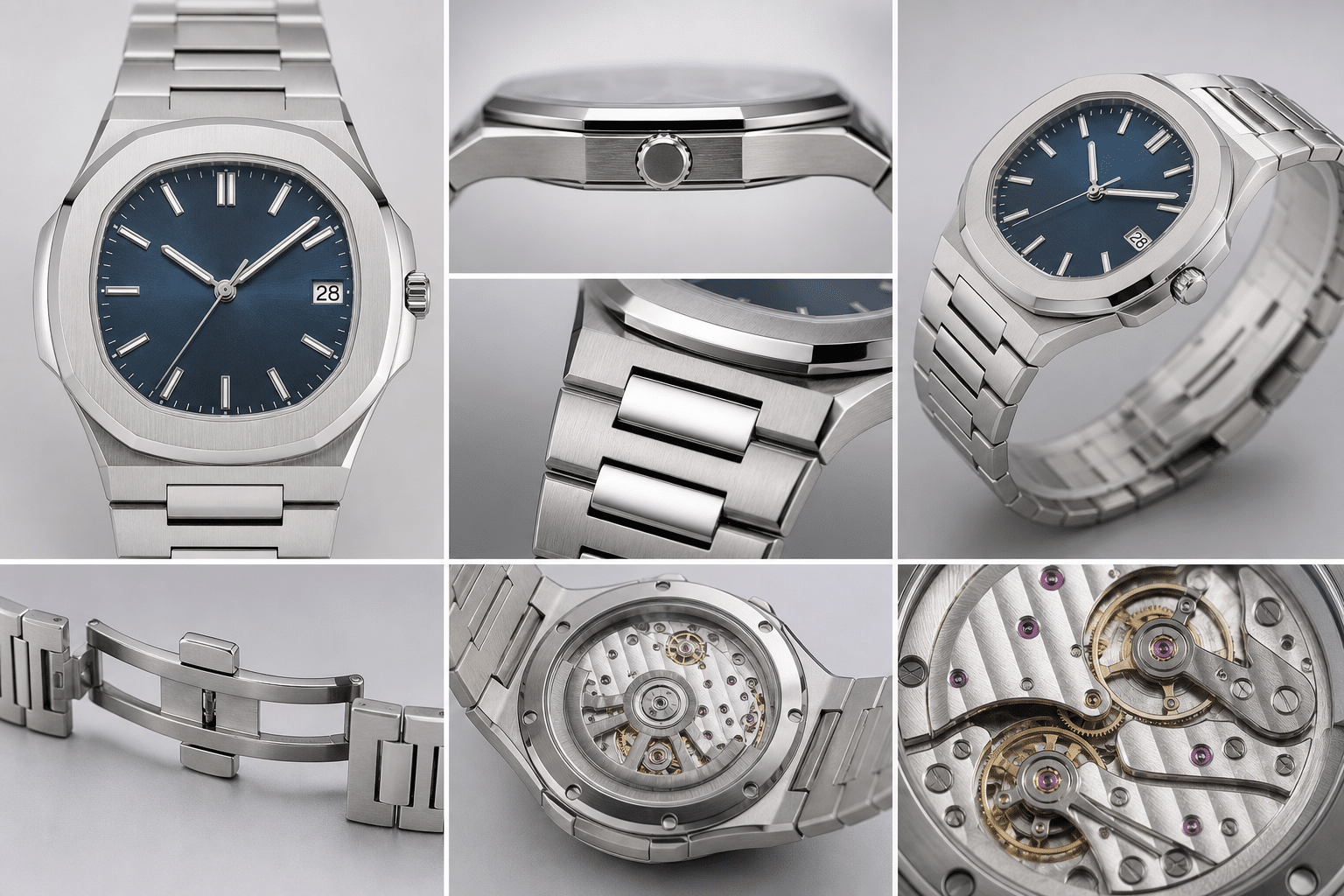
The practical question is not whether an AP super clone has a flaw. It will. The better question is whether the flaw is visible in normal wear, permanent in the watch’s construction, or likely to affect comfort and ownership. AP super clone red flags usually come from areas the Royal Oak design exposes constantly: the side profile, dial alignment, bracelet flow, bezel screw seating, and movement-route consistency.
A minor flaw in a hidden caseback engraving is not equal to a crooked hour marker on a clean dial. Slight brushing softness is not equal to a case that looks too thick from the side. This is where many buyers make the wrong QC decision: they obsess over a macro-photo detail that will rarely be seen, while accepting a case flaw or bracelet gap that will be obvious every time the watch is worn.
Flaws That Are Often Tolerable
Some AP replica acceptable flaws are normal within the current market and do not automatically justify QC rejection. Slight photo-angle distortion is the most common one. A straight-on dial shot can make a marker look cleaner than it is, while an angled shot can make the same marker look worse. Before treating a small alignment issue as a major problem, compare it across more than one image.
Small finishing softness can also be tolerable, especially on polished bevel transitions or inner bracelet edges. Genuine AP finishing depends heavily on hand-controlled transitions; no replica watch should be expected to reproduce that at the same level under magnification. If the brushing direction is generally consistent, the bevels are not visibly wavy, and the watch still has the flat, angular Royal Oak stance, minor softness is usually not the flaw that should drive rejection.
Caseback decoration differences are another area where buyers often overreact. A rotor engraving that is slightly less sharp, a bridge texture that looks flatter, or a modest color difference in decoration may reduce close-inspection credibility, but it rarely affects daily-wear appearance unless the watch has a display caseback that the owner plans to examine frequently. For most buyers, front-facing dial balance and case thickness matter more than decorative movement sharpness.
- Minor glare or reflection on the tapisserie dial in one photo
- Slight brushing variation that does not break the overall case and bracelet flow
- Small caseback decoration differences that do not suggest a wrong movement route
- Very slight datewheel centering variation if it is not obviously high, low, or clipped
- Photo-angle distortion that disappears in a second image
Flaws That Deserve More Caution
The more serious warning signs are the ones that change the watch’s identity on the wrist. A bulky side profile is one of the biggest AP super clone red flags under any Audemars Piguet super clone buying guide because the Royal Oak is not just a front-view design. If the mid-case, bezel stack, and caseback make the watch look thick or slab-like, the whole watch loses the tension that makes the Royal Oak convincing. This is especially important on thinner Royal Oak references, where extra height is easier to notice.
Dial misalignment deserves caution because the tapisserie grid gives the eye built-in reference lines. A slightly soft logo may be acceptable; a visibly crooked applied marker is different. The same applies to a date window that looks obviously off-center or cramped. On an AP dial, alignment errors do not hide well because the dial is geometric, structured, and repetitive.
Bracelet problems should also rank high in the QC decision. A small finishing variance on one link is not a major issue, but a large bracelet gap, uneven end-link fit, poor first-link drop, or clasp that appears misaligned can affect both appearance and comfort. The integrated bracelet is not an accessory on a Royal Oak; it is part of the case architecture. A good dial cannot fully save a weak bracelet.
Bezel screw alignment is more nuanced. Tiny differences can be exaggerated by macro photos, but visibly uneven seating, protruding screw heads, damaged screw slots, or a bezel that looks asymmetrical should not be ignored. The octagonal bezel is one of the first things people notice on an AP-style watch, so screw and bezel issues carry more visual weight than similar small hardware flaws on many round-case watches.
Movement mismatch is a different type of risk. It may not always be obvious in front photos, but unclear movement claims, a caseback that does not match the stated model, or a movement route that appears inconsistent with the case thickness should make the buyer pause. The issue is not only visual accuracy. It can also affect winding feel, date behavior, rotor noise, serviceability, and whether the watch was represented honestly.
- Obviously thick or awkward side profile for the model being copied
- Visibly crooked hour markers, logo, hands, or date window
- Large bracelet gap or poor case-to-bracelet transition
- Uneven, protruding, or damaged bezel screws
- Clasp misfit, rough bracelet edges, or signs of poor articulation
- Movement claim that does not match the caseback, date layout, or model style
- QC photos that contradict each other or avoid important angles
How to Weigh One Flaw Against the Whole Watch
A sensible QC decision starts with hierarchy. Ask three questions: will the flaw be visible during normal wear, is it built into the watch rather than caused by lighting, and does it affect comfort or long-term ownership? If the answer is yes to two or three of those, the flaw deserves caution. If it only appears in one extreme close-up and does not affect the case stance, dial balance, bracelet fit, or movement credibility, it may be acceptable.
One isolated flaw is not always a reason to reject an AP clone. A slightly soft caseback engraving on an otherwise strong Royal Oak replica is very different from a watch with a thick case, uneven bezel screws, a poor bracelet transition, and vague movement description. Repeated inconsistency across several areas is more concerning than one small imperfection.
At CleanVSFactory, we usually encourage buyers to separate “macro irritation” from “daily-wear distraction.” A flaw that bothers you only when zooming into a QC photo at 300 percent may not matter much on the wrist. A flaw that changes the silhouette, symmetry, or bracelet feel will keep bothering you after the novelty fades.
If you are asking, “Should I accept this AP clone?” focus less on whether the watch is flawless and more on whether any single compromise dominates the experience. The better approval standard is simple: the watch should look coherent from the front, believable from the side, comfortable through the bracelet, and honest enough in its movement route that you know what you are accepting.
Factory Claims, Version Labels, and Sales Descriptions: What Actually Matters
Factory labels and version names are useful, but they are not proof by themselves. AP clone factory claims should narrow your search, not replace inspection. A watch described as a newer version, upgraded movement, improved dial, or better bracelet still needs to show those improvements in the actual QC photos. The individual watch in front of you matters more than the longest sales description.
This is especially true with AP replicas because improvements are often uneven. A version update may improve the dial texture but leave the bracelet mostly unchanged. Another update may improve the movement decoration while the case shape still looks too heavy. A practical AP clone choice is rarely the one with the most aggressive feature list; it is the one where the case, dial, bracelet, movement route, and QC consistency all support each other.
Why Factory Reputation Is Only the Starting Point
A factory reputation can help avoid the weakest options, but it cannot approve the watch for you. APS, ZF, APF, and other known names may be associated with stronger AP production in certain model families, but that does not mean every reference, batch, or individual unit deserves automatic acceptance. AP replica version check should always happen at the watch level, not only the name level.
The reason is simple: AP designs leave very little room to hide inconsistency. Even a respected factory can produce a watch with a poorly centered date, uneven screw seating, stiff bracelet, or soft dial printing in a particular batch. Conversely, a less hyped option may be rational for a buyer if the specific model is simpler, the QC photos are clean, and the buyer understands the compromise.
Factory reputation is best treated as a probability filter. It tells you where to start, not where to stop. The QC photos decide whether the example being offered actually reflects the version claims.
A Traceable Way to Compare Two AP Clone Options
When comparing two AP super clones, use a simple evidence chain instead of a factory-name shortcut: model reference, stated factory or version, movement route, case thickness, dial and date execution, bracelet integration, clasp quality, caseback match, and real QC photo consistency. This makes the comparison traceable because each claim is connected to something the buyer can actually review.
For example, if one option claims a better movement but also shows a thicker side profile and a less natural date position, the movement claim may not improve the overall watch. If another option has a less dramatic caseback but cleaner bracelet flow, better marker alignment, and a more controlled case stance, it may be the more practical daily-wear choice. A factory comparison is most useful when it is tied to the specific reference, version, movement, and visible execution details rather than treated as a universal ranking.
Version Updates Can Change the Tradeoff
Version updates are not automatically upgrades in every area. A newer Royal Oak replica may have a better tapisserie dial but slightly different case finishing. A movement update may improve caseback credibility while introducing more uncertainty around long-term reliability. A bracelet revision may reduce visible gaps but still feel stiffer than expected once worn.
This is why “latest version” should not be treated as a magic phrase. The more useful question is: what changed, and does that change matter for this model? On a time-only Royal Oak, case thickness, bracelet flow, date placement, and dial texture should usually carry more weight than a small caseback decoration update. On a chronograph-style AP clone, movement layout, pusher alignment, and case height may matter more than a minor printing improvement.
Batch variation also matters. A seller may use photos from a strong earlier sample, while the actual QC watch has small differences. This does not automatically mean bad faith; it reflects how the replica watch market works. But it does mean buyers should compare sales description vs QC photos before making a final decision.
Price Differences Need a Practical Explanation
A higher AP super clone price does not automatically mean the watch is better in every area. Price can reflect the factory route, movement type, caseback decoration, dial complexity, bracelet finishing, availability, seller margin, or after-sale risk. Sometimes a more expensive version is genuinely more suitable because it uses a movement route that supports better case thickness or a bracelet that fits more cleanly. Other times the price difference is mostly attached to hype, scarcity, or a sales description that sounds stronger than the QC photos prove.
When comparing two AP replicas at different prices, ask what the extra cost is supposed to improve. If it improves the side profile, date position, bracelet articulation, or movement stability, the premium may be useful for a daily-wear buyer. If it only adds a slightly more decorative rotor while the case remains thick and the bracelet transition is weak, the lower-priced but better-balanced option may be the more rational choice. Price should be treated as one signal, not a final quality grade.
Claims That Should Be Matched Against Photos
Some sales claims are easy to write and harder to prove. “Correct thickness,” “upgraded dial,” “improved bracelet,” “clone movement,” and “better caseback” should all be checked against visible evidence. If the claim affects how the watch looks or wears, it should appear somewhere in the QC set.
- Case thickness: Look for side-profile photos, not just a front dial shot. A thin-looking front view can hide a heavy mid-case or tall caseback.
- Dial texture: The tapisserie pattern should look even, dimensional, and controlled across the dial. Avoid judging from one over-lit photo.
- Bracelet quality: Check the first-link transition, end-link fit, brushing direction, screw seating, and clasp photos where available.
- Movement route: The stated movement should make sense for the model’s thickness, date position, caseback appearance, and function layout.
- Caseback appearance: Decoration should support the claimed movement route, but it should not distract you from more visible flaws on the front and side of the watch.
If a seller claims a major update but the QC photos do not show the relevant area clearly, the claim is not enough. Ask for the angle that confirms the improvement. If the photo set avoids the side profile, hides the bracelet transition, or gives only a blurred movement view, that absence becomes part of the risk assessment.
The most reliable AP replica version check is not a debate over factory labels. It is a consistency test. The description, model type, case shape, dial layout, bracelet construction, movement view, and QC photos should all tell the same story. If they do not, slow down before approval.
Model-Specific Watchouts for Royal Oak, Offshore, and Complication-Style AP Clones
The same checklist does not carry the same weight across every AP-style replica. A time-only Royal Oak, a Royal Oak Offshore chronograph, and a skeleton AP replica create different risks. The mistake is applying one universal standard and then being surprised when the watch fails in an area that was predictable for that model family.
A simple-looking Royal Oak can be difficult because it has nowhere to hide. The Offshore looks more forgiving because it is larger and sportier, but the chronograph layout, pushers, and case thickness add their own problems. Skeleton and openworked designs look impressive in photos, yet they expose movement architecture and finishing more aggressively than a closed dial. The right Royal Oak replica checklist should change based on the model you are evaluating.
Time-Only Royal Oak Models
For time-only Royal Oak models, the inspection priority should be proportions first. These watches depend on a thin, flat, sharply finished case profile and a bracelet that flows naturally from the case. If the side profile is too bulky or the bracelet drops awkwardly from the first links, the watch will feel wrong even if the dial looks attractive.
The dial is also less forgiving because there are fewer elements to distract the eye. Tapisserie texture, logo placement, marker alignment, hand length, and date centering all sit inside a strict visual grid. A small dial flaw that might be acceptable on a busier sports watch can become more obvious on a clean Royal Oak.
For buyers asking which AP replica is safer, a well-executed time-only Royal Oak is usually more sensible than a complicated AP clone, but only if the case and bracelet are strong. Do not choose it just because it has fewer functions. Choose it because the specific QC watch proves that the proportions, dial, and bracelet work together.
Royal Oak Offshore and Chronograph-Style Models
Royal Oak Offshore and chronograph-style AP replicas require a different kind of caution. These watches are naturally thicker and more aggressive, so some bulk is expected. The problem is when the case becomes too tall, the pusher alignment looks awkward, or the subdial spacing does not match the intended layout. Offshore clone warning signs are less about subtle elegance and more about whether the watch looks mechanically coherent.
Chronograph layouts should be checked carefully. Subdials that sit too close, too far apart, or in the wrong position can make the dial look off immediately. Pushers should align cleanly with the case, and the crown guards should not look distorted or oversized. Bezel screws also matter because the Offshore’s larger case can make screw seating more visible, not less.
Movement-function realism should be judged conservatively. A working chronograph is attractive on paper, but more moving parts can mean more ownership risk. If the buyer does not actually need to use the chronograph often, reliability and correct visual layout may matter more than constant functional use. For daily wear, a visually coherent chronograph with realistic expectations is safer than one purchased purely because the sales description promises advanced movement behavior.
Skeleton and Openworked AP-Style Replicas
Skeleton and openworked AP-style replicas are the easiest to admire in seller photos and some of the hardest to judge properly. The visual complexity creates excitement, but it can also hide problems. Reflections, dark bridges, and dramatic lighting may make the watch look deeper and more refined than it appears in normal conditions.
The main skeleton AP replica risk is not only whether the dial looks busy enough. It is whether the depth, bridge shape, movement layout, screw finishing, and case thickness make sense together. If the openworked area looks flat, the bridges look crude, or the movement view does not appear mechanically plausible for the model, the watch can feel more like a decorative object than a convincing AP-style replica.
Case thickness also deserves extra attention. Skeleton designs often pull the eye into the movement, but the wrist still reads the outer case first. A thick or poorly shaped case will undermine the whole effect. Ask for side-profile and movement-side photos, not only dramatic front images.
For complication-style AP clones, the safer attitude is skepticism without panic. Some versions can be visually impressive and enjoyable if the buyer understands the compromise. But if the QC evidence is vague, the movement claim is unclear, or the watch depends on a complicated function that may be difficult to service, it is better suited to experienced buyers than first-time AP replica buyers.
Legal, Disclosure, and Ownership Limits Buyers Should Not Ignore
Replica watches can raise trademark, customs, import, resale, and disclosure issues depending on jurisdiction. This checklist is not legal advice and should not be read as a guarantee that buying, importing, carrying, gifting, or reselling a replica watch is risk-free. Buyers should understand that these are imitation products, not authorized Audemars Piguet goods, and they should avoid representing them as genuine watches in resale, trade, or authentication contexts.
Disclosure also matters in ordinary ownership. If a watch is shown, sold, traded, serviced, or discussed with another person, the safest and most ethical approach is to describe it clearly as a replica or AP-style imitation. A convincing dial or caseback does not change the product’s status. The goal of QC review should be personal risk reduction and expectation management, not creating confusion about authenticity.
After purchase, treat the watch conservatively. Avoid swimming, showering, or exposing the watch to water unless the specific unit has been pressure-tested. Avoid assuming that a local watchmaker will service a decorated or clone-style movement without hesitation. Avoid assuming that the bracelet, crown, caseback gasket, or pushers have the same durability standard as an authorized luxury watch. Careful ownership expectations are part of making a better buying decision.
Buyers should also confirm return, repair, shipping, and after-sales terms before ordering, because these terms can vary by seller and should not be assumed from a factory name or product description. These practical questions are separate from the QC checklist, but they affect ownership risk just as much as case thickness or movement route.
What This Checklist Should Not Be Used For
This checklist is intended to help readers understand visible quality, ownership risk, and realistic tradeoffs in replica-market AP-style watches. It should not be used to hide replica status, prepare a watch for resale as genuine, or suggest that a replica can pass professional authentication, boutique inspection, official service review, or resale screening. A strong super clone may look convincing in casual use, but close inspection can still reveal differences in finishing, movement architecture, case proportions, bracelet feel, dial details, or service compatibility.
The purpose of factory and movement information is to help readers avoid overpaying, misunderstanding claims, or approving a poorly documented watch. It is not a guide to misrepresentation. If a seller, listing, or buyer conversation depends on phrases such as “no one can tell,” “passes inspection,” “same as authentic,” or “safe to resell as genuine,” treat that language as a warning sign rather than useful evidence.
The Final Approval Rule: Choose the Fewest Visible Compromises
The final QC decision should not be based on which AP super clone has the longest specification list. It should be based on which watch shows the fewest visible compromises across the areas that define the Royal Oak and related AP designs: case, dial, bracelet, movement, and QC photo consistency. A watch can have a convincing dial but still fail as a daily wearer if the case sits too tall or the bracelet does not flow naturally from the case.
This is the practical use of an AP super clone buying checklist. It stops the buyer from treating one impressive feature as proof that the whole watch is strong. On AP-style watches, the design is too exposed for that. The octagonal bezel, flat case surfaces, tapisserie dial, integrated bracelet, and display caseback all give the eye reference points. If two or three of those areas look slightly wrong at the same time, the watch often feels less convincing than the sales description suggests.
The Five-Point Final Scan
Before approving an AP clone, run the final scan in the same order every time. Start with the case: does the side profile look controlled, or does the watch appear bulky from an angle? Move to the dial: is the tapisserie texture even, are the markers straight, and does the date sit naturally in the layout? Then check the bracelet: does it integrate cleanly with the case, or do the first links create gaps, stiffness, or an awkward drop?
The movement check should be practical, not romantic. Confirm that the stated movement route makes sense for the model, the caseback appearance matches the claim, and the movement choice has not forced an obvious thickness or date-position compromise. Last, compare the QC photos against each other. A watch that looks excellent in one front photo but questionable in side, clasp, or caseback images needs slower judgment.
A useful Audemars Piguet replica checklist is not a hunt for perfection. It is a filter for contradictions. If the factory claim says improved case shape but the side photo still looks heavy, trust the photo. If the description promises upgraded bracelet finishing but the end-link fit looks uneven, treat that as a real ownership concern. The final approval standard should come from the actual watch shown, not from the version name attached to it.
When a Strong Description Is Not Enough
Factory labels, version updates, and movement names are useful starting points, but they are not the final evidence. AP replicas are especially vulnerable to this mistake because many of them photograph well from the front. A sharp dial shot can hide a thick mid-case. A decorated caseback can distract from a stiff bracelet. A newer version can improve the dial texture while leaving screw seating, clasp feel, or case proportion only moderately changed.
For that reason, the final QC decision should favor visible proof over written claims. The question is not whether the description sounds like the best AP clone for daily wear. The question is whether the actual watch in the QC set looks balanced from the front, side, bracelet angle, clasp view, and caseback view. If the photos do not support the claim, the claim should not carry much weight.
At CleanVSFactory, we usually treat AP approval as a consistency check rather than a single-feature comparison. A watch with a slightly softer caseback engraving but strong case shape, clean dial alignment, and good bracelet integration is often more sensible than a watch with an impressive movement description but obvious wrist-facing flaws. Caseback details matter, but the flaws you notice every time you wear the watch matter more.
A Practical Standard for Daily Wear
The right standard is simple: approve the watch only if no single compromise keeps pulling your attention back to it. Minor finishing softness, small lighting distortion in a QC photo, or a decoration difference on the movement may be acceptable if the watch still looks coherent as a whole. AP super clones become disappointing when the flaws are visible in normal use, not just under macro inspection.
The warning sign is accumulation. A slightly thick case may be tolerable on some models. A slightly imperfect dial print may also be tolerable. A bracelet that is not quite as fluid as genuine is expected in many replicas. But if the same watch has a bulky side profile, uneven bezel screw seating, a weak bracelet transition, and vague movement information, the issue is no longer one small flaw. It is a pattern.
A better final approval rule is to choose the example with fewer visible flaws, not the one with the most ambitious claim. For daily wear, a balanced AP super clone with believable proportions, clean dial execution, a comfortable bracelet, a credible movement route, and consistent QC photos will usually be the more satisfying choice. The goal is not a flawless replica. The goal is a watch whose compromises do not dominate the experience every time it is on the wrist.
Disclosure: This article is for general educational and comparison purposes only. Replica watches are not genuine products from the original luxury brands, and brand names are used only to identify reference designs or comparison topics. Factory names, movement descriptions, prices, availability, QC details, seller policies, and version information can change, so readers should verify important details with the seller before making a purchase decision. Replica watches should not be represented, resold, or used as genuine watches.