
Ordering an Audemars Piguet-style super clone is not just a matter of asking for the “best factory” or accepting a front-facing photo. Royal Oak and Offshore-style replicas can look strong at first glance while still hiding problems in the case thickness, side profile, bracelet articulation, clasp fit, rotor noise, date behavior, or service options, making AP super clone red flags especially important when judging QC evidence and dealer claims. The main risk is vague selling language that does not identify the exact reference, factory, batch, movement route, or QC evidence.
This article focuses on the questions that turn a risky purchase into a clearer judgment. It explains what to verify before ordering, why side-profile photos and bracelet details matter so much on AP-style watches, how movement choice affects daily wear and repair expectations, and why water-resistance claims should be treated carefully unless the exact watch has been tested with a stated result.
Evidence boundary: this guide uses cautious buyer-evaluation language rather than treating factory names, movement labels, or replica specifications as verified facts. In the replica watch market, many claims are informal, batch-specific, or seller-described, so a careful buyer should ask for unit-level evidence instead of assuming that a factory label, model nickname, or movement phrase proves the exact construction of the watch being considered.
Brand boundary: Audemars Piguet and Royal Oak names are used here to identify the genuine reference designs being discussed. An AP-style super clone or replica watch is not a genuine Audemars Piguet watch, is not produced or approved by Audemars Piguet, and should not be represented, resold, or used as an authentic luxury watch.
| What to Ask | Why It Matters | Warning Sign |
|---|---|---|
| Exact model, factory, and batch/version | AP replicas vary heavily by reference and update | Only saying “top factory” or “latest” |
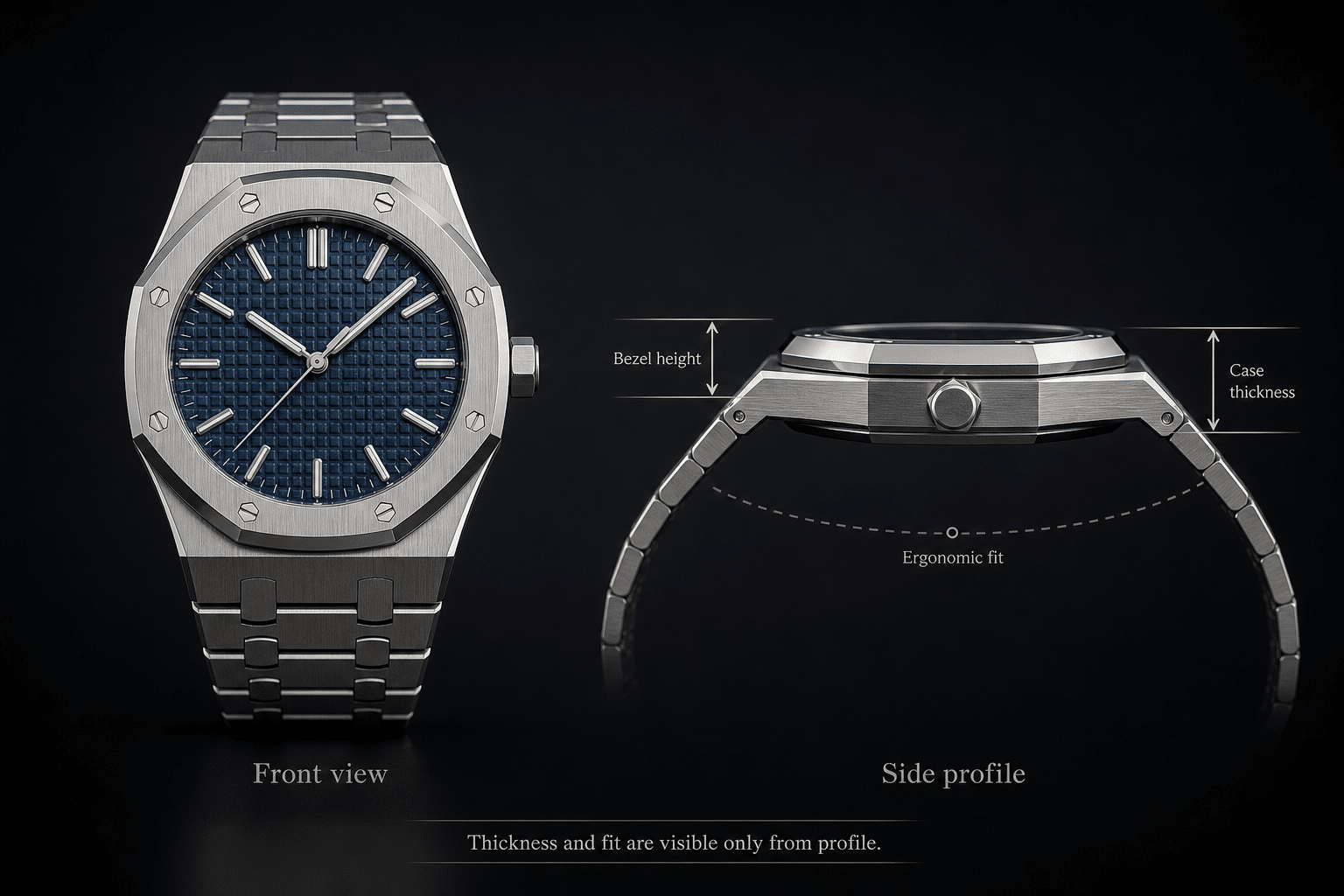
| Confirmed case thickness and side photo | Front photos can hide a tall or top-heavy case | No clean side-profile image |
| Bracelet drape, brushing, screws, and clasp | The Royal Oak design depends on bracelet feel | Stiff links, sharp edges, or loose clasp action |
| Movement route and expected behavior | Affects thickness, noise, date function, and service | No clear answer on clone-style vs Miyota-based build |
| Full QC photo set | Dial, date, bezel screws, caseback, clasp, and bracelet need checking | Only polished front shots or cropped angles |
| Water test and service parts availability | Claims need limits, method, and repair path | Promises like “waterproof” or unclear parts support |
Quick Questions Before You Read
Q: Is the factory name enough to choose an AP super clone?
No. The exact reference, version, batch, movement, and QC evidence matter more than a broad factory claim.
Q: What detail should be checked first on a Royal Oak-style replica?
Start with case thickness and a clear side-profile photo, because front photos often hide the biggest shape issues.
Q: Is a clone-style movement always the better choice?
Not always. It may improve appearance and proportions, but it can be harder to service than simpler movement routes.
Q: Should water-resistance claims be trusted?
Only if the exact watch has a stated pressure-test method and result, and even then it should be treated with limits.
Editorial Perspective: For AP-style super clone watches, cleanvsfactory.com treats the pre-order stage as a technical fit question, not a factory-ranking contest. A factory name, QC photo set, or seller description can be useful, but none of them proves the whole watch. The more practical judgment is whether the exact reference, movement route, case profile, bracelet behavior, and service expectations match how the buyer plans to wear the watch. A Royal Oak replica that photographs well may still be a poor daily choice if it is thick, stiff, noisy, difficult to size, or supported by vague movement claims.
Why Vague Answers Are Riskier With AP Super Clones
The first questions to ask before buying AP replica models are not about whether the watch is “the best” or whether it looks impressive in a front photo. The better starting point is whether the AP super clone can be described clearly: exact model style, factory version, movement route, case profile, bracelet build, and available QC evidence. If those basics are vague, the buyer is not really evaluating a watch. They are evaluating a claim.
This matters more with an Audemars Piguet replica watch than with many simpler round-case sports replicas. A Royal Oak replica is not forgiving. The octagonal bezel, flat case architecture, integrated bracelet, tapisserie-style dial, and display caseback all expose small compromises quickly. A watch can look strong in a straight-on dial photo and still wear too thick, feel stiff on the wrist, have a noisy movement, or show awkward bracelet articulation once handled.
Vague factory claims are not automatically dishonest, but they do increase buyer risk. “Top factory,” “latest version,” and “same quality” do not tell you whether the watch uses the correct movement route for that reference, whether the case thickness matches the claimed version, whether the bracelet has improved link finishing, or whether the actual batch has the update being advertised. The problem is not that every AP replica must be perfect. The problem is that vague answers prevent you from knowing which compromise you are accepting.
A buyer should also separate model difficulty from factory reputation. Some AP references are more forgiving because they use simpler time-and-date layouts, cleaner dial architecture, or a case thickness that can accommodate available replica movements more easily. Others are less forgiving because they involve ultra-thin proportions, skeletonized dials, chronograph layouts, open casebacks, or complicated pusher and subdial arrangements. A factory that performs well on a common Royal Oak time-and-date model may not carry the same strength into an Offshore chronograph or a Jumbo-style thin case.
Factory names in the replica watch market are useful buyer-facing references, but they should not be treated as official luxury-brand affiliations or automatic guarantees of quality across every model. For AP-style watches, the safer judgment is version-specific: a factory may be strong on one Royal Oak reference and weaker on another because case shape, bracelet construction, movement layout, dial execution, and finishing difficulty are not equally demanding across every model family.
Keep Replica and Genuine Reference Claims Separate
When a buyer compares an AP-style replica with a genuine Royal Oak or Offshore reference, the genuine watch should be used only as a design reference point. It does not prove that the replica has the same movement, finishing, water resistance, service support, case tolerances, or long-term durability. A replica-market watch may imitate the look of the original luxury watch, but it remains a replica product with different sourcing, assembly, and ownership risks.
This distinction is especially important when a specification from the authentic watch appears in a discussion. Genuine Audemars Piguet case dimensions, caliber names, water-resistance ratings, and finishing descriptions should not be automatically transferred to a super clone. The practical question is always what can be verified on the specific replica unit: its visible case profile, movement route, dial execution, bracelet construction, QC photos, and realistic service limits.
AP Replicas Can Look Better in Photos Than on the Wrist
Royal Oak-style watches are especially good at looking convincing from the front. The octagonal bezel, patterned dial, applied markers, and integrated bracelet shape create a strong first impression, even when the side profile or bracelet feel is less successful. A clean dial shot may hide the exact details that determine whether the watch feels credible in daily wear.
Case thickness is the biggest example. On a Royal Oak-style case, extra height does not disappear under the wrist the way it might on a thicker diver or chronograph. A slightly tall caseback, raised bezel, or bulky mid-case can make the watch feel top-heavy. The front may still look sharp, but the side view tells a different story.
The bracelet creates the same problem. A Royal Oak bracelet is not a normal bracelet attached to a case; it is part of the case design. If the first links are too stiff, the bracelet does not drape naturally. If the edges are rough, the watch feels cheaper immediately. If the clasp action is weak or the links squeak, no dial photo will reveal it. This is why asking “is this AP replica worth considering?” requires more than judging the best-looking picture.
Front photos also tend to hide caseback depth, bezel height, and the way the watch sits on the wrist. For AP super clones, the strongest visual angle is often not the most honest evaluation angle. A cautious buyer should treat front-facing photos as the beginning of the review, not the proof.
The First Goal Is Technical Clarity, Not Perfection
The goal before considering an AP super clone is not to find a flawless replica. That expectation usually leads to disappointment. The goal is to find out whether the version is documented clearly enough to deserve deeper evaluation. A clear answer gives you something to check. A vague answer asks you to trust a label.
For example, “latest Royal Oak” is not a useful answer by itself. Latest compared with what? A previous dial version? A bracelet update? A movement change? A corrected case thickness? A new clasp? Without that context, the word “latest” has very little buying value.
At Clean VS Factory, we usually treat AP evaluation as a version question before a beauty contest. A watch can look attractive in photos and still be the wrong choice if the movement route, case profile, and bracelet construction do not match the buyer’s expectations. The safer approach is to ask for specific, checkable details first, then decide whether the watch is worth more attention.
This article discusses replica watches as replicas. The purpose is not to help anyone represent a replica as genuine or misuse authentication language. The practical purpose is simpler: reduce the chance of choosing a watch based on weak claims, incomplete photos, or factory-name hype.
Match the Questions to Your Intended Use
Before judging any AP super clone, it helps to decide what kind of ownership you actually want. A watch chosen mainly for occasional photos has a different risk profile from a watch intended for regular office wear, travel, or daily rotation. For photo use, dial texture, bezel shape, hand alignment, and caseback appearance may matter most. For daily wear, bracelet comfort, case balance, clasp feel, movement noise, date behavior, and serviceability often become more important than small macro-level visual differences.
This distinction prevents a common beginner mistake: choosing the most visually impressive specification without asking whether it is the easiest watch to live with. A clone-style movement and display caseback may improve the appearance of a Royal Oak-style build, but if the movement is harder to service, louder than expected, or tied to a thicker caseback, it may not be the best choice for a buyer who wants a low-maintenance daily wearer. The most accurate-looking option is not always the most practical option.
Complicated AP-style replicas require even more caution. Chronographs, skeleton dials, openworked designs, and ultra-thin references give the buyer more details to admire, but they also add more points of failure and more areas where photos can mislead. For a first AP replica, a simpler time-and-date Royal Oak-style model may be easier to evaluate because the case, dial, bracelet, and movement behavior are more straightforward to check.
The Core Rule: Specific Questions Should Produce Specific Answers
The core rule is straightforward: specific questions should produce specific answers. If you ask what factory version the watch is, the answer should identify the model style, factory, batch or version, and relevant update points. If you ask about movement route, the answer should distinguish between a clone-style caliber and a Miyota-based build. If you ask about thickness, the answer should not drift back into “best quality.”
Clear technical answers do not guarantee a perfect watch, but they lower uncertainty. Vague praise does the opposite. The more an answer relies on broad language instead of model-linked detail, the more cautious the buyer should become.
The right question is not “what should I ask first?” in a generic sense. For AP, the first question is whether the watch can be identified precisely enough to evaluate. If the version cannot be explained, the rest of the claims become harder to trust.
Question Group 1: What Factory Version Is This AP Super Clone?
The first technical question should be: what factory version is this AP super clone? Not just “which factory,” and not just “is it the best one.” Factory identity only becomes useful when it is tied to the exact Royal Oak replica version, model reference style, movement route, and batch details. Without that connection, a factory name can create more confidence than the actual watch deserves.
This is especially true in the AP market because factory reputation is model-specific. APSF, ZF, APF, and other known names may be discussed by buyers in different AP families, but that does not mean one factory automatically wins every Royal Oak, Offshore, chronograph, or ultra-thin style build. A factory can be convincing on a 15500-style watch and less convincing on a different reference. A buyer who asks only “which Audemars Piguet replica factory is best?” may miss the more important question: which factory version is this exact watch?
Ask for the Exact Model, Reference Style, Factory, and Version
A useful question should combine the model family and the version claim. Instead of asking, “Is this the best AP?” ask something closer to: “Is this a Royal Oak 15400, 15500, or 15510-style build, which factory is it from, and what version or batch is being offered?” That wording forces the answer to become specific.
The difference matters because 15400, 15500, and 15510-style Royal Oak replicas are not the same evaluation. Dial layout, date position, marker spacing, case thickness, movement architecture, and bracelet execution can all vary. Offshore-style builds introduce another set of issues, especially with chronograph layout, case height, pushers, and rubber strap or bracelet integration.
The buyer should also ask what changed from the previous version. “Latest batch” is not a meaningful claim unless the update is named. A real version update might involve dial texture, blue dial tone, caseback depth, bracelet edge finishing, clasp engraving, movement route, or datewheel alignment. If no one can say what changed, the “latest” label may simply be a sales phrase.
Evidence Boundary for Factory Names
Factory names in replica-watch discussions should be treated as practical identifiers, not official verification. They can help organize comparisons, but they do not prove the movement inside a specific watch, the steel grade, the crystal quality, the water resistance, the batch date, or the finishing standard of the unit being evaluated. A careful buyer should therefore ask for factory-version claims to be paired with visible evidence: current QC photos, side-profile images, caseback views, bracelet details, and a movement-route explanation that matches the model.
This is also why “best factory” language should be narrowed before it becomes a decision. A more defensible question is not “Is APSF better than ZF?” in the abstract. It is “For this exact AP-style reference, which version is being offered, what are its known tradeoffs, and what evidence can be checked on this unit?” That framing keeps the discussion tied to the watch itself instead of turning informal reputation into a substitute for proof.
A factory comparison is most useful when it is tied to the specific reference, version, movement, and visible execution details rather than treated as a universal ranking. In practical terms, this means comparing the same model family, similar production period, same claimed movement route, and similar QC photo angles before drawing conclusions. Comparing a praised 15500-style build to a different Offshore chronograph or Jumbo-style thin case can create a false sense of certainty.
What a Clear Factory-Version Answer Looks Like
A clear answer identifies the watch in a way that can be checked. For example, it may state that the watch is a 15500-style Royal Oak from a specific factory, from a named version or current batch, with known updates to the dial texture, case profile, bracelet finishing, clasp, or movement route. It does not need to promise perfection. In fact, an answer that admits the known compromise is usually more useful than one that claims everything is identical.
Good version information should make comparison possible. If the answer tells you the exact model style, factory, version, and update points, you can compare photos, known batch notes, and expected specifications more intelligently. If the answer only says “top version,” you are left guessing whether you are looking at current production, older stock, a mixed-batch watch, or a model that does not match the description.
The movement claim should also match the version claim, even though movement details deserve their own deeper questions. If a version is being advertised as a higher-tier AP super clone, but the stated movement route does not match what that version is known for, that mismatch should slow the decision down. Factory, version, and movement should make sense together.
What a Vague Factory-Version Answer Suggests
Vague answers usually sound confident but avoid detail. “Top factory,” “best quality,” “newest,” “same as genuine,” or “highest version” are not enough by themselves. These phrases do not confirm the batch, the model reference style, the movement route, or the update history. They may be harmless shorthand, but they are not technical confirmation.
The biggest risk is comparing the wrong watch. A buyer may read praise for one factory’s 15500-style Royal Oak and assume it applies to a 15400, 15510, Jumbo-style 15202, or Offshore chronograph. That is a common mistake. AP replicas are too reference-sensitive for broad reputation to do all the work.
Another warning sign is an answer that avoids the version question entirely. If the response keeps returning to “best AP factory” without naming the actual version, the buyer has no stable basis for evaluation. In that situation, even attractive photos should be treated cautiously because the photos may not represent the exact production version being considered.
Version Details to Confirm
Before moving deeper into the evaluation, confirm the version details that affect the actual watch:
- Model style: Royal Oak 15400, 15500, 15510, Jumbo-style 15202, Offshore-style build, chronograph, diver, or another AP format.
- Factory identity: the specific Audemars Piguet replica factory being claimed, not just “top factory.”
- Version or batch: whether the watch is a named version, current batch, older batch, or unspecified production.
- Update points: what changed, such as dial color, tapisserie-style texture, case profile, bracelet finishing, clasp detail, or movement route.
- Claim consistency: whether the model, version, movement, and visible details all match the same story.
The clear judgment here is simple: do not treat the factory name as the decision. Treat factory identity as one piece of evidence that only becomes useful when connected to a specific AP model and version.
Factory Name Clarification: Factory names in the AP replica and super clone market are buyer-facing reference labels, not official Audemars Piguet affiliations or audited manufacturer identities. They can help organize comparisons, but buyers should still judge each watch by the exact reference style, version, batch, movement route, case profile, bracelet execution, and available QC evidence rather than assuming one factory name proves identical quality across every model.
Question Group 2: Is the Movement a Clone-Style Caliber or a Miyota-Based Build?
One of the most important AP replica movement questions is also one of the easiest to ask directly: “Is it a clone 4302 or Miyota-based build?” The exact caliber name may change depending on the model, but the purpose of the question stays the same. You are trying to identify the movement route, because that route can affect thickness, rotor noise, winding feel, date behavior, movement appearance, and future service expectations.
This is where many buyers oversimplify the decision. A clone-style movement is not automatically trouble-free, and a Miyota-based AP replica is not automatically a bad watch. The better question is whether the movement route fits the model and your tolerance. Some buyers value visual movement layout and correct case proportions. Others prefer a simpler, more familiar base movement even if the display caseback is less convincing or the rotor sound is more noticeable.
Ask for the Movement Type, Not Just the Factory Name
A factory label does not always answer what movement is inside a specific AP replica. Factories may update one model while leaving another on an older movement route. They may use clone-style calibers for certain Royal Oak references and Miyota-based builds for others. This is why movement should be asked separately from factory version.
For a 15500-style Royal Oak, a buyer may hear claims about a clone 4302 movement. For a 15400-style model, the discussion may involve a clone-style 3120 route. For some thinner or older-style builds, Miyota-based architecture with decorative plates may still appear. The specific claim needs to match the model being evaluated.
The practical question is not “what movement is best?” The practical question is: “What movement is inside this exact watch, and does it explain the case thickness, date behavior, rotor sound, and caseback appearance I should expect?” If the answer cannot connect those points, it is incomplete.
Clone-Style Movement Versus Miyota-Based Build
A clone-style AP movement route is usually chosen to support a more convincing architecture. It can help with visible movement layout, balance position, caseback appearance, and sometimes case thickness. On certain Royal Oak super clone watches, the movement route is part of why the watch sits closer to the expected profile. That can matter a lot, because AP case design is sensitive to extra height.
The tradeoff is complexity. Clone-style movements can be more model-specific, less familiar to local repair shops, and more dependent on parts availability, so an AP super clone checklist should weigh case, dial, bracelet, movement, and QC evidence together. They may look more correct through the display caseback, but that does not make them immune to dry assembly, rotor noise, date issues, or long-term service difficulty. A buyer should not treat “clone movement” as a magic phrase.
A Miyota-based AP replica usually takes a different path. Some mid-tier replicas are described as using a Miyota-style automatic base with decorative plates. That route may be easier for a buyer to understand from a service standpoint, but it often brings compromises: rotor whirring, different movement appearance, added plate thickness, and less convincing display caseback architecture. In some AP builds, the case may also become thicker or the visible movement layout may not match the genuine reference as closely.
The non-obvious point is that the “better” movement route depends on what would bother you more. If you care most about case profile and movement appearance, a mature clone-style route may be more sensible. If you care more about a familiar base movement and accept visual compromises, a Miyota-based build may be easier to live with. Neither route removes risk; they simply move the risk to different places.
Do Not Let a Caliber Name Replace Unit-Level Verification
Movement labels are especially easy to overread. A claim such as “clone 4302,” “clone 3120,” or “Miyota-based” may describe the intended architecture, but it does not prove the condition, lubrication, regulation, power reserve, assembly quality, or parts support of the specific watch. The buyer should ask for movement-side photos when relevant, but even a photo can only confirm visible layout and decoration. It cannot prove future reliability.
A safer way to phrase the question is: “What movement route is claimed for this exact unit, what visible signs support that claim, and what ownership behavior should I expect?” This keeps the answer grounded. It asks for both identification and consequences: rotor sound, case thickness, date behavior, winding feel, repair difficulty, and whether the movement choice creates any known compromise for that model style.
Movement trust in the replica market depends on understanding what the movement claim actually describes: architecture, decoration, layout, reliability expectation, or simply a market name used by sellers. A clone-style AP movement reference should not be read as an official Audemars Piguet caliber claim, and a decorated movement should not be confused with full architectural equivalence. The useful question is not whether the name sounds impressive, but whether the stated movement route explains the visible caseback, date behavior, thickness, rotor sound, and service risk of the exact watch.
Separate Movement Appearance From Movement Ownership
Movement decoration can be persuasive in AP-style replicas because many Royal Oak models use display casebacks. A bridge layout that looks closer at first glance may improve the watch visually, especially in photos. But appearance through the caseback should not be confused with movement health, lubrication quality, winding efficiency, or future parts support. A movement can look impressive and still have practical issues that only appear after regular wear.
For buyer decisions, it is useful to ask two separate questions: “Does the movement look appropriate for this model?” and “Is this movement route realistic for my ownership expectations?” The first question concerns visual accuracy. The second concerns serviceability, noise, date behavior, and repair options. Many beginner buyers focus only on the first question because it is easier to judge from photos, but the second question usually affects satisfaction more over time.
Movement Claims That Need Careful Verification
Power reserve claims should be treated carefully. A stated long reserve does not mean every unit will deliver that number in real daily use. Assembly condition, lubrication, winding efficiency, and movement variation can all affect performance. If the answer gives a power reserve claim without any restraint, it should be read as an estimate, not a guarantee.
Rotor sound is another area where wording matters. “Quiet movement” can mean almost anything. A Miyota-based build may have the familiar free-spinning rotor noise. A clone-style movement can still have rotor sound if the assembly, bearing, or case acoustics are not ideal. Ask what rotor behavior is normal for that movement route rather than expecting silence.
Winding feel and date behavior also deserve attention. Some buyers notice rough winding, weak crown feel, delayed date change, or inconsistent quickset behavior more than they expected. These details are not always visible in photos, but they affect daily ownership. A technically useful answer should explain whether the date change is expected to be instant or gradual, whether the hand stack matches the model, and whether the beat rate is consistent with the claimed movement style where relevant.
Claims such as “same movement layout” should be interpreted narrowly. It may mean the bridge layout looks similar through the caseback. It does not mean the finishing, tolerances, parts quality, service access, or long-term reliability are the same as the genuine AP caliber. That distinction is important because AP replicas with display casebacks invite buyers to overvalue movement decoration while underestimating ownership risk.
Movement Route to Verify
Before accepting a movement claim, confirm these points:
- Claimed caliber style: whether the watch is described as a clone-style 4302, clone-style 3120, Miyota-based build, or another route appropriate to the model.
- Visible movement layout: whether the bridge shape, rotor style, balance position, and caseback view are consistent with the claimed version.
- Case thickness connection: whether the movement route helps explain the stated case profile or creates extra height.
- Date behavior: whether date setting and date change behavior are described clearly for the movement used.
- Rotor sound expectations: whether some rotor noise is normal for the route rather than being dismissed with “silent” or “no problem.”
- Service expectation: whether the movement is likely to be more familiar to repair or more model-specific and harder to support.
Movement photos can help confirm layout and decoration, but they cannot prove long-term reliability, lubrication quality, or future parts availability. The correct buyer judgment is to use movement information to set expectations, not to assume that a more impressive movement description automatically creates a safer watch.
Movement Transparency Note: Movement references in this article describe replica-market movement routes or configurations, not official Audemars Piguet calibers or brand-manufactured movements. Buyers should check whether the claimed movement type matches the exact AP-style reference, case thickness, caseback view, date behavior, rotor sound expectations, and realistic service options for that specific unit.
Question Group 3: Can the Case Thickness and Side Profile Be Confirmed?
The most useful question here is simple: Can the case thickness be confirmed? For an AP super clone, especially a Royal Oak replica, this is not a minor spec-sheet detail. The Royal Oak design depends on a flat, low, angular profile. If the case is too tall, the watch may still look attractive from the front, but it can wear top-heavy, sit awkwardly above the wrist, and lose the thin architectural feel that makes the design work.
This is where many buyers misjudge AP replicas. A straight dial photo can show the tapisserie-style dial, logo placement, hands, and bezel shape, but it hides the most important physical question: does the watch have the right side presence? AP replica case thickness is often influenced by the movement route, caseback construction, bezel height, and how the bracelet leaves the case. A thicker case is not always a sign of sloppy assembly, but it is still a tradeoff the buyer should understand before getting attached to the watch.
Ask for a Side-Profile View, Not Only a Dial Shot
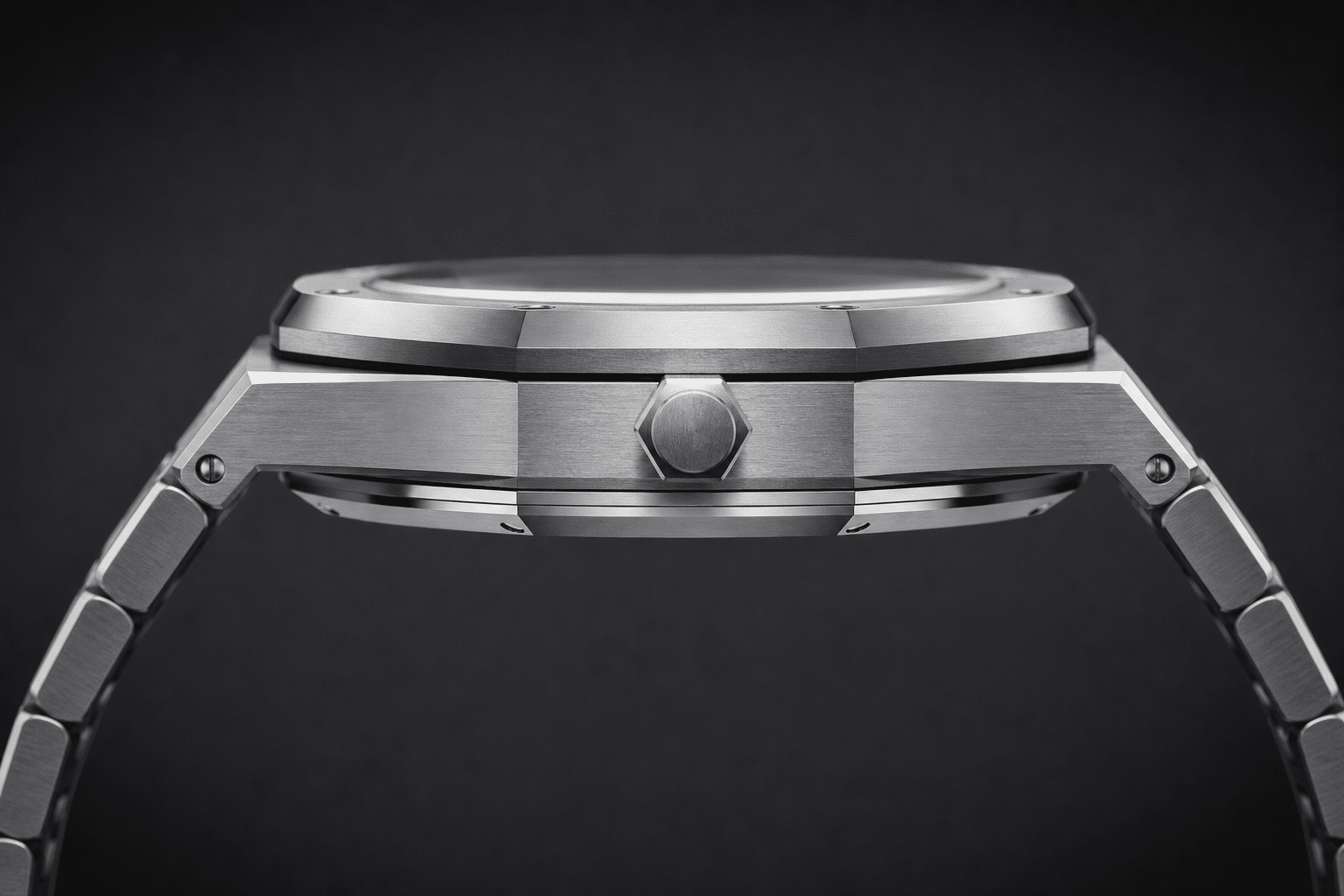
A proper side-profile photo tells you things a front photo cannot. It shows bezel height, mid-case shape, caseback depth, crystal rise, and whether the watch looks flat or stacked. On a Royal Oak-style design, those details matter more than many buyers expect because the watch is basically a thin geometric object wrapped around the wrist. Add too much height, and the whole personality changes.
The question should be direct: Can I see the side profile, including the bezel, caseback, and first bracelet link? A useful image should not be taken from an exaggerated low angle or a dramatic wrist shot. The best view is a clean side photo where the case, bezel, caseback, and bracelet transition can be seen together. If only front-facing beauty photos are available, the buyer is being asked to judge a three-dimensional watch from a two-dimensional angle.
Pay close attention to the caseback. Some AP super clone watches look reasonably slim from the bezel side but gain extra height through a deeper display back. That extra depth can make the watch sit higher than expected even if the dial side looks convincing. The practical issue is not whether the measurement sounds close on paper; it is whether the watch wears balanced from the side.
Why Thin AP Designs Are Harder to Replicate
The Royal Oak is less forgiving than many round sports watches because its case is broad, flat, and visually continuous with the bracelet. A Submariner-style case can hide some vertical mass behind curved flanks and thicker lugs. A Royal Oak cannot hide height as easily. The flat bezel, sharp mid-case, and integrated bracelet make extra thickness visible almost immediately from the side.
This is especially important on thinner Royal Oak references and Jumbo-style designs. The closer the original concept is to an ultra-thin luxury sports watch, the harder it becomes for a replica movement and case construction to preserve the right proportions. A movement that is acceptable in a thicker watch may force compromises in a thin AP design. That is why “does it use a good movement?” is not enough. The movement has to support the case profile, not fight it.
For daily wear, this matters more than a small dial-printing difference. A slightly imperfect printed detail may only bother you under macro photos. A thick or top-heavy case affects comfort every time the watch is on the wrist. If the side profile is wrong, the watch can feel more like an AP-inspired object than a convincing Royal Oak-style daily wearer.
What a Clear Case-Thickness Answer Looks Like
A clear answer should connect the measurement to the exact version being evaluated. “It is thin” is not useful. “Latest case” is not enough. A better answer includes a stated thickness measurement where available, side-profile photos, and confirmation that the measurement applies to the same model, factory version, and movement route being discussed.
The best wording to use is: Can the case thickness be confirmed for this exact version, and can I see a side-profile photo? If the response gives a number but no photo, the buyer still has only partial information. If the response gives photos but no measurement, the buyer can still judge wrist presence, but not dimensional accuracy. The strongest answer gives both.
Do not treat a missing thickness number as automatic rejection in every case, because some current batches are not always documented with reliable public measurements. But missing side-profile evidence should slow the decision down. With AP replicas, the case is too central to the design to evaluate blindly.
Case and Profile Checks
- Bezel height: Check whether the bezel looks thin and integrated or tall and blocky. A high bezel can make the whole watch look heavier than the front photo suggests.
- Mid-case shape: The case side should look controlled and architectural, not swollen. Rounded or overly thick sides weaken the Royal Oak replica case profile.
- Caseback protrusion: A deep caseback can make the watch sit high even if the upper case looks acceptable.
- Lug-to-bracelet transition: The first bracelet link should leave the case naturally. If the transition drops awkwardly or looks rigid, the watch may not sit well on the wrist.
- Top-heavy appearance: From the side, the watch should look balanced. If most of the visual mass sits above the bracelet line, expect a less elegant wearing experience.
The practical judgment is this: for a Royal Oak replica, side profile is not a secondary check. It is one of the fastest ways to separate a watch that only photographs well from one that may actually work on the wrist.
Question Group 4: How Is the Bracelet Constructed and Finished?
AP replica bracelet quality is not an accessory issue. On a Royal Oak replica bracelet, the bracelet is part of the case architecture. It defines how the watch sits, how it catches light, and whether it feels refined or crude in daily use. A convincing dial cannot rescue a bracelet that is stiff, sharp, loose, or poorly finished.
This is one of the main reasons AP super clones need more cautious questioning than simpler watches on straps. The Royal Oak bracelet has many small surfaces, alternating brushed and polished transitions, tight link gaps, and a clasp that must feel secure without being clumsy. Photos can show some finishing quality, but they rarely tell the full story of articulation, edge comfort, screw fit, or clasp action.
Ask About Link Articulation and Wrist Drape
The first bracelet question should be practical: Does the bracelet drape properly, or does it feel stiff? A Royal Oak-style bracelet should curve around the wrist with controlled flexibility. If the links are too rigid, the case can feel larger and flatter than the dimensions suggest. If the links are too loose, the watch may feel less solid and show uneven gaps.
This matters because AP’s integrated bracelet does not behave like a standard Oyster-style bracelet or a leather strap. There is less room to hide poor articulation. The first links leaving the case strongly affect comfort, especially on smaller or flatter wrists. A watch with an acceptable case size can still wear poorly if the bracelet does not wrap naturally.
Do not judge drape only from a watch lying flat on a table. A bracelet can look neat when straight but feel awkward once curved. If possible, ask whether the bracelet has any noticeable stiffness near the first links, whether the links move smoothly, and whether the bracelet sits naturally rather than forcing the case to hover.
Ask About Brushing, Bevels, and Edge Comfort
Royal Oak-style finishing is difficult because the bracelet uses many small planes. The brushed surfaces need to look even, and the polished bevels need to follow the links cleanly. Poor finishing usually appears in two ways: blurry transitions that make the bracelet look soft, or sharp unfinished edges that make it uncomfortable.
The key question is not “is the bracelet perfect?” A better question is: Are the brushed surfaces even, are the polished bevels consistent, and are the edges comfortable? This pushes the answer toward specific bracelet behavior instead of vague praise. A bracelet can look shiny in photos but still feel rough along the underside or link edges.
Edge comfort is underrated. Some buyers obsess over dial texture while ignoring the part of the watch that touches the wrist all day. Slightly imperfect brushing may be tolerable. Sharp edges that scrape the wrist or catch hair become annoying quickly. For daily wear, comfort should rank above macro-level finishing perfection.
Ask About Clasp Fit and Bracelet Adjustment
The clasp should close cleanly, hold securely, and not feel hollow or hesitant. Ask: How is the clasp quality, and does it snap shut firmly? A weak clasp action does not always mean the watch is unusable, but it changes the ownership experience. The bracelet may look like an AP from the top and still feel less convincing every time it is opened or closed.
Bracelet adjustment also deserves attention. Royal Oak-style bracelets typically rely on small screws, and screw quality matters. Poorly cut screws can strip, sit unevenly, or make sizing frustrating. Buyers should ask whether the bracelet uses screws, whether the screws sit flush, and whether the bracelet has enough removable links for the intended wrist size.
There is also a fit issue that buyers often miss: AP-style bracelets do not offer the same easy micro-adjustment flexibility as some mainstream sports watches. If the bracelet sizing lands between comfortable positions, the watch may feel slightly too tight or slightly too loose. That is not always a defect, but it is worth understanding before choosing a Royal Oak-style model for everyday wear.
Bracelet Details That Photos May Not Reveal
- Tactile feel: Photos can show brushing, but they cannot show whether the underside feels smooth or sharp.
- Link stiffness: A bracelet may look aligned but still resist natural wrist curvature.
- Looseness and gaps: Small gap variation may be visible in photos, but loose-feeling links are often only obvious in handling.
- Clasp snap: A clasp can look correct but close weakly or feel rough.
- Screw fit: Uneven or soft screws can create sizing and long-term maintenance issues.
- Squeaks or friction: These are daily-use annoyances that photos almost never reveal.
The clear judgment is that bracelet construction should be treated as a first-tier AP super clone evaluation point. If the bracelet is stiff, sharp, or poorly fitted, the watch will disappoint faster than a dial flaw that only appears under magnification.
Question Group 5: What QC Photos and Details Will Be Available?
Royal Oak replica QC questions should be specific because AP-style watches expose flaws quickly. The bezel is geometric, the screws are prominent, the dial has a repeating pattern, the case has sharp edges, and the bracelet is visually integrated. A single front photo under flattering light is not enough evidence to judge an AP super clone with confidence.
QC photos do not guarantee a perfect watch. They can be affected by camera angle, lens distortion, lighting, and reflection. But useful AP replica QC photos can reveal obvious alignment issues, uneven finishing, date problems, bezel screw irregularities, and whether the side profile matches the claim. If relevant QC details are not available, that is not a small inconvenience. It increases uncertainty in exactly the areas where AP replicas are most sensitive.
Before making a decision, buyers should review real QC photos where available, including dial printing, hand alignment, bezel screw position, datewheel centering, bracelet fit, clasp engraving, case thickness, caseback depth, and overall finishing. Factory labels and stock photos alone are not enough for a reliable judgment, especially on AP-style watches where the side profile and bracelet structure strongly affect the final impression.
Ask for Straight Dial Photos Under Neutral Lighting
The first QC request should be a straight-on dial photo under neutral lighting. This helps check marker alignment, hand alignment, logo placement, printed text clarity, date window position, and the overall impression of the tapisserie-style dial. The camera should be as level as possible because even a slight angle can make markers or the date window appear worse than they are.
For AP dials, alignment matters because the repeating square pattern gives your eye a grid. A marker that might be less obvious on another watch can stand out more against a structured Royal Oak-style dial. The date window is another important check. If the date sits too high, too low, or too far to one side, it will be visible every time the watch is worn.
Do not overreact to one distorted image. A slightly tilted camera can make the logo or markers look misaligned. The better approach is to ask for a clean, centered dial photo and, if needed, a second angle to confirm whether the issue is real or caused by perspective.
Ask for Bezel, Screw, and Case Edge Views
The Royal Oak bezel makes flaws easy to see because the octagonal shape is unforgiving. Ask for close views of the bezel, screw positions, brushing direction, polished bevels, and case edges. The question can be simple: Are the bezel screws even, and can the case edges be shown clearly?
Bezel screw alignment should be judged with restraint. Some variation can appear worse because of lighting or angle, and replica construction does not always reproduce the original AP screw system exactly. Still, uneven seating, visibly crooked screw heads, damaged slots, or inconsistent finishing are warning signs. The bezel is one of the first things people notice on a Royal Oak-style watch, so poor execution here affects the whole impression.
Case edge views also matter because AP replicas rely heavily on brushing and bevel transitions. Rounded edges, uneven brushing, or rough polished bevels can make the watch feel cheaper than the dial photo suggests. This is a good example of why QC should not focus only on the dial.
Ask for Bracelet, Clasp, and Side-Profile Photos
AP replica QC photos should include the bracelet and clasp, not just the watch head. Ask for bracelet fit, first-link transition, clasp view, and side-profile photos. These images help connect visual accuracy with wearability. A watch that looks strong from the front may still have a tall caseback, stiff bracelet transition, or clasp finishing that lowers confidence.
The side-profile photo is especially useful because it confirms several earlier claims at once: case thickness, bezel height, caseback depth, and how the bracelet leaves the case. If a watch is being described as a slim or well-proportioned AP super clone, the side view is the evidence that supports or challenges that claim.
The clasp view is not just decorative. It can reveal rough engraving, poor finishing, uneven closure, or signs that the bracelet construction is weaker than the watch head. For daily wear, clasp feel and bracelet comfort are not minor details.
What QC Photos Can Show and What They Cannot Prove
QC photos are useful evidence, but they are not final proof of the whole ownership experience. They can show visible alignment, case shape, dial condition, date centering, bracelet gaps, and obvious finishing problems. They cannot reliably show rotor noise, winding smoothness, actual power reserve, gasket condition, long-term bracelet comfort, or whether a movement has been properly lubricated.
This is why QC should be treated as one part of the decision rather than a guarantee. A clean QC set can reduce visible risk, but a buyer should still judge the movement route, service limits, and water-resistance claims separately. The safest pre-order evaluation combines photo evidence with technical questions instead of letting attractive photos replace the rest of the checklist.
QC Details That Should Not Be Skipped
- Front dial photo: Check marker alignment, logo placement, hand position, printed text, and dial pattern impression.
- Date window close-up: Check date centering and whether the font sits cleanly inside the window.
- Bezel and screw view: Check screw seating, bezel brushing, polished bevels, and visible case edge quality.
- Side profile: Check case thickness, bezel height, caseback depth, and whether the watch looks top-heavy.
- Bracelet fit: Check first-link transition, link gaps, and whether the bracelet appears naturally integrated with the case.
- Clasp photo: Check clasp finishing, engraving impression, closure alignment, and visible roughness.
- Caseback view: Check caseback depth, engraving quality, and whether the visible movement route appears consistent with the claimed version where relevant.
The strongest QC package does not need to be theatrical. It needs to be useful. Clear photos of the dial, bezel, side profile, bracelet, clasp, caseback, and date window reduce uncertainty. Refusal to provide those views, or replacing them with broad claims like “best quality” or “no flaws,” should make a careful buyer slow down.
Question Group 6: What Water-Resistance Testing Is Claimed, and What Does It Actually Mean?
AP replica water resistance is one of the easiest areas for buyers to misunderstand because the Royal Oak and Offshore look like luxury sports watches. That shape creates a false sense of confidence. A screw-down crown, a solid-looking caseback, and a sporty design do not automatically make an AP super clone safe for swimming, showering, or repeated water exposure.
The safer question is not “Is it waterproof?” The better question is: “Has this exact watch been pressure tested, and what was the result?” That wording matters because many water-resistance claims are assumptions based on the model design, not evidence from the actual watch being evaluated.
Ask Whether a Pressure Test Was Actually Performed
A useful answer should separate a real AP super clone water test from a general claim, because any best Audemars Piguet super clone assessment still needs measured resistance rather than vague wording. “It has gaskets” is not the same as “this piece was pressure tested.” “Factory says water resistant” is not the same as a measured result. The first describes intent; the second gives at least some evidence.
A clear answer should tell you what kind of pressure test was performed, what result was reached, and whether the test applies to the specific watch being considered. A dry pressure test, a wet pressure test, and a casual water check are not equal. If the answer does not identify the test type or result, treat the claim as incomplete.
For an AP-style replica, this matters because several sealing points can vary from unit to unit: crown seal, caseback seal, crystal gasket, pusher seals on chronograph or Offshore-style models, and the way the case was assembled after any handling. Even if the design has the right components, one poorly seated gasket can change the risk profile completely.
Ask What the Test Result Means in Real Use
A limited test result should not be translated into unlimited water confidence. Passing a basic pressure check may suggest the case is sealed at the time of testing, but it does not prove the watch is suitable for swimming, hot showers, soap exposure, repeated crown use, or long-term moisture resistance.
This is especially important with AP replicas because the watch is often chosen for daily wear, not for actual sport use. Sweat, rain, and accidental splashes are different from submersion. Heat, soap, and moving water can stress seals in ways a simple static test may not fully represent. A cautious buyer should treat water resistance as incidental protection, not a feature to rely on unless the watch has been independently checked and the owner accepts the remaining risk.
Offshore-style models create an additional trap. The genuine watch may have strong water-resistance specifications, but a replica version should not inherit that confidence automatically. Pushers, crowns, caseback construction, and assembly consistency are all practical weak points. If the watch has chronograph pushers, the question should become stricter, not more relaxed.
Keep Genuine-Watch Specifications Separate From Replica Claims
One of the most important evidence rules is simple: an authentic Audemars Piguet specification does not prove the same performance in a replica. The genuine model may have an official case construction, water-resistance rating, movement caliber, finishing standard, and service network, but those facts do not automatically transfer to an imitation watch. When evaluating an AP-style super clone, ask what has been verified on the replica unit itself.
This distinction is especially important for water resistance and movement performance. A replica may visually follow the design language of a Royal Oak or Offshore model, but its gasket fit, crown tube, pusher sealing, caseback assembly, and movement finishing depend on the replica build. For buyer safety, genuine-brand specifications should be treated as context for the design being imitated, not evidence that the replica has the same durability or service support.
Vague Water-Resistance Answers to Treat Carefully
Phrases like “waterproof,” “same as original,” “no problem in water,” or “you can swim with it” should be treated as weak answers unless supported by a specific test result. The problem is not only that the wording is too confident. The problem is that it gives the buyer no way to judge the actual moisture risk.
A more credible answer sounds less dramatic. It may say the watch passed a certain pressure test, but that water exposure should still be avoided or treated conservatively. That kind of answer is less exciting, but more useful. In replica watches, responsible water-resistance guidance should reduce risk, not encourage careless use.
At Clean VS Factory, we usually treat water-resistance claims as a separate technical question, not as part of general watch quality. A strong dial, good bracelet, and correct case profile do not prove the crown seal or caseback seal is dependable. Water damage can turn a visually excellent AP replica into a movement problem very quickly.
Water-Risk Questions to Ask Before Relying on the Watch
- Was this exact watch pressure tested, or is water resistance only assumed?
- What type of test was performed, and what result was recorded?
- Were the crown, caseback, crystal gasket, and any pushers checked as sealing points?
- Does the answer distinguish splash resistance from swimming or showering?
- Has the caseback been opened after testing, which could affect the seal?
- Should the watch be independently checked before any water exposure?
The practical judgment is simple: unless water resistance is clearly tested and independently trusted, assume the AP super clone should be protected from water. That does not mean every watch will fail near moisture. It means the cost of being wrong is high, and vague claims are not enough evidence to justify the risk.
Question Group 7: What Are the After-Sales and Service Limits?
AP replica serviceability should be considered before the watch is chosen, not only after something goes wrong. Royal Oak-style replicas are not simple disposable objects if they use clone-style movements, integrated bracelets, display casebacks, decorated bridges, small screws, and shaped case components. The more technically impressive the build is, the more important it becomes to ask what can realistically be maintained, adjusted, or replaced.
This is not about promises. It is about understanding AP super clone ownership risk. A buyer who expects genuine-level parts support, easy local repair, and unlimited replacement components is setting up for disappointment. A buyer who knows which parts are common wear points can make a more realistic decision.
A replica watch should be evaluated with realistic ownership expectations. Even a strong AP-style super clone can have limits in water resistance, long-term movement stability, servicing convenience, bracelet adjustment, and close inspection compared with a genuine reference. Buyers should confirm return, repair, shipping, and after-sales terms before ordering, because these terms can vary and should not be assumed from the watch specification alone.
Ask What Parts Are Realistically Replaceable
The first service question should be specific: “Which parts can realistically be replaced if they wear, fail, or arrive with issues?” On an AP-style replica, the answer should not stop at the movement. Bracelet links, bracelet screws, clasp components, crown, gaskets, crystal, hands, datewheel, rotor, and caseback screws can all affect ownership.
The Royal Oak bracelet deserves special attention. It uses many small fitted components, and sizing or adjustment depends on screw condition and link tolerance. A stripped bracelet screw, damaged clasp, or poorly fitted link can be more annoying in daily wear than a tiny dial flaw. If extra links, screws, or clasp parts are not realistically available, the buyer should know that before choosing the watch.
Gaskets are another overlooked item. Even if water exposure is avoided, gasket condition affects dust and moisture protection over time. If the caseback is opened for inspection or movement work, the gasket may need attention. A buyer should not assume that every watchmaker will have correct AP-style replica gaskets or crown components available.
Ask How Movement Issues Are Usually Handled
Movement route changes service expectations. A Miyota-based AP replica may be less visually accurate through the caseback, but its base architecture can be more familiar to independent repairers. A clone-style AP caliber may look more convincing and support better case proportions, but servicing can become more dependent on specific parts, movement knowledge, and factory-version compatibility.
That does not mean clone-style movements should be avoided. In many Royal Oak references, the better movement route is exactly what allows the case thickness, balance position, and display appearance to make sense. The tradeoff is that visual and dimensional accuracy may come with higher repair uncertainty.
Ask practical movement questions before deciding:
- What movement route is inside this exact version?
- If the rotor becomes noisy, loose, or inefficient, can it be adjusted or replaced?
- If the date change sticks or misaligns, is that usually repairable?
- Are movement parts commonly available, or would the solution likely require a donor movement?
- Can a local watch repairer reasonably work on this movement, or is it a more specialized clone-style caliber?
The strongest warning sign is a vague answer that treats all movements as equally easy to service. They are not. A decorated Miyota-based build, a clone 3120-style movement, a clone 4302-style movement, and a chronograph movement do not create the same repair path.
Ask What Problems Are Considered Normal Ownership Risk
Some issues should be considered normal risk rather than shocking failure. Slight rotor sound, minor bracelet stiffness, small finishing variation, imperfect clasp feel, modest lume performance, and conservative water-resistance confidence are all common realities in AP replicas. The buyer’s decision should depend on whether those risks are acceptable for the price and model type.
Rotor noise is a good example. A Miyota-based build may produce more noticeable rotor sound because of the winding architecture. A clone-style movement may be quieter in some versions, but it is not automatically silent or maintenance-free. If a buyer is highly sensitive to movement noise, that should be clarified before choosing the model, not discovered after wearing it at a desk.
Bracelet feel is another area where expectations need to be realistic. A Royal Oak replica bracelet can look excellent in photos but still have slightly sharp edges, tighter links, or less fluid drape than the genuine watch. Minor stiffness may improve with wear; rough edges or poor screw fit are more serious. The distinction matters because one is tolerable ownership character, while the other may become a daily irritation.
Chronograph and complication-style AP replicas deserve the most caution. A more complex layout may look more impressive, but extra functions usually mean more service questions. If the buyer wants the lowest ownership risk, a simpler time-and-date Royal Oak-style model is usually the more rational choice than a complicated chronograph chosen only for visual impact.
Service-Limit Questions That Reduce Surprises
- Can bracelet screws, spare links, and clasp parts be replaced if needed?
- Can the crown, crystal, caseback gasket, or other sealing parts be serviced?
- What movement route is used, and how serviceable is it in practice?
- If the rotor becomes noisy or the date mechanism has issues, what is the realistic repair path?
- Are movement parts available individually, or would repair likely depend on replacing a larger module or donor movement?
- Which minor issues should be considered normal variation rather than defects?
The buyer-first judgment is this: do not choose the most visually ambitious AP super clone unless you are comfortable with its service limits. A simpler and slightly less dramatic build may be the better daily-wear decision if parts, adjustment, and movement support are easier to understand.
How to Judge Clear Answers Versus Vague Answers
The purpose of AP replica buying questions is not to chase a perfect answer. It is to separate a watch that can be evaluated from a watch hidden behind broad claims. Clear answers reduce uncertainty because they connect the claim to the exact model, factory version, movement route, and evidence. Vague answers increase uncertainty because they ask the buyer to trust praise instead of information.
This matters more with AP super clone evaluation than with many simpler replica watches. A Royal Oak-style watch can look strong in one front photo while still having a questionable movement route, thick case profile, stiff bracelet, weak clasp feel, unsupported water-resistance claim, or unclear service path. The answer quality tells you whether the watch is being presented as a specific version or just as a sales label.
Clear Answers Name the Model, Version, Movement, and Evidence
A useful answer sounds specific. For example: “APSF 15510 current batch with clone-style 4302 route, updated dial color, current bracelet finish, side-profile photos available, pressure test not assumed unless checked separately.” That answer is not claiming perfection. It gives the buyer something to verify.
A clear answer usually includes several pieces of information:
- Exact model or reference style: 15400, 15500, 15510, 15202, Offshore, chronograph, diver, or another AP-style build.
- Factory and version: not just the factory name, but the batch or update point where possible.
- Movement route: clone-style caliber, Miyota-based build, decorated movement, or chronograph movement route.
- Physical evidence: QC photos, side-profile images, date window view, bracelet and clasp photos, or movement-side evidence when relevant.
- Limits: cautious language around water resistance, power reserve, serviceability, and long-term wear.
The best answers are not the loudest. They are the ones that make the watch easier to judge. If the answer admits a limitation, that can actually improve confidence because it shows the claim is not being inflated.
Vague Answers Depend on Praise Instead of Detail
Vague answers usually rely on words that sound strong but do not help evaluation. “Top quality,” “best factory,” “perfect,” “waterproof,” “same as genuine,” and “latest version” are not meaningful unless they are attached to specific details.
“Best AP” is too broad because AP replicas vary sharply by model family. A factory that is strong on a 15500-style Royal Oak may not be equally convincing on a 15202-style ultra-thin model, Offshore chronograph, skeleton dial, or complicated reference. The factory name is useful, but it is not the full decision.
“Same as genuine” is a warning phrase because it skips the real comparison. A responsible AP replica discussion should still allow for differences in tapisserie depth, movement finishing, bezel screw execution, bracelet finishing, water confidence, and serviceability. If the answer removes all tradeoffs, it usually removes the buyer’s ability to judge risk.
Incomplete Answers Should Slow the Decision Down
An incomplete answer is not always an automatic rejection. Sometimes the missing detail can be clarified with better photos, a movement confirmation, a side-profile view, or a more specific version description. But missing information should slow the decision down, especially if the watch already looks emotionally appealing.
The most common mistake is letting a beautiful dial photo override missing technical confirmation. For an AP super clone, the front view is only one part of the decision. If the movement route is unclear, the case thickness is unconfirmed, the bracelet construction is not discussed, and water resistance is described only with vague confidence, the buyer does not yet have enough information.
Think of incomplete answers as risk markers. One missing detail may be manageable. Several missing details together suggest the watch is being evaluated on appearance alone. That is where many disappointing AP replica purchases begin.
Claims That Should Be Softened Before You Trust Them
Some answers sound convincing because they use absolute language. In practice, those answers should be softened into checkable claims. “Identical to genuine” should become “visually close in some areas, but still different in movement behavior, finishing, serviceability, and status.” “Waterproof” should become “water resistance is unverified unless this exact unit has been pressure-tested.” “Best factory” should become “often preferred by some buyers for this model, but still dependent on batch, QC, movement route, and personal tolerance.”
This kind of wording is not pessimistic. It is more accurate. A buyer does not need every AP-style replica claim to be proven to a laboratory standard, but the decision should not depend on language that removes all uncertainty. The more absolute the claim, the more evidence the buyer should ask for before treating it as meaningful.
Avoid Questions That Encourage Misrepresentation
Some questions may sound common in replica-watch discussions but lead the evaluation in the wrong direction. Asking whether a replica can “pass authentication,” “fool experts,” or “be accepted as genuine” is not a useful ownership question and should not guide a purchase decision. A strong super clone may look convincing in casual wear, but close inspection can still reveal differences in finishing, movement architecture, bracelet feel, dial details, service compatibility, or construction.
The safer and more responsible questions are about visible quality, comfort, movement behavior, and risk. Ask whether the bezel screws are seated cleanly, whether the bracelet drapes well, whether the movement route matches the claimed version, whether the side profile is acceptable, and whether water-resistance claims are supported by testing. The purpose of factory and movement information is to understand tradeoffs and avoid overpaying for vague claims, not to represent a replica watch as genuine.
Red Flags Before You Decide
- Unclear version identity: the answer says “latest” but does not explain what changed.
- Inconsistent movement claims: the described movement route does not match the case thickness, display layout, or model type.
- No side-profile evidence: especially risky for Royal Oak-style watches where thickness and caseback depth matter.
- Unsupported water claims: terms like “waterproof” or “safe to swim” without a specific test result.
- Refusal to provide useful QC details: especially dial, date, bezel screws, bracelet, clasp, caseback, and side profile.
- Factory praise without model detail: the answer depends only on reputation rather than the exact AP replica being evaluated.
- No realistic service discussion: no answer on bracelet screws, movement issues, rotor noise, gaskets, or replacement-part limits.
The practical decision filter is straightforward: clear, specific, evidence-backed answers reduce uncertainty; vague claims make the buyer carry the risk. If the answer cannot identify the version, movement route, case profile, QC evidence, water-test meaning, and service limits with reasonable clarity, the watch may still look attractive, but it is not yet well documented enough to judge confidently.
A Practical Pre-Order Question Checklist for AP Super Clones
An AP super clone should not be evaluated only by the first attractive dial photo. The safer approach is to ask a short set of technical questions that force the important details into the open: factory version, movement route, case thickness, bracelet construction, QC photos, water-resistance test claims, and service limits. This AP replica checklist is not about finding a perfect watch. It is about deciding whether the watch is documented clearly enough to be worth serious consideration.
The most useful questions to ask before buying an AP replica are the ones that connect the claim to the exact watch in front of you. “Is this the best version?” is too soft. “Is this an APSF 15500 V3 with a clone-style 4302 route, and can the case thickness and side profile be confirmed?” is much harder to answer vaguely. That difference matters because Royal Oak-style replicas can hide their biggest compromises in the areas photos often skip.
CleanVSFactory’s editorial approach is to make replica watch decisions more traceable by connecting factory claims to visible details, movement behavior, version differences, and practical QC checks. For AP-style watches, that means asking whether the reference, batch, movement route, case profile, bracelet construction, and water-risk language all tell the same story before treating any factory name or specification as meaningful.
Factory and Version Questions
Start with identity before judging quality. Factory reputation only helps if it is tied to a specific AP model, reference style, version, and batch. A factory can be strong on one Royal Oak reference and less convincing on another, especially when the movement route, dial update, bracelet finishing, or case profile changes between versions.
- What exact AP model or reference style is being evaluated? A 15400, 15500, 15510, 15202-style Jumbo, Offshore Diver, and Offshore chronograph do not carry the same replication difficulty.
- Which factory version is it? Ask for the factory name and version or batch description, not just “top factory” or “latest.”
- What changed from the earlier version? A meaningful answer should mention something concrete, such as dial texture, case thickness, bracelet finishing, clasp, datewheel, movement route, or caseback detail.
- Does the claimed version match the claimed movement? If a version is advertised as a clone-style movement build but the case thickness, movement photo, or date behavior suggests otherwise, slow down.
- Are there known limitations with this exact version? A credible answer does not need to pretend the watch is flawless. It should be able to name the tradeoff.
The key judgment: a clear factory answer should narrow the watch down, not inflate it. “ZF/APSF latest best AP” does not tell you enough. “APSF 15500 current batch with clone-style 4302 route and updated dial texture” is more useful because it gives you something to verify.
Movement and Case Questions
Movement and case questions belong together on an AP super clone because the movement route often affects case thickness, caseback depth, rotor sound, date behavior, and future service expectations. A watch can have a strong dial and still wear wrong if the case profile is too tall or the movement choice does not suit the model.
- Is it a clone-style AP caliber route or a Miyota-based build? For example, ask directly: “Is it a clone 4302 route or a Miyota-based build?”
- What should I expect from the movement in daily use? Ask about rotor noise, winding feel, date change behavior, approximate power reserve expectations, and whether the movement has known sensitivity.
- Can the case thickness be confirmed? A useful answer should be tied to the exact version, not a generic number from another batch or factory listing.
- Can I see the side profile? Front photos do not show bezel height, mid-case thickness, caseback protrusion, or how the integrated bracelet exits the case.
- Does the movement route affect the case profile? Some builds look good from above but become less convincing because the movement and decoration require extra height.
- Does the case sit flat or top-heavy? This matters especially on Royal Oak-style watches, where the original design language depends on a flat, thin, architectural profile.
For daily wear, case profile is often more important than a tiny dial-printing difference. A slightly imperfect print may disappear on the wrist; an overly thick Royal Oak-style case keeps announcing itself every time the watch is viewed from the side.
Bracelet, QC, Water, and Service Questions
The bracelet is not a secondary detail on a Royal Oak replica. It is part of the watch’s architecture. A good AP-style case with a stiff, sharp, loose, or poorly finished bracelet can still feel disappointing quickly. QC evidence is the bridge that connects all claims to the actual unit being evaluated.
- Does the bracelet drape naturally around the wrist? Ask whether the links articulate smoothly or feel stiff near the first links.
- Are the bracelet edges comfortable? Photos may show brushing and polished bevels, but they do not always reveal sharp edges, squeaks, hair-pulling tendency, or rough screw fit.
- How does the clasp close? Ask about clasp snap, security, alignment, and whether the clasp feels loose or uneven.
- What QC photos will be available? At minimum, ask for straight dial, date window, bezel screws, side profile, caseback, bracelet, clasp, and movement-route evidence where relevant.
- Are the bezel screws even and properly seated? Royal Oak-style bezels make screw size, position, and alignment more visible than many buyers expect.
- Has any water-resistance test actually been performed? Separate a real pressure-test claim from a casual “waterproof” statement.
- What does the water test mean in normal use? A limited test should not be treated as permission for swimming, showering, or repeated water exposure.
- What parts are realistically replaceable or adjustable? Ask about bracelet screws, spare links, clasp components, crown, gaskets, and movement-related parts without assuming long-term availability.
- How are movement issues usually handled from a technical standpoint? Clone-style calibers and Miyota-based builds may create different service challenges, even if both look acceptable at first.
A strong QC set does not guarantee a flawless AP super clone, but weak QC evidence should change your risk calculation. If the watch is difficult to evaluate before the decision, it will not become easier to evaluate after the excitement of the photos wears off.
How to Phrase Questions So the Answer Stays Verifiable
The wording of a pre-order question matters. A broad question invites broad praise, while a technical question forces the answer to become easier to check. Instead of asking “Is this good quality?” ask “Which reference style, factory version, movement route, and batch is this, and can the side profile and bracelet photos confirm it?” Instead of asking “Is it the same as the original?” ask “Which visible details are close to the genuine reference, and which compromises should I expect on this replica-market version?”
It is also useful to ask one topic at a time. Combining factory, movement, case, bracelet, QC, and water resistance into one long message can produce a vague answer that sounds complete but skips important details. A more careful approach is to confirm identity first, then movement route, then case profile, then bracelet, then QC evidence, then water-risk and service expectations. Each answer should add a checkable piece of information rather than repeat general confidence.
Final Decision Filter
Use this filter before getting attached to the watch:
| Question Area | Clear Answer Looks Like | Warning Sign |
|---|---|---|
| Factory version | Exact model, factory, version or batch, and known update points | “Best AP,” “top quality,” or “latest” with no version detail |
| Movement route | Specific clone-style or Miyota-based explanation with realistic ownership expectations | “Same movement” or “perfect clone” without movement photos or behavior details |
| Case thickness | Measurement or side-profile evidence tied to the exact version | Only front dial photos, no thickness confirmation, no side view |
| Bracelet construction | Comments on articulation, clasp fit, edge comfort, screws, and wrist drape | Only polished marketing photos with no tactile or fit information |
| QC evidence | Front, side, caseback, bracelet, clasp, date, bezel screw, and movement-related views | Refusal to provide useful QC photos or repeated angle-heavy images |
| Water resistance | Specific pressure-test claim with cautious real-use interpretation | “Waterproof,” “no problem in water,” or “same as original” without test detail |
| Service limits | Realistic explanation of parts, movement, bracelet, and gasket limitations | Unlimited-sounding repair promises or no discussion of ownership risk |
The practical rule is simple: clear, specific, evidence-backed answers reduce uncertainty. Vague praise, unsupported water claims, inconsistent movement descriptions, missing side-profile evidence, and refusal to provide useful QC details should make a buyer cautious. With AP super clones, the smartest decision is often made before the watch is ever judged by beauty shots.
Disclosure: This article is for general educational and comparison purposes only. Replica watches are not genuine products from the original luxury brands, and brand names are used only to identify reference designs or comparison topics. Factory names, movement descriptions, prices, availability, QC details, seller policies, and version information can change, so readers should verify important details with the seller before making a purchase decision. Replica watches should not be represented, resold, or used as genuine watches.