
AP super clone watches are difficult to judge from surface-level photos because the design leaves little room to hide weak construction. Case thickness, bezel screw alignment, brushing transitions, bracelet integration, dial texture, date placement, and movement fit can all expose whether AP QC photo evidence is strong enough to support a purchase decision or whether the watch is worth avoiding. This article focuses on the moment when a buyer should stop asking for reassurance and start asking for evidence.
The main decision is not whether a listing sounds impressive, but whether the seller can support the claim with real QC photos, consistent specifications, a clear factory or version explanation, and a believable movement route. If those pieces do not match, or if the answers rely on vague phrases such as “same as genuine” or “latest version” without details, walking away is often the safer judgment.
Replica watches should be clearly understood as replica-market products, not genuine watches from the original luxury brands. Brand names are used here to identify the genuine reference design being discussed and to make comparison points clearer; they do not imply authorization, endorsement, or affiliation with Audemars Piguet or any other original luxury watch brand.
| Check Point | What to Verify | Walk Away If |
|---|---|---|
| Actual photos | Dial, bezel, side profile, bracelet, clasp, caseback | Only catalog images or cropped angles are provided |
| Case and bezel | Thickness, bezel geometry, screw alignment, brushing | Specs are missing or visible finishing looks soft |
| Movement claim | Route, functions, thickness impact, serviceability | Seller only says “Swiss” or “same as genuine” |
| Bracelet integration | End-link fit, taper, stiffness, clasp finishing | Gaps, rough edges, or poor articulation are visible |
| Factory/version story | Batch clarity, model match, price consistency | “Latest version” is claimed without proof |
| Seller communication | Clear answers to specific technical questions | Pressure, changing details, or generic reassurance appears |
Quick Questions Before You Read
Q: Are factory names enough to trust an AP super clone?
No. A factory name should be supported by actual photos, matching specs, batch details, and a clear movement explanation.
Q: What is the first detail to check on an AP-style replica?
Start with case thickness, bezel shape, screw alignment, and bracelet fit because these areas are hard to hide on AP designs.
Q: Is a higher price always a sign of a better version?
No. Price only makes sense when it matches verifiable finishing, movement details, version clarity, and real QC evidence.
Q: When should a buyer stop considering the watch?
Walk away when the seller cannot provide clear photos, consistent specs, or a believable explanation for the movement and version.
Editorial Perspective: AP replica evaluation should be model-specific, not factory-name driven. A respected factory label can help narrow the shortlist, but it does not prove the watch in front of you is the right version, the right movement route, or a good daily-wear choice. At cleanvsfactory.com, the safer approach is to compare the actual QC photos, case profile, bracelet fit, dial execution, movement description, and price logic together. If those signals do not support each other, the factory name should not carry the decision.
Evidence Boundary: This guide discusses imitation watches and buyer-risk evaluation. It does not treat replica watches as authorized Audemars Piguet products, does not claim equivalence with genuine watches, and does not assume that seller statements about factory, movement, water resistance, or materials are true unless the individual watch can be inspected through reliable evidence.
The First Rule: If an AP Super Clone Cannot Be Evaluated, Walk Away
The safest AP super clone decision is often the one you do not make. If a Royal Oak replica or Offshore replica cannot be evaluated through real photos, believable specifications, and a specific movement description, it should be treated as a risky listing rather than a high-end option. That is the first and most important filter.
AP super clone red flags are different from the warning signs on many simpler replica watches. A Submariner-style case can hide small flaws because the design is rounded, familiar, and visually forgiving. An Audemars Piguet replica does the opposite. The flat bezel, sharp case bevels, exposed screws, integrated bracelet, tapisserie dial, and thin case profile all make weak execution easier to see. If the evidence is missing, the buyer is being asked to trust the claim before inspecting the watch. That is not a good starting point.
This article is not about finding the most impressive AP replica quality claim. It is about knowing when to walk away. A serious super clone watch evaluation should reduce uncertainty. A bad AP clone usually increases it: unclear factory name, vague movement language, polished product images, no actual unit photos, and specifications that sound copied rather than checked. One of those issues may be manageable. Several together should stop the decision.
Why AP Replicas Leave Less Room for Guesswork
The Royal Oak is difficult because its design is almost architectural. The bezel is flat and geometric. The case lines are sharp. The bracelet does not attach like a normal strap; it flows from the case as part of the whole object. That means case thickness, bracelet integration, screw position, brushing direction, and dial texture are not small background details. They define the watch.
On a Royal Oak replica, a slightly bulky case can make the whole watch feel wrong on the wrist. A stiff bracelet can break the integrated look even if the dial is attractive. A flat tapisserie pattern can make the dial look printed rather than textured. These are not only macro-photo concerns. They affect the daily-wear impression, especially because AP designs have very little visual noise to hide behind.
Offshore models are more forgiving in one sense because they are larger and more aggressive, but they bring their own risks. Case bulk, pusher construction, chronograph layout, rubber strap fit, and movement thickness can all become problems. A listing that simply says “best AP super clone” without showing how those details are handled is not giving the buyer enough information to judge.
The Difference Between a Normal Limitation and a Walk-Away Red Flag
Every replica watch has limitations. A buyer should expect some compromise in dial texture, movement finishing, lume strength, bracelet feel, or long-term serviceability. Imperfection alone is not the warning sign. The real Audemars Piguet replica warning signs appear when the limitation is hidden, denied, exaggerated, or impossible to verify.
A normal limitation sounds like this: the watch uses a known movement route, the case thickness is stated, the photos show the actual piece, and the seller does not pretend the watch is equal to a genuine AP in every respect. That gives the buyer something to evaluate. A walk-away red flag sounds different: “same as genuine,” “Swiss movement,” “top quality,” “latest version,” but no real proof behind the words.
The distinction matters because AP buyers often focus too much on the most attractive photo and not enough on whether the watch can be checked. A replica can look strong from one angle and still be a poor choice if the bracelet fit, movement route, or case profile is unclear. At Clean VS Factory, we usually treat missing evidence as part of the product, not separate from it. If the listing hides the weak points, the buyer risk is already high.
Brand, Factory, and Authenticity Boundaries Before Evaluation
Before comparing photos or factory labels, buyers should keep one boundary clear: an AP super clone is a replica-market watch, not a genuine Audemars Piguet watch and not a product made, approved, serviced, or certified by Audemars Piguet. A genuine reference may be used as a visual comparison point for case shape, dial layout, bracelet design, or proportions, but that comparison does not make a replica watch authentic or officially connected to the original brand.
Factory names are also market references rather than official luxury-brand affiliations. A label such as APSF, ZF, APF, or another buyer-facing factory name can help organize comparisons, but it should not be treated as a certificate, a guarantee, or proof that every model from that source is equally strong. The safest use of factory information is to understand likely version differences and avoid unsupported claims, not to represent a replica watch as genuine.
How to Weigh Red Flags Instead of Chasing One Perfect Answer
A careful AP buyer should not treat every flaw with the same weight. A slightly imperfect logo print may be visible only under close inspection, while the wrong case thickness or a stiff integrated bracelet changes the way the watch wears every day. The practical question is not whether the replica has any flaws; it is whether the flaws affect the buyer’s intended use. A watch that looks convincing in photos may still be a poor daily choice if the movement is noisy, the bracelet is uncomfortable, or the case profile is too tall.
This is also why “best factory” claims need to be narrowed. A factory may produce a strong Royal Oak time-and-date model but be less convincing on a chronograph, openworked dial, or extra-thin reference. The buyer should ask whether the factory strength applies to this specific model and this specific version, not whether the factory has a good reputation in general.
When several small uncertainties appear together, they should be treated as one larger risk. A vague movement claim, no side-profile photo, unclear batch name, and a price that seems too convenient may each look manageable in isolation. Together, they suggest the watch is being sold through confidence rather than verification. That is usually the point where walking away is more sensible than asking for more reassurance.
A Traceable Red-Flag Pattern to Use Before You Decide
A useful way to avoid a weak AP super clone is to connect each claim to a checkable signal. If the seller says the case is improved, ask where the side-profile photo or measurement supports that statement. If the seller says the bracelet is upgraded, look for clear photos of the first links, underside finishing, clasp engraving, and articulation. If the seller says the movement is a better route, the claim should make sense with the case thickness, date position, subdial layout, rotor behavior, and display-back appearance.
This traceability pattern helps separate an incomplete listing from a truly risky one. A listing may be incomplete because the seller has not yet provided the right photos; that can sometimes be corrected by requesting specific angles. A risky listing stays vague after specific questions, changes its factory or movement story, or relies on phrases that cannot be verified. For AP-style watches, the buyer should not move forward until the main claims can be connected to visible, model-specific evidence.
The Clean Decision Rule
If an AP super clone requires trust before evidence, slow down. If it cannot be evaluated through actual watch photos, real specifications, and a specific movement explanation, walk away. A high-end AP clone should be inspectable before it is believed.
This rule is simple, but it protects buyers from many bad decisions. Do not upgrade a vague listing in your mind because the watch looks beautiful in a filtered photo. Do not accept a factory name as proof by itself. Do not treat a premium price as evidence of quality. For AP replicas, the burden is on the watch to show enough detail to be judged. If there is not enough information to judge, there is enough information to stop.
Photo Red Flags: Edited Images, Missing Angles, and No Real QC
Photo quality is not the same as watch quality. Some of the weakest AP clones look impressive in polished product photos because the lighting is doing the work. A serious evaluation of a Royal Oak replica needs neutral, direct images of the actual watch, not a perfect-looking catalog shot that could belong to any batch, any factory, or no real unit at all.
AP replica QC photos matter because the design exposes physical errors. Dial alignment, bezel screws, bracelet fit, case profile, brushing transitions, and date placement cannot be judged from one glossy front-facing image. If the photos are cropped, heavily sharpened, color-boosted, repeated across listings, or too low-resolution to inspect, treat that as a warning sign. The issue is not that the photography is unattractive. The issue is that it prevents evaluation.
Catalog Photos Are Not QC Photos
Catalog photos are made to sell the idea of the watch. QC photos are supposed to show the actual watch being evaluated. That difference is critical. A catalog image can hide batch variation, dial color differences, screw alignment, datewheel centering, bracelet gap issues, and case thickness. It may also show a better sample than the unit the buyer will receive.
A real QC set should make the buyer slightly more informed, not merely more impressed. It should show the same watch from multiple angles under normal lighting. If the listing only uses repeated factory images or edited marketing photos, the buyer is not seeing AP replica QC photos. They are seeing advertising material.
A common mistake is assuming that a beautiful photo means the watch has passed inspection. On AP-style designs, the opposite can be true. The more controlled the image, the more easily it can hide the specific defects that matter: uneven brushing, thick case walls, shallow tapisserie detail, misaligned screws, or a bracelet that does not sit cleanly from the case.
Angles That Hide AP Case and Bracelet Problems
Tilted photos are useful for drama, not evaluation. A Royal Oak replica photographed at an angle can look thinner than it is. A wrist-only shot can hide the side profile. Soft lighting can smooth out weak brushing and rounded bevels. A close crop can prevent the buyer from seeing how the bracelet transitions from the case.
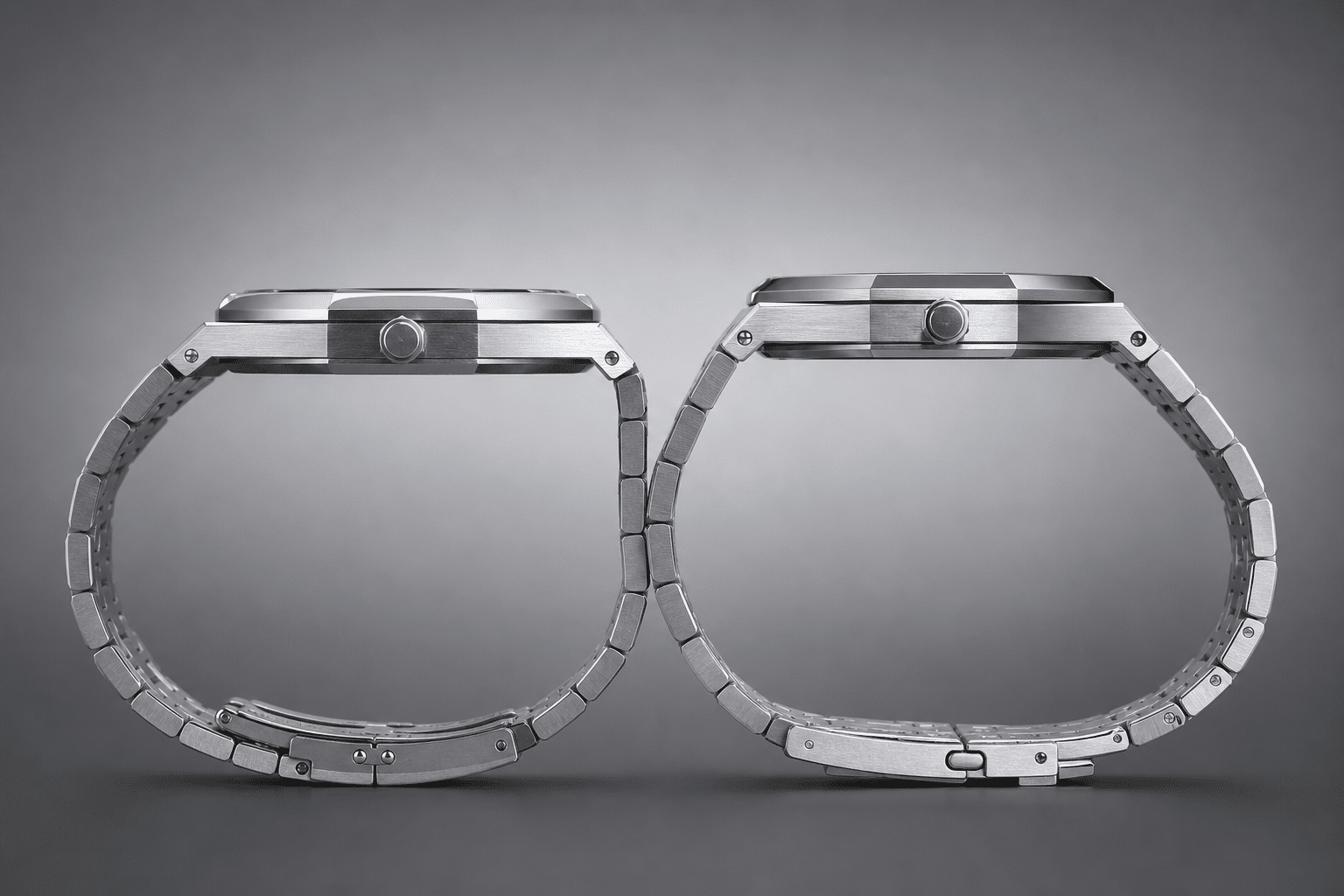
The most important hidden problem is often thickness. AP watches rely on proportion. If the case is too tall, the watch loses the flat, sharp, integrated character that makes the Royal Oak convincing. A front photo will not reveal that. The buyer needs a side-profile image that shows the bezel, mid-case, caseback, and bracelet line together.
Bracelet issues are also easy to hide. The first links should not look awkward, overly rigid, or separated from the case by uneven gaps. A photo taken only from above may make the dial look good while avoiding the bracelet articulation entirely. For AP replicas, that is not enough. The bracelet is not an accessory; it is one of the hardest parts of the watch to execute.
When “Beautiful Photos” Should Make You More Suspicious
Over-edited watch photos can make a weak clone look cleaner than it is. Excess sharpening can make dial printing and tapisserie texture appear more defined. Heavy contrast can hide uneven brushing. Color correction can make a difficult blue dial look closer than it appears in normal light. Soft reflections can blur bezel screw depth and case transitions.
The red flag is not professional photography by itself. The red flag is photography that removes the information a buyer needs. If every image is glossy, angled, and flattering, but none show the case side, clasp, caseback, bracelet fit, or straight dial alignment, the photos are not helping you judge the watch. They are steering your attention away from the risk areas.
AP is especially vulnerable to this because the most attractive angles are often the least useful. A Royal Oak dial can look dramatic in a close-up while the case is too thick. An Offshore can look powerful in a wrist shot while the chronograph layout or pusher shape is questionable. Beautiful photos should support inspection, not replace it.
What QC Photos Can Show—and What They Cannot Prove
QC photos are useful signals, but they are not final proof of the watch’s full ownership experience. They can show visible alignment, brushing quality, case thickness, date centering, dial texture, and whether the photographed unit roughly matches the seller’s claim. They usually cannot prove long-term reliability, water resistance, exact timekeeping stability, rotor noise over several days, or how the bracelet feels after hours on the wrist.
This limitation matters because some buyers over-trust QC images once the watch looks clean from the front. For AP replicas, the photos should be used as a negative filter first: they help identify watches to reject. Passing photos does not automatically mean the watch is the best choice; it only means there is enough visible evidence to continue asking about movement route, batch, price logic, and daily-wear risks.
QC photos can reduce uncertainty, but they do not guarantee perfection. Buyers should still review visible details and confirm seller policies before ordering, including how the seller handles mismatched photos, unacceptable visible flaws, water-resistance expectations, shipping risk, and after-sales questions. If those terms are unclear, even a clean-looking QC set should not be treated as a complete risk assessment.
QC photos reduce uncertainty, but they do not remove every risk. They are most useful when they show the actual watch from direct, neutral angles and allow the buyer to check dial printing, screw alignment, date centering, case thickness, bracelet fit, clasp finishing, and caseback structure before accepting the watch as a serious option.
QC Photos to Request
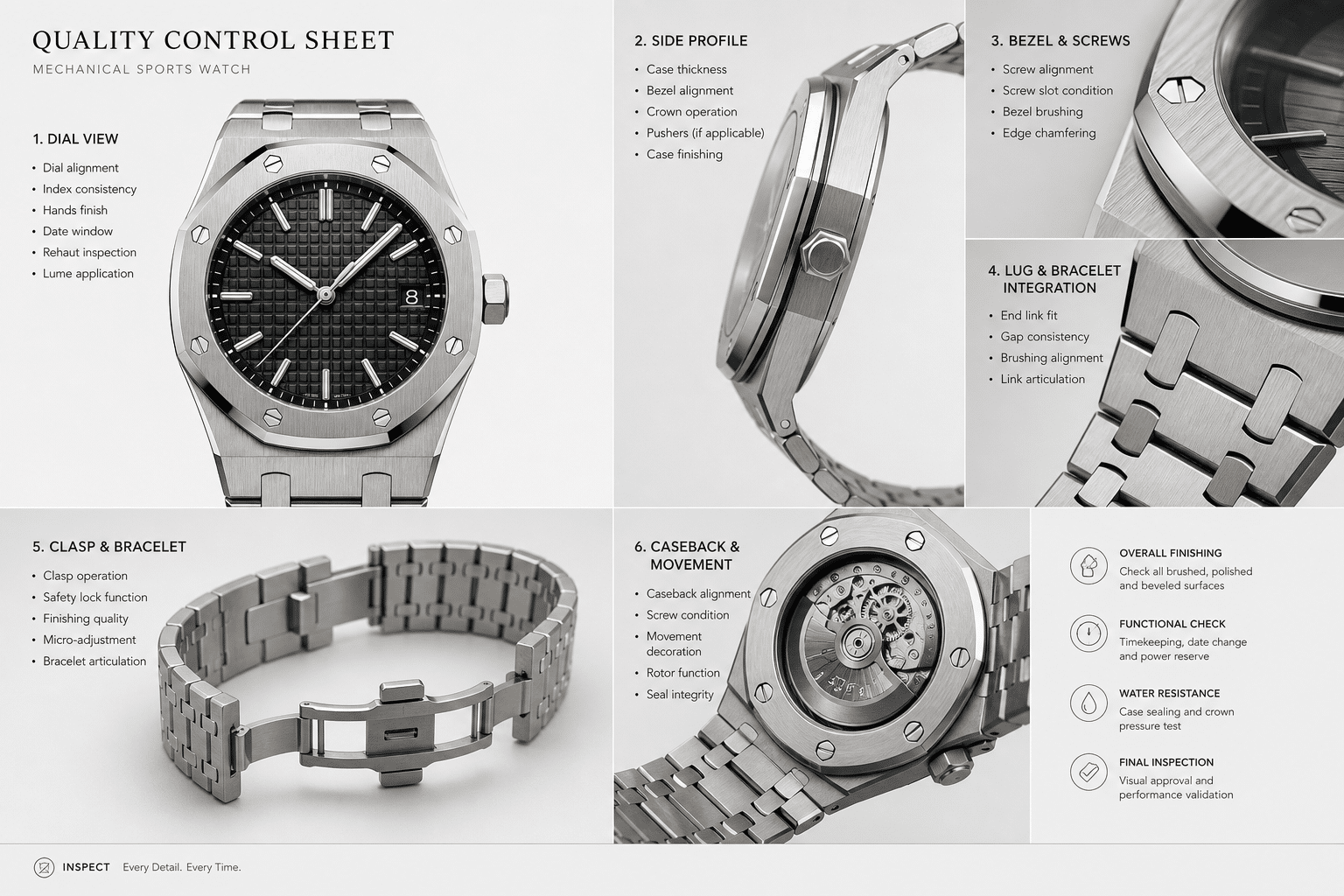
For an AP super clone, a useful photo set should cover the areas that determine whether the watch can be evaluated. At minimum, the buyer should expect to see:
- Straight dial view: to check dial alignment, logo placement, marker alignment, date window position if applicable, and overall symmetry.
- Side profile: to judge case thickness, bezel height, caseback shape, and whether the watch has the correct flat AP wrist presence.
- Bezel screw close-up: to inspect screw seating, spacing, orientation, and whether the screws look oversized or uneven.
- Bracelet integration: to see the first links, case-to-bracelet transition, articulation, and visible gaps.
- Clasp and bracelet underside: to check finishing, engraving quality, screw construction, and whether the bracelet appears rough or poorly assembled.
- Caseback: to confirm the movement route where visible and to check whether the finishing claim matches the actual watch.
- Date window photo if relevant: to inspect datewheel centering, font weight, and alignment within the aperture.
- Movement confirmation when relevant: especially for display-back models, chronographs, openworked designs, or listings making specific clone movement claims.
If these angles are refused or replaced with more polished product photos, that is not a small inconvenience. It is a Royal Oak replica photo red flag. Without actual watch pictures, the buyer is not evaluating the watch; they are evaluating a promise.
Verification Note: When possible, buyers should review real watch photos, dial details, clasp finishing, caseback structure, date alignment, bracelet fit, side-profile thickness, and movement information before making a decision. Stock images, edited beauty shots, and factory labels alone are not enough for a reliable judgment.
Movement Red Flags: Vague “Swiss Movement” Claims and Wrong Caliber Descriptions
Movement language is one of the easiest places for an AP super clone listing to sound premium while saying almost nothing. “Swiss movement,” “original movement,” “same as genuine,” or “top clone caliber” may look reassuring, but those phrases do not identify the actual AP replica movement, the movement family, the function layout, the thickness, or the likely ownership risk.
For AP replicas, vague movement claims are especially dangerous because the movement often affects the entire watch. It can determine case thickness, rotor noise, date behavior, chronograph layout, power reserve, display-back appearance, and serviceability. A movement description that does not explain the route is not a technical specification. It is marketing language.
Why “Swiss Movement” Is Usually Too Vague to Trust
A fake Swiss movement claim does not always mean the watch has no value, but it does mean the listing is not giving the buyer enough information. The term can be used loosely to suggest quality without naming the movement. Is it a Miyota-based route with decorative plates? A clone-style movement? A 7750-based chronograph? A simple automatic with AP-style decoration? Those are very different ownership experiences.
The AP market has moved through several movement routes over the years, from decorated base movements to more integrated clone movements on certain models. That history matters because a watch can look similar from the front while wearing thicker, sounding louder, or behaving differently in daily use. If the movement is not disclosed clearly, the buyer cannot judge whether the case proportions and function claims make sense.
“Swiss movement” also does not answer practical questions. How loud is the rotor likely to be? Does the date change cleanly? Is the movement architecture suitable for the caseback view? Does the chronograph actually function in a sensible layout? Can a watchmaker service it without unusual parts problems? These are the questions that determine whether the watch is livable, not whether the description sounds expensive.
Decorated Movement Does Not Always Mean Better Ownership
A decorated rotor or bridge can improve the look through a display caseback, but it does not automatically make the movement more reliable. This is one of the most common misunderstandings in AP clone movement risk. Buyers see AP-style engravings or a gold-colored rotor and assume the movement has been upgraded mechanically. Sometimes the decoration is mostly visual.
Decorative plates can also create tradeoffs. They may help the movement resemble the intended caliber from a distance, but they can add thickness, complicate access for service, or disguise a basic architecture underneath. On a Royal Oak, even a small thickness penalty can affect the whole case profile. A movement that looks more impressive in a caseback photo may still be the wrong choice if it makes the watch sit too tall or introduces noisy winding.
The better question is not “does it look decorated?” The better question is “does the movement route support the model honestly?” For a closed-caseback or less movement-focused model, Audemars Piguet ordering questions should include whether a proven, stable movement may be more rational than an elaborate-looking setup with poor reliability. For a display-back AP replica, visual layout matters more, but it still does not erase concerns about winding feel, power reserve variance, or serviceability.
Movement Claims Should Match the Model
A credible movement description should change depending on the AP model family. A simple Royal Oak, an Offshore diver, a chronograph, an openworked watch, and an extra-thin Jumbo-style model do not carry the same mechanical risks. If one generic movement claim is copied across all of them, that is a warning sign.
Royal Oak time-and-date models often need the movement to support the correct case thickness and date behavior. Offshore chronographs raise different questions: subdial spacing, pusher function, chronograph reliability, and whether the case has become too thick because of the movement architecture. Openworked-style replicas need extra skepticism because the movement is part of the dial. If the bridges, depth, and finishing are wrong, the entire watch can look flat even if the case is acceptable.
Extra-thin AP styles are among the most dangerous areas for vague movement claims. A listing may use language that suggests a true thin caliber, but the actual movement route may not support the proportions buyers expect. With these watches, the movement is not hidden technical trivia. It is the reason the case can or cannot be thin.
Visual Accuracy and Daily Reliability Are Different Movement Questions
A movement can be chosen for appearance, case fit, function layout, or daily reliability, and those goals do not always point to the same option. A decorated movement may look closer through a display back but may be harder to service or may add thickness. A simpler movement route may be less visually impressive but more predictable for daily wear. For beginners, this tradeoff is often more important than the seller’s claim that one movement is “higher grade.”
Chronograph and openworked AP replicas make this distinction even sharper. A complicated-looking movement can help the watch photograph well, but if the pusher action is poor, the subdial behavior is awkward, or replacement parts are difficult to source, ownership risk rises. Buyers who want a daily-wear AP-style watch may be better served by a simpler, stable configuration than by the most visually dramatic movement claim.
The most useful movement question is therefore not only “does it look close?” but “does this movement route make the watch more wearable, more serviceable, and properly proportioned for this model?” If the answer is unclear, the movement claim should be treated as unresolved risk rather than an upgrade.
How to Read Movement Names Without Over-Trusting Them
Movement names in replica listings often describe a market configuration rather than an official brand-manufactured caliber. A name may refer to the layout, the base architecture, a decorated bridge style, a rotor appearance, or a seller shorthand used to separate one route from another. That is why the movement label should be tested against the watch itself: crown position, date placement, subdial behavior, caseback view, rotor direction, case thickness, and practical service risk should all support the claim.
For AP super clone watches, movement traceability is strongest when the seller can explain what is inside in ordinary terms. A useful answer might distinguish a Miyota-based route from a 7750-based chronograph or a clone-style time-and-date movement. A weak answer repeats a premium-sounding name but cannot explain how it affects thickness, date setting, chronograph function, or daily reliability. The buyer does not need a watchmaker’s full teardown, but the description should be specific enough to compare against the visible design.
Movement Route to Verify
Before taking an AP super clone listing seriously, the movement route should be clear enough to evaluate. The buyer should be able to confirm:
- Movement type: whether it is a clone-style movement, Miyota-based route, 7750-based chronograph, quartz, or another stated architecture.
- Function layout: whether the seconds, date, subdials, and crown positions make sense for the advertised model.
- Date behavior: whether the date change and setting behavior match the claimed movement type, especially on time-and-date Royal Oak models.
- Chronograph function: whether the chronograph actually works as described, and whether the subdial layout is credible for that reference style.
- Rotor noise expectations: especially if the movement route is known to be louder in daily wear.
- Power reserve expectations: not just the advertised number, but whether the claim is realistic for the movement route.
- Case thickness compatibility: whether the movement claim supports the case profile being advertised.
- Serviceability: whether the movement is common enough to service reasonably or more dependent on specific parts and factory supply.
If a listing cannot answer these points and keeps returning to vague phrases like “Swiss movement” or “same as genuine,” the safest judgment is to stop considering it as a serious AP super clone. The movement does not need to be perfect, but the claim needs to be specific enough to inspect. Without that, the buyer is accepting the highest-risk part of the watch on faith.
Movement specifications can be useful when they come from a credible manufacturer document or a verifiable inspection of the individual watch, but a seller’s movement label should not be treated as proof by itself. In replica watch buying, a movement name, decoration style, or caseback view can be misdescribed, reused across listings, or presented without enough detail to confirm what is actually inside the watch. That is why the safest approach is to connect the movement claim to visible layout, case thickness, function behavior, and service expectations before treating it as meaningful evidence.
Movement Transparency Note: Movement references in this article describe replica-market movement types, movement routes, or visual configurations, not an official Audemars Piguet-manufactured caliber unless explicitly supported by verifiable evidence. Buyers should judge movement claims by model fit, function layout, case thickness impact, rotor behavior, and realistic service risk rather than by premium-sounding wording alone.
Specification Red Flags: Thickness, Case Shape, Dial Texture, and Bracelet Fit
AP watches are specification-sensitive in a way many buyers underestimate. A Royal Oak replica bad version may not fail because one small logo is off. It often fails because the physical structure is wrong: the case sits too tall, the bezel looks too rounded, the dial texture appears flat, or the bracelet does not flow naturally from the case. Those are not minor collector complaints. They change the entire wrist impression.
This is why vague specification language is a serious warning sign. A listing that says “correct size,” “best case,” or “perfect bracelet” without supporting measurements and clear photos is asking the buyer to trust a claim that should be verifiable. With an AP super clone, the case profile, octagonal bezel, tapisserie dial, and integrated bracelet are the watch. If those areas are unclear, the watch is not really being evaluated.
Case Thickness Is Not a Minor Detail on a Royal Oak
AP replica case thickness matters more than it does on many conventional watches because the Royal Oak design depends on a thin, flat, architectural profile. The case, bezel, mid-case, caseback, and bracelet are supposed to read as one low, sharp structure. If the watch is too thick, it does not simply become “slightly inaccurate.” It starts to wear like a different watch.
This is especially important on Royal Oak references where the genuine design is known for a refined profile. A thick replica can make the bezel appear heavier, the mid-case look slab-sided, and the bracelet transition feel less elegant. On the wrist, this is more noticeable than many dial printing flaws because the watch loses the flat, blade-like presence that makes the Royal Oak recognizable.
A serious listing should not hide thickness behind beauty shots. If the AP clone specs are not clear, or if the seller avoids side-profile confirmation, treat that as a warning sign. Exact dimensions should always be checked against the specific reference and current factory version, but the broader rule is simple: if the case profile cannot be verified, the watch should not be treated as a high-end AP clone.
Flat Bezel Geometry and Screw Alignment Are Easy to Expose
The Royal Oak bezel is unforgiving. Its octagonal shape, flat top surface, brushed grain, polished bevels, and eight visible screw heads create a grid of reference points. When one element is wrong, the eye catches it quickly. A weak bezel may look acceptable in a tilted photo, but a straight view often reveals uneven screw placement, soft edges, poor brushing direction, or a bezel that looks too rounded.
Bezel screw alignment deserves practical attention, but not because every buyer needs to study macro photos all day. The issue is that the screws sit on one of the most exposed parts of the watch. If they are oversized, unevenly seated, poorly finished, or visually drifting toward the wrong position, the front of the watch loses discipline. On an AP-style case, visual discipline is the whole point.
Polished bevels are another useful filter. Better AP replicas usually show cleaner separation between brushed surfaces and polished edges. Weak versions often blur this transition, making the case look soft or cheaply machined. If a listing describes “CNC perfect case” but does not show the bezel straight on and the case edge under neutral lighting, the specification claim is not doing much work.
Dial Texture Should Not Look Like a Printed Pattern
The tapisserie dial is one of the easiest areas to overpraise and one of the hardest areas to clone convincingly. A good replica dial should have visible depth, controlled texture, and a pattern that interacts with light. A bad one looks like a printed checkerboard. It may appear sharp in a compressed product image, but in hand it can feel flat, grainy, or too artificial.
This is where buyers often make the wrong tradeoff. They focus on dial color first, especially blue, and ignore the structure of the texture. Color matters, but texture is harder to hide. An incorrect dial texture can make even an otherwise decent Royal Oak replica look cheap because the dial occupies a large, open visual area under the crystal.
No replica should be assumed to fully reproduce the depth and finish of genuine AP dial production. The practical question is whether the tapisserie has enough three-dimensional definition to look convincing in daily wear. If the dial texture looks flat, muddy, overly shiny, or like a printed pattern, that is not a small flaw. It is one of the clearest signs of a weaker AP replica version.
Bracelet Integration Can Reveal the Whole Watch
The integrated bracelet is not an accessory on a Royal Oak. It is part of the case design. A bad bracelet fit can expose the whole watch faster than a slightly imperfect dial font. The first links should flow naturally from the case, the bracelet taper should look controlled, and the articulation should feel solid but not rigid. When the case-to-bracelet transition is wrong, the watch loses the continuous Genta-style shape buyers are usually paying for.
Bad bracelet fit shows up in several ways: uneven gaps at the head links, stiff links that do not drape around the wrist, rough brushing, weak polished bevels, poor clasp fit, or a bracelet that feels either loose and rattly or overly tight and uncomfortable. Some low-cost AP-style replicas also create a harsh wrist feel because the link edges are not finished cleanly. That may not appear in listing photos, but it becomes obvious during daily wear.
At Clean VS Factory, we usually treat AP bracelet quality as part of the case evaluation, not a separate comfort detail. A watch can have a decent dial and still feel wrong if the bracelet does not articulate correctly or if the clasp feels cheap. For AP replicas, bracelet construction is one of the strongest signs of whether the factory version is genuinely mature or just visually attractive from the front.
The cleanest specification rule is this: if thickness, bezel geometry, dial texture, and bracelet integration are described with vague praise but not supported by real evidence, slow down. A high-end AP replica should not require the buyer to guess whether the physical architecture is right.
Price Red Flags: Cheap Deals, Premium Markups, and Value Claims That Do Not Add Up
AP super clone price red flags usually appear at both ends of the market. A suspiciously low price can signal hidden compromises, but an expensive listing is not automatically safer. The real issue is whether the Audemars Piguet replica price is supported by evidence: factory version, movement route, finishing quality, QC transparency, and specification clarity.
Price alone does not prove quality. In the AP replica market, two watches can look similar in one front-facing photo while differing in case thickness, bracelet construction, dial texture, movement architecture, or batch age. That is why “same watch, much cheaper” is often a dangerous phrase. It may be the same model name, but not the same version, movement, or finishing standard.
When a Low Price Signals Hidden Tradeoffs
A low-cost clone is not automatically bad if the buyer understands what it is. The red flag appears when a cheap watch is advertised with premium claims: latest version, top factory, integrated clone movement, correct thickness, best dial, and full QC transparency, all without supporting proof. With AP replicas, that combination should make a careful buyer skeptical.
Unusually low pricing may point to older batch stock, a simpler movement route, weaker bracelet finishing, vague factory sourcing, or no real QC process. It can also mean the listing is using a familiar factory name loosely while shipping a different version. The buyer does not need to assume bad intent; the safer assumption is that the missing details are where the tradeoff lives.
The most common mistake is comparing only model names. A Royal Oak 15500-style replica with a decorated base movement is not the same buying proposition as a version using a more integrated movement route. A watch with a stiff bracelet and poor case profile is not equivalent to one with cleaner finishing, even if the dial color and case diameter sound similar in the listing.
When a High Price Is Just a Story
Premium replica pricing is only justified when the seller can explain what the premium is paying for. A higher price should correspond to clearer version information, better movement transparency, stronger finishing, more complete QC photos, or a more mature factory batch. If the only explanation is “best quality” or “latest super clone,” the price is just a story.
This matters because AP is a brand where small construction differences change the wearing experience. Better brushing, sharper bevels, improved bracelet articulation, and a more suitable movement route can justify a higher price. But a high price attached to vague claims does not reduce risk. It can simply make the wrong purchase more expensive.
Be especially careful with listings that use luxury language to replace technical detail. Phrases like “ultimate version,” “genuine level,” or “same as original” do not answer the practical questions. Which factory version is it? What movement route is inside? Are the photos of the actual watch? Does the case thickness make sense for the reference? If those answers are missing, the premium is not proven.
What Price May Reflect Besides Watch Quality
Price differences can come from several places, and not all of them improve the watch itself. A higher number may reflect a newer movement route, better bracelet finishing, tighter availability, factory scarcity, seller margin, shipping method, exchange risk, or after-sale handling. Some of those factors matter to the buyer; others do not change the physical watch on the wrist. The point is to separate a justified premium from a vague premium.
For AP replicas, this distinction is important because the same reference name can cover very different ownership risks. Paying more for a version with clearer QC, a movement route that supports the case thickness, and a better-finished bracelet may make sense. Paying more only because the listing says “best factory” or “limited stock” does not. The buyer should be able to trace the price back to something visible, measurable, or practically useful.
Prices can change by factory label, version, movement, seller channel, availability, finishing quality, and after-sales support. For that reason, exact comparisons should be verified at the time of purchase and should be evaluated like-for-like: same reference style, same claimed batch, same movement route, similar QC transparency, and comparable seller terms.
The Price Question That Matters Most
The useful question is not “Is this AP replica cheap or expensive?” The better question is: what evidence supports the price? A credible offer should have a logical connection between the claimed factory version, movement route, case specifications, bracelet quality, dial execution, and QC visibility.
If the price is low but the evidence is thin, assume there are hidden tradeoffs. If the price is high but the explanation is vague, assume the markup may be marketing rather than quality. The strongest AP super clone offers are usually not the ones with the loudest price claims; they are the ones where the watch can be evaluated without guessing.
For buyers comparing price versus quality, this is the clean filter: do not pay for adjectives. Pay attention to proof. Photos, specs, movement details, and version clarity should come before trust in the number.
Exact price claims should be treated carefully when they are not tied to a date, seller channel, factory version, shipping method, after-sale policy, and movement route. A number can look precise while still being unhelpful if the buyer cannot connect it to the specific watch being offered. In practice, a price comparison is only useful when the watches being compared are actually comparable.
Communication Red Flags: Vague Answers, Pressure, and Refusal to Clarify
Communication is part of the evaluation. With AP super clones, weak answers are often AP replica warning signs because the watch requires specific confirmation. A Royal Oak or Offshore replica is not a simple product where “looks good” is enough. Case thickness, movement route, dial texture, bracelet fit, factory version, and actual QC photos all affect whether the watch can be judged responsibly.
The issue is not whether the source sounds friendly. Friendly communication can still be useless if it does not provide verifiable information. The real warning sign is when reassurance replaces evidence: “best quality,” “do not worry,” “same as genuine,” or “Swiss movement” without photos, specifications, or a clear movement description.
Generic Reassurance Is Not Technical Confirmation
Generic praise does not confirm anything. “Top quality” does not identify the factory. “Best version” does not explain the batch. “Swiss movement” does not tell the buyer the actual caliber, movement family, function layout, or serviceability risk. “Same as genuine” is not a specification and should not be treated as one.
A credible answer should reduce uncertainty. If the question is about AP replica case thickness, the answer should address thickness or provide a way to verify it. If the question is about bracelet fit, the answer should not drift into dial color. If the question is about the movement route, the response should be more specific than “automatic movement.”
Fake AP super clone claims often survive because buyers accept confidence as proof. That is the mistake. Confidence is easy. Specificity is harder. A source that cannot explain the watch clearly may not understand the version, may not have control over the actual stock, or may be relying on copied listing text.
Pressure Before Proof Is a Serious Warning Sign
Pressure is especially risky when the buyer has not seen enough evidence to evaluate the watch. Urgency language can sound normal in a fast-moving market, but it becomes a red flag when it appears before real QC photos, movement details, or version confirmation. A buyer should not be pushed to decide while the most important information is still missing.
Common pressure patterns include “only one left,” “price increases today,” “factory stock disappearing,” or “many buyers waiting,” while basic questions remain unanswered. The problem is not scarcity itself. The problem is using scarcity to skip evaluation. For an AP replica, that is the wrong order.
If a source refuses QC photos, avoids side-profile confirmation, or says there is no need to check details because the watch is “top grade,” the safer decision is to pause. A serious AP super clone should be able to withstand basic scrutiny before any decision is made.
Changing Details Should Reset Your Confidence
Inconsistent answers should not be rationalized away. If the factory name changes, the movement description shifts, the claimed thickness becomes vague, or the model version is described differently from one message to the next, confidence should reset. AP replicas depend too much on version-specific details to treat those contradictions as harmless.
This is particularly important with Royal Oak and Offshore models because the same broad model name can cover very different construction quality. A change from one movement route to another may affect case thickness, rotor behavior, date function, serviceability, and price logic. A change in factory claim may affect dial texture, bracelet finishing, and batch reliability.
One small misunderstanding may happen. Multiple inconsistencies are different. If the answer pattern makes the watch harder to evaluate instead of clearer, the communication itself has become part of the risk.
Questions That Should Have Clear Answers
A high-end AP clone evaluation should not require advanced interrogation, but certain categories should be answerable. If they are not, the buyer does not have enough information to judge the watch responsibly.
- Factory or version: The claim should be specific enough to connect the watch to a known version, not just “top factory” or “best AP.”
- Movement route: The description should explain the movement type or route in practical terms, especially for chronographs, openworked styles, or extra-thin designs.
- Actual QC photos: The photos should represent the specific watch being evaluated, not only catalog images or repeated sample photos.
- Case thickness where relevant: For Royal Oak models, thickness is a major part of the wearing impression and should not be brushed aside.
- Bracelet and clasp details: Integrated bracelet fit, taper, articulation, brushing, and clasp feel are central to AP replica quality.
- Photo honesty: It should be clear whether the pictures are of the actual watch, a stock sample, or factory marketing material.
The final communication filter is simple: if the answers make the watch more measurable, confidence can improve. If the answers replace measurement with reassurance, pressure, or changing claims, the safer move is to walk away.
Factory and Version Red Flags: When the Name Does Not Match the Evidence
AP replica factory claims can be useful, but they are not proof by themselves. A factory name only matters when it lines up with the exact model, current best Audemars Piguet super clone version, movement route, batch details, and the actual photos of the watch being evaluated. If the claim is simply “best factory” or “latest version” without evidence, treat it as a label, not a fact.
This matters more with Audemars Piguet than with many simpler replica watches because AP models are not equally difficult. A factory that does well on a standard Royal Oak may not be equally strong on an Offshore chronograph, an openworked dial, or an extra-thin case. The wrong version can still carry a respected factory name while having an older dial, weaker bracelet fit, outdated movement decoration, or case thickness that does not match the current market expectation.
A Factory Name Is a Starting Point, Not a Guarantee
A credible factory claim should be supported by matching evidence. That means photos that look consistent with the claimed version, specifications that fit the model, and movement information that makes sense for that reference. A factory sticker, a copied product title, or a repeated seller phrase is not enough.
The red flag is not that a seller mentions APSF, ZF, APF, or another known AP source. The red flag is when the name is used to stop further questions. If the answer to every concern is “it is from a top factory,” the buyer still has not learned whether the dial texture is correct for this batch, whether the bracelet is the improved version, whether the case thickness is reasonable, or whether the movement route matches the model.
At Clean VS Factory, we usually treat factory reputation as the first filter, not the final decision. For AP super clone watches, the more useful question is: does the claimed factory version explain what I am seeing in the photos? If the evidence and the factory story do not support each other, the factory name should lose weight immediately.
Factory names in the replica market are typically buyer- and seller-facing labels rather than official brand designations. That means the name can help organize comparisons, but it should not be treated like a certificate of origin, a warranty, or proof of a specific movement, material, or case construction. The actual watch still has to carry the claim through photos, measurements, and consistent answers.
Factory-market names should be used as comparison references, not as official luxury-brand affiliations or automatic quality guarantees. A useful factory claim should be tied to the exact AP model, version, movement route, visible finishing, and actual QC photos of the watch being considered.
Old Batch Stock Can Be Sold as the Latest Version
Version language is one of the easiest areas to misuse. “V2,” “V3,” “latest,” and “upgraded” sound reassuring, but they mean very little unless the update can be seen or verified. In AP replicas, batch difference can affect the dial color, tapisserie definition, date placement, bezel brushing, bracelet articulation, clasp engraving, caseback finishing, and movement decoration. Those are not small changes if the watch is being priced as a current top-tier version.
A common warning sign is a listing that claims the newest AP super clone version while showing old catalog photos, inconsistent dial texture, or a movement shot that does not match the advertised route. Another is when the same photo set appears across multiple sellers, multiple dial colors, or even multiple references. That usually means the buyer is not looking at the actual watch or the actual batch.
Old stock is not automatically unusable. Sometimes an older batch can still be a rational choice if the price and expectations are clear. The problem is mislabeling. If an old Royal Oak version is priced and described as the latest improved batch, the buyer is paying for a claim rather than an upgrade. That is a walk-away signal unless the seller can prove what changed.
One Factory Claim Across Every AP Model Is Suspicious
Be cautious when one factory name is presented as the universal answer for every Royal Oak, Offshore replica, chronograph, openworked model, and extra-thin style. AP models create different problems. A time-only Royal Oak exposes case geometry and bracelet finishing. An Offshore adds bulk, pushers, strap integration, and often more complicated movement claims. A chronograph brings subdial spacing and functional reliability into the decision. An openworked dial exposes bridge depth, finishing, and movement layout much more aggressively than a closed dial.
This is why “factory name not enough” is not just a cautious slogan. It changes the buying decision. A model-specific factory strength is more credible than a universal ranking. If a source claims one factory makes the best version of every AP model without explaining the differences between the references, the claim is probably being used as marketing shorthand rather than a serious evaluation.
The strongest factory and version claim is narrow: specific model, specific batch, specific movement route, and photos that match. The weakest claim is broad: one famous factory name applied to everything with no version evidence. For AP replicas, broad claims are where many wrong purchases start.
How to Compare Versions Without Treating Updates as Automatic Upgrades
Version numbers are only useful when the buyer can identify what changed. A newer AP replica version may improve the bracelet, dial color, clasp engraving, movement decoration, or case profile, but it may also introduce a tradeoff in another area. For example, a movement route that improves the display-back appearance may increase thickness, or a dial update may look better in one color but less convincing in another. The buyer should ask what the update actually affects, not simply whether the listing uses the newest label.
A traceable version comparison should move from broad label to visible proof: model reference, claimed batch, movement route, case measurements, dial execution, bracelet construction, clasp finishing, and actual photos of the watch. If a seller cannot explain the difference between the claimed version and an older batch, the word “latest” does not carry much weight. In super clone watch comparisons, version-specific judgment is safer than relying on factory reputation alone.
Model-Specific AP Red Flags: Royal Oak, Offshore, Chronograph, and Openworked Risks
Royal Oak replica red flags are not the same as Royal Oak Offshore replica risks. Audemars Piguet designs share a recognizable language, but the failure points change sharply by model family. A buyer who uses one generic AP checklist may miss the exact weakness that matters most for the watch in front of them.
The practical rule is simple: judge the replica by the part of the design that the original model exposes most. A standard Royal Oak exposes flat geometry, bracelet finishing, and dial texture. An Offshore exposes size control, pusher construction, and comfort. A chronograph exposes subdial layout and movement behavior. An openworked AP exposes mechanical credibility because there is less dial surface to hide behind.
Royal Oak Red Flags Are Usually About Geometry and Finishing
On a standard Royal Oak, the biggest warning signs are usually not dramatic. They are small shape and finishing problems that change the whole wrist presence. A thick mid-case, a soft octagonal bezel, uneven brushing, weak polished bevels, or poor case-to-bracelet transition can make a Royal Oak replica feel wrong even if the dial looks attractive in photos.
The integrated bracelet is especially unforgiving. If the first links sit awkwardly, the bracelet drapes stiffly, or the gaps are uneven, the watch loses the fluid, architectural feel that defines the design. This is more important than many buyers expect. A good dial cannot rescue a Royal Oak that wears like a block on the wrist.
Dial texture is another key filter. A convincing tapisserie dial should have visible depth and controlled texture, not a flat printed grid or an overly sharp stamped pattern that looks harsh under light. The buyer does not need to obsess over every microscopic square, but if the dial looks lifeless, plasticky, or inconsistent across the surface, it is not a minor flaw on this model family.
Offshore Red Flags Often Involve Bulk and Function
Offshore-style AP replicas can look impressive because the original design is already large, aggressive, and visually busy. That boldness can hide problems in photos. The first red flag is excessive bulk. A risky Offshore clone may look acceptable from the front but become awkward from the side, especially if the case profile is too tall or the caseback protrudes more than expected.
Pusher feel and layout also matter. A Royal Oak Offshore chronograph is not just a bigger Royal Oak with extra buttons. If the pushers feel loose, the crown guards look crude, the subdials are poorly spaced, or the date window sits in an awkward position, the watch may be using a movement route that does not suit the case. That is a stronger warning sign than a small cosmetic flaw because it affects both appearance and ownership experience.
Comfort is often underrated with Offshore replicas. Heavy case construction, stiff rubber straps, poor buckle finishing, or an unbalanced case can make the watch tiring to wear. A dramatic wrist shot does not tell the buyer whether the watch actually sits well after several hours.
Chronograph and Openworked Models Need Extra Skepticism
AP chronograph warning signs deserve a stricter filter because the movement and dial layout are harder to fake convincingly. Subdial spacing, date position, case thickness, pusher action, and chronograph behavior should make sense together. If the listing shows a chronograph but avoids explaining the movement route or function, the buyer should slow down immediately.
The biggest mistake is assuming that a complicated-looking AP replica is automatically higher-end. Visual complexity can hide compromises. A busy dial may distract from wrong subdial spacing. A decorated caseback may distract from rotor noise or weak serviceability. A thick case may be excused as “sporty” when it is actually a movement accommodation problem.
Openworked and skeleton-style AP replicas require even more caution. The openworked dial removes the safety net. Bridge shape, depth, visible screws, balance position, finishing texture, and movement symmetry are all exposed. A watch can photograph well from one angle and still look flat or mechanically unconvincing in person. If the openworked dial looks like a decorative plate rather than a layered movement structure, that is not a small cosmetic issue; it is the main identity of the watch failing.
For complicated AP models, the safer buyer mindset is skepticism first. If the seller cannot show clear angles, explain the movement route, and acknowledge the limitations, the watch should not be treated like a top-tier AP super clone simply because it looks expensive in edited photos.
Impossible Claims: Water Resistance, Perfect Accuracy, and “Same as Genuine” Language
AP replica impossible claims are among the clearest fake AP super clone warning signs. A serious listing should leave room for limitations. If the language promises guaranteed waterproofing, perfect accuracy, genuine-equivalent construction, or “same as genuine” quality without evidence, the buyer is being asked to accept certainty where certainty does not belong.
This is especially risky with AP-style watches because the design depends on complex case construction, exposed finishing, integrated bracelet fit, and movement architecture. These are not areas where a phrase like “perfect 1:1” solves the problem. The more absolute the claim, the more evidence the buyer should require.
Water Resistance Should Never Be Treated as Guaranteed
A water resistance claim on a replica watch should be treated cautiously unless the individual watch has been properly tested by a qualified watch professional. A listing claim is not the same as pressure testing. Even if the case design appears solid, the actual result depends on gaskets, crown sealing, caseback fit, crystal seating, assembly quality, and whether the watch has been opened or adjusted.
This matters because AP designs often include multiple case parts, screws, pushers, display backs, or complex crown areas depending on the model. Offshore chronographs and other function-heavy designs add more potential sealing points. A blanket “guaranteed waterproof” statement is not realistic buyer guidance; it is marketing language.
The sensible approach is to assume no replica watch is safely waterproof for meaningful exposure until tested. If a source uses water resistance as a selling point but cannot discuss testing, limitations, or practical caution, confidence should go down, not up.
“Perfect 1:1” Is a Marketing Phrase, Not a Specification
“Perfect 1:1” sounds strong, but it does not tell the buyer anything useful. It does not identify the case thickness, movement route, dial construction, bracelet quality, date alignment, bezel screw execution, or batch version. For an AP replica, those details are the evaluation. Without them, perfection language is just a shortcut around inspection.
A more credible description would explain where the watch is strong and where it is limited. For example, a seller or source might identify improved bracelet finishing but still acknowledge that tapisserie texture, movement finishing, or water resistance expectations have limits. That kind of qualified explanation is more trustworthy than a claim that everything is identical.
Be especially careful with phrases such as “same as genuine,” “cannot be told apart,” or “authentic-level in every detail.” These claims are not only unrealistic; they also distract from the real buyer question: is this specific watch, in this specific version, good enough for your expectations and daily use?
Realistic Limitations Are More Trustworthy Than Absolute Promises
The best AP super clone evaluation is not built on hype. It is built on evidence: real photos, consistent specs, credible movement information, and a clear explanation of tradeoffs. A source that admits a limitation may actually be more useful than one that denies all limitations. AP replicas can be visually strong, but they are still not official products and should not be represented as genuine watches.
Transparent limitations also help the buyer avoid the wrong model. A person who wants a durable daily-wear Royal Oak-style watch may be better served by a simpler, proven configuration than by a complicated openworked or chronograph model with bold claims and limited movement clarity. The more complex the watch, the more dangerous absolute promises become.
The clean judgment is this: if a claim removes the need to inspect the watch, it is not a helpful claim. It is a red flag. Serious AP replica evaluation should make the watch easier to judge, not harder to question.
Authentication and Resale Language Should Be Rejected
Another walk-away signal is any claim that an AP super clone can pass authentication, fool experts, be accepted by an official boutique, or be resold as a genuine Audemars Piguet watch. Those statements are not responsible buyer guidance. A replica watch may look convincing in casual wear, but close inspection can still reveal differences in movement architecture, finishing, case proportions, bracelet feel, dial details, or service compatibility.
The purpose of factory, movement, and QC information is to help readers understand quality and risk, not to support misrepresentation. If a seller frames the watch around passing inspection rather than understanding the replica-market version, that is a serious trust problem. A buyer should evaluate the watch as a replica-market product and should not represent, sell, or use it as a genuine brand-manufactured watch.
A Practical Walk-Away Checklist for AP Super Clone Evaluation
The easiest way to learn how to avoid bad AP replica choices is to stop treating every unclear listing as something that can be “figured out later.” With AP super clone watches, uncertainty is not a small inconvenience. The Royal Oak and Offshore expose too much: case thickness, bezel geometry, tapisserie texture, bracelet integration, movement layout, and finishing transitions all sit in plain view. If the watch cannot be evaluated before the decision, it should not be treated as a serious high-end option.
A useful AP super clone checklist is not about finding a flawless watch. That is the wrong standard. The better standard is evidence. One minor imperfection may be acceptable if it is visible, understood, and consistent with the model’s known limitations. Multiple unanswered questions are different. Missing QC photos, vague movement language, unclear factory version, unrealistic specifications, and pressure to decide should work together as a stop sign.
Walk Away If the Photos Do Not Show the Actual Watch
Real QC photos should show the specific watch being evaluated, not a polished sample, reused catalog image, or heavily edited studio shot. For an AP-style watch, the photo set should make it possible to judge the straight dial view, bezel screw placement, case side profile, bracelet-to-case transition, clasp fit, and caseback where relevant. If all photos are angled, cropped, filtered, or limited to flattering wrist shots, the watch is being protected from inspection.
The practical test is simple: can you see the flaws that would matter on the wrist? If the answer is no, there is not enough proof. A risky AP clone often looks impressive until the missing angles appear. Case thickness, stiff bracelet links, uneven bezel brushing, poor date centering, and weak clasp finishing rarely announce themselves in beauty shots. If the photos do not let you evaluate those areas, walking away is more rational than hoping the hidden details are fine.
Walk Away If the Movement Claim Is Vague or Impossible
Movement verification matters because AP replicas often depend on whether the movement route actually supports the case design. “Swiss movement,” “original movement,” “same as genuine,” or “top clone caliber” is not enough if there is no clear explanation of the movement type, function layout, rotor behavior, date behavior, or relationship to the advertised model. A decorated movement can look attractive through a caseback and still be noisy, thick, poorly serviced, or mismatched to the reference.
This is especially important with chronographs, openworked models, extra-thin styles, and display caseback Royal Oaks. The more the watch depends on movement architecture, the less acceptable vague wording becomes. If the movement claim sounds impressive but cannot be connected to case thickness, subdial position, power reserve expectations, or basic serviceability, treat it as a warning sign rather than a premium feature.
Walk Away If the Specs and Price Do Not Match the Evidence
Case thickness, bracelet quality, dial texture, factory version, and price should tell one coherent story. If a listing claims a latest-version AP super clone but cannot support the claim with current photos, realistic specifications, and movement details, the price is just a number. A low price may hide an older batch, weak bracelet, generic movement route, or poor finishing. A high price may be nothing more than a better story attached to the same unclear watch.
AP is not a forgiving design for vague specifications. A Royal Oak that is too thick does not simply become “slightly less accurate”; it changes the whole profile of the watch. A flat-looking tapisserie dial, loose bracelet integration, oversized bezel screws, or weak brushing can affect the wearing impression immediately. If the claimed factory version, physical specs, and price logic do not support each other, the safer judgment is that the watch cannot be verified.
Walk Away If Communication Replaces Evidence With Pressure
Good communication is not the same as friendly communication. For AP super clone evaluation, useful communication means clear answers about actual QC photos, movement route, factory or version claim, case thickness where relevant, bracelet and clasp details, and whether the images represent the exact watch. Generic reassurance such as “best quality,” “do not worry,” or “same as genuine” does not answer the buyer’s real question.
Pressure before proof is one of the strongest communication red flags. If urgency appears before the watch has been shown clearly, the buyer is being asked to trust the claim instead of evaluate the evidence. Changing answers are just as serious. If the factory name, movement description, thickness, or version story shifts during the conversation, confidence should reset to zero rather than be patched together with assumptions.
Traceability Ladder Before Any Final Decision
Before treating an AP super clone as a serious option, the buyer can use a simple traceability ladder. Start with the exact model reference or reference style, then confirm the factory-market name, claimed version or batch, movement route, case thickness, dial and bezel execution, bracelet and clasp details, actual QC photos, and realistic ownership limits. If one step is missing, the next step becomes less reliable.
This ladder is not meant to create an illusion of certainty. It is meant to prevent unsupported claims from carrying the decision. A watch with a famous factory label but no real side-profile photo has not cleared the case-thickness question. A watch with a decorated movement photo but no clear explanation of the base movement has not cleared the reliability question. A watch with a high price but no version-specific evidence has not cleared the value question.
For CleanVSFactory, the practical editorial goal is to make these decisions easier to trace: factory names, movement claims, visible QC details, version differences, and ownership expectations should be connected rather than treated as separate sales points. When those signals align, the buyer can continue evaluating. When they conflict or disappear, walking away is usually the more disciplined choice.
The Final Filter
The final rule is strict but useful: if an AP super clone cannot be evaluated through real QC photos, credible movement information, realistic specifications, consistent factory or version details, and transparent communication, it should not be treated as a high-end AP clone. Rejecting a bad or unverifiable option is not a failed purchase attempt. It is the part of the buying process that protects you from the wrong watch.
For AP replicas, the question is not only “should I walk away?” The better question is whether there is enough proof to stay interested. If the answer depends mainly on trust, polished photos, vague claims, or pressure, the watch has already failed the checklist.
Disclosure: This article is for general educational and comparison purposes only. Replica watches are not genuine products from the original luxury brands, and brand names are used only to identify reference designs or comparison topics. Factory names, movement descriptions, prices, availability, QC details, seller policies, and version information can change, so readers should verify important details with the seller before making a purchase decision. Replica watches should not be represented, resold, or used as genuine watches.