
AP Royal Oak replicas need a stricter QC approach than many round-case watches because the design leaves very little room for visual errors, so an AP super clone price guide should be weighed against the same geometry-first inspection standard. The bezel, screws, tapisserie dial, markers, date window, case edges, and bracelet links all depend on clean geometry. A watch can look attractive in one front-facing photo but still show misalignment, uneven screw seating, awkward case thickness, or poor bracelet integration once viewed from other angles.
This article focuses on how to read QC photos before approving an AP replica. The main judgment is not whether the dial looks clean at first glance, but whether the watch holds together as a complete object: front alignment, side profile, bracelet flow, clasp finishing, and caseback consistency. It also explains which photo flaws may be caused by lighting and which repeated issues deserve more caution.
| QC Area | What to Check First | Why It Matters on AP |
|---|---|---|
| Front layout | Bezel centering, dial grid, markers, date position | Royal Oak geometry makes small alignment errors easy to notice |
| Bezel screws | Depth, spacing, seating, repeated unevenness | One glare spot may be harmless; repeated irregularity is more concerning |
| Side profile | Crystal height, bezel thickness, caseback protrusion | A convincing AP should look balanced, not just good from the front |
| Bracelet and clasp | End-link fit, articulation, brushing, clasp alignment | The integrated bracelet strongly affects wrist feel and overall impression |
| Caseback and movement | Rotor style, decoration route, screw condition, seating | Useful for consistency checks, but not proof of long-term reliability |
| Photo set | Front, angled, side, bezel, bracelet, clasp, date, caseback | Repeated issues across views matter more than one questionable image |
Quick Questions Before You Read
Q: Is one clear front photo enough for AP QC?
No. A front photo can hide side thickness, bracelet fit, clasp issues, and caseback seating.
Q: Should bezel screw alignment be judged from one image?
Not usually. Reflections can mislead, so confirm screw depth and seating across multiple angles.
Q: Do movement photos prove the watch will be reliable?
No. They help check claimed configuration and appearance, but not water resistance, regulation, or long-term health.
Q: What is the biggest mistake when approving an AP replica?
Approving it because the dial looks attractive while ignoring structure, profile, bracelet flow, and repeated alignment issues.
Editorial Perspective: For AP replicas, cleanvsfactory.com treats QC as a model-specific risk check rather than a simple factory ranking. A respected factory name can narrow the shortlist, but it does not prove that one individual Royal Oak has even screw seating, a controlled side profile, a centered date, or a bracelet that flows correctly from the case. Factory labels, seller descriptions, and polished QC photos are useful signals, but the final judgment should come from how the actual watch in the photos handles the Royal Oak’s exposed geometry.
Evidence Boundary Note: This article discusses replica watches and visual QC judgment, not authorized Audemars Piguet products. Official brand information can explain the authentic Royal Oak design language, but it cannot prove that a replica uses the same construction, materials, finishing process, movement, water-resistance standard, or quality control. For that reason, the QC approach here avoids treating factory names, seller descriptions, or decorative movement photos as conclusive proof.
Because no individual replica watch is verified by a brand source, the safest evidence is the actual photo set for the watch being offered. A buyer should read each QC image as limited evidence: a front photo can support a front-layout judgment, a side photo can support a thickness and caseback-protrusion judgment, and a caseback photo can support only a visible-layout judgment. None of those photos can guarantee long-term accuracy, water resistance, serviceability, or legal status.
Reader Boundary: Replica Comparison Is Not Authentication
Brand names are used here to identify the genuine reference design being discussed and to explain why certain visual details matter. AP replica watches and AP super clone watches are replica-market products, not genuine Audemars Piguet watches, and factory names in this market should not be read as brand authorization, endorsement, certification, or official production status.
The purpose of QC photo review is to help buyers understand visible quality, version consistency, and ownership risk before accepting a specific replica-market watch. It is not a method for representing a replica as genuine, avoiding disclosure, passing professional authentication, or creating resale legitimacy. A strong Royal Oak-style replica may look convincing in normal wear, but close inspection can still reveal differences in finishing, movement architecture, case proportions, bracelet feel, service compatibility, or materials.
CleanVSFactory’s buyer-facing approach is to make replica watch comparison clearer by connecting factory labels, movement descriptions, visible QC details, version differences, and realistic ownership limits. That approach is educational and comparison-focused; it should not be confused with official brand verification or a guarantee that any individual watch will meet a specific standard beyond what can be reasonably judged from the available evidence.
Why AP Replicas Have Less Tolerance for Small QC Errors
AP replica QC photos matter more because the Royal Oak is not a soft, rounded design. It is a geometry-driven watch. The octagonal bezel, exposed screw pattern, tapisserie dial, angular case shoulders, and integrated bracelet all line up visually. If one part is slightly off, the mistake does not disappear into the design. It interrupts the whole structure.
This is the main reason Royal Oak replica QC should be treated differently from many other replica watch checks. The issue is not that every AP super clone is mechanically harder than every other watch. The issue is that small flaws on Royal Oak replicas are easier to see because the design gives them nowhere to hide. A slightly rotated dial, uneven bezel screw, thick case profile, or loose end-link transition can change the impression faster than the same level of error on a more conventional round sports watch.
AP Design Is Built Around Visible Geometry
The Royal Oak is built like a visible alignment test. The bezel has eight flat sides. The screws sit in fixed positions around that bezel. The dial texture is made of repeated squares. The hour markers and date window sit inside that grid. The bracelet does not attach like an afterthought; it flows directly out of the case.
That makes AP replica alignment issues unusually obvious. If the bezel is slightly rotated against the dial, the eye catches it. If one screw sits lower than the others, the bezel no longer reads as balanced. If the tapisserie pattern does not sit square with the hour markers, the dial can look wrong even before the buyer knows exactly why. On a Royal Oak-style watch, visual symmetry is not a detail. It is the design.
This is also why factory reputation alone is not enough. A strong factory version can still produce individual units with imperfect screw seating, dial centering, or bracelet fit. For AP, the buyer is not only choosing a factory name. The buyer is judging whether that specific watch holds its geometry together in the actual QC photos.
Why “Best Factory” Claims Need to Be Narrowed for AP
Royal Oak buyers often ask which factory is “best,” but that question is too broad unless it is tied to a specific reference, size, dial color, movement route, and use case. A factory that performs well on one AP model may not be equally strong on another. A 15202-style Jumbo, a 15400, a 15500, an offshore chronograph, and a skeleton-style model create different problems for case thickness, movement layout, dial construction, bracelet fit, and caseback accuracy.
For this reason, the more useful AP comparison is not only factory name versus factory name. It is whether the chosen version solves the buyer’s main concern. A buyer who wants the watch mainly for photos may prioritize dial color, bezel brushing, and front geometry. A buyer who wants daily wear should give more weight to bracelet comfort, clasp execution, case thickness, movement stability, and whether the date changes cleanly. These priorities can point to different choices even when the factory label looks attractive.
Price can also mislead here. A more expensive AP replica may reflect a different movement route, more complex case finishing, limited availability, seller margin, or after-sale risk. It does not automatically mean the actual QC unit is better aligned. On a Royal Oak, a lower-priced but visually clean and well-proportioned watch can be a better practical choice than a higher-priced example with uneven screws, a bulky side profile, or a weak bracelet transition.
How to Treat Factory and Specification Claims During AP QC
Factory names are useful for organizing choices, but they should not be treated as laboratory evidence. A seller may describe a watch as coming from a known AP-focused factory, but the buyer still needs to verify the individual unit through photos. The practical question is not whether the factory has a good reputation in general; it is whether this exact watch shows acceptable bezel seating, dial alignment, side profile, bracelet fit, and caseback consistency.
Specification claims also need restraint. Claims about steel grade, crystal type, movement route, decorative bridges, or water resistance may appear in listings, but those claims are not fully proven by ordinary QC photos. A photo can sometimes show whether a crystal is clear, whether a movement layout broadly matches the seller’s description, or whether the caseback appears seated. It cannot prove metallurgy, gasket performance, pressure resistance, lubrication quality, or long-term movement health.
For AP replicas, the most defensible QC method is to separate what can be seen from what is being claimed. Visible geometry can be judged from photos. Long-term durability, true water resistance, and movement origin usually require evidence beyond a seller’s beauty shots. This distinction protects the buyer from approving a watch based on impressive language instead of observable execution.
Factory Name Clarification: Factory names in the AP replica watch market should be treated as practical buyer-facing references, not as official Audemars Piguet affiliations, audited manufacturer identities, or guarantees of identical quality across every model. Buyers should still judge each Royal Oak by visible QC details such as bezel screw seating, dial centering, case thickness, bracelet fit, clasp finishing, and caseback consistency.
Why Round Watches Can Hide More Than a Royal Oak
Many round sports watches are more forgiving. A Submariner-style case, for example, has a circular bezel, rounded case flanks, and a bracelet that can tolerate small visual variation without immediately disturbing the whole watch. A tiny SEL gap, a slightly soft lug edge, or a minor bezel insert difference may still matter, but the shape does not spotlight every alignment issue at once.
The Royal Oak behaves differently. Its octagonal bezel creates hard reference points. Its sharp case lines create clear edges. Its integrated bracelet makes the first link part of the case architecture. Even the brushing and polished bevels run in deliberate directions. This leaves very little finishing tolerance. If the brushing looks uneven or the bevel line breaks awkwardly, the watch can look less controlled even from normal viewing distance.
The non-obvious point is that AP replicas are often punished by their own best feature: the design is distinctive because it is rigid and architectural. That same architecture makes small QC errors more visible. A Royal Oak replica can look expensive in a single photo and still feel visually unstable once the buyer starts checking how the bezel, dial, case, and bracelet relate to each other.
The Buyer’s Main Risk: A Watch That Looks Good Only From One Angle
The most common AP QC trap is the attractive straight-on photo. A front image can make the dial color look rich, the bezel shape look clean, and the watch appear balanced. But that one view may hide the problems that matter most on AP: a thicker-than-expected case, uneven screw depth, a bracelet gap near the case, a date window sitting slightly off, or finishing that looks weaker from an angle.
This is why QC matters for AP in a more demanding way. The buyer should not ask only, “Does the front photo look good?” The better question is, “Does the watch still look controlled when the geometry is tested from more than one view?” A replica watch with a beautiful dial but poor case proportion or bracelet integration can disappoint faster than a simpler watch with a less dramatic design.
At Clean VS Factory, we usually treat Royal Oak replica QC as a structure check before a beauty check. Color, shine, and dial appeal matter, but they should not distract from alignment, proportion, and fit. If those fundamentals are weak, the watch may photograph well but wear less convincingly.
QC photos cannot guarantee long-term reliability, water resistance, or perfect finishing. They can, however, reduce the biggest AP-specific risk: approving a watch that looked strong in one flattering view but had obvious visual issues from the angles that actually expose the Royal Oak design.
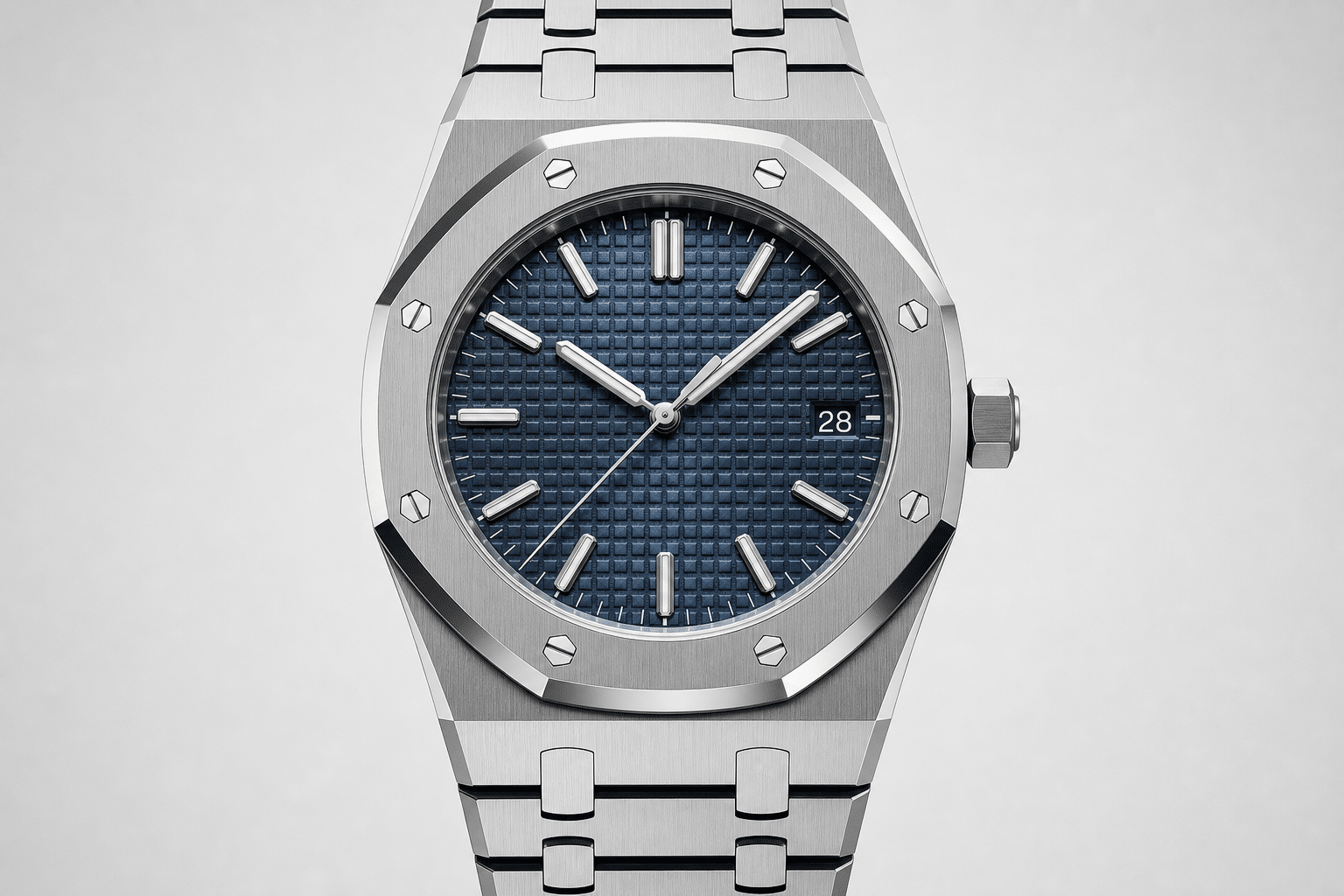
The Front Dial Photo Should Prove More Than Basic Cleanliness
A straight front QC photo for an AP replica should do more than show that the dial is clean and the hands are installed. For Royal Oak replica QC, the front image is the first test of whether the watch reads as one centered layout. The bezel, screws, dial opening, tapisserie grid, hour markers, hands, logo, minute track, and date window all need to make visual sense together.
The photo itself matters. If the camera is tilted, too close, or not centered over the dial, it can exaggerate problems or hide them. A slightly angled image may make the dial appear rotated, the date window look off-center, or the bezel seem uneven when the watch is not actually that bad. The front QC photo should be level enough to judge alignment without fighting lens distortion.
Bezel, Dial, and Markers Must Read as One Centered Layout
The first thing to judge is not a single detail. It is the relationship between details. The octagonal bezel should frame the dial evenly. The dial should not look shifted inside the case. The hour markers should sit cleanly against the tapisserie pattern and line up with the minute track. The hands should be centered and not visually fight the marker layout.
On an AP replica, a small misalignment can look larger because the watch gives the eye so many straight lines to compare. A marker that leans slightly on a plain dial may be easy to overlook. On a Royal Oak, that same marker sits against a square dial texture, a sharp bezel opening, and a formal minute track. The surrounding geometry makes the flaw easier to read.
The practical judgment is simple: if the front photo only looks good because the watch is photographed at a flattering angle, do not treat it as enough. A strong front image should show balance, not just shine.
Tapisserie Dial Alignment Is Easy to Underrate
The tapisserie dial is one of the most important AP-specific QC points because it creates a visible grid across the entire dial. Buyers often focus on color first, especially with blue or grey dials, but dial grid consistency can matter more in actual wear. If the square pattern appears slightly rotated against the markers, or if the printed text does not sit naturally within the pattern, the dial can feel “off” even when the printing itself is sharp.
This is where AP replica dial alignment becomes less forgiving than many other watches. The tapisserie texture is not just background decoration. It is a measuring surface. It makes small rotation, centering, and spacing issues easier to notice. The logo, applied markers, and date window all sit on top of that grid, so any disagreement between them becomes more visible.
Not every minor texture variation should trigger rejection. Lighting can change how the squares appear, and some dial colors reveal the pattern more aggressively than others. But if the grid, markers, and printed elements all seem to lean in different directions, that is not a harmless cosmetic quirk. It weakens the whole front layout.
Date Window Position Can Break the Whole Dial Balance
The date window is a small feature, but on a Royal Oak it has an outsized effect. AP dials are structured and symmetrical, so a date that sits too high, too low, too far left, or too far right can disturb the entire dial balance. This is especially noticeable because the date window sits near the tapisserie grid and close to a strong marker layout.
A date window check should include both the window position and the datewheel itself. The frame should look square and clean inside the dial layout. The numeral should sit centered enough that it does not look trapped against one edge. A date that is slightly imperfect may be acceptable depending on the model and buyer tolerance, but a visibly crooked or badly centered date will keep drawing the eye.
The mistake is treating the date as a secondary detail because it occupies a small area. On many AP replicas, the date window is one of the fastest ways a front photo stops looking balanced.
What the Straight Front Photo Should Show
The straight front photo should show a level dial, visible bezel screws, clean marker placement, readable date position, and enough resolution to judge whether the tapisserie pattern and dial text are centered. It should allow the buyer to compare the bezel outline, dial opening, markers, hands, logo, and date window as one system. If the photo is too angled, too low-resolution, or too heavily shadowed to judge those relationships, it has not done its job.
Bezel Screw Alignment Is a Bigger Deal on AP Than on Most Replicas
Bezel screw issues matter more on AP because the screws are not hidden hardware. They are part of the Royal Oak’s identity. On many watches, a screw or caseback detail is something the buyer notices only during close inspection. On an AP-style octagonal bezel, the eight visible screw positions are one of the first things the eye reads.
This is why AP super clone bezel alignment deserves serious attention in QC photos. The buyer is not looking for impossible perfection. The goal is to decide whether the screw layout looks controlled enough that the watch feels well assembled. Uneven screw depth, inconsistent slot appearance, poor spacing, or one screw sitting visually off-center can make the whole bezel look cheaper than the rest of the watch.
Why the Screws Are Part of the Design, Not Just Hardware
The Royal Oak bezel is built around repetition: eight sides, eight screw positions, alternating brushed surfaces, and polished bevels. The screws are visual anchors. They break up the bezel evenly and reinforce the industrial design language. If they look random, the bezel loses its discipline.
This is different from a watch where screws are hidden on the back or blended into a clasp. Royal Oak bezel screws are meant to be seen, so AP super clone red flags often begin with uneven slots, poor alignment, or finishing that breaks the visual rhythm. That makes Royal Oak bezel screws one of the most important front-facing QC details. A buyer who ignores them because the dial color looks attractive is missing one of the main AP-specific inspection points.
A good AP bezel check starts with spacing and seating. The screws should appear evenly placed around the octagonal bezel, with no single screw looking obviously sunken, raised, tilted, or pushed away from its expected position. The brushing and polished bevels around the screws should also look clean enough that the bezel does not appear roughly finished.
Common Bezel Screw Problems Seen in QC Photos
The most common bezel screw QC issues are uneven screw depth, inconsistent screw slot appearance, slightly off-center seating, and visual imbalance around the bezel. Sometimes one screw catches light differently and looks darker than the others. That can be a lighting issue. But if the same screw appears uneven in multiple images, it becomes more meaningful.
Screw slot consistency is another area buyers tend to over-simplify. On Royal Oak replicas, the visible screw slots may not always reproduce the exact construction logic of the genuine watch, and small variations can appear even on higher-tier examples. The practical question is not whether the screw system is technically identical. The practical question is whether the visible screw pattern looks neat, evenly seated, and consistent enough for the buyer’s expectations.
Screw depth matters more than many buyers expect. A screw that sits slightly proud of the bezel can catch light and look like a bump. A screw that sits too deep can look like a dark hole. Either problem breaks the flat, controlled appearance of the octagonal bezel. Since the bezel is one of the most visible parts of the watch, this is not a minor hidden flaw.
When a Screw Issue Is Minor Versus Distracting
A minor screw issue is usually one that appears only in a single photo, changes with lighting, and does not disturb the overall symmetry of the bezel. For example, one screw slot may look darker because of reflection, or a polished bevel may throw a shadow that makes the screw seem deeper than it is. That should prompt a closer look, not an immediate conclusion.
A distracting screw issue is different. If one screw sits visibly uneven across multiple photos, if the spacing around the bezel looks irregular, or if the screw position makes the octagonal layout feel unbalanced, the flaw is worth taking seriously. AP bezel screw alignment is not a background detail; it is a front-facing design element.
The clearest judgment is this: buyers should be more forgiving of tiny lighting differences than of repeated assembly imbalance. A screw that looks odd once may be a photo problem. A screw that looks wrong in every angle is a watch problem.
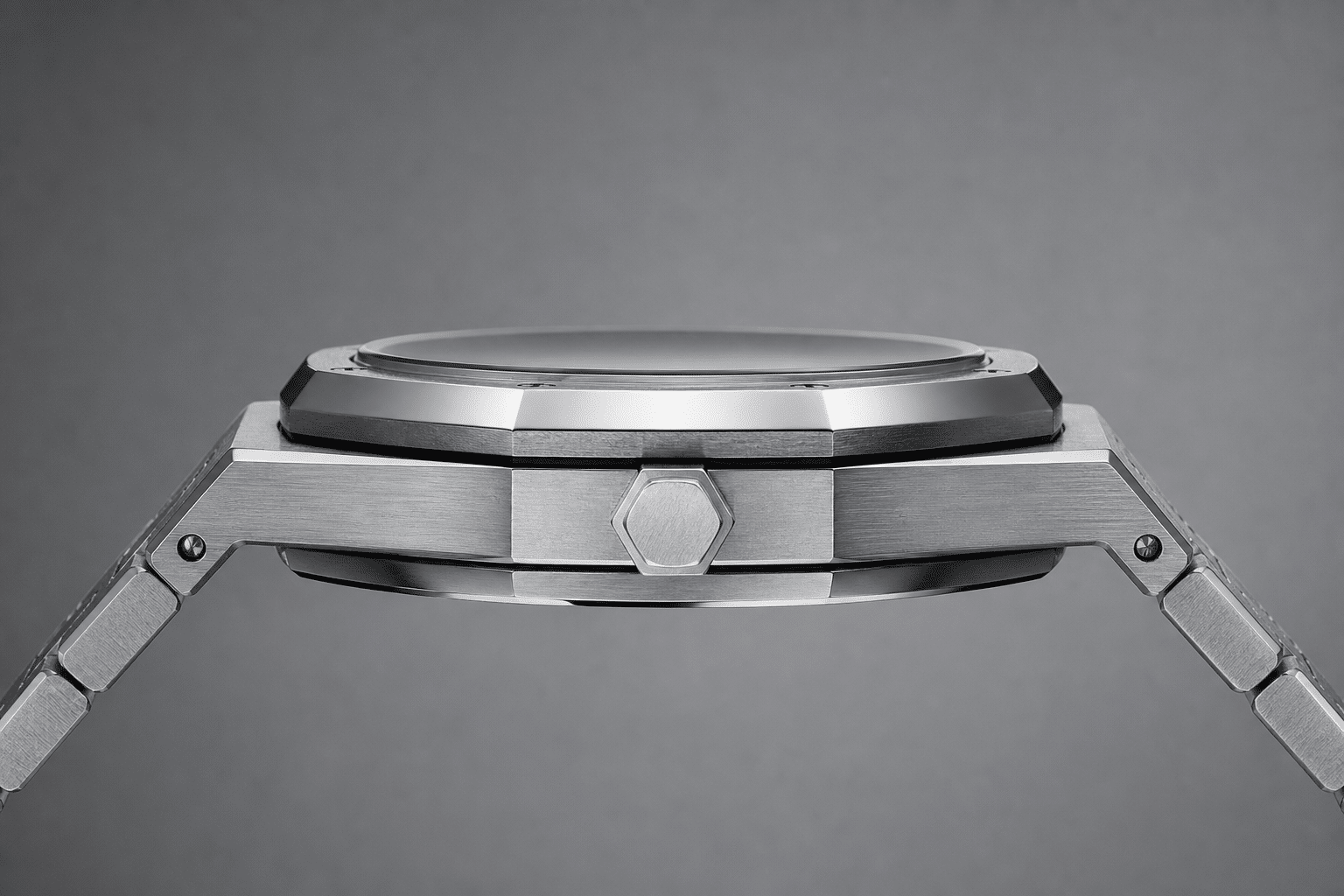
Side Profile Photos Reveal Case Thickness and Royal Oak Proportions
A straight front photo can make many Royal Oak replicas look more convincing than they really are. The side profile photo is where the watch has fewer places to hide. AP replica case thickness matters because the Royal Oak is not meant to read like a tall, chunky sports watch. Its appeal comes from a slim, layered case, a flat octagonal bezel, a controlled crystal height, and a bracelet that appears to flow directly out of the case.
This is why Royal Oak side profile QC should not be treated as a secondary angle. A watch can have an attractive dial and a clean bezel from the front, yet still look wrong on the wrist if the mid-case is too tall, the caseback protrudes heavily, or the bracelet drops awkwardly from the lugs. For AP, thickness is not just a measurement. It changes the entire attitude of the watch.
Why Thinness Matters to the Royal Oak Look
The Royal Oak design depends on tension between sharp geometry and elegant thinness. The bezel, mid-case, caseback, and bracelet are supposed to look like connected layers rather than a thick block with a bracelet attached. On a well-executed AP super clone, the case profile should feel controlled from the side, with the bezel and caseback not visually overpowering the mid-case.
This is where buyers often misjudge AP replicas. They focus on whether the watch is 39mm, 41mm, or whether the dial color looks close, but a too thick Royal Oak replica can lose the character of the original design faster than a small dial text issue. A slightly imperfect print may be hard to notice during normal wear. A bulky case profile is visible every time the watch sits above the wrist cuff.
Exact thickness should always be checked by model and factory version, because a 15202-style Jumbo, a 15400, a 15500, and a chronograph do not share the same tolerance. The practical rule is simpler: if the side view makes the watch look like a generic thick sports watch, the Royal Oak proportions are already compromised.
What the Side Photo Can Reveal That the Front Photo Cannot
A proper side profile photo should show the case as a complete structure: bezel height, crystal height, mid-case thickness, caseback thickness, and the first bracelet link transition. These areas rarely reveal themselves in a polished front beauty shot. Sellers and factories know the Royal Oak photographs well from the front. The side image is less flattering, but much more useful.
Look first at whether the caseback bulges too aggressively. Some movement routes and decorated movement assemblies can force extra caseback height, and while that does not automatically make the watch bad, it can make the watch sit higher than expected. A small increase may be acceptable on some references. A dome-like caseback or a visibly thick rear section is more serious because it changes both wearability and wrist presence.
Then check the bezel and crystal stack. The Royal Oak bezel should not look like a tall cap sitting on a thick base. The crystal should appear integrated rather than raised in a way that draws attention from the angular case line. If the bezel height, crystal height, and mid-case all look individually heavy, the side profile will feel inflated even if the front view is clean.
The last detail is the integrated bracelet transition. The first bracelet link should exit the case in a controlled line, not hang down abruptly or create a visible step. This is one of the more important AP case shape checks because the Royal Oak is designed as a case-and-bracelet object. If the bracelet appears disconnected from the case in side view, the watch will usually feel less refined on the wrist.
Thickness Is Both a Visual and Wearing Issue
Case thickness is easy to treat as a spec-sheet concern, but on AP replicas it is also a daily wear comfort issue. A Royal Oak-style case that sits too tall can feel top-heavy, especially because the case is broad, angular, and mounted to an integrated bracelet. The watch may look acceptable in a tray photo but feel clumsy once the bracelet is sized and the case starts catching cuffs.
At Clean VS Factory, we usually treat side profile photos as risk-reduction images rather than decoration. They help separate a visually impressive replica from one that actually carries the Royal Oak shape properly. A buyer who skips this angle may approve a watch that photographs well but wears with the wrong mass and posture.
The clearest warning sign is not a tiny fraction of extra thickness. It is imbalance. If the mid-case looks swollen, the caseback protrudes sharply, and the bracelet does not flow naturally from the case, the watch is not just slightly off. It is losing the design language that makes the Royal Oak convincing in the first place.
The Bracelet and End Links Can Make or Break an AP Replica
The Royal Oak bracelet is not an accessory attached after the watch is designed. It is part of the architecture. That is why an Audemars Piguet replica bracelet check matters more than it would on many watches with standard lugs or leather straps. If the end-link fit is loose, the first links do not articulate cleanly, or the brushing changes character from case to bracelet, the whole watch looks less coherent.
This is also why AP replica bracelet fit should be judged from more than one photo. A front image may hide gaps at the case connection. A wrist-style angle may hide uneven link spacing. A clasp photo may reveal rough finishing that the rest of the watch does not show. QC photos cannot prove long-term comfort or durability, but they can catch the obvious bracelet problems that make an AP replica feel cheaper than its dial suggests.
Integrated Bracelets Leave Fewer Places to Hide Gaps
On a conventional watch, a small gap between strap and case may not ruin the whole impression. On a Royal Oak replica, the case-to-bracelet transition is one of the main visual signatures. The first link should feel like it belongs to the case shape, with a controlled gap and a natural drop. If the transition looks loose, crooked, or visually disconnected, it becomes noticeable quickly.
A useful bracelet gap check looks at both sides of the case. One side should not sit visibly higher or farther away than the other. Small tolerances are normal in replica watch manufacturing, and lighting can exaggerate a shadow. The issue becomes more serious when the gap remains visible across multiple photos or when the first link appears to pull away from the case rather than pivot from it.
Pay attention to articulation as well. The bracelet should not look rigid at the head link, but it also should not appear floppy or poorly controlled. A Royal Oak bracelet close-up that shows uneven first-link behavior is worth slowing down over, because this area affects both the visual flow and how the watch sits on the wrist.
Finishing Consistency Matters Across Every Link
AP-style bracelets expose finishing quality because every link has flat brushed surfaces and polished bevels. Inconsistent brushing direction, cloudy polished edges, or rounded bevel transitions stand out more here than on a simpler oyster-style bracelet. The bracelet has many repeating surfaces, so a single rough area can disrupt the pattern.
The most useful QC photos are not only the glamorous top-down bracelet shots. Look for close-ups that show the first several links, the side edges, and the transition from brushed flat sections to polished bevels. If the case has sharper brushing than the bracelet, or the bracelet bevels look soft and uneven, the watch may feel less controlled in hand than it appears in a full-front photo.
There is a hierarchy here. A tiny difference in light reflection across one link may not matter. Uneven link spacing, rough edges, mismatched brushing direction, or a visibly crude bracelet transition matters much more. AP replicas rely heavily on bracelet quality for their daily-wear impression, so this is not an area to dismiss just because the dial looks strong.
Clasp Photos Should Not Be Treated as Optional
The clasp is less visible during normal wear, but it tells you a lot about the build standard of the bracelet. AP clasp QC should include closure alignment, engraving cleanliness, interior finishing, and whether the clasp sits square when closed. A bracelet that looks good from the top can still feel disappointing if the clasp is rough, misaligned, or weak in its visual execution.
QC photos will not tell you exactly how satisfying the clasp action feels, and they cannot guarantee future durability. They can, however, show obvious issues such as uneven closure, poor finishing on the clasp plates, rough edges, or inconsistent engraving. These are not always deal-breakers, but they should affect expectations.
For AP replicas, the clasp should be viewed as part of the bracelet system. If the end links are uneven, the bracelet finishing is inconsistent, and the clasp looks careless, the problem is no longer one isolated flaw. It suggests the bracelet was not executed at the same level as the case and dial.
Bracelet and Clasp Checks
Look for even end-link fit, consistent link spacing, clean brushing, aligned clasp closure, controlled link articulation, and no obvious gaps where the bracelet meets the case. Minor photographic shadows are normal; repeated visible separation or uneven finishing across several angles is the issue that should concern a buyer.
Angled Photos Help Separate Real Flaws From Camera Distortion
AP replica QC angles are important because the Royal Oak is both easy to photograph beautifully and easy to misread. The same polished bevel that makes the watch look sharp can also create harsh reflections. The same brushed surface that looks uneven in one photo may look perfectly normal in another. A single photo is not enough, but the reason is not only that sellers may choose flattering angles. It is also that AP finishing reacts strongly to light.
The practical rule is simple: one questionable image should trigger cross-checking, not immediate certainty. If a screw slot looks dark in one image, a dial appears slightly tilted, or a bracelet gap seems larger than expected, the next step is to compare straight, angled, and close-up views. Repeated evidence matters more than one suspicious frame.
Why a Beauty Shot Can Be Misleading
A beauty shot usually shows the Royal Oak from its strongest angle: straight front, controlled lighting, bracelet arranged neatly, and reflections managed to emphasize the octagonal case. That can be useful for judging general presence, but it can hide the problems that affect ownership satisfaction. Side thickness, caseback protrusion, bracelet gaps, clasp finishing, and uneven surface transitions are often outside the frame or softened by lighting.
This is why Royal Oak QC photos need context. A watch that looks excellent in the main image may still have a bulky side profile or poor bracelet transition. The front view is the opening argument, not the verdict. For AP replicas, the watch has to hold its shape from several angles because the design itself is built around exposed geometry.
How Reflections Affect AP Brushing and Polished Bevels
AP-style finishing creates sharp contrast between brushed surfaces and polished bevels. That contrast is attractive, but it can also distort what the camera shows. A polished bevel may flare white under strong light and look wider than it is. A brushed surface may catch shadow and appear stained or uneven. A screw slot may look black simply because it is reflecting a dark area of the room.
This is where buyers sometimes reject too quickly or approve too casually. Overreacting to one harsh reflection is a mistake. Ignoring a flaw that appears in every angle is also a mistake. The better approach is to ask whether the suspected issue moves with the light or stays fixed on the watch. A reflection changes character from photo to photo. A real assembly issue usually remains visible.
Repeated Problems Across Angles Matter More
A real QC concern becomes stronger when it appears in straight, angled, and close-up images. If the same end-link gap is visible from the front and side, it is probably not just shadow. If the case looks thick in every side angle, it is not only lens distortion. If a finishing inconsistency appears across multiple bracelet photos, it deserves more weight than a single glare-heavy image.
The opposite is also true. If a suspected problem disappears when the angle changes, it may be a camera issue rather than a watch issue. AP replica QC is partly about spotting flaws, but it is equally about not creating flaws from bad photo interpretation. A careful buyer does not need endless images. The buyer needs enough angles to confirm whether the concern belongs to the watch or to the photo.
QC photos cannot prove movement health, waterproofing, or long-term reliability. Their job is narrower but still important: they reduce visual blind spots. For a Royal Oak replica, that reduction matters because the watch’s design gives small alignment, thickness, and finishing issues very little room to hide.
Caseback and Movement Layout Photos Still Have a QC Role
Caseback photos are not the first thing to judge on an AP replica, but they still matter. On many Royal Oak models, the rear view can confirm whether the claimed movement route and visible layout make sense for the version being offered. It can also show whether the caseback is seated cleanly, whether the screws look abused, and whether the rotor and decoration match the seller’s description closely enough to avoid an obvious mismatch.
The mistake is treating an AP rotor photo as proof of quality. A decorated movement can look impressive in a still image and still have ordinary winding feel, inconsistent power reserve, rotor noise, or long-term service concerns. AP replica caseback QC is useful because it reduces version confusion, not because it guarantees the watch will perform like the genuine caliber.
Movement Choice Affects Ownership More Than the Rear Photo Suggests
AP replicas often force a tradeoff between visual similarity and ownership simplicity. A thinner or more visually convincing movement route may improve the caseback view or help the side profile, but it may also be harder to service, noisier, or less forgiving if the buyer expects daily wear. A decorated base movement may look less impressive through the caseback, but in some cases it can be easier to understand and maintain. Neither route is automatically better without considering the model and buyer’s intended use.
This matters especially for first-time AP buyers. A complicated AP replica with extra functions, skeletonized parts, or a heavily decorated movement can look more exciting in seller photos, but it may also add more points of failure and more QC uncertainty. A simpler time-and-date Royal Oak is often easier to evaluate because the buyer can focus on case geometry, date alignment, bracelet fit, and basic movement behavior instead of trying to assess a complex mechanism from limited photos.
When reviewing movement claims, it is useful to separate three questions. Does the visible layout match the seller’s description? Does the movement choice help the watch keep the correct case thickness? And is the movement route reasonable for the way the buyer plans to wear the watch? A photo can help answer the first two questions, but it usually cannot answer long-term reliability. That is why movement images should support the QC decision without replacing external checks.
Movement Photos Are Useful Evidence, but Only for Narrow Questions
A movement photo is strongest when it is used to answer a narrow visual question. Does the rotor shape look consistent with the version described? Are the visible bridges and plates broadly in the expected place for that seller’s claimed route? Does the caseback appear properly seated rather than obviously lifted? These are reasonable photo-based questions because they deal with visible layout and assembly condition.
The same image becomes weak evidence when it is used to answer broad performance questions. It cannot prove that the watch has been regulated well, that the power reserve matches a claimed number, that the automatic winding system will stay quiet, or that future service will be simple. A decorated AP-style movement may improve presentation, but decoration should not be confused with mechanical equivalence to an authentic caliber.
Buyers should also be cautious when a listing uses exact movement names or clone-movement language without clear supporting images. A seller description may be helpful, but the QC review should not assume the claim is true simply because the caseback looks attractive. If movement route is important to the purchase, ask for a clear caseback photo and judge only what the image can reasonably show.
Movement Transparency Note: Movement references in AP replica QC describe replica-market movement routes, visible layouts, or decorative configurations, not an official Audemars Piguet caliber unless supported by verifiable evidence, so an Audemars Piguet super clone buying guide should be treated as a version-screening reference rather than proof of genuine factory specification. Buyers should use movement photos to reduce version uncertainty, while understanding that ordinary QC images cannot prove regulation quality, lubrication condition, water resistance, serviceability, or long-term reliability.
What a Caseback Photo Can Confirm
A good caseback photo should show the visible movement layout clearly enough to compare with the claimed model route. For example, if a Royal Oak replica is advertised with a specific clone-style movement, the balance position, bridge layout, rotor shape, and general architecture should not look like a random decorated base movement hidden under plates. The photo does not need to be a watchmaker’s inspection, but it should be clear enough to catch a wrong or inconsistent movement claim.
The rotor deserves attention because it is often the most visible shortcut. Look for whether the rotor shape, color, engraving, and cutout style are broadly consistent with the claimed version. Engraving that looks extremely shallow, crooked, overly thick, or dirty does not automatically make the watch unusable, but it does weaken the overall impression. On an AP-style exhibition caseback, the rear side is part of the watch’s presentation, not a detail that disappears completely.
Caseback screws also matter more than buyers expect. Damaged screw heads, uneven seating, or a caseback that appears slightly lifted can suggest rushed assembly or prior handling. This is especially important on Royal Oak models because the case is visually engineered around sharp, clean lines. A sloppy rear assembly may not be visible on the wrist, but it is still a warning sign about how the watch was finished and handled before QC.
What a Caseback Photo Cannot Guarantee
A caseback photo cannot prove power reserve, water resistance, regulation quality, lubrication condition, or long-term movement health. It cannot tell you whether the movement was assembled cleanly inside, whether the rotor bearing will become noisy, or whether the date mechanism will remain stable after months of use. This is where buyers often overread the image. A sharp-looking movement photo is not the same as mechanical assurance.
Water resistance is another area where photos are especially limited. Even if the caseback appears flush and the screws look clean, that does not confirm gasket condition, pressure testing, crown sealing, or proper assembly under the caseback. For an AP replica, the safer assumption is that a caseback photo can show obvious visual problems but cannot prove the watch is ready for swimming, showering, or heavy moisture exposure.
The same restraint applies to movement decoration. Some decorated movements are visually close enough for casual viewing through an exhibition back, but decoration does not mean the movement functions like the genuine AP caliber. Plates, bridges, and rotors can improve appearance while still sitting over a different architecture. This is why movement photos should be read as version evidence, not as a promise of genuine-level engineering.
Why Movement Route Belongs in QC but Not as the Only Decision Factor
Movement route confirmation belongs in Royal Oak movement layout review because AP replicas can vary sharply between integrated clone-style routes and decorated base-movement routes, depending on model, factory, and batch. If the watch is priced or described as a higher-tier AP super clone, the rear view should support that claim. If it does not, the buyer should pause before accepting the watch simply because the front dial looks clean.
Still, movement route should not override visible external flaws. A more attractive caseback does not compensate for a crooked date window, uneven bezel screws, excessive case thickness, or a bracelet that does not integrate cleanly with the case. With AP, the watch is judged as a complete visual object. A strong movement photo is useful only if the rest of the watch also holds together.
The practical judgment is simple: use the caseback photo to confirm the claimed version and assembly cleanliness, but do not let it become the whole QC decision. For AP replicas, especially Royal Oak models, the front geometry, side profile, bezel execution, and bracelet fit still carry more daily-wear impact than movement decoration viewed from the back.
Common AP QC Mistakes Buyers Make When Reviewing Photos
The most common AP replica QC mistakes come from reacting too quickly. Royal Oak replicas can look excellent in a single polished photo because the design is instantly recognizable: octagonal bezel, tapisserie dial, exposed screws, integrated bracelet. But the same watch can start to fall apart visually once the buyer checks thickness, screw seating, bracelet transition, date position, and caseback assembly together.
A realistic scenario is easy to imagine. A buyer sees a strong dial photo, likes the blue tone, and gives the watch a mental approval within seconds. Later, the side profile shows a bulky caseback, the bezel screws sit at uneven depths, and the first bracelet link has a visible gap. None of those problems required expert authentication knowledge. They were missed because the buyer judged the watch as a dial picture instead of a complete Royal Oak-style object.
Mistake 1: Trusting One Straight-On Photo
A straight front image is necessary, but it is not enough for Royal Oak replica inspection. It can show dial centering, screw positions, marker placement, and date alignment, but it cannot show whether the case is too thick, whether the caseback protrudes awkwardly, or whether the bracelet leaves the case cleanly. AP is especially unforgiving because the front view is only one layer of the design.
This mistake is often caused by front photo bias. Buyers naturally focus on the most attractive image, especially if the tapisserie dial looks sharp and the bezel outline appears symmetrical. The better habit is to delay judgment until the side profile, bracelet close-up, clasp, and caseback have been reviewed. If those supporting photos are weak or missing, the front photo should be treated as incomplete evidence.
Mistake 2: Ignoring the Bracelet Because the Dial Looks Good
On a Royal Oak-style watch, the bracelet is not secondary. It is part of the case architecture. Bracelet gaps, stiff end links, uneven link spacing, or inconsistent brushing can damage the whole watch more than a small dial-printing flaw. A strap-based watch can sometimes hide a mediocre strap replacement; an integrated-bracelet AP cannot hide a poor case-to-bracelet transition as easily.
This is one area where buyers often misjudge value. They may accept a weak bracelet because the dial and bezel look strong, but the bracelet is what the wearer feels and sees throughout the day. If the first link sits poorly, if the clasp looks rough, or if the finishing changes noticeably from case to bracelet, the watch will feel less convincing even if the front photo looked impressive.
Mistake 3: Treating Movement Decoration as Proof of Overall Quality
A decorated caseback can create false confidence. Some buyers see an AP-style rotor, engraved bridges, and a busy movement layout, then assume the entire replica must be high grade. That is a risky shortcut. Movement decoration is only one part of AP QC, and it does not cancel out visible flaws in date alignment, bezel screw alignment, case thickness, or bracelet fit.
The stronger judgment is to separate appearance layers. A good-looking movement photo may support the claimed movement route, but it does not prove the dial is centered or the case is proportioned correctly. For daily wear, the external geometry usually matters more than a decorative movement seen only when the watch is off the wrist.
Mistake 4: Overreacting to One Distorted Photo
The opposite mistake is rejecting too quickly based on one bad image. AP surfaces catch light aggressively because of the mix of brushed flats and polished bevels. A screw slot may look darker in one angle, a dial may appear slightly rotated because the camera is tilted, or a bracelet gap may look larger due to shadow. One questionable photo should trigger comparison, not instant certainty.
Repeated evidence matters more. If the same date alignment issue appears in the straight front photo, the close-up, and the angled image, it is more likely to be real. If a suspected screw problem disappears in better lighting and does not repeat from another angle, it may be reflection or lens distortion. Good AP QC is not about being paranoid; it is about knowing which problems remain visible after cross-checking.
The practical red flags are the ones that survive multiple photos: a clearly off-center date, visibly uneven bezel screw seating, a case profile that looks too bulky from the side, or a bracelet transition that appears loose in more than one view. Minor lighting oddities are acceptable. Structural visual problems are not.
The Recommended QC Photo Set for an AP Super Clone
A useful AP replica QC photo set is not about collecting endless images. It is about getting the angles that reveal the design risks AP exposes most clearly. For a Royal Oak or similar AP super clone, the essential views are straight front, angled front, side profile, bezel close-up, bracelet close-up, clasp, date window close-up, and caseback. Each view answers a different question, and skipping one creates a blind spot.
The priority should be front alignment first, side proportion second, then bezel screws and bracelet integration. Caseback photos still matter, but they should not distract from the visible features that define the watch on the wrist. A complete photo set cannot guarantee perfect quality, long-term reliability, or water resistance. It simply gives the buyer enough evidence to avoid approving a watch based on one flattering image.
Straight Front Photo
The straight front photo should be level, centered, and clear enough to evaluate the whole face as one system. Use it to judge dial centering, bezel symmetry, screw placement, hour marker alignment, hand position, tapisserie grid alignment, logo placement, and date window position. If the photo is tilted or heavily distorted, it can still be useful, but it should not be the only front-facing evidence.
For Royal Oak QC checklist purposes, the date window deserves special attention in this view. AP dials are structured and geometric, so a date that sits too high, low, left, or right can disturb the whole dial balance. A small imperfection may be acceptable depending on buyer tolerance, but an obviously mispositioned date should not be dismissed as a tiny detail.
Angled Front and Bezel Close-Up
The angled front photo helps confirm whether suspected front-view issues are real. It can show how the bezel brushing, polished bevels, screw slots, and crystal edge behave under different light. A bezel close-up is especially important because Royal Oak bezel screws are part of the watch’s identity. They are not hidden hardware.
Use these photos to check screw seating, screw depth, spacing consistency, and whether the bezel finishing looks reasonably clean. A single dark screw slot may be lighting. A screw that appears sunken, raised, or off-center across several photos is more meaningful. The goal is not perfection; the goal is avoiding a visually distracting flaw that will draw the eye every time the watch is worn.
Side Profile Photo
The side profile photo is one of the most important photos needed for AP QC because the Royal Oak look depends heavily on proportion. Use it to judge case thickness, caseback protrusion, crystal height, bezel height, mid-case shape, and how the bracelet exits the case. A watch that looks strong from the front can feel wrong from the side if the case is too tall or the bracelet transition is awkward.
This view also affects daily-wear judgment. Excess thickness does not only make the replica less visually refined; it changes how the watch sits on the wrist. A Royal Oak-style case should feel layered and controlled, not like a tall generic sports watch with an AP dial and bezel attached.
Bracelet, Clasp, Date Window, and Caseback Photos
Bracelet close-ups should show the end-link fit, first-link transition, link spacing, brushing direction, polished bevels, and any visible gaps where the bracelet meets the case. The clasp photos should show whether the clasp sits square when closed, whether the engraving looks clean, and whether the inner plates appear roughly finished or reasonably controlled. These details are not only cosmetic; they affect how complete the watch feels as a Royal Oak-style object.
The date window close-up should confirm that the printed numeral is centered enough inside the aperture and that the frame does not look crooked against the tapisserie grid. The caseback photo should confirm visible movement layout, rotor style, screw condition, and whether the caseback appears seated. These images are useful, but they should be read carefully: they show visible condition, not hidden mechanical health.
Before making a decision, buyers should review real QC photos where available, including dial printing, hand alignment, bezel position, datewheel centering, bracelet fit, clasp engraving, case thickness, and overall finishing. Factory labels and stock photos alone are not enough for a reliable AP Royal Oak judgment.
Seller Claims, Policies, and Water Resistance Should Be Checked Separately
QC photos can reduce uncertainty, but they do not replace seller-policy verification. Before ordering, buyers should confirm return terms, repair options, shipping expectations, payment process, and after-sales support directly with the seller rather than assuming those terms from a factory label, photo set, or model name. A clean AP QC set can show visible execution, but it cannot prove how a seller will handle issues after delivery.
Water resistance deserves its own check because a Royal Oak-style case, screw-down appearance, or clean caseback photo does not prove pressure testing. Buyers should not assume swimming, showering, or heavy moisture use is safe unless the specific watch has been tested and the seller’s policy is clearly confirmed. Even then, replica watches should be treated more cautiously around water than genuine watches serviced through official brand channels.
Pricing should also be read with context. Replica watch prices can vary by factory label, version, movement configuration, finishing quality, seller channel, availability, and after-sales support. A higher price does not automatically prove better alignment, and a lower price does not automatically prove a poor watch. The most useful comparison is like-for-like: same reference, same factory label, same movement route, similar photo evidence, and similar seller terms.
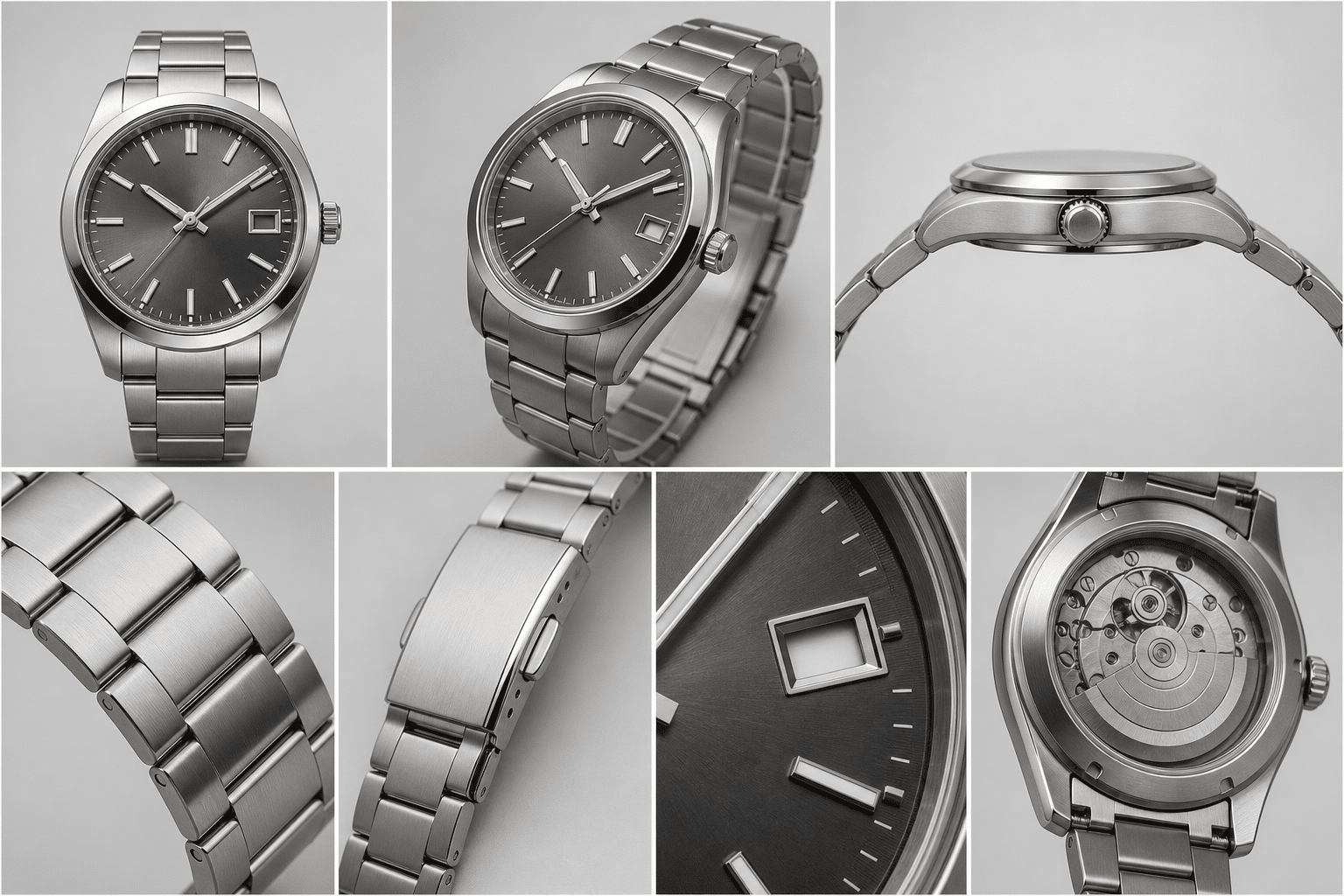
How to Make the Final AP QC Decision
The final AP QC decision should combine the whole photo set instead of treating one strong image as the answer. Start with the straight front photo, then confirm the same impression through angled views, side profile, bracelet close-ups, clasp, date window, and caseback. If the watch looks balanced from the front but loses control from the side or at the bracelet transition, the approval should be reconsidered.
A practical way to decide is to separate minor photo uncertainty from repeated watch evidence. Minor uncertainty includes glare on one screw, shadow near one bracelet link, or a dial color that shifts under lighting. Repeated watch evidence includes the same uneven screw seating across several images, a consistently bulky case profile, a date that remains off-center in multiple views, or an end-link gap that does not disappear when the angle changes.
Version-specific judgment matters here. A factory or version may be stronger on one Royal Oak reference than another because the movement route, case thickness, dial construction, bracelet structure, and date position can change by model. A 15202-style watch should not be judged with the same tolerance as a thicker chronograph or skeleton-style AP replica, and a buyer should avoid applying one universal “best factory” answer to every AP case size and configuration.
A Simple Accept, Pause, or Reject Framework
An AP replica is easier to approve when the front layout is centered, the bezel screws look evenly seated, the tapisserie grid does not fight the markers, the date is reasonably centered, the side profile looks controlled, and the bracelet flows naturally from the case. It does not need to be flawless, but the main Royal Oak geometry should hold together across the full photo set.
A pause is appropriate when the watch looks strong in some photos but uncertain in others. For example, if one screw looks dark, one bracelet gap appears suspicious, or the date looks slightly high in a tilted photo, the better response is to compare additional angles or request clarification rather than making a fast decision. QC photos reduce uncertainty, but they do not remove every risk, so repeated evidence should carry more weight than one isolated frame.
A rejection becomes more reasonable when the same problem remains visible across multiple images: uneven bezel screws, a visibly shifted dial, a poorly centered date, a swollen caseback, rough bracelet finishing, or a loose end-link transition. These are not hidden technical issues; they are visible design problems that affect the Royal Oak’s main visual identity.
Traceability Is About Matching Claims to Evidence
For CleanVSFactory, the goal of AP QC guidance is to make the decision more traceable by connecting factory names, version claims, movement descriptions, and visible photo evidence. A seller’s description can help identify the model route, but it should not replace the buyer’s own review of the actual watch images. The safest judgment is always tied to the specific reference and the specific unit being offered.
Claims such as “top version,” “latest batch,” or “best factory” should be treated as starting points, not conclusions. A more useful comparison asks whether the visible details support the claim: does the case thickness match the intended model character, does the bracelet fit the case cleanly, does the dial grid align with the markers, and does the movement photo broadly support the described configuration? If the evidence is weak, the label alone should not carry the decision.
This type of traceability is especially important for AP because the Royal Oak design is unforgiving. The buyer does not need an official brand-level inspection to spot many practical problems. The visible evidence in QC photos can already answer several important questions if the buyer reads the watch as a complete case, dial, bezel, bracelet, clasp, and caseback system.
Final Thoughts on AP Replica QC Photos
QC photos matter more for AP replicas because the Royal Oak design exposes small errors instead of hiding them. The octagonal bezel, visible screws, tapisserie dial, angular case, and integrated bracelet create a strict visual structure. When that structure is clean, the watch can look coherent and satisfying. When it is off, even a strong dial color or impressive caseback will not fully save the impression.
The most useful AP QC habit is restraint. Do not approve a watch because one front photo looks beautiful, and do not reject a watch because one reflection looks strange. Compare the full set of images, look for repeated evidence, and judge the details that Royal Oak geometry makes most visible: bezel screw seating, dial grid alignment, date position, case thickness, bracelet flow, clasp execution, and caseback consistency.
A replica watch should also be evaluated with realistic ownership expectations. Even a strong AP super clone can have limits in water resistance, long-term movement stability, servicing convenience, and close inspection compared with an authentic Audemars Piguet reference. The safest purpose of QC is not to prove perfection, but to reduce avoidable mistakes before the buyer accepts a specific watch.
In the end, AP QC is less about chasing a perfect label and more about verifying a specific example. A factory name may help narrow the search, but the actual photo set should decide whether the watch has the geometry, proportion, finishing, and bracelet integration that make a Royal Oak-style replica convincing in daily use.
Disclosure: This article is for general educational and comparison purposes only. Replica watches are not genuine products from the original luxury brands, and brand names are used only to identify reference designs or comparison topics. Factory names, movement descriptions, prices, availability, QC details, seller policies, and version information can change, so readers should verify important details with the seller before making a purchase decision. Replica watches should not be represented, resold, or used as genuine watches.