
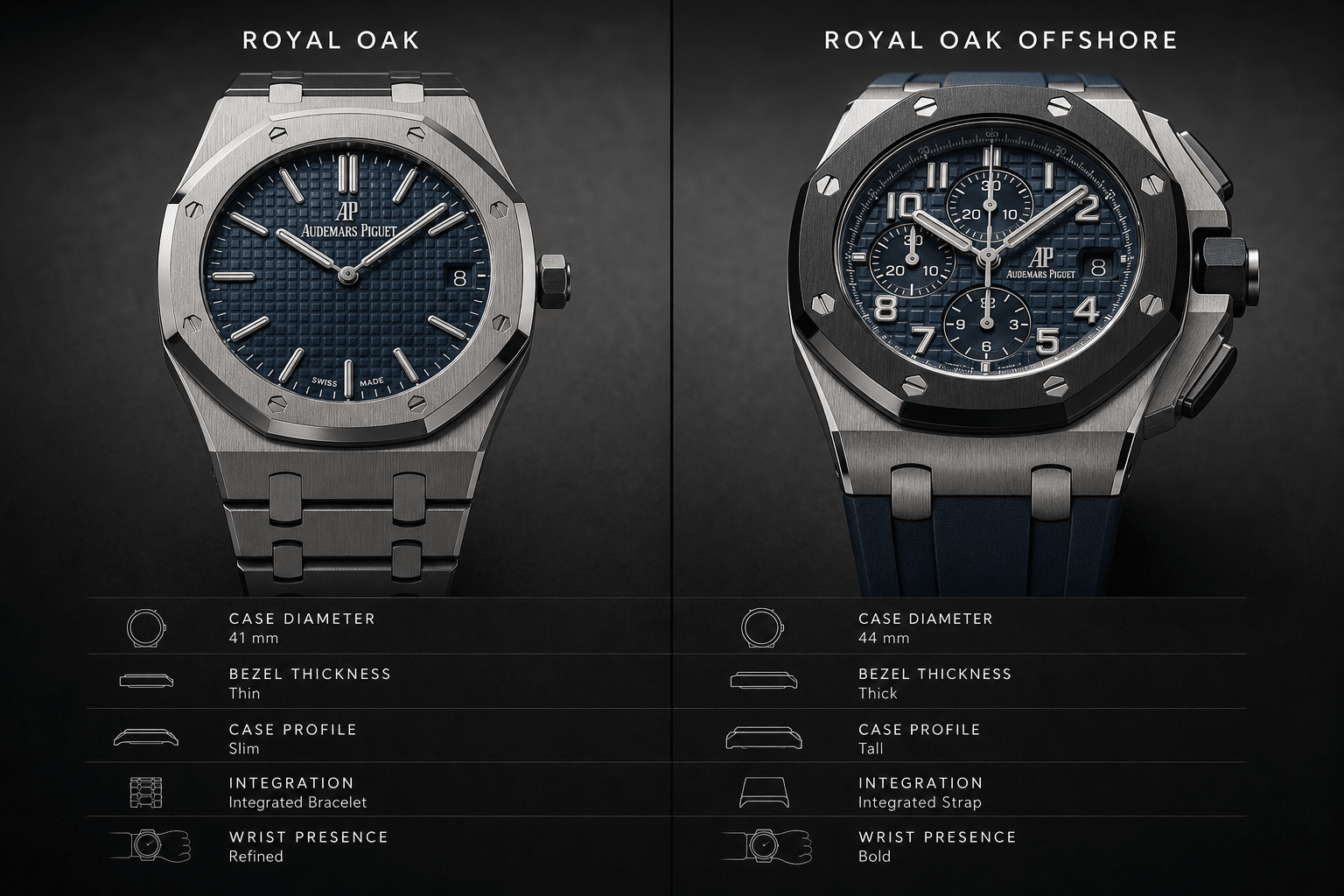
Choosing a first AP-style super clone is less about which model looks more impressive in photos and more about what will actually work on your wrist, especially when AP super clone water resistance affects daily expectations around crowns, gaskets, and case sealing. The Royal Oak and Royal Oak Offshore share the same broad design language, but they behave very differently in daily use. The Royal Oak is thinner, cleaner, and more versatile, while the Offshore is larger, thicker, sportier, and more mechanically complex.
This article helps first-time buyers judge that trade-off realistically. It looks at comfort, case thickness, bracelet or strap fit, visual details, chronograph risk, movement practicality, and QC priorities. The main takeaway is simple: if you are unsure, the Royal Oak is usually the safer starting point; the Offshore makes more sense only if you already want bold size, rubber-strap presence, and a sportier chronograph look.
Brand names are used here to identify the genuine reference design being discussed. Replica watches are not genuine products from the original luxury brands and should not be represented, sold, or used as authentic watches. Factory names in the replica watch market are useful buyer-facing references, but they should not be treated as official brand affiliations or automatic guarantees of quality across every model.
| Decision Point | Royal Oak | Royal Oak Offshore |
|---|---|---|
| First-watch suitability | Safer for most beginners | Better for buyers used to large sports watches |
| Daily comfort | Thinner case and integrated bracelet wear more easily | Thickness, weight, and strap fit need extra caution |
| Most important QC checks | Bezel screws, brushing, bevels, tapisserie dial, bracelet flow | Side profile, pushers, strap integration, subdial and date alignment |
| Movement concern | Simpler layout usually means fewer functional risks | Chronograph reset, pusher feel, rotor noise, and serviceability matter more |
| When paying more makes sense | Better finishing, bracelet feel, and thin proportions | Better proportion control, strap fit, and more stable chronograph behavior |
Quick Questions Before You Read
Q: Which is usually better as a first AP super clone?
The Royal Oak is usually the safer first choice because it is thinner, more versatile, and easier to wear daily.
Q: Is the Offshore a bad choice for beginners?
Not always. It suits buyers who already like large, thick, sporty chronographs and accept extra comfort and movement considerations.
Q: What detail should be checked first on a Royal Oak?
Start with bezel screw seating, brushing, polished bevels, tapisserie texture, date position, and bracelet flow.
Q: What makes the Offshore riskier to choose?
Its thickness, weight, strap fit, chronograph functions, pusher feel, and movement serviceability can affect ownership more than photos suggest.
Editorial Perspective: For a first AP super clone, cleanvsfactory.com treats the Royal Oak versus Offshore decision as a use-case question, not a simple factory ranking. A factory name, seller photo, or higher price can help narrow the shortlist, but it does not prove that a specific watch will suit your wrist or ownership expectations. The more useful comparison is whether the case thickness, bracelet or strap behavior, movement route, chronograph complexity, and known QC weak points match how you actually plan to wear the watch.
Evidence Boundary: This guide discusses imitation watches and buyer decision logic, not authorized Audemars Piguet products. Official brand information can help clarify what the authentic Royal Oak and Royal Oak Offshore families are known for, but it cannot prove that any replica has identical dimensions, finishing, materials, water resistance, movement construction, or service quality. For that reason, the recommendations below avoid treating factory labels, seller claims, or marketing phrases such as “1:1” as proof.
When a replica listing claims a specific movement, steel grade, water-resistance level, or factory version, the claim should be checked against the individual watch being offered. QC photos, movement photos, seller transparency, and post-purchase inspection matter more than broad wording. A Royal Oak-style replica and an Offshore-style replica may both look convincing in front-facing photos, but the ownership risks are different: the Royal Oak exposes finishing and bracelet flaws more quickly, while the Offshore adds thickness, strap fit, pusher alignment, and chronograph behavior to the checklist.
The purpose of factory, movement, and QC information in this guide is to help readers understand quality differences and ownership risk, not to help anyone represent a replica watch as genuine. A strong super clone may look convincing in normal wear, but close inspection can still reveal differences in finishing, movement architecture, case proportions, bracelet feel, dial details, or service compatibility.
The Short Answer: Most First-Time Buyers Should Start With the Royal Oak
If this is your first AP super clone, the Royal Oak is usually the safer first choice. It gives you the core Audemars Piguet look: the octagonal bezel, integrated bracelet, sharp case lines, and tapisserie dial, without forcing you immediately into the bulk, visual loudness, and chronograph-related compromises that often come with a Royal Oak Offshore replica.
The Offshore is not a bad choice by default. It can be the right AP super clone for a buyer who already likes large sports watches, rubber straps, thick cases, and aggressive wrist presence. The problem is that many first-time buyers choose the Offshore because it looks more dramatic in photos, then later realize it is harder to wear every day. For a beginner buyer asking “which one should I buy first,” the answer is not neutral: the Royal Oak is usually easier to live with.
The best first Audemars Piguet replica should not only look exciting on a screen. It should fit your wrist, match your clothing, feel comfortable for several hours, and avoid unnecessary mechanical complexity. On those points, a time-and-date Royal Oak-style replica usually has a wider comfort zone than a larger Offshore chronograph.
A more traceable first decision is to separate three questions that are often mixed together: which design family suits your wrist, which factory-market version is being offered, and which individual watch has acceptable QC evidence. The Royal Oak versus Offshore choice should come before the factory name, because a strong factory label cannot make an oversized Offshore comfortable if the case height, strap flare, and chronograph layout do not fit your daily use.
Why the Royal Oak Is Usually the Safer First Step
The Royal Oak works better as a first AP because it captures the classic AP identity in a more controlled package. The case is generally thinner, the bracelet is part of the design rather than an accessory, and the watch can move between casual, office, and smarter clothing more naturally than most Offshore models.
This matters because the Royal Oak is already a visually strong watch. Even without chronograph pushers or oversized case guards, the shape is instantly recognizable. The octagonal bezel, exposed screws, flat planes, and integrated bracelet create enough presence on their own. A first-time buyer usually does not need to jump straight to the loudest AP design to feel the brand’s character.
The Royal Oak also makes more sense if you are unsure about your tolerance for weight and thickness. It can still wear broad because of the integrated bracelet, so it is not automatically small or subtle. But compared with an Offshore, it is usually the less risky AP style for daily wear, especially if you want one watch that does not feel out of place with a shirt, jacket, or normal weekday clothing.
When the Offshore Can Still Be the Right First Choice
The Royal Oak Offshore replica makes sense when size and sportiness are the reason you want the watch, not an inconvenience you are willing to tolerate. If you already wear large dive watches, chronographs, or thick rubber-strap sports watches, the Offshore may feel natural. If you mainly wear slimmer watches, it can feel impressive for the first hour and excessive by the end of the day.
The Offshore is more casual, more muscular, and more obvious on the wrist. The larger bezel, thicker case, chronograph layout, pushers, and strap construction all add visual force. That is the appeal. But those same traits also reduce versatility. It is less likely to slide under a cuff, less likely to disappear during desk work, and less forgiving if your wrist is average or smaller.
There is also a practical ownership angle. Many Offshore models are chronographs, and chronograph replicas add more moving parts, more hands to align, more pusher feel to judge, and more movement-related risk than a simpler Royal Oak configuration. A working chronograph is not automatically a long-term trouble-free chronograph. That does not mean avoid every Offshore, but it does mean the Offshore is a more conditional first purchase.
Fast Decision Rule
Choose the Royal Oak if you want classic AP design, daily versatility, and the safer first-watch path. Choose the Offshore only if a larger case, heavier wrist presence, sportier styling, and added complexity are part of the appeal for you. If those sound like compromises, start with the Royal Oak.
Royal Oak and Offshore Have Very Different Design Personalities
The Royal Oak vs Offshore replica decision is not simply “smaller AP versus bigger AP.” The two watches communicate different things. The Royal Oak is architectural and bracelet-driven. The Offshore is muscular and sport-driven. If you choose only by diameter, you miss the real difference in how each watch feels as an object.
The Royal Oak is built around tension: flat brushing against polished bevels, a thin case against a wide integrated bracelet, a geometric bezel against a patterned dial. Its strength is proportion. If the case shape, bracelet flow, bezel brushing, and dial balance are right, the watch feels sharp without needing to be huge.
The Offshore is built around impact. The case is deeper, the bezel has more mass, the pushers change the side profile, and the dial often carries more information. Rubber straps or sportier bracelet configurations make the watch feel more casual and aggressive. It tends to look stronger in photos because the design has more obvious visual ingredients.
This is why an AP Royal Oak or Offshore super clone should be chosen according to how you actually dress and wear watches. If your normal style is office casual, clean sneakers, shirts, jackets, and understated sports watches, the Royal Oak usually fits better. If your style already leans toward large chronographs, oversized cases, gym-to-weekend clothing, and bold wristwear, the Offshore may feel more natural.
Visual accuracy should be judged through specific details rather than broad claims. Case thickness, lug and first-link behavior, dial texture, bezel brushing, hand length, date-window placement, clasp engraving, and bracelet or strap construction can all affect how convincing the watch feels in normal use. A front-facing photo can show the basic design, but angled photos are usually more useful for understanding whether the replica-market version preserves the intended proportions.
Royal Oak: Thin, Sharp, Bracelet-Focused
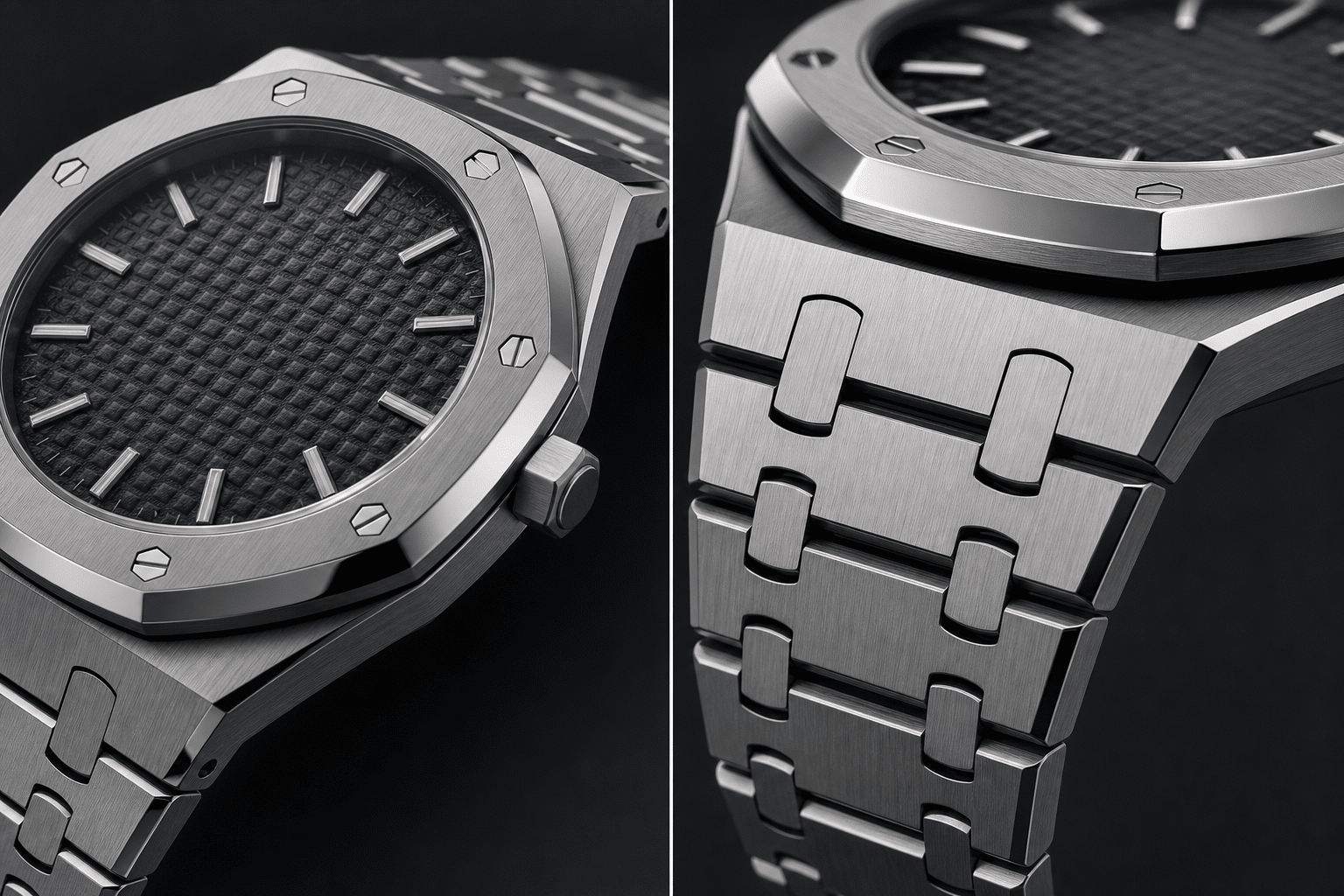
The Royal Oak’s design depends heavily on the integrated bracelet. The bracelet is not just there to hold the case; it is half the watch. The way the first links leave the case, the taper, the alternating brushed and polished surfaces, and the drape around the wrist all determine whether the watch feels convincing.
This is also why the Royal Oak can be less forgiving as a replica watch. A cleaner design exposes weak finishing more quickly. Soft bevels, uneven brushing, a stiff bracelet, or a dial that lacks depth are easier to notice because there are fewer large design elements to distract the eye. The Royal Oak may be safer for daily wear, but it demands better execution in the details.
For a first-time buyer, this creates a useful tradeoff. The Royal Oak is usually more wearable, but you should not assume it is easier to replicate just because it looks simpler. Its visual quality comes from precision: case edges, bracelet articulation, bezel geometry, dial texture, and proportion. If those are weak, the whole watch feels flatter.
Offshore: Larger, Sportier, More Aggressive
The Offshore has a different kind of appeal. It is less about thin elegance and more about physical presence. The thicker case, chronograph pushers, stronger bezel mass, larger dial furniture, and rubber-strap options make it feel like a sports watch first and a dress-adjacent luxury watch second.
That bolder design can hide some small finishing weaknesses better than a Royal Oak. A busy dial, larger case, textured strap, and chronograph layout give the eye more to process. Minor brushing issues or small dial imperfections may not stand out as immediately in casual viewing. This is one reason many Offshore replicas look impressive in seller photos.
The tradeoff is that visual drama does not equal long-term wearability. The same design that looks exciting in a close-up photo can feel bulky on a keyboard, loud in a meeting, and limiting with anything more formal than casual clothing. The Offshore is best treated as a deliberate sports-watch choice, not as the default first AP.
Daily Comfort: The Royal Oak Usually Wins on Wearability
Comfort should be one of the main deciding factors for a first AP super clone, not a detail you think about after ordering. Many buyers focus on dial color, factory name, or whether the watch looks impressive in photos. Then the real ownership test begins: can you wear it for a full day without noticing its thickness, weight, or case edges too much?
For Royal Oak replica daily wear, the advantage is usually its thinner profile and more balanced shape. The integrated bracelet spreads weight across the wrist, and the case sits flatter than most Offshore models. It still has presence, and it can wear wider than the diameter suggests, but it generally does not feel as top-heavy.
Offshore replica comfort is more dependent on your wrist and expectations. The case thickness, side profile, pusher structure, and strap bulk can make the watch feel much larger than the number on paper. This can be enjoyable if you want a bold sports watch. It can be frustrating if you expected a comfortable first replica that works with most daily situations.
At Clean VS Factory, we usually encourage first-time buyers to separate “impressive for five minutes” from “comfortable for five hours.” The Offshore often wins the first test. The Royal Oak more often wins the second.
Why Thickness Matters More Than Diameter Alone
Diameter gets too much attention because it is easy to compare. Thickness matters more in daily use. A watch can have a manageable case width but still feel awkward if the case height is high, the side wall is slab-like, or the movement and case construction push the watch too far off the wrist.
This is especially relevant for Offshore chronograph designs. The pushers, case guards, thicker movement architecture, and deeper caseback can make the watch feel taller and more physical than a simple time-and-date Royal Oak. Even when the diameter sounds wearable, the side profile may be what makes it feel too thick on the wrist.
The Royal Oak is not automatically perfect for every wrist. Its integrated bracelet does not curve like a soft leather strap at the lug point, so the first links can make it wear broad. But if the bracelet articulates well and the case height is controlled, it usually feels easier to wear all day than a thick Offshore.
Bracelet Flow Versus Strap Bulk
The Royal Oak bracelet is one of the main reasons the watch works. A good bracelet flows from the case, wraps evenly, and balances the watch head. When the bracelet is too stiff, too sharp, or poorly finished, the whole Royal Oak experience suffers. But when it is done well, it makes the watch feel slimmer and more integrated than its visual width suggests.
The Offshore often uses rubber or sport-style straps, which changes the comfort equation. Rubber can be practical and casual, but it can also add bulk where the strap meets the case. A thick strap that does not curve quickly around the wrist can make the watch sit high or flare outward. On a larger wrist, that may look strong. On an average wrist, it may make the Offshore feel larger than expected.
Bracelet or strap choice also affects visual balance. A Royal Oak on bracelet feels complete because the bracelet is central to the design. An Offshore on rubber feels sportier and more relaxed, but also less versatile. For daily wear, that difference matters more than many buyers expect.
Wrist-Fit Questions to Ask Yourself
- Will this be your daily watch or a weekend watch? If it needs to work five days a week, the Royal Oak is usually the safer first AP style.
- Do you already wear thick watches comfortably? If not, the Offshore may be a risky first jump, especially in chronograph form.
- Does the watch need to fit under a cuff? A thinner Royal Oak-style case is usually more practical than a tall Offshore case.
- Is your wrist flat or round? Integrated bracelets and large Offshore cases behave differently depending on wrist shape, not just wrist size.
- Do you want subtle AP recognition or obvious wrist presence? The Royal Oak is recognizable but cleaner; the Offshore is louder by design.
- Are you willing to feel the watch all day? If weight and case mass bother you, do not treat the Offshore as a casual upgrade from the Royal Oak.
The practical judgment is simple: if you are unsure, start with the Royal Oak. If you already know you enjoy large, thick sports watches and want the Offshore’s size as part of the experience, then the Offshore can make sense. Uncertainty favors the more wearable watch.
A Practical Wrist-Size Reading Before You Choose
For first-time buyers, wrist size should be read together with wrist shape. A 6.7-inch flat wrist can sometimes carry a Royal Oak better than a 7-inch round wrist because the integrated bracelet needs surface area across the top of the wrist. The Offshore is less forgiving because its case height and pusher mass add bulk in more directions. If the watch head overhangs or the strap flares outward before curving down, the watch will usually feel larger in real wear than it looked in a product photo.
It is also useful to compare your current most comfortable watch, not your largest watch. If your favorite daily watch is thin, light, and under a cuff most of the day, an Offshore chronograph may be a dramatic adjustment. If your current rotation already includes thick divers or large chronographs, the Offshore becomes a more reasonable first AP choice. This kind of comparison is more reliable than using case diameter alone.
Visual Accuracy: Royal Oak Is Cleaner, but Less Forgiving
The Royal Oak creates a trap for first-time AP super clone buyers: it looks simple, so people assume it should be easier to replicate. In practice, the opposite is often true. The cleaner the design, the fewer places there are to hide weak execution. On a Royal Oak replica, the case edge, bezel brushing, polished bevels, screw alignment, tapisserie dial, and bracelet finishing are not background details. They are the watch.
This is where Royal Oak super clone accuracy becomes more demanding than many buyers expect. A large Offshore can distract the eye with pushers, rubber strap texture, subdials, case mass, and color contrast, while AP super clone price tiers often shape how much case finishing and bracelet refinement buyers should realistically expect. A standard Royal Oak has a flatter visual field. If the brushing looks too soft, if the bevels are rounded, if the bracelet does not flow cleanly from the case, the flaw becomes part of the whole impression rather than a small isolated issue.
Why Small Finishing Errors Stand Out on the Royal Oak
The Royal Oak depends heavily on tension between brushed and polished surfaces. The top of the bezel should have a controlled satin grain, while the bevels need enough polish to catch light without looking over-rounded. If the AP replica finishing is too dull, the watch loses its sharp architectural feel. If the polishing is too wide or too bright, the case starts to look softened and less precise.
Bezel geometry matters more than beginners usually realize. The octagonal bezel is not only an outline; it sets the entire face of the watch. Slightly uneven edges, weak brushing direction, or screws that sit too high can make the watch feel off before the buyer can explain why. The visible bezel screws are a common pressure point because they sit in open view. A small issue with screw alignment, size, or seating is easier to notice on the Royal Oak than on a busier sports chronograph.
The bracelet is just as important as the case. A Royal Oak on bracelet should feel like one continuous object, not a case with a bracelet attached afterward. If the first links do not articulate naturally, if the bracelet finishing does not match the case, or if the link edges feel crude, the watch loses much of its AP character. This is why a cheaper Royal Oak-style replica can look acceptable in a straight photo but feel disappointing once it is handled or worn.
The non-obvious point is that macro photos can both reveal and mislead. They can expose screw issues, dial printing, and date alignment, but they can also hide the most important Royal Oak problem: how the surfaces behave as the wrist moves. Brushing direction, edge softness, and bracelet flow are often easier to judge from angled photos or short wrist videos than from one perfect front-facing image.
The Tapisserie Dial Is Not Just a Pattern
The tapisserie dial is one of the hardest visual elements to get right because it is not simply a grid. The owner sees depth, light play, print sharpness, marker placement, and date-window balance at the same time. If the texture looks too flat, too sharp, or too plasticky, the watch may still photograph well but feel less convincing in normal use.
Dial color also changes the risk. Blue dials are popular, but they are less forgiving because shade, sunburst effect, and texture become more obvious. A black or grey Royal Oak replica may hide small texture weaknesses better, while blue often magnifies them. For a first AP super clone, choosing the most iconic dial color is not automatically the safest visual choice.
Applied indices and hands should sit cleanly and match the dial layout. Slightly uneven markers, heavy printing, or a date window that appears cramped can pull attention away from the case finishing. The date is especially important because the Royal Oak dial has very little visual clutter. If the datewheel font or centering looks wrong, there are no chronograph subdials or colorful accents to distract from it.
The practical judgment is simple: a Royal Oak replica should not be evaluated only by whether the dial looks attractive in a seller photo. The stronger question is whether the finishing, dial texture, bezel, and bracelet all support the same sharp design language. If one of those areas is weak, the Royal Oak’s clean design exposes it quickly.
Offshore Wrist Presence Comes With More Practical Tradeoffs
The Royal Oak Offshore replica wins attention more easily. It is larger, thicker, sportier, and usually more dramatic in photos. For a first-time buyer scrolling through options, that can be persuasive. The Offshore looks like more watch for the money: bigger case, stronger bezel, chronograph pushers, bolder dial layout, and often a rubber strap that makes the whole piece feel more casual and aggressive.
That visual excitement is real, but it is not free. Offshore wrist presence is built from the same things that can make it harder to live with: a large case, thick profile, heavier construction, pronounced pushers, and a more casual sports-watch identity. A buyer who wants a bold AP replica for weekends may love that. A buyer expecting one daily watch for office, dinner, travel, and long desk days may find it less versatile than expected.
Why Offshore Looks Stronger in Photos
The Offshore is designed to be loud. The bezel has more mass, the case walls look stronger, the pushers add mechanical drama, and the dial often has more depth because of subdials, numerals, color accents, or textured sections. On a screen, these details create instant impact. A Royal Oak can look restrained next to it, especially if both are shown in the same photo lineup.
The rubber strap also helps the Offshore photograph well. It reinforces the sports-watch personality and makes the watch look ready for casual wear. On some wrists, that combination works very well. If the buyer already wears larger dive watches, Panerai-style cases, oversized chronographs, or thick rubber-strap sports watches, an Offshore super clone may feel familiar rather than excessive.
The mistake is assuming that stronger in photos means better as a first AP. Photos reward contrast and size. Daily wear rewards proportion, balance, and comfort. The Offshore often wins the first comparison and loses the eighth hour of wear if the buyer was not realistic about thickness and weight.
Why That Same Presence Can Become a Daily-Wear Problem
A thick Offshore case sits higher on the wrist, and that changes everything. It may not slide under a cuff easily. It can knock against a desk, laptop edge, steering wheel, or door frame more often. The chronograph pushers can also add side bulk, making the watch feel wider in real use than its stated diameter suggests.
Weight distribution matters as much as size. A heavy watch on a well-shaped bracelet can feel manageable, but a tall case on a strap can feel top-heavy if the strap does not hold the watch securely. Some buyers enjoy that solid presence for short wear. Others start noticing it after a few hours, especially in warm weather or during desk work.
Styling is another practical limit. The Offshore is a sports watch first. It usually works best with casual clothing, sneakers, polos, hoodies, denim, gym-adjacent outfits, and weekend wear. It is less natural with dress shirts, suits, or understated office clothing. That does not make it a bad choice, but it does make it a more specific choice.
For a first AP super clone, the Offshore is sensible only if the buyer actively wants size and visual loudness. If the buyer is merely attracted to the dramatic photos but actually wants an easy daily watch, the classic Royal Oak is usually the more rational starting point.
Movement and Chronograph Risk: Offshore Requires More Caution
Movement risk is one of the biggest reasons the Offshore deserves more caution as a first AP super clone. A Royal Oak in a simpler time-and-date configuration has fewer functions to align, fewer hands to manage, and usually fewer mechanical variables in daily use. A Royal Oak Offshore chronograph replica adds subdials, pushers, reset behavior, added movement thickness, and more parts that need to work together cleanly.
This does not mean every Offshore chronograph replica is a bad choice. It means the buyer should treat it as a more complicated ownership decision, not just a larger version of the Royal Oak. A chronograph that works in a short demo is not automatically a movement that will feel smooth, quiet, stable, and easy to service over time.
Movement Claims Need Individual Verification
Movement descriptions in replica listings should be read as claims to verify, not as settled facts. Terms such as “clone movement,” “decorated movement,” “Asian movement,” “ETA-style movement,” “Miyota-based movement,” “Seagull-based movement,” or “upgraded calibre” can mean different things depending on seller, version, and individual watch. Claims involving Swiss origin, original brand calibers, or official movement architecture should be treated with particular caution unless supported by clear evidence for the specific watch.
For a first AP buyer, the practical question is not only “what movement is advertised?” but also “what does that movement choice do to the watch?” If the movement route makes the case too thick, creates an awkward date position, produces noisy rotor behavior, or makes servicing difficult, the advertised specification may not improve the ownership experience. This is especially important for Offshore chronographs, where movement packaging affects subdial spacing, pusher feel, case height, and reset behavior at the same time.
Movement Transparency Note: Movement references in this article describe replica-market movement types, layouts, or advertised configurations, not an official Audemars Piguet caliber unless supported by verifiable evidence. Buyers should judge the specific watch by movement route, case thickness, date position, chronograph behavior, rotor noise, and realistic serviceability rather than by movement wording alone.
Why Simpler Royal Oak Configurations Are Easier for Beginners
A simpler Royal Oak usually gives the first-time buyer fewer ways to be disappointed. With fewer complications, the main concerns stay focused on case thickness, dial alignment, date position, bracelet feel, rotor sound, winding feel, and general timekeeping. Those are already enough variables for a first AP replica movement decision.
Fewer hands also mean fewer alignment problems. A time-and-date Royal Oak does not need chronograph seconds, minute counters, hour counters, and reset positions all sitting correctly. The dial can still have flaws, but there are fewer moving indicators that can return slightly off-center or make the watch feel mechanically untidy.
Case thickness is another advantage. Movement architecture affects how believable the case profile looks. If the movement route requires extra height, the watch can become thicker than the design should feel. On a Royal Oak, thickness is visible because the case is thin and architectural. On an Offshore, more thickness is expected, but there is still a limit where the watch starts to feel bulky rather than powerful.
At Clean VS Factory, we usually separate visual appeal from ownership risk at this point. A watch can look more exciting because it has more functions, but for a first buyer, simpler often means fewer surprises and a better chance of enjoying the watch long term.
What Chronograph Complexity Adds to Offshore Ownership
An Offshore chronograph replica introduces several practical concerns. Subdial spacing needs to look balanced. The chronograph hand should reset cleanly to zero. Pushers should feel firm and consistent, not gritty, loose, or uncertain. The date position should not look squeezed by the movement layout. These are not luxury talking points; they affect whether the watch feels properly assembled.
Rotor noise and winding feel also deserve attention. Some replica movements can be louder than buyers expect, especially in cases where the movement architecture or rotor design is not as refined as the watch exterior suggests. A loud rotor does not always mean immediate failure, but it can reduce the ownership experience, especially in a watch that otherwise presents itself as premium.
Power reserve claims should be treated carefully. Advertised numbers can vary from real-world performance, and complicated movements can show more inconsistency from unit to unit. For a beginner, the question is not whether the movement sounds impressive on paper. The question is whether the movement route is proven enough, serviceable enough, and appropriate for the case design.
Serviceability is the part many first-time buyers ignore. A basic movement problem may be easier for a watchmaker to diagnose than a modified chronograph issue. Chronograph modules, reset problems, pusher issues, and hand alignment faults can turn a visually impressive Offshore into a frustrating ownership experience if the buyer expected simple daily reliability.
Visual Similarity and Movement Practicality Are Separate Questions
A common beginner assumption is that the movement that looks most impressive in a listing is automatically the best choice. For AP replicas, that is not always true. Some movement routes may improve caseback appearance or advertised similarity, while another route may offer better stability, easier servicing, or a more reasonable case thickness. Those are different benefits, and they do not always come together in the same watch.
For a Royal Oak, movement choice should support the thin case profile and predictable daily operation. For an Offshore, movement choice must also support chronograph layout, pusher action, hand reset, and acceptable thickness. If a seller description focuses only on decoration or “clone” wording but does not explain reset behavior, power reserve expectations, or service practicality, treat it as an incomplete signal rather than final proof.
Movement Route to Verify
Before choosing an Offshore chronograph replica, the buyer should verify what movement route is being claimed, whether the chronograph is fully functional, how the subdials are arranged, and whether the case thickness makes sense for that specific reference. Broad phrases such as “clone movement” or “upgraded movement” are not enough without model-specific details.
It is also worth asking practical questions: Does the chronograph reset accurately? Is the rotor known to be noisy? What power reserve should be expected in real use? Does the movement create a thicker case than the reference should have? Are replacement parts or servicing options realistic if something goes wrong?
The safer first-watch judgment is clear: if a buyer mainly wants AP design, daily wearability, and fewer mechanical variables, a simpler Royal Oak is usually the better starting point. The Offshore chronograph is better for someone who already understands that the extra wrist presence comes with extra movement risk, not just extra visual drama.
QC Focus: What to Inspect Before Choosing Either Style
AP replica QC is not the same for a Royal Oak and a Royal Oak Offshore. A first-time buyer often asks whether the dial looks good, but the smarter question is whether the watch’s weak points match the model family. On a Royal Oak, small finishing errors can make the whole watch feel off. On an Offshore, the bigger risks are usually thickness, pusher alignment, strap integration, and chronograph behavior.
The most useful QC judgment is this: do not approve either style from only a straight front photo. The front view can make a Royal Oak look sharper than it is, and it can hide how tall an Offshore sits on the wrist. Camera angle and strong lighting can also make brushing look cleaner, dial texture look deeper, and case edges look crisper than they may feel in hand.
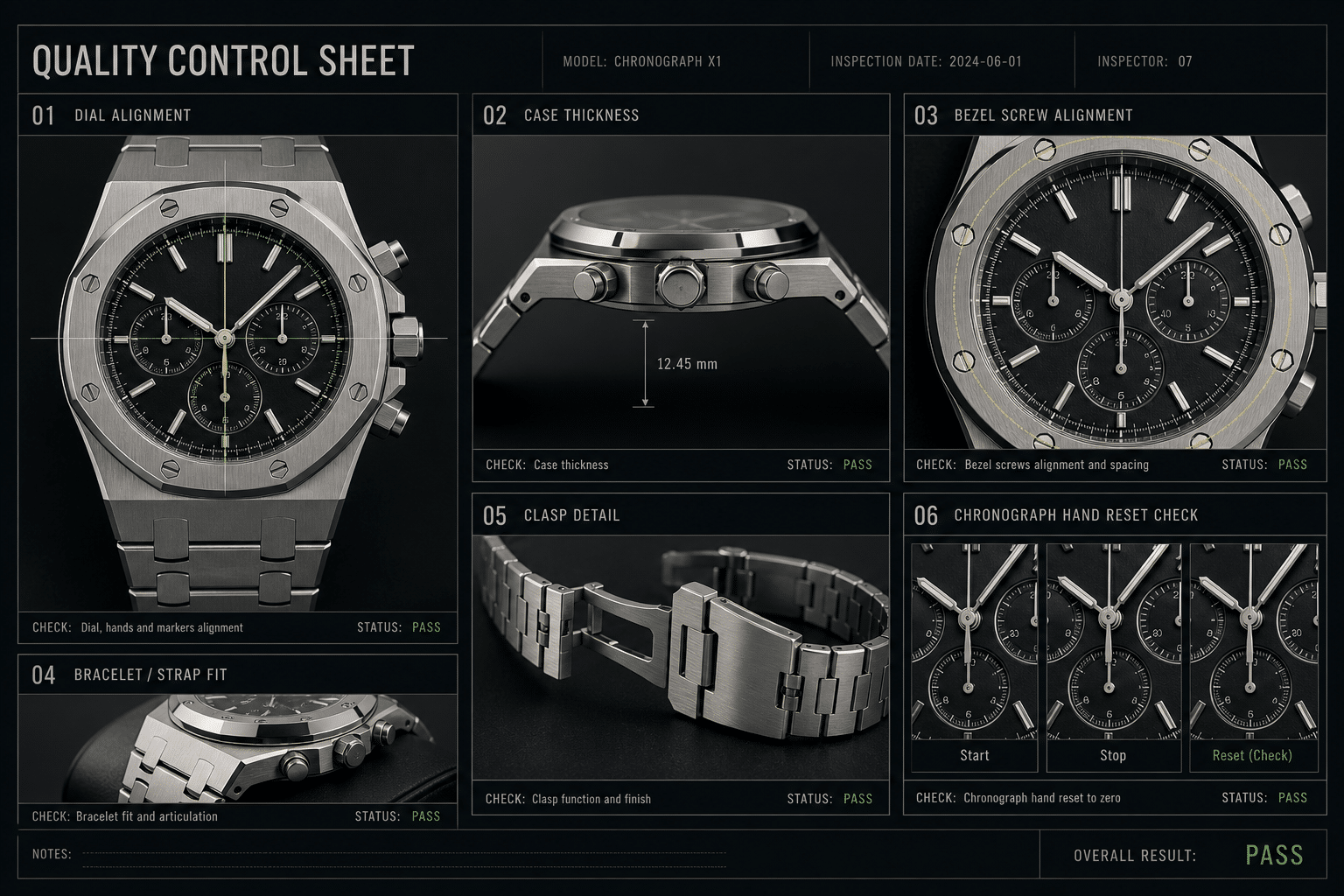
Before making a decision, buyers should review real QC photos where available, including dial printing, hand alignment, bezel position, datewheel centering, bracelet fit, clasp engraving, case thickness, pusher position, strap integration, and overall finishing. Factory labels and stock photos alone are not enough for a reliable judgment, especially when comparing a simpler Royal Oak against a more complex Offshore chronograph.
QC photos can reduce uncertainty, but they do not guarantee perfection or long-term reliability. They are most useful when they answer the specific risk of the model being considered: finishing and bracelet flow for a Royal Oak, or thickness, strap fit, pusher alignment, and chronograph reset for an Offshore. Buyers should still confirm seller policies, inspection steps, and after-sales terms directly before ordering.
Royal Oak QC Priorities
For a Royal Oak replica, start with the bezel and bracelet because they carry most of the watch’s identity. The eight bezel screws should sit evenly, look centered within their openings, and not appear sunken or raised. Minor slot-angle variation is common on replicas and should not be treated like the only issue, but uneven screw depth or visibly inconsistent spacing is more serious because it affects the whole bezel geometry.
Brushing direction matters more on the Royal Oak than on most sports watches. The flat bezel surface, case top, and bracelet links should show controlled satin brushing, while the polished bevels should remain clean and narrow. A common red flag is a case that looks too soft at the edges. The genuine Royal Oak design depends on sharp transitions; if the replica looks rounded in QC photos, it will usually feel even less convincing in real use.
The tapisserie dial needs more than a quick color check. Look for even dial texture, straight applied markers, clean printing, and a date window that does not sit too high, too low, or too close to one side. Blue dials are especially tricky because lighting can shift the shade dramatically. Do not reject a dial only because one photo looks slightly too bright, but do pay attention if the texture looks flat, the printing looks heavy, or the datewheel appears obviously misaligned.
Bracelet fit is the other major Royal Oak checkpoint. The first links should flow naturally from the case instead of looking rigid, gapped, or pinched. The bracelet should not appear twisted when laid flat, and the clasp should close evenly with clean engraving and no obvious rough metal inside. A beautiful dial cannot rescue a Royal Oak that wears like a stiff metal cuff.
Offshore QC Priorities
Royal Oak Offshore QC should begin with the side profile. The Offshore is already a thick, muscular design, so buyers sometimes excuse too much height simply because the model is large. That is a mistake. If the case looks slab-sided, excessively tall, or visually unbalanced from the side, it may feel bulky every time you wear it. For a first AP super clone, this is often a bigger ownership issue than a tiny dial-printing flaw.
Pusher and crown alignment also matter on Offshore models. The chronograph pushers should sit straight, match each other in height and angle, and not look squeezed into the case guards. On rubber-strap versions, the strap should integrate cleanly into the case without large gaps or uneven tension. Poor strap fit makes the watch look cheaper immediately because the Offshore’s case is designed around that bold strap-and-case connection.
If the Offshore is a chronograph, check the subdials before being impressed by the busy layout. The hands should be centered on their pinions, the chronograph seconds hand should reset cleanly to 12, and the subdial hands should not appear randomly offset. A tiny reset deviation may be tolerated by some buyers, but a clearly misaligned chronograph hand is not something to ignore, especially on a watch where the chronograph layout is one of the main visual features.
Date placement deserves attention as well. Offshore dials are visually busy, so a slightly off date can be easier to miss in photos than on a simpler Royal Oak. Look at the date window from a straight-on angle and ask whether the number sits centered, whether the font looks consistent, and whether the window itself appears properly positioned relative to nearby dial elements.
QC Evidence Should Match the Risk You Are Trying to Reduce
Not every QC image has the same value. A beautiful dial photo can help confirm marker alignment, but it does not prove bracelet comfort, case thinness, pusher feel, rotor behavior, or water resistance. For a Royal Oak, the most useful evidence is often angled because it shows case planes, bevel definition, screw seating, and bracelet transition. For an Offshore, the most useful evidence often comes from the side and from functional checks because thickness, strap flare, pusher seating, and chronograph reset are central to ownership risk.
Buyers should also avoid treating a previous buyer’s good example as proof that the next watch will be equally good. Replica watches can vary from piece to piece, even within the same claimed factory and version, so an Audemars Piguet super clone guide should be treated as a framework for comparison rather than a guarantee of identical finishing. The correct approach is to use reputation to build a shortlist, then use the specific QC set to judge the individual watch. If the photos do not show the area where that model is most likely to disappoint, ask for more evidence before approving.
QC Photos That Matter Most
The minimum useful QC set should include a straight front dial shot, an angled bezel shot, a side profile photo, a bracelet or strap fit photo, clasp photos, and a caseback or movement-route confirmation photo where relevant. For Offshore chronographs, add a photo showing the chronograph reset position after operation. Without that, you are approving the look of the watch but not the main functional risk.
For Royal Oak models, the angled bezel and bracelet photos are often more revealing than the straight dial photo. They show brushing quality, bevel sharpness, screw seating, and how the first links articulate from the case. For Offshore models, the side profile photo is non-negotiable. It tells you whether the watch looks like a powerful sports watch or simply a thick replica case trying to contain a complicated movement.
- Ask for a straight front photo: Check dial alignment, marker position, date centering, and chronograph hand reset if applicable.
- Ask for an angled bezel photo: Check brushing, polished bevels, screw seating, and case edge sharpness.
- Ask for a side profile photo: Especially important for Offshore thickness and Royal Oak case proportion.
- Ask for bracelet or strap fit photos: Royal Oak bracelet flow and Offshore strap integration can change the whole wearing impression.
- Ask for clasp and caseback photos: These reveal finishing consistency, engraving quality, and whether the claimed version makes sense visually.
The practical rule is simple: Royal Oak QC should protect you from finishing disappointment; Offshore QC should protect you from size, thickness, and chronograph disappointment. If the QC photos do not answer those risks, they are not enough for a first-time buyer.
How to Treat Seller Photos and Factory Labels
Seller photos, factory labels, and QC images are useful signals, but they should not be treated as final proof. A factory label can tell you which production route is being claimed, but it does not confirm that the individual watch has good bracelet articulation, correct side profile, clean pusher action, or acceptable date alignment. QC photos can show many visible details, but they can also hide thickness, rotor sound, winding feel, and how the watch balances on a real wrist.
For a Royal Oak, ask whether the photos show the watch from angles that reveal brushing and bracelet flow, not only the dial. For an Offshore, ask whether the photos show the side profile, strap fit, and chronograph reset after use. If the listing only shows bright front-facing photos, it may be enough to admire the design, but it is not enough to judge the ownership risks that matter most for a first-time AP buyer.
Factory Claims Matter Less Than the Exact AP Model and Version
Many first-time buyers start by asking for the best AP super clone factory. That sounds logical, but it is too broad to be useful. A factory can be strong on a simple Royal Oak time-and-date model and less convincing on a Royal Oak Offshore chronograph. Another factory may have better bracelet finishing on one reference but a less attractive movement route on another. The factory name helps narrow the field; it does not make the decision for you.
The safer question is: which factory, version, and batch is strongest for the exact Audemars Piguet replica version you are considering? A Royal Oak 15400, 15500, 15202-style Jumbo, Royal Oak Chronograph, Offshore Diver, and Offshore Chronograph all stress different parts of the build. Treating them as one “AP replica” category is how buyers end up paying for reputation instead of suitability.
Factory Name Clarification: Factory names in the replica watch market are buyer-facing references used to compare claimed production routes. They should not be treated as official Audemars Piguet affiliations, audited manufacturer identities, or guarantees that every Royal Oak or Offshore example from the same label will have identical finishing, movement behavior, or QC consistency.
Why “Best AP Factory” Is the Wrong First Question
The Royal Oak rewards factories that can control case geometry, bracelet articulation, dial texture, and thinness. The Offshore rewards factories that can handle a thicker case, pushers, strap integration, subdial layout, and movement packaging. Those are not the same manufacturing problem. A factory comparison that ignores the model family is usually too shallow for a real buying decision.
For example, a Royal Oak time-and-date model may be judged mostly by the case profile, tapisserie dial, bezel finishing, bracelet feel, and movement thickness. An Offshore chronograph adds another layer: pusher feel, chronograph hand reset, subdial spacing, case height, and long-term service risk. Even if both watches carry an AP name on the dial, the replica challenges are different.
At Clean VS Factory, we usually separate factory reputation from model suitability. A known AP super clone factory may deserve attention, but the buyer still needs to verify the exact reference, version update, movement route, and QC consistency. The best factory name on paper does not help if the specific watch has the wrong case profile or a batch with poor dial execution.
A factory comparison is most useful when it is tied to the specific reference, version, movement, and visible execution details rather than treated as a universal ranking. For AP-style replicas, this means the same factory-market name may be a reasonable shortlist option for one Royal Oak reference but a weaker choice for an Offshore chronograph if the case height, pusher alignment, strap integration, or movement route is less convincing.
Version and Batch Differences Can Change the Answer
AP super clone versions change because factories revise dials, bracelets, case shapes, movement decoration, datewheels, and sometimes the movement architecture itself. A later version can be meaningfully better, but “latest batch” is not automatically a guarantee. Sometimes an update improves the dial but introduces a different bracelet feel. Sometimes a movement route looks more impressive in a listing but has less real ownership history.
This matters because Royal Oak buyers and Offshore buyers should care about different version updates. On a Royal Oak, an improved bracelet, sharper bevels, better tapisserie texture, or corrected case thickness can be worth paying attention to. On an Offshore, a revised case side, better strap fit, more stable chronograph reset, or cleaner pusher alignment may matter more than a minor dial-printing change.
Factory claims also age quickly. A recommendation from two years ago may describe a discontinued version, a different movement supply, or a batch that no longer represents current production. This is why a buyer should confirm what is actually being offered rather than relying only on forum shorthand or seller language like “best version” or “newest edition.”
- Model first: Decide whether the Royal Oak or Offshore family fits your wrist, style, and risk tolerance.
- Reference second: A 15500-style Royal Oak and a 15202-style Jumbo do not carry the same replication difficulty.
- Factory and version third: Evaluate the current version for that exact reference, not the factory’s general reputation.
- QC last but essential: Even a strong version can produce uneven individual pieces.
The most useful factory comparison is not a permanent ranking. It is a match between factory strength and model weakness. If a factory’s strengths solve the exact problems of the watch you want, the recommendation is meaningful. If not, the name is just marketing weight.
Beginner Risk Ranking by AP Style
For most first-time buyers, a practical risk order is useful. A simple time-and-date Royal Oak is usually the easiest AP-style super clone to understand because the buyer can focus on case shape, dial texture, bracelet feel, and basic movement behavior. A Royal Oak chronograph increases visual and mechanical checks. An Offshore Diver can be more forgiving than an Offshore chronograph because it has the bold case and strap personality without the same chronograph reset and pusher concerns. An Offshore chronograph is often the highest-risk first AP choice because it combines size, thickness, strap fit, subdial layout, and movement complexity.
This does not mean a beginner can never buy an Offshore chronograph. It means the buyer should know what problem they are accepting. If the goal is daily comfort and a lower-friction first experience, choose the simpler route. If the goal is bold sports-watch presence and you are willing to verify chronograph behavior carefully, the Offshore becomes a more intentional choice rather than an impulse upgrade.
Price and Value: Paying More Only Helps If It Reduces the Right Risk
AP replica price should be judged by risk reduction, not by excitement. A higher price can make sense if it buys a better movement route, cleaner case geometry, stronger bracelet finishing, more accurate dial work, or better QC consistency. It does not make sense if it pushes a first-time buyer into a watch that is too large, too thick, too complicated, or too uncomfortable for regular wear.
This is especially important in the Royal Oak vs Offshore value decision. A Royal Oak may justify a premium when the extra cost improves the parts you will notice every day: bracelet feel, bevel sharpness, dial texture, date alignment, and case thinness. An Offshore may cost more because the case and chronograph system are more complex, but added complexity is not the same as added ownership comfort.
Price Claims Should Be Treated as Current, Not Permanent
Exact AP replica prices can shift because seller channel, factory version, claimed movement route, shipping method, availability, and after-sales support all affect the final offer. A higher listed price does not automatically mean a better individual watch, and a lower price does not automatically mean poor execution. Without reliable current pricing data for the exact version, it is safer to judge price by what risk the extra money is supposed to reduce.
For example, paying more may be reasonable if the upgrade clearly improves Royal Oak bracelet articulation, case profile, dial texture, or Offshore chronograph reset behavior. Paying more is less convincing if the difference is only vague marketing language, a more dramatic description, or a factory name without better QC evidence. For a beginner, value should be connected to visible and practical improvements, not only to reputation.
Prices can change by factory label, version, movement configuration, seller channel, availability, finishing quality, and after-sales support. Buyers should compare like-for-like details before treating one option as better value, especially when the two choices have different risk profiles such as a simpler Royal Oak and a more complex Offshore chronograph.
When a Higher-Priced Royal Oak May Make Sense
A higher-priced Royal Oak-style AP super clone is easier to justify when the upgrade improves the bracelet and case. The Royal Oak is a finishing-driven watch. If a better version has cleaner brushing, sharper polished bevels, smoother bracelet articulation, tighter clasp feel, and a more convincing case profile, those improvements affect daily satisfaction immediately.
Dial quality can also justify a premium, but only if the difference is visible in normal ownership. A more three-dimensional tapisserie texture, cleaner printing, better marker alignment, and a more centered date window matter because the Royal Oak dial is open and orderly. Small dial flaws have nowhere to hide. Paying more for a dial that looks balanced under normal light is more rational than paying more for a minor caseback engraving difference most owners rarely see.
The movement route can matter as well, but it should be judged practically. A movement that supports better case thickness, reasonable winding feel, stable date change, and acceptable serviceability is more valuable than a movement advertised with impressive language but little reliability history. For a first AP replica budget, the best value is usually the version that balances external accuracy with a proven ownership experience, not the most mechanically ambitious option.
When an Offshore Premium May Not Be Worth It for a Beginner
An Offshore premium becomes questionable when the buyer is paying for drama they may not actually wear. The Offshore often looks more expensive in photos because it has a larger case, stronger pushers, a busier dial, and more wrist presence. But if the watch feels too thick, catches on sleeves, looks too casual for your weekday clothing, or becomes tiring after a few hours, the extra cost did not reduce the right risk.
Chronograph function is another value trap. A working chronograph can make an Offshore feel more complete, but it also adds more things to inspect, more parts to stress, and more uncertainty over long-term use. A buyer who rarely uses chronographs may be paying extra for a complication that increases risk without improving daily enjoyment.
The beginner mistake is assuming the more complicated Offshore is automatically the more premium first AP super clone. In many cases, a simpler Royal Oak-style choice offers better real value because it is easier to wear, easier to inspect, and less likely to disappoint after the first excitement fades. The cheaper option is not always smarter, but the more expensive option must solve a real problem to be worth it.
| Price Driver | Worth Paying More For? | Why It Matters |
|---|---|---|
| Sharper Royal Oak bracelet finishing | Often yes | Bracelet feel and finishing define the Royal Oak ownership experience. |
| Better tapisserie dial execution | Yes, if visible in normal light | The clean dial layout exposes weak texture, printing, and marker alignment. |
| Offshore chronograph complexity | Only for buyers who truly want it | It adds visual appeal but also more QC and reliability concerns. |
| Larger Offshore case presence | Not by itself | Size can impress in photos but reduce comfort and versatility. |
| Version premium with proven improvements | Usually yes | Paying more makes sense when it improves case, dial, bracelet, or movement-route risk. |
The cleanest value rule is this: pay more when the upgrade improves the part of the watch that creates the main ownership risk. For the Royal Oak, that usually means finishing, bracelet flow, dial execution, and thickness. For the Offshore, it means case proportion, strap integration, chronograph alignment, and movement practicality. Anything else may be a premium without much real benefit for a first-time buyer.
Water Resistance, Durability, and Legal Clarity
Water resistance should not be assumed on either a Royal Oak-style or Offshore-style replica. Even if the authentic watch family is associated with sport-luxury use, that does not prove the individual replica has the same sealing, gasket quality, crown construction, caseback tolerance, or pressure-test result. Treat water resistance as unverified unless the specific watch has been pressure-tested after purchase by someone qualified to test it.
Durability claims should be handled the same way. A heavier Offshore case or sportier strap does not automatically make the watch more shock-resistant, more water-safe, or better suited for gym, swimming, showering, or travel abuse. A thinner Royal Oak does not automatically mean fragile either. The safer approach is to treat both as fashion and wristwear purchases first, not as guaranteed sports instruments.
A replica watch should be evaluated with realistic ownership expectations. Even a strong super clone can have limits in water resistance, long-term movement stability, servicing convenience, bracelet or strap tolerance, and close inspection compared with a genuine reference. Buyers should confirm return, repair, shipping, and after-sales terms before ordering, because those terms can vary by seller and should not be assumed from the factory-market name.
Replica watches can also raise trademark, import, resale, and disclosure issues depending on jurisdiction. This article is not legal advice and does not claim that buying, importing, selling, or reselling replica watches is risk-free. Buyers should understand that these are imitation products, not authorized Audemars Piguet goods, and should avoid representing them as authentic watches in resale, trade, or public disclosure contexts.
Decision Framework: Choose the AP Style That Matches Your Actual Use
If you are still asking, “which AP replica should I choose?” the safest answer is not the one with the most dramatic wrist shot. For a first AP super clone, the better choice is the watch that fits your actual week: your wrist size, your clothing, your tolerance for weight, and how much movement risk you are willing to accept. On that basis, the Royal Oak is the more sensible first step for most buyers, while the Offshore is the better choice only for buyers who already know they enjoy large, thick, sporty watches.
The Royal Oak vs Offshore replica decision is really a comfort-versus-impact decision. The Royal Oak gives you the core AP design language in a cleaner, thinner, more versatile format. The Offshore gives you more wrist presence, more sport-watch energy, and often more mechanical or functional complexity. Neither choice is automatically wrong, but they do not punish the same buyer mistakes.
Choose Royal Oak If You Want Daily Wear and Classic AP Design
Choose a Royal Oak if you want your first AP Royal Oak or Offshore super clone to work as a long-term daily watch rather than a weekend statement piece. It is usually easier to wear with office clothing, casual clothes, and cleaner outfits because the design is sharp without being oversized. The integrated bracelet still gives it presence, but the case profile is generally more manageable than an Offshore chronograph-style case.
The Royal Oak also makes more sense if you are buying your first serious AP replica and do not yet know your tolerance for case thickness, bracelet feel, or visible finishing imperfections. It is not a low-risk watch in every detail. The bezel brushing, polished bevels, tapisserie dial, and bracelet finishing all matter. But as a first ownership experience, it usually creates fewer daily-wear surprises than an Offshore.
For smaller or average wrists, the Royal Oak is usually the safer beginner choice. Even then, do not assume every Royal Oak wears small just because it is thinner. The integrated bracelet can make the watch span wider across the wrist than a normal round watch on a strap. The difference is that this width is usually easier to live with than the Offshore’s combined diameter, thickness, weight, and pusher mass.
At Clean VS Factory, we usually encourage first-time AP buyers to separate visual excitement from ownership comfort. A Royal Oak may look less aggressive in photos, but it is more likely to remain wearable after the novelty fades. That matters more than many beginners expect.
Choose Offshore If You Want Size, Sportiness, and Wrist Presence
Choose an Offshore if the boldness is the point, not a compromise you are trying to ignore. The Offshore works best for buyers who already wear large sports watches comfortably and want a louder AP replica with a more casual, muscular personality. If you like rubber straps, thick cases, strong bezels, chronograph layouts, and a watch that announces itself immediately, the Offshore can be satisfying in a way the Royal Oak is not trying to be.
The important test is honesty. If you are choosing the Offshore because it looks more expensive, more complicated, or more impressive in dealer photos, slow down. Its size and visual loudness do not disappear after purchase. A thick Offshore can feel exciting for the first ten minutes and tiring after a full day at a desk, under sleeves, or during travel.
The Offshore is also better for buyers who accept movement risk as part of the choice. Chronograph-style replicas often bring more variables: hand reset behavior, pusher feel, added case thickness, and service difficulty. If you rarely use the chronograph and mainly want the look, that may be acceptable. If you expect the same carefree ownership as a simpler time-and-date watch, the Offshore is usually the wrong first AP super clone.
A practical rule is simple: if you already own and enjoy large watches, the Offshore may fit your style. If you are buying it to “try something bold” as your first AP replica, the safer move is usually a Royal Oak.
The First-Time Buyer Mistake to Avoid
The biggest mistake is choosing the AP that looks strongest in photos without asking how it will feel after a month. Photos reward the Offshore. Daily wear often rewards the Royal Oak. A front-facing image does not tell you enough about side profile, weight balance, sleeve clearance, wrist overhang, or how often you will actually want to wear the watch.
Do not let factory reputation, price, or complication count make the decision for you. A higher-priced Offshore that is too thick for your wrist is not better value than a simpler Royal Oak you will wear three times as often. A visually impressive chronograph is not automatically the best first AP super clone if the movement route makes you nervous or the case height feels excessive.
CleanVSFactory’s editorial approach is to make replica watch decisions more traceable by connecting factory claims to visible details, movement behavior, version differences, and practical QC checks. For this specific Royal Oak versus Offshore decision, that means judging the watch by wrist fit, thickness, bracelet or strap behavior, chronograph complexity, and the evidence available for the individual piece rather than by a broad factory ranking or dramatic product photo.
Use this final filter before deciding:
- If you want one AP replica for regular wear: choose Royal Oak.
- If you dress mostly casual and like large sports watches: consider Offshore.
- If your wrist is smaller or you dislike thick watches: avoid starting with Offshore.
- If movement reliability worries you: favor simpler Royal Oak configurations over chronograph-heavy Offshore options.
- If you want maximum visual drama and accept comfort tradeoffs: Offshore is the more honest choice.
For most first-time buyers, the Royal Oak is the more balanced answer because it captures the classic AP identity while keeping daily comfort, case thickness, and long-term wearability under better control. The Offshore is not a bad choice; it is a more specific choice. Buy it first only if size, sportiness, and wrist presence are exactly what you want, not details you hope you can tolerate later.
Disclosure: This article is for general educational and comparison purposes only. Replica watches are not genuine products from the original luxury brands, and brand names are used only to identify reference designs or comparison topics. Factory names, movement descriptions, prices, availability, QC details, seller policies, and version information can change, so readers should verify important details with the seller before making a purchase decision. Replica watches should not be represented, resold, or used as genuine watches.