
Water resistance is one of the easiest AP super clone details to misunderstand because the watch can look solid, heavy, and well finished while still having unverified sealing, a concern closely tied to AP super clone after-sales reality because a listed rating, factory reputation, or rugged Offshore appearance does not prove that the individual watch can handle water. The real issue is not whether the case was designed to resemble a water-resistant watch, but whether this exact piece was assembled, sealed, and pressure tested properly.
This article focuses on the practical risk points buyers should judge before wearing an AP-style replica near water: crown and caseback sealing, crystal gasket fit, chronograph pusher risk, QC photo warning signs, and the limits of pressure testing. It also explains why simple splash exposure, handwashing, swimming, and showering are very different levels of risk, and why even a tested watch still needs cautious use and later retesting.
Reference clarification: Brand names such as Audemars Piguet, Royal Oak, and Royal Oak Offshore are used here to identify the genuine reference designs being discussed. AP super clones and AP-style replicas are replica-market watches, not genuine Audemars Piguet watches, and they should not be represented, resold, or used as authentic brand-manufactured watches.
Evidence note: Because water resistance on a replica watch depends on the individual unit, this guide does not treat seller wording, factory reputation, or genuine Audemars Piguet specifications as proof that a replica has the same protection. In this context, the most defensible evidence is an individual pressure test performed on the exact watch after final assembly and after any caseback opening.
| Buyer Question | What Matters Most | Practical Judgment |
|---|---|---|
| Can the advertised rating be trusted? | Individual pressure test after assembly | Treat ratings as unproven until tested |
| Is an Offshore chronograph safer because it looks sporty? | Pusher seals and extra case openings | Higher water-risk than simpler three-hand models |
| Can QC photos confirm water resistance? | Crown seating, caseback fit, crystal height, pusher alignment | Photos can show warnings, not proof |
| What exposure should an untested watch avoid? | Heat, soap, pressure, saltwater, chlorine | Avoid swimming, showering, and submersion |
| Does one passed test solve the issue permanently? | Seal aging, case opening, impacts, moisture events | Retest after service or meaningful exposure risk |
Quick Questions Before You Read
Q: Is an AP super clone waterproof if it comes from a known factory?
No. Factory reputation may improve expectations, but only inspection and pressure testing of the exact watch can verify resistance.
Q: Are Royal Oak Offshore chronograph replicas safe for swimming?
Not unless the specific watch has been properly tested, and even then swimming adds pressure, movement, and chemical exposure risk.
Q: What is the first water-risk detail to check in QC photos?
Look for obvious sealing concerns such as a poorly seated crown, uneven caseback, raised crystal, or misaligned pushers.
Q: What should I do if the crystal fogs after water exposure?
Treat it as urgent. Stop wearing the watch and have it inspected quickly to reduce movement and dial damage risk.
The Short Answer: Do Not Treat an AP Super Clone as Waterproof Without Testing
The practical answer is simple: an AP super clone should not be treated as waterproof unless the individual watch has been pressure tested and inspected. Some examples may handle light rain or accidental splashes without trouble, but that is not the same as being safe for swimming, showering, or repeated water exposure.
This is where many buyers make the wrong assumption. A Royal Oak or Offshore replica can look expensive, feel solid, and come from a respected factory, yet still have a weak seal at the crown, caseback, crystal, or another entry point. Visual quality and replica watch sealing are related only indirectly. A clean case finish does not prove gasket compression. A tight bracelet does not prove the case can resist pressure. A seller’s advertised rating does not prove the exact watch on your wrist has been tested.
For AP replica water resistance, the safest mindset is to separate appearance from protection. A watch can be visually convincing and still be vulnerable around water. That does not mean every AP replica will leak. It means water resistance is not something to assume from the model name, price tier, or factory reputation.
Editorial Perspective: For AP super clones, water resistance should be judged as a model-specific and unit-specific ownership risk, not as a general factory ranking. A known factory, higher price, or strong QC photo set can be useful signals, but they do not prove the crown tube, pusher seals, crystal gasket, and caseback gasket are sealing correctly on the individual watch. At cleanvsfactory.com, the more useful buyer question is whether the exact Royal Oak or Offshore being considered fits the buyer’s real use case: dry daily wear, occasional accidental moisture, or intentional water exposure. Those are different standards, and only the last one requires much stricter testing and maintenance expectations.
Why “Waterproof” Is the Wrong Word
“Waterproof” is the word buyers use, but it is the wrong standard for watches. Even genuine watches are normally described as water resistant, not permanently waterproof, because sealing depends on pressure, gasket condition, crown position, temperature change, and maintenance. With an AP super clone waterproof claim, the wording becomes even more important because the watch has not gone through the same brand-controlled testing and service system as the genuine product.
The non-obvious problem is that water damage often starts from a small weakness, not a dramatic failure. A crown that is not fully secured, a slightly uneven caseback gasket, or a crystal seal that was not seated perfectly may survive a dry desk-wear life for months. The same watch can fail quickly when exposed to hot water, pool pressure, or repeated handwashing. The buyer only discovers the weakness after moisture appears under the crystal, and by then the movement and dial may already be affected.
So the useful question is not “is this AP super clone waterproof?” The better question is: “Has this exact watch been pressure tested, and how much water exposure am I willing to risk?”
The Practical Rule for Buyers
Treat water resistance as unproven until the individual watch has passed a proper pressure test and basic sealing inspection. This rule matters more than the factory name. A strong factory may produce better machining and more consistent assembly, but it cannot guarantee that every shipped unit has perfect gasket placement, crown sealing, and case closure.
At Clean VS Factory, we usually encourage buyers to separate visual accuracy from ownership risk. An AP replica can be a strong-looking daily watch, but water exposure is a different category of evaluation. The watch must be judged as a sealed object, not only as a polished object.
If you are asking “can I swim with it?” the responsible answer is no unless the watch has been tested for that level of exposure and you accept that water resistance can change over time. If you are asking whether it is safe around water in daily life, the answer is more conditional: light accidental moisture may be tolerated by some watches, but an untested AP replica should still be handled cautiously.
What This Means Before Wearing It Near Water
Before wearing an AP super clone near water, avoid treating it like a sports watch just because the design looks robust. Do not swim with it, shower with it, expose it to hot water, or intentionally submerge it unless the watch has been individually pressure tested. Even then, water resistance should be treated as temporary and conditional, not a permanent feature.
For normal daily wear, the safer habit is simple: keep the crown fully closed, avoid operating the watch near water, dry the case after accidental splashes, and take any fogging or condensation seriously. The biggest mistake is using the first exposure as the test. Water should not be the testing method; a pressure test should be.
Advertised Water Resistance Is Not the Same as Real Pressure Testing
An advertised water resistance rating is not the same thing as an AP replica water resistance test. A listing may say “water resistant,” “splash-proof,” or mention a depth-style rating, but that does not prove the exact watch you receive has been tested under pressure. In the replica market, many ratings are better understood as claims about intended construction, not verified results.
This distinction changes the buying decision. If a seller says a watch is water resistant, the next question should not be “how many meters?” It should be “was this specific watch pressure tested after assembly?” Without that step, the rating is only a statement, not evidence.
What an Advertised Rating Usually Tells You
An advertised rating usually tells you what the watch is supposed to tolerate in theory, or what the seller believes the case design should handle. It may also be copied from the genuine model’s specification, which is especially misleading for AP replicas. A genuine Royal Oak or Offshore may carry an official water resistance rating, but a replica does not inherit that rating simply because it copies the design.
Terms like “splash-resistant” are also vague. A quick splash during handwashing is not the same as water running over the crown. Rain is not the same as pool use. A watch sitting still under a controlled test is not the same as a watch moving through water on a wrist. The wording in the listing rarely explains these differences, which is why buyers often overestimate what the claim actually means.
The strongest judgment here is straightforward: do not pay extra confidence to a waterproof claim unless it is backed by a test result for the individual watch. A premium-looking AP super clone with no test should be treated more carefully than a less glamorous watch that has actually passed pressure testing.
Evidence Standard for Water Claims
A useful water-resistance claim should identify the exact watch, the timing of the test, and whether the case was opened afterward. “Factory tested” or “waterproof” is weaker than a clear statement that the specific watch was tested after final assembly and that no caseback work happened after the test. If the seller cannot explain this sequence, the buyer should treat the result as incomplete rather than assume the best.
Photos of the watch beside testing equipment can be helpful only if they are tied to the same unit being shipped. A generic test photo, a sample result, or a screenshot from another watch does not prove anything about the piece on your wrist. For AP-style replicas, this distinction matters because small differences in crown seating, pusher fit, and caseback compression can change the outcome from one unit to another.
Traceability Questions to Ask Before Trusting a Water Claim
A water-resistance claim becomes more useful when it can be traced to a specific unit and a specific sequence of handling. Buyers should ask whether the test was done before or after the final QC photos, whether the caseback was opened after the test, whether the crown and pushers were checked in their fully closed positions, and whether the result applies only to splash confidence or to stronger pressure exposure. These questions do not create a guarantee, but they make the claim easier to evaluate.
It is also important to separate a real test from a general selling phrase. “This model is water resistant” is not the same as “this exact watch passed a pressure test after final assembly.” If water exposure matters, the second type of information is much more useful because it connects the claim to the actual watch being supplied rather than to a model family, stock photo, or factory reputation.
How to Read Seller Water-Resistance Claims
Seller wording should be treated as a useful starting signal, not final proof. “Water resistant,” “tested,” “30m,” and “splash-proof” do not always mean the same thing from one seller to another. A careful buyer should ask what type of test was done, whether it was performed on the exact watch being shipped, and whether the test happened before or after any caseback opening, regulation, or movement adjustment.
It is also worth separating price from proof. A higher price may reflect a better factory version, a more expensive movement, stronger finishing, limited availability, seller margin, or after-sale risk. It does not automatically mean better sealing. For AP models in particular, the useful comparison is whether the case construction, crown behavior, pusher design, and test evidence match the buyer’s planned use, not whether the listing sounds more premium than another seller’s description.
If water exposure is important, ask for plain information rather than promotional reassurance. Useful answers include the pressure level tested, whether the crown and pushers were checked, whether the caseback was opened afterward, and whether the seller considers the result suitable only for splashes or for stronger exposure. Vague confidence such as “no problem” is less useful than a specific test condition and a clear warning about limits.
Quality Control Note: For replica and super clone watches, buyer confidence should come from visible quality-control details and clear test information rather than broad wording such as “waterproof.” Crown seating, caseback fit, crystal height, pusher alignment, gasket condition, and whether the exact watch was pressure tested should be checked model by model before any water-use assumption is made.
What a Pressure Test Actually Confirms
Replica watch pressure testing checks whether the case assembly resists pressure at the time of the test. Depending on the equipment used, this may involve a dry pressure test, a wet pressure test, or both. The key point is that the test applies pressure to the actual watch, not to the model family, not to the factory name, and not to a sample unit shown in a listing.
A passed test is useful, but it is not magic. It confirms condition at that moment. It does not guarantee the watch will remain protected after a hard impact, a caseback opening, aging gaskets, crown misuse, or repeated heat exposure. Water resistance is not a permanent certificate. It is a condition that can degrade.
This is why a basic pressure test is best understood as a decision tool. If the watch fails, avoid water completely until the sealing problem is corrected. If it passes, you still need sensible habits, especially with an AP-style case where multiple construction points can affect sealing.
Why the Exact Watch Matters More Than the Listing
The exact watch matters because replica production has normal variation. Two Royal Oak replicas from the same factory and same batch can differ in gasket seating, caseback closure, crown tube fit, and final assembly pressure. One may resist light moisture reasonably well; another may be vulnerable even if it looks identical in QC photos.
Caseback opening is another underappreciated issue. A watch may have been sealed correctly at the factory, then opened for movement inspection, regulation, repair, or modification. If the gasket is pinched, displaced, dried, or not compressed evenly when closed again, the original sealing condition no longer applies. Buyers often focus on whether the watch was “tested before shipping,” but they rarely ask whether anything happened after that test.
For AP super clones, the listing is only a starting point. The individual watch is the real subject. If water exposure matters to you, ask for proof of testing or arrange testing locally before taking the watch near water.
The Main Leak Points on Royal Oak Super Clones
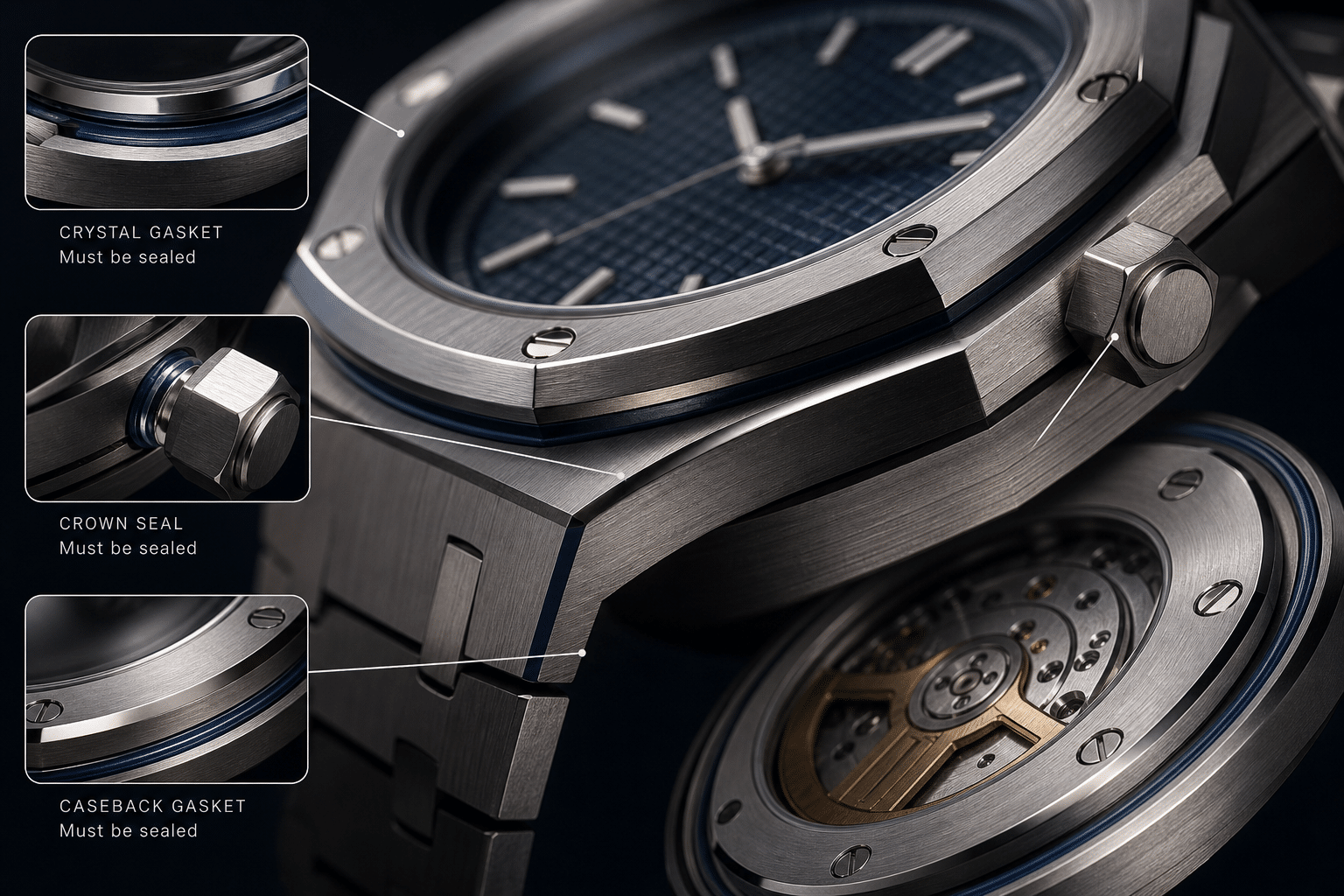
A Royal Oak super clone looks like a tight, angular steel object, but water resistance depends on small sealing surfaces that are easy to overlook. Even a simple time-and-date Royal Oak replica has several possible leak paths: the crown and crown tube, the caseback gasket, the crystal gasket, and the way the case assembly is seated. The octagonal bezel and integrated bracelet create visual strength, but they do not remove the basic watchmaking problem of keeping moisture out.
For Royal Oak replica water resistance, the first practical mistake is assuming that fewer complications means no risk. A three-hand Royal Oak has fewer openings than a chronograph, which is good, but it still depends on seals that must be correctly installed and compressed. If you want the watch to survive more than accidental moisture, those seals need to be checked rather than admired from the outside.
Crown and Crown-Tube Sealing
The crown is usually the first place to think about because buyers interact with it. Every time the crown is pulled for setting or date adjustment, the sealing system is disturbed. If the crown is not pushed or screwed back fully, even casual handwashing can become a real moisture risk.
On an AP-style replica, the crown can look flush enough in a photo while still being less secure than it should be. The crown gasket may be dry, slightly undersized, unevenly fitted, or simply not compressed well. The crown tube may also be a weak point if machining tolerances are not consistent. These issues are not always visible without inspection, which is why “the crown looks fine” is not a water-resistance test.
The buyer-facing rule is simple: never adjust the time or date near water, and always check that the crown is fully closed before washing hands or going outside in rain. If the crown action feels gritty, loose, unusually light, or inconsistent, do not treat the watch as safe around water until it has been inspected.
Caseback Gasket Compression
The caseback is another common misunderstanding. Buyers often look at the back of a Royal Oak replica and assume that if it appears closed, it must be sealed. In practice, the caseback gasket must sit correctly and compress evenly. A small section of gasket that is twisted, pinched, dry, or slightly out of position can weaken the entire seal.
This matters especially if the watch has been opened. Many AP replicas have display backs or decorated movements that tempt buyers and sellers to open the watch for inspection, photos, regulation, or movement checks. Once the caseback is removed, the previous sealing condition should be considered uncertain unless the gasket is inspected and the watch is pressure tested again.
A caseback can look acceptable from normal wrist distance and still have uneven compression. This is one reason a visually excellent Royal Oak super clone should not be assumed waterproof. The finishing tells you something about the quality of the case exterior; it does not tell you enough about gasket pressure.
Crystal Gasket and Moisture Entry
Moisture under the crystal is one of the most frustrating failures because the watch may still look perfect before it happens. The dial can be clean, the bezel screws can appear aligned, and the case can feel solid, yet moisture can enter if the crystal gasket is not seated or compressed correctly.
The Royal Oak’s flat, architectural design can create false confidence here. Buyers see a sharp crystal edge and a well-finished bezel and assume the top of the watch is sealed. But crystal sealing is not about how crisp the watch looks in photos. It depends on the gasket, the pressure fit, and the case tolerances beneath the visible surface.
Fogging after a temperature change is a warning sign, not a harmless quirk. If condensation appears under the crystal, the watch should be kept away from water immediately, and for a Royal Oak or Offshore choice, this kind of moisture response should factor into water resistance testing and case gasket inspection before continued wear. Waiting for the fog to disappear does not mean the problem is solved; it may only mean moisture has moved elsewhere inside the case.
Case and Bracelet Checks
Before exposing a Royal Oak replica to daily moisture, buyers can make a few basic visual checks, but these should be treated as risk screening, not proof. Look at whether the crown sits fully closed, whether the caseback appears evenly seated, whether there are obvious gaps around the caseback edge, and whether the crystal looks uneven from a side angle. If the watch was recently opened, assume the seal may have changed.
The bracelet itself is usually not the water-entry point, but it can distract buyers from the case. A Royal Oak bracelet with strong brushing, clean screws, and good articulation can make the whole watch feel more robust than it really is. Do not let bracelet quality create confidence about case sealing. Water resistance depends on the sealed watch head, not the feel of the integrated bracelet.
The sensible standard is cautious: a simple Royal Oak super clone may be more forgiving than a more complicated AP replica, but it is still not automatically safe for handwashing, rain, or accidental splash unless the crown, caseback, and crystal sealing are in good condition and the watch has been tested.
Why Royal Oak Offshore Chronograph Replicas Carry Higher Water Risk
The Royal Oak Offshore looks like the tougher AP choice, but for water exposure it is usually the more complicated and less forgiving replica. The reason is simple: an Offshore chronograph case has more openings than a simple Royal Oak. More openings mean more seals, more moving parts, and more chances for one small gasket to be the weak point.
This is where many buyers misread the watch. A large case, rubber strap, thick bezel, and sporty pushers make an AP Offshore replica feel like something that should handle water easily. In practice, Offshore replica water resistance depends less on how rugged the watch looks and more on whether the crown, caseback, crystal, and especially the chronograph pushers are correctly sealed on that exact unit.
Chronograph Pushers Add More Openings
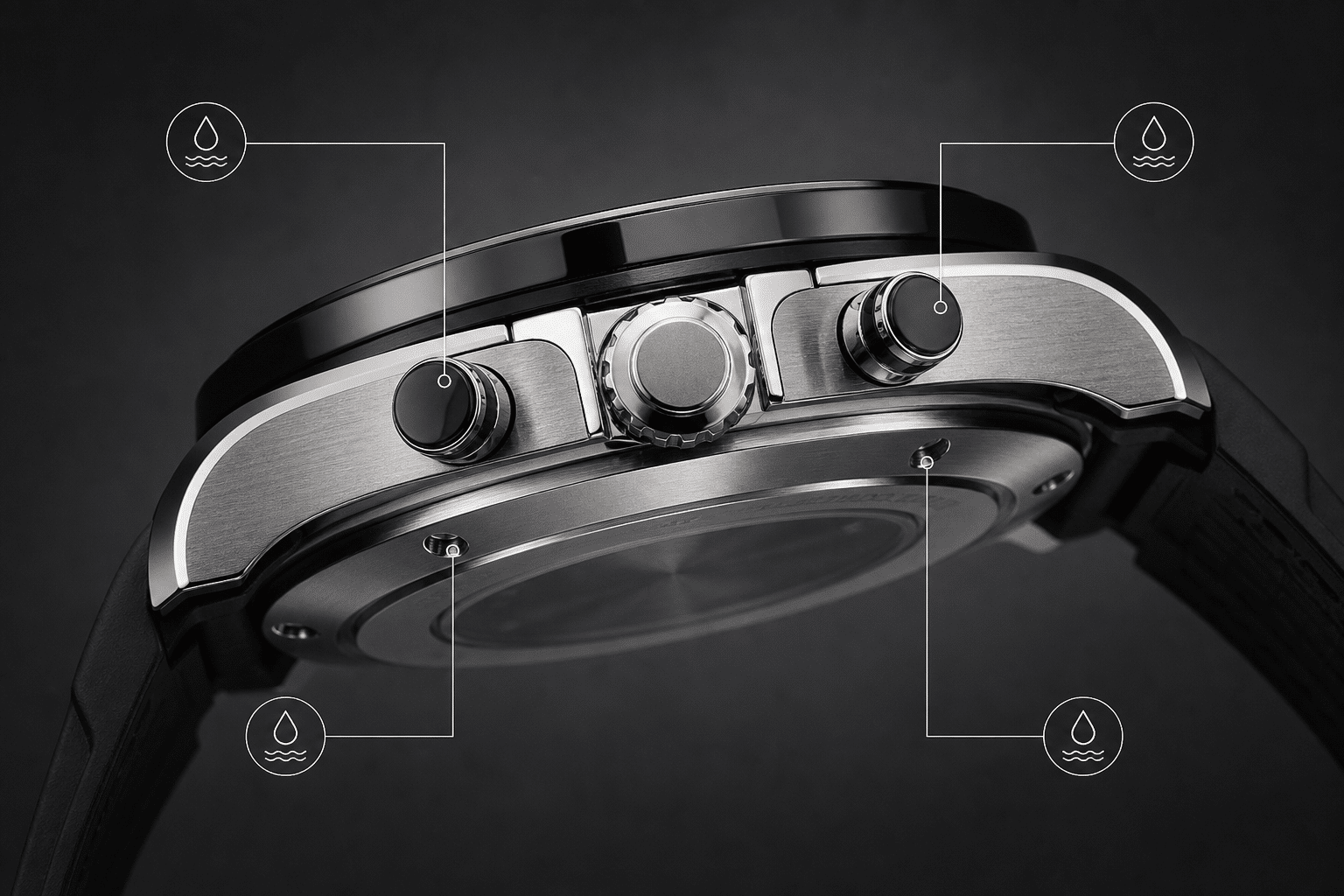
Every chronograph pusher is a hole through the case. That does not automatically mean the watch will leak, but it does mean the sealing system is more demanding. Each pusher needs its own gasket or rubber seal, and each seal has to maintain contact while the pusher moves in and out. That is a harder problem than sealing a fixed caseback or a crystal gasket.
On a simple three-hand Royal Oak-style replica, the main active control is the crown. On an Offshore chronograph replica, the watch adds two pushers, and sometimes those pushers have less predictable gasket compression than the rest of the case. A watch can look clean in photos, have a tight caseback, and still be vulnerable if one pusher gasket is dry, misaligned, thin, or poorly seated.
This is why the question “can I swim with an Offshore replica?” should be treated more cautiously than the same question on a simpler AP three-hand replica. A seller’s AP Offshore replica waterproof claim does not tell you whether both pushers were pressure tested under realistic conditions. Unless the exact watch has been tested, the chronograph system remains a major unknown.
Large Case Construction Can Create False Confidence
The Offshore case is physically bigger and visually more aggressive, which creates a false sense of security. Buyers see the thick case flank, rubber-clad details, oversized crown guards, and heavy wrist presence and assume the watch is built for water. That is a design impression, not a sealing result.
A larger case can actually add complexity. The caseback area is wider, the crown and pusher tubes are larger, and the case construction may involve more separate interfaces than a cleaner three-hand Royal Oak case. The watch can feel solid in the hand while still depending on small rubber seals that are only a few millimeters wide.
This is the non-obvious risk with Offshore chronograph replicas: the case may feel more durable than it really is around water. Sporty appearance is not the same as tested water resistance. For daily wear, that means an Offshore can be fine as a dry-use, occasional-splash watch if properly checked, but it should not be treated like a pool watch just because the genuine Offshore family has a performance image.
Why Pusher Use Around Water Is Especially Risky
Pressing chronograph pushers while the watch is wet is one of the worst habits for an Offshore replica. A static seal has one job: stay compressed. A pusher seal has to maintain protection while the pusher moves. When the pusher is pressed, the sealing surface can shift momentarily, and water sitting around the pusher tube may be pulled or pushed toward the case opening.
That risk increases if the watch is submerged, freshly rinsed, covered in pool water, or exposed to soap. Even if the pusher looks flush afterward, the damage may already be done. Moisture does not need a dramatic entry point; a tiny amount inside the case can fog the crystal, stain the dial, or start corrosion around the movement and hands.
The buyer rule is straightforward: do not operate chronograph pushers when the watch is wet, and do not use the chronograph underwater. If a buyer wants the least water-related ownership risk in the AP replica category, an Offshore chronograph is not the most conservative choice. It may be visually impressive, but it carries more sealing variables than a simpler Royal Oak layout.
Movement Risk After Moisture Is Different on Chronographs
Water risk is not only about whether the case leaks. It is also about what happens after moisture gets inside. A simple three-hand movement already faces corrosion risk, but a chronograph movement adds more levers, wheels, springs, and reset components. If moisture reaches those parts, repair can become more difficult and less predictable than drying a simpler movement quickly.
This matters for buyer decisions because a chronograph Offshore can be attractive in photos and impressive on the wrist while being less forgiving as a first AP replica. The watch may deliver stronger visual impact, but the ownership risk is higher: more external openings, more internal parts affected by moisture, and more chances that a small leak becomes an expensive or inconvenient repair. For buyers who mainly want a reliable daily-wear look, this tradeoff is worth taking seriously before choosing the most complicated case style.
Movement Configuration and Moisture Traceability
Movement descriptions in the replica market should be read as configuration references, not as official brand-caliber claims. In an AP-style super clone, the movement may be a clone-style architecture, a decorated movement, or a modified Asian movement depending on the model and version. Water exposure can affect all of these differently, especially when chronograph components, date modules, or decorative bridges make drying and inspection more complicated.
For water-resistance decisions, the most important movement question is not whether the movement looks convincing through a display back. It is whether moisture damage would be easy to detect, dry, clean, and service if a leak occurs. A decorated movement can look attractive in QC photos while still being vulnerable to corrosion, rotor noise after moisture, calendar instability, or chronograph reset issues if water enters the case.
Simple Three-Hand Royal Oak Models Are Safer, But Not Automatically Safe
A simple Royal Oak replica is generally a lower-risk choice around accidental moisture than an Offshore chronograph replica. The reason is not that it is magically waterproof. It is safer because the case has fewer active controls and fewer moving openings. Fewer openings usually means fewer places where sealing can fail.
This is a practical distinction, not a guarantee. Royal Oak replica water resistance still depends on the crown seal, caseback seating, crystal gasket, gasket condition, and whether the exact watch has been pressure tested. A simpler case design reduces the number of problems, but it does not remove the need for verification.
Fewer Openings Usually Means Lower Risk
Removing chronograph pushers simplifies the sealing challenge immediately. A time-only or date Royal Oak-style replica normally has the crown as the main user-operated entry point. Compared with an Offshore chronograph, there are fewer rubber seals being disturbed during normal use and fewer holes through the case wall.
For buyers comparing model families, this matters more than many forum discussions suggest. People often focus on dial color, bracelet finishing, or movement decoration, but for water exposure the case layout is more important. An AP three-hand replica is usually the more sensible daily-wear choice if the buyer wants to reduce moisture risk without treating the watch as a swim-ready object.
At Clean VS Factory, we usually separate visual ambition from ownership risk in this kind of comparison. A bold Offshore can look more expensive and exciting, but a simpler Royal Oak layout is often easier to live with because there are fewer functional parts that need to stay sealed.
The Crown Still Remains a Critical Point
The biggest mistake is assuming that “simpler” means “safe.” A three-hand Royal Oak replica can still leak through the crown if the crown is not fully closed, if the crown tube is poorly sealed, or if the gasket has been damaged by repeated use. This is especially relevant after setting the time or date, because buyers often forget to check the crown before washing hands or walking into rain.
The crown area is also exposed to wrist movement, sweat, dust, and small knocks. A clean-looking crown does not prove that the internal seal is healthy. If the crown feels loose, does not screw or push down securely depending on the construction, sits unevenly, or has a gritty feel when operated, water exposure should be avoided until the watch is inspected.
For a simple AP replica water risk assessment, the crown deserves more attention than most buyers give it. The absence of chronograph pushers lowers risk, but the crown remains the one control the owner touches regularly. That makes user behavior part of the sealing system.
The Better Daily-Wear Expectation
The more realistic expectation for a simple Royal Oak replica is accidental moisture tolerance, not swimming confidence. Light rain, brief splashes, or careful handwashing may be survivable for some well-assembled and tested watches, but that is different from intentionally wearing the watch in a pool or shower.
If a buyer asks whether a Royal Oak is safer than an Offshore, the answer is usually yes in relative terms. If the question is whether a simple Royal Oak replica is automatically safe around water, the answer is no. The better daily-wear mindset is to treat it as potentially more forgiving, but still conditional on pressure testing and careful handling.
This difference should affect model choice. Buyers who want the look of AP with fewer ownership complications should usually start with a simple Royal Oak-style layout rather than a chronograph Offshore. Buyers who choose the Offshore should do so because they accept the added water-risk variables, not because they believe the larger case makes it safer.
User Habits Often Matter as Much as Factory Quality
Even a reasonably sealed AP replica can be damaged by the way it is used. Factory quality matters, but owner behavior often decides whether a small weakness becomes a real water problem. Showering, swimming, soap exposure, hot water, crown handling, and pusher use can all defeat whatever sealing the watch had when it left the seller.
This is why Audemars Piguet replica swimming and AP replica showering should not be treated as casual questions. The issue is not only whether water touches the watch. It is the type of water, the temperature, the pressure, the length of exposure, and whether the owner operates the crown or pushers at the wrong moment.
Why Showering Is a Bad Test
Showering is one of the most misunderstood risks. Buyers sometimes think a shower is harmless because the watch is not deep underwater. That misses the real problem: hot water, steam, soap, shampoo, and changing pressure are a harsh combination for seals.
Heat can make rubber seals expand and contract. Soap reduces surface tension and can help moisture work into small gaps more easily than plain water. Steam can enter spaces that a quick splash might not. Once the watch cools, trapped moisture can condense under the crystal or around the dial. That is why a watch can look fine during the shower and show fogging later.
Using the shower as a “waterproof test” is a bad idea for an AP super clone. If the watch fails, the damage may not be immediately reversible, and drying the exterior does nothing for moisture already inside the case.
Swimming Adds Movement and Pressure
Swimming is more demanding than standing in light rain or getting a few splashes during handwashing. Arm movement repeatedly pushes water against the crown, caseback edge, crystal area, and pushers. In a pool, chlorine adds chemical exposure. In the ocean, saltwater is worse because it can leave residue and accelerate corrosion if any moisture gets inside.
The word “depth” also misleads buyers. A watch does not need to be deep underwater to face stress. Repeated movement at shallow depth can create pressure spikes, and water can sit around crowns and pushers for longer than expected. For an Offshore chronograph replica, that risk is multiplied by the pusher openings. For a simple Royal Oak replica, the risk is lower but still real if the watch has not been tested.
If a buyer wants to wear an AP replica in a pool, the responsible answer is not “the factory says it is water resistant.” The responsible answer is: only consider it after individual pressure testing, and even then understand that chemicals, aging seals, and user habits can change the risk over time.
Opening the Crown at the Wrong Time
Crown handling causes many avoidable water problems. Adjusting the time or date with wet hands, setting the watch near a sink, or failing to close the crown fully before exposure can turn a minor splash into a serious leak. The crown is not just a control; it is part of the case seal.
After changing the time or date, the owner should make a habit of checking the crown position before the watch goes near water. This sounds basic, but it is one of the most common real-world mistakes. A watch can pass a pressure test and still be exposed with the crown not properly secured later.
For Offshore chronograph owners, the same logic applies to pushers. Do not start, stop, or reset the chronograph with wet fingers, and do not press pushers after swimming or rinsing the watch. If water is sitting around the pusher tube, pressing the pusher is asking the seal to work under the worst condition.
Red Flags After Water Exposure
After any meaningful water exposure, the warning signs should be taken seriously. Fogging under the crystal, condensation that appears and disappears, dial spotting, lume discoloration, unstable timekeeping, a noisy or irregular rotor, or moisture visible near the date window are all reasons to stop wearing the watch and have it opened and dried by someone competent.
Do not keep testing the watch after seeing condensation. Moisture inside the case can damage the dial, hands, movement screws, calendar parts, and movement plates. The faster it is addressed, the better the chance of limiting damage.
The safest habit is simple: avoid unnecessary water, never use hot water as a test, keep the crown secured, avoid pusher operation around moisture, and treat any sign of condensation as urgent. These habits do not guarantee protection, but they reduce the most common ways buyers damage otherwise decent AP super clone watches.
QC Photos Cannot Prove Water Resistance, But They Can Reveal Risk Signals
AP replica QC photos are useful, but they are often misunderstood. They can show whether the watch looks properly assembled from the outside. They cannot prove that the watch is waterproof, pressure resistant, or safe for swimming. A clean dial shot, sharp bezel brushing, and well-aligned bracelet do not tell you whether the crown gasket is seated correctly or whether the caseback seal is evenly compressed.
The practical value of QC photos is risk detection, not water-resistance confirmation. If the crown is not sitting flush, the caseback edge looks uneven, the crystal appears high on one side, or the chronograph pushers look poorly fitted, the watch deserves caution before any water exposure. Those signs do not automatically mean the watch will leak, but they are strong enough reasons to ask more questions or avoid treating the watch as safe around water.
What QC Photos Can Show
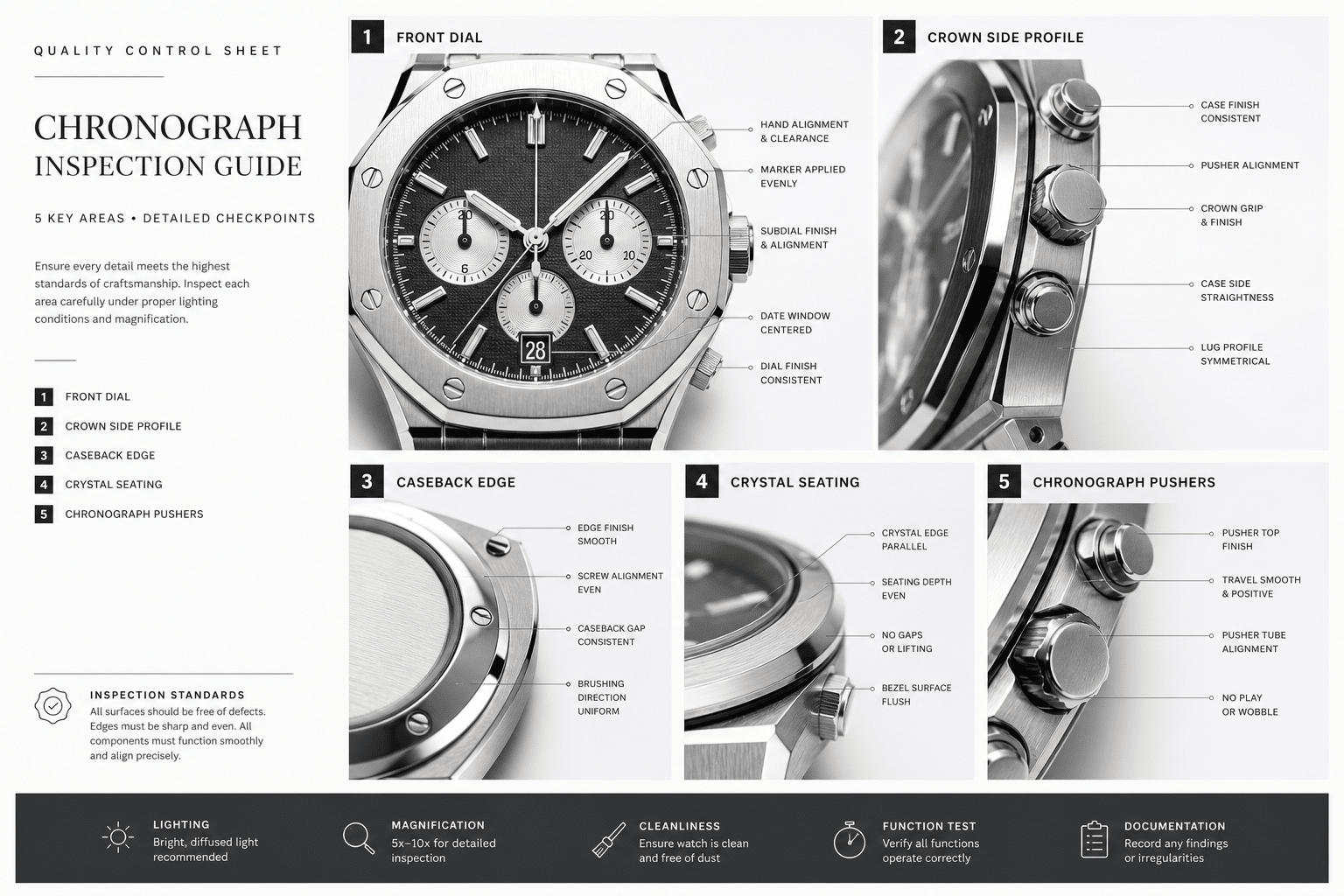
QC photos can reveal visible assembly issues that matter for a replica watch water resistance check. The most important areas are the crown position, caseback edge, crystal seating, and pusher alignment on Offshore chronograph models. These are not cosmetic details only. They are places where the case has to close tightly enough for the internal seals to do their job.
A crown that appears slightly pulled out, tilted, or not fully seated is one of the clearest warning signs. On a Royal Oak-style AP replica, the crown may look small compared with the case, but it is still a major leak path. If the QC photo shows a crown that is not flush with the case or seems to sit at an odd angle, do not assume it is just the camera angle. Ask for a direct crown-side photo before approving the watch.
The caseback is another area buyers often ignore because most QC photos focus on the dial and bracelet. A caseback gap, uneven caseback edge, or visible mismatch between the back and mid-case can suggest poor seating or uneven closure. The gasket may still be inside, but if the back is not tightened or seated evenly, the gasket may not compress correctly.
Crystal seating also matters. A crystal that looks uneven, too proud on one side, or poorly aligned with the bezel can be a risk signal. AP-style cases depend heavily on precise case construction, and moisture under the crystal is one of the more frustrating forms of water damage because the dial and hands can spot quickly.
What QC Photos Cannot Confirm
QC photos cannot show the condition of the internal gasket, the lubrication of the seal, the actual compression under the caseback, or whether the case assembly can handle pressure. This is where many buyers make the wrong leap: the watch looks tightly built, so they assume it is sealed. That assumption is not safe.
A watch can photograph beautifully and still fail a pressure test. The gasket may be twisted, dry, pinched, too thin, or not seated evenly. The crown tube may look acceptable from the outside while the internal crown gasket is inconsistent. On a chronograph Offshore replica, pusher gaskets are even harder to judge from photos because the vulnerable contact surfaces are not visible.
Photos also cannot tell you whether the watch was opened after production. If a caseback was removed for movement adjustment, rotor noise correction, dust removal, or any repair, the original seal condition may have changed. Even if the caseback looks closed in QC, that does not confirm pressure performance.
The clear judgment is this: QC photos can help you reject obvious risk in an Audemars Piguet super clone buying guide, but they cannot approve water use. For actual confidence beyond accidental splash exposure, pressure testing is still the decision point.
Photo Angles That Matter for Water-Risk Review
Most AP replica QC photo sets are designed to show dial alignment, bezel shape, bracelet fit, and general finishing. For water-risk review, the useful angles are different. You need views that show how the case is physically closed.
- Straight front photo: useful for checking whether the crystal appears evenly seated inside the bezel.
- Side profile photo: important because lighting can hide small gaps in front-facing shots.
- Crown-side photo: necessary to see whether the crown is fully closed, straight, and sitting properly against the case.
- Caseback edge photo: useful for spotting uneven closure, visible gaps, or a back that does not appear seated evenly.
- Pusher-side photo for Offshore chronographs: important because pusher alignment and fit are directly related to water-risk concerns.
A side profile photo is especially valuable because many small assembly issues disappear in glamour-style lighting. A crown may look acceptable from a front angle but show a slight gap from the side. A caseback may look normal from a full rear photo but reveal uneven seating when viewed from the edge.
QC Photos to Request
If water exposure matters to you, ask for practical photos, not just attractive ones. The minimum set should include a straight dial photo, a side profile, a crown-side view, and a caseback edge view. For an Offshore chronograph replica, also request a clear pusher-side photo showing both pushers and the crown area.
Do not ask QC photos to answer the wrong question. They cannot prove an AP super clone is waterproof. They can only help you identify visible reasons not to trust it near water until the watch has been tested.
Verification Note: When possible, buyers should review real watch photos and specific sealing-related details before making a decision, including crown seating, caseback structure, crystal alignment, pusher fit on chronograph models, and any available pressure-test information for the exact unit. Stock images, factory labels, and general water-resistance claims alone are not enough for a reliable judgment.
QC photos reduce uncertainty, but they do not remove every risk. They are most useful when they show the actual watch being supplied rather than only stock images, and when the buyer checks water-related details such as crown position, caseback seating, crystal height, pusher alignment, and whether any pressure-test information is tied to that exact unit.
Factory Reputation Does Not Replace Individual Water-Resistance Verification
A well-known factory can improve the odds of better machining, cleaner assembly, and more consistent case construction. It still does not turn AP super clone factory water resistance into a guarantee. The watch that matters is not the factory name in the listing. It is the exact unit on your wrist, with its own crown seal, caseback gasket, crystal fit, pusher fit, and handling history.
This is where buyers often overtrust premium versions. A high-end Royal Oak replica may have strong case brushing, convincing bracelet articulation, and a well-executed dial, but those features do not confirm sealing. Water resistance is not a visual accuracy category. It is a pressure and assembly category.
Why a Better Factory May Still Need Testing
Better factories usually have advantages. Their cases may be machined more consistently, their casebacks may thread or seat more cleanly, and their crowns may feel more secure. Those are real benefits. But none of them replaces testing.
A gasket can be installed poorly in an otherwise strong watch. A crown can feel solid but still have an inconsistent seal. A caseback can look fully closed while the gasket underneath is dry, twisted, or compressed unevenly. On Offshore-style models, even a well-finished case still has chronograph pusher seals that add more variables.
At Clean VS Factory, we usually separate factory reputation from the specific ownership risk. A factory name is useful for narrowing the market, but it does not answer whether one individual AP replica has passed a water-resistance check.
Why Factory Claims Need Careful Wording
Factory names in the super clone market are usually buyer-community and seller-channel terms rather than transparent manufacturer identities with public technical documentation. That does not make every factory claim useless, but it does mean claims about sealing, materials, movements, or water resistance should be handled carefully. A factory may be commonly discussed for strong visual execution, yet that reputation still does not verify the sealing condition of a specific watch.
For water resistance, this distinction is especially important because the issue is not only design quality. It is final assembly, gasket condition, caseback handling, and post-assembly testing. A seller can accurately describe a watch as coming from a respected source and still be unable to prove that the exact unit has safe seals. Buyers should therefore treat factory reputation as background context, not as water-resistance evidence.
How to Use Factory Names Without Overtrusting Them
Factory names in the replica watch market are useful buyer-facing references, but they should not be treated as official luxury-brand affiliations or automatic guarantees of quality across every model. For AP-style replicas, a factory label may help identify the general version being discussed, but it cannot prove the gasket condition, crown-tube fit, pusher sealing, or pressure-test result of a particular watch.
A more traceable comparison connects the factory name to the exact reference, version, case construction, movement configuration, and visible execution details. For example, a factory may be discussed positively for Royal Oak case shape or bracelet finishing while still requiring separate scrutiny for water resistance. The safer judgment is model-specific and unit-specific, not a universal ranking of factories.
Batch Variation and Version Claims
Version updates can be meaningful, but they are often misunderstood. A newer version may improve dial texture, case thickness, movement layout, or bracelet finishing. That does not automatically mean the sealing system improved. Unless the update specifically addresses gaskets, crown construction, pusher design, or caseback closure, the version claim may have little to do with water resistance.
Batch variation also matters. Two watches from the same factory and same model batch can leave with different practical sealing conditions. One may have a better-seated caseback. Another may have a crown gasket that is less consistent. A third may have been opened after production for adjustment, which can disturb the seal even if the watch still looks new.
This is why the search for the “best factory waterproof” AP replica is the wrong starting point. A better question is: has this exact watch been inspected and pressure tested after final assembly?
Premium Appearance Is Not a Pressure-Test Result
AP replicas create a special kind of false confidence because the Royal Oak and Offshore designs feel solid. The octagonal bezel, exposed screws, integrated bracelet, and heavy case presence can make the watch seem more rugged than it actually is. That impression is especially misleading with Offshore chronographs, where the sporty design suggests durability while the pushers add more water-entry points.
Higher visual accuracy does not equal genuine-level case engineering. A premium AP clone may be closer in wrist presence and finishing, but it is still not automatically safe for swimming, showering, or regular water exposure. The only responsible way to treat Audemars Piguet replica water resistance is as a verified condition, not a reputation benefit.
The clear buying judgment is simple: pay for better factory quality if the model justifies it, but do not pay for a factory name and then skip verification. The more expensive watch is not automatically the safer wet-weather watch.
How to Think About Rain, Handwashing, Swimming, and Showering
Not all water exposure is equal. A few drops of rain on a tested and properly closed AP replica is a different situation from wearing the watch in a pool or taking it into a hot shower. Buyers get into trouble when they treat all water contact as the same thing, or when they assume that surviving one accidental splash proves long-term protection.
The safest way to think about Royal Oak super clone water exposure is as a risk ladder. Light accidental moisture is lower risk. Long exposure, moving water, heat, soap, chlorine, saltwater, and submersion are higher risk. If the watch has not been pressure tested, even the lower end of the ladder should be treated cautiously.
Low-Risk Does Not Mean No-Risk
Rain exposure and a small accidental splash are usually the lowest-risk situations, especially if the crown is fully closed and the watch is wiped dry quickly. But “safe in rain” should not be interpreted as a blanket permission. If the crown is not seated correctly, if the caseback was opened recently, or if the crystal gasket is weak, even casual moisture can find a path inside.
Handwashing sits slightly higher on the risk ladder than many buyers expect. The issue is not just water touching the case. It is the angle of water spray, the habit of moving the wrist under the faucet, and the possibility that soap residue reaches the crown or caseback area. If you wash hands with an AP replica, keeping the watch away from direct water flow is more sensible than testing it under the tap.
Why Swimming Is a Different Category
AP replica swimming is not just “more water.” It adds pressure, movement, duration, and chemical exposure. Pool water introduces chlorine. Ocean water adds salt. Both can be harder on seals and metal surfaces than clean tap water. Wrist movement also changes the pressure against the case, crown, and pushers repeatedly.
This is why a watch that survives rain cannot be assumed ready for the pool. Swimming creates a different mechanical situation. The watch is exposed longer, water is pushed against seals more aggressively, and any weak point has more opportunity to fail.
For Offshore chronograph replicas, the risk is even higher if the pushers are touched while wet. Pressing a pusher can disturb sealing contact at the worst possible moment. Even on watches that have passed a basic test, operating chronograph pushers in water is not a sensible habit.
Why Showering Is Usually Not Worth the Risk
Showering is one of the most common buyer mistakes because it feels less extreme than swimming. In practice, it can be worse than it looks. Hot water, steam, soap, shampoo, and changing pressure all work against seals. Heat can make materials expand slightly, steam can enter tiny spaces more easily than visible water, and soap can reduce surface tension, helping moisture move through gaps that plain water might not exploit as quickly.
Taking a shower with a replica is rarely worth the risk. There is no practical benefit, and the possible damage can be immediate: condensation under the crystal, dial spotting, hand corrosion, movement instability, or moisture trapped inside the case. A super clone watch can be visually impressive and still be a poor candidate for hot-water exposure.
Practical Exposure Ranking
| Exposure Type | Relative Risk | Practical Guidance |
|---|---|---|
| Light rain | Lower | Still avoid prolonged soaking; wipe the watch dry and make sure the crown is fully closed. |
| Accidental splash | Lower to moderate | Usually less severe than submersion, but risky if the watch is untested or recently opened. |
| Handwashing | Moderate | Avoid direct faucet pressure, soap exposure, and letting water run over the crown or caseback. |
| Swimming | High | Do not assume safety unless the individual watch has passed appropriate testing and is maintained. |
| Showering | High | Heat, steam, soap, and pressure changes make this a poor habit even for many tested replicas. |
| Intentional submersion | Highest | Should be avoided unless there is a verified pressure-test result and realistic acceptance of ongoing risk. |
The practical rule is not complicated: treat casual moisture as something to minimize, not something to prove. If water use is part of your daily routine, testing and seal maintenance matter more than the factory name, the advertised rating, or how solid the watch feels in hand.
The Safest Ownership Approach: Test First, Avoid Assumptions, Maintain Seals
The safest way to think about AP replica water resistance is simple: treat it as a condition that must be verified, not a feature that comes automatically with the watch. A Royal Oak or Offshore super clone can look solid, expensive, and well machined, but none of that proves the crown gasket, caseback seal, crystal gasket, or pusher seals are working correctly on the exact watch you received.
This is the mistake many buyers make with AP super clones. They judge sealing confidence from the same things they use to judge visual quality: case finishing, bracelet feel, bezel fit, weight, and factory reputation. Those details matter for appearance and wrist presence, but they do not answer the water question. AP replica water resistance should be based on a pressure test result and basic gasket inspection, not on how convincing the watch looks in QC photos.
Use Testing as the Decision Point
If the watch has not been pressure tested, assume only cautious daily wear. That means avoiding intentional submersion, avoiding showering, and not treating Audemars Piguet replica swimming as a normal use case. Light accidental moisture is one thing; swimming, hot water, pool chemicals, saltwater, and repeated water pressure are a different category.
A verified pressure test does not make the watch permanently waterproof. It only confirms that the case assembly resisted pressure at the time of testing. That is still useful, because it gives the buyer a real decision point. Without testing, the owner is guessing. With testing, the owner at least knows whether the case, crown, crystal, and back were sealing properly under controlled conditions.
The practical judgment is this: if you care about avoiding water damage, pay more attention to the test result than the advertised rating. A seller claim, factory description, or “waterproof” label does not carry the same value as an individual test on the actual watch. This is especially true for Offshore chronographs, where pushers add more possible failure points than a simple three-hand Royal Oak.
Retest After Service or Case Opening
Water resistance can change after the watch leaves the factory. Opening the caseback, regulating the movement, replacing a rotor, changing a gasket, correcting a date issue, or even handling the crown repeatedly can affect sealing. A caseback can look tight but still have uneven gasket compression. A crown can screw down or push in normally while the internal seal is dry, twisted, worn, or poorly seated.
For AP super clones, retesting matters most after four situations:
- After the caseback has been opened: any movement work or inspection can disturb the rear gasket.
- After impact or a hard knock: case alignment, crystal seating, or crown-tube fit may be affected even if the watch still runs.
- After visible moisture signs: fogging, condensation, dial spotting, or unstable timekeeping should be treated as warning signs, not minor cosmetic issues.
- After long use: gaskets age, dry out, compress, and lose elasticity over time, especially if exposed to heat, sweat, soap, or chemicals.
Seal maintenance is not glamorous, but it is more important than most buyers realize. A visually strong AP replica can become risky around water simply because the seals are old or disturbed. This is why water damage prevention is less about trusting a model name and more about controlling exposure, testing when needed, and not assuming yesterday’s result still applies today.
What to Decide Before Buying an AP Replica for Daily Wear
Before buying, it helps to decide whether water resistance is a real requirement or only a nice-sounding claim. If the watch will mostly be worn at a desk, at dinner, or in dry daily use, the buyer may reasonably prioritize case shape, dial texture, bracelet comfort, and movement stability over aggressive water claims. If the buyer expects rain, handwashing, gym use, or travel wear, crown security, caseback history, pusher design, and access to pressure testing become more important.
This is also where “best factory” language should be narrowed. The best-looking AP Offshore in photos may not be the best low-risk daily wearer for a beginner. A simpler Royal Oak with fewer openings, a stable movement, and a clean pressure-test result may be the more sensible ownership choice even if it is less dramatic. A good replica for wrist shots and a good replica for daily use are not always the same purchase.
For buyers comparing prices, do not assume the most expensive listing solves the water question. Price may reflect movement choice, finishing, current availability, seller margin, or after-sale handling. It may not reflect stronger gasket installation or actual testing. The most practical value is a watch whose known tradeoffs match how it will be worn, with water exposure treated as a separate check rather than a built-in promise.
Policy and Seller-Communication Checks That Matter
Before ordering, buyers should confirm practical seller terms directly instead of assuming them from marketing language. Water-resistance testing, repair handling, return options, shipping expectations, and after-sales support can vary by seller and by transaction. Unless those terms are clearly stated for the specific purchase, they should not be treated as guaranteed protections.
This matters because water damage often creates a dispute about cause, timing, and responsibility. A seller may describe a watch as tested, while the buyer may use it in a way the seller did not intend, such as showering, swimming, or pressing chronograph pushers while wet. Clear pre-purchase communication about the test type, the acceptable exposure level, and what happens if moisture appears can reduce confusion even though it still does not remove the physical risk.
Buyers should also avoid using water resistance as a shortcut for authenticity or equivalence. A replica watch that passes a basic pressure test remains a replica-market product, not a genuine Audemars Piguet watch. Testing can help manage ownership risk, but it does not make the watch officially certified, brand-approved, or suitable to present as an authentic luxury watch.
Final Evidence Checklist Before Water Exposure
Before intentionally exposing an AP super clone to water, the buyer should be able to answer a few direct questions: Has this exact unit been pressure tested? Was it tested after the last caseback opening? Were the crown, caseback, crystal, and pushers visually inspected? Is the crown fully closed before exposure? Has the watch shown any fogging, condensation, or unstable behavior? If any answer is unclear, water exposure should be minimized.
This checklist is intentionally stricter than ordinary appearance QC because water damage is usually not reversible with a simple exterior cleaning. Once moisture reaches the dial, hands, movement, or calendar works, the cost and uncertainty of repair can exceed the value of taking the risk in the first place.
CleanVSFactory’s Practical Traceability Standard
CleanVSFactory’s editorial approach is to make replica watch decisions more traceable by connecting factory claims to visible details, movement behavior, version differences, and practical QC checks. For AP water resistance, that means not treating a factory name, a depth-style listing, or a sporty case design as final proof. The stronger approach is to identify the exact model, check the case layout, review real watch photos, understand whether the case has been opened, and rely on pressure testing when water exposure matters.
This standard also helps set realistic ownership expectations. An AP super clone can be a strong visual daily-wear watch while still having limits in water resistance, long-term seal stability, servicing convenience, and close inspection compared with a genuine reference. The safest use of factory and testing information is to avoid misunderstanding risk, not to treat a replica as equivalent to an authorized retail watch or as something that should be represented as genuine.
The Final Buyer Rule
The final rule is not complicated: water resistance is a test result, not a promise. If an AP super clone has not been individually checked, do not treat it as swim-ready. If it has been tested, still treat that result as temporary and conditional. It lowers risk; it does not remove risk.
For daily wear, the most sensible approach is conservative. Keep the crown fully secured, avoid operating pushers when wet, remove the watch before showering or swimming, and retest after any case opening or moisture incident. A simple Royal Oak-style replica is generally less complicated to seal than an Offshore chronograph, but neither should be handled like a guaranteed dive watch.
AP super clones can be impressive objects on the wrist, and strong current versions can look convincing in normal use. But appearance and sealing are separate questions. The buyer who understands that separation will make better ownership decisions, avoid unnecessary water damage, and treat AP replica water resistance with the caution it deserves.
Disclosure: This article is for general educational and comparison purposes only. Replica watches are not genuine products from the original luxury brands, and brand names are used only to identify reference designs or comparison topics. Factory names, movement descriptions, prices, availability, QC details, seller policies, water-resistance claims, and version information can change, so readers should verify important details with the seller before making a purchase decision. Replica watches should not be represented, resold, or used as genuine watches.