
The main decision in this comparison is not simply whether APS V3 or ZF V2 is the more popular AP Royal Oak 15500 replica. The harder question is which compromises matter more for your own use, especially when a clone 3120 movement guide shows why movement architecture can outweigh seller photos in judging an earlier 15400 reference: APS V3 generally makes a stronger case for dial texture, blue dial behavior, date balance, and the advertised clone 4302 movement layout, while ZF V2 remains persuasive through its case finishing, bracelet articulation, clasp feel, and exterior wearing presence.
The 15500 is an unforgiving model because its open dial, exposed bezel screws, sharp case lines, and integrated bracelet leave little room for sloppy alignment or finishing. This guide helps you judge the two versions through real buyer checks rather than factory reputation alone: dial tone, date centering, screw seating, case profile, bracelet fit, clasp action, movement route, and whether a price difference is supported by the actual QC photos.
Brand names are used here to identify the genuine reference design being discussed. Replica watches are not genuine products from the original luxury brands and should not be represented, resold, or used as authentic watches.
| Buyer Priority | APS V3 Lean | ZF V2 Lean |
|---|---|---|
| Dial-first purchase | Stronger starting point for tapisserie depth and blue dial light play | Still viable, but dial behavior needs careful QC checking |
| Exterior wearing feel | Acceptable, but not the main reason to choose it | Often favored for bracelet drape, clasp feel, bevels, and case presence |
| Movement confidence | Appeals to buyers wanting the advertised clone 4302-style route and display-back visual coherence | Less movement-focused; judge by the specific example offered |
| Blue dial risk | Often the safer comparison point, but still batch and lighting dependent | Requires extra scrutiny of tone, reflection, and photo angles |
| QC red flags | Check date centering, dial texture, markers, and movement photos | Check bezel screws, brushing, side profile, bracelet fit, and clasp action |
| Price justification | Worth more only if QC confirms cleaner dial, date, and movement details | Worth more only if finishing, bracelet comfort, and case execution are visibly better |
Quick Questions Before You Read
Q: Is APS V3 automatically better than ZF V2?
No. APS V3 is usually stronger for dial and movement-focused buyers, but ZF V2 can be the better choice for case, bracelet, clasp, and daily-wear feel.
Q: Which version is safer for a blue dial 15500?
APS V3 often has the stronger argument for blue dial behavior, but lighting, batch variation, and QC photos still matter more than reputation alone.
Q: What should be checked first in QC photos?
Start with dial tone, date centering, marker alignment, bezel screw seating, case profile, bracelet fit, and clasp action.
Q: When is paying more justified?
Only when the actual watch shows a verifiable advantage, such as cleaner dial behavior, better finishing, stronger bracelet feel, or the preferred movement route.
The Short Answer: APS V3 vs ZF V2 for the Royal Oak 15500
For most buyers comparing an AP Royal Oak 15500 replica, the APS V3 vs ZF V2 decision should not be reduced to “which factory is better.” The more useful answer is this: APS V3 is usually the stronger fit if your priority is dial texture, blue dial behavior, and confidence in the advertised clone 4302-style movement route. ZF V2 remains a serious option if you care more about case finishing, bracelet feel, and the exterior maturity of the watch on wrist.
That distinction matters because the Royal Oak 15500 is not a watch where one improvement automatically wins the whole comparison. A better dial can be offset by a bracelet that feels less refined. A stronger bracelet can lose appeal if the dial color looks too flat or the date sits poorly in the window. The safer choice depends on what you will notice every day, not what sounds best in a factory ranking.
At Clean VS Factory, we usually treat this as a version comparison rather than a factory loyalty question. APS and ZF both have credible Royal Oak 15500 replica-market versions, but the final decision still depends on the actual watch, the dial color, the batch, and the QC photos. A buyer who wants the “best AP replica” without defining what “best” means is more likely to choose the wrong one.
Editorial Perspective: In this comparison, the factory label is only a starting signal. APS V3 and ZF V2 can each be the better choice depending on whether the buyer values dial behavior, movement route, bracelet feel, case finishing, or daily comfort. The more careful buying method is to narrow the claim to this specific model and this specific use case, then verify the actual sample through QC photos instead of assuming that a famous factory name, a higher price, or a polished seller description proves the watch is the right one.
Evidence Boundary for This Comparison
This article discusses imitation watches and buyer-facing factory labels, not authorized Audemars Piguet products. Official brand information can help readers understand the authentic model family and design context, but it does not prove that any APS V3, ZF V2, or other replica version matches an authentic watch in finishing, movement construction, water resistance, durability, serviceability, or legal status.
Factory names in the replica market should also be treated as informal buyer shorthand rather than independently verified manufacturer claims. A seller may describe a watch as APS V3 or ZF V2, but the buyer still needs current QC photos, caseback images when relevant, and clear version details before relying on that label. In this guide, factory reputation is used as a practical comparison tool, not as proof of guaranteed specifications.
Factory Name Clarification: APS, ZF, and other replica-market factory names are buyer-facing reference labels, not official brand affiliations, audited manufacturer identities, or guarantees of identical quality across every watch. The useful way to read these names is as a starting point for model-by-model checking, especially for dial execution, case finishing, bracelet fit, clasp feel, and movement configuration.
Reference, Affiliation, and Authenticity Boundary
References to Audemars Piguet, Royal Oak, and the 15500 are used for identification and comparison with the genuine reference design. APS V3 and ZF V2 Royal Oak 15500 replicas are replica-market watches, not genuine brand-manufactured watches, and the use of a brand name in this article does not imply authorization, endorsement, official production, official service compatibility, or approval by Audemars Piguet.
A genuine reference watch can be useful as a visual benchmark for proportions, dial layout, bracelet architecture, and case design, but it should not be treated as proof that a replica version is authentic or commercially equivalent to the original luxury watch. The purpose of comparing factory versions is to help buyers understand visible quality differences and ownership risks, not to help anyone present a replica watch as genuine.
Best Choice by Buyer Priority
If you are a dial-first buyer, APS V3 is usually the more logical starting point. Its reputation in this comparison comes largely from the tapisserie texture, the way the dial catches light, and the stronger overall dial impression, especially on blue. That does not make every APS V3 dial automatically excellent, but it gives dial-sensitive buyers a clearer reason to start there.
If you are a bracelet-first buyer, ZF V2 deserves close attention. The Royal Oak bracelet is not just a strap attached to the case; it is half the identity of the watch. Buyers who care about link movement, edge finishing, clasp feel, and how the bracelet drops from the case may find ZF V2 more satisfying even if APS V3 gets more attention for the dial.
If movement confidence is high on your list, APS V3 has the stronger argument because buyers often associate it with a more convincing advertised clone 4302-style route for this reference. The practical value is not only the caseback view. It is also about whether the movement architecture appears to support the correct case profile and gives the buyer fewer reasons to worry about a mismatched mechanical package.
If you want the most balanced Royal Oak replica comparison, do not choose from factory name alone. Compare the actual dial, case, bracelet, date alignment, and movement route on the watch being offered. Between two good samples, APS V3 often makes more sense for dial and movement-focused buyers, while ZF V2 can be the better daily-wear choice for buyers who care most about exterior feel.
Why QC Still Matters After Choosing a Factory
QC can change the outcome of an APS V3 vs ZF V2 decision. A strong factory version can still arrive with a dial color that looks off, a datewheel that sits slightly high, a bezel screw that draws the eye, or a bracelet fit that does not look clean at the case transition. On a Royal Oak, those small issues are not hidden by a busy design.
This is especially true with the blue dial Audemars Piguet 15500 replica. Dealer lighting can make one dial look richer than it is, while flat lighting can make a good dial look dull. The same caution applies to date centering and marker alignment. A single angled photo can exaggerate a problem or hide one. Straight-on photos, side-profile shots, and bracelet/clasp images are what make the comparison useful.
QC photos can reduce uncertainty, but they do not guarantee perfection. Buyers should still review visible details, confirm the watch shown is the specific sample being offered, and ask the seller to clarify important policies before ordering.
The common mistake is choosing APS V3 or ZF V2 as if the label guarantees the individual watch. It does not. The factory version gives you a direction; QC decides whether that specific example is worth accepting.
Quick Decision Rule
Choose APS V3 if dial texture, blue dial behavior, and movement-route confidence matter most to you. Consider ZF V2 if bracelet finishing, case presence, and exterior feel are your top priorities. If the QC photos contradict the factory reputation, trust the photos before the shortcut.
How to Read Seller Claims Without Overreacting
Seller descriptions can be useful, but they should be read as claims to verify rather than final evidence. Phrases such as “latest version,” “best 15500,” “upgraded dial,” or “improved movement” only become meaningful when the photos support them. For this model, the buyer should connect each claim to something visible or testable: a cleaner tapisserie grid, a more centered date, better screw seating, a convincing caseback layout, or bracelet links that appear to fall naturally from the case.
A factory label can also be incomplete if it does not identify the current batch or if the listing uses older comparison photos. APS V3 and ZF V2 discussions can change over time because small production adjustments, dial-color batches, and movement sourcing may change the actual watch being delivered. This is why a buyer should avoid treating an old forum conclusion or a seller’s best sample photo as proof that the current watch will match it.
The practical approach is to ask what the claim helps you decide. If a seller says APS V3 has the better dial, the useful follow-up is not “is APS better?” but “does this specific APS sample show the tapisserie depth, date balance, and blue tone I want?” If a seller says ZF V2 has the better exterior, the useful follow-up is “do these QC photos show clean brushing, controlled bevels, good bracelet fit, and a clasp that appears properly seated?” That keeps the comparison grounded in evidence instead of factory shorthand.
Why the Royal Oak 15500 Is Harder to Clone Than It Looks
The Royal Oak 15500 replica looks simple at first glance: three hands, date window, octagonal bezel, integrated bracelet, clean dial. That simplicity is exactly why it is difficult. The 41mm Royal Oak does not have a rotating bezel, chronograph subdials, or heavy decoration to distract the eye. Proportion, finishing, and alignment carry the whole watch.
A good AP 15500 super clone has to solve several visible problems at the same time. The flat bezel must look sharp without appearing crude. The polished bevels need contrast against the brushed surfaces. The tapisserie dial must create depth without becoming too harsh or stamped-looking. The bracelet has to flow from the case instead of looking like a separate metal band added later.
This is why the 15500 punishes weak execution more than many buyers expect. A small flaw on a busier watch can disappear in the design. On the Royal Oak, a slightly awkward date window, uneven bezel screw seating, soft case edge, or stiff first bracelet link can become the thing you notice every time you look down.
The 15500’s Clean Layout Exposes Small Errors
The dial layout on the 15500 leaves very little room for visual imbalance. The AP logo, applied markers, date window, and minute track all sit in a wide open field of tapisserie texture. If the date is not centered, if an hour marker leans, or if the printing looks heavy, the issue has nowhere to hide.
The octagonal bezel creates the same problem. The screws, brushing direction, polished bevels, and crystal opening form a geometric frame around the dial. If one screw sits oddly, if the bevels look rounded, or if the brushing lacks control, the watch loses the crisp architectural feel that makes the Royal Oak convincing in the first place.
Case edge finishing is another area where buyers often misjudge photos. A Royal Oak should not look soft, but it should not feel crudely sharp either. The better replicas try to balance definition and comfort. Poorer finishing can look acceptable in a front photo, then feel less convincing once the watch is handled or seen from the side.
Integrated Bracelet Watches Need More Than a Good Dial
The Royal Oak is an integrated bracelet design, so the bracelet is part of the case architecture. This is where many replica watch buyers make a bad assumption: they focus heavily on the dial and treat the bracelet as a secondary detail. On the 15500, that is a mistake.
Bracelet articulation affects both comfort and realism. The first links need to fall naturally from the case. The end-link fit should look controlled. The clasp should close with enough confidence that the watch feels solid, not hollow or loose. Even if the dial is strong, a stiff bracelet or rough inner edge can make the watch feel less premium in daily wear.
The hardest details to judge from seller photos are often the ones that matter most after delivery. Blue dial tone, brushing quality, bracelet drape, and clasp feel rarely reveal themselves fully in one front-facing image. That is why the 15500 should be evaluated as a complete object, not only as a dial shot with a factory label attached.
Dial Texture and Sunburst Effect: Where APS V3 Usually Gets Attention
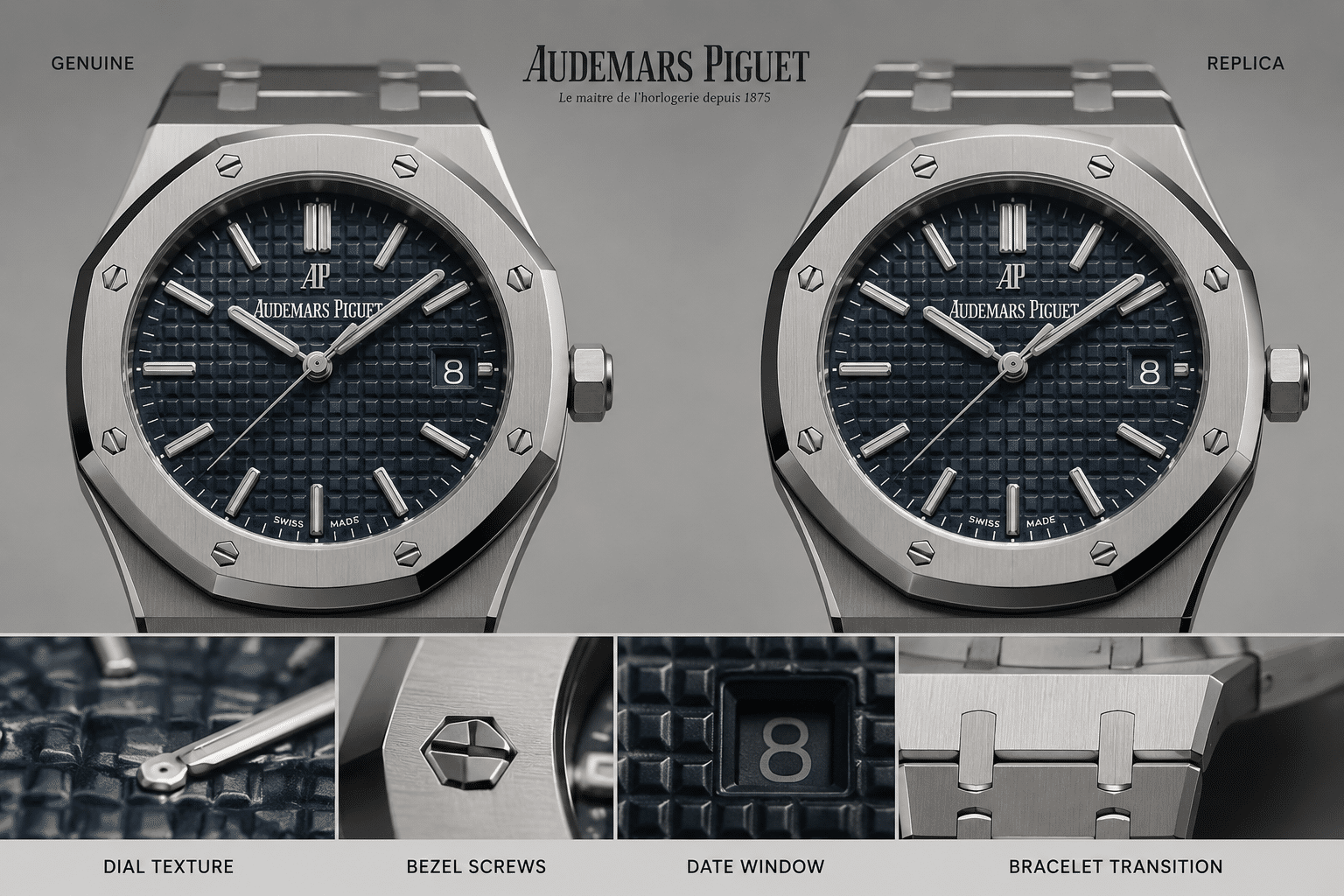
The APS V3 dial is one of the main reasons buyers put APS ahead in many Royal Oak 15500 replica discussions. The appeal is not simply “better color.” It is the combination of tapisserie depth, square definition, dial surface behavior, and the way the sunburst effect reacts under changing light. For buyers who stare at dial photos before making a decision, APS V3 often gives the more persuasive first impression.
The ZF V2 dial is not weak by default, and it should not be dismissed just because APS V3 gets more dial praise. ZF V2 can still look convincing in normal wear, especially for buyers who are less sensitive to exact blue tone or micro-texture. The real question is whether the dial gives enough depth and balance once you look past the factory name.
This is where buyers need restraint. The best blue dial 15500 replica in one lighting setup may not look like the best in another. Dealer photos, camera exposure, indoor lighting, and batch variation can all change the apparent color. A dial that looks rich and electric in a staged photo can look flatter in natural light, while a dial that looks muted in QC may be more balanced on wrist.
Tapisserie Depth and Pattern Definition
The tapisserie pattern should create structure without looking artificially harsh. On the Royal Oak 15500, the small raised squares and recessed channels need enough definition to give the dial depth, but if the pattern appears too sharp or stamped, the dial can look less refined under close viewing.
APS V3 is often preferred because its tapisserie effect tends to look more dimensional in photos, with better texture across the grid. The non-obvious point is that deeper-looking is not always better. If the texture becomes too aggressive, it can draw attention in the wrong way. A good dial should support the watch’s overall geometry, not make the surface look busy or rough.
For ZF V2, the decision depends on whether the dial still holds enough visual depth when viewed straight on and at an angle. If the dial looks flat under neutral light, the watch may feel less convincing even if the case and bracelet are strong. That is why dial QC should include more than one lighting angle.
Blue Dial Color Is the Most Sensitive Choice
Blue is the most desirable Royal Oak 15500 dial color for many buyers, and also the easiest one to overjudge from photos. The blue dial sunburst can shift from deep navy to brighter blue depending on angle, lighting, camera exposure, and crystal reflection. That makes factory comparisons more unstable than buyers want them to be.
APS V3 usually gets more attention for blue dial behavior because it can show stronger light play and a more engaging texture. Still, buyers should avoid treating a single photo as proof of color accuracy. Blue is not a flat paint sample. It is a layered visual effect, and the same watch can look different across indoor light, outdoor shade, and direct seller lighting.
Black, white, and grey dials are often more forgiving because they create less anxiety about exact saturation. They still require careful QC for printing, marker alignment, and date window framing, but they do not usually create the same debate over whether the shade is “right.” If you are highly sensitive to blue tone, APS V3 may be the better starting point, but the final call should still come from actual QC images.
Date Window, Logo, and Marker Alignment
Dial accuracy is not only texture and color. The AP logo placement, applied marker alignment, date window position, and dial printing all need to support the overall symmetry. A dial with strong tapisserie can still feel wrong if the date sits too high, the logo looks slightly misplaced, or one marker catches the eye for the wrong reason.
The date window is especially important because it sits in a clean area of the dial and interrupts the tapisserie pattern. If the datewheel is off-center, too low, too high, or visually cramped, it becomes noticeable quickly. This is not a minor macro-only concern for buyers who are sensitive to dial balance.
Marker alignment should be judged carefully, but not hysterically. Camera angle can make a marker look slightly off when it is acceptable in real viewing. The issue becomes more serious when the same misalignment appears in multiple straight and angled photos. That is when the flaw is probably on the watch, not in the photo.
Dial QC Photos to Prioritize
For dial QC, prioritize a straight-on photo under neutral lighting, an angled photo that shows tapisserie depth, and at least one image where the blue dial sunburst is not exaggerated by harsh dealer lighting, especially when judging a Royal Oak 15202 Jumbo replica against case finishing standards and dial manufacturing consistency. If possible, compare the date position and marker alignment across more than one photo before deciding.
The safest approach is to judge the dial as a complete composition. APS V3 may have the stronger dial reputation, but the best choice is still the individual watch with the cleaner texture, better color behavior, centered date, and balanced markers in the actual QC set.
Case Shape, Bezel Edges, and Finishing: Why ZF V2 Still Competes
The APS V3 case comparison should not be judged only by the dial, because the Royal Oak 15500 is a watch where the exterior surfaces carry much of the visual weight. ZF V2 still competes strongly because its case finishing and bezel treatment can give the watch a more mature physical presence, especially for buyers who notice how the brushed case, polished bevels, and octagonal bezel catch light on the wrist.
This is where a simple factory ranking becomes misleading. APS V3 may attract buyers for dial and movement reasons, but ZF V2 case finishing can be more persuasive to someone who values the feel of the watch as an object. On a Royal Oak replica, a slightly better dial does not automatically win if the case edges look too soft, the brushing lacks direction, or the side profile sits awkwardly above the wrist.
Bezel Brushing and Polished Bevel Transitions
The octagonal bezel is the first exterior area to inspect because it exposes both brushing quality and edge control. A convincing Royal Oak 15500 replica needs flat brushed planes with a clear grain direction, not a cloudy or circular finish that looks polished by accident. The polished bevels around the bezel should create a clean border against those brushed surfaces, but they should not look overly rounded or inflated.
ZF V2 often remains attractive here because the bezel and case surfaces can look more settled as a full exterior package. The judgment is not simply “sharper is better.” Overly aggressive edges can feel unfinished or uncomfortable, while overly soft bevels make the watch lose the architectural character that defines the Royal Oak. The better case shape is the one that keeps the geometry crisp without making the finishing look crude.
Buyers should also look at how the bezel finishing continues into the mid-case. If the brushing direction changes unevenly or the polished bevel line fades near the lug transition, the watch may look strong in a straight dealer photo but less convincing in normal wear. This is one of the reasons ZF V2 case finishing should remain part of the decision even when APS V3 receives more attention for the dial.
Case Thickness and Side Profile
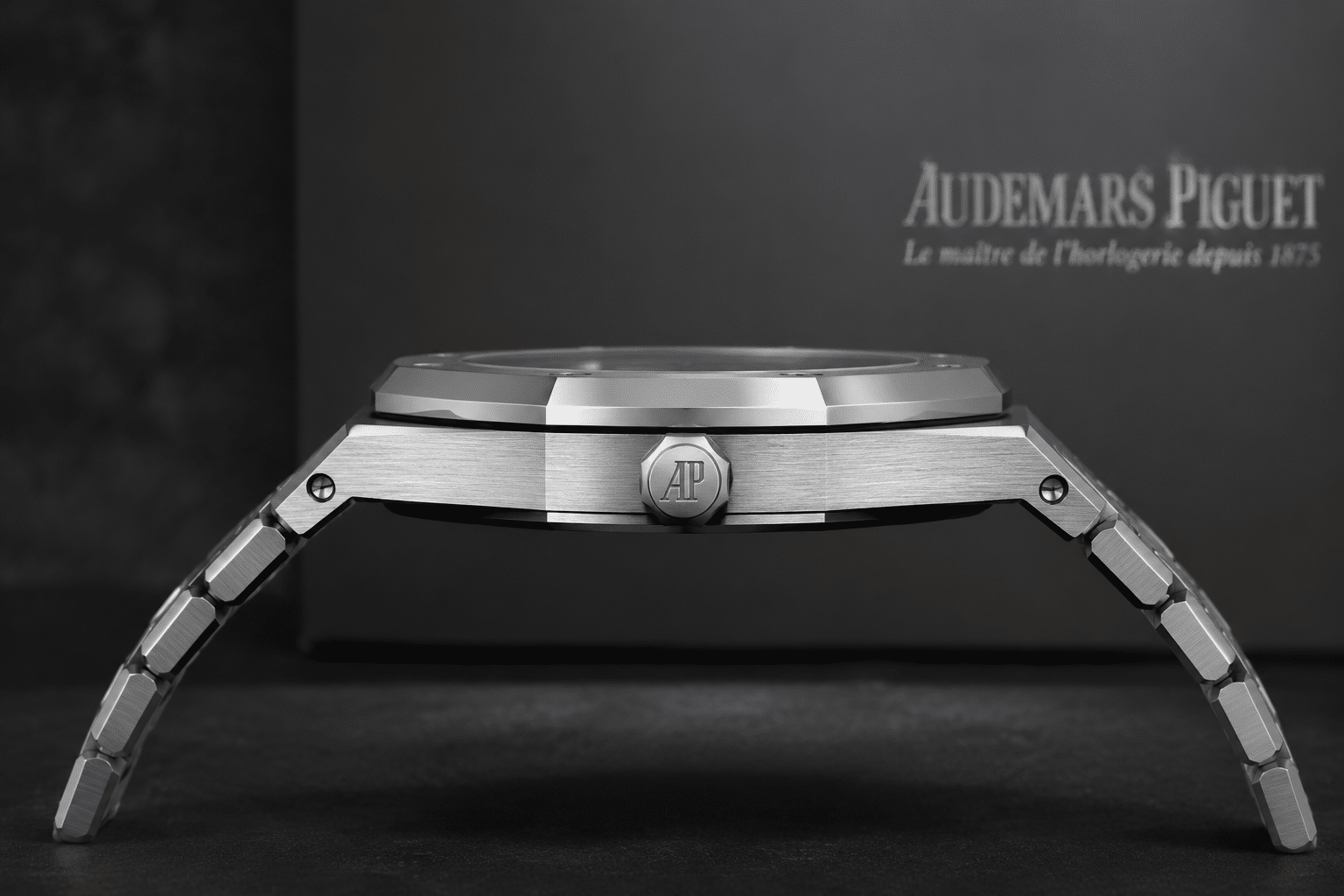
The Royal Oak replica side profile matters because the 15500 is not a thick sports watch trying to hide bulk. Its appeal comes from a wide, flat case, controlled height, and an integrated bracelet that should fall naturally from the lugs. If the mid-case looks slabby or the caseback adds too much visual height, the watch can feel heavier and less refined even if the front view looks acceptable.
For QC, the side photo is more useful than many buyers realize. It shows whether the bezel sits cleanly on the case, whether the caseback looks proportionate, and whether the lug transition creates a natural downward flow. A Royal Oak 15500 replica with a poor side profile may still photograph well from the front, but it will look less elegant on wrist because the case appears stacked rather than integrated.
ZF V2 can be the more satisfying choice for buyers who care about this exterior impression. APS V3 should still be checked carefully, because batch and sample quality matter, but buyers who prioritize case shape, side profile, and finishing consistency should not dismiss ZF V2 just because the market discussion often begins with dial texture.
Bezel Screws and Alignment Consistency
The bezel screws are an immediate QC checkpoint because they sit in plain view and break the clean geometry if one appears poorly seated. On the AP Royal Oak 15500 replica, the issue is less about chasing microscopic perfection and more about avoiding obvious imbalance. Screws should look evenly placed, flush enough to avoid a raised or sunken appearance, and consistent across the octagonal bezel.
A small camera angle can exaggerate alignment problems, so one front photo is not enough. Buyers should compare a straight-on image with a slight angled shot. If the same screw still looks visibly tilted, oversized, poorly finished, or unevenly seated across multiple views, that is more meaningful than a single distorted photo. This is especially important because the bezel screws frame the whole dial; when they look careless, the entire watch feels less controlled.
The practical judgment is simple: ZF V2 remains competitive when the case, bezel, and screw presentation look balanced as a complete exterior. APS V3 may still win for a dial-first buyer, but for someone who wants the Royal Oak replica side profile and case finishing to feel more convincing in daily wear, ZF V2 deserves serious consideration after QC.
Bracelet Articulation and Clasp Feel: The Detail Buyers Notice on Wrist
The Royal Oak replica bracelet is not an accessory attached to the case; it is part of the design. This is why the ZF V2 bracelet can matter more than buyers expect. A watch with a strong dial but a stiff, sharp, or awkward bracelet will feel less convincing after a few days of wear, because the Royal Oak depends on the way the bracelet drapes from the case and wraps around the wrist.
For daily wear, bracelet feel is one of the most practical differences between APS V3 and ZF V2. Photos can show brushing and link shape, but they rarely show whether the links move naturally, whether the clasp closes with confidence, or whether inner edges become irritating after sizing. This is where exterior maturity becomes more than a visual argument.
Link Movement and Wrist Drape
Good bracelet articulation means the links move with enough freedom to follow the wrist without feeling loose or rattly. On the Royal Oak 15500, the first few links near the case are especially important because they control how the watch sits. If those links are too stiff, the case may float or flare outward on smaller or flatter wrists. If they are too loose, the bracelet can feel less precise and show uneven gaps.
ZF V2 is often considered strong in this area because its bracelet finishing and link behavior can give the watch a more complete exterior feel. APS V3 has improved enough that this should not be treated as an automatic win for ZF, but buyers who ask which bracelet feels better should look beyond surface brushing. The real test is whether the bracelet falls naturally from the lug transition and stays comfortable after the watch is sized.
One non-obvious issue is that a bracelet can look excellent in a flat product photo and still wear poorly. Royal Oak links are broad and angular, so wrist shape matters. A buyer with a smaller wrist may notice stiffness and edge contact more than a buyer with a larger wrist. This is why bracelet articulation should be judged as a wearing issue, not only a finishing issue.
Clasp Action, Edge Comfort, and Sizing
Clasp feel is one of the first things buyers notice after delivery. A good clasp should close securely without feeling mushy, uneven, or overly tight. It does not need to imitate the exact tactile feel of a genuine AP clasp to be acceptable, but it should not feel like the weakest part of the watch. If the clasp action feels vague, the whole piece can feel less premium no matter how good the dial looks.
Edge comfort is just as important. The Royal Oak bracelet has many brushed surfaces and polished bevels, which means poor link finishing can create sharp spots along the inner edges. Slight crispness is expected on this design, but cutting edges, rough screw heads, or inconsistent link gaps are not small cosmetic issues if the watch is intended for daily wear.
Sizing also deserves attention. The Royal Oak bracelet does not offer the same easy micro-adjustment experience as many simpler sports watches, so a buyer may end up between ideal sizes. That matters more than forum photos suggest. A bracelet that is one link too loose can make the case slide around; one link too tight can make the edges more noticeable. For some buyers, ZF V2’s bracelet and clasp feel may be the reason it remains the more satisfying daily option even if APS V3 has the stronger dial discussion.
Bracelet Checks Before Accepting QC
Before accepting QC, buyers should request more than one front-facing photo. A bracelet side view can show link gaps and brushing consistency. A clasp photo can reveal engraving quality, closure condition, and whether the clasp sits evenly. A wrist-style angle can show whether the first links drop naturally from the case instead of flaring outward.
If video is available, it is more useful for bracelet articulation than still images. A short clip showing the bracelet flexing can reveal stiffness, loose sections, and clasp behavior that photos hide. The key judgment is not whether every link looks perfect under magnification; it is whether the Royal Oak replica bracelet supports the case as a complete wearing object.
Daily-Wear Buyer vs Photo-Accuracy Buyer
A buyer who wants the 15500 mainly for photos may rank the dial, bezel symmetry, and front-facing impression above everything else. That is understandable because the Royal Oak is visually driven, and APS V3 can be easier to justify when the dial is the main priority. But a photo-strong watch is not always the most comfortable daily watch. If the bracelet is stiff, the clasp feels weak, or the case sits too flat and wide on the wrist, the ownership experience can feel less satisfying than the QC photos suggested.
A daily-wear buyer should give more weight to bracelet articulation, crown feel, clasp security, and movement behavior. These are not always the details that win online comparison photos, but they are the details that affect the watch every time it is worn, sized, wound, or set. For a first-time Royal Oak replica buyer, this distinction matters because the model is less forgiving than a simpler round-case sports watch with a standard bracelet.
The best choice depends on how the watch will actually be used. If it will be worn occasionally and judged mostly by dial appearance, APS V3 may be the more satisfying route. If it will be worn often, especially on a smaller wrist or in situations where comfort matters, ZF V2’s exterior strengths may carry more real value. Neither priority is wrong, but mixing them up can lead to disappointment.
Clone 4302 Movement Confidence and Real Ownership Tradeoffs
The advertised clone 4302-style movement matters because the Royal Oak 15500 has a display caseback and a case design that depends on the movement fitting the watch properly. For many buyers, the APS V3 movement route adds confidence because it is tied to the modern 15500 architecture rather than feeling like a decorative solution placed behind the dial. Still, movement confidence should not be confused with a guarantee of long-term performance.
This is the section where APS V3 has a clearer argument for buyers who care about ownership feel, not just exterior appearance. A stronger movement route can support better case proportions, a more convincing caseback view, and a more satisfying daily-use experience. But the smarter way to judge it is by practical behavior: winding feel, rotor sound, date change, power reserve consistency, and whether the specific batch matches the movement claim.
What the Advertised Clone 4302 Route Means for Buyers
The advertised clone 4302-style route gives the AP 15500 replica a more coherent technical package when the current sample actually matches the seller’s claim. It is not only about seeing decorated bridges through the caseback. The movement architecture can affect how the watch is built, how the case thickness is managed, and how credible the display-back impression feels to a buyer who knows the model. That is why APS V3 appeals to movement-sensitive buyers.
A decorated movement can look impressive, but decoration alone is not the same as a reliable ownership experience. The buyer should care whether the movement route is established enough, whether current batches are consistent, and whether the watch behaves normally during winding and date operation. At Clean VS Factory, we tend to separate “looks good through the back” from “makes sense for daily ownership,” because those are not always the same thing in super clone watches.
The practical judgment is that APS V3 is usually the more comfortable choice for buyers who prioritize advertised clone 4302-style movement confidence. ZF V2 may still be attractive if exterior finishing is the main priority, but a buyer who worries about movement route, caseback credibility, and mechanical behavior will probably find APS V3 easier to justify.
Movement Evidence Buyers Should Ask For
Movement claims deserve a stricter standard than dial or bracelet opinions because the buyer cannot confirm everything from a beauty photo. If a listing says “clone 4302,” the useful evidence is a current caseback image, consistent bridge and rotor layout, seller confirmation that the shown watch is the actual sample, and normal setting or date-operation behavior. Even then, those checks support confidence in the route; they do not prove long-term reliability or equivalence to an authentic Audemars Piguet movement.
Buyers should also avoid treating movement decoration as proof of mechanical identity. A bridge shape, rotor engraving, or decorated plate can make the caseback look closer to the expected visual layout, but it does not verify tolerances, lubrication, parts quality, power-reserve stability, or service compatibility. For practical ownership, the more useful question is whether the movement in the specific sample behaves consistently and whether the buyer accepts the service risk that comes with replica movements.
Movement Transparency Note: Movement references in this article describe replica-market movement routes and configurations, not an official Audemars Piguet-manufactured caliber unless supported by verifiable evidence. Buyers should judge movement confidence through current caseback photos, stated version details, setting behavior, date operation, rotor sound, and realistic service expectations rather than bridge decoration alone.
Rotor Sound, Winding Feel, and Date Change
Rotor sound is one of the most common ownership complaints in replica watches, and it should not be ignored just because the movement looks correct in photos. A mild mechanical sound is normal for many automatic watches, but excessive whirring, scraping, or unstable rotor noise can make the watch feel less refined. Buyers should be cautious about any claim that a clone movement is silent or risk-free.
Winding feel is another useful signal. It should feel reasonably smooth and consistent, not gritty, loose, or uneven. Crown operation matters because owners interact with it directly when setting the time or date. If the crown feels fragile or the date setting feels rough, that affects confidence more than a small cosmetic flaw on the movement plate.
The date change should also be checked with realistic expectations. Some clone 4302-style movements are described with instant or near-instant date behavior, but individual performance can vary. A buyer should not rely only on factory descriptions. If possible, confirm that the date advances cleanly and that the datewheel sits centered in the window. A visually strong AP 15500 replica can become annoying quickly if the date operation feels uncertain.
What Movement Photos Can and Cannot Prove
Movement photos are useful, but they have limits. They can confirm the broad movement route, decoration style, rotor shape, bridge layout, and whether the caseback view matches what the seller claimed. They can also reveal obvious dirt, damaged screws, poor engraving, or a movement that does not match the advertised version.
What movement photos cannot prove is long-term reliability. They do not show lubrication quality, assembly cleanliness, power reserve under real use, or whether the movement will remain stable after months of wear. This is where buyers often overread QC photos. A clean caseback image is a good sign, but it is not a service report.
The more sensible approach is to treat movement photos as confirmation, not proof of durability. APS V3 movement confidence is a real reason to choose it, especially for buyers who dislike uncertainty, but the buyer should still expect normal replica movement limitations. No version should be treated as maintenance-free, guaranteed waterproof, or identical to the genuine AP caliber.
Movement Route to Verify
Before relying on older forum comparisons, buyers should confirm the stated movement route for the current batch. Factory versions change, sellers may use outdated descriptions, and two watches described with similar wording may not always represent the same production run. This matters especially with the AP 15500 because the movement is part of the reason buyers compare APS V3 and ZF V2 in the first place.
The safest rule is to verify the current version, request a caseback or movement photo when available, and judge the movement together with the full watch. If movement confidence is the priority, APS V3 is usually the stronger direction. If the buyer values exterior finishing more and accepts the movement tradeoff after verification, ZF V2 can still make sense. The wrong choice is choosing either version from factory name alone.
Blue, Black, White, or Grey Dial: Color Choice Changes the Risk
The AP 15500 dial color is not just a taste decision. It changes how much variation a buyer has to tolerate between factory photos, QC photos, indoor lighting, and real wrist use. In the APS V3 vs ZF V2 decision, blue usually gets the most attention because it is the most emotional choice, but it is also the easiest color to overjudge from a single photo.
For a blue dial Royal Oak replica, the risk is not that every blue dial is bad. The risk is that the buyer may expect one stable shade and receive a watch that shifts more than expected. A dial can look deep navy in one dealer photo, brighter electric blue under a lightbox, and almost grey-blue near a window. That lighting shift is normal for sunburst-style dials, but it makes color accuracy harder to evaluate than black, white, or grey.
Why Blue Creates the Most Debate
Blue is the color where APS V3 often gets the strongest praise, mainly because buyers are looking for more life in the dial: stronger sunburst tone, better depth, and less flatness. The problem is that blue is also the color most distorted by camera exposure and seller lighting. A slightly over-bright photo can make a decent dial look too loud, while a dim photo can make a weak dial look richer than it really is.
This is why the “best blue dial 15500 replica” question is harder than it sounds. The buyer is not only comparing APS V3 dial quality against ZF V2 dial quality. The buyer is comparing batch variation, photo conditions, and personal tolerance for color mismatch. If the blue tone is your main reason for buying the watch, APS V3 may be the more sensible starting point, but the actual QC set still matters more than reputation alone.
The non-obvious mistake is choosing blue because it looks best in promotional photos, then judging the delivered watch under completely different lighting. For blue, the safest approach is to ask whether the dial still looks balanced across several angles, not whether it matches one ideal reference image. A blue dial that looks slightly different in each photo can still be acceptable; a dial that turns overly purple, washed out, or too flat in every photo deserves more caution.
More Forgiving Dial Colors for Practical Buyers
Black, white, and grey are usually more forgiving AP 15500 dial colors because they reduce the emotional weight of color accuracy. They still need QC for marker alignment, printing, date centering, and dial cleanliness, but they create less anxiety around saturation and sunburst tone. For a buyer who wants a daily-wear Royal Oak replica without obsessing over whether the blue is “the right blue,” these colors can be the smarter route.
Black tends to hide small color differences well and gives the watch a sharper, more technical look. It can also make minor dial texture limitations less obvious in casual use. The tradeoff is that black may feel less special to buyers who associate the Royal Oak 15500 with the blue dial. If the priority is the safest dial color rather than the most iconic one, black is often easier to QC.
White and silver-white dials can look clean and balanced, but they expose printing quality and marker alignment more clearly. A slightly crooked marker or uneven date window can stand out because the background is bright, so an Audemars Piguet Royal Oak guide is most useful when it treats dial manufacturing, handset proportions, and date wheel alignment as model-specific checkpoints rather than generic cosmetic notes. Grey sits between the two: more interesting than black, usually less volatile than blue, and often easier to live with if the buyer wants a modern Royal Oak look without the strongest color-matching risk.
The practical judgment is simple: choose blue if dial character is the point of the purchase and you are willing to inspect multiple QC angles carefully. Choose black, white, or grey if you want an easier color to QC and care more about overall wrist presence than chasing the most debated dial tone.
QC Variation: The Differences That Can Change the Final Choice
APS V3 and ZF V2 are both serious AP 15500 replica options, but the final choice should be made on the actual QC photos, not the factory name alone. This matters because the Royal Oak design has very little visual clutter. A slightly off date, uneven marker, poorly seated bezel screw, or awkward bracelet gap can change the impression faster than it would on a busier watch.
For Royal Oak replica QC, the goal is not to find a mathematically perfect watch. The goal is to identify whether the visible issues remain noticeable across normal viewing angles. Some flaws are camera angle, reflection, or lens distortion. Others are real sample problems that will bother the buyer every time the watch is worn.
Front Dial and Bezel Checks
The first AP 15500 QC photos should be judged from a straight-on dial image. Look at whether the dial feels centered inside the case, whether the hour markers sit evenly, whether the AP logo is level, and whether the date is centered in the window. Date alignment is especially important because the 15500 has a clean, open dial; a low or high date can become the detail your eye keeps returning to.
Bezel screw alignment should be checked, but buyers should avoid treating tiny screw-angle differences as the whole decision. On the Royal Oak, the more useful question is whether any screw looks obviously sunken, raised, damaged, or inconsistent with the others. A small visual variation may be tolerable. One screw that clearly breaks the symmetry of the octagonal bezel is more serious.
Dial marker alignment also needs restraint. QC photos taken slightly off-axis can make a marker or date window look worse than it is. If the same issue appears in a straight photo and an angled photo, it is more likely to be real. If it appears only in one distorted image, ask for another angle before rejecting a watch that may otherwise be strong.
Side Profile, Bracelet, and Clasp Checks
The side profile matters more on the 15500 than many buyers expect. A front photo can make both APS V3 and ZF V2 look convincing, but a case side photo shows thickness, caseback shape, bezel height, and how naturally the bracelet drops from the case. This is where a Royal Oak can feel either integrated or slightly blocky.
Bracelet fit should be checked at the first link and along the side of the bracelet. Look for uneven gaps, stiff-looking end-link transition, rough edges, or brushing that changes direction awkwardly. The integrated bracelet is part of the case architecture, not an accessory. If the bracelet connection looks poor, the whole watch loses the clean Royal Oak line.
The clasp deserves its own look because it affects daily-wear satisfaction. A visible clasp gap, rough inner edge, weak closure, or sloppy engraving will not always appear in standard front photos. If possible, a short clasp video or extra clasp photo is more useful than another beauty shot of the dial.
Seller Photos, QC Photos, and What They May Hide
Seller listing photos are usually chosen to show the watch at its best. They can help identify the claimed factory version, dial color, and general style, but they often do not show the specific watch a buyer will receive. QC photos are more useful because they show the actual sample, yet they still have limits: strong lighting can hide brushing inconsistency, a flattering angle can reduce visible case thickness, and a tight crop can avoid showing bracelet drape or clasp fit.
For the AP 15500, the missing photos can be as important as the photos provided. If there is no side-profile image, the buyer cannot properly judge thickness and caseback height. If there is no clasp image, the buyer cannot judge closure seating or inner finishing. If the blue dial appears in only one harshly lit photo, the buyer cannot know whether the color remains balanced under softer light. These gaps do not automatically mean the watch is bad, but they do mean the buyer has less evidence.
A useful QC set should answer the buyer’s real priority question. For APS V3, that often means dial behavior, date centering, and movement-route confirmation. For ZF V2, it often means case finishing, bracelet transition, clasp action, and side profile. If the seller’s photos do not address the reason you are choosing that version, the comparison is incomplete even if the factory name sounds correct.
QC Evidence Should Match the Claim
Each claim in a listing should be matched to the right kind of evidence. A claim about dial improvement should be supported by clear dial photos under usable lighting. A claim about bracelet refinement should be supported by side views, clasp images, or a short articulation video. A claim about movement route should be supported by a current caseback or movement photo when available, not only by a copied product description.
This matters because many weak buying decisions come from evidence mismatch. A seller may describe a better dial while showing only one saturated beauty shot, or describe a stronger bracelet while showing no clasp or side angle. When the evidence does not match the reason for choosing APS V3 or ZF V2, the buyer should slow down and request the missing view instead of accepting the factory label as proof.
When a Flaw Is Acceptable and When It Is Not
An acceptable flaw is usually small, angle-dependent, and not repeated across the QC set. A slightly warm dial tone, a tiny reflection near the date, or a marker that looks questionable in one tilted image may not justify rejecting an otherwise strong sample. Buyers who reject every minor photo artifact can end up chasing a better watch that never arrives.
A red flag is different. If the date is visibly off in every straight photo, if the dial marker is clearly crooked, if the bezel screw seating is visibly uneven, if the bracelet has a persistent gap at the case, or if the clasp does not close cleanly, the issue will likely remain noticeable in daily wear. On a Royal Oak 15500 replica, symmetry and fit are not small details. They are the visual structure of the watch.
At Clean VS Factory, we usually treat QC as the final version comparison. APS V3 may be stronger on paper for one buyer and ZF V2 may be stronger for another, but a clean ZF V2 sample can beat a weak APS V3 sample, and the reverse is equally true.
QC Photos to Request
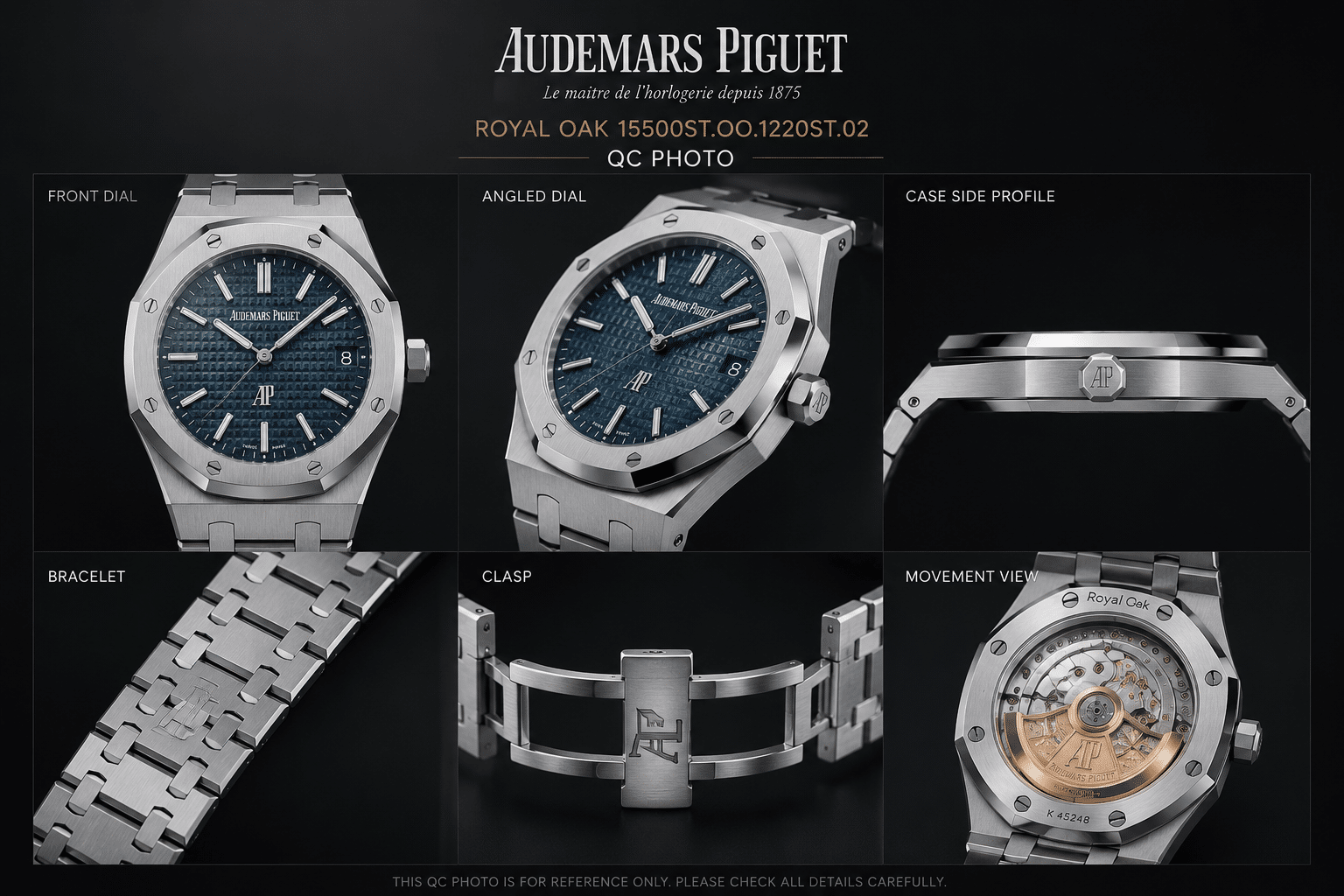
The most useful QC set includes a straight front dial photo, an angled dial photo, a case side photo, bracelet side photos, clasp photos, caseback photos, and a movement-route photo when available. For blue dials, neutral lighting and at least one angled photo are especially important because color and sunburst behavior can change quickly under different light.
Do not make the decision from only one front-facing image. A Royal Oak can look excellent from the top and less convincing from the side or clasp. The better QC habit is to judge balance across the full watch: dial, bezel, case profile, bracelet, clasp, and movement route together.
Price and Value Logic: When Paying More Does or Does Not Help
The AP 15500 replica price should not be judged as a simple ladder where the higher number automatically means the better watch. In the APS V3 vs ZF V2 comparison, value depends on what the price difference is actually buying: a newer factory version, a more desirable dial, a preferred movement route, stronger bracelet finishing, better QC support, or simply a more expensive listing.
This is where buyers often make the wrong move. They assume the most expensive Royal Oak replica value is always the safest, or they go the other way and choose the cheapest listing with a familiar factory name. Both approaches can fail. The useful question is whether the added cost reduces a risk that matters to you.
Prices can change by factory label, version, movement configuration, seller channel, availability, and after-sales support. Exact comparisons should be verified at the time of purchase, and a higher listing price should not be treated as proof of a better watch unless the current sample and seller communication support that conclusion.
What a Price Difference Might Actually Reflect
A real price difference may reflect the factory version, movement route, dial quality, bracelet finishing, batch recency, or QC consistency. If one APS V3 listing is tied to a current batch with stronger dial behavior and a clearly documented movement route, a premium may be understandable. If one ZF V2 example has cleaner case finishing, better bracelet articulation, and stronger clasp execution, that can also justify paying more for buyers who care about exterior feel.
But price can also reflect dealer channel, demand for blue dials, stock scarcity, or vague marketing language. Two watches can both be described as APS V3 or ZF V2 while differing in batch timing, dial tone, included photos, and how carefully the sample is screened. A higher price without clearer version information or better QC is not value. It is just a higher price.
For this model, paying more makes the most sense when the premium is connected to something visible or usable: cleaner dial color, better date centering, more consistent bracelet fit, documented movement route, or a sample that needs fewer compromises. Paying more for a factory name alone is a weak reason.
When the Cheaper Choice May Be Enough
The cheaper choice may be enough if the buyer wants a casual daily-wear AP 15500 replica and is not chasing the most debated blue dial or the most refined bracelet feel. A black or grey dial with good alignment, clean bezel screws, and acceptable bracelet fit can be more rational than paying extra for a blue dial that still needs careful QC and may not match the buyer’s ideal tone.
This is especially true for buyers who know they will wear the watch in normal settings rather than study it under macro photos. If the case profile is acceptable, the bracelet is comfortable, and the dial does not show obvious alignment issues, a less expensive sample can deliver most of the ownership satisfaction. The mistake is buying cheap while expecting the strongest dial, best bracelet, newest movement route, and flawless QC all at once.
A lower price is not automatically a warning sign, but it should make the buyer ask sharper questions. Is it the current version? Is the movement route clearly stated? Are the QC photos complete? Is the dial color the one shown in the actual sample? If those answers are vague, the saving may not be worth the uncertainty.
When Paying More May Reduce Friction
Paying more may be sensible when the buyer is trying to reduce friction rather than buy perfection. For the Royal Oak 15500, friction usually means rejecting multiple samples because of blue dial tone, uneven date alignment, bracelet gaps, clasp issues, or uncertainty about the movement route. A better-screened watch can save time and reduce disappointment, even if it is still not identical to the genuine reference under close inspection.
For APS V3, a premium is easier to justify when the buyer specifically values dial impression and movement confidence. For ZF V2, a premium is easier to justify when the sample shows stronger case finishing, bracelet articulation, and clasp feel. The value logic changes depending on the buyer’s priority. A dial-first buyer and a bracelet-first buyer should not necessarily pay for the same thing.
The clearest value rule is this: do not pay more unless the extra cost is attached to a specific advantage you can verify or reasonably expect from the version. If the premium only comes with louder claims, it does not solve the real buying problem. If it comes with cleaner QC, a better-matched dial, stronger exterior finishing, or a more confident movement route, the higher price may be justified for the right buyer.
Seller Terms, Shipping, and After-Sales Questions to Confirm
Price should also be compared together with seller terms, not in isolation. Before ordering, buyers should confirm return or exchange expectations, repair options, what happens if the delivered watch differs from the QC sample, whether any water-resistance testing is offered, and how shipping risks are handled. Unless those terms are clearly stated by the seller, they should not be assumed from a factory name, a higher price, or a polished product description.
Water resistance is especially important on Royal Oak-style replicas because the design may look like a luxury sports watch, but appearance does not prove sealing performance. Buyers should not assume swimming, showering, or heavy water exposure is safe unless the specific watch has been tested and the seller’s policy is clearly confirmed. Even after testing, replica watches should be treated more cautiously around water than genuine watches maintained through official service channels.
Which Buyer Should Choose APS V3, and Which Buyer Should Choose ZF V2?
The decision to choose APS V3 or ZF V2 should not start with factory loyalty. For the AP Royal Oak 15500 replica, the better question is what kind of imperfection you are more willing to live with. APS V3 is usually the stronger fit for a dial-first buyer who cares about tapisserie texture, blue dial behavior, and movement-route confidence. ZF V2 remains a serious choice for the buyer who judges the watch more by exterior finishing, bracelet feel, case presence, and daily-wear comfort.
This is why there is no honest single answer to the “best AP 15500 replica version” question. The Royal Oak 15500 is not a watch where one part carries the whole impression. A strong dial with a stiff bracelet can still disappoint. A better bracelet with a weaker blue dial can also feel wrong if the buyer is sensitive to color and texture. The safer choice is the one that matches the buyer’s priority and then passes QC on the actual watch being offered.
Choose APS V3 If Dial and Movement Confidence Matter Most
APS V3 makes the most sense for buyers who look at the Royal Oak 15500 and immediately focus on the dial. If the tapisserie pattern, square definition, sunburst reaction, AP logo placement, and date window balance are the details you will keep checking on your wrist, APS V3 is usually the more sensible starting point. This is especially true for the blue dial, where tone and light play can make or break the whole impression.
The other reason to lean APS V3 is movement confidence. The advertised clone 4302-style route matters because the 15500 is a display-back watch and because movement architecture affects more than decoration. It can influence case fit, thickness confidence, date behavior, rotor feel, and the overall impression that the watch was built around the expected layout rather than adapted around a generic base. That does not make the movement risk-free, and it does not guarantee long-term reliability, but it gives movement-sensitive buyers a clearer reason to prefer APS V3.
The buyer who should choose APS V3 is the one who would rather accept slightly less exterior refinement than feel unsure about the dial or movement route. If the watch will be judged mostly from the front, under changing light, and by how close the dial feels to the modern 15500 character, APS V3 is usually the cleaner bet.
Choose ZF V2 If Exterior Maturity Matters More
ZF V2 is better suited to the buyer who experiences the Royal Oak as a case-and-bracelet object first. On this watch, the bracelet is not just a strap attached to the case. It is part of the design. The way the first links drop from the case, how the bracelet wraps the wrist, how the clasp closes, and how the brushing meets the polished bevels all affect whether the watch feels convincing in daily wear.
If your priority is exterior maturity, ZF V2 deserves real consideration. A Royal Oak replica can have a good dial and still feel less satisfying if the bracelet is too rigid, the clasp feels loose, the case edges look dull, or the brushed and polished transitions lack control. These are the details that become obvious after the watch is worn for a few days, even if they are harder to judge in a single front-facing QC photo.
ZF V2 is the more logical choice for a bracelet-first buyer who cares less about winning a macro dial comparison and more about how the watch sits, moves, and feels. It is also a reasonable option for buyers who want a balanced exterior package and are willing to verify the dial carefully in QC rather than assume the factory name settles everything.
Legal, Disclosure, and Water-Resistance Caution
Replica watches are imitation products and should not be described or resold as authentic, authorized, or affiliated with Audemars Piguet. Buyers should also understand that replica watches may raise trademark, customs, import, resale, and disclosure issues depending on jurisdiction. This article is a buyer guide, not legal advice, and it should not be read as reassurance that a purchase, shipment, or resale is risk-free.
Water resistance should also be treated as unverified unless the individual watch has been pressure-tested after purchase by a competent watchmaker or testing service. An authentic watch’s water-resistance rating does not prove that a replica version has the same sealing, gasket quality, case tolerances, or pressure performance. For APS V3, ZF V2, or any other Royal Oak replica, avoid swimming, showering, or sports use unless the specific watch has been tested and the buyer accepts the remaining risk.
The Balanced Buyer’s Final Check
A balanced buyer should not choose from forum shorthand alone. APS V3 and ZF V2 are close enough that the QC result can change the final decision between two individual watches. A strong ZF V2 with clean bracelet fit, sharp case finishing, centered date, and acceptable dial tone may be more satisfying than a weaker APS V3 sample. The reverse is also true if the APS V3 dial is cleaner and the ZF V2 sample shows visible alignment or finishing issues.
The final comparison should be made from actual QC photos, not only from factory reputation. Look at the dial straight on, then at an angled dial shot. Check whether the date sits naturally in the window, whether the bezel screws look evenly seated, whether the bracelet transition is clean, and whether the side profile looks controlled. If a flaw disappears only in one photo but returns in every other angle, it is probably not just camera distortion.
At Clean VS Factory, we usually treat this kind of decision as a version comparison, not a factory victory lap. APS V3 and ZF V2 both make sense for the right buyer, but neither name protects you from a weak individual sample. The best choice for me question should always end with the same practical step: compare the specific watch, not only the factory label.
Final Priority Rule
Choose APS V3 if dial accuracy and movement confidence are your two biggest priorities. Choose ZF V2 if bracelet finishing, clasp feel, and exterior presence matter more in daily wear. If you want the most balanced 15500 option, do not chase the loudest recommendation; compare the actual QC result and accept the version with the fewest visible problems in the areas you care about most.
The simplest rule is this: dial-first buyers should start with APS V3, bracelet-first buyers should seriously consider ZF V2, and movement-sensitive buyers should give APS V3 extra weight. For everyone else, the safer first AP replica is not the one with the strongest factory reputation on paper, but the one whose dial, bracelet, case profile, and movement route all make sense together in the specific watch being approved.
Disclosure: This article is for general educational and comparison purposes only. Replica watches are not genuine products from the original luxury brands, and brand names are used only to identify reference designs or comparison topics. Factory names, movement descriptions, prices, availability, QC details, seller policies, and version information can change, so readers should verify important details with the seller before making a purchase decision. Replica watches should not be represented, resold, or used as genuine watches.