
Why the Royal Oak 15400 Replica Cannot Be Judged From the Front Photo Alone
A clean front photo is not enough to judge an AP Royal Oak 15400 replica. This is the first mistake many buyers make with this reference: they compare dial color, logo placement, and bezel screws from one straight-on seller image, then assume the better-looking dial means the better watch. For the 15400, that logic is too shallow, especially when a Royal Oak 15510 replica comparison can show why newer visual cues do not automatically prove better construction. The Royal Oak is a flat, integrated-bracelet design with a display caseback, so the watch exposes construction choices that a front-facing photo can easily hide.
The 15400 is not only a dial-copy problem. It is a proportion problem and a movement-architecture problem. Two Royal Oak 15400 replica watches can look similar from the front, but one may sit thicker on the wrist, show a less convincing movement layout through the back, or have bracelet integration that makes the case feel blockier than it should. Those differences are not small if the buyer actually wears the watch. They change the profile, the balance, and the way the Royal Oak’s sharp geometry reads in normal use.
Replica watches should be clearly understood as replica-market products, not genuine watches from the original luxury brands. In this guide, Audemars Piguet and Royal Oak references are used to identify the genuine reference design being compared, not to imply authorization, endorsement, official production, or service compatibility with the original brand.
The Seller Photo Problem
Front-facing seller photos are useful, but they are also the easiest angle to control. A straight-on image can make the bezel shape look clean, reduce the visibility of case height, hide how the first bracelet links drop from the case, and completely avoid the display caseback. This matters because many weaker 15400 versions are most flattering from the dial side. The dial may look attractive, the Grande Tapisserie texture may appear deep under strong lighting, and the hands may line up well enough, yet the watch can still be compromised once viewed from the side or rear.
The most misleading part is thickness. A Royal Oak with extra case height does not simply become “slightly thicker.” It loses part of the low, architectural stance that makes the 15400 work. On a round dive watch, extra thickness can be easier to forgive. On a Royal Oak, the flat bezel, thin mid-case impression, and integrated bracelet create a continuous horizontal line. If the movement route forces a taller case or a bulky caseback, the watch starts to look stacked rather than refined.
The caseback is another area seller photos often avoid. A display caseback means the movement is not just a hidden engine. It is part of the visual package. If the rotor position, visible balance area, or bridge layout looks obviously unrelated to the expected 15400 architecture, the front photo has only told half the story. A buyer asking “is the front photo enough?” should treat the answer as no, especially on this reference.
Why the 15400 Exposes Construction Mistakes
The Royal Oak 15400 exposes mistakes because its design has very little visual padding. The octagonal bezel has hard geometry. The case side is broad and flat. The bracelet is not an add-on strap; it begins at the case and becomes part of the watch’s shape. When the proportions are off, the error is not isolated to one detail. It changes the whole wrist profile.
This is why movement architecture matters earlier in the decision than many buyers expect. A movement that is only disguised under decorative parts can still affect case thickness, caseback depth, rotor behavior, and the position of visible components. A watch can photograph well from the front while making less sense as a complete object. For a stronger Royal Oak replica version, the buyer should care about whether the construction supports the 15400’s proportions, not just whether the dial looks impressive under studio light.
Small errors also travel across the design. If the case is too thick, the bracelet may appear to fall away from the case less naturally. If the caseback is too bulky, the watch can sit higher and feel less planted. If the movement layout looks wrong through the back, the display caseback becomes a liability instead of a feature. None of these issues are properly answered by a single front-facing photo.
First Decision Rule
The first rule in any serious Royal Oak 15400 replica guide is simple: judge the watch as a three-dimensional object. Start with the front, but do not stop there. The minimum useful evaluation includes the dial side, side profile, bracelet angle, and display caseback. If a seller or listing only shows the front, the watch has not been evaluated yet; it has only been presented from its safest angle.
QC photos reduce uncertainty, but they do not remove every risk. They help buyers judge visible execution before shipment, especially when factory names or stock photos do not show the exact watch being supplied. For the 15400, a useful photo set should connect the front dial, side thickness, bracelet transition, and rear movement view into one consistent sample.
QC photos can reduce uncertainty, but they do not guarantee perfection. Buyers should still review visible details, confirm the seller’s current terms directly, and avoid treating any single image set as proof of long-term reliability, water resistance, official origin, or authenticity.
The practical judgment is clear: for the 15400, a beautiful front photo should earn interest, not approval. Approval comes only after the case thickness, wrist profile, bracelet integration, and rear movement presentation make sense together.
The Genuine AP Royal Oak 15400 Design Details That Matter for Replicas
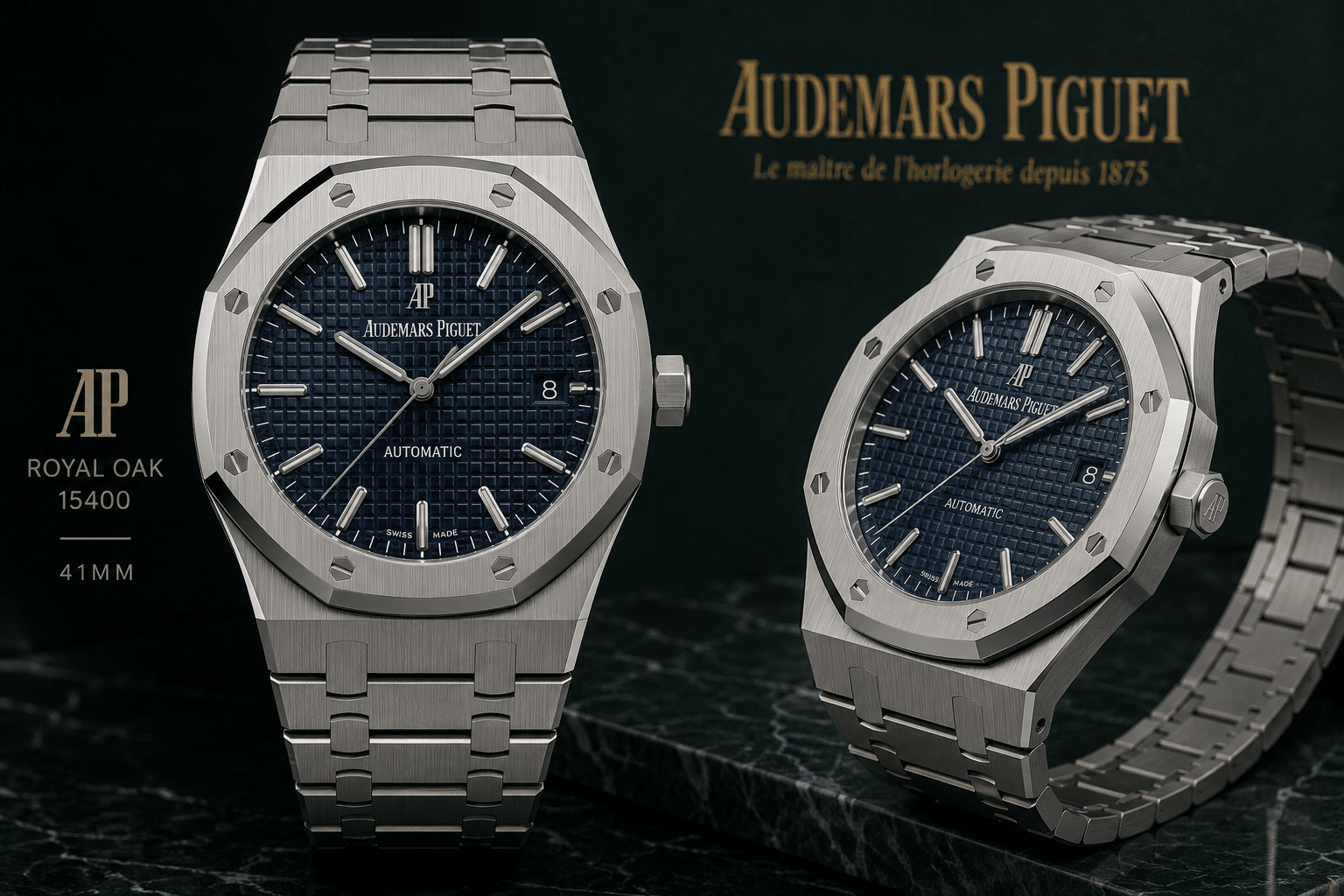
Before comparing factories or movement routes, the buyer needs to know what makes the 15400 identifiable. The Royal Oak 15400 design is specific: a 41mm case, classic Royal Oak proportions, a date window at 3 o’clock, visible AUTOMATIC dial text, and an hour marker beside the date. These are not collector trivia points. They are the reference points that help buyers avoid confusing a 15400-style watch with a different Royal Oak generation or a loosely labeled AP replica.
This matters because Royal Oak references can look similar in casual photos. A buyer who only thinks “blue Royal Oak, 41mm, integrated bracelet” may miss layout differences that affect whether the watch is actually trying to represent a 15400. The right question is not just “does it look like an AP?” The better question is “does it carry the correct 15400 identity before I start judging quality?”
Any comparison to Audemars Piguet should be understood as a replica-market visual reference, not an official brand affiliation or a substitute for authorized retail. The goal is to compare the offered watch against the genuine reference design for proportion, layout, and construction logic, while recognizing that close inspection, movement architecture, finishing, and service expectations can still differ.
41mm Case and Classic Royal Oak Wrist Presence
The 15400 is a 41mm Royal Oak, but it does not wear like a normal 41mm round watch. The case is wide, flat, angular, and connected directly to the bracelet. The bezel spreads visually across the wrist, and the first bracelet links extend the footprint before the bracelet begins to curve downward. This is why some buyers find the 15400 larger than expected even when the diameter sounds familiar.
For replica evaluation, the 41mm case is only the starting point. The more important question is whether the case, bezel width, and bracelet taper create the correct Royal Oak proportions. If the bezel looks too heavy, the case side looks too tall, or the bracelet transition looks stiff, the watch can feel less like a 15400 even if the front diameter is technically close. The Royal Oak’s wrist presence depends on flatness and flow as much as size.
The non-obvious point is that a slightly wrong side profile can make the watch appear both larger and less refined. Extra thickness raises the case, reduces the sleekness of the bracelet line, and makes the octagonal shape feel more like a block. Buyers often focus on dial color first, but for this model, case flatness is a stronger daily-wear signal.
“AUTOMATIC” Text and 3 O’clock Marker Layout
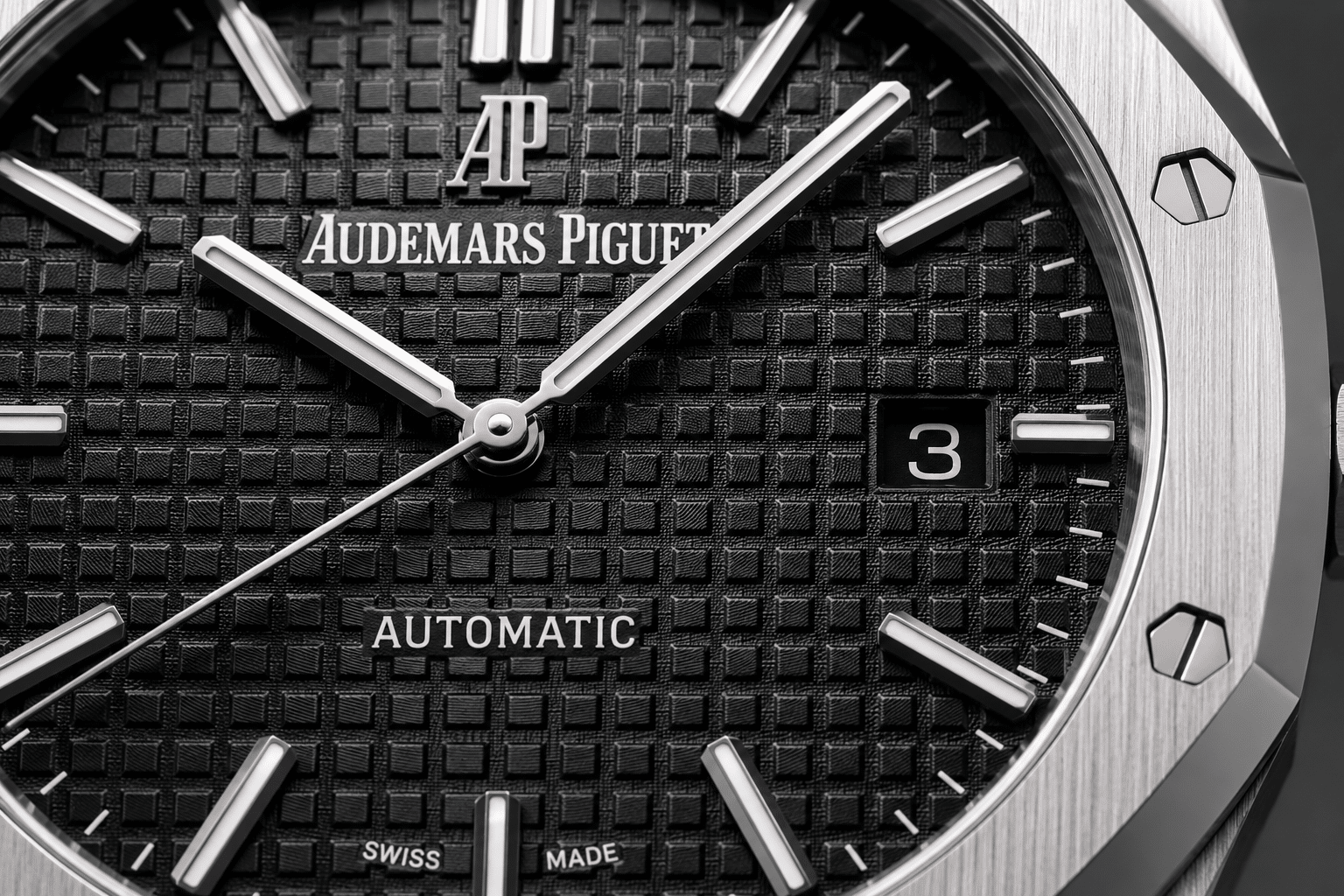
The AUTOMATIC text is one of the simplest AP 15400 replica details to check, yet it is often overlooked because buyers are distracted by dial color and tapisserie texture. On the 15400, the word sits on the lower half of the dial and helps define the reference’s visual balance. If the printing is too thick, too high, too low, or poorly centered, the dial can feel off even before the buyer understands why.
The 3 o’clock area matters even more. The 15400 has a date window at 3 o’clock and a visible hour marker beside it. That marker helps preserve the dial’s rhythm across the right side of the watch. If it is missing, cramped, misaligned, or awkwardly proportioned, the date side becomes visually weak. This is one reason the 3 o’clock marker should be checked before getting lost in broader factory claims.
A practical dial text check should include three things: whether the AUTOMATIC printing belongs to the 15400 layout, whether the date window sits cleanly within the dial geometry, and whether the 3 o’clock marker balances the date rather than looking like an afterthought. These details are easier to verify than movement architecture, so there is no reason to skip them.
Display Caseback as a Design Feature, Not an Afterthought
The 15400’s display caseback changes the replica evaluation. On a closed-back watch, the movement route may still affect reliability and thickness, but the owner does not see the architecture every time the watch is turned over. On the 15400, the rear view is part of the model’s appeal. That means the movement area, rotor presentation, and visible layout need to support the overall design rather than merely fill the space.
This does not mean every buyer must obsess over macro-level movement finishing. The more useful point is simpler: if the caseback is open, a wrong-looking movement structure becomes part of the watch’s visual identity. Decorative finishing can help a photograph, but the display back still raises the standard for coherence. A strong 15400 replica should make sense from the front and from the rear, even if it remains limited under close inspection.
For buyers asking how to identify 15400 quality, the answer starts with model identity and proportion logic: 41mm case, correct dial layout, visible 3 o’clock marker, convincing case flatness, integrated bracelet flow, and a caseback presentation that does not contradict the watch’s intended architecture.
The Old Miyota Decorative-Plate Problem
The older Miyota 15400 replica route is not automatically a bad movement choice in a general sense. Miyota 9015 movements can be practical, available, and serviceable in many replica watches. The problem is more specific: the Royal Oak 15400 has a thin-case expectation and a display caseback, so a movement that needs decorative disguise creates compromises that are harder to hide on this model.
A Miyota-based Royal Oak can look acceptable from the dial side because the movement is not visible from the front. The seller photo may show a clean tapisserie dial, neat hands, and a convincing octagonal bezel. The issue appears when the watch is viewed as a complete object. The decorative plate movement is trying to imitate an AP-style rear view while the underlying layout remains based on a different movement architecture. That mismatch is the old 15400 replica problem.
Decorative Plates Can Improve Photos but Not Architecture
A decorated movement plate is best understood as a visual cover. It can imitate bridge shapes, add engraved text, and make the rear view look more complicated than a plain base movement. In seller photos, this can be persuasive, especially if the image is taken at a flattering angle or the rotor covers the most obvious weaknesses. But the plate does not change where the movement’s core components actually sit, how the movement is built, or how much space the total assembly may need inside the case.
This is where buyers often misunderstand the term “decorated.” Decoration improves appearance; architecture determines layout. On a display-back Royal Oak, the difference matters. If the watch uses a Miyota 9015 under a decorated movement plate, the caseback may show AP-inspired styling, but the visible structure can still feel like a costume over the wrong body. For a watch as flat and architectural as the 15400, that is a real buying concern, not a minor forum detail.
Movement trust in the replica market depends on understanding what the movement claim actually describes: architecture, decoration, layout, reliability, or simply a market name used by sellers. A Miyota-based configuration, a decorated movement, and a clone 3120 route are not the same type of claim, so they should be compared through visible layout, case thickness, rotor behavior, and expected service convenience rather than treated as interchangeable labels.
Movement descriptions in the replica market should be checked carefully because they may refer to layout, decoration, clone architecture, or seller terminology rather than an official brand-manufactured caliber. A “3120-style” or “clone 3120” label should not be read as a genuine Audemars Piguet movement claim.
The judgment here should be controlled: not every Miyota-based version is useless, and not every buyer needs the most advanced movement route. But if the goal is a more convincing 15400, decorative plates are a compromise. They can make the watch look better in a rear photo than a bare movement would, but they do not solve the deeper caseback accuracy issue.
Why the Wrong Balance-Wheel Position Matters
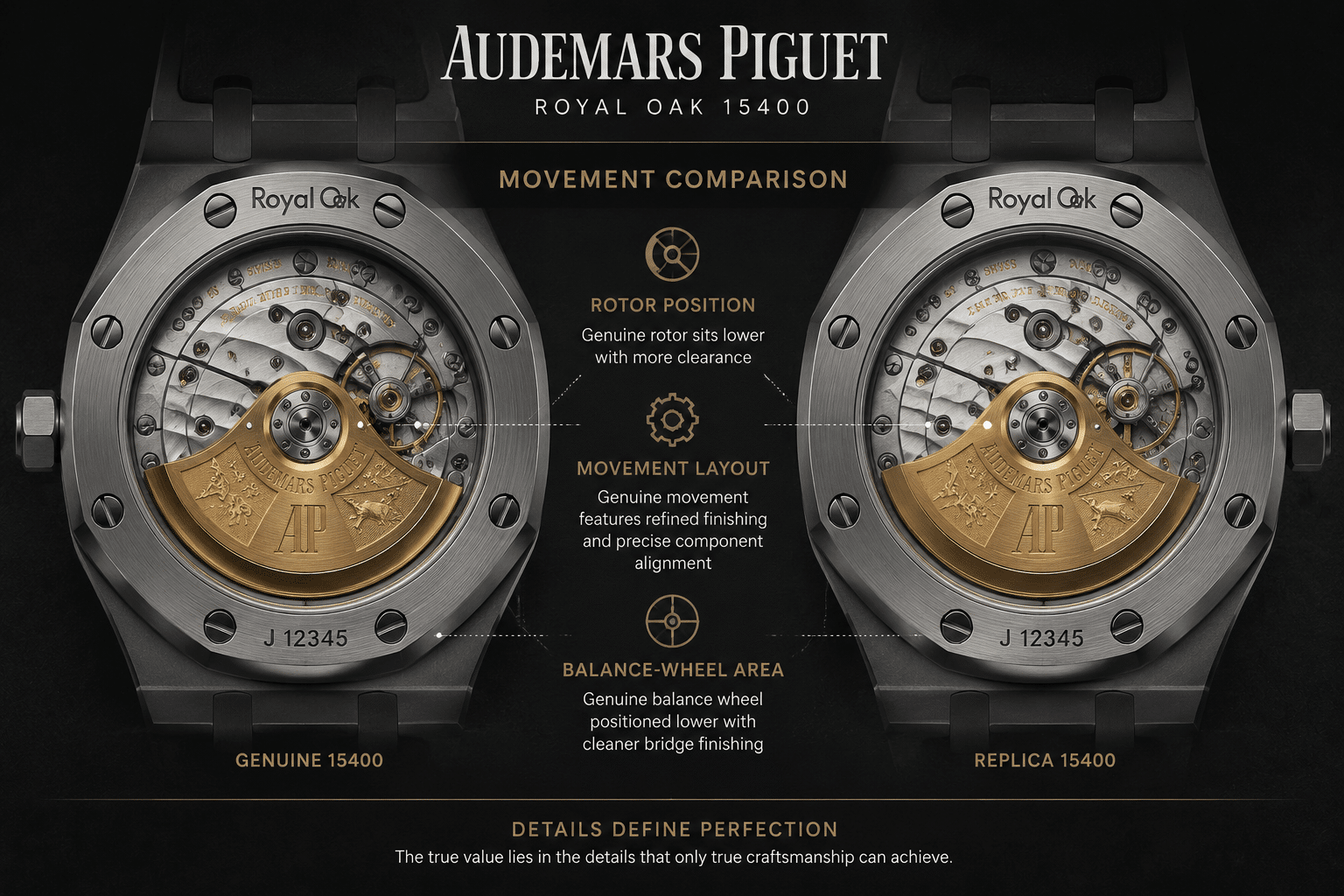
The balance wheel is one of the few movement areas that even a non-watchmaker can learn to recognize. Through a display caseback, it gives the eye an anchor point. On a 15400-style watch, if the visible balance area sits in a position that does not match the expected layout, the rear view immediately feels less coherent. The buyer may not know the technical reason at first, but the movement can look crowded, shifted, or incorrectly organized.
This is why the wrong balance position matters more on the Royal Oak 15400 than it would on many closed-back replicas. The caseback invites inspection. A decorative plate can draw attention to the rotor and engraved surfaces, but it cannot fully hide the underlying movement layout from someone who knows where to look. If a buyer is paying for a better Royal Oak replica version, the rear architecture should not depend only on cosmetic distraction.
The practical takeaway is not to use the caseback for deceptive authentication claims. The purpose is buyer protection. If the movement layout does not match the seller’s description or looks like an older decorative-plate route being sold as something more advanced, that should slow the decision down.
Rotor Sound and Ownership Feel
The Miyota 9015 is known in the replica market for a rotor sound that can be more noticeable than buyers expect, especially because of its winding behavior. Some units are quieter than others, and case construction can affect how much sound reaches the wrist. Still, rotor noise is a real ownership signal. A watch that looked elegant in photos can feel less refined if the rotor is loud during normal arm movement.
Winding feel is another practical point. A movement does not need to feel like a genuine AP caliber to be enjoyable, but it should not feel rough, loose, or inconsistent from the start. Older decorative-plate versions can add visual ambition without improving the tactile experience. That gap between photo appeal and daily-use feel is exactly why the 15400 should not be judged from the dial side alone.
The sensible position is this: a Miyota decorative-plate movement may be acceptable for a buyer who prioritizes lower cost and mainly wants the Royal Oak look from the front. It is less suitable for a buyer who cares about caseback coherence, thinner wrist profile, and a more integrated ownership experience. On the 15400, that distinction changes the buying decision.
Why Clone 3120 Changes the Royal Oak 15400 Replica Decision
The clone 3120 movement changes the AP 15400 replica decision because it addresses the part of the watch that front photos cannot solve: the relationship between movement architecture, display-caseback layout, and case construction. On this reference, a better dial is not enough. The Royal Oak 15400 has a visible caseback and a relatively thin, flat case profile, so the movement route directly affects whether the watch feels mechanically coherent or merely decorated.
This is why the clone 3120 movement should not be treated as a small technical upgrade. For the Royal Oak 15400, it is closer to a construction route. A decorative movement can imitate some visible shapes, but it does not fully solve the layout problem underneath. A 3120-style clone route is usually more suitable because the movement layout is closer to what the caseback expects to show, and it can support a more convincing case profile than older plate-based versions.
Architecture Matters More Than Decoration
The most common misunderstanding is thinking that a nicer-looking rotor equals a better Royal Oak 15400 movement. It does not. Rotor engraving and bridge decoration help the first impression, but they are secondary if the underlying movement architecture is wrong. On a closed-back watch, surface decoration might matter less. On a Royal Oak 15400 replica with a display caseback, the movement layout becomes part of the design.
A clone 3120 movement matters because it aims to place the visible components in a more logical relationship to the caseback opening. The buyer is not only looking at whether the rotor is gold-toned or whether the bridges have engraved text. The better question is whether the movement appears built for this case, or whether it looks like a smaller base movement wearing an AP-style costume.
That distinction changes the buying decision. If a version has an attractive dial but a movement route that creates a visibly compromised caseback, it may still be a weak choice for a buyer who cares about the 15400 as a complete watch. For this model, decoration can improve photos, but architecture improves the object.
More Correct Balance-Wheel Placement Improves the Caseback Impression
The balance-wheel area is one of the quickest places where the movement route becomes visible. Buyers often focus on the rotor first because it is large and easy to see, but the balance position is usually more revealing. A stronger clone 3120 caseback should look more consistent with the expected Royal Oak 15400 movement layout, while older decorative-plate routes often struggle because the real movement underneath was not designed around the same visual architecture.
This does not mean every clone 3120 caseback is perfectly finished or identical to the genuine movement. The point is more practical: in Royal Oak 15500 factory differences, the balance-wheel placement, bridge layout, and rotor relationship tend to look more coherent when the movement route is built around the 3120-style architecture instead of using a generic automatic movement hidden under plates.
For a buyer asking why clone 3120 matters, this is the cleanest answer: it reduces the caseback mismatch that decorative movement solutions cannot fully hide. If the seller only shows a straight front photo and avoids a clear rear view, the movement claim has not really been tested.
Thickness and Wrist Balance Are Part of the Movement Decision
The clone 3120 discussion is not only about the caseback. It also connects to case thickness and wrist balance. The Royal Oak 15400 depends on a flat architectural profile. If the movement route requires extra vertical space, the case can become taller, the caseback can appear more swollen, and the bracelet transition can feel less natural on the wrist.
This is where many buyers misjudge the model. They compare two AP Royal Oak 15400 replica photos from the front and choose the sharper dial. But if one version has a better movement route that supports a cleaner side profile, that version may be more convincing in actual wear even if the front-photo difference is small. On the 15400, the most attractive watch in a seller album is not always the better-built watch.
At CleanVSFactory, we usually treat movement choice as part of the case decision, not a separate technical footnote. If the movement, caseback, and case thickness do not work together, the watch may look attractive in one angle but feel less convincing as a Royal Oak on the wrist.
Movement Route to Verify
“Clone 3120” should be verified as a movement-route claim, not accepted as magic wording. Buyers should ask for a clear caseback photo, a rear angle that shows movement depth, and version information that matches the stated watch. This is not about using the watch for deception or resale as genuine. It is about making sure the replica watch being evaluated actually matches the construction claim being used to justify it.
- Check the caseback layout: the balance-wheel area, rotor position, and bridge layout should look coherent, not like a decorative plate hiding a different movement.
- Check the side profile: the movement route should support a case that looks appropriately flat for the 15400, not unnecessarily bulky.
- Check photo consistency: the front, side, and rear images should appear to show the same watch, not mixed sample photos from different versions.
- Check the seller wording: vague phrases such as “best movement” or “upgraded movement” are less useful than a clear movement-route description.
The judgment is simple: for the Royal Oak 15400 replica, clone 3120 is usually worth prioritizing when the buyer cares about caseback realism, case thickness, and overall construction logic. It does not guarantee perfect reliability or flawless finishing, but it addresses a more important problem than a decorative rotor can.
Movement references in this guide describe replica-market movement routes and configurations. A “clone 3120” claim should be checked through visible caseback layout, balance-wheel position, movement depth, and side profile rather than treated as an official Audemars Piguet caliber or proof of genuine-level construction.
Case Thickness and Side Profile: The Check Seller Photos Often Hide
The Royal Oak 15400 case thickness is one of the most important checks because this watch is supposed to wear like a flat, integrated steel design, not like a tall round sports watch with an AP-style dial. A front photo can make almost any decent 15400 replica look clean. The side profile tells you whether the case construction actually supports the Royal Oak shape.
A too thick Royal Oak replica changes the entire impression. The bezel may still look sharp from above, the Grande Tapisserie dial may photograph well, and the hands may be aligned, but the watch can lose the low, architectural character that makes the 15400 convincing. This is why the AP 15400 side profile should be checked before treating the watch as a serious shortlist candidate.
Why a Thick 15400 Looks Wrong Even With a Good Dial
The 15400 is not forgiving in profile. Its design depends on stacked horizontal layers: bezel, crystal, mid-case, caseback, and bracelet. If the case is too tall, the watch begins to look top-heavy. That extra height is not always obvious in a straight seller photo, but it becomes visible when the watch is viewed from the side or worn on the wrist.
The problem is not only a number on a spec sheet. A thicker case changes how the Royal Oak sits. The watch can ride higher, the bracelet may drop less naturally from the case, and the flat geometry can feel interrupted. A buyer who likes the 15400 because it looks thin and architectural should care more about side profile than tiny macro flaws in dial printing.
Photo angles can also mislead. A side shot taken too low may exaggerate thickness, while a high three-quarter angle can hide it. One side photo is useful, but multiple angles are better. The goal is not to measure the watch from a picture with perfect accuracy. The goal is to see whether the case layers look balanced or inflated.
Bezel, Mid-Case, and Caseback Proportions
A good side profile starts with the relationship between the bezel and the mid-case. The Royal Oak bezel should feel like a broad, flat architectural frame, not a raised cap sitting on a bulky body. If the mid-case looks too deep, the watch loses the clean horizontal tension that makes the 15400 recognizable.
The caseback is just as important. A display-back replica with a thick or protruding rear structure can make the watch look heavier than it should, especially from the wrist side. This is where movement route and case construction meet. If the movement solution requires extra space, the caseback may become the place where the compromise appears.
Buyers should look for a balanced visual stack: crystal height should not dominate, bezel height should not look excessive, the mid-case should stay controlled, and the caseback should not appear like an added spacer. Small deviations are normal in replica watches. A visibly swollen case profile is a different problem because it affects the watch every time it is worn.
Bracelet Drop and Wrist Fit
The integrated bracelet makes the side-profile check even more important. On the Royal Oak, the first links are not an afterthought; they continue the case shape. If the case is too thick or the first bracelet links do not articulate cleanly, the watch can sit awkwardly, especially on smaller or flatter wrists.
Bracelet drop matters because the 15400 does not have traditional lugs that curve down to rescue the fit. The bracelet has to leave the case at the right angle. If the first links are too stiff, too gapped, or too flat, the watch can wear larger than its 41mm size suggests. This is one reason some buyers find a visually strong 15400 replica less comfortable than expected.
The practical judgment is that bracelet integration should be reviewed together with case thickness. A thin-looking case with poor first-link behavior still may not wear well. A strong Royal Oak 15400 replica should look coherent from the side and should show a natural transition from case to bracelet.
Side Photos to Request
For the 15400, side photos are not extra decoration; they are normal verification. A buyer should want enough angles to understand how the watch is built, not only how the dial photographs.
- Direct side profile: useful for judging bezel, mid-case, caseback thickness, and whether the watch looks overly tall.
- Three-quarter front angle: helps show how the bezel and bracelet connect without flattening the watch into a dial-only view.
- Three-quarter rear angle: shows whether the display caseback looks integrated or visually bulky.
- Bracelet-angle photo: helps reveal first-link articulation, bracelet drop, and whether the watch may sit flat or stiff on the wrist.
If a listing shows five beautiful dial photos but no usable side view, the Royal Oak 15400 case thickness has not been answered. For this reference, that missing angle should slow the decision down.
APS and ZF Royal Oak 15400 Versions: How to Compare Without Oversimplifying
The APS 15400 replica versus ZF 15400 replica question is useful, but only if it is framed correctly. The mistake is asking which factory is “best” in a universal sense. The better question is which specific Royal Oak 15400 version has the stronger movement route, cleaner side profile, more convincing dial execution, better bracelet finish, and more consistent QC sample.
For the 15400, factory reputation can point you in the right direction, but it should not finish the decision. APS and ZF have both been discussed heavily in the AP replica market, and both names can appear in serious comparisons. Still, a factory name by itself does not tell you whether the watch being offered is the current version, whether the movement claim is accurate, or whether the actual QC watch has alignment problems.
Factory names are useful market references, but they do not guarantee identical quality across every model or version. APS, ZF, and similar replica-market labels should not be understood as official Audemars Piguet affiliations, authorized production sources, or proof that a specific watch will match a seller’s description without supporting photos and version details.
Factory Name Is Only the Starting Point
A buyer comparing APS or ZF 15400 options should first ask what movement route is being offered. If the watch is presented as a clone 3120 version, that claim should be supported by caseback photos and consistent version information. If the seller only relies on the factory name and avoids the movement discussion, the comparison is incomplete.
This matters because the 15400 is not a model where the front dial alone determines quality. A factory may have a good reputation for case finishing or bracelet feel, but the Royal Oak 15400 also depends on movement architecture and case thickness. A visually clean ZF or APS front photo does not automatically answer the caseback and side-profile questions.
The strongest AP Royal Oak factory comparison starts with the actual watch: factory, version, movement route, side profile, caseback layout, dial color, and QC photos. Without those details, “APS or ZF 15400?” becomes too broad to be useful.
Where APS and ZF Comparisons Usually Matter
The first comparison point is the movement route. For the Royal Oak 15400, a clone 3120 version usually deserves more attention than an older decorative-plate route because it better supports the model’s display-back and thin-case expectations. This does not make every clone 3120 watch perfect, but it gives the version a better technical foundation.
The second point is case profile. Some buyers over-focus on dial color and forget that the Royal Oak is a case-and-bracelet watch as much as a dial watch. If one version has a cleaner side profile and better bracelet integration, that may matter more in daily wear than a slight difference in tapisserie texture under harsh lighting.
The third point is dial finish. The 15400 dial should be checked for Grande Tapisserie definition, logo position, printing weight, marker alignment, and date-window balance. Blue dials are often the most scrutinized because color shifts dramatically in photos, but grey, black, and white or silver tones can also reveal texture and printing differences depending on light.
The fourth point is bracelet and clasp quality. Royal Oak bracelets are difficult because the finishing alternates between brushed planes and polished bevels across many small surfaces. If the bracelet feels stiff, sharp, poorly articulated, or visually uneven at the first links, the watch will feel less convincing even if the dial is strong.
| Comparison Area | Why It Matters on the 15400 | What to Check |
|---|---|---|
| Movement route | Affects caseback layout, case thickness potential, and construction logic | Clone 3120 claim, rear photos, balance-wheel area, rotor layout |
| Case profile | The 15400 depends on a flat, architectural wrist presence | Side view, caseback height, bezel-to-mid-case balance |
| Dial execution | The dial geometry makes small alignment issues visible | Tapisserie texture, logo, “AUTOMATIC” text, date alignment, markers |
| Bracelet and clasp | The integrated bracelet defines comfort and visual flow | First-link fit, brushing, bevels, clasp finish, articulation |
| QC consistency | Good factory reputation does not prevent individual sample flaws | Actual QC set, not reused sample images or old forum photos |
A factory comparison is most useful when it is tied to the specific reference, version, movement, and visible execution details rather than treated as a universal ranking. APS or ZF can be a helpful starting label, but the final judgment should come from the actual 15400 sample: its caseback layout, side thickness, dial alignment, bracelet fit, and photo consistency.
Batch Variation and Seller Claims
Batch variation is the reason old forum opinions should be used carefully. A comment about an APS 15400 replica or ZF 15400 replica from a previous batch may still be useful, but it may not describe the exact watch being offered now. Factories update parts, sellers reuse descriptions, and market names can remain the same while details change.
Seller wording also needs to be read with caution. Phrases such as “latest version,” “upgraded movement,” or “best edition” are not enough unless they are tied to visible evidence. For the 15400, the evidence should include movement-route confirmation, caseback view, side profile, and a full QC set. A factory claim to verify is not an insult to the seller; it is normal due diligence for this model.
The practical judgment is that APS and ZF should be compared as version-specific options, not as permanent winners or losers. One may look stronger in movement-route clarity, another may appeal through finishing or bracelet feel, and the actual QC sample can still decide the better buy.
Version Details to Confirm
Before shortlisting a Royal Oak 15400 replica from APS, ZF, or any seller using those names, confirm the details that actually affect ownership. This keeps the decision grounded in the watch being offered rather than factory reputation alone.
- Factory and version: ask what specific APS or ZF 15400 version is being offered, not only the factory label.
- Stated movement: confirm whether it is described as clone 3120, decorative-plate Miyota, or another route.
- Caseback photos: check whether the movement layout visually supports the stated movement route.
- Side profile: review the AP 15400 side profile for case thickness, caseback height, and bracelet transition.
- Dial details: inspect “AUTOMATIC” text, 3 o’clock marker balance, date alignment, and tapisserie consistency.
- Dial color: request realistic lighting if color matters, because Royal Oak dials can shift heavily under seller lighting.
If the seller cannot provide enough information to connect the factory name, movement route, side profile, and caseback layout, the safer decision is to wait for a clearer sample. For the Royal Oak 15400, uncertainty usually hides in the angles that are not shown.
Factory names such as APS and ZF are buyer-facing labels used in the replica watch market. They should be treated as practical reference points for comparing versions, not as official Audemars Piguet affiliations, audited manufacturer identities, or guarantees that every watch from the same label will have identical movement execution, case profile, dial quality, or bracelet finishing.
Dial-Side Checks: The 15400 Details That Still Matter
A strong movement route does not excuse a weak dial. The Royal Oak 15400 dial is built around geometry: straight markers, a squared tapisserie grid, centered printing, and a date window that sits inside a very organized layout. This is why a Royal Oak 15400 dial check should not be treated as a quick glance at color and logo. On this model, small front-side errors can disturb the whole face of the watch.
The practical judgment is simple: dial quality is necessary, but not sufficient. A good dial cannot rescue the wrong caseback or a poor movement route, but a bad dial can still ruin an otherwise promising AP 15400 replica. The front photo QC stage should confirm that the watch actually presents as a 15400, not merely as a generic Royal Oak with a blue or black textured dial.
“AUTOMATIC” Text, Logo Placement, and Printing Weight
The “AUTOMATIC” text is one of the easiest 15400 identifiers to check because it sits openly on the lower half of the dial. Buyers sometimes focus on whether the word is present and forget to judge how it is printed. The weight, spacing, and horizontal alignment matter because the Royal Oak dial has very little visual softness. If the text is too bold, too high, or slightly tilted, it may not be obvious in a small seller photo, but it can look crude once the watch is on the wrist.
The AP logo deserves the same caution. It should not look like it is floating randomly above the center or crowding the upper dial. In front-facing AP replica QC photos, compare the logo position against the central hands, the 12 o’clock marker, and the tapisserie squares around it. A tiny position difference may be tolerable, but a logo that appears visibly off-center is a red flag because it suggests the dial printing or dial feet positioning may not be controlled well on that sample.
Printing sharpness is also easy to misread. Bright lighting and image compression can make thick printing look cleaner than it is. If the photo is overexposed, ask yourself whether the text edges still look crisp or whether everything has become a bright blur. For the 15400, clean but slightly imperfect printing is more acceptable than heavy, swollen printing that changes the character of the dial.
3 O’clock Marker and Date Window Balance
The 3 o’clock area is one of the most important AP 15400 dial details because this reference keeps an hour marker beside the date window. That marker helps the dial remain balanced. If the marker is crooked, too short, too close to the date aperture, or visually misaligned with the surrounding markers, the right side of the dial immediately feels wrong.
Date alignment should be checked with the same discipline. A slightly imperfect date photo caused by camera angle is not automatically a rejection, but within any Royal Oak replica models assessment, a date that sits clearly high, low, or left inside the window should be treated seriously. The Royal Oak dial does not hide datewheel problems well because the surrounding grid and rectangular marker geometry give your eye many reference lines.
The common buyer mistake is judging the date window only by whether the number is readable. Readability is not enough. Look at the amount of empty space above, below, left, and right of the numeral. If the date appears squeezed toward one edge, the flaw will likely remain visible in daily use, especially on lighter dial colors where the date disc contrast is stronger.
Tapisserie Pattern and Marker Alignment
The Grande Tapisserie pattern is where many Royal Oak replica photos become misleading. A dramatic light angle can make the dial look deeper, sharper, or cleaner than it appears in normal indoor light. Photos can help you check grid consistency, but they cannot fully prove texture quality. Treat seller lighting as a presentation tool, not as evidence that the dial has genuine-level depth.
What buyers can reasonably check is whether the tapisserie squares look evenly arranged and whether the applied hour markers sit cleanly over the pattern. Marker alignment matters more on the Royal Oak than on many round watches because the dial already has a strong grid. A marker that leans slightly may look minor in isolation, but against the tapisserie pattern it becomes easier to notice.
Pay special attention to the long markers at 12, 6, and 9, plus the smaller marker near the date at 3. These points anchor the dial. If one of them is visibly rotated or unevenly seated, the watch may never look calm from the front. A tiny amount of photo distortion is normal, but repeated misalignment across multiple images is not something to explain away.
Dial color should be judged cautiously. Blue, grey, black, and white or silver dials can shift heavily depending on lighting temperature, camera processing, and crystal reflection. A blue dial that looks ideal in a seller’s bright front photo may appear flatter or more purple in real life. For the Royal Oak 15400 dial check, color is important, but alignment, printing balance, and date placement are usually more decision-changing than chasing a perfect shade from one photo.
Caseback Checks: Where Clone 3120 Advantages Become Visible
The AP 15400 caseback is where the movement claim becomes difficult to ignore. A front photo can make many versions look similar, but the display caseback reveals whether the watch has a coherent movement layout or only a decorative attempt to imitate one. A clone 3120 caseback should not be judged only by whether it has gold-colored parts or AP-style engraving. The more useful question is whether the layout makes sense as a whole.
This is also where buyers need restraint. A stronger clone 3120 version can look more convincing than an older decorative-plate route, but it is still not a genuine AP movement and should not be judged as one. The caseback photo check is about consistency, version accuracy, and buyer expectation, not about creating a false authentication argument.
Balance Position and Bridge Layout
The visible balance area is one of the first things to inspect because it reflects the movement architecture, not just decoration. On older decorative-plate versions, the plate may imitate part of the AP-style visual language while the underlying movement still gives away a less coherent layout. With a better clone 3120 route, the balance position and bridge arrangement should appear more naturally integrated through the display back.
This matters because the 15400 is not a closed-back watch. Owners will see the rear of the watch when handling it, resizing the bracelet, winding it, or comparing photos. A wrong-looking balance area may not affect timekeeping directly, but it reduces the logic of the whole replica. If the front is clean and the back looks like a decorated cover sitting over an unrelated movement, the watch feels less resolved.
Do not over-focus on one shiny detail. Buyers often notice the rotor first because it is large and branded, but bridge layout and movement depth are more meaningful. A rotor can be engraved attractively while the rest of the movement still looks flat, crowded, or mismatched to the claimed version.
Rotor Appearance and Movement Finish
Rotor appearance is worth checking, but it should be judged realistically. Look at whether the rotor shape, engraving impression, and finish are consistent with the claimed clone 3120 version. The engraving should not look excessively thick, muddy, or randomly placed. The color should also avoid a cheap, overly yellow tone, although lighting can exaggerate metal color in photos.
Movement decoration is where buyers should avoid false confidence. A clean photo can show whether the visible surfaces are roughly consistent, whether screws look poorly seated, and whether the movement looks dusty or careless. It cannot prove long-term reliability, service quality, or internal cleanliness. A beautiful caseback is not the same thing as a fully proven movement.
The strongest caseback impression comes from coherence: rotor, bridges, balance position, screws, and overall depth working together. If one part looks new and polished while the surrounding movement looks flat or mismatched, question whether the photo represents the actual version being offered.
Matching the Caseback to the Claimed Version
A caseback photo is only useful if it belongs to the same watch being reviewed. Some listings use repeated stock photos, and careless sellers may show a front image from one version and a rear image from another. This is a common risk with AP replica QC photos because buyers often ask about “clone 3120” as a label, while the listing photos may not prove the specific sample.
The practical check is consistency across the whole image set. The dial color, bracelet, case finish, protective stickers, lighting setup, and rear photo should look like they come from the same watch and the same QC session. If the front image looks like a real sample but the caseback looks like a polished catalog shot, treat the movement claim as unconfirmed.
A stated clone 3120 route should be supported by a clear rear view, not merely by seller wording. The claim may still be accurate, but a buyer should not approve a Royal Oak 15400 replica on text alone when the display caseback is one of the main reasons to choose that movement route.
Caseback Photos to Compare
At minimum, request or review one straight rear photo and one angled rear photo. The straight rear image helps check movement layout, rotor position, engraving, and visible balance area. The angled rear image helps reveal depth, caseback height, and whether the movement presentation looks flat or layered.
A useful caseback set should show the entire rear of the watch, not only a cropped rotor close-up. Cropped photos can make decoration look better while hiding bridge layout, screw alignment, and caseback proportions. If the seller cannot provide a clear rear image for a display-back 15400, that is not a small omission. It removes one of the most important ways to verify whether the claimed movement route matches the watch.
Common QC Mistakes When Reviewing a Royal Oak 15400 Replica
Royal Oak 15400 QC is not difficult because there are hundreds of things to check. It is difficult because buyers often check the wrong things first. The model’s sharp geometry makes obvious problems stand out, but attractive AP replica QC photos can also distract from the practical red flags: missing angles, date alignment, caseback mismatch, and bracelet fit.
The right approach is to separate cosmetic variation from structural warning signs. A small reflection on the crystal, a slight color shift from lighting, or a photo taken a few degrees off-center may be acceptable. Severe marker misalignment, a visibly crooked date, inconsistent caseback photos, or unclear movement-route claims should not be waved through just because the dial looks good in one image.
Mistake 1: Approving the Watch From One Dial Photo
The most common QC mistake is approving the watch from a single clean dial shot. A Royal Oak 15400 can look impressive from the front even when the side, bracelet transition, or caseback raises questions. One front photo mainly tells you that the watch has the right general face. It does not confirm the whole watch.
For the front photo itself, check the basic geometry: logo placement, “AUTOMATIC” text, marker alignment, hand alignment, date centering, and whether the dial appears rotated inside the case. If the first image already shows a major issue, more angles will not fix it. If the first image looks good, it is only the beginning of the review, not the end.
Mistake 2: Ignoring Bezel Screws and Case Geometry
The Royal Oak bezel makes screw alignment more visible than on most round watches. The octagonal shape gives your eye eight fixed reference points, so uneven spacing or badly seated screws can disturb the entire front view. Buyers should not expect absolute perfection, but they should reject severe irregularity that is obvious without zooming deeply into the photo.
Look at whether the bezel sits evenly around the crystal and whether the screw heads appear consistent in size and depth. Slight angle distortion from the camera can make one side look larger, so compare more than one image before judging. But if the same screw looks sunken, rotated awkwardly, or out of line across several photos, it is not just a photo angle problem.
Case geometry also matters from the front. The Royal Oak is built from hard lines, so a bezel that looks shifted or a dial that appears off-center will be more noticeable than it would be on a softer, round sports watch. This is why QC tolerance should be stricter on geometry than on tiny macro-level finishing marks.
Mistake 3: Treating the Movement Claim as Automatically Proven
A stated clone 3120 movement is a claim to verify, not a fact to assume. If the seller says the watch uses a clone 3120 route, the caseback images should support that statement. This does not mean the buyer is performing authentication. It means the buyer is checking whether the offered version matches the description.
The mistake is accepting the movement label because the front dial is attractive. For the 15400, the whole reason the movement route matters is that it affects visible caseback logic and the overall construction package. If the caseback photo is missing, reused, low-resolution, or inconsistent with the rest of the QC set, the movement claim remains incomplete.
At CleanVSFactory, we usually treat factory and movement claims as version information that must match the actual photos. A good claim with weak supporting images is not enough for a careful buyer, especially on a display-caseback Royal Oak.
Mistake 4: Forgetting Bracelet and Clasp Fit
The integrated bracelet is part of the Royal Oak identity, not an accessory attached after the fact. A 15400 replica can have a strong dial and still disappoint if the first links sit awkwardly, the bracelet looks stiff, or the clasp finishing appears rough. In QC photos, the bracelet should flow from the case without obvious gaps, uneven transitions, or twisted first links.
Bracelet fit is hard to judge from a flat front photo, so look for angled images showing the first link drop and side transition. A little stiffness in a new bracelet is not unusual, but visible misfit at the case-to-bracelet junction is more serious because it changes how the watch wears and how the case visually integrates with the bracelet.
Clasp finish is another practical signal. You cannot know the exact clasp feel from photos, but you can inspect engraving quality, brushing direction, polished edges, and whether the clasp appears cleanly assembled. Poor clasp finishing often reflects lower overall attention to the bracelet, which matters more on a Royal Oak than on many strap-based watches.
Red Flags Before You Decide
Before approving a Royal Oak 15400 replica, slow down if any of the following appear in the QC set:
- Only one attractive front photo is provided, with no clear side or rear view.
- The date sits visibly high, low, or off-center inside the date window.
- The 3 o’clock marker, major hour markers, or AP logo appear clearly misaligned.
- Bezel screws show severe irregularity, uneven seating, or obvious size inconsistency.
- The caseback image does not match the claimed clone 3120 version or appears reused from another watch.
- The bracelet transition looks gapped, twisted, or poorly integrated with the case.
- The seller’s movement-route explanation is vague while the photos do not clarify it.
The sound QC decision is not the one that finds zero flaws. No replica watch should be judged that way. The better decision is to identify which flaws affect daily-wear confidence and which are only photo-level imperfections. On the Royal Oak 15400, date alignment, bezel geometry, bracelet integration, and caseback consistency deserve more weight than tiny reflections or color shifts caused by lighting.
Daily Wear Reality: What Clone 3120 Improves and What It Does Not Guarantee
The clone 3120 route makes the Royal Oak 15400 replica more coherent as a watch, but it does not remove normal replica ownership risk. Its main value is architectural: the movement layout, display-caseback impression, and potential case profile make more sense for this reference than older decorative-plate routes. That is different from saying clone 3120 reliability is automatic, guaranteed, or equal to a genuine AP movement over years of use.
This is where buyers often overcorrect. After learning that clone 3120 improves the 15400, some treat it as the only thing that matters. That is a mistake. For Royal Oak 15400 daily wear, the movement route is the foundation, but the final experience still depends on winding feel, rotor behavior, bracelet comfort, clasp quality, case finishing, and the actual QC sample. A strong movement architecture can still be let down by a stiff bracelet, rough clasp action, uneven finishing, or poor adjustment from the factory.
Better Architecture Does Not Mean Zero Risk
The practical reason to choose clone 3120 is not that it makes the watch risk-free. It is that it solves the specific mismatch that made older 15400 replicas feel compromised: a movement layout that did not suit an open-back, relatively thin Royal Oak case. A clone 3120 version usually gives the buyer a more believable movement position and a more logical case construction. That matters every time the watch is off the wrist or viewed from the side.
Reliability should be judged more carefully. A replica movement can run well, but it may still arrive dry, noisy, poorly regulated, or inconsistent from one unit to another. Power reserve claims should be treated as a general expectation rather than a promise. If the watch stops early, winds roughly, or shows calendar hesitation, the fact that it is a clone 3120 does not make those issues disappear.
The buyer’s judgment should be simple: clone 3120 is worth prioritizing for this model because it improves the structure of the watch, not because it guarantees a trouble-free ownership experience. If you expect genuine-level finishing, silent operation, and long-term service certainty, the movement upgrade alone will not meet that expectation.
Wearing Comfort Depends on More Than the Movement
The Royal Oak is not a forgiving daily watch if the bracelet is poorly executed. Its integrated bracelet is part of the case design, so comfort depends on how the first links drop from the case, how smoothly the bracelet articulates, and whether the clasp closes with a clean, secure feel. A technically better movement does not fix a bracelet that sits too stiffly or pulls hair because the link edges and gaps are rough.
Case balance also matters. A 15400 replica with better movement architecture can feel more natural if the case thickness and caseback height are controlled, but the watch still has a broad, flat 41mm wrist presence. On smaller wrists, the first bracelet links may matter more than the diameter number. If those links flare outward before wrapping down, the watch can wear larger and less planted than the front photo suggests.
This is why daily-wear satisfaction should be judged as a package. Movement route comes first for the 15400, but bracelet feel decides whether the watch is comfortable enough to wear often. A clean dial and correct caseback are less satisfying if the bracelet feels sharp, rattly, or awkward on the wrist.
Service and Water Resistance Expectations
Serviceability is another area where buyers should stay realistic. A clone 3120 may be more model-correct than a decorative-plate Miyota version, but that does not mean every local watchmaker will want to work on it or have suitable parts available. More specialized replica movements can be less convenient to service than common workhorse calibers, even when they look better through the caseback.
Water resistance should never be assumed from seller photos, factory claims, or the Royal Oak name. The 15400 design includes a caseback, crown, crystal gasket, and bracelet construction that all need proper sealing and testing. Unless the individual watch has been pressure-tested by a competent service source after purchase, it is safer to treat water exposure as a risk rather than a feature.
A replica watch should be evaluated with realistic ownership expectations. Even a strong super clone can have limits in water resistance, long