
The main question with the AP Royal Oak 15510 replica is not whether it is the newest reference, but whether the specific version in front of you has enough proof behind it, especially when sizing comparisons like Royal Oak 15450 37mm sizing affect how the case and bracelet sit on smaller wrists. The 15510 has the appeal of a current-generation Royal Oak layout, yet small mistakes on this design are easy to notice: dial spacing, bezel shape, brushing direction, bracelet fit, logo balance, and caseback presentation can all change the buying decision.
This article helps separate “newer” from “safer.” It explains why older 15400 and 15500 replicas may feel less risky for some buyers, especially when their factory differences, movement behavior, and common flaws are already better documented. The practical judgment is simple: choose the 15510 only when the factory version, movement route, batch history, and QC photos support the purchase. If those details are vague, a more proven Royal Oak reference may be the more sensible choice.
Brand names and reference numbers are used here for identification and comparison only. A Royal Oak 15510 replica is a replica-market watch, not a genuine Audemars Piguet watch, and factory labels in the replica market do not imply authorization, endorsement, or production by the original luxury brand.
| Decision Point | What to Check on the 15510 | Practical Buyer Judgment |
|---|---|---|
| Reference choice | 15510 versus 15500 or 15400 evidence | Newer is worthwhile only if the exact version is well proven |
| Factory version | Batch history, update notes, real QC examples | A known factory name is not enough without version-specific proof |
| Movement route | Clone, decorated, or upgraded claims explained clearly | Caseback appearance should not be treated as reliability proof |
| Visible execution | Dial texture, print weight, markers, logo, bezel screws | Royal Oak details expose small alignment and finishing issues quickly |
| Daily wear suitability | Bracelet articulation, clasp feel, winding, date behavior | Comfort and consistency matter more than having the latest reference |
| QC photo request | Straight dial, side profile, bracelet, clasp, caseback, movement | Pause if the seller cannot provide clear photos and explanations |
Quick Questions Before You Read
Q: Is the AP 15510 replica automatically better than the 15500 or 15400?
No. It is newer, but older references often have more documented flaws, updates, and owner feedback.
Q: What matters most before choosing a 15510 version?
Verify the exact factory version, movement route, batch maturity, and real QC photos before judging it.
Q: Should a decorated caseback influence the decision?
Only partly. It may improve appearance, but it does not confirm winding quality, rotor noise, date reliability, or service ease.
Q: Is the 15510 a good first Royal Oak replica?
It can be, but beginners may find the 15500 or 15400 easier to evaluate because their tradeoffs are better known.
Editorial Perspective: For this Royal Oak 15510 replica guide, the useful comparison is not a simple factory ranking or a claim that the newest reference is the best. At cleanvsfactory.com, this kind of watch is treated as a model-specific buying question: the factory name helps narrow the shortlist, but the final decision still depends on the exact batch, movement route, case profile, dial execution, bracelet feel, QC evidence, and whether the buyer wants a photo-focused piece or a more predictable daily wearer.
The Short Answer: Newer Does Not Automatically Make the 15510 Replica Safer
The AP Royal Oak 15510 replica is not automatically the safer Royal Oak choice just because the reference is newer. It can be worth considering, especially for buyers who want the current-generation look, but the buying decision should start with evidence: the factory version, the movement route, the batch history, and the actual QC photos of the watch being offered.
This is where many buyers misread the market. A newer Royal Oak reference may be newer in Audemars Piguet’s catalog logic, but that does not mean the replica version is more mature. Factories usually need time to refine the case shape, dial spacing, bracelet fit, bezel finishing, and display-back presentation. Older Royal Oak replicas such as the 15400 replica and 15500 replica often have a larger record of version updates, buyer feedback, and known flaw patterns. That does not make them perfect, but it does make their risks easier to understand before money changes hands.
The practical answer is simple: if you are asking, “is the 15510 replica better?” the answer is only if the specific version proves it. Newness is a feature. It is not proof of better execution, better reliability, or better long-term ownership.
Evidence Boundary: What Official Model Facts Can and Cannot Prove
When buyers discuss the 15510, official Audemars Piguet model information can help clarify the authentic reference family, design context, case size, dial language, and movement naming. That kind of information is useful for understanding what the replica is trying to imitate. It does not prove that a replica has the same finishing, movement construction, water resistance, materials, tolerances, warranty support, or service experience as the authentic watch. In this guide, any comparison to the authentic Royal Oak should be read as a visual and buyer-evaluation reference, not as a claim of authorization, equivalence, or identical performance.
Factory names in the replica watch market should be read as buyer-facing references rather than official luxury-brand affiliations. A name such as APSF, ZF, or another AP-market factory label may help organize comparisons, but it does not prove that every 15510 example from that source has the same dial, movement route, bracelet finishing, or batch maturity. The traceable way to use a factory name is to connect it to the specific reference, version, movement description, and real watch photos being evaluated.
The purpose of factory, movement, and QC information is buyer education, not authentication avoidance. A strong replica may look convincing in normal wear, but close inspection can still reveal differences in finishing, movement architecture, proportions, bracelet feel, dial details, or service compatibility. A replica watch should not be represented, traded, or resold as a genuine brand-manufactured watch.
Why the 15510 Looks Like an Easy Upgrade
The Royal Oak 15510 replica attracts buyers because it feels like the obvious move forward. It is tied to a newer Royal Oak reference, it looks current, and it gives the buyer the feeling of choosing the latest AP-style design rather than settling for an older generation. For many buyers, that emotional pull is real. A watch that appears more current can feel more desirable before any technical comparison begins.
The problem is that the replica market does not mature at the same speed as the official model cycle. A new reference can create fresh production challenges even when the overall design looks familiar. Small changes in dial layout, logo spacing, case feel, bracelet integration, or movement display can force factories to revise parts that looked acceptable on the previous generation. On a Royal Oak, those small changes are not minor decorations; they affect the whole visual balance of the watch.
That is why the 15510 should be treated as a version-dependent purchase, not a default upgrade over the 15500 or 15400. A buyer who chooses it only because it is newer may end up accepting more uncertainty, not less.
The Real Buying Question Is Factory Maturity
The better question is not “should I choose the newer version?” The better question is: has this Royal Oak 15510 replica version matured enough to reduce avoidable risk? Factory maturity matters because the first attractive photos of a new AP replica watch rarely tell the whole story. Early versions can look convincing from the front while still having weak bracelet feel, inconsistent brushing, vague movement claims, or small proportion issues that become obvious once the watch is handled.
At Clean VS Factory, we usually treat this kind of decision as a version comparison rather than a reference-year comparison. A factory name is useful, but it is not the whole answer. A factory can be strong on a 15500, less proven on a 15510, and still excellent on a different AP model. The buyer’s job is to connect the factory name to the exact model and batch, not assume the reputation transfers automatically.
For a newer Royal Oak reference, the safest path is to demand clearer evidence. That does not mean rejecting the 15510. It means judging it harder than a more established Royal Oak replica with years of feedback behind it.
Buyer Rule Before Reading Further
Do not treat the Royal Oak 15510 replica as better unless three things line up: the version is clearly identified, the movement route is explained without vague marketing language, and the QC photos support the claimed upgrade. If any of those three points are missing, the 15510 is not a safer Royal Oak replica choice simply because it is newer.
Why Buyers Are Drawn to the Royal Oak 15510 Replica
The Royal Oak 15510 super clone gets attention because it offers something many buyers instinctively want: the current Royal Oak look without choosing a reference that feels one generation behind. For someone comparing an Audemars Piguet 15510 replica against older AP replica watch options, the appeal is easy to understand. The 15510 sounds fresher, looks more current, and gives the impression that the buyer is moving with the latest design language rather than buying into a discontinued or older-market favorite.
That attraction is not irrational. Replica buyers often choose with both eyes and context. A Submariner buyer may want a safer daily Rolex replica, but a Royal Oak buyer often cares about wrist presence, reference identity, and whether the watch feels modern. The 15510 benefits from that psychology. It feels like the updated choice before the buyer has even compared factory maturity or movement claims.
The caution is that popularity and reference freshness do not equal proven execution. The Royal Oak design is unusually unforgiving. It has flat brushed planes, polished bevels, an octagonal bezel, exposed screw details, a structured dial, and an integrated bracelet that must flow into the case correctly. A newer AP replica model can look impressive in a seller photo while still missing the calm, balanced feel that makes the Royal Oak convincing on the wrist.
The Appeal of Owning the Newer Reference Style
Many buyers are drawn to the 15510 because it feels closer to the watch they would see in current AP conversations. The reference sounds contemporary. The dial presentation feels updated. The overall idea of wearing the latest Royal Oak replica has a stronger emotional pull than choosing a 15400 or even a 15500, especially for buyers who do not want to explain why they picked an older reference.
This is where the 15510 has real appeal. A buyer who already prefers the current Royal Oak generation may not be fully satisfied by a more mature older replica, even if that older watch is technically the safer choice. Reference preference matters because a replica watch still has to be enjoyable to wear. If the buyer constantly wishes the watch were the newer layout, the safer older reference may feel like a compromise from day one.
The smarter way to frame it is not to dismiss the 15510’s appeal, but to separate emotional preference from execution confidence. Wanting the current Royal Oak look is valid. Assuming that the current look has the most mature replica execution is the mistake.
Why Royal Oak Replicas Magnify Small Differences
The Royal Oak is a difficult design because it gives factories very little room to hide. On a round sports watch with a busy bezel or thick case, small proportional errors may blend into the overall shape. On a Royal Oak, the geometry is exposed. The bezel must sit correctly, the screws must look evenly placed, the dial must feel centered, and the bracelet must leave the case with the right visual tension.
This matters more on the 15510 than many buyers expect. A minor shift in logo placement, date window position, marker length, or dial spacing can change the face of the watch. Slightly soft brushing or rounded bevels can make the case feel less crisp. A bracelet that is too stiff, too loose, or poorly finished can make an otherwise attractive Royal Oak 15510 super clone feel cheaper in daily use.
The non-obvious point is that the 15510’s appeal depends on restraint. The Royal Oak is not convincing because it is loud; it is convincing because its case, bracelet, dial, and bezel all hold the same disciplined geometry. If one part feels rushed, the whole watch can lose that controlled AP look.
15510 vs 15500 vs 15400: The Reference Difference Buyers Must Understand
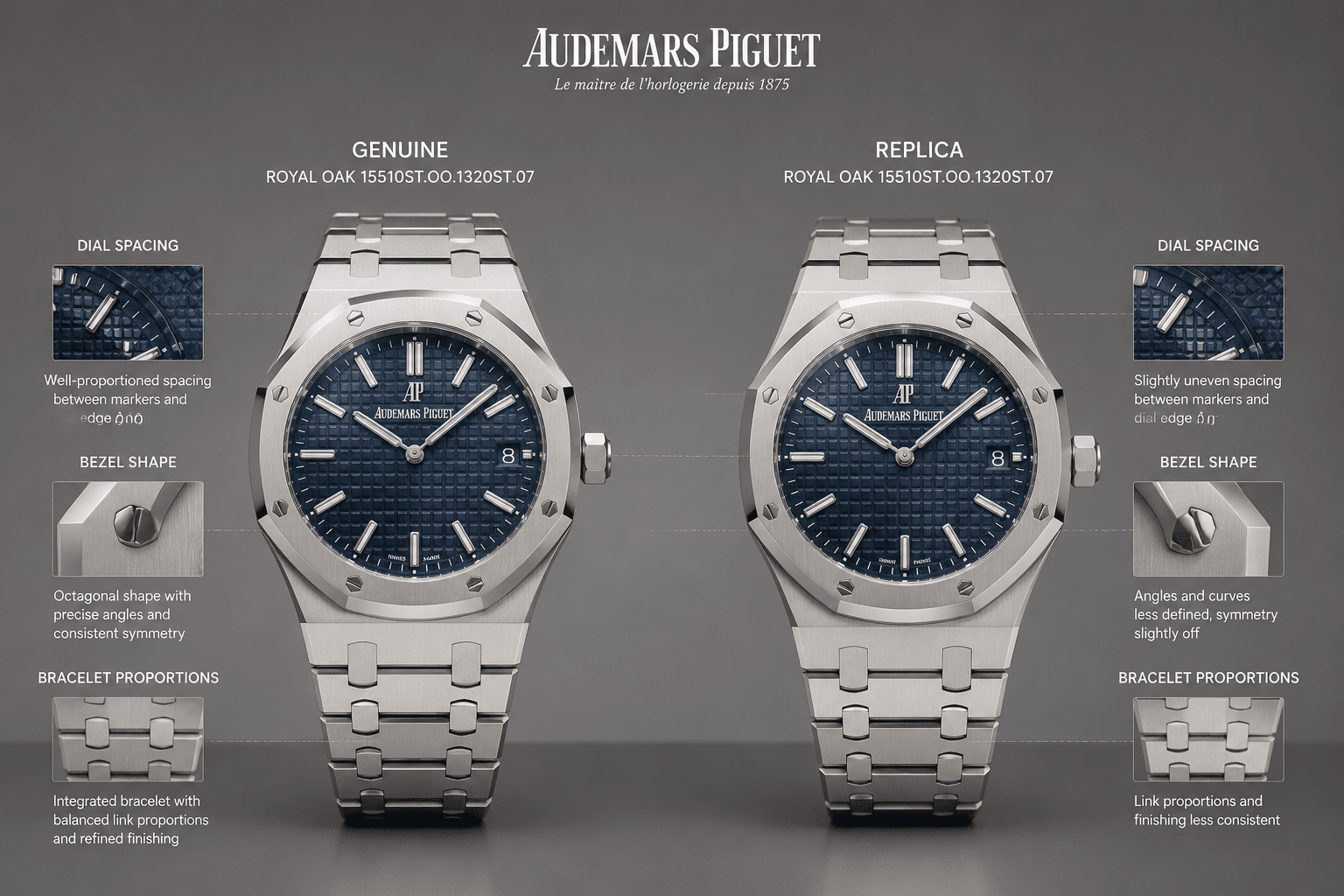
A practical 15510 vs 15500 replica comparison is really a maturity-versus-newness comparison. The 15510 may be the fresher reference, but the 15500 and 15400 have had more time in the replica market. That means more factory revisions, more buyer feedback, more known flaws, and usually a clearer sense of which issues are acceptable and which ones should be avoided.
The same logic applies to a 15510 vs 15400 replica decision. The 15400 is older in AP reference terms, but that age can be an advantage for a replica buyer. The longer a model has been produced, revised, criticized, and compared, the easier it becomes to judge whether a current example is strong or weak. With the 15510, the buyer may face more uncertainty around version naming, batch consistency, movement description, and whether the factory has fully adapted the newer reference details rather than simply modifying an existing production base.
This does not mean the older Royal Oak replica is always the best Royal Oak reference to choose. It means the buyer should stop treating “newer” as the same thing as “safer.” A proven older reference with well-understood tradeoffs may be the better daily-wear decision for one buyer, while a carefully verified 15510 may suit another buyer who values the current look enough to accept extra checking.
A factory comparison is most useful when it is tied to the specific reference, version, movement, and visible execution details rather than treated as a universal ranking. For the Royal Oak family, the same factory label can lead to different buyer judgments across the 15400, 15500, and 15510 because the dial layout, caseback presentation, bracelet construction, and movement route may not be equally refined on each reference.
Where the 15400 Still Has an Advantage
The 15400 replica still has one major advantage: its flaws are better mapped. Buyers have discussed the case thickness, dial printing, movement presentation, bracelet feel, and factory differences for years. That kind of history reduces surprise. It does not remove risk, but it gives the buyer a clearer baseline for what is normal, what is improved, and what should be rejected.
The 15400 also benefits from a simpler kind of buyer expectation. Because it is not being sold as the newest Royal Oak replica, buyers are less likely to overpay only for reference freshness. The decision often becomes more grounded: does this version have a convincing case proportion, acceptable dial execution, clear movement route, and bracelet quality that matches the price? That is a healthier way to evaluate a replica watch.
For buyers who prioritize stability over having the latest AP reference style, the 15400 can still be the more rational choice. Its advantage is not that it is older; its advantage is that the market has had more time to expose its problems.
Why the 15500 Is Often the Middle Ground
The AP 15500 replica often sits between the 15400 and 15510 in a useful way. It feels more modern than the 15400, but it is generally more documented than the 15510. That makes it a natural middle-ground reference for buyers who want a newer Royal Oak look without taking on the full uncertainty of the newest-generation replica.
For many buyers asking which Royal Oak replica is safer, the 15500 deserves serious consideration because it has already gone through more visible factory competition and version refinement. Its dial layout, case proportion, movement presentation, and bracelet integration have been debated long enough that buyers can compare examples with more confidence. The 15500 is not automatically better than the 15510, but it often gives the buyer more information to work with.
The tradeoff is emotional. If a buyer specifically wants the 15510 look, the 15500 may feel like a compromise. But if the buyer wants a more modern Royal Oak replica with lower version uncertainty, the 15500 is often the more balanced starting point.
What the 15510 Changes for Replica Buyers
The 15510 changes the buying decision because it resets part of the evaluation. Even if a factory performed well on the 15500, the buyer still needs to ask whether the 15510-specific details have been executed correctly. A reference update can affect dial balance, logo placement, case feel, bracelet fit, and how the movement is presented through the caseback. Those are not abstract differences on a Royal Oak; they are the details that determine whether the watch feels refined or merely close in photos.
The biggest risk is version confusion. A seller may describe a Royal Oak 15510 replica as “latest version” or “upgraded” without explaining what has actually changed. That language is not enough. A meaningful upgrade should be visible in the watch: cleaner dial proportions, better finishing consistency, clearer movement information, and QC photos that match the claim.
The 15510 makes sense when the buyer wants the current Royal Oak look and is willing to verify the exact version carefully. If the goal is the lowest-surprise AP replica for daily wear, the older 15400 or 15500 may still be smarter until the specific 15510 version has enough evidence behind it.
Buyer Fit: Photo Accuracy Versus Daily Wear
A buyer choosing between the 15510, 15500, and 15400 should also decide what kind of ownership matters most. If the watch is mainly for photos, occasional wear, and current-reference appearance, the 15510 can be attractive when the dial, bezel, and caseback presentation are convincing. If the watch is intended for frequent wear, the more important questions become bracelet comfort, clasp security, rotor behavior, winding feel, and whether the movement route has enough real ownership feedback.
This distinction prevents a common mistake: treating the most visually current replica as the best practical watch. A 15510 with a dramatic dial and attractive caseback may win in seller photos, while a more mature 15500 or 15400 may be easier to live with because its weaknesses are already known. Neither choice is automatically right. The better choice depends on whether the buyer is prioritizing visual freshness, long-term predictability, or the lowest chance of post-purchase frustration.
Factory Maturity Matters More Than the Reference Year
The most useful way to judge an AP Royal Oak 15510 replica is not by asking whether the reference is newer. It is by asking whether the specific Royal Oak replica factory version has had enough time to become stable. A newer reference can look more exciting on a listing page, but in the replica market, excitement often arrives before consistency.
This is where buyers often misread the AP market. A factory may have a strong reputation for the 15400, a well-documented 15500, or even another brand entirely, but that does not automatically transfer to the AP 15510 factory version in front of you. The Royal Oak is too sensitive to small execution changes for broad factory reputation to be enough. Case thickness, dial spacing, bracelet articulation, bezel screw placement, and movement presentation all need to work together on this exact model.
For a mature replica version, the flaw pattern is usually known. Buyers have seen multiple batches, compared dial colors, discussed bracelet feel, noticed recurring alignment issues, and learned which claims are reliable. With a newer model like the 15510, that feedback can be thinner. The watch may be visually strong in controlled photos while still carrying early batch risk in finishing consistency, movement description, or parts matching.
Why Early Versions Can Look Convincing but Wear Unevenly
Early versions of a Royal Oak 15510 replica can be very persuasive in front-facing photos because the Royal Oak design has an immediate visual identity: octagonal bezel, integrated bracelet, tapisserie dial, slim luxury-sports profile. If the dial color is attractive and the bezel looks clean, many buyers assume the hard work has been solved. That is a risky shortcut.
The problems that separate a mature replica version from an early one are often not obvious in the first photo set. Bracelet edges may feel sharper than expected. The first links may not drape naturally from the case. The clasp may close with a lighter or rougher feel. Brushing can look acceptable under bright light but appear uneven when the watch moves on the wrist. Rotor noise or poor winding feel may only become noticeable after several days of wear.
This is why factory maturity matters more for the 15510 than the reference year itself. Older Royal Oak replicas such as established 15400 and 15500 versions often have more reported ownership patterns. Buyers know which flaws are common and which are isolated. A newer 15510 may not yet have that same trail of evidence, so the buyer is forced to rely more heavily on version details and QC photos.
The strongest warning sign is a watch promoted mainly as “latest version” without explaining what actually improved. A true version update should usually have a practical reason: corrected dial texture, improved date position, better bracelet fit, more accurate case profile, clearer movement route, or cleaner finishing, especially when an AP 15400 clone 3120 guide is used to judge whether the claimed upgrade reflects real mechanical or construction changes. If the only argument is that it is new, the claim is not strong enough.
Factory Reputation Is Not the Same as Model Execution
Factory names are useful, but they are not a final answer. APSF, ZF, and other AP-focused factories may have credible histories with certain Royal Oak references, yet the buyer still needs to separate factory reputation from model execution. A factory comparison only becomes useful when it is tied to the exact reference, batch, movement route, and dial color being considered.
A common mistake is choosing a 15510 because a factory is respected for the 15500, or because the same name performs well in another model family. That logic is too broad. The 15510 is not just a renamed 15500 in the replica buying process. Even small reference updates can force factories to adjust dial spacing, logo placement, caseback presentation, bracelet fit, or movement decoration. Those changes create new chances for inconsistency.
At Clean VS Factory, we usually treat this as a version-confidence question, not a factory-fan question. A strong factory name can reduce uncertainty, but it does not remove the need to verify the actual watch. The safer choice is not always the newest reference from the most talked-about factory; it is the version with the clearest execution record and the fewest unexplained claims.
Buyers asking “which factory makes the 15510?” should add a second question: “which factory version has enough evidence behind it?” That evidence can include consistent QC examples, stable dial color execution, clear movement descriptions, repeated batch feedback, and fewer reports of bracelet or finishing surprises. Without those, the factory name is only a starting point.
How to Treat Factory Claims Without Overreading Them
Factory labels in the replica watch market are often used as shorthand, but they should not be treated like official manufacturer documentation. A seller’s factory name may help a buyer organize options, yet it does not independently prove the movement inside the watch, the steel grade, the crystal quality, the waterproofing, or the exact source of any component. For the 15510, the safer approach is to treat factory claims as leads that must be checked against visible evidence, version notes, movement photos, and consistent QC examples.
This is especially important when a listing uses ranking language such as “best AP 15510,” “top factory,” or “newest upgraded batch.” Those phrases may reflect seller opinion, buyer discussion, or market positioning, but they are not enough to establish technical superiority. A more defensible evaluation asks what is actually improved, whether the improvement appears on the individual watch, and whether the buyer can tolerate the remaining flaws if the factory reputation turns out to be overstated.
CleanVSFactory’s editorial approach is to make replica watch decisions more traceable by connecting factory claims to visible details, movement behavior, version differences, and practical QC checks. For the 15510 specifically, that means a factory name should lead to more questions rather than fewer: which batch, which dial color, which bracelet execution, which caseback, which movement route, and which real photos support the description?
Seller Language That Deserves Extra Verification
Some seller phrases are not wrong by themselves, but they should trigger extra checking. Words such as “latest,” “upgraded,” “top version,” “super clone,” and “factory direct” can be useful only if they are connected to specific, visible details. For the 15510, a safer listing explains what changed in the batch, which movement route is being used, what the caseback should look like, and which QC photos will be supplied before acceptance.
Buyers should be especially careful when a listing uses absolute language such as “perfect,” “same as genuine,” or “passes inspection.” Those phrases create unrealistic expectations and can encourage the wrong kind of buying decision. A better seller explanation is practical and limited: it identifies the factory label, describes the movement configuration, shows the actual watch, and acknowledges that replica watches may still differ from the authentic reference under close inspection.
Version Details to Confirm
Before treating a Royal Oak 15510 replica as a mature replica version, confirm the basics in a practical way. The seller or source should be able to identify the factory version clearly, not just call it “new,” “best,” or “upgraded.” Vague language is especially risky on newer references because early stock, revised batches, and mixed descriptions can circulate at the same time.
- Factory and version: Confirm the claimed AP 15510 factory version and whether it is an early batch or a later revision.
- Batch update notes: Ask what changed from the prior version, such as dial texture, bezel alignment, bracelet fit, case thickness, or movement presentation.
- Dial color availability: Treat each dial color separately. A factory can execute one color better than another, especially with blue, grey, or sunburst-style finishes.
- Movement claim: Clarify whether the watch uses an integrated-style clone movement, a decorated base movement, or another route. Decoration alone does not prove better ownership.
- QC consistency: Look for repeated consistency across multiple examples, not one perfect-looking sample photo.
If these details are unclear, the smarter move is to slow down. With a less-proven reference, uncertainty is part of the cost. A stable Royal Oak replica is usually built on repeated factory refinement, not on reference-year excitement.
The 15510 Dial Is Simple-Looking but Easy to Get Slightly Wrong
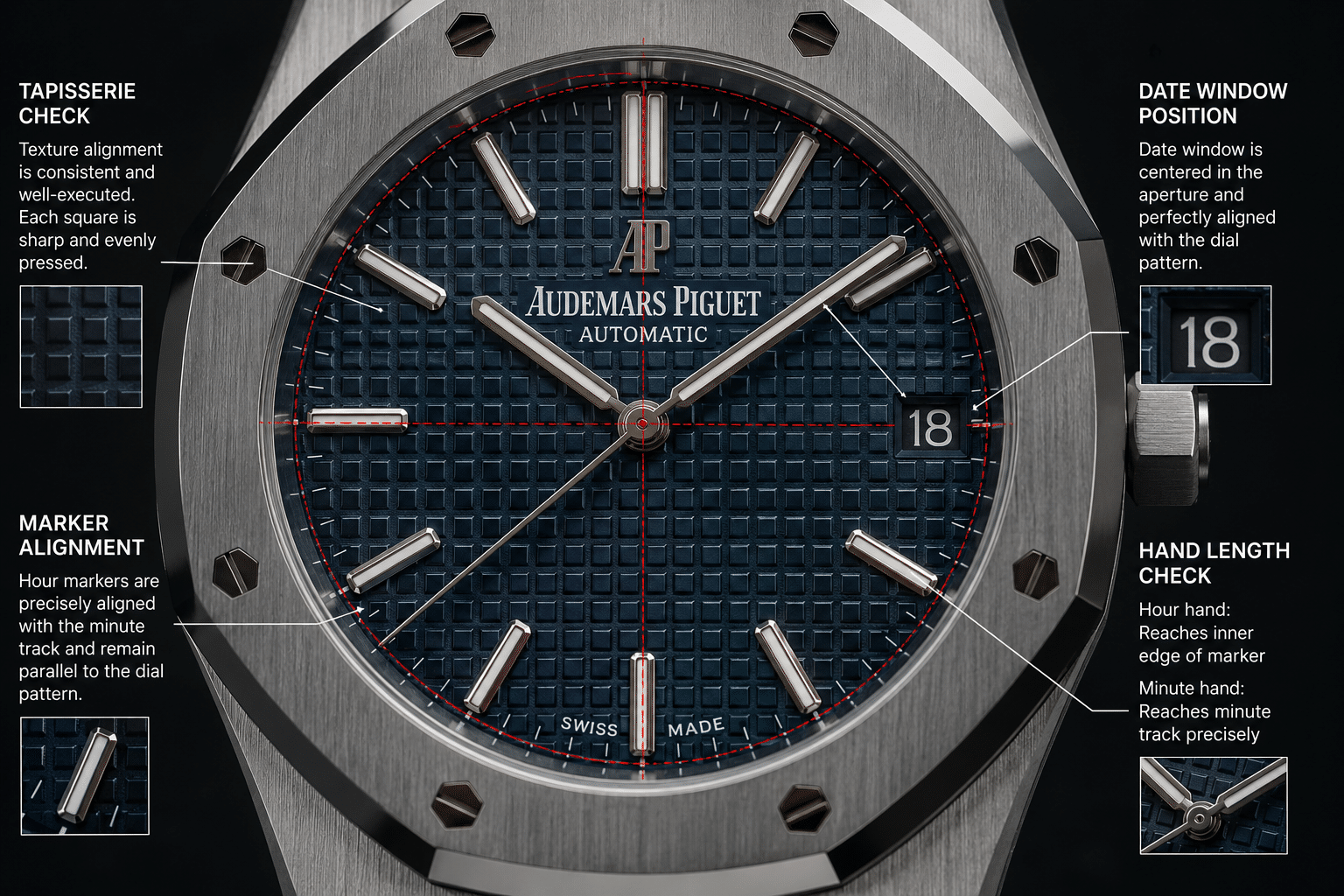
The Royal Oak 15510 dial looks clean, but it is not forgiving. The design gives the eye very little distraction. There are no busy chronograph registers or complicated subdials to hide spacing problems. On an AP 15510 replica dial, small errors in texture, logo placement, marker alignment, date position, or print weight can make the whole face feel slightly off even when the watch looks attractive at first glance.
This is why dial evaluation should not stop at “the color looks good.” The Royal Oak 15510 dial depends on proportion. The tapisserie pattern must carry enough depth without looking crude. The printing must be sharp without becoming too heavy. The hour markers need to sit cleanly and evenly. The date window should feel integrated into the layout, not pushed, crowded, or visually tilted.
For buyers comparing 15510 replica dial accuracy, the practical question is not whether the dial survives macro-level scrutiny against a genuine AP. Most replicas will show limitations under serious magnification. The better question is whether the dial remains balanced in normal wrist viewing and whether the flaws are small enough that they do not dominate the watch’s presence.
Dial Texture and Print Weight
The tapisserie pattern is the first place to judge whether a Royal Oak 15510 replica feels refined or rushed. A flat or overly sharp pattern can make the dial look printed rather than dimensional. A pattern that is too coarse can make the watch feel heavier than the design should. A pattern that is too shallow may look acceptable in direct light but lose the Royal Oak character when the angle changes.
Dial color can hide or exaggerate this. Blue and grey dials often look better in dramatic seller photos than in neutral lighting because reflections add artificial depth. Black can conceal texture weakness but may make print weight or marker alignment more obvious. Silver or light dials can expose uneven printing and date-window framing more easily.
The print weight matters more than many buyers expect. If the logo, minute track, or small text is too bold, the dial can look less elegant even if the layout is technically close. If the printing is too light or uneven, the watch may look weak in close photos. The best practical check is to view the dial straight-on under neutral lighting and ask whether the printing feels integrated with the tapisserie pattern or sits on top of it awkwardly.
Date Window and Marker Alignment
The date window is one of the easiest dial flaws to check in front-facing QC photos. On the Royal Oak, the date does not have much visual cover. If the window is too close to the edge, slightly tilted, poorly framed, or matched with a datewheel that sits too high or too low, the imbalance is noticeable. A small date misalignment may be acceptable for some buyers, but a visibly tilted or poorly centered date is not a minor issue on a clean Royal Oak dial.
Hour markers deserve the same attention. Look especially at the 12, 3, 6, and 9 positions because those anchor the visual geometry of the dial. A slightly rotated marker, uneven lume fill, or inconsistent marker height can disturb the balance more than a small macro flaw in printing. The Royal Oak’s straight lines make alignment errors easier to see than on a rounder, softer case design.
Camera angle can mislead here. A slightly tilted QC photo can make markers look off when they are acceptable, or make a poor dial look better than it is. The useful test is consistency across multiple angles. If the same marker or date position looks wrong in every shot, assume the issue is real.
Hands, Logo, and Dial Balance
Hands are often overlooked because buyers focus on the tapisserie dial first. On the 15510, hand length and finishing still matter. If the minute hand feels too short, the dial loses precision. If the hands are too thick, too shiny, or poorly finished at the edges, the face can look less refined than the case and bracelet suggest. These are small details, but on a minimal Royal Oak dial, small details carry more visual weight.
Logo placement is another balance point. A logo that sits slightly too high, too low, or too heavy can change the empty space around it. This does not always jump out in seller photos, but it affects whether the dial feels calm or cramped. Buyers should compare the logo position against the markers and date window rather than judging it in isolation.
The strongest AP 15510 replica dial is not the one that looks most dramatic in a close-up. It is the one where texture, printing, markers, hands, logo, and date placement work together without one detail pulling the eye for the wrong reason. If a dial flaw is the first thing you notice, it will probably keep bothering you after the watch arrives.
Case, Bezel, and Bracelet Finishing Decide Whether the 15510 Feels Convincing
A Royal Oak 15510 replica is not judged only from the dial. The watch is built around architecture: flat planes, sharp bevels, brushed surfaces, polished transitions, an octagonal bezel, and an integrated bracelet that must flow from the case without looking stiff or detached. If the Royal Oak 15510 case and bracelet are weak, the watch may still photograph well but feel unconvincing on the wrist.
This is where the Royal Oak is less forgiving than many round sports watches. A Submariner-style case can hide minor finishing compromises more easily because the shape is familiar, curved, and tool-watch oriented. The Royal Oak is more exposed. The bracelet is part of the case design, the bezel is a dominant visual feature, and the brushing direction becomes part of the watch’s identity.
The key judgment is simple: case and bracelet finishing matter more in daily wear than many macro dial flaws. A slightly imperfect print detail may only bother you in photos. Rough bracelet edges, poor link articulation, bulky case thickness, or uneven bezel finishing will affect the way the watch feels every time you put it on.
Bezel Shape and Screw Alignment
The bezel is one of the highest-visibility parts of any AP Royal Oak bracelet replica. The octagonal shape must look crisp, not rounded or soft. The brushed top surface should feel controlled, while the polished bevels should create clean separation at the edges. If the bevels are too wide, too dull, or uneven, the watch loses the tension that makes the Royal Oak design work.
Bezel screws are another practical inspection point. On replicas, screw size, placement, and slot alignment can vary. Perfect execution should not be assumed, even on higher-tier versions. What matters for most buyers is whether any screw looks obviously rotated, sunken, raised, oversized, or uneven compared with the others. A single badly positioned screw can draw attention because the bezel is so symmetrical.
Some bezel alignment issues are more serious than others. Slight slot variation may be acceptable depending on buyer tolerance and the specific factory version. A visibly crooked screw, inconsistent screw depth, or bezel that looks off-center against the dial is harder to ignore. On the Royal Oak, symmetry is not decoration; it is the design.
Case Profile and Thickness Perception
Side-profile photos are essential for judging a Royal Oak 15510 case. A front photo can make almost any Royal Oak replica look slimmer than it is. The side view shows whether the mid-case, bezel, crystal, and caseback stack together naturally or create a bulky slab effect.
Thickness perception matters because the Royal Oak is supposed to wear as a refined integrated-bracelet watch, not just a large steel sports watch. Even if the measured thickness is close, the watch can feel visually wrong if the caseback protrudes awkwardly, the bezel sits too tall, or the side brushing lacks clean horizontal discipline. A case that is technically acceptable on paper can still look heavy on the wrist.
Crystal height also affects this impression. If the crystal sits too proud or the bezel-to-crystal transition looks clumsy, the watch may appear less refined in profile. This is not always obvious in a seller’s best front-facing photo, so buyers should not accept a 15510 replica without seeing the side.
Bracelet Articulation and Clasp Feel
The integrated bracelet is one of the hardest parts of the Royal Oak to replicate convincingly. It has to look sharp but wear comfortably. It has to feel solid but still drape around the wrist. If the first links are too rigid, the watch can sit awkwardly. If the link gaps are uneven, the bracelet can look cheaper than the case. If the edges are poorly finished, the watch becomes irritating as a daily wearer.
Bracelet fit quality is not just a comfort issue; it changes the whole wrist presence of the watch. A Royal Oak with a stiff bracelet can look larger and less elegant than its size suggests. A bracelet with clean articulation makes the case feel integrated and balanced. This is why bracelet finishing is often more important than a small dial detail that only appears under magnification.
The clasp should also be checked carefully. A weak clasp action, rough internal finishing, shallow engraving, or uneven closure does not always show in glamour photos. It becomes obvious when the watch is worn. No replica should be expected to match the hand-finished feel of a genuine AP, but a mature version should not feel sharp, loose, or unfinished in basic daily handling.
Case and Bracelet Checks
For case finishing to check properly, buyers should look beyond one clean dial shot. A good QC set should make it possible to judge the front symmetry, side profile, bezel finishing, bracelet integration, clasp condition, and how the watch sits when worn. Missing angles create unnecessary risk, especially on a newer reference where batch consistency may still be developing.
- Front view: Check bezel symmetry, screw position, dial centering, and whether the case shape looks balanced.
- Side profile: Look for thickness perception, crystal height, caseback protrusion, and clean horizontal brushing.
- Bracelet connection: Inspect the end links and first bracelet links for stiffness, gaps, or awkward case integration.
- Link finishing: Look for uneven brushing, overly rounded bevels, sharp edges, or inconsistent spacing between links.
- Clasp photos: Check closure alignment, internal finishing, engraving quality, and whether the clasp appears secure.
- Wrist shot: Use it to judge how the case and bracelet drape together, not to estimate authenticity or status.
If the case and bracelet look strong only from the front, the evaluation is incomplete. The Royal Oak earns its character from the way surfaces, edges, and links work together. For the 15510 replica, a convincing wrist feel depends on that physical execution more than the appeal of owning the newer reference number.
Movement Claims Around the 15510 Need Extra Caution
The AP 15510 replica movement is one of the easiest areas for buyers to misunderstand because the language around it is often too broad. A seller may describe a Royal Oak 15510 movement claim as “upgraded,” “clone,” “decorated,” or “latest version,” but those words do not tell you enough by themselves. The real question is not whether the movement sounds advanced. The real question is what movement route is actually inside the watch, how it affects case thickness, how it behaves in daily wear, and whether it can be serviced without becoming a headache.
This matters more on the 15510 than on older, better-documented Royal Oak replicas because the reference has a shorter market history. With a 15400 or 15500 replica, many buyers already know the common movement routes, typical complaints, and expected compromises. With the 15510, vague movement language creates more room for confusion. A watch can have an attractive display caseback and still carry ownership tradeoffs that will not show up in a polished movement photo.
Movement descriptions in the replica market should be read as configuration references, not as official brand-caliber claims unless there is clear, verifiable evidence. Buyers should distinguish between movement layout, decoration, reliability, and actual serviceability. For the 15510, a display-back photo can support a visual comparison, but it should not be treated as proof that the watch contains an authentic AP-manufactured caliber or that it will behave like the genuine reference over time.
Decorated Movement Does Not Always Mean Better Ownership
A decorated movement can improve the view through the caseback, but decoration is not the same as mechanical quality. A bridge shape, rotor engraving, or color-matched plate may make the watch look closer to the AP layout in photos, yet it may not improve winding efficiency, date behavior, power reserve, or long-term serviceability. For a buyer who plans to wear the watch regularly, those practical issues matter more than whether the movement looks impressive for a few seconds under a caseback shot.
This is where many Royal Oak 15510 replica buyers overpay for the wrong upgrade. A visually dressed movement may help the watch feel more complete, especially on a display-back model, but it can also add thickness, create misleading expectations, or hide a simpler base movement underneath. If the decoration is only cosmetic, the buyer should treat it as a visual feature, not as proof of a more reliable AP replica movement.
The stronger choice is not always the most dramatic-looking movement. It is usually the route that supports the correct case profile, has fewer known daily-use complaints, and can be explained clearly before the buyer accepts the watch. At Clean VS Factory, we usually treat movement choice as part of the ownership decision, not just a spec-sheet line. If the movement claim cannot be explained in plain terms, the buyer should slow down.
Why Movement Naming Can Be Misleading
Movement names in the replica market are not always used consistently. One seller’s “clone movement” may mean an integrated architecture designed to resemble the genuine layout more closely. Another seller may use the same phrase for a base movement with decorative plates. “Latest version” may refer to the dial, the case, the rotor, the batch, or simply current stock. Without confirmation, the name alone does not tell the buyer enough.
This is especially risky with a newer Royal Oak reference because factories and dealers may update descriptions faster than buyers can build long-term feedback. A listing might borrow language from a 15500 movement discussion and apply it loosely to the 15510. It may also mix old stock, revised batches, and different movement routes under one broad product name. That does not mean every claim is dishonest, but it does mean the buyer should not treat the wording as final evidence.
The practical test is simple: if the seller cannot clarify the movement route, expected caseback appearance, and basic behavior, the buyer should not pay a premium just because the description sounds technical. A clear, less glamorous movement explanation is usually safer than a dramatic claim with no supporting details.
Movement Evidence Should Match the Exact Watch
Movement specifications from a movement maker can explain a baseline caliber’s dimensions, beat rate, power reserve, or function layout, but they do not prove that a specific Royal Oak 15510 replica contains that movement. Likewise, a decorated rotor or bridge view can support a visual description, but it does not establish long-term reliability, service compatibility, or equivalence to an authentic AP caliber. The buyer should ask for clear movement photos and plain-language disclosure of the movement route, then treat any unverified technical label as a claim to evaluate rather than a fact to rely on.
Daily-Wear Concerns: Rotor Noise, Winding, and Date Behavior
The movement issues that matter most are often the ones buyers notice after the excitement fades. Rotor noise can make a Royal Oak replica feel cheaper on the wrist, especially because the case and bracelet transmit vibration easily. Winding feel also matters. A gritty or loose crown action can make the watch feel less refined even if the dial and bracelet look strong in photos.
Date behavior is another area to check carefully. The buyer should understand whether the movement has a stable date change, whether the date sits centered in the window, and whether there are known reports of sticking or slow date turnover on that route. A perfect-looking datewheel in one QC photo does not prove long-term calendar reliability, but an off-center or inconsistent date in QC is a warning sign before the watch is even worn.
Power reserve claims should also be treated cautiously. Some replica movement descriptions borrow numbers from the genuine AP caliber or from ideal serviced examples. Real-world performance can vary by movement condition, factory assembly, lubrication, and batch. For daily wear, a buyer is better served by a movement with predictable behavior than by a claimed high reserve that has little confirmed ownership feedback behind it.
Movement Route to Verify
Before accepting a 15510, the buyer should verify the stated movement route, not just the marketing name. Ask what type of movement is being used, whether it is an integrated clone-style route or a decorated base movement, and whether the caseback photo matches the description. If beat behavior is relevant to the claim, it should be described accurately rather than used as vague sales language.
Also check whether the movement choice affects case thickness, rotor noise, date change, and future service options. A movement that looks more correct but is harder to service may still be the right choice for an experienced buyer who values visual completeness. For a daily-wear buyer, a more proven and serviceable route may be more sensible. The safest position is to judge the AP 15510 replica movement by clarity and behavior, not by the most impressive label attached to it.
Price Should Be Read Through the Movement and Risk
Price differences between Royal Oak 15510 replicas can be confusing because a higher number may reflect several different things: a more expensive movement route, better case and bracelet finishing, limited batch availability, seller margin, after-sale handling, or simply stronger market demand for the newer reference. A higher price does not automatically mean the watch is more mature, and a lower price does not automatically mean it is unusable. The price only becomes meaningful when it is connected to what the buyer can verify.
For the 15510, the most useful price question is: what extra risk or benefit is the buyer actually paying for? If the premium buys a clearer movement route, better side profile, stronger bracelet finishing, and more consistent QC examples within an Audemars Piguet Royal Oak guide context, it may be easier to justify. If the premium is mostly attached to “latest AP model” language while the movement and batch details remain vague, the buyer may be paying for reference hype rather than a better ownership outcome.
Prices can change by factory label, version, movement configuration, seller channel, availability, finishing quality, and after-sales terms. Buyers should compare like-for-like details rather than relying on broad statements about “best value” or “factory-direct” pricing, especially when the movement route or batch identity is not clearly documented.
Why Long-Term Feedback Is Thinner on the 15510 Replica
15510 replica ownership feedback is thinner because the model has not had the same market time as the 15400 and 15500. That does not automatically make the 15510 a bad choice, but it does lower the confidence level. A newer Royal Oak replica can look strong in early photos while still lacking enough daily wear reports to reveal bracelet comfort, movement stability, date reliability, or batch consistency over time.
This is one of the biggest traps with the 15510. Buyers often ask, “Is the 15510 reliable?” when the more precise question is, “Is this factory version and batch documented enough to trust?” A few attractive wrist shots do not equal a Royal Oak replica long-term review. They show that the watch can photograph well, not that the movement behaves consistently or that the bracelet and clasp hold up under regular use.
Photo Hype Versus Ownership Evidence
Early praise for a new replica reference often comes from front-facing photos, seller images, and first impressions. Those can be useful, but they are not the same as ownership evidence. Royal Oak replicas are especially prone to photo hype because the design is instantly recognizable and the bracelet creates a strong visual effect even when finishing or articulation is not fully refined.
The problem is that many weaknesses appear after handling, not in the first image set. Rotor noise, crown feel, clasp security, bracelet sharpness, hair pulling, date change behavior, and small finishing inconsistencies are ownership issues. They require time, not just lighting. A 15510 that looks clean in a launch batch may still need several rounds of factory refinement before buyers understand its real flaw pattern.
The strongest long-term feedback usually describes the exact watch after weeks or months of wear. It mentions what changed, what remained stable, and what became annoying. Generic praise such as “looks amazing” or “best AP replica” is less useful unless it includes the factory, version, movement route, and actual wear experience.
Why Version Labels Matter in Feedback
Feedback on the 15510 is only useful when the version is identified clearly. A positive review from one factory batch may not apply to another batch with a different dial, caseback, rotor, or movement route. A negative review may also be outdated if the factory has revised the model. Without version labels, the buyer is left comparing opinions that may not describe the same watch.
This is where forum comments can become noisy. One buyer may be discussing an early version with a less convincing movement presentation. Another may be discussing a newer batch with improved dial spacing or better bracelet finishing. If both simply call it a “15510 replica,” the discussion sounds like a direct comparison when it may actually be about different products.
The better approach is to treat every ownership report as conditional. Look for the factory name, approximate purchase period, movement description, dial color, and whether the buyer mentions daily wear or only first impressions. A report with modest detail is more valuable than a dramatic opinion with no version context.
What Older References Teach Buyers
The 15400 and 15500 teach an important lesson: maturity creates a clearer flaw map. Over time, buyers learn which dial colors are safer, which movement routes are noisier, which bracelets feel better, which datewheel issues appear, and which batches improved. That history does not make older references perfect, but it makes the risk easier to understand before buying.
The 15400 also benefits from a long period of factory iteration, while the 15500 has become a major comparison point for modern 41mm Royal Oak replicas. Buyers can find more discussion about case thickness, bracelet feel, tapisserie execution, and movement behavior. With the 15510, the feedback pool is still developing, so the buyer has less protection from collective experience.
For a buyer who wants a proven Royal Oak replica for regular wear, older references may be the more rational choice even if the 15510 feels more current. For a buyer who specifically wants the newer reference style, the thinner feedback history simply means the watch should be judged more cautiously. Newness should raise the verification burden, not lower it.
QC Photos Are More Important When the Reference Is Less Proven
Royal Oak 15510 QC matters more because the reference has less stable long-term feedback. When a model is well documented, buyers can lean partly on known factory patterns. With the 15510, the exact watch in the AP replica QC photos carries more weight. The buyer is not only checking whether the watch looks good; the buyer is checking whether this individual piece supports the factory’s movement, case, dial, and bracelet claims.
QC photos cannot prove long-term durability, water resistance, or future reliability. They can, however, help catch avoidable problems before acceptance. On a Royal Oak, the most important checks are not generic. Dial balance, bezel screw placement, side profile, bracelet integration, clasp quality, and movement-route confirmation matter more than a simple “does it look nice?” review.
Before making a decision, buyers should review real QC photos where available, including dial printing, hand alignment, bezel position, datewheel centering, bracelet fit, clasp engraving, case thickness, caseback finishing, and overall brushing quality. Factory labels and stock photos alone are not enough for a reliable judgment, especially on a newer Royal Oak 15510 version.
Front Dial Photo: Alignment and Balance
The front dial photo should be straight, well lit, and centered. On the 15510, the buyer should check marker alignment, hand position, logo placement, date window centering, and whether the overall dial feels balanced. A slightly angled photo can make a good dial look wrong or hide a flawed one, so the straight-on image is the first filter.
Pay attention to the relationship between the date window and the surrounding dial texture. If the date looks too high, too low, or cramped against the window, it will be visible every time the watch is checked. Also look at whether the hands are cleanly finished and proportional to the dial. On a Royal Oak, small spacing issues stand out because the dial is flat, geometric, and highly organized.
The judgment here should be strict but not irrational. Tiny imperfections visible only under heavy zoom may not matter on the wrist. Misaligned markers, a visibly crooked logo, or a consistently off-center date are different. Those are daily-view flaws, not just macro-photo flaws.
Side Profile Photo: Thickness and Case Shape
The side profile photo is essential because the Royal Oak’s case does not forgive bulk. A front photo can make almost any 15510 replica look sleek. The side view shows whether the mid-case, bezel, crystal height, and caseback work together or whether the watch wears visually thick. This matters because the Royal Oak’s elegance depends on flat planes and controlled proportions, not just the octagonal bezel.
Buyers should look for a balanced case stack rather than one isolated number. A slightly thick watch may still wear acceptably if the caseback, bezel, and bracelet transition are visually controlled. A watch that looks slab-sided or top-heavy will feel less convincing even if the dial is attractive. This is why side photos should not be treated as optional on a less-proven reference.
Lighting can hide thickness, especially if the photo is taken from a flattering angle. A useful QC set should include a true side view and at least one angled wrist or case shot. If every image avoids the profile, that is not proof of a problem, but it is a reason to ask for better visual confirmation.
Bracelet and Clasp Photos: Fit Over Hype
The bracelet is where many Royal Oak replicas separate themselves in actual wear. For the 15510, buyers should check how the first links meet the case, whether the bracelet appears too stiff, whether gaps look uneven, and whether the brushing and polished bevels flow consistently. A beautiful dial cannot rescue a bracelet that feels sharp, loose, or poorly articulated.
Clasp photos matter because the clasp is handled every time the watch is worn. Look for clean closure, reasonable engraving quality, and no obvious rough finishing inside the clasp. The clasp does not need to feel like a genuine AP clasp to be acceptable, but it should not look crude or misaligned. A weak clasp experience will make the watch feel cheaper than its photos suggest.
For daily wear, bracelet fit is more important than many buyers expect. A slightly better dial color may be nice, but a comfortable bracelet with cleaner articulation usually creates a better ownership experience. With a newer reference, this is exactly the kind of issue that long-term reports may not have fully mapped yet.
What QC Photos Can Show and What They Cannot
QC photos are useful signals, not final proof. They can show whether the dial is centered, whether the bezel screws look acceptable, whether the case profile appears too thick, and whether the bracelet has obvious gaps or finishing problems. They can also confirm whether the caseback and visible movement match the seller’s description. These are real checks, and they should influence the decision.
QC photos cannot fully show winding smoothness, rotor noise, long-term date behavior, bracelet comfort after several hours, or how the brushing looks in ordinary indoor light. A buyer should therefore avoid treating a clean QC set as a guarantee. The better interpretation is more measured: strong QC photos reduce obvious risk, while weak or incomplete QC photos increase it. For a less-proven 15510 version, that difference matters more than it would on a long-established model.
Water Resistance and Durability Should Not Be Assumed
Water resistance is one of the easiest areas to overstate on any Royal Oak replica. Even if the authentic reference has an official water-resistance specification, that specification does not apply to an imitation watch. A replica’s gasket condition, crown sealing, caseback fit, crystal seating, assembly quality, and post-shipping handling can vary from piece to piece. Unless the individual watch has been pressure-tested after purchase, buyers should avoid swimming, showering, or treating the watch as water-safe.
The same caution applies to durability claims. A clean QC set can show visible finishing, but it cannot prove shock resistance, long-term bracelet wear, calendar reliability, or movement service life. For a daily wearer, the safer assumption is that a replica needs more conservative use than an authentic watch with brand warranty and authorized service support. That does not make the 15510 unusable; it simply means the buyer should separate visual appeal from unverified performance claims.
Policies to Confirm Before Ordering
Because seller terms can vary, buyers should confirm practical policies directly before making a purchase decision. Important points include whether QC photos are supplied before shipment, what happens if a visible defect is found during QC, how movement issues are handled after delivery, whether any water-resistance testing is available, and what repair or return options the seller actually offers. These details should be confirmed in plain language rather than assumed from marketing phrases.
Shipping, customs, delivery timing, returns, repairs, and water-resistance terms should not be treated as automatic guarantees. A careful buyer should keep records of the seller’s stated terms and avoid relying on vague promises such as “risk-free,” “customs safe,” or “fully guaranteed” unless the seller explains the exact policy and limitations.
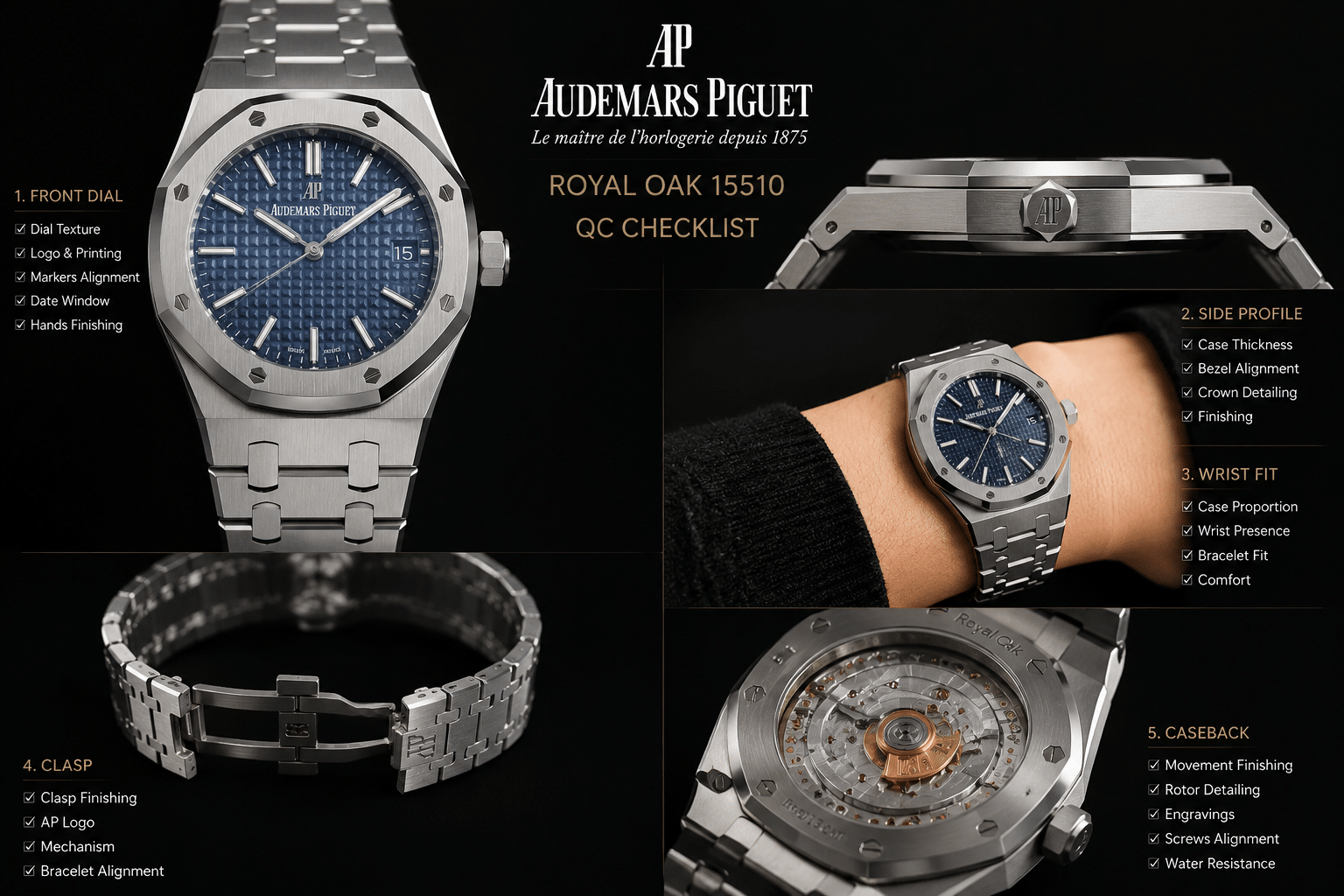
QC Photos to Request
A sensible Royal Oak 15510 QC set should include a straight front dial photo, an angled dial photo, a side case profile, bracelet shots near the case, clasp photos, a caseback image, and a movement-view photo if the watch has a display back. The goal is not to use the watch for deceptive authentication. The goal is to confirm whether the replica being offered matches the claimed version and whether obvious flaws are present before acceptance.
The buyer should also ask for movement-route confirmation when the listing relies on terms such as clone, upgraded, decorated, or latest version. If the photos support the claim and the visible details are consistent, the 15510 becomes a more reasonable choice. If the QC set is incomplete, overly flattering, or avoids the movement and side profile, pausing is smarter than accepting the watch because it is the newer reference.
When the 15510 Replica Makes Sense and When an Older Reference Is Smarter
The AP 15510 replica buying decision is not really a question of whether the newest reference is more attractive. It is a question of whether the buyer gains enough from the current-reference look to accept a higher verification burden. If the factory version is mature, the movement route is clearly described, and the QC evidence supports the watch shown, the 15510 can make sense. If those points are vague, the older 15500 or 15400 replica is often the smarter choice, not because it is more modern, but because its flaws are usually better mapped.
This is where many buyers make the wrong comparison. They ask, “Should I buy the 15510 replica because it is newer?” A better question is, “Do I want the newest Royal Oak look badly enough to take on more version uncertainty?” For a buyer who wants a safer Royal Oak replica choice for daily wear, a proven reference with known tradeoffs can be more rational than a newer watch with thinner batch history.
The 15510 Buyer: Current Look, Higher Verification Burden
The 15510 makes the most sense for a buyer who specifically wants the newer-generation Royal Oak appearance and understands that the model needs closer checking. This buyer is not choosing the 15510 because it is automatically safer. He is choosing it because the updated reference matters to him enough to verify the details more carefully.
A sensible 15510 buyer should be comfortable asking version-specific questions. Which factory version is being offered? Is it an early batch or a revised release? Is the movement claim specific or just described with broad words like “upgraded” or “latest clone”? Do the QC photos show the dial, case side, bracelet, clasp, and caseback clearly enough to judge the actual watch? If those answers are missing, the appeal of the newer reference is not enough.
The 15510 is better suited to an experienced collector than to a nervous first-time buyer. An experienced buyer can separate a tolerable flaw from a warning sign. A beginner may look at a clean front photo, see the newer reference style, and miss the larger issue: the watch may be less proven than an older Royal Oak replica with years of feedback behind it.
The 15500 or 15400 Buyer: Proven Feedback, Lower Surprise Risk
The 15500 and 15400 replicas are usually better fits for buyers who value predictability. These references have had more time in the replica market, more factory iteration, and more buyer discussion. That does not make every piece good, but it does make the risk easier to understand. Known flaws are easier to live with than unknown ones.
The 15500 often works as the middle-ground choice. It still feels modern, but it is generally more documented than the 15510. For buyers deciding whether to choose 15510 or 15500, the 15500 may be the safer reference if the goal is a current-feeling Royal Oak replica without relying on a less established version history.
The 15400 is different. It is not the newest style, and some buyers will not want a discontinued-generation look. But for a buyer who cares more about mature versions, clearer movement expectations, and well-known flaw patterns, the 15400 can still be a very logical option. Older does not mean worse if the replica execution is more settled.
At Clean VS Factory, we usually treat this as a version-confidence decision rather than a simple model ranking. A newer reference can be more desirable, but a mature older version can be easier to evaluate, easier to compare, and less likely to surprise the buyer after the first week of wear.
The Daily-Wear Rule
For daily wear, the safer AP replica is usually the one with the fewest ownership surprises, not the newest reference number. Bracelet comfort, clasp feel, rotor noise, winding behavior, date reliability, and case balance will matter more after a month than the fact that the dial belongs to the latest generation.
This matters especially with the Royal Oak because it is an integrated-bracelet watch. If the bracelet feels rough, the clasp feels weak, or the case sits awkwardly, the watch will not feel convincing even if the reference is technically newer. A buyer who plans to wear the watch often should be more conservative than a buyer who only wants a visually current piece for occasional use.
The practical rule is simple: choose the 15510 if the current look is important and the specific watch has strong version confidence. Choose the 15500 or 15400 if daily-wear stability, known flaws, and broader ownership feedback matter more than having the newest Royal Oak reference.
The Final Buyer Rule: Newer Is Better Only When the Evidence Is Better
The AP Royal Oak 15510 replica conclusion is not that buyers should avoid the 15510. The better conclusion is that buyers should judge it harder. A newer replica reference has to prove itself through factory version maturity, movement clarity, batch stability, and QC evidence. The reference year alone does not reduce risk.
The strongest Royal Oak 15510 buying rule is this: newer is better only when the evidence is better. If the 15510 version has clear improvements, a credible movement route, convincing case and bracelet execution, and strong QC photos, it can be a reasonable choice. If it is being promoted mainly as the latest model, the buyer should slow down.
The Three-Part Test for the 15510
Before treating the 15510 as an upgrade, use a three-part test. First, confirm the factory version. A factory name is useful, but it is not enough by itself; the exact version and batch confidence matter more on a newer reference. Second, confirm the movement route. A decorated movement photo does not automatically mean better ownership if the movement is noisy, poorly described, or difficult to service. Third, confirm the QC evidence. The actual watch shown should support the claim that this version is mature enough to choose over a more established 15500 or 15400.
If all three points are strong, the 15510 can make sense for a buyer who wants the current Royal Oak look. If one of the three is weak, the decision becomes less attractive. If two or more are unclear, the safer move is usually to wait, compare another batch, or consider an older reference with better long-term feedback.
When to Pause Instead of Upgrading
Pause if the seller cannot clearly explain the version. Pause if the movement is described only with vague labels. Pause if the QC set skips the side profile, clasp, bracelet fit, or caseback. Pause if the argument for the watch is mostly “this is the newest AP model.” Those are not automatic deal-breakers, but they are signs that the buyer may be relying on excitement instead of evidence.
The 15510 replica is not wrong because it is newer. It is risky when buyers treat newness as proof of quality. For beginners, the smarter path is often a more proven Royal Oak replica with known tradeoffs. For experienced buyers, the 15510 can be worth considering if the specific factory version, movement claim, and QC photos justify the upgrade.
Legal, Trademark, and Disclosure Caution
Replica watches are imitation products and should not be described, resold, or presented as authorized goods from Audemars Piguet or any other trademark owner. Buyers should understand that replica watches can raise trademark, customs, import, resale, and disclosure issues depending on jurisdiction. This article is a buyer-evaluation guide, not legal advice, and it should not be read as a claim that any shipment, resale, or ownership situation is risk-free.
This caution also matters in private transactions. If a buyer later sells, trades, gifts, or services the watch, clear disclosure is essential. A replica Royal Oak 15510 may be enjoyable as an imitation watch, but it should never be used to mislead another person about authenticity, warranty status, factory origin, or connection to the original brand.
The final decision should not be based on which reference sounds more current. It should be based on which watch gives the buyer more confidence before money changes hands and fewer surprises after wearing it. In the replica watch market, evidence beats release date.
Disclosure: This article is for general educational and comparison purposes only. Replica watches are not genuine products from the original luxury brands, and brand names are used only to identify reference designs or comparison topics. Factory names, movement descriptions, prices, availability, QC details, seller policies, and version information can change, so readers should verify important details with the seller before making a purchase decision. Replica watches should not be represented, resold, or used as genuine watches.