
On an AP Royal Oak replica, case thickness is not a small background specification. Because the Royal Oak has a broad bezel, flat case construction, sharp side profile, and integrated bracelet, the Royal Oak 15400 comparison becomes especially relevant, especially when a ZF Factory AP guide is used to judge where case finishing standards and wrist balance still separate one build from another, and when judging how even an extra 0.3mm to 0.5mm can change how the whole watch reads on the wrist. A watch that looks acceptable from the dial side may still appear stacked, top-heavy, or poorly balanced once viewed from the side.
This guide focuses on how to judge thickness by reference and construction, not by one universal number. Jumbo-style models leave the least room for compromise, 15400 and 15500-style pieces need balanced proportions more than extreme thinness, and chronographs can justify more depth only when the case layers, pushers, caseback, and bracelet transition remain controlled. The key decision is whether the added height is mechanically understandable and visually integrated, or whether it disrupts the Royal Oak’s low, architectural character.
| What To Check | Why It Matters | Buyer Judgment |
|---|---|---|
| Flat side-profile photos | Front shots hide extra case height | Request side, wrist-angle, and bracelet-transition views |
| Jumbo-style references | Thinness defines the design character | A small thickness increase can be more noticeable here |
| 15400/15500-style models | Larger cases tolerate slightly more mass | Accept only if bezel, mid-case, and bracelet flow stay balanced |
| Chronograph cases | Movement modules and pushers require more depth | Extra thickness is reasonable only if it looks integrated |
| Caseback projection | A bulging back can make the watch sit high | Avoid pieces that rock on the wrist or feel top-heavy |
| First bracelet links | The bracelet should continue the case line | A sharp drop from the case suggests poor thickness control |
Quick Questions Before You Read
Q: Is 0.5mm really noticeable on a Royal Oak replica?
Yes, it can be. The flat, layered case and integrated bracelet make small height changes easier to see than on many round sports watches.
Q: Should I judge thickness from the listed measurement alone?
No. Measurements help, but side-profile photos reveal whether the crystal, bezel, caseback, and bracelet transition look balanced.
Q: Are Royal Oak chronograph replicas always too thick?
Not necessarily. Chronographs need more depth, but the added height should not look like stacked layers or crude spacers.
Q: Is the thinnest option always the better choice?
No. Thinness still has to be balanced with movement reliability, serviceability, and how well the watch wears in daily use.
Editorial Perspective: For a Royal Oak replica, factory name and price should be treated as starting signals, not final proof. A well-known factory may perform strongly on one AP reference and less convincingly on another if the movement route, caseback clearance, bracelet integration, or dial-side construction changes. At cleanvsfactory.com, this kind of comparison is treated as a model-specific buying question: the useful decision is not simply “which factory is best,” but whether this exact version preserves the Royal Oak’s side profile while using a movement and case construction that make sense for the buyer’s intended use.
Why Case Thickness Matters More on a Royal Oak Than Most Replica Watches
AP Royal Oak case thickness is not a small specification buried in the chart. On this watch, it is one of the first things that decides whether the replica feels elegant or heavy. A 0.3mm to 0.5mm difference sounds harmless if you are thinking about a round dive watch or a chunky chronograph, but on a Royal Oak replica thickness changes the entire side profile because the design is broad, flat, and built from visible horizontal layers.
The Royal Oak does not hide extra height well. A Submariner-style case has rounded transitions, crown guards, a rotating bezel, and a more conventional sports-watch shape that can visually absorb small dimensional differences. The Royal Oak is different. Its flat case, octagonal bezel, exposed case flank, and integrated bracelet create a long, clean visual line. If that line becomes too tall, the watch can look stacked instead of sharp.
This is why Royal Oak replica thickness deserves more attention than many buyers give it. Dial texture, logo placement, hand shape, and bezel screws matter, but they do not rescue a watch that looks too thick from the side. The Royal Oak’s appeal comes from the tension between strong geometry and low visual mass. Once the case gains too much height, that tension weakens.
The Royal Oak Is Judged From the Side, Not Only the Dial
Many buyers judge an AP Royal Oak replica from a front-facing photo because the dial is the most obvious feature. That is understandable. The tapisserie pattern, applied markers, date window, and AP logo are all easy to compare in pictures. But the Royal Oak side profile often tells a more useful story about the watch’s proportions.
From the front, a slightly thick case can still look convincing because the octagonal bezel dominates the view. From the side, there is nowhere for excess height to hide. The crystal, bezel, mid-case, caseback, and bracelet connection are all visible as separate layers. If one layer is too tall, the whole watch starts to look less refined.
The practical judgment is simple: if a Royal Oak replica looks good only from the dial side, it has not passed the most important visual test. A strong version should still look composed at a low side angle, where the flat architecture and bracelet flow can be judged together.
Why 0.5mm Feels Larger Than It Sounds
Half a millimeter is not much on a ruler. On a Royal Oak, it can change the feeling of the watch because the case is already visually stretched across the wrist. Extra height may show as a raised crystal, a taller bezel stack, a deeper mid-case, a more protruding caseback, or a first bracelet link that drops away from the case too sharply.
The non-obvious issue is that the buyer does not usually perceive the extra 0.5mm as a number. The buyer perceives it as a watch that sits a little too high, catches a cuff more often, or loses the flat, blade-like elegance that makes the Royal Oak distinctive. This is why a small millimeter difference can feel larger in daily wear than it looks in a factory description.
On a thicker, rounder sports watch, a tiny height increase may blend into the case shape. On a Royal Oak, that same increase can make the case look more like a slab. The difference is not just measurement accuracy; it is how the watch presents itself on the wrist.
Thickness as Part of the Watch’s Identity
Case thickness is part of the Royal Oak’s design language, not just an engineering detail. The watch is supposed to feel architectural but controlled. The bezel should sit with confidence, the mid-case should remain clean, and the bracelet should continue the case line rather than looking like it was attached to a raised block.
This is where buyers often misjudge replica watch proportions. They may accept a thicker Royal Oak because the dial looks strong or the finishing seems good in macro photos. That can be a reasonable compromise on some watches, but it is a bigger compromise on a Royal Oak because thinness and flatness are part of the model’s identity.
At Clean VS Factory, we tend to treat thickness as a model-fit question rather than a generic quality score. A Royal Oak replica does not need to be described as perfect to be worth considering, but its side profile must make sense for the design. If the case height fights the bracelet flow, the watch will usually feel less convincing no matter how sharp the dial photo looks.
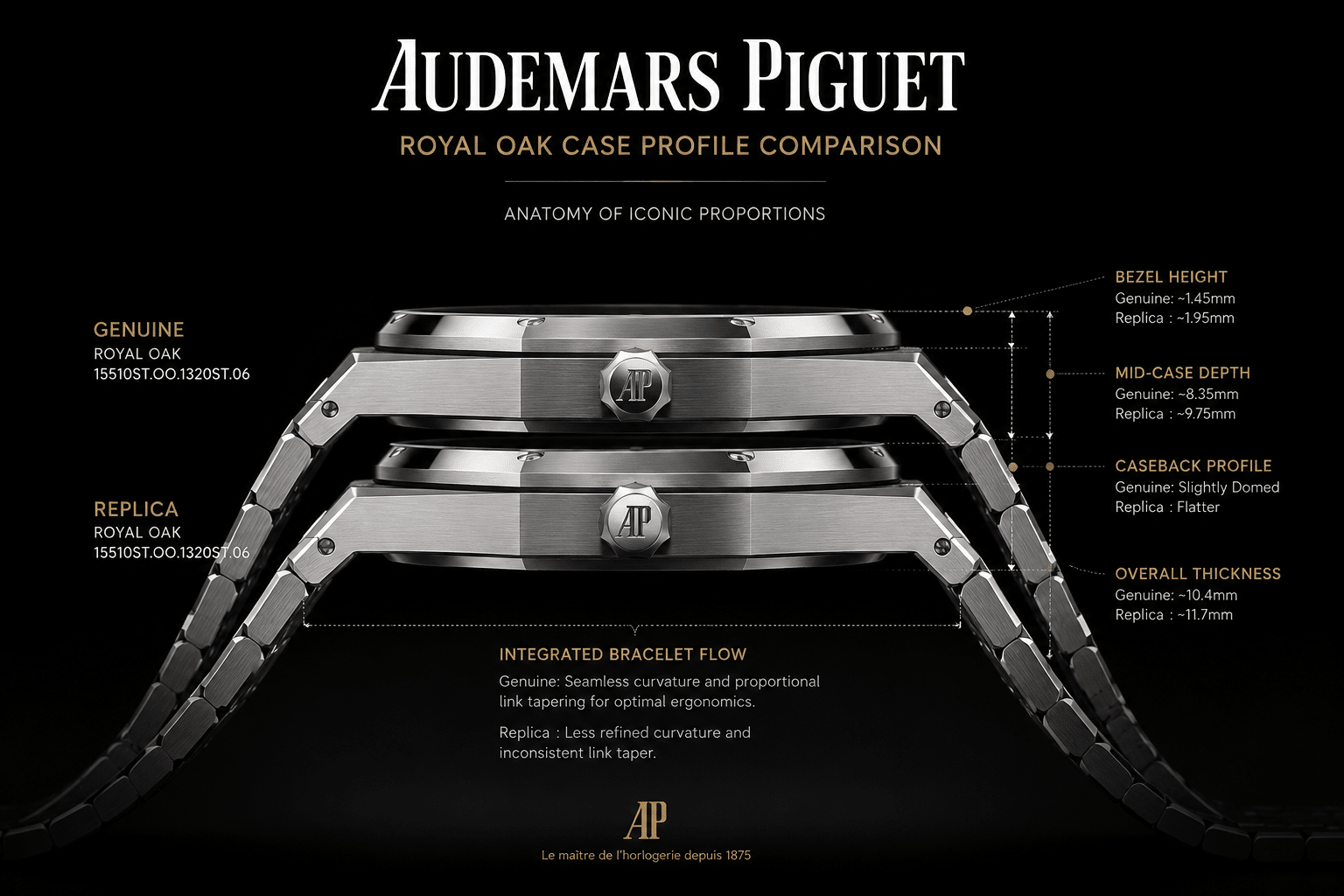
The Royal Oak Case Architecture Makes Thickness Errors Easy to See
The Royal Oak case profile is unforgiving because the watch is built like a layered object. The octagonal bezel sits on top, the mid-case forms a flat horizontal body, the caseback completes the underside, and the integrated bracelet leaves the case without traditional lugs to disguise the transition. This architecture makes AP Royal Oak side profile errors easier to see than on many conventional replica watches.
Extra thickness does not always appear in one obvious place. Sometimes the crystal sits slightly high. Sometimes the bezel looks taller than it should. Sometimes the mid-case becomes puffy. Sometimes the caseback projects downward, making the watch look acceptable from above but bulky from the rear angle. The result is the same: the Royal Oak proportions lose their clean, flat rhythm.
That is why front photos can be misleading. A watch can have a good dial, aligned bezel screws, and attractive brushing while still looking wrong from the side. For Royal Oak replicas, the side view is not a secondary angle. It is where the case construction reveals whether the proportions are controlled.
The Octagonal Bezel Adds Visual Weight Quickly
The Royal Oak bezel is large, flat, and visually powerful. Because it is octagonal and sharply framed, even a small increase in bezel height can make the whole case look heavier. A taller crystal stack can create the same effect, especially if the crystal appears to float above the bezel instead of sitting low and integrated.
This matters because the bezel is the first layer the eye reads. If it looks too tall, the viewer often assumes the entire watch is too thick, even when the mid-case is not the main problem. A good Royal Oak case profile should make the bezel look strong but not overbuilt. The bezel should define the watch, not make it feel top-loaded.
Buyers should be careful with beauty shots taken slightly above the dial. Those angles can make the bezel look crisp while hiding its actual height. A lower side angle gives a more honest impression of whether the bezel, crystal, and case body are working together.
The Mid-Case Should Look Flat, Not Puffy
The mid-case is one of the most important Royal Oak signatures because it gives the watch its horizontal discipline. It should read as a clean, flat flank, not a swollen middle section. When the mid-case becomes too deep, the watch starts to lose the thin architectural character that separates the Royal Oak from more ordinary steel sports watches.
A puffy side profile is more damaging than many dial flaws because it affects the entire wrist presence. Dial printing can be judged only when someone looks closely. Case bulk is felt immediately when the watch is worn, especially because the Royal Oak case is wide and angular.
The mistake is assuming that a thicker mid-case is acceptable because the front view remains attractive. On this design, the flat flank is part of the visual identity. If that flank becomes too tall, the watch may still look like a Royal Oak from across the room, but it will not carry the same elegance up close or on the wrist.
The Bracelet Must Flow Out of the Case
The integrated bracelet is not just attached to the Royal Oak; it completes the case shape. The first links should leave the case naturally and continue the watch’s geometry around the wrist. When case height is poorly controlled, the bracelet transition can look abrupt, with the first link dropping too sharply or sitting at an awkward angle.
This is one of the easiest ways to spot a thickness problem without measuring the watch. If the case looks like a raised platform and the bracelet falls away from it, the silhouette is wrong. The Royal Oak should not look like a thick watch head sitting on a bracelet. It should look like one continuous steel structure.
Bracelet taper also plays a role. Because the bracelet narrows as it wraps the wrist, a tall case can make the head feel visually separated from the bracelet. The more the case rises above the bracelet line, the more the watch loses the low, integrated feel that defines the model.
Case and Bracelet Checks
For this reason, side-view QC photos matter more than polished front shots when judging Royal Oak thickness. The useful checks are simple: look at how high the crystal sits, whether the bezel looks stacked, whether the mid-case flank remains flat, how much the caseback projects, and whether the first bracelet links sit naturally against the wrist line.
One photo can distort the impression because lighting and camera angle can exaggerate height. Repeated bulk across several side angles is more meaningful. If the bracelet transition looks awkward in every side shot, the issue is probably not just perspective. It is a case proportion problem.
Factory Reputation Does Not Replace Model-Specific Thickness Checks
Royal Oak buyers often ask which factory is “best,” but thickness problems are rarely solved by the factory label alone. A factory may have a strong reputation for one Royal Oak reference, while another reference from the same factory may use a different movement route, different caseback profile, or different bracelet construction. That means the same factory name can lead to different wearing results depending on whether the watch is a 15202-style Jumbo, a 15400, a 15500, or a chronograph.
Price also needs to be read carefully. A higher price may reflect a closer movement architecture, better finishing, limited availability, seller margin, or simply market demand. It does not automatically prove that the case is thinner, the side profile is more accurate, or the bracelet transition is better. For Royal Oak replicas, a useful comparison should place the claimed factory, movement type, stated thickness, side-profile photos, and known version behavior next to each other before deciding whether the premium is justified.
Seller descriptions and QC photos are useful signals, but they are not final proof. A listing may say “latest version” or “best case thickness,” yet the buyer still needs to check whether the crystal sits low, the mid-case remains flat, the caseback does not bulge, and the first links flow correctly. The safest judgment is version-specific: this exact watch, from this batch, with this movement route, shown from these angles. Anything broader can become marketing language rather than buyer-verifiable evidence.
A factory comparison is most useful when it is tied to the specific reference, version, movement, and visible execution details rather than treated as a universal ranking. For Royal Oak thickness, that means checking whether the stated version uses a case designed around the movement or whether the case has been adjusted to hide extra height in the crystal stack, mid-case, or caseback. The factory name can organize the search, but the actual decision should come from traceable evidence: real photos, measurement basis, movement route, and the way the bracelet exits the case.
Factory Name Clarification: Factory names in the replica watch market are commonly used buyer-facing labels. They should be treated as practical market references, not as official brand affiliations, audited manufacturer identities, or guarantees of identical quality across every Royal Oak model, batch, or movement route.
How 0.3mm to 0.5mm Changes Wrist Feel, Sleeve Fit, and Elegance
Royal Oak wrist comfort is closely tied to case height because the watch already wears broad. The case shape, integrated bracelet, and flat geometry spread across the wrist differently from a compact round watch. Add 0.3mm to 0.5mm in the wrong place, and the AP Royal Oak replica fit can shift from low and balanced to slightly top-heavy.
This is where buyers often learn the lesson too late. A front-facing QC photo looks clean, the dial looks sharp, and the bezel alignment seems acceptable. Then the watch arrives and feels too thick on wrist. It catches a shirt cuff, sits higher than expected, or feels more blocky than elegant. The problem was visible, but only from angles many buyers did not ask for or did not prioritize.
Wrist size matters, but it does not erase thickness. A larger wrist can carry a Royal Oak more easily, especially in wider case sizes, but extra height still changes the watch’s balance. The Royal Oak is supposed to feel broad and flat, not tall and perched.
A Thicker Case Changes the Center of Gravity
When a case gains height, the watch’s mass sits farther above the wrist. On a Royal Oak, that can make the watch feel less planted because the bracelet is wide and integrated, while the case head remains visually dominant. The result is not always dramatic, but it can be enough to make the watch feel slightly unstable or top-heavy during daily wear.
This effect is especially noticeable when the bracelet is not sized well. A loose bracelet allows a taller case to shift more, while a properly sized bracelet helps keep the watch settled. But sizing cannot fully correct a case that is fundamentally too tall for the model’s proportions.
The key judgment is that comfort is not only about sharp edges or bracelet articulation. Case height affects how the watch balances. A Royal Oak replica with strong finishing but uncontrolled thickness may still feel less refined than a slightly less flashy version with a better wearing profile.
Cuff Clearance Is Part of the Royal Oak Experience
The Royal Oak is a luxury sports watch, but part of its appeal is that it can still feel sleek, and the visual discipline behind the Royal Oak tapisserie dial guide helps explain why the watch reads refined rather than bulky, especially when an AP replica factory comparison looks beyond version names to case height, bezel geometry, and finishing consistency. It should not behave like a tall tool watch that constantly fights a shirt cuff. A case that sits too high can catch sleeves more often, especially because the bezel edges and angular case shape create clear contact points.
This does not mean every Royal Oak must disappear under a cuff like a dress watch. That is not the point. The issue is whether the watch preserves the low-profile elegance that makes the design work in both casual and sharper settings. If the case height makes the watch feel chunky, the wearing experience changes.
For daily wear, this matters more than many macro-level details. A slightly imperfect dial texture may not bother the owner every day. A watch that catches cuffs, rolls on the wrist, or feels too tall will be noticed repeatedly.
Elegance Comes From Low Visual Mass
The Royal Oak’s elegance does not come from softness. It comes from sharp geometry kept under control. The bezel is bold, the case is angular, and the bracelet is industrial, but the whole design works because the visual mass stays low and disciplined. Thickness disrupts that balance quickly.
A thicker replica can still look expensive in a photo, but it may not feel like a Royal Oak in motion. The watch can become too blocky, too upright, or too visually heavy. That is why chasing the best dial or the most attractive brushing is not enough if the case height undermines the silhouette.
The practical takeaway is clear: on a Royal Oak replica, thinness is not automatically the only goal, but controlled thickness is non-negotiable. The better watch is the one where the case height, bracelet flow, and wrist presence support the model’s flat architectural character. If 0.5mm makes the watch lose that character, it is not a small compromise.
Movement Architecture Is the Main Reason Some Royal Oak Replicas Get Thicker
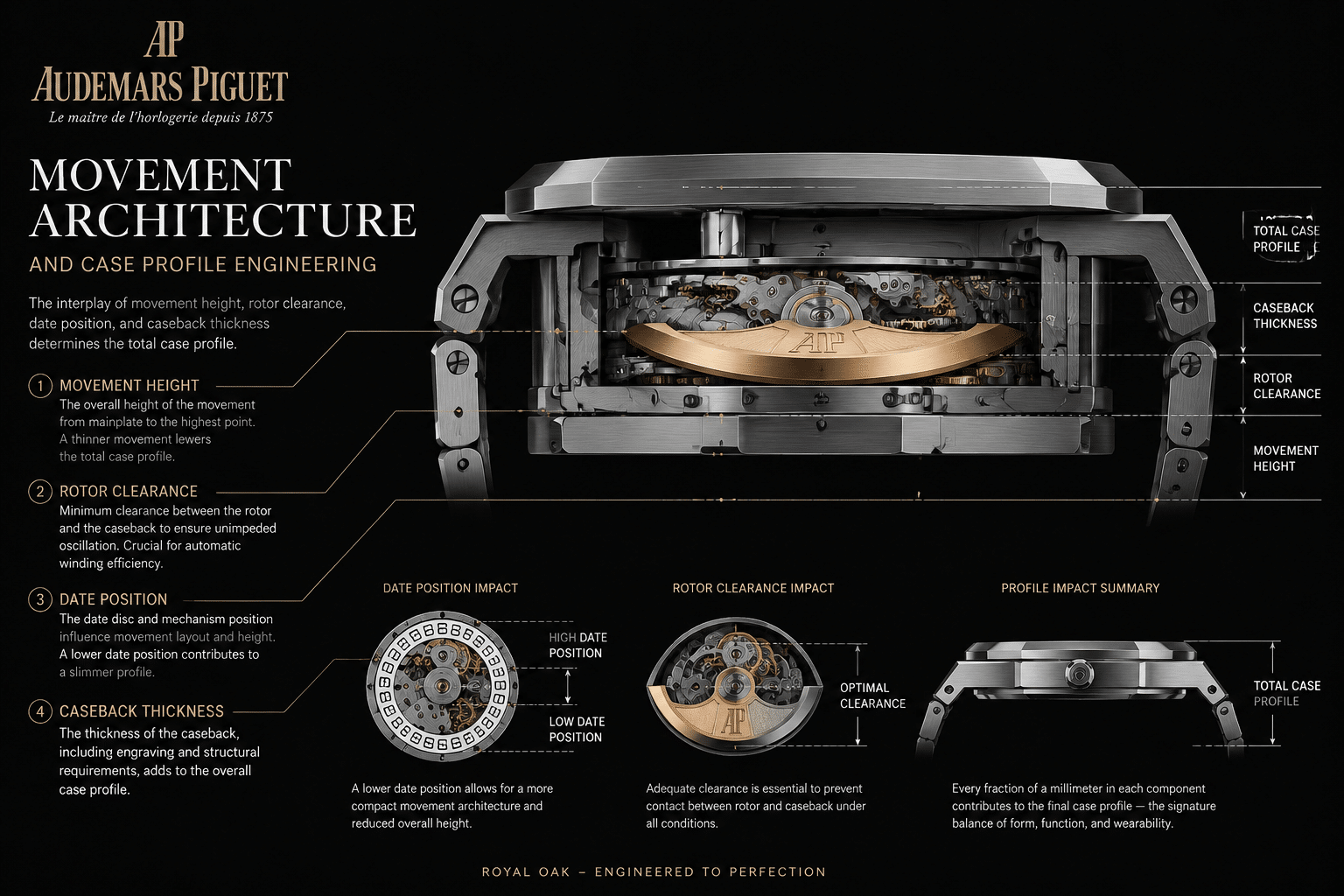
A Royal Oak replica does not become thick only because the case maker was careless. Very often, the case height is forced by the movement architecture inside the watch. This is why two replicas of the same external reference can look similar from the dial side but sit differently from the side: one movement route may allow a flatter case, while another needs extra space for plates, spacers, rotor clearance, date positioning, or a taller hand stack.
This is the part many buyers underestimate. A Royal Oak replica movement is not just a reliability question. It is also a case-shape question. If the movement is too tall, or if a base movement is covered with decorative bridges to imitate the AP layout, the factory may need to hide that height somewhere. Sometimes it appears as a thicker mid-case. Sometimes it appears as a deeper caseback. Sometimes the watch keeps an acceptable front view but loses the flat side profile that makes the Royal Oak feel sharp and architectural.
The important distinction is clone movement versus decorated movement. A closer movement architecture can support the correct date position, rotor location, balance-wheel view, and case proportions more naturally. A decorated base movement may look convincing enough through a display back in casual photos, but if the underlying layout is not close, the case may need compromises to make everything fit. A pretty movement view does not automatically mean the AP replica movement thickness is suitable for the case.
Movement trust in the replica market depends on understanding what the movement claim actually describes: architecture, decoration, layout, reliability, or simply a market name used by sellers. A decorated movement may improve the display-back impression while still relying on an Asian base movement with different dimensions, service needs, and clearance requirements. Buyers should therefore connect the movement description to practical outcomes: date alignment, hand-stack height, rotor space, caseback depth, and whether the stated case thickness is believable for that exact configuration.
Thin Models Need More Than a Pretty Movement View
Thin Royal Oak references are the least forgiving because there is no room to hide mechanical compromises. If the original design depends on an ultra-flat movement, a replica using a thicker base movement starts with a disadvantage before the case is even built. The factory can shave the case, adjust the caseback, or reduce visible stack height, but it cannot ignore the physical height of the movement, rotor, hands, dial, and crystal.
This is why buyers should be careful with movement photos that focus only on engraving, rotor color, or bridge decoration. Those details matter, but they are not the first question for a thin Royal Oak. The first question is whether the movement route allows the watch to keep the intended case height. A thin-looking decorated movement can still require a spacer or a deeper rear profile if the architecture does not match the model closely enough.
At Clean VS Factory, we usually treat movement choice as part of the external design, not a separate technical footnote. If the movement forces the case to become taller, the buyer is not only accepting a mechanical compromise. They are accepting a different wrist profile.
Chronograph Layouts Add Height and Complexity
Royal Oak chronograph replicas create a different problem. The extra height is not always a flaw by itself, because chronograph mechanisms naturally require more space than a simple time-and-date layout. The issue is whether the added height is controlled and integrated into the case design. A chronograph module, thicker automatic movement, stacked subdial construction, and additional clearance for pushers can all increase case depth.
This is where a buyer should avoid a lazy assumption: “chronographs are thicker, so any thickness is acceptable.” That is not true. A good AP chronograph replica can have more case height than a three-hand Royal Oak and still look balanced. A poor one looks like the case was simply stretched vertically to fit the movement. The pusher area makes this more obvious because the side of the case becomes busier, and a tall mid-case can make the pushers appear sunken, misplaced, or visually heavy.
Chronograph movement architecture also affects ownership risk. A more complicated movement stack can mean more friction, more adjustment sensitivity, and harder servicing. This does not mean every chronograph replica should be avoided, but buyers should understand that the thickness tradeoff is connected to both appearance and long-term practicality.
Caseback Shape Can Reveal Movement Compromise
The caseback is one of the easiest places to spot movement-driven thickness. If the front of the watch looks acceptable but the rear profile protrudes noticeably, the case may be using the back to create movement clearance. That can help the watch look thinner from above, but it changes how the watch sits on the wrist.
A protruding caseback lifts the center of the watch and can make the bracelet feel less planted. On a Royal Oak, this matters because the integrated bracelet is supposed to flow from the case, not fight against it. If the caseback pushes the watch upward, the first bracelet links may drop too sharply, creating a side silhouette that feels less refined even if the dial and bezel look strong.
This is also why quoted thickness numbers should be treated carefully. Some sellers measure only the most favorable part of the case, while buyers experience the total stack: crystal, bezel, mid-case, caseback, and bracelet transition. A case that is technically “close” in one measurement can still wear wrong if the height is distributed poorly.
Movement Route to Verify
Before accepting a Royal Oak replica based on front-facing photos, verify the movement route as part of the case-thickness decision. Ask what movement architecture is being used, whether it is a closer integrated-style clone or a decorated base movement, and whether the stated case thickness matches current market examples of that version. Factory names are useful, but they are not enough because batches and movement routes can change.
- Confirm the stated movement route: Do not rely only on bridge engraving or rotor appearance.
- Compare the case thickness claim: Treat exact numbers as version-specific, not permanent factory truth.
- Check the caseback profile: A deep or rounded rear profile may reveal clearance compensation.
- Look at the date and hand stack: Incorrect architecture can affect dial layout and vertical spacing.
- Judge the full side profile: The best movement route is the one that supports the case shape, not just the display-back view.
The practical judgment is simple: if the movement architecture forces a Royal Oak case to become tall, the watch may still function, but it no longer carries the same design logic. On this model family, movement choice is visible from the outside.
Movement Transparency Note: Movement references in this article describe replica-market movement types, routes, or configurations, not an official Audemars Piguet caliber unless explicitly supported by verifiable evidence. Buyers should judge each version by how the movement architecture affects case thickness, date position, caseback clearance, service risk, and daily-wear expectations.
15202 Jumbo Replicas: The Thinness Test Most Buyers Underestimate
The Royal Oak 15202 Jumbo is the hardest common Royal Oak replica to judge because its identity is built around thinness. The 39mm case, slim bezel, low caseback, and integrated bracelet are supposed to create a flat, elegant side silhouette. If the 15202 replica thickness creeps upward, the watch does not merely become “slightly bigger.” It starts to lose the point of being a Jumbo.
This is why the Royal Oak Jumbo replica is less forgiving than many larger AP replicas. A thicker sports watch can sometimes hide a half millimeter because the case is already muscular. The 15202 cannot. Its appeal is the tension between a sharp steel sports design and an unusually thin wearing profile. Add too much height, and the watch begins to feel like a regular Royal Oak-style sports watch rather than a Jumbo-style design.
Buyers often focus on the blue dial, Petite Tapisserie texture, logo position, and bracelet finishing. Those are important, but for the 15202, the side silhouette should be near the top of the checklist. A beautiful dial cannot fully rescue a Jumbo-style replica that sits too tall on the wrist.
Why the Jumbo Has Less Margin for Error
The 15202 has less margin for error because the genuine design is associated with an ultra-thin profile. A small increase in thickness becomes part of the whole visual impression. On a thicker watch, 0.4mm may be absorbed into the general mass of the case. On a Jumbo, the same difference can make the bezel stack look heavier, the caseback more obvious, and the bracelet transition less graceful.
The movement route is the main reason this problem persists. The original Jumbo architecture depends on an exceptionally thin automatic movement. Most replica movement options cannot reproduce that architecture exactly, so the case must accommodate the difference. Some versions manage the compromise better than others, but buyers should not assume that a “clone-style” or decorated movement automatically solves the thinness problem.
The correct mindset is not to ask only, “Which factory makes the best 15202?” The better question is: “Does this specific version keep the Jumbo’s thin case logic, or does it only imitate the front view?” For this reference, that distinction changes the buying decision.
Where Extra Thickness Usually Shows
Extra thickness on a 15202-style replica usually appears in one of four places: the crystal and bezel stack, the mid-case, the caseback, or the bracelet transition. A raised crystal or slightly tall bezel can make the watch look heavier even if the rear profile is controlled. A deeper mid-case makes the side look more slab-like. A protruding caseback can lift the watch off the wrist. A poor first-link angle can make the bracelet look like it is attached to the case rather than flowing out of it.
The most misleading version is the one that looks excellent from the front. The Jumbo’s dial-side view can hide a lot because the octagonal bezel and tapisserie dial dominate the photo. The side view is less forgiving. If the caseback protrudes or the case flank looks too deep, the watch may read as too thick even before anyone measures it.
For QC photos, the key is not one perfect side shot. Look for consistency across multiple angles. If the case looks tall in a flat side photo, an angled wrist photo, and a caseback photo, it is probably not just camera distortion. If only one photo looks odd, lighting or perspective may be exaggerating the issue.
When a Thicker Jumbo-Style Replica May Still Be Acceptable
A slightly thicker Jumbo-style replica is not automatically a bad choice for every buyer. If the dial execution is strong, the bracelet feels fluid, the movement route is practical, and the case does not look visibly bulky on the wrist, some buyers may accept the compromise. The mistake is accepting it without understanding what is being traded away.
For a buyer who wants the most accurate Jumbo wearing experience, thickness should be treated as a primary filter. For a buyer who mainly wants the 39mm Royal Oak look and values daily usability more than strict side-profile accuracy, a controlled thickness compromise may be rational. The difference is expectation. The first buyer will notice the extra height every time the watch slips under a cuff. The second buyer may care more about stable operation and overall appearance.
The clear judgment: thickness accuracy matters more on the 15202 than on most larger Royal Oak references. If a version looks too thick from the side, do not let a strong dial photo talk you out of what the case profile is already telling you.
15400 and 15500 Replicas: Thickness, Diameter, and Modern Royal Oak Balance
The 15400 and 15500 are different from the 15202 because they are larger, more modern Royal Oaks with more visual mass from the start. Their case diameter, dial openness, and wrist span give them more tolerance than the Jumbo. But that does not make thickness unimportant. A 15400 replica thickness or 15500 replica thickness problem can still make the watch look too tall, especially from the side.
The key is proportion, not absolute thinness. A 41mm Royal Oak can visually spread its height across a broader case, so it may look acceptable from above even when it is slightly thicker than ideal. The danger appears in the side profile. If the case flank becomes too deep, the bezel sits too high, or the caseback projects too much, the watch can turn from sharp and architectural into flat-sided and blocky.
This is where buyers need to avoid applying the wrong standard. A 15400 or 15500 should not be judged as if it were a 15202 Jumbo. It is supposed to have a stronger wrist presence. But it still needs the correct relationship between case diameter, bezel height, mid-case depth, and bracelet flow. A larger Royal Oak can be substantial; it should not look swollen.
Why Larger Royal Oaks Can Hide Thickness Slightly Better
A larger case diameter can make the watch appear thinner from the dial side because the surface area spreads visual weight. On the wrist, a 41mm Royal Oak has enough width that a small increase in height may not immediately jump out in a straight-on photo. This is why many 15400 and 15500 replicas look convincing in front-facing QC images.
The side view tells a different story. The Royal Oak case is still a flat, angular object. If the case height is not controlled, the wide case can actually make the watch look more slab-like, not less. The extra diameter gives the watch presence, but it also creates a long horizontal case flank. If that flank is too tall, the whole watch starts to look heavy.
For buyers comparing modern Royal Oak fit, this matters more than wrist size alone. A larger wrist can handle the diameter, but it does not automatically fix a poor side profile. Thickness is a proportion issue before it is a comfort issue.
The 15400 and 15500 Need Different Proportion Checks
The 15400 and 15500 are related, but they should not be treated as interchangeable in thickness judgment. Their dial layouts, movement routes, and visual balance are different enough that a case profile that looks acceptable on one may not look equally natural on the other. The 15400 has its own dial structure and movement-related expectations, while the 15500 has a more open dial and a different modern character.
With the 15400, buyers should pay close attention to whether the case keeps a controlled, flat side profile and whether the movement route supports the expected case height. Older movement approaches in the market were more likely to create thickness compromises, so version awareness matters. With the 15500, the larger dial opening can make the watch feel broader and cleaner from above, but it also means the case needs to remain well balanced from the side to avoid looking like a thick plate on the wrist.
A factory name alone is not enough here. The better comparison is version, movement route, case profile, and bracelet transition together. A watch with strong dial details but a tall case can still disappoint in daily wear because the Royal Oak is not only a dial design.
Modern Royal Oak Thickness Is About Balance, Not Just Thinness
For the 15400 and 15500, the goal is not to find the thinnest possible replica. The goal is to find the version where the height makes sense for the diameter and the bracelet. A case that is too thin for the wrong reasons could introduce other compromises, while a slightly thicker case may be acceptable if the profile is controlled and the watch sits naturally.
The best modern Royal Oak replica fit comes from balance: the bezel should not look overly tall, the mid-case should remain flat and disciplined, the caseback should not dominate the wrist feel, and the first bracelet links should flow out of the case without a sharp drop. If those elements work together, a small measurement difference may be livable. If they fight each other, even a technically close number can feel wrong.
The practical judgment is this: the 15400 and 15500 allow more visual mass than the Jumbo, but they do not excuse careless thickness. A good modern Royal Oak replica should look broader than a 15202, not simply taller.
Royal Oak Chronograph Replicas: When Extra Thickness May Be Expected but Still Needs Control
Royal Oak chronograph replica thickness has to be judged differently from a simple three-hand Royal Oak. A chronograph needs more internal space for the movement stack, chronograph module, subdial gearing, pusher system, and caseback clearance. Expecting an AP chronograph replica case to wear like a thin Jumbo-style watch is the wrong starting point.
The mistake is going too far in the other direction. Some buyers see “chronograph” and excuse any tall case, deep caseback, or boxy side profile. That is risky. A Royal Oak chronograph can be thicker, but the extra height still needs to look engineered into the watch rather than added as a crude spacer. If the case looks like separate layers piled on top of each other, the watch loses the sharp, flat character that makes the Royal Oak work.
Why Chronographs Usually Have Less Thinness Potential
A chronograph is not just a dial with extra subdials. The movement has to drive elapsed seconds, minutes, and sometimes hours, while also supporting start, stop, and reset functions. Depending on the movement route, that can mean a thicker base movement, an added chronograph module, taller hand posts, more dial-side clearance, or extra room under the caseback for the rotor and bridge layout.
This is why AP chrono replica risk is not only about reliability. The internal architecture often decides the external case profile, especially when cross-checking proportions against top Audemars Piguet replica factories and an Audemars Piguet Royal Oak replica guide where model thickness, movement layout, and case construction are evaluated together. If the movement is too tall or the subdial layout is achieved through compromises, the factory may have to increase case depth to make everything fit. The result can be a watch that looks acceptable from the front but carries too much height from the side.
The practical judgment is simple: chronograph buyers should accept a controlled thickness compromise, not a careless one. A slightly deeper AP chronograph replica case can be reasonable if the bezel, mid-case, pushers, and caseback still sit in proportion. A case that looks inflated because the movement route forced extra room is a different problem.
Pushers Make Case Height More Noticeable
Pushers draw the eye directly to the side profile. On a three-hand Royal Oak, the case flank can look clean and uninterrupted. On a chronograph, the pusher guards and pushers interrupt that surface, so any extra case height becomes easier to notice. If the pusher alignment sits too high, too low, or too centered within an overly deep case wall, the whole side can look heavy.
This is one reason angled photos matter so much on a Royal Oak chronograph replica. A front photo may show strong subdial spacing and a clean tapisserie pattern, but the side view tells you whether the case and pushers belong together. If the pushers look small because the case wall is too tall, or if they appear buried in a thick mid-case, the chronograph looks less refined even before measuring anything.
Subdial spacing also connects to thickness more than many buyers realize. A movement that struggles to place the counters correctly may require dial-side adaptation, additional gearing, or a different movement stack. Those internal choices can influence pusher position and case depth. In a Royal Oak chronograph, the dial, side case, and movement route are not separate issues.
The Best Chronograph Compromise Is Controlled Thickness
A good Royal Oak chronograph replica does not need to be ultra-thin. It needs to look coherent. The bezel should not appear perched on top of a swollen mid-case. The caseback should not protrude so much that the watch rocks on the wrist. The pushers should look naturally placed within the case band, not like they were fitted after the case height was already decided.
The acceptable thickness compromise depends on the complete side profile. A watch can be slightly taller and still wear well if the caseback is shaped cleanly, the pusher case profile is balanced, and the bracelet begins its drop from the case without a harsh angle. The version to avoid is the one where every layer looks thick at once: raised crystal, tall bezel, deep mid-case, protruding caseback, and a bracelet that falls away sharply.
For buyers choosing a Royal Oak chronograph replica, the safest mindset is not “is it thin enough?” but “does the added thickness look controlled?” Chronograph complexity gives the factory less room to work, but it does not excuse a bulky, stacked case. If the watch loses the Royal Oak’s horizontal tension from the side, the chronograph function has come at too high a visual cost.
Photo Accuracy Versus Daily-Wear Suitability
Some Royal Oak replicas are more convincing in photos than they are as daily-wear watches. A version with a strong dial, crisp bezel brushing, and attractive macro shots may be appealing for visual comparison, but if the caseback is tall or the bracelet transition is awkward, it may feel less satisfying after regular use. This is especially relevant for buyers who plan to wear the watch with shirts, jackets, or fitted cuffs, where case height becomes noticeable several times a day.
The opposite can also be true. A version may have a minor dial texture difference or a small finishing compromise that appears in close-up comparison, yet it may wear better because the case sits lower, the bracelet articulates naturally, and the movement is more stable. For many daily-wear buyers, that can be the more sensible tradeoff. Visual accuracy and ownership reliability are related, but they are not the same priority.
For a first Royal Oak replica, a simpler three-hand model with a more stable movement route may be easier to live with than a complicated chronograph or ultra-thin-style watch that demands tighter construction tolerances. Complicated references can be more interesting, but they leave less room for movement, case, and servicing compromises. Beginners should be especially cautious when the watch looks excellent only from the front and the listing does not clearly show how it sits from the side.
A realistic ownership view also includes limits that photos cannot fully answer. Water resistance, long-term movement stability, regulation consistency, bracelet screw security, and future servicing convenience can vary by version and seller. Buyers should confirm return, repair, shipping, and after-sales terms before ordering, and they should not treat a convincing side profile as proof that every practical ownership issue has been solved.
Side-Profile QC Photos: The Fastest Way to Catch Thickness Problems
Royal Oak QC photos are most useful when they show what the front view hides. Dial shots can confirm printing, markers, date alignment, and subdial layout, but they cannot prove whether the case height is right. For AP replica side profile QC, the key is to see the watch as a layered object: crystal, bezel, mid-case, caseback, and bracelet transition in one visual line.
The best QC review is not based on one flattering angle. Royal Oak cases reflect light aggressively because of the brushed flats and polished bevels, so a single photo can make the watch look thinner or thicker than it is. Compare several angles before deciding whether the case looks too thick. Repeated bulk across multiple photos is much more meaningful than one awkward reflection.
Before making a decision, buyers should review real QC photos where available, including dial printing, marker alignment, hand alignment, bezel screw position, datewheel centering, case thickness, caseback profile, bracelet fit, clasp engraving, and overall finishing. Factory labels and stock photos alone are not enough for a reliable Royal Oak thickness judgment.
Front Photos Cannot Prove Thickness Accuracy
A straight-on dial photo is almost useless for judging case thickness. The octagonal bezel dominates the image, the bracelet appears symmetrical, and the dial can look sharp even if the case is too tall. This is how buyers approve a watch that looks excellent in QC but feels chunky once it arrives.
Front photos also hide caseback protrusion. A Royal Oak can look flat from above while sitting high on the wrist because the rear profile is doing the damage. That matters for comfort, cuff clearance, and the way the first bracelet links angle down from the case.
Use the front photo for dial and alignment checks, not thickness approval. If the side profile photo is missing or too angled to read, the QC set is incomplete for this type of watch.
The Best Side Photo Shows the Whole Case Stack
The most valuable side-angle photo is plain rather than beautiful. It should show the crystal height, bezel seating, mid-case depth, caseback projection, and first bracelet link angle without heavy perspective distortion. The watch should be close to level, not tilted in a way that hides the caseback or exaggerates the bezel.
Look first at how the layers relate to one another. A slightly visible crystal is normal; a crystal that looks like it is sitting too high above the bezel is a warning sign. A defined caseback is expected; a caseback that looks like a separate bulge under the watch deserves closer attention. The bracelet end link should flow from the case, not drop sharply as if the watch is perched above it.
At Clean VS Factory, we usually treat side-profile photos as a proportion check rather than a single measurement exercise. A claimed thickness number is useful, but the buyer still needs to see whether the case, caseback, and bracelet work together in real visual space.
Lighting Can Make the Case Look Thinner or Thicker
Royal Oak finishing makes thickness harder to judge than a smooth round case. Brushed steel can flatten the side in bright light, while polished bevels can create shadows that make the watch look deeper than it really is. A dark reflection under the caseback can also exaggerate rear thickness.
This does not mean QC photos are unreliable. It means they should be read in groups. If one side photo looks bulky but the wrist-angle photo looks balanced, the issue may be lighting or camera position. If every angle shows a tall mid-case, raised caseback, and awkward bracelet drop, it is more likely a real case profile problem.
QC Photos to Request
- Flat side-profile shot: Best for checking crystal height, bezel seating, mid-case depth, and caseback projection.
- Angled wrist shot: Shows whether the watch sits planted or rides high on the wrist.
- Caseback-side shot: Helps reveal whether the rear profile is clean or overly protruding.
- Bracelet transition close-up: Shows whether the first links flow naturally from the case or drop too sharply.
Do not use these photos as an authentication exercise or as a way to misrepresent the watch. The purpose is simpler and more practical: avoid accepting a replica watch that looks strong from the dial side but loses the Royal Oak shape from the side.
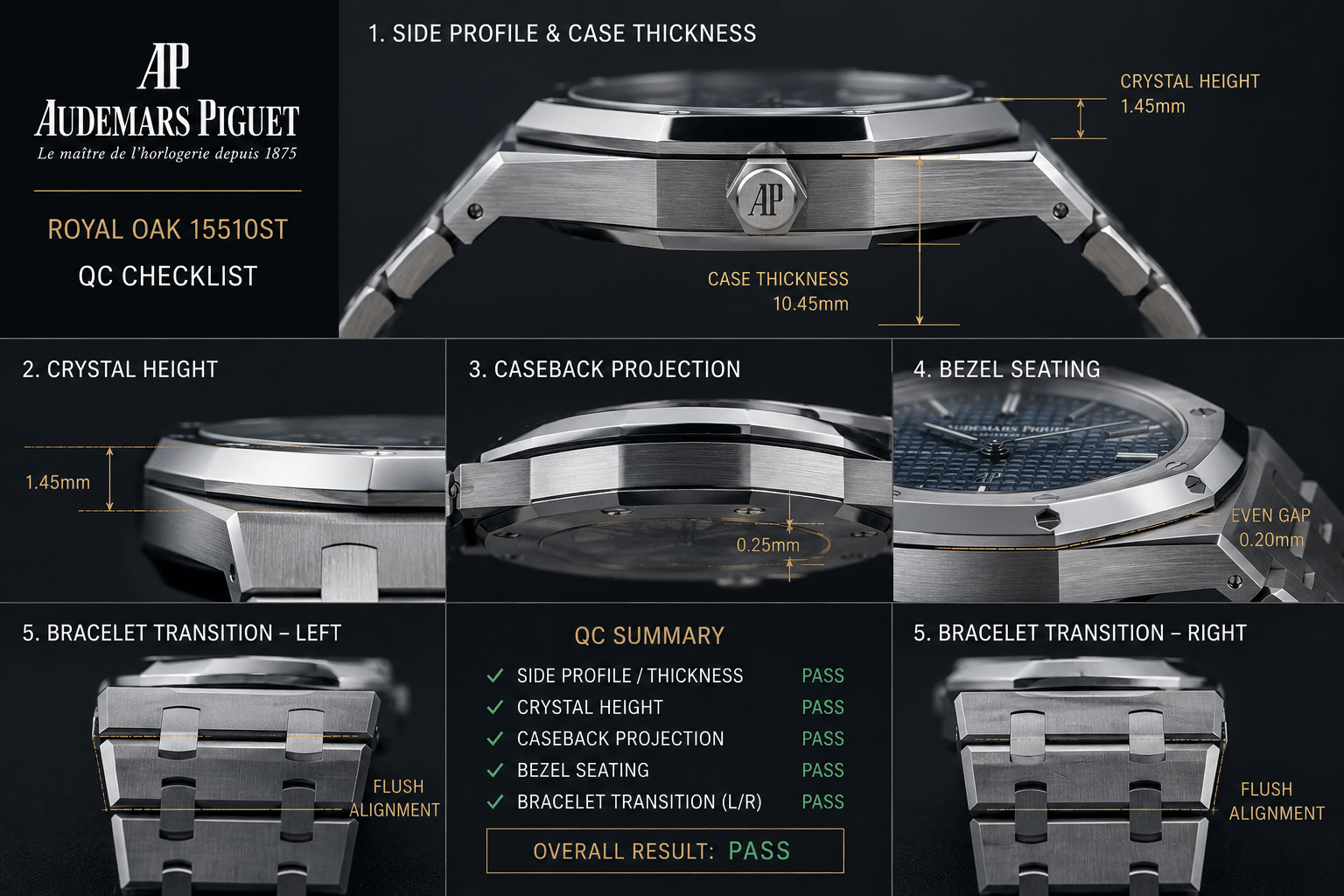
Thickness Red Flags: Crystal, Bezel, Caseback, and Bracelet Transition
Royal Oak thickness red flags rarely appear as one obvious flaw. More often, the case profile problem is spread across several areas: a raised crystal, a tall bezel stack, a thick caseback, or a poor bracelet transition. Each one may look minor alone, but together they can make the watch appear bulky.
This is why the question should not be only “is the measurement close?” A replica can be close on paper and still look wrong if the extra height is placed in the wrong area. The Royal Oak’s flat case flank and integrated bracelet make uneven case stack more visible than it would be on many round sports watches.
Raised Crystal or Tall Bezel Stack
A raised crystal is one of the fastest ways for a Royal Oak to look taller than it should. The Royal Oak bezel already has strong geometry, so extra height above the dial adds visual mass immediately. If the crystal seems to sit proud of the bezel or the bezel looks thick and heavy from the side, the watch can lose its crisp architectural feel.
The bezel stack matters because it is visible from nearly every angle. Even if the mid-case is reasonably controlled, a tall bezel and crystal combination can make the case look top-heavy. This is especially noticeable in angled wrist photos, where the upper layers catch light and make the watch appear more elevated.
A small amount of crystal presence is not automatically a red flag. The problem is proportion. If the upper case looks inflated compared with the model family, or if the bezel appears perched rather than seated, the thickness compromise is in the wrong place.
Bulging Caseback or Deep Rear Profile
A thick caseback can be less obvious in seller photos but more annoying in daily wear. It raises the watch off the wrist, changes the center of gravity, and can make the bracelet feel like it is hanging from the case instead of wrapping naturally around the wrist.
Caseback protrusion is often linked to movement-clearance compromises. A factory may keep the dial side visually clean but create space underneath for rotor clearance, movement height, or internal spacing. That can be a rational engineering choice, but it still affects wrist comfort and profile accuracy.
The clearest warning sign is a caseback that looks like a separate pod under the watch. On a Royal Oak, the rear profile should not dominate the side view. If the watch looks acceptable from above but appears to balance on its caseback from the side, the flaw will likely be felt as much as seen.
Bracelet Transition That Drops Too Sharply
The integrated bracelet is unforgiving because it exposes how the case sits on the wrist. If the case is too high, the first bracelet links often drop at a sharper angle. That creates a visual break between the case and bracelet, which is one of the most damaging AP replica case flaws.
This issue can also make a watch feel larger than its diameter suggests. The Royal Oak already wears broad because of its case shape and bracelet span. If the bracelet transition is poor, the watch can feel stiff, elevated, and less elegant, even if the dial and bezel look convincing.
When reviewing photos, look at the first two links on each side of the case. They should appear to continue the case line smoothly before curving around the wrist. If they fall away abruptly, the case may be sitting too high, the caseback may be too deep, or the bracelet connection may not be well controlled.
Red Flags Before You Decide
- Repeated side-profile bulk: One odd photo may be perspective; the same thick look across several angles is harder to dismiss.
- Visibly raised caseback: A rear profile that pushes the watch off the wrist can affect both comfort and proportions.
- Awkward first-link angle: A bracelet that drops sharply usually means the case-to-bracelet flow is compromised.
- Heavy bezel and crystal stack: Extra height above the dial can make the whole watch look more blocky.
- Inconsistent model character: A case profile that looks closer to a thick sports chronograph than the intended Royal Oak family should be treated cautiously.
The strongest judgment is not based on one flaw in isolation. If two or three of these red flags appear together, the watch is probably not suffering from a minor angle problem. It is more likely that the case construction, movement clearance, and bracelet integration are not working together cleanly.
How to Treat Stated Measurements Without Overtrusting Them
A listed case thickness can be helpful, but it should not be treated as a complete answer. Replica watch listings may measure from different points, use older version data, repeat seller-provided numbers, or omit how the crystal and caseback are included. Because of that, a stated number is best used as a starting reference, not as proof that the watch will wear correctly.
The more useful question is where the height sits. Two Royal Oak replicas can have similar stated thickness while feeling different because one distributes height evenly and the other pushes it into the caseback or bezel stack. The first may look composed on the wrist. The second may feel taller because the height is concentrated where the eye and wrist notice it most.
Buyers should also avoid comparing numbers across different Royal Oak families without context. A Jumbo-style reference, a modern 41mm three-hand model, and a chronograph do not have the same thickness tolerance. The number only becomes meaningful when it is judged against the intended reference, movement route, caseback shape, and bracelet transition.
Measurement Questions That Actually Help
- Where was the measurement taken? Ask whether the number includes the crystal and the highest point of the caseback.
- Is the number current? Confirm that the measurement applies to the specific version being offered, not an older batch or generic listing.
- Does the photo match the claim? If the stated number sounds thin but the caseback looks deep, trust the visual evidence and ask for clarification.
- Is the comparison reference-specific? A thickness that is acceptable on a chronograph may be too much for a Jumbo-style watch.
This is evidence discipline in practical form. The buyer is not trying to turn a replica purchase into a laboratory test; the goal is to avoid letting a neat number override visible case behavior. If a seller cannot provide a clear side photo or explain the measurement basis, the claimed thickness should be treated cautiously.
Legal, Brand, and Authenticity Boundaries in Thickness Comparisons
Thickness comparisons can be useful, but they should not blur what the watch is. A Royal Oak replica is an imitation product, not an authorized Audemars Piguet watch. Discussing case profile, movement architecture, bracelet flow, or visual similarity does not make the product genuine, authorized, or equivalent to the authentic reference.
Official brand information, when available, can help explain the design target of an authentic Royal Oak reference. It should not be used as proof that a replica has the same construction, tolerances, finishing, materials, water resistance, movement quality, or service support. A replica may be visually inspired by the authentic model family, but buyers should still expect differences in finishing, movement behavior, durability, serviceability, disclosure obligations, and legal status depending on jurisdiction.
This distinction matters because words such as “same,” “1:1,” and “identical” can create unrealistic expectations. A careful buyer guide should describe what can be observed from photos and handling: side profile, case stack, bracelet transition, dial layout, and movement-route claims. It should not imply authentication or brand endorsement. The more precise the language, the more useful the comparison becomes.
Traceability should be used for buyer understanding, not for misrepresentation. Comparing a Royal Oak replica against a genuine reference design can help explain proportions, but the watch should not be represented as genuine, treated as a substitute for authorized retail, or evaluated as if it carries official brand approval. The safer purpose of factory, movement, and QC information is to understand quality limits, avoid overpaying for unclear claims, and make a more informed personal-use decision.
Final Buying Logic: Choose the Version That Keeps the Royal Oak Low and Coherent
The best AP Royal Oak replica thickness decision is not always the thinnest watch on the list. It is the watch whose height makes sense for the reference, movement route, bracelet construction, and intended use. A thin-looking case with a weak movement route or awkward caseback may not be the best daily choice. A slightly thicker case that remains visually coherent may be more satisfying for a buyer who values practical wearability.
For Jumbo-style references, be stricter because the design identity depends heavily on thinness. For 15400 and 15500-style references, judge balance more than absolute thinness. For chronographs, accept that added height may be part of the movement architecture, but reject cases that look stacked, inflated, or poorly integrated. Across every Royal Oak family, the side profile should remain the final visual test.
The simplest checklist is also the most reliable: front photos for dial execution, side photos for thickness, caseback photos for movement clearance, wrist photos for balance, and bracelet-transition photos for integrated flow. If those views support each other, the watch has a stronger chance of wearing well. If they conflict, believe the side profile before the marketing description.
For CleanVSFactory, the goal is to make replica watch comparison easier to understand by connecting factory names, movement claims, visible QC details, and realistic ownership limits. On a Royal Oak, that traceability is especially important because a small case-height difference can reveal decisions made inside the watch: movement route, spacer use, caseback clearance, and bracelet integration. The better buying choice is usually the version whose claims can be checked through visible evidence rather than the one with the loudest description.
A 0.3mm to 0.5mm difference is small in measurement terms, but the Royal Oak is not a forgiving case design. Its beauty depends on flatness, proportion, and continuous geometry. When the case height supports that design, the replica can feel sharper, calmer, and more elegant. When the height fights the design, the watch may look acceptable in a dial photo but lose the very character that makes the Royal Oak worth choosing.