
AP replica comparisons can become confusing because version names such as V2, V3, V4, “latest batch,” or “best edition” are often used without a clear standard. A newer label does not automatically mean better case shape, cleaner finishing, improved movement layout, or stronger daily-wear reliability, especially when a Royal Oak case thickness difference can affect how closely the watch matches its reference. The more useful question is whether the specific watch matches its reference, uses a sensible movement route, and shows coherent execution in real QC photos.
This article helps separate meaningful improvements from seller wording. Instead of judging an AP replica by label alone, it focuses on the details that actually affect the buying decision: case thickness, side profile, bezel screw alignment, dial color, date position, bracelet articulation, clasp finish, caseback consistency, and visible flaws on the actual unit. The goal is to help buyers choose the version with fewer practical compromises, not simply the one described as newest.
Replica watches should be clearly understood as replica-market products, not genuine watches from the original luxury brands. Audemars Piguet names, Royal Oak references, and design terms are used here for identification and comparison only; they do not imply authorization, endorsement, official production, or equivalence with an authentic Audemars Piguet watch.
| What to Check | Why It Matters | Better Buyer Judgment |
|---|---|---|
| Exact AP reference | Royal Oak, Jumbo, and Offshore cases have different challenges | Compare only watches with the same model family and size |
| Version label | V2, V3, V4, and “latest” are not standardized | Ask what actually changed in the batch |
| Side profile photos | Thickness, bezel height, and caseback shape show real execution | Value balanced geometry over straight-on beauty shots |
| Movement route | Architecture affects thickness, date position, caseback layout, and ownership feel | Prioritize coherent construction over decorative plates |
| Dial and bezel details | Tapisserie depth, marker alignment, date placement, and screw seating are visible | Use neutral-light QC photos before accepting claims |
| Bracelet and clasp | Comfort, articulation, closure, and finishing affect daily wear | A smoother older batch may beat a rough newer one |
Quick Questions Before You Read
Q: Is the newest AP replica version always the safest choice?
No. A newer batch may fix one issue while introducing another, so QC evidence matters more than the label.
Q: What should I check before trusting a seller’s version claim?
Confirm the exact reference, movement route, case size, dial, caseback, and actual batch changes.
Q: Are caseback photos enough to judge the watch?
No. They help check consistency, but side profile, dial, bracelet, clasp, and date alignment are also important.
Q: Can an older AP replica batch be a better buy?
Yes, if it has stronger proportions, cleaner finishing, and fewer visible flaws than the newer-labeled option.
Editorial Perspective: For AP replica buying, version names should be treated as organizing labels, not proof of superiority. At cleanvsfactory.com, this comparison is approached as a model-specific judgment: the factory name helps narrow the shortlist, but the final decision still depends on the reference, movement architecture, side profile, dial execution, bracelet feel, clasp quality, and whether the actual QC photos support the seller’s description.
Evidence Boundaries for AP Replica Comparisons
Official Audemars Piguet information can help buyers understand the authentic Royal Oak design target, such as the 39mm Royal Oak Jumbo 16202ST with its “Petite Tapisserie” dial and ultra-thin positioning, or the 41mm Royal Oak 15510ST with its “Grande Tapisserie” dial and official case specifications.[1][2] That kind of source is useful for identifying the genuine model family, but it does not prove that any replica factory has matched the case, dial, bracelet, movement, finishing, or water resistance of the authentic watch.
This distinction matters because replica marketing often borrows official model language without the controls, service network, warranty, or manufacturing documentation behind the original watch. When this article mentions Royal Oak, Jumbo, Offshore-style, tapisserie, caseback layout, or bracelet integration, those terms are used to describe the design target and buyer inspection logic. They should not be read as suggesting authorization, endorsement, or equivalence with Audemars Piguet.
Buyers should also treat factory names and version numbers as informal market labels rather than verified technical standards. Unless a claim is supported by clear QC photos, seller documentation, or a reliable source, it should be treated as a comparison clue rather than a fact. That is especially important for claims about movements, steel grade, water resistance, factory updates, exact batch dates, and “same as genuine” language.
Why AP Replica Version Names Can Mislead Buyers
AP replica version names are useful only when they are tied to a specific factory, reference, movement route, batch, and actual QC evidence. On their own, labels like V2, V3, V4, “latest version,” or “best edition” are not reliable proof that one Audemars Piguet replica is better than another. They may tell you how a seller organizes inventory, but they do not tell you whether the watch has the right case thickness, dial execution, bracelet feel, or movement layout.
This is where many buyers get trapped. They ask, “Which version is better?” when the better first question is, “Which exact watch is this version describing?” One seller may call a Royal Oak batch V3 because it has a newer dial. Another seller may call a similar watch V4 because the clasp or movement decoration changed. A third seller may use “latest AP replica version” simply because it is the newest stock they received, not because the watch is objectively improved.
The clear judgment is this: “latest version” should never be treated as proof of better quality. In the AP replica market, a version name is a starting clue, not a buying decision. It becomes meaningful only after you confirm what changed and whether that change matters for the specific reference being replicated.
Version Labels Are Not Standardized Across Sellers
There is no universal AP replica version registry that forces every seller to use V2, V3, or V4 in the same way. Version numbering is often created by factories, dealers, or sellers for convenience. Sometimes it reflects a real update. Sometimes it reflects a different factory batch. Sometimes it is just marketing language used to make an older watch sound current.
This is why two sellers can describe the same-looking Royal Oak replica differently. One may focus on the dial update and call it V3. Another may focus on the movement route and call it V4. A third may avoid numbers entirely and describe it as the “best edition.” None of those labels are useful unless the seller can explain what actually changed.
For buyers, the practical move is to ask for evidence behind the seller version claim. What factory made it? Which reference is it copying? What movement is inside? Is the case thickness different from the previous batch? Did the dial texture change, or only the rotor engraving? If the answer stays vague, the version name should carry very little weight.
Factory Name Clarification: Factory names and version labels in the AP replica market are buyer-facing references, not official brand affiliations, audited manufacturer identities, or guarantees of identical quality across every Royal Oak model. Buyers should judge each watch model by model, using visible QC details and component evidence rather than assuming that a higher version number or familiar factory name proves a stronger result.
A more traceable comparison records the claim and the evidence separately. For example, “V4” is only the claim; the evidence would be a thinner measured side profile, a different date position, a clearer tapisserie pattern, a revised bracelet, or a movement layout that can be seen in the actual caseback photo. Keeping those two categories separate helps buyers avoid treating a seller’s label as proof.
Treat Version Claims as Hypotheses, Not Conclusions
A useful way to read any AP replica version claim is to treat it as a hypothesis that needs testing. If a seller says a watch is V4, the buyer should ask what the V4 label predicts: thinner case, corrected date position, improved dial texture, cleaner bezel screws, better bracelet finishing, or a different movement route. If the QC photos do not show those improvements, the label has not earned much trust.
This method also prevents buyers from overpaying for wording. A higher price attached to a newer version may reflect a better movement, lower availability, recent factory hype, seller margin, or after-sale risk. It does not automatically prove that the watch is better for daily wear. The buyer’s job is to connect the price difference to visible or practical improvements, not to assume the version number explains it.
Prices can change by factory label, version, movement configuration, seller channel, availability, finishing quality, and after-sales support. Before treating one AP replica as better value than another, compare like-for-like evidence: the same reference style, the same movement route, the same dial color, similar QC angles, and clearly stated seller terms. A lower price may indicate a fair compromise, but it may also reflect an older batch, a different factory label, weaker finishing, or less support after ordering.
“Latest” Does Not Always Mean Improved
AP replicas are not improved in a straight line. A newer batch may fix one visible problem while creating another. A dial update may improve the tapisserie texture but shift the blue tone too bright. A bracelet update may make the links feel smoother but introduce a looser end-link fit. A movement decoration update may look better through the caseback while doing little for reliability or serviceability.
This is especially important with Audemars Piguet replica versions because the Royal Oak design is unforgiving. Small changes affect the whole watch. If the case becomes slightly thicker to support a different movement, the front photo may still look clean, but the side profile can feel wrong on the wrist. If the dial color improves under studio lighting but looks too saturated in daylight, the “upgrade” may not help the buyer who cares about daily-wear realism.
The better comparison is not newer versus older. It is meaningful improvement versus cosmetic relabeling. A previous batch with stable movement behavior, acceptable dial color, and clean bracelet fit can be more sensible than a newer-labeled version with a flashier description but weaker physical execution.
AP Models Make Version Confusion Worse
Audemars Piguet replicas are especially prone to naming confusion because many Royal Oak models share the same broad design language. From a distance, a 15202-style Jumbo, a 15400-style Royal Oak, a 15500-style Royal Oak, and some Royal Oak Offshore models all carry the familiar octagonal bezel, exposed screws, tapisserie dial, and integrated design. Structurally, they are not the same watch.
Case size, thickness expectations, dial layout, date position, bracelet construction, and caseback design can vary sharply between references. A version label that sounds strong on one Royal Oak replica may mean very little on another. A factory batch that works well for a thicker 41mm reference may not solve the challenges of a slimmer Jumbo-style watch. A dial color that looks acceptable on one model may be wrong for another reference or production style.
That is why AP factory comparison should never begin with “Which V number is best?” It should begin with the exact model being evaluated. Until the reference, size, dial color, movement route, and caseback type are clear, the version name is too loose to trust.
Start Every AP Factory Comparison With the Exact Reference
An AP factory comparison should start with the exact AP replica reference, not the factory name and not the version label. This is the first filter that prevents buyers from comparing the wrong watches. A Royal Oak 15400-style replica, a Royal Oak 15500-style replica, a Royal Oak 15202-style Jumbo, and a Royal Oak Offshore do not create the same replication problems, even if sellers describe all of them with similar “latest version” language.
Factory reputation is model-specific. A factory can be strong in one Royal Oak replica comparison and less convincing in another. The reason is simple: each reference asks for a different balance of case thickness, dial spacing, movement architecture, bracelet construction, and caseback layout. A broad “best AP factory” claim may sound helpful, but it can hide the exact weakness that matters on the watch you are actually considering.
At Clean VS Factory, we usually treat the reference as the starting point because it keeps the comparison honest. Once the model is identified, factory names and version labels become easier to test. Without that step, buyers often compare slogans instead of watches.
Model Family Comes Before Factory Reputation
The buyer should separate the main AP model families before judging any factory claim. A standard Royal Oak is not the same project as a Royal Oak Jumbo, and neither should be compared casually with a Royal Oak Offshore. The Jumbo-style watches are more sensitive to thinness and dial proportion. Standard 41mm Royal Oak models tend to make movement route, date placement, and bracelet integration more central. Offshore models bring different concerns such as case bulk, rubber strap fit, chronograph layout, or sportier case construction.
This matters because a version claim may be true but still irrelevant. A seller may say a factory has the newest Royal Oak batch, but if the buyer is asking about a Jumbo-style reference, the strongest 41mm Royal Oak update does not automatically apply. The same factory can have a mature version of one reference and a less convincing version of another.
The safer decision path is to identify the model family first, then compare factories within that family. This prevents the common mistake of assuming one factory reputation covers every AP replica equally.
Size and Case Architecture Change the Comparison
Case size is not just a number on a listing. With AP replicas, diameter, thickness, lug integration, and bracelet transition all affect whether the watch feels convincing on wrist. A 39mm Jumbo-style watch has very little tolerance for extra thickness. A 41mm Royal Oak can absorb slightly different proportions more easily, but the case side, bezel height, and bracelet flow still need to look coherent. Offshore models are larger by nature, but poor side profile or awkward strap integration can still make them feel bulky in the wrong way.
This is why AP replica case size should be checked before version labels are taken seriously. A seller may advertise “V4 upgraded case,” but the important question is whether the case architecture suits the claimed reference. If the mid-case looks too tall, the bezel sits too rounded, or the bracelet does not flow naturally from the lugs, the version name does not rescue the watch.
For daily wear, the most convincing AP replicas are usually the ones where the case, bezel, and bracelet feel like one continuous design. The Royal Oak was not designed as a case with a bracelet attached afterward. Weak integration is easy to notice once the watch is on the wrist.
Dial Color and Caseback Style Must Match the Claimed Reference
Dial color is another reason the exact reference matters. Blue, grey, black, and silver dials do not hide flaws equally. Blue is usually the most discussed because lighting, camera exposure, and batch variation can make one dial look excellent in one photo and too bright or too purple in another. A version label tells you nothing if the dial shade does not make sense for the reference being copied.
The caseback also has to match the claimed watch style. Some Royal Oak references are judged heavily through the display back because the movement layout, rotor shape, and decoration are visible. Others are more about external proportion. If the seller calls a watch a certain reference but the date position, dial text, or caseback layout does not fit that reference, the version name becomes a distraction.
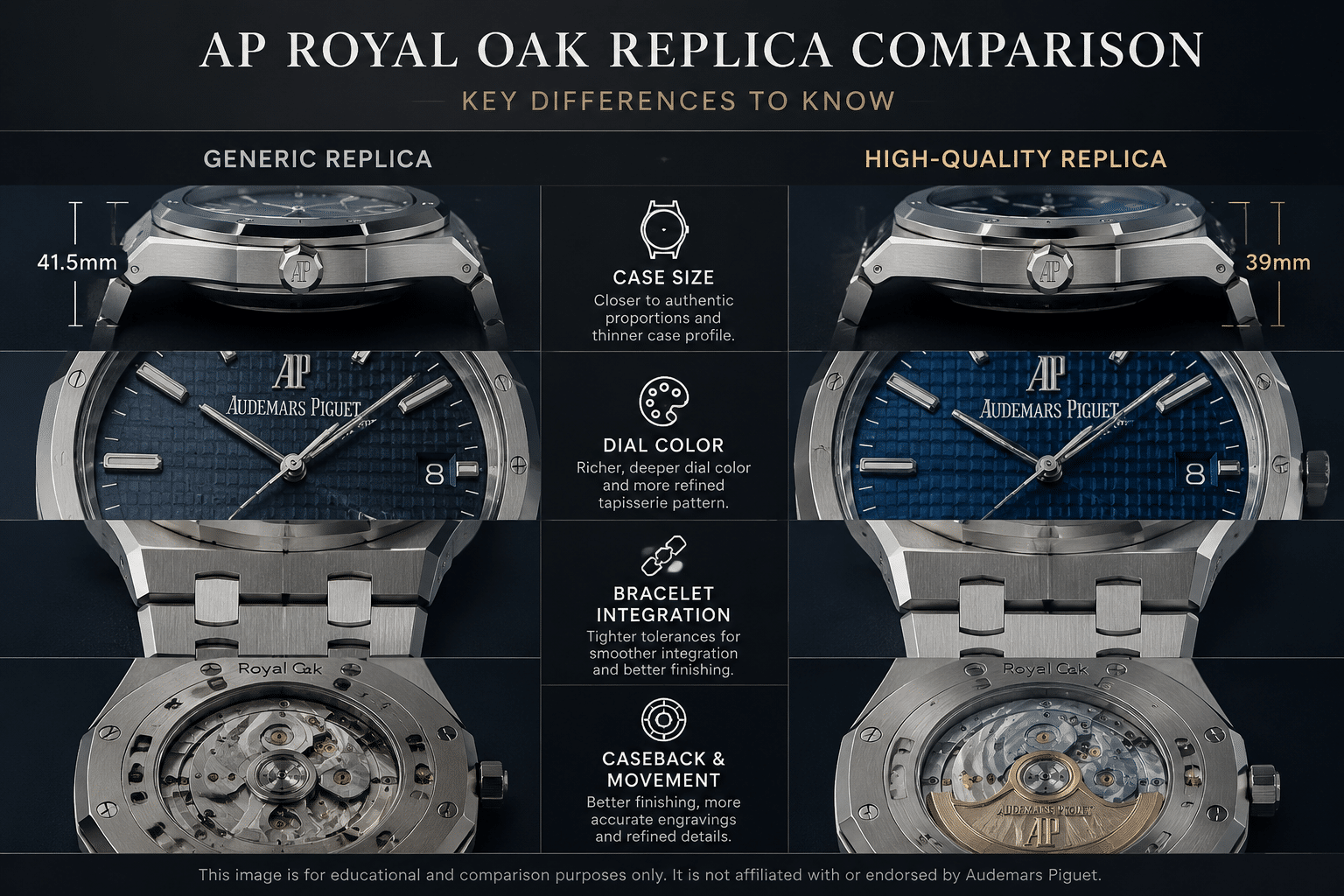
A practical Royal Oak replica comparison should confirm four basics before going further: model family, case size, dial color, and caseback type. Once those are clear, the buyer can judge whether the factory version actually matches the watch being sold.
Movement Architecture Matters More Than a Version Label
The AP replica movement is one of the strongest clues in any Royal Oak replica comparison because it affects more than timekeeping. Movement architecture can shape the case thickness, date position, hand stack, crown feel, rotor behavior, and what the watch looks like through the caseback. A V3 or V4 label may sound more advanced, but if the movement route is poorly matched to the reference, the watch can still be the weaker choice.
This is where buyers often overvalue decoration. A decorated movement bridge, gold-tone rotor, or engraved caseback view can look impressive in photos, but decoration is not the same as architecture. The better question is whether the movement layout supports the watch’s proportions and whether it is likely to be reasonable for daily ownership. A visually attractive movement can still have rotor noise, awkward winding feel, unstable date behavior, or limited service options.
The clear judgment here is that movement route should be verified before cosmetic upgrades are trusted. If a seller describes an AP replica as the “latest version” but cannot clearly state the movement type or show the caseback layout, the version claim is incomplete.
Use Movement Specifications Carefully
Official movement specifications can help buyers understand mechanical baselines such as diameter, thickness, jewel count, frequency, hand-winding, hacking, and power reserve. For example, Miyota lists the 9015 as an automatic movement with official dimensions and functional specifications, while Sellita publishes technical documentation for the SW200-1 movement family.[3][4] These documents can explain what a movement is supposed to be, but they do not prove that a particular AP replica contains that movement or that a decorated movement performs to the same standard.
This is why a seller’s movement statement should be checked against the actual watch rather than accepted as a badge. If a listing says “9015,” “SW200,” “clone 3120,” or another movement name, the buyer should still ask for supporting photos and look for consistency with case thickness, date position, crown behavior, and caseback layout. Movement names are useful only when they help explain the construction of the specific unit being sold.
Movement Transparency Note: Movement references in this article describe replica-market movement types, base-movement routes, or visible movement configurations, not an official Audemars Piguet caliber unless supported by verifiable evidence. Buyers should check the specific watch’s caseback layout, date position, crown behavior, case thickness, and seller-provided movement information before treating any movement name as meaningful.
Movement descriptions in the replica market should be checked carefully because they may refer to layout, decoration, clone architecture, or seller terminology rather than an official brand-manufactured caliber. A phrase such as “clone 3120-style” or “AP-style decorated movement” should be read as a replica-market construction description, not as evidence that the watch contains an authentic Audemars Piguet movement or can be serviced through official brand channels.
When comparing two AP replicas with different movement descriptions, buyers should separate four issues: what the seller calls the movement, what the visible layout suggests, how the movement affects the case and date position, and what ownership risks may follow from that route. A clone-style name may sound more convincing than a base-movement description, but the practical question is whether the architecture works coherently in this specific reference.
Visual Accuracy and Ownership Reliability Are Different Priorities
AP replicas make this tradeoff obvious because the movement route can serve different goals. One version may look better through the caseback because the bridges and rotor appear closer to the reference style, while another may be less impressive visually but use a more familiar base movement with simpler service expectations. Neither choice is automatically better; the right one depends on whether the buyer values display-back appearance, thinner proportions, quieter winding, easier servicing, or lower ownership risk.
For a buyer who mainly wants the watch to photograph well, dial texture, caseback decoration, and front-facing proportions may carry more weight. For daily wear, crown feel, rotor noise, bracelet comfort, date stability, and practical serviceability often matter more. Confusing these two goals is one reason buyers end up disappointed: they choose the most attractive QC photo, then discover that the ownership experience is not as smooth as the image suggested.
Balance-Wheel Position Can Reveal the Movement Route
On display-back AP replicas, balance-wheel position can help buyers understand whether the movement route is consistent with the claimed reference style. This should not be treated as an authentication trick or a promise of genuine-level construction. It is simply a useful consistency check. If the visible layout does not match what the seller says the watch is using, the buyer should slow down before accepting the version claim.
For AP-style replicas, the caseback often attracts attention because the movement is part of the visual experience. Sellers know this, so they may emphasize bridge decoration or rotor engraving. Those details matter, but layout matters more. A pretty rotor cannot fix a movement architecture that forces the wrong thickness, wrong date position, or an obviously mismatched caseback presentation.
Buyers should ask for a clear movement photo when the caseback is part of the reference. The photo will not prove long-term reliability, but it can confirm whether the visible layout supports the seller’s description.
Case Thickness Often Follows the Movement Choice
Movement choice often explains why two AP replicas with similar front photos feel different in real life. A movement with added decorative plates, awkward spacing, or an unsuitable base can force the case thicker. On a Royal Oak, that extra thickness is not a small detail. The design depends on a flat, architectural profile, and a thick side wall can make the watch feel heavier and less refined even if the dial looks good.
This is especially noticeable on slimmer Royal Oak designs. A watch can photograph well from the front because the bezel and dial hide the extra height. The side profile is less forgiving. If the movement route makes the case sit too tall, the watch may lose the elegant, integrated feel that defines the model.
That is why “case thickness from movement” should be part of the buying conversation. A newer version with a more complicated-looking movement is not automatically better if it makes the case proportions worse. For many buyers, a stable and proportionally sensible movement route is more valuable than a decorative upgrade that only looks good in a caseback photo.
Decoration Is Not the Same as Mechanical Quality
Movement decoration can help an AP replica look more convincing in photographs, but it should not be confused with mechanical quality. Bridges, engraved rotors, Geneva-style striping, and polished-looking plates can all be applied to a movement that still has average winding feel, rotor noise, inconsistent power reserve, or uncertain serviceability.
The ownership risk is practical. If the watch is difficult to service, if the rotor is loud, or if the date mechanism is unstable, the buyer will notice those issues more often than the bridge finishing. A movement that looks slightly less impressive but behaves more predictably may be the more sensible daily-wear choice.
This is why movement photos should be used as evidence, not as reassurance by themselves. They can show layout, rotor style, and visible finishing, but for AP complication movement risks, those images cannot prove that the movement is clean, properly lubricated, well regulated, or reliable over years of use.
Movement Route to Verify
Before accepting a V2, V3, V4, or “best edition” claim, buyers should verify the movement route in plain terms. Ask for the seller-stated movement type, a caseback photo if the model has a display back, and a clear explanation of whether the movement is an integrated clone route, a decorated base movement, or another architecture. The wording does not need to be overly technical, but it should be specific enough to compare.
Useful buyer-facing checks include the movement photo, caseback layout, rotor style, date behavior, crown and winding feel if described, and whether the case thickness makes sense for the claimed reference. None of these checks guarantees long-term performance, but together they make the version claim testable.
If the seller can only repeat “latest version” without explaining the movement, the buyer is not comparing movements. They are comparing marketing language. For AP replicas, that is usually the wrong place to start.
Case Thickness, Bezel Geometry, and Screw Position Tell the Real Story
An AP replica can survive a quick front-facing photo and still fail the moment you see the side of the case. That is why AP replica case thickness matters more than most version names. A seller can call a Royal Oak “V3,” “V4,” or “latest edition,” but if the mid-case is too tall, the bezel looks swollen, or the case-to-bracelet transition sits awkwardly, the watch will not carry the Royal Oak shape convincingly.
The Royal Oak is unforgiving because the design is built from hard geometry. The octagonal bezel, flat case planes, exposed screw heads, brushed surfaces, polished bevels, and integrated bracelet all need to line up visually. On a Submariner-style watch, a slightly soft case edge may disappear in daily wear. On a Royal Oak replica, the same softness can make the whole watch feel cheaper because the design depends on crisp edges and controlled proportions.
Side Profile Photos Matter More Than Straight-On Beauty Shots
Straight-on dial photos are the easiest images to make look impressive. They hide the side profile, reduce the visibility of case thickness, and make the bezel appear flatter than it may be in real life. A strong AP factory comparison should always include side-profile QC photos because that is where many version claims become testable.
The most important check is not only the listed millimeter thickness. It is how the thickness is distributed. A Royal Oak replica with a slightly thicker case can still look acceptable if the mid-case, bezel, and caseback are balanced. A watch with a bulky middle section or a raised caseback can look top-heavy even if the seller quotes a reasonable number. This is where buyers often misread specifications: a thickness number is useful, but the visual side profile tells you whether the watch wears correctly.
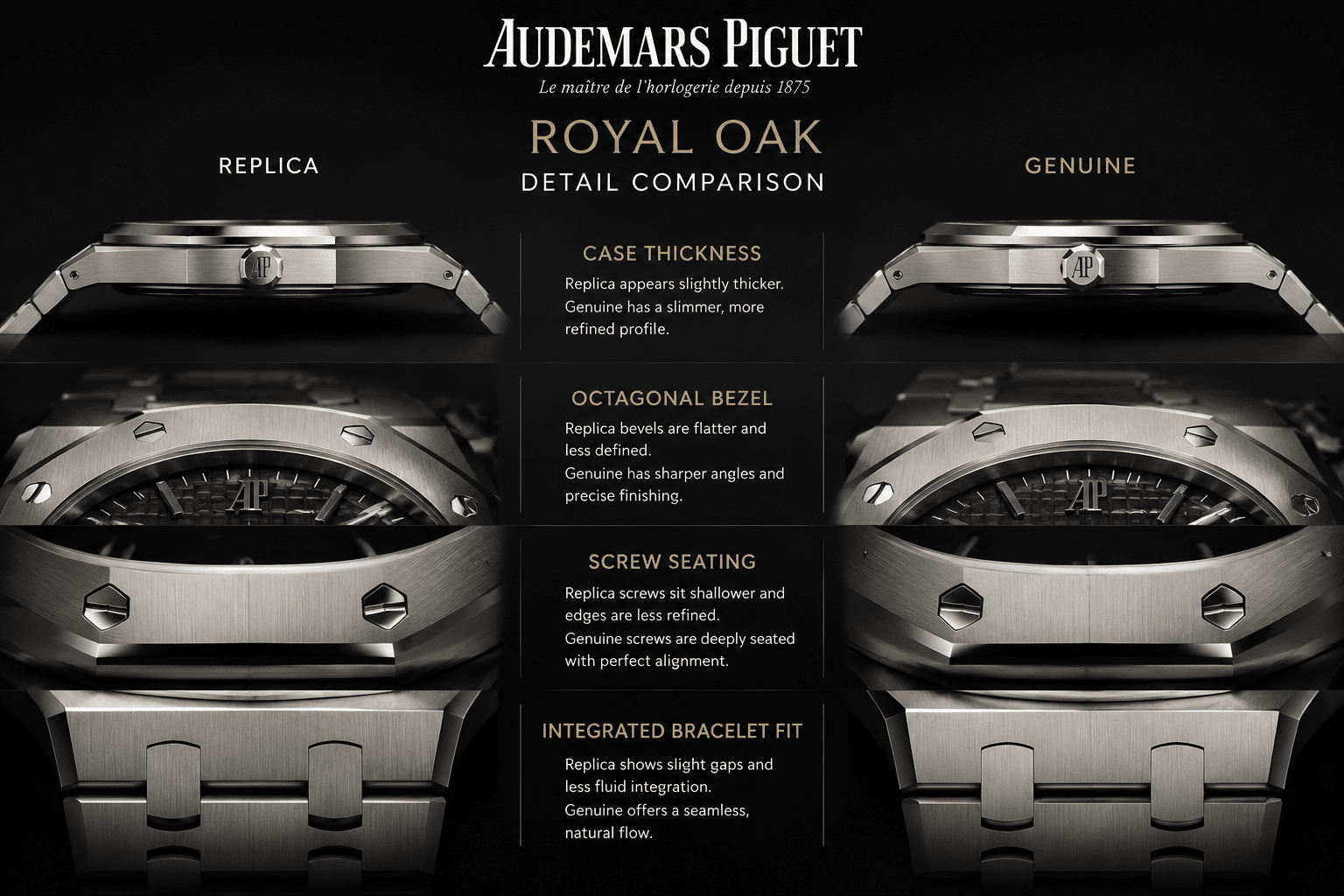
Look at the bezel height, the mid-case wall, the caseback bulge, and the first link transition. If the case drops into the bracelet naturally, the watch has a better chance of looking coherent on wrist. If the first links angle downward awkwardly or the case looks like a block sitting on top of the bracelet, the version label does not matter much. That is a physical AP replica case flaw, not a naming issue.
Bezel Screws Should Look Even and Purposeful
Royal Oak bezel screws are a useful comparison point because they sit directly on the most recognizable surface of the watch. The goal is not to use Royal Oak bezel screws as an authenticity trick. For a buyer comparing factories, the practical question is simpler: do the screws look clean, even, and intentionally placed, or do they make the watch look careless?
Check screw seating first. The screw heads should sit evenly in their recesses without one appearing too deep, too high, or tilted. Minor distortion from camera angle is normal, especially in angled QC photos. A red flag is when the unevenness appears in multiple images or when one screw clearly interrupts the shape of the octagonal bezel. Poor screw seating can make an otherwise decent AP replica look unfinished.
Orientation and spacing also matter. The screws should feel visually consistent across the bezel, even if no replica should be treated as a perfect reproduction of the genuine construction. If the screw heads look oversized, crowded toward the crystal, or randomly positioned, the bezel loses the disciplined geometry that makes the Royal Oak work. This is one of those flaws that buyers notice more in real life than they expect, because the bezel catches light every time the wrist moves.
Brushing and Polished Edges Need Clean Transitions
AP-style finishing depends on contrast. Brushed planes should look directional and controlled, while polished bevels should define the case edges cleanly. A weak factory version often fails not because the brushing is absent, but because the transition between brushing and polishing looks soft, rounded, or inconsistent.
The best way to compare AP factory case finishing is to look at angled photos under moderate light. Harsh lighting can exaggerate scratches; flat lighting can hide poor brushing. What you want to see is a clear grain direction across the bezel and case, with polished bevels that do not look wavy or over-buffed. If the bevels are too rounded, the watch loses the architectural character that separates a convincing Royal Oak replica from a generic angular sports watch.
This is also where “latest version” can be overrated. A newer batch may advertise a dial or movement update while the case finishing remains average. For daily wear, clean case geometry and controlled finishing often matter more than a small advertised upgrade that only shows under macro inspection. If two versions are close, choose the one with the better side profile, screw seating, and brushing consistency before chasing the higher version number.
Dial Tapisserie, Date Window, and Blue Color Are Version-Name Traps
The AP replica dial is where many buyers get pulled into version-name marketing. Sellers know that “upgraded blue dial,” “new tapisserie,” and “latest dial color” sound persuasive. The problem is that dial quality cannot be judged by the claim. It has to be judged by texture, color behavior, printing, applied marker alignment, date position, and how all of those details work together under real lighting.
Royal Oak dials are difficult because the tapisserie pattern is not just decoration. It controls how the dial reflects light, how deep the surface appears, and how sharp the applied indices look against the background. A version can look impressive in one edited photo and still feel flat, too glossy, or too harsh in QC images. This is why an AP replica dial should be compared across several photos, not one saturated front shot.
Tapisserie Texture Should Have Depth Without Looking Overdone
A convincing Royal Oak tapisserie dial needs controlled depth. The squares should look defined, consistent, and dimensional, but not cartoonishly raised or overly sharp. Weak dials often fall into two opposite traps: they look too flat and printed, or they look too aggressive, with a texture that appears stamped rather than refined.
The buyer’s mistake is assuming that more visible texture automatically means a better dial. It does not. If the pattern looks oversized, muddy, or too glossy, it can distort the proportions of the entire dial. On a Royal Oak, the dial texture must support the indices, logo, minute track, and date window. If the tapisserie dominates everything else, the watch may look dramatic in photos but less convincing on wrist.
Also check whether the pattern remains clean near the date window and logo area. Some weaker executions look acceptable in the center but lose crispness around cutouts or printed text. That kind of inconsistency is more useful than a version number when comparing two AP replica factory options.
Blue Dial Photos Can Be Misleading
Blue Royal Oak dials are especially dangerous for buyers because the color changes heavily with light, exposure, and camera processing. A deep blue in one seller photo can turn bright electric blue in another. A grey-blue dial may look accurate in indoor light but too pale outdoors. One photo cannot settle AP replica blue dial accuracy.
The smarter approach is to ask for or compare neutral-light images when possible. Avoid judging from photos taken under strong LED lighting, direct sunlight, or heavy phone-camera saturation. Those images may make a mediocre dial look richer than it is. They can also make a good dial look wrong by exaggerating the hue.
Batch variation matters here. Two watches described with the same version name may not show the exact same blue tone if they come from different production runs or different photo conditions. This is why “latest blue dial” should be treated as a claim to verify, not a reason to skip inspection. If blue color is your priority, dial photos deserve more weight than the seller’s label.
Date Window Position Is a Practical Comparison Point
The date window is one of the fastest ways to see whether a Royal Oak replica dial has been executed carefully. It should not look like an afterthought cut into the tapisserie. Check the window shape, date centering, font weight, and whether the date sits naturally within the dial layout for the claimed reference style.
A slightly imperfect date is not always a deal-breaker. Many replica watches have minor datewheel variation, and camera angle can make the numeral look less centered than it is. The bigger issue is consistency. If the date sits too high, too low, too far inward, or the font looks obviously heavy compared with the rest of the dial printing, that flaw will be visible during normal use because the eye naturally returns to the date window.
Date placement can also be influenced by the movement route and case/reference architecture, which is why buyers should not compare every AP replica under one generic “V4” label. A date position that is acceptable on one Royal Oak-style reference may look wrong on another. The correct question is not “which version has the date?” but “does the date placement make sense for this exact watch?”
Dial Checks Before You Decide
- Neutral-light dial photo: Use this to judge color and texture without heavy saturation or glare.
- Straight-on alignment photo: Check logo placement, applied indices, minute track, and hand alignment.
- Date window close-up: Look at numeral centering, cutout shape, and font weight.
- Angled dial photo: Confirm whether the tapisserie has controlled depth rather than flatness or excessive gloss.
- Color consistency across images: Be cautious if the same watch appears dramatically different in every photo.
If the dial is the main reason you are choosing one version over another, do not let a single beauty shot decide the purchase. A better AP replica dial is the one that stays believable across normal angles, not the one that looks most dramatic in a seller’s best photo.
Bracelet Drape and Clasp Quality Can Expose Weak Factory Execution
A Royal Oak replica can have a strong dial and still feel wrong because the bracelet does not behave like part of the watch. The AP replica bracelet is not a removable afterthought in the way a simple strap can be. It is part of the Royal Oak’s architecture, and it determines how the case sits, how the watch moves, and how expensive or cheap the watch feels during daily wear.
This is where version names become especially weak. A seller may advertise a new dial, upgraded movement decoration, or improved caseback, but those claims do not tell you whether the bracelet drapes naturally, whether the clasp closes securely, or whether the link finishing matches the case. Royal Oak bracelet quality should be treated as a primary comparison point, not a small finishing detail.
Bracelet Drape Affects Both Comfort and Visual Credibility
Bracelet drape describes how the links fall around the wrist. A good integrated bracelet should feel solid but not rigid. It should curve naturally from the case, with the first links articulating smoothly rather than forcing the watch to sit like a flat metal plate.
Stiff links are a common problem on weaker AP replicas. In photos, the watch may look fine because the bracelet is laid flat. On wrist, poor articulation can create gaps, pressure points, or an awkward case angle. This affects comfort, but it also affects visual credibility. The Royal Oak is supposed to flow from case to bracelet. If the bracelet fights the wrist, the design loses its purpose.
QC photos can help, but they cannot fully reveal tactile feel. Still, bracelet-fit images are useful. Look for obvious gaps near the end-link area, uneven link spacing, and a bracelet that appears too stiff when curved. If the bracelet looks reluctant to bend even in seller photos, it may feel worse in daily use.
Clasp Engraving and Closure Feel Should Not Be Ignored
The clasp is one of the most handled parts of the watch, so it should not be judged only by whether the logo exists. Clasp engraving should look clean, centered, and consistent with the rest of the finishing. Overly shallow, rough, or bulky engraving can make the bracelet feel lower grade even if the dial is attractive.
Closure feel is harder to evaluate from photos, but it still matters. A good clasp should close securely without feeling flimsy or misaligned. If a seller provides clasp photos, check the inside finishing, hinge alignment, and whether the clasp plates look cleanly machined. Rough interior surfaces, uneven brushing, or loose-looking clasp construction are warning signs because they affect the ownership experience every time the watch is worn.
Clasp quality should be read as a quality indicator, not as proof of anything beyond the watch in front of you. The practical question is whether the clasp feels consistent with the case and bracelet. If the case looks refined but the clasp looks crude, the factory execution is uneven.
Finishing Consistency Across Links Matters
Royal Oak bracelet finishing is difficult because every link has multiple surfaces. The brushed tops, polished bevels, side edges, and link gaps all need to work together. A weak AP replica bracelet often exposes itself through inconsistency rather than one dramatic flaw.
Uneven brushing is the first thing to check. The grain should run cleanly and consistently across the links. If some links look cloudy, circular, or directionless, the bracelet will not match the sharper geometry of the case. Polished bevels should also remain controlled. Over-polished edges can look soft, while rough bevels can feel sharp against the skin.
Hair-pulling and edge sharpness are practical ownership issues, not just finishing complaints. Even strong Royal Oak-style bracelets can have tight tolerances, but lower-quality bracelets often make the problem worse with rougher edges or inconsistent link gaps. For daily wear, a slightly less hyped version with better bracelet comfort can be more sensible than a newer-labeled version with a prettier dial photo but poor link finishing.
When comparing AP factories, the bracelet should be judged with the same seriousness as the dial and case. If the bracelet drapes naturally, the clasp feels secure, and the finishing remains consistent across the links, the watch has a stronger chance of feeling coherent on wrist. If the bracelet is stiff, sharp, loose, or poorly brushed, the version name cannot rescue the wearing experience.
Caseback Layout and Factory Claims Should Match the Watch Being Sold
The AP replica caseback is not just a decorative area for rotor engraving and movement decoration. It is one of the easiest places to check whether the seller’s version claim makes sense. If a watch is described as a certain Royal Oak reference with a specific movement route, the display caseback, rotor shape, bridge layout, caseback screws, and engraving quality should support that story. If they do not, the “latest version” label becomes much less useful.
This does not mean a caseback photo can prove long-term reliability or complete accuracy. It cannot. What it can do is expose inconsistency. A seller may describe a watch as an upgraded AP replica version, but if the caseback layout looks like a generic decorated movement, the rotor sits in the wrong visual style for the claimed reference, or the engraving looks careless compared with the rest of the watch, the buyer should slow down. The caseback is a consistency check, not a certificate.
The Caseback Should Support the Claimed Reference
The first question is simple: does the Royal Oak caseback layout match the watch being sold? A 15400-style Royal Oak, a 15500-style Royal Oak, a Jumbo-style model, and an Offshore chronograph should not all be judged by the same vague “AP movement” description. Each reference has different expectations for display-back layout, rotor appearance, bridge design, movement visibility, and sometimes caseback thickness.
A common buyer mistake is comparing the caseback against a general idea of what an Audemars Piguet replica should look like instead of checking it against the specific reference being copied. That is how mismatches get missed. A rotor may have attractive gold-tone engraving, but if the movement architecture does not visually fit the claimed model family, the decoration is solving the wrong problem.
For version comparison, the caseback should answer three practical questions:
- Does the rotor style make sense for the claimed movement route?
- Does the bridge layout look consistent with the stated reference style?
- Do the caseback screws, engraving, and finishing look aligned with the quality level claimed by the seller?
The strongest AP factory versions usually look coherent from front to back. The dial, case thickness, movement route, and caseback presentation feel like they belong to the same watch. Weaker versions often look convincing from the front but less organized from the rear, especially when the movement decoration is used to hide a less suitable base architecture.
Rotor and Bridge Decoration Can Distract Buyers
Movement decoration is one of the easiest areas to overvalue in AP replica comparison. A decorated rotor, engraved bridges, and Geneva-style striping can look impressive in seller photos, especially under bright lighting. But decoration is not the same as correct architecture, clean finishing, or stable ownership.
The practical judgment is this: layout consistency matters more than decorative shine. A bridge can be engraved, but the engraving may be too thick, too shallow, uneven, or poorly spaced. A rotor can look similar in color, but its shape, position, and finishing may still feel wrong for the claimed Royal Oak caseback layout. A movement photo should make the version claim clearer, not simply give the buyer something attractive to look at.
Buyers should also avoid assuming that a more decorated movement is automatically the better daily-wear choice. In some AP replicas, a simpler and more proven movement route may be less visually exciting through the caseback but more sensible if it keeps the case thickness under control and reduces ownership risk. A visually busy caseback can create confidence in photos while still leaving questions about winding feel, rotor noise, serviceability, and long-term stability.
Caseback Photos Are Useful but Not Complete Proof
An AP caseback QC photo is useful because it lets the buyer compare the seller’s claim against the actual watch shown. It can confirm visible details such as rotor engraving, bridge layout, caseback screw placement, movement decoration, and general finishing. It can also reveal careless assembly, dust under the display back, rough engraving, mismatched screws, or a movement that does not support the advertised version description.
Still, caseback photos have limits. They do not prove the movement is clean inside. They do not prove the watch will run reliably for years. They do not prove the power reserve, service history, or water resistance. A sharp caseback image is evidence, but it is only one layer of evidence.
The better approach is to use the caseback as a cross-check. If the dial, case thickness, bracelet quality, and caseback layout all point in the same direction, the factory claim becomes more credible. If the caseback contradicts the claimed movement route or reference style, the version name should be treated with caution, even if the front photo looks strong.
QC Photos Beat Seller Slogans Every Time
AP replica QC photos are where version claims become testable. A seller can call a Royal Oak “V3,” “V4,” “new batch,” or “best edition,” but those words matter less than the actual watch shown before shipment. If the QC set shows poor dial color, uneven date placement, rough bracelet finishing, misaligned bezel screws, weak clasp finishing, or excessive case thickness, the slogan has already lost the argument.
The strongest reason to rely on QC photos is simple: they show the unit you are actually being asked to accept. Stock photos show what a factory or seller wants the watch to look like. QC photos show the real sample, with its own alignment, finishing, and batch variation. For AP replicas, that difference matters because small physical inconsistencies can change the entire impression of the watch.
QC photos reduce uncertainty, but they do not remove every risk. Buyers should review dial printing, marker alignment, hand alignment, bezel screw seating, datewheel centering, case thickness, bracelet fit, clasp engraving, and caseback finishing before accepting a version claim, especially when the seller relies on stock photos or broad “latest version” wording.
Use QC Photos to Test the Version Claim
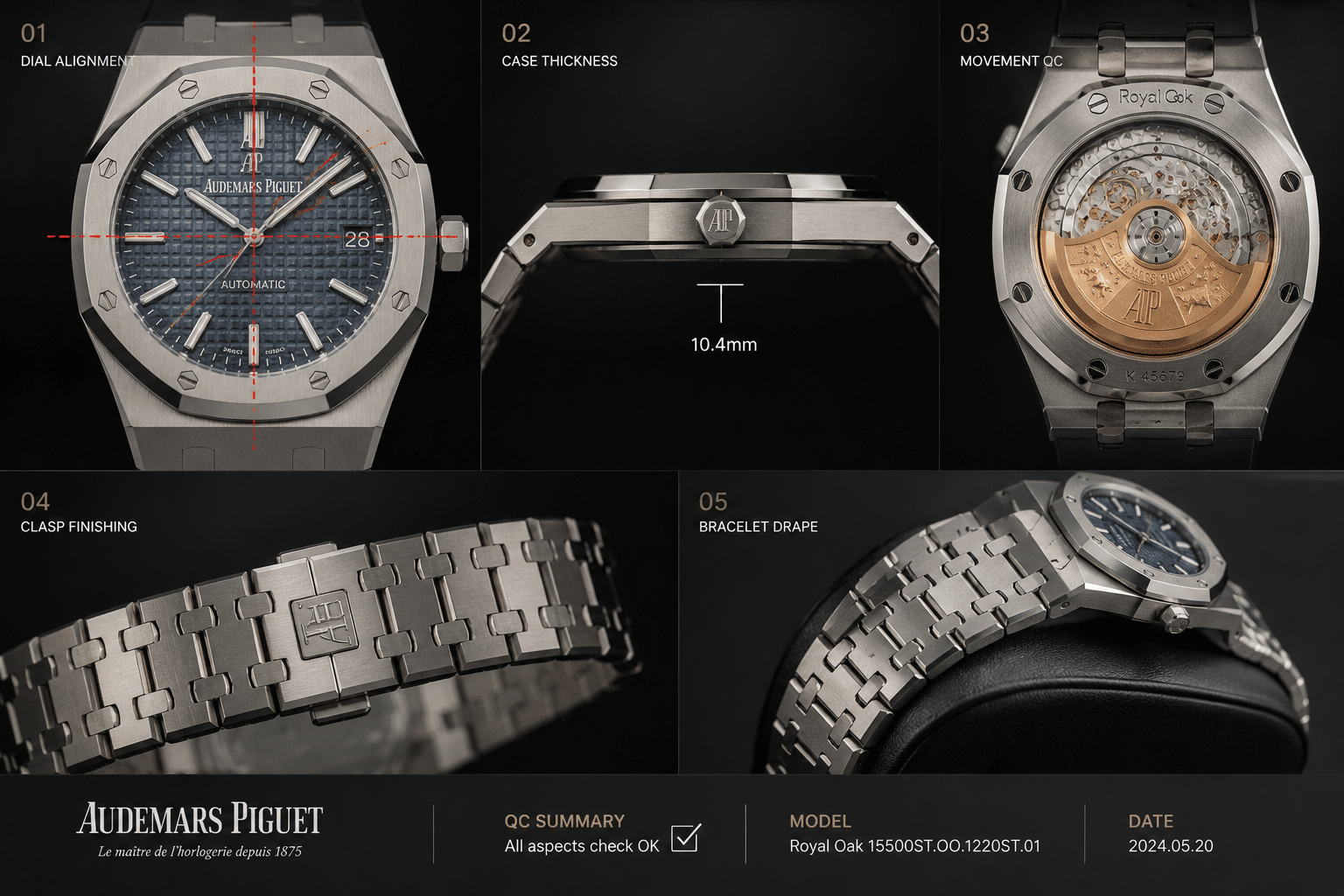
A proper Royal Oak QC check should not begin with “which version is better?” It should begin with “does this exact watch support the claimed version?” The front dial photo checks marker alignment, logo placement, tapisserie consistency, hand position, date centering, and dial color. The side profile checks whether the case thickness and bracelet integration look acceptable. The caseback photo checks whether the movement presentation fits the claimed reference. Bracelet and clasp photos show whether the finishing quality matches the rest of the watch.
The most useful QC review is not a search for perfection. No AP replica should be treated as flawless. The goal is to decide whether the visible compromises are acceptable for that reference and price tier. A slightly imperfect photo angle is not the same as a crooked date window. Minor lighting variation is not the same as a dial color that looks wrong in every image. The buyer has to separate photo distortion from actual construction problems.
For AP, the hierarchy matters. Case thickness, dial color, bracelet fit, and date alignment usually affect daily-wear confidence more than a tiny engraving imperfection on the clasp. A watch with ten advertised upgrades can still be the wrong choice if one major visual flaw dominates the wrist presence.
Seller Photos Show Evidence, but They Also Have Blind Spots
Even a full QC set has blind spots. Photos can show screw seating, dial alignment, caseback layout, and obvious finishing problems, but they may not reveal winding smoothness, rotor noise, clasp tension, link sharpness, or how the case sits after the bracelet is sized. This is why a clean-looking AP replica for photos is not always the same as the most sensible daily-wear option.
When two watches look similar in QC, buyers should give extra weight to the parts that affect repeated use: movement behavior, bracelet comfort, clasp security, and case thickness on wrist. A watch that wins a macro-photo comparison by a small margin may still be less enjoyable if the bracelet is stiff or the movement route adds practical risk. QC photos are essential, but they should be read alongside the buyer’s intended use.
Stock Photos Should Not Decide the Comparison
Stock photos are useful for understanding what a factory version is supposed to represent, but they should not decide an AP factory comparison. Factory promotional images are often shot from flattering angles, under controlled lighting, and sometimes from samples that are cleaner than regular production pieces. They may not show the exact watch being prepared for the buyer.
This is especially risky with Royal Oak replicas because straight-on beauty shots can hide the problems buyers most need to see. Case thickness can disappear in a front photo. Bracelet stiffness cannot be judged from a perfect flat-lay image. Blue dial color can look richer or darker depending on exposure. Bezel screw depth may look cleaner when the photo is slightly soft.
A seller who only provides stock images is asking the buyer to trust the claim rather than inspect the watch. That is a weak position for any top Audemars Piguet replica factories comparison, especially when judging an AP replica version against the actual unit, not the best-looking image from a product folder.
One Flaw Can Matter More Than a Long Feature List
AP replicas are often advertised through long upgrade lists: improved dial, upgraded movement decoration, better clasp, corrected screws, new batch, refined bracelet. Some upgrades may be real. The problem is that a long list can distract from the one flaw that matters most.
A Royal Oak with a visibly thick side profile will not become slim because the rotor engraving is improved. A blue dial that looks flat or overly saturated in neutral light will not be saved by a cleaner clasp stamp. A bracelet that sits awkwardly at the case can make the whole watch feel wrong even if the dial printing is sharp. For AP, the design works as one continuous object, so a major flaw in proportion or integration carries more weight than several small cosmetic wins.
This is where buyers should be stricter than the seller’s description. A “latest version” with one serious physical compromise may be less sensible than an older-labeled version with a stable movement route, cleaner case profile, and better bracelet fit. The better AP replica is the one with fewer meaningful compromises on the actual watch, not the one with the longer marketing description.
QC Photos to Request
A useful AP replica photo inspection should include enough angles to test the claims. The minimum set should cover the watch as an object, not just the dial as a pretty image.
- Straight front dial photo: checks marker alignment, logo position, tapisserie consistency, hands, and date centering.
- Neutral-light dial photo: helps judge blue, grey, black, or silver dial color without heavy saturation.
- Side profile photo: reveals case thickness, bezel height, mid-case shape, and bracelet integration.
- Caseback photo: checks movement visibility, rotor style, bridge layout, engraving, and caseback screws.
- Bracelet drape photo: shows whether the integrated bracelet falls naturally or looks stiff and awkward.
- Clasp photo: checks engraving depth, brushing, polish, closure fit, and consistency with the bracelet.
- Date window close-up: helps evaluate date centering, font weight, window cutout, and placement.
- Bezel screw close-up: checks seating, depth, spacing, and whether one screw looks visibly worse than the others.
If a seller’s version claim is strong, these photos should make it easier to believe. If the photos make the buyer ask more questions than they answer, the safest response is not to be impressed by the version name. It is to compare the actual evidence again.
How to Compare Two AP Factories Without Falling for “Best Version” Claims
When two AP factories both claim to offer the latest or best Royal Oak version, the buyer needs a comparison method that removes the slogan. The better option is not automatically the higher version number, the newer batch, or the more expensive listing. The better option is the watch with fewer meaningful compromises for the exact reference being replicated.
A practical AP factory comparison should move in order: identify the reference, confirm the movement route, compare the physical construction, inspect bracelet and clasp quality, check caseback consistency, then judge the actual QC photos. If the process starts with “which factory is best?” the buyer is already too broad. Factory reputation matters, but only after the model and component execution are clear.
Step One: Ignore the Slogan and Identify the Watch
Start by naming the watch correctly. Is it a 15400-style Royal Oak, a 15500-style Royal Oak, a Jumbo-style 15202, an Offshore Diver, or a chronograph-style Offshore? What is the case size? What dial color is being compared? Is the watch supposed to have a display caseback? These questions are basic, but they prevent many bad comparisons.
A buyer choosing between two “latest version” Royal Oak replicas may think they are comparing equal products, but one could be a stronger execution of a 15500-style watch while the other is a weaker execution of a different reference. At that point, the version names are not helping. They are hiding the fact that the buyer is comparing different design problems.
AP factory strength is model-specific. A factory that handles one Royal Oak reference well may not be equally strong across Offshore chronographs, thin Jumbo-style models, or skeleton-style designs. The reference comes first because it defines the standards for thickness, dial layout, bracelet integration, date position, and caseback presentation.
Step Two: Confirm Movement Route Before Cosmetic Details
Movement route should be checked before getting lost in dial shade or clasp engraving. The movement can affect case thickness, date placement, caseback layout, rotor behavior, and ownership risk. A watch with attractive cosmetics can still be a poor choice if the movement architecture forces the case too thick or creates a caseback layout that does not match the claimed reference.
This does not mean every buyer needs to become a movement expert. The practical checks are simpler: ask what movement route is being used, request a caseback or movement photo when appropriate, compare the date behavior and case thickness against the claimed model style, and be cautious when a seller uses vague terms without showing evidence.
At Clean VS Factory, we tend to treat movement choice as part of the whole watch, not a separate technical badge. A movement route is valuable only if it supports the reference convincingly and keeps the ownership risk reasonable. A decorated movement that creates a thicker, less coherent watch is not automatically an upgrade.
Step Three: Compare Physical Flaws by Importance
Once the reference and movement route are clear, rank the flaws by how much they affect the real watch. Not every imperfection deserves the same weight. Some flaws mainly appear in macro photos. Others change the wrist presence immediately.
| Comparison Point | Why It Matters | How Much Weight to Give It |
|---|---|---|
| Case thickness | Changes the entire Royal Oak profile and is hard to hide on wrist. | Very high |
| Dial color and texture | Especially important on blue dials and tapisserie patterns. | Very high |
| Bracelet fit and drape | Defines comfort and the integrated Royal Oak look. | High |
| Date alignment | Visible every time the dial is checked. | High |
| Bezel screw seating | Affects the precision of the octagonal bezel. | Medium to high |
| Clasp engraving | Useful quality signal, but less important than case and dial execution. | Medium |
This ranking prevents a common mistake: choosing the watch with more advertised improvements while ignoring the flaw that matters most. If Factory A has slightly weaker clasp engraving but a better case profile, stable movement route, and cleaner dial color, it may be the more rational choice than Factory B with a louder “newest version” claim and a visibly thicker case.
Step Four: Judge the Actual Watch in QC
The final decision should be based on the actual QC photos, not only on factory reputation. Even strong factories can have uneven samples. Even a good batch can produce one watch with a crooked date, rough screw seating, or a bracelet gap that would bother the buyer every time it is worn.
For a side-by-side AP factory comparison, place the QC sets next to each other and compare the same angles: front dial against front dial, side profile against side profile, caseback against caseback, bracelet against bracelet, clasp against clasp. Do not compare one factory’s best stock photo against another factory’s real QC photo. That is not a fair comparison.
The safest choice is usually the watch with the fewest serious physical compromises, not the one with the most confident description. A cheaper or older-labeled version may be acceptable if its main flaws are minor, the movement route is stable, and the actual QC photos look coherent. A newer-labeled version is worth paying for only when the visible evidence shows real improvement where it matters.
The final rule is simple: version names can start the conversation, but they should not decide it. The actual AP replica in front of you should win or lose on reference accuracy, movement logic, case profile, dial execution, bracelet quality, caseback consistency, and QC evidence.
Build a Traceable Comparison Record
When comparing two AP factories, it helps to create a simple written record instead of relying on memory or seller descriptions. List the claimed factory, claimed version, exact reference style, movement route, case thickness observation, dial notes, bracelet notes, caseback notes, and QC-photo concerns. This turns the comparison from a brand-name debate into a component-by-component review.
The value of this record is not bureaucracy; it prevents confusion. If one option wins on dial color but loses on side profile, and another option wins on bracelet drape but has weaker caseback decoration, the buyer can decide based on the priorities that matter most. A traceable decision is easier to trust because every conclusion is connected to a visible or practical detail.
Common Buyer Mistakes When Reading AP Version Claims
The biggest AP replica buyer mistakes usually start with treating version language as if it were a technical standard. It is not. A seller claim like V3, V4, latest batch, best edition, or upgraded version may be useful as a clue, but it should never override what the actual watch shows in photos. The safer habit is to assume the version name is incomplete until the reference, movement route, case shape, dial, bracelet, and QC evidence support it.
This matters more with AP than with many simpler replica watches because the Royal Oak design is easy to recognize but hard to execute consistently. A weak bracelet, thick side profile, flat dial texture, or wrong date position can make an otherwise attractive AP replica feel wrong quickly. Some flaws are acceptable if the buyer understands them. Others undermine the whole watch, no matter how impressive the version label sounds.
Mistake One: Treating Version Numbers Like Official Standards
V2, V3, and V4 are not universal grades across the AP replica market. One seller may call a watch V3 because that is how their supplier labels it. Another may call a similar batch V4 because the dial changed, the movement decoration changed, or simply because “new version” sells better. These labels are not audited, standardized, or consistent across factories.
The correction is simple: ask what changed. A real update should be explainable in component terms. Did the case get thinner? Did the movement route change? Is the tapisserie texture improved? Did the bracelet finishing become cleaner? If the answer is only “latest batch” or “best version,” the claim is too vague to make a decision on.
A higher version number can also hide a downgrade. A newer batch may improve dial color but introduce rougher bracelet brushing. It may update the rotor engraving while leaving the case too thick. For AP replica version claims, the number matters only after the physical changes are clear.
Mistake Two: Comparing Different References Under One Label
A Royal Oak Jumbo-style replica and a 41mm Royal Oak-style replica should not be judged under the same version label. The Jumbo-style watch is judged heavily on thinness, no-seconds dial balance, bracelet flow, and the difficulty of replicating an ultra-thin movement layout. A 15400-style or 15500-style Royal Oak has different proportions, different dial spacing, different movement expectations, and a different caseback appearance.
This is where many buyers accidentally compare the wrong things. They ask which AP factory has the better V3 without first confirming whether both watches are trying to replicate the same reference style. That creates a false comparison. A factory can be stronger on one Royal Oak family and less convincing on another, especially where case thickness, date placement, or movement architecture changes.
The practical correction is to identify the model family before reading the seller description. Royal Oak, Royal Oak Jumbo, Royal Oak Offshore, chronograph, diver, and skeleton-style replicas each carry different risks. A version name that sounds strong for one reference may mean very little for another.
Mistake Three: Ignoring the Bracelet Because the Dial Looks Good
AP replica buyers often study the dial first because the tapisserie pattern and blue color are obvious in photos. That is understandable, but it can lead to a poor daily-wear decision. The Royal Oak bracelet is not a normal bracelet added to a case; it is part of the watch’s architecture. If the links are stiff, the brushing is uneven, the bevels feel rough, or the clasp feels weak, the watch loses much of what makes the design convincing.
A good dial can make a stock photo look excellent. A poor bracelet can make the same watch feel cheap within minutes on the wrist. This is especially important for buyers trying to avoid wrong AP replica choices based on front-facing photos only. The bracelet affects comfort, wrist presence, perceived finishing, and how naturally the case transitions into the links.
The correction is to treat bracelet quality as a primary factor, not a bonus. Look for link articulation, clean brushing direction, consistent polished bevels, end-link fit, clasp finishing, and closure feel where possible. If the bracelet looks rigid or poorly finished in QC photos, a stronger dial may not save the watch as a daily wearer.
Mistake Four: Letting One Marketing Phrase Override QC Evidence
The most expensive mistake is believing a phrase after the photos already show a problem. “Best edition” does not fix a crooked date. “Latest batch” does not make a thick case look thinner. “Upgraded version” does not correct uneven bezel screw seating, rough clasp edges, or a dial color that looks wrong in neutral light.
QC red flags should carry more weight than factory hype. A minor dust mark, slight lighting distortion, or small photo-angle issue may not matter much. But a major case profile problem, visibly poor dial color, misaligned markers, uneven screw seating, or weak bracelet fit affects the whole impression of the watch. These flaws are not academic if they change how the AP replica looks or feels in normal use.
At Clean VS Factory, we usually treat version claims as a starting point, not a verdict. The actual watch shown in QC has to support the seller claim. If the visible evidence conflicts with the marketing language, trust the evidence.
Misrepresentation and Seller-Language Red Flags
The purpose of factory and movement information is to help readers understand quality and risk, not to represent a replica watch as genuine. A strong AP super clone may look convincing in normal wear, but close inspection can still reveal differences in finishing, movement architecture, case proportions, bracelet feel, dial details, documentation, or service compatibility. It should not be described, sold, or used as an authentic Audemars Piguet watch.
Buyers should be cautious when a listing relies on phrases such as “same as genuine,” “passes inspection,” “factory certified,” “official AP source,” “perfect 1:1,” or “authentic Swiss AP movement.” Those claims create unnecessary risk because they suggest authentication passability, official authorization, or brand-manufactured components without evidence. A more useful seller description explains the reference style, movement route, factory label, batch differences, visible QC details, and practical ownership limits.
CleanVSFactory’s buyer-facing approach is to make replica watch comparison clearer by connecting factory names, movement claims, visible QC details, version differences, and realistic ownership expectations. That role is educational and comparative; it should not be read as official brand affiliation, authentication certification, factory authorization, or a guarantee that any replica-market watch will meet the standards of a genuine Audemars Piguet product.
Water Resistance, Durability, and Legal Claims Need Extra Caution
Buyers should not assume an AP replica has the same water resistance, shock resistance, warranty support, or long-term durability as the authentic reference. Even when an official AP page lists water-resistance information for a genuine Royal Oak model, that specification applies to the authorized Audemars Piguet watch, not to an imitation product from a replica factory.[2] For a replica, water resistance should be treated as unverified unless the individual watch has been pressure-tested after purchase by a competent watchmaker.
Legal and disclosure language also needs restraint. Replica watches can raise trademark, customs, import, resale, and disclosure issues depending on jurisdiction. The USPTO describes counterfeit goods in trademark terms, and U.S. Customs and Border Protection identifies intellectual property rights enforcement as a trade priority, but those sources should be used as cautionary context rather than as legal advice about any specific buyer or shipment.[5][6]
This is why careful comparison should include both product inspection and expectation management. A strong-looking AP replica may still differ from the authentic watch in finishing tolerances, movement behavior, serviceability, documentation, legal status, and resale disclosure obligations. The safest wording is not “same as genuine” or “customs safe,” but “this imitation watch appears stronger or weaker based on visible component execution and the buyer’s risk tolerance.”
A Practical AP Replica Comparison Checklist
An AP replica comparison checklist should be short enough to use before deciding, but strict enough to prevent version-name mistakes. The goal is not to find a perfect watch. The goal is to compare Royal Oak replicas by the details that actually affect ownership: reference accuracy, movement route, case thickness, dial execution, bracelet quality, caseback consistency, and QC evidence.
The best AP replica factory decision is usually not “which one has the newest label?” It is “which actual watch has the fewest meaningful compromises for this reference?” That difference matters. A slightly older-labeled version with stable movement behavior, better case proportions, and cleaner bracelet finishing can be more rational than a louder “latest version” with unresolved physical flaws.
Ignore Version Names Until the Basics Are Confirmed
Start by putting V2, V3, V4, latest, and best edition to the side. First confirm the watch being compared: model family, case size, dial color, date position, caseback type, and general reference style. If those basics are unclear, the version name is not useful yet.
Then confirm the movement route. This does not mean assuming the movement is perfect because it has a clone-style name. It means checking whether the movement choice makes sense for the reference, case thickness, date placement, rotor layout, and caseback appearance. A movement that supports the correct proportions is more valuable than decoration that only looks good in one caseback photo.
Only after the reference and movement route make sense should the version label enter the discussion. By that point, the label becomes a way to organize information, not a reason to trust the watch blindly.
Rank Flaws by Visibility and Ownership Impact
Not every flaw deserves the same reaction. AP replicas are detail-heavy watches, so small imperfections are expected. The buyer’s job is to rank flaws by how much they affect the watch in real use, not by how dramatic they look in macro photos.
- Highest priority: case thickness, side profile, bracelet fit, and overall proportions because these affect the entire wrist presence.
- High priority: dial color, tapisserie texture, date position, and marker alignment because these are visible every time the watch is worn.
- Medium priority: bezel screw seating, brushing direction, polished bevel consistency, and clasp quality because they affect perceived finishing.
- Lower priority: tiny printing differences or movement decoration details that are mostly noticed under magnification, unless the watch has a display caseback and the layout is clearly inconsistent.
This ranking prevents overreacting to small flaws while missing bigger ones. A slightly imperfect engraving may be acceptable for many buyers. A case that looks too thick for a slim Royal Oak design is much harder to ignore.
Let QC Photos Decide the Final Comparison
The final comparison should be based on the actual watch shown in QC photos, not stock images, factory reputation, or version slogans. A useful QC set should let the buyer judge the straight dial view, side profile, date window, bezel screws, bracelet fit, clasp finishing, and caseback layout. If those photos are missing, the comparison is incomplete.
QC photos do not prove long-term reliability, and they cannot fully communicate bracelet feel or winding quality. They can, however, expose whether the main physical claims make sense. If the seller says the watch is the best AP replica version available but the side profile looks bulky, the date sits poorly, and the bracelet finishing appears rough, the photos have already answered the question.
The practical rule is simple: use the version name to locate the option, but use the watch itself to judge it. AP replica version claims are only helpful when the reference, movement, components, and QC photos all point in the same direction. The stronger choice is the one supported by evidence, not the one with the most confident label.
Confirm the Decision Before Accepting the Watch
Before making the final decision, buyers should confirm that the chosen watch still makes sense after the first excitement of the seller description has passed. Recheck the exact reference, movement route, case side profile, dial color, date centering, bracelet drape, clasp finish, and caseback layout as one connected set of evidence. If one major detail contradicts the seller’s version claim, it is worth asking for clarification rather than assuming the label is correct.
Buyers should also confirm return, repair, shipping, and after-sales terms before ordering, because those terms can vary by seller and should not be assumed from a factory name or version label. This is separate from watch quality, but it is part of realistic buyer expectation management. A careful comparison is strongest when the product evidence and the ordering terms are both understood before a decision is made.
References
[1] Audemars Piguet, “Royal Oak Jumbo Extra-Thin 16202ST.OO.1240ST.02 official specifications,” official brand product reference, available at Audemars Piguet Royal Oak Jumbo 16202ST official specifications.
[2] Audemars Piguet, “Royal Oak 15510ST.OO.1320ST.01 official specifications,” official brand product reference, available at Audemars Piguet Royal Oak 15510ST official specifications.
[3] Miyota, “Caliber 9015 official movement specifications,” movement manufacturer technical product page, available at Miyota 9015 official movement specifications.
[4] Sellita, “SW200-1 official technical documentation,” movement manufacturer technical document, available at Sellita SW200-1 official technical documentation.
[5] United States Patent and Trademark Office, “Counterfeit Goods Basics,” official trademark and counterfeit-goods guidance, available at USPTO Counterfeit Goods Basics.
[6] U.S. Customs and Border Protection, “Intellectual Property Rights,” official customs enforcement information, available at U.S. CBP Intellectual Property Rights.
Disclosure: This article is for general educational and comparison purposes only. Replica watches are not genuine products from the original luxury brands, and brand names are used only to identify reference designs or comparison topics. Factory names, movement descriptions, prices, availability, QC details, seller policies, and version information can change, so readers should verify important details with the seller before making a purchase decision. Replica watches should not be represented, resold, or used as genuine watches.