
AP complication replicas are a different decision from a standard Royal Oak. Once the dial is openworked, the calendar is stacked with subdials, or a tourbillon is exposed, small issues in symmetry, thickness, finishing, and setting behavior become much easier to spot, so an AP factory comparison should focus on execution details rather than version labels alone. That means factory reputation matters, but model-specific execution matters even more.
This article helps you judge where the real risks are: which builds are more forgiving, which ones look strong in photos but feel awkward on the wrist, and which details should decide the purchase before price does. It also shows why some complication pieces make sense only for enthusiasts who accept more QC checks and more ownership compromise.
| Model Type | First Check | Main Risk |
|---|---|---|
| Tourbillon | Balanced layout and case profile | Looks off if the cage or height feels forced |
| Skeleton / Openworked | Bridge finishing and dial symmetry | Exposes rough finishing and service limits |
| Perpetual Calendar | Subdial spacing and date behavior | Harder to set and easier to imbalance |
| Standard Royal Oak | Case shape and bracelet integration | Usually safer for daily wear |
| First-time buyer | Thickness and QC photos | Complications magnify small flaws |
Quick Questions Before You Read
Q: Are complication AP replicas a good first purchase?
Usually not; the standard Royal Oak is more forgiving and easier to judge.
Q: What matters more than factory name on these models?
Model-specific balance, thickness, and how clean the dial and case details look.
Q: Are skeleton and openworked versions riskier?
Yes, because the movement and finishing are exposed and flaws are easier to notice.
Q: Why are perpetual calendars more demanding?
They can look convincing in photos but be harder to set and less forgiving in daily use.
Editorial Perspective: For AP complication replicas, cleanvsfactory.com treats factory names, seller photos, and version labels as useful starting signals rather than final proof. A tourbillon-style Royal Oak, an openworked skeleton model, and a perpetual calendar replica create different risks, so the practical comparison should focus on the exact reference, movement route, case thickness, dial architecture, bracelet balance, and how the buyer plans to wear the watch. A watch that looks strong in photos may still be the wrong daily-wear choice if the movement is awkward to set, the case is too tall, or the exposed finishing draws attention to factory shortcuts.
Why AP complication replicas need a different standard
AP complication replicas are more fragile buying decisions than standard Royal Oak replicas because more of the watch is exposed, more of the movement architecture has to be suggested, and more parts can fall out of visual or functional harmony. A closed-dial Royal Oak can hide a lot behind the tapisserie dial. A tourbillon, skeleton, or perpetual calendar model cannot. The watch is asking the buyer to inspect the very areas where replica manufacturing has the least margin for error.
This is the first mistake many buyers make with high-complication Royal Oak replicas: they judge them by the same standard used for a 15400 or 15500. That standard is too simple. On a standard Royal Oak comparison, the main questions are usually case thickness, bracelet finishing, dial texture, datewheel, and movement route. On a complication model, the buyer also has to care about dial depth, exposed bridge finishing, subdial spacing, calendar behavior, cage symmetry, setting feel, and whether the case had to become noticeably thicker to house the complication-style construction.
The result is a different risk profile. A complicated AP replica may look more impressive in a seller photo, but it is often less forgiving in daily wear. The visual drama that attracts buyers is the same reason flaws become easier to notice. That does not make every AP complication replica a bad choice, but it does mean the buyer should stop asking only, “Which factory is best?” and start asking, “Is this specific complication model worth the risk for how I plan to wear it?”
Evidence baseline: what official AP information can and cannot prove
Official Audemars Piguet specifications are useful for understanding the authentic Royal Oak design baseline, not for proving that a replica matches it. For example, AP lists the Royal Oak 15510ST as a 41 mm Royal Oak with a Grande Tapisserie dial and 50 m water-resistance rating, which helps explain why case proportion, dial texture, and integrated bracelet geometry matter so much when buyers judge AP-style replicas.[1] That official information does not prove anything about a replica factory’s case, bracelet, water resistance, or movement quality.
The same restraint applies to thinner and more design-sensitive Royal Oak references. AP lists the Royal Oak Jumbo Extra-Thin 16202ST as a 39 mm model with a Petite Tapisserie dial and extra-thin positioning, which helps frame why added thickness is especially noticeable on Royal Oak-style watches.[2] A complication replica should therefore be judged against the visual discipline of the Royal Oak family, but not described as equivalent, authorized, or built to the same technical standard.
Why complications expose more flaws
A tourbillon opening, openworked dial, or perpetual calendar layout creates more visual reference points than a normal Royal Oak dial. On a simple model, the eye reads the bezel, tapisserie, hands, markers, and bracelet as one clean design. On a complication model, the eye starts checking layers: the cutout edge, the visible movement, the hand height, the bridge shape, the subdial balance, and the way everything sits under the crystal.
That is why small flaws carry more weight here. A slightly rough bridge edge on a closed-dial watch would be invisible. On an AP skeleton replica, it becomes part of the dial. A slightly uneven subdial on a basic three-hand model does not exist; on a perpetual calendar replica, it can disturb the whole face. A thicker case on a standard Royal Oak may be acceptable if the profile still looks clean. On a tourbillon-style Royal Oak, extra height can make the watch feel like the movement was forced into the case rather than designed with it.
The non-obvious point is that complications do not only add mechanical risk. They also reduce the watch’s ability to hide manufacturing shortcuts. Extra openings and indications make the replica more transparent, visually and mechanically. For a first-time buyer, that usually means less tolerance for small mistakes, not more.
Why factory reputation alone is not enough
Factory reputation matters, but it is not portable across every AP family. A factory that does well with a standard Royal Oak case and bracelet may not automatically be the right choice for a tourbillon-style dial. A factory that creates an impressive openworked layout may still struggle with thickness, movement finishing, or long-term serviceability. Complication replicas are too model-specific for a simple factory ranking to be useful.
Factory Name Clarification: Factory names in the replica watch market are commonly used buyer-facing labels. They should be treated as practical market references, not as official brand affiliations, audited manufacturer identities, or guarantees of identical quality across every model.
At Clean VS Factory, we usually treat these watches as factory-plus-model decisions, not factory-name decisions. The name on the listing is only the starting point. The more important question is whether that factory’s strengths match the problem the watch creates. Tourbillon models need convincing cage placement and case proportion. Skeleton models need depth, bridge shape, and finishing consistency. Perpetual calendar models need balanced display logic and stable calendar behavior. Those are different jobs.
A more traceable factory comparison should move in a fixed order: first confirm the claimed factory label, then identify the exact AP-style reference, then check whether the seller is describing a current version or an older batch, then compare the visible execution. For high-complication pieces, that visible execution means the tourbillon aperture, skeleton bridge shape, subdial placement, case thickness, bracelet transition, clasp finish, and any available movement-side photos. If one of those details conflicts with the factory claim, the buyer should trust the observable evidence more than the label.
This is where many buyers overpay for confidence they do not actually have. A known factory name can reduce some risk, but it does not erase the basic difficulty of the model. With AP complication replicas, factory reputation should be used to narrow the field, not to approve the watch automatically.
The smarter baseline: standard Royal Oak versus complications
The safer baseline is simple: if the buyer wants the most reliable daily-wear AP replica experience, a standard Royal Oak is usually the more rational starting point. It has fewer visible traps, fewer moving displays, fewer setting concerns, and a more mature factory history. It may be less exciting on paper, but it gives the buyer a better chance of receiving a watch that looks coherent on the wrist and stays easier to live with.
High-complication Royal Oak replicas make more sense for buyers who already understand the tradeoff. They are better treated as enthusiast pieces, occasional-wear watches, or collection additions where visual interest matters more than maximum practicality. If the buyer expects the same ownership simplicity as a standard three-hand Royal Oak replica, disappointment is likely.
The decision rule is blunt but useful: choose the complication only if its exposed design is the reason you want the watch and you accept that the same exposure increases risk. If the goal is a clean, versatile AP replica for regular use, the standard Royal Oak comparison remains the smarter reference point.
Tourbillon AP replicas: how R8, BBR, and BBS split the job
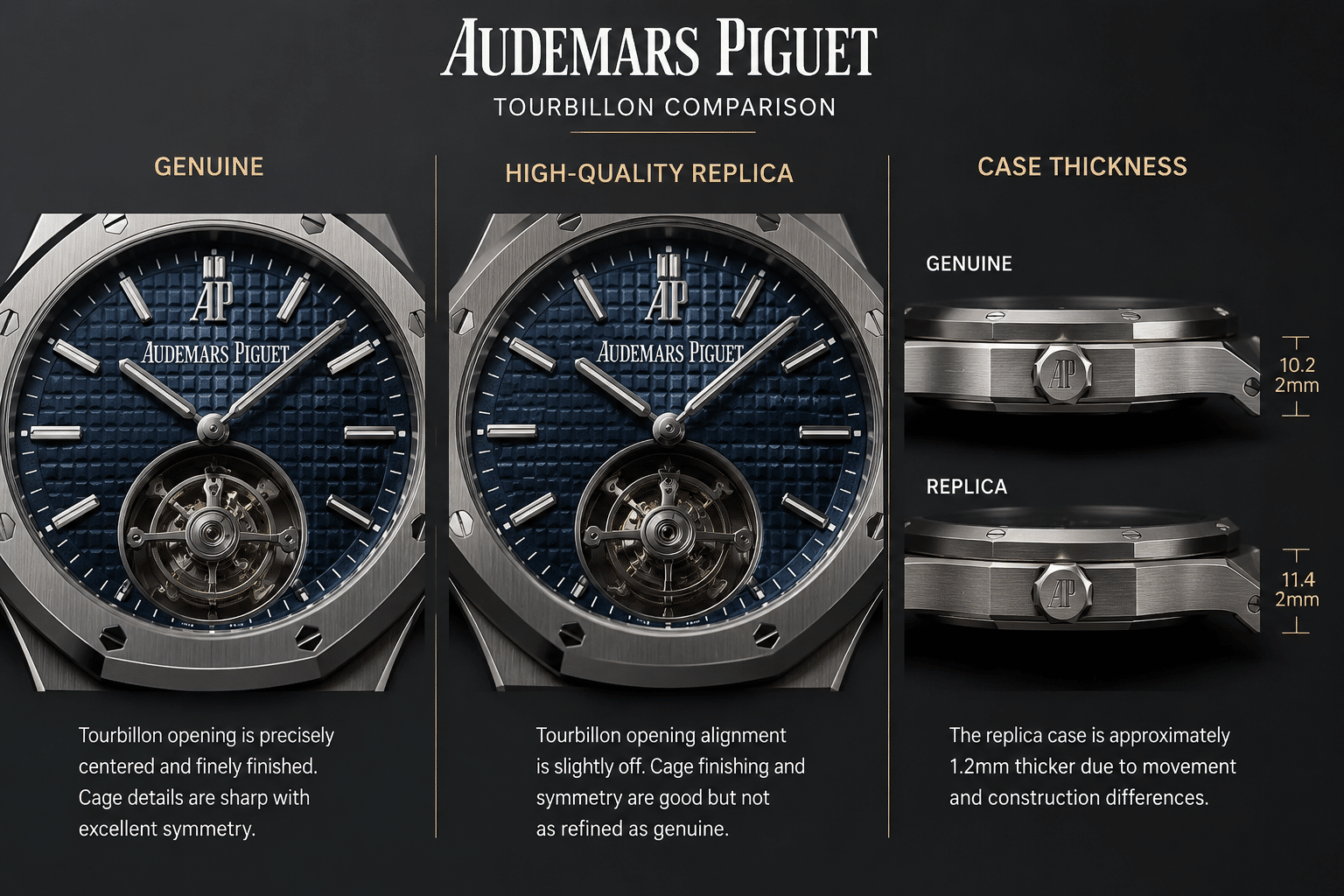
An AP tourbillon replica should not be judged only by whether the tourbillon-style cage is visible. The more important question is whether the whole watch feels built around that opening. The cage, dial aperture, movement layout, bezel depth, case thickness, and bracelet balance all have to work together. If one part looks forced, the watch loses the architectural discipline that makes the original Royal Oak tourbillon design so difficult to imitate.
R8, BBR, and BBS are usually discussed in this niche because tourbillon-style AP replicas are not mass-market Royal Oak builds. They require a different set of compromises from standard 15400 or 15500 replicas. R8 has been associated with the AP tourbillon space for layout and presentation, while BBR and BBS are often treated as competing or alternative routes depending on the specific reference and batch. The buyer should not read that as a universal winner list. In this category, the right factory depends heavily on the exact model, the current version, and the buyer’s tolerance for thickness and movement exposure.
The visual temptation is obvious. A tourbillon opening gives the watch instant drama. The risk is just as obvious once you know where to look: the most eye-catching part of the watch is also the part most likely to reveal imperfect finishing, weak symmetry, or a case that had to grow taller than ideal.
What R8 usually tries to solve
R8 is usually brought into AP tourbillon discussions because buyers are looking for more than a generic open-heart effect. The expectation is that an R8 tourbillon build should handle the basic architecture more convincingly: the dial opening should sit where the eye expects it, the cage should not look lost or undersized, and the overall presentation should feel closer to a purpose-built complication model rather than a standard case modified to show movement activity.
The key issue is layout discipline. On a Royal Oak tourbillon-style design, the aperture cannot simply be “somewhere near six o’clock.” Its size, centering, border finishing, and relationship to the hands affect the whole dial. If the cage appears too deep, too flat, too bright, or slightly off-center, the watch may still look impressive at first glance but weaker once worn regularly.
R8’s role is best understood as an attempt to reduce the obvious tourbillon-specific compromises, especially presentation and proportion. It does not make the category risk-free. Even stronger R8 examples can still carry thickness concerns, exposed finishing limits, and service questions that a simpler Royal Oak buyer would not have to think about.
Where BBR and BBS can help or fall short
BBR and BBS can be interesting alternatives when their version of a specific AP tourbillon replica handles a detail better than the R8 route. In some cases, buyers may prefer the way the dial opening is cut, how the visible cage fills the space, or how the case and bezel appear in photos. That is why it is too simplistic to say one factory automatically wins every tourbillon model.
The danger is that BBR or BBS can look strong in the exact area buyers notice first, while still falling short in the areas that matter after purchase. A dramatic cage view does not help much if the case wears too tall, the dial aperture lacks clean finishing, or the side profile looks stacked. Tourbillon replicas often have a “front-photo advantage,” where the watch appears convincing straight on but loses credibility from the side.
For this category, the better question is not “which factory is closer?” in a general sense. It is “which factory version makes the least damaging compromise on this reference?” If the buyer values dial drama above all else, BBR or BBS may be worth considering on the right model. If the buyer wants a more balanced ownership experience, the case profile and movement behavior should carry more weight than the cage alone.
Tourbillon-specific red flags in QC photos
QC photos for an AP tourbillon replica should start with symmetry. The cage area needs to look centered within the dial opening, and the opening itself should align cleanly with the vertical axis of the watch. Even a small shift can make the entire dial feel unsettled because the tourbillon aperture is the natural focal point.
The second red flag is cage presentation. The visible structure should not look overly sunken, loosely framed, or visually disconnected from the dial. Buyers often focus on whether the cage is moving, but movement alone does not mean the watch is convincing. The more useful judgment is whether the cage looks integrated into the dial architecture.
The third red flag is side profile. A tourbillon-style Royal Oak can look acceptable from the front while wearing too thick from the side. Ask for a profile view that shows the bezel, mid-case, caseback, and crystal height together. If the case looks like a tall sandwich rather than a sharp Royal Oak form, the complication has probably cost too much in proportion.
Before making a decision on a tourbillon-style AP replica, buyers should review real QC photos where available, including the dial aperture, cage centering, hand clearance, bezel screw alignment, side profile, bracelet transition, clasp fit, and movement-side finishing. Factory labels and stock photos alone are not enough for a reliable judgment.
Skeleton and openworked AP replicas: why THB gets attention
An AP skeleton replica is unforgiving because the dial no longer protects the watch from scrutiny. On a normal Royal Oak, the dial surface carries the design. On an openworked Royal Oak, the exposed movement becomes the design. That changes the evaluation completely. Bridge shape, depth, edge finishing, hand clearance, and visual layering all matter more than they would on a solid-dial model.
THB gets attention in this niche because buyers looking at openworked AP replicas are usually chasing a stronger first impression than a basic skeletonized shortcut can provide. The goal is not simply to remove dial material and show mechanical parts. The goal is to create an organized, layered view that has some of the architectural rhythm buyers expect from an AP openworked design. That is a much harder job than it appears in photos.
The main buyer trap is assuming that more visible mechanics means a better replica watch. Often, the opposite is true. The more the watch shows, the less it can hide. A skeleton model may photograph beautifully under controlled lighting while revealing rough edges, shallow depth, or awkward spacing in normal wear.
What the open dial reveals immediately
The open dial reveals finishing first. Any rough bridge edge, uneven plating tone, blunt bevel, or poorly treated cutout becomes visible without needing a caseback view. On a closed-dial model, movement finishing is mostly a private detail. On an AP skeleton replica, it is on display every time the buyer checks the time.
It also reveals depth. A convincing openworked Royal Oak should not look like a flat decorative plate laid over a basic movement. The best visual effect comes from layers: hands above bridges, bridges above wheels, and open spaces that feel intentional rather than hollow. If everything appears too flat, too shiny, or too uniformly colored, the watch can look less like a skeletonized complication and more like a cutout dial.
Hand alignment and legibility matter more than buyers expect. Skeleton models can become visually busy, and discussions around XF Factory 15202 history often show why handset proportions remain part of long-term buyer evaluation, so if the hands are poorly finished, badly proportioned, or sitting at an awkward height, the whole watch becomes harder to enjoy. The flaw is not always obvious in one macro photo, but it becomes obvious when the watch is used as a watch instead of as a picture.
Where THB can look convincing
THB can look convincing when the openworked layout has a coherent shape and the visible structure fills the dial in a balanced way. The buyer should look for whether the bridges feel connected, whether the open spaces are evenly distributed, and whether the movement view has enough depth to avoid looking like a flat stencil. This is where a strong THB example can create a better first impression than more generic skeleton builds.
The most important point is that THB’s appeal is visual architecture, not magic. A good-looking open dial does not automatically solve movement durability, finishing refinement, or service access. The buyer still has to accept that exposed construction raises expectations while making flaws harder to ignore.
THB is most sensible for buyers who specifically want the openworked look and understand that the watch will be judged at closer range than a standard Royal Oak. It is less sensible for someone who wants the safest first AP replica. Skeleton models reward buyers who enjoy the design risk; they punish buyers who expect the clean simplicity of a closed dial.
Why skeleton models magnify service concerns
Skeleton AP replicas can magnify service concerns because the movement is both a functional component and a visible design element. Handling marks, dust, uneven lubrication signs, loose-looking parts, or rough finishing are more noticeable. Even if the watch runs acceptably, the buyer may become more aware of mechanical imperfections because there is no dial to hide them.
There is also less emotional tolerance for faults. If a closed-dial Royal Oak develops rotor noise or a slightly rough winding feel, the owner may still enjoy the watch visually. On an openworked model, every tactile concern feels connected to the exposed movement. The watch invites the buyer to think mechanically, which makes movement anxiety more common.
For daily wear, this matters. A skeleton replica is usually better as a visually interesting piece for careful use than as the most practical AP replica in a rotation. If the buyer wants low-maintenance ownership, fewer visible movement parts and a proven standard Royal Oak route are usually the safer choice.
Movement transparency for openworked builds
Movement claims on openworked AP replicas need an especially narrow reading because the visible architecture can make a modified or decorated movement look more elaborate than it is. A bridge shape, rotor engraving, or skeletonized plate may improve the visual impression, but it does not automatically confirm the underlying movement family, long-term stability, or service access. Buyers should distinguish between layout, decoration, modification, and actual movement architecture before treating a seller description as meaningful.
For THB-style skeleton watches, the most useful inspection question is not whether the movement looks busy. It is whether the visible parts support the design without creating obvious functional concerns: clean hand clearance, stable crown operation, acceptable winding feel, reasonable rotor behavior, and no visible debris or rough assembly marks. A transparent comparison should connect what the buyer can see in QC photos with what the movement is expected to do in daily handling.
Perpetual calendar AP replicas: APS and BBR-style risks are different
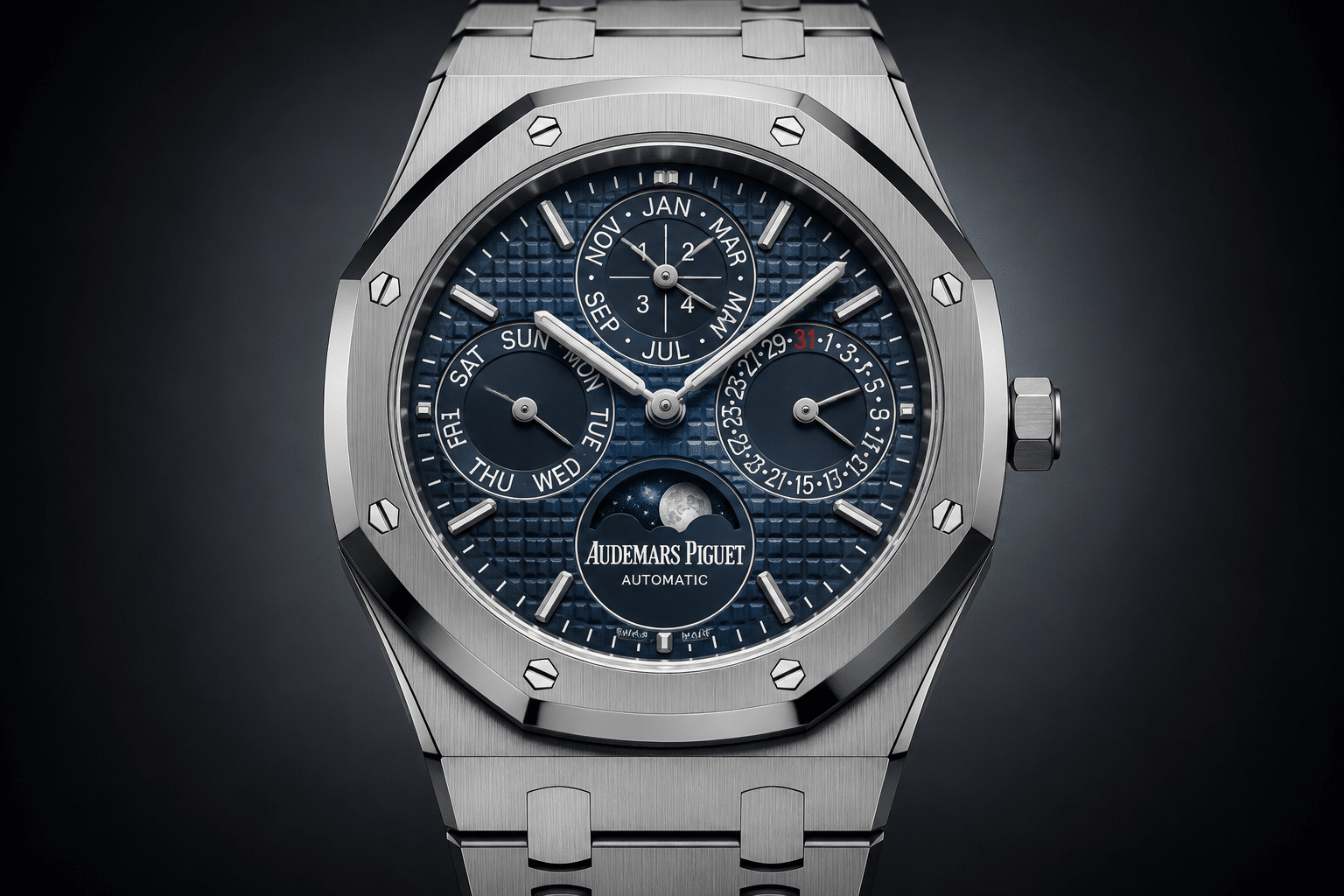
Perpetual calendar AP replicas cannot be judged with the same relaxed standard used on simpler Royal Oak models. A dial that looks balanced in photos is only the first layer; the real question is whether the calendar display still feels coherent once the watch is on the wrist, adjusted, and left running. On this type of replica, the buyer is not just evaluating appearance. He is also judging whether the display logic is believable enough to live with.
The trap is that perpetual calendars look orderly even when the underlying behavior is not. Subdials can be printed cleanly, pointer hands can sit in the right places, and the calendar windows can look sharp, yet the overall watch still feels off once you compare how the indications interact. APS-style builds tend to attract buyers who want the most convincing overall calendar architecture, while BBR-style discussion usually centers more on visual presentation and dial balance. That difference matters because a perpetual calendar is one of the few AP replicas where display consistency can be as important as case finishing.
In practice, the buyer should care less about whether each subdial looks neat in isolation and more about whether the whole face reads naturally at a glance. If the month, date, moon-phase-style display, and pointer positions do not feel coordinated, the watch loses credibility fast. That is why perpetual calendar AP replicas carry more ownership risk than standard Royal Oak models: the complication is not forgiving, and the watch has to behave like a system, not just a pretty dial.
Why the display layout is unforgiving
Perpetual calendar dials punish small mistakes because there is nowhere to hide them. On a simple AP, a slightly off-center marker or a minor spacing issue can disappear once the watch is moving under normal light. On a perpetual calendar, the eye immediately compares one display zone against another. If the subdial spacing is uneven, if one pointer sits visually heavier than the others, or if the calendar windows do not feel harmonized, the whole watch starts to look engineered rather than composed.
That is why display consistency matters more here than raw print sharpness. Buyers often fixate on whether the text is crisp or whether a window is neatly cut, but the bigger issue is whether the dial reads as one coherent layout. A perpetual calendar replica can have decent individual components and still feel wrong if the calendar logic appears crowded, empty, or slightly mismatched. This is one of the few AP complication categories where “looks fine in macro” is not enough; the watch has to make visual sense from a normal wrist distance.
What APS-style builds usually need to get right
APS-related perpetual calendar discussion usually comes back to three things: display balance, functional consistency, and how the calendar correction feels in hand. The dial needs to present the subdials in a way that does not fight the Royal Oak case, because the AP layout is unforgiving when the complication sits too high, too dense, or too busy. The buyer is not looking for extra drama. He is looking for a display that behaves in a controlled, believable way.
Functional consistency matters just as much as the look of the face. A good perpetual calendar replica should not only show the right indications in the right places, it should also feel like the calendar parts belong together. If the setting sequence feels awkward, if the correction process does not feel stable, or if the hands seem to resist proper alignment, the watch stops being a convincing complication and becomes a fragile novelty. APS-style builds are often chosen because buyers expect a more serious approach to that balance, but even then the watch should be treated as a careful-use piece, not a carefree daily watch.
BBR-style builds can still make sense for buyers who value the visual impression first, but that is a different priority. The mistake is treating one style as universally better. On perpetual calendars, the real question is whether the watch delivers a believable display without creating avoidable ownership headaches. That is a tighter standard than most replica buyers are used to.
Common compromises buyers miss
The compromises usually show up after the excitement of the first inspection. A perpetual calendar replica may need more careful setting than the buyer expected, and that alone changes the ownership experience. These watches are more sensitive to how they are adjusted, more vulnerable to user error, and less forgiving if the display is left in a state that does not match the intended calendar logic. A watch can look properly aligned one day and feel less convincing the next if the correction behavior is inconsistent.
Another missed tradeoff is display balance versus long-term consistency. A dial that looks very complete in photos can still be harder to keep mentally “right” over time if the calendar indications do not advance or reset with enough confidence. The buyer who wants an impressive display piece may accept that compromise. The buyer who wants a complication he can wear casually usually should not.
That is the practical rule here: if the calendar logic, subdial spacing, and correction behavior do not all support each other, the watch is already compromised before cost even enters the picture. On AP perpetual calendar replicas, the difference between a decent-looking watch and a good ownership decision is often much smaller than buyers expect.
How to read factory labels, seller claims, and price differences
Factory labels are useful, but they should not be treated as proof that the watch is the right one to buy. In AP complication replicas, the same factory name can mean different things depending on the reference, batch, movement route, dial execution, and how the seller describes the version. A listing that says R8, BBR, BBS, THB, or APS-style does not answer the most important question by itself. It only tells the buyer where to start checking.
The sharper comparison is whether the factory’s known strength matches the complication’s biggest weakness. For a tourbillon-style model, the useful evidence is cage placement, aperture finishing, side thickness, and whether the visible movement looks integrated rather than dropped in. For a skeleton model, the useful evidence is bridge depth, edge treatment, hand clearance, and whether the open dial remains legible in normal light. For a perpetual calendar, the useful evidence is subdial balance, calendar hand alignment, correction behavior, and whether the display makes sense as a complete system.
Price can also be misleading. A higher price may reflect a better movement route or cleaner finishing, but it may also reflect low availability, seller margin, short-term hype, or the extra after-sale risk of handling a complicated watch. A cheaper listing may be a poor value if the case wears too tall or the calendar behavior is unstable. A more expensive listing may still be a poor value if the extra money buys a dramatic dial but not a better ownership experience.
Seller descriptions should be read as claims to verify, not conclusions to accept. Phrases like “best version,” “latest batch,” or “top factory” are only useful if they connect to buyer-checkable details: profile photos, dial alignment, movement behavior, bracelet fit, and clear QC images under neutral light. For complicated AP replicas, the decision should be built from visible evidence and practical use case, not from a factory label or a price tier alone.
A practical traceability method is to ask what each price difference is supposed to buy. If the answer is a newer movement route, the seller should be able to describe how it changes setting feel, display behavior, or reliability expectations. If the answer is better finishing, the QC photos should show cleaner bridge edges, more even brushing, sharper bezel definition, or better bracelet fit. If the answer is only a factory label or vague “upgrade” language, the buyer does not yet have enough evidence to know whether the price difference is meaningful.
How to handle unsupported seller evidence
The safest way to read a complication listing is to separate visible evidence from verbal confidence. A seller can claim a factory name, a movement route, a new batch, or a stronger dial, but the buyer can usually verify only part of that claim before purchase. QC photos can show alignment, profile, finishing, and obvious assembly quality; they cannot prove long-term reliability, pressure resistance, service condition, or that the watch will behave like the authentic complication.
Be especially cautious when a seller borrows language from authentic AP specifications. Official brand information can clarify what the genuine Royal Oak family is trying to achieve, but it should not be used to claim that a replica has the same engineering, finishing, certification, or water resistance. If a listing depends on words like “same,” “genuine spec,” “authentic grade,” or “1:1” without specific inspectable proof, treat those phrases as marketing language rather than technical evidence.
Thickness, case geometry, and wrist feel in complication AP models
Complication AP replicas often fail first on proportion, not on one obvious defect. In photos, a watch can look acceptable because the dial is clean and the case shape is familiar. On the wrist, though, extra height or a poorly balanced stack changes the experience immediately. A complication model that wears too tall or too top-heavy stops feeling like a refined Royal Oak and starts feeling like a dense object strapped to the wrist.
That is why case thickness matters more here than on simpler models. The buyer is not just checking a number. He is checking whether the bezel sits naturally against the crystal, whether the caseback adds too much bulge, and whether the overall shape still looks integrated once the bracelet starts moving. Some complication replicas photograph well because the front view hides the problem. The wrist reveals it fast.
Case height versus visual balance
Visual thickness and actual comfort are not the same thing. A watch can look slim enough in a straight-on shot and still wear awkwardly if the profile rises too quickly or the caseback sits too proud. On AP complication replicas, profile height affects realism and comfort at the same time. If the watch lifts too far off the wrist, it loses the low, architectural presence that makes a Royal Oak convincing in the first place.
That is especially important for buyers who expect a complication to behave like a normal daily watch. A few extra millimeters may not sound dramatic on paper, but on wrist they change how the watch moves under cuffs, how it sits during typing, and how often it catches attention for the wrong reason. The better complication replicas are the ones that control that profile well enough to preserve the AP silhouette instead of just approximating it from the front.
Why openworked and calendar builds stack differently
Openworked and calendar constructions do not build height in the same way, which is why their weaknesses show up differently. One type may expose more of the internal structure and visually amplify every layer; another may stack the calendar module in a way that adds more vertical bulk behind the dial. Either way, the buyer should expect the architecture to affect the profile, not just the visuals. More complication usually means more layering, and more layering usually means more thickness or at least a more complicated mass distribution.
That extra layering can make a watch look busy even if the individual parts are well executed. The case may still be attractive, but the wrist feel changes because the watch stops sitting as a single flat object. This is why complication AP replicas deserve a different standard: the problem is not only accuracy, it is structural harmony.
Bracelet and clasp comfort matter more than buyers expect
Bracelet comfort becomes more important as the head gets heavier or taller. If the case wears top-heavy, even a good bracelet cannot fully hide it, but a weak bracelet makes the issue worse. The balance point shifts, the watch moves more on the wrist, and the clasp can feel like it is supporting a watch head rather than completing the design. On AP complications, that imbalance is one of the quickest ways to expose a watch that looked promising in photos.
The buyer should think in terms of full-package wear, not just case shape. A complication model that feels acceptable in the hand but unstable on the bracelet is not a good daily-wear fit. It may still work as an occasional piece, but once the goal becomes regular use, the comfort gap becomes hard to ignore.
What This Means for Daily Wear
For occasional wear, a complication AP replica can be a satisfying display piece if the buyer accepts the thickness and handling tradeoff. For collector display, visual drama matters more than long-term comfort. For regular wearing, the safer standard is stricter: the watch needs to sit well, balance well, and stay visually convincing after the novelty wears off. If it only works in photos, it is not really a daily-wear watch.
Buyer Expectation Note: No replica watch should be judged by factory reputation alone. A better decision usually depends on the specific model, movement version, case thickness, dial accuracy, bracelet quality, service risk, and how closely the watch will be inspected in real use.
The movement side of AP complications is where many buyers overrate decoration and underrate risk. A decorated movement can look impressive through the back, but that does not automatically mean the watch is built around a better architecture. On complication replicas, the movement route determines more than appearance. It affects setting feel, stability, maintenance difficulty, and how much confidence the owner can have after the initial excitement fades.
This matters because a complication replica can look premium while still being harder to keep healthy than a simpler model. The more the watch asks of the movement, the more the buyer needs to care about serviceability. That is especially true for AP complications, where the ownership cost is not just the purchase price. It is also the chance that the watch becomes annoying, delicate, or expensive to keep running the way it should.
Movement specification claims need a narrow reading
When a seller names a movement, the buyer should treat that as a claim to inspect, not as proof. Official movement documents can explain the specification baseline for a movement family; for example, Miyota lists the 9015 as an automatic movement with 24 jewels, hand-winding, stop-second function, and a listed movement thickness of 3.90 mm.[3] That kind of source can help a buyer understand what a real Miyota 9015 is supposed to be, but it does not prove that a specific replica AP complication actually contains that movement.
The same logic applies to Swiss-style or decorated movement claims. A specification sheet, rotor engraving, or bridge decoration can support only a narrow inspection question: does the stated architecture make sense, and do the visible parts match the seller’s description? It should not be stretched into a promise of durability, authenticity, service compatibility, or genuine-brand performance.
Decorated appearance versus real architecture
A pretty movement view is not the same thing as a strong movement architecture. Decorative bridges, polished surfaces, and a convincing rotor can create a good first impression, but those touches do not tell the whole story. The underlying build still has to support the complication logic without making the watch awkward to set or unreliable in extended use. In other words, the back of the watch can look much better than the actual experience warrants.
That is the key mistake buyers make with complication replicas: they assume visible finishing equals technical strength. It does not. A movement can be dressed up well and still be less practical than a plainer-looking alternative. The right question is not whether the movement looks expensive. It is whether the movement architecture makes sense for long-term ownership.
Which movement behaviors matter in daily use
The behaviors that matter most are the ones the owner will actually feel. Winding feel matters because it tells you whether the movement reacts cleanly or feels rough and hesitant. In serious Audemars Piguet factory rankings, date change behavior matters because a complication that shifts awkwardly at the wrong time feels less trustworthy. Power reserve matters because buyers quickly notice when a watch does not hold energy the way they expected. Rotor noise matters because it changes the experience every time the watch moves on the wrist.
Beat rate and timing stability matter too, but only if they translate into a watch that runs with some consistency rather than one that needs constant attention. For a complication replica, the buyer should judge the movement by how smoothly it lives with the watch, not by a decorative spec sheet. A good-looking movement with poor setting behavior is still the wrong movement for this kind of piece.
Why serviceability should affect model choice
Serviceability should change the buyer’s final choice because complexity always compounds risk. The more elaborate the complication, the more likely the watch is to demand specialized handling later. That does not mean every complicated AP replica is a bad purchase. It means the buyer should understand that a model with more calendar logic, more layers, or more exposed movement structure is usually less forgiving if something goes wrong.
This is where practical judgment matters more than excitement. If the buyer wants a watch to wear often and forget about, a simpler AP path is usually the smarter choice. If he wants the complication experience itself and accepts the maintenance tradeoff, then the replica can still make sense. The wrong decision is assuming the watch can be both visually dramatic and mechanically carefree. For AP complications, that is rarely true.
QC photos for AP complication replicas: what actually matters
QC photos for AP complication replicas should be read in a stricter order than QC photos for a standard Royal Oak. The front dial comes first because complications create more reference points for the eye: tourbillon openings, skeleton bridges, moonphase discs, calendar hands, subdials, and printed scales all need to sit in a coherent visual system. If the dial looks slightly crooked or crowded in the first straight-on image, better lighting will not fix the watch.
The common mistake is treating QC as a cosmetic approval step. For AP complication QC, it is more useful to treat the photos as a risk filter. You are not trying to prove that the watch is perfect. You are trying to decide whether the visible flaws are acceptable before they become more annoying on the wrist. A tiny marker issue on a simple dial may disappear in daily wear; a crooked calendar hand or off-center openworked bridge can become the first thing you see every time you look down.
Front dial and display checks
Start with the most boring photo: the flat, straight-on dial shot. It is less flattering than angled photos, but it tells you more. On a tourbillon-style AP replica, check whether the dial opening is centered, whether the cage area looks visually balanced, and whether the surrounding indices or printed minute track are not being pushed out of harmony by the aperture. The opening should look intentional, not like a hole cut into a dial that was never designed for it.
On skeleton and openworked Royal Oak models, the first check is symmetry. The exposed bridges should not look heavier on one side unless the original design is also asymmetrical. Look at the negative space between bridges, the alignment of the hands, and whether the visible screws or jewel settings create a clean pattern. Skeleton replicas often look better in dramatic seller photos because shadows add depth. In QC, ask yourself whether the watch still looks structured under neutral light. If it turns flat, messy, or overly shiny, the open dial may be doing more harm than good.
For an AP perpetual calendar replica, dial alignment matters even more because the display is crowded by design. Check subdial spacing, hand centering, moonphase position, date or week indicators, and whether all calendar pointers sit cleanly on their tracks. A single slightly misaligned calendar hand is not automatically a rejection, but multiple small inconsistencies make the dial look nervous. That is a bigger problem than many buyers expect, because perpetual calendar dials rely on calm balance rather than one dramatic feature.
Bezel alignment is the next front-view check. The octagonal bezel should frame the dial evenly, and the visible bezel screws should not look randomly rotated, sunken, or proud. AP bezel screws are always a sensitive area in replicas, so do not expect genuine-level execution. The practical question is whether one screw, one corner, or one polished bevel jumps out immediately. If it does in a normal front photo, it will usually bother you more in person.
Side profile and thickness checks
The side profile is where many complication AP replicas lose their case. A front photo can hide height; a side photo exposes it. Ask for a clean horizontal profile shot and look at the relationship between bezel, midcase, crystal, and caseback. If the watch head looks like a tall stack rather than a flat integrated Royal Oak case, the replica may still photograph well from the front but wear awkwardly.
Case thickness is not only a measurement issue. It changes the whole wrist feel. A tourbillon or perpetual calendar replica can be technically impressive but still sit too high above the bracelet. On an AP-style integrated bracelet, that extra height is more obvious than on a watch with a strap because the Royal Oak design is supposed to flow from case into bracelet. If the caseback protrudes heavily or the midcase looks swollen, the watch may feel top-heavy even if the dial is attractive.
Crystal height deserves its own glance. Some complication builds use a taller crystal or thicker rehaut area to make room for the display or movement architecture. In QC photos, this can create a “fishbowl” look from the side. It may not be obvious in a straight-on dial shot, but on wrist it can make the watch look less like a refined Royal Oak and more like a display case for a movement. For daily wear, that is often a bigger tell than a minor printing flaw.
Bracelet, clasp, and finishing checks
After the dial and profile, move to the bracelet. On an AP replica, the bracelet is not a secondary part; it is part of the case architecture. Check the first links near the case, the SEL-style fit at the transition, and whether the bracelet drops naturally or looks stiff and forced. Complication models can already feel visually heavy, so a rigid or poorly fitted bracelet makes the whole watch feel less convincing.
Look for uneven gaps, rough brushing, soft polished bevels, and links that do not sit flush. Do not overreact to every tiny reflection in QC lighting, because Royal Oak bracelets are difficult to photograph cleanly. The real red flag is inconsistency: one side of the bracelet fitting tighter than the other, one link showing a different finish direction, or a clasp that does not close evenly. Those are wearability problems, not just photo problems.
Clasp fit matters because it affects confidence in daily use. Ask for open and closed clasp photos if possible. The engraving should look clean enough, but the more important check is mechanical fit: the clasp should sit flat, close properly, and not show obvious bending or uneven pressure. A beautifully complicated dial does not compensate for a bracelet that feels cheap every time you put the watch on.
QC Photos to Request
For AP complication replicas, the most useful QC set is simple: one straight-on dial photo, one slight angle dial photo, one left and right side profile, one caseback or movement-side photo if relevant, one bracelet transition photo, and one open and closed clasp photo. A short video showing hand motion, calendar hand behavior, or tourbillon cage movement can help, but it should not be treated as proof of long-term reliability.
Be cautious with photos taken only from flattering angles. A high-angle wrist shot can hide thickness. A dark dial shot can hide rough bridge finishing. A side photo tilted downward can make the case look slimmer than it is. The best QC photos are not the prettiest ones; they are the ones that make the watch easier to reject if something is wrong.
Movement photos have limits. They can show whether the visible decoration, rotor, or bridge layout looks acceptable, but they cannot prove service condition, lubrication, long-term stability, or whether a calendar mechanism will remain consistent over time. Treat movement photos as supporting evidence, not a guarantee. For complication AP replicas, the approval decision should still be led by dial balance, side profile, bracelet fit, and obvious functional red flags.
Traceable QC review order
A useful QC review should be repeatable instead of emotional. First, check the straight-on dial for symmetry and display logic. Second, check side profile and caseback height to see whether the complication has distorted the Royal Oak silhouette. Third, check bracelet transition and clasp fit because a heavy complication head can make weak bracelet construction feel worse. Fourth, review any movement-side photo only as supporting evidence, not as proof of durability or official movement origin.
This order keeps the buyer from being distracted by the most dramatic feature. Tourbillon motion, skeleton depth, and perpetual calendar subdials are attractive, but they should not override basic alignment, thickness, finishing, and handling checks. QC photos reduce uncertainty, but they do not remove every risk; they simply make it easier to decide whether the exact watch being offered is acceptable before approval.
Legal, customs, and disclosure boundaries
Replica watches should be discussed clearly as imitation products, not authorized goods from Audemars Piguet or any other trademark owner. The USPTO explains counterfeit goods in relation to unauthorized use of protected trademarks, which is why wording around replicas should avoid implying authenticity, brand approval, or official origin.[4] This is not a technical quality point; it is a disclosure and trademark boundary that buyers should understand before purchase.
Import and customs risk should also be described cautiously rather than as a guarantee in either direction. U.S. Customs and Border Protection identifies intellectual property rights enforcement as a trade priority, including enforcement connected to counterfeit and infringing goods.[5] That does not predict what will happen to any single shipment, but it does mean buyers should not treat replica watches as customs-safe or risk-free.
The broader counterfeit-watch context is also relevant because Swiss watch brands are frequently discussed in anti-counterfeiting work. The OECD’s report on counterfeiting and the Swiss economy addresses counterfeit Swiss watches as part of the wider trade in fake goods, which supports a cautious industry-level framing without proving anything about a specific seller, factory, or order.[6] For this article, the practical takeaway is simple: judge the watch carefully, keep disclosure clear, and do not confuse replica comparison with authorization or authenticity.
Who should avoid complication AP replicas—and when standard Royal Oak is safer
A complication AP replica is not the safest first step into Royal Oak replicas. It may be the more exciting watch, but excitement is not the same as ownership confidence. Tourbillon, skeleton, and perpetual calendar models ask the buyer to accept more visible compromises, more thickness risk, more finishing exposure, and more movement uncertainty. A first-time AP replica buyer who mainly wants a clean daily-wear choice will usually be better served by a standard Royal Oak replica with a simpler dial and a more mature factory route.
The direct recommendation is this: choose a complication AP replica only if you already understand what you are giving up. If your expectation is a stable, easy, low-maintenance daily watch that looks refined in every setting, a complicated Royal Oak is usually the wrong place to start. If your expectation is a collector-style piece that looks visually special and you can tolerate more QC scrutiny, then the category becomes more reasonable.
Best-fit buyer profile
The best-fit buyer for an AP complication replica is not the buyer chasing the “most expensive-looking” option. It is the buyer who understands collector risk. This person knows that an openworked dial may reveal rough finishing, that a tourbillon-style model may wear thicker than expected, and that a perpetual calendar display may require more patience during setting and ownership. They are buying the visual character of the complication, not expecting the same practicality as a simple three-hand watch.
These models also make more sense for buyers who rotate watches. If the watch is worn occasionally, the thickness, sensitivity, and servicing concerns are easier to live with. As a daily wear choice, the same flaws become more noticeable. A heavy case, less comfortable bracelet, noisy winding, or awkward calendar setting routine is tolerable once a month; it is much less tolerable on a Monday morning when you just want the watch to work.
At Clean VS Factory, we usually separate visual ambition from ownership comfort when discussing models like these. A complication can be the more interesting watch in photos while still being the less rational watch to own. That distinction matters more with AP than with many brands because the Royal Oak design depends so heavily on thinness, bracelet integration, and precise surface finishing.
When the standard Royal Oak is the smarter baseline
A standard Royal Oak replica is the safer baseline when the buyer wants fewer surprises. The simpler dial gives factories fewer places to expose alignment problems. The case can usually stay closer to the correct profile. The bracelet and bezel become the main quality points, rather than having to compete with a tourbillon opening, exposed movement, or multiple calendar displays. That makes the watch easier to evaluate and easier to live with.
For most first-time AP replica buyers, a standard Royal Oak replica is also a better learning tool. It teaches you what AP finishing should feel like in replica form: the bezel shape, the bracelet drape, the tapisserie dial, the clasp action, and the way the watch sits flat on the wrist. Once you understand that baseline, it becomes much easier to judge whether a complication model is worth the extra compromise.
The standard model is not automatically better in every way. It is simply less exposed. A complication replica may offer more visual drama, but it also gives the factory more chances to get something slightly wrong. If you are sensitive to dial balance, case thickness, or mechanical behavior, the safer first pick is usually the simpler Royal Oak path.
Final decision rule for tourbillon, skeleton, and perpetual calendar models
Use a different rule for each complication family. For tourbillon-style AP replicas, buy only if the dial opening, cage presentation, and case thickness work together. If the tourbillon area looks impressive but the case wears too tall, the watch is more spectacle than successful replica.
For skeleton and openworked Royal Oak models, judge the exposed architecture before judging the factory name. The bridges, depth, hand visibility, and finishing consistency matter more than a dramatic first impression. If the open dial looks flat, rough, or visually confused in neutral QC photos, it is unlikely to become more convincing in real use.
For perpetual calendar replicas, prioritize display coherence and setting tolerance. A good-looking dial is not enough if the subdials feel crowded, the calendar hands are inconsistent, or the mechanism is frustrating to live with. This is the complication family where buyers most often underestimate ownership behavior because the dial looks calm in photos.
Before approving any AP complication replica, buyers should confirm the exact version being offered, compare real QC photos against stock images, ask how the movement route is described, and decide whether the watch is meant for occasional enjoyment or regular wear. They should also confirm return, repair, shipping, and after-sales terms before ordering because those terms can vary by seller and should not be assumed from the factory name.
The final rule is simple: if you want a safer first AP replica, choose a standard Royal Oak replica. If you want a complication AP replica, choose it as an enthusiast piece, not as the low-risk option. The more a model shows, moves, or stacks inside the case, the more carefully it should be judged before approval.
References
[1] Audemars Piguet, “Royal Oak 15510ST official specifications,” official product information for the Royal Oak 41 mm model, available at Audemars Piguet Royal Oak 15510ST Official Specifications.
[2] Audemars Piguet, “Royal Oak Jumbo Extra-Thin 16202ST official specifications,” official product information for the Royal Oak Jumbo 39 mm model, available at Audemars Piguet Royal Oak Jumbo 16202ST Official Specifications.
[3] Miyota, “Caliber 9015 official movement specifications,” manufacturer specification page for the Miyota 9015 automatic movement, available at Miyota 9015 Official Movement Specifications.
[4] United States Patent and Trademark Office, “Counterfeit Goods Basics,” official educational document on counterfeit goods and trademark-related basics, available at USPTO Counterfeit Goods Basics.
[5] U.S. Customs and Border Protection, “Intellectual Property Rights,” official CBP trade priority page on intellectual property rights enforcement, available at U.S. CBP Intellectual Property Rights.
[6] OECD, “Counterfeiting, Piracy and the Swiss Economy 2025,” report section addressing counterfeit goods affecting Swiss industries including watches, available at OECD Counterfeiting and Swiss Watches.