
XF Factory still comes up in AP Royal Oak 15202 Jumbo replica discussions because it became a reference point for the part of this watch that is hardest to fake convincingly: the thin, flat, restrained case profile. The problem is that XF is no longer an active factory, and broader AP complications factory risks show why the name alone does not tell a buyer whether a specific watch is worth considering. Condition, batch variation, movement health, parts originality, seller evidence, and QC photos matter more than nostalgia.
This article looks at why XF earned that reputation, where its A2121-style movement route helped the 15202 proportions, and why current alternatives should be judged against the same practical standard. The useful question is not simply “Is XF better?” but whether the exact watch in front of you has the right side profile, dial balance, date position, bracelet flow, movement confidence, and overall wrist presence for the price.
Editorial Perspective: For this model, factory reputation is only the starting point. At cleanvsfactory.com, the XF 15202 is treated as a model-specific buying question rather than a simple closed-factory ranking. XF’s name helps explain why thinness and case geometry matter, but a real purchase still depends on the individual watch: movement condition, side-profile evidence, bracelet wear, dial alignment, date position, and whether the buyer wants a display-accurate piece, a daily wearer, or a collectible old-stock example with higher verification risk.
| Decision Point | What To Check | Buyer Judgment |
|---|---|---|
| XF label | Batch, condition, seller proof, movement photos | Treat it as a clue, not a guarantee |
| Case profile | Side shots, bezel height, caseback thickness | More important than front-only beauty photos |
| Movement route | No-seconds layout, hand stack, date position | Thin proportions may come with service tradeoffs |
| Dial balance | Petite Tapisserie spacing, printing, date alignment | Small errors stand out on the simple 39mm design |
| Bracelet integration | End-link transition, clasp feel, wrist flow | A good case can still feel wrong if the bracelet is weak |
| Current alternatives | QC consistency, reliability, price logic | A clean newer piece can be smarter than a tired XF |
Quick Questions Before You Read
Q: Is an XF 15202 automatically the safest choice?
No. XF is respected for proportions, but each watch still needs condition, movement, dial, bracelet, and seller evidence checked.
Q: Why does case thickness matter so much on the 15202?
The Jumbo’s appeal depends on a thin, flat wrist presence, so extra thickness can change the whole look quickly.
Q: Should buyers trust old-stock XF claims?
Only with clear photos of the side profile, dial, bracelet, caseback, and movement. The claim alone is not enough.
Q: Can a current-production 15202 be a better buy?
Yes, especially if it has cleaner QC, stronger reliability, and fewer condition risks than an older XF-labeled example.
Why XF Factory Still Comes Up in 15202 Jumbo Discussions
The XF Factory 15202 still comes up because the AP 15202 replica market has never been only about dial color or bezel screws. The Royal Oak Jumbo lives or dies by thinness, case flow, and whether the watch sits with the quiet, flat confidence of the original design. XF became a reference point because it came unusually close to that slim Jumbo impression at a time when many alternatives looked good from the front but became too thick or heavy from the side.
That is the important distinction buyers often miss. XF is not discussed because it is a normal current-production option, and it should not be treated as an easy “buy XF and stop thinking” answer. It is a closed factory legacy name. Its reputation belongs to a specific moment in the replica market when XF handled the 15202’s proportions better than most competitors. Any individual watch still depends on batch, condition, movement route, and whether the seller’s claim is actually credible.
Experienced buyers still mention XF because the 15202 is one of those watches where the biggest flaw is not always visible in a straight-on photo. A Royal Oak Jumbo replica can have a decent blue dial, acceptable bezel screws, and clean printing, yet still feel wrong if the case height, bezel thickness, and bracelet transition make it wear like a larger Royal Oak. XF’s legacy is that it understood the Jumbo as a shape, not just as a dial and bracelet package.
The Short Answer: XF Became the Thin Jumbo Reference
The short answer to why buyers still talk about XF is simple: the XF Factory 15202 became the thin-case reference for the Royal Oak Jumbo replica conversation. The 15202 is supposed to feel flat, elegant, and almost blade-like on the wrist. XF did not make a perfect replica, but it got closer than many rivals to the profile that defines the model.
This matters because the 15202 is not forgiving. On a thicker Royal Oak reference, a little extra height can be hidden by the larger case and more muscular design language. On the Jumbo, extra thickness changes the personality of the watch. It stops looking like the restrained 39mm Royal Oak and starts looking like a compact watch trying to carry a heavier movement than the design was meant to hold.
That is why “best 15202 replica” discussions often circle back to XF even after the factory closed. Buyers are not only remembering a name. They are remembering a proportion standard that current options still get measured against.
Why Closed Factories Can Still Shape Buyer Expectations
A closed factory can continue shaping buyer expectations when it solved one problem especially well and the market has not fully replaced that solution. XF sits in that category. Its closure did not erase the comparison; it made the comparison more persistent because buyers now judge newer AP 15202 replica options against a benchmark they may not be able to buy safely or verify easily.
This is where forum advice can become misleading. “XF was the best” may be a useful historical statement, but it is not a complete buying rule. A clean current-production watch with better QC and clearer movement condition may be a more sensible ownership choice than an old XF-labeled piece with uncertain storage history, swapped parts, or vague seller photos. Factory legacy helps define what to look for; it does not guarantee the watch in front of you is the right one.
At Clean VS Factory, we usually treat closed-factory names as comparison tools rather than automatic recommendations. XF remains valuable because it reminds buyers what the 15202 should prioritize: thin case profile, balanced wrist presence, and coherent Jumbo proportions. The mistake is turning that benchmark into nostalgia and ignoring the condition of the actual watch being evaluated.
How to Read XF Claims Without Overvaluing the Label
A seller description that says “XF” should be treated as a useful lead, not final proof. For a closed factory, the buyer has to separate three things: whether the watch is genuinely from the claimed source, whether the parts are still original to that version, and whether the watch remains mechanically healthy enough for the intended use. A correct label with a tired movement, worn bracelet, or unclear part history can still be a poor daily-wear decision.
The most practical way to read an XF claim is to ask what the label explains and what it does not explain. It may explain why the side profile looks thin or why the model is priced higher than a current alternative. It does not explain storage history, service condition, rotor behavior, date change quality, bracelet stretch, or whether the dial and hands have been replaced. Those points have to be verified through photos, seller answers, and realistic risk tolerance.
This is especially important because the 15202 attracts buyers who are chasing one historical “best version.” That mindset can create blind spots. A strong XF example may still be desirable, but a buyer should not pay only for the story of the factory. The watch itself needs to show the thin case, calm dial layout, clean bracelet flow, and movement confidence that made the XF name worth discussing in the first place.
Factory Name Clarification: Factory names in the replica watch market are buyer-facing reference labels, not official brand affiliations or audited manufacturer identities. For a closed-factory name such as XF, buyers should judge the specific watch model by model through visible case profile, dial condition, bracelet evidence, movement-route information, and seller documentation rather than assuming the label proves identical quality across every example.
A more traceable way to evaluate an XF claim is to build a chain of evidence: claimed factory, claimed version, visible case profile, dial and date execution, bracelet condition, movement route, and current operating behavior. If one link is missing, the watch is not automatically wrong, but the buyer should price and judge it as a less certain example rather than as a fully documented closed-factory piece.
Brand Boundary for Royal Oak Replica Comparisons
Brand names are used here to identify the genuine reference design being discussed and to explain why the Royal Oak Jumbo silhouette is difficult to reproduce. Replica watches, including XF-labeled 15202 examples, are not genuine Audemars Piguet watches, are not produced by Audemars Piguet, and should not be described, sold, or presented as authentic brand-manufactured watches.
This boundary matters because the genuine Royal Oak Jumbo can be a visual comparison point without becoming proof of authenticity, service compatibility, resale legitimacy, or official approval. A replica-market factory label may help buyers discuss versions and visible execution, but it does not create an official connection with the luxury brand or prove that every example from that label has the same quality.
Why the AP Royal Oak 15202 Jumbo Is So Difficult to Replicate
The Royal Oak 15202 Jumbo is difficult to replicate because it is restrained rather than complicated-looking. There is no large chronograph layout to distract the eye, no oversized case to absorb small dimensional mistakes, and no seconds hand to add motion. The watch is mostly flat surfaces, sharp edges, a slim bezel, a Petite Tapisserie dial, and an integrated bracelet that must flow from the case without looking forced.
Official brand information is useful here only as a baseline for the genuine Royal Oak Jumbo design language, not as proof of replica execution. Audemars Piguet lists the current Royal Oak “Jumbo” Extra-Thin 16202ST as a 39mm watch with a Petite Tapisserie dial and an ultra-thin Royal Oak profile, which helps explain why buyer comparisons focus so heavily on case height, dial texture, and integrated-bracelet flow.[1]
That simplicity is exactly why the Royal Oak 15202 Jumbo replica creates problems. A small increase in case thickness is not a spreadsheet issue; it changes how the watch sits. A slightly tall crystal, heavy bezel, raised hand stack, or awkward bracelet transition can make the whole watch feel less like a Jumbo, even if the front-facing QC photo looks respectable.
The movement architecture sits behind many of these problems. The genuine 15202 was built around an ultra-thin Cal. 2121 layout, so the case proportions depend heavily on movement height and dial-side spacing. Replica factories cannot simply install a generic automatic movement and expect the same wrist profile. If the movement route is too thick or the dial stack is poorly managed, the compromise shows up in the case, hands, date window, or caseback.
The 39mm Case Leaves Little Room for Error
The 39mm case is a major reason the AP Jumbo replica difficulty is higher than many buyers expect. The 15202 does not have the visual mass of a 41mm Royal Oak, so every vertical dimension becomes more obvious. The bezel height, mid-case thickness, crystal lift, and first bracelet link all sit close together visually. If one part is too tall, the whole profile starts to look compressed or swollen.
This is especially visible from the side. A strong 15202 replica should not only look correct from the dial view; it should have a low, clean line from bezel to caseback and into the bracelet. When the case is too thick, the bracelet seems to drop away from the watch head instead of continuing the case geometry. That is the kind of flaw buyers notice in daily wear even if they cannot name the measurement.
For this model, side profile matters more than many macro dial flaws. A slightly imperfect printing detail may disappear on the wrist, but a heavy case profile changes the watch every time it slips under a cuff or catches light from the side.
No Seconds Hand Changes the Movement Problem
The absence of a seconds hand helps in one way and hurts in another. It removes an obvious motion cue, so buyers do not have to judge a visible seconds sweep the way they would on many automatic watches. But it also makes the dial calmer, which means the eye spends more time on hand height, minute hand alignment, date position, and the overall stillness of the face.
This changes the movement problem. A factory cannot rely only on hiding beat-rate differences because there is no central seconds hand to watch. The movement still has to support the correct case thickness, date placement, hand stack, and crown behavior. A thicker or less suitable movement route can force compromises that appear on the dial side even when the case finishing looks decent.
That is why the 15202 is not automatically easier just because it has fewer hands. In practical buyer terms, no seconds hand reduces one visible tell but increases pressure on proportion and layout. The watch has less going on, so the wrong details have fewer places to hide.
Petite Tapisserie Dial Accuracy Is Harder Than It Looks
The Petite Tapisserie dial is another reason the thin Royal Oak replica problem is not only about case measurements. The 15202 uses a smaller, finer dial texture than the larger Royal Oak references. If the grid scale is too coarse, the dial immediately feels closer to a different Royal Oak family. If the texture is too sharp or flat, it may photograph well but lose the soft depth that makes the Jumbo dial convincing in changing light.
Printing weight also matters. On a quiet no-seconds dial, the AP logo, minute track, date window, and marker alignment carry more visual responsibility than buyers expect. A slightly heavy logo or poorly centered date can disturb the symmetry because there is no running seconds hand or busier layout to distract from it.
The most useful way to judge a 15202 dial is not to hunt one isolated flaw under extreme magnification. Look at whether the dial texture, markers, logo placement, hands, and date window feel calm together. The Jumbo is a balance watch. If one element shouts, the design starts to lose its character.
What XF Factory Got Right on the 15202
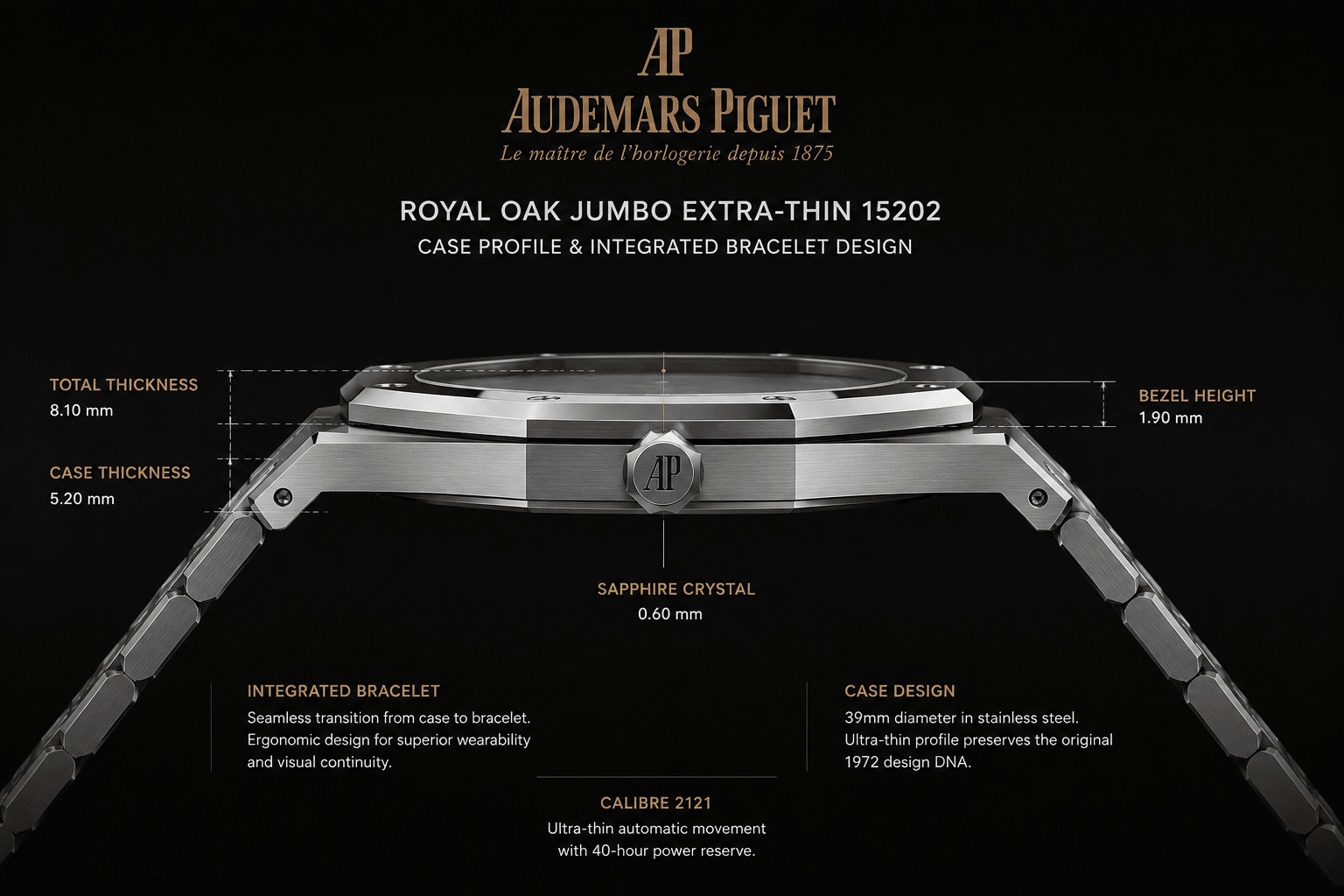
What made the XF 15202 replica important was not one perfect detail. It was the way the case thinness, bezel proportion, bracelet integration, and overall wrist presence worked together better than many competing versions. XF understood that the Royal Oak Jumbo is judged as a complete silhouette. If the watch looks too thick, the rest of the execution has to work much harder to recover credibility.
The XF Royal Oak Jumbo stood out because it came unusually close to the visual identity that buyers expect from a 15202: slim, flat, compact, and refined rather than bulky. That does not mean every XF example is flawless. It means XF solved the biggest external problem well enough that experienced buyers still use it as a reference when discussing newer pieces.
This is the core reason its legacy has lasted. A factory can improve a logo, a date font, or a clasp engraving in later batches, but if the case geometry is wrong, the 15202 stops feeling like a Jumbo. XF’s strength was that it placed the largest priority in the right area.
Thinness Was the Main Reason XF Stood Out
Thinness was the main reason XF became a benchmark. The 15202’s appeal depends on how low the watch sits and how naturally the case flows into the bracelet. A thick 15202 replica may still look like a Royal Oak from across the room, but it loses the specific Jumbo character that makes the reference desirable in the first place.
XF’s execution was respected because the side profile looked closer to what buyers expected from an extra-thin Royal Oak. The bezel did not feel as visually stacked, the mid-case did not dominate the watch, and the caseback did not create the same heavy-bottomed impression seen on many thicker solutions. On the wrist, that difference matters more than a small macro-level dial imperfection.
The judgment here is clear: for the 15202, case thinness is not just one specification among many. It is the first filter. If the watch fails there, it becomes difficult for dial and bracelet details to save it.
The Case, Bezel, and Bracelet Worked as a Single Shape
The Royal Oak’s integrated design means the case, bezel, and bracelet cannot be judged separately. The octagonal bezel sets the geometry, the case carries the thickness, and the bracelet has to continue that shape without looking like an attachment. XF’s 15202 is remembered because those parts worked as a more coherent single form than many alternatives.
On weaker Royal Oak Jumbo replicas, the case head can look too tall while the bracelet sits too low or feels disconnected at the first link. That creates a subtle but immediate problem: the watch no longer drapes like a thin sports watch. It becomes a watch head mounted on a bracelet, which is the opposite of what makes the Royal Oak design work.
XF did not eliminate every bracelet or finishing limitation, but its case-bracelet relationship helped preserve the intended wrist presence. For a 15202, that integrated flow is more important than buyers often realize when they only compare front-facing dial photos.
Why Proportion Matters More Than One Perfect Detail
A 15202 replica can have an acceptable dial, clean hands, and a decent date window while still failing as a Jumbo if the proportions are wrong. This is why XF’s reputation has stayed alive. It performed well in the area that defines the model before the buyer even starts checking smaller details.
Proportion matters because the 15202 is a design of restraint. The case should not feel tall. The bezel should not appear heavy. The bracelet should not overpower the watch head. The dial should sit calmly within the case rather than looking buried under thick crystal and stacked components. When those relationships are correct, the watch feels more convincing in normal wear even if close inspection still reveals limitations.
The practical takeaway is that XF became a benchmark because it prioritized the right hierarchy. On this reference, the best-looking macro detail does not compensate for a wrong silhouette. Buyers comparing any AP 15202 replica should start with the overall profile and wrist balance before getting absorbed by isolated close-up flaws.
The A2121-Style Movement Solution and Why It Mattered
The XF 15202 movement discussion matters because the Royal Oak Jumbo is not a watch where the movement sits quietly in the background. On many thicker replica watches, a factory can hide a generic automatic movement under extra case height, a thicker caseback, or a decorative bridge. The 15202 gives almost no room for that kind of compromise. If the movement is too thick, the whole watch becomes too tall. If the hand stack is wrong, the calm no-seconds dial starts to look mechanically forced. If the date position is slightly off, the small 39mm dial makes it easier to notice.
This is why buyers still talk about the XF 15202 movement route. The so-called A2121 movement was not important because it made the watch equivalent to Audemars Piguet’s genuine Cal. 2121. It was important because it supported the part of the replica that mattered most on the wrist: the thin Jumbo profile. In practical terms, XF’s movement approach helped the case, dial, hands, and date window sit in a more believable relationship than many thicker or more generic alternatives.
Why the 15202 Movement Route Affects the Entire Watch
The 15202 is one of the few replica watches where movement thickness directly controls the visual identity of the model. In JF Factory AP history, the genuine Royal Oak Jumbo is famous for being flat, restrained, and elegant rather than bulky. A movement that requires extra height does not only make the case thicker; it changes the bezel-to-caseback balance, the way the mid-case sits against the wrist, and the transition from case to bracelet.
That is the core reason the XF 15202 movement became part of the factory’s reputation. A thin Royal Oak replica cannot be judged only from a straight dial photo. The side profile tells the real story. If the caseback is pushed down too far or the bezel appears to sit on a tall metal base, the watch stops reading like a Jumbo even if the dial color and tapisserie pattern are acceptable.
The movement also affects the dial side. Hand height, cannon pinion thickness, datewheel position, and dial spacing are all connected to the movement architecture underneath. On the 15202, there is no running seconds hand to distract the eye. That sounds like an advantage, but it also means the buyer notices the stillness of the dial more. A heavy-looking hand stack or awkward date placement can feel more obvious than it would on a busier Royal Oak reference.
The tradeoff is ownership risk. A thinner or more specialized replica movement route can make the watch look more convincing, but it may not be as simple to service as a common automatic movement. A basic Miyota-based solution can be easier for many watch repairers to understand, but if it forces a thicker case or awkward dial layout, it weakens the entire 15202 impression. For this model, movement choice is not only about reliability; it is about whether the watch can physically remain a Jumbo.
What “A2121-Style” Should and Should Not Mean
“A2121-style” should be read as replica-market shorthand, not as proof of genuine Cal. 2121 architecture. This distinction matters. The genuine AP Cal. 2121 is an ultra-thin, historically significant automatic movement with a very specific construction. A replica movement marketed as A2121 is not the same object, and buyers should not treat the name as an official technical equivalence.
What the term can reasonably mean is that the factory used a movement route intended to support the 15202’s no-seconds layout, thin case, and date position more convincingly than a basic off-the-shelf setup. That is why the XF 15202 movement earned attention. It was not because the movement finished like genuine AP work under magnification. It was because the movement helped preserve the case profile and dial geometry that define the watch.
The mistake is assuming that a more exotic movement label automatically creates a better ownership experience. It does not. Buyers should expect possible compromises in rotor feel, winding smoothness, long-term serviceability, and parts availability. Rotor noise may still exist depending on the base movement and how the winding system is executed. Crown feel may not match the genuine watch. Date operation can vary by individual example. These are normal areas to approach carefully rather than reasons to romanticize the movement name.
At Clean VS Factory, we usually separate the visual role of a replica movement from the ownership role. A movement can help the case look right while still being less convenient to service later. With the 15202, that tradeoff is sharper than usual because the watch’s best visual quality depends heavily on keeping the movement thin and correctly arranged.
Published movement specifications can help buyers understand why thickness and layout matter, but they should not be used to confirm what is inside a specific replica. For example, Miyota’s official 9015 specifications list a 3.90mm movement height, automatic winding, hand-winding, stop-second function, and a stated running time of more than 42 hours; Sellita’s SW200-1 technical document is also useful as an official reference for that movement family’s construction and service documentation. Those documents explain movement baselines, not the truth of any individual seller’s replica movement claim.[2][3]
Movement Transparency Note: Movement references in this article describe replica-market movement types, layouts, or claimed configurations, not an official Audemars Piguet caliber unless supported by verifiable evidence. Buyers should check movement claims against case thickness, hand stack, date position, rotor behavior, serviceability, and real watch photos because the same label can depend on the specific version and individual example.
For traceability, the movement question should be tied back to physical evidence. A credible movement explanation should match the visible no-seconds layout, crown position, caseback thickness, date behavior, and hand height. If the seller’s movement language sounds impressive but the watch appears unusually thick, has a high hand stack, or lacks clear movement-route photos, the buyer should treat the claim as incomplete.
Movement Route to Verify
The first thing to verify is the actual movement description, not just the seller’s label. “A2121,” “clone 2121,” and similar wording can be used loosely in the replica market. A buyer should ask what movement route is being claimed, whether the watch uses a no-seconds configuration, and whether the case thickness being advertised matches clear side-profile evidence.
Second, compare thickness claims cautiously. A number by itself is not enough. The watch should be judged from the side, including bezel height, mid-case thickness, caseback shape, and how the first bracelet link exits the case. A thin measurement can still be misleading if the caseback bulges or the bracelet transition looks heavy.
Third, do not rely on movement photos alone as proof of quality. Decorative plates, rotor engravings, and bridge shapes can make a movement look more impressive than it behaves. For the XF 15202, the smarter question is whether the movement supports the correct case profile, hand stack, date position, and daily-use expectations. A beautiful-looking movement photo does not guarantee smooth winding, quiet rotor behavior, clean calendar action, or easy future servicing.
Where XF Was Not Perfect
XF’s reputation should not be confused with perfection. The factory became important because it handled the biggest 15202 problem unusually well: keeping the Royal Oak Jumbo thin and proportionally convincing. That does not mean every XF 15202 had perfect dial printing, perfect date alignment, perfect bracelet feel, or identical execution across batches.
This is where forum shorthand can mislead buyers. “XF was the best” is a useful historical statement only if it is understood narrowly. It means XF set a high benchmark for the Jumbo profile. It does not mean every XF-labeled watch is automatically cleaner, safer, or better preserved than every current alternative. A strong historical design can still be weakened by poor QC, old parts, storage wear, movement condition, or batch inconsistency.
Batch Variation Still Matters
Two XF-labeled 15202 pieces should not be assumed to be identical. Replica factory production is rarely as standardized as buyers imagine, especially when discussing older or discontinued pieces. Dial tone, brushing sharpness, clasp action, movement condition, and even small component consistency may vary by batch and individual watch.
This matters more now because XF is no longer a normal current-production option. Once a factory is closed, the market begins to mix real leftover pieces, old stock, used examples, serviced watches, and sometimes watches with unclear part histories. The name on the listing may point to XF, but the buyer still has to judge the specific watch in front of them.
The clear judgment is this: XF batch differences are less important than the Jumbo profile if the watch is being discussed historically, but they become very important if money is changing hands today. A buyer evaluating an actual old XF 15202 should stop treating the factory name as a guarantee and start treating it as only one clue.
Small Dial and Date Issues Can Still Break the Look
The 15202 dial is quiet. There is no seconds hand, no chronograph scale, and no large case size to absorb small imperfections. That makes the dial printing, logo placement, tapisserie scale, marker alignment, and date-window balance more important than they first appear.
On a busier watch, a slightly imperfect datewheel can disappear into the design. On the Jumbo, the date sits in a clean visual field. If the date is too high, too low, too close to the window edge, or printed in a noticeably wrong weight, it can pull attention immediately. The same applies to the hands. A hand stack that looks too tall or too heavy can make the center of the dial feel wrong even if the case profile is strong.
Dial tone is another area where buyers should stay realistic. Blue Royal Oak dials are difficult in general because lighting changes the appearance dramatically. A watch can look excellent in one photo and too flat, too purple, or too dark in another. XF’s case profile may have been the headline strength, but a poor dial example should not be excused only because the factory name is respected.
Bracelet and Clasp Feel Should Not Be Ignored
The Royal Oak bracelet is not an accessory attached to the watch; it is part of the watch’s architecture. On the 15202 especially, the case and bracelet need to read as one continuous shape. If the bracelet is stiff, uneven, sharp, poorly brushed, or loose at the wrong points, the entire ownership experience changes.
Bracelet finishing on an XF 15202 may vary by individual example and condition. Buyers should look for consistent brushing direction, clean polished bevels, even link articulation, and a clasp that closes securely without feeling crude. A clasp that looks acceptable in photos can still feel weak or rattly in daily use. That matters because the Royal Oak is a tactile watch; much of its appeal comes from how the bracelet wraps the wrist.
For an older XF piece, bracelet condition can matter as much as dial condition. Worn screws, stretched links, rough edges, and inconsistent clasp action are not small details if the watch is intended for regular wear. A beautifully thin case attached to a tired bracelet is not the same ownership proposition as a clean, well-preserved example.
Photo Accuracy and Daily Reliability Are Not the Same Priority
A buyer who wants the watch mainly for comparison photos may judge the XF 15202 differently from someone who wants to wear it several times a week. For photo accuracy, the thin case profile, dial texture, date position, and bracelet geometry may carry the most weight. For daily wear, winding feel, rotor behavior, clasp security, bracelet comfort, movement stability, and access to future service become more important.
This distinction matters because an older XF can win the visual argument and still be the less practical ownership choice. A watch that looks excellent from the side may have a dry movement, noisy rotor, stiff crown, weak clasp, or bracelet wear that only becomes obvious after handling it. Conversely, a newer current-production alternative may be a little thicker but easier to live with if the buyer values predictable daily use over the closest historical silhouette.
Neither priority is wrong, but mixing them creates bad decisions. If the goal is the most convincing Jumbo profile, XF’s legacy deserves attention. If the goal is a low-drama daily wearer, the buyer should give more weight to movement condition, parts availability, bracelet health, and the seller’s ability to provide clear QC evidence before payment.
How XF’s Shutdown Created a Gap in the 15202 Market
The XF Factory shutdown matters because the market did not simply lose another factory name. It lost a specific solution to a specific problem. The 15202 is not like a thicker Royal Oak reference where several factories can compete by improving dial texture, bracelet finish, or movement decoration while the case architecture remains more forgiving. The Jumbo requires thinness, correct visual balance, a no-seconds layout, acceptable date positioning, and a movement route that does not force the case out of proportion.
That combination is why the closed XF Factory still shapes buyer expectations. Experienced buyers remember XF because it came unusually close in the area that most defines the 15202. Current AP 15202 alternatives may improve certain details or offer easier availability, but many still face the same central problem: combining visual thinness, plausible movement logic, and stable ownership in one watch.
The Problem Was Not Just Availability
If XF’s absence were only a supply problem, the market would have moved on more cleanly. Another factory would produce a similar watch, buyers would compare new versions, and the old name would fade. That has not fully happened because the 15202 problem is architectural. A factory cannot solve it only by improving dial printing or adding better case brushing.
The case has to remain thin without looking artificially flattened. The movement must support the no-seconds layout without creating an awkward hand stack. The date must sit naturally in the dial. The bracelet has to flow from a slim case without making the watch feel top-heavy or stiff. Missing one of these elements can make the watch feel less like a Jumbo, even when individual parts look impressive in isolated photos.
This is the gap XF left behind. Its shutdown removed a benchmark that buyers could point to for the overall Jumbo impression. The result is that current comparisons often become less about finding a universally superior factory and more about choosing which compromise is acceptable: thickness, movement route, dial execution, bracelet feel, or serviceability.
Old Stock Creates More Questions Than New Production
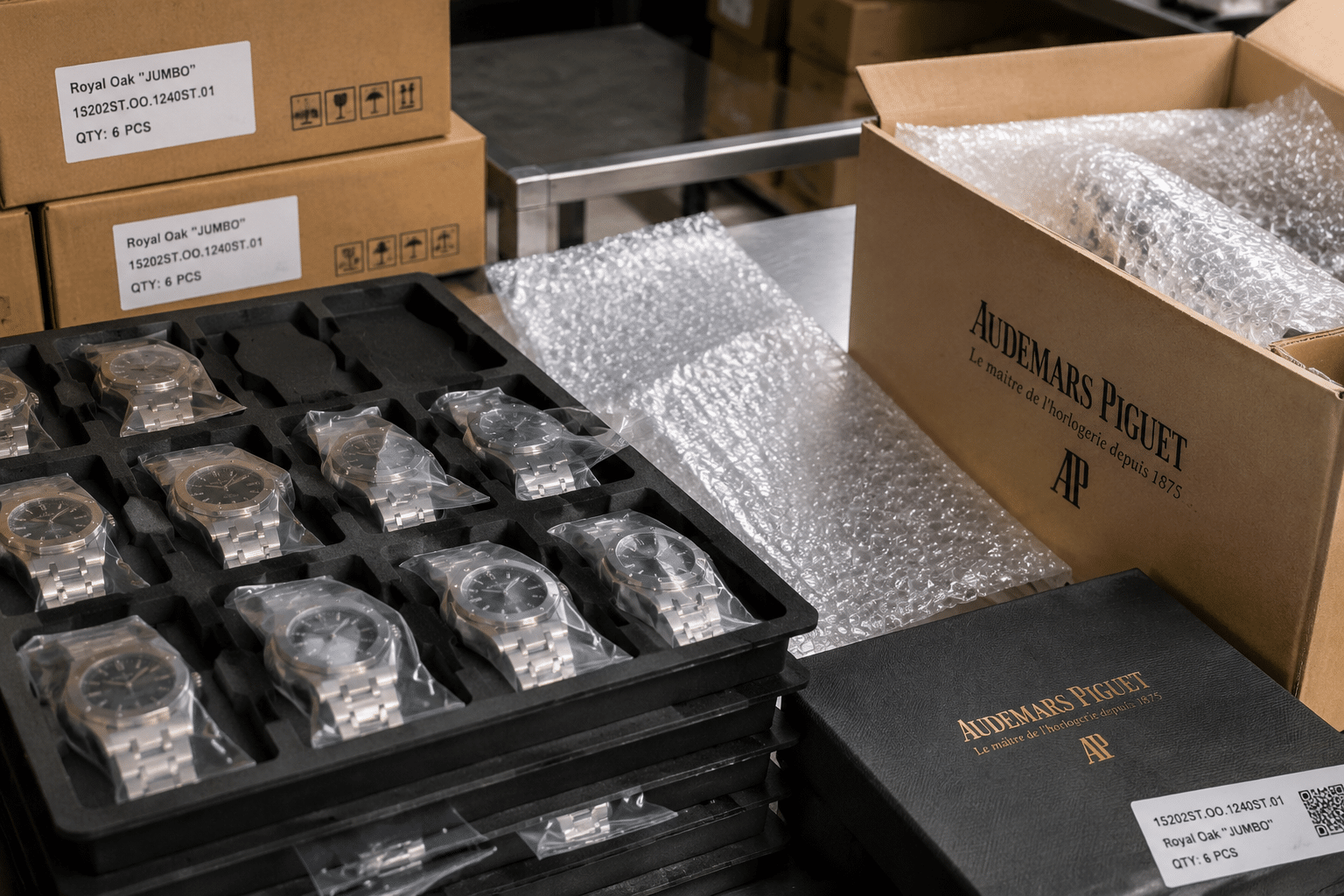
The shutdown also changed how buyers should think about any claimed XF 15202 still circulating. Old stock is not automatically bad, but it creates different questions than current production. How was the watch stored? Has the movement been serviced or left dry for years? Are the bracelet, clasp, dial, hands, and movement route consistent with the claimed version? Has anything been replaced?
Leftover inventory can also blur factory identity. Once a factory closes, sellers may describe watches using the strongest market name attached to that model. Some claims may be accurate; others may be incomplete, outdated, or based on mixed parts. A buyer should be cautious with any listing that leans heavily on “XF” but avoids clear photos of the side profile, dial, bracelet, caseback, and movement route.
The practical lesson is not to dismiss old XF pieces, but to stop treating the factory name as enough. A claimed XF 15202 should be evaluated as an individual watch with an individual condition profile. In some cases, the legacy proportions may justify the risk for an experienced buyer. In other cases, unclear history or poor condition can make a less famous current-production alternative the more rational daily-wear choice.
Why Current 15202 Alternatives Still Struggle
The problem with most 15202 replica alternatives is not that they fail everywhere. Many current AP 15202 replica options can look good in front-facing photos, and some may improve a specific detail such as dial color, bracelet brushing, or caseback decoration. The difficulty is combining all the 15202 requirements in one watch: thin case, convincing movement layout, calm dial spacing, correct date position, low hand stack, and a bracelet that flows from the case without looking overbuilt.
This is why the “best current 15202 option” question is harder than it sounds. A factory can make a stronger dial but lose the Jumbo character with extra case height. Another can use a more practical movement but create a hand-stack or date-window compromise. For the Royal Oak Jumbo, the winning formula is not one impressive specification. It is whether the watch still wears like a thin, quiet, 39mm integrated-bracelet design.
A factory comparison is most useful when it is tied to the specific reference, version, movement, and visible execution details rather than treated as a universal ranking. For the 15202, the same factory name may produce different buyer outcomes depending on whether the example solves the thinness problem, keeps the date visually balanced, and avoids bracelet stiffness at the first links.
Thickness Remains the Most Visible Compromise
On a larger or thicker Royal Oak reference, a small increase in case height can be easier to forgive. On the 15202, it changes the watch immediately. The Jumbo is supposed to sit flat, low, and almost blade-like on the wrist. If the mid-case gets too tall, the bezel appears heavier, the case flank looks more vertical, and the bracelet transition starts to feel less natural.
This is where many current 15202 replica alternatives still struggle against the memory of XF. A watch can have a clean dial and decent bracelet finishing, but if the side profile is too thick, it no longer gives the same Royal Oak Jumbo impression. Experienced buyers notice this before they notice minor printing differences, because thickness affects the entire silhouette of the watch.
The mistake is judging a 15202 mainly from straight-on dial photos. A front photo can hide extra height. A side profile cannot. For this model, case thickness is not a minor specification; it is one of the main reasons the reference exists.
Movement Appearance and Practical Reliability Pull in Different Directions
The 15202 creates an awkward movement problem. A visually plausible movement route helps preserve the thin case and no-seconds layout, but more specialized solutions can be harder to evaluate, harder to service, and less predictable over time. A simpler automatic movement may be more familiar to repair, but it can force changes in thickness, rotor behavior, hand height, or caseback appearance.
This is the tradeoff many buyers underestimate when comparing XF versus current factory options. The most realistic-looking movement solution is not automatically the safest ownership choice. The most reliable or serviceable base movement is not automatically the most convincing 15202 solution. With the Jumbo, movement realism and practical reliability often pull in opposite directions.
At Clean VS Factory, we usually treat the movement as part of the whole architecture rather than a separate upgrade label. If the movement choice makes the case too thick, raises the hands too much, or pushes the date into the wrong visual position, the watch may be mechanically sensible but less convincing as a 15202.
Hand Stack and Date Position Can Reveal the Movement Route
The 15202 dial is quiet. There is no running seconds hand to distract the eye, and the Petite Tapisserie pattern gives the dial a controlled, balanced look. That means hand-stack proportions and date-window placement become more visible than buyers expect. If the hands sit too high above the dial, the watch can look slightly layered or artificial. If the date sits too deep, too high, too low, or too far from the expected visual balance, the compromise shows quickly.
These issues often come from the movement route underneath. A movement that was not designed around the 15202 layout may require spacing adjustments, dial-side modifications, or a different calendar position. The result can be a watch that looks acceptable in a casual photo but feels off when compared against the Jumbo’s flat, restrained design language.
This is also why dial texture alone should not decide the comparison. A current AP 15202 replica may have a better-looking blue tone or sharper printing than an older example, but if the hand height and date position reveal an awkward movement fit, the improvement is incomplete.
Comparison Points That Matter Most
- Side profile: Check the full case height, bezel thickness, mid-case shape, and how flat the watch appears from the crown side.
- Dial spacing: Look at whether the logo, markers, hands, and date window sit naturally on the Petite Tapisserie dial without crowding.
- Date position: A slightly misbalanced date window is more noticeable on the 15202 because the dial has so few distractions.
- Hand height: Hands that sit too tall can make the dial look stacked rather than slim and calm.
- Bracelet transition: The first links should flow from the case; a stiff or bulky transition weakens the integrated Royal Oak shape.
- Clasp fit: A loose, sharp, or weak-feeling clasp may not ruin photos, but it affects daily wear immediately.
The sensible way to compare current 15202 alternatives is category by category, not by factory name alone. A current piece can beat an old benchmark in one area and still lose the overall Jumbo impression if the thickness, hand stack, and bracelet integration do not work together.
How to Evaluate an Old or Leftover XF 15202 Carefully
An old XF 15202 should not be judged only by XF’s historical reputation. The better question is whether the specific watch in front of you is complete, consistent, clean, and mechanically sensible. A strong factory legacy does not protect a leftover watch from storage wear, part swaps, poor handling, bracelet fatigue, or unclear service history.
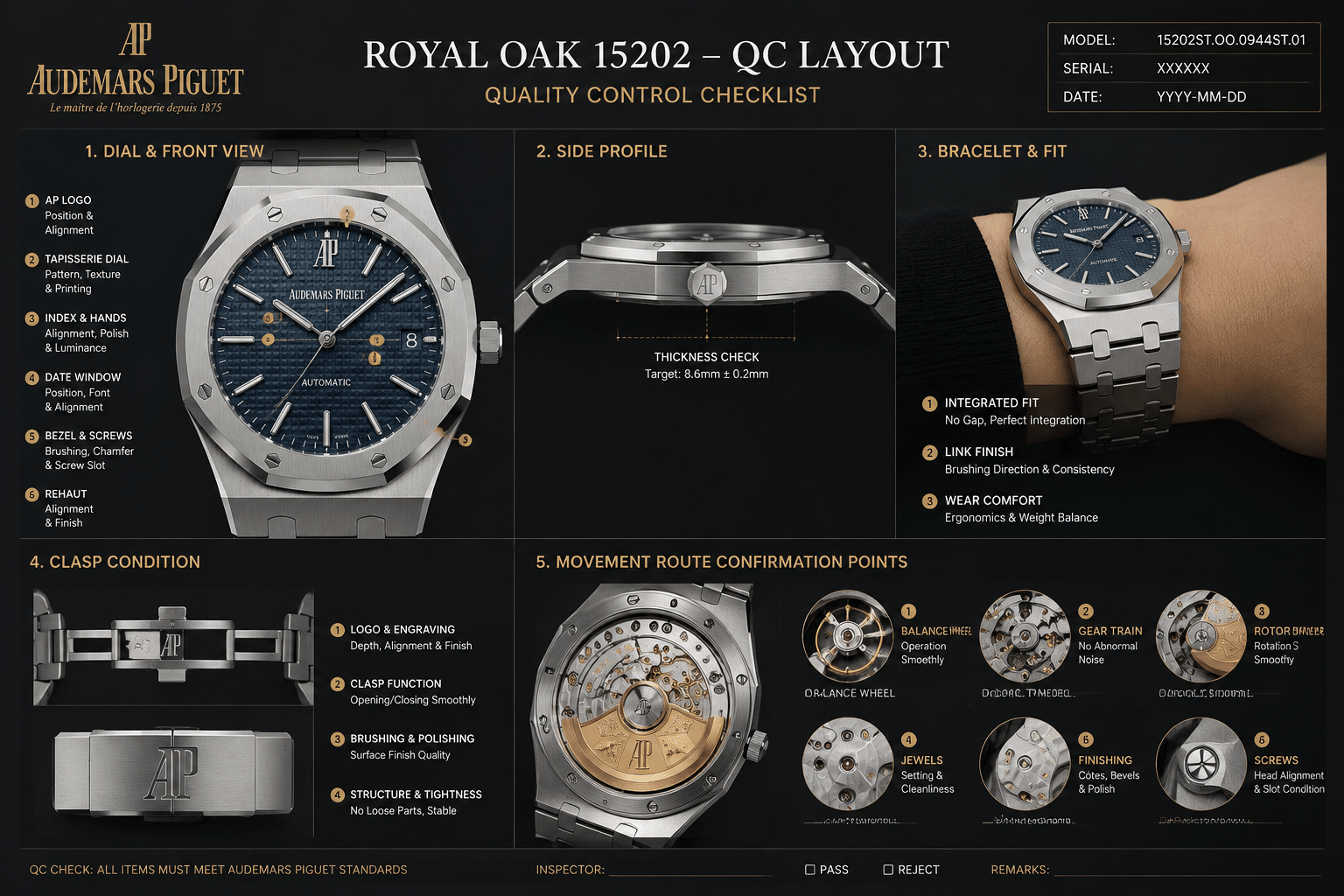
This is where many buyers make the wrong leap. They hear that XF was the benchmark and assume any claimed old XF 15202 is automatically desirable. That is too simple. The design may have been strong, but the individual watch still needs normal XF 15202 QC scrutiny: side profile, dial alignment, date window, bracelet condition, clasp fit, caseback details, and movement condition.
Side Profile Photos Matter More Than Beauty Shots
The main reason buyers still care about XF is the thin Jumbo profile, so side photos matter more than polished front-facing beauty shots. A seller can make almost any Royal Oak replica look attractive with the right lighting and angle, which is why comparisons of top Audemars Piguet replica factories should prioritize profile evidence over studio presentation. What you need is a clear crown-side view, a non-distorted case profile, and ideally a wrist-profile image that shows how the watch sits when worn.
Be cautious with photos that hide the mid-case or show the watch only from a high three-quarter angle. Those images may emphasize the bezel and dial while avoiding the one area that made XF important in the first place. If the claimed XF advantage is thinness, the QC photos should prove the profile, not just the dial color.
A practical red flag is overconfidence without evidence. If a seller leans heavily on the XF name but cannot provide clear side profile photos, bracelet condition shots, or movement-route confirmation, the claim should be treated as incomplete rather than proven.
Check Dial, Date, and Hand Alignment Together
The 15202 dial does not forgive small alignment problems as easily as busier watches. With no seconds hand and a clean Petite Tapisserie layout, the eye naturally rests on the logo, markers, hands, and date window. A small date misalignment or uneven marker can disturb the whole dial balance.
Do not inspect these details separately. A date window that looks acceptable by itself may feel wrong when compared with the marker spacing and hand center. A slightly high hand stack may become more obvious if the dial already has a deep-looking date or uneven print. On a quiet Jumbo dial, small issues can combine into a larger visual problem.
For an old XF 15202, this matters even more because condition and originality may vary. A replacement dial, changed datewheel, or serviced movement can affect the dial-side appearance. The watch may still be usable, but it should not be evaluated as a clean historical benchmark unless the parts and alignment make sense together.
Bracelet Condition Can Change the Whole Ownership Experience
The Royal Oak bracelet is not a secondary detail. On the 15202, it is half the watch. A thin case with a tired, loose, sharp, or mismatched bracelet will not feel like a strong Jumbo replica in daily wear. Bracelet stretch, uneven gaps, weak clasp closure, and inconsistent brushing can make an otherwise attractive watch feel old in the wrong way.
Pay close attention to the first links near the case. If they are too loose, the integrated shape loses tension. If they are too stiff, the watch may not drape correctly around the wrist. The clasp should close securely without feeling hollow or unstable, and the brushing should look consistent across links rather than patchy from wear or refinishing.
This is one reason an old XF claim should not automatically beat a current-production alternative. A cleaner current watch with a better bracelet and more predictable condition may be a more rational daily-wear choice than a historically respected XF-labeled piece with bracelet fatigue and unclear movement condition.
QC Photos to Request
- Front dial photo: Use it to check marker alignment, logo placement, dial texture, hand position, and date centering.
- Crown-side profile: This is essential for judging the thin case and bezel-to-mid-case proportion.
- Angled wrist-profile photo: Helpful for seeing whether the watch sits flat or looks thick in real wearing position.
- Clasp and bracelet photos: Check clasp closure, engraving condition, link gaps, brushing consistency, and signs of heavy wear.
- Bracelet articulation view: Look for stiffness, looseness, uneven end-link behavior, or visible stretch.
- Caseback and movement-route evidence: Useful for consistency checks, but movement photos alone should not be treated as proof of overall quality.
QC photos reduce uncertainty, but they do not remove every risk. For an XF 15202 claim, buyers should review real watch photos where available, including dial printing, marker alignment, hand alignment, datewheel centering, case thickness, bracelet fit, clasp engraving, caseback finishing, and movement-route evidence before accepting the factory label as meaningful.
These photos do not guarantee anything by themselves, and they should not be used to support deceptive resale or misrepresentation. They simply help a buyer understand whether a claimed old XF 15202 is consistent with the seller’s description and suitable for realistic ownership expectations.
What Price Can and Cannot Prove on an XF 15202
Price is one of the easiest signals to misread with a closed-factory watch. A higher price may reflect XF’s reputation, scarcity, movement route, clean condition, seller margin, sourcing difficulty, or after-sale risk. It does not automatically prove that the watch is a better example. On discontinued replica models, price can also reflect hype around the factory name rather than measurable improvement in the individual watch.
For the XF 15202, the more useful price question is whether the premium is attached to evidence. If the seller is asking more because the watch has a thin side profile, verified movement route, clean bracelet condition, centered date, and convincing dial balance, the premium has something to examine. If the price is based mostly on “rare XF” language and selective photos, the buyer is paying for uncertainty.
A fair comparison should include ownership cost, not just purchase price. An older XF that needs movement work, bracelet attention, or parts troubleshooting can become more expensive than a current-production option. A lower-priced current piece may still be the wrong choice if it loses the Jumbo profile badly, but it should not be dismissed only because the factory name is less nostalgic.
Seller Claims That Need Extra Caution
Some XF 15202 listings become risky not because the watch is automatically poor, but because the language around it asks buyers to accept too much without evidence. Phrases such as “factory original,” “old stock,” “A2121,” “closest version,” or “closed-factory collectible” may describe a real feature, but they should still be connected to photos, movement-route explanation, condition details, and realistic ownership expectations.
Buyers should be especially cautious with listings that imply official Audemars Piguet connection, professional authentication passability, guaranteed waterproof performance, or guaranteed resale value. Those claims are not supported by a replica-market factory label. A strong super clone may look convincing in normal wear, but close inspection can still reveal differences in finishing, movement architecture, case proportions, bracelet feel, dial details, or service compatibility.
Pricing language also needs restraint. A high price does not prove a watch is a better XF example, and a low price does not prove the seller is dishonest. The useful test is whether the price matches the evidence: clear side profile, consistent dial and date execution, bracelet condition, movement-route explanation, and transparent seller terms. Prices can change by factory label, version, movement, seller channel, availability, and condition, so exact comparisons should be verified at the time of purchase.
Evidence Boundaries for Replica Watch Claims
When discussing a closed-factory replica such as the XF 15202, the strongest evidence usually comes from the watch itself rather than from broad factory reputation. Clear side-profile photos, dial alignment, bracelet condition, movement-route evidence, and transparent seller communication are more useful than a confident factory label. Factory names in the replica market are often informal buyer shorthand, so they should be treated as context rather than official provenance.
Official brand sources can explain what the genuine design prioritizes, but they cannot prove that a replica has the same case construction, finishing, movement, water resistance, or durability. Likewise, official movement documents can explain the specifications of a movement family, but they do not prove that a specific replica watch contains that movement unless the individual watch is inspected and documented. This distinction is especially important on the 15202 because the wrong movement route can change the case profile and dial-side layout even when the watch looks attractive in front photos.
Buyers should also treat water resistance and durability as unverified unless the individual watch has been pressure-tested and inspected after purchase. Genuine-brand water-resistance ratings do not transfer to replica watches, and seller claims should not be treated as a substitute for testing. For an older XF-labeled watch, age, gasket condition, caseback fit, crown tube condition, and prior handling can all matter more than the factory story.
The safest use of XF history is to avoid misunderstanding quality, not to imply that a replica watch is an authorized Audemars Piguet product or suitable to represent as genuine. A transparent comparison should keep the boundary clear: the genuine Royal Oak Jumbo is the visual reference point, while the XF 15202 is a replica-market version that must be judged by its own visible execution, movement route, condition, and ownership limits.
Traceability Checklist for an XF 15202 Decision
A practical XF 15202 decision should move from broad claim to specific evidence. Start with the factory name, then check the exact reference style, claimed batch or version, movement route, case profile, dial execution, bracelet condition, and real-watch photos. If the seller cannot connect those points, the buyer is relying on reputation rather than traceability.
The strongest visual evidence is usually not the most dramatic photo. A straight dial shot helps with logo placement, marker alignment, hand length, date centering, and Petite Tapisserie texture. A side shot helps with bezel height, mid-case thickness, caseback shape, and whether the bracelet exits the case naturally. A clasp and bracelet sequence helps identify wear, refinishing, link stretch, screw condition, and whether the bracelet still feels coherent with the thin case.
Movement evidence should be read carefully. A movement photo, rotor engraving, or “A2121-style” label can support a discussion, but it should not be treated as proof of official caliber origin or long-term reliability. The more useful question is whether the movement route matches the visible architecture of the watch: no running seconds, low hand stack, plausible date position, acceptable case thickness, and realistic service expectations.
For CleanVSFactory, the goal is to make replica watch comparison easier to understand by connecting factory names, movement claims, visible QC details, and realistic ownership limits. That means XF should be respected as a historical 15202 benchmark, but every individual example still has to earn confidence through current condition and evidence.
When XF Legacy Should Influence Your Decision—and When It Should Not
XF’s legacy should influence how you judge an AP 15202 replica, but it should not make the decision for you. The useful lesson from XF is clear: on the Jumbo, thinness, proportion, movement route, dial calmness, and bracelet flow matter more than a single impressive close-up detail. That standard still helps buyers evaluate current alternatives.
The risk is turning that standard into factory nostalgia. “XF was the benchmark” does not mean every old XF-labeled watch is the safest choice today. Condition risk, serviceability, QC consistency, and confidence in the watch’s origin still matter. A strong historical factory name cannot fix a poor dial, tired bracelet, uncertain movement, or unclear batch claim.
Use XF as a Proportion Standard
The best use of the XF 15202 benchmark is as a comparison standard for shape. When looking at current alternatives, ask whether the case sits low enough, whether the bezel feels proportionate, whether the bracelet flows naturally, and whether the dial has the quiet balance expected from a Jumbo. Those questions are more useful than asking only which factory name is currently most discussed.
XF remains relevant because it showed how important the overall profile is. Even if a current option improves a dial detail or bracelet finish, it still needs to preserve the slim, restrained character of the 15202. If it does not, the watch may be a good Royal Oak-style replica but a less convincing Jumbo.
This is the key distinction: XF should shape your standards, not narrow your judgment. A buyer who understands why XF mattered can compare current pieces more intelligently without assuming only an old XF can be acceptable.
Do Not Let Factory Nostalgia Override QC
An old benchmark with poor condition can be a worse ownership choice than a less famous but cleaner current piece. This is especially true if the watch has unclear parts, a questionable movement state, heavy bracelet wear, or photos that avoid the important angles. A factory name is useful context, not a substitute for inspection.
For daily wear, QC consistency often matters more than forum status. A watch that winds smoothly, has a centered date, secure clasp, even bracelet feel, and convincing side profile may deliver a better ownership experience than a claimed old XF with uncertain history. The more a seller relies on the legend of XF, the more carefully the actual watch should be checked.
The clear judgment is this: XF remains a benchmark, but not every XF-labeled watch is a smart choice. The older and more hyped the piece is, the more the buyer should demand evidence from the watch itself.
A Practical Scenario: Old XF Claim Versus Current Alternative
Imagine an experienced buyer comparing a claimed leftover XF 15202 against a current-production alternative. The XF has the appeal of the thin case and historical reputation. The current option may have fresher condition, easier sourcing consistency, cleaner bracelet action, or better-supported movement expectations. Neither choice wins automatically.
The buyer should compare the areas that actually affect the AP 15202 replica decision: side profile, dial alignment, date position, hand height, bracelet condition, clasp feel, and movement confidence. If the old XF has a strong profile but a tired bracelet, uncertain service history, and weak QC photos, the safer 15202 replica choice may be the current watch. If the current alternative is visibly thicker and loses the Jumbo silhouette, the XF may still be more attractive to a buyer who accepts the ownership risk.
That is the realistic way to use XF’s legacy. It should help you understand what the 15202 is supposed to feel like, while still forcing every individual watch to earn its place on condition, construction, and daily-wear practicality.
The Real Legacy of XF Factory in the 15202 Market
The XF Factory legacy is not that it made the AP Royal Oak 15202 replica problem disappear. Its real importance is narrower and more useful: XF showed that a replica could get unusually close to the Royal Oak Jumbo proportions that matter most on the wrist. The thin profile, restrained case shape, and integrated bracelet flow gave buyers a reference point that still influences how current alternatives are judged.
That is why XF still matters even as a closed factory. The 15202 is not a model where one strong dial or one decorated movement can carry the whole watch. If the case feels too tall, the bezel sits too heavy, or the bracelet transition looks bulky, the Jumbo character is weakened immediately. XF’s best-known strength was solving that balance better than many options that came before and after it.
Still, a historical benchmark is not the same thing as a safe purchase. An old XF-labeled watch can have storage wear, unclear parts history, movement condition issues, or batch uncertainty. Buyers who treat “XF” as a magic word are missing the practical lesson. The better lesson is to use XF as a measuring standard for what a convincing 15202 replica should prioritize.
XF Is Still the Reference Point, Not a Guaranteed Safe Bet
XF remains a 15202 replica benchmark because it focused on the hardest part of the Royal Oak Jumbo: preserving the slim, calm, almost flat-wearing identity of the watch. That matters more than many buyers realize. On a 39mm Royal Oak Jumbo, excess thickness does not hide well. It changes the entire stance of the watch, especially from the side and at the bracelet junction.
The mistake is turning that reputation into a blanket recommendation. Not every claimed XF 15202 deserves the same confidence, and not every current alternative should be dismissed only because XF once set the standard. Condition, dial alignment, date placement, bracelet feel, and movement behavior still decide the ownership experience of the individual watch in front of you.
A realistic 15202 choice starts by separating legacy from risk. XF should influence what you look for: thin case profile, balanced bezel height, clean dial spacing, believable no-seconds layout, and a bracelet that does not feel like an afterthought. It should not override obvious QC problems or vague seller claims. In practice, a cleaner current-production piece can be more sensible than a tired old benchmark if the XF example has poor condition or uncertain parts.
The 15202 Market Still Has an Unsolved Combination Problem
The reason the XF Factory legacy has lasted is that the market has not fully solved the combination problem. A factory may improve dial texture but lose the case profile. Another may offer a more practical movement route but create thicker proportions. A bracelet may feel solid, while the hand stack or date position still gives away the compromise. The Jumbo demands all of these elements to work together.
This is the central point buyers should remember: the AP 15202 replica is difficult because its design leaves no room for visual padding. The absence of a seconds hand makes the dial quieter, but it also puts more pressure on hand height, date balance, and dial printing. The thin case is beautiful, but it restricts movement options. The integrated bracelet is iconic, but it exposes poor case geometry immediately.
So the real XF Factory legacy is not nostalgia. It is a standard of judgment. XF proved that thinness and proportion are not optional details on the Royal Oak Jumbo; they are the identity of the watch. Current alternatives should be compared by those 15202-specific standards, not by factory reputation alone. For buyers with realistic expectations, that is the most useful takeaway: respect XF as the historical reference, but judge every watch individually before calling it the better choice.
Legal and Disclosure Considerations
This article discusses imitation watches for buyer-education purposes and does not describe authorized Audemars Piguet products. Replica watches can raise trademark, disclosure, resale, customs, and import issues depending on jurisdiction. The USPTO explains counterfeit goods in relation to trademark use, and U.S. Customs and Border Protection identifies intellectual property rights enforcement as an import priority; those sources support cautious disclosure language, not any broad claim that a specific purchase is safe, legal, or risk-free.[4][5]
References
[1] Audemars Piguet, “Royal Oak Jumbo Extra-Thin 16202ST official specifications,” official brand specification page for the genuine Royal Oak Jumbo Extra-Thin, available at Audemars Piguet Royal Oak Jumbo 16202ST 官方规格.
[2] Miyota, “Caliber 9015 official movement specifications,” official movement manufacturer specifications for the Miyota 9015, available at Miyota 9015 官方机芯规格.
[3] Sellita, “SW200-1 official technical documentation,” official technical document for the Sellita SW200-1 movement family, available at Sellita SW200-1 官方技术文档.
[4] United States Patent and Trademark Office, “Counterfeit Goods Basics,” official USPTO educational document on counterfeit goods and trademark issues, available at USPTO Counterfeit Goods Basics.
[5] U.S. Customs and Border Protection, “Intellectual Property Rights,” official CBP resource on intellectual property rights enforcement and import-related issues, available at U.S. CBP Intellectual Property Rights.
Disclosure: This article is for general educational and comparison purposes only. Replica watches are not genuine products from the original luxury brands, and brand names are used only to identify reference designs or comparison topics. Factory names, movement descriptions, prices, availability, QC details, seller policies, and version information can change, so readers should verify important details with the seller before making a purchase decision. Replica watches should not be represented, resold, or used as genuine watches.