
JF Factory still comes up whenever buyers discuss AP Royal Oak replicas, but its reputation is easy to misunderstand. The point is not that an old JF-labeled watch is automatically the right choice today. JF mattered because it helped raise expectations for Royal Oak case shape, bracelet integration, dial balance, and version refinement, especially around the 15400 period, much like XF Factory 15202 history remains relevant when buyers evaluate closed-factory influence, batch evolution, and long-term collector discussions. That historical role explains why older reviews and forum comments still influence buyer decisions.
This article looks at JF as both a benchmark and a warning. Its stronger external execution made many AP replicas feel more coherent on the wrist, while its Miyota-based decorative movement route also showed why movement architecture, case thickness, rotor noise, and caseback realism matter. For modern buyers, the practical judgment is whether a specific JF piece has enough verified condition, correct version details, and movement evidence to justify attention over current alternatives.
Replica watches should be clearly understood as replica-market products, not genuine watches from the original luxury brands. Brand names such as Audemars Piguet and Royal Oak are used here for reference and comparison only; they do not imply authorization, endorsement, production relationship, or affiliation with the original luxury watch brand.
| Buyer Check | Why It Matters | Practical Judgment |
|---|---|---|
| Factory name | JF reputation reflects its peak period | Use it as context, not proof of value |
| Royal Oak case and bracelet | JF was respected for geometry and wrist feel | Check polishing, stretch, clasp wear, and fit |
| Movement route | Miyota 9015 decoration affects refinement | Expect possible rotor noise and caseback compromise |
| Old stock claims | Shutdown-era listings can be hard to verify | Ask for current QC, movement, and caseback photos |
| Old reviews | Comparisons were based on older competitors | Compare against current AP replica options |
| Used condition | Wear can outweigh original factory strengths | A tired bracelet or over-polished case weakens the buy |
Quick Questions Before You Read
Q: Is an old JF AP still worth considering?
Possibly, but only if the exact version, condition, movement, and current photos support the asking price.
Q: Why do buyers still mention JF after shutdown?
JF helped set earlier expectations for Royal Oak case shape, bracelet feel, and visual balance.
Q: What is the main weakness to check first?
The movement route and caseback details matter, especially on Miyota-based decorative builds.
Q: Should old forum praise guide today’s purchase?
Only as background. Current QC evidence and comparison with newer alternatives should decide the purchase.
Editorial Perspective: For cleanvsfactory.com, JF Factory is best understood as a model-specific historical benchmark, not a universal buying recommendation. The JF name can help explain why Royal Oak buyers learned to care about case geometry, bracelet articulation, and dial balance, but it does not prove that a current listing is original, well-preserved, or better than newer AP replica options. A careful buyer should separate JF’s old reputation from the actual watch being offered: movement route, case thickness, bracelet condition, caseback evidence, and current QC photos matter more than a factory label alone.
Traceability Position: CleanVSFactory’s editorial approach is to make replica watch decisions more traceable by connecting factory claims to visible details, movement behavior, version differences, and practical QC checks. That means treating JF as a useful comparison reference while still asking what can be verified on the exact watch being considered.
Why JF Factory Still Comes Up in AP Replica Discussions
JF Factory still comes up because it was not just another AP replica maker. For a long stretch of AP replica history, especially in Royal Oak discussions, JF became the reference point buyers used to judge case shape, bracelet feel, dial balance, and version progress. That history matters. But it does not mean an old JF Factory AP is automatically the smartest watch to buy today.
The important distinction is simple: JF matters as a benchmark, not as a default modern recommendation. Many newer buyers see old forum posts praising JF and assume the name itself still carries the same buying power. That is where mistakes begin. A discontinued factory name is useful context, but it does not replace current QC evidence, movement confirmation, version details, or condition review.
JF’s reputation came from a time when the Royal Oak replica market was much less mature. Many AP replicas looked acceptable from the front but failed in the areas that define the Royal Oak in real wear: the case profile, the bracelet flow, the bezel geometry, and the way the watch sat flat and sharp on the wrist. JF helped teach buyers to look beyond the dial photo. That is why people still mention JF in replica watch discussions even after it stopped being a normal current-production option.
Evidence Boundaries for This JF Discussion
Official Audemars Piguet material can help clarify the design language and specifications of authentic Royal Oak references, such as the 41mm Royal Oak 15510ST with a Grande Tapisserie dial and integrated bracelet construction.[1] That kind of source is useful for understanding what buyers are visually comparing against, but it does not prove that any JF, APSF, ZF, or other replica has the same construction, finishing, water resistance, movement quality, or serviceability as an authentic Audemars Piguet watch.
Movement documentation works the same way. Miyota’s official 9015 specifications help explain why buyers discuss that caliber as a slim automatic movement with hand-winding and stop-second functionality.[2] Those specifications do not prove that a specific old JF watch contains a genuine Miyota 9015, has been maintained properly, or performs to the movement maker’s expected condition after years of storage or wear.
These source boundaries are important because replica-market discussions often mix three different kinds of evidence: official reference specifications, seller descriptions, and buyer QC photos. Official sources can describe the genuine reference or a movement family, but the specific replica still has to be judged by its visible execution, claimed configuration, and current condition rather than by borrowed authority from the genuine watch or movement maker.
The Short Answer for Modern Buyers
If you are asking whether JF Factory history still matters, the answer is yes. If you are asking whether an old JF should automatically beat a current AP replica option, the answer is no. JF remains important for understanding how AP replica standards developed, but the factory name alone is weak evidence when judging an actual watch today.
For modern buyers, JF is most useful as a reference language. When collectors say a Royal Oak has “old JF-style bracelet quality” or compare a case to “JF proportions,” they are usually talking about a standard that became familiar during JF’s strongest years. That comparison can help you understand what people valued: sharper finishing, more convincing case lines, and a bracelet that felt more serious than typical low-tier replicas of the period.
The practical buying lesson is not to chase the name blindly. It is to understand why the name became respected, then apply that standard to the actual watch in front of you. At Clean VS Factory, we usually treat factory reputation as the beginning of a comparison, not the end of it. With a discontinued factory like JF, that approach becomes even more important.
Why Old Forum Praise Can Be Misleading Today
Old JF praise can be useful, but it needs a date stamp in your mind. A forum comment from the peak JF era was judging JF against the AP replica options available at that time. It was not comparing JF against today’s more developed movement routes, newer case construction, or current factory versions. A statement like “JF is the best AP” may have been reasonable in its original context and still be incomplete for a modern buyer.
This is the most common misunderstanding with discontinued factory discussions. Buyers read old praise as if it were a permanent ranking. In reality, factory reputation is tied to period, model, version, and the competition available at the time. JF earned its place because it raised the standard for Royal Oak replicas when many alternatives were rougher. That does not freeze the market forever.
The safer reading is this: old JF discussions tell you what mattered before the current AP replica market matured. They help explain why bracelet finishing, case geometry, and overall wrist presence became central evaluation points. They do not prove that any watch labeled “JF” today is fresh, correct, well-preserved, or better than a current option.
The 15400 Era: How JF Became the Royal Oak Reference Point
The JF 15400 era is where the factory’s reputation became difficult to ignore. The AP Royal Oak 15400 replica was the right model at the right time: large enough to have strong wrist presence, mainstream enough to attract constant buyer attention, and technically demanding enough to expose weak factories quickly. JF did not become famous because buyers liked the factory name. It became famous because its Royal Oak execution looked and felt more convincing than much of the market around it.
The 15400 gave JF a stage where its strengths were visible immediately. The Royal Oak is unforgiving because the case, bezel, dial, and bracelet are not separate visual parts. They have to work as one flat, angular, integrated object. If the bracelet is stiff, the bezel brushing is soft, or the case shoulders look wrong, the entire watch loses the Royal Oak character. JF’s best 15400 work gave buyers a more complete impression than many earlier AP replicas.
Version development also mattered. JF was not remembered only for releasing one popular watch; it was remembered for repeated improvement. Buyers saw progress in areas such as case finishing, dial execution, bracelet feel, and overall refinement. That created confidence during a period when many factories treated AP replicas as a dial-and-logo project rather than a serious case-and-bracelet challenge.
Why the 15400 Was the Right Model for JF’s Breakout
The 15400 was ideal for JF because it sat in the center of Royal Oak demand. It had the recognizable 41mm presence, the Grande Tapisserie-style dial language, the octagonal bezel, and the integrated bracelet that made the Royal Oak instantly identifiable. Buyers wanted it, forums discussed it constantly, and every visible flaw had a comparison point.
Unlike some ultra-thin or complicated AP references, the 15400 was not only about mechanical thinness or rare collector appeal. It was a daily-wear luxury sports watch shape, and that made tactile quality more important. A buyer could feel the bracelet, see the way the case transitioned into the first links, and judge whether the watch had the flat, architectural Royal Oak personality. JF’s ability to deliver a stronger version of that impression is why the JF Royal Oak reputation grew so quickly.
The key judgment is that JF became popular because it solved the problems buyers noticed in normal use, not because it solved every technical problem. The 15400 looked coherent on the wrist. For its era, that was a major step forward.
How JF Changed Buyer Expectations for AP Replicas
Before JF became the AP name to know, many buyers were more forgiving. If the dial looked close and the watch had the basic octagonal bezel shape, some considered it acceptable. JF changed that expectation. Buyers started asking harder questions: Is the bracelet finished cleanly? Does the case profile look flat enough? Are the polished bevels controlled? Does the dial layout sit correctly, or does it look crowded and cheap?
This shift is part of JF’s real legacy. It pushed AP replica discussions away from simple front-facing dial comparisons and toward full-watch evaluation. The Royal Oak became understood as a watch where bracelet finishing and case geometry are not secondary details. They are part of the identity of the model.
That is also why the phrase “best old AP replica” usually points back to JF in collector memory. The praise is not just nostalgia. JF helped define what buyers expected from a serious Royal Oak replica: sharper external finishing, more disciplined proportions, and version updates that tried to correct known weaknesses. The limitation is that those expectations later moved beyond JF’s own technical platform.
Why the 15400 Comparison Should Stay Model-Specific
One buying mistake is to take JF’s 15400 reputation and apply it to every AP reference. The 15400 rewarded JF’s strengths because the model depends heavily on case shape, bracelet integration, and balanced dial execution. That does not mean the same factory reputation applies equally to Offshores, chronographs, perpetual-style layouts, or thinner references where movement architecture and case height become more difficult to hide.
For a first-time AP replica buyer, the 15400-style Royal Oak is also more forgiving than many complicated AP references because the visual challenge is concentrated in the case, bracelet, dial, and date layout rather than several active complications. That does not make it easy, but it makes the evaluation clearer. A buyer can check bracelet flow, bezel screw alignment, case thickness, tapisserie balance, and movement route without also judging extra pushers, sub-dial spacing, or complicated module behavior.
This is why “JF was strong on AP” should be narrowed before it becomes buying advice. The more useful statement is that JF was especially influential in the Royal Oak 15400 conversation, where its external execution matched what buyers could see and feel every day. For other AP models, the same factory name needs a fresh model-by-model check.
Factory Name Clarification: Factory names such as JF, APSF, ZF, and similar replica-market labels should be treated as practical buyer references, not as official Audemars Piguet affiliations or guarantees of identical quality across every model. A discontinued factory name can explain historical reputation, but each watch should still be judged model by model through version evidence, visible QC details, movement route, and current condition.
In practical comparison, the factory label should be followed by the reference, version, and movement route. A JF 15400 discussion is not the same as a JF Offshore discussion, and an old-stock claim is not the same as a current QC-confirmed watch. This model-specific reading helps prevent a useful historical label from becoming an unsupported universal ranking.
Factory names are useful market references, but they do not guarantee identical quality across every model or version. A careful comparison is strongest when it is tied to the exact reference, dial color, movement configuration, caseback style, bracelet construction, and current QC evidence instead of relying on a broad factory reputation.
What JF Did Well: Case Shape, Dial Balance, and Bracelet Feel
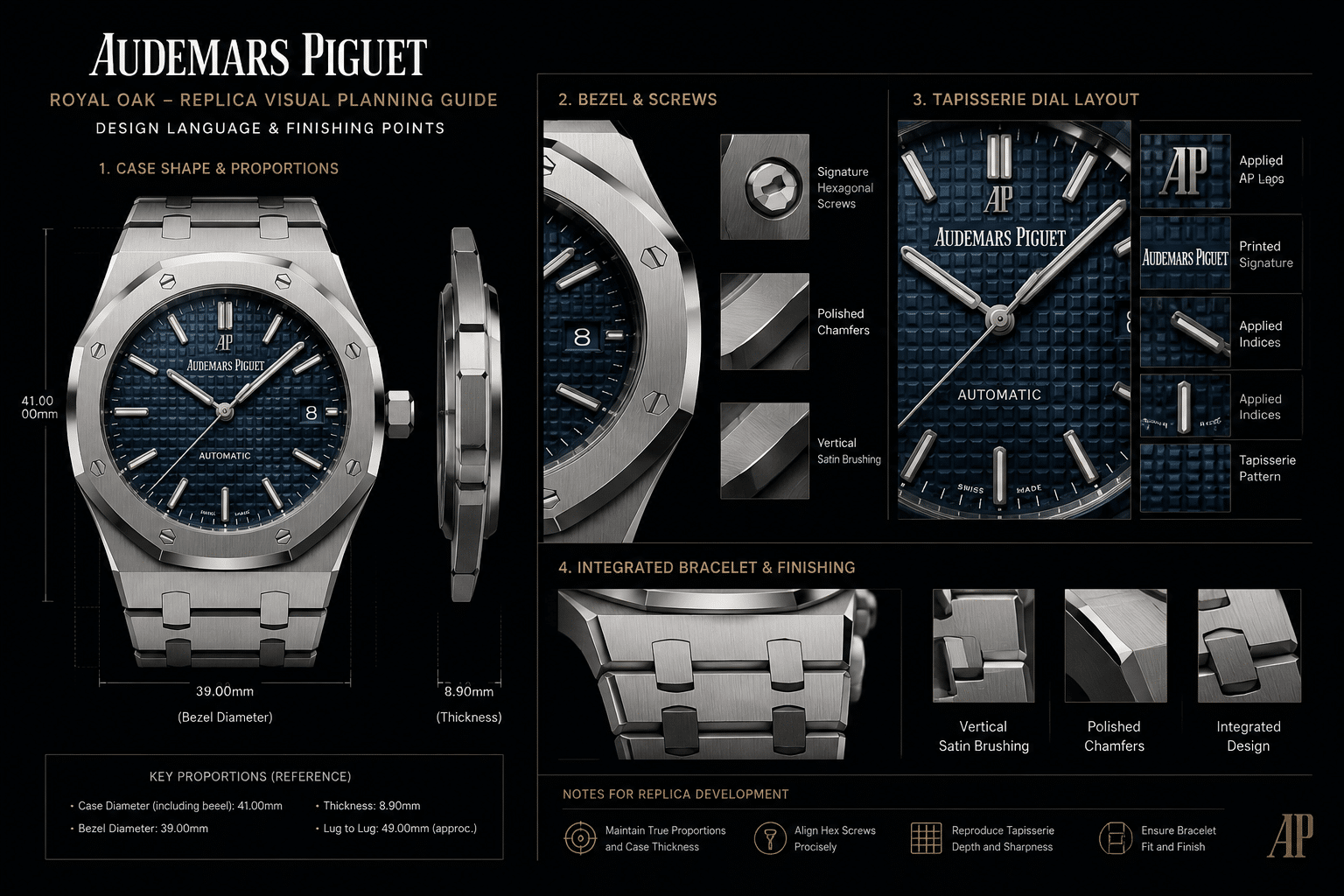
JF’s strongest reputation came from visible execution. The factory understood that an AP Royal Oak replica does not live or die by the dial alone. The case must look flat and architectural, the bezel must sit with the right visual tension, the dial must feel balanced inside the case, and the bracelet must behave like part of the watch rather than an attachment. That is where JF earned respect.
The fairest way to describe JF is not “flawless,” but “convincing in the areas buyers handled every day.” Batch differences existed, and old examples today can vary heavily by wear, polishing, and condition. Still, the JF AP bracelet and JF Royal Oak case became reference points because they gave many buyers a stronger physical impression than competing options of the time.
Case Geometry and the Royal Oak Silhouette
The Royal Oak case is difficult because it has nowhere to hide. Round watches can disguise small shape errors more easily. A Royal Oak cannot. The flat planes, angular shoulders, octagonal bezel, exposed screws, and integrated bracelet junction all create a strict geometry. If one area is too soft or too bulky, the watch starts looking like a general AP-inspired object rather than a serious Royal Oak replica.
JF earned credit because its cases usually captured the broad Royal Oak silhouette better than many older competitors. The visual mass was more controlled, the bezel shape looked more deliberate, and the transition into the bracelet felt more natural. This mattered more on the wrist than in isolated macro photos. A watch can photograph well from the front and still feel wrong if the side profile is too tall, the lugs look heavy, or the bracelet drops awkwardly from the case.
The judgment here is practical: JF’s case work mattered because it made the watch read correctly at normal viewing distance. It was not about microscopic perfection. It was about giving the Royal Oak its flat, sharp, integrated character.
Dial Layout and Visual Balance
JF’s dial work also helped its reputation, especially because the Royal Oak dial is easy to underestimate. The tapisserie texture, applied markers, logo position, date window, minute track, and hand length all need to sit together cleanly. If the logo is too heavy, the date window feels misplaced, or the markers do not align well with the pattern, the dial loses the calm precision that makes the design work.
JF was not producing a genuine AP dial, and close inspection could still reveal limitations in texture depth, printing weight, and finishing. But for its era, the overall visual balance was strong enough that buyers could wear the watch without feeling that the dial was the weak point. That was important because AP replicas often fail not through one dramatic mistake, but through several small spacing and finishing issues that make the watch feel less expensive than it should.
For buyers reading old JF comparisons, this is the useful lesson: dial balance should be judged as a whole. Do not only zoom in on the logo or tapisserie squares. Look at whether the markers, hands, date, and printed elements create a stable impression inside the case.
Why the Bracelet Became Part of the JF Legend
The bracelet is the reason many collectors still speak warmly about JF. On a Royal Oak, the bracelet is not just a strap. It is half the watch’s design. The links need to articulate smoothly, the brushed surfaces need to flow in the same direction as the case, the polished bevels need to catch light without looking rounded, and the clasp needs to feel secure rather than hollow.
JF’s bracelet reputation came from daily-wear feel as much as appearance. A better bracelet changes how the watch sits on the wrist, how it moves when the wrist bends, and how solid the watch feels when handled. Many replicas can look acceptable in a straight-on photo, but a stiff bracelet or poorly fitted end link gives the game away to the wearer immediately. JF reduced that problem better than most of its era.
This does not mean every JF bracelet today is desirable. Age changes the equation. Links can loosen, edges can be over-polished, screws can show wear, and clasp action can degrade. The historical reputation is real, but an individual old bracelet still needs condition review.
Case and Bracelet Checks
When evaluating a JF Royal Oak case or bracelet, start with the areas that affect the whole watch impression. For an AP 15400 factory comparison, check whether the bezel screws sit evenly, whether the brushed and polished transitions still look crisp, and whether the side profile appears controlled rather than swollen. Then look at the integrated bracelet junction: the first links should sit naturally from the case, not drop in a stiff or awkward way.
Bracelet link finishing deserves close attention. Uneven brushing, overly shiny polished bevels, loose screws, rough link edges, or a clasp that feels weak can reduce the value of the watch even if the factory name is correct. A clean JF AP bracelet can still be impressive, but a worn or heavily polished one should not be judged by reputation alone.
The most useful QC mindset is simple: ask whether the watch still carries the Royal Oak shape as one continuous object. If the case, bezel, bracelet, and clasp do not work together, the old JF name cannot fix the wearing experience.
The Movement Limitation: Miyota 9015 Architecture Behind the Decoration
JF’s biggest weakness was not that its watches were fragile or unusable. The real limitation was architectural. Many JF AP builds relied on the Miyota 9015 AP replica route, with decorative plates used to create the impression of an Audemars Piguet-style movement when viewed through the caseback. For its era, this was a sensible compromise: the Miyota 9015 was slim for a mass-market automatic, generally serviceable, and more dependable than many low-grade clone movements. But it was never the same thing as a true integrated AP clone movement.
This is the point modern buyers often miss when they ask about the “JF movement problem.” The issue was not simply whether the watch could keep time. The issue was whether the movement architecture supported the whole Royal Oak design: case thickness, caseback layout, balance position, rotor behavior, and the overall mechanical impression. JF could make the watch look strong from the dial side, but the movement route placed a ceiling on how convincing the watch could be from the side and back.
What a Decorative-Plate Movement Means
A decorative-plate movement is exactly what the name suggests: the underlying movement remains one thing, while extra plates, bridges, rotor decoration, and engraving are added to make it resemble something else. In JF’s case, the base was commonly a Miyota 9015-style automatic movement dressed to look closer to an AP caliber. That can improve the first impression through a display caseback, but it does not change the location of the working parts underneath.
This matters because Royal Oak replicas are not judged only by whether the rotor has the right color or the bridge has engraving. The genuine AP movement layout influences how the case is built around it. A decorated Miyota can imitate surface appearance, but it cannot fully reproduce the correct movement geometry. That is why Miyota vs clone movement is not just a collector argument; it affects the physical shape of the watch.
The practical tradeoff was clear. Miyota-based JF watches could be more reliable than some ambitious but poorly executed clone movements, especially for buyers who cared more about daily use than caseback accuracy. But the same route also meant the watch was technically dated once integrated clone movement options became more mature. A decorated movement can be acceptable if the buyer understands what it is. It becomes a problem when a listing presents it as if it were a true AP-style clone.
What Miyota 9015 Specs Can and Cannot Prove
Miyota lists the 9015 as an automatic movement with a 26mm diameter, 3.90mm height, 24 jewels, 28,800 vibrations per hour, hand-winding, stop-second function, and an approximate 42-hour power reserve.[2] These specifications explain why the 9015 became attractive for many replica projects that needed a relatively thin automatic base movement.
Those official specifications should be used narrowly. They support what the Miyota 9015 is as a movement family, but they do not confirm the movement inside a specific JF Royal Oak, the originality of a seller’s watch, the quality of decorative plates, the condition of lubrication, the sound of the rotor, or the accuracy of a used example. For an old JF listing, the buyer still needs actual movement photos and seller transparency rather than relying on a generic movement name.
Movement descriptions in the replica market should be checked carefully because they may refer to layout, decoration, clone architecture, or seller terminology rather than an official brand-manufactured caliber. A seller’s movement label should be treated as a claim to verify through photos and version context, not as proof that the watch contains an official Audemars Piguet movement or has genuine-brand service compatibility.
Why Rotor Noise and Winding Feel Matter
The Miyota 9015 is often discussed by buyers because its rotor behavior can be more noticeable than expected in some watch cases. In a dressier or sports watch with a closed caseback, that may be easier to ignore. In a Royal Oak-style replica, where buyers already pay close attention to thinness, bracelet feel, and mechanical refinement, rotor noise becomes more noticeable. A JF movement may keep acceptable time, yet still feel less refined when the rotor spins freely or produces a faint whirring sound on the wrist.
Winding feel also tells part of the story. A genuine high-end movement is not only judged by accuracy; it is judged by how the crown feels, how the rotor behaves, how the date changes, and whether the mechanical feedback matches the visual promise of the watch. The Miyota 9015 can be practical, but it does not deliver the same tactile impression as a better-integrated movement route. For buyers who wear the watch casually, this may be a tolerable compromise. For buyers expecting a quiet, heavy, AP-like mechanical feel, it can be disappointing.
This is where we usually encourage buyers to separate visual accuracy from ownership experience. A JF Royal Oak can photograph well from the front and still remind the owner of its movement route during daily wear. The sound, crown feel, and case thickness are not always visible in listing photos, but they are part of the watch once it is on the wrist.
How Movement Architecture Affected Caseback Accuracy
Display casebacks made the JF compromise easier to see. Decorative plates helped fill visual space, but the movement layout underneath still differed from the AP architecture buyers were hoping to see. The balance position, bridge shape, rotor relationship, and depth of the movement could look close enough at a glance, but less convincing under direct comparison or careful inspection.
This also helps explain why JF cases were thicker on some Royal Oak references than later integrated-movement builds. The case had to accommodate a movement platform that was not designed around the same architecture as the original AP caliber. Even if the case diameter, bezel, and bracelet were impressive, the movement stack could push the side profile away from the slimmer Royal Oak feel.
For many owners at the time, that was an acceptable price to pay. JF was competing in a market where most alternatives were less refined overall. But in modern AP replica discussions, caseback accuracy and case thickness carry more weight. Buyers are no longer comparing only dial texture and bracelet finishing; they are asking whether the movement supports the shape of the watch correctly.
Movement Route to Verify
An old JF listing should never be judged by the factory name alone. The buyer should confirm the movement route, whether it is Miyota-based, whether decorative plates are used, whether the caseback photos match the claimed version, and whether the watch has been serviced or left untouched for years. If the seller cannot provide a clear movement view, the “JF” label is weak evidence.
The safest interpretation is simple: JF movement history explains why the factory was respected and limited at the same time. The watches could be visually strong, wearable, and historically important, but the Miyota 9015 architecture kept them below the technical ceiling of later integrated clone movement routes.
Movement Transparency Note: Movement references in this article describe replica-market movement routes, decorative-plate configurations, and buyer-facing claims, not official Audemars Piguet calibers or brand-authorized construction. Buyers should verify the actual movement photos, rotor layout, caseback structure, service condition, and case thickness because a movement name or decoration style alone cannot prove the internal architecture of an individual watch.
Movement trust in the replica market depends on understanding what the movement claim actually describes: architecture, decoration, layout, reliability expectation, or simply a market name used by sellers. A movement photo reduces uncertainty, but it should be read together with case thickness, rotor behavior, crown feel, and the seller’s version description.
Why JF’s Strengths and Weaknesses Both Shaped Modern AP Standards
JF shaped modern AP replica standards in two opposite ways. It showed buyers how much case shape, dial balance, and bracelet feel mattered on a Royal Oak replica. It also showed the market that those visible strengths were not enough if the movement architecture forced compromises in thickness, caseback realism, and ownership feel. That combination is why JF still matters as a benchmark, but not as a permanent answer.
Before the current generation of AP replica watches, many buyers judged a Royal Oak mostly from the front: dial color, tapisserie texture, logo placement, bezel screws, and bracelet finishing. JF performed well enough in those areas to raise expectations across the category. After JF, a serious AP replica could no longer rely on a decent dial and a generic bracelet. Buyers expected a sharper integrated bracelet, cleaner finishing transitions, and a more convincing Royal Oak silhouette.
The weakness was just as influential. Once buyers understood the limits of decorated Miyota-based builds, the conversation changed. A modern AP replica comparison now has to ask whether the movement route, case thickness, and caseback layout work together. That shift is part of JF’s legacy too.
From Visual Accuracy to Mechanical Layout
The market moved from “does it look like a Royal Oak?” to “does the structure make sense as a Royal Oak?” That is a more demanding standard. The Royal Oak is not a forgiving design because the movement, case, bezel, and integrated bracelet all affect the same visual impression. If the movement is too tall or arranged incorrectly, the case profile changes. If the case profile changes, the bracelet transition and wrist presence change with it.
This is why old JF vs newer options debates can be misleading when they focus only on front-facing photos. JF may still hold up well in certain visible areas, especially bracelet reputation and general case presence, but newer AP replica standards give more weight to the internal route behind the watch. A cleaner movement architecture can improve the side profile and display-back credibility, even if the front dial difference looks small in a photo.
The important judgment is not that every newer factory is automatically better than old JF. The better judgment is that modern AP comparisons must be model-specific and version-specific. A factory can be strong on one Royal Oak reference and weaker on another. A newer movement route may solve one problem while introducing another. JF taught buyers to demand better finishing; later factories taught buyers to demand a better structure underneath it.
Why AP Replicas Are Harder Than They Look
The Royal Oak looks simple from a distance, which is exactly why it is difficult to clone convincingly. There is no busy dial or thick bezel to hide mistakes. The flat case surfaces, octagonal bezel, slim profile, exposed screws, integrated bracelet, and tapisserie dial all sit in plain view. A small thickness difference or a stiff bracelet can change the whole impression on the wrist.
AP replica standards became stricter because buyers learned that the Royal Oak is judged as one continuous object. The bracelet is not an accessory; it is part of the case design. The movement is not only a technical specification; it affects case construction. The dial is not only a pattern; it has to balance with the markers, date window, logo, and bezel opening. If one element is off, the watch can still look good in isolated photos but feel less convincing in daily wear.
That is the lasting lesson from JF. It proved that external execution could make an AP replica desirable, but it also exposed why movement architecture could not remain an afterthought forever. Modern buyers should treat JF as a historical factory benchmark, not a shortcut that replaces actual version, movement, and condition review.
The 2021 Shutdown Context and the Problem With “Old JF Stock”
The JF Factory shutdown changed the meaning of the name. Before 2021, “JF” could refer to a current-production AP replica from a known market leader. After the shutdown, it became a historical label, a collector reference, and sometimes a sales claim attached to old inventory. That difference matters because a discontinued replica factory cannot be evaluated the same way as an active factory with current batches and recent QC feedback.
When buyers ask, “is old JF stock real?” the honest answer is that the label alone is not enough. Old JF stock can mean genuine leftover inventory from the factory’s active period. It can also mean a used watch, a watch assembled from mixed parts, a piece with swapped components, or simply a listing using the JF name because it still carries nostalgic value. The factory-name risk is much higher after production has stopped.
This does not mean every old JF claim is false. It means the burden of evidence is higher. Age, storage conditions, movement condition, bracelet wear, gasket dryness, and polishing history matter more on discontinued pieces than they do on a fresh current-production watch. An old JF Royal Oak can still be interesting, but it should be judged as an individual watch, not as a magic factory label.
Why Shutdown Changes the Meaning of the Factory Name
Factory reputation is easiest to evaluate when a factory is active, versions are known, and buyers can compare recent examples. Once production stops, the name becomes harder to verify. There is no normal batch flow, no predictable version continuity, and no easy way to know whether a watch being offered today reflects an original JF build, later parts mixing, or a seller’s loose description.
This is why “JF after shutdown” should be treated differently from old forum praise. The praise may describe what JF achieved during its active period, but a current listing describes one specific watch in one specific condition. Those are not the same thing. A decade-old reputation does not tell you whether the rotor is healthy, the bracelet has stretch, the case was over-polished, or the movement has been serviced.
The shutdown also makes version claims less reliable. Sellers may use broad language such as “latest JF,” “old stock,” or “best version” without showing the details that would prove it. In a live production market, vague wording is already a concern. With a discontinued replica factory, it becomes a much bigger warning sign.
Why New Old Stock Claims Need Evidence
NOS claims sound attractive because they suggest an untouched watch from the original period. In practice, new old stock needs proof. A watch can sit for years and still develop issues from dried lubrication, aging gaskets, bracelet handling, or poor storage. “Unworn” does not automatically mean mechanically fresh.
Clear photos matter more than the story attached to the watch. A serious old JF stock claim should be supported by front dial photos, side profile shots, bracelet and clasp condition, caseback details, and a movement view. The buyer should be able to see whether the watch matches the claimed version and whether the movement route is consistent with what is being described.
Condition confirmation is especially important on Royal Oak replicas because the bracelet and case finishing are central to the watch. A polished bracelet may look shiny in photos but lose the sharp brushed and polished transitions that made JF respected in the first place. A soft case edge or uneven clasp finish can erase much of the value people associate with old JF AP pieces.
Red Flags Before Taking an Old JF Claim Seriously
Be cautious when the listing relies on nostalgia more than evidence. Phrases like “old king,” “rare JF,” or “best AP ever” do not prove factory origin, movement route, or condition. The more emotional the description, the more important the photos become.
- Vague version claims without clear reference, dial, caseback, or movement evidence.
- Missing movement photos, especially when the listing makes claims about the JF movement.
- Unclear condition language such as “like new” without bracelet, clasp, and case-side images.
- Overly polished bracelets or softened case edges that weaken the Royal Oak geometry.
- Caseback details that do not match the claimed movement route or reference.
- Seller language that treats the JF name as proof instead of providing current QC evidence.
The practical answer to “should I buy old JF?” is not yes or no based on the name. The better question is whether the actual watch has the right condition, confirmed movement route, acceptable case profile, and enough photographic evidence to justify the risk. After the shutdown, JF became history first and inventory claim second. Modern buyers should treat it that way.
How to Read JF Comparisons Without Falling Into Nostalgia
An old JF comparison can still be useful, but only if you read it with the right time stamp. The mistake is treating a forum comment from the JF peak as if it were a current AP replica buying decision. Many older posts calling JF “best AP” were correct for their moment, but they were judging against the factories, movement routes, and QC expectations available then.
The practical question is not simply “is JF still better?” A better question is: better than what, in which model, in what condition, and compared against which current option? Factory reputation is a weak form of evidence when it is separated from version context, batch difference, movement route, and actual photos of the watch being considered.
This matters because JF nostalgia often sounds more precise than it really is. A buyer may see an old forum comparison praising a JF Royal Oak, then assume any watch labeled “JF” carries the same value today. That is not a safe reading. An old JF comparison may explain the standard JF helped create, but it should not replace fresh QC evidence.
The Five Questions to Ask When Someone Says “JF Was Best”
Before accepting any claim that “JF was best,” filter it through five questions. First, which model is being discussed? A JF 15400 comment does not automatically apply to every Royal Oak or Offshore reference. AP replica comparisons are highly model-specific because case thickness, bracelet structure, dial layout, and movement demands change from one reference to another.
Second, which version was being compared? Older JF praise often refers to a specific version or batch, not every watch that ever carried the JF name. Version context matters because small changes in case shape, dial printing, bracelet finishing, or caseback layout can change the ownership impression.
Third, when was the comparison written? A review from the JF-dominant period was not comparing against the same modern AP replica landscape. If the post predates integrated clone movement options or newer factory revisions, its conclusion may still be historically useful but incomplete for a modern decision.
Fourth, what movement route did the watch use? A factory label without movement confirmation leaves too much unknown. Even if the external watch looks strong, the movement route affects thickness, caseback credibility, rotor behavior, and long-term practicality.
Fifth, what condition evidence exists now? This is the most overlooked filter, especially when older JF references are compared against Audemars Piguet replica factories through current photos rather than reputation alone. A well-preserved old piece and a polished, worn, loosely assembled old piece are not the same watch. If the current listing does not show enough photos to compare JF by condition, the old review is background information, not proof.
When Old Praise Still Has Value
Old JF praise has value when it teaches the buyer what serious AP replica evaluation should look like. JF helped make buyers pay attention to bracelet flow, case geometry, bezel shape, dial balance, and the overall Royal Oak silhouette. Those are still the right categories to inspect today.
The best use of an old JF comparison is educational, not automatic. If a reviewer praised the way a JF bracelet transitioned from case to first link, that tells you to inspect bracelet articulation on any Royal Oak replica you are considering. If the praise focused on case shape, that tells you to look beyond a straight-on dial photo and check side profile, lug flow, bezel height, and wrist presence.
At Clean VS Factory, we usually treat older factory praise as a reference point, not a final answer. It can sharpen your eye, but it should not decide the purchase by itself. The more useful habit is to ask whether the current watch in front of you still shows the qualities that made the old comparison meaningful.
When Old Praise Becomes a Buying Trap
Nostalgia becomes risky when it replaces inspection. If a seller, forum comment, or collector memory relies only on “JF was the king,” the claim is not strong enough. The watch still needs current QC review, confirmed specifications, and condition proof.
The trap is especially common with discontinued or older pieces because the factory name carries emotional weight. Buyers may forgive bracelet stretch, soft polishing, weak clasp action, cloudy caseback photos, or missing movement evidence because the label says JF. That is backwards. On an old AP replica, the older the factory claim, the more important the present condition becomes.
An old review is still valid only within its original comparison environment. It may explain why JF mattered, but it cannot prove that a specific watch today is clean, original to its claimed version, correctly described, or mechanically healthy. Current photos and verified details carry more weight than reputation.
What Modern Buyers Should Check Instead of Chasing the JF Name
The useful question is not “Is it JF?” The useful question is “What is the exact watch, what movement route is inside, what condition is it in, and what does the QC evidence prove?” That shift protects buyers from paying for a factory story instead of evaluating the actual Royal Oak replica in front of them.
For an AP replica QC decision, prioritize the areas that change daily-wear credibility first: dial alignment, bezel screw position, case thickness, bracelet condition, clasp fit, and movement evidence. Macro-level flaws can matter, but a Royal Oak that sits too thick, wears stiffly, has a loose bracelet, or hides its movement route will feel questionable long before a tiny printing flaw becomes relevant.
A Royal Oak replica checklist should be stricter for discontinued pieces than for current production. With an old JF watch, the buyer is not only judging factory execution. They are also judging age, storage, wear, possible polishing, gasket condition, movement health, and whether the watch still matches the claimed version.
Condition Matters More on Discontinued Pieces
Condition is not a secondary detail on an old JF piece. It can be the deciding factor. A historically respected factory watch with a stretched bracelet, tired clasp, over-polished bevels, or dry movement is not automatically more desirable than a newer option with stronger current QC.
Look carefully for softened case edges. The Royal Oak depends on sharp brushed surfaces and polished bevel transitions. If the case has been heavily polished, the watch may lose the angular character that made the model convincing in the first place. A polished bracelet can look shiny in photos while actually removing the crisp contrast that AP-style finishing needs.
Bracelet looseness deserves special attention. Integrated Royal Oak bracelets should articulate smoothly, but they should not feel sloppy. Uneven link gaps, excessive side play, or a clasp that closes weakly can make an old AP replica feel aged even if the dial still looks attractive.
Movement age also matters. A watch that has sat unused for years may have lubrication concerns even if it runs during a short video. That does not mean every old JF movement is bad, but it means the buyer should not treat “running” as the same thing as “healthy for daily wear.”
QC Photos Should Prove More Than the Factory Label
JF QC photos should prove the watch, not just decorate the listing. A front dial shot is necessary, but it is not enough. Straight-on photos can hide case thickness, bracelet wear, clasp condition, and caseback layout. A convincing AP replica needs to be judged from multiple angles because the Royal Oak is a shape-driven watch, not just a dial-driven one.
The front dial photo should show marker alignment, logo placement, date window balance, hand alignment, and whether the dial sits cleanly inside the case. The side profile should show case thickness, crystal height, bezel stack, and whether the mid-case looks proportionate. For Royal Oak replicas, side profile often reveals more than the most flattering dial shot.
Bracelet and clasp photos are just as important. The bracelet should show consistent brushing, reasonable link gaps, and natural articulation. The clasp should not look excessively worn, unevenly engraved, or loose. A watch with strong dial photos but poor bracelet condition is rarely a satisfying AP replica because the bracelet is part of the watch’s identity.
Caseback and movement photos should confirm the movement route and general cleanliness. Even if the buyer is not a watchmaker, these photos help separate a real specification from a loose factory-name claim. If a listing avoids the movement side entirely while leaning heavily on the JF name, that is a weak signal.
Movement and Thickness Should Be Confirmed Together
Movement route and case profile are linked in AP Royal Oak replicas. A movement is not just an internal specification; it helps determine how thick the case must be, how the caseback looks, how the rotor behaves, and whether the watch feels proportionate on the wrist.
This is why a movement photo should not be viewed separately from the side profile. A watch may be described with attractive factory language, but if the side case looks too tall or the caseback structure looks inconsistent with the claimed version, the buyer should slow down. The factory name cannot correct a mismatch between movement architecture and case design.
Rotor noise is another ownership clue. Some movement routes are known for more audible rotor behavior than others. That does not automatically make the watch unusable, but it changes daily-wear expectations. Buyers who want a quiet, refined-feeling Royal Oak replica should not ignore this just because the watch carries a respected historical label.
QC Photos to Request
- Front dial: Check marker alignment, logo position, date centering, hand alignment, and dial balance.
- Side profile: Check case thickness, bezel stack, crystal height, and whether the case looks proportionate.
- Caseback: Check layout consistency, engraving quality, display-back appearance, and signs of wear or mismatch.
- Clasp: Check closure strength, engraving clarity, scratches, looseness, and general wear.
- Bracelet articulation: Check link gaps, stretch, brushing consistency, end-link fit, and whether the bracelet drapes naturally.
- Movement view: Check the movement route, rotor style, visible cleanliness, and whether the listing matches the claimed specification.
QC photos reduce uncertainty, but they do not remove every risk. They are most useful when they show the exact watch being supplied rather than stock images, and when the buyer checks visible execution details such as dial printing, hand alignment, bezel screw position, date centering, bracelet fit, clasp engraving, case thickness, caseback layout, and movement photos where relevant.
If these photos are missing, the safest interpretation is not that the watch is bad. The safer interpretation is that the evidence is incomplete. For an old AP replica condition decision, incomplete evidence should reduce confidence, not increase curiosity.
How Price Should Be Interpreted on Old JF Pieces
Price is another place where the JF name can distort judgment. A higher asking price may reflect genuine scarcity, a cleaner bracelet, a more desirable version, or a seller taking on after-sale risk. It may also reflect nostalgia, limited availability, or a margin built around the phrase “old king.” Price alone does not prove a better watch.
For an old JF Royal Oak, the more useful price comparison is not simply “JF versus newer factory.” It is whether the movement route, case thickness, bracelet condition, clasp feel, version evidence, and seller’s current photos justify paying extra over a fresher alternative. A well-preserved old JF may carry collector appeal; a tired example with weak evidence should not command a premium just because old reviews praised the factory.
Buyers should also separate photo appeal from ownership value. A watch that looks excellent in still photos but has a noisy rotor, dry movement, loose bracelet, or over-polished case may be less satisfying for daily wear than a newer option with slightly less nostalgic status but stronger current condition. The right choice depends on whether the buyer wants a historical JF example, a daily-wear AP replica, or the most convincing modern case-and-movement package.
Buyers should also confirm return, repair, shipping, and after-sales terms before ordering because those terms can vary by seller and are not proven by a factory name. This is not a substitute for judging the watch itself, but it helps separate the quality question from the practical purchase-risk question.
Water Resistance and Daily Wear Boundaries
Water resistance should not be assumed from the model name, the Royal Oak design, or the fact that a watch looks well assembled in photos. Unless the exact watch has been tested and the seller’s policy is clearly confirmed, buyers should treat replica watches more cautiously around water than genuine watches designed, tested, and serviced through official channels.
Daily wear expectations should also stay realistic. A strong bracelet and sharp case can make an old JF Royal Oak enjoyable, but age, gasket condition, movement lubrication, clasp wear, and prior handling can affect how the watch performs over time. The safer approach is to view an older replica as a condition-sensitive watch rather than a maintenance-free purchase.
Legal, Trademark, and Disclosure Boundaries
Replica AP watches should be discussed as imitation products, not authorized Audemars Piguet goods. The USPTO explains counterfeit goods in relation to trademark use and consumer confusion, which is why replica-watch content should avoid implying brand approval, official origin, or authentic status.[3] This article uses AP and Royal Oak terminology only to describe the model family and buyer comparison context, not to suggest affiliation, endorsement, or authorization.
Cross-border purchases can also involve customs and intellectual-property enforcement considerations. U.S. Customs and Border Protection identifies intellectual property rights as a trade priority area, including enforcement against infringing goods.[4] That does not predict what will happen to any particular shipment or buyer, but it is enough reason to avoid broad claims such as “customs safe,” “legal everywhere,” or “risk-free to import.”
The safest use of factory and movement information is to understand quality, risk, and realistic comparison, not to misrepresent a replica watch as genuine. A replica-market guide should help buyers avoid confusion and overpayment while keeping the boundary clear: these watches are not official brand products and should not be represented as authentic Audemars Piguet watches.
How to Use JF Information Responsibly
JF history is useful when it helps buyers understand why case geometry, bracelet integration, dial balance, and movement route became important in AP replica evaluation. It becomes risky when the same history is used to imply that a replica watch is equivalent to an authentic Audemars Piguet watch, suitable for resale as genuine, or likely to pass professional authentication.
A strong super clone may look convincing in normal wear, but close inspection can still reveal differences in finishing, movement architecture, case proportions, bracelet feel, dial details, or service compatibility. The purpose of factory and movement information is to help readers understand quality and risk, not to represent a replica watch as genuine.
For CleanVSFactory, the more responsible comparison method is to connect the factory label to visible evidence: version details, case shape, bracelet condition, movement photos, caseback layout, and seller terms. That keeps the discussion practical for buyers while avoiding unsupported claims about official brand affiliation, authentic movements, guaranteed inspection results, or universal factory rankings.
Where JF Belongs in Today’s AP Replica Decision
JF belongs in today’s AP replica discussion as a historical benchmark, not as a shortcut. The JF Factory legacy is real because it helped define what buyers expected from Royal Oak replica standards, especially in case shape, bracelet feel, and the 15400-era visual package. But legacy is not the same as current buying proof.
The balanced judgment is simple: JF deserves respect, but not blind preference. A clean, well-documented old JF piece may still interest a collector who understands its movement route, condition, and limitations. For a buyer seeking the most rational daily-wear AP replica buying decision, the name alone is not enough.
The key limit remains the older Miyota-based architecture behind much of the JF reputation. That does not erase what JF did well, but it explains why modern buyers should compare actual watches rather than repeat old rankings. Current options, verified movement route, case profile, condition, and QC evidence all matter more than nostalgia.
The Best Way to Remember JF
The best way to remember JF is as the factory that forced AP replicas to be taken more seriously. It raised expectations for how a Royal Oak replica should look and feel, especially in the areas buyers notice immediately: bracelet integration, case shape, bezel presence, and dial balance.
That is different from saying JF remains the permanent winner in every modern comparison. It does not. The market moved, movement routes changed, and buyer standards became more technical. JF is most useful today as a reference point for understanding progress, not as a reason to ignore newer evidence.
The Smarter Modern Buyer Standard
The smarter modern buyer standard is model, version, movement route, condition, and QC evidence before reputation. This applies whether the watch is labeled JF, APS, ZF, APF, or anything else. Factory reputation can guide the first look, but it should not decide the final judgment.
If someone asks “should I still consider JF,” the honest answer is: only with context. Consider the exact model, confirm the version, verify the movement route, inspect the condition, and compare the QC photos against current alternatives. If those pieces of evidence are strong, the old JF name can add historical interest. If they are weak, the name should not carry the watch.
JF as history still matters. JF as a default modern choice does not. That distinction is the safest way to respect what the factory achieved without letting nostalgia make the buying decision.
References
[1] Audemars Piguet, “Royal Oak 15510ST Official Specifications,” official Royal Oak reference information including case size, dial description, and collection details, available at Audemars Piguet Royal Oak 15510ST Official Specifications.
[2] Miyota, “Caliber 9015 Official Movement Specifications,” official movement information including dimensions, jewels, vibration rate, hand-winding, stop-second function, and power reserve, available at Miyota 9015 Official Movement Specifications.
[3] United States Patent and Trademark Office, “Counterfeit Goods Basics,” official guidance explaining counterfeit goods and trademark-related consumer confusion issues, available at USPTO Counterfeit Goods Basics.
[4] U.S. Customs and Border Protection, “Intellectual Property Rights,” official CBP trade priority page on intellectual property enforcement and infringing goods, available at U.S. CBP Intellectual Property Rights.
Disclosure: This article is for general educational and comparison purposes only. Replica watches are not genuine products from the original luxury brands, and brand names are used only to identify reference designs or comparison topics. Factory names, movement descriptions, prices, availability, QC details, seller policies, and version information can change, so readers should verify important details with the seller before making a purchase decision. Replica watches should not be represented, resold, or used as genuine watches.