
Thin Patek-style sports replicas are often judged from the wrong angle. A dial can look clean in front-facing photos, but the watch may still feel visually off if the movement forces a taller mid-case, deeper caseback, or awkward bracelet and strap transition, especially when rotor noise assessment becomes part of evaluating whether the internal build matches the external refinement. For Nautilus and Aquanaut designs, this matters because their appeal depends on a slim sports case that wears closer to a dress watch than a typical bulky diver or chronograph.
This article focuses on movement thickness as a case-accuracy issue, not just a mechanical choice. It helps readers judge whether a DD324/DD330-style route, Miyota 9015, or decorated movement solution supports the correct side profile, and why small differences of 0.3–0.6mm can change the whole watch. The practical takeaway is simple: before worrying about tiny dial details, confirm the side view, caseback depth, and bracelet or strap flow.
| Judgment Point | What To Check | Why It Matters |
|---|---|---|
| Movement route | DD324/DD330, Miyota 9015, or decorated option | Movement height affects case packaging and profile |
| Side profile | Level side-view QC photo | Reveals mid-case height and caseback bulge |
| Nautilus 5711 | Bezel, flank, caseback, bracelet flow | Integrated bracelet exposes excess thickness quickly |
| Aquanaut | Rubber strap gap and wrist lift | Rubber hides some issues but not poor underside shape |
| Factory claim | Current batch measurements and photos | “Updated case” means little without proof |
| Buying risk | Missing side photos or only front dial shots | May hide bulky case construction |
Quick Questions Before You Read
Q: Is movement choice mainly about reliability?
No. On thin Patek-style sports replicas, movement thickness also decides how accurately the case can be built.
Q: Should I judge a Nautilus replica by the dial first?
Not first. The side profile, caseback depth, and bracelet flow usually reveal bigger accuracy problems.
Q: Can a slightly thicker watch still look acceptable?
Yes, if the extra height is distributed smoothly instead of appearing as a bulky caseback or slab-sided mid-case.
Q: What QC photo matters most before buying?
Ask for a neutral, level side view showing the bezel, mid-case, caseback, and bracelet or strap transition.
Editorial Perspective: For this topic, cleanvsfactory.com treats movement choice as a case-architecture decision, not a simple factory ranking. A famous factory name, a higher price, or a polished movement photo can help narrow the shortlist, but none of them proves that a Nautilus or Aquanaut replica will wear thin. The more useful buyer question is whether the movement height, caseback depth, gasket space, mid-case shape, and bracelet or strap transition work together for the specific model and intended use.
Factory names and movement shorthand in the replica watch market should be read as buyer-facing reference points, not official Patek Philippe affiliations, factory authorizations, or proof that every batch is built the same way. For thickness-sensitive models, traceability comes from connecting the claimed movement route to current-batch side photos, measured case height, caseback construction, and bracelet or strap behavior.
Brand names are used here to identify the genuine reference designs being discussed. Replica watches and super clone watches are replica-market products, not genuine Patek Philippe watches or products from any original luxury brand, and they should not be represented, resold, or used as authentic watches.
Why Thin Patek Sports Watches Are Harder to Clone Than They Look
Patek Philippe sports watches are difficult replicas for a reason that is easy to miss in front-facing photos: their identity is not built only on the dial. A Nautilus or Aquanaut looks simple from above, but the watch is defined by thinness, flat case flow, and the way the case disappears into the bracelet or strap. Once the Patek replica case thickness is even slightly too tall, the whole watch can feel less like a slim sports watch and more like a standard automatic watch wearing a Patek-shaped costume.
Patek Philippe’s own current collection pages identify Nautilus and Aquanaut as separate model families and document authentic-watch details such as case material, dial description, strap or bracelet configuration, and movement family; those official pages are useful for authentic-model background, but they do not prove anything about replica execution.[1][2]
This is why a thin Patek replica cannot be judged the same way as many other replica watches. Dial color, marker shape, hand length, and bezel finishing still matter, but they do not rescue a bulky side profile. If the movement inside forces a deeper caseback or a taller mid-case, the visual balance changes immediately. Buyers often ask, “why does my replica look bulky?” The answer is usually not the dial. It is the side architecture.
The Nautilus 5711 is the obvious example because its slim, porthole-style case relies on a very flat horizontal line. The Aquanaut has a softer, rounder case and rubber strap, but it is still a thin watch by design. Both models punish excess height because their case shapes were not designed to hide bulk. On these watches, replica watch thickness is not just a measurement on paper; it affects wrist presence, bracelet flow, caseback proportion, and how convincing the watch feels in normal use.
The Front View Can Look Correct While the Side View Looks Wrong
A front photo can make a Patek replica look safer than it really is. The dial may be clean, the hands may be centered, the date may sit well, and the bezel may appear reasonably shaped. None of that proves the case is right. Thin Patek sports watches are three-dimensional designs, and the Nautilus side profile is one of the most important parts of the watch’s character.
The problem is that front-facing QC photos flatten the watch. They hide caseback depth, mid-case height, crystal seating, and how the first bracelet link or strap leaves the case. A replica can look convincing from above and still look too tall from the side. That is the trap. Buyers who only compare dial photos may approve a watch that fails the more important side-profile accuracy test.
For Patek sports replicas, the side view should be treated as a primary inspection angle, not an extra photo. If the caseback hangs too low, the mid-case looks slab-sided, or the bracelet drops awkwardly from a thick case wall, the watch loses the visual thinness that makes the original design appealing. This is a bigger issue than a tiny printing variation that only appears under macro photos.
Why Patek Thinness Is Less Forgiving Than Many Rolex-Style Cases
Rolex-style sports cases are usually more forgiving because their design language accepts mass. A Submariner, GMT-Master II, or Sea-Dweller has crown guards, a raised bezel, a thicker case flank, and a tool-watch personality. If a replica is slightly thicker, the extra height may still blend into the overall design. It may not be ideal, but it does not always destroy the watch’s character.
Rolex’s own information for the Submariner line emphasizes professional dive-watch specifications and construction features such as a 41mm case and Cerachrom bezel on the authentic 124060, which helps explain why that design language has more visual mass than an ultra-thin luxury sports case; this official information should not be used to infer replica quality or water resistance.[3]
Patek sports watches are different. The Nautilus and Aquanaut are luxury sports watches, but they are not visually heavy tool watches. Their appeal comes from tension: sporty shapes with dress-watch thinness. That means a small increase in case height can look more obvious than the same increase on a thicker Rolex replica. The buyer is not just comparing dimensions; the buyer is comparing the whole visual attitude of the watch.
This is where many factory claims become less useful. A factory may improve dial texture or case finishing, but if the movement route forces a thicker body, the watch may still feel wrong on the wrist. At Clean VS Factory, we usually treat thin Patek replicas as side-profile watches first and dial watches second. That does not mean the dial is unimportant. It means the case architecture decides whether the replica belongs in the right visual category at all.
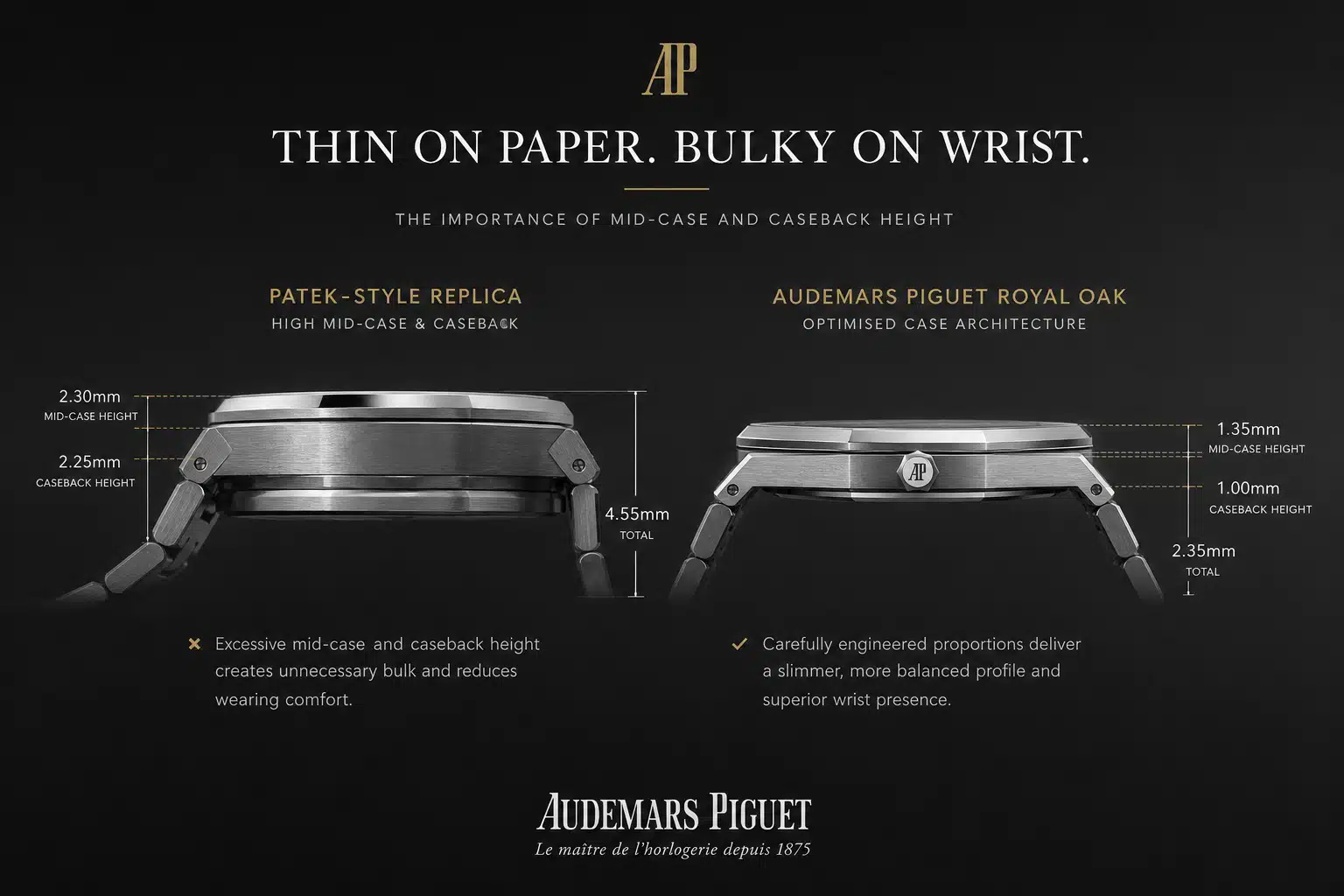
How Movement Height Turns Into Case Thickness
Movement thickness does not stay hidden inside the watch. It becomes case thickness through a stack of parts that all need physical space. The movement sits below the dial, the hands need clearance above the dial, the rotor needs room to turn, the movement spacer must hold everything securely, and the caseback needs enough depth to close without rubbing. If one layer is taller than expected, the case maker has to find room somewhere.
On a thick watch, that extra room can sometimes be absorbed without changing the look too much. On a Nautilus or Aquanaut-style case, there is far less visual margin. A thicker movement may require a deeper caseback, a taller mid-case shape, a slightly altered dial position, or a less elegant transition from bezel to case. This is what makes a replica too thick even when the front view looks well executed.
The important point is that the movement is not just a reliability decision. It is a case design decision. A thinner movement gives the case maker more freedom to keep the original flatness and proportion. A taller movement forces compromises, and those compromises usually show from the side before they show anywhere else.
Movement trust in this category depends on understanding what the movement claim actually describes: a clone-style architecture, a decorated movement, a Miyota-based configuration, an ETA-style route, or simply a market name used by sellers. A buyer should avoid treating those names as official brand-caliber claims and instead ask how the chosen route affects dial height, rotor clearance, gasket space, caseback depth, and real serviceability.
Movement descriptions in the replica market should be checked carefully because they may refer to layout, decoration, clone architecture, or seller terminology rather than an official brand-manufactured caliber. A DD324-style or DD330-style claim should therefore be read as a replica-market movement route, not as proof of a genuine Patek Philippe caliber, official service compatibility, or identical long-term performance.
The Movement Is Only One Layer of the Thickness Stack
Buyers sometimes compare movement height as if the case can be calculated by adding only one number. That is not how the watch is built. The movement is the main layer, but it is surrounded by other layers that matter: dial thickness, hand stack height, calendar clearance, movement spacer, retaining structure, rotor clearance, gasket position, crystal seating, and caseback shape.
This stacking effect explains why two replicas using similar-looking movements can still wear differently. One version may distribute the height better, with a flatter caseback and cleaner mid-case line. Another may solve the same internal problem by pushing the caseback downward, making the watch sit higher on the wrist. The total thickness number matters, but the distribution of that thickness matters just as much.
For thin Patek sports watches, the most damaging compromise is not always the largest measured number. It is often where the extra height appears. Extra thickness under the caseback changes how the watch sits. Extra height in the mid-case changes the side silhouette. Extra space above the dial can disturb the relationship between crystal, bezel, and hands. A buyer looking only at the spec sheet may miss the flaw that becomes obvious on the wrist.
Why Gaskets and Caseback Clearance Cannot Be Ignored
A replica case still has to be assembled as a working watch. Even if a factory wants a thinner case, the watch needs enough space for the gasket, caseback threading or fastening structure, movement stability, and rotor clearance. If the case is cut too aggressively thin without respecting those needs, the result can be poor assembly tolerance, rubbing, pressure on the movement, or inconsistent closing of the caseback.
This does not mean buyers should assume strong water resistance. Replica watches should not be treated as guaranteed waterproof unless properly tested by a competent watch technician. The point is more basic: a case needs structural room to function. If the chosen movement is too tall for the intended case profile, the factory must either increase external thickness or accept internal risk. Neither option is ideal on an ultra-thin sports design.
This is why “thin case” claims should be read carefully. A visually thin case is only useful if the movement, spacer, gasket fit, and caseback clearance are all compatible. A watch that looks thin in one photo but has poor internal clearance is not automatically the better buy. The safer version is the one where movement height and case construction make sense together.
Water resistance should not be assumed from the model name, case shape, screw-down appearance, or similarity to a genuine reference. Buyers should confirm whether the specific replica watch has been tested, what kind of test was performed, and what the seller’s policy actually covers, while treating any thin replica case more cautiously around water than a genuine watch serviced through official brand channels.
Movement Route to Verify
Before judging a Patek replica by exterior photos alone, buyers should confirm the actual movement route. Factory shorthand can be vague, and the same model name may appear in different versions with different internal architecture. A listing may emphasize “upgraded movement” or “latest version,” but those words do not explain whether the movement supports the correct case profile.
The practical question is simple: does the movement route allow the case to stay thin without creating a bulky caseback or distorted mid-case? If the seller or factory description cannot clearly identify the movement type, the buyer should be more cautious. For this category, movement route is not a minor technical detail. It is the reason the case either looks slim or looks inflated.
DD324, DD330, Miyota 9015, and Decorated Movement Routes
Patek replicas are often discussed through movement names because the movement affects more than timekeeping. It controls how thin the case can be, how the caseback is shaped, how the rotor behaves, and how convincing the watch looks through a display back. The mistake is assuming that the most impressive-sounding movement name automatically creates the best replica. In practice, the movement route has to be judged by architecture, execution, batch consistency, and how well it supports the case.
The main routes buyers usually encounter are DD324 movement builds, DD330 movement builds, Miyota 9015-based builds, and decorated movement options. Each route has a different tradeoff. Some are chosen because they better support slim Patek-style case construction. Others are chosen because they are familiar, practical, or easier to maintain. Decoration can improve appearance through the caseback, but it does not automatically fix movement height or case profile.
The strongest buyer judgment is this: for a thickness-sensitive Patek replica, the movement that looks nicest in a listing photo is not always the movement that produces the best side profile. The real question is whether the movement architecture helps the case remain thin without forcing awkward caseback depth or a bulky mid-case.
There is also a daily-ownership side to this decision. A buyer who wants the most visually accurate case may accept a more specialized movement route if it supports the correct thin profile, while a buyer who wants easier servicing may prefer a more familiar movement even if the case is slightly less elegant. Neither priority is automatically wrong. The mistake is buying a movement label without deciding whether the goal is side-profile accuracy, quieter daily wear, simpler servicing, or the most convincing display-back appearance.
Movement Transparency Note: Movement references in this article describe replica-market movement routes, architecture, and packaging behavior, not official Patek Philippe calibers unless supported by verifiable brand documentation. Buyers should judge the specific version by visible side-profile results, movement height, rotor clearance, caseback depth, and service expectations rather than assuming a movement label proves case accuracy.
DD324 and DD330 Routes: Why Buyers Associate Them With Better Thinness
DD324 and DD330 routes are popular because buyers associate them with more Patek-style architecture. When executed well, these clone movement routes can support slimmer case construction, while hacking seconds behavior remains a related technical detail when comparing movement authenticity, than a movement that needs heavy modification or thick decorative layering. That is why they often appear in discussions about better Nautilus and Aquanaut case accuracy.
The advantage is not magic. A movement route that better matches the intended layout gives the case maker more freedom to keep the caseback shallow, preserve the mid-case shape, and maintain the flat visual line that Patek sports watches require. This is especially important when the original model is known for being thin. A movement that fits the concept of the watch helps the exterior look less forced.
Still, buyers should not treat every DD324 movement or DD330 movement claim as automatically superior. Version execution matters. A poorly finished or poorly regulated clone movement can still bring ownership frustration. A factory can also use the right movement label while making case compromises elsewhere. The better question is not “does it say DD324 or DD330?” but “does this specific version show the correct side profile, reasonable caseback depth, and stable movement behavior?”
Miyota 9015 Routes: Practical Movement, Possible Case Compromise
The Miyota 9015 has a real appeal in replica watches. It is widely used, relatively familiar, and often more practical than many buyers expect. For some models, a Miyota-based route can be a rational choice because the movement is known, serviceable in many markets, and not overly exotic. The problem is that practical reliability does not automatically equal Patek case accuracy.
Miyota’s official specifications list the 9015 as an automatic movement with hacking seconds, hand-winding capability, 24 jewels, a 28,800 vibrations-per-hour frequency, an approximate 42-hour running time, and a 3.90mm movement height; those specifications describe the movement family, not proof that any specific replica contains it.[4]
In thin Patek-style cases, the Miyota 9015 route can create compromises depending on how it is mounted and decorated. If the movement needs plates, spacers, or visual changes to imitate a Patek-style layout, the total package may become taller or less efficient inside the case. That can lead to a deeper caseback or a side profile that looks heavier than the original design should allow.
Rotor noise is another buyer-facing issue. Miyota 9015 movements can produce noticeable rotor sound because of their winding design. Some buyers accept this because they value a familiar movement route. Others find it distracting, especially in a watch that is supposed to feel slim, quiet, and refined. For a Nautilus or Aquanaut replica, the Miyota route may be acceptable only if the buyer understands the tradeoff: easier ownership logic in some cases, but not always the best route for the thinnest or most elegant case profile.
Decorated Movements: Visual Appeal Does Not Always Mean Better Architecture
Decorated movements are easy to oversell because they look persuasive through a display caseback. A rotor with Patek-style engraving, bridge decoration, or color-matched finishing can make the watch feel more complete in photos. But decoration sits on top of the movement problem; it does not automatically solve it.
If the base movement is not well matched to the case, decoration may actually make the architecture harder to package. Plates, overlays, rotor changes, and cosmetic bridges can add height or create clearance issues. The result may be a watch that looks more attractive from the back but less accurate from the side. For buyers focused on case thickness, that is the wrong tradeoff.
A decorated movement should be judged separately from movement height, rotor behavior, power reserve, and case fit. It may improve the view through the caseback, but it does not prove the replica has better side-profile accuracy. On a thin Patek replica, a cleaner case silhouette is usually more important than a prettier movement photo. If the decoration makes the caseback deeper, the watch has paid for visual theater with the very thinness that defines the model.
Why 0.3–0.6mm Can Change the Whole Side Profile
On a thin Patek-style sports watch, a small replica watch thickness difference is not small in visual terms. A 0.3mm difference may sound like a rounding error on paper, but on an 8mm-class case it can change the relationship between the bezel, mid-case, caseback, and bracelet line. A 0.6mm difference is even more serious because it often cannot be hidden in one place; the extra height usually spreads into the caseback bulge, the vertical case wall, or the transition below the bezel.
This is why side profile accuracy matters more here than it does on many thicker sports replicas. From the front, a Patek replica can show a clean dial, correct marker spacing, and a convincing bezel shape. From the side, the same watch may suddenly look too bulky on wrist because the case no longer has the flat, compressed architecture that defines the original design. The buyer’s mistake is treating thickness as a specification instead of a proportion.
Why Small Numbers Look Bigger on an 8mm-Class Watch
The thinner the original watch, the less room there is for error. If a thick dive-style replica gains 0.4mm, the added height may disappear into the caseback or crystal profile because the design already has visual mass. On a slim Nautilus or Aquanaut-style case, that same 0.4mm can be obvious because the watch is supposed to sit low, flat, and almost blade-like from the side.
A useful way to think about it: a 0.3mm difference on an 8mm-class watch is proportionally more visible than the same number on a 13mm chronograph. It changes the bezel-to-case ratio, makes the mid-case height look heavier, and can push the caseback lower against the wrist. This is why buyers comparing thin case comparison photos should not dismiss a few tenths of a millimeter too quickly.
The strongest judgment here is simple: if you are buying a Patek sports replica specifically because you like the thin profile, side-view proportion should outrank small dial-printing differences. A slightly imperfect print detail may only bother you in macro photos. A swollen case profile changes the watch every time you wear it.
Where Extra Thickness Usually Shows First
Extra thickness rarely appears as a neat, evenly distributed number. It usually shows first in one of three places: a deeper caseback, a taller mid-case wall, or a heavier transition under the bezel. Each one creates a different visual problem.
- Caseback bulge: The watch may look acceptable from above, but the underside sits higher and creates a lifted wrist presence.
- Slab-sided mid-case: The side wall looks too vertical or too tall, reducing the elegant flatness of the case.
- Bezel-to-case imbalance: The bezel may appear too thin relative to the body below it, making the whole case look heavier.
- Bracelet or strap transition: The first bracelet link or rubber strap may angle downward awkwardly because the case is sitting too high.
The mid-case is often the easiest place to spot the problem in side view QC. A good slim case should not look like a box with a bezel placed on top. The side should show controlled layering: bezel, case band, caseback, then bracelet or strap. When those layers become too tall or too separated, the replica loses the visual thinness even if the measured thickness is not dramatically off.
What to Check Before You Decide
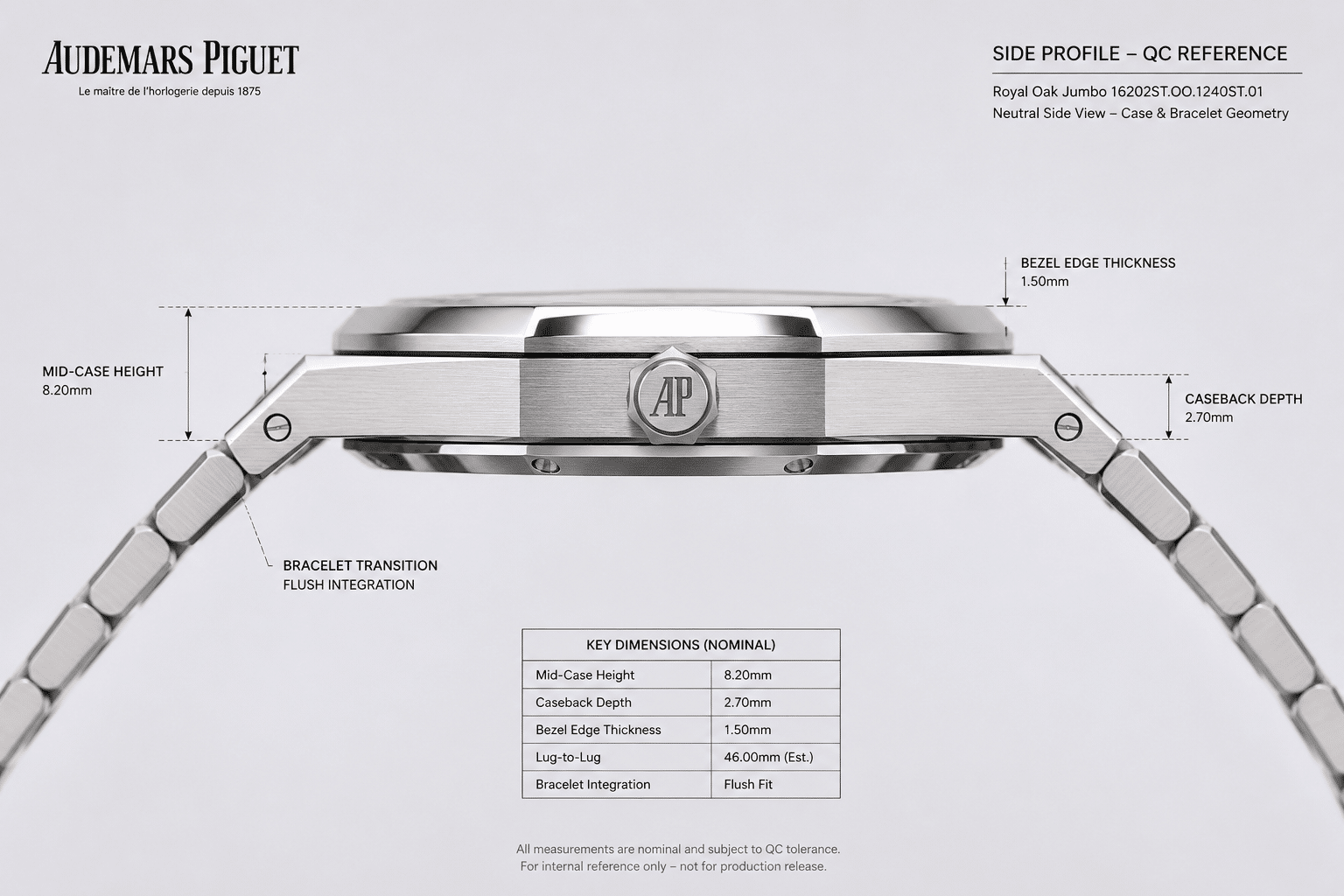
Do not judge side profile accuracy from angled glamour photos. Ask for a neutral side-profile photo taken straight across the case, not tilted downward from the dial side. The photo should show the bezel edge, mid-case height, caseback depth, and bracelet or strap transition in one view. Side view QC is most useful when the camera is level with the case, because angled shots can hide a deeper back or exaggerate a thin bezel.
If verified reference dimensions are available for the exact model, use them as a guide, but do not rely on numbers alone. Two replicas with similar stated thickness can wear differently if one hides height under the caseback while the other keeps a cleaner mid-case shape. For a thickness-sensitive Patek replica, the safer choice is the version that looks balanced from the side, not simply the one with the most attractive front dial photo.
The Nautilus 5711 as the Clearest Thickness Test
The Nautilus 5711 is the model that exposes thickness errors most clearly because the design leaves almost no visual margin. The commonly cited original profile is around 8.3mm thick, and that number matters because the watch’s identity depends on flatness. The 5711 is not supposed to feel like a compact sports watch with a thick body. It is supposed to look wide, thin, and continuous from case to bracelet.
Patek Philippe’s current Nautilus 5811/1G page describes a white-gold case, blue sunburst dial with black gradation, integrated bracelet, and caliber 26-330 S C for the authentic watch; that official information helps frame the Nautilus design family, but it should not be treated as evidence about the discontinued 5711 or any replica version.[1]
For buyers comparing Nautilus 5711 replica thickness, the key question is not only whether the dial color is attractive or whether the horizontal grooves look sharp. The harder question is whether the Patek 5711 case profile still has the flat porthole case effect. If the movement route forces a taller caseback or a thicker Nautilus mid-case, the watch may look correct in a front photo and still feel wrong on the wrist.
Why the 5711 Punishes Thick Movement Routes
The 5711 punishes thick movement routes because the case design is visually horizontal. The bezel is thin, the case flanks are broad and flat, and the integrated bracelet is meant to continue the line of the case rather than distract from it. When extra height is added, the whole watch can start to look stacked instead of compressed.
This is different from a round sports watch where crown guards, bezel height, lugs, and crystal thickness can absorb small dimensional compromises. The Nautilus has fewer hiding places. A 0.5mm increase can make the side wall look heavier, the caseback more pronounced, and the first bracelet link less natural. That is why the best Nautilus replica thickness discussion should always include side-profile QC for 5711, not just dial and bezel photos.
A common buyer misunderstanding is assuming that a sharper dial automatically means the better 5711. For this reference, that is not always true. If one version has a slightly better dial but a visibly thicker case, while another has a more balanced side profile, the second may be the more convincing daily-wear choice for a buyer who cares about the Nautilus silhouette.
Caseback Depth Is Often the Tell
Caseback proportion is often where the compromise becomes visible. A deeper caseback can allow the factory to fit the movement and rotor, but it changes how the watch sits. Instead of lying flat against the wrist, the case rides higher, and the side silhouette gains a rounded or protruding underside that the 5711 should not emphasize.
This is especially important because the caseback is easy to miss in seller photos. Front shots can make almost any good modern Patek replica look slim. A side shot exposes whether the caseback has been used as the storage area for extra movement height. If the underside looks swollen, the dial cannot fully rescue the watch for a buyer focused on 5711 case accuracy.
The practical judgment is direct: if the caseback depth looks wrong in a neutral side photo, do not talk yourself into the watch because the dial looks clean. On a Nautilus 5711-style replica, caseback bulk is not a minor underside detail; it changes the whole wrist profile.
Bracelet Flow Makes the Case Look Thicker or Thinner
The integrated bracelet can either help or hurt the perceived thickness of the 5711. When the first links leave the case smoothly, the watch looks flatter because the bracelet continues the case line. When the case is too tall or the end-link transition is awkward, the bracelet drops away from the case and makes the head of the watch look thicker.
This is why a 5711 should not be judged as a case alone. The case and bracelet form one visual object. If the caseback sits too deep, the bracelet may appear to start too high or fall too sharply from the case. That changes the famous Nautilus flow even if the bracelet finishing itself is acceptable.
At Clean VS Factory, we usually treat this as a proportion question rather than a factory-name question. A famous factory label does not automatically solve the 5711 if the current version’s caseback and bracelet transition do not work together. For this model, side profile and bracelet flow are part of the same decision.
How the Aquanaut Shows Similar Thickness Problems Differently
The Aquanaut has a different personality from the Nautilus, but it is not free from the same thickness problem. Key time-and-date Aquanaut models are commonly referenced around an 8.1mm original profile, which means excess movement height can still become visible quickly. The difference is where the eye catches it.
Patek Philippe’s official Aquanaut 5167A page lists the authentic model with a steel case, composite strap, date, sweep seconds, and an 8.1mm height, which supports the point that this time-and-date Aquanaut is designed as a relatively thin sports watch; it does not prove that a replica has the same dimensions or strap quality.[2]
With an Aquanaut replica, the rubber strap and rounder case edge can hide some harsh transitions that would be obvious on a Nautilus bracelet. But that does not mean the watch can tolerate a bulky case. Extra height often appears through caseback height, side wall thickness, strap angle, and wrist gap. If the Aquanaut looks too tall from the side, it loses the casual flatness that makes the design work.
Why the Rubber Strap Changes the Visual Test
The rubber strap changes how buyers should inspect the watch. On a Nautilus, the bracelet flow makes excess case height obvious because the bracelet is part of the case architecture. On an Aquanaut, the tropical strap is more flexible, so a thicker case may look acceptable from above. The problem often appears only when the watch is viewed at wrist level.
If the case is too tall, the strap may leave the case at a steeper angle or create a visible gap before it settles around the wrist. This strap gap from thick case construction is one of the more useful Aquanaut side profile QC signs. It tells you that the issue is not just a number on a spec sheet; the case height is affecting how the watch wears.
Aquanaut buyers should be careful not to overvalue top-down photos. A clean dial and well-cut strap pattern can make the watch look strong in listing images. The real test is whether the rubber strap fit looks natural from the side and whether the caseback sits low enough to keep the watch close to the wrist.
Where Extra Height Appears on Aquanaut Replicas
On Aquanaut replicas, extra height usually shows in the underside first. A deeper caseback can make the watch sit like a small platform on the wrist rather than a thin sports watch. The rounded case edge may soften the look from certain angles, but it cannot fully hide a tall underside if the movement stack has forced the caseback down.
The side wall is the second place to check. If the mid-case looks too thick or too vertical, the Aquanaut loses the slightly rounded, low-profile case feel that separates it from heavier rubber-strap sports watches. The case does not need to look fragile, but it should not look like the rubber strap is attached to a thick puck.
The Aquanaut is sometimes more forgiving than the Nautilus in photos because the strap breaks up the visual line. On the wrist, however, it can be just as revealing. If the strap lifts away, the caseback bulges, or the case wall looks tall under neutral lighting, the watch is signaling that the movement and case architecture are fighting the original thin design.
Bracelet Flow, Caseback Proportions, and the Illusion of Thinness
Measured thickness is only the easiest number to quote. It is not always the best way to judge whether a Patek replica looks thin on the wrist. Two watches can be close on a caliper and still wear differently if one spreads its height through a shallow caseback and smooth mid-case curve, while the other hides the problem poorly in a bulky underside.
This is why bracelet flow and caseback proportions matter so much on Patek-style sports replicas. A Nautilus-style case should not look like a round watch head with a bracelet attached to it. The case, flank, first link, and bracelet should read as one flat, continuous object, because exterior architecture has to support the same credibility expected from Patek Philippe clone movements when the watch is judged as a complete system. On an Aquanaut-style case, the rubber strap should leave the case naturally without lifting sharply or creating an obvious wrist gap. If the watch looks thick on wrist, the problem is often not the number alone; it is where the height has been placed.
Measured Thickness Versus Visual Thinness
A watch can measure acceptably but still look wrong if the proportions are concentrated in the wrong area. On thin Patek sports designs, visual thinness comes from distribution: the bezel should not sit too high, the mid-case should not look slab-sided, and the caseback should not hang below the case like an added dome. The best-looking replica watch versions usually make the height feel integrated rather than stacked.
This is the non-obvious part many buyers miss. A slightly thicker case with well-shaped flanks can look more convincing than a nominally thinner case with a sharp caseback bulge. Calipers tell you total height; the side silhouette tells you whether the watch still has the flat, elegant character buyers expect from a Nautilus or Aquanaut. For this category, side appearance deserves more weight than a single quoted thickness figure.
How a Deep Caseback Changes Wrist Presence
A deep caseback changes how the watch sits before anyone notices the dial. If the caseback sits too high, the entire watch rides above the wrist and loses the low, planted feel that defines these designs. From above, the dial and bezel may still look attractive. From a wrist-level angle, the watch starts to look top-heavy, especially if the mid-case is vertical and the underside is visibly rounded.
This is one reason a Patek replica can disappoint even when the front photo looks strong. The buyer expected a slim sports watch, but the caseback proportions make it wear like a thicker automatic dress-sport watch. On the wrist, that extra underside height changes the shadow line under the case, increases the gap at the edges, and makes the watch feel less integrated with the bracelet or strap.
Why Bracelet or Strap Transition Matters
For a Nautilus-style replica, bracelet flow is part of the case accuracy. The first links should drop from the case with a natural angle, not fight against a tall case wall. If the end link transition looks abrupt, the bracelet does not flow, and the case appears thicker than it may actually measure. The eye reads the break between case and bracelet as bulk.
For an Aquanaut-style replica, the same issue appears through strap angle. A rubber strap can hide some side thickness better than an integrated steel bracelet, but it also exposes underside problems quickly. If the strap lifts away from the wrist because the caseback is too deep, the case looks taller and less settled. A good strap fit makes the watch look flatter; a poor strap fit makes even a decent case dimension look suspicious.
At Clean VS Factory, we usually treat this as a proportion check rather than a number check. A buyer comparing two super clone watch versions should ask which one sits flatter and flows better from the case, not only which seller claims the lower millimeter measurement.
Factory Claims, Version Updates, and Thickness Numbers
A factory thickness claim can be useful, but it is not proof by itself. “Updated case” may mean the dial color changed, the clasp engraving improved, the movement decoration looks better, or the caseback was revised. Unless the update is tied to a specific model, movement route, batch, and side-profile photo, the claim is too vague to decide a Patek replica purchase.
The sharper question is not simply, “Is the new version thinner?” It is: thinner where? A replica version update that reduces the top crystal height but leaves a deep caseback may not improve wrist presence. A better movement route may allow a flatter case, but only if the factory actually redesigned the case around it. Thickness numbers need context, and old forum praise is not enough if the current batch uses a different movement or caseback structure.
Factory names are useful market references, but they do not guarantee identical quality across every model, batch, or version. A factory comparison is most useful when it is tied to the exact reference, movement configuration, case shape, dial execution, bracelet or strap construction, and available QC evidence rather than treated as a universal ranking.
Why “Updated Case” Needs More Detail
“Updated case” is one of the most overused phrases in the replica watch market. It sounds specific, but it often hides several different possibilities. The update may involve a slightly revised bezel edge, a different caseback engraving, a new gasket arrangement, or no meaningful thickness change at all. For thin Patek sports watches, the only update that matters here is one that improves the side silhouette and wearing profile.
Buyers should ask for evidence that connects the update to case dimension and side-profile accuracy. A front photo cannot prove that the mid-case curve improved. A decorated movement photo cannot prove that the caseback became shallower. A seller claim about an upgraded movement does not automatically mean the watch now wears thinner. The movement route and the external case execution have to support each other.
Batch Differences Can Matter More Than Old Reviews
Older reviews can be helpful for understanding a model’s history, but they can also mislead buyers when factories change movement supply, caseback design, or production batches. A review from a previous version may show a watch that was thinner, thicker, or simply built around a different internal layout. In this category, a six-month-old comparison can be less useful than current QC photos from the actual watch being offered.
This is especially important with Patek replica case thickness because small adjustments can change the side profile without being obvious in product listings. One batch may have a slightly cleaner mid-case line, while another may show a heavier underside. Factory reputation helps narrow the search, but it does not replace version accuracy. A strong factory name attached to the wrong batch is still a risk.
Price should be read with the same caution. A higher-priced Patek replica may reflect a thinner movement route, better finishing, tighter availability, seller margin, or greater after-sale risk being built into the quote. It does not automatically prove a better case profile. For this category, the buyer should connect price to visible and verifiable improvements: current-batch side photos, confirmed movement architecture, caseback depth, bracelet or strap fit, and evidence that the watch actually sits thin on the wrist.
Prices can change by factory label, version, movement, seller channel, availability, and after-sales support, so exact comparisons should be verified at the time of purchase. Buyers should also confirm return terms, repair options, water-resistance testing, shipping expectations, customs risk, and after-sales support directly with the seller instead of assuming those points from a factory label or product description.
Version Details to Confirm
- Movement route: Confirm whether the watch uses the claimed DD-style route, Miyota-based route, or decorated movement route. Do not rely only on shorthand names.
- Measured case thickness: If a number is provided, ask whether it includes crystal and caseback and whether it applies to the current batch.
- Side-profile photo: Look for a level side image showing bezel, mid-case, caseback, and bracelet or strap transition.
- Caseback design: Check whether the caseback is flatter, deeper, or simply decorated differently.
- Batch timing: Confirm that the photos and specifications are for the current version, not an older review sample.
The safest interpretation is cautious: a replica version update may be real, but it only matters if it improves the specific weakness you care about. For thickness-sensitive Patek models, that means the side profile must support the claim.
Before making a decision, buyers should review real QC photos where available, including dial printing, hand alignment, datewheel centering, case thickness, side profile, caseback depth, bracelet fit, strap angle, clasp engraving, and movement photos when relevant. Factory labels, stock photos, and “latest version” wording are not enough for a reliable thickness judgment.
Verification Note: When possible, buyers should review real watch photos rather than relying only on stock images, factory labels, or older comparison posts. For thin Nautilus and Aquanaut-style replicas, side-profile photos, caseback depth, bracelet or strap transition, movement information, and current-batch measurements can help reduce uncertainty before a decision.
Side-Profile QC Checklist for Patek Replica Buyers
Patek replica QC photos should not be judged like standard front-facing catalog shots. For Nautilus and Aquanaut-style watches, side-profile QC is the main thickness test. If the watch looks too tall from the side, dial accuracy alone should not rescue the decision. A clean dial on a bulky case still misses the design logic of these models.
The goal is not to demand perfection. Slight variation is normal in replica watches, and not every small difference will matter in daily wear. The problem is when the caseback depth, mid-case thickness, bracelet transition, or strap angle changes the whole wrist profile. Those are not minor macro-photo flaws; they affect how the watch wears every time it is on the wrist.
QC photos can reduce uncertainty, but they do not guarantee perfection or prove that a replica watch is genuine. Their best use is practical: checking visible details, asking better questions about the supplied version, and confirming seller policies before ordering.
Front Dial Photo: Useful but Not Enough
A front dial photo is useful for checking alignment, marker placement, date position, hand finish, and general dial quality. It is not enough to evaluate case thickness. From straight above, even a bulky Patek replica can look clean because the caseback and underside are hidden.
This is where many buyers make the wrong call. They approve a watch because the dial looks strong, then notice later that the case sits too high or the bracelet does not fall naturally. For thin Patek sports replicas, front-view beauty is only the first filter. It should never be the final decision.
Side Profile Photo: The Most Important Thickness Check
The most useful photo is a straight, level side-profile shot taken in neutral lighting. It should show the crystal height, bezel edge, mid-case wall, caseback depth, and the first section of the bracelet or strap. Angled photos can hide bulk, especially when the watch is tilted downward or shot from above.
Look for balance. The bezel should not look overly tall compared with the mid-case. The mid-case should not appear like a thick vertical slab. The caseback should not protrude so much that it visually becomes a second case underneath the watch. If the side silhouette looks heavy before the watch is even on the wrist, the issue will usually become more obvious in daily wear.
Caseback and Wrist-Angle Photos: Where Bulk Usually Appears
Caseback photos help confirm whether the underside is shallow and integrated or visibly deep. A display caseback can be attractive, but the real question is whether its depth disrupts the case proportions. A beautiful-looking movement through the back does not compensate for a caseback bulge that makes the watch sit too high.
Wrist-angle photos are equally important because they show how the watch behaves under real wearing conditions. On a Nautilus-style replica, check whether the bracelet starts smoothly from the case or drops awkwardly after a thick case wall. On an Aquanaut-style replica, check whether the rubber strap hugs the wrist or lifts away because the caseback is pushing the watch upward.
Choosing Between Photo Accuracy and Daily Wear
Some Patek replicas are built to look strongest in seller photos: clean dial, attractive movement decoration, sharp engraving, and a polished caseback view. Those details can matter, but they do not always produce the best daily-wear watch. A version that photographs well from the front may still feel less satisfying if the case rides high, the rotor is noisy, the strap angle is awkward, or the movement route creates servicing concerns.
For first-time buyers, the safer decision is often the watch with fewer hidden compromises rather than the one with the most impressive listing language. A slightly less decorative movement may be acceptable if it allows better case packaging and a calmer ownership experience. A small dial flaw that only appears under macro inspection may matter less than a caseback bulge that changes the watch every time it is worn. The best choice depends on the buyer’s goal: close-up visual comparison, comfortable daily wear, easier maintenance, or the thinnest possible side profile.
A realistic ownership view is important for any thin super clone watch. Even when the case profile is strong, buyers should not assume genuine-watch water resistance, official service compatibility, long-term movement stability, or identical finishing under close inspection. The responsible purpose of movement and thickness traceability is to help buyers understand quality and risk, not to represent a replica as an authentic watch or as a substitute for authorized retail.
Red Flags Before Buying
- Bulky caseback: The underside looks deep enough to change the whole side silhouette.
- Unusually tall mid-case: The case flank appears slab-sided instead of slim and controlled.
- Poor bracelet flow: The first links do not transition naturally from the case.
- Strap lifting away from the wrist: The Aquanaut-style strap angle suggests the caseback sits too high.
- Unclear movement route: The seller cannot confirm what movement architecture is inside the watch.
- Only front-facing QC photos: The most important thickness evidence is missing.
The practical rule is simple: if you care about Patek case accuracy, do not approve a watch without seeing the side. A thin-looking dial photo can hide the exact flaw that makes the replica feel wrong in real use.
Compliance Boundaries for Thickness Comparisons
The purpose of comparing movement height, case thickness, and side-profile details is buyer education, not authentication avoidance. A strong super clone may look convincing in normal wear, but close inspection can still reveal differences in finishing, movement architecture, case proportions, bracelet feel, dial details, or service compatibility. Readers should not use thickness information to represent a replica watch as a genuine Patek Philippe watch.
Factory and movement information is most useful when it helps buyers avoid overpaying, misunderstanding a version, or accepting an unsupported seller claim. It should not be treated as proof of official brand approval, genuine movement origin, professional authentication passability, resale legitimacy, or guaranteed long-term performance. Broader public resources from the USPTO explain counterfeit-goods concerns around protected marks, and customs resources identify intellectual-property enforcement as a trade issue; those sources provide general risk context rather than model-specific buying advice.[5][6]
Disclosure: This article is for general educational and comparison purposes only. Replica watches are not genuine products from the original luxury brands, and brand names are used only to identify reference designs or comparison topics. Factory names, movement descriptions, prices, availability, QC details, seller policies, and version information can change, so readers should verify important details with the seller before making a purchase decision. Replica watches should not be represented, resold, or used as genuine watches.
References
[1] Patek Philippe, “Nautilus 5811/1G official specifications,” official brand reference for the authentic Nautilus 5811/1G model and collection details, available at Patek Philippe Nautilus 5811 official specifications.
[2] Patek Philippe, “Aquanaut 5167A official specifications,” official brand reference for the authentic Aquanaut 5167A model, including case, strap, functions, and dimensions, available at Patek Philippe Aquanaut 5167A official specifications.
[3] Rolex, “Submariner 124060 official specifications,” official brand reference for the authentic Submariner 124060, including case size, materials, and professional dive-watch specification context, available at Rolex Submariner 124060 official specifications.
[4] Miyota, “Caliber 9015 official movement specifications,” official movement manufacturer reference for Miyota 9015 dimensions, frequency, jewel count, running time, hacking, and hand-winding features, available at Miyota 9015 official movement specifications.
[5] United States Patent and Trademark Office, “Counterfeit Goods Basics,” official educational resource on counterfeit goods and trademark-related concerns, available at USPTO Counterfeit Goods Basics.
[6] U.S. Customs and Border Protection, “Intellectual Property Rights,” official customs resource on intellectual-property enforcement and trade-related IPR issues, available at U.S. CBP Intellectual Property Rights.