
Rotor noise in a Patek Philippe replica is easy to misjudge because a noisy automatic movement is not always a faulty one. Thin Patek-style cases can make rotor motion sound louder than expected, and Miyota 9015-based builds often have a busier, freer-spinning feel than DD324-style clone movements, so acceptable timegrapher numbers should be considered alongside acoustic behavior rather than treated as a separate diagnosis. The important question is not simply whether the rotor can be heard, but whether the sound is smooth, consistent, and matched by normal winding, power reserve, and timekeeping.
This article helps separate acceptable operating noise from signs that deserve caution before continued wear. A brief whir, soft spin, or mild vibration may be reasonable in the right movement, while scraping, grinding, hard knocking, visible wobble, sudden new noise, or weaker performance can point to friction, loose parts, bearing issues, or movement shift. The goal is to judge the movement by behavior, not anxiety over volume alone.
| What You Notice | Likely Meaning | Buyer Action |
|---|---|---|
| Smooth brief whirring | Often normal rotor movement | Monitor if performance stays stable |
| Busy free-spinning sound in Miyota 9015 | Common in thin Patek-style cases | Accept if no wobble or power issue |
| Calm DD324-style clone becomes rough | Possible change in seating or friction | Request inspection before heavy wear |
| Scraping or grinding | Possible metal contact or dryness | Stop wearing and have it checked |
| Hard knocking or loose rattle | Possible rotor screw, bearing, or movement shift | Avoid shaking; seek service advice |
| Noise plus weak winding or poor reserve | Noise may be linked to mechanical fault | Do not judge by sound alone; inspect performance |
Quick Questions Before You Read
Q: Is rotor noise always a bad sign in a Patek replica?
No. Smooth, consistent rotor sound can be normal, especially in thin cases or Miyota-based builds.
Q: What sound should make me worry first?
Scraping, grinding, hard knocking, loose rattling, or a sudden new noise deserves caution.
Q: Does movement type change the judgment?
Yes. Miyota 9015 movements often sound busier, while DD324-style clones are generally expected to feel calmer.
Q: Should I open the watch to check the rotor?
No. If the noise is harsh, worsening, or paired with poor performance, use a watchmaker or seller inspection instead.
Editorial Perspective: For rotor noise, the most useful buyer judgment is not whether a seller calls the watch a high-grade Patek replica or whether the factory has a strong name on other models. At cleanvsfactory.com, this type of issue is treated as a movement-and-use question: a Miyota-based watch may be acceptable with a smooth free-spinning rotor, while a DD324-style build with scraping, wobble, or weak winding deserves more caution. Factory labels, QC clips, and seller descriptions are useful signals, but they should be checked against movement behavior, case thickness, service reality, and how the buyer plans to wear the watch.
Why a Patek Philippe Replica Rotor Makes Noise at All
A Patek replica rotor noise is not automatically a bad sign. Any automatic movement has a winding rotor inside the case, and that rotor is designed to move when your wrist moves. Its job is simple: swing or spin with motion, transfer energy through the winding system, and help keep the mainspring charged. A completely silent automatic watch is not a realistic expectation, especially in the replica market where movement type, case construction, and assembly quality can vary from one version to another.
The important distinction is between normal automatic rotor sound and a sound that suggests mechanical interference. A soft swish, brief spin, or light bearing sound can be part of normal operation. Grinding, scraping, hard knocking, or a loose internal rattle is different. Buyers often panic because the watch looks refined and dressy, especially with Patek-style cases, but the movement inside is still a mechanical system with moving parts.
Because this topic involves replica-market watches, factory names, movement labels, and model references should be read as buyer-facing comparison terms rather than official Patek Philippe affiliation. A replica watch is not an authorized retail product and should not be represented as genuine. The practical purpose of checking rotor noise is to understand quality, risk, and maintenance reality, not to support misrepresentation.
Brand names are used here to identify the genuine reference designs being discussed. A Patek Philippe replica, Nautilus-style replica, Aquanaut-style replica, or Calatrava-style replica is still a replica-market watch, not a genuine brand-manufactured watch from Patek Philippe. Rotor-noise discussion should help buyers understand mechanical behavior and service risk, not imply authenticity, brand approval, or official service compatibility.
The Rotor Is Supposed to Move
The rotor is a weighted semicircular component mounted on a bearing or pivot system. When the watch changes position, gravity and wrist movement cause the rotor to rotate. That motion can create a faint spinning sound, a soft mechanical sweep, or a small vibration through the case. If you hold the watch close to your ear in a quiet room, you may hear more than you would during normal wear.
This is where many owners misjudge the issue. They ask, “Why does my replica watch make sound?” when the better question is, “What kind of sound is it, and does the watch still behave normally?” A smooth rotor noise during movement is not the same as a damaged rotor. In fact, a watch can be relatively audible and still wind properly, keep acceptable time, and show no signs of a movement problem.
Patek-style replicas can make rotor sound feel more noticeable because the visual design creates an expectation of silence. Slim cases, polished casebacks, and dress-watch proportions do not leave much acoustic buffer between the movement and the wearer. The result is that a normal automatic rotor sound may feel louder than it would in a thicker sports watch.
Noise Alone Is Not the Full Diagnosis
Rotor volume by itself is a weak diagnosis. A noisy automatic watch is not necessarily defective, and a quiet one is not automatically healthy. What matters more is the character of the sound, whether it has changed, and whether it comes with performance symptoms.
A consistent light rotor sound from day one is usually less concerning than a new harsh noise that appears after shipping, impact, or several weeks of wear. The same logic applies to vibration. Mild movement vibration can be normal, especially when the rotor spins freely, but a heavy clunk or shifting sensation inside the case deserves more caution.
For a practical first check, focus on four things: whether the sound is smooth, whether it is consistent, whether the watch winds and runs normally, and whether the noise feels like spinning rather than rubbing. If those points are acceptable, the rotor noise is often part of the ownership experience rather than an immediate defect.
Miyota 9015 Rotor Sound Versus DD324 Clone Rotor Behavior
The movement route changes the whole noise expectation. Many Patek Philippe replica watches have used Miyota-based movements, while higher-spec versions may use a DD324-style clone movement depending on the model and factory version. These two routes can feel very different on the wrist, so judging all Patek replica movement noise by the same standard leads to bad conclusions.
The practical judgment is this: Miyota rotor noise is often louder without being defective, while DD324 rotor noise should be judged more cautiously if it sounds rough, uneven, or newly developed. That does not mean every DD324-style movement is quiet or every Miyota is a problem. It means the baseline expectation is different.
Miyota’s official 9015 specifications identify it as a slim automatic movement with hand-winding and stop-seconds functions, which helps explain why it is commonly chosen for thin automatic builds; those specifications do not prove that any particular replica watch actually contains a genuine Miyota 9015 or that its rotor has been assembled correctly.[1]
Movement Transparency Note: Movement references in this article describe replica-market movement routes or configurations. A Miyota-based claim, DD324-style claim, or clone movement label should be checked against the specific watch, QC evidence, and service reality rather than treated as proof of an official Patek Philippe caliber or guaranteed assembly quality.
Why Miyota-Based Patek Replicas Often Sound Busier
Miyota 9015 rotor sound is one of the most common complaints in automatic replica watches. The movement is known for a rotor that can spin freely and quickly in one direction, creating a brief whirring or “busy” sensation. In a thicker watch, that sound may be easier to ignore. In a Patek-style case, especially a thinner dress or Nautilus-style build, it can feel much more obvious.
This is not always a defect. A Miyota-based Patek replica may produce a fast spinning sound after wrist motion, a faint vibration, or a rotor noise that becomes noticeable when the room is quiet. If the watch winds correctly, keeps stable time within reasonable replica expectations, and the sound is smooth rather than harsh, the owner usually does not need to treat the noise alone as a failure.
The common mistake is expecting the ownership feel of a visually refined Patek-style watch to match the silence of a much more expensive genuine movement architecture. The Miyota route can be serviceable in some builds, but it often gives away more mechanical presence. Buyers who are sensitive to sound should understand this before choosing a Miyota-based version, not after the watch arrives.
Why DD324 Noise Should Still Be Judged Carefully
A DD324-style clone movement is usually expected to feel more integrated in a Patek replica, especially when the movement is properly assembled and matched to the case. In many versions, the rotor behavior may seem calmer than a Miyota 9015. That quieter expectation is exactly why rough DD324 rotor noise should not be dismissed too quickly.
DD324 rotor noise can still happen. A dry rotor bearing, weak lubrication, imperfect assembly, rotor wobble, or caseback contact can create sound even in a clone-style movement. The warning is not simply that the rotor is audible. The concern is when the sound becomes scratchy, uneven, clicky, or noticeably different from what it was when the watch first arrived.
For buyers comparing Patek replica movement options, the DD324 route is not a magic cure for every ownership issue. It may give a more convincing movement layout and a calmer rotor feel in some models, but it can also be less forgiving if assembly quality is poor. A clone movement that sounds like metal rubbing metal deserves closer attention than a Miyota rotor that simply free-spins smoothly.
Movement Route to Verify
Before judging rotor noise, confirm what movement route the watch actually uses. Seller descriptions can be vague, and factory names alone do not always tell the full story. Ask whether the watch is Miyota-based, DD324-style, or another automatic movement configuration, then judge the noise against that movement’s normal behavior.
During pre-purchase research or QC, this matters more than many buyers realize. If you expect a quiet DD324-style clone and receive a Miyota-based build, the rotor may sound “too loud” only because your expectation was wrong. If you knowingly choose a Miyota route, a smooth free-spinning rotor is easier to accept as part of the tradeoff.
A traceable movement judgment should connect the claim to observable behavior: rotor smoothness, winding response, power reserve, crown feel, caseback clearance, and whether the sound changes over time. A movement name by itself cannot show lubrication condition, rotor screw tension, or how well the movement holder fits the case. That is why the same movement route can feel acceptable in one watch and questionable in another.
Movement Choice Matters More Than Factory Name for Rotor Noise
For rotor noise complaints, factory reputation is only a starting point. A factory may make a strong-looking Nautilus-style case or a convincing dial, but that does not automatically mean every movement configuration from that factory will feel quiet, refined, or easy to service. The same factory name can appear on different batches, different movement routes, or different versions of the same model, and the rotor behavior may not be identical across them.
This is especially important for buyers comparing price levels. A higher-priced Patek replica may cost more because of case finishing, dial execution, movement decoration, availability, seller margin, or after-sale support. It does not automatically prove the rotor will be quieter or the movement will be easier to maintain. If rotor sound is a major concern, the buyer should compare the actual movement route, case thickness, caseback style, and service options rather than relying only on the factory label.
Visual accuracy and daily ownership comfort are also separate priorities. A DD324-style movement may look more appropriate through a display back and may create a calmer ownership feel in some versions, but it can be more complicated to handle if parts or service access are limited. A Miyota-based build may be less visually convincing and more audible, yet it can be more familiar to service and more predictable for some daily-wear buyers. The better choice depends on whether the buyer values movement appearance, noise level, serviceability, or simple reliability most.
For first-time Patek replica buyers, this distinction can prevent a common mistake: choosing the most impressive seller description and then being disappointed by normal mechanical behavior. A quieter movement is not always the lowest-risk movement, and a louder rotor is not always a defective movement. The useful question is whether the movement’s known behavior fits the buyer’s tolerance for sound, maintenance, and daily use.
Factory-market names such as 3KF, PPF, ZF, and similar labels can be useful references when discussing Patek-style replicas, but they should not be treated as official luxury-brand affiliations or automatic guarantees across every model. A factory comparison is most useful when it is tied to the exact reference, version, movement route, case construction, and visible execution rather than treated as a universal ranking.
Prices can change by factory label, version, movement configuration, seller channel, availability, and after-sales terms, so a more expensive listing should not be treated as proof of a quieter rotor or better assembly. If two watches are being compared, the practical comparison should be like-for-like: same reference style, same movement route, same caseback type, similar QC evidence, and clear seller communication about what happens if scraping or knocking appears on arrival.
Normal Rotor Noise: What Owners Usually Do Not Need to Panic About
Normal rotor noise in a Patek Philippe replica is usually smooth, brief, and linked to movement. It may appear when you rotate your wrist, pick up the watch, or hold it near your ear in a quiet room. During evaluation, movement thickness and case accuracy can serve as a related fit standard, but the sound itself should not sound like scraping, grinding, or something loose hitting the case. The owner’s job is not to demand total silence, but to separate acceptable mechanical sound from symptoms that change how the watch behaves.
A good rule is simple: if the replica watch rotor sound has been consistent from the beginning, the watch winds normally, the power reserve feels stable, and timekeeping has not suddenly changed, mild rotor sound is usually not worth panic. The more dangerous pattern is not sound itself, but sound plus worsening behavior.
Soft Whirring During Wrist Movement
A soft whirring or light spinning sound during wrist movement can be normal, especially in Miyota-based Patek replicas. The sound may be more obvious when you move the watch deliberately or when the room is silent. This is different from hearing harsh rotor noise during casual daily wear without any unusual movement.
Owners sometimes test the watch too aggressively because they are trying to “find” the problem. That can make a normal rotor sound worse than it really is. A better test is ordinary handling: pick up the watch, rotate it gently, and listen for smoothness. If the rotor spins freely and the sound fades naturally, that is usually less concerning than a sound that catches, scrapes, or knocks.
Light clicking can also be normal in some automatic movements, depending on the winding system and how the rotor engages. The key is consistency. A quiet, repeatable mechanical click during motion is not the same as a random rattle that feels like a loose part inside the case.
Light Vibration Without Timekeeping Problems
Some owners feel a mild rotor vibration through the case. This can happen when the rotor spins quickly, and it is especially noticeable in thinner watches. If the watch starts reliably, winds through normal wear, and keeps time within a stable range, light vibration alone is usually not a reason to reject the watch or assume the movement is defective.
The practical baseline is performance plus feel. A rotor that can be heard but does not interfere with winding is usually acceptable. A rotor that sounds slightly louder in a quiet room but behaves the same every day is usually something to monitor, not panic over. The sound becomes more meaningful only when it changes, gets harsher, or appears with poor winding, short power reserve, stopping, or a rough crown feel.
For daily wear, normal rotor noise is best treated as part of the movement’s character. Patek-style replicas can look elegant while still housing a movement that makes audible mechanical sound. Buyers who understand that difference are less likely to mistake every whir or vibration for a defect.
Warning Signs: Scraping, Knocking, and Loose Movement Symptoms
A bad rotor noise in a Patek Philippe replica is usually not defined by volume alone. A Miyota-based watch can be louder than expected and still be mechanically normal. The concern starts when the sound changes from a smooth spin into scraping, knocking, rattling, or a loose internal feel. Those sounds suggest interference, poor assembly, dryness, or a component that is no longer sitting where it should.
The practical test is simple: normal rotor sound feels like motion; abnormal rotor sound feels like impact or friction. A soft whirr after wrist movement is one thing. A repeated metal-on-metal scrape, a hard knock against the caseback, or a watch that sounds loose inside should not be dismissed as “just rotor personality.” For daily ownership, this distinction matters more than whether the movement is called Miyota, DD324, or another clone-style route.
Scraping or Rubbing Sounds
A rotor scraping sound is one of the clearest warning signs. Scraping may point to rotor rubbing against the caseback, a slightly lifted rotor, poor bearing condition, a loose screw, or a movement that is not seated correctly in the case. The owner cannot diagnose the exact cause by ear, but the sound category is still meaningful: scraping is friction, not ordinary automatic winding.
This is especially important in slim Patek-style replicas because there is less margin between the movement, rotor, spacer, and caseback. If the rotor is making contact, continued wear can turn a small assembly issue into visible wear marks, weaker winding, or movement contamination. A watch with a consistent soft spin can be monitored; a watch with a rough scraping noise should be inspected before being treated as a normal daily wearer.
Knocking, Rattling, or a Loose Feeling
Knocking is different from free-spinning rotor sound. A loose rotor replica watch may produce a dull tap, repeated clack, or uneven rattle when the case changes direction. That can happen if the rotor screw is not secure, the movement holder is not tight, or another internal part has shifted. It may also feel like the movement is moving inside the case rather than the rotor simply rotating.
A useful way to separate the two: normal rotor motion usually has a smooth start and fade. Loose movement symptoms feel irregular. The sound may happen at odd angles, appear as a hard stop, or feel like something is hitting the case rather than spinning around a bearing. If the watch also shows a shifting crown feel, inconsistent winding resistance, sudden timekeeping change, or reduced power reserve, the issue moves from “annoying noise” to a likely service-needed problem.
Noise That Appears Suddenly
A noisy rotor defect is more likely when the sound appears suddenly after shipping, a knock, a drop, or a period of otherwise normal wear. A sound that has been present from day one and remains stable is less alarming than a new scrape or knock that arrives overnight. Sudden change usually means something changed physically: lubrication condition, screw tension, rotor position, bearing behavior, or movement seating.
This is where many owners misjudge the situation. They compare the sound to forum comments about Miyota rotor noise and assume all rotor noise is normal. That is too broad. Miyota free-spinning noise can be normal when it is smooth and consistent. A sudden hard knock, new grinding sound, or rotor that feels unbalanced should be treated differently, even if the movement still runs for the moment.
Red Flags Before Continued Wear
Stop wearing the watch and request inspection or service if the rotor noise includes clear scraping, heavy knocking, visible rotor wobble through a display back, winding failure, sudden power loss, or stopping after normal wrist use. These symptoms suggest more than sound preference. They may involve contact, looseness, or reduced winding efficiency.
The strongest judgment here is simple: smooth and consistent can be acceptable; harsh, sudden, or performance-related is not. If a Patek replica sounds loose inside, runs poorly, or gets worse over a few days, continued wear is not the smart test. It is better to pause use before a minor rotor or assembly issue becomes a movement problem.
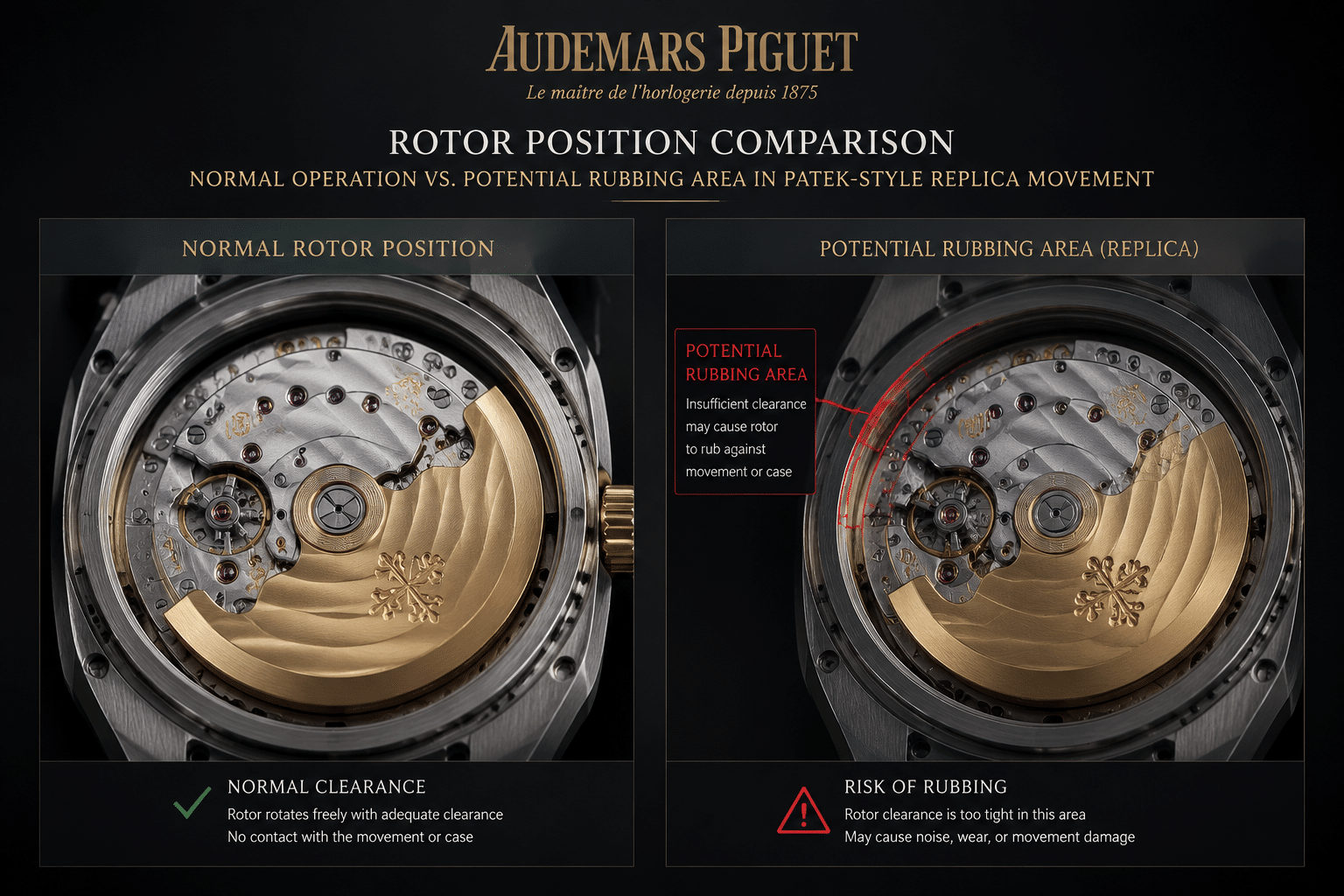
Why Thin Patek-Style Cases Can Make Rotor Noise Feel Louder
Thin case rotor noise is often more noticeable in Patek Philippe replica watches because the case design gives sound fewer places to disappear. A slim Nautilus-style, Aquanaut-style, or Calatrava-style replica can make a normal automatic rotor sound louder than the same movement in a thicker sports case. That does not automatically mean the watch is defective. It means the case is less forgiving.
Patek-style designs create a specific expectation problem. The watch looks refined, flat, and quiet, so the buyer expects the movement to feel equally silent. Replica movement routes do not always match that emotional expectation. A thin dress watch case with a Miyota-based automatic movement may sound busier than its appearance suggests, even when the rotor is functioning normally.
Official Patek Philippe information can clarify the authentic design families buyers are visually referencing: the Nautilus 5811/1G is presented with a white-gold case and blue sunburst dial, while the Aquanaut 5167A is listed as a steel model with a composite strap, date display, and sweep seconds.[2][3] Those official details help describe the genuine watches, but they do not prove anything about the movement fit, rotor clearance, materials, or water resistance of a replica version.
Caseback Resonance and Wrist Position
The caseback can act like a small sound chamber. When the rotor spins, the vibration travels through the movement, spacer, caseback, and sometimes the strap or bracelet. In a quiet room, or when the watch is close to the ear, this resonance can make the automatic rotor sound sharper than it feels during normal wear.
Display-style casebacks can also change perception. A visible movement makes owners more aware of the rotor, and thinner caseback construction may transmit more sound than a heavier closed back. Wrist position matters too. A quick turn of the wrist, a loose strap fit, or holding the case near the ear can exaggerate a sound that would barely register during ordinary use.
This is why Patek replica case noise should be judged by pattern, not just loudness. A smooth, repeatable rotor sound in a thin case is usually less concerning than a rough scrape in a thicker one. Case architecture can amplify normal sound, but it does not explain away mechanical rubbing, knocking, or sudden changes.
Why Visual Elegance Can Create Unrealistic Sound Expectations
Patek Philippe’s design language is quiet by nature: slim bezels, clean dials, elegant profiles, and restrained finishing. That visual restraint makes rotor noise feel more out of place than it would on a chunky sports replica. Owners often hear the same type of mechanical sound differently because the watch looks like it should be silent.
For buyers, the mistake is assuming thinness equals refinement in every ownership detail. In replica watches, thinness can actually make the movement more audible because tolerances are tighter and the case has less mass to dampen vibration. A heavier case can mask rotor sound better, even if the movement inside is not technically superior.
At CleanVSFactory, we usually separate visual accuracy from ownership feel when discussing slim Patek-style replicas. A watch can look elegant in photos but still have a more audible rotor than a buyer expects. That does not make it a bad watch by itself, but it does mean the buyer should know whether the sound is smooth movement noise or a true warning sign.
Visual accuracy should also be kept separate from mechanical traceability. A convincing dial texture, slim case profile, or attractive caseback decoration does not prove the rotor is properly seated or lubricated. When rotor noise is the concern, the relevant evidence is motion behavior, clearance, winding efficiency, and consistency over time, not only how close the watch looks to a genuine reference design.
QC Video Checks for Rotor Noise Before Accepting a Watch
A QC video can help identify obvious rotor problems before accepting a Patek Philippe replica, but it cannot prove everything. Phone microphones exaggerate high-frequency sound, handling noise can be louder than the movement, and a seller’s room acoustics can make a normal rotor seem harsher than it is. The goal is not to demand silence. The goal is to catch scraping, rattling, uneven rotor motion, or a sound that does not match normal automatic movement behavior.
Good QC judgment focuses on motion and consistency first, audio second. A loud clip is not automatically a noisy rotor defect. A smooth rotor that spins freely and settles normally is less concerning than a quieter clip where the rotor appears to wobble, stick, or knock at certain angles.
What a Useful Rotor QC Clip Should Show
A useful QC video rotor noise check should show gentle, wrist-like movement rather than aggressive shaking. The case should be tilted slowly enough for the rotor response to be visible if there is a display back or open movement view. If the watch has a closed back, the clip should still show normal handling motion and allow the buyer to hear whether the sound is smooth, scraping, or knocking.
The best clip for this narrow purpose is short and controlled: a few angle changes, no table tapping, no hard shaking, and no background noise if possible. If the rotor spins audibly but smoothly, that may be normal, especially for a Miyota-based Patek replica. If the sound includes repeated metal contact, heavy clacks, or an uneven rattle, it deserves a closer question before approval.
What QC Audio Cannot Prove
QC audio cannot reliably measure real-world rotor volume. A phone held close to the case may make a normal rotor sound dramatic. Some microphones also compress sound in a way that makes soft mechanical movement seem sharper than it is. This is why rejecting a watch based only on “I can hear the rotor” can be a mistake.
What audio can reveal is the type of sound. Smooth whirring, brief spinning, and light mechanical movement are different from scraping, knocking, or loose internal rattling. If the clip is unclear, ask for a calmer repeat rather than trying to diagnose from one noisy recording. A second controlled video often tells more than arguing over the first clip’s volume.
QC photos and videos reduce uncertainty, but they do not remove every risk. They help buyers judge visible execution before shipment, especially when factory names or stock photos do not show the exact watch being supplied. For rotor concerns, the most useful evidence is controlled movement, no visible wobble, stable winding behavior, and no scraping or knocking under gentle handling.
QC Photos and Video to Request
For rotor concerns, request a normal front dial photo, a side profile photo, a caseback or movement view when the model allows it, and a short gentle-motion video focused on rotor behavior. The front and side views do not diagnose rotor sound, but they help confirm the watch is not being judged from a single awkward angle and may reveal obvious caseback or case-fit issues.
If the seller provides a timegrapher video, treat it as supporting evidence, not a rotor-noise test. Stable timing does not prove the rotor is perfect, and a noisy rotor does not always show immediately on a timegrapher. The most useful decision comes from combining signs: rotor motion, sound type, winding behavior, and whether anything feels loose or inconsistent.
The practical QC standard should be reasonable. Accept normal automatic movement sound if it is smooth and consistent. Pause if the rotor appears to wobble, scrape, knock, or behave unevenly. A buyer does not need watchmaker-level diagnosis before acceptance, but they should not green-light a watch that already sounds mechanically wrong in a controlled clip.
Verification Note: When possible, buyers should review real watch photos, a controlled rotor video, caseback or movement views where applicable, side-profile fit, and any available timing information, using Patek Philippe clone movements as a movement-specific reference point, before making a decision. Stock images, factory labels, and short seller claims alone are not enough to judge rotor clearance, winding behavior, or service risk reliably.
How to Read Seller Claims About Quiet Movements
Seller descriptions often use simple labels such as “upgraded movement,” “silent rotor,” “latest version,” or “best factory,” but those phrases do not diagnose rotor behavior by themselves. A quiet movement claim should be treated as a claim to verify, not a guarantee. The buyer should ask what movement route is actually inside, whether the rotor is Miyota-based or DD324-style, whether the caseback is slim or display-style, and whether a controlled QC video can show the rotor response under gentle motion.
Factory labels can help narrow the shortlist, but they do not replace model-specific checking. A factory that performs well on one Patek-style model may not have the same movement fit, case clearance, or rotor behavior on another. Even within the same model family, a version change can affect rotor clearance, movement holder fit, or caseback resonance. For rotor noise, the specific watch and movement route matter more than the broad reputation of the name attached to the listing.
It is also worth separating marketing silence from practical quietness. A watch may sound quiet in a seller’s short clip because the room is noisy, the phone is far from the case, or the rotor was not moved through enough angles. Another watch may sound loud because the microphone was too close, even though the rotor is smooth. The useful evidence is not a dramatic audio impression; it is a controlled clip, stable winding behavior, no visible wobble, and no scraping or knocking sounds.
For buyers choosing a daily wearer, after-sale risk matters as much as the first impression. If a seller cannot explain the movement route, cannot provide a basic rotor video, or dismisses scraping as normal without checking, the risk is not only the noise itself. The risk is being left with a watch that needs service immediately and no clear path to inspection, adjustment, or replacement.
Claims such as “perfect,” “same as genuine,” or “guaranteed to pass inspection” should be treated with caution in any replica-watch discussion. For rotor noise specifically, those phrases do not answer the practical questions: which movement route is inside, how the rotor behaves under gentle motion, whether the caseback clearance is adequate, and whether the sound is smooth or friction-based. A more reliable comparison looks at the actual model version, movement configuration, finishing details, and available QC evidence.
Buyer Boundaries for Rotor Noise Decisions
Rotor-noise information should be used to decide whether a replica-market watch is acceptable for personal ownership, not to support claims that it is genuine or capable of passing professional authentication. A strong super clone may look convincing in normal wear, but close inspection can still reveal differences in movement architecture, case proportions, finishing, bracelet feel, dial execution, or service compatibility.
Before ordering, buyers should confirm practical seller terms directly rather than assuming them from a factory name or listing phrase. Return handling, repair options, water-resistance testing, shipping expectations, customs risk, and after-sales support can vary by seller and situation. If a rotor issue appears during QC or immediately after delivery, clear communication and documented video evidence are usually more useful than relying on broad promises such as “latest batch” or “quiet version.”
Evidence Boundaries for Movement and Factory Claims
Movement labels should be treated as practical clues, not final proof. A seller may describe a watch as Miyota-based, DD324-style, or clone 324, but the buyer still needs clear photos, consistent QC behavior, and a credible after-sale path. Official movement specifications are useful for understanding what a genuine movement family is designed to do, but they do not authenticate the movement inside a specific replica watch unless the individual watch is inspected.
The same restraint applies to factory claims. Names such as 3KF, PPF, ZF, or other Patek-oriented factory labels are often discussed by buyers, but informal reputation does not prove rotor clearance, lubrication quality, or batch-level assembly. A factory can produce a visually convincing case and still ship an individual watch with a loose rotor screw, dry bearing, or poor movement seating. That is why rotor-noise judgment should stay tied to the specific watch in hand.
Water-resistance claims deserve similar caution. Even if an authentic sports model has an official water-resistance rating, that rating should not be transferred to a replica. A replica watch should be treated as unverified around water unless the individual watch has been pressure-tested after purchase by someone with appropriate equipment. Rotor sound is not a water-resistance test, and a quiet movement does not say anything about gasket condition.
Replica watches can also raise trademark, customs, import, resale, and disclosure concerns because they imitate protected brand identity rather than being authorized goods from the original manufacturer. The USPTO explains counterfeit goods in relation to trademark use, and U.S. Customs and Border Protection identifies intellectual property rights enforcement as a trade priority; this supports cautious disclosure language, not a promise about what will happen in any individual shipment or jurisdiction.[4][5]
Dry Rotor Noise, Poor Lubrication, and Service Reality
Dry rotor noise is different from the normal automatic rotor sound many Patek Philippe replica owners hear during movement. A healthy rotor may spin, swish, or briefly whir. A dry or poorly lubricated rotor usually sounds rougher: more like a gritty buzz, coarse scraping, or uneven mechanical drag. The important judgment is not simply “can I hear it?” but whether the sound feels smooth and consistent or rough and worsening.
This is where many owners misread the situation. A Miyota-based replica can be naturally audible even when nothing is wrong, while a DD324-style clone movement can still develop noise if the rotor bearing, lubrication, or assembly condition is poor. Quiet does not automatically mean healthy, and loud does not automatically mean defective. The more useful question is whether the noise is paired with poor winding efficiency, reduced power reserve, stopping, rough crown feel, or a sound that has clearly changed since the watch arrived.
When Sound Becomes a Maintenance Clue
Rotor sound becomes more meaningful when it appears together with performance symptoms. If the watch still winds normally, runs consistently, and holds power in the expected range for that movement route, a noticeable rotor may only be an ownership characteristic. If the rotor sound is getting worse, the watch stops after short wear, or the power reserve drops sharply, the noise is no longer just an annoyance. It becomes a maintenance clue.
A dry rotor bearing can reduce winding efficiency because the rotor is not moving as cleanly as it should. Poor lubrication can also create a harsher tone that feels different from the familiar free-spinning Miyota sound. Owners often describe it as “scratchy,” “raspy,” or “like something is dragging.” That kind of dry rotor noise should not be ignored for months just because the watch is still running today. Mechanical wear usually becomes more expensive to deal with after it has been allowed to continue.
At CleanVSFactory, we usually treat rotor noise as part of the ownership experience, not just a sound complaint. A watch that looks strong in photos can still become frustrating if the movement feels dry, winds poorly, or needs service immediately after delivery. For a buyer, this is why replica movement service should be considered before chasing a “quieter” version blindly.
Why Service Advice Depends on the Movement Route
Serviceability depends heavily on what movement is inside the watch. A Miyota 9015-based Patek replica is often easier to deal with because the base movement is familiar, parts are more available, and some watchmakers are more comfortable replacing or servicing it. In many cases, replacement may be more rational than a complicated repair, especially if the issue is beyond simple inspection.
DD324-style clone movements are a different situation. They may offer a more convincing movement layout and a quieter expectation when properly assembled, but service can be more dependent on parts access and watchmaker willingness. Some local watchmakers will not work on clone movements, and some will only handle basic regulation or visible assembly issues. That does not make the movement bad, but it changes the service reality.
The practical decision is simple: do not open the watch yourself to oil the rotor, tighten parts, or “check the bearing” unless you actually have the tools and experience. A careless caseback opening can introduce dust, damage gaskets, mark screws, or make the original problem harder to diagnose. If the sound is rough, worsening, or linked to weak winding, a proper movement inspection is safer than repeated guessing.
| Symptom | Likely Meaning | Sensible Action |
|---|---|---|
| Smooth whirring from day one | Often normal rotor behavior, especially on Miyota-based builds | Monitor only if timekeeping and winding are stable |
| Rough, dry, raspy sound | Possible rotor bearing dryness, poor lubrication, or friction | Request inspection if it persists or worsens |
| Noise plus weak power reserve | Possible winding efficiency issue | Treat as service-relevant, not just cosmetic noise |
| Noise after impact or shipping shock | Possible loose rotor, screw, or movement seating issue | Stop wearing until checked |
| Scraping with visible rotor wobble | Possible contact or assembly fault | Service or replacement request is justified |
Normal, Monitor, or Service Needed: A Simple Decision Framework
If you are asking whether a noisy rotor is normal or bad, classify the problem by behavior rather than emotion. Rotor noise in a Patek replica movement problem should be judged by four things: the type of sound, whether it has changed, whether the watch still winds properly, and whether the movement feels secure inside the case. This avoids the common mistake of treating every audible rotor as a defect.
Normal: Smooth, Consistent, and Expected
Normal rotor noise is smooth, brief, and consistent. A soft whirring sound when the watch is moved, a short spinning sensation after wrist motion, or a faint mechanical sound in a quiet room is usually not a reason to panic. Miyota free-spinning sound can be louder than buyers expect, especially in slim Patek-style cases, but it is usually acceptable if the sound is smooth and the watch performs normally.
This category also includes a light rotor vibration that has been present since the watch arrived and has not become harsher. If the watch winds through normal wear, keeps reasonable time, and does not stop unexpectedly, the safer judgment is to treat it as normal ownership noise rather than a defect. Trying to eliminate every sound from an automatic replica watch often creates more anxiety than useful diagnosis.
Monitor: Noticeable but Not Clearly Dangerous
Monitor rotor noise when the sound is louder than expected but not clearly rough, scraping, or loose. This might be a rotor that you hear more often in a quiet room, a Miyota-based movement that spins freely after certain wrist movements, or a DD324-style movement that sounds slightly busier than expected but remains stable.
The key is consistency. If the noise stays the same for several days of normal wear, the watch maintains its power reserve, and there is no knocking or rattling inside the case, continued observation is reasonable. Do not stress-test the watch by shaking it aggressively. That tells you less than normal daily wear and can create a problem that was not there before.
Monitoring should become more serious if the sound slowly grows harsher, the watch begins stopping overnight sooner than before, or winding through the crown feels rough. At that point, the issue has moved from “annoying sound” toward automatic watch troubleshooting.
Service Needed: Harsh, Sudden, or Performance-Related
Service-needed symptoms are more direct. Scraping, grinding, repeated knocking, a loose internal feel, visible rotor wobble, or a sound that appears suddenly after impact should not be treated as normal rotor character. The same applies if the noisy rotor is paired with weak power reserve, poor winding, sudden stopping, or a noticeable change in timekeeping.
A harsh sound usually suggests interference, dryness, looseness, or assembly condition rather than ordinary winding behavior. That does not mean the movement is ruined, but it does mean continued wear is a bad bet. A rotor that is rubbing or loose can damage surrounding parts if the watch is worn normally for weeks.
If the watch is new and the problem is obvious from delivery, a replacement or service discussion is more reasonable than trying to “break it in.” Some movements settle slightly, but scraping and knocking are not break-in sounds. A buyer should be especially firm when the issue appears immediately, is visible on video, or affects winding performance.
What This Means for Daily Wear
A Patek Philippe replica with smooth, consistent rotor sound can usually be worn normally. A louder Miyota-style rotor may be less refined than the watch’s elegant case suggests, but that alone does not make it defective. The owner simply needs realistic expectations about the movement route.
A watch in the monitor category can stay in use if performance remains stable, but the owner should pay attention to changes rather than volume alone. The moment the sound becomes rough, sudden, or performance-related, stop treating it as a personality trait. For daily wear, the safest rule is clear: smooth and stable is acceptable; harsh, worsening, or paired with weak winding deserves inspection before more wrist time.
A replica watch should be evaluated with realistic ownership expectations. Even a strong super clone can have limits in water resistance, long-term movement stability, servicing convenience, parts access, and close inspection compared with a genuine reference. For rotor noise, the most responsible decision is not to chase a completely silent watch, but to choose a movement route whose normal behavior, service reality, and QC evidence match how the buyer plans to wear it.
References
[1] Miyota, “Miyota 9015 official movement specifications,” official caliber information for the 9015 automatic movement, available at Miyota 9015 官方机芯规格.
[2] Patek Philippe, “Nautilus 5811/1G official specifications,” official collection information for the Nautilus 5811/1G, available at Patek Philippe Nautilus 5811 官方规格.
[3] Patek Philippe, “Aquanaut 5167A official specifications,” official collection information for the Aquanaut 5167A, available at Patek Philippe Aquanaut 5167A 官方规格.
[4] United States Patent and Trademark Office, “Counterfeit Goods Basics,” trademark and counterfeit goods educational guidance, available at USPTO Counterfeit Goods Basics.
[5] U.S. Customs and Border Protection, “Intellectual Property Rights,” customs and intellectual property rights enforcement information, available at U.S. CBP Intellectual Property Rights.
Disclosure: This article is for general educational and comparison purposes only. Replica watches are not genuine products from the original luxury brands, and brand names are used only to identify reference designs or comparison topics. Factory names, movement descriptions, prices, availability, QC details, seller policies, and version information can change, so readers should verify important details with the seller before making a purchase decision. Replica watches should not be represented, resold, or used as genuine watches.