
A Patek Philippe replica timegrapher result can look reassuring at first glance, but the numbers only mean something when they are read with context, especially when clone movement distinctions affect how those readings are interpreted. Rate, amplitude, beat error, trace quality, winding level, test position, and even cropped screenshots can change the judgment. A watch showing a neat-looking number may still deserve caution if amplitude is weak, beat error is high, or the seller cannot confirm how the test was done.
This article helps separate a reasonable GL decision from a risky one. Instead of treating one screenshot as proof of daily accuracy, it explains which ranges are generally healthy, which results are borderline, and when to ask for a retest or regulation. The main focus is practical QC judgment: whether the movement looks stable enough for ownership, whether the evidence is clear, and when weak timegrapher signals should outweigh attractive cosmetic QC.
Replica watches should be clearly understood as replica-market products, not genuine watches from the original luxury brands. Brand names are used here to identify the genuine reference design being discussed, and they do not imply authorization, endorsement, official service support, or affiliation with Patek Philippe or any other luxury watch brand.
| QC Signal | Generally Acceptable | When to Be Cautious |
|---|---|---|
| Rate | 0 to +10 s/d is strong; within ±15 s/d can be usable | Beyond ±20 s/d should lead to regulation or retest |
| Amplitude | 250–310° is healthy when properly wound | Near or below 220° is concerning, especially at full wind |
| Beat error | 0.0–0.3 ms is very good; around 0.5 ms may pass | 0.8–1.0 ms needs caution with weak amplitude or messy trace |
| Screenshot clarity | Full screen shows settings, trace, and test conditions | Cropped images can hide lift angle, position, or unstable readings |
| GL/RL decision | Clear screenshot, stable trace, practical rate, and no major visual flaws | Multiple weak signals or refusal to retest can justify RL |
Quick Questions Before You Read
Q: Is one good timegrapher number enough to GL a Patek replica?
No. The rate should be judged together with amplitude, beat error, trace stability, winding condition, and visual QC.
Q: What beat error is usually acceptable?
0.0–0.3 ms is strong, around 0.5 ms is usually workable, and 0.8–1.0 ms needs caution.
Q: When should I ask for a retest?
Ask when the screenshot is cropped, winding is unclear, amplitude is low, rate is extreme, or the trace looks unstable.
Q: Should movement type affect the decision?
Yes. Miyota-based movements may be easier to service, while clone-style movements need cleaner QC because repair risk can be higher.
Editorial Perspective: A timegrapher screenshot should be treated as one buyer-verifiable signal, not as final proof that a Patek Philippe replica is “good.” At cleanvsfactory.com, this kind of QC is judged by movement route, winding context, screenshot completeness, and intended use. A watch that looks excellent in seller photos may still be the wrong daily-wear choice if the movement shows weak amplitude, unstable trace behavior, or unclear testing conditions. The goal is not to demand genuine Patek Philippe standards from a replica movement, but to avoid approving a unit that already shows avoidable risk before shipping.
What the Timegrapher Screen Tells You During Patek Philippe Replica QC
You usually see the timegrapher screen after the main QC photos: dial, case, clasp, caseback, date alignment, and wrist shots. For many buyers, this is the moment where the Patek Philippe replica QC becomes less visual and more confusing. The watch may look clean in photos, but the timegrapher screenshot decides whether the movement looks healthy enough to approve before shipping.
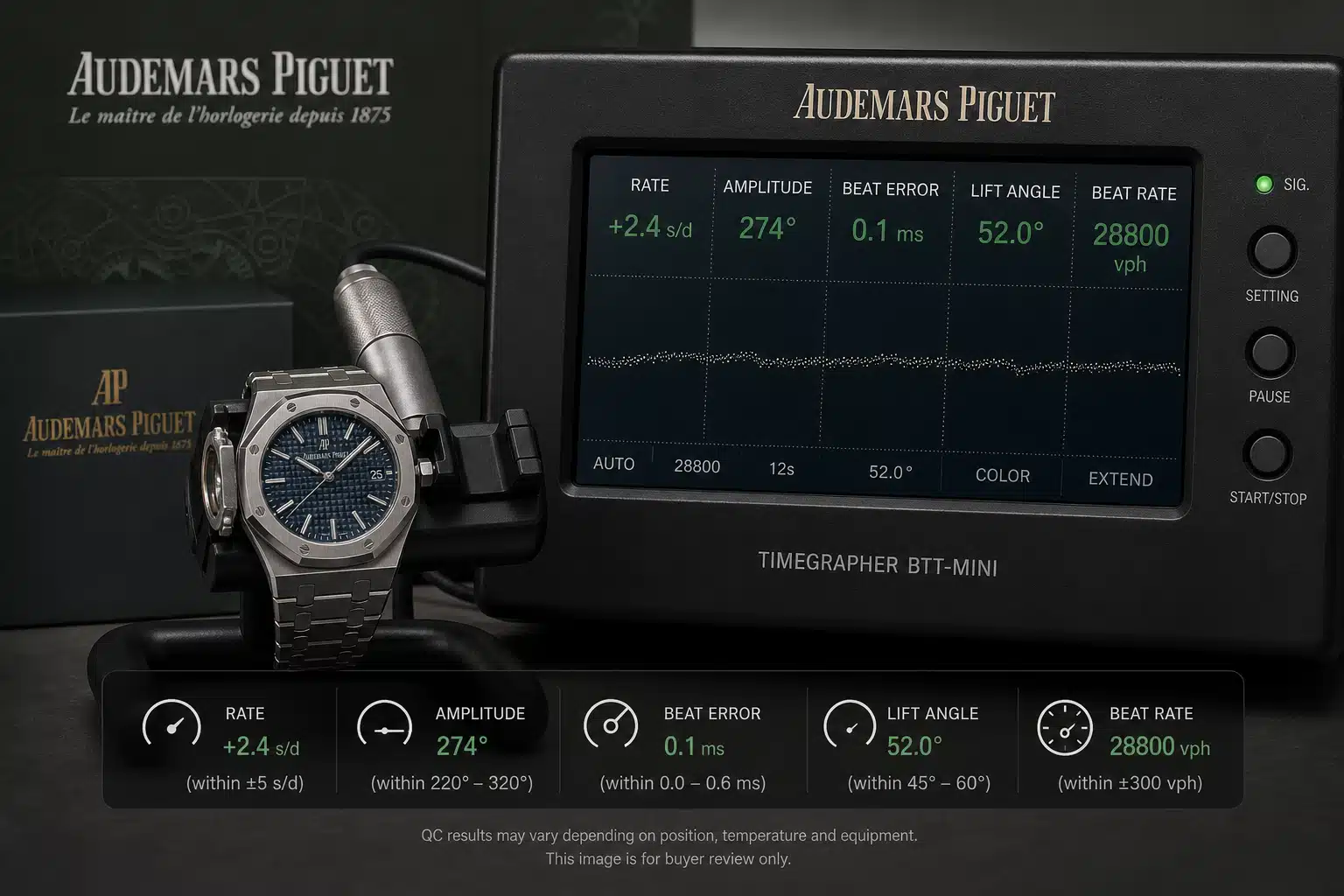
A Patek Philippe replica timegrapher result should be treated as a movement health snapshot, not as a promise of genuine-level regulation. The screen is showing how the movement behaves under one test condition, usually for a short period, often in one position, and often after an unknown amount of winding. That still matters. A clean-looking Nautilus or Aquanaut replica with weak movement numbers can become a more frustrating purchase than one with a tiny cosmetic flaw.
The key judgment is simple: does the screenshot support the approval decision, or does it create a reason to ask for clarification before giving GL? A good result does not prove long-term reliability, full servicing, or authentic Patek Philippe performance. A poor result, however, can warn you that the movement may be poorly regulated, underpowered, badly handled, or not properly tested before shipping.
The Main Numbers Buyers Usually See
Most replica watch QC timegrapher screenshots show several numbers at once. The rate reading tells you whether the watch is running fast or slow under the test condition, usually shown in seconds per day. The amplitude reading shows how strongly the balance is swinging, which gives a rough view of movement energy. Beat error shows how evenly the tick and tock are spaced, which can suggest how well the escapement is adjusted.
You may also see lift angle, beat rate, and test position. Lift angle is a machine setting that affects the displayed amplitude number. Beat rate shows the movement frequency, such as 21,600 or 28,800 beats per hour, depending on the movement route. Test position may show whether the watch was tested dial up, dial down, crown up, or in another position, though many QC screenshots only show one position.
This matters more with Patek Philippe replicas because movement routes vary. Some super clone watch models use decorated or clone-style movements designed to look closer through the caseback. Others use Miyota-based or other workhorse-style movements with different noise, winding feel, and service expectations. The same number can be reassuring in one movement route and less impressive in another if the test conditions are unclear.
Why Seller Labels and Factory Names Are Not Enough
A factory name can help narrow expectations, but it does not replace reading the actual timegrapher evidence. The same factory may produce a strong version of one Patek Philippe replica and a less convincing version of another, especially when case thickness, movement decoration, date layout, and caseback visibility create different engineering compromises. A “best factory” claim is only useful when it is tied to a specific model, version, movement, and buyer goal.
Seller descriptions can also compress too much into one label. “Clone movement,” “super clone,” or “latest version” may describe the selling angle more clearly than the mechanical condition of the individual watch. For QC approval, the buyer should still check whether the screenshot shows a practical rate, believable amplitude, controlled beat error, visible settings, and a stable trace. Factory reputation may explain why a watch entered the shortlist, but the individual QC evidence should decide whether this unit deserves GL.
A factory comparison is most useful when it is tied to the specific reference, version, movement, and visible execution details rather than treated as a universal ranking. For a Patek Philippe replica, that means checking whether the claimed version matches the case profile, dial texture, date position, bracelet or strap construction, caseback view, and movement route shown in the actual QC set. A strong factory-market name can still produce a weaker individual unit, and a less hyped version can sometimes be more sensible if the timegrapher result, visual finishing, and ownership expectations are better aligned.
Factory Name Clarification: Factory names in the replica watch market are buyer-facing reference labels. They can help compare versions, but they are not official brand affiliations, audited manufacturer identities, or guarantees that every Patek Philippe replica from the same label will show the same movement health, case finishing, dial accuracy, or timegrapher behavior.
Why Timegrapher Results Matter More Before Shipping
Before shipping, the timegrapher screen is one of the few movement-side checks a buyer can review. You cannot feel the crown action, hear the rotor, test the power reserve, or wear the watch for several days. The screenshot is imperfect, but it gives you a chance to catch obvious weakness before the watch leaves the seller.
The most useful way to read the screen is as a risk filter. Strong visual QC plus reasonable timegrapher numbers usually supports approval. Strong visual QC plus questionable movement numbers should slow the decision down. In practice, we would rather ask one calm clarification question before shipping than accept a watch where the movement already looks weak on the only mechanical test provided.
Do not overread the screenshot. One timegrapher image cannot tell you whether a Patek Philippe replica will run perfectly on the wrist, survive long-term ownership without service, or match the standards of a genuine Patek Philippe movement. It can tell you whether the unit appears stable enough for a sensible QC approval decision. That is the right standard for this stage.
Before making a decision, buyers should review the timegrapher screenshot together with real QC photos where available, including dial printing, marker alignment, hand alignment, datewheel centering, case thickness, caseback finishing, bracelet or strap fit, clasp engraving, and movement photos when relevant. Factory labels and stock photos alone are not enough for a reliable judgment.
Rate: How Many Seconds Per Day Is Acceptable?
Rate is the number most buyers notice first because it looks like a direct answer to daily accuracy. If the screen says +6 s/d, the watch is running about six seconds fast per day under that test condition. If it says -12 s/d, it is running about twelve seconds slow per day under that same condition. For replica watch rate evaluation, this number is useful, but it should not be judged like a laboratory promise.
For a Patek Philippe replica QC decision, a rate around 0 to +10 seconds per day is generally strong if the other numbers look healthy. A result within roughly +/-15 seconds per day is usually acceptable for many replica movements, especially if the watch is otherwise clean and the seller’s screenshot is clear. Once the reading moves beyond about +/-20 seconds per day, it deserves closer review, especially if the watch is new, properly wound, and supposed to be ready for shipping.
The mistake is expecting a replica movement to behave like a carefully regulated genuine Patek Philippe caliber. That is not the correct comparison. The better question is whether the rate is reasonable for the movement type, test position, winding level, and QC stage. A slightly imperfect number can still be a GL if the movement looks stable. A dramatic number should not be ignored just because the dial and case look good.
Why Slightly Fast Is Often Easier to Accept Than Very Slow
A small positive rate is often easier to live with than a large negative rate. Many buyers prefer a watch that gains a few seconds rather than one that loses time, because being slightly early is usually less annoying than finding the watch behind during the day. In QC terms, a modestly fast reading can also be easier to regulate if the seller is willing and the rest of the movement data looks normal.
A very slow reading deserves more caution. It does not automatically mean the movement is defective, but it can be a less comfortable sign if combined with weak amplitude or noticeable beat error. A watch running -3 seconds per day is not a concern by itself. A watch running -25 seconds per day while also showing weak energy is a different conversation.
When the Rate Number Should Trigger a Question
You should ask for clarification when the rate looks unusually high, unusually slow, or inconsistent with the rest of the screenshot. A reading such as +25, +35, or -30 seconds per day may be regulatable, but it should not be waved through without context. The buyer should know whether the watch was fully wound, whether it can be regulated before shipping, and whether the screenshot was taken in a normal test position.
Also be cautious with screenshots that look too perfectly staged. A single number near zero is nice, but if the image is cropped tightly, the trace is unclear, or the test duration looks very short, the result may not tell much. For QC approval, a transparent screenshot with a slightly imperfect but believable rate is often more useful than a suspiciously perfect number with missing context.
Practical GL / RL Rate Guide
| Rate Reading | QC Meaning | Buyer Action |
|---|---|---|
| 0 to +10 s/d | Strong practical range for many replica movements | Usually supports GL if other numbers are healthy |
| Within about +/-15 s/d | Generally acceptable in replica QC | Usually acceptable with clean amplitude and beat error |
| About +/-16 to +/-20 s/d | Borderline but not automatically bad | Consider movement type, winding, and regulation option |
| Beyond about +/-20 s/d | Needs context before approval | Ask whether it can be retested or regulated |
These ranges are practical QC guidance, not guaranteed wrist performance. A rate number can change with position, winding level, temperature, and movement condition. Use it to judge whether the watch is reasonable to approve, not to predict exact daily accuracy for the next year.
Amplitude: What Healthy Power Looks Like on the Screen
Amplitude is the timegrapher number many beginners underrate. It measures how far the balance swings, shown in degrees. If rate tells you whether the watch is running fast or slow in that moment, amplitude gives you a better clue about whether the movement has healthy energy behind it.
For many automatic replica movements, a properly wound reading around 250 to 310 degrees is generally healthy. This does not mean every good watch must fall inside that exact window, because movement design, lift angle setting, test position, and winding level all affect the display. Still, amplitude is one of the first numbers to check when deciding whether a Patek Philippe replica movement looks strong or weak in QC.
A lower number does not always mean a bad movement. The watch may not have been fully wound before testing. The lift angle setting may be wrong. The position may be less favorable. But if the seller says the watch is fully wound and the amplitude sits below roughly 220 degrees, that deserves a question before approval. For long-distance shipping, you want a movement that begins the trip looking reasonably healthy, not one that already appears tired on the bench.
Why Low Amplitude Can Be More Concerning Than a Small Rate Error
A small rate error is often a regulation issue. Low amplitude can point to a broader energy issue. It may come from insufficient winding, friction inside the movement, weak mainspring output, dry or dirty condition, or a movement that is not transferring power efficiently. That is why an otherwise attractive Patek Philippe replica with low amplitude can be more worrying than one running a few seconds fast.
The key is combination. Low amplitude by itself needs context. Low amplitude together with a poor rate and elevated beat error is a stronger warning sign. Buyers should not panic over one number, but they should not ignore a movement that looks weak across several readings.
Why the Watch Must Be Properly Wound Before Testing
Amplitude depends heavily on winding level. A watch tested near full wind should usually show stronger amplitude than the same watch tested after sitting for a long time. If a QC screenshot shows low amplitude, the first question should not be an accusation. It should be simple: was the watch fully wound before the timegrapher test?
This is especially important with Patek Philippe replica models using automatic movements that may not have been worn or wound consistently before QC photos. A low reading from an underwound watch may improve after proper winding. A low reading after proper winding is more meaningful. That difference can decide whether the buyer gives GL, asks for a retest, or becomes cautious about the movement.
Very high amplitude also needs context. A number that looks unusually high may be affected by lift angle settings or measurement conditions, and it should not automatically be treated as proof of a superior movement. In replica watch amplitude review, healthy and believable is better than dramatic. The goal is not to chase the biggest number on the screen; it is to confirm that the movement has enough stable energy to make QC approval sensible.
Beat Error: How Much Imbalance Is Too Much?
Beat error is the time difference between the “tick” and the “tock” of the escapement. On a Patek Philippe replica timegrapher screen, it is usually shown in milliseconds. This is not a cosmetic detail and it is not a prestige number. It tells the buyer whether the movement adjustment looks centered enough for stable operation.
For most replica watch beat error readings, 0.0 to 0.3 ms is very good. Up to about 0.5 ms is generally acceptable if the rest of the screenshot looks calm and consistent. Once the number moves toward 0.8 ms or 1.0 ms, the buyer should slow down and ask for context, especially if the watch is being presented as ready to ship.
The common mistake is treating beat error as a pass-or-fail number by itself. A Patek replica showing 0.7 ms beat error with otherwise healthy timing may simply need adjustment. A watch showing 0.9 ms beat error together with weak energy and an unstable trace is a different situation. That combination suggests the movement may not be well adjusted, may have taken poor handling, or may be less predictable after shipping.
Why Beat Error Matters for Stability
A cleaner timegrapher beat error usually supports more stable escapement timing. It does not mean the replica movement is finished or regulated like a genuine Patek Philippe movement, but it does suggest the basic tick-tock balance is not badly off. For QC approval, that is the practical value: the number helps show whether the movement looks reasonably settled before the buyer gives GL.
A high beat error can sometimes be corrected by a watchmaker, but that is not the point during QC. The buyer is not trying to diagnose the exact repair from one screenshot. The buyer is deciding whether this specific watch looks safe enough to accept before shipping, using issues such as Patek Philippe rotor noise as a related QC concern rather than a repair plan. If the seller can retest or regulate the watch before dispatch, a borderline number may be manageable. If the seller avoids the question, the risk becomes harder to justify.
When Beat Error Is a Red Flag
Beat error becomes more concerning when it appears with other weak signals. A reading around 0.8 ms or higher deserves caution if the trace looks messy, the rate is far outside the comfort range, or the amplitude is low for a watch claimed to be fully wound. In that case, the issue is not one imperfect number; it is a pattern of poor movement behavior.
For a Patek Philippe replica, this matters because many buyers are already accepting compromises in movement architecture, decoration, rotor feel, and serviceability. The timegrapher beat error should not add another avoidable problem. A slightly imperfect but stable reading can be acceptable. A high reading with weak supporting numbers is a fair reason to ask for a retest before deciding, and in some cases a fair reason for QC rejection.
Lift Angle, Test Position, and Why One Screenshot Can Mislead
A QC timegrapher screenshot is useful, but it is not a full movement test. Most sellers provide one image, usually taken in one position, often dial up, and often without much explanation of winding level or measurement settings. That is enough to catch obvious problems, but it is not enough to prove how the Patek Philippe replica will perform across a full day on the wrist.
The timegrapher lift angle is one of the most misunderstood settings. It affects the displayed amplitude number. It does not usually change how the watch is physically running, but an incorrect lift angle can make the amplitude look stronger or weaker than it really is. This is why buyers should be careful about over-reading a single amplitude figure without checking the screen settings and movement context.
Lift Angle Affects the Amplitude Number
Lift angle is a measurement assumption used by the machine. If the setting does not match the movement being tested, the amplitude reading may be distorted. The watch itself has not suddenly gained or lost power; the display is being calculated from the wrong reference. That distinction matters because a buyer may reject a healthy watch or approve a weak one if the setting is misleading.
In replica QC, this is especially relevant because Patek-style replicas may use different movement routes behind similar-looking casebacks. A clone-style movement, a decorated automatic movement, and a Miyota-based route may not deserve the same exact assumption. If the screenshot shows an unclear lift angle and the amplitude looks unusually low or unusually high, asking for clarification is reasonable.
One Position Is Not a Full Accuracy Test
One dial-up reading often looks better than real wrist use. A movement can behave differently crown up, crown down, dial down, or after being worn for several hours. This is normal even in many mechanical watches, but it matters more in replica watch QC because the movement may be unserviced, lightly regulated, or affected by shipping and handling.
The practical judgment is simple: use the screenshot as a health check, not a promise. If the rate, amplitude, beat error, beat rate, and test position are visible and the numbers are sensible, the screenshot supports approval. If the screen is cropped, the settings are unclear, or the result looks too perfect without context, it is not wrong to ask for another reading. A normal retest request is not an accusation; it is part of reducing avoidable QC risk.
When to Ask for a Second Screenshot
Ask for a second screenshot when the first image shows very low amplitude, high beat error, an extreme rate, unclear lift angle, missing beat rate, or a test screen cropped so tightly that important settings are hidden. A second reading is also useful when the seller says the watch was fully wound but the numbers look weak.
The best request is calm and specific: ask for the watch to be fully wound and tested again with the full screen visible. If the second result improves and the trace looks stable, the first screenshot may have been a winding or setting issue. If the second result confirms the same weak pattern, the buyer has a stronger reason to pause before GL.
How to Read Screenshot Traceability
A more traceable timegrapher screenshot shows the full display, not only the most flattering number. Buyers should look for the rate, amplitude, beat error, beat rate, lift angle, testing position, and visible trace pattern in the same image. If the screenshot cuts off settings or only shows a cropped rate value, it becomes harder to know whether the result reflects a stable movement or a selective presentation.
Trace quality matters because the printed lines can reveal behavior that a single number hides. A clean and consistent trace supports the idea that the movement is running steadily during the short test. A drifting, broken, or scattered trace deserves more caution, especially when it appears with low amplitude or high beat error. This does not diagnose the exact mechanical problem, but it gives the buyer a practical reason to ask for a clearer retest before approving the watch.
QC Photos, Seller Claims, and Policy Boundaries
QC photos can reduce uncertainty, but they do not guarantee perfection. Buyers should still review visible details and confirm seller policies before ordering, especially when the decision depends on a claimed factory label, movement route, or regulation promise. A clean timegrapher screen is useful only when it belongs to the same watch shown in the dial, caseback, clasp, bracelet, and wrist photos.
Seller policies should not be assumed from general wording such as “tested,” “checked,” or “latest version.” Before approval, buyers should confirm practical terms directly with the seller, including whether regulation is possible before shipment, what happens if the watch arrives with a clear mechanical issue, and whether any water-resistance testing has actually been performed on that specific unit. Water resistance should not be assumed from a Nautilus-style or Aquanaut-style appearance, and a replica watch should be treated more cautiously around water than a genuine watch maintained through official service channels.
The purpose of factory and movement information is to help readers understand quality and risk, not to represent a replica watch as genuine. A strong super clone may look convincing in normal wear, but close inspection can still reveal differences in finishing, movement architecture, case proportions, bracelet feel, dial details, or service compatibility. No timegrapher screenshot should be treated as proof that a replica watch can pass authentication, official service review, or professional resale screening.
Movement Route Matters: Clone Movements Versus Miyota-Based Patek Replicas
The same timegrapher numbers do not always mean the same thing across every Patek replica movement. Some Patek Philippe replicas use clone-style or heavily decorated layouts to support a closer caseback appearance. Others use a more common Miyota movement route that may be less visually convincing but easier to understand, regulate, or service. The buyer should judge the screenshot against the movement inside the watch, not against the model name printed on the dial.
This is where many QC mistakes happen. A buyer sees a Nautilus or Aquanaut-style replica and expects the timing behavior to match the image of a high-end Swiss movement. That is the wrong standard. The better question is whether the Patek replica movement is healthy for its own architecture: reasonable rate, stable trace, acceptable beat error, and energy that makes sense for the winding state.
Why a Workhorse Movement Can Be Easier to Accept
A Miyota-based movement is not the most romantic answer in a Patek-style replica, especially if the buyer cares about movement decoration or caseback accuracy. It may bring rotor noise, a different winding feel, and visual compromises compared with a better-decorated clone-style route. But for many buyers, the practical advantage is that a common workhorse movement can be easier to regulate and less mysterious if service is needed later.
That does not make every Miyota-based Patek replica a better buy. It means the buyer should separate visual ambition from ownership risk. If the watch has a closed caseback or the buyer mainly wants reliable daily wear, a solid workhorse route with clean timegrapher numbers may be more rational than a more impressive-looking movement with unstable behavior.
Why Clone-Style Movements Need More Context
Clone-style Patek replica movements can support a more convincing visual package, especially on watches where the caseback, rotor shape, bridge layout, or movement thickness affects the overall impression. That visual benefit is real, but it does not cancel the need for basic movement health. A decorated or clone-style layout still needs manageable beat error, sensible timing, and a stable trace before it deserves approval.
At Clean VS Factory, we usually treat movement route as part of the buying decision rather than a label to admire. A clone movement QC screenshot should not be judged more generously just because the movement looks closer to the intended design. If the numbers are weak, the buyer is still accepting shipping risk and possible service frustration. The stronger choice is the movement route that matches the buyer’s priorities: visual accuracy if the caseback matters, practical serviceability if daily wear matters more, and healthy QC numbers in either case.
Movement Transparency Note: Movement references in this article describe replica-market movement routes, displayed timegrapher behavior, and buyer-facing configuration claims. They should not be read as official Patek Philippe calibers, brand-certified construction, or proof that a specific watch contains a stated movement unless the individual unit is supported by clear photos, visible beat-rate evidence, and transparent QC information.
Decoration, Thickness, and Ownership Risk Are Different Questions
Some Patek Philippe replicas are bought because the caseback view matters. In that situation, movement decoration, bridge shape, rotor appearance, and movement thickness can be part of the buying goal. But these visual movement details should not be confused with functional health. A movement can look closer through the caseback while still being harder to service, more sensitive to poor adjustment, or less forgiving if the QC numbers are weak.
For daily wear, the more useful comparison is whether the movement route fits the buyer’s tolerance for rotor sound, hand-winding feel, power reserve behavior, regulation options, and after-sale repair risk. A photo-focused buyer may accept a more complex movement route for a better display-back impression. A first-time buyer who wants fewer surprises may be better served by a simpler and more serviceable movement, even if the caseback is less visually ambitious.
Evidence Boundaries: What Official Patek Sources Can and Cannot Prove
Official Patek Philippe model pages are useful for understanding the authentic watch that a replica is visually imitating, but they should not be used as proof that a replica has the same construction, finishing, movement, or water resistance. For example, Patek Philippe lists the current Nautilus 5811/1G with a white-gold case, blue sunburst dial, date display, and self-winding movement, while the Aquanaut 5167A is listed with a steel case, embossed black dial, composite strap, date display, and center seconds.[1][2] Those facts help buyers identify the official design language, but they do not validate a seller’s replica movement claim or QC result.
This distinction matters during timegrapher review because replica buyers often borrow expectations from the authentic reference. A genuine model’s official specification can explain why a caseback view, date position, dial layout, strap style, or movement appearance matters visually. It cannot show that a replica movement is regulated to genuine standards, that its power reserve matches the authentic watch, or that its case and seals perform like the authorized product. For QC, official brand information should be treated as a reference point for the original design, while the seller’s actual photos and timegrapher screenshot remain the evidence for the individual replica unit.
Movement Specification Claims Need a Narrow Reading
When a seller describes a Patek Philippe replica as Miyota-based, the official Miyota documents can help explain the movement family in general, not prove what is inside a particular watch. Miyota lists the 9015 as an automatic movement with a 28,800 bph frequency, 24 jewels, hand-winding, second-stop function, and a stated power reserve of more than 42 hours; Miyota lists the 8215 as an automatic movement with a 21,600 bph frequency, 21 jewels, hand-winding, and a stated power reserve of more than 40 hours.[3][4] Those specifications can help a buyer understand why beat rate, hand-winding feel, and power-reserve expectations may differ between movement routes.
The narrow reading is important: a Miyota specification sheet does not prove that a specific Patek replica actually contains that Miyota caliber. It also does not prove the movement was installed cleanly, regulated well, or protected from shipping shock. If the seller claims a Miyota 9015, Miyota 8215, clone 324-style, clone 240-style, or decorated automatic route, the buyer should still rely on movement photos when available, visible beat rate, timegrapher behavior, and seller transparency. Technical specifications are useful context, but QC approval should be based on the exact watch being offered.
Power Reserve Context: Why Timing Numbers Change as the Watch Winds Down
A Patek Philippe replica timegrapher result should never be read without asking a simple question first: how much energy was in the movement when the test was taken? The same watch can show a healthy amplitude after being fully wound and a noticeably weaker reading later in the replica watch power reserve. That does not automatically mean the movement is defective, but it does change how the QC screenshot should be judged.
This matters because many buyers look at one timegrapher screenshot as if it represents the watch in every condition. It does not. A fully wound movement has stronger mainspring torque, so the balance usually swings with more energy. As the watch winds down, amplitude can drop, rate can drift, and timing stability may look less impressive. For QC approval, the real concern is not whether numbers change. The concern is whether the numbers are weak even when the watch is properly wound.
Fully Wound Versus Nearly Unwound Readings
A fully wound Patek replica movement should generally give the cleanest version of its timegrapher performance. If the watch has been wound properly, the amplitude should look stronger, the trace should look more stable, and the rate should be easier to evaluate. This is why a low power reading in QC needs context before the buyer reacts too quickly.
If the seller tests the watch after it has been sitting for a while, the amplitude may look lower than expected. That can be normal near the end of the power reserve, especially with some automatic movements that are not running at full mainspring strength. A buyer should not reject a watch only because one number looks softer if the watch was not fully wound before testing.
The sharper judgment is this: low amplitude late in the power reserve is explainable; very weak amplitude at full wind is harder to excuse. If the screenshot shows poor numbers and the seller says the watch was fully wound, the buyer should ask for more clarity rather than treating the result as a harmless low-power reading.
Daily wear also complicates the picture. A desk-heavy buyer may not move enough to keep some automatic replica movements near full wind, while an active wearer may maintain better energy during the day. This is why the question “will it keep time on wrist” depends not only on the QC screenshot, but also on winding efficiency, movement condition, and how the watch will actually be worn.
Why Power Reserve Claims Need Verification
Power reserve claims on Patek Philippe replicas should be treated as movement-specific, not model-specific. A Nautilus-style or Aquanaut-style replica may be sold with different movement routes depending on factory version, batch, and seller description. Two watches with the same exterior reference can behave differently if one uses a clone-style movement and another uses a decorated workhorse movement.
This is where buyers often misjudge the timegrapher winding level. They assume a claimed power reserve automatically means the watch will hold strong numbers for that entire period. In practice, the last part of the power reserve may show weaker amplitude and less stable timing. A movement can still run, but running is not the same as running strongly.
Exact runtime should be confirmed for the specific movement inside the watch, not borrowed from the genuine Patek Philippe reference or from a seller’s broad model name. Replica movement claims can vary, and even similar-looking versions may not deliver the same reserve in daily use. For QC, the practical request is simple: if the numbers look weak, ask whether the watch was fully wound before the screenshot and whether a retest can be taken after winding.
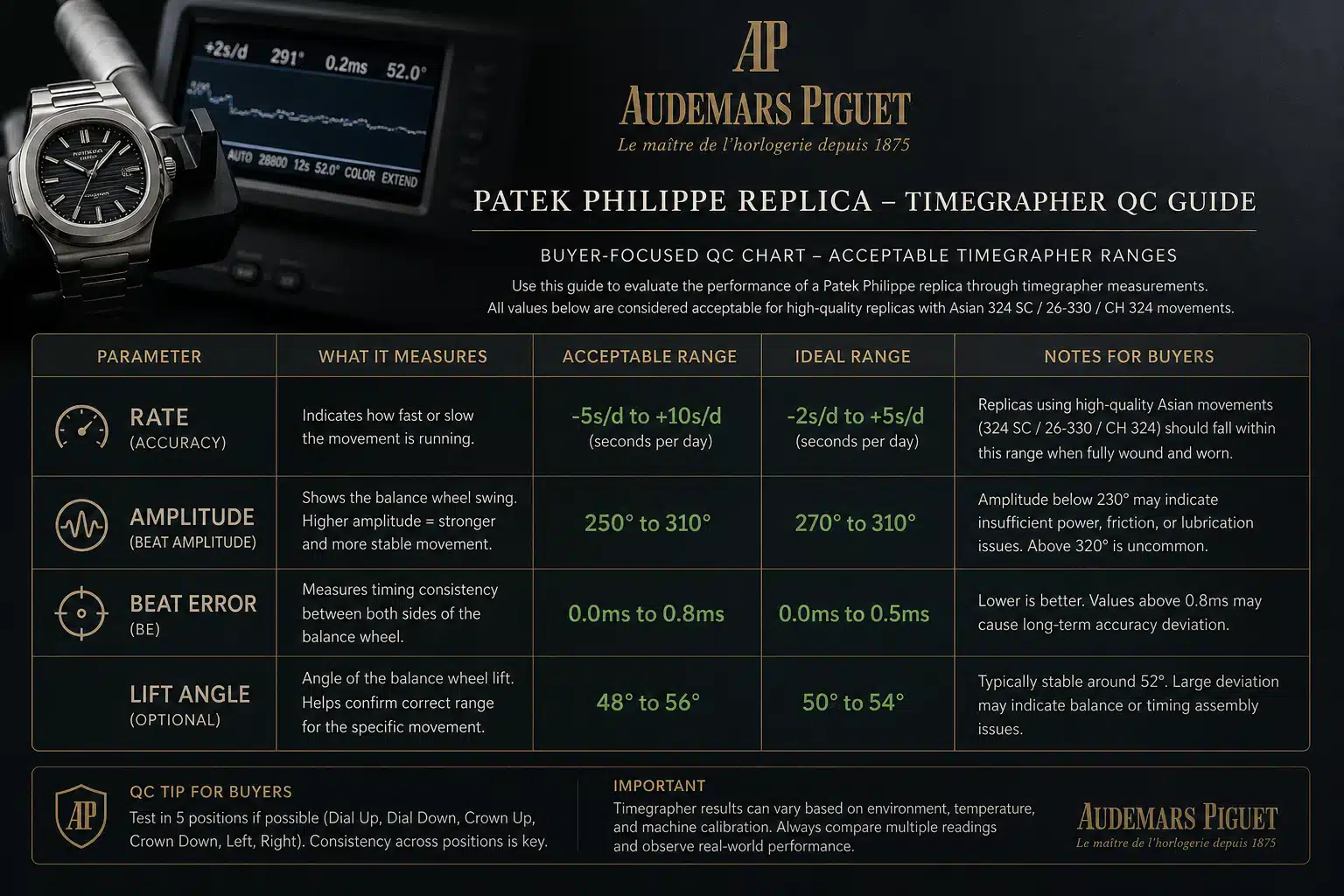
Acceptable Number Ranges for Patek Philippe Replica QC
Acceptable timegrapher numbers for a Patek Philippe replica should be judged as movement-health signals, not as proof of genuine Patek-level regulation. The goal before QC approval is to decide whether the movement looks stable enough to ship and reasonable enough for daily use. A beautiful dial or caseback does not compensate for a movement that looks weak, erratic, or poorly adjusted on the screen.
The ranges below are practical Patek replica QC numbers, not mechanical guarantees. Movement route, winding level, test position, lift angle setting, and seller regulation all affect the reading. A slightly imperfect number can still be acceptable if the rest of the screen is healthy. Multiple weak numbers together deserve more caution.
Strong QC Range
A strong QC result usually means the watch is running close to neutral or slightly fast, with healthy amplitude and low beat error under clear test conditions. For many automatic Patek replica movements, a rate around 0 to +10 seconds per day, amplitude roughly in the 250 to 310 degree area when properly wound, and beat error around 0.0 to 0.3 ms would be a reassuring combination.
This does not make the watch equivalent to a genuine Patek Philippe movement. It simply means the replica movement looks well enough regulated in that test moment. For a buyer deciding whether the numbers look acceptable, this is usually a comfortable GL range if the visual QC is also clean and the screenshot is not cropped or unclear.
Acceptable but Worth Noting
Some readings are not ideal but still reasonable for a replica movement. A rate within about plus or minus 15 seconds per day can be acceptable if amplitude is healthy and beat error is controlled. A beat error up to about 0.5 ms is usually not alarming by itself. An amplitude slightly below the preferred range may also be acceptable if the watch was not fully wound or the movement route is known to run a little lower.
The mistake is treating every non-perfect number as an automatic RL. Replica watch QC is about risk control, not chasing laboratory precision from a single screenshot. If the watch is visually strong, the movement route is known through Patek Philippe clone movements context, and the timegrapher result is only mildly imperfect, asking for regulation may be more sensible than rejecting the watch outright.
Numbers That Deserve Clarification or Retesting
A retest is reasonable when the rate is beyond about plus or minus 20 seconds per day, the amplitude is around or below the low 220s while the watch is said to be fully wound, or beat error is approaching roughly 0.8 to 1.0 ms. These numbers do not guarantee failure, but they are no longer “ignore it and GL” numbers.
Buyers should also ask questions if the timegrapher screenshot hides the lift angle, does not show the beat rate clearly, appears heavily cropped, or conflicts with the seller’s description. A suspiciously perfect rate with weak amplitude and high beat error is not better than a slightly fast watch with a healthier overall screen. The combination matters more than one flattering number.
Simple Range Framework for Buyers
| QC Category | Rate | Amplitude | Beat Error | Buyer Judgment |
|---|---|---|---|---|
| Strong | About 0 to +10 s/d | About 250-310 degrees when wound | About 0.0-0.3 ms | Usually comfortable if the rest of QC is clean |
| Acceptable | Within about +/-15 s/d | Slightly below ideal with winding context | Up to about 0.5 ms | Often acceptable, especially if movement looks stable |
| Ask First | Beyond about +/-20 s/d | Near or below about 220 degrees | About 0.8 ms or higher | Request winding confirmation, regulation, or retest |
| Possible RL | Extreme gain or loss | Very weak at full wind | High plus unstable trace | Reasonable to reject if retest does not improve |
This framework is most useful when read as a pattern. One borderline number may be manageable. A poor rate, low amplitude, high beat error, and unclear test setup together are a different situation. At Clean VS Factory, we tend to treat the timegrapher as a confidence check: it does not prove perfection, but it can warn the buyer when a visually attractive replica may carry unnecessary movement risk.
When Bad Numbers Point to Shipping Risk or Service Needs
Poor timegrapher numbers matter because QC happens before the watch faces shipping, handling, and daily wear. A Patek Philippe replica that already shows weak movement behavior on the bench may not become more stable after international transit. Not every imperfect number is serious, but weak numbers should not be dismissed just because the watch looks good in photos.
The practical concern is replica movement risk. Shipping shock can expose marginal regulation, weak amplitude, or unstable timing that was already visible in the QC screenshot. A watch with a small rate error may simply need adjustment. A watch with low amplitude, high beat error, and an uneven trace may be telling the buyer that the issue is deeper than regulation.
Regulation Issue Versus Movement Health Issue
A regulation issue usually means the watch is running too fast or too slow while the rest of the movement looks healthy. If amplitude is strong and beat error is low, a rate outside the preferred range may be correctable before shipping. This is why a watch running +18 seconds per day is not automatically worse than one running +5 seconds per day if the +5 watch has weak amplitude and unstable behavior.
A movement health issue is different. Low amplitude can suggest weak energy transfer, friction, poor lubrication, insufficient winding, or a movement that is not performing confidently. High beat error can suggest poor adjustment. An erratic trace can suggest instability. These are not things a buyer should try to diagnose from one screenshot, but they are valid reasons to ask for retesting or a different unit.
The key distinction is simple: rate tells you how the watch is timed in that moment; amplitude and stability tell you more about how comfortably the movement is running. For replica QC, the second question is often more important before shipping.
Why Multiple Weak Signals Matter
One weak signal can have an explanation. A low amplitude reading may come from an underwound watch. A slightly high rate may be improved with regulation. A beat error reading a little above ideal may still be tolerable if the rest of the screen is strong. The risk rises when the numbers point in the same bad direction.
Low amplitude plus high beat error plus poor rate is a stronger warning than any single number alone. Add a cropped screenshot, unclear lift angle, or seller unwillingness to retest, and the buyer has less reason to trust the movement condition. This is where RL becomes a reasonable choice, not because the watch is guaranteed to fail, but because the risk is unnecessary before shipment.
A good QC decision should separate cosmetic disappointment from movement-health concern. A small dial alignment issue and a weak timegrapher result are not the same type of risk. Cosmetic flaws affect how the watch looks; poor timegrapher numbers can affect whether the watch is enjoyable to own. For a Patek super clone buyer, the safer decision is to accept small imperfections only when the movement evidence still looks stable enough for daily use.
How Model Complexity Changes the Timegrapher Decision
Not every Patek Philippe replica creates the same QC risk. A simpler three-hand Calatrava-style watch, a basic Nautilus-style automatic, and a complicated calendar or chronograph-inspired model should not be judged with the same comfort level. Complicated layouts may add visual appeal, but they can also introduce more points where thickness, hand stack, module alignment, date behavior, winding efficiency, or serviceability become harder to verify from photos.
This is why a beginner should be cautious about approving a complicated Patek replica only because the seller photos look impressive and the rate number is acceptable. A good timegrapher reading does not prove that every function is reliable, that the calendar changes cleanly, or that the movement architecture is easy to service later. For first-time buyers, a simpler model with stable timegrapher numbers can often be a more forgiving ownership choice than a visually ambitious watch with more mechanical uncertainty.
Model design also affects how much a movement issue will bother the owner. A thin dress-style Patek replica may rely heavily on case profile and winding feel, so movement thickness and rotor behavior matter. A sport-style Nautilus or Aquanaut replica may be judged more on bracelet feel, clasp action, dial texture, date position, and daily-wear comfort. In both cases, the timegrapher result should be weighed against the actual use case: photo accuracy, occasional wear, or regular daily wear.
Certification and Genuine-Watch Standards Are Not the QC Benchmark
Some buyers compare replica timegrapher screenshots with chronometer-style expectations, but that can create the wrong approval standard. COSC describes chronometer certification as a formal testing process for movements under defined conditions, including multi-day testing across positions and temperatures.[5] A seller’s single timegrapher screenshot is not the same kind of test, and it should not be presented as a certification result.
The useful lesson is not that a replica must meet chronometer standards. The useful lesson is that real accuracy claims require controlled testing over time. A Patek Philippe replica QC image is a short pre-shipping health check, so the buyer should use it to screen for obvious problems rather than to demand laboratory-level evidence. If the rate is practical, amplitude is believable, beat error is controlled, and the trace looks stable, the screenshot can support GL within replica expectations. If the screen hides conditions or shows several weak numbers, the buyer has enough reason to ask for more evidence.
GL or RL: A Practical Decision Framework for Patek Super Clone Buyers
The right GL RL decision for a Patek super clone QC set should not be based on one attractive number. A clean rate means less if the amplitude is weak, the beat error is high, or the screenshot hides the test conditions. The practical question is not whether the watch performs like a genuine Patek Philippe. It is whether this specific replica movement looks healthy enough to ship, wear, and regulate within realistic expectations.
For QC approval, separate two issues. Cosmetic flaws are judged from the dial, case, datewheel, hands, markers, clasp, and overall finishing. Movement-health concerns are judged from the timegrapher range, movement route, winding context, and whether the result looks stable rather than staged. A slightly imperfect cosmetic detail may be acceptable if it does not bother you on the wrist. A weak movement signal deserves more caution because it can affect ownership after the watch arrives.
When GL Is Usually Reasonable
GL is usually reasonable when the timegrapher screenshot is clear, the rate is within a practical replica range, amplitude looks healthy for the stated winding condition, and beat error is controlled. The rest of the QC set should also look consistent: no obvious dial misalignment, no badly centered date, no suspicious hand clearance issue, and no sign that the movement route is being misrepresented.
For many Patek Philippe replica buyers, a watch running slightly fast with solid amplitude and low beat error is easier to accept than a watch showing a perfect rate but weak energy. A “0 s/d” screenshot can look comforting, but it does not automatically mean the movement is better. If the other numbers are soft or the display is cropped, that perfect rate may be less meaningful than a less perfect but healthier overall reading.
A GL also makes more sense when the movement route matches your expectations. A Miyota-based Aquanaut-style replica may be acceptable with practical timing and some rotor noise risk, while a more visually ambitious clone-style Nautilus or Calatrava-style build should still show stable basic health. At Clean VS Factory, we usually treat the timegrapher as a confidence check, not a luxury-grade precision certificate.
When to Ask for Clarification Before Deciding
Ask for clarification before deciding if one number is borderline but the rest of the watch looks promising. This is not being difficult; it is normal replica watch buyer caution. A retest request is especially reasonable when the lift angle is unclear, the watch may not have been fully wound, the amplitude is lower than expected, or the screenshot does not show enough information to judge the result fairly.
Clarification is also useful when the numbers do not match each other. For example, a strong rate paired with low amplitude may suggest the watch was regulated for the screenshot but still lacks healthy power. A decent amplitude with high beat error may not be an automatic rejection, but it deserves a second look if the trace appears unstable. The point is to avoid approving a Patek super clone QC set based on the most flattering single figure.
A second timegrapher image is most useful when it answers a specific question: was the watch fully wound, was the same position used, are the settings visible, and did the numbers remain broadly stable? If the retest improves because the watch was wound properly, the original concern may be reduced. If the retest remains weak or the seller cannot provide a clear view, the risk becomes harder to ignore.
When RL Makes Sense
RL makes sense when the timegrapher result shows extreme rate, very low amplitude at full wind, high beat error combined with other weak indicators, or inconsistent QC evidence. One imperfect number is not always enough to reject a watch. Multiple weak signals together are different. They suggest the issue may not be simple regulation, especially if the movement already looks unstable before shipping.
QC rejection is also reasonable when the screenshot appears incomplete in a way that prevents judgment. A cropped display, missing settings, unclear beat rate, or refusal to retest can be more concerning than a single borderline value. In replica QC, transparency matters because buyers are making a decision from photos and screenshots, not from handling the watch in person.
Do not use RL only because the numbers are not genuine Patek-level. That is the wrong benchmark for a replica movement. Use RL when the watch looks risky against realistic replica standards: weak energy, unstable timing, poor adjustment, unclear movement condition, or a combination of movement and visual problems that would bother you after delivery.
Final Buyer Check Before Approval
- GL: Clear screenshot, reasonable rate, healthy amplitude, controlled beat error, stable-looking trace, and no major visual QC concerns.
- Ask first: One borderline number, uncertain winding level, unclear lift angle, cropped screen, or a result that needs a simple retest to confirm.
- RL: Extreme rate, very weak amplitude at full wind, high beat error with unstable trace, unclear evidence, or seller unwillingness to clarify.
A Practical Traceability Checklist Before Giving GL
Before approving a Patek Philippe replica, it helps to connect every claim to visible evidence. The factory name should connect to the exact model and version being offered. The movement description should connect to beat rate, caseback photos, timegrapher behavior, and any visible movement layout. The cosmetic QC should connect to actual watch photos rather than stock images. The final decision should come from the combined pattern, not from whichever detail looks strongest in isolation.
For CleanVSFactory, the goal is to make replica watch comparison easier to understand by connecting factory names, movement claims, visible QC details, and realistic ownership limits. That means a buyer should be comfortable saying why the watch is acceptable: the version matches expectations, the visual details are acceptable for the reference, the timegrapher screen is readable, and the movement route fits the intended use. If any of those links are missing, asking for clarification is more useful than relying on a broad “super clone” label.
Prices can change by factory label, version, movement, seller channel, and availability, so exact comparisons should be verified at the time of purchase. A lower price should not be treated as proof of poor quality, and a higher price should not be treated as proof of a better movement or more reliable QC. The more useful comparison is like-for-like: same reference style, same stated factory version, same movement route, similar visible finishing, clear QC photos, and transparent seller communication.
QC photos reduce uncertainty, but they do not remove every risk. They help buyers judge visible execution before shipment, especially when factory names, movement labels, or stock photos do not show the exact watch being supplied.
Legal and Disclosure Context for Replica Watch Buyers
Timegrapher review is a technical QC step, but it does not change what the product is. Replica watches are imitation goods and should not be described as authorized, genuine, or endorsed by Patek Philippe or any other trademark owner. The USPTO explains counterfeit goods in relation to trademark use, and U.S. Customs and Border Protection identifies intellectual property rights enforcement as a trade priority at the border.[6][7] That does not predict what will happen to any specific shipment, but it is a reason to avoid treating replica purchases as legally risk-free.
For buyer communication, the safest wording is clear and limited: this is a replica watch QC guide, not an authentication claim, warranty claim, import guarantee, or legal opinion. A good timegrapher result can support a practical GL decision for an imitation watch, but it cannot make the watch authentic, authorized, or equivalent to the genuine product. Buyers should also avoid resale or disclosure behavior that could confuse another person about authenticity.
Final Takeaway: Read the Pattern, Not One Number
A Patek Philippe replica timegrapher result is most useful when the buyer reads the whole pattern. Rate shows timing under one condition. Amplitude shows whether the movement has healthy energy. Beat error shows whether the escapement adjustment looks reasonably centered. Lift angle, position, winding level, and screenshot clarity determine how much confidence the buyer should place in the result.
The strongest QC decisions come from matching the timegrapher screen with the rest of the evidence. If the watch looks clean, the movement route is understood, the screen is complete, and the numbers are practical, GL is usually reasonable. If the watch looks beautiful but the movement evidence is weak or hidden, the safer move is to ask for a retest before approval. A Patek replica does not need to perform like a genuine Patek Philippe to be enjoyable, but it should not begin ownership with avoidable movement risk already visible in QC.
References
[1] Patek Philippe, “Nautilus 5811/1G official specifications,” official model information for the authentic Nautilus 5811/1G, available at Patek Philippe Nautilus 5811 Official Specifications.
[2] Patek Philippe, “Aquanaut 5167A official specifications,” official model information for the authentic Aquanaut 5167A, available at Patek Philippe Aquanaut 5167A Official Specifications.
[3] Miyota, “Caliber 9015 official movement specifications,” manufacturer specification page for Miyota 9015 movement features and technical data, available at Miyota 9015 Official Movement Specifications.
[4] Miyota, “Caliber 8215 official movement specifications,” manufacturer specification page for Miyota 8215 movement features and technical data, available at Miyota 8215 Official Movement Specifications.
[5] COSC, “Chronometer-certified official explanation,” official description of chronometer certification and testing context, available at COSC Chronometer Official Certification Explanation.
[6] United States Patent and Trademark Office, “Counterfeit Goods Basics,” official educational material on counterfeit goods and trademark-related issues, available at USPTO Counterfeit Goods Basics.
[7] U.S. Customs and Border Protection, “Intellectual Property Rights,” official CBP information on intellectual property rights enforcement in trade, available at U.S. CBP Intellectual Property Rights.
Disclosure: This article is for general educational and comparison purposes only. Replica watches are not genuine products from the original luxury brands, and brand names are used only to identify reference designs or comparison topics. Factory names, movement descriptions, prices, availability, QC details, seller policies, and version information can change, so readers should verify important details with the seller before making a purchase decision. Replica watches should not be represented, resold, or used as genuine watches.