
The main question in this article is not whether a Patek Philippe replica has a “clone” movement label, but whether that movement actually improves the watch in ways a buyer can see, feel, or service later. In many replicas, a decorated base movement can look more convincing at first glance because of plates, engraving, or rotor finishing, but annual calendar replica limitations may still prevent it from matching the real architecture, thickness, crown position, date placement, or display-back depth. That difference matters most when the model has an exhibition caseback, a thin case profile, or complicated dial functions.
This guide helps separate useful movement upgrades from expensive wording. It looks at when clone-style construction is worth considering, when a decorated Miyota or other base movement may be the more practical daily-wear choice, and which Patek-style models demand closer checking before paying more. The goal is to judge the movement by model-specific benefits, not by seller claims alone.
Brand names are used here to identify the genuine reference design being discussed. Patek Philippe replica watches are replica-market products, not genuine Patek Philippe watches, and no movement label, factory name, or caseback decoration should be understood as official brand authorization, endorsement, or proof of authentic brand-manufactured parts.
| Buyer Situation | What to Check First | Practical Judgment |
|---|---|---|
| Nautilus 5711-style replica | Case thinness, date position, movement layout | Clone-style routes can be easier to justify if they improve profile and proportions. |
| Aquanaut 5167A-style replica | Exterior finish, daily reliability, caseback importance | A decorated base movement may be acceptable if wearability matters more than display accuracy. |
| 5712-style complicated replica | Subdial spacing, moonphase, power reserve, hand height | Verify real function behavior and layout before paying a clone premium. |
| Calatrava or dress-style model | Closed or open caseback, case thickness, dial cleanliness | A simpler decorated movement can make sense if the watch stays thin and elegant. |
| Seller claims “latest clone” | Clear movement photos, exact movement name, version details | Labels alone are not proof; architecture and consistency matter more. |
| Daily-wear priority | Servicing options, parts availability, power reserve expectations | A more serviceable base movement may be smarter than a riskier clone-style option. |
Quick Questions Before You Read
Q: Is a clone-style movement always better than a decorated movement?
No. It is only worth more when it improves the specific model’s thickness, layout, caseback appearance, or function placement.
Q: When is a decorated movement a reasonable choice?
It can be reasonable for closed-caseback or dial-focused models where servicing simplicity and lower cost matter more than movement architecture.
Q: What should I verify before paying extra for a clone movement?
Ask for clear movement photos, exact movement naming, case thickness, dial layout, and realistic power-reserve expectations.
Q: Which Patek-style replicas need the most caution?
Complicated 5712-style models need careful checking because subdial spacing, hand height, moonphase, and power-reserve behavior can reveal shortcuts.
The Real Difference Between a Clone Movement and a Decorated Movement
The practical difference is this: a clone movement is an architecture-first attempt to copy the layout of a Patek-style caliber, while a decorated movement is an appearance-first solution built on a different base movement. One tries to place the bridges, rotor, wheels, balance, calendar parts, and sometimes the hand stack closer to the original movement layout. The other takes a working automatic movement and dresses it with a decoration plate, engraved rotor, or bridge covers so it looks more Patek-like through a caseback.
This distinction matters because buyers often ask, “Is clone movement better?” when the better question is, “What part of the watch does this movement route actually improve?” A clone movement may support a thinner case, a more convincing exhibition-back view, or better date placement. A decorated movement may be less visually correct from the back but simpler, cheaper, and good enough if the watch is judged mostly from the dial side. Decoration is not automatically bad. The mistake is paying clone-movement money for a base movement that has only been visually disguised.
Architectural Copy Versus Visual Disguise
An architectural clone is designed around the idea of movement layout. In a Patek replica, that means the factory is not only trying to make the rotor look right; it is trying to make the visible structure make sense. The bridge shape, rotor size, balance position, wheel locations, date system, and overall movement depth should sit closer to the Patek caliber layout the watch is meant to represent. It still will not be a genuine Patek Philippe movement, and it should not be treated as one, but the goal is structural resemblance rather than cosmetic cover-up.
A decorated movement starts from a different logic. The base movement may be a Miyota, Seagull, or another automatic caliber, then covered with plates or modified visual parts. The rotor may carry engraving, the bridges may be hidden under a shaped cover, and the visible surface may be finished to suggest a higher-end caliber. From a quick glance, this can look more impressive than a plain undecorated movement. Under closer viewing, the problem is usually proportion: the balance may sit in the wrong place, the bridge geometry may look too flat, and the decoration plate may cover the movement instead of revealing real architecture.
The non-obvious point is that movement decoration can improve the photo without improving the watch. A decorated Miyota meaning is often misunderstood because buyers see gold-colored plates and rotor engraving and assume they are looking at a super clone movement. In reality, the working movement underneath may have very little in common with the Patek-style caliber being imitated. That does not make the watch useless, but it changes what you are paying for.
Why the Label Alone Is Not Enough
Sellers use terms like clone movement, super clone movement, 324 clone, and decorated movement inconsistently. Sometimes “clone” means the movement layout is genuinely closer to a Patek-style architecture. Sometimes it only means the rotor has been engraved and the visible side has been dressed. That is why the label alone should never decide the purchase.
A buyer should treat the movement name as a claim to verify, not as proof. If a listing says “Patek clone movement” but only shows dial photos, the claim has limited value. If the caseback view shows a large cover plate with generic engraving and no meaningful layout resemblance, the watch may be a decorated base movement even if the sales description sounds more ambitious. The strongest listings usually make the movement route clear through photos, case thickness information, and model-specific movement naming.
At Clean VS Factory, we usually separate the movement label from the movement evidence. A strong term in a listing is less useful than seeing whether the movement architecture, case profile, and dial-side details actually work together. This is especially important with Patek Philippe replicas because thin cases and refined proportions leave less room to hide a movement that does not fit the model.
Compliance-Safe Reading of Movement Terms
Movement descriptions in the replica market should be read as market terminology, not official Patek Philippe caliber identification. A phrase such as “324 clone,” “super clone movement,” or “decorated Miyota” may describe layout intent, bridge decoration, rotor engraving, or seller shorthand, but it should not be treated as evidence that the watch contains a genuine Patek Philippe caliber or an official brand-manufactured movement.
The purpose of comparing these movement routes is buyer education: understanding case thickness, dial alignment, caseback appearance, serviceability risk, and ownership expectations. It should not be used to represent a replica watch as genuine, prepare a watch for resale as authentic, or suggest that a replica can pass professional authentication or official service review.
How to Trace a Movement Claim Before Comparing Prices
A useful movement comparison should start with the exact model version, not the most impressive movement phrase. Buyers should identify whether the watch is a simple time-and-date model, a thin sports model, a display-back dress model, or a complication-heavy reference, because each category exposes movement shortcuts in different ways.
The next step is to connect the claim to visible evidence. A “324 clone” or “super clone movement” description is more meaningful when the watch also shows a coherent caseback layout, reasonable case thickness, correct crown height, centered date position, and movement photos that reveal bridge geometry rather than only rotor engraving. Without those checks, the movement name is only a market reference.
Factory or seller terminology can help organize options, but it should not be treated as official Patek Philippe terminology or proof of an authorized movement source. In replica-market use, movement names often describe an intended architecture, a decoration style, or a seller-facing configuration rather than a genuine brand-manufactured caliber.
Evidence Boundaries Buyers Should Keep in Mind
Official Patek Philippe information can help confirm what an authentic model family is designed to be, but it cannot prove that any replica has the same construction, finishing, movement, water resistance, or service standard. For example, Patek Philippe lists the Aquanaut 5167A as a steel watch with a composite strap, date display, and center seconds, which is useful background when discussing the authentic design target, not proof of replica execution.[1]
The same boundary applies to movement documents. A manufacturer specification sheet can explain what a Miyota 9015 or Miyota 8215 is designed to offer as a standalone caliber, but it does not prove that a seller’s Patek-style replica contains that movement or that the installation was assembled, regulated, or serviced to any particular standard. This is why movement photos, seller transparency, and realistic ownership expectations remain more important than a single movement label.
Movement trust in the replica market depends on understanding what the movement claim actually describes: architecture, decoration, layout, reliability expectation, serviceability risk, or simply a market name used by sellers. A careful buyer should avoid treating a movement label as a shortcut for quality until the claim is tied to the specific watch, version, photos, and ownership tradeoffs.
Movement Transparency Note: Movement references in this article describe replica-market movement routes, base calibers, decoration methods, or claimed clone-style configurations. They should not be read as claims that a replica contains a genuine Patek Philippe caliber, official brand parts, or Swiss-manufactured movement unless clear, verifiable evidence is provided for that specific watch.
Editorial Perspective: The most useful way to judge a Patek Philippe replica movement is to connect the movement claim to the specific model, not to treat “clone” as an automatic upgrade. At cleanvsfactory.com, this comparison is approached as a buyer-fit question: does the movement improve case thickness, date position, caseback layout, service expectations, or daily wear feel? If the answer is unclear, the factory label, seller description, and QC photos should be treated as signals to examine further rather than final proof.
Movement Route to Verify
Before treating a movement claim as meaningful, check four things: movement photos, case thickness claims, caseback layout, and the exact movement name used for that specific model. A real movement photo should show more than rotor engraving. It should let you judge whether the bridge layout, balance position, and movement depth look coherent or whether the watch is relying on a decoration plate to create the impression of a Patek caliber.
Case thickness is also part of the evidence. If a slim Nautilus-style replica uses a bulky base movement plus added decoration, the case often has to compensate. If the watch claims a clone-style route, the movement should help the factory build the case closer to the intended proportions. The point is not to turn the buyer into an authenticator. The point is to avoid paying for a technical claim that is only decorative language.
Why Decorated Miyota and Base Movements Still Exist in Patek Replicas
Decorated Miyota and other base movement replicas still exist because they solve a different buyer problem. They are not trying to win the movement-architecture contest. They are trying to provide a working automatic movement at a lower cost, with enough visual dressing to avoid looking completely plain through a display back. For many buyers, especially those focused on front-side appearance, this can be a rational compromise.
The decorated base movement route is common because the base calibers are easier to source, familiar to many repairers, and often simpler than purpose-built clone-style movements. A Miyota-based watch may have rotor noise, a different winding feel, or a less refined caseback view, but it can still be a practical daily wear movement if the buyer understands the tradeoff. The wrong purchase happens when a buyer expects architectural accuracy and receives cosmetic decoration.
What Official Miyota Specifications Can and Cannot Prove
Miyota’s official 9015 specifications list a 26-jewel automatic movement with hand-winding, stop-seconds function, 28,800 vibrations per hour, and a stated approximate 42-hour power reserve.[2] Miyota’s official 8215 specifications list a 21-jewel automatic movement with hand-winding, 21,600 vibrations per hour, and a stated approximate 42-hour power reserve.[3] These specifications are useful for understanding why sellers may describe one base movement as thinner, smoother, or more modern than another.
Those specifications should not be stretched into proof of what is inside a specific replica. A listing that says “Miyota decorated movement” still needs clear movement photos, honest naming, and realistic service expectations. Decoration plates can also make movement identification harder from casual photos, so buyers should avoid treating gold-tone plates, rotor text, or bridge engraving as technical evidence by themselves.
Decoration Plates and Rotor Engraving
A decoration plate is essentially a visual cover. It can hide the original bridge layout of the base movement and create a surface that looks more like a high-end Patek-style caliber. An engraved rotor adds another layer of resemblance, especially in product photos where the eye is drawn to text, color, and finishing rather than mechanical structure.
This is why decorated movements can look persuasive in still images. A gold-tone rotor, engraved lettering, and bridge covers create the impression of luxury finishing. But plates do not relocate the real movement architecture underneath. They do not automatically move the balance to the correct position, improve the date mechanism, or make the movement thinner. They mainly change what the viewer sees.
The practical buyer judgment is simple: decoration can make a base movement less visually plain, but it cannot turn that movement into a true Patek-style layout. If the watch has a closed caseback, this limitation may matter very little. If the caseback is part of the appeal, the limitation becomes much more important.
Where Decorated Movements Can Make Sense
A decorated movement can make sense when the buyer values reliability, simplicity, and lower cost more than movement-view accuracy. For example, if the watch is worn as a daily piece and the owner rarely looks through the caseback, a stable base movement may be more satisfying than a more ambitious movement route with uncertain parts support. This is not about saying cheaper is always smarter. It is about matching the movement to the way the watch will actually be used.
Decorated base movements are also more defensible in models where thinness is less critical or where the exterior execution does most of the work. If the dial printing, case shape, hands, markers, and strap or bracelet fit are the main reasons you like the watch, then movement architecture may not deserve the largest share of the budget. A decorated Miyota movement can be acceptable if the watch is priced honestly and the buyer does not expect a convincing Patek movement view.
The main ownership tradeoff is feel. Miyota-style movements are often known for practical automatic performance, but some examples have noticeable rotor sound because of the winding design. Winding feel and crown action may also feel less refined than buyers expect from a Patek-style replica. These are not always deal-breakers, but they are daily-use details. A movement that looks acceptable in photos can still feel ordinary on the wrist if the rotor is loud or the crown action feels rough.
For buyers asking for a reliable replica movement, the decorated base route can be reasonable. For buyers asking for a movement that looks structurally close to the Patek caliber layout, it is usually the wrong expectation. The value depends on honesty: a decorated base movement should be priced and judged as a practical movement with cosmetic dressing, not as a full clone-style solution.
What a True Clone-Style Movement Tries to Improve
A true clone-style movement tries to improve the parts of a Patek replica that decoration alone cannot fix. The obvious benefit is the exhibition caseback, but that is only part of the story. In thin luxury sports watches like Nautilus and Aquanaut-style replicas, movement architecture can influence case thickness, crown position, date placement, dial spacing, and the overall balance of the watch on the wrist.
This is why a Patek clone movement can be worth paying more for in the right model. The premium is not just for engraving or a nicer rotor. It is for a movement route that gives the factory a better mechanical foundation to build the watch around. A caliber 324 clone-style route, for example, is valued because many simple Patek designs are closely tied to thin automatic movement architecture. If the movement underneath is poorly matched, the case may become thicker, the date may sit slightly off, or the watch may lose the slim elegance that makes the original design appealing.
Layout Accuracy Matters More Than Decoration
When the caseback is open, layout accuracy matters more than surface decoration. A rotor can be engraved, but rotor scale is harder to fake convincingly. Bridges can be polished, but incorrect bridge shape or placement will still look mechanically incoherent. A movement can have attractive finishing, yet if the balance position, jewel placement, and visible depth do not make sense for the model, the caseback view remains compromised.
This is where clone-style movements usually separate themselves from decorated movements. They try to make the visible components belong to the movement rather than sit on top of it. Stronger examples create a more natural sense of depth, spacing, and mechanical organization. They are still limited by replica production standards and batch consistency, but they tend to be more convincing than a base movement hidden under a large plate.
The clear judgment: if the caseback is part of why you want the watch, layout beats engraving. A beautifully engraved rotor on the wrong architecture is still the wrong architecture. Buyers who focus only on text sharpness or gold color may miss the bigger issue, which is whether the movement actually resembles the Patek-style caliber it claims to represent.
Case Thickness and Crown Position
Movement architecture also affects the outside of the watch. A base movement with extra decoration plates can force the factory to add thickness, adjust the caseback profile, or accept a less elegant side view. On a thick sports chronograph, a small difference may be easier to ignore. On a Nautilus or Calatrava-style watch, even a modest thickness increase can change the whole wrist presence.
A closer movement architecture gives the factory more room to build a slimmer or better-proportioned case. It can help the crown sit at a more natural height and reduce the feeling that the caseback is bulging to accommodate the movement. This does not mean every clone-style movement automatically produces a perfect case. It means the movement route can remove one of the biggest structural obstacles.
For buyers asking about a thinner replica case, the movement choice is often the hidden reason one version feels more convincing than another, especially when timegrapher result standards are considered alongside case thickness and long-term regulation stability. Photos from the dial side may look similar, but the side profile can reveal whether the case was designed around the movement or forced to cover it.
Date and Hand Stack Compatibility
The movement underneath also influences practical dial-side details. Date position, datewheel height, hand stack, and dial spacing are not just cosmetic choices. They are tied to where the calendar and hand-setting systems sit inside the movement. If the base movement architecture does not line up well with the dial design, the factory may need compromises: a date window that sits slightly wrong, hands that ride too high, or dial furniture that feels less natural.
A clone-style movement tries to reduce those compromises by matching the functional layout more closely to the model. In simple time-and-date Patek replicas, this can make the dial feel cleaner and the case more coherent. In more complex models, it becomes even more important, but also more difficult, because subdials and indicators place greater demands on the movement route.
The useful buyer takeaway is that movement accuracy is not only something you see through the back. It can shape the watch from the dial to the case flank. A super clone movement is worth considering when it improves the full architecture of the replica, not merely when it gives the seller a stronger phrase to put in the listing.
How to Read Movement Photos Without Overvaluing the Wrong Details
Movement photos are useful, but they can also lead buyers toward the easiest details instead of the most important ones. Bright engraving, gold-tone finishing, and a clean rotor photograph well, while bridge depth, plate coverage, balance position, and movement thickness require slower comparison. A buyer should first decide what the photo is supposed to prove: caseback realism, movement architecture, finishing quality, or only that the watch has some form of decorative treatment.
A strong movement photo should show the movement straight-on, with enough resolution to judge whether the bridges appear to be functional shapes or large covers. The balance area deserves attention because it is harder to disguise than rotor text. If the balance position looks unrelated to the claimed Patek-style caliber, or if the visible bridge work looks like a flat stamped surface, the watch may still be a decorated base movement even if the seller uses clone language.
Lighting matters as well. Harsh reflections can hide machining marks, uneven brushing, or plate edges, while angled photos can make a thick caseback look slimmer. For a display-back Patek replica, it is useful to compare the movement photo with a side-profile photo because a convincing rotor view does not always mean the movement helped the case remain thin. The buyer is trying to understand the whole construction, not just admire the most flattering photo.
The Hidden Risks of Clone Movements Buyers Should Not Ignore
A clone-style movement can make a Patek Philippe replica look more correct, but it does not automatically make the watch safer to own. This is the part many buyers miss. The same architecture that helps with case thickness, bridge layout, and exhibition-back realism can also make replica movement service more difficult if the movement uses less common parts or comes from a batch with inconsistent assembly.
The better question is not only “is clone movement reliable?” It is “reliable compared with what, in which model, and with what service path if something goes wrong?” A simple decorated base movement may be less impressive through the caseback, but a watch repairer is more likely to understand its basic structure. A clone movement may look closer to a Patek-style caliber, yet become more frustrating if the winding system, date mechanism, rotor assembly, or specific bridge components are not easy to replace.
Serviceability Is Not the Same as Accuracy
Movement accuracy in the visual sense and movement serviceability in the ownership sense are two different things. A clone-style caliber may place the balance, bridges, rotor, and date components closer to the correct layout, but that does not mean it uses widely available parts or can be serviced like a common Miyota, ETA-style, or Seiko-based movement. If the movement stops winding, develops rotor noise, loses power reserve, or has a date change problem, the repair route can be narrower.
This matters more in Patek replicas than in many basic Rolex-style replicas because buyers often choose Patek models for thinness, elegance, and movement view. A 324-style clone route may support a slimmer case and more convincing back view, but it can also introduce more specific tolerances. The crown feel may be more delicate, the winding action may be less familiar to general repairers, and the calendar system may not tolerate rough handling as well as a simpler base movement.
At Clean VS Factory, we usually separate visual movement quality from ownership risk. A movement that photographs better under a display back may still be the wrong choice for a buyer who wants the simplest daily-wear experience and has no practical service option nearby.
Batch Variation and Version Claims
Clone movement reliability also depends heavily on batch consistency. Two watches described with the same “clone movement” label can behave differently if they come from different factory versions, different production periods, or different movement suppliers. One batch may have acceptable winding feel and stable timekeeping; another may show noisy rotors, weak power reserve, sticky date change, or inconsistent regulation.
This is why movement names alone are not enough. Sellers may use terms like “super clone movement,” “324 clone,” or “latest clone caliber” as if they describe one fixed technical standard. In practice, those phrases can cover different constructions, different decoration levels, and different quality control standards. A buyer should treat the label as a starting point, not proof.
Power reserve claims deserve particular caution. A listing may quote a figure that sounds close to the genuine Patek caliber, but real performance can vary by movement condition, lubrication, rotor efficiency, and assembly quality. Unless the specific model and batch have a consistent track record, a large advertised power reserve should not be treated as a guarantee.
Red Flags Before You Decide
- Vague movement wording: Phrases like “best clone,” “super movement,” or “same movement style” mean very little unless the seller can show the actual movement route.
- No movement photos on display-back models: If the watch has an exhibition caseback, clear movement photos are part of basic buying judgment, not an optional luxury.
- Impossible reliability claims: Any seller claiming a clone movement is risk-free, identical in performance, or guaranteed for long-term use is oversimplifying the ownership reality.
- No version clarity: A factory name without version, batch, or movement detail is not enough, especially for Patek replicas where thickness and layout depend on the movement route.
- Universal “clone is better” advice: Clone movements are often better for structure and display realism, but not always better for serviceability or low-stress daily wear.
The safest buyer is not the one who automatically chooses the most advanced movement. It is the buyer who understands what that movement improves and what new risks it introduces.
Exhibition Casebacks: Where the Difference Becomes Obvious
An exhibition caseback changes the movement decision because it turns the movement into part of the watch’s visible design. On a closed-back replica, a decorated base movement may be judged mostly by how it runs and how thick it makes the case. On an exhibition caseback replica, the Patek movement view becomes part of the buying experience, and this is where decoration alone can start to look thin.
Decorated movements often work at a glance. A gold-tone rotor, engraved text, and bridge covers can create the impression of a higher-end caliber in seller photos. The problem appears when the caseback is viewed more carefully. Plate finishing can look flat, jewel placement may not make sense, the balance position may be wrong for the claimed caliber style, and the movement depth can feel shallow or covered rather than mechanically coherent.
What Decoration Can Hide
A decoration plate is useful because it can hide the base movement underneath. It can cover bridges, disguise the rotor area, and create a more Patek-like surface. But hiding is not the same as matching architecture. If the underlying movement is different, the plate has to work around the original wheel positions, screw locations, and rotor geometry. That is why some decorated movements look overly smooth, overly blocked, or oddly arranged through the caseback.
Rotor engraving is one of the most overrated details in this comparison. Buyers often focus on whether the rotor says the right words or has a similar color, but engraving quality does not fix incorrect bridge layout or shallow movement depth. A decorated movement can have attractive text and still look wrong as a complete mechanical picture.
What Clone Layouts Usually Show Better
A clone-style movement usually performs better through a display back because it is trying to organize the movement around the same visual logic as the Patek-style caliber. Bridge shape, rotor scale, balance location, and the relationship between open and covered areas tend to look more coherent. Even when the finishing is not at genuine level, the layout can make the movement feel more believable as a complete design rather than a base movement wearing a cover.
The important point is hierarchy. For caseback realism, bridge layout and movement depth matter more than a polished rotor. Balance position matters more than decorative text. Proportions matter more than bright engraving. If the caseback is one of the reasons you want the watch, the movement route should be evaluated as architecture first and decoration second.
QC Photos to Request
For an exhibition-back Patek replica, QC photos should include a clear straight-on caseback view under neutral lighting, not only a dramatic angled shot. The buyer should be able to see the rotor shape, bridge layout, balance area, plate coverage, and general finishing texture. A second photo with the rotor in a different position is useful because some flaws are hidden when the rotor covers the wrong area.
A side-profile photo also matters because the movement route can affect case thickness. A decorated movement may look acceptable from the back but still force a thicker case. A clone-style movement may justify its premium only if it helps the watch keep the slimmer profile expected from the model.
QC photos reduce uncertainty, but they do not remove every risk. For Patek-style replicas, buyers should review the dial printing, marker alignment, datewheel centering, hand height, case thickness, lug shape, strap or bracelet fit, caseback finishing, rotor position, bridge layout, and balance area before accepting a movement claim.
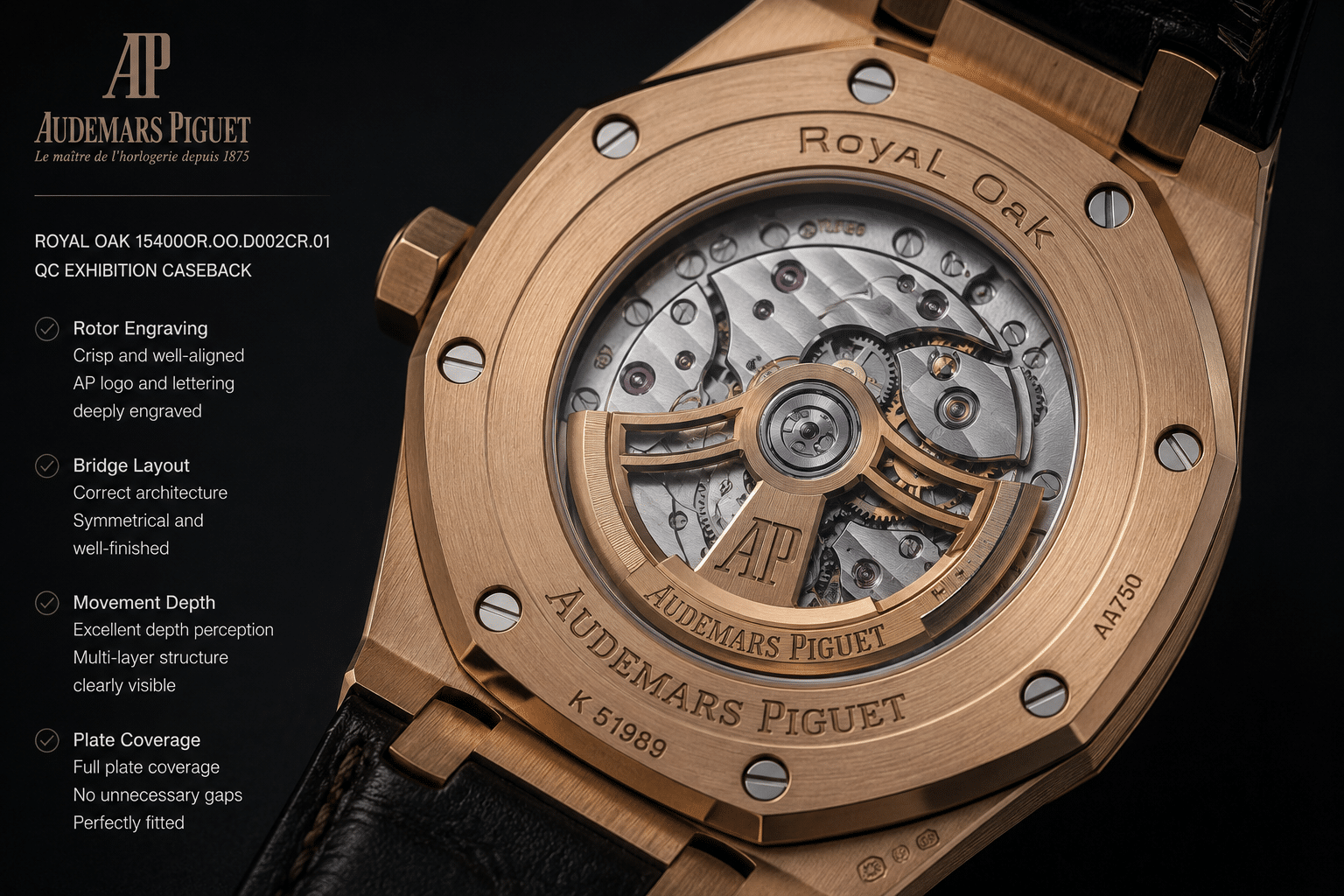
These photos are not about helping anyone misrepresent a replica as genuine. They are about making sure the buyer understands what is actually being purchased. If a seller promotes an open-back Patek replica but cannot show a clear movement photo, the safest assumption is that the movement claim needs more verification.
Verification Note: When possible, buyers should review real QC photos rather than relying only on stock images or movement labels. For Patek-style replicas, useful verification includes dial alignment, date position, side-profile thickness, caseback structure, rotor position, bridge layout, balance area, clasp or strap finishing, and the exact movement information provided for that specific watch.
How Movement Choice Affects Nautilus 5711 and Aquanaut 5167A Replicas
The Nautilus 5711 and Aquanaut 5167A are where movement choice becomes more than a technical label. These are simple time-and-date Patek sports models, so the movement does not need to drive multiple complications. Instead, it affects proportion: case thickness, date window placement, crown position, and how slim the watch feels on the wrist.
That is why the Nautilus 5711 replica movement decision is different from buying a model where the case hides bulk more easily. A clone-style route can be worth paying for if it helps the factory build a thinner, better-balanced watch with a more convincing caseback view. A decorated base movement can still be a rational daily-wear choice, but only if the buyer accepts a possible compromise in movement view or case profile.
Authentic Model Facts Versus Replica Claims
Patek Philippe’s official Aquanaut 5167A page identifies the authentic model as a steel Aquanaut with a composite strap, date, and sweep seconds, which helps explain why buyers focus on sport-wear comfort, date placement, and a clean time-and-date layout when comparing replicas.[1] Patek Philippe’s current Nautilus 5811/1G page describes a white-gold Nautilus with a blue sunburst dial and the series’ recognizable rounded-octagonal case language, which is useful background for understanding the design family but should not be used as evidence that a replica 5711 or 5811 is dimensionally or mechanically equivalent.[4]
That distinction matters in this section. Official brand pages can clarify the authentic design target, but replica evaluation still has to come from the specific watch in front of the buyer: QC photos, side profile, date alignment, bracelet fit, rotor behavior, caseback layout, and the seller’s willingness to identify the actual movement route. A citation can support the authentic reference background; it cannot validate a factory’s execution.
Nautilus 5711: Thinness and Caseback Matter
The 5711 is unforgiving because the design is flat, wide, and integrated. A small increase in case thickness is more noticeable than buyers expect, especially from the bracelet side. The Nautilus case is supposed to sit low and flow into the bracelet; when the movement route forces extra height, the watch can lose some of that elegant sports-watch character even if the dial looks good from above.
This is where a 324-style movement route can make practical sense. If the clone-style architecture allows a slimmer case, cleaner date window position, and more coherent exhibition-back layout, the premium is easier to justify. The buyer is not just paying for a nicer rotor. The buyer is paying for a movement that supports the shape of the entire watch.
A decorated movement in a 5711 can still be acceptable for a buyer who mainly cares about front-side appearance and wants simpler ownership expectations. But if the caseback is visible and the side profile looks bulky, the savings may come with a compromise that is hard to ignore once the watch is on the wrist.
Aquanaut 5167A: Practical Wear Versus Display Accuracy
The Aquanaut 5167A is a little more forgiving. The rubber strap, sportier personality, and less formal case presence make small differences in thickness less severe than on a Nautilus bracelet watch. That does not mean movement choice is unimportant, but the buyer’s priority can shift more toward wearing comfort, crown feel, rotor noise, and day-to-day reliability.
For a buyer focused on the Aquanaut as a practical daily replica, a decorated base movement may be easier to accept if the exterior execution is strong and the case does not become noticeably bulky. The rubber strap also changes the wearing impression; it can absorb some visual weight that would stand out more on a flat integrated bracelet.
A 5167A clone movement is still preferable for buyers who care about display-back accuracy and slimmer architecture. But the advantage is most meaningful when the movement route visibly improves the total watch, not merely when a listing uses the word “clone.” If the clone version has uncertain reliability and the decorated version is thinner than expected and well assembled, the decision becomes less automatic.
What This Means for Daily Wear
For the Nautilus 5711, the clone route is usually easier to justify because thinness, bracelet-side profile, date placement, and caseback realism all work together. For the Aquanaut 5167A, the decision is more balanced: clone-style movement for the buyer who values architecture and movement view, decorated base movement for the buyer who wants a simpler, more practical daily-wear option and is less concerned with the caseback.
The mistake is choosing by movement label alone. The most suitable movement for a 5711 replica or 5167A replica is the one that improves the specific watch you are buying. If the movement does not help the case profile, date position, or ownership experience, the label is doing more marketing work than mechanical work.
Why Complicated Models Like the 5712 Change the Risk Equation
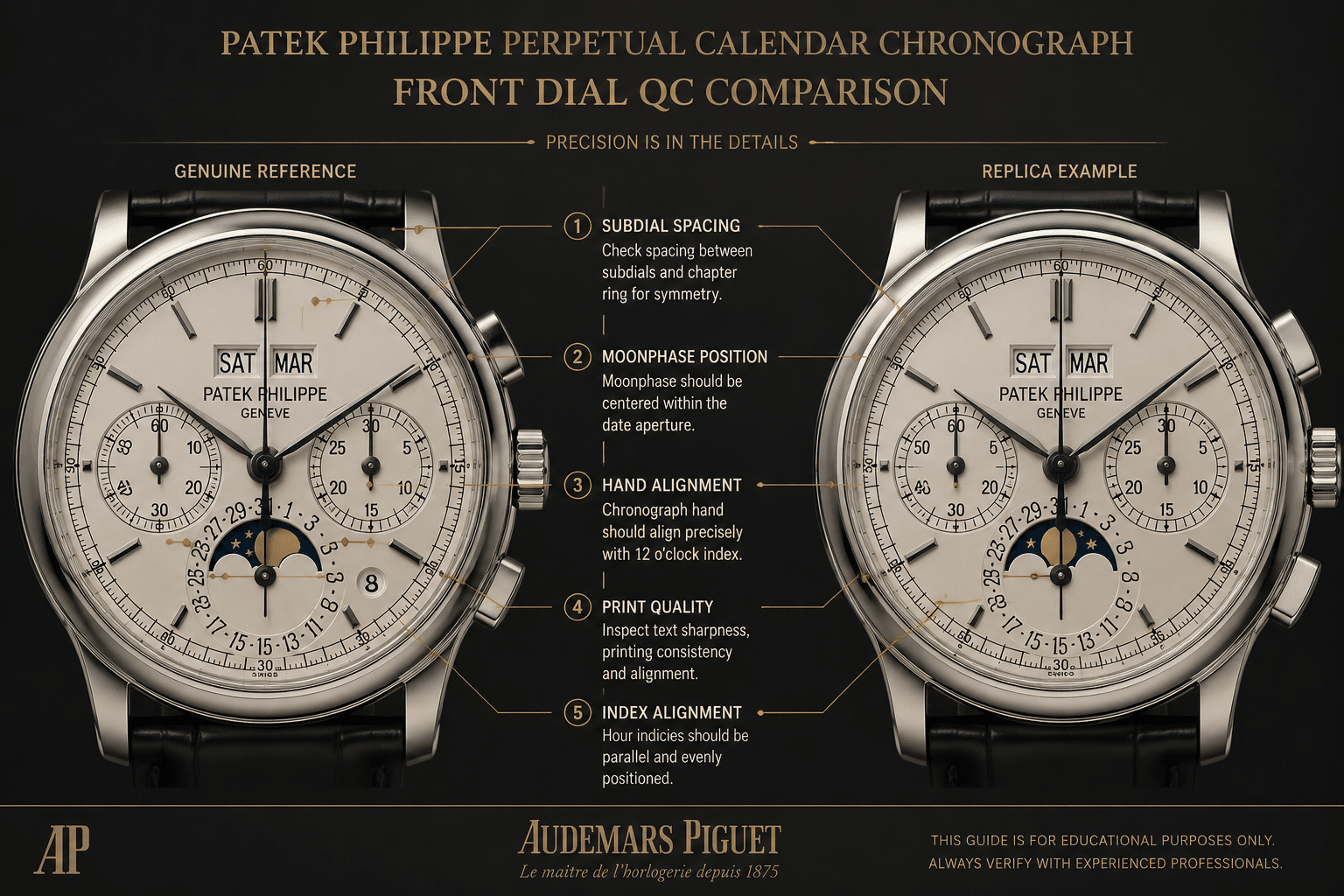
A Patek 5712 replica movement should be judged more cautiously than a simple 5711 or 5167A movement because the dial itself depends on the mechanics underneath. On a time-and-date model, a decorated movement can sometimes hide its compromise behind a clean dial and acceptable case profile. On a complicated Patek replica, the subdial spacing, moonphase display, power reserve indicator, and hand alignment all expose whether the movement route actually fits the watch.
This is where buyers often make the wrong assumption. They see a decorated rotor or engraved bridge through the back and think the watch has solved the important problem. For a 5712-style model, rotor decoration is not the hard part. The hard part is placing several displays in the right visual relationship on the front of the watch without creating a thick case, awkward hand stack, or simplified function that does not behave as expected.
Subdial Layout Is Harder Than Rotor Decoration
The 5712 design is difficult because the dial is asymmetrical but still balanced. The small seconds, date, moonphase, and power reserve display have to sit in a very specific relationship to the case shape and horizontal dial texture. If the base movement was never designed for that layout, a factory may rely on a movement module, adjusted dial feet, or cosmetic compromises to make the dial look close enough in photos.
Decorative plates do not fix subdial geometry. They may make the caseback look busier, but they do not move the true driving wheels into the correct positions. That is the decorated movement limitation buyers need to understand: a watch can have an attractive rear view and still show front-side problems through slightly wrong subdial placement, crowded printing, uneven moonphase framing, or hands sitting too high above the dial.
A clone-style route can improve this if the architecture is closer to the intended model layout, but it does not remove risk. More architecture-correct movements are often more specialized, and specialized replica movements can bring service complexity. The better judgment is not “clone movement complication equals safe.” It is whether the claimed movement actually supports the dial layout, case thickness, and functions of that exact version.
Functionality Versus Appearance
Complicated-looking replicas should always be separated into two questions: what looks functional, and what is mechanically functional. A moonphase display may advance in a simplified way. A power reserve indicator may be decorative, semi-functional, or tied to a different mechanism than buyers expect. A date or small seconds display may work, but with spacing or hand height that reveals the movement route.
This matters because a buyer attracted to a complicated Patek replica is usually paying for visual drama, not just timekeeping. If one of the displays behaves oddly or is only decorative, the ownership experience changes. It may still be acceptable for a buyer who mainly wants the dial appearance, but it is not the same value proposition as a simple replica with a proven automatic movement and fewer things to go wrong.
The safest view is that complications multiply both visual and mechanical risk. A simple time-and-date watch can be judged mostly by case shape, dial execution, thickness, and movement stability. A 5712-style watch adds more failure points: hand alignment, display synchronization, moonphase operation, power reserve behavior, module thickness, and future service uncertainty.
Version Details to Confirm
Before choosing a 5712-style replica, confirm the movement route in practical terms, not just by the seller’s movement label. Ask which displays are functional, how the moonphase advances, whether the power reserve indicator actually responds to winding, and whether the movement is a true architecture-led solution or a base movement with added modules and decoration.
QC photos should include a straight dial shot, a side profile, and clear views of the subdials under neutral lighting. The key is not to use these photos for deception; it is to understand what you are buying. If the listing uses vague language like “super clone movement” but cannot explain the display behavior, the 5712 replica risk is higher than the photos suggest.
Calatrava and Dress Models: When a Decorated Movement May Be Enough
The Calatrava replica movement decision is different because many dress-style Patek designs are judged first by proportion, dial cleanliness, and wrist elegance. A buyer comparing a simple Patek dress watch replica may use Patek Philippe clone movements as a practical reference point, but does not always need the most ambitious clone-style movement if the movement is hidden, the case remains thin, and the watch operates cleanly for daily wear.
This is one of the few areas where a decorated movement can be the more rational choice. If the watch has a closed caseback, paying heavily for movement-view accuracy may not improve the part of the watch the owner actually experiences. The better question is whether the movement route supports the thin dress case and stable hand position without adding unnecessary thickness or noise.
Closed Caseback Models Reduce the Visual Penalty
On a closed-back Calatrava-style model, movement decoration has limited practical value. A decorated rotor, bridge cover, or engraved plate may sound impressive in a listing, but if the movement is not visible, the buyer should care more about winding feel, crown action, timekeeping consistency, and whether the case profile still looks like a dress watch.
This is where buyers sometimes overpay for the wrong feature. A more elaborate movement description does not automatically make a Calatrava replica worth it. If the dial printing is clean, the hands are properly set, the small seconds is positioned naturally, and the case sits flat on the wrist, a reliable base movement can be acceptable. The visual penalty of decoration is much smaller when there is no exhibition caseback to inspect.
Thinness Still Matters on Dress Watches
A decorated movement is only acceptable if it does not make the watch feel bulky. Dress models are less forgiving than sports models because their elegance depends on a thin case, restrained bezel, and clean side profile. Even a reliable dress replica can disappoint if the case becomes too thick for the design language.
This is why the Calatrava decision cannot be reduced to “clone is better” or “base movement is cheaper.” A decorated automatic caliber may be sensible in one reference and a poor fit in another. If the movement route forces a thick mid-case, high crystal, or awkward small seconds placement, the savings are not worth it. For a dress watch, proportion is not a secondary detail; it is the point of the design.
For buyers who rarely look at the movement, a decorated movement acceptable approach makes sense only when the exterior remains convincing. If the watch has an exhibition caseback, the calculation changes because bridge layout, rotor scale, and finishing become part of the visible experience. Closed-back logic should not be applied blindly to display-back models.
Price Logic: What Buyers Are Actually Paying For
Patek replica movement price is often presented as if the movement name alone explains the value. It does not. A clone movement value premium is easier to justify when the architecture improves the whole watch: thinner case construction, better dial layout, more coherent exhibition-back view, or model-specific compatibility. If none of those things improve, the buyer may simply be paying for a stronger-sounding label.
In practice, price differences can also reflect factory positioning, case accuracy, bracelet or strap quality, dial finishing, QC consistency, and version maturity. A premium replica movement may be part of the cost, but it is rarely the only reason one version costs more than another. The mistake is choosing the most expensive listing because it uses the phrase “clone movement” without checking what that movement changes in the actual watch.
Replica watch prices can vary by factory label, version, movement configuration, finishing quality, seller channel, availability, and after-sales support. Buyers should compare like-for-like details before treating one option as better value, and exact prices should be verified at the time of purchase rather than assumed from old listings or general factory reputation.
When a Clone Movement Premium Is Easier to Justify
A clone movement premium makes the most sense on models where movement architecture affects visible structure. Exhibition-back watches benefit when bridge layout, rotor scale, balance position, and movement depth look more coherent. Thin watches benefit when the movement allows a slimmer case instead of forcing extra height. Layout-sensitive models benefit when date position, subdial spacing, or hand stack are better supported by the movement underneath.
This is why a clone-style route can be worth paying more for in the right Patek replica. The buyer is not just paying for decoration. The buyer is paying for the chance that the case, dial, and movement were designed to work together more convincingly. That premium is justified only when the version proves it through photos, proportions, and clear movement information.
When a Decorated Movement Can Be the Smarter Value
A decorated base movement can be the smarter value when the watch is simple, the caseback is closed, or the buyer prioritizes daily wear over movement-view accuracy. In that situation, the cheaper movement tradeoff may be reasonable: less architectural accuracy, but potentially simpler ownership expectations and easier understanding for a general repairer familiar with common automatic movements.
This does not mean decorated movements are automatically reliable, and it does not mean they are always the budget winner. A poorly executed decorated movement can still create rotor noise, thick case proportions, weak winding feel, or an awkward date position. The value depends on whether the savings come from simpler construction or from cutting corners that affect the watch on the wrist.
Price Claims to Treat Carefully
Treat vague “best version” claims carefully, especially when the seller cannot explain what changed between versions. A price jump should be supported by something visible or practical: better case thickness, more accurate dial layout, improved movement architecture, cleaner caseback presentation, stronger finishing, or more consistent QC. If the only explanation is “new super clone movement,” the claim is incomplete.
At Clean VS Factory, we usually encourage buyers to separate movement marketing from model benefit. Paying more is sensible when the movement route improves the specific reference you want. Paying more because the phrase sounds more advanced is how buyers end up with an expensive replica that is not actually better for their priorities.
Factory and Version Names Are Not Technical Proof
Factory-market names can be useful for comparing options, but they should be treated as buyer-facing references rather than official luxury-brand affiliations or automatic guarantees. A factory may have a stronger reputation on one Patek-style model and a weaker result on another because case structure, dial layout, bracelet construction, movement height, and caseback execution are not equally difficult across every reference.
A factory comparison is most useful when it is tied to the specific reference, version, movement route, and visible execution details. For movement-heavy Patek replicas, the practical question is not which factory name sounds strongest, but whether that version shows the correct relationship between movement architecture, case thickness, crown position, dial layout, and real QC evidence.
Which Movement Route Makes Sense for Your Buyer Priority?
The most suitable movement for Patek replica buyers is not always the most expensive movement or the one with the strongest marketing phrase. The right answer depends on what the movement actually improves in the model you want. If the movement route helps the case stay thinner, places the date correctly, makes the exhibition caseback more convincing, or supports the dial layout properly, a clone-style route can be worth the premium. If those benefits are mostly invisible in daily use, a decorated base movement may be the more rational choice.
This is the main point in the clone vs decorated movement decision: you are not choosing between “good” and “bad” in a vacuum. You are choosing between accuracy versus reliability, movement-view realism versus service simplicity, and model-specific proportion versus lower ownership risk. Buyers get into trouble when they treat the movement label as a status upgrade instead of asking what problem it solves.
For daily wear, the safer movement choice is often the one that matches your actual use. A buyer who never looks through the caseback should not pay mainly for caseback architecture unless the same movement also improves thickness or crown position. A buyer who specifically wants a Nautilus or Aquanaut because of the slim luxury-sports feel should be more sensitive to movement architecture, because even a small increase in thickness can change the wrist presence.
If You Care Most About Caseback Realism
Choose the clone-style route if the movement view is part of the reason you want the watch. On many Patek Philippe replicas with exhibition casebacks, bridge layout and movement depth matter more than engraving alone. A decorated rotor can look attractive in a listing photo, but if the bridges sit like a cover plate over an unrelated base movement, the caseback can feel flat and less coherent once you know what to look for.
The priority here should be architecture first, decoration second. Look for clear movement photos, bridge shapes that make sense for the claimed caliber style, rotor scale that does not look oversized or undersized, and enough visible depth around the balance and plates. A clone-style movement is still not a guarantee of genuine-level finishing, but it usually gives the factory a better foundation for a convincing Patek movement view.
This route makes the most sense for buyers who care about caseback accuracy on models where the open back is visually important. It is less necessary on closed-back dress models, and it becomes harder to justify if the seller cannot show the movement clearly. A vague “super clone movement” label without useful photos is not enough.
If You Care Most About Daily Wear Simplicity
A decorated base movement can be acceptable if your priority is a reliable-feeling daily watch rather than movement architecture. This is especially true when the exterior execution is strong, the caseback is closed or rarely viewed, and the model does not depend on ultra-thin proportions to look right. In that situation, paying extra for a clone movement may not improve the part of the watch you actually experience every day.
The tradeoff is honest but real. You may get simpler servicing expectations, more familiar movement behavior, and a lower price, but you give up movement-view accuracy and sometimes case proportion. Rotor noise, winding feel, and date behavior still need to be judged, especially on Miyota-based routes, but these movements can be practical when the buyer accepts what they are.
Aquanaut-style replicas can be more forgiving than Nautilus 5711-style replicas because the rubber strap and sportier case language hide small proportion differences better. Calatrava-style models depend on the reference: if the caseback is closed and the case remains thin enough, a decorated base movement may be enough. If the watch becomes visibly thick for a dress piece, the movement has harmed the model even if it runs well.
If You Are Considering a Complicated Patek Replica
Complicated Patek replicas need the most caution. A 5712-style watch is not just a simple caseback question. Subdial spacing, moonphase position, power reserve behavior, hand alignment, and case thickness all depend on what the movement or module can realistically support. Decorative plates do not fix an incorrect front-side layout.
A clone-style movement may improve the architecture, but it can also raise service risk. More displays mean more parts, more adjustment points, and more ways for a replica movement to feel less stable over time. The more complicated the dial, the less useful it is to ask only “which option should I choose?” The better question is whether the specific version handles the displays correctly enough for your expectations.
For these models, confirm what is functional and what is only decorative or simplified. Check whether the moonphase advances as claimed, whether the power reserve behaves logically, whether the subdials sit in believable positions, and whether the case thickness still suits the watch. If those answers are unclear, the impressive movement name should not carry the decision.
A Practical Pre-Purchase Checklist for Movement Claims
Before paying more for a clone movement, the buyer should be able to connect the extra cost to a visible or ownership-related benefit. For a thin Nautilus-style replica, that may mean a slimmer side profile, cleaner date position, and a more coherent caseback. For a closed-back Calatrava-style model, the same premium may be less useful unless the movement also improves thickness, crown feel, or hand alignment.
Ask for evidence in the same order the watch will be experienced: dial first, side profile second, movement view third, and ownership expectations last. Dial photos show whether date placement, hand height, and subdial spacing are believable. Side photos show whether the movement forced the case to become thick. Caseback photos show whether the architecture is closer to the claimed caliber or mainly decorative. Ownership questions cover rotor noise, winding feel, power reserve, and what happens if the movement needs service.
The safest conclusion is often a narrow one. A specific clone-style movement may be the better choice for a specific 5711 version because it supports the case and caseback. A decorated Miyota-based route may be the better daily choice for a specific closed-back or front-focused model because it reduces cost and complexity. Neither answer should be stretched into a universal rule for every Patek Philippe replica.
Questions That Make a Seller Claim More Traceable
Before deciding, buyers should ask for the exact movement route, the version or batch description, and whether the photos show the actual watch or only a stock example. A transparent answer does not need dramatic promises; it should simply make the claim easier to compare with visible details such as case thickness, date position, caseback layout, rotor behavior, and dial-side alignment.
It is also worth confirming return, repair, shipping, and after-sales terms before ordering, because these conditions can vary by seller and model. Those policy questions are separate from the movement comparison itself, but they matter when choosing between a more specialized clone-style movement and a simpler decorated base movement with different ownership risks.
Policy, Water, and After-Sales Checks
Movement choice should not be separated from ownership conditions. A specialized clone-style movement may be less attractive if the seller cannot clearly explain repair options, parts access, inspection process, or what happens if the watch arrives with winding, date-change, or rotor issues. A simpler decorated base movement may be easier to understand, but buyers should still confirm the seller’s actual terms instead of assuming a warranty, exchange, or repair path exists.
Water resistance should not be assumed from the model name, case shape, or resemblance to the authentic reference. Even if a seller says a specific replica has been tested, buyers should confirm the testing method and policy directly and treat replica watches more cautiously around water than genuine watches serviced through official brand channels.
Legal, Trademark, and Disclosure Boundaries
Replica watches should be discussed and purchased with clear disclosure in mind: they are imitation products, not authorized Patek Philippe goods. The USPTO describes counterfeit goods in relation to trademark use on goods that are not authorized by the trademark owner, which is why buyers should avoid language that presents a replica as genuine, authorized, or equivalent to the original brand product.[5]
Cross-border purchases can also raise customs and intellectual-property issues depending on jurisdiction, shipping route, and enforcement context. U.S. Customs and Border Protection identifies intellectual property rights enforcement as a trade priority, so buyers should not treat any replica watch shipment as universally risk-free or legally simple.[6] This article is buyer guidance, not legal advice.
Final Decision Rule
Choose the movement route that improves the specific Patek replica you want, not the one with the most impressive label. A clone-style movement is the better fit when it supports thinner case architecture, stronger caseback realism, better date placement, or a layout-sensitive dial. A decorated base movement is the smarter value when the watch is mainly judged from the front, the movement is not often viewed, and daily wear simplicity matters more than architectural accuracy.
For a Nautilus 5711, movement architecture can matter because thinness, bracelet-side profile, and caseback view are central to the watch. For an Aquanaut 5167A, the decision is more balanced because comfort and practical wear may outweigh caseback obsession. For a 5712 or other complicated Patek replica, caution should increase sharply because movement route affects both appearance and ownership risk. For Calatrava-style dress models, the caseback type and case thickness should decide whether a clone premium is justified.
The clearest buying logic is simple: if the movement route solves a visible or structural problem in the model, it may be worth paying for. If it only sounds better in the listing, it is not automatically the better watch.
References
[1] Patek Philippe, “Aquanaut 5167A Official Specifications,” official model information for the authentic Aquanaut 5167A, available at Patek Philippe Aquanaut 5167A Official Specifications.
[2] Miyota, “Miyota 9015 Official Movement Specifications,” official technical information for the Miyota 9015 automatic movement, available at Miyota 9015 Official Movement Specifications.
[3] Miyota, “Miyota 8215 Official Movement Specifications,” official technical information for the Miyota 8215 automatic movement, available at Miyota 8215 Official Movement Specifications.
[4] Patek Philippe, “Nautilus 5811 Official Specifications,” official model information for the authentic Nautilus 5811/1G, available at Patek Philippe Nautilus 5811 Official Specifications.
[5] United States Patent and Trademark Office, “Counterfeit Goods Basics,” official educational guidance on counterfeit goods and trademark-related issues, available at USPTO Counterfeit Goods Basics.
[6] U.S. Customs and Border Protection, “Intellectual Property Rights,” official CBP overview of intellectual property rights enforcement as a trade priority, available at U.S. CBP Intellectual Property Rights.
Disclosure: This article is for general educational and comparison purposes only. Replica watches are not genuine products from the original luxury brands, and brand names are used only to identify reference designs or comparison topics. Factory names, movement descriptions, prices, availability, QC details, seller policies, and version information can change, so readers should verify important details with the seller before making a purchase decision. Replica watches should not be represented, resold, or used as genuine watches.