
Annual calendar Patek Philippe replicas can be confusing because the dial may look complicated while the movement underneath may not perform the same calendar logic as a genuine annual calendar. The key issue, similar to a replica Patek Philippe calendar function assessment, is not whether the day, date, month, or moonphase-style display can move, but whether the watch can mechanically distinguish 30-day and 31-day months without manual correction.
This article helps separate visual calendar styling from real annual calendar behavior. It focuses on models such as the Patek Philippe 5726 and 5205, where attractive layouts can create the impression of a true complication. The practical judgment is simple: if the calendar function is the reason for buying, buyers should ask how the mechanism handles month endings, which displays are truly functional, and whether a simpler replica would be more reliable for daily wear.
| Buyer Question | What To Check | Practical Judgment |
|---|---|---|
| Does it work like a genuine annual calendar? | Confirm behavior after a 30-day month | Treat it as annual-calendar-style unless proven otherwise |
| Is “working calendar” enough? | Ask whether indicators auto-correct or only move manually | Moving displays do not prove programmed month logic |
| Is the 5726 a safe choice? | Check case thickness and dial display compromises | Strong visual appeal, but complication claims need caution |
| Is the 5205 easier to judge? | Inspect aperture alignment and clean dial spacing | Refined layout can expose small alignment flaws |
| Who should avoid these models? | Buyers expecting low-maintenance calendar behavior | A simpler time-date or basic calendar replica may suit better |
Quick Questions Before You Read
Q: Does a moving month display mean the replica has a real annual calendar?
No. It may only mean the display can be adjusted or advances in a basic way.
Q: What is the most important test for these replicas?
Check whether the watch correctly skips impossible dates after a 30-day month.
Q: Are Patek 5726 and 5205 replicas mainly visual choices?
In most cases, yes. Their layouts may look convincing, but the calendar logic needs proof.
Q: Should beginners choose an annual calendar replica?
Only if they accept manual correction and possible display limitations; simpler models are usually easier to live with.
Editorial Perspective: For annual calendar Patek replicas, the useful buyer question is not which seller photo looks most convincing or which factory name sounds strongest. The more practical comparison is whether the movement route, case thickness, setting method, and known calendar limitations match the way the buyer plans to wear the watch. At cleanvsfactory.com, this type of model is treated as a complication-risk decision first and a factory-label decision second, because a good-looking dial can still hide simplified calendar behavior.
Factory names in the replica watch market are buyer-facing references, not official Patek Philippe affiliations or proof that every version performs the same way. For annual-calendar-style models, a factory label should be checked against the exact reference, version, movement route, case thickness, calendar setting method, and available real-watch photos.
Brand, Factory, and Authenticity Boundaries
Brand names are used in this article to identify the genuine reference design being discussed and to make comparison points easier to understand. A Patek Philippe replica, Patek 5726 replica, Patek 5205 replica, or annual calendar super clone is not a genuine Patek Philippe watch, is not made by Patek Philippe, and should not be represented, resold, or described as an authentic brand-manufactured watch.
Factory names in the replica watch market can be useful market references, but they do not create official luxury-brand affiliation and they do not guarantee identical quality across every model or version. A factory comparison is most useful when it is tied to the specific reference, version, movement configuration, case shape, dial execution, bracelet or strap construction, and available QC evidence.
Movement descriptions also need careful reading. In the replica market, terms such as clone movement, decorated movement, modified automatic, or upgraded movement may describe layout, decoration, or seller terminology rather than an official Patek Philippe caliber. The purpose of movement information here is to help buyers understand quality and risk, not to suggest that a replica watch is mechanically or commercially equivalent to a genuine annual calendar.
What a Genuine Patek Philippe Annual Calendar Is Designed to Do
A genuine annual calendar is not valuable because it has several calendar windows on the dial. Its real purpose is to make a mechanical decision that an ordinary date watch cannot make: it knows the difference between 30-day months and 31-day months. In normal use, a genuine annual calendar advances from April 30 to May 1, from June 30 to July 1, and from November 30 to December 1 without the owner correcting the date by hand.
That is the standard a Patek Philippe annual calendar sets. The watch is designed around automatic month correction, not just around showing day, date, month, and sometimes moonphase information. This matters because many buyers judge annual-calendar-style replicas by the dial first. If the windows are in the right place and the dial looks complicated, it is easy to assume the annual calendar function is also there. That is the wrong test.
The practical value of the complication is convenience over time. A simple date watch will usually continue from the 30th to the 31st even in a month that has only 30 days. A genuine annual calendar mechanism is built to avoid that error for most months. The owner still needs to understand setting rules and correction limits, but the core idea is that the watch is calculating the calendar, not merely displaying numbers.
The Difference Between Displaying Calendar Information and Calculating It
Displaying calendar information means the dial has places to show a day, date, month, or moonphase-style indication. Calculating calendar information means the movement has a programmed calendar mechanism that controls when those indications should advance and when they should skip an impossible date. That distinction is the heart of this article.
A watch can have a day window, a date window, and a month display without having true annual calendar logic. The indicators may move, and they may even be adjustable through pushers or crown positions, but movement does not automatically equal intelligence. For buyers comparing a Patek Philippe annual calendar with a replica version, the important question is not “does something move?” It is “does the mechanism know what month length it is dealing with?”
This is where annual calendar replicas often create confusion. The visual layout can be close enough to suggest sophistication, but the underlying calendar mechanism may be much simpler. A buyer who understands this separation will ask better questions and avoid paying for a complication expectation that the watch may not actually deliver.
A traceable comparison should therefore separate three layers: the genuine reference design, the replica-market dial execution, and the movement behavior inside the specific watch being offered. The first layer explains what the authentic model is meant to represent; the second layer can be judged through photos and visible finishing; the third layer needs clear setting instructions or demonstrated month-transition behavior. Mixing those layers together is how broad claims such as “fully functional” become misleading.
Why February Is the Normal Exception
Even a genuine annual calendar is not the same as a perpetual calendar. In most normal annual calendar watches, February remains the exception. Because February has 28 days in common years and 29 days in leap years, the owner typically needs to correct the watch around the end of February.
That does not make the genuine annual calendar weak. It simply defines what the complication is designed to do. It handles the regular difference between 30-day months and 31-day months, while February correction remains part of ownership. This is a useful point for replica buyers because it prevents unrealistic expectations in both directions. A genuine annual calendar is not fully maintenance-free, but it does perform a very specific mechanical job that most replicas do not reproduce.
The Practical Test Buyers Should Understand
The simplest test is the 30-day month transition. If a watch is set correctly on April 30, does it move to May 1 by itself, or does it show April 31 and require manual correction? That is the practical difference between a true annual calendar function and a calendar-style display.
For a buyer researching a Patek annual calendar replica, this test matters more than the number of windows on the dial. Day, date, month, and moonphase-style displays can make the watch look convincing in photos, but the real annual calendar question is whether the movement automatically handles 30-day months. If it cannot do that, the watch should be judged as an annual-calendar-style replica, not as a mechanically faithful annual calendar.
What Annual Calendar Patek Replicas Usually Replicate Visually
Most annual calendar replica watches are built to imitate the visible experience first. That usually means reproducing the dial layout, calendar windows, hands, subdial positions, moonphase-style display, case shape, and the general impression of a complicated Patek Philippe design. For an appearance-focused buyer, this is why a Patek annual calendar replica can look attractive in QC photos even before the movement behavior is understood.
The key judgment is simple: visual complexity is not the same as complication performance. A replica may capture the look of a 5726-style Nautilus annual calendar or a 5205-style dress annual calendar well enough for casual viewing, but the dial-side arrangement does not prove that the watch has genuine annual calendar logic underneath. Photos show layout. They do not prove calendar intelligence.
This does not mean the visual side is meaningless. Many buyers choose these watches because they like the balanced complication layout, the moonphase-style detail, and the feeling of a more advanced Patek design. That can be a valid appearance decision. The mistake is treating a convincing dial as proof of a fully equivalent mechanical complication.
Day, Date, Month, and Moonphase-Style Displays
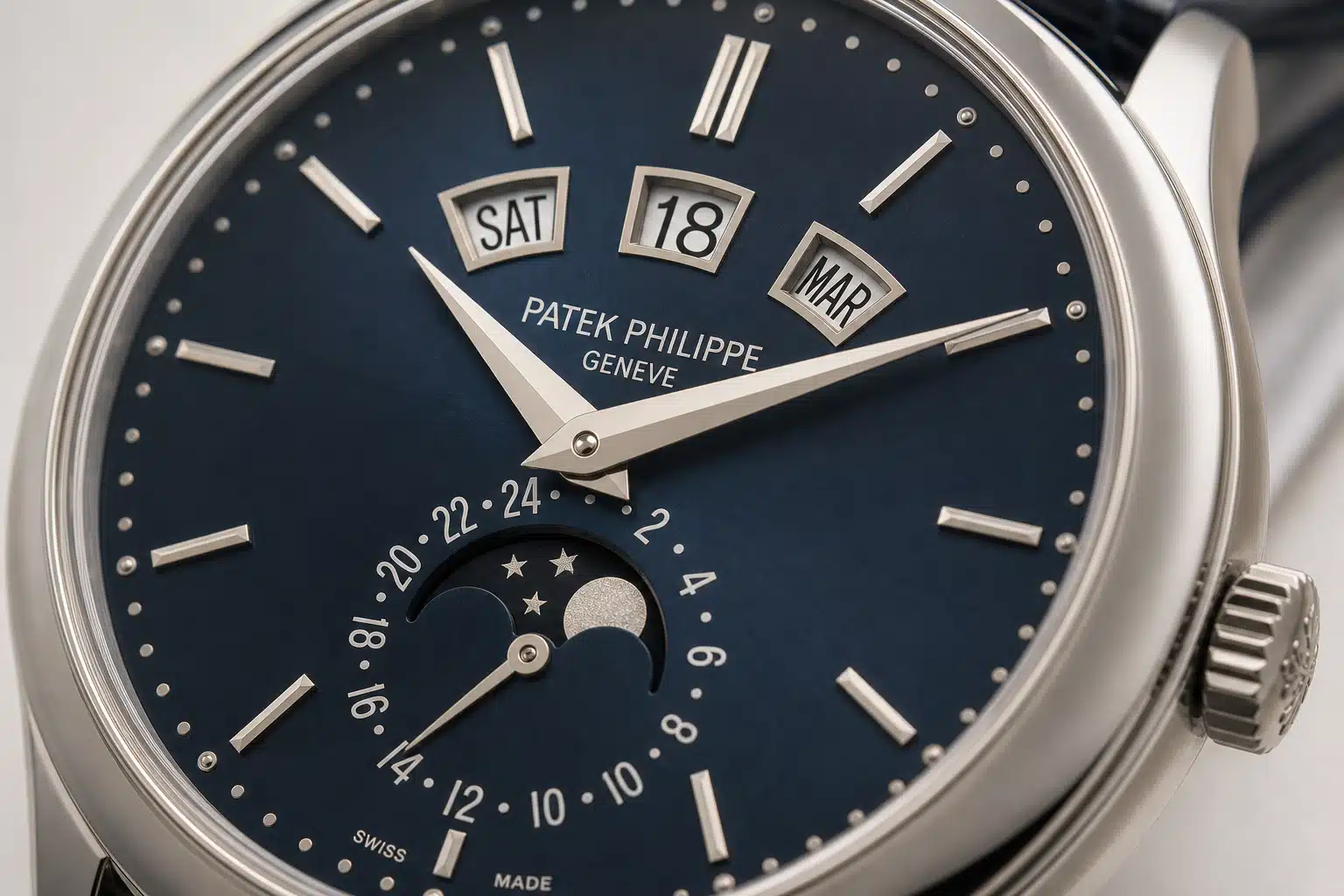
Annual-calendar-style Patek replicas often focus on the most recognizable indicators: a day window, a date window, a month display, and a moonphase-style disc or subdial. On a 5726-style replica, the appeal is that these indications sit inside the Nautilus design language, giving the watch more presence than a simple time-and-date sports model. On a 5205-style replica, the cleaner aperture layout can make the watch feel more formal and purposeful.
These displays are what buyers notice first in photos. Are the calendar windows centered? Is the date sitting properly inside the aperture? Does the moonphase-style disc look aligned? Are the hands and markers clean enough that the dial does not look crowded or cheap? Those are real visual questions, and they matter because annual calendar layouts leave little room for sloppy execution.
Still, the buyer should keep the hierarchy clear. A neat month display does not prove the watch understands month length. A moving moonphase-style disc does not prove astronomical accuracy. A calendar display replica may be visually satisfying while still being mechanically simplified.
Why Dial Complexity Can Create a False Sense of Functionality
A complicated dial can make a simplified movement look more advanced than it is. This is especially true with Patek annual calendar replicas because the genuine watches are known for useful complication logic, not just decorative busyness. When a replica shows several indicators in the expected places, the buyer naturally wants to believe the same logic exists behind the dial.
That assumption is where many wrong purchases begin. A busy dial can hide the difference between a working indicator and a true annual calendar mechanism. The indicator may advance, but it may not advance with the correct program. It may be adjustable, but adjustment is not the same as automatic correction. It may look like a genuine annual calendar in one static photo, but ownership is judged over weeks and months, not in a single dial shot.
For this type of replica watch, the better approach is to separate two questions. First, does the watch look convincing enough for the buyer’s expectations? Second, does the buyer accept that the annual calendar behavior may not match the genuine watch? If the answer to the second question is no, strong dial execution will not solve the ownership problem.
Why Most Annual Calendar Replicas Still Need Manual Adjustment
Most annual calendar replicas still need manual adjustment because the movement is usually adapted to drive calendar displays rather than reproduce the full annual calendar program. This is the direct answer to the common buyer question: does it work automatically? In most cases, a Patek annual calendar super clone may show day, date, month, and moonphase-style information, but it should not be assumed to handle 30-day and 31-day months like the genuine complication.
This is not only a matter of poor quality. It is a matter of mechanical architecture. A true annual calendar requires a programmed calendar mechanism that coordinates the date and month behavior over the year. That is much harder to reproduce than placing a convincing set of windows on the dial. In the replica market, factories often prioritize the external layout, case proportions, dial spacing, and basic indicator movement because those are the parts buyers see immediately.
The result is a practical ownership tradeoff. The watch may change date each day, and some indicators may move or be manually set, but the owner may still need to correct the calendar after certain month changes. Buyers who understand this before purchase are less likely to be disappointed. Buyers who expect a fully functional annual calendar replica in the genuine mechanical sense are usually expecting too much from this category.
Daily Date Change Is Not the Same as Annual Calendar Logic
A daily date change only proves that the date mechanism advances. It does not prove the watch knows whether the month has 30 or 31 days. This is the most common misunderstanding in annual calendar replica function claims. A watch can roll from the 15th to the 16th perfectly and still fail the important test at the end of April, June, September, or November.
True annual calendar logic is about the exception, not the routine. Almost any basic date movement can advance once every 24 hours. The annual calendar complication earns its value when it avoids the wrong 31st day in a shorter month. If the replica cannot make that correction automatically, then the owner must become the calendar program by adjusting it manually.
For daily wear, this difference becomes more noticeable. If the watch stays running for weeks, the incorrect transition after a 30-day month can interrupt the experience. For occasional wear, the issue may feel less serious because the buyer may reset the watch before each use anyway. The function limitation is the same, but the annoyance depends on how the watch is worn.
Why Simplified Calendar Modules Are Common in Replicas
Simplified calendar modules are common because true complication replication creates pressure in several areas at once. The movement must fit inside the case, support the dial layout, remain reasonably stable, and still be serviceable enough for real ownership. A complicated-looking watch that becomes too thick, too fragile, or too difficult to repair is not a good outcome for most buyers.
Cost also matters. Reproducing a true annual calendar mechanism is far more demanding than adapting an existing automatic movement to move visible indicators. In a replica watch, the buyer may be paying for case finishing, dial execution, decoration, and layout accuracy, but that does not mean the budget can also support a mechanically faithful annual calendar system. This is why the phrase “super clone” needs to be read carefully when complications are involved.
From a buyer-first perspective, the more sensible standard is not whether the watch claims the most functions on paper. It is whether the movement route matches the ownership expectation. A simpler, more stable calendar display may be less impressive technically, but it can be more realistic than an overcomplicated module that is unreliable, thick, or poorly supported.
Movement Choice Affects More Than the Caseback View
On an annual-calendar-style Patek replica, the movement choice affects daily ownership more than many beginners expect. A decorated movement may look more convincing through a display back, but a careful clone versus decorated movement comparison shows that decoration does not prove stable calendar operation, quiet winding, good power reserve, or easy servicing. A buyer comparing versions should ask whether the movement is being used mainly for visual similarity, calendar display routing, or practical reliability.
This is where the “best factory” question becomes too broad. One factory may execute the dial and case well, while another version may use a movement setup that is easier to live with. For a buyer who wears the watch often, a slightly less ambitious calendar module with fewer setting risks can be preferable to a more complicated-looking version that is thick, fragile, or difficult to correct. Visual accuracy and daily reliability are related, but they are not the same buying priority.
Movement descriptions in this category should be read as replica-market configuration references rather than official Patek Philippe caliber claims. A phrase such as decorated automatic, clone-style movement, upgraded movement, or modified base movement may describe appearance, layout, or seller terminology, but it does not prove genuine brand architecture, official service compatibility, or true annual calendar programming. The most useful movement question is what the movement actually does in this specific version.
Version Details to Confirm
Before judging any annual-calendar-style replica, buyers should confirm which indicators are functional, which are decorative, and how each calendar display is adjusted. The important questions are practical: does the date advance daily, does the day or month display move independently, is the moonphase-style display adjustable, and what happens after a 30-day month?
Vague descriptions such as “fully functional” are not enough. That phrase may only mean the visible indicators move, not that the watch contains true annual calendar logic. A more useful description explains the setting method, the correction sequence, and any limits in the calendar behavior. If those details are missing, the safer assumption is that manual correction will be part of ownership.
At Clean VS Factory, we usually encourage buyers to separate visual accuracy from ownership experience on complicated replicas. For annual calendar Patek-style models, that distinction is especially important because the dial can look far more mechanically intelligent than the movement actually is.
Movement Transparency Note: Movement references in this article describe replica-market movement routes, display behavior, and practical ownership limits, not an official Patek Philippe caliber or a brand-authorized movement unless supported by direct evidence for that exact watch. Buyers should judge annual-calendar-style replicas by the specific version, setting method, and demonstrated month-transition behavior rather than by movement decoration or broad “super clone” wording alone.
The Patek 5726 Replica Problem: Nautilus Looks, Complication Expectations
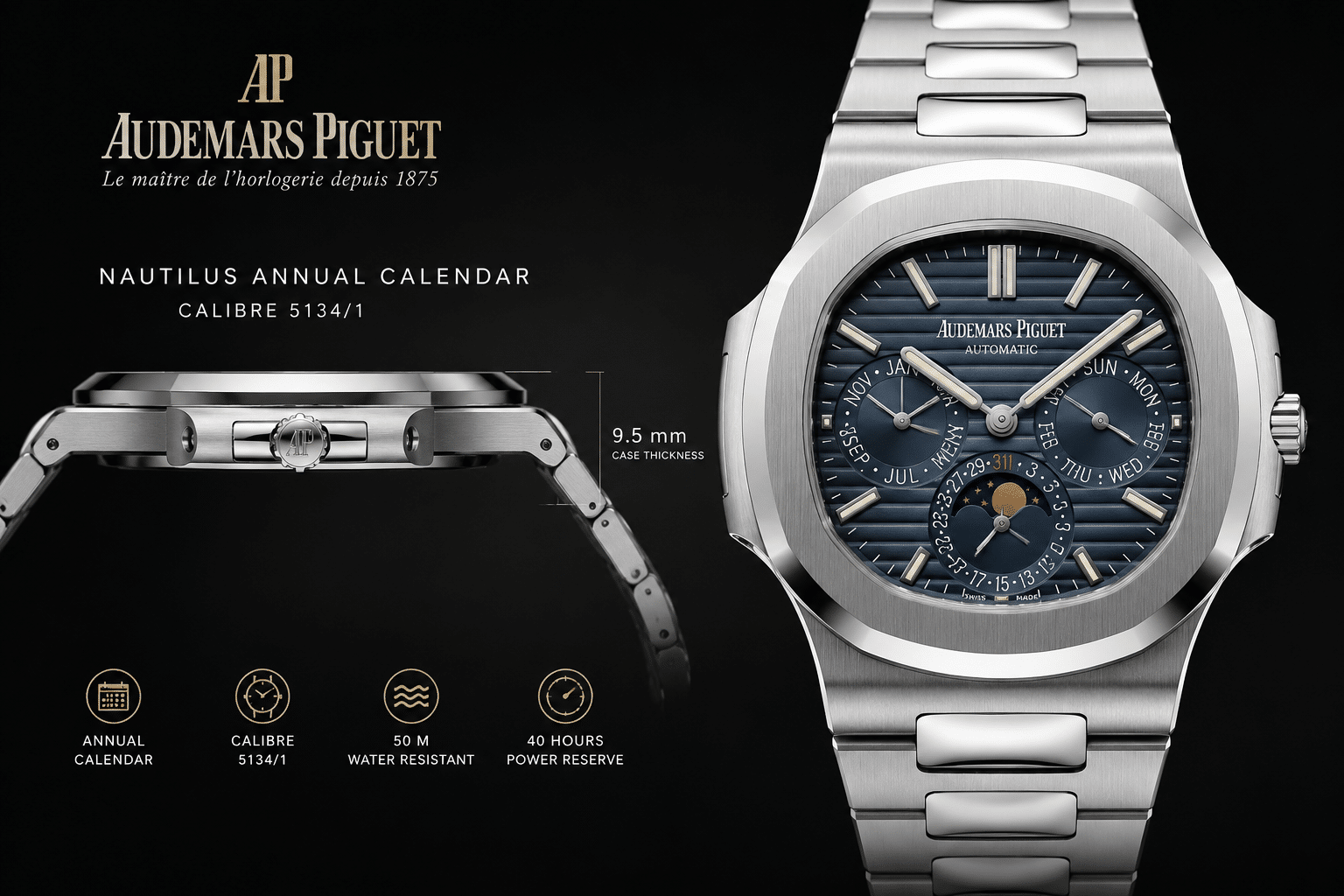
The Patek 5726 replica creates a very specific trap for buyers: it looks like a Nautilus first and an annual calendar second, but the buyer often expects both parts to be equally convincing. The Nautilus case, integrated bracelet, rounded octagonal bezel, and horizontal dial texture carry most of the visual appeal. Add a moonphase display, day and month windows, and a date window, and the watch starts to feel much more serious than a simple time-and-date Nautilus replica.
That is exactly where expectations need to be controlled. A Patek 5726 replica should usually be judged as a Nautilus-style complicated dial replica, not as a true annual calendar machine. The display may be attractive, and some indicators may move, but that does not mean the movement has the mechanical program to understand 30-day and 31-day months the way a genuine annual calendar does.
Why the 5726 Looks More Advanced Than a Simple Nautilus Replica
The 5726 design has more visual “information” than a basic Nautilus. The dial is not just hands, markers, and date. It has calendar windows, a moonphase-style display, and a more symmetrical complication layout that suggests mechanical depth. In photos, especially straight-on QC images, that complexity can make a Patek 5726 super clone look more impressive than a simpler Nautilus-style replica.
The problem is that the Nautilus case leaves little room for error. Case thickness, bracelet integration, dial spacing, and the calendar display all have to work together. If the movement or calendar module forces the case too thick, the watch may still look recognizable, but it loses some of the flat, elegant wrist presence that makes the Nautilus design convincing. This is why the 5726 is not automatically a “better” replica just because it has more functions on the dial.
For most buyers, the strongest reason to choose a Nautilus annual calendar replica is dial presence. It gives the visual impression of a complicated Patek inside a famous sports-luxury case. That can be satisfying if the buyer understands the compromise. It becomes a poor choice when the buyer assumes the added displays mean genuine-style annual calendar operation.
A version-specific comparison is especially important on the 5726 because the same visual reference creates several competing pressures at once: thin case feel, bracelet articulation, dial texture, calendar window placement, moonphase-style disc alignment, and movement height. A version that looks good from the front may still feel wrong from the side, while a version with acceptable thickness may have less convincing calendar display routing. The safer judgment is model-and-version specific, not a universal ranking by factory name alone.
Where 5726 Buyers Often Misread the Replica
The most common mistake is asking whether the 5726 replica is “fully functional” without defining what that means. If the date changes, the day and month indicators can be adjusted, and the moonphase-style disc moves, some listings or discussions may describe the watch as functional. But a moving display is not the same as annual calendar logic.
The practical question is narrower: does the watch automatically handle the transition after a 30-day month, such as April 30 to May 1, without showing an extra incorrect date? Most annual-calendar-style replicas should not be assumed to do that unless the movement behavior is clearly demonstrated and explained. A working-looking moonphase display also does not prove that the calendar system is mechanically equivalent to the genuine Patek Philippe annual calendar.
This is why buyers researching a 5726 replica fully functional claim should be skeptical of photos alone. A dial image can show alignment, printing, date position, and moonphase placement, but it cannot prove the calendar’s intelligence. The safer judgment is simple: buy the Patek 5726 replica only if the Nautilus shape and complicated dial are the main attraction, not if true annual calendar behavior is the reason you want the watch.
The Patek 5205 Replica Problem: Dress Watch Elegance With Simplified Calendar Logic
The Patek 5205 replica creates a different kind of misunderstanding. Unlike the 5726, it does not rely on the Nautilus case to attract attention. Its appeal comes from a cleaner dress watch case, a balanced aperture layout, and a formal dial that makes the day, date, and month windows look intentional and refined. Because the design is calmer, the function limitation can be easier to overlook.
That is the buyer risk. The 5205 annual calendar replica may look more “proper” than a sportier complicated replica because the calendar windows are neatly arranged and the moonphase-style subdial fits the dress-watch language. But the clean layout should not be confused with genuine annual calendar programming. A Patek 5205 replica is still mainly an appearance decision unless the specific movement behavior is clearly understood.
Why the 5205 Layout Can Feel More Convincing
The 5205-style dial is persuasive because it makes the complication look orderly. The calendar windows sit in a structured arrangement, the moonphase-style subdial gives the lower dial a natural focal point, and the dress watch case does not distract the eye with bracelet integration or sports-watch geometry. In QC photos, this can make the 5205 annual calendar replica feel more mechanically believable than it really is.
Small visual details matter more here than many buyers expect. Window alignment, date centering, dial printing, and the position of the moonphase-style subdial are not just cosmetic issues. On a clean dress watch dial, uneven spacing or a poorly centered date window stands out quickly because there is less visual noise to hide it. A busy Nautilus calendar dial can sometimes disguise small flaws; the 5205 layout is less forgiving.
Still, good window alignment does not answer the bigger functional question. A neat aperture layout can show day, date, and month information, but it does not prove the movement knows how long the current month is. Buyers asking about Patek 5205 replica functions should separate two questions: does the display look convincing, and does the calendar behave like a genuine annual calendar? The first is visible in photos. The second usually is not.
The Same Manual-Correction Issue in a More Formal Package
The 5205 replica often feels more mature than the 5726 replica, but the ownership limitation is similar. Many versions may require manual correction when the calendar display falls out of sync, especially around month transitions. The watch may advance certain indicators, but that does not mean it performs the automatic month-length correction that defines a real annual calendar function.
This matters more for buyers who want the 5205 because of its complication rather than its appearance. If the attraction is the elegant case profile, organized dial, and formal Patek-style presence, the replica may still make sense with realistic expectations. If the attraction is the belief that a Patek 5205 super clone will provide genuine-style calendar convenience, disappointment is likely.
The best way to evaluate this model is not to ask whether it has calendar windows. It obviously does. The better question is how those windows are driven, how they are adjusted, and what happens after a 30-day month. Without clear answers, the buyer should treat the 5205 replica as a visually complicated dress watch, not as a mechanically faithful annual calendar.
Common Buyer Misunderstandings About “Fully Functional” Annual Calendar Replicas
The phrase “fully functional annual calendar replica” is where many buyers get misled, sometimes without anyone using deliberately deceptive language. In replica watch functions, “working” can simply mean that an indicator moves or can be adjusted. It does not automatically mean the watch contains the same calendar logic as the genuine annual calendar mechanism.
For Patek annual-calendar-style replicas, this distinction is critical. A date window may change. A month display may be adjustable. A moonphase-style disc may rotate. Calendar pushers may move the indicators. None of those points alone proves that the watch automatically calculates 30-day and 31-day months. The real annual calendar function is not the presence of several displays; it is the mechanical decision-making behind them.
“Working” Can Mean the Indicator Moves
In replica descriptions, a working indicator often means the part is not purely printed or frozen. That is useful information, but it is limited. A decorative subdial that never moves is different from a disc that advances, and a manually adjustable month window is better than a fake fixed display. But both can still fall short of genuine annual calendar behavior.
This is especially important with a working moonphase replica claim. A moonphase-style disc may move on a cycle, or it may be adjusted through a pusher or crown position, but that does not mean it is astronomically accurate or mechanically integrated like the genuine watch. For many buyers, the moving disc is enough for visual enjoyment. For buyers expecting real complication logic, it is not enough.
A practical buyer should ask what “working” means in plain terms. Does the date change by itself every night? Can the month be corrected independently? Does the watch require manual setting after shorter months? Are the pushers functional or decorative? These questions matter more than the label attached to the watch.
“Super Clone” Does Not Guarantee Complication Equivalence
“Super clone” is often used to describe a higher-grade replica with stronger case shape, dial execution, finishing, and movement presentation. It should not be read as a promise that every complicated function has been mechanically reproduced. This is especially true for annual calendar Patek replicas, where the visual layout is much easier to imitate than the genuine calendar program.
At Clean VS Factory, we encourage buyers to separate visual accuracy from ownership experience. A Patek 5726 replica or Patek 5205 replica can look convincing in photos and still require manual calendar correction in real use. That does not automatically make the watch worthless, but it changes what the buyer is actually paying for.
The safest interpretation is this: “super clone” may tell you the watch is trying to be close in appearance and construction, but it does not settle the movement question. For annual calendars, the movement question is the main question.
Red Flags in Function Claims
Be cautious with vague claims such as “same function as genuine” if there is no explanation of how the calendar behaves after 30-day months. A serious description should be able to say which indicators move, which ones are manually corrected, and how the calendar is set. If the only proof is a dial photo with all displays visible, the claim is not strong enough.
Another warning sign is the absence of adjustment instructions. Annual-calendar-style replicas often have specific setting sequences, and careless adjustment can create misalignment or damage on some movements. If nobody can explain how the calendar pusher, crown positions, date setting, and month display work, the buyer should assume the function claim is incomplete.
The clearest red flag is a claim of genuine-equivalent annual calendar operation without a demonstration of month-length handling. For this category, the buyer’s key test is not whether the watch looks complicated. It is whether the watch knows the difference between a 30-day month and a 31-day month. Most replicas should be treated as simplified until proven otherwise.
Claims such as “perfect,” “same as genuine,” or “guaranteed to pass inspection” should be treated with caution in this category. A more responsible comparison looks at the exact model version, visible execution, movement configuration, setting method, and available QC evidence. The purpose of factory and movement information should be to understand quality and avoid overpaying, not to represent a replica watch as genuine.
How to Evaluate QC Photos for Annual Calendar-Style Patek Replicas
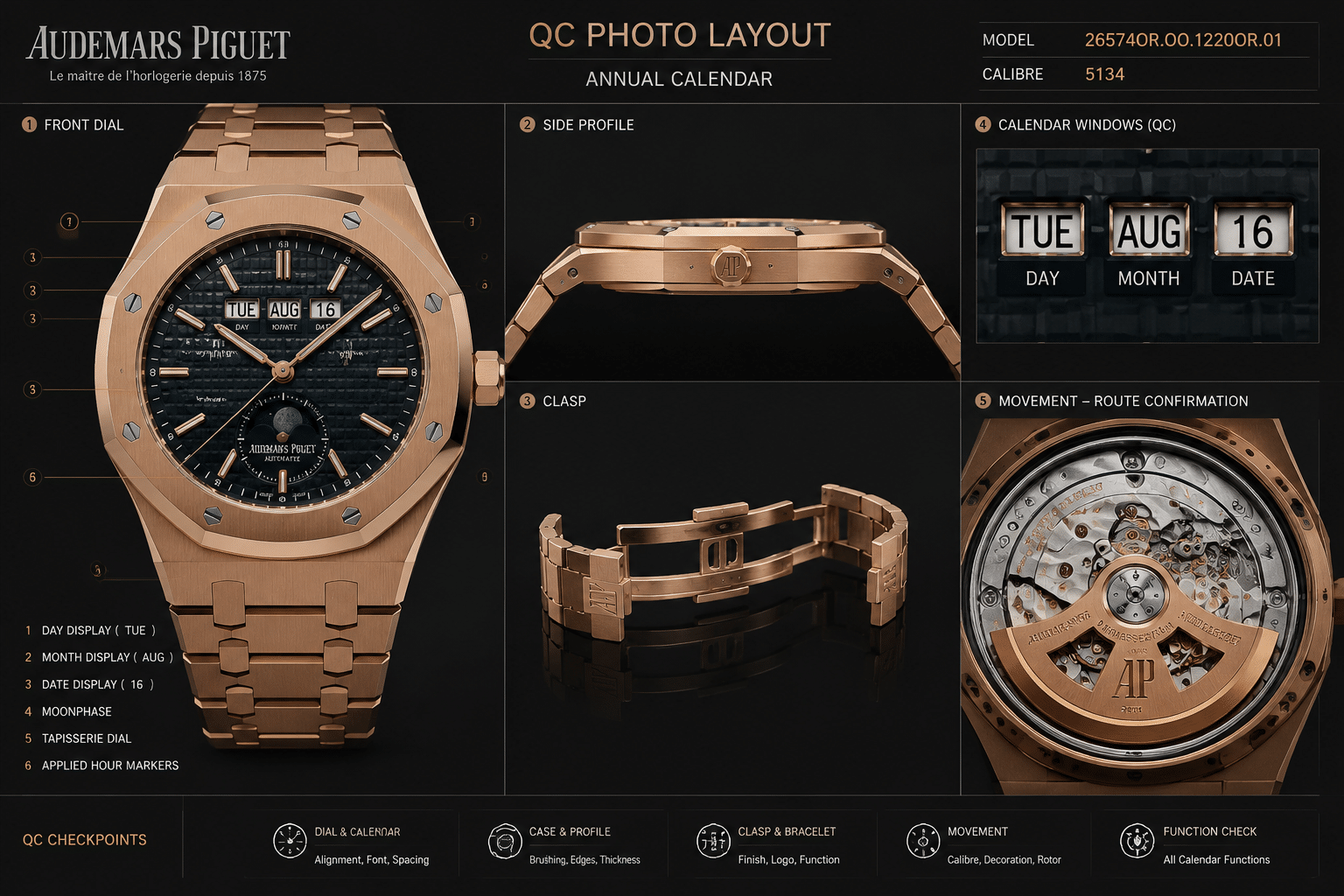
Patek replica QC photos are useful, but only if the buyer understands their limits. For an annual calendar-style watch, QC should be treated as a visual inspection tool first: window alignment, date alignment, moonphase disc position, hand alignment, case profile, side view, and clasp fit. It should not be treated as proof that the watch contains genuine annual calendar intelligence.
The mistake is over-reading a few clean photos. A Patek 5726-style or 5205-style replica can look organized in a straight-on dial shot while still requiring manual correction in real ownership. Good annual calendar replica QC helps you reject an obviously poor unit; it does not prove the calendar understands 30-day and 31-day months.
Before making a decision, buyers should review real QC photos where available, including dial printing, aperture alignment, hand alignment, datewheel centering, moonphase-style disc position, case thickness, side profile, bracelet or strap fit, clasp engraving, and caseback finishing. Stock photos and factory labels alone are not enough for a reliable judgment.
Dial Windows and Subdial Alignment
The first QC photo should be a straight, level dial image. If the camera is tilted, the day, date, and month windows can look worse or better than they are. Ask yourself a simple question: are the calendar indications centered enough that they will not bother you on the wrist?
For window alignment, the most important check is not whether the font is identical under macro enlargement. It is whether the displayed text sits too high, too low, or visibly off to one side inside the aperture. A slightly imperfect font may disappear in daily wear; a crooked date or month window stays noticeable every time you glance at the dial.
The moonphase-style disc deserves the same practical treatment. It should sit naturally within the opening, with no obvious tilt, scraping, or awkward partial exposure. Buyers sometimes focus on whether the moon artwork is perfectly faithful, but a badly centered disc is usually the more irritating flaw because it makes the whole dial look careless.
Hand alignment also matters because these watches already have a busy dial. If the minute hand does not meet the markers cleanly, or if a subdial hand points between positions when it should be centered, the visual complexity starts to work against the watch. On a simple time-and-date replica, a small alignment issue may be easier to ignore. On an annual calendar-style Patek replica, every window and hand competes for attention.
Case Thickness and Side Profile
Side-profile photos are especially important for complicated Patek-style replicas because the movement route and added calendar displays can make the case thicker than the genuine design suggests. A watch may look convincing from the front but feel too tall once the side view reveals a heavy mid-case, thick caseback, or raised crystal profile.
This matters more on Patek designs than many buyers expect. A Nautilus-style annual calendar needs bracelet integration and case thinness to feel balanced, and Patek Philippe clone movements are often judged by how well that mechanical layout preserves the intended proportions. A 5205-style dress watch needs a refined case profile because the formal design leaves fewer places to hide extra thickness. If the side view looks bulky, the watch may still be wearable, but it should be judged as a visual compromise rather than a faithful complication replica.
Clasp fit and bracelet or strap attachment should also be checked, but they should not distract from the main issue. A clean clasp photo is helpful. A side view showing how the watch sits, how the lugs or bracelet connect, and whether the case looks overbuilt is more decision-changing for these models.
What QC Photos Cannot Prove
QC photos can show that the indicators move if the seller provides images at different settings. They can show a different date, a different month, or a shifted moonphase-style disc. That is useful, but it only confirms display movement. It does not prove the annual calendar replica QC has verified true annual calendar programming.
The practical question is not simply “can QC prove the function?” The better question is: can the watch automatically pass from April 30 to May 1 without showing an incorrect extra date? A normal QC photo set rarely demonstrates that. Even several photos with changed indicators may only show that the calendar was manually advanced.
For this reason, buyers should separate visible inspection from functional expectation. Use QC photos to check calendar window alignment, case profile, dial printing, hand placement, side thickness, and clasp fit. Do not use them as evidence that the watch will handle 30-day and 31-day months like a genuine annual calendar.
At Clean VS Factory, we usually encourage buyers to treat QC as risk reduction, not proof of mechanical equivalence. With complicated Patek-style replicas, that distinction prevents one of the most common disappointments: approving a beautiful-looking watch and later realizing the calendar behavior is much simpler than the dial suggests.
Seller Photos, Factory Labels, and Price Are Only Signals
Factory labels, QC photos, and seller descriptions can help narrow a shortlist, but they should not be treated as final proof of annual calendar behavior. A label may identify the general source of a watch, yet factory reputation does not apply equally to every model or every version. A factory that performs well on a simpler Nautilus-style watch may still face compromises on a 5726-style annual calendar because the case, dial, and movement demands are different.
Price also needs careful interpretation. A higher price may reflect a better movement base, cleaner finishing, harder availability, seller margin, or after-sale risk; it does not automatically prove true annual calendar logic. For this category, the more useful comparison is whether the price premium buys visible improvements and a clearer movement explanation, not whether the listing uses stronger language such as “best version” or “fully functional.”
QC photos can reduce uncertainty, but they do not guarantee perfection or future reliability. Buyers should still confirm the seller’s return terms, repair options, water-resistance testing position, shipping expectations, and after-sales communication before ordering, because these policy details are separate from the visible quality shown in photos.
Verification Note: When possible, buyers should review real watch photos, dial-window closeups, side-profile images, clasp finishing, caseback structure, and clear movement or setting information before deciding. Stock images, factory labels, and price differences can help with screening, but they are not enough to verify calendar behavior or reduce uncertainty about a specific annual-calendar-style replica.
Evidence Boundaries Buyers Should Keep in Mind
Official brand information can help identify what an authentic model family is, how a genuine reference is described, and which design language belongs to the original watchmaker. For example, Patek Philippe’s official Nautilus information describes authentic Nautilus design details and specifications for current official references, but that type of source does not prove that a replica 5726 has the same case construction, finishing, movement behavior, or service standard.[1]
The same boundary applies to movement claims. A seller may describe a replica as having an “Asian clone,” “decorated automatic,” or “upgraded movement,” but those phrases should not be treated as technical proof unless the specific watch is documented clearly. An official movement specification sheet can explain the specifications of a named caliber, but it cannot prove that a particular replica contains that movement unless the evidence is tied to that exact watch.
Legal and disclosure language also needs restraint. Replica watches can raise trademark, customs, import, resale, and disclosure issues because they are imitation products using protected brand identifiers, and U.S. intellectual property guidance treats counterfeit goods as goods bearing marks that are identical or substantially indistinguishable from registered trademarks.[2] Customs guidance is relevant because border agencies may enforce intellectual property rights against infringing goods, but that does not allow any article or seller to predict what will happen to a specific shipment or buyer.[3]
For buyers, the practical conclusion is simple: use official sources to understand the authentic watch, use QC photos to judge the visible replica, and use cautious language for anything involving factory identity, movement content, water resistance, legality, or genuine-equivalent performance. If a claim cannot be verified directly, it should be treated as a seller claim or buyer impression rather than a settled fact.
Why These Replicas Are Usually Appearance Watches, Not Complication Watches
A fair Patek annual calendar replica review has to make one point clearly: most of these watches should be evaluated as appearance watches, not complication watches. Their strongest appeal is the visual impression of a complicated Patek design. Their weakness is the gap between that visual complexity and the genuine annual calendar’s automatic month-length logic.
This does not make every annual calendar super clone a bad choice. It means the buying standard needs to be honest. If the buyer wants dial presence, layered calendar displays, and the look of a high-complication Patek-style watch, the category can make sense. If the buyer wants genuine annual calendar convenience, the expectation is too high for most replicas in this segment.
The Real Value Is the Dial Presence
The attraction is easy to understand. A simple time-and-date Patek-style replica may be cleaner, but an annual calendar-style dial looks more technical and more elevated. The day, date, month, and moonphase-style display give the watch a sense of depth that photographs well and feels more special than a plain dial.
For some buyers, that is the entire point. They are not buying the watch to test the calendar at the end of every month. They want the visual accuracy of the layout, acceptable case proportions, readable windows, and a convincing wrist presence. For that buyer, appearance versus function is not a defect as long as the compromise is understood before purchase.
The more practical judgment is this: if the dial execution is clean and the case is not overly thick, the watch may satisfy an appearance-focused buyer. If the date is crooked, the moonphase-style disc sits badly, or the case side looks bulky, the model loses its main reason to exist because the function will not rescue it.
The Real Risk Is Expecting Genuine Convenience
The disappointment starts when a buyer assumes the complicated dial means complicated mechanical behavior. A replica may advance its date, move its month display, or show a moonphase-like indication, but that does not make it equivalent to a genuine annual calendar. The ownership expectation has to include manual correction and possible setting inconvenience.
This is where simpler replica models can be more rational. A basic Calatrava-style watch, a time-and-date Nautilus-style model, or another less complicated design may offer a cleaner daily wear experience because there are fewer displays to set and fewer expectations to disappoint. Paying more for complexity is not always paying for a better ownership experience.
The better question is not only “is it worth it?” It is “what am I paying for?” With these replicas, the answer is usually visual presence and collection variety, not authentic complication performance. Buyers who accept that tradeoff are less likely to feel misled by the watch later.
A Practical Decision Framework Before Buying
Before choosing a Patek annual-calendar-style replica, buyers should decide whether the purchase is being driven by appearance, daily convenience, or mechanical curiosity. If the main goal is appearance, the decision can focus on dial balance, aperture alignment, case profile, finishing, and comfort. If the main goal is daily convenience, the manual-correction reality becomes much more important. If the main goal is mechanical curiosity, the buyer should ask for a clear explanation of the setting sequence and month-transition behavior instead of relying on the word “functional.”
A useful comparison path is to start with the exact reference style, then check the version, then review the movement route, then inspect QC photos, and only then decide whether the price and compromise make sense. This order keeps the buyer from starting with a factory name or marketing phrase and working backward to justify the watch. For CleanVSFactory, the goal is to make replica watch comparison easier to understand by connecting factory names, movement claims, visible QC details, and realistic ownership limits.
Buyers should also confirm return, repair, shipping, and after-sales terms before ordering, because those practical terms can vary by seller and are separate from the technical quality of a watch. This does not change the calendar limitation, but it helps set expectations before money is committed. A complicated-looking replica with unclear terms, unclear movement behavior, and only stock photos is harder to judge than a simpler model with transparent photos and plain-language function limits.
Who Should Still Consider a Patek Annual Calendar Replica
A Patek annual calendar replica buyer can still be satisfied if the watch matches the right use case. The right buyer is not someone chasing true annual calendar convenience. It is someone who likes the 5726 or 5205 visual language, accepts manual setting, and understands that the complicated dial is mainly an aesthetic choice.
This category works best when expectations are modest and specific. The buyer should care about dial layout, window alignment, case shape, and wrist presence more than mechanical equivalence. If those visible areas are handled well, the watch can still be enjoyable as part of a collection.
Appearance-Focused Buyers
An appearance-focused buyer may still find appeal in these watches because the annual calendar layout has a different personality from simpler Patek-style replicas. A Patek 5726 replica buyer may want the Nautilus case with a more interesting dial. A 5205-style buyer may prefer the formal aperture layout and moonphase-style display because it feels more complete than a basic dress watch.
This buyer should be honest about what they are choosing. The appeal is the look of a complicated Patek design, not the satisfaction of owning a mechanically faithful annual calendar. If the case profile is acceptable, the dial printing is clean, and the calendar windows are centered, the visual experience may be enough.
Occasional Wearers Who Already Expect Manual Setting
Occasional wearers are often better suited to annual calendar-style replicas than daily wearers. If a watch sits in rotation for several days or weeks, the owner will probably reset the time and calendar before wearing it anyway. In that situation, manual setting tolerance becomes part of the normal routine rather than a special annoyance.
A buyer who rotates watches may not care that the replica does not automatically solve every month transition. The watch is being worn for a dinner, a weekend, or a change of style, not as a continuous calendar tool. The limitation still exists, but it becomes less intrusive.
What This Means for Daily Wear
Daily wear makes calendar behavior more noticeable. If the watch is on the wrist every day, the owner will eventually face the correction issue after shorter months, and the difference between a display-based replica and a true annual calendar becomes harder to ignore.
For occasional wear, the same limitation may be acceptable because the watch is often reset before use. For daily wear, buyers who dislike manual correction should be cautious. In this category, realistic expectations matter more than the label “super clone.”
Who Should Avoid Annual Calendar Patek Replicas
The clearest rule is simple: avoid annual calendar replica models if the annual calendar function is the main reason you want the watch. A Patek 5726 replica or Patek 5205 replica can be attractive as a complicated-looking design, but the Patek annual calendar replica limitations become hard to ignore if you expect the watch to think through month lengths like the genuine complication.
This is not about saying every annual-calendar-style replica is a bad watch. It is about choosing the right category for the right expectation. If you want low-friction daily wear, fewer calendar corrections, and less ownership uncertainty, a simpler replica model is usually the more rational choice than a not fully functional replica with several displays that require attention.
Buyers Who Want True Annual Calendar Convenience
Buyers who want true complication behavior should be cautious. The practical appeal of a genuine annual calendar is automatic correction for 30- and 31-day months, with February being the normal exception. Most annual calendar replicas do not reproduce that calendar intelligence, even if the dial shows day, date, month, and moonphase-style information.
If your question is “is this too risky because I want the calendar to operate like the genuine watch,” the answer is usually yes. The risk is not only that the replica may need correction; it is that the ownership experience will feel different from the function you thought you were buying.
Buyers Who Dislike Manual Correction
Manual correction is part of the reality with many annual-calendar-style replicas. If adjusting the date, month, or display sequence after short months sounds annoying, this category will likely frustrate you over long-term ownership. The more you wear the watch as a regular daily piece, the more noticeable that adjustment frustration becomes.
A better daily replica for this type of buyer is usually a simpler time-and-date model or a less complicated calendar layout. It may look less impressive in photos, but it removes the main irritation: owning a complicated dial that still asks you to manage the calendar yourself.
Buyers Who Prioritize Mechanical Faithfulness Over Appearance
Annual calendar Patek replicas are weakest for buyers who care more about mechanical faithfulness than visual presence. The watch may capture the design language, the aperture layout, and the general Patek complication look, but visual imitation and mechanical equivalence are different standards.
At Clean VS Factory, we usually encourage buyers to separate appearance accuracy from ownership experience, especially with complicated models. If your satisfaction depends on the movement behaving like a true annual calendar, avoid annual calendar replica options and consider a simpler replica model where the visible function and actual function are better aligned.
References
[1] Patek Philippe, “Nautilus 5811/1G official specifications,” official brand reference for authentic Nautilus model information, available at Patek Philippe Nautilus 5811 official specifications.
[2] United States Patent and Trademark Office, “Counterfeit Goods Basics,” official guidance on counterfeit goods and trademark-related distinctions, available at USPTO Counterfeit Goods Basics.
[3] U.S. Customs and Border Protection, “Intellectual Property Rights,” official customs guidance on intellectual property rights enforcement, available at U.S. CBP Intellectual Property Rights.
Disclosure: This article is for general educational and comparison purposes only. Replica watches are not genuine products from the original luxury brands, and brand names are used only to identify reference designs or comparison topics. Factory names, movement descriptions, prices, availability, QC details, seller policies, and version information can change, so readers should verify important details with the seller before making a purchase decision. Replica watches should not be represented, resold, or used as genuine watches.