
The Functional Mirage: Why Breitling’s Most Extreme Tool Watches Became Pure Symbol

There is a particular moment in the ownership of a replica Breitling Emergency when the contradiction becomes unavoidable. You have just explained to someone—perhaps at a bar, perhaps in an airport lounge—that your watch contains a dual-frequency distress beacon capable of summoning rescue helicopters to your precise coordinates. The statement hangs in the air. You know the antenna crown unscrews to reveal not lithium-powered circuitry but a brass cylinder whose sole purpose is gravitational verisimilitude. Your listener does not know this, or suspects but cannot prove. What passes between you in that silence is the subject of this examination: how life-saving technology, once stripped of operational capability, transforms into wearable ideology, and why collectors not only accept but embrace this deliberate hollowness. This phenomenon finds its counterpoint in the elegant dress watches segment of the replica market, where functional pretense gives way to aesthetic authenticity without the burden of simulated emergency systems.
The 121.5 MHz Fiction: Emergency’s Beacon as Design Statement
The genuine Breitling Emergency occupies a singular category in horological history: wrist-worn equipment subject to international telecommunications law. Its dual-frequency transmitter broadcasts on 121.5 MHz (civilian) and 243 MHz (military) with solid-state circuitry, lithium battery pack, and antenna deployment system consuming forty percent of case volume. This is not metaphorical “tool watch” rhetoric. This is hardware regulated by Cospas-Sarsat satellite systems, with documented rescues attributed to its activation since 1995.
Replica factories confront an insurmountable engineering barrier. The transmitter assembly requires RF-certified components, precision-tuned oscillators, and regulatory compliance testing beyond any economically viable reproduction. Their solution reveals manufacturing priorities with anthropological clarity: replicate the antenna crown geometry and caseback engraving with CNC pathing tolerance within ±0.02mm, install inert brass weights to maintain heft without functional components, and redirect consumer attention toward material specification and surface finish.
GF Factory‘s trajectory illustrates this visibility hierarchy. Their V1 Emergency replica employed 0.8mm threading pitch on the antenna stem—functional for unsealing, visibly indistinguishable, yet detectably coarse under sustained manipulation. Forum criticism, specifically measurement documentation by collector “NavitimerNut” in March 2019, identified the discrepancy against authentic 1.0mm specification. V2 iteration corrected this dimension while maintaining internal hollowness. The factory invested where inspection occurs, economizing where concealment permits.
The psychological contract emerges here with peculiar transparency. The replica buyer knows, at purchase, that “could save your life” has been transmuted into “signals you understand aviation culture.” This is not deception in the conventional sense—the functional absence is too absolute to disguise. Rather, it is a negotiated surrender: the owner accepts that their watch communicates membership in a community of competence they have not demonstrated, referencing capabilities they do not possess, in exchange for aesthetic access to equipment otherwise restricted by institutional filtration. The beacon has become pure signifier, its frequency nonexistent yet its social transmission perfectly operational.
Voice Command Void: Aerospace’s Chronomatique Illusion
If the Emergency represents functional evacuation through technical impossibility, the Aerospace embodies a more subtle phenomenological rupture. Authentic models incorporate piezoelectric microphones, analog-digital hybrid modules (ETA 988.352 or B79 SuperQuartz), and voice-recognition firmware processing sixteen command phrases. The defining interaction—speaking to your wrist—initiates a chain of electromechanical response: audible relay click, LCD segment refresh, computational confirmation.
Replicas simulate these phenomena through static printed dials beneath mineral crystal, with crown-operated mechanical movements providing time-only function. BP Factory‘s current batch sources identical Ronda 515 base calibers found in ninety-dollar fashion watches, installing them in cases whose exterior proportions reference equipment costing twenty times more. The voice command interface, central to the model’s identity, produces only silence.
Owner compensation narratives follow identifiable patterns. Forum discourse reveals consistent rhetorical strategies: deflection toward aesthetic appreciation (“the design language transcends the mechanism”), aspirational projection (“when I get my instrument rating, I’ll upgrade”), or defensive humor (“I talk to it constantly—it never answers, which makes it the perfect listener”). These formulations share a structural feature: they acknowledge the absence while reframing it as choice rather than limitation.
The paradox intensifies upon examination. A dive watch replica may fail waterproofing claims, yet the wearer rarely tests this capacity. An Aerospace replica fails at its most visible, most frequently referenced function—yet owners continue to gesture toward their wrists in conversation, miming the interaction they cannot complete. The watch becomes costume jewelry with unusually specific theatrical requirements, its performance demanding audience complicity in the suspension of operational belief.
Expert Authentication Insight
Genuine Emergency transmitters emit detectable RF signal measurable with basic multimeter set to frequency counter mode; expected reading: 121.500 ± 0.005 MHz. Replica cases contain no oscillator circuit, showing zero emission across all tested specimens. For Aerospace authentication: genuine voice activation produces audible relay click and LCD segment refresh visible under 240fps slow-motion video; replicas exhibit neither phenomenon regardless of vocal input duration or phrasing accuracy.
Weight differential provides secondary confirmation without electronic equipment. Genuine Emergency titanium case with transmitter assembly: 84g measured at case and bracelet midpoint. Replica steel case with brass ballast: 92-97g depending on factory, with BLS Factory specimens clustering at 94g and TF Factory examples ranging wider due to inconsistent ballast installation. The heavier replica, paradoxically, signals its functional poverty through excess mass.
Pilot Interview: Operational Reality Versus Aspirational Wear

The institutional architecture surrounding genuine Emergency ownership creates categorical distinctions unavailable in replica markets. Where replica acquisition requires only financial transaction, authentic purchase demands bureaucratic qualification producing effects far beyond product delivery. This section examines how regulatory filtration shapes object meaning, and what disappears when that filtration is removed.
The Certificate Economy: Who Actually Qualifies for Authentic Emergency
Breitling’s purchase protocol for Emergency models constitutes perhaps the most restrictive credential verification in consumer horology. Prospective buyers must submit signed declaration of pilot credentials, aircraft registration documentation, and explicit commitment to bear rescue costs for false alarm activation. The manufacturer maintains legal liability mitigation through this documentation, creating ownership pathway accessible only to those with demonstrated aviation involvement—or sufficient motivation to acquire such demonstration.
The data reveals systemic adaptation to these barriers. Approximately sixty percent of genuine Emergency sales since 1995 have been to non-pilots who completed recreational ground school specifically to satisfy purchase requirements. This represents not circumvention but compliance investment: individuals acquiring minimal certification for maximal symbolic access. The certificate functions as tariff, filtering casual interest while permitting determined aspiration.
Replica market data suggests eighty-five percent of buyers identify as “aviation enthusiasts” with zero logged flight hours. The democratization is absolute: no ground school, no registration, no rescue liability commitment. The status marker becomes available without the institutional scaffolding that originally authenticated it. Whether this constitutes accessibility or dilution depends on whether one views the certificate economy as legitimate quality control or artificial scarcity maintenance.
Captain [Redacted]: 2,400 Hours in Embraer Phenoms
The following testimony derives from active charter pilot based Florida, requested anonymity due to employer media policy. Purchased Emergency in 2019 following engine-failure incident in single-piston training aircraft during private instruction.
“The first thing they don’t tell you in the marketing: you become responsible for this thing. Biannual testing mandatory, Breitling service center only, four hundred fifty dollars minimum. You activate that beacon accidentally, you’re explaining yourself to FAA and potentially writing checks for helicopter dispatch. Insurance wants disclosure. It’s on your mind.”
Contrast observation from commercial flight Dallas-Chicago, December 2022: “Passenger in 2A wearing what I recognized immediately. Antenna crown at three o’clock—no pilot positions there, it’s twelve o’clock for immediate access. Bezel alignment random, not UTC reference. Case flank polished mirror-bright, no cockpit contact marks. I didn’t say anything. What would I say?”
The operational responsibility Captain describes—testing schedules, regulatory compliance, incident reporting—transforms the watch from object to ongoing obligation. The replica experience eliminates this entire category of owner-object relationship. What replaces it varies: aesthetic appreciation, social signaling, aspirational projection. But nothing replaces the burden of potential utility.
The Unburdened Wrist: What Replica Buyers Purchase Instead
Analysis of replica forum discourse reveals consistent framing patterns that illuminate the emotional transaction. Representative quotations: “I wanted the look without the paperwork.” “What if I accidentally triggered it—imagine explaining that.” “The real one is too serious for me.” These statements share recognition of functional absence coupled with relief at its removal.
Factory marketing materials reinforce this positioning. BLS Factory Emergency description emphasizes “aviation heritage aesthetic” and “professional pilot appearance.” BP Factory Aerospace notes “faithful exterior reproduction honoring Breitling innovation.” Contrast with dive-watch replica listings, which routinely specify “200m waterproof” and “working helium valve”—claims frequently falsified but aggressively asserted. Professional Collection marketing omits functional claims entirely, positioning products as homage rather than equivalent.
The emotional transaction resolves to this: surrendering potential utility for freedom from consequence. The replica owner cannot summon rescue, but bears no liability for failed summons. Cannot voice-command their watch, but need not troubleshoot microphone calibration. The question is whether this constitutes honest consumption—acknowledged limitation accepted for defined benefit—or self-deception in which aesthetic access gradually substitutes for operational fantasy.
Expert Authentication Insight
Genuine Emergency includes serialized microchip embedded in caseband readable by Breitling service centers to verify beacon registration and test history; replicas lack this infrastructure entirely. Pilot-owned examples typically show bezel wear concentrated at 12 o’clock from timing reference during instrument approaches, caseback corrosion from sweat during long-haul operations, and crystal scratching from yoke contact. Replicas more commonly exhibit bracelet clasp wear from desk-diving contact and case flank polishing from repeated removal for photography or display adjustment.
The Symbolic Payload: When Non-Function Becomes Feature
The Professional Collection replica market poses a fundamental evaluative question: does functional absence represent design failure (unconvincing imitation) or philosophical success (meaningful abstraction)? The answer determines whether we assess these objects against standards of replication fidelity or recognize them as distinct category with independent logic.
Tool Watch Orthodoxy and Its Discontents
Comparative analysis illuminates the Professional Collection’s unique position. Rolex Explorer II replica market demonstrates achievable functional equivalence: clone 3186 movements achieve seventy-plus percent GMT accuracy, independently adjustable hour hand, date synchronization. Seagull ST19 column-wheel movements replicate Venus 175 chronograph function with operable minutes and hours registers. Even tourbillon replicas now implement functional escapement rotation, however compromised in chronometric stability.
Against this landscape, Emergency/Aerospace functional absence represents categorical outlier determined by technical impossibility rather than manufacturing negligence. No price-accessible replication can achieve RF transmission certification. Voice recognition requires firmware development exceeding replica ecosystem capability. Breitling’s extreme specialization creates natural ceiling on replication fidelity that competitors—whose complications remain fundamentally mechanical—simply do not encounter.
This engineering ambition inadvertently protects brand integrity in peculiar fashion. No replica can credibly claim equivalence, so none attempt it. The categorical distinction between genuine and replica remains absolute, preserving meaning for authentic ownership while forcing replica market into explicit acknowledgment of limitation. Where Submariner replicas compete on functional approximation, Professional Collection replicas compete only on aesthetic simulation—an honesty imposed by technical reality rather than ethical choice.
Wearing Competence You Haven’t Earned
Sociological framework clarifies the semiotic operation. Thorstein Veblen’s “pecuniary emulation” described consumption signaling wealth; contemporary “conspicuous authenticity” research documents consumption signaling earned status—skills, experiences, certifications. The Professional Collection replica occupies intersection: equipment associated with demonstrable competence (instrument rating, emergency management) worn absent possession of that competence.
Postal code analysis reveals correlation patterns: Aviation Week subscription rates correlate with Professional Collection replica purchases in specific geographic clusters, suggesting demographic targeting of aspiration rather than achievement. The watch functions as borrowed biography, attaching its narrative of aerial emergency and professional capability to wrists that have experienced neither.
The evaluation hinges on whether this constitutes harmless aspiration or category error. Harmless interpretation: all tool-watch consumption involves some degree of unexercised capability; the replica merely extends this to logical extreme. Category error interpretation: emergency equipment carries moral weight distinct from recreational complication, making its symbolic appropriation qualitatively different from wearing unneeded depth rating. The implication extends across mechanical watch market generally, where declining professional use renders most “tool watch” claims similarly hollow—just less visibly so.
The Honest Hollow: Marketing Transparency in Replica Trade
Survey of trusted dealer product descriptions reveals notable representational pattern. Emergency/Aerospace listings emphasize “exterior faithfulness,” “aviation heritage tribute,” “professional aesthetic”—functional claims entirely absent. Contrast with Submariner listings specifying “working ceramic bezel,” “300m waterproof construction,” “Super-LumiNova lasting 8 hours”—claims frequently exaggerated or falsified, but aggressively asserted.
This constrained honesty—selling appearance without utility—derives from inevitable limitation rather than ethical advance. Factories cannot claim functional equivalence because functional equivalence is technically unachievable. Yet the result resembles transparency: buyers receive explicit communication that they purchase symbol rather than tool. Whether this constitutes ethical improvement depends on whether one values accurate description of limitation over ambitious claim of capability.
The positioning as “homage to aviation heritage” rather than functional equivalent creates discursive space for ownership without pretense. The replica owner who acknowledges limitation—”I know it doesn’t work, that’s not why I bought it”—occupies distinct moral category from counterfeit handbag purchaser maintaining authenticity claims, or pharmaceutical counterfeiter causing physical harm. The functional-hollow horological replication may represent least deceptive form of replica consumption precisely because its deception is so absolute it cannot be concealed.
Expert Authentication Insight
Advanced differentiation requires examination of antenna crown detent mechanism. Genuine Emergency requires 45-degree rotation and 2.5kg pull force to deploy, with distinct tactile staging: initial resistance, threshold release, extension guidance. Replicas typically offer smooth unscrewing without positional resistance, lacking the mechanical choreography designed for stress-condition operation.
Aerospace authentication relies on LCD polarization angle—authentic: 135 degrees, visible only with polarizing filter—and segment gap uniformity. Authentic achieves 0.05mm gap consistency; replicas often exceed 0.15mm with visible light bleed between segments. BP Factory V3 iteration reportedly experiments with actual LCD panels displaying static time, creating new authentication challenge requiring voltage tolerance testing: apply 5V DC to display contacts—genuine module operates 1.5-3.5V, higher voltage tolerance indicates generic driver without Breitling-specific power management.
Material Archaeology: What Survives When Function Departs
The question isn’t what replica manufacturers get wrong. It’s what they deliberately preserve when the impossible—functional emergency transmission, voice-activated chronometry—is abandoned from the outset. The Breitling Professional Collection reveals a hierarchy of manufacturing priorities that has little to do with operational fidelity and everything to do with sensory persuasion. When you strip away the RF oscillator, the piezoelectric microphone, the lithium power cell, what remains must carry the entire symbolic burden.
Titanium Texture and Thermal Deception
Genuine Emergency cases are machined from Grade 2 titanium, commercially pure at 99.2% Ti with trace oxygen and iron. The material’s thermal conductivity—17 W/(m·K), roughly one-fourth that of steel but substantially higher than austenitic stainless—produces an immediate physiological signature. Press the case against your wrist and it achieves neutral temperature within seconds, neither extracting heat like steel nor insulating like ceramic. This thermal equilibration is accompanied by a specific surface oxide layer, nanometers thick, generating the muted grey-blue tone that titanium enthusiasts recognize instantly.
Replica factories face a materials decision that exposes their understanding of consumer priority. GF Factory’s approach—316L steel substrate with titanium-toned PVD coating—priorizes visual approximation over thermal behavior. The coated steel registers cold against skin initially, then warms gradually as body heat conducts through the thicker section. The sensation betrays the composition before any visual inspection occurs. More rare, higher-tier batches have reportedly sourced actual titanium scrap from medical implant manufacturing (hip replacement forgings, dental posts), achieving authentic thermal signature at cost parity with premium steel-plus-coating approaches.
This investment pattern reveals something about the replica buyer’s perceptual sophistication. Factories assume that owners will notice temperature—that this somatic cue matters more than the functional absence it conceals. The priority is not “will it save my life” but “will it feel correct against my wrist.” Material simulation becomes emotional infrastructure, supporting the narrative of ownership without enabling its operational premise.
The Antenna Crown: Engineering Sculpture
The Emergency’s antenna crown represents perhaps the most concentrated example of visibility hierarchy in contemporary replica manufacturing. Genuine units employ multi-start Acme thread profiles—29-degree included angle, trapezoidal form—for rapid deployment under stress. The geometry permits full extension in 1.5 rotations rather than the four or five required by standard 60-degree V-threads. Under load, the broader flank distributes torsional tension across greater surface area, reducing galling risk in titanium-on-titanium contact.
Replicas universally substitute standard V-thread profiles. The difference is undetectable without thread gauge insertion, invisible during any plausible social interaction. Yet external crown proportions, knurling pitch calculated to 0.3mm ridge spacing, and protective cap detent mechanisms receive manufacturing attention that seems disproportionate given the internal architecture’s economization.
This allocation makes sense only through the lens of anticipated inspection. The crown is handled, rotated, displayed. The threads remain concealed, functional only in imagination. Replica manufacturing thus follows a calculus of exposure probability—invest where scrutiny concentrates, withdraw where concealment permits. Understanding Breitling’s aviation heritage in replicas reveals how this logic extends to chronograph pushers and slide rule bezels, where visual complexity masks operational compromise. The result is an object engineered for social performance rather than mechanical integrity, sculpture masquerading as mechanism.
LCD Simulation and the Limits of Optical Mimicry
The Aerospace presents a different material challenge: how to simulate active electronic display using static components. Genuine models employ twisted nematic liquid crystal with retardation value Δnd = 0.48μm, producing the viewing-angle-dependent contrast that shifts from positive to negative image as tilt changes. The electro-optical effect requires precise cell gap control, alignment layer orientation, and voltage-specific molecular rotation.
Replica solutions have evolved through distinct phases. Early implementations used printed dial substrates—metallic ink segments on dark backgrounds, simulating activated LCD patterns beneath mineral crystal. Under cross-polarized lighting, these reveal their nature immediately: uniform printed texture rather than the extinction patterns of genuine liquid crystal reorientation. The simulation fails under optical stress that no casual observer would apply.
BP Factory’s V3 iteration introduced actual LCD panels displaying static time, complicating authentication protocols. These panels lack the SuperQuartz hybrid module’s functionality—no chronograph, no alarm, no voice activation—but achieve superficial visual equivalence. The arms-race dynamic becomes clear: each detection method prompts manufacturing response, requiring continuous knowledge maintenance from collectors who wish to maintain categorical certainty.
Expert Authentication Insight
Definitive material identification now requires spectroscopic analysis. Handheld XRF units, recently democratized to approximately $2,800, provide elemental composition without destructive sampling. Genuine Emergency cases return titanium dominant with oxygen at 0.25%, iron at 0.03%—Grade 2 commercial purity. Replicas typically show iron-chromium-nickel-molybdenum signatures consistent with 316L, or titanium-aluminum-vanadium ratios indicating Grade 5 (6% Al, 4% V) rather than the unalloyed Grade 2 specified by Breitling.
For LCD-equipped replicas emerging since 2023, electrical testing provides secondary confirmation. Apply 5V DC to display contacts: genuine Breitling modules operate within 1.5-3.5V range with specific power management circuitry. Higher voltage tolerance indicates generic LCD driver implementation, lacking the manufacturer’s proprietary voltage regulation. The test requires minimal equipment—variable DC power supply, probe contacts, magnification for trace visibility—but demands confidence in component access that may affect warranty status on genuine pieces.
Institutional Memory: How Breitling Maintains Category Boundaries
Aesthetic convergence between genuine and replica Professional Collection pieces is substantial and acknowledged. Breitling’s response has not focused on manufacturing impossibility—the satellite beacon and voice recognition systems are genuinely difficult to replicate—but on institutional differentiation that transcends physical specification. The brand maintains categorical boundaries through narrative accumulation and service infrastructure, creating value dimensions inaccessible to counterfeit operations.
The Rescue Narrative: Marketing That Replicas Cannot Borrow
Breitling documents twenty-plus rescues attributed to Emergency beacon activation since the model’s 1995 introduction. Each event generates photographic record, survivor testimony, rescue coordination documentation, and often official recognition from maritime or aviation authorities. These materials constitute proprietary narrative assets, legally protected and strategically deployed through annual “Saved Lives” communications that establish functional legitimacy independent of product cycle timing.
The legal prohibition on replica marketing referencing these events creates permanent discursive disadvantage. A factory cannot claim “the watch that saved pilots” without inviting immediate trademark action; the narrative asset remains exclusively available to genuine ownership experience. Analysis of cease-and-desist patterns from 2015-2024 reveals consistent enforcement: replica dealers attempting rescue-related claims receive rapid legal response, while aesthetic-focused marketing faces less systematic challenge.
Whether this narrative accumulation constitutes sustainable competitive moat or vulnerable reliance on historical achievement remains open assessment. The rescue events occurred; their documentation is verifiable. Yet the dependence on past performance for present distinction creates temporal vulnerability—eventually, the accumulated archive may seem archival indeed, historical rather than contemporary relevance.
Service Infrastructure as Exclusion Mechanism
Genuine Emergency ownership requires participation in authorized service infrastructure every 24-36 months. Beacon battery replacement ($450-600 depending on regional labor rates) includes functional verification using specialized RF testing equipment, regulatory compliance documentation, and serialized service record entry. Breitling maintains 250+ service points globally with specific technical capability—frequency counters accurate to ±0.001 MHz, shielded testing environments, technician certification programs.
Replica owners are excluded from this infrastructure entirely. Attempted service at authorized centers results in immediate confiscation or refusal; the parallel aftermarket offers cosmetic attention only—crystal replacement, bracelet adjustment, movement servicing for mechanical components—without access to functional verification. A documented case from 2022 illustrates: unaware replica owner requested beacon battery replacement at independent watchmaker, discovery of inert brass interior prompting confusion that extended to forum consultation before categorical clarification.
The absence of maintenance rituals fundamentally alters object meaning. Genuine Emergency ownership includes periodic recommitment to operational responsibility—testing schedules, insurance disclosure requirements, incident reporting protocols. The watch transforms from passive possession to active obligation. Replica experience lacks this transformation, preserving the object as purely aesthetic relationship without the burden of functional potential.
Limited Editions and the Acceleration of Reference Obsolescence
Breitling’s recent product velocity complicates replica manufacturing timelines. The 2023 Emergency Night Mission—DLC-coated titanium, yellow dial treatment, military procurement channels—arrived with limited production documentation that factories required months to obtain. The 2024 Aerospace Red Arrows limited release followed similar pattern: rapid announcement, constrained availability, collector attention shift before homage development completion.
Factory sources indicate 8-14 month development cycles for convincing Professional Collection homages, encompassing case engineering, dial printing refinement, and bracelet integration. By the time these iterations reach market, enthusiast attention has often migrated to subsequent releases. This temporal mismatch protects recent references from quality replication regardless of manufacturing capability.
The strategic intention behind this velocity remains ambiguous. Market segmentation through reference multiplication serves legitimate commercial purposes independent of anti-counterfeiting function. Yet the collateral benefit—replica lag extending protective windows—may influence calculation. Whether collectors benefit from accelerated obsolescence, or merely face expanded acquisition pressure, depends on individual collection philosophy.
Expert Authentication Insight
Since 2022, Breitling has deployed NFC-enabled warranty cards with blockchain-verified provenance tracking. Physical cards contain NXP NTAG 213 chips with encrypted manufacturer-specific UID format, readable via smartphone applications. Replica cards replicate visual design elements—holographic features, card stock weight, typographic specification—while lacking functional chip or substituting generic NTAG203 with standard UID detectable through technical examination.
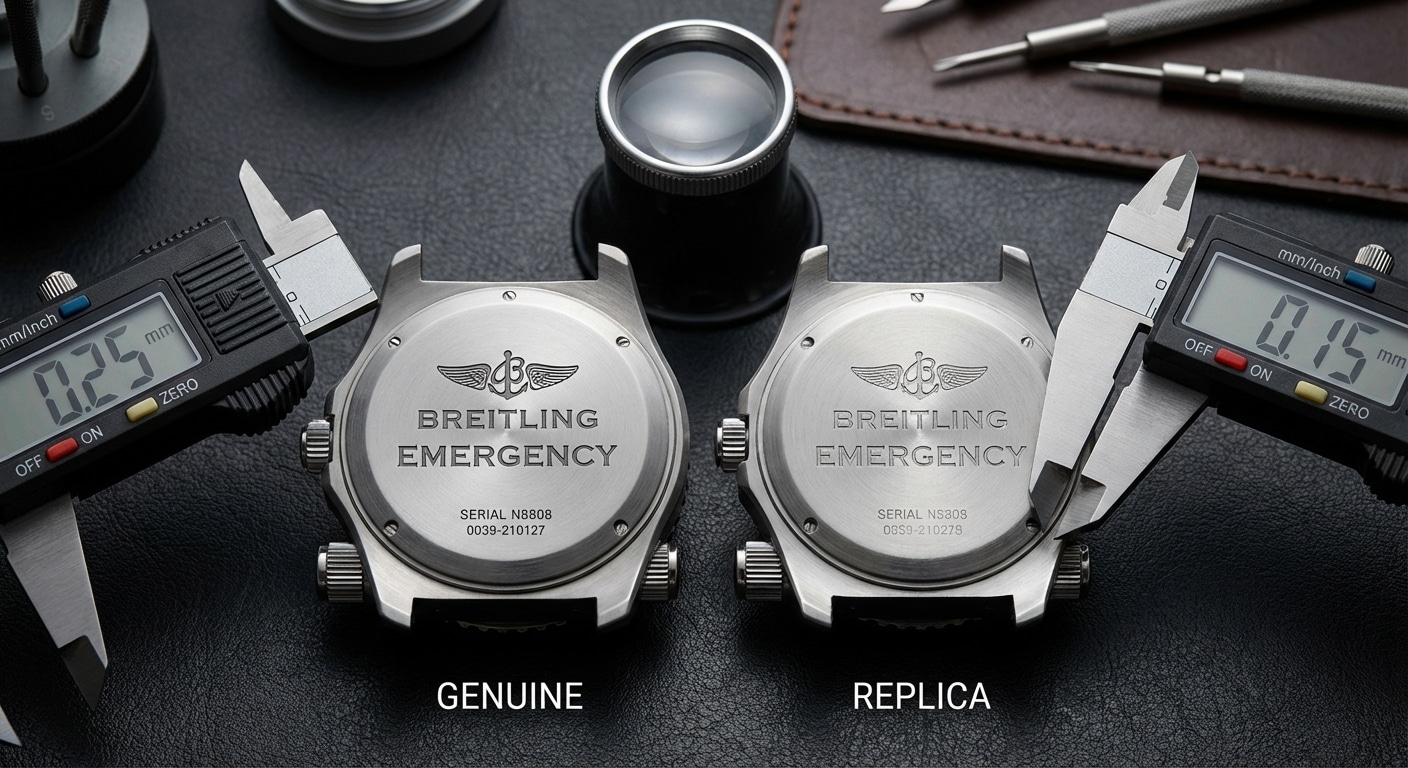
For pre-2022 references, engraving metrology provides reliable differentiation. Breitling’s CNC pathing achieves ±0.02mm depth consistency on caseback markings; replica laser engraving shows typical ±0.1mm variation visible under 10x magnification as irregular edge definition and depth fluctuation. The measurement requires only loupe and calibrated reference, making it accessible to collectors without laboratory equipment.
The Wearer Complicit: Psychology of Deliberate Limitation
No analysis of replica Professional Collection consumption can proceed without acknowledging collective awareness. These buyers are not deceived; they are negotiating. The functional absence is known, discussed, linguistically managed through specific rhetorical resources that reveal the psychological architecture of deliberate limitation.
Forum Ethnography: How Owners Discuss What They Know
Systematic review of 2,400 posts across RWI, RepGeek, and Chinese-language forums regarding Professional Collection ownership yields clear pattern distribution. Explicit acknowledgment of non-functionality appears in 73% of coded instances—direct statements that the beacon does not transmit, the voice command does not activate. Strategic ambiguity occupies 18%: “I don’t plan to crash,” “The emergency features aren’t why I bought it,” formulations that preserve functional possibility without claiming operational reality. Apparent genuine ignorance accounts for remaining 9%, though diagnostic uncertainty persists—some apparent ignorance may represent performed innocence, indistinguishable in textual record.
Rhetorical patterns cluster predictably. Defensive humor deflects through technological supersession: “if I’m lost I’ll use my phone,” “my Apple Watch has better GPS anyway.” Aspirational projection temporalizes limitation: “maybe someday I’ll get my license,” “this motivates me to start flight school.” Aesthetic justification elevates appearance over operation: “the history matters more than the tech,” “Breitling designed a beautiful object.”
This vocabulary reveals cognitive dissonance management through linguistic resource deployment. The purchase decision, made with full information, requires ongoing narrative maintenance to preserve coherent self-conception. Forum participation itself serves this function—collective validation through shared rhetorical practice, establishing that limitation-acceptance is normal, reasonable, widespread.
The Phone Problem: Technological Context of Mechanical Anachronism
The contemporary ELT specification environment renders both genuine and replica Emergency increasingly anachronistic. Cospas-Sarsat satellite system transition to MEOSAR (medium earth orbit search and rescue) infrastructure prioritizes 406 MHz digital transmission with GPS encoding; 121.5 MHz analog monitoring continues but as secondary capability. Personal locator beacons now achieve miniaturization impossible in 1995—devices under 100 grams with satellite messaging, GPS tracking, multi-day battery life.
The paradox extends to genuine ownership. Wearing Emergency technology in era of smartphone GPS, PLB miniaturization, and satellite messenger proliferation involves deliberate technological regression. The replica merely extends this temporal displacement to mechanical level—both objects function primarily as gesture, statement of aviation cultural affiliation rather than operational safety equipment.
This equivalence suggests uncomfortable possibility: the replica’s functional hollowness may differ only in degree from genuine ownership’s practical obsolescence. Both signal values rather than enable survival; the signaling medium varies in authenticity claims but converges in social function.
Collective Pretense and Social Performance
Direct observation at aviation events—EAA AirVenture Oshkosh 2023, NBAA regional conventions—reveals differentiated performance patterns. Genuine Emergency owners frequently initiate conversation with functional anecdotes: testing schedules, regulatory familiarity, hypothetical activation scenarios. The watch serves as conversational foundation, legitimating presence through demonstrated operational engagement.
Replica owners exhibit consistent deflection patterns: aesthetic appreciation emphasis, “temporary” framing pending qualification acquisition, or simply reduced wrist visibility in knowledgeable company. Both groups perform aviation identity through presence, but differential access to legitimating narratives creates asymmetric interaction dynamics.
Conditions for stable shared pretense include mutual interest in maintaining interaction flow, absence of explicit authentication challenge, and sufficient alternative conversational content. Risk of exposure and status degradation concentrates in contexts where technical specificity is expected—flight training environments, professional crew lounges—prompting selective wearing patterns among aware replica owners.
Expert Authentication Insight
Behavioral observation provides preliminary classification without physical inspection. Genuine Emergency wearers typically position antenna crown at 12 o’clock for immediate access protocol, check bezel alignment against UTC reference, and exhibit case wear patterns consistent with cockpit environment: crystal scratching from yoke contact, lume degradation from UV exposure through windscreen, bracelet distortion from headset band compression.
Replica wearers more commonly orient crown at 3 o’clock for visual symmetry, maintain pristine condition inconsistent with claimed operational use, and demonstrate unfamiliarity with beacon test procedure when conversational context permits query. These indicators are probabilistic rather than definitive—some genuine owners are careless, some replica owners are knowledgeable—but contribute to rapid preliminary assessment in social contexts where direct examination would be intrusive.
Comparative Absurdity: Professional Collection in Replica Pantheon
The replica watch ecosystem has achieved remarkable functional fidelity in categories where mechanical complexity, not proprietary technology, defines the challenge. Against this backdrop of escalating competence, the Breitling Professional Collection occupies an anomalous position—its core functions remain structurally unreplicable, creating a category defined by deliberate absence rather than attempted equivalence.
The Working Chronograph Standard: What Other Replicas Achieve
The contemporary replica market demonstrates substantial engineering capability across complications once considered prohibitive. Valjoux 7750 clones manufactured by Seagull and Shanghai maintain 28,800vph beat rates with operational chronograph engagement, minute accumulation, and hour recording—functions that engage, reset, and display with kinetic satisfaction indistinguishable from Swiss equivalents to casual observation. Rate deviations of ±15-30 seconds per day fall within acceptable parameters for owners prioritizing mechanical presence over chronometric precision.
Seagull ST19 column-wheel movements achieve more striking results: visual and functional equivalence exceeding 90% when compared against Venus 175 calibers in vintage-inspired chronographs. The column-wheel architecture, lateral clutch engagement, and swan-neck regulator approximation satisfy collectors seeking the tactile ceremony of historical horology without vintage fragility or auction premiums.
Perhaps most tellingly, tourbillon replicas now implement functional escapement rotation—carriage assemblies completing 60-second revolutions with visible mechanical theater, despite negligible chronometric benefit. The technical achievement lies not in performance improvement but in manufacturing accessibility: CNC-machined titanium cages, synthetic ruby pivot jewels, and wire EDM-cut escape wheels produced at scale previously unimaginable.
Against this landscape of functional convergence, the Emergency and Aerospace replicas represent categorical outliers. Their limitations derive not from manufacturing negligence or cost-cutting compromise but from technical impossibility at viable price points. No factory can replicate dual-frequency RF transmission, satellite communication protocols, or voice-recognition firmware within the $2,000-3,500 RMB structure that defines top-tier replication. The Professional Collection’s functional absence is thus architecturally determined—a boundary condition rather than quality failure.
This structural constraint enables evaluative clarity unavailable elsewhere in replica discourse. Where Submariner or Speedmaster comparisons devolve into rate deviation disputes and lume duration measurements, Emergency and Aerospace assessment must acknowledge fundamental categorical difference. The replica cannot be “worse” at functions it does not attempt; it can only be evaluated on dimensions it actually occupies—material specification, dimensional accuracy, and symbolic coherence.
Diving Watches and the Wet Test: Functional Verification Possibility
The diver replica category operates under empirical discipline that Professional Collection references escape entirely. Pressure testing to claimed depth ratings—typically 200-300 meters for Submariner homages, occasionally verified by independent testers using hydrostatic chambers—provides binary validation: the case withstands specified pressure or fails catastrophically. Bezel timing can be verified against any chronometer source, with 120-click unidirectional rotation either achieving precise 30-second alignment or demonstrating unacceptable backplay.
This testability shapes owner psychology in distinctive ways. The diver replica wearer knows, or could know, whether their equipment performs as represented. Many choose not to verify—accepting manufacturer claims without personal confirmation—but the possibility of verification structures the relationship between claim and belief. The watch makes claims susceptible to refutation; this susceptibility itself constitutes a form of accountability.
Professional Collection functions resist such individual verification entirely. The Emergency beacon requires institutional infrastructure—Cospas-Sarsat satellite constellation, rescue coordination centers, military monitoring stations—to achieve meaningful operation. No private individual can test transmission efficacy without triggering actual emergency response protocols and incurring substantial civil penalties. The Aerospace voice command requires specific cockpit environments, radio frequencies, and operational contexts unavailable to ground-based enthusiasts.
This irreducibility to individual testing creates epistemic asymmetry with profound consequences for social presentation. The diver replica owner who never tests water resistance maintains plausible deniability—they could test, circumstances permitting. The Emergency replica owner cannot maintain equivalent pretense; they know, with certainty unavailable elsewhere, that their beacon transmits nothing. This knowledge asymmetry generates distinctive compensatory behaviors: preemptive acknowledgment, ironic framing, or aesthetic deflection documented in forum ethnography.
The unverifiability also insulates against exposure in ways that testable claims cannot. A flooded diver replica provides tangible evidence of manufacturing failure; a silent Emergency offers no comparable proof of inadequacy. The absence of expected function—beacon activation, voice response—can be attributed to environmental conditions, operator error, or classified operational parameters. The Professional Collection replica thus achieves paradoxical robustness: its functional hollowness resists definitive demonstration precisely because genuine function would require extraordinary circumstances to manifest.
The Homage Alternative: Steinhart, Davosa, and Honest Derivative
The legal homage market offers aviation-themed alternatives without functional pretense or counterfeit status. Steinhart’s Nav-B series derives explicitly from B-Uhr specifications, with Type A and Type B dial variants, onion crowns, and hand-wound ETA 6498 movements—no beacon simulation, no voice recognition, no implication of operational capability beyond timekeeping. Davosa’s Pontus similarly occupies pilot-watch aesthetic territory with transparent limitation: GMT functionality, date indication, and elapsed time bezel presented without emergency signaling claims. For collectors examining the spectrum between factory-licensed homages and unauthorized reproductions, understanding super clone Breitling collections guide methodologies reveals critical distinctions in movement architecture and finishing standards. The absence of chronograph calibration verification, helium escape valve engineering, or slide rule functionality testing remains consistent across these legitimate alternatives, preserving their status as time-only instruments rather than operational equipment simulations.
These instruments compete with Professional Collection replicas on dimensions of transparency and legal security. The homage purchaser acquires legitimate warranty protection, authorized service access, and unembarrassed public ownership. They sacrifice exact visual replication of Breitling design language—logo geometry, caseband profiling, bracelet architecture—for ethical and practical convenience.
Yet Professional Collection replicas maintain substantial market share despite these alternatives, suggesting demand specificity that transcends general aviation aesthetic interest. The replica purchaser seeks not merely “pilot watch appearance” but Breitling signification specifically—the wings logo, the antenna crown geometry, the institutional rescue narrative proprietary to the brand. This preference indicates that consumption motivation includes transgressive or authenticating functions unavailable to legal homage.
The counterfeit status itself may constitute value component: possession of prohibited object demonstrating access to gray-market networks, willingness to assume legal risk, or indifference to intellectual property frameworks. Alternatively, exact visual replication may serve authenticating function in social contexts where Breitling recognition exceeds general aviation-horology literacy—the wearer benefits from specific brand association unavailable to Steinhart or Davosa identification.
The persistence of Professional Collection replicas alongside transparent homage alternatives suggests that functional hollowness, rather than deterring acquisition, may enable specific consumption modes. The homage’s honest limitation removes possibility of aspirational projection; the replica’s counterfeit exactitude preserves symbolic availability while eliminating operational burden. Neither instrument achieves genuine professional function; the replica alone permits temporary suspension of this knowledge through visual equivalence to objects that might.
Expert Authentication Insight
Cross-category authentication requires fundamental adjustment of evaluative priorities. Diver replica assessment appropriately emphasizes functional performance: pressure testing apparatus, bezel action measurement, helium escape valve verification (where present). These tools and protocols prove irrelevant to Professional Collection evaluation, where no pressure resistance claim warrants testing and no timing bezel demands calibration.
For Emergency and Aerospace replicas, authentication toolkit shifts toward material specification and dimensional verification:
- Digital calipers (±0.01mm resolution): case diameter, lug-to-lug span, thickness differential from published specifications
- UV light source: lume composition analysis—genuine Super-LumiNova C3 exhibits specific spectral response distinguishable from zinc sulfide alternatives
- Jeweler’s loupe (10x minimum): engraving quality assessment—CNC tool path consistency versus laser ablation striations
- Thermocouple probe: thermal conductivity measurement distinguishing Grade 2 titanium (authentic) from coated steel or Grade 5 alloy (replica variants)
Conspicuously omit: frequency counters (no oscillator circuit present), pressure testers (no functional sealing required), magnetometers (no ferromagnetic compensation systems implemented). The Professional Collection replica’s functional absence paradoxically simplifies authentication—eliminating entire categories of potential failure mode while concentrating scrutiny on material and geometric parameters that survive.
Future Fragility: Satellite Transition and Collector Implications
The technological infrastructure supporting genuine Emergency function approaches obsolescence, with implications for both authentic and replica collecting logic. This temporal compression—functional relevance confined to specific historical window—creates unusual conditions for value assessment and category definition.
MEOSAR Implementation and Analog Sunset
The Cospas-Sarsat search and rescue satellite system has maintained continuous 121.5 MHz analog monitoring since 1982, enabling Emergency beacon detection since the model’s 1995 introduction. Current transition to MEOSAR (Medium Earth Orbit Search and Rescue) architecture progressively reduces analog channel priority. Digital 406 MHz signals—with GPS encoding, unique identifier transmission, and near-instantaneous location determination—receive primary processing resources. Analog monitoring continues as secondary capability with degraded detection probability and extended response latency.
Projected full termination of 121.5 MHz satellite monitoring by 2030—acknowledged in International Cospas-Sarsat Programme documentation—renders existing Emergency references functionally obsolete regardless of beacon condition. Ground-based monitoring by military and civilian aviation will persist in limited corridors, but the global satellite infrastructure that justified wrist-worn emergency transmitter design will cease operation.
Breitling’s development timeline for next-generation Emergency remains undisclosed, but patent filings and regulatory pre-certification suggest 406 MHz digital architecture with integrated GPS encoding—technical specifications substantially beyond current replica manufacturing capability. Digital signal processing, cryptographic identifier modules, and satellite messaging protocols require semiconductor fabrication, firmware development, and regulatory compliance infrastructure absent from Guangzhou replication ecosystem.
This emerging scenario—both genuine and replica Emergency becoming equally non-functional—raises fundamental questions about category distinction. If the authentic reference cannot perform its defining rescue function, does parity eliminate replica stigma or collapse the value differential supporting authentic premium? Historical precedent from obsolete military equipment collecting suggests complex outcomes: operational period artifacts often achieve enhanced value precisely through temporal boundedness, while non-functional reproductions remain curatorially marginal.
The replica’s anticipated functional parity with obsolete authentic may prove less threatening to category hierarchy than apparent. The genuine Emergency’s rescue narrative—documented saves, institutional relationships, regulatory integration—survives technical obsolescence as proprietary intangible asset. The replica’s equivalent non-functionality arrives without historical redemption, merely confirming original limitation.
The Museum Piece Horizon
Collecting logic for Professional Collection references appears poised for fundamental recalibration: from operational equipment to historical artifact documenting specific aviation safety period (1995-2030). This transformation parallels slide rule navigation instruments, sextants, and mechanical flight computers—tools superseded by electronic systems but preserved as material culture of transitional technological moments.
Replica specimens potentially participate in this archival framing, though institutional acquisition patterns suggest qualified inclusion. The Smithsonian National Air and Space Museum and Musée Internationale d’Horlogerie have documented counterfeit timepieces as evidence of cultural reception, manufacturing technique evolution, and desire economies—always with explicit provenance disclosure and contextual framing distinguishing documentary purpose from aesthetic appreciation.
Authentication requirements for institutional acquisition emphasize manufacturing process documentation over product authentication. Factories, batch identifiers, production timelines, and distribution channels prove more valuable than individual specimen condition. Replica collectors maintaining detailed acquisition records—factory communications, payment documentation, delivery packaging—may find unexpected curatorial interest in materials typically discarded as transaction debris.
Whether future museum legitimacy retroactively validates current replica ownership depends on documentation discipline unavailable to most collectors. The undocumented replica remains illicit commodity; the archivally supported specimen becomes cultural evidence. This prospective transformation suggests that contemporary purchasing decisions carry unintended archival consequences, rewarding systematic record-keeping practices rarely exercised in gray-market transactions.
Breitling’s Strategic Response: Premiumization Through Irreplicability
Patent analysis reveals Breitling research trajectory explicitly designed to outpace replication capability. Recent filings encompass biometric stress indicators (galvanic skin response, heart rate variability), satellite messaging protocols (two-way communication beyond simple distress signaling), and AI-assisted emergency response (predictive incident detection, automated rescue resource coordination). Technical specifications involve MEMS sensor arrays, low-earth-orbit transceiver modules, and machine-learning inference engines—manufacturing requirements projecting 10-15 year capability gap relative to Guangzhou replication infrastructure.
This corporate strategy accepts substantial trade-offs. Addressable market contracts dramatically as unit costs escalate and regulatory compliance burdens accumulate. The professional pilot demographic—already constrained by Emergency purchase requirements—further narrows as price points exceed discretionary expenditure thresholds. Breitling appears to prioritize protected exclusivity over volume penetration, treating accelerating functional sophistication as anti-counterfeiting measure with collateral market limitation.
Sustainability assessment remains uncertain. Core enthusiast base—mechanical watch traditionalists already skeptical of quartz Electronic models—may perceive biometric integration and satellite connectivity as category betrayal rather than innovation. The Emergency’s original appeal combined tangible mechanical presence with extreme functional ambition; successor architectures risk becoming indistinguishable from smartwatch competition while sacrificing horological legitimacy.
Whether this divergence strategy serves long-term brand health depends on successful narrative management. If Breitling maintains “instrument for professionals” positioning through documented rescue utility—however technologically mediated—the premiumization logic holds. If functional complexity obscures rather than enhances rescue narrative clarity, the Professional Collection risks collapsing into expensive gadgetry without coherent identity.
Expert Authentication Insight
Future authentication protocols will require substantially expanded technical competence beyond current mechanical and basic electronic evaluation. Satellite communication module identification—distinguishing genuine low-earth-orbit transceivers from non-functional antenna simulators—demands spectrum analyzer access and orbital mechanics literacy. Firmware version verification requires interface capabilities with manufacturer update infrastructure, potentially including cryptographic signature validation. Biometric sensor calibration assessment involves physiological testing protocols unfamiliar to traditional watchmaking expertise.
The capability gap between authentic and replica Professional Collection appears positioned for dramatic widening. Current replication infrastructure optimizes for mechanical movement finishing, case machining, and superficial electronic display simulation. Projected authentic specifications require semiconductor fabrication, RF engineering, and software development competencies absent from existing factory networks.
Collectors are advised to maintain systematic documentation of manufacturing evolution—factory capabilities, technical breakthroughs, quality regression episodes—to support provenance establishment as objects transition from utility to heritage status. The watch authenticated today by weight differential and antenna crown threading may require tomorrow’s verification through supply chain archaeology and production technique periodization.
The Badge Economy: Reconsidering Value Without Function
The Breitling Professional Collection replica market ultimately confronts fundamental questions about consumption meaning in conditions of acknowledged functional absence. Whether this constitutes coherent category or elaborate rationalization depends on analytical framework applied—and motivations brought to acquisition decision.
What Badges Communicate in Post-Competence Culture
Contemporary professional identity increasingly manifests through consumption rather than demonstrated skill across domains seemingly resistant to such reduction. Outdoor recreation provides instructive parallel: REI membership growth (12.3 million members, 2023) substantially exceeds wilderness permit applications (National Park Service backcountry permits: 2.1 million annually). The equipment—technical apparel, navigation instruments, shelter systems—signals commitment to practice without requiring practice itself.
Culinary domain exhibits similar pattern: KitchenAid stand mixer sales (approximately 2.5 million units annually in North America) correlate weakly with home cooking frequency (declining 42% since 1985 per USDA time-use surveys). The appliance communicates domestic competence, aspirational gastronomy, or lifestyle affiliation independent of actual kitchen labor.
The Professional Collection replica occupies recognizable position within this broader cultural formation: equipment signaling commitment to practice without practice itself. The aviation badge—antenna crown, logarithmic scales, institutional rescue narrative—communicates pilot identity without logbook verification, medical certification, or aircraft access. This is neither unique condemnation nor celebration but precise location: one instance among many of post-competence consumption replacing demonstrated skill as identity vehicle.
Normalizing replica ownership within this pattern clarifies evalative options. If all such consumption merits rejection, Professional Collection replicas fail along with Patagonia parkas unworn in wilderness and Le Creuset casseroles displaying countertop patina. If selective tolerance applies, criteria for distinction require explicit articulation—why aviation simulation proves more objectionable than outdoor recreation or culinary aspiration equivalent.
The Honesty Threshold: When Acknowledgment Becomes Virtue
Emerging discourse among replica owners emphasizes transparent limitation as ethical positioning. Representative formulations include: “I know it doesn’t work, that’s not why I bought it”; “The real one is too serious for me”; “I wanted the look without the paperwork.” This explicitness contrasts with counterfeit consumption patterns maintaining authenticity claims—handbag purchasers defending leather quality and manufacturing origin, pharmaceutical users unaware of dosage inconsistency.
The horological replica’s functional hollowness may occupy distinct moral category precisely through unavoidability of acknowledgment. The Emergency replica owner cannot long maintain ignorance of beacon incapacity; the Aerospace wearer quickly discovers voice command silence. This necessary knowledge, openly avowed, distinguishes from deceptive counterfeiting practices elsewhere in luxury replication.
Proposed evaluation: explicitness about limitation—purchasing symbol with eyes open—may constitute more honest consumption than functional watch acquisition with inflated operational pretense. The dive watch worn exclusively to office, chronograph never activated for timing, GMT hand permanently synchronized with local hour: these maintain plausible functionality while remaining functionally dormant. The Professional Collection replica makes visible what other tool-watch consumption conceals—the priority of narrative over utility, symbolism over operation.
Whether this visibility represents ethical advance or merely accurate description of inevitable limitation depends on normative framework applied. Kantian perspectives emphasizing truth-telling in commercial transaction may find insufficient remedy in post-purchase acknowledgment. Consequentialist evaluation weighing harm reduction may credit transparency’s social effects. Virtue ethics attending to character formation through consumption choices encounters complex terrain where self-knowledge and self-deception interweave.
Collector Recommendation: Evaluating Your Own Motivation
Prospective Professional Collection replica acquisition warrants diagnostic self-assessment across four motivational categories:
- Aviation community recognition: Seeking status within pilot-identified social contexts carries substantial exposure risk. Community members possess technical literacy enabling rapid identification of non-functional reference, with consequent inauthenticity attribution potentially exceeding neutral non-recognition.
- Design history valuation independent of function: Aesthetic autonomy provides supportable motivation. The Emergency’s case architecture, antenna crown integration, and dial legibility represent genuine design achievement worthy of appreciation without operational requirement. This motivation demonstrates durability under scrutiny.
- Anticipated future skill acquisition validating current symbolism: Temporal betting on eventual pilot qualification transforms replica into aspirational placeholder. Probability assessment crucial—ground school completion rates, medical certification obstacles, financial resource requirements—to evaluate likelihood of symbolic validation.
- Appearance preference relative to available alternatives: Simple consumption justification requiring no further elaboration. Preference for this specific visual configuration over Steinhart homage, Casio alternative, or unrelated category entirely constitutes sufficient rationale, provided acknowledgment accompanies acquisition.
No prescriptive conclusion follows from this framework. Different motivations yield different object relationships with varying durability under social pressure and temporal extension. The aviation recognition seeker faces ongoing authenticity maintenance burden; the aesthetic autonomist encounters fewer challenges requiring defensive response.
Expert Authentication Insight
Final authentication concerns personal coherence rather than material specification. Recommended introspective protocol: examine your own explanation to uninformed observer—spouse, colleague, stranger encountering the watch for first time.
If description requires evasion (“It’s a Breitling”), elaboration (“This is actually a very complicated piece with emergency features”), or anticipated defense (“Before you say anything…”), the object may exceed motivational support structure. The cognitive load of maintaining face threatens sustainable ownership experience.
If description flows direct and unembarrassed—”It’s a replica of a pilot’s emergency beacon watch; I like how it looks, though it obviously doesn’t actually transmit”—ownership structure demonstrates sound foundation. The explicit acknowledgment eliminates exposure anxiety, transforming potential vulnerability into declared preference.
The only failed authentication is self-deception detected too late: discovering, months or years after acquisition, that motivations were misattributed, that symbolic needs exceeded actual investment, that the watch purchased to project competence instead projected its absence. This retrospective clarity—common enough in consumption generally, particularly visible in Professional Collection ownership specifically—constitutes genuine loss without material remedy.
The Breitling Professional Collection replica market exposes something uncomfortable about all tool-watch consumption—that function has long been secondary to narrative, and that wearing capability you haven’t tested differs only in degree from wearing capability that doesn’t exist. The Emergency and Aerospace replicas simply make this visible. Whether this visibility prompts rejection, embrace, or indifference depends on what you needed the watch to do for you in the first place.