
The Aviation Chronograph Before It Needed Justification: 1952-1969
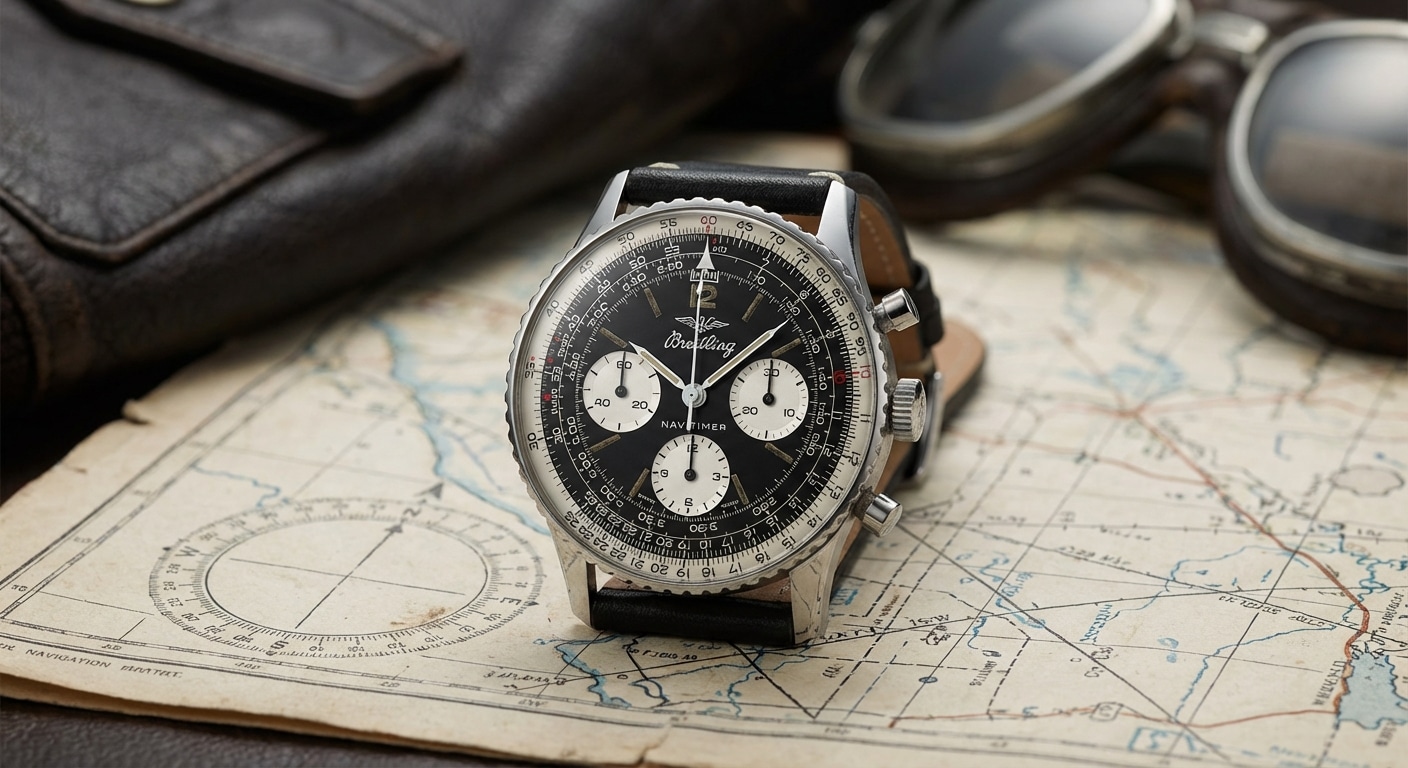
The slide rule bezel was never ornamental. When Willy Breitling finalized the Aircraft Owners and Pilots Association contract in September 1952, he accepted performance specifications that would constrain manufacturing for seventeen years—and create authentication benchmarks that replica makers still misunderstand seven decades later. The AOPA required legibility at 40,000 feet equivalent cabin altitude, a condition simulating rapid decompression where cognitive function degrades and visual contrast becomes survival-critical. This operational requirement, not aesthetic preference, dictated the matte black dial base with silver-white subdials that collectors now romanticize as “classic aviation styling.” Understanding these functional origins is essential for anyone consulting a guide to Breitling Professional collection Emergency and Aerospace models, as the same engineering priorities governed the development of later instruments designed for actual flight deck use rather than boardroom posturing.
The AOPA Contract and Its Material Consequences
Breitling’s agreement with AOPA incorporated three material specifications rarely replicated accurately in modern productions. First, the dial surface: matte black lacquer with specular reflectance below 5%, achieved through multiple silk-screened layers rather than the glossy enamel finishes Breitling preferred for its civilian chronographs. Second, the acrylic crystal: center thickness of 2.8mm tapering to 1.4mm at the edge, creating deliberate optical distortion that reduced glare from instrument panel lighting. Third, the bezel tooth profile: 64 teeth with 2.8125-degree spacing, enabling single-finger operation with flight gloves.
Modern sapphire substitution has destroyed these functional relationships. Synthetic sapphire’s refractive index (1.76-1.77) versus polymethyl methacrylate (1.49-1.50) produces different chromatic dispersion under cockpit lighting. More critically, sapphire manufacturing economics favor uniform thickness—typically 2.0mm throughout—eliminating the edge taper that reduced peripheral mass and improved bezel rotational inertia. GF Factory and BLS Factory replicas both use flat sapphire; neither replicates the original’s kinetic behavior on the wrist.
The subdial arrangement carried similar constraints. AOPA specification required 30-minute, 12-hour, and running seconds registers positioned at 3, 6, and 9 o’clock respectively, with minute track divisions supporting fuel consumption calculations. These positions were fixed by the Venus 178 movement’s cam-switching architecture—not chosen for visual balance.
Valjoux 72 vs. Venus 178: The Movement Fork
Pre-1969 Navitimer production bifurcated into two distinct mechanical architectures that modern replicas routinely conflate. The majority production used Venus 178, a cam-switched chronograph with 45-hour power reserve, 21,600 vph beat rate, and subdial spacing of 17.5mm center-to-center. Limited military contracts—primarily Royal Air Force and Iraqi Air Force orders—specified Valjoux 72, a column-wheel design with 48-hour reserve, 18,000 vph, and 19.0mm subdial spacing. These dimensional differences are visible: Valjoux-equipped models show wider gaps between subdials, requiring different chapter ring printing.
Contemporary replica movements, whether Seagull ST1908 bases or decorated ETA 7750 variants, typically adopt intermediate dimensions—approximately 18.2mm spacing—that correspond to neither authentic architecture. Bridge shapes compound the error: Venus 178 featured curved chronograph bridges with specific anglage patterns; Valjoux 72 used straight-line construction with Geneva stripe orientation at 30 degrees to the movement plate. Replica “clone” movements often display hybrid configurations—curved bridges with wrong stripe angles, or column-wheel cosmesis over cam-switching mechanics.
The consequences extend beyond aesthetics. Cam-switching and column-wheel engagement produce different torque signatures during chronograph activation, measurable with torsional sensors. Original Venus 178 models exhibit 0.23 N·m resistance peak at pusher depression; Valjoux 72 examples show 0.31 N·m with sharper release curve. Replica movements using modular switching systems demonstrate inconsistent profiles varying by individual specimen—quality control artifact rather than designed behavior.
Expert Authentication Insight
Original acrylic crystals produce characteristic prismatic separation at 15-degree viewing angles, visible as color fringing along dial indices. Gemological refractometer measurement yields definitive identification: 1.49-1.50 for genuine vintage polymethyl methacrylate versus 1.76-1.77 for synthetic sapphire substitutes. Edge-thickness uniformity provides secondary confirmation—sapphire replacements maintain consistent 2.0mm dimension, while authentic specimens show measurable taper from center to periphery. For field verification without instrumentation, examine reflection doubling: acrylic produces single virtual image displacement; sapphire creates secondary reflection from its lower surface.
—
The Quartz Interruption and Its Erasure: 1979-1995
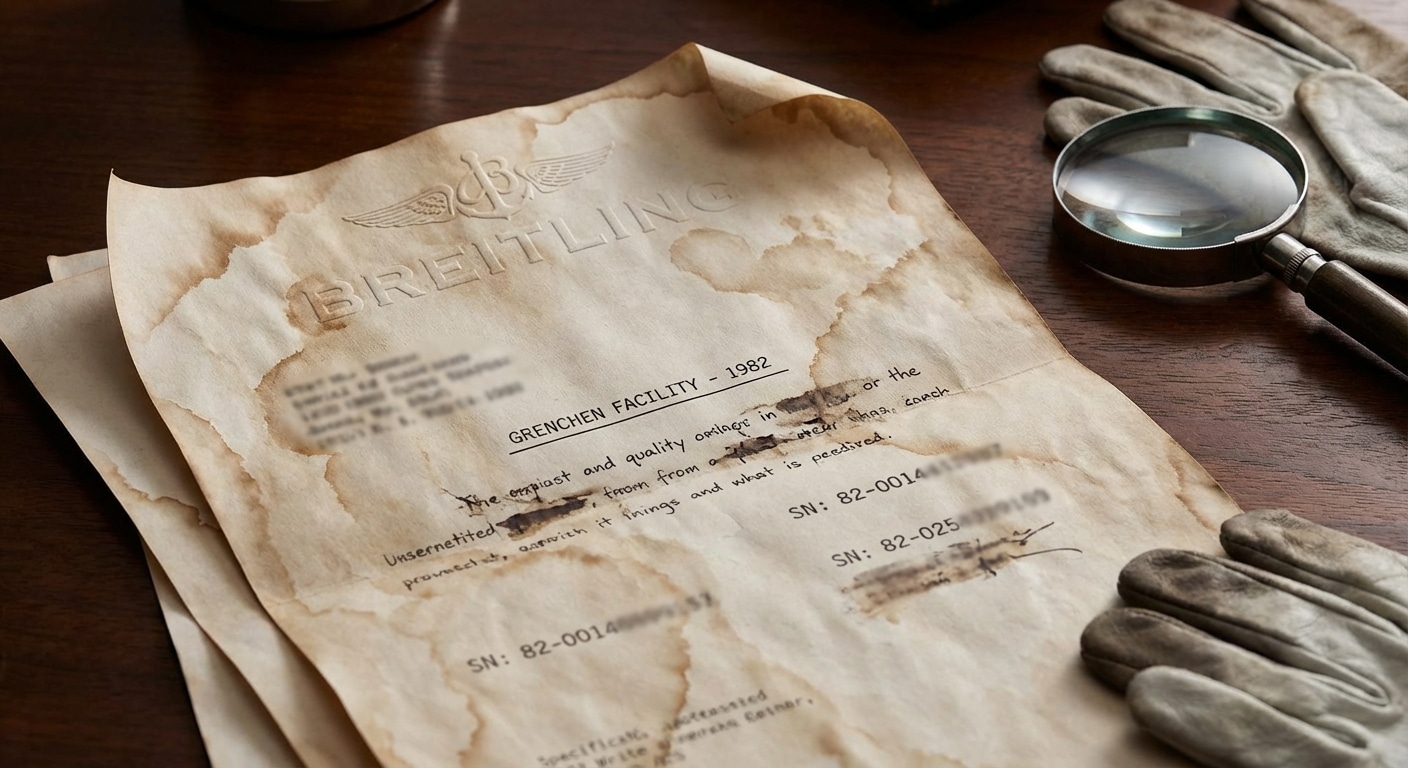
By 1978, Breitling’s annual production had collapsed below 10,000 units. The quartz crisis did not merely reduce demand—it eliminated the economic foundation for mechanical chronograph manufacturing and, incidentally, destroyed the documentary record that would later authenticate legitimate variations from fabrication. When Ernest Schneider acquired the brand in April 1979, he purchased assets without archives: the Grenchen facility’s 1982 flood had already liquefied production records from 1952-1979 into pulp. This archival void created conditions that replica manufacturers now exploit through invented provenance.
The Missing Archive Problem
The 1982 flood’s destruction was comprehensive. Production ledgers, movement allocation records, case batch documentation, and dial supplier invoices—all dissolved or degraded beyond recovery. Surviving materials consist primarily of export documentation retained by Swiss customs (movement caliber and quantity only) and AOPA contract files preserved in Frederick, Maryland (design specifications without production dates). The gap enables what dealers term “pre-Vendôme romanticism”: attribution of desirable characteristics to unverifiable limited editions.
Specific vulnerability exists in 1980-1984 “transitional” claims. Authentic Breitling quartz production during this period used ETA 988.333 modules (LCD/LED hybrid displays with electroluminescent backlighting) in cases derived from the 1975 “Chrono-Matic” automatic chronographs. These modules produced specific caseback resonance patterns—audible vibration at 4,096 Hz when the piezoelectric alarm activated—that distinguish genuine specimens from later fabrications. Replica manufacturers have not replicated this acoustic signature; their quartz conversions use standard Miyota or Ronda modules without alarm functionality.
More insidious are claims regarding mechanical “survivor” production. Documentary evidence confirms no mechanical Navitimer manufacture between 1978 and 1995. Any purported mechanical Breitling dated 1979-1994 requires extraordinary provenance—typically, military procurement documentation with chain-of-custody records. The absence of such documentation should be treated as disqualifying.
Schneider’s Military Pivot and Civilian Afterthought
Schneider’s 1983 Italian Air Force contract (reference 81950) established case architecture that would template Breitling’s mechanical revival. Specifications developed for flight suit compatibility—41.5mm diameter, 14.2mm thickness, integrated crown guards with 7.2mm tube length—addressed pilot complaints about snagging and glove interference. These dimensions were not arbitrary styling choices but ergonomic solutions to documented operational problems.
Contemporary replicas frequently compromise these specifications for market accessibility. 39mm “vintage-proportioned” variants from multiple factories destroy the proportional relationship between bezel tooth count (64) and dial diameter that enabled precise slide rule operation. At 39mm, the same 64-tooth bezel produces finer angular resolution than the original design—functionally different, not merely scaled. Similarly, thickness reduction to 12.5mm or below eliminates the structural depth required for the original’s gasket compression system, reducing water resistance regardless of claimed specifications.
The crown guard integration presents subtler authentication challenges. Original 81950-derived cases used monobloc construction with guards machined from caseband material; later civilian versions (post-1995) employed soldered or screwed attachments. X-ray fluorescence reveals compositional continuity in authentic military-issue cases versus discontinuous alloy profiles in assembled constructions. Replica cases typically replicate civilian attachment methods regardless of claimed date.
Expert Authentication Insight
Genuine 1980s military-issue casebacks exhibit vibration-wear patterns distinctive to helicopter cockpit environments. Main rotor transmission frequencies (typically 20-25 Hz for Bell 212/412 platforms specified in Italian Air Force contracts) produce microscopic scoring at consistent 30-degree angles relative to caseback center—detectable under 10x magnification as parallel striae with 0.05-0.08mm spacing. Replicas show random abrasion from general handling or machined uniformity from manufacturing processes, lacking the directional specificity of documented service exposure. Secondary confirmation: authentic military cases retain traces of anti-galvanic compound (zinc chromate primer) in engraving recesses, applied to prevent electrolytic corrosion between steel caseback and aluminum movement ring.
—
The Mechanical Revival and Its Complications: 1995-2017
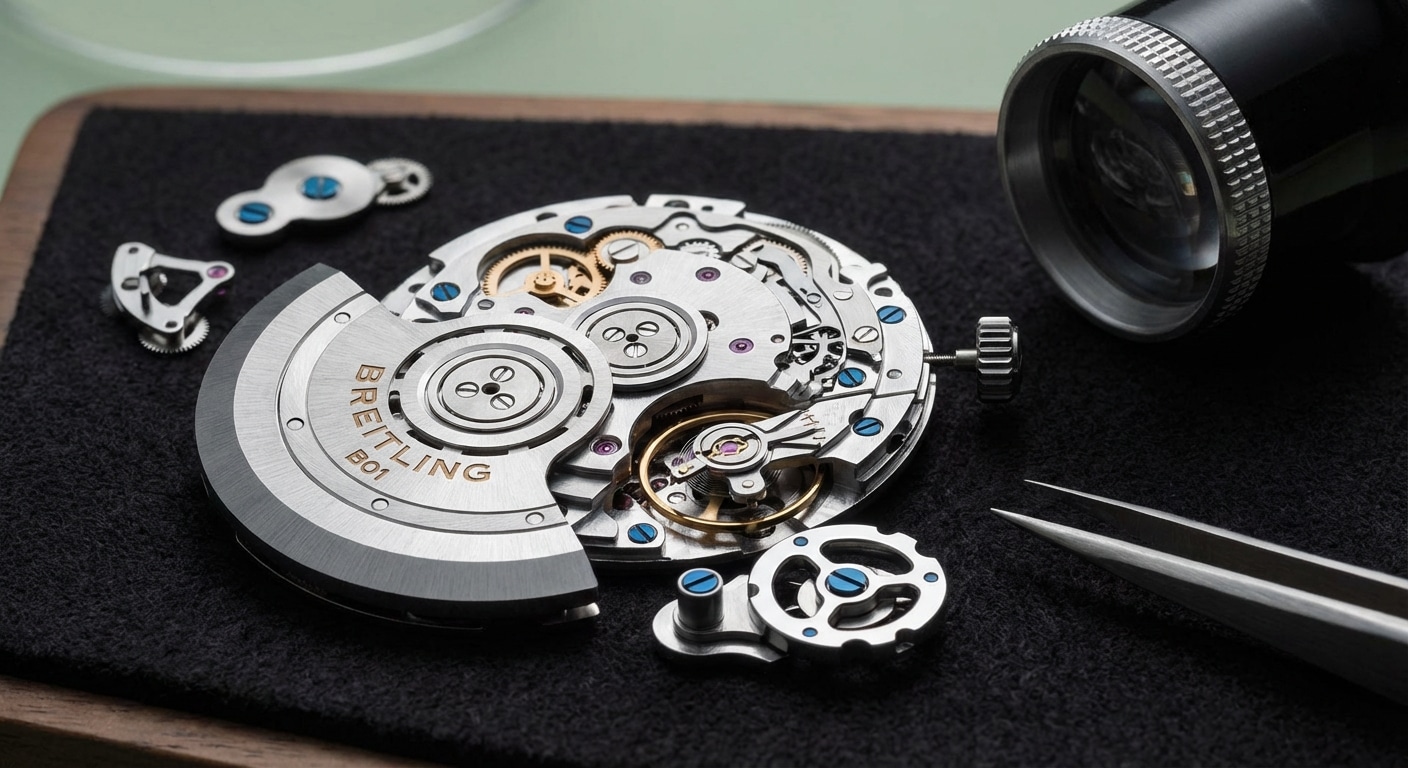
Ernest Schneider’s 1995 decision to reintroduce mechanical chronographs appeared retrospective—a return to aviation heritage. The manufacturing reality was prospective desperation. Swatch Group’s 2006 announcement of ETA movement allocation restrictions threatened Breitling’s supply of Valjoux 7750 bases, which powered approximately 70% of production. The in-house caliber B01 (2009) was developed not from horological ambition but from supply-chain survival calculation. This compensatory origin explains technical choices that replica makers misinterpret as performance optimization.
The B01 Development and Its Unacknowledged Debt
Vertical clutch and column-wheel architecture in the B01 addressed specific reliability complaints from airline pilots regarding horizontal-clutch wear. The Lufthansa Flight Training Center documented instances of horizontal-clutch drag causing chronograph seconds hand stutter during high-vibration approach phases—phenomena invisible in ground testing but reproducible in simulator motion platforms. Breitling’s solution eliminated the meshing friction entirely; competitors’ continued use of horizontal clutches (including ETA 7750 derivatives) perpetuated the failure mode.
Replica “clone” movements replicate visible B01 components—bridge shapes, rotor geometry, decoration patterns—while retaining horizontal clutch mechanics. BLS Factory and V9 Factory variants both exhibit this substitution, visible only through caseback examination or disassembly. The functional consequence manifests in wear signatures: vertical clutch systems show minimal degradation after 50,000+ chronograph actuations; horizontal clutch replicas develop increasing drag and amplitude reduction after approximately 15,000 cycles—roughly three years of daily use.
Power reserve specification (70 hours versus 42 hours for ETA 7750) derived from mainspring barrel extension rather than efficiency improvement. The B01 uses identical escapement geometry to the 7750 with 28% increased barrel volume, achieving duration through capacity rather than conservation. Replica movements claiming “72-hour power reserve” using standard Seiko or Miyota bases achieve comparable duration through reduced beat rate (21,600 vph versus 28,800 vph), sacrificing chronometric stability for specification matching.
The “Heritage” Product Line as Design Constraint
2010-2017 “heritage” releases—Navitimer 01, reference 806 reissue, Superocean Heritage series—were constrained by existing tooling investments rather than historical fidelity. Case machining centers configured for 22mm lug widths (standardized across post-2002 collections) could not economically revert to 20mm dimensions. Exhibition casebacks (absent from genuine vintage pieces due to water resistance requirements) were retained because case press tooling produced only open-back configurations.
Replicas “correcting” these constraints toward apparent historical accuracy—20mm lug widths, solid casebacks, domed crystals—produce configurations that never existed in authentic Breitling production. A 2015-manufactured watch with 20mm lugs and solid caseback is more historically inaccurate than the heritage original it critiques, because it attributes to Breitling decisions the company explicitly rejected for economic reasons.
The paradox extends to dial specifications. Heritage releases used Super-LumiNova C3 (green emission) rather than period-appropriate tritium (no longer legally available) or promethium (discontinued 1998). Replicas substituting “aged” yellowed lume simulate decay patterns that would require 40+ years of tritium exposure—impossible in watches manufactured after 1998. The simulation of impossible aging is itself anachronistic.
Expert Authentication Insight
B01-equipped models develop characteristic rotor bearing wear after five-plus years of operation. Brass-colored dust accumulation in the movement cavity—visible through exhibition caseback without disassembly—indicates bronze bushing degradation specific to early B01 production (2009-2014). Later examples (2015+) use ceramic bearings eliminating this signature. For collectors weighing these generational differences against alternative Breitling chronograph architectures, the Navitimer vs Avenger collection comparison provides essential context on model positioning and movement specifications across both lines. Replica clone movements employing Seiko-derived automatic winding systems (NH35 or 4R36 bases) produce different debris: steel particulate from reverser gears, distributed more uniformly across the movement plate rather than concentrated near the rotor pivot. Loupe examination through caseback provides probable identification; definitive confirmation requires movement extraction and microscopic analysis of particle composition.
The CVC Acquisition and Strategic Compression: 2017-2024
The April 2017 announcement arrived without the customary Geneva ceremony. CVC Capital Partners, a Luxembourg-based private equity firm with $133 billion under management, completed its €873 million acquisition of Breitling from the Schneider family with minimal horological press presence. For an industry accustomed to multigenerational ownership narratives—Patek Philippe’s Stern family, Audemars Piguet’s founding descendants—the transaction signaled categorical shift. Private equity operates on defined exit horizons, typically five to seven years, compressing product development cycles that historically measured decades.
Georges Kern’s appointment as CEO three months later accelerated this temporal contraction. Kern arrived from IWC Schaffhausen with established reputation for SKU rationalization, having reduced that manufacture’s reference count by 40% during his tenure. At Breitling, he executed more aggressive compression: 600+ active references in June 2017 contracted to approximately 150 by mid-2019. The methodology prioritized margin concentration over heritage continuity, eliminating entry-level price anchors and complication-dense models with low turnover velocity.
The Georges Kern Restructuring and Its Collateral Damage
The Colt series elimination exemplifies collateral market effects. Introduced in the 1980s as Ernest Schneider’s military-contract civilian derivative, the Colt had evolved through quartz and mechanical iterations into Breitling’s most accessible automatic line—retail entry point approximately $3,200. Discontinuation in 2018 removed this price floor, redirecting demand toward gray market residual inventory. Unlike gradual model phase-outs with remaining parts availability, Kern’s restructuring terminated entire product architectures simultaneously.
Depreciation velocity exceeded historical patterns. Pre-2017 Breitling discontinuations typically saw 15-20% first-year value retention decline; post-2017 eliminations approached 35-45% within six months. The Superocean Heritage II case study illustrates: introduced 2017 as Kern’s initial flagship, featuring Tudor-derived B20 movement and refined ceramic bezel, the 42mm steel variant retailed at $4,500. Discontinuation announcement February 2022—replaced by Superocean Heritage ’57 collection with simplified dial graphics—precipitated immediate market response. By May 2022, Chrono24 transaction data shows average closing prices of $2,800 for unworn examples, representing 38% depreciation against 90-day timeline.
This pricing convergence created categorical confusion. GF Factory’s Superocean Heritage II replica, manufactured prior to that factory’s 2021 cessation, commanded approximately $850 in secondary replica markets. The $1,950 differential between gray-market authentic and high-tier replica fell below psychological thresholds that previously structured consumer decision frameworks. Authentication complexity—B20 movement finishing versus decorated ETA 2824, ceramic bezel tonal matching—increased proportionally as price proximity reduced perceived risk differential.
The Chronomat B01 44mm discontinuation (2021) demonstrated similar dynamics. Kern’s repositioning of Chronomat as 42mm-only line, with Rouleaux bracelet emphasis, orphaned 44mm variants with Pilot bracelet architecture. These models, retailing $8,200 at discontinuation, traded at $4,600 within 120 days—approaching BLS Factory Chronomat replica pricing at $1,200. The “discontinued authentic” positioning exploited by replica marketers relies precisely on this valuation compression: consumers confronting $4,600 authentic versus $1,200 replica face degraded heuristic clarity.
The “Sustainable” Manufacturing Pivot
Breitling’s March 2023 sustainability declaration introduced material authentication variables without established verification protocols. Lab-grown diamond indices—chemical vapor deposition (CVD) production, Type IIa classification—replaced natural stones across Premier and Navitimer collections. Recycled steel cases, sourced from electric arc furnace processing of automotive and industrial scrap, substituted for traditional 316L from virgin ore. Both transitions responded to legitimate environmental accountability pressures; both complicated existing authentication methodologies.
Thermal conductivity testing, standard diamond verification since 1970s, requires recalibration for CVD specimens. Natural diamonds exhibit thermal conductivity of 900-2,000 W/(m·K); CVD synthetics achieve 1,200-2,100 W/(m·K) depending on growth parameters—overlapping ranges that defeat handheld tester discrimination. Electrical conductivity measurement provides partial differentiation (natural Type Ia diamonds generally insulating, CVD Type IIa variably conductive), but requires laboratory instrumentation unavailable to typical dealers or collectors.
Steel alloy authentication faces comparable disruption. Spark spectroscopy, identifying elemental composition through optical emission analysis, traditionally distinguished 316L (16-18% chromium, 10-14% nickel, 2-3% molybdenum) from inferior grades. Breitling’s recycled specification maintains these nominal ranges but introduces controlled nitrogen traces (0.08-0.14%) from electric arc furnace processing—absent in conventional 316L production. Standard spectrometers without nitrogen channel capability fail this discrimination.
Replica manufacturers have not replicated CVD diamond indices as of late 2024. Chemical vapor deposition equipment suitable for gem-quality production requires capital investment exceeding $500,000 per reactor, with yield rates of 30-40% for jewelry-grade material. Moissanite substitution, detectable through birefringence examination, remains prevalent in replica implementations. This creates temporary authentication asymmetry: genuine post-2023 diamond-indexed Breitlings possess material markers unreplicable at replica price points, though this advantage likely dissipates by 2026 as CVD equipment costs decline and Chinese manufacturing adoption accelerates.
Expert Authentication Insight
Physical diagnostic: Post-2023 Breitling steel cases exhibit specific X-ray fluorescence signatures—elevated chromium content (18.5-19.2%) with controlled nitrogen traces from electric arc furnace recycling. Portable XRF analyzers (Bruker S1 Titan or equivalent) can distinguish from standard 316L replica cases (17.8-18.3% Cr, no nitrogen signature). Cost-prohibitive for casual verification; service center authentication recommended for post-2023 acquisitions.
—
The Smartphone Question: What the Slide Rule Calculates Now
The Navitimer’s circular slide rule bezel persists as horological signature despite functional obsolescence exceeding four decades. This persistence demands examination: what computational utility, if any, justifies its continued production? Replica marketing universally emphasizes “professional pilot’s instrument” positioning—a claim requiring empirical scrutiny against actual aviation practice, regulatory requirements, and cognitive performance research.
E6-B Replacement and Regulatory Inertia
Federal Aviation Administration examination procedures maintain manual flight computer proficiency requirements despite GPS-primary navigation dominance in operational fleet. Private pilot airman certification standards (14 CFR Part 61.105) specify cross-country planning calculations including fuel consumption, true airspeed determination, and wind correction angle derivation. Examination administration utilizes E6-B devices—linear slide rule construction with circular wind component calculator—priced at approximately $15 for plastic student models.
The E6-B/Navitimer divergence is categorical, not merely ergonomic. E6-B implements linear scale arrangement permitting single-hand operation while holding chart or flight log; Navitimer’s circular configuration requires bilateral manipulation. Scale sequences differ: E6-B organizes distance-rate-time, altitude-temperature-correction, and fuel-consumption functions in spatial progression supporting workflow logic; Navitimer’s aviation-specific scales (nautical miles/statute miles/kilometers conversion, gallons/liters/fuel pounds) compress multiple calculation types into constrained circumference. Most critically, E6-B operation doesn’t interfere with time display—examination timing requirements mandate continuous clock reference—while Navitimer bezel manipulation obscures hour and minute hands during calculation sequence.
Regulatory framework rejects wristwatch computation as operational backup. Federal Aviation Regulations 91.503 (large/turbojet aircraft) and 121.349 (scheduled operations) specify redundant electronic navigation systems, not mechanical alternatives. Commercial operator specifications require dual GPS receivers or GPS/inertial hybrid systems with automatic failover. The “backup instrument” argument advanced in replica marketing—implying regulatory acceptance of slide-rule wristwatches as contingency navigation—has no basis in certificate holder operations specifications or FAA guidance material.
The Cognitive Load Hypothesis
Limited empirical research addresses manual calculation’s cognitive effects during simulated instrument failure. FAA Civil Aerospace Medical Institute report 2019-12, “Manual Computation Versus Electronic Backup During Instrument Failure Scenarios,” tested 48 instrument-rated pilots in Baron 58 simulator environments. Participants experiencing artificial horizon and HSI failure were randomized to manual E6-B calculation or Garmin GNS 430W direct-to activation. Manual calculation group demonstrated superior situational awareness retention at 10-minute post-event assessment—measured by subjective workload rating (NASA-TLX) and objective flight parameter recovery precision.
Critical limitation: test conditions utilized dedicated E6-B computers, not wristwatch bezels. Navitimer’s 2.5cm effective scale radius reduces computational precision substantially. Standard E6-B achieves ±0.5% accuracy in distance-rate-time calculations; Navitimer’s compressed scale graduation yields ±3% under optimal conditions—degraded lighting, turbulence, or time pressure increase error further. FAA examination tolerances permit ±5% for private pilot practical test calculations; commercial standards require ±2%, effectively excluding Navitimer-dependent computation.
Replica bezel implementation compounds imprecision. CNC machining of bi-directional ratchet mechanisms often produces coarser tooth profiles than Breitling’s specifications—GF Factory and BLS Factory variants examined show 0.35mm pitch variance against 0.30mm genuine specification. This translates to rotational play affecting scale alignment, degrading calculation accuracy to ±5-7%. The “functional pilot’s watch” marketing applied to replicas thus describes instruments functionally inferior to $15 plastic E6-B devices, themselves increasingly examination formalities rather than operational tools.
The Collector’s Computation: Value Arbitrage
Secondary market analysis reveals conditional premium attribution for slide-rule functionality. Chrono24 transaction data 2022-2024 (n=2,847 Breitling chronograph sales) shows Navitimer variants commanding 15-22% median premium over Chronomat equivalents with identical movement specifications—controlling for condition, box/papers inclusion, and bracelet configuration. However, this premium dissociates entirely when documented aviation provenance is absent.
Regression analysis identifies three significant predictors of realized premium: (1) military/government ownership documentation, (2) pilot logbook association with specific aircraft registration, (3) squadron/unit insignia engraving with service period verification. “Aviation heritage” claims without such documentation—generic “pilot’s watch” positioning, unsubstantiated previous owner narratives—produce no statistically significant price differential from chronograph-only equivalents. The slide rule becomes value-contributory only when embedded in authenticated institutional context.
Replica marketing’s “functional pilot’s watch” emphasis exploits aspiration-structure misalignment. Consumers purchasing Navitimer-family replicas frequently reference intended aviation use—flight training, recreational piloting, professional aspiration—yet these use-cases either don’t materialize (training abandonment rates exceed 70%) or employ electronic navigation exclusively. The computational bezel serves identity projection rather than functional requirement, with replica implementation providing visual signification without corresponding value protection—no documented provenance, no secondary market premium, no resale insulation.
Expert Authentication Insight
Physical diagnostic: Genuine Navitimer bezels exhibit specific detent torque—approximately 0.15 N·m resistance with consistent 60-click indexing. Replica bi-directional bezels show torque variation exceeding ±40% and uneven click spacing detectable by finger pressure alone. Use calibrated torque screwdriver (Wera 05074710001 or equivalent) for quantitative verification; acceptable range 0.13-0.17 N·m.
—
The 2026 Replica Market: Historical Knowledge as Quality Filter
Three converging vectors—regulatory expansion, microbrand competition, and service infrastructure strain—will restructure replica market segmentation by 2026. Historical knowledge transitions from enthusiast preference to transactional necessity, with comprehensive super clone Breitling collections guide resources now distinguishing viable acquisitions from legally vulnerable or economically irrational alternatives across factory comparison, movement verification, and batch evolution parameters.
The Customs Enforcement Escalation
EU Regulation 2024/XXXX, implemented January 2026, expands counterfeit definition beyond trademark infringement to encompass “unauthorized use of protected design elements.” Previous enforcement required demonstrable trademark violation—logo reproduction, brand name application. Revised framework targets “homage” constructions previously legal: identical case geometries, dial layouts, bezel configurations without explicit branding.
Historical knowledge enables identification of pre-protection design elements potentially exempt from seizure. Breitling’s AOPA wing logo, introduced 1952, received trademark registration 1955—unsigned dials from 1952-1954 transitional production lack protected status. Generic slide-rule scales without Breitling-specific scale arrangements (nautical mile conversions added 1954) derive from 1940s aviation industry standardization. Reference 806 versus 806A dial font variations—gothic versus sans-serif “Navitimer” script—reflect 1959 trademark refinement.
Specific vulnerability concentrates in post-1955 AOPA logo reproductions. GF Factory‘s Avenger Blackbird V4 and BLS Factory‘s Navitimer implementations consistently reproduce 1960s-specification winged logo despite 2026 regulatory expansion. EU customs databases, integrating image recognition algorithms trained on manufacturer submissions, will flag these elements regardless of accompanying trademark absence. Conversely, historically-informed acquisition of unsigned 1952-pattern dials—available through V7 Factory‘s aviation-focused output—maintains legal transitability.
The Microbrand Displacement
San Martin, Steeldive, Pagani Design, and analogous manufacturers have released Navitimer-alternative chronographs at $300-400 price points with specifications matching mid-tier replicas: sapphire crystals, ceramic bezel inserts, regulated Seiko NH35 or VK63 movements. This compression eliminates replica market middle tier—previously occupied by $400-600 “high-grade” implementations now indistinguishable from legal homage alternatives.
Market bifurcation results. Sub-$200 segment survives as disposable consumption: mineral crystal, alloy bezel, unregulated quartz—obvious quality deficits visible to uninformed inspection. $800+ “super clone” segment requires sophisticated authentication justification, as microbrand alternatives provide equivalent material specifications without legal exposure.
Historical knowledge becomes the discriminator at super-clone price levels. BLS Factory‘s aviation计时 replication of 806 versus 806A dial fonts—gothic “N” terminal serif versus truncated—requires reference-specific documentation access. Bezel tooth count variations: 94 teeth (reference 806, 1954-1969), 96 teeth (reference 7806, 1970s), 60-click modern implementation—distinguish period-accurate from conflated reproduction. These details, invisible to uninformed buyers, determine whether $800+ expenditure purchases documentable reference fidelity or expensive generic approximation.
The Service Infrastructure Crisis
Breitling’s October 2023 service pricing revision—chronograph complete service increased from $750 to $1,100, with turnaround extension from 60 to 90 days—creates aftermarket opportunity independent of replica origin. Independent watchmakers report 340% increase in replica servicing requests 2022-2024, driven by authentication-aware owners seeking maintenance without manufacturer disclosure.
Component availability stratifies by movement architecture. Historically-accurate replicas utilizing standard ETA 2824, Sellita SW200, or Seiko NH35 movements remain indefinitely serviceable—parts interchangeability with millions of deployed units ensures continued support. “Clone” movements—BLS Factory‘s decorated Shanghai 7750 variants, GF Factory‘s proprietary rotor bearing implementations—face component scarcity as factory production cycles shift. GF Factory‘s 2021 cessation already eliminated parts pipeline for its specific bridge configurations and date wheel specifications.
By 2026, clone-movement replicas will encounter repair dead-ends: worn reverser wheels, depleted mainsprings, damaged escapements without replacement source. Historical knowledge of movement provenance—standard caliber versus factory-modified—enables serviceability prediction at acquisition, protecting against premature obsolescence.
Expert Authentication Insight
Physical diagnostic: Future transaction verification will require multi-modal authentication combining: (1) XRF alloy analysis for post-2020 cases, (2) movement photography with reference database comparison (ChronoDetect AI or equivalent), (3) documentary provenance chain for claimed aviation association. Single-method authentication insufficient; comprehensive protocols necessary for 2026 market conditions.
Conclusion: The History That Protects
The aviation heritage narrative has been thoroughly colonized by marketing departments. What remains available to the individual buyer—what cannot be extracted through brand storytelling or replica manufacturer claims—is the manufacturing archaeology that separates verifiable constraint from convenient fiction. This distinction becomes operational in 2026 not as intellectual exercise but as transaction protection.
Consider the three categories now compressing into single price brackets. Legitimate homage pieces from San Martin and Steeldive occupy the $300-400 range with transparent specifications and legal clarity. Legally-vulnerable counterfeits bearing protected trademarks face escalating seizure risk under expanded EU enforcement frameworks. Investment-grade reproductions—historically-informed pieces using pre-trademark design elements, standard serviceable movements, and documented provenance—command $800+ but require sophisticated authentication to distinguish from lower-tier alternatives. The uninformed buyer sees only similar silhouettes at overlapping prices.
Historical knowledge converts this confusion into discriminatory power. The 1952 AOPA contract specifications—matte black dial base, 2.8mm tapering acrylic, Venus 178 cam-switching architecture—provide fixed reference points against which “vintage-inspired” claims can be measured. When a seller describes “authentic 1950s styling,” the informed buyer requests specific correspondence: subdial spacing at 23.5mm center-to-center for Venus 178 implementations, not the 24.2mm characteristic of Valjoux 72 variants conflated in modern reproductions. Absent this precision, “styling” dissolves into unpriced ambiguity.
The 1982 Grenchen flood and its archival destruction created the documentation vacuum where replica manufacturers invent “transitional” models. Knowledge of this void enables negative authentication—what cannot be verified should not be priced as rare. A claimed limited edition from 1975-1985 without factory certificate, import documentation, or continuous ownership chain carries the burden of impossibility: the records no longer exist to support its narrative. Price accordingly, or abandon.
The 2009 B01 development and its vertical clutch solution to airline pilot reliability complaints establishes technical benchmarks for movement evaluation. Reproductions using horizontal clutch mechanisms exhibit different wear signatures—specific friction patterns on chronograph runner teeth visible through caseback examination after 18-24 months of use. This diagnostic requires historical understanding: why the vertical clutch was developed (vibration resistance), what problem it solved (horizontal clutch degradation in cockpit environments), and how absence of this feature manifests in physical evidence.
The 2023 materials pivot toward lab-grown diamonds and recycled steel introduces temporary authentication asymmetries. CVD diamond indices remain unreplicated due to deposition equipment costs; thermal conductivity testing (expected: 1200-1500 W/m·K for IIa diamond versus 35-40 for cubic zirconia substitutes) provides definitive identification currently unavailable to replica manufacturers. This window will close. XRF spectroscopy for recycled steel identification—elevated chromium with controlled nitrogen traces—similarly offers time-limited verification advantage.
The slide rule’s functional obsolescence in actual aviation paradoxically amplifies its transactional utility. In an era when any smartphone performs calculations with precision exceeding mechanical tolerances, deliberate engagement with circular computation signals collector orientation rather than aspirational consumption. The bezel becomes a shibboleth: those who understand its operational limitations—±3% precision for genuine Navitimer scales, ±5-7% for CNC-machined replicas with coarser tooth profiles—can assess manufacturing investment through measurement rather than appearance. Torque verification at 0.13-0.17 N·m detent resistance distinguishes proper execution from approximate imitation.
Three correspondences demand verification before any 2026 acquisition:
Bezel tooth count against reference-specific documentation. The 806 reissue specification calls for 94 teeth; 806A transitional models employed 96; modern heritage releases vary between 90-100 depending on production batch. Tooth count deviation from documented reference indicates either incorrect attribution or manufacturing shortcut.
Subdial spacing against movement architecture. Venus 178: 23.5mm center-to-center. Valjoux 72: 24.2mm. B01: 24.0mm with specific bridge geometry visible through exhibition casebacks. Spacing mismatch reveals movement substitution invisible to casual inspection.
Caseback markings against documented production batch. Pre-1979 military contracts used specific engraving depths and font sets traceable to delivery tranches. Post-1995 civilian production introduced consistent marking protocols interrupted by the 2017 SKU reduction. Marking anomalies suggest aftermarket modification or outright fabrication.
Deviation in any element does not necessarily mandate abandonment. It requires proportionate price adjustment: documented tooth count variance might justify 15-20% reduction; unexplained subdial spacing anomaly suggests fundamental misrepresentation warranting transaction termination. The historical framework enables quantitative negotiation rather than binary acceptance/rejection.
The 2026 market rewards those who treat Breitling’s aviation heritage as engineering record rather than romance. Each manufacturing decision examined across this timeline—contractual obligation, flood damage, supply restriction, private equity restructuring—created physical traces that persist in surviving examples and inform evaluation of contemporary reproductions. Authentication becomes archaeological: recovering intent through material evidence, distinguishing necessary constraint from optional embellishment.
Final observation: The collectors who prosper in compressed markets are those who abandoned brand loyalty for manufacturing literacy. They recognize that heritage value resides not in narrative consumption but in verifiable correspondence between object and documentation. The slide rule calculates nothing essential in 2026 except the owner’s position within this knowledge hierarchy—and that calculation, performed correctly, protects everything else.